That’s Why God Made the Movies

I love nothing more than a good horror movie, unless it’s a well-written horror novel…and with his latest, the amazing Paul Tremblay has somehow managed to give his readers both.

Our little movie that couldn’t had a crew size that has become fluid in the retelling, magically growing in the years since Valentina uploaded the screenplay and three photo stills to various online message boards and three brief scenes to Youtube in 2008. Now that I live in Los Angeles (temporarily; please, I’m not a real monster) I can’t tell you how many people have told me they know someone or are friends of a friend of a friend who was on-set. Our set.

Like now. I’m having coffee with one of the producers of the Horror Movie remake. Or is it a reboot? I’m not sure of the correct term for what it is they will be doing. Is it a remake if the original film, shot more than thirty years ago, was never screened? “Reboot” is probably the proper term but not with how it’s applied around Hollywood.

Producer Guy’s name is George. Maybe. I’m pretending to forget his name in retribution for our first meeting six months ago, which was over Zoom. While I was holed uip in my small, stuffy apartment, he was outdoors, traipsing around a green space. He apologized for the sunglasses and his bouncing, sun-dappled phone image in that I-can-do-whatever-I-want way and explained he just had to get outside, get his steps in, because he’d been stuck in his office all morning and he would be there all afternoon. Translation: I deign to speak to you, however you’re not important enough to interrupt a planned walk. A total power play. I was tempted to hang up on him or pretend my computer screen froze, but I didn’t. Yeah, I’m talking tougher than I am. I couldn’t afford (in all applications of that word) to throw away any chance, as slim as it might be, to get the movie made. Within the winding course of our one-way discussion in which I was nothing but flotsam in the current of his river, he said he’d been looking for horror projects, as “horror is hot,” but because everything happening in the real world was so grim, he and the studios wanted horror that was “uplifting and upbeat.” His own raging waters were too loud for him to hear my derisive snort-laugh or see my eye-roll. I didn’t think anything would ever come from that chat.

Horror that is “uplifting and upbeat.” Oooo-kay then.

I’ve been a fan of Tremblay since I read his brilliant A Head Full of Ghosts, which was so real and believable and so original that it blew my mind. It was one of the more ambitious horror novels I’d read this century, and having enjoyed that thoroughly, delved more deeply into the Tremblay canon. I’ve yet to be disappointed in one of his novels–they are always very original, even when taking on a horror trope; they are hard to stop reading or put down at any point over the course of the narrative; and his characters are always believable, absolutely real, and completely relatable, even if they aren’t the nicest people around.

The “cult horror movie” trope is one that has been used before, of course, both in fiction and on film. The primary reason for the success of The Blair Witch Project back in the day was due to no one being certain whether it was a work of fiction or if the film’s conceit–found footage of something that actually happened–and that huge success resulted in the rise of the “found footage” trope. Tremblay plays a bit with this here–the original film in this book, Horror Movie, is also named Horror Movie. Five kids made the movie back in the day, with everyone participating and everyone having off-camera duties as well as their on-camera performances. The movie was never released, but about ten years earlier than the time of the novel, the director released some scenes on line and also published the script, posting links on every horror film board and horror fan board she could find. This has stirred up interest in the movie again…and the book is about the “reboot/remake” of Horror Movie, and the person telling the story is the only survivor from the original movie…but we don’t learn that right away. (Part of the lore of the movie is its “curse”.) He also played the monster the kids in the movie “create”, by isolation, torture and mind control–and the use of a mask that he (only known as The Thin Kid) is forced to wear.

The story has two timelines–the current day with the making of the new version, and his memories of making the original. There are also flashbacks to periods in his life between the bookends of the film being made–the film being made reminds me of Jack Ketchum’s The Girl Next Door–and as the book goes on, the timelines cross over and over again and once again, we have a completely unreliable narrator–but that doesn’t become very apparent until the book continues to move on and this blurring of fact and fiction is done so incredibly well that you can’t help but wonder how all of this is going to play out and what is real and what isn’t–while the tension keeps building and building as everything spirals out of control.

This book is utterly amazing, and I am so grateful I started reading Tremblay. Highly recommended, and will make a lot of Top Ten lists this year.


Gotta Travel On

The Ides of April and Tax Day, huzzah. I’ve filed for an extension for mine because I just couldn’t deal with it before, which is kind of childish and more than a little immature; the key word here is avoidance. But I plan to get it all finished this week, God willing and the creek don’t rise. I am going into the office a little later than I usually do, because I have to swing by the Cat Practice to get Sparky’s food on the way to the office. It’s an Admin Day, so not a big deal for me to not be there as early as usual.

I feel rested and good this morning, which is a very pleasant change and surprise. I did go to bed a little early last night, but I spent most of the day writing in my journal, watching documentaries, and later on in the evening we watched more episodes of The Gentlemen. I also finally looked up the name of the star, Theo James, because it was bothering me that I recognized him and couldn’t place him. I am liking it a lot more than I would have thought, frankly; not being a big fan of producer/showrunner Guy Ritchie, but it’s actually quite fun. I also went down some rabbit holes of research yesterday, which is always a lot of fun for me. I also started reading Paul Tremblay’s The Pallbearer’s Club, which I had a little trouble getting into at first, but I remembered having this issue with A Head Full of Ghosts, too–like the latter, he’s playing with form and style and point of view in the former, which is a bit hard to get used to it, so it’s slow going (for me) at first, but as always, there’s such depth and compassion in his writing it’s easy to see why his career has taken off. I’ll try to read some more of it when I get home from work tonight, after I do the day’s writing. I am definitely planning on writing every day now, even if it’s just a little something. I made lots of notes yesterday in my journal, too, which was very cool.

I decided yesterday, when watching a lengthy documentary of LSU football highlights (I was doing this around chores, listening to the documentary while Sparky and Paul slept on the couch) that one of the problems I’ve been facing with writing lately, something I’ve talked about on here a lot, is how I’ve not really been able to focus all of my creative energies on anything that I am writing, but have any number of things in-progress that my mind keeps attention-deficiting between, skittering around between projects and ideas without really landing effectively on anything for long enough to get very far. Yesterday I decided, as I grabbed the journal and hit play on the documentary that I was going to free-form take notes and scribble out ideas as they came to me, regardless of what they were about or for, even if they were entirely new project notes. I did a lot of scribbling, and most of it focused on one project, which really needs to get done by the end of the year, as well as some others I was a bit surprised still were there and fresh in my mind. I also know now that if I rewrite at least three of these short stories drafts that I have on hand, that collection will be complete.

I also found the voice for a new project idea I’ve had in the front of my mind for a while, primarily because we watched those ‘troubled teen cure’ documentaries at the end of the previous week. I had an idea for one set in Kansas, based on a foster home where the kids went to my high school. I didn’t think much of it when I was in high school–other than how much harder those kids had it than the rest of us–and sometime in the years since high school I thought, I could write a crime novel around that story even though it would entirely be fictional and the real place was simply a starting point for my fictionalization. The title came to me this weekend–The Crooked Y–and so that’s definitely moving up the list of “what to write next.”

As you can tell, writing is becoming more important to me and it feels good for my mind to be creating again, even in this current ADHD way, which is so much better than the dry well experience I’ve been having since…well, since Mom died, really. 2023 was a lot of personal trauma; and relentless from January on, which makes it not surprising, I suppose, that my brain has been fallow for so long.

And on that note, I am going to start getting ready to head into the spice mines for the day. Have a great Monday, Constant Reader, and I may be back later.

The Itchy Glowbo Blow

Wednesday and we’ve made it halfway through the week, Constant Reader. Didn’t think it was quite possible, did you, when Monday dawned so early and ugly? We expecting thunderstorms today in New Orleans–it feels cooler and damp this morning, but I don’t know when we are supposed to have said storms; probably this afternoon. I slept really well again last night–it’s been lovely getting good sleep lately. I felt a bit tired yesterday when I got home from work, and so took it a little easier on myself when I got home. I managed to get caught up on my emails (such a weird feeling) and did some writing last night. I think I’m still a bit in the post-book malaise phase of things, so writing anything isn’t easy (not that it ever is) but Paul got home late so was left to my own devices once I finished writing for the evening. I did watch some documentaries on Youtube about the Hapsburgs last night (I also discovered an English-language biography about her–Margaret of Austria–which I added to the my list of books to buy…which is almost as out of control as my TBR stack, which is now essentially the entire living room), and I read a short story in Hitchcock’s My Favorites in Suspense anthology; a dark little Charlotte Armstrong story called “The Enemy.” Armstrong was a writer I discovered as a tween, when Mom let me join the Mystery Guild Book Club; I got an omnibus by her (The Witch’s House, Mischief, The Dream Walker) which I greatly enjoyed. I rediscovered Armstrong thanks to the work of both Sarah Weinman and Jeffrey Marks, which enabled me to continue reading in her canon.

Armstrong won an Edgar for Best Novel for A Dram of Poison, a charming if dark little story of suspense; maybe the rare Edgar winner where there’s no dead body but the plot has to do with preventing an accidental death? It’s very clever, and incredibly charming, but beneath that clever charming surface it says something dark and awful about human nature and character–people who are unhappy spreading their misery to others. Armstrong was also made a Grand Master by Mystery Writers of America. Her work may seem a bit dated in the modern day–technology and society have moved on from the times she lived and wrote in–but I think it’s well worth the read. “The Enemy” is that same style of writing as Dram, a serious subject presented charmingly, and the death of a child’s dog the catalyst for an exposé of something darker and nastier…and yes, the plot also hinges on the darkness a human being is capable of creating. It’s a really clever, if slightly dated, story–and you can’t help but smile or laugh at the last line of the story. I am really enjoying these time capsules into the past, to tell you the truth. I bought a few more of these anthologies on eBay yesterday, too. It’s nice to have short story collections around for those times when my brain can’t really focus on reading an entire novel.

I have been listening to Carol Goodman’s The Drowning Tree on Audible, but I may have to break down and finish actually reading a physical copy because I can’t keep listening every day and with my memory a literal thing of the past these days, I’m not sure I remember enough of the story to pick it up again this weekend. I also picked up copies of her new novel, The Bones of the Story, along with Paul Tremblay’s new short story collection, The Beast You Are. I do like Tremblay’s writing–A Head Full of Ghosts was one of the best horror novels of the last decade, and I’ve liked everything else of his that I’ve read–and I think this may even be his second collection. I am also hoping to pull together another collection myself this year–This Town and Other Macabre Stories–but I am not sure if I will have the time. I also got the copy edits for a short story I contributed to an anthology in my inbox last night, so that has to go onto the to-do list, and I still have page proofs to get through. But for the most part, it seems as though I have a guilt-free free weekend, which one can never truly go wrong with, either. I’ll have some errands to run, of course–I always have errands to run–but there’s no stress or pressure on me either, which is kind of nice. I think maybe that’s the reason I’ve been sleeping so well this week? No pressure and my schedule has kind of normalized, gotten back to normal, settled back into the routine my body is used to, perhaps?

Yes, that makes total sense to me.

I also have ideas and thoughts pinging around in my head. I’m itching to get back to the works I have in progress; I want to get a strong first draft of two different novels finished before I leave for Bouchercon next (!!!) month. I actually, finally, made a to-do list yesterday; I am hoping that I can get my life back on track the way it was before the pandemic and the madness of the last few years. That doesn’t mean that my blood pressure won’t continue to go up predicated on the constant assaults on everyone who’s not a cisgender straight man from the demons on the right–which is part of the reason my interest in the Civil War and the 1850’s, that terrible lead-up to the split, has been heightened these last few months. I do see a lot of similarities in the split between conservative v. progressive today, which was predicated along the lines of abolitionist/pro-human trafficking back then. One of the books my father gave me to read was called Southerners in Blue, which was a novelization of the true story (albeit poorly written) of a Union sympathizer and others like him in Winston County, Alabama. (If you’re not familiar with Winston County, the easiest way to explain it is this county did not vote for secession and essentially stated that if Alabama had the right to secede from the Union, the county had the right to secede from Alabama. They did not secede from Alabama, just said they had the right to predicated on the secession arguments being presented, but have gone down in Alabama history and lore as having actually seceded even though they most certainly did not) Basically, in some of the northern counties of Alabama there was basically a second civil war, between the “secesh” and the “Unionist” supporters, and the mountains of north Alabama were filled with deserters from the Confederate Army, This was also novelized into a book called Tories of the Hills by Wesley Sylvester Thompson, which is incredibly rare (my uncle has a copy, which my aunt won’t let be removed from her house–wise, as I would totally steal it). I had read another book also while I was up there, about the Kansas-Missouri border war–which had a decided “secesh” slant to it, of course, while complaining that all previous histories were “unsympathetic to the Missouri slave-owner point of view”. I’m sure he had a point, but simply because there are two sides to every story doesn’t mean each side deserves to be heard, or that each side’s opinion has equal weight. It did spark my interest, though, and I really think there’s a book in this little-known history of north Alabama. Again, it would be difficult to write–lots of potential landmines there–but it’s also, as I said, not very well known and with today’s tribalism mentality–not to mention how loud the Lost Cause fanatics are–it’s hard to wrap one’s mind around the notion that the South wasn’t monolithic in its thinking.

Because no group of people are, really, which is why I don’t like being asked for a gay perspective on anything; I can only speak for myself.

But while I continue to research this aspect of history and try to figure out a way to get a novel out of it, I am going to map out two others. One is already in progress, and the other is a New Orleans ghost story I’ve been wanting to write for quite some time now. The trick is to make it different from every other ghost story I’ve already written. Good luck with that, Mr. Repetitive!

Heavy heaving sigh.

And on that note, I am heading into the spice mines. Have a great Wednesday, Constant Reader, and I will check in with you again later.

Doo Doo Doo Doo Doo (Heartbreaker)

Well, I’ve decided on my audiobook for the drive to and from Alabama this weekend: Carol Goodman’s The Night Visitors. Carol is one of my favorite writers (and has become a friend! I love my life) and I love her works; if you’re not reading her already you need to get on it–and there’s a healthy canon to dig into as well (always a plus). She also has a new book coming out this spring, called The Bones of the Story, which is a great title. I’m working on a short story this week while I am letting my novel manuscripts rest, and it’s definitely some slow going. I got about two thousand words into this story about a year ago, and I think it works perfectly for this anthology a friend of mine is putting together; I just need to finish the damned thing. But tonight I have a ZOOM call I have to do and I have to pack for my weekend in Alabama, and tomorrow morning I’m getting up, writing a post and hitting the road while listening to the divine Carol Goodman.

Does life get better? I think not.

It’s actually kind of funny; after I finished yesterday I realized I could, for the first time in quite a while, take some down time to myself for a minute or two without guilt or something looming over me needing to be done. After I sent the manuscript (such as it is) in along with my editorial thoughts and analyses, I thought, wow, I’ve sure written a lot since just before Christmas and showed an incredible amount of discipline–the kind of single-mindedness you’ve not had for quite a while, and I should feel drained and tired but I don’t. That was an incredibly over-confident assumption to make, even though it was true at the time I thought it. When I got home from work I realized my candle wick had burned down so far that it needed to rest and be replenished for a while. I am still feeling motivated and creative, though; I was simply drained yesterday. Before I went to bed last night (after watching another episode of The Recruit, which I am really enjoying) I kind of felt like the batteries were already starting to recharge. I feel very tired this morning, too–I slept well, don’t get me wrong, but I think I needed to sleep longer. Ah, well. I don’t have to get up before the sun rises tomorrow, so that’s something.

I always like Thursday nights.

But the kitchen is still a mess. I wasn’t in the mood to clean last night when I got home, either. I just felt disoriented, emotionally and intellectually spent, and physically tired. I used to call it the malaise, because it felt like melancholy brought on by the utter exhaustion of my creativity and drive to write. It’s very weird. Usually, the malaise also brings with it the feeling that I don’t even want to think about writing anything else ever again–which is not the case this time, which is very weird to me. I am champing at the bit to get to work on more things, new things, even to start working on the editing of everything else. It is very weird, and I will keep you posted on how this weird new version of malaise works itself out.

But I’ll have to clean the kitchen before the ZOOM thing tonight. That, or turn off all the kitchen lights.

Heavy heaving sigh.

I watched an interesting documentary on Youtube in my tired malaise last night, a new one from James Somerton called The Death of Queer Privacy, which was interesting. The primary focus of the documentary–Somerton does popular media critiques from a queer perspective–was, to begin with, about outing as well as the potentially problematic tropes in Paul G. Tremblay’s A Cabin at the End of the World and it’s film adaptation, A Knock at the Cabin. It was another look–deconstruction, if you will–if whether a straight identified (I don’t know how he actually does identify) writer centering a gay couple/family at the heart of a horror novel/movie is either good representation (they could just as easily have been a straight couple, a mixed-race couple, lesbians, etc.; sexual orientation didn’t play a part in the plot and if anything, the fact that the gay family was presented as normal and not a big deal tends to undermine any critical analyses of this as intentionally or unintentionally sinister) or if the book/movie, at heart, centers the trauma of a queer family as entertainment for the masses. I may want to watch that again; I wasn’t paying a lot of attention because I was tired and scrolling through social media on my iPad, so I may have missed some things, but the critique and look at the film itself was merely an introduction to the main topic, which was the attack on queer people’s right to privacy–which served as an interesting counterpoint to a lot of the public discourse about queer celebrities and how much of their lives, if any, needs to be shared with the audience. The recent forced outing of Kit Conner from Heartstopper is perhaps the best example of this; the idea that queer people in the public eye need to–nay, must–come out and be publicly queer, no matter how they themselves feel about revealing that much of themselves to the world, is problematic on its face. Somerton then went on to talk about how gossip blogger (and garbage human being) Perez Hilton essentially dragged a couple of people out of the closet. And really, are the personal and private lives of any celebrity any of our business? Simply because we enjoy someone’s performance in film and television, or like someone’s music, doesn’t really give us the right to know intimate details of their personal lives. I’ve never cared, beyond mere idle interest in hearing gossip; but I don’t care that much about it because I don’t know these people. What does who Taylor Swift is dating have to do with her music–other than her break-ups tend to spawn some amazing music–and why do I care? Why would I care who Tom Hiddleston is fucking, unless it’s someone I actually know? (There’s an interesting dialogue to be had about our billion-dollar celebrity gossip industry…) To circle around back to Tremblay, I knew he was publicly identified as straight as far as I knew (and didn’t care to know more). I was a fan of his before reading A Cabin at the End of the World (having greatly enjoyed A Head Full of Ghosts and Disappearance at Devil’s Rock–I’ve not read the others yet–and so I was delightfully surprised that the family the book was centered on was a gay couple and their adopted child. It was yet another entry in the “people go to secluded place and then horrible things happen” trope of horror, but with a remarkable twist that made it even more intense and terrifying. (I’m really looking forward to the film.) I read the book and enjoyed it, and I didn’t read anything sinister into it; but I was also reading it from an entertainment perspective rather than to gain a sociopolitical perspective for writing a critique…which now I kind of want to do, thank a lot, James Somerton–this is how this kind of thing always happens to me.

In fact, an essay exploring three mainstream novels by non-queer writers centering queer characters could prove interesting–and the Tremblay, S. A. Cosby’s Razorblade Tears, and Laurie R. King’s Back to the Garden would be the perfect trio to look at as they are relatively current, critical successes, and often award recognized.

And on that note I am going to head into the spice mines. Have a lovely morning, Constant Reader, and I’ll check in with you again later.

King of My Heart

I went down a wormhole thought pattern of sorts this morning, triggered by reading a Crimereads essay about spy novels, and their genesis; it mentioned that Rudyard Kipling’s Kim was one of the first spy novels, and I also realized that only had I not read Kim, I’m not entirely sure I’ve ever read Kipling; however, a quick Internet search just not has reminded me that I have, indeed, read Kipling: Rikki-Tikki-Tavi, The Jungle Book, Captains Courageous, but I really don’t remember anything about them (let’s be honest, all my memories of The Jungle Book are naturally from the Disney animated film). I may have also even read Just So Stories, but am not entirely sure. I’m sure Kipling’s work does not stand the test of time–just the title of the poem “The White Man’s Burden” made my eyes almost pop out of my head when I came across it this morning–as they undoubtedly reflect the white supremacist view of Imperialism and the need for the British Empire.

On that same note, I feel relatively certain that the M. M. Kaye novels I once enjoyed (Shadow of the Moon and The Far Pavilions) probably wouldn’t hold up well, either.

I always read for pleasure and for enjoyment; to escape the world in which I found myself inhabiting and feeling like a changeling for the most part; I still do, for the most part. I haven’t been paid to write a book review in over a decade; I’ve always felt that as an author myself, there was a conflict of interest in accepting pay to read and critique another author’s work, and there was always, inevitably, the possibility that an honest view on something that didn’t work for me as a reader would be seen as a vindictive move on my part to torpedo another author, out of jealousy or spite or both. There are any number of these reviewers being employed, and paid quite handsomely, by major newspapers, and I don’t want to be one of them. I don’t like writing negative reviews, and if I am reading something I don’t care for, having to finish reading it because I am being paid to write about would inevitably make me resent the book and its author and would thus color the review.

I generally read things I think fall under my purview as a writer–mostly crime novels, some horror now and then, and maybe something every once in a great while, that would be considered literary. Often these are books by writers I already have discovered, or new ones recommended to me by others whose tastes I respect–The Coyotes of Carthage came to me in this way; Lisa Unger was recommended to me by numerous friends; and yes, Paul Tremblay came to me as a recommendation from a friend. I know I need to expand my horizons to improve as a writer, which is why I am not only committed to the Diversity Project (books by marginalized writers) but also to the Short Story Project. The Diversity Project has been a terrific learning experience, and the Short Story Project has helped me become a better short story writer. I’ve been trying to read New Orleans history lately–with a dash of Louisiana thrown in for flavor–in order to get a better sense of the city and state, so that I can write about them both more knowledgeably; plus there is so much inspiration in reading about the past of both city and state! It’s also incredibly humbling to know how little of that actual history I did know, and even though I knew how rich that history was, I had no idea just how much of a gold mine of inspiration and ideas it would prove to be.

Like I said, I tend to read things I think I will enjoy, and if I am not enjoying the experience, I inevitably stop reading. I have started things and put them aside, only to go back to them again and greatly enjoy them; Paul Tremblay’s A Head Full of Ghosts being the best and most recent example of this I can remember; I started it, got several chapters in, and wasn’t feeling it. I went back to it months later and couldn’t put it down, and frankly, after The Cabin at the End of the World, Tremblay is becoming one of my current favorite authors.

So, I’ve been wrong about books before, and I’ve also been wrong about authors before. Hence the dilemma in being a book reviewer, and why I have chosen for many years now to seek extra income by reading for reviews. I enjoy writing about books I enjoyed on here, my blog; that’s part of its reason for existence, and I also curate what I read and write about here. No one chooses for me what I read or what I write about; and I will only review something negatively if the writer is, frankly, long dead; and even then, it’s simply an explanation of why the book didn’t work for me (an example of this latter type was Night Has a Thousand Eyes by Cornell Woolrich; I appreciated the book but there were things about it I didn’t like, that I felt didn’t “play”, but since he is long dead–over fifty years–I wasn’t overly concerned about hurting his feelings….and I have enjoyed other works of his).

I often talk about how my education in what the Academy considers to be classic American literature (British, too, for that matter) is sorely lacking. It’s something that I occasionally wonder about; should I go back and read these so-called classics as decided by a group of people whose opinion I generally don’t respect very much? It’s entirely possible, I know, that books I was forced to read as a teenager in high school and college were actually better than I thought at the time because I loathed being forced to read anything and I despised the way they were taught by pompous pseudo-intellectuals with tenure (I really enjoyed mocking that world in my story “Lightning Bugs in a Jar”, and will probably mine it again at some point as story fodder).

But I can honestly say I went back twice to reread The Great Gatsby only to discover that I loathed it even more than I remembered loathing it the first time; I also spent some time in my twenties trying to read other works by the writers I was forced to read and found that I did, in fact, enjoy some of them. I hated Sinclair Lewis when I was forced to read Main Street in college; I later went back and enjoyed both Elmer Gantry and It Can’t Happen Here very much. I disliked Fitzgerald’s This Side of Paradise very much, and I loathed the Hemingways I was forced to read (The Old Man and the Sea, A Farewell to Arms) so much that I just can’t bring myself to read anything else of his. I was very surprised, actually, to find myself enjoying Faulkner quite a bit, and I keep meaning to go back and reread both The Sound and the Fury and Sanctuary–but there are also a lot of other Faulkner novels I’ve not read, and probably should. I also despised Tom Sawyer and the other, celebrated Mark Twain short stories I was forced to read; but as an adult greatly enjoyed Puddinhead Wilson, The Prince and the Pauper, A Connecticut Yankee in King Arthur’s Court, and Life on the Mississippi.

But I am not someone who became a writer because I wanted to have a legacy, or be lionized; I became a writer because I wanted to tell stories, and I wanted to tell the stories that I wanted to tell. I never had any desire to have my work be taught in colleges, or for students to be forced to write papers about my work. I always say that sort of thing isn’t up to me to decide, and it’s never been my aim. If I’m forgotten after I die, well, I won’t be the first.

I justify to myself not reading a lot of literary fiction by saying there simply isn’t enough time for me to read everything that I actually want to read, let alone find the time things people think I should read. But I also have this sense in my mind that perhaps I am missing out on something; I know I’ve read books that have gotten critical acclaim that were more on the literary side and liked them very much and learned from reading them. Colson Whitehead, for example, is simply brilliant while also writing genre fiction–The Nickel Boys and Underground Railroad were stunningly brilliant; I really need to read more of his work–and thinking about Colson Whitehead led me to thinking about, of all people, Cormac McCarthy. I’ve not read McCarthy, but from what I have gathered from what I have heard about his work is it technically is also genre fiction; The Road is a post-apocalyptic dystopian novel, after all–a friend whose opinion I respect read and hated the book, so I’m probably not going to go there–so I started going through his canon on the web and I finally settled on one to add to my TBR pile at some point, Outer Dark, because it too sounds like genre fiction. We shall see how that goes, shan’t we?

Laura Lippman often says that genre fiction is literature, and by claiming literary classics as genre (the most common is, of course, Crime and Punishment) we are demeaning the great genre work, which stands on its own without the necessity of claiming Dostoevsky or Faulkner’s Sanctuary as crime fiction (although I do believe Sanctuary is pulpy noir of the best kind). I do agree with her to some degree; as I said, I do think Sanctuary is noir, and an argument could be made that An American Tragedy by Dreiser is as well. (I’ve also pointed out numerous times that The Great Gatsby is really a murder mystery told in reverse) But her point is spot on: genre fiction doesn’t need to claim classics from the Academy in order to be recognized as literature, and claiming those books does make it seem like trying to make fetch happen.

I also like to believe that my best work is still ahead of me.

Of course, that means I actually need to do it.

And on that note, tis back to the spice mines.

End Game

I’m really becoming a huge fan of Paul Tremblay.

I’ve always enjoyed horror, ever since I was a kid; I used to love watching Creature Features on WGN in Chicago, and getting scared–sometimes having nightmares. But the supernatural has always interested me, as well as horror; in the 1980’s and even into the early 1990’s I saw myself as becoming a horror writer rather than a crime writer. And while I’ve written some “scary” stories and novels, I don’t know that I could classify them as horror– I think Sara and Sorceress are probably the closest I’ve ever come to writing horror; maybe even Lake Thirteen would count (it certainly bears my favorite cover of all my novels). But I see myself as more of a fan of horror than a writer of it; as I’ve said many times, I tend to write more about human monsters than supernatural ones. I had heard great things about Paul Tremblay before I started reading his actual work; my friend Megan in particular is a big fan of his, and based on her recommendation I started reading A Head Full of Ghosts, but it didn’t really strike my fancy that first time, and so I put it aside and moved onto something else. I did pick it up again later, and then, of course, I couldn’t put it down.

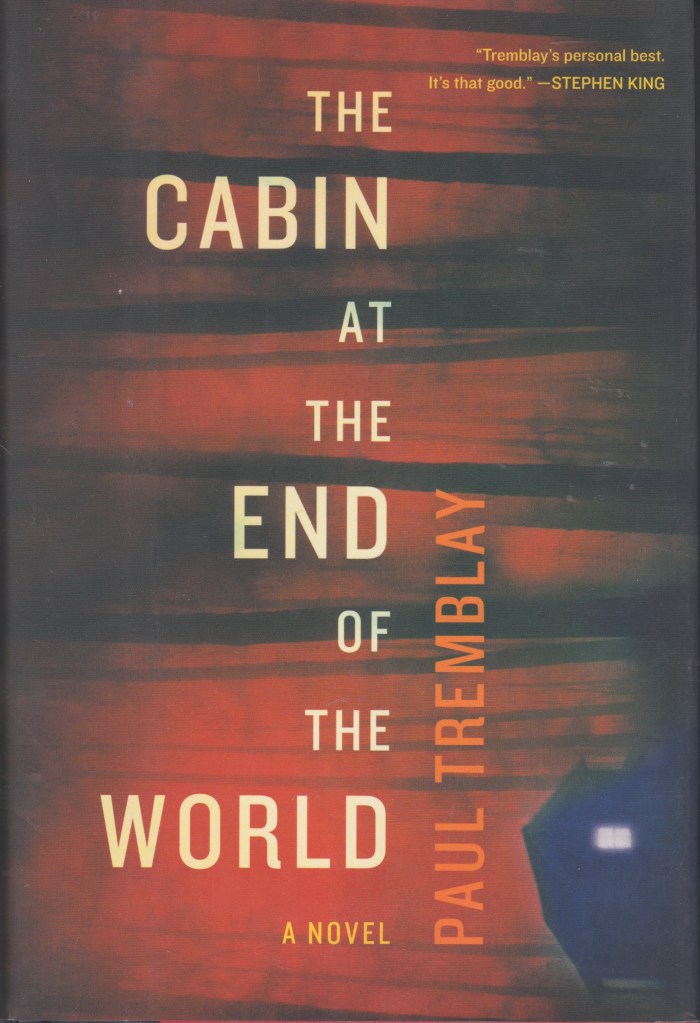
After finishing The Coyotes of Carthage, I was looking through the TBR piles, pulled out a book or two before putting them back, and then finally decided to read a second Tremblay, The Cabin at the End of the World.

It was a most excellent choice.

The girl with the dark hair walks down the wooden front stairs and lowers herself into the yellowing lagoon of ankle-high grass. A warm breeze ripples through the blades, leaves and crab-like petals of clover flowers. She studies the front yard, watching for the twitchy, mechanical motion and frantic jumps of grasshoppers. The glass jar cradled against her chest smells faintly of grape jelly and is sticky on the inside. She unscrews the aerated lid.

Wen promised Daddy Andrew she would release the grasshoppers before they got cooked inside the homemade terrarium. The grasshoppes will be okay because she’ll make sure to keep the jar out of direct sunlight. She worries, though,, that they could hurt themselves by jumping into the sharp edges of the lid’s punched-in holes. She’ll catch smaller grasshoppers, ones that don’t jump as high or as powerfully, and because of their compact size there will be more leg-stretching room inside the jar. She will talk to the grasshoppers in a low, soothing voice, and hopefully they will be less likely to panic and mash themselves against the dangerous metal stalactites. Satisfied with her updated plan, she pulls up a fistful of grass, roots and all, leaving a pockmark in the front yard’s sea of green and yellow. She carefully deposits and arranges the grass in the jar, then wipes her hans on her gray Wonder Woman T-shirt.

Ironically, in my earlier paragraphs I talked about writing crime because I want my monsters to be human; ironically, the monsters in Paul Tremblay’s latest, sublime entry into the horror genre could easily be considered a crime thriller as well because his monsters are all too human, and this set-up is just as terrifying as any supernatural horror novel I’ve ever read. Being out in the country has never really appealed to me very much (ironically, my current work-in-progress is set out in the country) precisely because it’s no safer out in the country than it is in the city; at least in the city someone will hear your screams or cries for help. The very isolation of the country is part of its terror for me; in no less part because country people always smugly assert (and reassure themselves) that crime and murder are MUCH more likely to happen in the big, bad, dangerous city.

Sidebar: I still think there’s a terrific essay to be written about the proliferation of rural horror/crime novels in the 1970’s, directly tied to the inherent racism of white flight from integrated schools and neighborhoods to the suburbs and the country, and perhaps someday I will have the confidence to write the essay based on that abstract theme.

Tremblay has set his terrifying tale in a small cabin on a lake in upstate New Hampshire, close to the Canadian border, where our heroes–a married gay couple (Andrew and Eric) are spending a ‘back-to-nature’ vacation with their adopted child, Wen. The story is told in the present tense (always creepier in horror, seeing the action unfold as it happens rather than in the much safer past tense–it’s happening as opposed to it’s already happened) and the point of view shifts between the two dads and their young daughter. Wen is out on the lawn catching grasshoppers and naming them when a big man appears suddenly out of the woods, friendly and nice, he tries to win her over but ultimately fails, sending her running inside to warn her daddies that they are no longer alone in their rustic cabin–with no cell service and no wi-fi (which, ironically, was part of the cabin’s original appeal–to unplug; that appeal will righteously bite the in their ass now that a Dionysian influence has arrived in their idyllic world).

The big man, Leonard, isn’t alone; he has three friends with him, all wearing similar button-down shirts in different colors and jeans: Redmond, kind of an asshole every-straight-man; Sabrina, a nurse; and Adriane, who is older. As the three family members barricade themselves into the cabin, the four seemingly normal visitors let them know they are there to present them with a horrible, horrific choice: they have seen, in visions and dreams, that the apocalypse is nigh, but have been shown the cabin and the small family, and told that if one of them will voluntarily sacrifice himself, the end of the world will be stopped.

This is, of course, every parent’s worst nightmare: a threat to not only their family but to their child, and Tremblay does an amazing job of letting us, the readers, get to know all three of the family members, developing them into complicated, realistic characters with backstories and levels and layers; I also applaud him for writing about a same-sex family and making the characters absolutely real. (This is how you do it, people; read the book and take notes). Wen is completely believable as a little girl; the family bond and love is absolutely real; and that makes the horror even more horrible, more horrifying, more of a gut-punch…as we go through every step of the process with them, all over the course of less than twenty-four hours, as their lives are irrevocably altered and changed, as they refuse to believe the story of their visitors, but slowly but surely the wonder begins to creep in…what if this is absolutely real and they are indeed messengers from God?

I will leave it to the horror academics to discuss the symbols and symbolism threaded throughout the story–but I have to bring up the colors of the shirts the visitors are wearing, and the fact there are four of them: representing the four horsemen of the apocalypse along with their warnings of doom. The questions of faith, of existing as gay in a heterosexist society, of family and love–all of these are beautifully explored and written about, and the building of tension and suspense is unparalleled; it’s really hard to put the book down and walk away from the story without finding out how it all ends–will they make the sacrifice, or will the world end? Are the visitors right–and how will anyone ever know if they were, because the world not ending doesn’t prove anything if the sacrifice occurs.

Or are they just insane?

I highly recommend this book, and cannot wait to read more Tremblay.

Invisible String

Labor Day morning, and I feel rested. I’ve not felt this good in quite some time, frankly–I am sure ignoring my emails and staying away from social media over the course of the long weekend has something to do with that, indubitably–and now I am having my morning coffee and slowly coming alive. May as well enjoy it while I can, since tomorrow I have to get up unbearably early, but we only have one clinic day this week and it’s also a four-day work week, so maybe it won’t be so bad on my physically.

I worked on the book for a little while yesterday; not very much, not nearly as much writing as needed to be done over the long weekend–which is inevitably always the lament, is it not? But getting rest–both physical and mental–is also inevitably necessary and a necessity. I did manage to not only finish reading Little Fires Everywhere over the course of the weekend, but I also finished The Coyotes of Carthage (which will be getting its own entry eventually) and started reading Paul Tremblay’s The Cabin at the End of the World, which is not only extraordinary but nothing like I was expecting–and I was also going in blind, knowing nothing about the book other than I had read his earlier novel A Head Full of Ghosts and really enjoyed it. It features and centers, for example, a happily married gay couple and their adopted child; didn’t see or expect that coming. I’m about halfway through the book, and while I certainly don’t want to give anything away, I am already planning on spending some more time with it today. Reading is such an escape (always has been) and a pleasure for me my entire life; I never really understand what it’s like for people who don’t read, or who don’t like to read–its so outside of my own experience I’m not sure I could ever understand choosing not to read.

The work I did on the book yesterday, while not a lot, was also quite good work, and I am certain that the rising quality of this novel I am writing has everything to do with the high quality of what I am reading these days. I mean, between Matt Ruff, Celeste Ng, Steven Wright, and Paul Tremblay, one really cannot go wrong, can one? I’ve also come to understand that my deadlines–while arbitrarily set–are also set up to maximize time, and are also predicated on the idea that I can actually have the energy–both physical and creative–to do good work every day. I’m not sure that I can anymore–not sure that I ever could–but the mindset is the key, and I know after seeing clients for eight hours, I really don’t have the bandwidth to write anymore the way I used to; which inevitably, I am sure, has something to do with the malaise this current world in which we live has created. Malaise is probably not the right word; depression is probably closer to what I really mean–there’s this weird depressive thing going on in my subconscious that makes macro issues I would ordinarily blow off or ignore or brush off much more micro and much more draining on me.

So, what is a writer to do in these days? Self-care, as I have noted before, is more important than ever. I am going to use the massage roller this morning, and possibly do some stretching exercises as I get ready to face this day–I intend to write today; it’s been lovely dipping my toe into it most of the weekend but I really need to dive into the pool today–and I’d also like to get some more cleaning done at some point. There are electronic files to sort as well, and filing to be done; floors to be cleaned and laundry to fold; all the endless minutiae I always intend to keep up with as I go but inevitably push the back of the priority list and do nothing about until they reach a point like the one they are at now: a literal mess that requires more focused work than ordinarily they would. And while my energies are frequently scattered…I have found that the binge reading I’ve been doing has done a lot to create a sort of inner peace that I’ve been missing lately. I also think I’ve sort of been in mourning about the loss of football season–yes, I know they are going to try to have a season, but it’s not a real season and thus not the same thing; this will be the first year since 2010 that Paul and I have not gone to at least one game in Tiger Stadium–but at the same time, that has also freed up my weekends. My goal for this week is to read a short story a day, as well as a chapter or two per day of whatever book I am currently reading–I suspect I may finish the Tremblay today, it’s that good and that unputdownable–as well as to do some stretches every morning after I get up and before I take my shower. I think regimenting my days into a sort of routine–since I clearly love routines when I can manage to stick to them–is perhaps the smartest way to go.

We watched the new episode of The Vow last night, and it’s getting more and more chilling the deeper into the series we go; I’m glad it’s currently not binge-able, because watching one episode per week makes it more easily digestible. They are doing a most excellent job as well of showing how attractive NXIVM was; a lot of the things they talk about, when it comes to taking responsibility for yourself and changing your mentality and behavior to become more successful, sounds like practical advice you can apply to improve your life–but there’s certainly a dark side to the whole thing. Last night’s episode, which brought up the branding and master/slave “sorority” within the organization, was positively chilling.

We also started watching the new Ridley Scott series for HBO MAX, Raised by Wolves, which is extraordinary. We watched all three episodes that were made available immediately, and it’s quite an accomplishment; it looks very expensive, with no expense spared on production design and special effects. The story itself is also interesting, if a bit hard to understand to begin with; it’s set in 2145, and Earth has been ravaged to the point of becoming unlivable because of a religious war, between Mithraic religion (worship of the sun) and atheists. Since Earth was becoming uninhabitable, both sides launched space ships to another Earth-like planet to save humanity; and it gets a lot more complicated from there. It’s a very high-concept show, and I am curious to see how it all plays out going forward. If you’re a science fiction fan, I’d recommend it; I don’t know if people who generally don’t watch sci-fi would like it as much–I could be wrong. I would have never guessed, for example, that Game of Thrones would have become the cultural phenomenon that it was.

And I still haven’t decided what short stories to focus on writing, although I am leaning towards “After the Party”, “The Flagellants”, “Waking the Saints”, “Please Die Soon,” and “He Didn’t Kill Her.”

And on that note, tis back into the spice mines with me.

The Way I Feel About You

Well, my plans on how to stay calm during an LSU game most emphatically did not work yesterday.

I do, however, have a very clean apartment.

It was, on the whole, a most exciting game–if you’re an LSU fan, but it also had a lot of stressful moments, momentum swings, and tension. And yet, when the smoke cleared and the game clock ran down, LSU upset the second ranked team in the country and the national championship runners-up from last year decisively, 36-16. Hardly anyone gave LSU a chance, and even those who only made Georgia a seven-point favorite were doing so half-heartedly; as I watched the pre-game show it was so clear no one really thought LSU had a chance, or would even meet that seven-point margin; they were trying to hype up the ratings–if they said what they really believed, that Georgia was going to humiliate LSU–only die-hard fans would watch.

Which would have been a pity. LSU was dominant in retrospect–at the time it didn’t feel that way. We went up 3-0, stopped a fake field goal attempt on fourth down by the Bulldogs, and then drove down the field to go up 10-0. Two more field goals followed, along with some lights-out, tenacious defense, and the score at half-time was 16-0, LSU. Georgia had never trailed this season for more than fifteen seconds, and had not been held scoreless in a half in God knows how long. But it was really only a two-score game, and I was concerned about having to kick three field goals instead of touchdowns…then again, LSU had four scoring drives in the first half; it could have been 28-0. I worried those field goals might come back to haunt us in the second half. And I was wrong. LSU scored twenty more points in the second half to put the game away–although Georgia scored 16 points of their own–but the final score was 36-16, and the biggest win for LSU since the Alabama game in 2011; certainly one for the history books, and one that will go down in LSU lore as one of the great Death Valley wins.

Suddenly, after the Florida loss, with LSU looking slow and lackadaisical and almost mediocre, now LSU looks like a championship team who can compete with anyone. And while I don’t want to get my hopes up–Alabama looks completely unbeatable–how exciting would it be if we got to play Florida again for the SEC championship game? Florida has already lost to Kentucky; Georgia already has a conference loss with both Florida and Kentucky yet to play; all the contenders in the East have a loss already (Kentucky to Texas A&M; Georgia to LSU; Florida to Kentucky) so the stakes for the Florida-Georgia game are really, really high in two weeks.

Yes, it was a very exciting day around the Lost Apartment yesterday. GEAUX TIGERS!

I also watched another two episodes of The Haunting of Hill House, which is probably one of the best horror television shows I’ve seen in a while. I am quite frankly loving this television horror renaissance, which is producing such amazing programs. The Haunting of Hill House, of course, still can–and might–go off the rails, but so far it is terrifying, eerie, and mesmerizing; the call-backs to the original source material are enormously satisfying, and yet it could stand entirely on its own with a different title; it’s almost like a revisitation of the Lutz family twenty or so years after the original story of The Amityville Horror–how do you experience something supernatural and terrifying, particularly if you’re not really sure what it was you were experiencing, and deal with that trauma for the rest of your life? The Crain children, now adults, have dealt with this in varying ways, but they are definitely all suffering from PTSD and trauma. The first four episodes told the same story from different points of view of the adult Crains, their present reality juxtaposed with their memories of their stay at Hill House. All the characters are compelling, well-written and defined, and the acting is absolutely stellar. I said in a previous entry it’s reminiscent of the best of Stephen King’s It and Paul Tremblay’s A Head Full of Ghosts; I am also going to throw in the first season of the television adaptation of The Exorcist as well–an excellent show that only lasted two seasons but I wish it could have gone on for longer. This is some excellent story-telling, and it is astonishing how true to the mood of the novel this show is.

I won’t deny it–at first I thought, when I heard of this and how it was going to be done, I rolled my eyes. You can’t do this better than Shirley Jackson, I thought dismissively, remembering the horrible 1999 film version (the original film version, in black and white, directed by Robert Wise and starring Julie Harris–who should have at least gotten an Oscar nomination–was superb and terrifying). But I was absolutely, positively, completely wrong. The show is amazing and fantastic, and I can’t wait to watch more; I might even do so today before getting started on writing–since there’s no Saints game today, and of course being sick last week put me desperately behind.

I also read some more in Empire of Sin yesterday–Storyville is now up and operational. I’ve always avoided reading about Storyville, or even considering writing about it; for me, I was thinking it was almost cliche to do so. David Fulmer has already done a series set in that time–Chasing the Devil’s Tail, Jass, Rampart Street, Lost River–with his detective, Valentin St. Cyr; he also had a story in New Orleans Noir, and since he has done so well with the period and the area I didn’t really see any need to cover that same ground. But now….now I am thinking I could, and differently. “The Blues Before Dawn” might actually turn into a novel rather than a short story, and it’s a great title, if I do say so myself. But once I get this revision under control, I’ll have some more time to play around with the story and see where it goes.

I’m particularly interested in Tom Anderson, the unofficial mayor of Storyville.

I’m also thinking I should watch Pretty Baby again; it’s been decades.

And on that note, I think I am going to take my coffee into the living room, ensconce myself in my easy chair, and watch the next episode of The Haunting of Hill House preparatory to heading into the spice mines.

Have a lovely Sunday, everyone.

IMG_4250

One

GEAUX TIGERS!

Yes, second ranked Georgia rolls into Tiger Stadium today to take on the twelfth-ranked Tigers, reeling from the first loss last week at Florida. I’m trying not to get to invested in the stakes of the game; I just want the Tigers to play better than they did last week and be competitive. I want them to win, I will be rooting them on–but I will also likely be cleaning and keeping myself occupied to handle the nerves.

Sigh.

I slept in this morning–I did wake up around seven, but chose to stay in bed for another hour, before finally getting up and getting a load of laundry started. I feel extremely well-rested this morning; which is absolutely lovely. I have a lot of cleaning and organizing to do today in order to clear my plate so tomorrow can be all about writing and editing and reading. I am greatly enjoying Empire of Sin; it’s giving me all kinds of ideas about stories to write and maybe even a novel or two…I’ll probably read Herbert Asbury’s The French Quarter next.

Lisa Morton once suggested that I do a New Orleans version of her book Monsters of LA. I am thinking that might just be something I can do, now that I’m reading all this New Orleans history.

I also started streaming the Netflix series The Haunting of Hill House last night; I got through the first two episodes, which I greatly enjoyed. I was tempted to watch  yet a third but stopped myself as it was getting late. There’s been, since the trailers for the show dropped, a lot of anger and disgust from Shirley Jackson fans as well as horror fans, since obviously the show was going to be different from the novel, and why does this even need to be? Well, I am a huge fan of both Jackson AND this particular novel; one of my proudest moments was when Night Shadows was a Shirley Jackson Award finalist. (I love the rock I got for being a finalist.) The show is good. It didn’t have to be Hill House; it didn’t have to be The Haunting of Hill House, but that’s what it is, and it is inevitable, as such, that it’s going to be compared to the original. Jackson’s structure is there; Hill House, the Crain family, the Dudleys; even some of the things that happen in the book happen in the show. It’s being told in a parallel structure; when the Crains moved into Hill House, a young couple with five children, ostensibly to renovate the house and flip it. Something horrible happened while they lived there, and the parallel story being told in modern times is about the Crains today; all five of the kids grown up into severely damaged adults. The children are Steve, Shirley, Theo, Nell, and Luke–the names of the characters from the novels plus the novelist’s name–and the parallel story structure works. The performances are good, and I also like the concept–it’s very Stephen King’s It, because clearly they are all going to have to return to Hill House and face not only the house but their own demons. As I watched and began to understand the story structure, I also thought to myself, ah, this is a great direction modern horror is going in; not only dealing with the paranormal elements but the also dealing with the psychological aspects of having dealt with something so traumatic as a child. It reminded me somewhat of Paul Tremblay’s novel A Head Full of Ghosts in that way. I am really looking forward to continuing to watch and see how it plays out. I don’t see how this can become a regular series…but then again Netflix turned Thirteen Reasons Why into a multi-season show and the second season just wasn’t very good.

I’m also still watching season three of The Man in the High Castle, which is sooooo good. The first season was terrific, the second kind of mess, but they’ve really hit their stride in Season 3.

And now, I have laundry to fold, dishes to put away, spice to mine.

Have a lovely lovely Saturday, everyone.

43223298_1950817528545814_2974190918912966656_n

That’s Enough for Me

A grim, rainy Monday outside the Lost Apartment, and I can hear the wind roaring around the upper level of the house. It is pouring here right now; the leaves are glistening with wet in the gloom–and am I ever glad I got the windows in the car fixed!

Yesterday was a lovely day; I got some work done, went to Costco, and managed to finish reading Paul Tremblay’s wonderful A Head Full of Ghosts.

“This must be so difficult for you, Meredith.”

Best-selling author Rachel Neville wears a perfect fall ensemble: dark blue hat to match her sensible knee-length skirt and a beige wool jacket with buttons as large as kitten heads. She carefully attempts to keep to the uneven walkway. The slate stones have pitched up, their edges peeking out of the ground, and they wiggle under her feet like loose baby teeth. As a child I used to tie strings of red dental floss around a wiggly tooth and leave the floss dangling there for days and days until the tooth feel out on its own. Marjorie would call me a tease and chase me around the house trying to pull the wax string, and I would scream and cry because it was fun and because I was afraid if I let her pull one tooth she wouldn’t be able to help herself and she’d pull them all out.

How much has passed since we lived here? I’m only twenty-three but if anyone asks I tell them that I’m a quarter-century-minus-two years old. I like watching people struggle with the math in their heads.

Earlier this year, the book won the Bram Stoker Award for Best Novel, and as I have mentioned previously, I’d started it before and got distracted and for some reason hadn’t finished it. I picked it up again last week and started at the beginning again, and this time read it all the way through. It’s an interesting book–well-written, certainly, and I also thought it was interesting the way Tremblay chose to deal with its subject matter: is Marjorie Barrett a mentally ill teenager, or is she possessed by a demon? Complicating matters is that her father is descending into religious mania, while her mother is quite rational and skeptical; and while all of this is going on the family, in need of money, has agreed to have it all filmed as a reality show, The Possession.

The point of view character is the younger daughter, Merry (Meredith), who is remembering it all as it happened in two ways; she is remembering it for the afore-mentioned novelist, who is writing a non-fiction book about what happened to the Barretts, and Merry herself is writing a blog about the television show AND the case under a pseudonym for Fangoria.

It’s an interesting book, and it reminded me a lot of Shirley Jackson’s We Have Always Lived in the Castle in the voice; an emotionally arrested young woman telling the story in a child-like way about what happened when she was a child, and does she have an adult voice?

I’d read somewhere recently about how horror novels and films are often attacked by religious groups when the books themselves actually are quite affirmative of religion; I’ve always thought that to be true–Anne Rice’s vampire novels are actually very much about affirming Catholicism; and doesn’t almost every vampire novel, really, confirm that the symbolism necessary to defeat or keep vampires at bay those of Roman Catholicism? (Particularly interesting in that in Dracula, a Transylvanian would have been Greek Orthodox not Roman Catholic.) I don’t know enough about the genre to write knowledgeably about this, but it is definitely interesting.

And now back to the spice mines.