On my way home from Kentucky over the weekend, I started listening to Carol Goodman’s marvelous The Seduction of Water. The book was too long, however, for me to finish before I pulled up in front of the Lost Apartment Saturday night; I have been known to stay in the car for another fifteen to twenty minutes to finish an audiobook, but when I checked with this one, I still have over an hour left to go. There was no way I was going to sit in the car for another hour with the apartment merely a dozen or so yards away from me, so I unplugged the phone and started unloading the car, figuring I could listen to it on Sunday while doing things. I was exhausted and had too many other things to do that day, so I put it off until the morning of the 4th, when I finished listening while doing laundry and cleaning the kitchen.
And what a marvelous tale it is, indeed.
My favorite story when I was small, the one I begged for night after night, was “The Selkie.”
“That old story,: my mother would say. She’d say it in the exact tone of voice as when my father complimented her dress, Oh, this old thing, she’d say, her pale green eyes giving away her pleasure. “Wouldn’t you rather something new?” And she’d hold up a shiny book my aunt Sophie, my father’s sister, had bought for me. The Bobbsey Twins or, when I was older, Nancy Drew. American stories with an improving message and plucky, intrepid heroines.
“No, I want your story,” I would say. It was her story because she knew it by heart, had heard it from her mother, who had heard it from hers…a line of mothers and daughters that I imagined like the images I had seen when I stood by her side in front of the mirrors in the lobby.
“Well, if it will help you sleep…”
And I would nod, burrowing deeper into the blankets. It was one of the few requests I stuck to, perhaps because my mother’s initial hesitation came to be part of the ritual–part of the telling. A game we played because I knew she liked that I wanted her story, not some store-bought one. Even when she was dressed to go out and she had only come up to say a quick good night she would sit down on the edge of my bed and shrug her coat off her shoulders so that its black fur collar settled down around her waist and I would nestle into its dark, perfumed plush, and she, getting reading to tell her story, would touch the long strands of pearls at her neck, the beads making a soft clicking sound, and close her eyes. I imagined that she closed her eyes because the story was somewhere inside her, on an invisible scroll unfurling behind her eyelids from which she read night after night, every word the same as the night before.
“In a time before the rivers were drowned by the sea, in a land between the sun and the moon…”
I’ve always loved the selkie story, myself, and what a marvelous opening this was for the novel!
Our main heroine, Iris Greenfeder, is an ABD (all but dissertation) trying to patch together a living from being an adjunct writing teacher at several different schools. This particular semester, as the book opens, she is also teaching a writing class at Rip Van Winkle Prison. Iris’ mother was a sort of successful fantasy writer who was killed in a fire before she could either write or complete writing the final volume of her trilogy. Iris’ father manages the Hotel Equinox in the Catskills, a luxury resort hotel with stunning views of the Hudson River Valley. Her mother was killed when she was about eleven, and was checked into the dive hotel as “Mr. and Mrs. John McGlynn”–but only her body was found. Was it an affair? Was it something else? This mystery hangs over Iris’ life when the book opens, and her own writing career gets a boost when she sells a story to Caffeine magazine, whose editor kind of pulls Iris back into the orbit of the Equinox Hotel. She lands a top agent who also has more than a passing interest in Iris’ history, and her mother.
She isn’t there long when she realizes that many mysteries shroud not only her own past, but the hotel as well. As she starts trying to figure out her mother–no one believes she was having an affair, despite the police conclusion–and what happened all those years ago, she finds that her mother was also involved in a crime involving some of her friend–the McGlynn, one of whom went to prison and her friend, his sister, threw herself in front of a train after visiting her brother. He was in jail for robbing a hotel, but did he actually do it, or was he framed? Did Iris’ mother know the truth? Slowly but surely Iris starts following the clues and trying to figure out what the truth about her mother was–and there are also people who are looking for that final manuscript of her trilogy. Why? Who cares about an old unpublished manuscript? Iris also is in a long term relationship with an artist that isn’t really giving her what she needs, either–but can she trust the younger, sexy ex-con from her class at the jail that she hires at the Equinox?
This book is classic Goodman; erudite and literary, with ties to writers and the publishing world and legends and fairy tales, all woven together in an enthralling mystery that is very hard to put down.
Well, yesterday felt normal–as opposed to all the energy and the fabulous mood I was in on Monday, yesterday I felt more like the way I usually do on a midweek morning coming into the office. It was busy and we did have some odd and unusual issues, like we did on Monday, but it all worked out and I managed to get everything done and get out on time. I wasn’ tired when I got home, but there were men working on the house on our side of the building until about eight o’clock, playing (bizarre) music (choices) really loudly and of course, hammering and drilling and all those other power tool-esque things construction workers use. I’d intended to get some things done, but this successfully irritated me enough to make me lethargic. Then Scooter climbed into my lap and started purring and head-butting me and that was all it took; I was down for the evening. I did manage, however, to do a load of dishes so the evening wasn’t a complete waste. I feel more awake and alert and energetic this morning than I did yesterday, so that’s a step in the right direction, I think. Tomorrow I’ll be working from home, and trying to get caught up on the data entry and quality assurance stuff, as well as doing some yearly, on-line trainings about safety that are due (biohazard, fire prevention, HIPAA, etc.) so I’ll have a pretty full plate tomorrow, which is cool. I hope to spend some time with Megan Abbott’s Beware the Woman this weekend, and I also would like to get some more entries finished–I have a review of Carol Goodman’s marvelous The Seduction of Water to post, and I have more entries about my own books to write. and on and on and on.
We watched more of Red Rose on Netflix last night, and we’re really enjoying it. It’s a horror series about a deadly app teens have on their phones; it’s an interesting modern take on the horror trope of the haunted device, and a very clever use of cell phone technology to base a horror series on. We’ll probably finish it over the course of the weekend, we’re about halfway through with four more episodes to go.
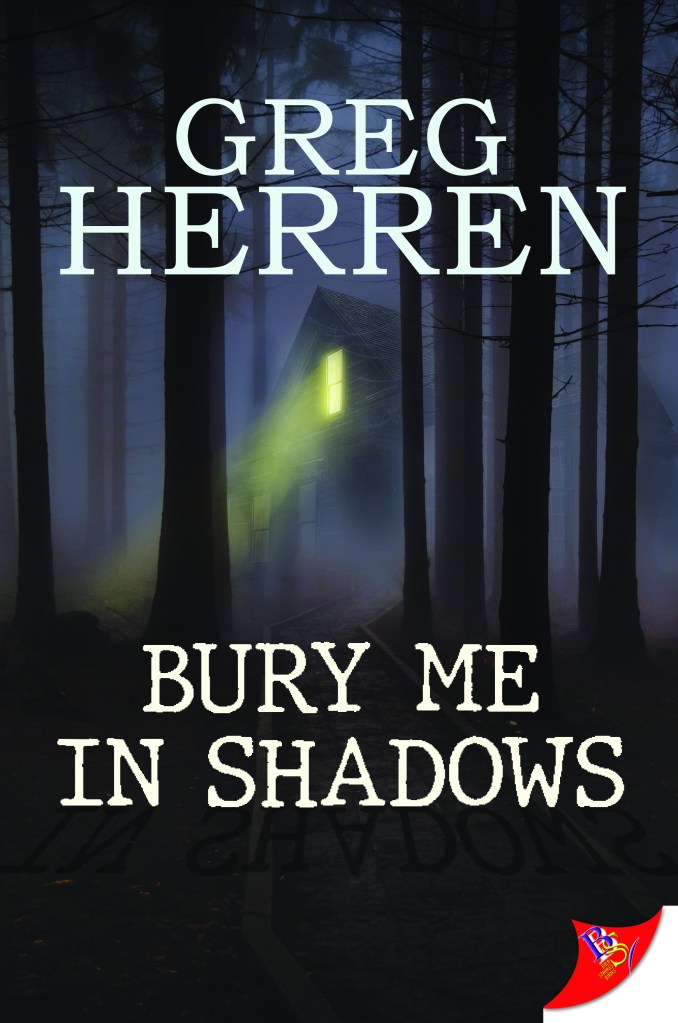
I’m also getting better at figuring out where I am at in my life and getting a grasp on everything I am doing and what needs to be done going forward. I want to spend the rest of this month trying to get one of my in-progress manuscripts finished, or at the very least, a first draft finished. I also am going to start trying to pull together another short story collection, and I want to get these novellas finished and out of the way, too. I am also aware that is a far too ambitious plan for me; there’s no way I’d be able to get all that writing done in twenty-five days. I also have another Alabama book swirling around inside of my head; I keep thinking Beau Hackworth, Jake’s boyfriend in Bury Me in Shadows, deserves his own story and would be the best place for me to continue on with Corinth County tales; I have others in progress (two novellas, in fact, “Fireflies” and “A Holler Full of Kudzu”) and numerous short stories. I have one actually coming out in an anthology this fall, predicated around breaking the Father Brown rules for a mystery story–mine was “include a supernatural element,” natch–called “The Ditch” that I’m rather pleased with. I want to revise my old story “Whim of the Wind” again, too, because I think I’ve finally unlocked the key to solving the problem in the story (with a grateful not to Art Taylor, whose story “The Boy Detective and the Summer of 74”) but have never gotten around to actually, you know, making the changes to the story.
That story, “Whim of the Wind,” is uniquely special to me. After being told by my first creative writing professor that I would never be a published author and to “find another dream” sent me into a tailspin that resulted in my flunking out of college and putting off seriously pursuing writing as a vocation for over a decade (there were flashes of time when I’d put some effort into it, writing stories and so forth before giving it all up as pointless and impossible for me) I took creative writing again when I went to a junior college in California in an attempt to get my GPA up enough to allow me to re-enroll in the California State University system. We were allowed to take that class twice, so I took it in both fall and spring semesters. The first semester my stories were derivative and trying too hard, but the teacher was very encouraging, which I wasn’t used to, so I decided to take it again in the spring–he urged me to do so. One day in class we were talking about stories and structures and writing, and I just had this idea pop into my head and I started writing in my notebook. All throughout the rest of the class I kept writing, and I finished it when I got home that night. That story was “Whim of the Wind,” and not only did the teacher love it (he wrote on the first page, excellent, you should send this out which was a huge thrill for me. The class also loved it and didn’t critique it very much–there wasn’t anything negative anyone had to say about it. But the story was flawed; there was a strong flaw in its premise which inevitably always got the story kicked back from anywhere I may have submitted it; editors would even admit they loved the story but it was missing something–but no one has ever been able to tell me what the story needed…and please remember, what I turned in was a first draft, I’ve never rewritten the story because I didn’t know how–and it’s really one of those “kill your darlings” examples; I can’t change the opening paragraph because it’s poetic and beautifully written and…I can’t bring myself to make any changes to that, and I suspect that’s really what it needs. Maybe I’ll take another look at it this weekend.
I’ve also been going through my journals looking for things–ideas, story fragments, etc.–that I’ve forgotten about, and I must say there’s quite a lot of that. I’ve even started writing short stories in my journal that I never finished and they are just sitting there, minding their own business and waiting for me to remember them so I can finish them. It’s also interesting seeing what I write in those things, too–sometimes I just free-write, which is open it, take a pen and just start scribbling whatever pops into my head, which makes for a kind of interesting (to me) look at how my brain operates when free associating…I am sure some future psychoanalyst (or even current, for that matter) would look and see a need for medication if not multiple psychoses. I also free associate write when I am playing with ideas for stories or novels in progress, so that’s always interesting to see again later.
And on that note, I am heading into the spice mines. Have a lovely Thursday, Constant Reader, and I will be back with you later.
Well, it’s the fifth and it’s back to the office with me this morning. It’s also Pay-the-Bills Day, woo-hoo! An oddly weird work week, the aftermath of a trip, and that weird stage of being beyond writing, if that makes any sense. I do have proofs to correct and other edits to come on something else, but I am not writing anything at the moment. I have some ideas I am toying with–a New Orleans ghost story, an Alabama book, among others–but for the moment I am just re-acclimated to myself and my world. I took yesterday off for the most part, and it was nice. I slept well again and felt good all day. I made holiday waffles for Paul, and I ate the Subway sandwich he’d purchased for me on Monday, I did some chores this morning while listening to the end of Carol Goodman’s marvelous The Seduction of Water (more on that later), and then Paul was up. I had thought about doing some work, getting started on the proofs or something, but once he was up I thought, we haven’t both had an entire day to ourselves in a long time so therefore, everything else could wait for another day.
We binged through a Paramount Plus show called School Spirits, which essentially is about a high school girl who is murdered, and her soul is trapped at the school with the spirits of other students throughout the school’s history who died there and cannot move on. She doesn’t remember how she was murdered or who had done it; there were gaps, and the other ghosts estimate that perhaps once she remembers everything she can then move on. It was cute enough, and entertaining enough, with some interesting twists here and there that it held our interest, and we watched all the way through until the season finale. We then moved on to the first two episodes of a horror series on Netflix, Red Rose, which was interesting and intriguing enough for us to continue, and decide to continue until we finish it. It was, all in all, a lovely relaxing day, and I am glad of it.
I also reread Daphne du Maurier’s “The Birds” yesterday. It’s really quite a wonderful and creepily intimate little story. I think it’s creepier and scarier than the film Hitchcock made of it–although the film is terrifying in an entirely different way. The story is very intimate and small–it focuses on a farmer trying to protect his family from the sudden turning of the birds, and how they have to fortify themselves in their house during the attacks, which in the story have to do with high tide. It’s really quite something, but du Maurier was such a master. I may write more about it later; the jury is still out on that.
I slept deeply and well last night, but didn’t wake up earlier than the alarm this morning nor am I awake and alive and ready to spring into action at work the way I was Monday morning. I don’t feel tired, I just don’t feel like I am fully awake just yet, which of course is fine. I do not regret taking yesterday off for myself; I am trying to not make myself crazy with that sort of thing anymore. No one can work at full capacity every day, after all, and there’s nothing wrong with me taking some time for myself and time off from everything every once in a while, to stop from going completely insane or at least wearing myself out. It’s much easier to take care of yourself, and I am trying to pay attention to my health on all fronts, including getting rest and not allowing my brain to get burned out. I think protecting my mental health, particularly since having the long COVID last year, is much more important now than it has ever been before in my life. I may not do a lot of thinking or writing this week, but there’s only two in-office days this week and a work-at-home Friday in my future, so maybe waiting until this weekend to do any of that sort of thing is perhaps for the best. I do want to start reading my new Megan Abbott novel; perhaps when I get home from work today I can use my writing time for reading.
Plus I need to figure out what I want to do next and come up with a plan of some sort for the next few years.
And on that note, I am heading into the spice mines. Have a lovely Wednesday, Constant Reader, and I will check in with you tomorrow, if not later.
I was born in Alabama but didn’t grow up there. I was two years old when my parents migrated north in search of work, good jobs, and a better life for our family. My parents, however, were very Southern, so I was raised with their values and beliefs (which were very Southern and of their time) but being confronted with very different values and beliefs at school every day opened up my mind in ways that it may not have been had I grown up in Alabama. Our neighborhood in Chicago, near Lawndale Park (our nearest major cross street was 31st and Pulaski), was the perfect representation of America’s vaunted ‘melting pot’; our neighborhood was filled with first or second generation European immigrants; many from eastern Europe, who fled either before or after the war. There were Czechs, Poles, Austrians, Hungarians, and Serbs; in the fourth grade we even had a Muslim girl from Yugoslavia. She had the most delightful first name which I’ve never forgotten–Zlatiça–even as her last name is lost in the clouds of memory. It was also very confusing trying to figure out where the immigrant kids (either they were born in another country or their parents/grandparents were) came from, given that the maps of Europe had been redrawn barely twenty years earlier. The Czech children I knew didn’t identify as Czech but rather as Bohemian; they also called their language that. It took years of study and reading up on history to realizing Bohemia became Czech after the first world war; for many years I believed Bohemia still existed under that name but had somehow been folded into another country or something; I don’t remember. I do remember being confused. Until I finally wrapped my mind around the post WWI renaming of the region, I always just assumed Bohemia was a German region. Reading history didn’t help much in that regard, as Bohemia was part of the Holy Roman Empire for centuries (in fact, the Thirty Years’ War kicked off in Bohemia).
But there was a lot of racism in our neighborhood too; the white European immigrants detested the brown immigrants from Mexico and Central America; I vividly remember the way our babysitter would sneer the word Mexican when referencing anyone brown. There was also a lot of strife in Central America at that time; I think both Guatemala and Nicaragua were enduring civil wars of some sort, hence the influx of Central American refugees and immigrants. I remember Martha, a girl in the sixth grade, telling me about how soldiers came and shot up her village, killing dozens of people she knew and members of her family. She was very calm and unemotional as she told me about it, which is pretty remarkable for a child who couldn’t have been more than ten or eleven, talking about a trauma she witnessed when she was six or seven. (Now I know she was dissociating; and I do remember her telling me calmly that she felt like she wasn’t even there as it happened; like she was watching it all happen from a distance.) Ironically, we became friends because we exchanged Nancy Drew or Hardy Boys mysteries; this conversation came about because we were reading a Hardy Boys book set in Central America; I want to say Footprints Under the Window, but it may have been something else….but she wanted me to know that the depiction of Central America in the book was nothing like the reality.
My grandmother used to tell me wonderful stories when I was a kid about my family history and the history of the county we’re from in Alabama. As a wide-eyed innocent and naïve child, I believed everything she told me, and always wanted to fictionalize those stories. I was in my early twenties when I wrote a short story based on one of those tales; about the Lost Boys and the evil renegade Yankee soldier who burned the house down and presumably murdered the two boys of the house. The story was called “Ruins,” and while I was pleased with the story I felt the story was too short; there was more to the story than I could fit given the length restrictions. I always thought of the story as a kind of an abstract or lengthy synopsis of the novel I would write someday. But it was also a Civil War story, and I wasn’t sure how I could write a Civil War ghost story without being, frankly, offensive. I tucked it away in a drawer and would think about it from time to time–usually when driving through Alabama on my way north–but still couldn’t wrap my mind around it. I worried and fretted and feared and doubted myself constantly. I told the story once to another writer friend of mine, and she urged me to write it…in fact, she hounded me about it for about twelve or thirteen years before I decided to take a deep breath, put on my big boy pants, and take that risk.
“Was this an accident, or did you do it on purpose?”
I opened my eyes to see my mother standing at the foot of my hospital bed, her heart-shaped face unreadable as always. The strap of her Louis Vuitton limited edition purse was hooked into the crook of her left arm. Her right hand was fidgeting, meaning she was craving one of the rare cigarettes she allowed herself from time to time. Her dove gray skirt suit, complete with matching jacket over a coral silk blouse, looked more rumpled than usual. Her shoulder length bob, recently touched up as there were no discernible gray roots in her rigid part, was also a bit disheveled. She wasn’t tall, just a few inches over five feet, and always wore low heels, because she preferred being underestimated. Regular yoga and Pilates classes kept her figure slim. She never wore a lot of make-up, just highlights here and there to make her cheekbones seem more prominent or to make her eyes pop. Looking at her, one who didn’t know better would never guess she was one of the top criminal attorneys in the country or that her criminal law classes at the University of Chicago were in high demand.
I could tell she was unnerved because she’d allowed her Alabama accent to creep slightly back into her speech. She’d worked long and hard to rid herself of that accent when she was in law school, because she said no one took her seriously when she spoke or else thought she was stupid once they’d heard it. The only times she used it now was when she wanted someone to feel superior to her, or she’d been drinking, or she was upset.
It worked like a charm getting her out of speeding tickets.
I hadn’t been asleep, nor had I been awake either, hovering in that weird in-between state where it seemed like I’d been living for the last three or four days.
“It wasn’t on purpose.” I managed to croak the words out. My throat was still raw and sore from having my stomach pumped. My lips were dry and chapped, and my eyes still burned from the aftermath of the insane drug-and-alcohol binge I’d gone on in the aftermath of the break-up with fucking Tradd Chisholm. “It was an accident.” I shifted in the hospital bed, trying to sit up more, the IV swinging wildly. The memory of that last and final fight with Tradd flashed through my head.
The main character in the original short story was only twelve, and the cousin he shares the adventure with was supposed to be fourteen. I was writing a lot of short stories at the time set in Alabama, with the idea to tie them all together in some ways–and was also reading a lot of Faulkner at the time, so yeah, a fictional county in Alabama where all the stories were set and were interconnected was kind of derivative; I kind of smirk to myself now when I think about the hubris of aspiring to be Faulkner-esque, especially at that time, when everything I wrote was pretty much garbage. Ah, the hubris of youth. But I did write a lot of “Corinth County” short stories back in the day, and while the writing may have been atrocious, the idea behind them and the core themes were good and had potential.
When I started thinking about turning the short story into a novel, I soon realized that the characters were too young, so I aged them. I originally aged them to teenagers, and in the first attempt at a rough first draft, I got about two chapters in with my main character, Jake, being banished the summer before his senior year to help take care of his dying grandmother back in rural Corinth County. The original first line was something like The summer before my senior year my mother ruined my life. Properly self-absorbed, narcissistic, everything’s about me teenager, right? My original thought was he was a student at a Catholic all boys’ school, was openly gay, and had a crush on a classmate…and having just found out said classmate had gotten a summer job lifeguarding, managed to get himself and his female best friend jobs at the concession stand at the pool, so he could be around his crush and see him all the time. His banishment for the summer had to do with his lawyer mother accepting a co-counsel role in a major trial in California and being gone; she has also kicked out her fourth husband (a much younger tennis pro) and so she can’t leave him alone in Chicago for the summer. The other option was staying with his father and his second family in the suburbs, which was equally unappealing, so he choses Alabama…and is picked up at the airport in Birmingham by another teenager who’d been taken in by Jake’s grandmother when his own mother died. This character, Kelly Donovan, was originally meant to become close with Jake and participate in all the mysteries Jake encounters at his grandmother’s. I also wanted to play with Jake’s being strongly attracted to Kelly, who is some kind of distant cousin, and straight.
But I scrapped that beginning, too. Would a young senior in high school in rural Alabama, a star athlete, be so accepting and open to Jake’s sexuality? Probably not…and he would also be worried and nervous about his patron’s grandson coming to stay there. As I delved more deeply into Jake’s character and who he was, I started thinking it made more sense for him to be older. Why not have him be a student at Tulane, and living in New Orleans? But if he was living in New Orleans, what would make his mother exile him to rural Alabama for the summer? And the more I thought about Jake…the more I realized there was underlying trauma in his life. I didn’t want his mother to be homophobic, but her mother, the dying family matriarch? Yes, yes, that worked better. I made him a loner, but someone who didn’t want to be a loner. He didn’t ever feel like he had friends at his Catholic school; and coming to Tulane he met his first, real boyfriend…which ended up being a disaster. And then realized, what if he goes on a binge–easy enough to do in New Orleans–after a bad break-up and winds up in the hospital? And if he had tried once before to kill himself…yes, yes, this is a MUCH better backstory and pulls the actual plot of the book together much better.
I also knew I wanted to touch on themes of homophobia in the rural South, as well as the horrors of modern-day Southern racism and the South’s racist past.
When I started doing research for the book, I soon learned that many of the old family/county stories my grandmother used to enthrall me with were all apocryphal; almost every region of the South has some version of the stories she told me; the story of the Lost Boys, a local legend which was the foundation of the book, pops up all over the old South–almost every state and every region of the old Confederacy has a version of the story, complete with renegade Union soldier (think Gone with the Wind), and so I decided to address that trope in the book while also using it. But I also added another layer to the story–the Lost Boys may not be the only ghosts at the old Blackwood place, which has a tragic and bloody and horrifying history, as does the entire county. I also started lessening Kelly’s importance to the story–he’s still there, he’s still a character who also gets a big reveal later in the book–but Kelly’s behavior to Jake is abominable and homophobic, establishing some conflict between the two of them as well. Part of this was because of the change in the story, but then I needed to partner-in-crime as well as potential love interest, so I came up with Beau Hackworth (the Hackworths are a large and poor family in the county; I’ve used that family before in stories; my main character in Dark Tide was a Hackworth from Corinth County).
And of course, when you’re writing about a Southern rural county and the Civil War, you cannot avoid the issues of race, prejudice, Jim Crow, and enslavement. I wanted to make it very clear that this wasn’t some “Lost Cause” romantic fantasy that perpetuates the lies and mythologies that sprang up in the South decades after the actual war ended. Jake’s mother raised him not to be racist or prejudiced, as she tells him several times, “We do not take pride in the fact our ancestors enslaved people. The heritage is hate, and don’t ever forget that.” I did wonder if I was being too generous to white people with this, but on the other hand I wasn’t interested in writing from the perspective of someone racist. I will be the first to admit that I worried about being offensive in this book; the last thing I would ever want to do is be insensitive on the subject of race. But I also knew and trusted my editor enough to know she wouldn’t let me get away with anything, and I also had to trust myself to handle it all sensitively. There were a couple of things she saw in the manuscript that could potentially be considered problematic–but they were also easily fixed.
I was very pleased with the end result, and I do think it is one of my best books. I was absolutely thrilled when it was nominated for two Anthony Awards last year at Bouchercon.
And it also goes to show that you cannot play it safe, and things that scare you are precisely the things you should write about .
(For the record, I will add Cheryl A. Head’s Time’s Undoing is one of the best crime novels ever written about racism in Alabama. Beautifully written and brilliantly told, it should really be required reading.)
Tuesday morning and I have the day off for the holiday blog. Huzzah! Although it’s going to seriously fuck with my head once I return to work tomorrow. I love these short work weeks, quite frankly; but at the same time they inevitably disorient me and make me uncertain of both day and date. But I will survive and get through this.
Yesterday was a bit of a revelation. I slept deeply and well Sunday night for the first time since leaving for the trip (I did manage one good night’s sleep in Kentucky, but that’s another story involving a massive thunderstorm, a loud weather alert alarm in the other part of the house and a brief power outage) with the end result that returning to the office for the first time in over a week wasn’t an unpleasant experience. There were some things I had to get caught up because they’d slid while I was gone (I take care of so many little things that are nevertheless important that my co-workers don’t even realize need to be done), and of course it was a lame duck workday–wedged between a weekend and a holiday–so the energy was weird and and we had a lot of unexpected problems to handle for clients, which we did handle with aplomb, but I felt off-balance all day and the time just flew; next thing I knew it was time to pack up and leave for the day–but I never got tired. I usually am groggy and partially out of it all morning, and hit a wall in the middle of the afternoon, but yesterday I felt just as energetic and relaxed as I did when I got to the office at seven thirty yesterday morning. I had to run over to Midcity to pick up my PrEP prescription, then swung over to Uptown to get the mail (a check! a check!), stopped at CVS to pick up some Claritin-D and my Xanax prescription before heading down to Tchoupitoulas to make some groceries at Rouse’s. I also bought too much perishable food, as it my wont; I want to make watermelon soup today (because it’s cool and refreshing) and chicken salad…and I also want to make a bowl of salad. I was thinking about making Shrimp Creole for dinner–but again, hot. I also bought hamburgers to cook out; I’ll probably go ahead and do that anyway at some point this afternoon or in the early evening. (Paul got me a turkey sandwich from Subway for dinner that I’ll need to eat at some point today.)
I slept really well again last night, too. Paul and I finished watching The Suspect, which was interesting and disturbing at the same time, and then moved on to this week’s Platonic (which is hilarious; you should be watching this show) and finally to Deadline with James D’arcy, which is quite interesting. I stayed up later than I usually do–almost midnight–because I never felt tired, and yet once I went to bed I went into a deep sleep that lasted until around six, and then I was able to sleep again until seven thirty. I feel good today, too; rested and energetic and peaceful, which is nice. I honestly feel better than I have in months, for two days in a row now, which is lovely and marvelous. (I also have cut back on my caffeine the last two days…which also may have something to do with it.)
So, what are my big plans for this holiday? I have some chores to do, as always, and of course I need to rearrange the refrigerator from the Costco run on Sunday (Paul helped put things away, which I appreciated but…I am like my mother in that while I appreciate the help, it always means I’ll have to redo it at some point….it’s really frightening how like my mother I am), and I want to finish listening to Carol Goodman’s marvelous The Seduction of Water, which I have about an hour left on (I can do it while folding laundry and reorganizing and cleaning this morning), and then I want to get started on Megan Abbott’s Beware the Woman. Also, one of my Alfred Hitchcock Presents volumes purchased on eBay opens with Daphne du Maurier’s superb story “The Birds” (yes, the story Hitchcock’s film was based upon) so I’ve been rereading that lately. Du Maurier was such a master; I’ll probably talk about the story more once I’ve finished rereading. At some point Paul will get up and we’ll probably watch some movies this afternoon. I’ve really only been in the mood lately for true crime documentaries or comedies (we watched Dirty Grandpa before I left for the north; wrong on so many levels and yet hilarious) lately, and much as I am enjoying the new Tom Holland series on Apple TV (The Crowded Room), it’s been much too heavy for me to watch lately. We may get caught up on it today, who knows?
I also have an out of nowhere unexpected offer to write another book, which is also lovely. But it will be from scratch, unless I can find something else to repurpose. I’ll spend some time brainstorming that today, too.
And on that note, I am heading into the spice mines. Have a lovely day, Constant Reader…I’ll probably be back later.
Happy Second Class Citizen Independence Day, Constant Reader!
I am so tired of being Cassandra on the walls of Troy, warning people of the impending doom from the consequences of their narcissistic privilege, only to be either ignored or patted on the head condescendingly and told I don’t understand or am being terribly overdramatic. Well, too many of you didn’t listen and here we are.
But I am not going to talk about the fraud perpetrated on this country recently by six illegitimate and corrupt justices on the Supreme Court. This is the date designated as the nation’s birthday, and it’s a day of celebration as well as contemplation.
Despite its flaws and faults; its checkered history and immoral lapses in policy; and the current turmoil of bigotry and hatred and divisiveness, I still love my country. Despite the slanders and slurs hurled against people like me, I am a citizen just like anyone else in this country. I pay taxes like everyone else. There is nothing in the Constitution prohibiting my existence or my life or my reality; yet religious zealots, over and over again throughout our history, keep trying to seize control of the government in order to legislate their version of morality, theoretically based in their religion. I was raised in that religion, read the Bible and went to worship and prayed and Sunday school and all of that–as a child and without my consent. I know the Bible. I’ve read it, many times. I’ve studied it, read religious philosophy and religious studies. I’ve studied and read up on the history of Western civilization, which is forever yoked to the history of the rise of Christianity. I know when doctrine was decided as legitimate and what was heresy; what texts were left out of the Christian Bible and why; as well as the relationship of the New Testament and law to the Old. I’ve read up on the basic messages of many religions, from Islam to Hinduism to what most would call “voodoo” to the mythologies of ancient civilizations. The conclusion that I came to, from my reading and studying and so forth, was that the modern religions I considered all have, at their core, the same fundamental principle: be kind, be helpful, have empathy and compassion for others, and most importantly, do not judge. Judgment is reserved for God, however you choose to see him, and He is very jealous of that privilege. None of us are perfect and we are all sinners–but our sins are between us and God and are none of your fucking business.
Winston Churchill once said about the United States, “You can always count on Americans to do the right thing–once they’ve exhausted every other possibility.” It’s true. In his farewell address George Washington warned of our nation being dragged into “the broils of Europe” (which would make a great title), and that was the cornerstone of our foreign policy for generations. American soldiers did not fight a war in Europe until the first World War–and even then we only came in during the third year of the conflict. Likewise, we stayed out of the second World War, as the world erupted into flames, until we ourselves we attacked two years into the war, and the European allies of Japan also declared war on us. We have been participating in the broils of Europe ever since.
Those are realities. But our entrance into each war changed its course, and enabled the Allies to emerge triumphant. Defeating the Nazis is something we can be proud of, even as we essentially had an apartheid system of our own at home. Defeating the Japanese and putting an end to their war crimes is something we can also take pride in–even though there was a very strong element of revenge to the war–but using nuclear weapons on civilians to bring a close to the war is still morally and ethically questionable. (The horrific racism against the Japanese during the war was also abominable, and that’s doesn’t even take into consideration the horror of the unconstitutional incarceration of thousands of Japanese-Americans, while also robbing them of their belongings and destroying their businesses.)
But the ideals on which this country was founded–freedoms essentially from the potential tyranny of the Federal government–are very high-minded and noble. We have not lived up to those ideals too many times, and the fact that people who are straight, white, and cisgender have always been given priority over everyone who doesn’t fit into that demographic isn’t something we should be proud of–our system is flawed because human beings are flawed. Loving your country doesn’t mean turning a blind eye to its faults and problems, and critiquing and discussing moral, legal and ethical failures in our history, in my mind, is further proof that you do love the country and want it to live up to its ideals of equality and justice for everyone regardless of any adjectives that can be placed in front of the word American. My country has disappointed me, never more so than recently with a renegade Supreme Court discarding precedent, accepted law, and essentially pissing on the very idea of equality while pursuing what can be best be called a completely unAmerican agenda to undermine the basic principles of justice and liberty for all. Patriotism doesn’t require blind obedience and loyalty; which is why the Founding Fathers tried very hard to protect dissent.
I seriously doubt Benjamin Franklin or John Adams would ever agree that corporations are people, entitled to all legal protections of the individual while also not being held accountable legally than the individual; therefore the “citizenship” of corporations is also higher class than that of the individual.
But how can you not love and admire and respect the ideals the country strives to achieve? We haven’t always lived up to those ideals; many times we have failed, horribly.
I have always believed that the arc of justice always bends towards justice, and that we as a country can and should always be looking for ways to make things better, pass legislation to correct flaws and defects in the system, and always keep a wary eye out for corruption. The Founding Fathers also could not conceive of anyone making a career out of politics, either, which is why they established no term limits, which was a huge mistake. We have a presidential term limit now, but none for either house of Congress or the Supreme Court, or any federal bench for that matter. That was a major flaw and oversight in the drafting of our remarkable Constitution, with the end result we have a corrupt system where our politicians are often up for sale, and aren’t even ashamed. How does someone middle class or from a poor background go into politics and retire wealthy?
But, like Churchill, I have faith that my fellow Americans will always, inevitably, do the right thing–once every other possibility is explored and exhausted.
May you have a fabulous fourth of July, Constant Reader. I’ll probably make several posts today; who knows?
Monday, and the 3rd of July. It is back to the office with me today, but of course tomorrow is a day off with pay so this week is going to be weird and off-kilter too. Yay? But this week I have page proofs to go over, errands to run, and a life to get back on track. I feel rather disoriented from being gone for an entire week for a change, which was weird. I did wind up feeling much better yesterday as the day progressed; we made a Costco run in the midst of that dreadful heat advisory (felt like 114) and I also did a lot of laundry. I emptied the dishwasher and reloaded; it isn’t full yet. I am going to try to stay efficient this week, and hope that efficiency–doing the dishes when I get home from work every night, keeping up with the laundry, putting things away rather than let them pile up–is maintained as we move sluggishly through the rest of this blazing hot summer.
We started watching a true crime documentary series last night called The Suspect, and got two episodes in (out of four total). The show is from CBC, and is about a murder and trial in St. John, Nova Scotia. It’s always interesting to watch these shows and see how the police and prosecution actually operate as opposed to the way they do in fiction. It’s actually kind of terrifying, really, and of course, it gave me an idea for a book to go with this great title I came up with in the car the other day.
I’ve also been thinking about my writing and what I want to do with it and where I want to go. I really am not in a place where I should be coming up with new concepts and structures and characters for a new novel when there are already so many in progress around here that I need to finish at some point, not to mention the short stories, too. Heavy heaving sigh.
But I slept so deeply and well last night. I woke up a few times, always afraid that’s the end of the sleep for the night, but I was literally out like the power after a hurricane. And I had no resistance to getting up to the alarm, either. I feel rested, which is wonderful. I wish I could figure out a way to get sleep like that while I am traveling, but I also think I over-caffeinate when I travel, too. I don’t nearly follow my necessary daily routines when I am traveling; I don’t drink nearly as much water and, like I previously said, over-caffeinate. This inevitably results in me becoming dehydrated, and when I am dehydrated I generally don’t get hungry, either, and I often wind up skipping meals and so forth, which means my blood sugar drops precipitously as well. In other words, I need to retrain what I do when I am traveling and/or on the road and take care of myself better than I usually do while away.
I feel terrific this morning and my mood has also significantly improved. I don’t think I’ve completely rehydrated yet, either; but I feel so much better today than I did yesterday that it’s almost like I’m an entirely new person. This is always lovely, frankly. There’s nothing like a good night’s sleep; I just wish I could unlock the secret to getting good rest every night, but no such luck.
We also watched Rock Hudson: All That Heaven Allowed, which was okay. If you’ve never read a biography of Hudson, or seen any previous documentaries about his life, there’s nothing much new here. I’ve learned a lot about Rock Hudson doing research for Chlorine–if you’re writing a novel about a closeted gay actor in the 1950’s, who better to read about than Rock?–so this documentary was nothing new for me. It was well done, and I liked that they interviewed his surviving gay exes or gay friends (for the record, I’ve also researched Tab Hunter–whom I met a few times–and Montgomery Clift, Anthony Perkins, and several others. I find that I really like doing research, to be honest. The whole time I was gone at Dad’s I was reading and learning more about Alabama history, which I think will make my future Alabama novels much better than they would have been, and also inspired more ideas for Alabama books.
And on that note, I am heading into the spice mines for the rest of the day. It’s been so long since I’ve been at work…anyway, have a great pre-holiday Monday, Constant Reader, and I’ll check in with you again later.
It really boggles my mind that it took me so long to get into listening to audiobooks. I think it was more of a sense that it didn’t count as reading if I wasn’t holding a book (or my iPad) in my hands and scanning the words with my eyes. I’ve never really liked being read to, either; and while I do enjoy live readings by authors of their work, those generally don’t last more than ten hours. I also worried that, as I do have ADHD and good writing always inspires me and floods my brain with ideas for new work for me or stuff that I am already working on (driving through Alabama, for whatever reason, always is inspiring to me), and it’s very easy to go back to where I was reading when inspiration hit. It’s not quite as easy to do this when you’re listening–I haven’t exactly mastered the rewind thing while driving at eighty miles per hour–so I am always afraid I’ve missed something. But…audiobooks in the car on long trips has literally changed my life and made the drives less irritating, boring and painful.
I have always had a taste for fiction that could be classified as Gothic; two of my favorite writers (Daphne du Maurier and Mary Stewart) were masters of the genre. I thought with the deaths or retirements of the major Gothic authors of the mid to late twentieth century that the style (or sub-genre, if you will) had fallen out of fashion (after it’s peak in the 1970’s and early 1980’s) and I missed them, terribly. What I hadn’t known was authors were still writing them, updating and reinvigorating the field…because the cover styles that always marked a Gothic novel (big spooky house, light in a window, creepy looking tree, woman in a flowing nightgown with long hair running from it and looking back over her shoulder in fear) were actually which became obsolete.
I am so glad I found Carol Goodman.
When I picture the house I see it in the late afternoon, the golden river light filling the windows and gilding the two-hundred-year old brick. That’s how we came upon it, Jess and I, at the end of a long day looking at houses we can’t afford.
“It’s the color of old money,” Jess said, his voice full of longing. He was standing in the weed-choked driveway, his fingers twined through the ornate loops of the rusted iron gate. “But I think it’s a little over our ‘price bracket.'”
I could hear the invisible quotes around the phrase, one the Realtor had used half a dozen times that day. Jess was always a wicked mimic and Katrine Vanderburgh, with her faux country quilted jacket and English rubber boots and bright yellow Suburban, was an easy target. All she needs is a hunting rifle to look like she strode out of Downton Abbey, he’d whispered in my ear when she came out of the realty office to greet us. You’d have to know Jess as well as I did to know it was himself he was mocking for dreaming of a mansion when it was clear we could barely afford a hovel.
It had seemed like a good idea. Go someplace new. Start over. Sell the (already second mortgaged) Brooklyn loft, pay back the (maxed-out) credit cards, and buy something cheap in the country. By country, Jess meant the Hudson Valley, where we’d both gone to college. and where Jess had begun his first novel. He’d developed the superstition over the last winter that if he returned to the site where the muses had first spoken to him he would finally be able to write his long-awaited second novel. ANd how much could houses up there cost? We both remembered the area as rustic: Jess because he’d seen it through the eyes of a Long Island kid and me because I’d grown up in the nearby village of Concord and couldn’t wait to get out and live in the city.
Isn’t that a great opening?
All of Goodman’s novels are unique, but tied together by that strong, literate authorial voice that makes starting to read (or listen) to a new one as comfortable as slipping into your house shoes; the word choices are marvelous, and the sentence/paragraph constructions are so intricate yet not impenetrable to the reader. Goodman’s novels usually have a central core that has to do with education and/or literature of some kind, and are inevitably set in either upstate New York and/or the Hudson Valley or the city itself; but there’s always a brooding, old building involved. The books are also smart and well-paced, and there is often a dual timeline involved, whether it alternates between past and present or does an entire time-jump to reveal the secrets and the truths bedeviling our heroine. Goodman’s heroines are likable, relatable, and understandable.
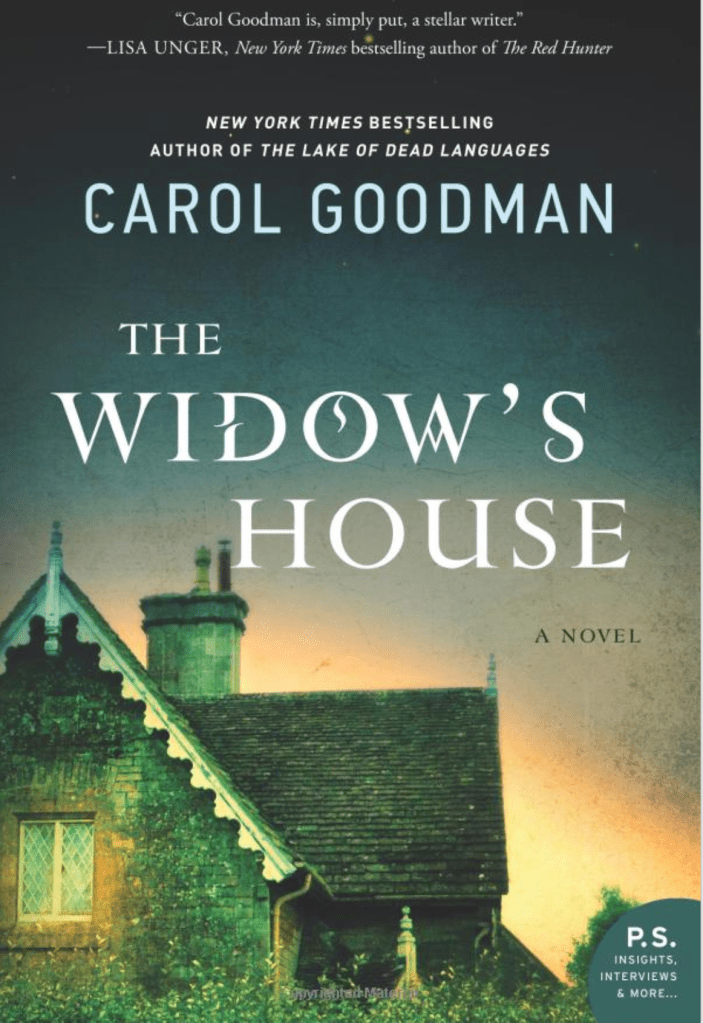
The Widow’s House focuses primarily on our main character, Clare Martin. Clare met her husband, Jess, in a creative writing seminar at a impressive university near Concord, where she grew up and she and Jess are currently looking for a house they cannot afford. Both were aspiring writers when they met; Jess wrote a debut novel that made a splash but is now ten years overdue on his second (aside: this always amazes me. I don’t think I’ve ever known a writer given an advance who then never delivered a manuscript for ten years or more without consequence, but this always pops up in novels about literary writers–Michael Chabon’s Wonder Boys comes to mind. Then again, most writers I know are genre writers and no crime writer could ever not deliver for ten years–I always feel horribly guilty when I miss a deadline and then it’s usually only an extra month that I need, not ten years. Maybe it’s different for those who write lit-ra-CHOOR) while Clare has buried her own authorial ambitions while working as an editor (and then a freelance one) to support Jess while he writes his book (I also would never let Paul go ten years without working while I couldn’t write so I could support him financially; I feel relatively confident the obverse is also true). The house their realtor is showing them at the opening of this book is called River House, but it’s also a site of many tragedies and deaths and madness, so much so that someone has taken a chisel and changed RIVER HOUSE on the gate column to RIVEN HOUSE. But the master of the crumbling old house is looking for caretakers to live on the property rent-free in exchange for upkeep work on the estate… but the master is the same writing professor in whose class they met–a professor Jess resents for trashing his debut novel in the New York Times, a review Jess is certain has kept him from breaking out as a major (best-selling) literary star. But the deal is too good to pass up, and Clare herself thinks moving there might help her restart her own writing…
Several of Goodman’s other novels tackle the world of the writer–The Stranger Behind You was a particular standout–and boy, could I relate to Clare’s fears and insecurities and anxieties about writing. To make matters worse, there also seems to be a ghost (or two, or maybe even three) at Riven House–but only Clare sees or experiences the haunting, to the point that she begins to question her own sanity. But why? Why would someone gaslight Clare, the wife of an underperforming novelist? There were some times in the book where Jess would be a bit of a emotionally abusive ass to her, and I would get a bit frustrated with her–a point I often had with the heroines of Victoria Holt and Phyllis A. Whitney–for subsuming herself and her needs and desires and dreams in service to his, and he doesn’t seem to appreciate it in the least. The ghost mystery has to do with tragedies in the path; the murder of an illegitimate child, the suicide of its mother, and madness and murder. Clare starts unraveling the mysteries from the past to get to the bottom of what is going on at Riven House–and there’s a marvelous, heart racing conclusion during a massive winter storm and power loss at Riven House, when Clare finally finds the truth and has to fight for her own life.
What a satisfying, thoroughly enjoyable read–which is what you always get from Carol Goodman. If you haven’t read her yet, START. Immediately.
I drove back this morning from Kentucky. The drive isn’t hideous (other than the hell that Chattanooga always is, either direction, no matter the time of day or day of the week or time of the year); it’s actually quite a lovely drive. The mountains of Kentucky and Tennessee are stunningly beautiful. There’s a brief jog into Georgia’s northwest mountains before I connect to I-59 south and cross the Alabama state line, returning to the central time zone at the same instant (being on Eastern time seriously fucks with my body clock, and it’s getting worse). Alabama is–well, Alabama is beautiful. I will always feel that tug and tie to the state of my birth, where my people are from, where my mother and ancestors are buried. It isn’t easy sometimes to love the land of my birth; it’s complicated, as so many things that don’t need to be actually are. I think I am probably going to write about Alabama again, because I find myself wrestling with that complicated, sometimes agonizing tie, trying to understand and unravel and perhaps finally find some kind of peace rather than just mournful acceptance.
It also always interests me how little traffic there is through Mississippi. Maybe a bit in Meridian, but nothing more than a slight irritation, ever. Once I pass Meridian, I am in the home stretch and start to get antsy, anxious and tired and ready to just be home. I start watching the mileage markers alongside the highway; and I always feel a bit of a little thrill the first time the milage to New Orleans is on a sign; that means soon and the countdown is in its final stages. It always surprises me a little how quickly I can get home once I reach Slidell, though I start getting antsy to get through Bayou Sauvage and start relaxing again because I am almost to the East and then the high rise; and when I reach the top of that I see the CBD and the Superdome and I release a lot of tension I didn’t even realize I was holding in my shoulders. It’s always lovely to come home–even if getting out of the car in front of the house was oppressive. My God, it was lovely in Kentucky; I’d forgotten what a heat advisory in New Orleans feels like–which always makes me laugh: how can I always forget? For fuck’s sake, I write about it all the fucking time.
It was an interesting week. I don’t think I’ve had an entire week off from work since we went to Italy (willing to freely admit that might be incorrect; my memory banks are currently fried and I am beginning to suspect they aren’t going to repair themselves). It was incredibly hot in Alabama, Lord, was it hot in Alabama. But…I also don’t spend a lot of time outside in the summer in New Orleans, to be fair, and I spent a lot of time outdoors whilst in Alabama. Monday was Mom and Dad’s anniversary, so that’s why I took the trip. I met Dad in Jasper, where we stayed, on Sunday; we went to the grave on Monday and drove around the county, visiting other graves of ancestors. We also went to the county courthouse at 2:00, which was when they were married…and then we departed for Kentucky. There was a horrific thunderstorm Sunday night in Jasper; there was an even worse one in Kentucky–a derecho–and so a lot of trees and tree limbs came down, and of course my parents’ house had lost power on Sunday night, and it hadn’t been restored by the time we got there on Monday night. It came back on Tuesday night, but my sense of days and dates and so forth was already screwed up by then, and I’d lost track of everything. I spent a lot of time with Dad, which was great and I am very happy I was able to do this with him so he didn’t have to do it alone; and it was great spending time with him up north.
I got my love of history from my dad, which is something I am forever grateful for, and so of course we talked a lot about history, not just the family stuff but the county and Alabama in general. I read a couple of history books while I was up there–more on those later–and Dad gave me some terrific ones about Alabama, which of course started triggering my fallow creativity. I did a lot of creative thinking while I was up there, and of course, as I said, I was also wrestling with my complicated heritage and complicated feelings about it. I may not agree with many of my father’s takes on history–particularly US History and the Civil War–but I enjoy listening respectfully to his (wrong) opinions, and of course, it got me to thinking about my complicated heritage and how I feel about it, which naturally made me want to write some more about it. I have an idea germinating, but I am going to do some more research and reading before I even start spitballing ideas (and titles) for the next Alabama book.
Talking to my dad about my mother and the rest of the family also made me realize some things about myself. Mom hated conflict and avoided it at all costs and she also suffered from anxiety. I hate conflict and avoid it at (almost) all costs, and I also suffer from crippling anxiety sometimes; I am always anxious, but sometimes…it’s horrible, really. The Xanax helps somewhat, but not always. I even have anxiety about having anxiety. So of course, the perfect job for someone with anxiety is being a writer, which is almost non-stop anxiety triggers.
I listened to Carol Goodman’s The Widow’s House on the way up, and her The Seduction of Water on the way back. I haven’t finished the second–about an hour or so left–which I will probably finish listening to while I do chores. There will, of course, be more on them later. I also missed the second game of the College World Series final on my way up to Jasper, and you can imagine my horror, Constant Reader, to see that after winning the first game against Florida, my Tigers got spanked in the second 24-4. This would ordinarily have made me a bit tense about the final, winner takes all game; but was also delighted to arrive in Kentucky to see that LSU pounded Florida 18-4 to bring home LSU’s seventh national championship on baseball (GEAUX TIGERS!!!).
I started writing this last night, hoping to post it before I went to bed, but I just got overwhelmingly exhausted, so I went to bed…and was unable to fall asleep. Yay. SO I finally got tired of just laying there and got up and finished this, am doing some laundry, and have a load of dishes soaking in soapy water in the sink. I have a lot of errands to do today (well, it may only be 4:53 am, but it is Sunday), chores around the house, and so I figured I should get up and get going on the day rather than just staying in bed, hoping to get a nap or something before sunrise. Yet here I am. Sigh. But I only have to get through Monday at the office (and run errands on the way home) and then have the 4th off. It’s going to be a very somber 4th for me this year, as the Supreme Court decided, in their bigoted bought and paid for opinion, that I am a second class citizen that “Christians” can essentially spit on.
How fucking Christ-like. There will be more on that later, as well.
And on that note, I am going to go fold some clothes and get some things done. I’ll be back later, no doubt.
Monday morning and in Jasper, Alabama. Today is my parents’ anniversary, and the first since we lost Mom earlier this year. Dad and I are going to the grave to put flowers on it, and then we’re going to convoy up to Kentucky. There’s no plan, really, other than having breakfast here and then checking out and so forth. The firsts are always the hardest; both of their birthdays, which are only a day apart, will be rough come October; him being alone on his and then her not being here for hers. Their birthdays are weekdays, so I don’t know if I can make it up here for that–unless he decides to do it on a weekend, but he’s also retired, so his time is his own. I do worry about him, though. It’s very easy to put myself into his place by imagining the horror of losing Paul. I mean, I’ve already had to confront that hideous possibility several times already, but even so it’s not going to be easy. The selfish part of me kind of hopes I go first, to be honest…but I would prefer not to; because I don’t want Paul to go through what my dad is going through right now. I’d rather shoulder that grief and burden then put him through it, if that makes sense? My life would be empty and bleak and there wouldn’t be anymore joy in it, but I’d rather I deal with that than him.
I hate even thinking in terms of “who goes first,” really. Kind of hard not to have thoughts about our mortality when having to go through this sort of thing.
The drive was lovely, but there was a lot more traffic than I am accustomed to; but then I never drive north on a Sunday, either; it’s usually mid-week or not on the weekend. We’ll probably get to Nashville just in time for rush hour (hurray!), and then the rest of the drive up, but at least the drive was broken up a bit. I was able to get Whataburger in Tuscaloosa (seriously, the simple pleasures mean everything to me), and then drove on up through the countryside. Alabama is so beautiful; everything is in bloom and everything is green. I had wondered about kudzu the last time I came up here; I’ve seen a lot of it on this trip so maybe May was too early for it to get leafy and green? The mystery of kudzu is just another one of those things I’ll probably always be interested in and never completely understand.
I’m also thinking about writing about Alabama again.
On the drive, I kept thinking about stories that are in progress–particularly one, which I wrote first in 1983 and have been sitting on ever since–and I was even thinking about my next book to start writing (yes, I have others that have to be finished but…) and I want to write another Gothic. I was listening to Carol Goodman’s marvelous The Widow’s House (and yes, absolutely loving it) which got me to thinking about Gothics again, and a New Orleans ghost story I’ve been wanting to tell, set on Camp Place in my neighborhood and roughly titled Voices in an Empty Room. I’ve had the idea forever, and I love that title–does it get more Gothic than that title?–and I was also thinking about another short story I’ve rewritten and revised and haven’t been able to sell anywhere; I may do another draft and try again, but it will probably just end up in my next short story collection. One of the things I love about being an avid reader as well as a writer is that great craftsmanship in novels is something that always inspires me to be better myself. Carol Goodman does that whenever I read/listen to one of her books; many authors do, frankly. I often am amazed that they consider me a colleague, let alone speak to me. I always feel like a rank amateur when I am reading a master like Carol.
As for the grieving, it’s still hard for me to talk about Mom without getting upset or getting teary-eyed and my voice cracking. I try very hard to hold it together in front of Dad–not in a toxic masculinity sense of “men don’t cry” but more in the sense that he’ll lose it completely if I do; he’s never going to get over this. It’s funny, but I never have ever felt completely comfortable crying in front of my parents. Maybe it’s a holdover from childhood? I cry easily, actually; television shows and movies and books make me cry all the time. I don’t like crying in front of anyone, really; maybe that is a toxic masculinity thing after all? I’ve always wept privately, away from people and by myself. Maybe it’s a vulnerability thing? I don’t like showing my vulnerability–primarily because whenever I have, those I thought were safe enough to let in, eventually went on to exploit it and I have always regretted it.
I’ve always been a magnet for shitty people, seriously. (That isn’t to say I don’t have marvelous, wonderful friends now; the kind I used to dream about having when I was younger.) Maybe, for whatever reason, there’s something about me that makes people be shitty to me? This is a distinct possibility; I am terrible with verbal and physical cues and often misread situations and say or do something inappropriate or unintentionally offensive; if I had a dollar for every person I’ve accidentally offended, I could retire now. I never want to offend anyone–even people I don’t much care about or like (racists and misogynists and homophobes, on the other hand, oh, yes, make no mistake–I am definitely determinedly trying to offend the fuck out of all of you trash). I don’t ever want to make anyone feel bad, for any reason. Even when someone deserves it, I always feel terrible and guilty about making them feel bad later when I’ve calmed down. I know I have a temper, and a bad one at that, so I am constantly trying to not lose it. Knowing that I have a terrible time grasping what is obvious to everyone else and being bad at reading social cues, I am often asking myself do I have a right to be angry about this or am I being unreasonable? Because I also know that when I AM angry, I am completely unreasonable, and I don’t like that because it’s not fair, for one thing, and for another, I prefer to be rational and logical.







 Queer and Loathing in America