Teardrops on My Guitar

Saturday, and the first blog entry of the three day Labor Day weekend.

Labor Day.

September.

Sep-fucking-tember.

I think the kindest thing anyone can say about this year is that it hasn’t been a pleasant experience for most people, and putting it that way is perhaps a bit of a stretch. I do feel bad for people who are actually having good things happen to them in this year of utter misery and repeated horror; as I said recently, this is why we  need to get our joy where we can find it. Adaptability is one strength (supposedly) of our species, and I do see people adapting left and right; on the other hand, I also see others desperately clinging to the past and resisting adaptation most stubbornly. This has been quite a year on every level–and it has been interesting seeing how people have adapted, and how people are handling it all so differently.

This is why it surprises me when I see authors talking about how they are going to handle the pandemic in their work–or rather, how they are not going to address the pandemic in their work. It’s so global and so intense and it’s affected everyone, changing how we do things and how we live our lives, from the most mundane things like picking up prescriptions to grocery shopping to going out to eat, to the big things like jobs and house payments and school attendance and daycare. It has affected every part of our lives, so how can we ignore it or pretend like it never happened? It’s very similar to the Katrina situation New Orleans writers found ourselves in afterwards; we couldn’t pretend like the city hadn’t been destroyed or that we’d all been through a horrible trauma. But when I, for example, started writing my post-Katrina work, we were over a year into the recovery and so I could write about what it had been like, rather then trying to figure out what it was going to be like. Pandemic writing, of course, will inevitably date your work, just like Katrina divided my career into before and after. I’m still, frankly, trying to decide how to deal with it in my own work–or if I even want to continue writing the series or not.

And let’s be honest: my first and thus far only attempt to write pandemic fiction, started in the first weeks of the quarantine/shutdown, quickly became dated; I am very glad I didn’t finish it because a lot of the work would have been wasted. I do want to finish the story, though, see if anyone wants to publish it.

Today is going to be my catch-up day; I am going to try to get a chapter revised today, but my primary concern is getting things caught up; I want to finish reading Little Fires Everywhere (I really got sucked into it for a few hours last night) and get started on The Coyotes of Carthage, and I also think I might spend some time today with some short story reading–that Sara Paretsky collection keeps giving me side-eye whenever I sit down in my easy chair–and of course, there’s always electronic files to sort and clean up as well as physical ones. The house really needs some serious cleaning, frankly, and I know I’ll feel much better once that chore is actually accomplished.

Then again, who knows? This could easily turn into another lazy day.

Yesterday during condom-packing time, I watched the season finale of Real Housewives of New York (Dorinda’s recently firing makes a lot more sense now) and moved on to the next on my Cynical 70’s Film Festival, All the President’s Men. To digress for a moment, can I just say how fucking ridiculously good-looking Robert Redford was? I know, I know, commenting on the almost insane beauty of Redford isn’t like anything new, but good lord. Dustin Hoffman was also never considered to be particularly good-looking, but he looks pretty good in this movie and isn’t completely overshadowed by Redford, which would have been expected. It’s a very good film, from top to bottom; everyone in the cast is superb (it was also interesting to see so many people in bit roles that would later become stars on television–Polly Holiday, Stephen Collins, Meredith Baxter Birney), and it also made me miss the heyday of the thriller featuring the intrepid, dogged, never say die investigative journalist. This is something we’ve lost with the rise of the Internet, 24 hours news channels, and the death of print: with magazines and newspapers either shuttering or cutting back staff, it’s really no longer realistic to have the crusading journalist as the heroic center of your book or movie; as I watched the show I kept thinking about the old Ed Asner series Lou Grant, and whether it was streaming anywhere.

All the President’s Men, of course, is the film version of the book Carl Bernstein and Robert Woodward wrote about their investigation into the Watergate break-in in 1972, which was the tiny thread that was pulled and eventually brought down the Nixon presidency and almost destroyed the Republican party in the process. I read the book initially when I was in college–it was required reading for my Intro to Journalism class (I was torn between majoring in journalism or English; being unaware that I could have gone to college somewhere and majored in Creative Writing–but actually, I am very glad I never did that)–and it was my first real experience with understanding, for the first time, what Watergate was all about. It happened in real time during the course of my life, but I was also between the ages of 11 and 13 from the first reports of the break-in and the resignation of a president, and so I didn’t really understand what was going on and only had a vague idea as it infiltrated every aspect of the culture beyond the news. It certainly gave rise to the concept of conspiracy theories and the belief that the government couldn’t be trusted–which gave rise to Reaganism in the 1980’s–but reading the book was my first baby-step forward to shaking off the ideology with which I had been raised. I had never seen the film, and so it really seemed to be perfect for my Cynical 70’s Film Festival…although it was difficult for me to get up the desire to actually queue it up and click play, frankly; the utter failure of the 4th Estate to do its job properly in this century plays no small part in why we are where we are today. But it’s a good film, and it also depicts the back-room aspect of journalism–the battle for column inches, the struggle for the front page, the competition with other newspapers and television–which is really kind of a lost world now. (I had always wanted to write about a newspaper–which is partly why I made Paige a journalist, morphing her gradually into a magazine editor.) I will say watching this movie now made me think about writing about a modern-day journalist; the struggle between the print and on-line copy, etc. If I only had more time.

It’s also very sad to know that if Watergate was happening now, the story would be killed by an editor, and we’d never know the truth.

We also finished watching Outcry last night, which was terrific, and the latest episode of Lovecraft Country (it dropped early because of the holiday weekend), and its continued brilliance is really something. We also saw the preview for Raised by Wolves, the new Ridley Scott series for HBO MAX, and it also looks terrific. A new season of The Boys also just dropped on Prime; so there’s a wealth of things for us to watch, and I rediscovered (oops) my Showtime watch list last night, which also has a cornucopia of delights on it.

And on that note, tis time for me to head into ye olde spice mines for the day. May you all have a lovely, lovely day today.


IMG_4205

Untouchable

And here we are at Friday again, with a three day holiday weekend looming over us. This would have been Southern Decadence in a normal year, and around four o’clock this afternoon I would be departing for the French Quarter to pass out condoms and people-watch. Instead, I will be at home in the air conditioning, making condom packs and doing other work-at-home duties while watching today’s Cynical 70’s Film Festival choices.

I had another good night’s sleep last night, which was quite lovely, particularly as I have a bit of a busy day ahead of me before I can slip into my three-day weekend. The kitchen, well, the entire Lost Apartment, is a mess yet again; I try to keep it cleaned as I go, but inevitably at some point during the week I get too tired and let it go–and from that point on I just look at it and feel defeated, certainly too defeated to take care of it, and let t slide for the weekend. Perhaps not the smartest way to housekeep, and inevitably I resent the time I wind up spending on it on the weekend having to clean, but I do enjoy cleaning, and there’s something to the fact that cleaning helps me think.

I read some more on Little Fires Everywhere last night; it really is remarkably well written and interesting, and I am really looking forward to finishing reading it this weekend. We also are watching a Showtime documentary called Outcry, which is about the Greg Kelley case in Texas; to wit, Greg Kelley was a local football star in his small town and very well-liked, and then was accused, and convicted, of molesting a four-year-old child–and at every level, the justice system clearly failed, from the investigating officers and police department, to the prosecution AND the defense attorney, to the jury. I don’t know whether Greg Kelley actually molested that child or not–he of course claims he is innocent–but the mentality evident from every level of the justice system clearly wasn’t to give him a fair trial. Just like with Who Killed Garrett Phillips?, it was clear that very early on the police decided who was guilty and shaped their investigation, not to find the truth but to build a case that backed up their belief. It’s shocking, and horrifying, but this is the sad truth in most criminal prosecutions and investigations; I’ve even touched on this in some of my books–that the cops, who are generally overburdened with cases, decide on a suspect who is guilty early on and that decision impacts and directs their entire investigation–and they don’t rule out other suspects.

This systemic flaw in our criminal justice system is very terrifying; what could be scarier than knowing that you are innocent, not believed, and the full force of our system is being brought to bear on convicting you? Every American has a constitutional right to a fair trial, to due process…it’s the corner-store of our entire system. The Constitution provides for protecting the individual against the abuses of the state, and this is something people tend to forget frequently when it comes to criminal justice. The Constitution and our system specifically makes it difficult to convict people of crimes by making certain that individual rights aren’t being violated during the investigation and in court; but this only works when a judge is impartial and when prosecutors aren’t looking to make names for themselves but are actually looking for justice–not to get a win-loss record that their raises and futures are dependent on.

Quite frankly, I have reached a point where the thought of just being a witness in a criminal case is worrisome; you never know when the cops are going to decide that you are the actual criminal and are going to slant their investigation towards convicting you.

Perhaps the most interesting part of the Outcry documentary is seeing the white people realize hey, if this can happen to a good-looking white football star in Texas, it could happen to ANYONE and then get involved in trying to make change.

I think part of the problem is that we elect judges and district attorneys; there’s always something political involved in their decision making, and the idea that justice is dependent on their reelection prospects (and further political ambitions) is kind of terrifying.

But it’s much easier to believe that our system works the way it’s supposed to rather than take a long, hard look at it, and try to make important reforms.

I also found it interesting that at least in the Greg Kelley case, the word of the victim–a four year old boy–was taken as gospel truth without question to the point it was literally the only evidence used to convict a nineteen-year-old and send him to jail for twenty-five years; why aren’t women who are sexually assaulted given that same courtesy?

Don’t get me wrong–I think child abuse (whether physical, sexual or mental) is one of the worst crimes out there and every effort should be made to protect them and convict those who are actually guilty; but it is in the entire best interest of society to ensure that those who are convicted of these crimes are actually guilty.

For every innocent person sent to prison, there’s a guilty person still walking around free, and that’s scary.

And on that note, tis back to the spice mines with me.

Picture to Burn

Thursday, Thursday, is today’s child full of woe? I used to know that rhyme when I was younger–one of those things that would pop out of my mouth and brain every now and then when I wasn’t expecting it to–and now I cannot seem to summon it from the depths of my memories. I think it was Tuesday’s child, anyway; was Thursday’s child full of grace or something like that? Possible, I suppose.

Another good night’s sleep was had yesterday evening, which is lovely. I have to go into the office today and run errands on the way in.  I’m just glad to be feeling more rested, to be honest, and then tomorrow is a work-at-home day, and then I slide into the three day weekend, which is kind of nice. I hope to finish reading  Little Fires Everywhere this weekend, start reading The Coyotes of Carthage, and perhaps dip my eyes back into the Short Story Project–I have Sara Paretsky’s short story collection glaring at me from the end table as well as the new Lawrence Block anthology, and so many others I’ve not finished reading–and of course, I want to get a lot of writing done. I want to spend some time on Bury Me in Shadows, as well as maybe get some short story writing done, which would be lovely.

One can certainly hope, can’t one?

But I’ve also learned my lesson about over-planning for the weekend; I know I need to just make a list of things to do that need to be done and not overly pressure myself to get it all done over the course of the long weekend, while recognizing that I also need to recharge my batteries and I also need to do some cleaning; perhaps even work on that damned file cabinet which I never finished working on.

Yesterday’s Cynical 70’s Film Festival choice wound up being nothing I was considering. Instead, I choose to rewatch The Exorcist, which I’ve never seen other than the “edited for television” version. The Exorcist was a phenomenon at the time, and most people still, to this day, consider it the scariest film they’ve ever seen and it regularly pops up on lists of best horror films ever made. I read the book at the height of its popularity, when I was in junior high school, and while it didn’t precisely scare me, it was lurid–we all read it for the lurid parts, like the crucifix masturbation scene and so forth; there was something sacrilegious about reading it, like actually reading it was an act of subversion. The film broke all box office records of the time and was nominated for a lot of Oscars, and the soundtrack–Mike Oldfield’s “Tubular Bells”–always brings up mental associations with the film. It was the first outright horror film to get that many Oscar nominations, or to be nominated for any, really, other than Rosemary’s Baby, which wasn’t nominated for a lot; William Friedkin, fresh off his Oscar winning outing with The French Connection–which is also on my list–directed it. A more traditional entertainment, The Sting, wound up sweeping the Oscars that year. A few years ago, I reread the book to see how well it held up, and as an adult who is also now a writer and has been a reviewer, and has read thousands of other books in the interim, I can say it doesn’t hold up well at all–it really isn’t all that scary, either; it was a product of its time and it might not even get published were it written today. The characters were very cardboard and one-dimensional and behaved in ways that made no sense whatsoever; the focus was on the sacrilege, really, and the shock. I wondered if that would be true of the movie, as well, in its unedited version.

The acting was fine, really; Ellen Burstyn is never bad in anything, and Linda Blair was also fine; but the truth is the direction of the film doesn’t really develop the characters enough to make the viewer empathize with them, or identify with them. The scares weren’t as scary as they were; it’s hard to be scared when you know something is coming and you’ve already seen it, after all; part of the thrill of a horror film is not knowing when the scares are coming, so rewatches never have quite the same effect. I watched this time in a more analytic way, rather than as a viewer–but while others I’d seen before–Aliens comes to mind–really hold up incredibly well, The Exorcist doesn’t; I don’t feel like I got to know enough about Chris MacNeil or Father Karras enough to care about either one of them; and I found that I had more questions about them and who they were than I did when I viewed it as simply an entertainment. I think had the film been filmed more intimately, rather than from a cold distance, it would have held up a lot more; I don’t know, I am neither a filmmaker or a critic. But it didn’t trigger much of a reaction in me, and that’s rather telling. I think the problem, from a story-telling point of view, is that it couldn’t make up its mind whether it was about the MacNeils or Father Karras; although the title would tend to make you think the focus was on Father Karras; it should have been titled The Exorcism, really, and that, I think, was the end problem result for me: the book and film were really about Father Karras and his struggle with his faith, but only touched on that issue glancingly; because it also wanted to focus on how dismissive we are of spiritual issues in our modern scientific world, and wanted to show how an atheist, irreligious woman would try to get her child scientific treatment and slowly come around to the idea that in the modern world, something rooted in past superstition was the issue. Both are great stories, but for me, it failed in trying to tell both and wound up just skittering across the surface like a needle on a warped vinyl record.

Ultimately, though, The Exorcist–both book and film–are important works in both disciplines; along with Rosemary’s Baby, ushered in the 1970’s revival and rejuvenation of horror, in both film and literature, and that influence cannot be denied. Without either of those books, would Carrie have been published, or Peter Straub’s first horror novel? It was The Exorcist, after all, that first really introduced me to horror.

And I absolutely loved the television series inspired by it.

And on that note, tis time for me to return to ye old mines of spice. Have a lovely day, Constant Reader, and I’ll catch you again tomorrow.

IMG_4201

This Is Me Trying

And so here we are, sliding into Wednesday like we’re stealing third base.

I just realized yesterday morning that this coming Monday is Labor Day. A three day weekend! Huzzah! And one that I completely forgot about until Facebook memories reminded me about past Southern Decadence weekends, which are always Labor Day weekend–except for this year, of course.

Maybe, at some point this weekend, I’ll curl up with Frank Perez and Howard Philips Smith’s definitive history of the event, Southern Decadence in New Orleans. You should really consider getting a copy–and while you’re at it, you could get the e-book of Bourbon Street Blues, which is set during Southern Decadence. It’s so weird not having Decadence this year–this year has really sucked for everyone. I feel bad for the few people who are having a good year in some way, because the massive suckage has ruined everything–which really makes celebrating those successes all the more important for the rest of us, to claim a small victory over this shitty year whenever we can.

In my sad, almost desperate attempt to find something good in this year, I realized that, failing everything else, I’ve read some amazing books this year; have watched some excellent television shows; and the pandemic work-at-home-making-condom-packs has also enabled me to watch a lot of films I’ve never seen, which has also been not only educational but interesting. The Cynical 70’s Film Festival, for example, has been pretty awesome, and has reminded me a lot of what it was like growing up in that decade of earth tones and mood rings and disco balls and bell bottoms–just yesterday at the office between clients some of the kids and I–I wasn’t the one who brought it up either–started talking about the Bermuda Triangle, which was a thing in in the 1970’s (this was triggered by the storm system heading up the Atlantic coast, which startled both of my co-workers, who’d always thought Bermuda was in the Caribbean–I laughed and said, yes, I’d always thought the same until I read The Deep and this led into an entire discussion of Bermuda’s geographic location which led, as free form conversations tend to do, a lot of jumping around on the topic of Bermuda, which led to the Bermuda Triangle). It wasn’t a real thing, after all; just another one of the many weird conspiracies and so forth that existed and proliferated in that crazy decade–although Area 54 and UFO’s seem to be turning out to be an actual thing (both of which were very popular topics of discussion and wonder in the 1970’s–hence Close Encounters of the Third Kind).

Maybe I should look into the Bermuda Triangle. Hmmmm.

Last night the Insomnia Curse was broken and I slept like the dead. I woke up at five, looked at my alarm, and rolled over and went back to sleep. My alarm–which I hadn’t set–went off  at seven this morning (maybe I dreamed it; it was set for six from the last two mornings) and so I was able to shut it off and sleep a bit more. I feel marvelously rested and awake this morning (despite the Internet outage; I am freeloading off the Cox Wi-fi–which I don’t understand; I have access to this as a Cox customer, but my home wireless is out; how can one work without the other? I don’t know and I don’t want to hurt my brain by trying to figure it out). Anyway, according to the Cox website our home wireless should be back up by around 1:30, so I am okay with using this until such time as ours comes back up. It’s okay; there’s any amount of on-line work stuff I can do until the wireless comes back up and I can stream movies whilst making condom packs again–today’s choices range from Bonnie and Clyde (technically a late 1960’s movie, but it was one of the films that signaled the change in Hollywood film), All the President’s Men, and Klute–but I am always amazed at how helpless we’ve become without the Internet or access to it, you know?

I was extremely tired last evening when I got home from the office; I was tired a lot during the day, but kept having these weird spurts of energy, and even had one after i got home from work. I sat down in the easy chair after doing the dishes and unpacking my backpack and rewatched this week’s episode of The Vow, which I kept dozing off while trying to watch on Monday night. It’s a very interesting show–cults have always been of interest to me (the 1970’s, by the way, was a big time for them) and I have always kind of wanted to write about one. When we were living in Kansas, there was actually a local one; the Way. There had used to be two colleges in Emporia, the county seat: Kansas State Teachers College (which evolved into Emporia Kansas State College and finally to what it is now, Emporia State University) and the College of Emporia. C of E was a religious school; Presbyterian, to be exact, but it had gone bankrupt and closed down in or around 1973, after which the campus was purchased by the Way International–which was a cult. When we first moved to Lyon County, since my sister and I were both teenagers, everyone warned us about the Way College of Emporia and to be careful. The members were easy to identify, really; for one thing, they always traveled in pairs, wore Polo-style shirts with name tags identifying them as members of the Way International, and they also wore khaki style pants. They also were always smiling and had a glazed look to their eyes. There were also all kinds of rumors about what went on at the campus; armed guards–and I remember seeing them–patrolled the grounds and the boundaries, keeping the curious away; and of course there were always stories about weird bonfires and ceremonies being seen from a distance, and “this guy I know is friends with a cop and they always get calls from the people who live around the campus about dogs disappearing and hearing screams from the campus and…” you know the type of thing; the story that has grown exponentially from what was originally said so you aren’t really sure what the kernel of truth in the story actually was; I actually have a file folder labeled The Cult in my file cabinet with some research I did about the Way International over the years, with an eye to writing a novel about it some day. (Obviously, The Cult is too obvious a title to actually use for such a book)

Who knew Kansas in the 1970’s was such a gold mine of material for a writer?

I’ve also been researching Chlorine while being too tired to focus on either reading or writing anything–I am definitely itching to get back to Little Fires Everywhere, and when I finish working today I am going to get Chapter Seven of Bury Me in Shadows whipped into shape for sure–and there’s such a glorious wealth of material about the closeted stars and closeted Hollywood of the time; I am kind of surprised no one has done a noir about underground gay Hollywood of the time already. (Of course, now that I’ve said that, there will probably be eighty-five million of them before I get this damned thing done) It was such an interesting period–obviously, there are biographies of the gay stars of the time (Rock Hudson, Montgomery Clift, Anthony Perkins, etc.) and there’s even a biography of Henry Willson, the gay agent played by Jim Parsons in Ryan Murphy’s Hollywood, who represented all the beefcakes male stars of the time–but I am also interested in the ones who never quite made it as movie stars, either, and the clients of Willson who were beefcakes but not gay–like Guy Madison, who was certainly gorgeous and hunky and eventually had a hit TV show. I bet their stories are just as interesting as Rock Hudson’s and the other big closeted stars.

And on that note, tis back to the spice mines with me. Have a lovely Wednesday, everyone.

IMG_4209

Stay Beautiful

I really do miss the gym.

All those years of inactivity, and of not going to the gym, and now of course I am becoming more acutely aware of how soft, saggy, and squishy my body has become. Heavy sigh. But, per my new mentality and outlook on life that I am trying to implement, I am not going to allow myself to regret said last time or anything of that nature, and simply will try to find time in each week to not only get a nice stretch done, but to do some crunches and possibly push-ups; based on the theory that some exercise is better than none. And I also know it helps make me feel better; I have one of those round ridged things that you can roll your back over to self-massage (I am describing this badly, well aware) and I used it yesterday, and felt exponentially better; I am going to try to use it as many days I can remember to do so. Self-care is always crucial, and during these difficult and strange times in which we find ourselves, even more so.

Yesterday morning I got up an hour earlier than I usually do on Mondays; something I was resisting doing because I am not now, nor have ever been, much of a morning person, and the thought of getting up at or around six in the morning was anathema to me. But I did it, and had coffee and breakfast and woke myself up a great deal more than usual, and I even managed to get to work early and have a jump on the day–and that was actually lovely. When I got home from work I was tired; very tired–partly from getting up so early and partly because there was some minor stress involved at work in the afternoon; I  was required to do some problem-solving, and while (he typed modestly) it’s something I am actually quite good at, it’s still draining and stressful and tiring while I am in the midst of it, and particularly when the adrenaline from the stress finally drains away. I came home and tucked myself up in my easy chair with Little Fires Everywhere (I cannot emphasize enough how much I am enjoying this book) and then did some organizing and cleaning in my office while the LSU-Texas A&M game from last season played on Youtube as delightful background noise while I waited for Paul to come home.

After Paul got home–and I read some more–we settled in to watch this week’s episode of The Vow, during which I kept dozing off, which I thought meant I had a lovely night’s sleep ahead of me. Alas, my old friend insomnia came back for a visit last evening, and so while I was enormously relaxed and comfortable in the bed, my mind never completely shut down, so I was partially awake for the majority, if not all, of the night, I’m not tired per se this morning as I drink my coffee, nor am I groggy; but I don’t have high hopes for a productive day other than seeing my clients. It’s definitely fine; I suppose–what other choice do I have, really–but a good night’s sleep would obviously have been more preferable. Ah, well, perhaps tonight that will happen–Lord knows I should be tired and sleepy tonight.

I also started working on a new short story for some reason last night instead of working on the book; reading Little Fires Everywhere started making me think of a new story–as good writing always does inspire me–and I wanted to write the opening down before I forgot it; it didn’t quite go the way I’d planned, as these things never really do, and it is definitely veering off the track I’d originally intended for it to go, but it’s called “Noblesse Oblige”–the relationship between Mrs. Richardson and Mia in the book made me start thinking about a certain kind of wealthy, or upper middle class, woman; whom I generally tend to refer to as “limousine liberals”–the kind who are all about the right causes and doing what they can to help those who aren’t as privileged as they are, but don’t want to get too close to those underprivileged people and are inevitably surprised and shocked when their “generosity” isn’t met with the worshipful adoration and gratitude they feel it should be–and become resentful. You know, the ones who say things like “after everything I’ve done for you”–which, to me, has become an incredibly loaded statement.

While the show Friends hasn’t aged terribly well, every so often there was an episode that was absolutely (and probably accidentally) insightful about the human condition; this was one in which Joey and Phoebe had an argument about doing charity work or doing things for other people; Joey’s position (which, ironically, was the same as Ayn Rand’s) was that there was no such thing as a selfless act, because even the most noble person gets a sense of satisfaction after doing something charitable. Phoebe, who “didn’t want to live in a world where Joey was right, desperately spent the entire episode trying, and failing, to prove Joey wrong. It was so strange to me, and jarring, to see a philosophy of Ayn Rand’s being illustrated so perfectly on a situation comedy on my television screen that I never forgot the episode (yes, I’ve read Ayn Rand; but unlike many who profess to be her devotees and acolytes I have read beyond Atlas Shrugged and The Fountainhead; I also read her other novels–Anthem, We the Living–and most of her non-fiction as well–which is why I find the modern day political posturing of those who profess to be her followers revolting and a bastardization of her philosophy; because they clearly haven’t read anything beyond the two novels that she used to illustrate her beliefs and values. For the record, I believe her philosophy and theories were interesting, but ultimately would never truly work because they weren’t based in any sort of reality–however, the purpose of this entry is not to point out the fallacies in Randian philosophy and this is merely a sidebar); and I think about it every now and again whenever I am presented with someone’s “good works”.  One is never supposed to question someone’s motives for doing something charitable; it is always to be assumed they are doing it because they are a good, generous, kind and giving person; and it is cynical to question the motives behind charity: that the reason and motives behind the act aren’t important and shouldn’t be questions because the act is, in and of itself, such a good thing that it should be above reproach.

And while there is some truth to that, I always question motives, and if that makes me a cynic, so be it. I do a lot of volunteer work, and I’ve donated writing to charity anthologies over the years, and have edited, for free, others. Inevitably, though, I do gain something from all of this: self-satisfaction in helping others because I enjoy it, my name on the spine of a book is promotional even if I did the editing for free, and the same with the donated short stories–if someone who has never read my work before reads one of the donated stories and likes it, there’s always the possibility they will buy my other work–so inevitably the donation works as promotional material for my career. And I do get some satisfaction from helping people–it makes me feel good about myself, makes me feel like I am a better person than I probably am, and there’s also a sense of paying a cosmic, karmic debt in advance–the idea that doing something to help other people either repays people who’ve helped me, or will be banked so that someone will help me out in the future.

Which probably isn’t how that works, is it?

And on that philosophical note, tis off to the spice mines with me.

IMG_4219

Should’ve Said No

Well, we made it to another Monday, did we not? The end of August is nigh upon us as well; soon the Earth’s continuous shifting will have the northern hemisphere turning away from the sun and our days will continue to shorten and at some point, cooler weather will arrive in New Orleans, and the humidity will dissipate for a season. Fall is quite spectacular here, and when it isn’t gloomy so are our winters; the six or so months from mid-September through early May is when we remember how lucky we actually are to live in these climes.

As I said yesterday, I am making an effort to see positivity in life rather than negativity; to focus on  what I finished rather than what I haven’t completed yet. Yesterday I overslept again, which seems to be more of a thing these days; but it was fine. I got up, did some organizing, worked on my electronic files a bit more, and worked on Chapter Six of the book, while also preparing Chapter Seven to be worked on, which I am hoping I’ll be able to do this evening after work. I also spent some time with Little Fires Everywhere, which is actually quite marvelous; Celeste Ng is a terrific writer, and I am glad I have this gateway into her work;  so much truth and honesty and reality and insight in this book–I may even have to go back and rewatch the television show (like I have the time for that) once I finish reading the book.

I also realized, over the course of the weekend, that I only have one more short story still out there in the submission ether–this is another rather long shot, and one I suspect I’ll never hear from if they don’t choose my story, which is frankly quite a long shot as I’ve already mentioned–but that’s okay and I don’t mind. It’s kind of nice to take a long shot every once in a great while, just to see what happens and keep your dreams alive. I want to get some more short stories out there into the submission ether, and so I suspect I am going to have to either finish rewriting some or get something unfinished finished; I kind of am missing working on my short stories, if truth be told, and why not get something out there again? I’ve not tried either Ellery Queen or Alfred Hitchcock in a while; while also recognizing that I don’t really write mystery short stories in the traditional sense; I write crime stories that are also quite morbid. There are a couple of submission calls I’d like to write something for–or, rather, submit something for–which is also a matter of seeing if there’s anything on hand that might work if finished or revised; I really want to get “The Flagellants” finished and in some kind of shape to get out there, but am not really sure, to be honest, if it’s right for either market that currently has a call out; I am relatively certain it wouldn’t be right for either of the mystery magazines mentioned before.  But, between those magazines and the two other mystery magazines I submit to–that’s four potential stories to get out there, and then there’s the other two submission calls, so that’s a total of six stories I can get out there if I’d like to, and if I can get anything ready, or have something that’s close to being ready.

In other words, I kind of need to get my shit together and get back to putting nose to grindstone, or nothing will  happen. As it is, I already am going to go a second year now without a new book coming out; it’s unlikely even if I finish Bury Me in Shadows that it will be released in 2021 now.

I woke up earlier than I normally do on a Monday, primarily so I won’t have to be rushed this morning on my way out of the house to get to work, and in theory, will be more awake by the time I get to the office. That’s the theory, at any rate; I am already sort of groggy awake, and I am drinking cappuccinos this morning–that should also help, rather than the usual coffee–to help jolt my mind and body into wakefulness. It certainly can’t hurt anything to try something new, and while I abhor getting up at six the way I did this morning usually, so far it’s not been so bad.

We binged Cheer over the course of the weekend, and what a terrific documentary series it was. I remember when it was a thing and everyone was talking about it; it seemed so long ago that I was shocked to realize the show went viral in January of this year. But it was also that lost, pre-pandemic world, so of course it seemed like I was years behind the curve on watching it. Paul and I both got very into it–to the point that we were tense about how they’d do once they made it to nationals–and there were a few times during the series I was surprised to find myself moved to tears. I also don’t remember the last time I ever saw a docuseries of any kind that centered young gay Black men, and did so in such a moving, sympathetic way. We both fell kind of in love with both Jerry and La’Darius, as well as with Lexi and Morgan and Gabi as well. I kind of a had a love/hate thing going with their coach, Monica; and the routines they did were just kind of insane. The production team, who was already responsible for the junior college football series Last Chance U (which I am now thinking about watching), did an excellent job with it, and like everyone else who binged it back when it first aired, not only fell in love with the kids featured, but were bereft when it was over.

We also watched the new episode of Lovecraft Country, which was, as its two previous episodes, equally superb. Like the book, the central focus on this new section of the series centered Letitia; and the actress playing her, Jurnee Smollett, is absolutely killing it in the part. Again, there are monsters in the show, but again, the racists are the more palpable, and more horrifying, threat. It’s also lovely to see the horrible racist white people through the eyes of the Black people for a change, and there’s really no question about where the real threat primarily comes from for the characters. The show is also diverging from the book a bit, but it’s not harming the show in the least; if anything, the show is developing into its own thing, and that is actually a very good thing.

Ah, the cappuccino is starting to kick in, and yes, getting up earlier and drinking them instead of my regular morning coffee is certainly the smart way to go. I don’t know why I’ve been avoiding the idea of getting up at six since we reopened the STI clinic for Mondays and Tuesdays; but I have been, and it’s not been working–I wind up groggy all morning and I don’t get near as much done during my mornings at the office as I should. Here’s hoping that changes this morning, shall we?

I’m trying to shake off the lingering malaise of the pandemic–really, if I put my mind to it and think back through the fog, my productivity has been way down since my world basically shut down, and I also just realized, hey, this is a three day weekend because a week from today is Labor Day; this weekend would be my weekend to spend the evening Friday passing out condoms and taking pictures of hot boys with my phone. There’s no Southern Decadence this year, of course, despite my making thousands of condom packs thus far this summer; it’s another casualty of COVID-19, just as Halloween is likely to be as well. I’m not overwhelmingly confident that things will even been righted next year, and that 2021 won’t be second verse, same as the first.

And on that lovely note, perhaps it is time for me to head back into the spice mines and finish getting ready for work. I need to make my second cappuccino of the morning, pack my lunch, and get my backpack ready for imminent departure as well.

Have a lovely Monday, Constant Reader.

IMG_4214

You’re Not Sorry

There are few things I despise more than the non-apology.

These tumultuous times in which we find ourselves inhabiting now has, amongst its innumerable other crimes, introduced the world to the apology that really isn’t an apology; in which someone refuses to admit fault and isn’t sorry for what they said; they’re merely sorry you misinterpreted what they said. It generally runs along the lines of something like I’m sorry if my words offended anyone–which, to me, kind of places the blame on the people who were offended by the shitty thing said in the first place–and usually, for the record? What was originally said was pretty fucking offensive; insensitive to the point where I have to seriously question the empathy and humanity of the speaker, and generally leaves me feeling sorry for anyone related to said speaker, or who is forced to have to interact with them in any way, shape or form, because of work.

This happens constantly these days; it’s become sadly predictable: someone says something incredibly shitty, people are justifiably shocked, horrified and outraged, which inevitably leads to the person apologizing for their words, but at the same, they are also very careful not to take on any blame themselves. I don’t understand this mentality, but it’s a linguistic knot people are always very careful to tie with precision: I’m sorry what I said offended you, not I’m sorry I offended you by saying that. The difference is pretty clear; the first relieves the original speaker of any fault and places all blame on the people taking offense (really, it’s just gaslighting); while the second accepts blame and begs pardon and is actually a sincere attempt by a decent person to take responsibility and implies a promise to do better in the future.

And personally,  I don’t accept these non-apologies. I find them, frankly, to be worse than the original offense. My response? “Seriously, go fuck yourself. And yes, I fully intended to offend you and I am not sorry at all; in fact, you might to fuck off now before I really focus on hurting your feelings–because I can, and am quite good at it.”

I’m not sure when we as a people, society and culture ceased being able to admit we were wrong, admit fault, and promise to do better. What is so terrible about being wrong? We are all human, and we all make mistakes, don’t we? It’s inevitable; it’s embarrassing somewhat, but seriously–the world will not end if you ever admit you’re wrong. I’ve admitted I’m wrong and apologized even when I didn’t think I was wrong in the first place–because it isn’t about MY feelings.

I guess thinking about other people’s feelings isn’t something we do anymore? When, precisely, did that change? Or was the whole “care about others” thing just another part  of the massive gaslighting of me about everything else this life has turned out to be, from politics to history to religion?

I will admit it here, I will admit it there, I will admit it everywhere. I’ve been wrong many times in my life, and will probably be wrong quite a few more times before my ashes are sprinkled into the Mississippi (although I am beginning to think I may have some of them sprinkled there and some sprinkled into the Rigolets; I must remember to make provision for that in my will–and yes, now that I am in my sixtieth year, I need to start thinking about those things and taking them a lot more seriously than I have in the past). I see this bizarre “refusal to ever admit error” every day on social media–not as much as I used to, as I tend to unfriend and/or hide narcissistic sociopaths who have nothing better to do with their lives and their time than to troll people on the web as a way of making themselves feel superior to other people. To paraphrase  Sixteen Candles, “why do you want to be King of the Dipshits? Well, you can hold court without me, O Wise and All-Knowing One.”

I know I should be more tolerant, but I have neither the time nor the patience to deal with this kind of trash any longer, nor do I want to see it on my feeds. And as I grow more and more conscious of how little time I may have left in this world–I certainly don’t want to spend what there actually is left listening to this kind of nonsense anymore.

Enough! Life exposes me to enough toxicity that I cannot control; but I can control what I chose to see on my social media. And if you want to smugly assert that I am fooling and deluding myself by putting myself into an echo chamber–feel free to assume your moral and intellectual superiority. I, for one, am tired of being exposed to homophobia and racism and misogyny and bigotry and prejudice and ignorance; I’ve been around it my entire life and I’d really prefer not to be around it anymore.

Ugh.

I am also, in an effort to control this narrative that my life has become, trying to be more positive about things. Yes, I recognize the irony in that this entry began as a rant about awful people and their gaslighting ways; but cutting as much negativity as I can out of my life like the cancer it is will be the first step in looking at the world in a more positive light. It would be very easy to look at yesterday and think, ah, yes, started out the day terribly behind and after an enormously frustrating day where everything that could go wrong did, I am choosing to look at what I managed to get done, despite the endless frustrations, as a triumph. I did manage to get some organizing done. I got some research notes recorded for a future project. I got some chores around the Lost Apartment done, and tried to organize my computer files around a computer update that came out of nowhere and really annoyed the hell out of me at the time. It took a while–it always does after these things–for my computer to go back to functioning properly, but this morning it’s running better than it has in a while. So, I guess there’s that. I’m trying not to feel like I lost the day yesterday, and being frustrated and annoyed with the circumstances beyond my control isn’t going to help me get anything done today.

I started reading Celeste Ng’s Little Fires Everywhere, and as I got through the first two chapters I began remembering the show more. The book is so well-written, and I love how Ng puts these little touches of truth in to deftly set the narrative up very quickly; after a mere two chapters I know what Shaker Heights is like to live in, the kind of relationship Mia and Pearl have, and the entire family dynamic of the other family–parents with their children, the children with each other. I can’t stop wishing Id read the book along with the show, but that cannot be helped now, and I’m really enjoying the book.

I slept later than I wanted to this morning, but then again I stayed up later than I’d intended to last night as well. We watched another HBO MAX documentary show, in two parts, Who Killed Garrett Phillips? Coming hard on the heels of The Case Against Adnan Syed, Paul and I have been having good conversations about just how broken our criminal justice system is. I’ve also been seeing some great conversations on social media between crime writers about this very thing as well, and about how we, as crime writers, are also sort of complicit in the perpetuation of the mythology of the infallible police department. The enormously popular Law and Order franchises have done an excellent job of depicting criminals as scumbags and our Constitutional rights as essentially “get out of jail free” cards that keep the good, hardworking cops from putting away the dangerous criminals that prey on every day citizens. Obviously, it isn’t that black and white, and there are many more shades of gray involved; people also tend to forget the entire point of our Constitutional rights are to protect everyone against abusive conduct from the state. Is it incredibly frustrating when someone isn’t convicted of a crime? Sure, but how do we–how does anyone–ever know that someone actually is guilty if theres little to no evidence one way or the other? I am stunned, frankly, that Adnan Syed was convicted based on how little evidence there actually was against him, other than someone who was pretty much an unreliable witness who testified against him. The multiple years of the Potsdam police and district attorney’s office trying to hang the murder of Garrett Phillips on a black man when the only evidence of anything they had against him was that they were in the school parking lot at the same time was completely racist and insane; they didn’t even look at anyone else or at any other option. Within 24 hours, based on NOTHING, they became convinced that one of the few black men in the area, an ex of the child’s mother, was guilty and only looked for evidence that would put him behind bars. It was infuriating to watch, frankly.

And it does make you wonder how many people who didn’t do anything wrong are sitting in jail right now.

I’ve briefly touched on this from time to time in my books; I know for a fact that I said once–probably in a Chanse book, but I don’t remember which one–that the cops decide early on who’s guilty and stop looking for facts and information that don’t bolster the case they are building. The question I’ve seen a lot on social media lately is whether we, as crime writers, are complicit in building up a mythology of police work as opposed to the reality. It’s a difficult question, one that is very nuanced, and brings up many philosophical questions as well. J. M. Redmann always says that we as writers write about the search for justice in a world where justice is rarely found; I think about that a lot when I write. I know that I also prefer to end my books with a criminal caught and behind bars; even if the justice is Pyrrhic, at least for a time, at the end of my books, the bad guys are in jail and order of a sort has been restored to the worlds of my characters. I never talk about the trials; I’ve thought about using Chanse testifying at a trial as a framing device for one of his investigations, but it was something I never got around to doing; Chanse novels inevitably always follow the A leads to B leads to C structure Ive used since the beginning; Scotty books inevitably do that as well, even if the story skitters about a lot more in a more confused pattern than the Chanse one do.

As citizens, we don’t like to think that our justice system has become corrupted or broken, or that it operates in a way that isn’t fair to everyone; in order to maintain our semblance on sanity (or what passes for it) far too many of us are willing to look the other way or just believe what we are told. In Who Killed Garrett Phillips? so many of the people of that small town simply found it so easy to believe that the black guy must be a killer (and did so very quickly) and when the cops told the family he was the guy, they simply believed it and never questioned it–likewise, the Korean family of the victim in The Case Against Adnan Syed never questioned the police and district attorney’s viewpoint that Hae Min Lee’s ex-boyfriend was so jealous of her new relationship that he would, with no previous indication before or since that he was that kind of person, plan to kill her and then execute the plan; a grieving family will always believe what they are told by the police, and nobody ever wants to question why they are so quick and easy to believe what the police say mainly because we want to believe they are right, because if we ever stop believing that the police aren’t impartial, that their investigations aren’t carried out in a professional, unbiased, and impartial way, then what happens when we need them?

The abuses in the Garrett Phillips case carried out by the now-sanctioned former district attorney, Mary Rain, and her obvious racism and bias was appalling to see, and disheartening. We may never know who killed that boy now, and it’s partially her fault; her determination to convict an accused black man and absolute refusal to even consider for a moment that he might not have done it, to follow any of the myriad of other leads that were possible, is a horrifying abuse of justice and power. And never fool yourself that prosecutors don’t have a lot of power, or that they can abuse that power for any number of reasons, not the least of which is political power and furthering their own political careers.

I had an idea recently–time has no meaning any more, so it may have been any time during the past three years–about writing a book about Venus Casanova’s last case as a New Orleans police detective. Having put in for retirement already, in her last month she’s been assigned desk duty to ease her out of the workforce–obviously you don’t want to assign an active case to someone who might not be able to see it through–and she’s essentially catching up on all of her paperwork and interviewing suspects for other detectives’ cases in her remaining time. Her ritual has always been to go out to the neighborhood coffee shop before going to work and reading the paper over her coffee. With less than a month to go she reads about a shooting of a young Black man in a sketchy neighborhood–but soon realizes that the young man’s grandmother, who was raising him, was someone she went to high school with many years ago and lost touch with when she went away to college. She decides to check with the investigating officer, and he tells her “it’s just another random shooting.” (The book would be called that, Just Another Random Shooting.) He’s not going to look into it anymore, dismissing it as another drug related crime with no witnesses and no evidence, and so she asks if he minds if she talks to the grandmother–and it turns out to be something else entirely; and that lackadaisical response from the police–‘just another random shooting’– was something the killers planned on. It’s an interesting idea, and it worries at my brain from time to time, particularly when I see another local news report about another young Black man being killed for no apparent reason in a sketchy neighborhood. And then I wonder, am I the right person to tell this story? Who am I, as a gay white man, to write from the perspective of a straight Black woman in a city with a violent history of oppressing people of color?

I can think of any number of reasons to justify writing from Venus’ perspective; I’ve always loved the character, I’ve always wanted to write from her perspective; I’ve thought many times over the years of centering her in a book about her; I feel like I know her inside and out already.  But…on the other hand, sure, writers write and have a right to write about whatever they choose, but….

It is a good idea, though, and I also don’t see the story working from any other point of view. Sigh.

And now back to the spice mines.

IMG_4211

Breathe

One of the things I love most about books being turned into television series–or mini-series–is reading the book while I am watching the show. I discovered how amazingly fulfilling and fun and joyous this could be with Big Little Lies, and I’ve tried–sometimes failing–to do this every time Paul and I start binge-watching and loving another adaptation.  (Little Fires Everywhere remains my biggest disappointment; I cannot believe I did not have a copy of the book on-hand, or waited to watch until I had one in my clutches)

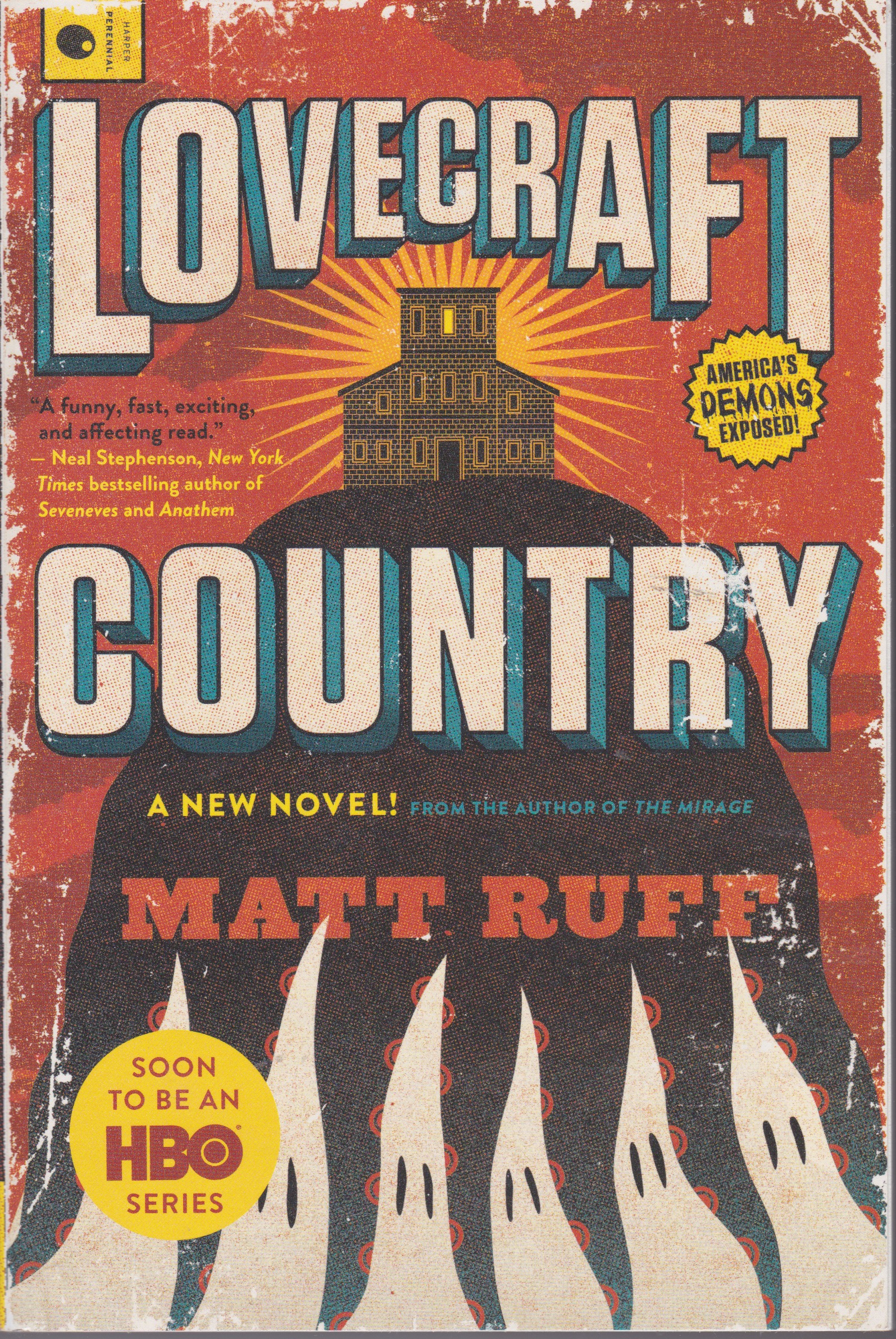
When I saw the first preview for HBO’s Lovecraft Country, it literally blew me away. I literally thought to myself, wow, I cannot WAIT to watch that, and was even more delighted to discover that it was, in fact, a novel. I got a copy, placed it on the mantle, and the week the first episode aired, I started reading. (Obviously, I do not read as fast as I used to.) I love love LOVE the show, and the book is actually pretty marvelous, as well. I finished it last night as I waited for the way-outer bands of Hurricane Laura to reach us here in New Orleans–all we got was a tropical storm effect, I am terrified frankly to look up what actually happened where the eye came ashore, and will have to gird myself with more coffee before I do look–and I am pleased to report the book finishes just as strongly as it starts–and that the entire book is fucking fantastic.

lovecraft country

Atticus was almost home when the state trooper pulled him over.

He’d left Jacksonville two days before in the secondhand ’48 Cadillac Coupe that he’d bought with the last of his Army pay. The first day he drove 450 miles, eating and drinking from a basket he’d packed in advance, stopping the car only to get gas. At one of the gas stops the colored restroom was out of order, and when the attendant refused him the key to the whites’ room, Atticus was forced to urinate in the bushes behind the station.

He spent the night in Chattanooga. The Safe Negro Travel Guide had listings for four hotels and a motel, all in the same part of the city. Atticus chose the motel, which had an attached 24-hour diner. The price of the room, as promised by the Guide, was three dollars.

I’m going to be honest right up front: I’ve never read H. P. Lovecraft. Oh, the horror, literally, right? When I was a kid I bought a copy of The Dream Quest of Unknown Kadath and other Stories, and it just…well, it just didn’t do it for me. I lost interest several pages in, and gave up; and have never since returned to try the Lovecraftian waters. As I grew older and became more and more aware of the horror genre, I also became aware of how much of an impact and influence Lovecraft had, not just on horror, but on the sisters that genre is usually lumped in with, fantasy and science fiction. Lovecraft is honored and saluted and studied and written about, over and over again; new anthologies explore his worlds and “cosmic horror”; so many horror writers and fans claim, on their social media pages, to have attended “Miskatonic University” (which, to be fair, is far less annoying than those who claim “the School of Hard Knocks,” har har); and of course, over the past decade (perhaps longer; who knows? I don’t, and don’t care to find out) you cannot be involved in publishing, or a fan, as I am, of the horror genre and not been aware of what I have come to call “the Lovecraft Wars.” (The Lovecraft Wars, in short, debate the legacy of Lovecraft and his vile, racist beliefs; the standard defense is a shrugged ‘he was a man of his time’–to which the only proper response, frankly, is so was Hitler–and whether or not he should continue to be honored as an influential author; I don’t know the answer to those questions, frankly, and it’s not my writing community so I have no skin in the game. But you cannot help but be aware of this ongoing conflict.)

Anyway, I was pleased when I saw the trailers for HBO MAX’s Lovecraft Country, which clearly centered Black people, and when I found out it was also a book, I decided to get it and read along while watching the series. I was also a little disappointed to see, based on the author photo on the back cover, that author Matt Ruff appeared to be white–which also seemed to be a whole other field of land mines; the #ownvoice debate.

And then I started reading, and watching.

The book is set in a post-Korean War pre-Brown v. Topeka Board of Education United States; when racism was not only permissable and acceptable to the majority of white people but was often enshrined into law; separate bathrooms, denial of service, mob violence and burning crosses were, horrifyingly enough, just a part of everyday life for Black people. The police weren’t there to help protect them; they were there to force them to continue to live their lives on their knees–and kill them if they tried to rise. Lovecraft Country doesn’t flinch away from this or try to downplay it in any way (either book or television show), and there were times I found it hard to keep reading and would put the book down–only to think to myself, that’s some serious privilege there, bud–this is what Black people experience to this very fucking day and they can’t just ‘put down the book’ and walk away from it; refusing to read it because it makes you uncomfortable and makes you squirm makes you even more complicit than you already are. So, yes, there are some parts to the book that will make white people uncomfortable–but you need to get over it, for any number of reasons but at least one is because the book itself is a revelation.

As I’ve said, I’ve not read Lovecraft, but I got the sense from reading the book that the interconnected stories that make up the book are all inspired by, or retellings of, some of Lovecraft’s; only now centering Black people and their struggle against not only supernatural forces but against the casual, every day racism of the society in which they live. Atticus is returning to Chicago from Jacksonville because he received a letter from his estranged father about a family legacy; Atticus’ mother, it turns out, was descended from a slave who was raped and impregnated by a master who was also a very powerful warlock and part of an ancient society with peculiar beliefs centered in the book of Genesis. His uncle George is the publisher/editor of the travel guide mentioned in the opening of the book; eventually Atticus and George go on a road trip to Massachusetts–to Lovecraft Country–along with a childhood friend named Letitia (Tish)–to find Atticus’ father and they wind up in a very chilling and scary place called Ardham (Lovecraft wrote about Arkham–and I will always wonder if Arkham Asylum from the Batman universe was an homage to Lovecraft as well). They deal with racism every step of the way, “sundown towns” (towns where people of color were required to be outside the city limits by sundown or else suffer the consequences), and corrupt racist cops.

Each section of the book focuses on another person who is a part of their immediate family/friends group, dealing with some kind of different, supernatural experience: the next part of the book centers Tish buying a big empty old mansion in a whites-only part of Chicago that also happens to be haunted, and so on–Tish’s sister has her own story; Atticus and his father go looking for journals of another warlock and encounter a haunting; George’s wife and son have their own stories as well–but all these stories are connected by a thread that goes back to Atticus’ family legacy and a war between different covens of warlocks for not only supremacy, but knowledge and power.

The book is exceptionally well-written, and as I said earlier, unflinching in its depiction of a racist society from the point of view of those consistently victimized by it, and it’s a toss-up between who is scarier–the warlocks and the forces they unleash, or the horrible racists, so entrenched in their horrific beliefs and values that they can’t see Black people as human beings. The fact Ruff chose to call his primary character Atticus didn’t escape me, either; Atticus being also the name of the noble white hero of To Kill a Mockingbird, which is, while a beautifully written novel, one which has become increasingly problematic to me over the years for any number of reasons. I greatly enjoyed reading the book–and in all honesty, it made me curious to read Lovecraft at some point after all these years; although it’s certainly not going to be a priority for me.

I will read more of Ruff’s work, though; the descriptions of his other books sound incredibly subversive, which appeals to me.

I recommend this book highly.

Don’t Blame Me

The morning after, and Orleans Parish is in a tornado warning/flash flood watch until 4 pm this afternoon. It’s still creepily gray outside this morning, and it’s still too early for damage assessments to where Laura came ashore last night as the most powerful hurricane to make landfall in Louisiana since 1856.

18 fucking 56.

Today is usually my day to go into the office and make works supply bags for the syringe access program, but I am not sure what the weather holds–I haven’t checked yet (other than the alerts on my phone), not have I checked to see any news reports as of yet for southwest Louisiana. I have four boxes of condom packs to take in–yes, I’ve been a productive motherfucker this week; I already took in two boxes the other day–and I do need more supplies for tomorrow. I am dreading to see what this storm did, frankly; hurricane season always brings a little PTSD for me in its wake–probably always will–and viewing storm damage photos and videos and hearing survivors’ stories inevitably makes me weepy. While writing Murder in the Rue Chartres (and years later, “Survivor’s Guilt”) was cathartic, the psychological scars may never heal completely.

While making my condom packs yesterday, I watched another 1970’s movie in my on-going 1970’s film festival, Magic, starring Anthony Hopkins and Ann-Margret. I’ve watched this movie before, but a long time ago, and I had also read the novel on which it was based, by William Goldman. Goldman also wrote The Princess Bride and Marathon Man; I went through a Goldman phase after reading The Princess Bride–and his career was pretty amazing, actually; he rarely wrote the same kind of book and was never really pigeon-holed as a novelist. He was also an Oscar winning screenwriter–he won Oscars for Butch Cassidy and the Sundance Kid and All the President’s Men (which is on my list for my 1970’s film festival; it also contains the line “follow the money” which he wrote for the movie and is now a part of the vernacular)–and he was a terrific novelist. I don’t really remember much of the novel of Magic, nor did I remember much of the film, other than remembering that there was one scene in particular that was absolutely terrifying; guess what? It still is.

I’ve also found ventriloquist dummies to be terrifying ever since.

Magic begins with a young magician, Corky, (a very young Anthony Hopkins) appearing at an amateur night and bombing badly; after he comes back to an apartment where his mentor, Merlin Jr., is very ill, he tries to pretend he did well but Merlin sees through him. Flash forward another year, and David Ogden Stiers is arriving at the same club–which has a massive line outside–to meet Burgess Meredith, who is an agent and wants him to see the act of his client, Hopkins. Hopkins starts doing some card tricks but starts getting heckled; turns out the heckler is his ventriloquist dummy, Fats–who makes up a huge part of the act and the audience loves him. The network guy–Stiers–loves the act, and soon he’s offered an enormous contract for his own network special, but it requires a physical, which Hopkins flatly refuses to do, and flees New York to the Catskills, where he grew up, and goes to stay at a closed resort, run by Ann-Margret, whom he had a crush on a kid. Ann-Margret’s marriage to her high school sweetheart has failed, and become abusive, and they slowly start to begin a relationship, the relationship Corky wishes they’d had in high school. However, Corky and Fats have an even stranger relationship; is Corky insane, with DID, thinking Fats is real and can speak to him, or is Fats real? The movie never really lets us know one way or the other, and it eventually devolves into murder–and of course, a really sad, tragic, cynical ending which was very typical of the 1970’s. Both Hopkins and Ann-Margret–and Burgess Meredith, too, for that matter, are absolutely terrific; Hopkins should have become a star based on this film alone, and I’ve never understood why Ann-Margret–who was incredibly beautiful–never had a bigger career. Jerry Houser, best known for Summer of ’42 and playing Marcia Brady’s husbands in later reboots of The Brady Bunch, also has a bit role as the cabdriver who brings Corky up to the Catskills…and I couldn’t think of his name as I watched; I had to look it up later. He was kind of sexy, too, in that 1970’s kind of way.

Paul and I also started watching the documentary series The Case Against Adnan Syed on HBO MAX last night, and got two episodes into it. I never listened to the podcast that made this case so famous (I am behind the curve on podcasts, and can admit that), but the documentary is very well done and very interesting–look forward to seeing the rest. Only two episodes in, I am not certain how they managed to get a conviction, to be honest, unless it was racially motivated on the part of the jury; we’ll see how the rest of the series goes.

And now to check the weather before heading into the spice mines.

IMG_4128

Dancing With Our Hands Tied

Good morning, Wednesday, how is everyone holding up so far this week?

So Laura apparently isn’t going to be too much of a thing in New Orleans, but things aren’t looking good for eastern Texas/western Louisiana. Keep safe, my friends, and everyone else, do keep them in your thoughts and send them positive energy, as I certainly shall be doing until this too has passed. It’s similar to 2005’s Rita; following the same path and intensifying pattern. We’ll still get about 2 to 4 feet of storm surge into Lakes Borgne and Pontchartrain, and a lot of sudden, intense rain (street flooding), but for the most part, New Orleans has yet again dodged a bullet.

And compared to a direct hit, yes, that’s not too much of a thing in New Orleans.

It was very strange to not have to go into the office this week (I did have to go by yesterday–and will again today–to get more supplies) to do any work; especially when you take into consideration the vacation days I took last week. I’ve not been into the office to actually work now since last Wednesday–a full seven days–and it’s made me feel very disconnected from my job this morning; I really don’t know how all of you who’ve been having to work at home all this time without ever going into your offices have managed to do that without feeling untethered at best, disconnected at worst. At this point, it feels as though the pandemic has been going on forever, and the last days of what was previously our normal existence–late February, early March–seem like ancient history to me now, and I’ve already accepted the fact that life, that world, that way of existing, is gone forever. Whatever it is we will see when this ends–should it ever end–will be completely different. This is one of those “sea change” experiences, where life and society and culture change irrevocably forever. The world before the first World War ceased to exist after it ended; the interregnum between the two wars was a kind of stasis world, where all the problems unresolved by the Treaty of Versailles coupled with the crash of the American–and by extension, world–economy created a bizarre vacuum which fascism swept in to fill, with the inevitable war that followed–one that took a look at what had been, up to that time, called “the Great War” and basically said, “Hold my beer, you ain’t seen nothing yet.” The world in the spring of 1914 was almost completely different in almost every way in the fall of 1945–a span of only thirty one years.

So what will our world, culture and society look like in a post-pandemic environment? Will we ever get to said post-pandemic environment? Or will those of us who survive this look back at this time and say, “ah, yes, the beginning of the dystopia?”

How depressing. Which is one of many reasons why I never look forward or back, and try to live in the now. The now is depressing enough as is, if you let it be.

While I didn’t work on the book yesterday or read anything, I did educate myself somewhat by watching the Kings and Generals channel on Youtube, something I discovered recently. I watched the episodes on the Battle of Lepanto and The 1565 Siege of Malta, which were extremely informative and educational. I had previously watched the Fall of Constantinople in 1453; the Sack of Constantinople in 1204; the Battle of Mojacs; and the Siege of Vienna. Most of my study of European history has always been western-centric, primarily focusing on Great Britain, Spain, and France, with a smattering of Germany/Holy Roman Empire thrown in for good measure (and primarily the Hapsburgs); it is only recently that I’ve realized how much I’ve not looked at eastern Europe, other than some post Peter the Great Russian history–which also is primarily because it impacted western Europe. My knowledge of Asian history is non-existent; and if you ignore the scanty knowledge of ancient Egypt, I really don’t know much about African history either, other than the colonial period and not much of that. I also don’t know much about Latin America, either. Several years ago–after the Italy trip of beloved memory–I started looking into Venetian history, which is entangled heavily with that of the Byzantine Empire and its successor, the Ottoman Empire–both of which I know very little about, and as I started reading more about these eastern European empires (the Venetian included), I began to get a better concept and grasp on how little of world history I actually knew.

I would love to have the time to study more of the history of Constantinople/Istanbul, as the capital of two major historical empires that covered 1500 years of human history.

We also watched a two part documentary on HBO about the Michelle Carter/Conrad Roy case, I Love You Now Die. If the names mean nothing to you, it’s the case where the boyfriend committed suicide while his girlfriend was texting him supposedly ordering him to do it. The facts of the case–which I hadn’t really looked much into before–aren’t what they seem and it was an interesting case; her conviction, held up under appeal, set a legal precedent that can be seen as either scary or good. Was she a sociopath? Or were they both emotionally damaged teenagers locked into a strange co-dependent relationship that was actually toxic, made it even more dangerous because no one else knew how toxic it had actually become? As I watched, I wondered–as I am wont to do–how I would tell the story were I to fictionalize it, and finally decided that the best way to do it would be from multiple points of view: both mothers, the sister of the suicide, and one of the Michelle’s “friends” from high school–all of whom claimed to not be really friends of hers in the first place–and the real story is loneliness, on the parts of both kis, really. A truly sad story, without any real answers.

While I was making condom packs yesterday I also continued with my 1970’s film festival by watching the 1972 Robert Redford film The Candidate, which is one of the most cynical political films I’ve ever seen–and almost every political film made since that time has been highly cynical. The 1970’s was an interesting decade for film; a transitional period where the old Hollywood was done away with once and for all and cynical, brutal realism took its place. Watching these films has also reminded me, sometimes painfully, how questionable style and design choices were in that decade–clothing, cars, buildings, etc. It was an ugly decade–remember the hair styles, with the carefully blown dry “feathered bangs” hair-sprayed into place? Sideburns and porn-staches? The bell bottoms and earth tones? The enormous steel cars that were essentially tanks? How dirty everything seemed, and how trash littered the sides of the roads and waterways? It’s all there in these films, as well as that dark, bitter cynicism.

The Candidate is about an idealistic young lawyer who works for social justice causes named Bill McKay, whose father was a powerful two-term governor of California. Recruited by a political operative played to sleazy perfection by Peter Boyle, McKay–who has always disdained politics–agrees to run for senator against a long-term, popular Republican incumbent. No one expects him to win, and McKay agrees to it so he can talk about issues that are important to him–and he immediately makes it clear he wants his campaign to  have nothing to do with his father. The movie follows him from his own first faltering public appearances and watches as he slowly develops into an actual politician. He’s perfectly fine with everything, and he wins the primary–but the numbers extrapolate to a humiliating defeat in the general…so he starts watering down his message, speaking in generalities and never addressing issues directly–and his campaign begins to take off, and winning becomes more important to him than the issues, to the point he even allows his father, played with sleazy perfection by two-time Oscar winner Melvyn Douglas, to get involved in the campaign. He pulls off the upset and wins, and as the celebrations begin, he asks his campaign manager, “So, what happens now?” as no thought has ever been put into the future should he actually win; and that’s how the movie ends, with that question unanswered. It’s a very strong indictment of modern politics, and still relevant today; essentially, he wins because he is handsome and never says anything that means anything. We never really are sure, as the viewer, what he wants and what he stands for; which is a very deliberate choice by the filmmakers–we’re basically shown a little bit behind the curtain, but mostly we see what the voters would see. This movie doesn’t have a Frank Capra ending, but the typical cynical view of the 1970’s. The screenplay, incidentally, won an Oscar.

Aliens was the second movie on yesterday’s condom packing double feature. I had originally intended to watch Alien and Aliens back to back; don’t remember why I didn’t rewatch Aliens back then, but I didn’t, but I also figured it was equally appropriate to rewatch the day after rewatching Jaws, because it too is a monster movie, and one of the best of all time. Sigourney Weaver is even better in this one than she was in the first; and while I love Marlee Matlin and think she’s a terrific talent, I still think Weaver should have got the Oscar for this (if not for Alien). Once again, a primary theme for the movie is “no one listens to the woman who is always proven to be right”–amazing how timeless that theme has proven to be–and again, as in the first film, the Ripley character is given a relationship to soften her and make her more “womanly”; in the first film it’s the cat–which really, I felt, weakened her character, while at least in this one it’s the little girl, Newt, that she risks her life to go back for when everyone else, including me, is screaming get the fuck out of there are you fucking crazy? There are also some other terrific performances in this movie, which is a non-stop adrenaline ride, including Bill Paxton’s first performance of note as Hudson; Michael Biehn (why was he not a bigger star?) in a  great follow-up to The Terminator as Hicks; and Paul Reiser, who was so sleazily perfect as the company rep (and should have been nominated for an Oscar himself) that I have never been able to stand watching him in anything else since I saw this movie for the first time because I hated him so much as Burke that I cannot see him as anything else. Everyone in the cast is terrific; but there are some small things that date the film–Hudson makes an illegal alien joke about Vasquez (would this still be a thing that far into the future?); the analog transmissions rather than digital; and of course–the cigarette smoking; would cigarettes never evolve over time?

If all goes well, I expect to be here tomorrow morning. Have a great day, Constant Reader.

IMG_4164