Roar

Ah, Nancy Drew.

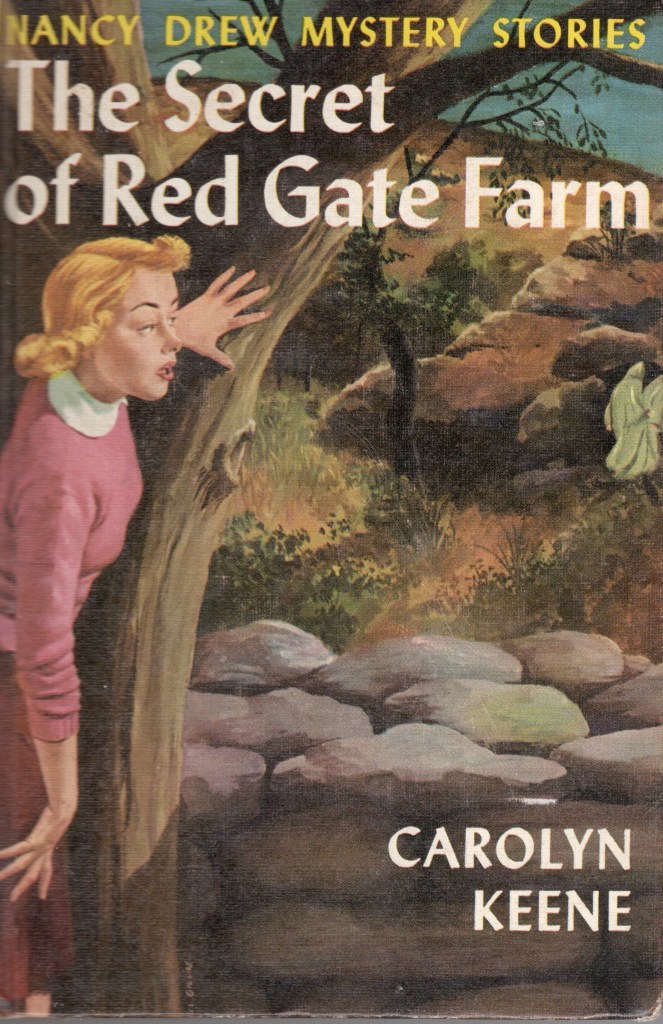
Nancy Drew wasn’t the first kids’ sleuth series I discovered (Trixie Belden’s The Red Trailer Mystery and The Three Investigators’ The Mystery of the Moaning Cave came first), but when I was in the fifth grade, sometime between 1969 and 1970, we had a table of books in the back of the room that had belonged to the (now grown) children of our teacher. I was already reading mysteries checked out from the library or ordered from the Scholastic Book Fair, so when I saw The Secret of Red Gate Farm there on the table, along with the banner NANCY DREW MYSTERY STORIES, I couldn’t pass it up.

And on the back was a listing of all the titles in the series to that point in Nancy Drew history when this copy was printed. This was very exciting for me–a series? Of mysteries? I’d never heard of such a thing, and my life was about to be changed forever.

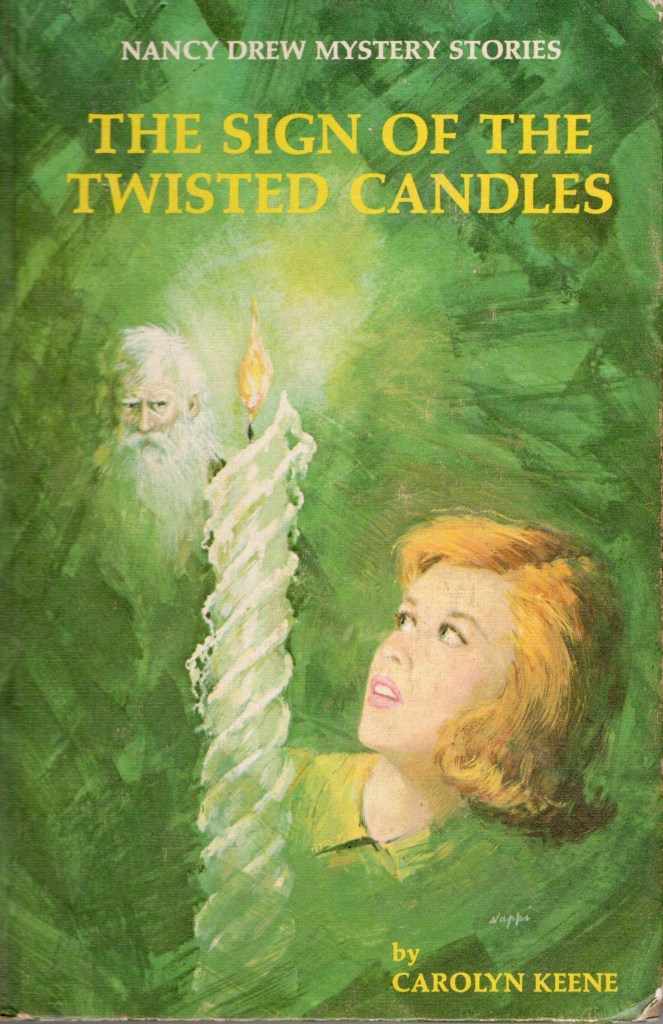
I recently found excellent replacement copies for my collection at the library sale–my copies of Crossword Cipher and Red Gate Farm are seriously dilapidated and wrecked–and I don’t remember if I have a revised text copy of Twisted Candles, so I picked it up, too. I do sometimes wonder if my collecting this books isn’t part of the neuroses I think it it is and part of a tendency to hoard things, especially books.

It probably will not come as a surprise to anyone that it always really bothered me that I didn’t read or acquire the books in order. There were other volumes in the series back on the table, including The Mystery at Lilac Inn, The Hidden Staircase, and The Haunted Showboat. (There was also a Dana Girls, The Secret of the Old Well. I eventually acquired the first and third books, The Secret of the Old Clock and The Bungalow Mystery, from the Woolworth’s on 26th and Pulaski in Chicago.) Nancy Drew was my first real foray into collecting a kids’ series, and of course, my parents were delighted that I moved on to the Hardy Boys without argument as ordered; they never liked me reading books with female heroines, which of course made Nancy Drew even more appealing to me because it was forbidden. (So, of course, I kept reading and acquiring them whenever I could when I wasn’t being supervised. So, yes, I was even in the closet as a Nancy Drew reader,)

But even as the revised texts appealed to me more because the font was better and the books were illustrated, I did notice, even as a kid, that Nancy was a lot more passive than she was in the original texts. Things happened to Nancy in the newer books, and her personality was bland to the point of being beige. It also irritated me that of course this rich lawyer’s daughter didn’t have a job, didn’t go to school, didn’t seem to have any responsibilities whatsoever other than traveling around doing as she pleased and stumbling over mysteries (sometimes the mystery came to Nancy). Her friends all adored her, would do anything she asked, and she was good at everything she tried. As someone who was not good at everything he tried, this annoyed me. Why not give her some flaws? Why make her this super-character who was perfect in every way? As I got older and revisited the original texts more, I could see why aficionados preferred the older versions, despite being dated and rife with racial and racist stereotypes; because Nancy wasn’t perfect in her original incarnation. She was a bit arrogant, definitely classist, and very headstrong to the point of being willful. She was also absolutely fearless, and had very deep convictions about right and wrong, and how wrongs must always be righted. She was fascinating but realistic. She’s aware of her privilege–even as she uses it as needed–but tries to use it to help others less fortunate, which is kind of admirable. The original text Nancy was the kind of character a girl between the ages and nine and thirteen would find aspirational, would want to be like, a role model of sorts presented at a young and formative age that they, too, could be smart and independent and liked as themselves, rather than as someone’s daughter or girlfriend or wife.

Even as a kid, I was drawn to strong, independent female characters. That has never changed.

Most of my collection of Nancy Drew mysteries–and all the other kids’ series I collect–are currently in boxes in my storage attic. There just isn’t room to have them out on display (which makes me crazy, but it’s either that or the copies of my own books, and my vanity trumps not displaying the books every time), because I do have copies of every Nancy Drew except for maybe one or two, and there are some revised editions I don’t have. Shortly after I got to the age where I could actually buy them with my own money, the editions changed; they went from the old flat matte covers to what aficionados and collectors call “the flashlight editions”, because there’s a flashlight as the logo on the spine (rather than the little black box with Nancy in profile) and they went to a glossy cover; also on the cover where NANCY DREW MYSTERY STORIES was changed to a banner across the top in yellow (the Hardy Boys’ banner was blue), and I didn’t like the new glossy covers or the flashlight editions or the banner…plus, I wasn’t going to start over and collect them all in this new format; this was when I started looking for them at yard sales, second hand stores, and flea markets (before the Internet and ebay).

I’ve also noticed how rabid the fans for both Nancy Drew and the Hardy Boys can be. I belong to several Facebook groups for fans and collectors, and those people can get worked up really easily–and of course, it always has something to do with bigotry and change. They hated the new Nancy Drew series because (gasp, the horror!) Ned was Black and even greater horror, she has sex. There was a lot of pearl-clutching over this, as there was about the new Hardy Boys series, in which Joe was made much younger, their mother was killed off, and there were a lot of supernatural elements to both (I never finished the Nancy Drew show, but not out of distaste; I always appreciate new interpretations and find the changes made interesting. I never finished because I forgot about it, in all honesty)–again, pearl clutching–but every so often it amuses me to think about writing a book built around this fandom. But it would of course have to be a fictional series, but it could be really, really funny.

And I think the Hardy Boys may now be in the public domain? I don’t know how that works, but I’d love to be able to write my own. I’ve always wanted to, and if I could actually use the original characters…how fun would that be? I’ve also always hoped to get a gig ghostwriting for either series…I suppose it’s not impossible, but I’m not sure they are still releasing new titles in either series. There have also been spin-off series, too–but I’ve never read outside the original canon. Once they stopped being published in hardcover, I don’t care about collecting the paperbacks or reading them, either.

But Nancy was important in the formation of my interests in reading and what I write, and maybe she wasn’t my favorite series of them all, but I have an appreciation for her and the books still to this day.

My goal is to write an entry on every series I collect–I think I’ve already done The Three Investigators–but so what if I have? My blog, my entries!

Next up, I will probably read the original text of the Hardy Boys’ The Mark on the Door, which I picked up in a tweed edition sans dust-jacket at the library sale.

Until then, hang in there.

Calfskin Smack

Tuesday and we made it through Monday. I didn’t sleep great for some reason on Sunday night–restless and kept waking up–so I was dragging yesterday, as could be expected. I wasn’t mentally tired, but physically? Yeah, not great. I was also hungry all morning despite having had cereal, a banana, and peanut butter toast. Go figure. Then again, I also ate earlier than usual on Sunday, so that could have had a lot to do with the hunger issue. I am glad that I have finally identified that feeling as hunger, though. It’s very rare when I experience it, so am very glad to know what it actually is for those moments when I do have that dull empty stomach ache. The irony that I didn’t think it was hunger because hunger pains usually went away after a moment or two, so I thought it was something else. I guess my body has changed yet again.

I did start revising the first four chapters of the next book I am going to write. It was a bit slow going, primarily because I don’t think I’ve got the voice completely down again–I decided that it was silly not to reread the chapters again before working on the rewrite; that could be why it was slow going and hard for me to slip back into my character’s voice again. There’s a cynical, world-weariness to him that you’d think would be super easy for me to slip into again, but the difficulty with the revision stuff made me realize I don’t really know much about my character and his history/back story either, so I need to work on that a bit more before I can really dig into the story the way I really want to, so that’s something, right? But I took a break from it, folded clothes and washed dishes, and then came back to it and slid right into his head and his voice, knowing exactly where I was and who I was writing about and what was going on. It felt good, and while I only did about 800 words or so today in total gain (there was also subtraction going on), it felt really good and it also put me into a good mood. I do love writing–at least this part of it, before I’ve cursed myself out for not seeing this plot hole or for forgetting this subplot and never resolving it, when I am stuck in the middle and it feels like everything I am writing is just filler; you know, the emotional rollercoaster of a journey I undertake with every new book I write.

Yeah, this is the part I like.

We also watched the new episode of Last Call, which is a book I still need to read. It’s such an eerie and creepy story–one which American Horror Story: NYC essentially “ripped from the headlines” for a significant portion of its plot–but I mused about how I hadn’t heard anything about this case, despite being gay and out at the time. I was living in Tampa, and reading the local queer paper and I also used to subscribe to both Out and The Advocate because once I was out I was all about being gay in every aspect of my life, and what better way to learn about being gay than reading, which is what I always did? But I never read anything about these murders that I recall. I am definitely going to have to read this book, and there are a few other gay books I want to read this summer–but there are sooooo many great new crime novels dropping by amazing authors too! Bouchercon is also looming on the horizon. I am getting invited to meals and meetings, and of course there are my panels. I don’t know who all is going because it always seemed so far away that there was plenty of time to check in with everyone, but it’s like getting closer and closer by the day.

The lackadaisical almost malaise I’ve been staggering under for quite some time now seems to have lifted, or at least for a temporary lull, at any rate. This year hasn’t been an easy one, and neither was the last. Everyone seems to be struggling with more things than usual these days, so I am not really comfortable complaining or whining or even just commenting on what a shitty period the last few years have been. I’m glad Mom is no longer suffering or struggling, but I hate that the side effect of that is Dad’s unhappiness. I’m glad Scooter left us pretty quickly and painlessly with a minimum of suffering–when I got home from the office yesterday Paul had picked up his cremated remains, so had a moment of deep sadness and misery when I got home from work yesterday. It was nice to share the sadness, though, with Paul; I try not to be sad in front of him because I think it makes him feel worse–also because it’s even harder for me to see him sad, but we should share our griefs and burdens more because it does help not to do it alone. As I mentioned, it felt good to start digging into the new book last night, even if it was just revising and strengthening what was already there. I haven’t started reading the new Kelly Ford, but will probably do that today. I actually was sitting in my easy chair feeling sad last night and missing Scooter, when I snapped myself out of it and got up off my ass and did some things. I made myself write, and when I got stuck, instead of giving up I did some chores to shake things loose in my head and wrote some more. I slept better last night than I did the night before–still woke up a few times, but still was a much less restless night than Sunday night was–and am feeling pretty rested, if not completely awake, this morning, which is also nice. I am hoping to make it through the week without getting run down and/or exhausted. I got two books yesterday–the new Eryk Pruitt, Something Bad Wrong, and a reprint of a Scholastic Book Club mystery I really enjoyed as a kid, The Mystery of the Pirate’s Ghost by Elizabeth Honess, which should be fun revisiting. I am still considering writing middle grade mysteries, and so I am trying to reread some of my favorites as well as some of the more modern offerings.

And on that note, I think I am going to head into the spice mines. Have a lovely Tuesday, Constant Reader, and I’ll check in with you again tomorrow.

Seekers Who Are Lovers

Sunday morning in the Lost Apartment again, and I am looking forward to a lovely and productive day here. We had a rather marvelous thunderstorm last night–although there was potential street flooding, so hopefully the car is okay–which was nice. It’s been awhile since we’ve had a thorough cleansing rain like that, which is part of why the heat index has been so miserable lately. The temperature has been hot, and the humidity about what it usually is–not humid enough to rain, but so close it’s miserable. I had planned to barbecue last night, despite the heat, but when I was getting ready to start putting everything together was when I realized it was not only raining but pouring. There was also magnificent, long lasting rolling thunder claps that lasted for seconds; the kind where it sounds like the sky is splitting apart. So, I made pizza instead for dinner, and hopefully will be able to cook out this afternoon. The power also went out overnight–I slept well again last night, to wake up to blinking clocks everywhere. It was out for maybe about twenty minutes, based on the emails from Entergy letting me know an outage had occurred (how does one check one’s email without power? A mystery for the ages) and the follow up announcing the restoration of power was sent about twenty minutes later.

I ran my errands yesterday, including making groceries and dropping off boxes of books at the library sale. I cleaned and organized and filed most of the rest of the day, finally getting the office area whipped into some semblance of order that’s not only workable but close enough to being finished that it won’t take long to do so that I can finish it over my coffee this morning and while taking breaks from writing this–although these things generally tend to be fairly stream of consciousness. Today I am going to make a to-do list for the week, update the bills list and make sure everything is current, and I’d like to make some progress on the rugs in the kitchen. The living room looks much more bearable now that those boxes of books are gone, and I think I need to thin out the beads next as well as do some additional book pruning. I cleaned out some drawers yesterday, getting that project under way, and I also need to go through my last few journals to mark the places where I made notes on the things I am thinking about writing now. I’m also trying to decide what the point of whatever it is I want to write next will be. I’d like to write something for the Malice anthology, but the deadline looms and I don’t think I really have anything I can whip into shape in merely one day, which means I am going to need to write a draft and figure this story out as I go–the idea is very amorphous, and I’ve not been feeling terribly creative yesterday, which could prove to be a most frustrating writing experience. There’s another one I’d like to revise and work on–I am feeling connected to it, and to its voice, but again I am trying to figure out what I am trying to say in the story. I need to reread all of these things, of course. I need to reread lots of things so that I can get a grasp of them again so I can find my way into writing them. I actually started two books this past week, can you believe that? Like I don’t already have enough things in progress already that I need to start two more? I wrote the first sentence of each book, and stopped there. I know what I want to say in both of them, and where I want those opening chapters of each to go, but I’m not sure precisely how to say it.

I also got deeper into Megan Abbott’s Beware the Woman, taking it slowly and savoring the experience as the rare treat and pleasure reading anything written by Abbott always winds up being. Each book is different in content, yet variations on a theme; I think future literary scholars will look book on her canon and study it as the incisive social commentary it is, about what it is to be a woman as well as how it is to be one, the strictures and compromises, the struggles between expectations and reality, all wrapped up in a lovely bow of beautifully constructed sentences that are complex in their very simplicity, and razor-sharp observations and insights into the strange tangle of emotions and contradictions that make us all so tenderly and sadly human.

We watched a tragic gay romance movie last night, Firebird, which was based on a true story from the days of the Soviet Union and its homophobia (still a thing in Russia to this very day, never forget). It was very well done, but it was also sad as such stories always are, with the kind of bittersweet ending where the truly conflicted one ends up dead and the one who isn’t moving on with his life stronger for the experience. So, no, not the feel-good gay movie of any year, by any means, so after that a few episodes of Awkwafina is Nora from Queens was just the ticket back from that downer.

Also, when I was dropping off books at the library sale, since I had cash on me (which is a rare thing) I checked the children’s section for series books I collect (I do this periodically, but only when I have cash on me) and I scored today with four books at two dollars apiece, and I had exactly eight dollars on me. I got three yellow-spined revised text (important) Nancy Drews (The Secret of Read Gate Farm, The Sign of the Twisted Candles, The Clue in the Crossword Cipher) which was the style when I started reading them so those are the ones I want. I already had copies, but the ones I already had on hand have been damaged over the years, and these were in excellent condition. I also got a tweed original text Hardy Boys The Mark on the Door, which I’ve never had a copy of (I only ever had the blue spine revised text) and have never actually read. There was no dust jacket, but it’s in really good condition. It’ll be fun to read it; per the fan groups, this was one of the books written during the time the original writer had left and the new ghost writers weren’t as good; and the plots tended to be a bit on the insane side sometimes. I am rather intrigued to read it–since they were all revised to get rid of offensive ethnic and racist stereotypes and language, it could be eye-opening.

I’ve also been reading Matt Baume’s marvelous Hi Honey I’m Homo, and am now up to the chapter on Dinosaurs, which I never watched. It’s really a fun book about how queer representation began and evolved over the years, as well as documenting the pushback against that representation (newsflash shocker: evangelicals have been coming for us every step of the way), and it’s written in an easy and accessible style that flows well. I’ve enjoyed his Youtube content, and I’m delighted to see that the book is in the same vein and just as well done. Highly recommended, and definitely more to come on that when I’ve finished reading the entire thing.

And now to my easy chair, to spend more time with Megan Abbott. Have a great Sunday, Constant Reader, and I will check in on you again tomorrow.

Private Eyes

I loved the Three Investigators.

When I was writing about rereading “The Birds” the other day, it brought Alfred Hitchcock to mind again. I have been revisiting the old Alfred Hitchcock Presents anthologies lately, and slowly (finally) realizing what an enormous influence on my writing Mr. Hitchcock was. Obviously, there’s the films, and the television series, of course, but even more so in books–books he had little to do with other than licensing his name–because hands down, no questions asked, my favorite juvenile series was The Three Investigators. I loved those books, and still do. The Hardy Boys, Nancy Drew, the other series–they don’t really hold up well for me now, but I can still enjoy the The Three Investigators as much today as when I first read them. The books are incredibly well written, and the three boys themselves are very distinct from each other yet not one-dimensional, and that holds true for all the members of their supporting cast–Uncle Titus, Aunt Mathilda, Hans and Konrad, Hitchcock himself, Worthington the chauffeur–as well as the primary settings, the Jones Salvage Yard and Headquarters, a wrecked mobile home hidden in plain sight, beneath and behind piles of junk, with secret tunnels leading to it.

What I liked the most, though, was that the plots of the mysteries themselves were very intricately plotted, and the criminals were actually pretty smart, so it took a lot of good detective work, thinking, and intelligence to outwit them. Many of the books were treasure hunts, which of course I love love love, and often required the solving of a puzzle, which I also loved. The three boys who formed the investigation were Jupiter Jones, Pete Crenshaw, and Bob Andrews. Jupiter (First Investigator)had been a child star on a Little Rascals type television show as “Baby Fatso”, which he doesn’t like being reminded of, or being called fat (this was actually one of the few kids’ series that dealt with fatphobia and flat out said making fun of people for being overweight was cruel; think about how much Chet Morton gets teased for being fat in The Hardy Boys and the same with Bess Marvin in Nancy Drew); he is also the brains of the outfit. He has a quick deductive mind, pays attention to details, and has read a lot so he’s got a lot of arcane knowledge in his mind that comes in handy quite often. Pete (Second Investigator) is strong and athletic and not nearly as bright as Jupiter. Pete also gets scared easily, but an ongoing theme in the books is how Pete always overcomes his fears to come to the aid of his friends. Bob Andrews is Records and Research; he works at the local library so can do research for them, and he also is the one who writes up all their cases to present to Mr. Hitchcock, to see if it’s worthy of his introduction. When the series begins, he has a brace on one leg from a bad fall down a nearby mountain–so he doesn’t get to get involved in any legwork or in-person investigations for several volumes until the brace comes off.

And of course I loved learning from Jupiter’s vast stores of knowledge.

“Help!” The voice that called out was strangely shrill and muffled. “Help! Help!”

Each time a cry from within the mouldering old house pierced the silence, a new chill crawled down Pete Crenshaw’s spine. Then the cries for help ended in a strange, dying gurgle and that was even worse.

The tall, brown-haired boy knelt behind the thick trunk of a barrel palm and peered up the winding gravel path at the house. He and his partner, Jupiter Jones, had been approaching it when the first cry had sent them diving into the shrubbery for cover.

Across the path, Jupiter, stocky and sturdily built, crouched behind a bush, also peering toward the house. They waited for further sounds. But now the old Spanish-style house, set back in the neglected garden that had grown up like a small jungle, was silent.

“Jupe!” Pete whispered. “Was that a man or a woman?”

Jupiter shook his head. “I don’t know,” he whispered back. “Maybe it was neither.

Jupe and Pete are on their way to call on a prospective new client, referred to them by none other than Alfred Hitchcock himself. Professor Fentriss had bought a parrot from a peddler, primarily because he stuttered and was named Billy Shakespeare (Fentriss is an English professor). The parrot says “to-to-to be or not to-to-to be, that is the question.” But this is in and of itself mysterious, as Jupe points out, because parrots don’t stutter; they have to be taught to stutter. Why would anyone teach a parrot to stutter? But the stuttering parrot is just the start of a bizarre and unusual case, with twists and turns and surprises everywhere the boys turn. Their detecting soon leads them to the revelation that there were six parrots and a mynah bird the peddler was selling, and they were all taught specifically to say one phrase. The phrases are clues to a treasure trail, and the prize is a magnificent and incredibly valuable painting by a master.

This book is an excellent example of precisely why I loved this series so much. The pacing is always excellent, the characterizations are three-dimensional, the mystery is intricate and puzzling and hard to figure out, and the conclusion of the book, where the boys have to beat several bad guys to actually find the painting, which takes place in a spooky abandoned cemetery on a foggy night, is some of the best atmospheric writing I’ve ever encountered. You really feel like you’re lost in the fog with bad guys you can’t see out there somewhere.

I’ve never understood why these books never achieved the popularity of the Hardy Boys and other series like them. They were better written, better stories, and just over all vastly superior to the Hardy Boys in every way. The first book in the series, The Secret of Terror Castle, remains one of my favorite kids’ books to this day (several books from this series make that same list). The problem with the series was time, really. Alfred Hitchcock eventually died, and they had to get someone else to fill in for him. Eventually, recognizing that Hitchcock’s name alone dated the books, they removed the references. The books themselves were never updated, which is also a shame because it dates the books but at the same time gives them a kind of nostalgic charm, as well. The Secret of Terror Castle was about the home of a silent film star whose career was ended by talkies, who turns out to be still alive. That was a stretch for me even when I first read it in the early 1970’s, let alone today. Whenever I think about writing my own kids’ series, I always think of it in terms of being Hardy Boys-like, but really what I would want to do is emulate the Three Investigators, whose books were well-written and a lot of fun to read.

Be sure I will talk about them again another time.

Glass Candle Grenades

Monday and a holiday; it’s lovely to have another day at home to work on these edits, which I am hoping against hope to complete today. Yesterday was lovely and relaxing; I worked on the micro edits–the lines/copy edit–which is always a long and tedious process. The macro edit, to me, is more fun if more creatively taxing. I’ll be digging into that a little later, when my mind is more awake and I have more caffeine in my system. It’ll be a weird and short work week for me, and then of course next week I am on vacation. I’ll be taking lots of books with me on that trip, although I’m not sure I’ll have much time to read. I’m not really sure what Dad and I will be doing in Kentucky. I know when I’ve been up there before he’s mentioned going sight-seeing; like to Cassius Clay’s home (the original, the one Muhammed Ali was named for at birth; he was Henry Clay’s brother and one of Kentucky’s leading abolitionists) or to the Kentucky Derby museum. Which is fine, I love history and while horse racing history isn’t something I’ve ever looked into much before, but you never know. I had thought about writing a mystery around the horse racing at the Fairgrounds…I knew a horse trainer back in the day–but never got around to it. I mean, Dick Francis kind of cornered the horse racing mystery market, did he not?

Of course, I’ll come home to another short week because of the 4th holiday, too–so it’s going to be three weeks before i do another full five day work-week. I slept decently last night–not great, but not bad, either–and so this morning feel a little bit dragging around, but that’s fine; coffee, a shower, and some time reading should get me over the hump. We abandoned City on Fire last night; we just had no enthusiasm for watching, and so moved on to The House of Hammer, which is about, of course, the twisted history of the Hammers through the lens of Armie Hammer, the actor, getting canceled for his abusive sexual preferences. It was interesting–I am always fascinated by twisted rich families that hate each other so passionately–but we need to find something meaty, like a good crime series, to dig into. It’s amazing how we can hve so many options yet can never find anything to watch, isn’t it?

I spent some time yesterday with Chris Clarkson’s adorable That Summer Night on Frenchmen Street, which is charming and fun and delightful to read, and may even be able to finish reading it today, with any luck and some strong motivation, at any rate. I think from that I will move on to either Megan Abbott or Eli Cranor; I can’t decide which of the plethora of great 2023 new releases to select from, to be honest. I know I’ll be listening to Carol Goodman in the car next weekend on the way up and I’m not sure who I’ll listen to on the way home.

A quick glance at Twitter has shown me that LSU fans have now surpassed eleven thousand shots in the Rocco’s College World Series Shot Competition, and are well on pace to break the record (just over eighteen thousand) set by Mississippi last year. Oh, how the bars and restaurants in Eauxmaha must love LSU fans! I mean, even if the shots are only a dollar, that’s over eleven grand in receipts on those shots alone, not counting everything else being sold there. LSU is playing Wake Forest tonight, and it will take a strong effort for the Tigers to pull off the win. If they do pull out a win, I’m thinking the shots record will fall tonight.

I also read an old short story yesterday that I remember from when I was a kid. Periodically, Mom let me join a book club. The first one I joined was the Mystery Guild, and those selections i received from the Mystery Guild really kind of shaped my future both as a reader and writer. I still remember the books–still have some of the original copies–and over the years, I’ve tried to replace the ones lost over time to cross-country moves. Recently I repurchased a copy of Alfred Hitchcock Presents a Month of Mystery on eBay, and there was a story in it I read as a kid that I never forgot; and I wanted to reread it. It was called “The Queen’s Jewel” and was written by Robert Golding (I’d forgotten the name of the author). I took the book down yesterday afternoon to reread the story, and it was amazing to me how much of it I still remembered, the details. The main character, Jane Farquhar, owns a small hotel of sorts with guest cabins in the brush in Africa. One of her ancestors was a server for the imprisoned Mary Queen of Scots, and before her execution she gave him the pendant of a ruby set in a heavy gold chain with four carat blue-white diamonds surrounding it. It is very valuable, and Jane’s father raised her to be prepared, always be prepared, because someone will eventually come to try to steal it from her in some way…and thus the story is about her defending herself against a criminal pretending to be an American cousin. The story holds up and works, but it opens with Jane discovering the body of her poisoned guard dog–which did make me wonder, would this story be published today? Opening with a dead dog?

I also didn’t know much about Robert Golding, so after reading the story I used the google to find out he was one of the many Ellery Queen ghostwriters (I only recently found out that many Ellery Queen novels were ghostwritten) and it turned out Golding wrote two of my favorite Ellery Queen novels, The Player on the Other Side and Calamity Town, which is one of my all-time favorite mystery novels; little wonder his short story connected so well with me. I don’t remember The Player on the Other Side other than that it was one of my favorites; but Calamity Town? I remember a lot of that novel, and it was primarily about the Wrights, the first family of Wrightsville–a location so popular that Queen kept returning there for more murder mysteries (The Murderer is a Fox was another great Wrightsville mystery). He also apparently wrote a lot of the juvenile Ellery Queen mysteries–published as Ellery Queen Jr.–which I also enjoyed as a kid; Ellery Queen Jr. and the Jim Hutton 1970’s television series Ellery Queen (which I loved) were what originally brought me to reading the adult Ellery Queens; the first I read was the one they actually filmed for the pilot, The Fourth Side of the Triangle, which was marvelous, and then I started buying his books or checking them out from the library. So thank you, Robert Golding, for being an influence on me and my writing without my knowing it. I’m really looking forward to reading some more of these old short stories. I got another Hitchcock (Alfred Hitchcock Presents Stories to Be Read with the Door Locked) and an old MWA one, edited by Robert L. Fish, With Malice Toward All, which also looks rather fun.

And on that note, I think I am going to head into the spice mines and read for a bit while my brain continues to wake up before tackling the manuscript. Have a lovely holiday, Constant Reader, and I’ll check back in with you later.

Bad Boy

Masculinity is something I’ve always felt I viewed from the outside.

It’s very strange; for someone who doesn’t look back very often and has a rather healthy disdain for nostalgia, for some reason since the pandemic started, I’ve been revisiting my past a lot. I don’t know, perhaps it was triggered by having dinner with an old friend from high school a while back (which also inspired me to write a horribly dark short story); or perhaps it’s because of short stories or novel ideas I’ve been toying with, but lately, I’ve been thinking about my past much more so than I usually do, and what it was like for me growing up. I wrote a Sisters in Crime quarterly column several years ago about the first time I realized, once and for all, that I was indeed different from everyone else–it centered the first time I heard the word fairy used towards me as a pejorative, as well as the first time I was called a faggot. I’ve also been examining and turning over issues of masculinity inside my head for quite some time (most of my life). #shedeservedit was itself an examination of toxic masculinity and how it reverberates through a small community when it’s allowed to run rampant and unchecked: boys will be boys. Some short stories I’ve published have also examined the same subject.

What can I say? My not being the American masculine ideal has played a very major part in shaping my life and who I am; how could it not? I used to, when I was a kid, pray that I’d wake up the next morning and magically be turned into the kind of boy I was supposed to be, the kind that every other boy I knew–from classmates to cousins to everything I watched on television and at the movies.

Society and culture have changed in many ways since I was a little boy who didn’t fit so easily into the conformist role for little boys; roles for male and female were very narrowly defined when I was a child, and children were forced into conforming to those roles almost from birth. Boys were supposed to be rough and tumble and play sports and get dirty and like bugs and frogs and so forth; girls were supposed to be feminine and play with dolls or play house, wear dresses and mother their baby dolls. Boys weren’t supposed to read or enjoy reading (but I was also supposed to get good grades and be smart), and that was all I wanted to do when I was a kid. I used to love Saturdays, when my mother would go to the grocery store and drop me off at the library on her way. I loved looking at the books on the shelves, looking at the cover art and reading the descriptions on the back. I loved getting the Scholastic Book Club catalog and picking out a few books; the excitement of the day when the books I’d ordered arrived and I could go out on the back porch when I got home and read them cover to cover. I was constantly, endlessly, pushed to do more “boyish” things; I played Pee-wee baseball (very much against my will), and later was pushed into playing football in high school–which I hated at first but eventually came to love…which just goes to show, don’t automatically hate something without trying it. But yeah, I never loved playing baseball. I was enormously happy when we moved to Kansas and I discovered, to my great joy, that my new high school didn’t have a team.

One less traditionally masculine thing for me to participate in was always a bonus.

The things that I really wanted to do weren’t considered masculine pursuits, and as a general rule I was denied them as much as possible. My parents forbade me from reading books about girls–Nancy Drew, the Dana Girls, Trixie Belden–which, quite naturally, made me want them more (my entire life the best way to get me to do something is to tell me either not to do it or tell me I can’t do it…either always makes me want to do it). Oddly enough, when my reading tastes became more adult–when I moved from children’s books to reading fiction for adults–they didn’t seem to care that I was reading books by women about women quite so much as they did when I was younger; either that, or they gave up trying as they finally saw me as a lost cause–one or the other; I don’t know which was the actual case. Maybe my embrace of football in high school overrode everything else suspect about me. It’s possible. My family has always worshipped at the goalposts…and I kind of still do. GEAUX TIGERS!

I spent a lot of my early life trying to understand masculinity and how it worked; what it was and why it was something I should aspire to–and never could quite wrap my mind around it. The role models for men always pointed out to me–John Wayne, etc.–never resonated with me; I always thought they were kind of dicks, to be honest. The whole “boys don’t cry, men never show emotions, men make the money and the entire household revolves around their wants and needs” shtick never took with me, and of course, as I never had any real sexual interest in women…the whole “locker room talk” thing was always kind of revolting to me, because I always saw girls as people. It probably had something to do with the fact that I was more likely to be able to trust girls than boys; I had so many boys decide they couldn’t be friends with me anymore because at some point other kids calling me a fairy began having an negative impact on their own lives all through junior and senior high school (to this day, I’ve never understood this; why were we friends before, and what changed? It wasn’t me…I didn’t suddenly switch gears from butch boy to effeminate overnight) it’s little wonder I have difficulty ever trusting straight men…but in fairness, I have trouble trusting everyone. But I never quite understood the entire “boys are studs girls are sluts” thing, but I also never truly understood the dynamics of male/female attraction. Yes, I dated in high school; I dated women in college before I finally stopped entirely. And yes, I also have had sex with women, back then–but never really enjoyed it much.

In all honesty, I still don’t understand masculinity, at least not as it was defined in my earlier decades of life. I’ve never understood the cavemen-like mentality of responding with violence (no matter how angry I get, I never get violent); I’ve never understood the refusal to recognize that women are human beings rather than life support systems for vaginas and wombs and breasts; I’ve never understood the mentality that a man’s desires should trump (see what I did there?) bodily autonomy for women. No man has a right to a woman’s body, nor does any man have a right to tell a woman what she can or cannot do with her body. Maybe always being an outsider looking in and observing has something to do with my mindset, maybe my difference and always having mostly female friends most of my life is what shaped me into understanding these things.

I also mostly only read women’s books, to be honest. There are some straight male writers I read and admire (Ace Atkins, Bill Loefhelm, Michael Koryta, Harlan Coben, Chris Holm, Stephen King, Jeff Abbott and Paul Tremblay, just to name a few) but I really have no desire to read straight male fantasies that reduce women to caricatures and gay men, if they do appear, as stereotypes; but after I recently read I the Jury by Mickey Spillane, a comment someone left on my post gave me a whole new perspective on how to read such books from the 40’s 50’s, and 60’s; the perspective of reading these books as examples of post-war PTSD…and that opened my eyes to all kinds of questions and potential critical analyses; that the horrors of World War II and what the veterans saw and experienced shaped the development of the culture of toxic masculinity that arose after the war (not that toxic masculinity didn’t exist before the war, of course, but the war experience certainly didn’t help any and it most definitely reshaped what “being a man” meant). I was thinking about doing a lengthier critical piece, on I the Jury, along with the first Travis McGee novel, and possibly including Ross Macdonald, Richard Stark and possibly Alistair MacLean. There’s certainly a wealth of material there to take a look at, evaluate, and deconstruct–and that’s not even getting into Ian Fleming and James Bond.

I’ve also always found it rather interesting that Mickey Spillane was Ayn Rand’s favorite writer. Make of that what you will.And on that note, I am off to bed. The last two days have been long ones, and tomorrow and Sunday will also be long days. I’m planning on driving back to New Orleans on Sunday–timing it so I get back after the parades are over so I can actually get home–regardless of what happens here. It’s not been an easy time here, and I am very tired.

34054221_10213669413507077_8537943171068329984_n

If Not For You

One of the most fun, for me, things about being a writer is being able to pay homage to books and writers I’ve enjoyed or felt a connection to in some way. I do this in at least every book I write–sometimes it’s as little a thing as having one of my characters reading a book I greatly enjoyed–and sometimes it’s a little more sly and tongue in cheek. For one example, I wondered occasionally while writing Bury Me in Shadows if anyone would notice that the name of the plantation house that burned during the Civil Was was Blackwood Hall–I only called it that once or twice; I usually referred to it as “the ruins”–and that it was a ghost story…hence The Ghost of Blackwood Hall, which had always been one of my favorite Nancy Drew mysteries when I was a kid (my favorite books in any series were ones that dealt with ghosts, hauntings, or the supernatural–it never was anything supernatural–in them; even as a kid I had, apparently, this morbid fascination with death and the afterlife that has continued into my adulthood). Vieux Carré Voodoo was also inspired, in some ways, by The Mystery of the Fiery Eye, one of my favorite Three Investigators mysteries–a jewel stolen from an idol that cultists will kill to get back is at the heart of both stories, and I also took inspiration somewhat from Wilkie Collins’ The Moonstone, which I had also read and loved as a child.

I’ve not picked up a Nancy Drew mystery in years to read through, until recently. I remember the series fondly–it wasn’t my favorite, nor was the Hardy Boys; but those books were more easily accessible and easier to find in stores and libraries than the other kids’ series, and with the kind of obsessive behavior I’ve always had–which hasn’t tempered much with the passage of time–once I started reading a series I wanted to read (and own) the complete set. This odd childhood obsession has never abated, even as I am now past sixty; I don’t have room to have all my series books out displayed on bookshelves (they are some of the boxes in the attic and the storage unit) and I think I am missing a few volumes from each series I do collect–but without being able to put them out, it’s hard for me to know which ones I am missing, so I’ve kind of held back on collecting them over the last decade or so. Discovering eBay in the wake of Hurricane Katrina was a big impetus in getting me to start collecting (trying to finish collecting) again, but the lack of space for storage–let alone putting them out on display in bookcases–inhibited me and I began to wonder about the advisability and the point of collecting children’s book series if I was simply going to put them in boxes and store them. It seemed kind of dumb, in all honesty, and so I stopped.

But the kids’ series had an enormous impact on me growing up and as a developing writer. I honestly think that The Haunted Showboat, number 35 in the Nancy Drew series, was my first actual encounter with New Orleans and Mardi Gras; it was either the fourth or fifth Nancy Drew mystery I had actually read (I started with The Secret of Red Gate Farm, The Mystery at Lilac Inn, and The Hidden Staircase; I think the next I read was The Haunted Showboat or Password to Larkspur Lane) and I do believe it was Nancy Drew who introduced me to New Orleans (outside of US History; I knew the Battle of New Orleans and the Louisiana Purchase and all of that, but this was my first non-historical introduction to the city).

I used to be able to list the books in order as well as give some background on the story; my memory isn’t quite as reliable on that score as it used to be. I joined some fan groups on Facebook, primarily to see if there were other alternatives than eBay and scouring second hand stores for the copies of the series books I am missing (and that’s a whole other story; there’s definitely a murder mystery novel that can be built around adult fans of kids’ series, seriously), and have been taken aback by the toxicity that can show up in these groups: hatred of anything new or daring or different to do with the characters (they have gone to TOWN on the new television series for both Nancy Drew and The Hardy Boys–hating changes and updates with the fiery white hot passion of a dozen burning suns–and it inevitably comes down to ‘political correctness’ and ‘being woke’–despite knowing that all the earlier series books were revised in the 1950s thru the early 1970s to get rid of dated stereotypes and racism), but that is a subject for a different time (I’ve not watched Nancy Drew–literally forgot about it–but I’ve liked The Hardy Boys).

Anyway, as I am writing a new Scotty book, I decided to do some research into Nancy Drew and New Orleans–mainly deciding to reread both books that were set, at least in part, here.

So, I went on line (much easier than going through the boxes in storage–which is yet another example of how stupid it is for me to keep storing books) and ordered copies of both The Haunted Showboat and The Ghost of Blackwood Hall, which, according to a synopsis I read on a Nancy Drew website, had Nancy, Bess and George come to New Orleans–which I didn’t remember. I remembered that the book was about Mrs. Putney being swindled out of her jewelry, and it had something to do with spiritualism, which eventually led Nancy and her friends to the abandoned, haunted Blackwood Hall–but I did not remember them coming to New Orleans. This struck me as strange–I certainly vividly remembered other parts of the story, particularly a scene when Ned and Nancy stumbled into quicksand (which, according to everything I read and saw on television and/or movies as a child, I thought would be more of a danger to me at every point of my life).

Both books arrived on the same day, but since I do remember The Haunted Showboat more than I remembered anything New Orleans with The Ghost of Blackwood Hall, I decided to look through the latter and read the New Orleans section again.

Yeesh.

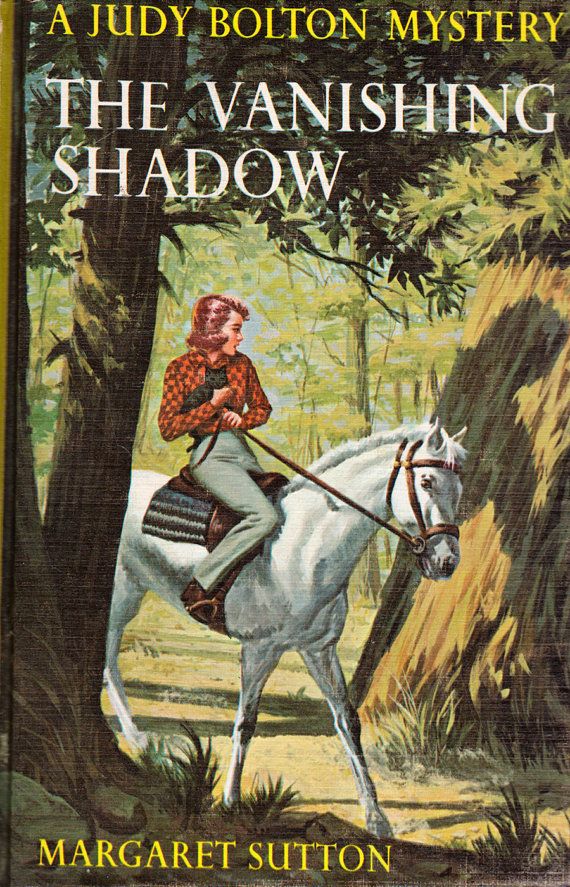
Despite my obsession with collecting and reading the entire series, as I mentioned earlier, Nancy Drew was never my favorite of the kids’ series; I liked The Three Investigators and Ken Holt most of all, and I always thought both Trixie Belden (the original six) and Judy Bolton were better written and more interesting than Nancy (Judy was also a goody two-shoes, but she was more rounded and developed, as were her friends), and looking through The Ghost of Blackwood Hall made me remember why she was never a favorite; the books aren’t very well written. (The original texts were much better than the revised ones, but it was a very low bar to hurdle, seriously.) And yet I had to have all the books and read them all; I watched the 70s television series with pre-Dynasty Pamela Sue Martin; and I still sort of have a soft spot for good ole Nancy; but man, these revised texts are simply terrible–and the later, newer books steadily declined in quality–I remember one where Nancy and her friends, being chased by a bad guy, duck into a room and–this is so stupid, it was even shown as an illustration–hide by sitting in chairs and holding up picture frames because of course the bad guy would look at them sitting still and believe they were a photograph or a painting.

Even as a kid, I knew that was fucking stupid.

Anyway, so Nancy is hired by a jeweler to help out his client Mrs. Putney–who clearly isn’t the sharpest tool in the shed–who is a widow and received a message from “beyond the grave” from her husband that she needed to bury her most valuable jewelry in the woods for safekeeping. (She’s also told to tell “no man or woman” about this; which is why the jeweler brings her to Nancy because she’s a “girl”–but the jeweler is a man…I guess in her mind he doesn’t count because he’s the one who spots that her jewelry is all fake, once she’s reconsidered her stupidity and dug the jewels back up.) There’s a lot of gullibility and superstition in this book, for the record, that doesn’t really make any logical sense. In a weird sequence of events, Nancy winds up with the name of a man from New Orleans who was an accomplished jewelry designer and “capable of making fakes that look real”–so she decides to follow the clue to New Orleans to look for information on the man. Because of course. Anyway, despite the fact that Mrs. Putney isn’t paying for this trip and in fact warns her not to go–Carson Drew, Nancy’s father, decides to foot the bill for her, Bess and George to fly down to New Orleans and follow this laughable clue that could only be a valuable one in a Nancy Drew mystery. (As I was reading this part again, I started thinking about how expensive this would be back then–the revised text was written in 1967, the original in the late 1940’s–and how amazing it was that all three eighteen year old girls had nothing else to do and could hop on a flight to New Orleans just like that; I am sure even back then it was more expensive to buy a ticket at the last minute.)

None of this mattered, of course, to young Greg when he was reading it the first time…and yes, I am being harsh about a kids’ series book which I am clearly too old for, but c’mon. And I knew when I was a kid that the books weren’t well written. (One thing that always annoyed me about this series and the Hardy Boys was they never really deduced anything or solved an actual mystery; really, the books were usually about catching a criminal whose identity was known almost from the start through a series of contrivances.)

But…

Once they are in New Orleans–after Bess tells a strange woman on their flight where they are staying in city: Nancy, seated in front of them, was sorry their hotel had been named. She had wanted to keep their visit to New Orleans as secret as possible. Um, you’re on a flight to New Orleans. So, since it’s too late to call on the suspect’s former boss, they go sight-seeing–but Nancy ducks into every jewelry and/or pawn shop they come upon.

The trip proved to be pleasurable, if not profitable. Their inquiries led them into many sections of New Orleans. The French Quarter, where the buildings were charming in their elegance of a bygone day, interested them most. Beautiful ironwork, delicately tinted plaster walls, old courtyards, once the center of fashionable Creole family life, fascinated the girls.

On a balcony, a brightly-colored parrot chattered at them in friendly fashion. A smiling woman, bearing a basket of flowers, stopped to sell a flower to each girl. On all sides, the visitors saw interesting characters, and heard the soft-spoken dialect which was a blend of French, Cajun, and Gumbo.

GUMBO IS NOT A LANGUAGE.

And since Cajun is a derivative of French…sigh. And by 1967 New Orleans wasn’t really bilingual anymore. It had begun to die out around the turn of the twentieth century, and it’s definitely a rarity here now to find anyone native who speaks both English and French, or speaks French as their first language.

The next day they visit their suspect’s former employer, who knows nothing, and then do some site-seeing before lunch “in a quaint restaurant.”

“New Orleans is wonderful!” Bess exclaimed. Counting on her fingers, she added, “We’ve seen the banana wharf, the market, the garden district, and that old cemetery where all the dead are buried in tombs above the ground.”

“That’s because this place is below sea level,” said George. “Say, do you suppose that guide that we believed the story about the tomb which is supposed to glow at night with an unearthly light?”

“He said spirits come out and weave back and forth like wisps of fog,” said Bess.

“That’s just what they are–fog,” George declared practically.

“Oh, I don’t for a minute believe in ghosts,” Bess replied quickly.

“I wish we had time to go to Grand Isle, the haunt of Lafitte and his men,” said Nancy.

“Who is he?” Bess asked.

“He was a famous pirate,” Nancy replied. “According to tradition, when burying treasure, he always murdered one of his band and left his ghost to guard the hidden loot!”

I guess Bess never studied about the Battle of New Orleans–and no one at either the Stratemeyer Syndicate or Grosset & Dunlap knew that you capitalize “Garden District.” Then comes a really weird section where the girls visit a spiritualist photographer on whose works sometimes “spirit writing” appears. Naturally, Nancy’s image has a warning to stop sleuthing, and then the lights go out and when they come back on, the photographer is unconscious, along with Nancy, are gone! This for me is a particularly weird section. Nancy is the point of view character, even if at a distance. Why would you then switch to Bess and George frantically searching for Nancy rather than showing her capture and abduction and eventual escape? WHY HAVE THE ACTION TAKE PLACE OFF THE PAGE?

Oh, and when Nancy regained consciousness, she was tied up and trapped in a basement near the Quarter.

A basement. Near the French Quarter. In New Orleans, which we’ve already learned is below sea level and therefore bodies can’t be buried in the ground. So of course we have basements.

But Nancy leads the cops back to the house, where all evidence of her being tied up and so forth have disappeared:

To their surprise the policeman remarked soberly, “This isn’t the first time queer things have happened in this section of the city.”

Ah, so it must be the Faubourg Marigny. Lots of queers lived there and in the lower Quarter back then. But I guess the girls should consider themselves lucky that they found an English-speaking cop–who would never say “this section of the city.” He’d name the neighborhood–“this isn’t the first time queer things have happened in the Marigny.” So anyway, the girls decide to go home, and fortunately, there’s a flight from New Orleans to River Heights within an hour. They pack and head for the airport just in time to catch their flight home–when Bess mentions something else mysterious that is going on that she knows about and just hasn’t mentioned before for some reason, and of course, as always, this side story subplot is connected to the main one.

And that’s where I stopped, since that was the end of Nancy’s adventures in New Orleans.

Sigh.

The Haunted Showboat, on the other hand, opens with an immediate eye-roller for New Orleanians:

“Would a trip to the Mardi Gras interest you, Nancy, and also a mystery to solve?” Bess Marvin asked.

Mardi Gras is French for Fat Tuesday, so basically Bess just asked her if she would interested in a trip to “the Fat Tuesday.” Yes, I am well aware that outside of New Orleans it’s all lazily considered Mardi Gras, but it’s really Carnival. Mardi Gras is quite literally Fat Tuesday, the final day of Carnival, and while I’ve grudgingly come to accept that there’s no way that people will ever not refer to the entire event as “Mardi Gras”–even I have a tendency to get lazy and say”Mardi Gras” when I mean Carnival–it will never not bother me. Of course, Bess isn’t from Louisiana and she can be forgiven for getting this wrong, and even using “the” as unnecessary definitive article can be forgiven. But–and this is something that always annoyed me about both Nancy Drew and the Hardy Boys–never is it mentioned in this book that Nancy and her friends have been to New Orleans before, and never was it mentioned on that previous trip in The Ghost of Blackwood Hall that Bess and George have New Orleans relatives.

Wouldn’t you think that would have come up in The Ghost of Blackwood Hall? Of course it didn’t, because when book 25 was written they had no idea that Book 35 would return Nancy and friends to New Orleans and Louisiana. (This kind of continuity thing used to drive me nuts; Nancy and the Hardys were ‘well known’ as amateur detectives, and every book opens with a reference to their first series book as well as the most recent, and closed with a teaser for the next, despite the fact that really, every mystery they solved was a stand alone with no connections to the past or the future. A couple of other continuity errors that always bugged me with Nancy is that Ned is mentioned as her boyfriend in the revised text of Number 5, The Secret at Shadow Ranch even though she meets him for the first time in Number 7, The Clue in the Diary; she finds her dog Togo as a stray at the opening of The Whispering Statue’s original text; but she already has Togo in the revised text of earlier volumes and yes, I am aware that I have spent way too much time in my life obsessing about Nancy Drew and continuity errors in the series–and there are a lot.)

Anyway.

If anything, The Haunted Showboat is actually worse than The Ghost of Blackwood Hall in so many ways, and not just in the aforementioned minor ways. First of all, the cousin of Bess and George’s, who invited them down, is named Donna Mae, because back in the day you could always make your audience know “hey this is set in the South” by giving a female character two first names–and always something Mae. (Ellie Mae Clampett is another example; for the record, out of dozen and dozens of southern women relatives there is exactly one whose name was “Something Mae”.) It takes a while for them to get to Louisiana–Nancy’s car is stolen once, and the replacement is sabotaged–because of course the criminals down in Louisiana will stop at nothing to keep this teenager from the midwest to interfere with their plans!–but there’s one part of their trip that is absolutely hilarious: they drive through Mobile on their way to New Orleans, but somehow get to the Mississippi River before they get to New Orleans or the plantation outside of town they are visiting:

Soon the girls reached the broad Mississippi and gazed at the peaceful, somewhat muddy river.

SOMEWHAT MUDDY?

Nancy then follows the River Road and turns inland. This geography makes literally no sense at all. But..it’s Nancy Drew, and the worst is yet to come.

You see, the Havers–who live at Sunnymead–have two black servants: Mammy Matilda and Pappy Cole. And oh yes, it’s just as racist and horrible as you can imagine–especially when you add in the “voodoo drums” they hear when canoeing through the swamp to get to the wrecked and haunted showboat, the River Princess. Anyway, yes, you can just imagine how dated and awful these depictions are. And everyone calls it “the Mardi Gras,” which no one does in the real world, either. The Quarter is referred to (correctly) as the “Vieux Carré”, but an aside says “or the old city”–it means “old square”, not old city–and of course they have lunch at Antoine’s.

There’s also an Uncle Rufus, who lives in the swamp in a tiny cabin and does voodoo spells.

There’s also a swamp episode and a wrecked, haunted showboat in an episode of Scooby Doo Where Are You?, which I’ve always wondered whether it was inspired (or stolen) from this edition.

So, neither book has aged particularly well–I’m still trying to wrap my mind around Gumbo as a language–and I suppose I shouldn’t be surprised by the racist depictions of Black characters in The Haunted Showboat, but the book is still in print and kids are still reading it. Everyone knows that the original texts of the Hardy Boys and Nancy Drew series were updated in the 1950’s and through the 1960’s to get rid of problematic depictions of non-white characters; it might not be a bad idea for them to do it again now. No one should be reading The Haunted Showboat as it stands today, really.

But it was an interesting time travel to revisit the books again. At some point I’d love to talk about all the kids’ series I read when I was a child, but…time.

Straight Back

G’morning, Saturday! How you doing? I slept well, woke up sans alarm, and feel kind of rested and good this morning. The sun is ridiculously bright this morning–it was yesterday as well–but that’s fine. Today is a long day of college football, and I have one errand to run this morning later on. Yesterday was a fairly good day; I got my work done during the day and ran the errands that needed running. I made Swedish meatballs (my version of them, any way) for dinner last night, and we settled in to watch the finale of Bad Sisters and of course, Halloween Ends, which was remarkably different than what I was expecting and despite a slow start, turned out rather interestingly after all.

I did think about the book last night while I was waiting for Paul to be ready for television viewing (and while I was doing some chores and making dinner), so I think I may have some success working on it this morning. I am going to try to get this done, put the dishes away and do some other chores before taking a shower and getting cleaned up to work on the book before I have to run the errands. And while I am of course hoping that Alabama cleans Tennessee’s clock today, the LSU game isn’t until this evening so I have the day pretty much all free heading into that, so there’s no reason I can’t get some writing done today and tomorrow (note to self: check the time of the Saints game today so you can plan accordingly). I don’t need to make another grocery run this weekend–or even order anything for pick-up–so I can pretty much plan on having the time to get things done around here. I have to work Monday morning in the clinic (covering for someone) but I also don’t have to be there until eight-thirty, either. Huzzah!

I also want to start rereading ‘salem’s Lot today; but I also have some other things I want to read as well. There never is enough time for everything, seriously. I have a couple of short stories written by friends that I need to look over (I promised feedback months ago) and I also have that Shirley Jackson Edgar-winning story I want to read, too. At some point I want to drive around the city and take pictures of Halloween decorations too–maybe I can take a walk with my phone tomorrow morning around the neighborhood and the Garden District–because I feel like I don’t document life in New Orleans as much as I should.

But then this blog has never really had a theme other than really just being a kind of diary for me, more than anything else, one where I don’t really talk about personal things as much perhaps as I would in a diary but just a way of situating myself and seeing where and how I am every morning. I have some pending entries that I also need to finish–entries talking about other books I’ve written, other books I’ve read and yet not done an entry for yet–and of course that takes time out of my day every day as well as time away from my other writing. But I do have a rather funny one about Nancy Drew and New Orleans I really should finish sometime–I have a weird love/hate thing with Nancy Drew; my OCD required me to collect and read the entire series, yet she was never really a favorite of mine; there were other juvenile series I vastly preferred to both Nancy and The Hardy Boys–but I had wanted to pay homage to Nancy’s adventures in New Orleans in the new Scotty book, so I reread the two books where Nancy came to New Orleans (The Ghost of Blackwood Hall and The Haunted Showboat) and whoo-boy, were they dated, wrong on almost every level, and horrifyingly racist. (Sidebar: I’ve always wanted to write my own juvenile series, similar to Nancy Drew and the Hardy Boys, and at the same time I’ve always wanted to write a murder mystery set at a fan convention for one of these series–because I belong to some fan-pages on Facebook and let me tell you, those folks are interesting)

I also have my entry about Donna Andrews’ marvelous Round Up the Usual Peacocks to finish, and I also have a rather lengthy entry about Interview with the Vampire I think I’ll wait to finish until I am done with watching the show.

I am not going to lie, I was curious about Halloween Ends primarily because I absolutely hated the second film in this sequel/reboot series, or whatever the hell it is considered. I was impressed by the creative decisions made on how to handle this absolutely, finally the last chapter (the end definitively ends it, trust me); but I am not entirely sure how I felt about the focus being moved off Laurie and Michael Myers. I guess I was a little disappointed–I was hoping to see, I guess, a balls-to-the-wall Laurie v. Michael battle, which we did kind of get, but it also wasn’t the primary focus of the film? I appreciated the new story as well as the new cast members like Rohan Campbell (who plays Frank on Hulu’s The Hardy Boys reboot), but I came away a little disappointed, but that was due to my own expectations, not any failure of the film itself. (I was also really amused to no end that Kyle Richards of The Real Housewives of Beverly Hills, who played one of the kids Laurie babysits in the very original Halloween, was brought back to reprise the role in the new trilogy. After listening to her talk about “filming” all season, and “having to focus on learning her lines” while dealing with RHOBH drama…only to watch the actual film to see she has exactly two scenes and at most five lines made me laugh out loud–and of course, Paul shadily said “I find it really hard to believe a bartender in Haddonfield could afford all that plastic surgery” which sent me into gales of laughter. I did enjoy the movie, though, and appreciated the different direction it took. If you’re a fan of Halloween, I think you’ll enjoy it, too–but understand it’s different going in.

All right, on that note I am going to head into the spice mines. Have a lovely Saturday, Constant Reader, and GEAUX TIGERS!

That’s Alright

Sunday morning and I slept really well last night, so am feeling rested. I believe the Saints game is tonight, if I am not mistaken, which gives me most of the day to get things done. I did manage to get some things done yesterday in the wake of the LSU debacle; my kitchen is all straightened and cleaned up (I also watched the Auburn debacle against Georgia before giving up on football entirely for the day, as it was clearly not meant to be my day at all) and I finished reading my Donna Andrews book (Round Up the Usual Peacocks, more on that later) while getting started on my revisitation of Interview with the Vampire (which I realized, once again, upon starting that it’s really not a horror story of the kind one usually associates with vampires) and I also got some other things done yesterday as well. Today I have even more things to do, including picking up the groceries I ordered yesterday, and am hoping that I’ll be able to get a lot of things powered through. My coffee tastes great, I feel rested–if a little loopy from sleep, and that should wear off rather soon. A new episode of Interview with the Vampire should drop today as well–it’s fun to reread the book while watching the new adaptation–and of course, tomorrow I have to return to the office to see how much, if any, of a difference returning to the office for Mondays will make in how my work week goes every week.

We watched Sins of Our Mother last night on Netflix, a documentary about the so-called “Doomsday Mom,” who began to believe we were living in the end times and that she and her lover were modern-day prophets, which led to the murders of their spouses, one of her brothers, and two of her children. She hasn’t been tried yet–which of course led to my “why would you make the documentary before the trial?” question–but it was interesting. I feel incredibly sorry for her son Colby, her only surviving child–how do you go on with your life after something like this happens to you?– which is why the impact of crime on people is becoming more and more interesting to me than actually writing whodunnit murder mysteries. How do you go back to your normal life? How do you carry on, go on, get past the horror of your brother and sister being murdered by your mother and her lover? That she has become almost completely insane with religious fervor? I shudder at the thought.

We also started watching the Netflix adaptation of Christopher Pike’s The Midnight Club into a series. I loved Christopher Pike back in the day, once I discovered him; I made a point of going back and reading everything he wrote, and it was reading Pike (and from him, discovering other y/a horror/suspense writers in his wake like R. L. Stine, Jay Bennett, and Lois Duncan) that led me into writing my original three young adult novels (Sara, Sorceress, Sleeping Angel). I liked the Pike novels because they were so damned dark, and happy endings were never guaranteed in a Pike book (I always liked Pike more than Stine, even though I liked the way Stine linked his books together under the Fear Street series header), which I also liked. The Midnight Club is totally dark; the premise is that the book is set in a hospice for terminally ill teenagers, and they gather every night at midnight to tell each other stories–scary stories for the most part, but stories–and they also swear that the first one to die will try to come back and tell the others what death is like…while strange things are going on in the hospice itself, in which you can never be sure if those things are really happening or if the kids themselves are hallucinating from their drug protocols, which as I recall kept me off-balance as I read the book. Such a great premise, really; I don’t really remember much of the book other than the setting and the dying teenagers–which is pretty fucking grim, if you don’t mind me pointing that out–so there’s this almost-casual acceptance of their impending deaths as well as their curiosity about the supernatural and the world beyond–or if there even is one. I remember reading The Midnight Club and thinking “this is really heavy shit for teenagers to digest” but then…I was reading Stephen King when I was a teenager, so there’s that…but Pike was the one who made me realize my perceptions of what you could and couldn’t do in young adult fiction were heavily skewed and incredibly incorrect in almost every way. I’m not sure I am going to write any more of them, to be honest–I do have ideas for any number of others, but I think I’m going to pause my young adult writing for a while and maybe, perhaps, do some stand alones that are for adults rather than a young adult audience…(although I think mine do qualify as readable by adults, too, but I am not the best judge of any of that, really)

I really need to work on my book this morning once I finish this and get cleaned up. I want to do a little more reading on Interview today, and I have some other things that need to get done, too. The key is to not allow myself to get derailed or distracted, which is never an easy thing for me to have not happen, you know? I sometimes wonder how much I could get done if I weren’t so easily distracted from everything, but there you are; we’ll never know because I will always be distracted. Heavy sigh.

And on that note, I am going to head into the spice mines this morning. Y’all have a lovely Sunday and if you have an NFL team you root for, I hope they do well today.

Carousel

As Constant Reader should know by now, while my entire identity and ego is wrapped up (probably too much) in being a writer, the truth is I have always been, currently am, and will always be, a reader first. I love to read, always have since I first learning what the little squiggles on the pages actually meant and learned how to decipher the little squiggles first into words, then into sentences, paragraphs and eventually entire stories. Reading was always my escape from a world too harsh for a little creative gay boy surrounded by people who didn’t read much nor cared much about books and so forth; sometimes the fantasy worlds I created in my head–always influenced by my reading–were safer and better places that I preferred to what, to me, was the horror of reality. I also learned a lot from my reading. I learned about other countries and cultures and groups; history and geography and other little odds and ends of information that remain lodged in my head and make me good at both Jeopardy! and Trivial Pursuit (case in point: I learned from Nancy Drew’s 44th adventure The Clue in the Crossword Cipher that the Incas’ language was quechua; I’ve never forgotten that, or that the Nasca Lines play a part in the book, and she and her friends also went to Machu Picchu).

Over the last few years I realized that my reading was primarily white and straight and decided to correct that; since then I have discovered the eye-opening marvel that is the talent of non-white authors and their remarkable story-telling ability. S. A. Cosby, Kellye Garrett, Silvia Moreno-Garcia, Mia P. Manansala, Alex Segura Jr, Raquel V. Reyes and many others have opened my eyes to other American experiences, and reading their work has also given me a broader and deeper understanding and appreciation of a different kind of American experience.

And then I read Gabino Iglesias’ 2022 release, The Devil Takes You Home.

Leukemia. That’s what the doctor said. She was young, white, and pretty. Her brown hair hung like a curtain over her left eye. She talked to us softly, using the tone most people use to explain things to a child, especially when they think the child is an idiot. Her mouth opened just enough to let the words flow out. She said our four-year-old daughter had cancer in her blood cells. Our Anita, who waited in the other room, playing with Legos and still wrapped in innocence. Acute lymphoblastic leukemia. Those strange words were said in a voice that was both impossibly sharp and velvety. Her soft delivery didn’t help. You can wrap a shotgun in flowers, but that doesn’t make the blast less lethal.

The young, white, pretty doctor told us it was too early to tell for sure, but there was a good chance that Anita was going to be okay. Okay, that’s the word she used. Sometimes four letters mean the world. She immediately added that she couldn’t make any promises. People fear being someone else’s hope. I understood her, but I wanted her to be our hope.

Jesus.

The opening of the book rips your heart out and rends your soul.

I am not a parent, never have been, never wanted to be, and never will be. I admire and respect parents (for the most part) because when I try to imagine what it’s like to be one, I can’t–it literally wears my brain down. I am a chronic worrier as it is; I get nervous when Paul doesn’t come home from work when he’s supposed to, or dawdles and delays and doesn’t text me. But for the most part, I know he’s an adult and functional and I believe he can, for the most part, navigate the world safely so I don’t spend a lot of time worrying about him.

I don’t think parents ever have a moment’s rest from the time the child is born until the child or the parents die–and I can imagine no greater grief than losing a beloved child.

Losing their child is how this book opens. And you just know in your heart of hearts–things aren’t going to get better any time soon for the father narrating this story. It isn’t a spoiler to let you know, Constant Reader, that by Chapter Three Anita is dead and her parents are swimming in debt and grief and drowning in it all. Before long, the marriage is over and Mario is alone with his grief and his debt and misery.

I don’t think I’ve ever read such a literate and powerful description of rock bottom in my life.

Mario turns back to crime in an attempt to make things right with the world and to somehow fill his horrible emptiness with something, anything. He starts off as a hitman, killing bad people and making money to pay down his debt and maybe, just maybe, somehow get his wife back and they can start over. Mario is desperate–and aren’t desperate characters the essense of noir at its purest distillation? He is then recruited to help liberate some cash from a cartel on its way to Mexico. Success means a cool two hundred grand and the potential to start over. Failure means a bullet in the head.

Both are better options than the life Mario is living at the time.

The pacing is breakneck and the story itself is a trainwreck you can’t look away from; you can’t help rooting for Mario, flaws and all, because the suffering is so intense you want him to find, somehow, both redemption and peace. (The book also serves as a stinging indictment of poverty in this country, and the near-impossibility of bettering yourself while drowning in the debt incurred for the possibility of bettering yourself, as well as our fraudulent health care system. Parents shouldn’t be saddled with insurmountable debt for trying to keep their child alive and especially not when the child passes.)

There are also some fascinating elements of the paranormal/supernatural mixed into the story, too–but while this might throw a typical noir off-track, it works here to heighten the sense of madness and unreality the entire book invokes. The true horror of the book is the system, designed to keep people of color down and to keep the cycle of poverty going.

Here are just a few of the gems in the prose:

The middle of nowhere is remarkably consistent in terms of being unmemorable.

The décor was a mix of a failed attempt at hill-country chic circa 1970 and neon signs for the kinds of beers folks buy at gas station convenience stores on their way to somewhere they wish they could escape.

The Devil Takes You Home is raw, fresh and original, with the kind of crisp smart literate writing that speaks of Lisa Lutz, Megan Abbott, and Jim Thompson.

I marked any number of pages for these writing gems that both awed and inspired me (to do better with my own work).

I highly recommend the book–but be warned: there is violence and gore aplenty, but it all works because it’s not there for shock value.