Cardigan

Yes, it’s cardigan/sweater/light jacket weather in New Orleans again; autumn has fallen. And yes, I recognize our weather undoubtedly would feel like spring/early summer to some people–lows in the sixties, highs in the seventies–but this is a thirty degree drop from the dreadful days of August/September, and this year it lasted into October. There’s always been something unsettling to me about the fall season–as things wither and die, as the sun recedes and is only around for about nine hours per day, and the season of rest for the earth approaches–which is undoubtedly why All Hallows’ Eve was dated around that time of change; and why the ancients undoubtedly believed the veil between the worlds of the living and the dead was so thin at this time of year.

It’s also lovely because now it’s crockpot cooking weather, which I love–soups and chilis and meatballs with gravy! Yum!

I went to bed early last night, unable to continue watching the election results. I didn’t want to check this morning when I woke up, frankly, but one cannot live in denial forever. Obviously, there are no final results and it isn’t over, as I discovered as I woke up, but my pessimism remains firmly in place. I don’t like being proven right in these instances, but I deep down believed this was going to be close, with the possibility of the results not going the way I wanted and going the way I feared. It’s not quite as shocking to me as it might be to other white people; as a gay man, I’m quite used to being hated abstractly by a majority of Americans and having my rights considered, at best, unimportant and at worst not worth thinking about. I have seen the face of American white hatred and have, in fact, been dealing with it for most of my adult life–and it’s not just white Americans, either. There’s enough homophobia and transphobia out there for white Americans to share with people of color–it’s the one thing white Americans are willing to share with people of color.

But we survived the Reagan administration, when they were letting HIV/AIDS kill us–and not-so-secretly hoping it would kill all of us–and we survived the second Bush presidency, so if the worst comes to worst yet again, I am sure somehow we can survive another four years of this. Am I tired of it all? Yes, I am. Will I go on fighting? I have to, because what other choice do I have?

It’s very easy to give in to despair, which of course is what they want us to do. They want us to go quietly into that good night, disappear from public view, get swept back under the rug or securely locked back into our closets. But I do know I am not going to listen to any analysis; I am not interested in “understanding” the other side any more than they are interested in “understanding” me and my values and my beliefs. All I am interested in is the final results, and getting on with my life for as long as I can.

I worked on “A Dirge in the Dark” last night some, in bits and pieces here and there, because I couldn’t truly focus on anything for very long. I think the story is going to turn out really well, actually, which pleases me. I’ll try to spend some more time with it today and tonight, see if I can get that draft finished, and I also need to start working with Bury Me in Shadows again. I need to rouse myself from this stupor and start getting things taken care of again. That’s pretty much all I can do, and all of the negativity of the last year or so needs to be ignored, put away, shunted aside and locked up in a dark corner of my mind. I need to focus on me, and my career, and the things I have to get done; and not worry about things that are beyond my control.

I had also intended to go to the gym last night, but I was tired and got home late from the office. I decided to take the night off from working out and just go tonight when I get home from work; at least tomorrow I don’t have to get up at six in the morning, and then I can go on Friday and Sunday quite happily. There’s not an LSU game this weekend I don’t think, so I can spend all day Saturday cleaning and writing and reading–as I mentioned after the disappointment of last weekend’s LSU game, I no longer am vested in either the conference or national races, so I only have to watch LSU games and can ignore the rest of them quite happily while getting things done that I need to get done.

I want to finish reading The Hot Rock, and I also want to get back to both the Short Story Project as well as the Diversity Project. I feel like a lot of things have slid this year, and I need to snap out of this pandemic stupor and get back to being on top of things. There’s no telling when any of this might end, and I need to stop pinning thoughts on my mental bulletin board with post-its attached reading for when the pandemic is over. We’re going into month seven, with no end in sight, and I can’t keep pushing things back on my lists–no matter how much I want to.

I feel like this morning, in some ways, I’ve woken up, shaken off the malaise and stupor of the last year, and am seeing everything with a cold, dispassionate, clear eye. We shall see how long it lasts, of course–I know I’ll get tired again this afternoon, and run out of steam at some point, and of course going to the gym tonight will be exhausting–but might as well make some hay while I can.

And on that note, tis back to the spice mines.

You’re My Best Friend

If I had a dollar for every time I’ve been told that I’m a terrible friend, I wouldn’t need a day job.

If I had a ten dollar bill for every time I’ve been told I am a terrible person, I would be debt-free.

Friendship has always been a tricky thing for me to negotiate. It’s something I’ve never really quite understood the rules for–like so many other aspects of life; it really needs, at least for me, a rulebook or a guide of some kind. I was a very sheltered child, and have–this always makes people laugh when I say this, but it’s true–a horrible degree of painful shyness. I never know how to start a conversation with someone I have just met, and social occasions where I don’t know anyone are excruciating, as I can never introduce myself to anyone and just start talking. Social events where I only know one person in attendance is excruciating for the person I know, as I literally glom onto them like a life preserver and refuse to let them out of my presence–and if they do manage to escape, I will find them like I’ve chipped them, tracking them down like an escaped pet.

I always feel bad about it later–wondering, as is my wont, if the poor person I glommed on to even likes me or enjoys my company in the first place. I also wonder if I should apologize.

I don’t understand the rules, you see.

So, as with everything, I have always taken my cues from books, television shows, and movies. Ah, those marvelous friendships that exist in fiction! Trixie Belden and the Bob-Whites; Nancy with Bess and George; Frank and Joe with Chet, and so on and so forth. I always wanted friends like the ones fictional characters had, wanted to be a friend like fictional characters actually were. But, as I grew older and life continuously proved to be much more difficult, as well as vastly different, from the fictional worlds I loved to escape into, I began to learn that I not only didn’t understand what friendships were like in the real world, but that there were rules I didn’t know about, and those rules were different with every person.

One of the maxims I began to swear by when I burned my life to the ground at thirty-three and started to building a life that was more in keeping to what I had wanted and dreamed of since I was a child was the common denominator in all of your problems is you. Neat, simple, and to the point; it’s also true. But there are, as I learned over the year, also corollaries to the theorems; other truths to be considered, proofs and postulates. At thirty-three, I very willingly took ownership that all the issues I had previously, either with friends or in romantic-type relationships, were mine and mine only–any blame for dysfunction or ruptures or bad behavior could only be laid at my own door. I was never able, for example, to understand or figure out where a relationship went wrong, turned sour, when knowing me and interacting with me became so problematic and difficult that it was easier for someone to just walk away rather than try to work it out (which I always believed was something that friends did; one of those rules that were never explained to me). I tried, believe me–so many hours and journal entries wasted on trying to understand what I did wrong, where I went wrong, what was wrong with me, why did this continue to happen?

I thought back to all the times I’d been ghosted by someone, or a friend had informed me that I was a terrible person and a bad friend; in retrospect, it was something that happened so regularly that there had to be some truth in it. I’d always thought, and taken pride in, being a good friend; for always being there with kind words and a shoulder to be cried upon whenever it was needed…and yet–

And yet.

And yet, as I noted on my birthday blog, I found that I was also frequently disappointed by people. Whether it was my birthday, or being included in things, or whenever I needed someone to talk to when I was personally going through something difficult…inevitably, what I made myself available for with others wasn’t being made available to me. When I tried to talk to someone about problems, it was often dismissed–or I was told, “Jesus, you’re such a downer.” I have had friends tell me, through intermediaries, that “so-and-so doesn’t really want to talk to you anymore because they just can’t deal with you anymore.”

I learned this lesson: when you expect things from people you will inevitably be disappointed.

I’m not sure how old I was, or when I discovered an all-too-important corollary to my common-denominator theorem, but it was incredibly freeing. That corollary was certain personality types attract emotional predators, and that isn’t the fault of the person who attracts them.

Narcissists, for example, seek the personality types that will feed their self-obsession–and they aren’t interested in anyone else’s self-obsession unless it correlates with their own; in other words, if listening to your problems and offering comfort will soothe their own self-satisfaction; i.e. see what a good friend I am? I am such a wonderful person.

I know that I have narcissistic tendencies and that I have an ego; I don’t really think it’s possible for someone to become a creative artist without the odd mixture of complicated and complex and contradictory personality traits that inevitably drive so many of us to drink, drugs, and/or despair; the introversion and self-obsession and ego that drives us to create and believe that others will be interested in our creations, while at the same time being harshly self-critical, self-defeating, and utterly insecure about everything.

And while I’ve also come to realize that while friendship isn’t, and shouldn’t be, something where one needs to be constantly keeping score, a lot of people do that very thing.

I also learned to be suspicious of people doing nice things for me–because in the past, that nice thing inevitably would be used to bludgeon me as an example of how much better a friend that person was than I, and therefore I didn’t deserve to have friends.

When you’re told you’re terrible in some way, especially if it comes from more than one person, it becomes easy to believe that it’ s true. I’ve also been ghosted a lot; one day I would be close friends with someone and the next day the same person didn’t want to speak to me, say hello, or even acknowledge my existence. The first time that happened to me was in seventh grade, in junior high school (junior high was a horrible experience for me, but that’s not the point of this entry), and ever since then, I’ve had difficulty in trusting people completely; whenever I met someone new, befriended someone, there’s always been a wariness inside my mind, a little voice saying remember–you can’t trust people to not turn on you and that, coupled with my innate shyness and social awkwardness, has always made it difficult for me to ever get really close to people. It was in junior high, after all, that I learned there were names for what and who I was–unpleasant, insulting names, always said in a sneering, contemptuous manner–and so I kept my true self hidden from people.

Faggot. Sissy. Fag. Cocksucker.

Even before I was completely sure I knew what the words meant, I knew they were bad–they weren’t complimentary–and whatever they meant, it wasn’t anything I wanted to be.

God knows I’ve been told enough times by people that I’m a terrible friend and a terrible person; it used to always slash me to the quick and hurt my feelings. I was ghosted in junior high school by an entire group of friends who suddenly all stopped speaking to me or acknowledging my existence–to this day I don’t know why–and that early experience, combined with innate shyness, has always made it difficult for me to trust people. And as I’ve gotten older, my trust has gotten harder to earn.

But as I said, I wish there was a manual of some kind; instructions or something. I never know what is appropriate and what isn’t; I’ve also certainly been known to misjudge politeness for friendship before. Am I supposed to reach out to someone when they’re going through a rough time, or do I give them their space? Is it more annoying to have to answer emails and messages from friends who mean well when you’re going through something, or is it better to be left alone? I also have a tendency to withdraw into myself whenever things aren’t going so well; I don’t reach out to other people for support when I am going through something, and while I do appreciate well wishes and things like that…I don’t understand the rules.

I know lots of people at this point in my life; social media has made keeping up with people from my past much easier than it ever was before. I do notice there are gaps, though; I have reacquainted myself with people I went to high school with in Kansas, but no one from before that; after high school graduation the next big gap is people I met and knew from 1978-1985. There are people I know from when we first moved to New Orleans, and various writers and authors and editors and actors and actresses with whom I have crossed paths at one time or another, and people I’ve worked with. My friends’ list on Facebook is a curious mixture of people from all over the country with me as the primary common denominator.

But one thing I have definitely learned over the years is when someone abuses you–emotionally, mentally, verbally–they will do it again, and no matter how much you care about them , or how much time or energy you’ve put into the relationship, it will happen again. I’ve gotten much better about recognizing the difference between a disagreement and an abusive friendship, and my go-to has become If I won’t let my mother talk to me like this, well, youre not my mother.

But I still wish there was a guidebook, you know? It would make things so much easier.

207487_10150150060542610_263430972609_7301793_6247407_n

The Long Run

Not only do I write two private eye series, erotica, and the occasional stand alone,  I also, sometimes, write what’s classified as young adult fiction. I have not published anything that could remotely be considered y/a in quite a while, and therein lies a tale (I think the last book I published that could be considered “young adult” was Dark Tide; I could be wrong. I no longer remember when and in what order my non-series books came out).

To be clear, the fact that I even call those books “y/a” even though I don’t really think of them as young adult fiction is a marketing thing, really; in my mind, they’re simply novels I wrote about teenagers. I started writing about teenagers when I actually was one; the stories I wrote in high school weren’t bad, for a teenager, and were the first indication–from my fellow classmates, and my English teacher–that I could seriously become a published writer if I chose to try to do so; the utter lack of seriousness my writing aspirations received from my family was kind of soul-crushing. But I always wanted to write about teenagers, from the very beginnings; I wanted to do my own Nancy Drew/Hardy Boys style series, and then progressed to other stories.

I progressed as a reader pretty quickly when I was growing up; I went from the series books, like the Hardy Boys and Nancy Drew, and the Scholastic Book Club mysteries, to Agatha Christie, Charlotte Armstrong, and Ellery Queen when I was around eleven or twelve, if not younger; I know I read both Gone with the Wind and Antonia Fraser’s Mary Queen of Scots when I was ten. The few books I read that were considered “children’s books” (there was no such thing as young adult fiction then) were books like The Outsiders and The Cat Ate My Gymsuit and I did enjoy them; I just didn’t think of them as either being particularly authentic or realistic. Nor did they have any bearing on my life, or the lives of my friends–I viewed them like youth-oriented television shows like The Brady Bunch, existing in some bizarre alternate universe that has no basis in actual reality or what those of us who were that age were actually experiencing. I always thought there was something missing–complicated and authentic books about the lives of real teenagers and the real issues they faced everyday, without getting into the insanity of the preachy-teachy “issue” books that usually wound up as ABC After-school Specials, which I loathed. 

Not all “issue books” were bad, in all fairness; some, like Lisa Bright and Dark, about a girl struggling with mental illness whose parents refused to face their daughter’s reality, so her friends tried to help her by serving as amateur psychologists, and  I Never Promised You a Rose Garden, about a teenaged girl in a mental hospital dealing with her illness were actually quite good. But I loved books like The Cheerleader, about a poor girl in a small New England town with ambitions and dreams that far exceeded those of most of her friends…dealing with issues of popularity, sex, and first love.  David Marlow’s Yearbook was also a favorite, and while not marketed to kids, was about high school, but had some themes and plot-lines considered far too heavy for teens to digest in the 1970’s. You can also see it in the pap that was considered movies for teenagers; G-rated bubble-gum like The Computer Wore Tennis Shoes, and inevitably came from Disney and starred Kurt Russell. (These movies are an interesting time capsule; I did try to watch one of them recently on Disney Plus and didn’t last three minutes in that squeaky clean, sex-free college environment.)

(Also, I would like to point out at this time there were terrific books being published in the 1970’s for teens that dealt with major issues and were groundbreaking; Sandra Scoppetone was writing about queer teens back then, and there were some others doing terrific work at the time–I just wasn’t aware of those books until much later.)

My first three young adult novels–Sorceress, Sleeping Angel, Sara–were written as first drafts in the early 1990’s, put in a drawer, and forgotten about for nearly twenty years. Sorceress  had no queer content in it at all; it was my version of the truly popular trope of romantic/domestic suspense where an orphaned girl goes to live in a spooky mansion far away from her old life (Jane Eyre, Rebecca, almost everything written by Victoria Holt), and slowly becomes aware that everything in the house isn’t as it seems. It was a lot of fun to write–I loved those books and I loved putting a modern spin on them. Sleeping Angel’s first draft was never completed, and the published version is vastly different than what the original first draft contained; there are still some vestiges of the original plot there in the book that are never truly explained, and by the time I realized, after many drafts, that I hadn’t removed those vestiges from the book it was too late to do anything about it other than hope no one noticed. The book did well, won an award or two, and is still a favorite of my readers, according to what I see on social media. One of the things I added to the story was a queer subplot about bullying, which is what I think readers truly responded to, and I also feel like adding that to the story in addition to the other changes I made to it made it a stronger book. Sara was always intended to have gay characters and a gay plot; I originally started writing it as a novel for adults and realized, over the course of writing it, that actually the teenage story was the most interesting part and I could deal with some issues there if I switched the focus of the book to the teenagers. One thing that changed from the 1991 first draft to the draft that was published is that the character I originally had being bullied for being gay, even though he wasn’t (another character, one of the biggest bullies, actually was), was actually not only gay but had come out, and so the book also talked about the reverberations of a popular football coming out, and what impact that had on the school social structure and hierarchy.

Sara, incidentally, is one of my lowest selling titles–which also kind of breaks my heart a little bit.

Since those three, there have been others I’ve written–Lake Thirteen, Dark Tide–and I’ve also dabbled in what is called “new adult fiction”–books about college-age or just out of college-age characters–this is where The Orion Mask and Timothy and the current one I’m working on, Bury Me in Shadows, fall on the marketing spectrum.

One of the questions I had to deal with in writing young adult novels with queer content was the question of sex. I had already been through being banned in Virginia because I had written gay erotica (a really long story that I revisited recently with Brad Shreve on his podcast; I really do need to write in depth about the entire experience); what would happen if ‘notorious gay porn writer’ Greg Herren began writing fiction specifically aimed at teenagers? But the truly interesting thing about being used as a political pawn by the right-wing fanatics in the power games they play is that once they’ve made use of you, they forget about you and move on. My young adult fiction was released without a single complaint, protest, or any of the sturm und drang that my speaking at a high school to a group of queer and queer-supportive youth created scant years earlier.

Interesting, isn’t it?

And yet…there is no sex in any of those books. None. I don’t  remember my gay teens even getting a chaste kiss, let alone a sex life, or fantasies, or a boyfriend.

And what about desire?

A couple of years ago someone tagged me on Facebook on an article about just that very subject; that was when I started writing this post (three yeara ago, looks like) but I never finished writing this until this morning.

Go ahead and read it. I’ll wait.

Okay, welcome back. Some interesting points, no?

Now, check out this one. 

I know, it’s a lot of information to process, but it’s something we should all be thinking about, particularly as the calls for diversity in publishing and popular culture continue. Sex is, quite obviously, a touchy subject when it comes to young adult fiction, but when it comes to questions of sexuality and being a sexual minority, what is too much and what is not enough? Even depictions of straight sexuality is frowned on and controversial when it comes to young adult fiction. (For the record, that is also considered the case for crime fiction–no explicit sex scenes–or at least so I was told when I was first getting started; doubly ironic that my mystery series were what the right-wing Virginian fanatics considered porn–I really do need to write about that.)

I also have noticed the elitism evident in hashtags like #ownvoices and #weneeddiversevoices that have come and gone and return periodically on Twitter; those actively involved in promoting those tags, when it comes to queer books, make it abundantly clear they only care about those published by the Big Five in New York–which is a good target, I agree, and they do need to be doing better when it comes to diversity and “own voices” work–but this focus also ignores the small presses, particularly the queer ones, who have been doing this work all along and making sure queer books were still being published for all ages and getting out there and made available to those who want and need them. I am absolutely delighted to see queer books by queers being published by the Big 5, and young adult work in particular…and yet…there are some serious issues still with the Big 5–and with what is called ” young adult Twitter”.

I do find it interesting to see who they decide are the “cool kids” and who they banish to the outer tables with the freaks and geeks.

It’s part of the reason I don’t engage with young adult twitter, to be honest. I really have no desire to return to the high school cafeteria at this point in my life.

And I’ll write about teenagers whenever there’s a story I want to tell involving teenagers–which currently is the Kansas book; I turned my protagonist in Bury Me in Shadows into a college student because it actually works better.

And on that note, tis back to the spice mines with me. (And huzzah for finally finishing this post!)

End Game

I’m really becoming a huge fan of Paul Tremblay.

I’ve always enjoyed horror, ever since I was a kid; I used to love watching Creature Features on WGN in Chicago, and getting scared–sometimes having nightmares. But the supernatural has always interested me, as well as horror; in the 1980’s and even into the early 1990’s I saw myself as becoming a horror writer rather than a crime writer. And while I’ve written some “scary” stories and novels, I don’t know that I could classify them as horror– I think Sara and Sorceress are probably the closest I’ve ever come to writing horror; maybe even Lake Thirteen would count (it certainly bears my favorite cover of all my novels). But I see myself as more of a fan of horror than a writer of it; as I’ve said many times, I tend to write more about human monsters than supernatural ones. I had heard great things about Paul Tremblay before I started reading his actual work; my friend Megan in particular is a big fan of his, and based on her recommendation I started reading A Head Full of Ghosts, but it didn’t really strike my fancy that first time, and so I put it aside and moved onto something else. I did pick it up again later, and then, of course, I couldn’t put it down.

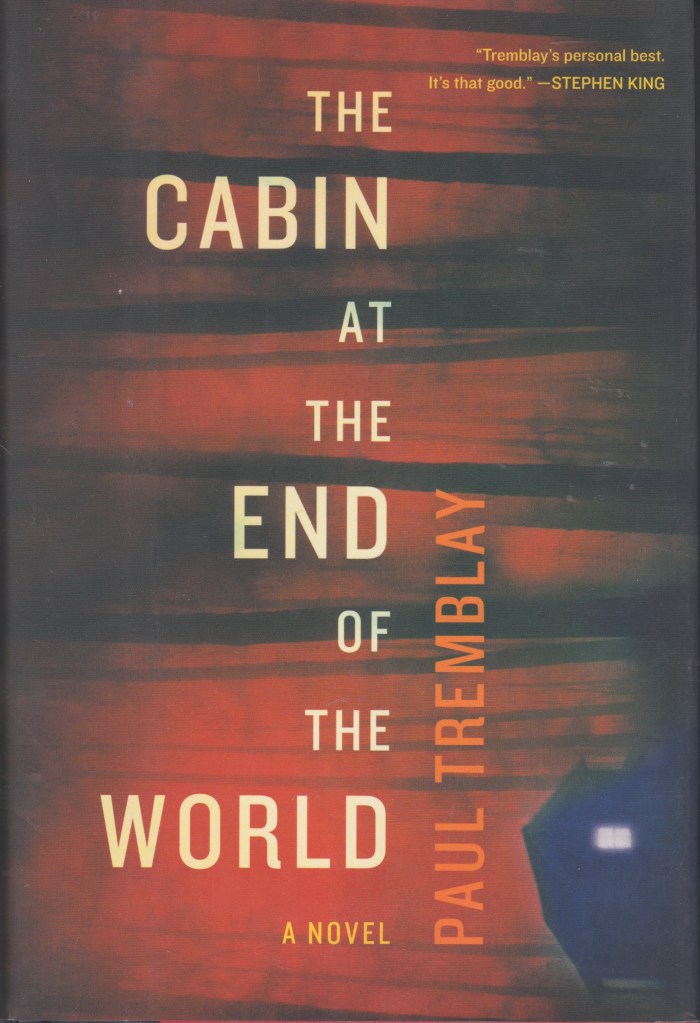
After finishing The Coyotes of Carthage, I was looking through the TBR piles, pulled out a book or two before putting them back, and then finally decided to read a second Tremblay, The Cabin at the End of the World.

It was a most excellent choice.

The girl with the dark hair walks down the wooden front stairs and lowers herself into the yellowing lagoon of ankle-high grass. A warm breeze ripples through the blades, leaves and crab-like petals of clover flowers. She studies the front yard, watching for the twitchy, mechanical motion and frantic jumps of grasshoppers. The glass jar cradled against her chest smells faintly of grape jelly and is sticky on the inside. She unscrews the aerated lid.

Wen promised Daddy Andrew she would release the grasshoppers before they got cooked inside the homemade terrarium. The grasshoppes will be okay because she’ll make sure to keep the jar out of direct sunlight. She worries, though,, that they could hurt themselves by jumping into the sharp edges of the lid’s punched-in holes. She’ll catch smaller grasshoppers, ones that don’t jump as high or as powerfully, and because of their compact size there will be more leg-stretching room inside the jar. She will talk to the grasshoppers in a low, soothing voice, and hopefully they will be less likely to panic and mash themselves against the dangerous metal stalactites. Satisfied with her updated plan, she pulls up a fistful of grass, roots and all, leaving a pockmark in the front yard’s sea of green and yellow. She carefully deposits and arranges the grass in the jar, then wipes her hans on her gray Wonder Woman T-shirt.

Ironically, in my earlier paragraphs I talked about writing crime because I want my monsters to be human; ironically, the monsters in Paul Tremblay’s latest, sublime entry into the horror genre could easily be considered a crime thriller as well because his monsters are all too human, and this set-up is just as terrifying as any supernatural horror novel I’ve ever read. Being out in the country has never really appealed to me very much (ironically, my current work-in-progress is set out in the country) precisely because it’s no safer out in the country than it is in the city; at least in the city someone will hear your screams or cries for help. The very isolation of the country is part of its terror for me; in no less part because country people always smugly assert (and reassure themselves) that crime and murder are MUCH more likely to happen in the big, bad, dangerous city.

Sidebar: I still think there’s a terrific essay to be written about the proliferation of rural horror/crime novels in the 1970’s, directly tied to the inherent racism of white flight from integrated schools and neighborhoods to the suburbs and the country, and perhaps someday I will have the confidence to write the essay based on that abstract theme.

Tremblay has set his terrifying tale in a small cabin on a lake in upstate New Hampshire, close to the Canadian border, where our heroes–a married gay couple (Andrew and Eric) are spending a ‘back-to-nature’ vacation with their adopted child, Wen. The story is told in the present tense (always creepier in horror, seeing the action unfold as it happens rather than in the much safer past tense–it’s happening as opposed to it’s already happened) and the point of view shifts between the two dads and their young daughter. Wen is out on the lawn catching grasshoppers and naming them when a big man appears suddenly out of the woods, friendly and nice, he tries to win her over but ultimately fails, sending her running inside to warn her daddies that they are no longer alone in their rustic cabin–with no cell service and no wi-fi (which, ironically, was part of the cabin’s original appeal–to unplug; that appeal will righteously bite the in their ass now that a Dionysian influence has arrived in their idyllic world).

The big man, Leonard, isn’t alone; he has three friends with him, all wearing similar button-down shirts in different colors and jeans: Redmond, kind of an asshole every-straight-man; Sabrina, a nurse; and Adriane, who is older. As the three family members barricade themselves into the cabin, the four seemingly normal visitors let them know they are there to present them with a horrible, horrific choice: they have seen, in visions and dreams, that the apocalypse is nigh, but have been shown the cabin and the small family, and told that if one of them will voluntarily sacrifice himself, the end of the world will be stopped.

This is, of course, every parent’s worst nightmare: a threat to not only their family but to their child, and Tremblay does an amazing job of letting us, the readers, get to know all three of the family members, developing them into complicated, realistic characters with backstories and levels and layers; I also applaud him for writing about a same-sex family and making the characters absolutely real. (This is how you do it, people; read the book and take notes). Wen is completely believable as a little girl; the family bond and love is absolutely real; and that makes the horror even more horrible, more horrifying, more of a gut-punch…as we go through every step of the process with them, all over the course of less than twenty-four hours, as their lives are irrevocably altered and changed, as they refuse to believe the story of their visitors, but slowly but surely the wonder begins to creep in…what if this is absolutely real and they are indeed messengers from God?

I will leave it to the horror academics to discuss the symbols and symbolism threaded throughout the story–but I have to bring up the colors of the shirts the visitors are wearing, and the fact there are four of them: representing the four horsemen of the apocalypse along with their warnings of doom. The questions of faith, of existing as gay in a heterosexist society, of family and love–all of these are beautifully explored and written about, and the building of tension and suspense is unparalleled; it’s really hard to put the book down and walk away from the story without finding out how it all ends–will they make the sacrifice, or will the world end? Are the visitors right–and how will anyone ever know if they were, because the world not ending doesn’t prove anything if the sacrifice occurs.

Or are they just insane?

I highly recommend this book, and cannot wait to read more Tremblay.

If You’ve Got the Money, I’ve Got The Time

One of the things I find fascinating about many people is their dedication to nostalgia; their insistence that some past time of their life was somehow this incredibly magical time of innocence (which it could conceivably have been); a utopia paradise of some sort where everything was right with the world and everyone was so happy and–you get the picture. It’s like how people glowingly refer to high school as one of the “best times of their lives” (which, frankly, is terribly sad and tells me more about their present circumstances than I’d care to know); the past wasn’t magic and neither were our childhoods. If they mean I liked life better before I knew how awful it can be, that I can understand–and I do think that is what they actually mean, even if it isn’t what they are actually saying: they preferred life when the bills and putting food on the table was someone else’s responsibility; when the biggest worries were who will I go to the Homecoming dance with and I have to study for that History test and so forth. But my teenaged years weren’t halcyon and rosy. The 1970’s was a very strange decade of reaction to the 1960’s–and for a queer kid, first trapped in a middle to upper middle class suburb of Chicago and then a small rural town in Kansas, it was hard. I’ve no desire to ever relive high school or go back to being a teenager. Sure, it might be easier to be a queer teen  in a Chicago suburb now–but I suspect it’s not that different in a rural high school in Kansas now than it was forty years ago.

Reading was always my escape from the pressures of a world into which I really didn’t fit–and one that from my earliest memories as a child I knew I didn’t belong in. Reading was a godsend for me, and I read ravenously. I was always being told to go outside and play instead of reading; the most effective punishments were the ones either prohibiting me from reading or limiting how much I could read, and the earliest signs of my obsessive/compulsive disorder were evident with my discovery of the mystery series for kids, which was the next gradual move for me as a reader from the Scholastic Book Fair mysteries. My goal has always been to finish collecting all the series I read and collected as a child: the Hardy Boys, Nancy Drew, the Dana Girls, The Three Investigators and Trixie Belden, as well as the lesser known ones like Biff Brewster, Ken Holt (over whom I had a weird bonding moment with James Ellroy), Rick Brant, Vicki Barr, Judy Bolton, Cherry Ames, Kay Tracey, and Connie Blair. (I also collected the Chip Hilton sports series.) I still have the copies I had as a child, and in the aftermath of Hurricane Katrina, I discovered eBay and tried to finish collecting the series. I don’t have room in the Lost Apartment to display them proudly in a bookcase–I have far too many books; and many of them are boxed up and stored–but I refuse to rid myself of them, because I keep holding out hope that someday I will live in an apartment or condo or house where I can have a room filled with bookcases that will also serve as my office.

But eBay gradually led me to collectors’ and fan pages of these books on Facebook..occasionally someone on one of those pages will be selling a copy of something I need to complete my collections.  There is a generic page for series books in general, and then there are individual pages for Nancy Drew and the Hardy Boys, respectively–and probably still others for the other series that I don’t know about. I know there are also fan websites and serious scholarship on the kids’ series–some of them make for interesting reading, if you have some free time (or are wasting time you should be spending on writing). Some of the fan websites also have conferences and trips–the Nancy Drew group, for example, has an annual trip to where one of the books was set, and tours and so forth to visit the places Nancy also went to look for clues in the course of her investigation. (They were in New Orleans a few years ago; I was going to register–it’s not cheap–until I realized it was more about being a fan than anything else.)

And boy, do these people take their series fandom seriously. I’m not as rabid or as devoted as the majority of them; periodically I might reread one of the series books (I’d love to write an essay about the Ken Holt series, which was darker and more hard-boiled than any of the others; which was why James Ellroy and I bonded over them–which is still so weird to me), but I don’t reread an entire series from beginning to end, and while I used to remember plot details quite vividly, as I’ve gotten older those memories are fading.

I’ve not watched the new CW series Nancy Drew–well, I watched the first episode but didn’t keep watching; primarily because I haven’t had time and Paul and I usually watch shows together–at least, I like to give him a chance to watch something I might enjoy before moving on to watch it on my own (like Riverdale). Maybe he’ll be interested in Nancy Drew, maybe he won’t; I thought he’d like Riverdale but he didn’t. Maybe Nancy Drew is something I’ll wind up watching while he’s working in the evenings; I don’t know. But I’ve also not seen the recent film adaptation, Nancy Drew and the Hidden Staircase, either. But boy, do these Nancy Drew fans take their Nancy Drew seriously. They were outraged that Nancy Drew had sex in the first episode (because Nancy of course never had sex in the series; I don’t even think she even enjoyed a chaste kiss from Ned in all 58 of the original books) and Ned Nickerson was black! Nancy Drew was not only having sex but she was having sex with a black teenager!

The pearls were clutched so tightly! And if you stuck a piece of coal up these people’s asses, it would have come out a diamond. There was a lot of moaning and whining about people’s childhoods being ruined (really? Mine is still just fine) and the “horrors of political correctness” and on and on and on. In other words, Nancy should be a virgin and only know white, straight, cishet people. Got it.

Anyway, Hulu recently announced that they are doing a Hardy Boys series; however, instead of Bayport the town is Bridgeport; their first case is their mother’s murder; and rather than being 18 and 17, their ages will be 16 and 12. Their father is off investigating the murder and so he deposits them with their aunt in Bridgeport, but they soon realize their mother’s death is somehow connected to the town–and everyone in town is a suspect.

Yes, these are significant changes to the original canon of the Hardy Boys, but also remember: The Mickey Mouse Club did two serialized versions of the Hardy Boys, making them also about 13 and 14. The Hardy Boys fans are fan with this, of course, and with the other changes Disney made…so what’s the problem? As someone pointed out, in response to all the whining and moaning about ruining characters and childhoods and “political correctness”, someone also commented, grumpily, “I suppose Chet will be slim, gay, and black”–which actually sounded kind of good to me, frankly. The character of Chet is overweight and loves to eat (kind of like Bess in the Nancy series) and also like Bess, his appetite and weight are the subject of lots of jokes, teasing and sometimes humiliation. Not really cool, if we’re being completely honest.

And yes, all of these people are grandparents with graying hair and are white people. All of this whining and complaining over two television series based on characters that have evolved and changed and been rewritten multiple times in the nearly hundred years they’ve been around–to appeal to  new generations of readers. The original versions of the books were all revised in the 1950’s and 1960’s because they were loaded with racial and ethnic stereotypes that were beyond offensive; naturally, the nice old white people prefer the original texts (big shock, right?).

And if any kids’ series need to be turned into television programs, can I vote for The Three Investigators and Encyclopedia Brown?

I am really tired of this whole “you’re ruining my childhood” nonsense. Unless they are traveling back in time to do so, your childhood hasn’t changed.

I’ve always wanted to write a book about kids’ series fans and conventions; I might just have to now. I mean, I get it–people don’t like change, and something that was beloved when you were a child you want frozen in amber forever. But I just wish these people would unpack their issues with the updates and changes–and nothing gets my gorge going more than the ever popular whine of every racist, misogynist, and homophobic piece of shit out there: politically correct. Sorry you don’t feel safe expressing your hateful bigoted opinions any more without consequence.

I’ve also always wanted to write my own middle-grade series; I used to think about that all the time when I was a kid, even up to coming up with characters and titles for the books in the series because of course I did. I don’t know if I can write middle-grade or not; but it’s worth a shot sometime.

And of course, I can talk for hours on the subject of the kids’ series. Perhaps someday I will.

1801217_10152346389544050_285672915_o

Amarillo by Morning

So, this morning when I woke up, as my first cup of coffee brewed, I dialed the COVID-19 testing hot-line for staff at the day job and made an appointment to get tested. They scheduled me for 9:20 am; I was called at around eight thirty, which left me with about fifty minutes to wake up, drink some coffee, and pull myself together. Our clinic’s COVID testing set-up is in the parking garage which is the ground floor of our building; staff simply drives into the garage and pulls up to the area where the tents and check-in desk are set up, and the doctor comes out and swabs your nose. Needless to say, as I swilled down coffee and brewed another quick cup to take with me in the car, my nerves were definitely feeling a bit frayed. Saturday was a better day than Friday; yesterday was better than Saturday. So far this morning I seem to feel okay other than fatigue–going up stairs to put on a T-shirt and shorts to drive over to the office made my legs and hips ache a bit; it also triggered a small coughing fit (note: the only time my lungs feel tight is when I cough; other than that I breathe fine and they don’t phase me at all. But when I cough, I feel a tightness in the center of my chest that is pretty severe–but as I said, once the coughing spasm passed, I feel fine) but I got dressed and drove over to the office. It didn’t take long as the streets are pretty empty–there’s some traffic, to be sure, and a pandemic and over-burdened hospitals doesn’t seem to be stopping people from driving like thoughtless assholes–and then I pulled into the garage, got checked in, signed my consent to be tested form, and Dr. Halperin came out and swabbed both nostrils.

And while I can see why the vice-president thought it was invasive–I imagine anything put it any of his orifices would be invasive to him–it really wasn’t that bad. It’s certainly not the worst thing I’ve ever had done to me; I’d certainly rather get my nostrils swabbed like that on a regular basis than have an abscessed tooth ever again, and the worst part of it wasn’t the invasiveness at all. The worst part is the chemical on the swab–it doesn’t quite burn per se, but the closest experience I can think of to it is when you accidentally and deeply inhale mothballs; my eyes watered and it burned a little bit, but not painfully.

In a best case scenario, the test results will be back within 2-4 days–it may be longer, who knows? But I have to go into a strict quarantine until the results do come back, which means not leaving the house or running any errands or doing much of anything. Of course I have gloves and masks, so I can theoretically do some things and leave the house if necessary, but I shouldn’t really take the risk of infecting someone else by going out in public until I know for a certain whether I currently have it, or did have it, or don’t have it at all. I was also a little confused because I’d assumed there would be a blood draw to go with the swab test, but I am also conditioned to thinking about testing for different viruses (HIV, syphilis, and Hep C) so I assumed the testing would also have to involve blood. But then I realized, afterwards as I was driving home, that mucous doesn’t carry the HIV, syphilis or Hep C viruses (virii?); but the COVID-19 virus can be airborne transmitted–which means it must be in the mucous membranes along with the antibodies.

At least that makes testing for it that much easier, so that’s kind of a plus?

I also noticed, this morning, a little bit of PTSD kicking in from the good old HIV/AIDS pandemic days–“oh, look, I need to get tested for a potentially fatal virus and have to wait days to get the results back”–but I quickly tamped that down, shoved the lid closed and firmly padlocked it. I suppose it’s a bit of a surprise that particular version of all the PTSD’s I have locked behind various doors in my brain took so long to try to worm it’s way out, but it did finally show up and I was able to beat it down rather easily.

Thank you, coping mechanisms, developed over several decades of seemingly endless trauma.

I didn’t have to take a nap yesterday, but after we finished watching Miss Fisher and the Crypt of Tears, a lovely stand-alone film follow-up to the wonderful Miss Fisher series from Australia (it was kind of an Indiana Jones-lite adventure, set in Palestine in 1928 and quite fun), I got down my copy of Barbara Tuchman’s A Distant Mirror and opened it up to the chapter about the Black Death. Yes, I recognize that my recent fascination with plagues and epidemics and pandemics is probably morbid, given the current state of affairs in the world, yet my curiosity had always had a bit of morbidity to it and it’s really not surprising that it would take this kind of turn. (And I’m actually kind of glad; I was glad to finally read “Death in Venice” even if it left me a little cold; and it also led me down the path to rereading “The Masque of the Red Death”, and back into my Daphne du Maurier short stories) Realistically, while everyone talks about the Spanish influenza pandemic of a hundred years ago, primarily because it was the most recent pandemic (note to self: reread Katherine Anne Porter’s “Pale Horse Pale Rider”), the worst pandemic in history was clearly the bubonic plague, the Black Death, or, as it was known more simply during the fourteenth century, “the pestilence.”

Here’s how the chapter opens:

In October 1347, two months after the fall of Calais, Genoese trading ships put into the harbor of Messina in Sicily with dead and dying men at the oars. The ships had come from the Black Sea port of Caffa (now Feodosiya) in the Crimea, where the Genoese maintained a trading post. The diseased sailors showed strange black swellings about the size of an egg or an apple in the armpits and groin. The swellings oozed blood and pus and were followed by spreading boils and black blotches on the skin from internal bleeding. The sick suffered severe pain and died quickly within five days of the first symptoms. As the disease spread, other symptoms of continuous fever and spitting of blood appeared instead of the swelling or buboes. The victims coughed and sweated heavily and died even more quickly, within three days or less, sometimes in 24 hours. In both types everything that issued from the body–breath, sweat, blood from the buboes and lungs, bloody urine, and blackened excrement–smelled foul. Depression and despair accompanied the physical symptoms, and before the end “death is seen seared on the face.”

The disease was bubonic plague, present in two forms: one that infected the bloodstream, causing the buboes and internal bleeding, and was spread by contact; and a second, more virulent pneumonic type that infected the lungs and was spread by respiratory infection. The presence of both at once caused the high mortality and speed of contagion. So lethal was the disease that cases were known of persons going to bed well and dying before they woke, of doctors catching the illness at a bedside and dying before the patient. So rapidly did it spread from one to another that to a French physician, Simon de Covino, it seemed as if one sick person “could infect the whole world.” The malignity of the pestilence appeared more terrible because its victims knew no prevention and no remedy.

The chapter is pretty horrific, and it’s hard to imagine what it must have been like to live through in the fourteenth century. It’s impossible to know how many people died because they died so quickly that graveyards overflowed and burial pits had to be dug; people simply dragged the bodies of their dead loved ones to the pits and dumped them there. Estimates were obviously guesses and sometimes exaggerated; one monk’s reported death toll for one particular city, in fact, was more than what its recorded population showed. But it’s not inaccurate to guess that one third of the European population died during the pestilence; towns disappeared, families completely died out. Farms went untended because the farmers and their families died; there were also undoubtedly consequential deaths, not from the plague but because of it; young children whose parents had died starved to death, etc. Naturally they thought it was the end of the world, a punishment from God for sin; and the fourteenth century, which Ms. Tuchman describes as “calamitous”, was certainly ripe for that kind of belief.

One of the interesting things to me about this current pandemic is–and this may entirely be because I am not paying attention and my social media is sort of a bubble; but I cannot believe someone would be saying this about the pandemic and no one i know would notice it and be outraged enough to post about it–where are the evangelicals? Where are all those “end times” preachers and ministers and con artists to prey on the fears of their congregation? Why isn’t anyone pointing out that this could actually be the “rapture” where God is calling his own to him? I have seen that some trashbag minister called this God’s punishment for the gays–but it didn’t gain any traction.

Maybe one of the outcomes of this pandemic will be the ending of that nonsense. I rather doubt it, but you know, hope springs eternal.

I did read for a while yesterday–I got further into Ammie Come Home and I read a short story by Harlan Ellison, “On the Downhill Side”, from his collection Deathbird Stories, which I’d originally read years ago, before I moved to New Orleans, and this story is set in New Orleans. Oddly enough, when I opened the ebook in my Kindle app on the iPad (I was actually looking to see if the collection included his Edgar winning “The Whimper of Whipped Dogs”–it does) it was already opened to that story, so I read it, and as always with Ellison, loved it–and while it certainly is brilliantly written, it was written by someone who didn’t live here. I did love the story; like all of Ellison’s stories, the humanity in it was overwhelming and identifiable and relatable. I’ll probably give it, at some point, its own entry here.

And now I am feeling a bit tired, so I am going to go rest for a bit.

Sexy-Shirtless-Guys-8

Coat of Many Colors

And just like that, we’ve made it to Friday. How lovely!

I slept extremely well, which was lovely. I feel rested today and I also feel as though I can actually handle whatever blows the world and life decide to throw at me today. Yesterday wasn’t an easy one; I felt tired most of the day and the lethargic lack of energy wasn’t, frankly, very much fun. I got home and rewarded myself with a quick view of Spider-man Into the Spider-verse, which is my favorite super-hero movie of all time (not that I am dogging on Tom Holland, whom I adore as Peter Parker) and that eased me into going to bed last night. I had already decided to go to the gym after work today rather than before; so I have this morning to regroup and get on top of everything again.

I did write a little bit yesterday. I had decided to revise a story I’d written for an anthology, which was rejected (rightly so, he typed grimly, after starting to reread it last night), and submit it to yet another anthology (I have three stories to submit by the end of the month), and I found myself wondering–I can’t say the name of the story, since the anthology is a blind/submission read–if I needed to tone it down a little bit? It’s a gay story, from a gay man’s point of view and there’s a lot of sexualizing and a lot of the gay male gaze; and I began wondering, as I revised and removed sentences from passive past tense to the active past tense (it is amazing how easily I default to passive voice; a problem I never seem to be able to kick; and it’s really not that difficult to avoid, really) and changed some things and made sentences stronger, how often do my stories get rejected for fear of offending a reader or a reviewer, rather than the quality of the story? That’s one of the issues one consistently faces as a gay writer trying to publish in a homophobic society and culture; you’re never sure if your story just wasn’t up to par, or if the gay point-of-view made the editors uncomfortable–or made them worry about offending readers and getting one-starred on Goodreads and Amazon as a direct result.

It’s shitty, but it’s my reality, and that of every gay writer. I’d like to think that a good story that is well-written would rise above that kind of bullshit, but every time I think we’re making progress, either in the culture and society and publishing–we get shoved back hard and shown our place.

And for the record, I’ve only published one short story in a mainstream market with a gay male character and theme. ONE. Everything else I’ve published in a mainstream market was about a straight character without any of the gay in it.

Over the last week or so, I’ve been sickened by the levels of overt and covert homophobia I’ve seen on Twitter. Yes, I know, I know; Twitter is a cesspool roiling with trolls and incels and every other kind of monster imaginable. But I don’t follow a lot of people over there; mostly other writers and maybe some journalists and reporters and reviewers and magazines, etc. Every so often I seem something appalling being tweeted at someone I know and like in the real world, not just cyberspace; I often report problematic tweets I see as harassment against someone else, and it may take a couple of days, but that account eventually gets suspended. It may be like trying to drain the ocean with a teaspoon, but I figure it’s the least I can do. And it has to be something egregious–like the use of a slur and an outright slander–for me to do something; my litmus test generally is if I start typing out an angry response I should just report it and not engage.

Typing out the tweet before deleting it always makes me feel better, and then I delete and report the person instead. This works for me.

Anyway, many years ago I stopped talking about politics publicly, either here, or on my blog or Facebook, because I have no desire to debate anyone or argue with anyone on my social media accounts. Part of it was, indeed, joining the national board of Mystery Writers of America; the realization that not everyone in the crime fiction world would agree with me on everything and I didn’t want to get into pissing contests on social media, particularly as a board member whose conduct might be held against the organization. Obviously, I still talk about queer equality and homophobia, but anyone who follows me on social media knows I’m a gay man (the pictures in every blog post alone is a tell, hello?) and as such, I feel I’m entitled to talk about that; I also feel like I have every right to speak out against racism when I see it, as well as misogyny and transphobia. These are, in my opinion, societal ills and I cannot just sit idly by and not speak my piece on these things from time to time.

One of the things I’ve noticed over the last week–I’ve actually noticed it before, but not to this extreme–is homophobia, particularly from people who actually should know better. That’s the true evil, to me, in our society; that all the hatreds–racism, homophobia, misogyny, transphobia–are so deeply engrained and systemic that people who should know better sometimes fall back into them quite easily, without thinking twice about what they are saying or how it can be perceived. Do I think these people are actually and actively homophobic? Probably not, but it’s really easy, as I said, to fall back into it.

Pete Buttigieg did something no openly gay man had ever done before; he ran for president as a prospective candidate in one of the two major parties. I don’t know Pete; I’ve never met him or his husband, Chasten, and what I do know is from reading about them in the press (I also follow Chasten on Twitter) and from seeing them speak on television. I’ve been impressed from the very first with Pete; he’s smart, articulate, and passionate about wanting to help other people. If Chasten’s name was Christine, I honestly think Pete would have been mopping the floor with the other candidates; he’s young, he’s attractive, a Rhodes scholar, a great public speaker, and a military veteran. He has flaws, obviously; there’s no such thing as a perfect candidate, no matter what anyone might think. But when he announced, I braced myself for the homophobic onslaught to come.

I just didn’t expect the majority of it to come from the left.

Campaigns always tend to be ugly, and this year’s presidential election will be no different from any previous one’s. Primaries can also be ugly–I remember the ugliness of the Democratic primaries of 1968, 1980, and 2016 very vividly, thank you very much (an aside: please note that ugly Democratic primaries inevitably lead to Republican presidents being elected–Nixon, Reagan, and Trump)–and so there are going to be slurs and insults and snide questions thrown around; I get it. Politics and power are an ugly business. But as I observed without commenting…I couldn’t help but notice that people who should know better, either consciously or subconsciously, were falling back on their internalized homophobia.

I never saw derisive nicknames, for example, for any of the Democratic candidates…except for Buttigieg. Think I’m wrong? How is Pete Buttigieg so much whiter than any of the other candidates, so much more so that an appellation of “Mayo Pete” was appropriate? No one was calling Amy Klobuchar “Wonder Bread Amy.” And sure, the ‘Mayor Pete’ branding might have had something to do with that–but as a gay man of a certain age, I couldn’t help notice that he was the only one with such a nickname. Were the other white candidates that much better than him on issues of race?

As for the leftists slyly shortening his name to “Pete Butt”–do you really think you’re fooling anyone? Yes, yes, I’m sure you were only calling him that because, of course, you were saving characters on social media where you have limited characters; but you could have saved three more by calling him “”Pete B”; people would have known who you were talking about. I daresay you could have even just said “Pete” since you were talking about the primaries.

So, why Pete Butt? Unless you’re using it as a dogwhistle; you know you can’t call him “Pete Buttsex” or “Pete the Fag” so instead you say “Pete Butt”–knowing full fucking well how that would be read. Congratulations on your wokeness, and go fuck yourself. By disrespecting Pete Buttigieg, who accomplished something I never thought I’d see happen in my goddamned lifetime, you are exposing your own inner homophobia. Oh, sure, you  can criticize him for his conduct as mayor, you can criticize his positions, you can oppose his candidacy all you like without being homophobic…but the glee I saw in basically calling him a faggot by using a dog-whistle?

Yeah, thanks for dropping the mask.

I’m not hurt by this behavior–I’m mostly disappointed. Disappointed in the left, disappointed in Democratic voters, disappointed in people I thought knew better and were allies. Disappointed in myself for once again thinking cishet straight people actually gave a shit about me and people like me.

Kind of like “woke” people who have no friends that are people of color. Why is that, precisely?

I mean, how very dare he run for president! Queers need to know their place, and certainly the halls of Congress and the White House aren’t, apparently, it.

And for the record, he won Iowa.

Nothing will ever change that. You may not like him, you may have dipped into your soul and the dark recesses of your lizard primordial brain to come up with a way to dismiss him and get away without being outright homophobic, but I see you.

And I’ll never forget–nor will I ever look at you the same way again. And don’t bother trying to explain how you’re not homophobic to me.

I SAW for myself.

Bravo.

1947744_10202426989929765_1557969767_n

Here’s a Quarter (Call Someone Who Cares)

Hello, Thursday, and how are you doing this lovely morning?

Yesterday was bizarre. I got up in the morning and took care of some business while I woke up–laundry, dishes, etc.–aware that we were expecting bad weather. It rained off and on all morning–nothing unusual there–and I got sprinkled on a bit when I walked to and from the gym (and yes, that’s twice this week and I am doing quite well with this so far, and I’m still enjoying the way my muscles feel), and then as I was getting ready for work and a conference call, a nasty thunderstorm rolled in. I got out of the shower and as I was getting dressed, I heard this weird clicking sound. Puzzled, I walked over to one of the bedroom windows and saw little white pellets bouncing off the windows, the fence, and the crepe myrtles. Hail? It’s hailing in New Orleans? But it’s seventy degrees outside! 

That’s correct, it was seventy degrees and hailing.

Plagues of Egypt, anyone?

It’s also rained heavily all night overnight here in New Orleans; it’s still dark outside and sprinkling.  I slept very well–always sleep well during rainstorms–and certainly didn’t want to get up this morning. Working out does, apparently, help with sleep, and I’ve greatly enjoyed the kind of restful sleep I’ve been having this entire week, which is very lovely. It’s also lovely to be working out for the right reasons again; for so long I was working out for all the wrong reasons; making it about aesthetics and how I looked (and enjoying the kind of attention I was getting for having a worked out physique) rather than doing it because of how it made me feel and to be healthier. Now that I’m older, and am on blood pressure medication and another daily pill for cholesterol–well, I should have forced my old fat ass back into the gym before I had to go on both. But we’ll see now what, if any, difference regular working out makes to those–although it will also be hard to tell whether it’s the result of the workouts or the drugs I have to take. Curious.

We watched another episode of Sex Education, and I have to say, the show is really quite revolutionary and clever, while also being well-acted and well-written. As I said the other day, each episode is basically a lesson is actual sexuality; yesterday’s was one in which a group of the teenage girls, not friends, being forced to come up with what they have in common as women: the answer inevitably ended up being sexually assaulted in some way, or as one of them told their teacher as they walked out, “unsolicited penises.” And sadly, they did indeed bond over their shared trauma. What a horribly sad statement about what it’s like to be a woman–or a teenaged girl–in these modern times.

Today is a long day at the office, and once I’m fully awake I have some emails to answer and some bills to pay; as well as trying to assemble everything I need for my taxes so i can get them off to the accountant and filed and out of the way. I need to get to work on the Secret Project again–I didn’t even open the file yesterday–and I also need to get started on my Sherlock story. I’m just going to get it started and try to get the rough draft sorted; I can always fix things later, after all, and as I often say, it’s much easier to edit something then it is to write it. But at the moment I’m still feeling a bit groggy and not quite awake yet–still on the first cup of coffee–and so that will have to be later in the day at some point.

I also finished reading Richard Campanella’s Bourbon Street, which I greatly enjoyed and highly recommend. My next non-fiction history read about New Orleans will be Jason berry’s City of a Million Dreams: A History of New Orleans at Year 300, which should be quite fun. I’ve made lots of notes from the Campanella; I’m sure there will be plenty of notes to be made from the Berry. I certainly am enjoying finally learning the true history of my home, and it is certainly inspiring me to write more historical fictions about New Orleans.

And on that note, the coffee is starting to kick into gear, so I am heading back into the spice mines until it’s time to head into the office. There’s also a lull in the rain–which undoubtedly is helping me wake up–but it’s definitely one of those days where you’d rather just stay in bed and read–which actually sounds lovely; if it weren’t for the coffee situation, I should probably do that more in the mornings, you know?

Have a lovely Thursday, Constant Reader!

1231520_256008661214780_1755497244_n

Tear Time

Friday and a rather chilly, grayish day has come to usher in the weekend. I was exhausted last night when I got home from work–which has been happening more and more lately–and slept really well. Paul didn’t get home until late, so we weren’t able to watch anything last night–but we made our plans for the weekend; since we really don’t care about the Super Bowl we’re going to try to get caught up on the shows we watch this weekend. I also want to get deeper into the Dorothy Hughes novel I am reading, Dread Journey. It’s relatively short, so I should be able to get through it relatively quickly, if I can devote the time to it.

This week wore me out somehow–I can’t remember the last time I was so worn down by a week in which it wasn’t parade season or I wasn’t on a trip somewhere. Not sure what that’s about, but it’s also part and parcel of the reboot I need to do on my life and my weekly routine. Most of all I need to start taking better care of myself, for one thing–particularly when it comes to health-related issues; there’s doctor’s appointments and blood work I need to have done that I somehow never seem to get around to, and that’s a big no-no. Last year was supposed to be the year that got taken care of–and it actually didn’t turn out that way.

But…at least now when I am home and too exhausted after work to write or read or focus on a TV show, I have lots of LSU game highlights from this past season to stream on Youtube.

I’m not, I think, going to try to overdo things this weekend; or make a to-do list that I will never finish, you know? I do need to update the to-do list I have running–I think I accomplished almost everything I needed to on the list yesterday, and there are some emails I need to send this morning before I head into the office later this morning–and I have several blog posts I’ve started writing and need to finish–my rereads of Victoria Holt’s Kirkland Revels and Patricia Highsmith’s The Talented Mr. Ripley have reviews I’ve started and not finished, for example. And as I begin to move on to the next book in the TBR pile, I should get those out of the way because I will also have to write a review of Dread Journey.

And I have some short stories I should finish, and others I should revisit.

The publishing world has really been a dumpster fire for quite some now–first the RWA mess, and now the whole American Dirt dust-up. Both dust-ups ultimately boil down to the same thing: what responsibility do writers have when they write outside their own experience? Particularly when it comes to the marginalized? I have always held that a writer can write about anything they wish; anything that intrigues them enough for them to sit down and spend the time constructing a novel is something they should write about. I chose to write a novel about rape culture in a small town, but I chose not to write it from the point of view of the victim, but rather that of someone else in the town, another player on the football team who wasn’t involved in the incident–but is close friends with the boys who did. I’ve been struggling with this manuscript for several years now; partly from a sense that maybe I wasn’t the right person to tell this story; was centering a teenaged boy rather than a teenaged girl in this story the right choice; was i doing a kind of To Kill a Mockingbird thing, trying to do a #notallmen type thing that would ultimately be offensive?

I like to think the fact that I actually do worry about these things is a good sign.

Anyway, I’ve always said that writers can write anything they are interested in, but have a responsibility to get things right. I’ve written from the point of view of women before; I’ve written from the point of view of a teenaged girl before. Do I, as a gay man, have a right to write about straight women/girls? Of course I do, and no one has ever told me that I don’t. But I also owe it to women–and all the women I’ve known–to create multi-faceted, complex, complicated women characters that are believable and whose experiences are also believable. Likewise, a cisgender straight person writing about gay men have a responsibility to gay men to get it right and create real characters rather than fantasy, and a white person writing about an oppressed racial minority particularly has a responsibility to that minority to do the work and get it right. As writers, we don’t always get it right, and we owe it to that minority to listen when they say we got it wrong.

We need to do better.

And comparing minorities of any kind–religious, racial, gender, sexuality, ethnic–to vampires and werewolves and zombies to justify writing outside your own experience? Shows that you don’t have the empathy to write about any minority. You can’t compare actual human beings to mythological creatures as a justification for writing about them because we actually exist. 

And if you can’t understand how horrible and odious making those comparisons are…well, I’m not going to read your work because I can be relatively certain it won’t be any good.

And on that note, those emails aren’t going to answer themselves.

540739_507321959326648_1681995800_n

Georgia on My Mind

Huzzah! We made it to Wednesday, and what a lovely thing that is to behold. It’s cold this morning in the Lost Apartment–it’s in the forties outside this morning–so my space heater is on and I am basking in the warmth. Last night was a good night of make-up sleep–I feel amazingly rested and refreshed this morning—and my coffee? Why, it’s delicious and wonderful, thank you for asking!

I was terribly exhausted last night when I got home from work; barely enough energy to fold the towels in the dryer (after a refluff cycle) and literally, just sat in my easy chair and just wasted away the evening rewatching the first half of the LSU-Oklahoma game on the DVR. I still, all this time later, cannot wrap my mind around that game. As I watched, and thought about the upcoming national title game with Clemson, I realized that if LSU loses that game, it will be disappointing; but it won’t really take away the magic of this past season. It was stressful at times, but almost always a joy to watch LSU play this year; to not lose games they shouldn’t and to raise up to the level of the opponent they were playing. There were, to be sure, some sloppy games where the defense gave up far more points than they should have (Vanderbilt and Mississippi come to mind), but it was still an amazing, amazing ride for LSU fans.

Today is pay day, so once I finish this and plow through my emails this morning I have to pay some bills and update the checkbook. I know, I know; I am old-fashioned that way; I like to keep a register of what I spend and on what–it helps at the end of the year with tax prep, which I should start working on soon–and I just can’t, even though I rarely, if ever, write checks anymore, not keep a handwritten register of my spending through the checking account. It’s interesting that no one really writes checks anymore, yet they are still called checking accounts–perhaps someday in the future they’ll be rebranded as debit accounts, to differentiate from credit accounts.

I also came to the conclusion last night that I really need to stop beating myself up for not getting as much done on Mondays and Tuesdays as I would like. I work twelve hour days on both; I get up at six in the morning and get home from work just after eight in the evening. Mondays are generally busier than Tuesdays, but both are busy enough regularly to wear me out. Monday nights I usually am not as worn down as I am on Tuesdays; but it’s still exhausting, and I am usually too tired to even read when I get home from work on those nights. I think it’s not just the length of the workdays but the getting up so ridiculously early as well; and I generally don’t sleep as well on those nights when I have to get up while it’s still dark outside. But the good news is I’ve finally recognized that it’s probably insane to criticize myself for not getting as much done on those two days as I want to; and of course today I feel rested, so if anything today is the day I should beat myself up for not getting anything done–if I don’t get anything done, that is, today.

I’ve not yet ventured onto Twitter to see if RWA is still aflame, a la the firebombing of Dresden during World War II; but those fires were still being fed pretty well yesterday all day. It still staggers me that this enormous rift has formed in one of the largest writers’ organizations in the world, frankly; I believe they have somewhere between nine and ten thousand members, and over 150 chapters. That boggles my mind. Granted, they aren’t all published authors–there’s aspiring authors, and industry professionals, and so forth. I had considered joining RWA at one point–my Todd Gregory novels could be seen as erotic romances, even if it was, in my mind, a bit of a stretch. I talked to a lesbian friend who was a member, and was stunned to discover that if I did join, I couldn’t be a part of forums and so forth that were for authors because I had worked for a publisher so I was therefore suspect and couldn’t participate in forums where authors might talk about publishers because my presence could inhibit their discussions. It was absurd on its face, I felt; when Harrington Park Press was sold and the fiction lines discontinued, I continued to work as an editor–but strictly on a contract basis; Bold Strokes Books would offer me manuscripts to edit and I would say yes or no. I didn’t have the power or control to offer contracts or negotiate them; I was sometimes sent a manuscript for evaluation and if I thought it was something that held promise I would say yes I’d like to work on this one and they’d offer a contract to the author. But that was enough, in the eyes of RWA, to make me a “publisher” and not an “author.” I didn’t think that could be right, of course, so I wrote to the main office of RWA asking–and was told, yes, even simply editing on a contract/for hire basis was enough to make me a publisher rather than an author in their eyes.

So, I didn’t join. At the time I wondered if this was all because I was gay and wrote gay books–the ever-present shadow of homophobia always lingers in the back of my mind, making me question any and everything–but eventually simply shrugged my shoulders and figured, well, if they don’t want my money they don’t want my money.

Now, I really wonder. For one thing, publishers aren’t permitted to file ethics complaints about authors–and yet the complaints against Courtney Milan that led to this entire mess were filed by what RWA would classify–or did when I considered joining–as publishers. But the complainants were nice white ladies (NWL’s), so one can’t help but think that yes, they wouldn’t let me join as an author because I was a gay man; exceptions are made for NWL’s and no one else. But, as I said, I’m glad I didn’t join–even if their decision about how I’d be classified as a member was rooted in systemic and personal homophobia, because I am very happy to know I never gave money to such an organization so riddled with bigotry and nastiness.

I was always wary of joining writers’ organizations, because as a gay author I could never be certain me and my work would be welcomed into the group. I joined Mystery Writers of America and Sisters in Crime a bit warily, but as I slowly became more and more involved with both groups, I found them not only welcoming but encouraging. (To be sure, there are undoubtedly members who are homophobic, but I’ve not had the displeasure of experiencing any of that, and I am very grateful to both groups for that.) I also belonged to Authors Inc for a while, and I also belong to the Thriller Writers. I was never terribly involved with either group, so I don’t know what those groups are like–but when I belonged to Authors Inc I was asked to contribute to their anthologies, which is where my stories “A Streetcar Named Death” and “An Arrow for Sebastian” first appeared (you can get them now in my collection Survivor’s Guilt and Other Stories, available through the Bold Strokes website or any on-line book retailer), which I always took as a good sign. I always wanted to go to their annual convention, but it was just out of my financial reach each and every year. Same with the Thriller Writers yearly event in New York–too expensive.

And of course today is merely a half-day for me, so I can leave the office early and come home, get some things done, perhaps even make dinner–madness, right?

And on that note, tis back to the spice mines with me. Have a lovely Wednesday, Constant Reader.

adam hagenbuch 1.jpg