Mandolin Rain

Thursday, aka Friday Eve, has arrived and I have a purring kitty interfering with my computer usage this morning before I go to the office. Which is fine; he usually doesn’t want to sit in my lap when I’m at the computer and he seems to be okay with that this morning, which is lovely.

It’s been a week for the publishing world, let me tell you, Constant Reader. I am not going to talk about any of that here; I have another blog entry I am working on, where I talk about reading The Hunter by Richard Stark, which correlates with the crazy publishing week, so it’s best left to there.

Last night we watched perhaps the best episode of Castle Rock that has aired, either season, to date; as we learned about Annie Wilkes’ childhood and her relationship with her parents–and the two actors who played her mother and father were astonishingly good. It was riveting television, and I was truly sorry to see the episode end. It also seriously paid homage to Misery, and a lot of the things we are familiar with Annie saying were all learned from her parents. I know Castle Rock is theoretically set in an alternate universe to King’s novels, which enables them to use his characters, settings, and stories to create new versions–which is genius, really–and doing an entire season with Annie Wilkes as a younger woman was incredibly smart. Lizzy Kaplan is giving an Emmy worthy performance as young Annie, and watching this is making me want to reread Misery, which I still consider one of the best books of the last century.

Ironically, I wasn’t able to finish this entry yesterday; it’s the first blog day I’ve missed in quite a while. There’s been a lot of drama in two writing communities I belong to this week, and I’ve not been able to look away from either–one in particular I described to Paul as a slow-motion train wreck, and just when you think the last car has finally come off the tracks, here comes another train on the same line. Today, however, I am determined to ignore the train wreck as much as possible because I have too much to get done. I’ve not even been able to catch up on my emails, and the inbox just keeps filling up every damned day. So, today I am going to finish paying the bills, clean out my inbox, and do some goddamned writing. I’ll never finish this fucking book if I don’t focus, and I have some short stories that need to be reworked and revised and so forth as well.

Last night we watched the second-to-last episode of American Horror Story: 1984, and have just about decided that the only way one can watch a season of anything produced by Ryan Murphy is to simply not think about it, because once you start thinking about it you see all the holes in the plot and all the contrived behavior that makes no sense in terms of character–because the characters are only there to service the plot, which is the penultimate story-telling sin. But I can’t stop myself from watching–and somewhat enjoying–these shows. Some of the kids at work were streaming the Hotel season, which I’d stopped watching as it aired and never finished; and it seemed a bit more cohesive in a binge. I may go back and rewatch it, just to see if it works better as a binge show where you don’t have time to think about these things.

It certainly worked with The Politician.

I also want to finish reading The Ferguson Affair, which is making me think about some other issues with old works being read through the present-day lens (which also occurred with me reading The Hunter and, a few months back,  I the Jury)–and the age-old question of separating the artist from the art (not in Macdonald’s case; as far as I know he was never problematic, but the attitudes of the time, translated into fiction, are what I am talking about in this case–in particular, women and minorities and how they are represented on the pages of the book).

I am also slowly but surely making my way through Richard Campanella’s Bourbon Street, and enjoying the trip immensely. New Orleans history–dark and bloody as it is–is endlessly fascinating, and I am always finding inspiration for more stories and books the more of it I read.

I’m not really sure how much I am going to get done this weekend–the emotional drains of the LSU-Alabama game on Saturday, followed by the Saints-Falcons game on Sunday–is probably going to be prohibitive of doing any writing–unless I do it in the mornings–all weekend. So, mostly reading will be on the agenda this weekend, methinks.

And on that note, tis back to the spice mines with me. I don’t have to head into the office until around noonish, so I have this morning free to write and answer emails and put away dishes and…sigh. I’m getting tired just thinking about it, so I better just do it.

Til tomorrow, Constant Reader.

12278783_974033955990958_8280930644329109887_n

Can’t We Try

And just like that, this is the last day of my combination of illness/vacation. The good news is that I think I’m over everything that prevented the trip to Bouchercon in Dallas; the other good news is that I feel remarkably rested, centered, and ready to get back into the world again. I slept deeply and well again last night–and for those of you who can sleep well every night, I hope you appreciate it! I certainly never did back in the days when I could fall asleep simply by putting my head on the pillow and closing my eyes.

That seems so very long ago now.

These little vacations, I think, are very important for me. I need to recharge more frequently than I used to, and the weekends, while helpful, simply aren’t enough anymore. I have another little week-long vacation coming at the end of this month; I always try to take them around office holidays–so I am taking the first three days of Thanksgiving week off. As I said, I do need to take these little vacations every now and then in order to continue functioning; I wear out a lot easier now that I am older.

Paul and I got caught up on Catherine the Great last night, which is quite enjoyable (although as I said to Paul, “Catherine’s life when she was younger, and how she came to power, is a lot more interesting than this part of her life; but since you have Helen Mirren, it has to be about her when she’s older.” And Helen Mirren is absolutely killing it.

We also watched the first three episodes of Watchmen last night, and we are all in on this one, too. Regina King is just a goddess, and one of our best actresses working today. The story is all too apt for this time, as well–it’s themes of racism and white supremacy and fighting it, while exposing all the ugly nastiness of white supremacy, is all too too timely for our present day–and the third episode, which brings the remarkably talented and vastly under-appreciated Jean Smart into the cast, was one of the best. As a federal agent who hates vigilantes, and has come to Tulsa to help fight not only the white supremacy but to also bust “vigilantes”–which would be, in her own words, “some rich asshole with too many toys”–Smart is the anchor the show needed–the first two episodes didn’t seem as cohesive or to make as much sense as they all do now; the addition of her and her character pulled the entire show together and has essentially set up the conflict for the rest of the season. I never read the graphic novel on which the show is based; but it’s another take at superheroes (vigilantes) like Amazon’s The Boys, and it veers away from the path that DC and Marvel set up with their own hero universes.

I started reading another book yesterday, but am not sure I’m going to finish it–too much misogyny and homophobia in it already–it was originally published in 1962–but I might go ahead and finish it; it would tie directly into the essay about toxic masculinity that reading I the Jury inspired, and let’s face it, that essay needs other examples rather than just Spillane. I know I want to reread James Ellroy’s Clandestine because of its remembered homophobia; it’s one of the reasons I never read more Ellroy, despite always wanting to. He’s an MWA Grand Master; deeply respected in the field, and considered one of the giants in the genre, plus LA Confidential alone sounds terrific. And reading Ellroy to get a sense of 1950’s Los Angeles is probably the best way to get a sense for the time, for Chlorine.

I’m also still thinking about Silvia Moreno-Garcia’s Certain Dark Things. It’s just that good, Constant Reader. I also saw she has signed to do a novel for Agora, the Polis Books diversity imprint; I seriously can’t wait to read that.

I’ve done very little writing since I went on vacation; I’ve been primarily focusing on resting, doing some cleaning and filing, and getting over being sick. I’ve felt really good the last few days, and I think I can face returning to the office again tomorrow. I’d like to get some writing done today–I also want to get my email inbox emptied out–but I am not going to pressure myself; I am simply going to take the day as it comes and try to get whatever needs to be done finished as it comes along. I kind of need to reread where I am with Bury Me in Shadows anyway; I’ve not even really looked at it much over the last two weeks as I was not feeling myself. Today I feel rested and relaxed and healthy enough to possibly get some work done; and even if I don’t–if I save my energy because I am going back to work again tomorrow–I should be able to get some reading done. I may go ahead and finish reading that book I started to read this weekend; it’s kind of short, and so it shouldn’t take terribly long to read, right?

And then I can move on to something else.

I’m still enjoying Richard Campanella’s Bourbon Street, although I always find the early Colonial period of New Orleans a bit dull and uninteresting…although I am curious to see how the street–and the city itself–eventually became such a rough place. People in Louisiana outside of New Orleans–the ones who comment on newspaper articles and television station websites–always trash New Orleans as being “dangerous” and “full of crime” and “unsafe”; which, to me, I have always considered codewords  for racists, who can’t stand the idea of all the people of color who live and work here. They often will talk, in their little comment/rants, about how New Orleans “didn’t used to be like that” and bemoan the wonderful, lily-white days before desegregation. But my reading of New Orleans history definitely gives the lie to those comments; historically, the city has always been a hotbed of crime and murder. Always. Those lovely “white flight emigrants” are like those people who seem to think the 1950’s was this idyllic period of American history, when it was anything but that; the ones who think Happy Days was a documentary, and Leave It to Beaver was reality television. Frankly, it wasn’t particularly a great time to be white, either–McCarthyism, the widespread fear of communism and the Soviets, the shadow of the mushroom cloud, the rise of the suburbs–it was not the wonderful time we are so often told it was. What was wonderful about the 1950’s? The economy was booming in the post-war period.

Which should tell you all you need to know about white American priorities.

Over this past weekend I got an idea about what to do with a failed short story I’ve done many drafts on and has been rejected everywhere. I do think I can now do something with it, and maybe even get it published somewhere. Stranger things have happened, after all.

And now, I think I’m going to get some more coffee, work on my emails for a bit, and then repair to my chair to read for a little bit while I figure out how to best spend my last day of vacation. Have a lovely day, Constant Reader!

12219348_974033942657626_1437633031952871209_n

Come Go with Me

I’ve always enjoyed horror as a genre, both in film and in novels. One of the greatest joys of the last decade or so has been the rise of horror television, with terrific shows like American Horror Story (despite its many flaws), The Exorcist, Castle Rock, and so many others. I suppose even The Walking Dead sort of counts as a horror program.

I do not consider myself to be anything more than a horror fan, frankly; I am not an expert, I’ve not read (or watched) everything, I’ve never done any comprehensive studying of the genre. I don’t know what are tropes or stereotypes or what-may-have-you, unless they are so obvious it’s like being hit in the head with a baseball bat. The Haunting of Hill House is one of my favorite novels; Stephen King is one of my favorite writers; I could watch all four Scream movies a million times without ever getting bored or not being entertained–I even enjoyed the MTV television series called Scream, which had nothing to do with the films.

I know so little about the genre that I’m not even sure of the sub-genres contained within; I could write pages about the sub-genres in crime fiction, but horror? I’d be hard-pressed to even name them.

I’ve written two vampire novellas (“The Nightwatchers” and “Blood on the Moon”) and an entire gay erotic vampire novel (Need), and a ghost story novel (Lake Thirteen) and a monster novel (Sara), and I suppose Sorceress would be considered gothic horror–I certainly followed the blueprint for Gothic novels with that one, which was kind of the point. And while there are any number of horror short stories in the files, as well as aborted novels, I’ve never really had much luck in publishing horror. Crime is the genre I know best, and you should always, as they say, write what you know; I always fear my horror attempts are ridiculously derivative of Stephen King–but then again, steal from the best.

I also don’t have a much time to read as I would like, and as such, I tend to primarily read within the crime genre, branching out into horror only occasionally–writers like Bracken MacLeod, Paul Tremblay, Christopher Golden, Michael Rowe, and some others spring to mind–and the pile of unread horror in the TBR stacks continues to grow, it seems, by leaps and bounds every year as I never seem to get around to reading any of them.

But this year, as I’ve noted, I’ve made a conscious effort to read more diverse writers, and the end result of that has been me finding any number of terrific writers I might not have read had I not made an effort, had I allowed myself to continue with the ease of white privilege and simply reading other white writers.

I only regret not making the effort sooner.

certain dark things

Collecting garbage sharpens the senses. It allows us to notice what others do not see. Where most people would spy a pile of junk, the rag-and-bone man sees treasure: empty bottles that might be dragged to the recycling center, computer innards that can be reused, furniture in decent shape. The garbage collector is alert. After all, this is a profession.

Domingo was always looking for garbage and he was always looking at people. It was his hobby. The people were, not the garbage. He would walk around Mexico City in his long, yellow plastic jacket with its dozen pockets, head bobbed down, peeking up to stare at a random passerby.

Domingo tossed a bottle into a plastic bag, then paused to observe the patrons eating at a restaurant. He gazed at the maids as they rose with the dawn and purchased bread at the bakery. He saw the people with the shiny cars zoom by and the people without any cash jump onto the back of the bus, hanging with their nails and their grit to the metallic shell of the moving vehicle.

I’m not sure where I first heard of Silvia Moreno-Garcia; I am friends with members of the horror writing community on social media, and we have friends in common; so I am sure I heard of this book first from one of our mutual friends on Facebook (I have also purchased her next novel, Gods of Jade and Shadow). I decided, as always, to read horror in celebration of Halloween; alas, illness and being overly busy has limited my reading lately, and as such, outside of my annual reread of The Haunting of Hill House, the only horror I was able to squeeze into October was Certain Dark Things, and this is not, by any means, to be seen as any kind of judgment of Ms. Moreno-Garcia’s consummate skill as a storyteller; this has everything to do with me being tired, ill, and unable to focus as a result. Those moments when I was able to focus was when I was able to read this book; and it is, quite frankly, a pleasure and a treasure.

Certain Dark Things is set in a Mexico City that teems with ugliness, darkness, poverty and corruption. As I read the descriptions of the city, I couldn’t help but think damn I bet she could write some brilliant noir set in this version of Mexico City–like I said, my mind always reverts to crime fiction–but this Mexico City, this world Moreno-Garcia has created, is steeped in reality and actual Mexican history–of which I know some, but not nearly enough (my interest in history is colored by, sadly, the white supremacy of American educational systems; focused primarily on the United States and Europe, with some Egyptian thrown in for good measure).

Moreno-Garcia also throws everything anyone who’s ever read about vampires into question from the absolute beginning of the book: perhaps because of Stoker’s Dracula, and every film/television adaptation of some form of it ever since, I have a tendency to always think of vampires as being eastern European/Transylvanian in origin; almost every vampire novel or story I’ve read has been almost entirely white. I myself, when writing my own little vampire stories, fell victim to these same tropes (although I did have Creole witches, which upon new reflection is also kind of problematic). So Certain Dark Things also opened my mind; why would supernatural/paranormal creatures always be white? Are there no supernatural/paranormal creatures or beings from other, non-white cultures?

There are two main characters in the novel: Atl, the female vampire, descended from a long line of vampires going back to Aztec days (and not your typical, Transylvanian vampire, either), and Domingo, a poor young man of the streets who sorts through garbage looking for things to sell to support himself. In this world, there is, like in Charlaine Harris’ Sookie Stackhouse novels, an awareness that vampires and other creatures like them exist; so Domingo isn’t as terrified when he encounters Atl as he might be, were their reality still in question. Domingo is drawn to Atl, wants to help her and be with her, but it’s not in a romantic way, nor is it a product of being “glamoured” (as Harris called it in her work), either; it’s more along the lines of Atl being the first person to truly see Domingo, and appreciate him, and recognize his humanity despite being of the streets.

And that’s very powerful.

Atl herself is on the run. In this new world Moreno-Garcia has created, Mexico City is an independent city-state where vampires aren’t permitted; she has run there after the annihilation of her clan of vampires in north Mexico. She is on the run and needs to get out of Mexico completely; she has run to the city to hide and to try to find the means to get out of the country. There are many different kinds of vampires in this world; with different abilities and different powers.

There’s a third character, Ana Aguirre, a single mother who works as a police detective in the city, dealing with corruption and sexism every single day, not taken seriously by her superiors, and trying to do whatever she can to ensure a good future for her daughter. Ana is also a strong character, defined and complex; her inner struggle over her own integrity warring with what is the best thing to do for her daughter is masterfully described, and very relatable.

I’d read an entire series about Ana Aguirre in this world, frankly.

Moreno-Garcia doesn’t over-explain this world, either; but somehow, with sparsity of description and a minimal approach to the past few decades that changed the world as we now know it, she manages to create an entire world that is completely believable and easy to become immersed in. The story moves quickly, the characters growing more depth from each experience they have, and it’s all too soon over.

I would love to read more books about Atl and her world; I’d love to read more of Moreno-Garcia’s work.

This is a truly terrific work. I highly recommend it.

Songbird

So, daylight savings time means I didn’t sleep as late as I have the last few mornings–simply because the clocks were turned back an hour. I woke up yet again at ten this morning–I went to bed around ten last night–and slept like a stone yet another night. Sleep really is the best thing, isn’t it? These last few nights of good sleep have been absolutely heavenly, and I feel a million times better than I did before this staycation started. I also can’t help but feel that missing Bouchercon–much as I hated to do so–was probably the smartest thing I could have done; thank you, doctor, for forbidding my travel.

And a belated congratulations to all the Anthony Award winners! I didn’t win for Best Short Story, but couldn’t be happier that Shawn Cosby did! He’s a great guy, a terrific writer, and also supports other writers. His debut novel, My Darkest Prayer, was fantastic; he recently signed a two book contract with Flatiron Books and I can’t wait to see what he does next, quite frankly. The other nominees–Art Taylor, Barb Goffman, and Holly West–are also terrific writers and awesome people who support other writers as well. Being nominated for an Anthony for a short story was one of the biggest thrills of my career so far.

It’s also weird that it’s a Sunday morning and  there’s no Saints game today.  It’s weird that both the Saints AND LSU have bye weeks the same weekend; but next weekend is going to be tough–LSU at Alabama for all the marbles; the Saints playing the hated Atlanta Falcons.

I imagine by the end of that weekend I am going to be quite worn out from emotion and adrenaline.

Angela Crider Neary, who moderated the Anthony Short Story nominees panel yesterday, very graciously sent me the questions she intended to ask me on the panel, so I thought I’d go ahead and answer them today–even though I’ve already lost. 😉

You’ve written in an impressive array of genres – over 50 short stories, two different private eye novel series, young adult novels (some with supernatural elements), and even some erotica as well as some horror and suspense.  Do you like one of these genres or formats (short or long) better than others, and tell us what you enjoy or find rewarding about writing each of them.  Are there any other genres you have written or would like to write?

I’ve also written some romance! I like all the genres I write in pretty equally; I just wish I was better at writing horror than I am. I’ve always had a strong passion for history, so I think historicals is something I’d like to try at some point–it surprises me that I haven’t already. I find writing short to be a lot more difficult than writing long; I always think of ideas in terms of books rather than short stories, and sometimes have to modify the idea down, as I can certainly never write all my ideas as novels unless I have an exceptionally long life. I’ve been experimenting with writing novellas lately–I’m in the process of writing two right now. Of course, there’s little to no market for novellas. I guess I’ll wind up self-publishing them or something.

I love the title of your current Anthony-nominated story, “Cold Beer No Flies.”  Is there a story behind this particular title, and how important do you think titles are for stories or novels?

Thank you, I’m rather partial to that title myself! When I was a teenager in Kansas, there was a bar in the county seat that was very similar to the bar in my story. It was simply called My Place and they had a reader board out on the side of the road and one day it said COLD BEER NO FLIES. That tickled me for some reason, and I never forgot it. About ten years later I wrote the first draft of the story with that title. It sat in my files for a very long time, and about ten years ago I revised it for the first time, shifted the setting from Kansas to the Florida panhandle, and changed the main character from a young woman to a young man. When Florida Happens came about, I revised it one last time and submitted it to the blind read process, and was delighted to have the judges score it highly enough for inclusion. (My story in the Blood on the Bayou anthology also went through the blind read, and was picked.)

You have two PI novel series set in New Orleans.  How would you describe these two series, how they differ from each other, and how you’re able to slip into the separate moods and characters of each of them?

The Chanse series is more hard-boiled than the Scotty series, which is more light and fun. Chanse is a completely different kind of  gay man than Scotty; he was raised working class, his family lived in a trailer park and were evangelical Christians in a small working class town in east Texas. He used football and a scholarship to LSU to get out, and finally came out officially after graduating from college. He’s more scarred emotionally, more bitter and cynical, and has a very low opinion of humanity. Scotty is the polar opposite of Chanse: from a wealthy society family on both sides, he grew up in New Orleans with extremely liberal, progressive parents who never had any issue with his sexuality, and was kind of a fuck-up in some ways, though–flunked out of college, worked as a stripper and a personal trainer, etc. But he has a very positive outlook on life, and has no baggage about his sexuality whatsoever; in fact, he revels in being gay. I’d never read a character like that before, and I felt like there needed to be one. Scotty is much more fun to write than Chanse–I kind of just make up the story as I go, because that’s kind of how Scotty lives his life, up for anything and everything–whereas Chanse is more rigid, more unhappy, and more of a tight-ass, so I have to plan his stories out from the very beginning.

You’re the co-founder of the Saints and Sinners Literary Festival, which takes place in New Orleans every spring.  Tell us about it.

Well, way back in 2002 my partner, myself, and Jean Redmann went out for dinner and drinks one night, and over the course of conversation the subject of writer’s conferences came up–and how queer writers were often not included, and if they were, were put on what we call a “zoo panel”–a panel where all the non-straight writers are gathered together which, no matter the good intentions, always felt like we were zoo animals people came to see and point at, and those panels inevitably devolved into “let’s teach the nice straight people about homophobia.” We thought it would be lovely to have an event of our own–open and welcoming all who wanted to participate–where being queer wasn’t the topic of discussion. We also thought it would be good to stress the importance of queer literature and its importance in its response to the AIDS epidemic, and try to honor the many writers we lost to the plague years. We figured we might be able to pull it off maybe once or twice before interest died down…and here we are, seventeen/eighteen years later, still going strong. I have less to do with the organizing now than I did in the beginning–most of it is my partner and his team–but I still get credit for it.

Your Lambda Literary Award winning Murder in the Rue Chartres was described by the New Orleans Times-Picayune as “the most honest depiction of life in post-Katrina New Orleans published thus far.”  There was such overwhelming personal and community devastation after the hurricane and flooding.  Why did you choose to write about the hurricane and what was that like for you?

It’s so weird to me that it’s been over fourteen years now. But even now, it’s impossible to describe, or talk about, everything that happened because of Katrina. 90% of the city was rendered uninhabitable, and for awhile we weren’t even sure if the city was going to come back–or if we would ever be able to come home. We were lucky, we were able to evacuate when so many couldn’t–and that guilt lasted a really long time. It took me a long time to forgive myself for leaving New Orleans to die. It’s very difficult to describe how New Orleanians feel about New Orleans, that deep love that runs through, and colors, everything. The entire time I was gone I felt unmoored, unanchored, unsure about the future. I also knew I was going to have to write about Katrina, and I didn’t really want to. I was one of the first to come back–I returned to New Orleans on October 11th, about six weeks or so after it happened. I had been blogging at that time for not quite a year–but I was blogging extensively throughout that time, describing what I was feeling and what I was seeing. (I only wish technology had advanced to the point where phones had cameras–I didn’t have a digital camera at the time and so was unable to document everything with pictures; all I have is memories and the blog.) Katrina was such an enormous event, that the entire world was aware of–I didn’t see how I could possibly continue to write fiction about New Orleans without acknowledging Katrina, but at the same time I didn’t want to write about it, either. The Scotty series–I’d finished and turned in the third book in that series, Mardi Gras Mambo, about three weeks before the storm and I’d intended to start writing the fourth almost immediately, after taking about a month off to rest and regroup. Ironically, the idea was called Hurricane Party Hustle and I wanted to write a book set in the city during an evacuation with another near-miss hurricane–which I’d already experienced three or four times at that point. Needless to say that idea was scrapped. I also didn’t see how I could write a light, funny book about New Orleans when we were still in the midst of everything.* I wasn’t even sure I wanted to write a Chanse book. My editor at Alyson Books, Joseph Pittman, kept after me, telling me I was the perfect person to write such a book, and so on and so on, and I finally agreed to write it–but only on the condition that Chanse, like me, had evacuated and returned on the same day I did. I didn’t think survival stories from Katrina were mine to tell.** Writing the book itself was incredibly difficult, and I found myself drinking a lot whenever I finished for the day. But in the end, it was incredibly cathartic to write the book and I am very grateful, to this day, that Joe wore me down and convinced me to write it.
*Of course, now, all these years later, I can actually see how a funny book could be written about New Orleans in the aftermath–particularly in the way New Orleanians who were here reacted. The ruined refrigerators, for example, that everyone dragged out to the curb for disposal and sealed with duct tape–people decorated their refrigerators or wrote slogans on them; some of them were enormously funny. New Orleans has always had a sort of gallows sense of humor about itself; we always laugh, no matter what, and I do regret that I wasn’t in a place where I could examine that.
**I did eventually write a survival story, “Survivor’s Guilt” (my story in Blood on the Bayou, it was nominated for a Macavity Award a few years ago), and while I still didn’t think I had the right to tell a survival story–I kept questioning myself the entire time I was writing it–I based a lot of it on survival stories I’d been told, and given the response to the story, I think I got it right. I have another idea for a noir story set in the aftermath as well–it came to me on a panel at Raleigh Bouchercon several years ago Katrina Niidas Holm was moderating, and she keeps pushing me to write it–and I think I’ll someday get to it.
I also think sometimes I might go ahead sometime and write Hurricane Party Hustle–probably enough time has passed to write a story about an evacuation and near-miss , and sometimes I think I might go back and write a Scotty book set during that time as well…maybe.
And on that note, back to the spice mines. Thanks to everyone who voted for my story for the Anthonys so it made the short-list; that meant a lot, and I appreciate it.
And here’s hoping I won’t miss Sacramento next year.

12342747_979916128736074_4778087642931571758_n

Bad

I should be getting ready to go to the airport.

Instead, I am glumly sitting at my desk in the Lost Apartment, feeling horribly sorry for myself and staring out the windows. It’s gray out there this morning, and this is the worst I’ve felt in quite some time. It’s bad enough to miss out on something you were looking forward to for most of the year–even worse is to miss it because you’re sick. I hate being sick, hate it hate it hate it. Im going back in to see the doctor tomorrow, so hopefully this will all be over soon. I don’t know why it’s rebounded again so terribly, but last night I definitely was feeling like crap and that’s what I woke up to this morning. Heavy heaving sigh. I suspect today–which I’d hoped would be somewhat productive–is going to be spent in my easy chair under blankets, eating chicken noodle soup and reading. Yay.

But I should be able to finish reading Certain Dark Things, so that’s definitely something to be pleased about. Little victories are important when you feel like you’re at death’s door, and maybe when I’m finished with it, I may just go ahead and treat myself to reading a Stephen King; there are any number of Kings in my bookshelves that I’ve not read. I’ve also got some terrific ARCs I should read as well. I really do have a plethora of riches in my TBR pile, and there’s also all kinds of things to watch on my streaming services. So, I should probably be sort of productive, right? Rather than moping around feeling like shit and feeling sorry for myself, right? I bet after I have some chicken noodle soup I’m going to feel a lot better. I wonder what it is about chicken soup that makes you feel better always? Is it an actual thing, or have we been socialized and trained to believe in its healing powers, so it’s a psychosomatic response?

And I may not be going to Dallas, but I still am on vacation, right? So this should be about getting caught up, rested, and treating this as a vacation–despite the fact that everyone on my social media timelines (well, a high percentage of them anyway) will be at Bouchercon without me, and I will have an enormous sense of ‘fear of missing out’ come to fruition. I’ve gotten a lot better about dealing with my lifelong FOMO, but it still pops up. I love going to events like Bouchercon because it helps me reconnect with my writing, and helps remind me that I actually am one. I’ve talked on here before endlessly about the Imposter Syndrome I experience almost every day when it comes to being a writer; going to Bouchercon and talking with other writers, sitting on panels talking about writing and books–all that stuff reaffirms me and reminds me that yes, Greg, you actually are a writer, and you’re actually pretty good at it. That kind of reassurance is quite lovely, and it’s necessary sometimes. It helps keep me going. Bouchercon and the combined Tennessee Williams Festival/Saints & Sinners are usually spaced apart enough to give me the needed jolt of creative energy I need every six months; it’s going to be terrible missing Bouchercon this year just for this very reason.

But in other exciting news, this author roundtable I participated in has gone live right here. Crime Reads is one of my favorite websites, and it was quite lovely being asked, as an Anthony Award nominee, to participate in a roundtable discussion about crime fiction. Sigh. I really hate not being in Dallas this weekend.

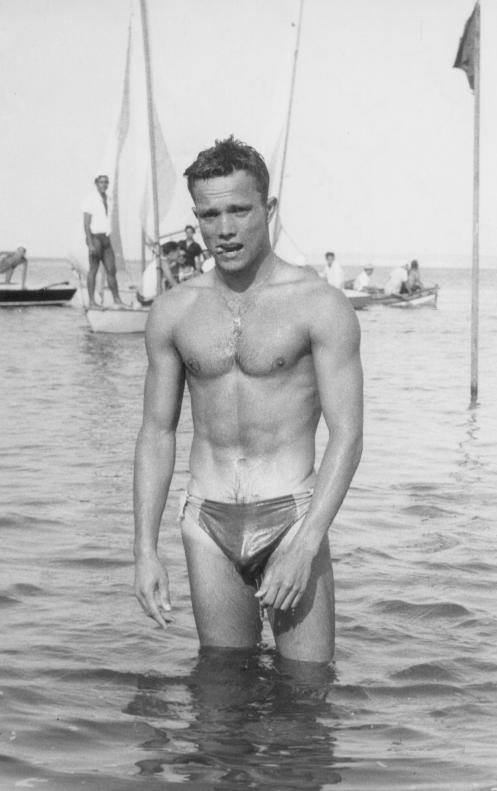
Isn’t this picture interesting?

11960119_981587768570225_1252831736402199058_n

I’m not really sure where I found it, but all my pictures of hot men that I share generally pop up on the Internet somewhere. I save the ones I like, or that pique my curiosity, and then I share them here so my blog crossposts onto social media with an image.

This picture particularly intrigues me not just because the model is attractive with a nice, leanly muscled body; while I am not an expert on the subject of male bikinis, the one he’s wearing looks too modern to have been around as long as it would have had to have been if the picture is as old as it looks–to me, it looks like it was taken in the 1940’s or 50’s. I don’t know why it does, but it does. When I first saw it, I thought, ah, this is some sailor or Marine from during the Second World War in the South Pacific…but as I look at it more, I could be wrong. It’s the tone of the black and white colors that make it look like it is decades old, but that could have been achieved in other ways, including modern day digital filters. I also don’t think, upon further reflection, that this bikini is actually his–or if it is, this is the first time he’s worn it out in the sun, based on the tan lines exposed. I’m also not sure what he has in his mouth, although it is most likely a cigar of some sort.

I guess my perception of the picture is because it looks like other beefcake black and white photography from the time period where I placed the picture originally; there are a lot of beefcake images from the WW2 era and just after where gorgeous young men in the military either posed nude or next-to-nude, most likely for money. As this is also the time period that Chlorine is going to be set, these images speak to me more than just as the ordinary isn’t this a great picture of a hot guy reaction the more recent ones I use on this blog generally get. I wonder about this guy…was he gay or bisexual? The cigar he might or might not be chomping on is yet another symbol of masculinity from that era; so he’s a strong, healthy sexy body, and while the bikini might cast some aspersions on his perceived masculinity in that era, the cigar counteracts that. So, who is this guy? What is his story?

A google image search turns up nothing.

And on that note, tis back to the spice mines with me. I still feel pretty shitty, so I think I’m going to go lay down and make some soup in a bit. Have a lovely Wednesday, Constant Reader!

Will You Still Love Me?

Sunday morning. LSU managed to remain undefeated yesterday, squeaking out a 23-20 nerve-wracking win over Auburn and looking like LSU of old. It was a very tense, stressful afternoon here in the Lost Apartment, believe you me. But they did pull out the win to move to 8-0; with Alabama on the horizon in two weeks in Tuscaloosa. They will most likely be ranked 1 and 2 at the time of the game; the winner takes the lead in the division, becomes the favorite to win the SEC, and make the playoffs. There’s some talk, already, that even if LSU loses to Alabama they might still make the playoffs; Oklahoma’s shocking loss to Kansas State opening that door still wider. There are a number of good one loss teams in the SEC already–Georgia and Florida are about to play next week in a battle of once-beatens to determine who will win the East division, and a shot to play the winner of LSU-Alabama in Atlanta in December.

Likewise, it also wouldn’t be the first time Alabama lost to LSU and got to play for the national title.

I was emotionally spent after the game, so I spent the rest of the evening finishing reading Robert Tallant’s Ready to Hang: Seven Famous New Orleans Murders. Tallant isn’t the best writer, and he’s also, as they say, a product of his time; but I found his retelling of famous New Orleans murders quite entertaining. The last three chapters (“Let the Poor Girl Sleep!”, “The Axman Had Wings”, and “Fit as a Fiddle and Ready to Hang”) were quite interesting, and I can see easily how to translate those real life true crimes into fiction, particularly the last one–about a handsome young man who wanted to be a singer and went around killing older men with money. The book was written and published in 1952 originally, and so the story of Kenneth Neu, as written by Tallant, skirted around what was patentedly obvious to me at any rate–he flirted with older men to see if they might be interested in his looks, and then killed and robbed them. (When he was tried eventually, he was only tried for the murder he committed in New Orleans; a previous crime in New Jersey definitely involved homosexual activity, and they didn’t want to try him for that one in case the jury sympathized with him killing an older gay man…so obviously, the prosecutors in Orleans Parish successfully kept any possibility of homosexuality out of his trial.) Neu is an interesting character to me; originally from Savannah, served in the military, and extremely charming and good-looking. Even throughout his trial he was cheerful, trying to charm people, even singing and dancing for the audience in the courtroom during breaks in the trial. He’s almost like something out of Patricia Highsmith; there’s definitely some Ripley in Neu. And obviously, he would make for a fascinating character in an old time New Orleans noir.

I’m also working on a short story–have been for some months now–called “A Little More Jazz for the Axeman,” which will go into my collection Monsters of New Orleans should I ever finish it; I’d also like to send it out for submission. It’s a Venus Casanova story, and while I got off to a relatively good start on it, it kind of stalled on me–primarily because I didn’t know the particulars of the true Axeman murders. I’d read some of it in Empire of Sin, but Tallant covered it a bit more thoroughly. I do need to come up with a timeline of the original Axeman murders, which should be relatively easy to do now, and see how I can work with that for my Venus short story.

I do intend to write today, Constant Reader, after two days of meaning to but never getting around to it. But the time has come, and I really must stop procrastinating. I don’t know what time the Saints game is today, but regardless, I have to sit here and at the very least finish off Chapter Twelve, whose rewrite has been in stasis now for over a week. I only have thirteen more chapters to go before the damned thing is finished–and while I know I’ll be holed up in a hotel room in Dallas for five days this coming week, well, I also know it’s Bouchercon and I won’t get any writing finished. I won’t even read much, except for the airport coming and going and the plane ride itself. I do want to finish Silvia Moreno-Garcia’s Certain Dark Things this week as well; hopefully in time to get another horror novel read by Halloween. I’ve really fallen down on my reading lately–I also have some terrific ARC’s on the pile, including Elizabeth Little’s Pretty as a Picture and Alex Marwood’s The Poison Garden–and I really need to get back to dedicated reading again, rather then falling into Youtube rabbit holes every night. Reading also inspires writing, so there’s that, too.

I think the next non-fiction book I’m going to read is Richard Campenella’s Bourbon Street–as I continue my deep dive into New Orleans history.

And on that note, I think I’m going to get another cup of coffee and sit with Moreno-Garcia’s Certain Dark Things for awhile before i head back into the spice mines.

Have a lovely day, Constant Reader!


11412088_10155811453605290_2854015540641376322_o

Don’t Mean Nothing

Well, I got up early this morning–with an assist from Needy Kitty, who has apparently decided this week that after getting fed really early in the morning two days in a row, that this should become a regular thing. It’s okay, actually, I was already awake when he climbed on me in bed and laid down. And it doesn’t kill me to get up early anyway, now does it? Today is my half day, Wednesday, which means running by the mail on the way to the office and I get off early enough to meet a friend for dinner. Huzzah!

I’m getting things done this week, even if it feels like I’m just treading water. I always have so much to do, you know, that it sometimes feels like I never make any progress; it seems like every time I cross something off the to-do list, something else rears its ugly head, you know? Or two something elses, sometimes three. Heavy heaving sigh. But I suppose it’s better than having nothing to do, or being bored, or something. One thing I never have to worry about is being bored–unless I am watching something boring, or am bored by whatever I’m reading.

As Bouchercon looms on the horizon, I should probably start doing some planning, or at least figuring out what I’m going to be doing, and when I’m going to be doing it. I also should talk some more about the Anthony nominees for Best Short Story, of which I am one, for “Cold Beer No Flies.” It’s lovely to be nominated for awards–it really is, no humility about this, folks, I fucking love making short-lists–and it’s a real joy to be nominated with writers like my fellow nominees: Holly West, S. A. Cosby, Barb Goffman, and Art Taylor. Not only are they talented writers but they are also really awesome people. That’s one of the things I love about being a part of the publishing community, really–the vast majority of people in it are pretty awesome. Sure, there’s the occasional dirtbag asshole, but for the most part? A fun group of people. Can’t wait to see them all next week!

My email inbox is ridiculously full again; I feel sometimes like Sisyphus pushing that rock every time I look at it. Heavy heaving sigh. But all I can do is put my head down and keep clicking them open and responding to them, hoping against hope that each one I answer won’t engender yet another response to answer. Oh, well, it could be worse: I could get no emails except junk. Or ones from political campaigns. I wish I had a dollar for every email I get asking for money for a political campaign–I could leave the spice mines behind for good and relax in my hammock on the white sand beach while sipping a margarita.

I finally finished reading Norah Lofts’ short story collection Hauntings: Is There Anybody There? I really enjoyed them; they were more Gothic than straight up horror, and (breakthrough alert) I realized after finishing the book that perhaps the reason I am so bad at writing horror (I’m more of a fan than a horror writer) is because I like Gothic-style horror more than anything else. Oh, sure, I read all different styles of horror (I’m really enjoying Certain Dark Things), but when it comes to writing it, I tend to go more along the line of Gothic, which is more creepy and unsettling than scary. Bury Me in Shadows is a Gothic-style novel; I’d love to have a parody Gothic style cover with my cute teenaged gay boy running away from a big creepy house with one light on in a window, looking back over his shoulder…which is, now that I think about it, a really good idea.

I read a lot of Norah Lofts when I was a teenager; primarily her fictional biographies of royal women. She wrote about Eleanor of Aquitaine (Eleanor the Queen), Katherine of Aragon (The King’s Pleasure), Anne Boleyn (The Concubine), Napoleon’s stepdaughter Hortense de Beauharnais (A Rose for Virtue), George III’s sister Caroline-Matilda (The Lost Queen), and Isabella of Castile (Crown of Aloes). She also wrote Biblical fiction, with Queen Esther and How Far to Bethlehem?, and a lot of what was classified, marketed and sold as historical romances–but they weren’t really romances. They were dark stories about lost love and hopelessness and her women rarely had happy endings; Nethergate was one of those. She was an excellent writer with a good eye for details and character, that made her creations come to life–but she also wrote some Gothic horror, which included this collection of ghost stories. I don’t remember how it came to my attention or who reminded me of Lofts, but I ordered a copy of the Hauntings from a second-hand bookseller, and as I said, I really enjoyed it. I’d love to revisit some of her other work that I enjoyed, to see how it holds up and if my evolving and maturing tastes have altered how I read them, but again–my TBR pile continues to grow every day and I am never going to read everything I need and want to read.

And on that note, it’s back to the spice mines with me.

11709702_10155754097765702_1906706518738509845_o

I Heard a Rumor

And now it’s Tuesday.

Yay for Tuesday! I managed to get some things done yesterday–my Sisters column for one, and an interview with Crime Reads for being an Anthony short story finalist, which was pretty cool. I was going to do some work on Bury Me in Shadows, but I couldn’t find the chapter file I worked on over the weekend and decided, rather than obsessively hunting for it, to just push it off and forget about it for now. So, instead I worked on the proposal, which was interesting and something different. (I found the file this morning; I don’t know how it wound up saved to the directory it was saved.)

We watched Catherine the Great last night on HBO, starring Helen Mirren, and it’s quite good. She’s phenomenal, as always, and they managed to script it in a way that made it interesting–often a problem with historical adaptations/biographies of royalty–and really brought the era, and the problems she faced as an illegitimate usurping empress quite well. I’m looking forward to the next episode, as well as starting Watchmen.

And I’m feeling much better about things. Getting stuff done yesterday was a good way to start the week–despite feeling less than at my best–and I love the feeling of crossing things off my to-do list, you know? I got some other things done as well–things I can’t talk about publicly, alas, sorry to be a tease–but again, getting things done feels good, and I have felt kind of, I don’t know, discombobulated since the last epic volunteer project, which is what put me behind to begin with.

Heavy heaving sigh.

And today is the last of my “get up early” days this week. I know we’re taking Scooter in for a veterinary visit this Saturday, probably around ten, but if I’m not up by then on my own without the use of an alarm, well, then I am seriously in some kind of trouble. I slept really well last night–I’ve slept well the last few nights, actually, which has been kind of lovely–and while I don’t like to be “untimely ripp’d” from my bed in the mornings, once I shake off the sleep and fully become awake, it’s a whole different other story, you know? I suspect that not only have I not gotten over what made me so ill the weekend before last, but it’s coming back. This is, of course, terrible timing as I am scheduled to leave for Bouchercon next week. Not good, not good at all. I took a Claritin because my sinuses feel messed up, and then some DayQuil because I have post-nasal drip as well.

We’ll see how that goes, shan’t we?

Barb Goffman, one of my fellow nominees for the Anthony for Best Short Story next week, posted a rather lovely blog here, where we all talk about our stories, and she provides links to read them all. This was an incredibly generous thing for her to do, and since I’ve not read all the stories, this gives me an excellent opportunity to do so.

I’m still reading Certain Dark Things and Ready to Hang–although the story of the Lamana kidnapping has now progressed to the trial of the kidnappers, which isn’t that interesting.  But I should finish both by the weekend, so I can be prepared for the LSU-Auburn game. I’m not sure who the Saints are playing–I do love the Saints, but most of the time I don’t even know who they’re playing until Game Day.

And now it’s back to the spice mines with me. Have a lovely day, Constant Reader.

11693996_10205580861694588_6593653836409415779_n

Luka

Ah, a lovely lazy Sunday morning, with a lot on my plate to get done.

LSU won again yesterday, taking Mississippi State down in their own stadium 36-13. With about five minutes left in the first half LSU was ahead only 9-7; State had just scored and the cowbells were ringing. As time ran out in the half, LSU was ahead 22-7. Within another five minutes of the second half, we were ahead 36-7, and the game was essentially over. Four touchdowns in less than ten minutes.  Next up is Auburn in Death Valley; Auburn rebounded from their loss to Florida with a blowout of Arkansas, and they’ll be thirsty to beat LSU. Another loss and their championship hopes are over; Auburn has also lost two straight to LSU in the closing minutes.

It will be a tough one.

The Saints are playing later this afternoon, the Bears in Chicago at Soldier Field. I have a lot to get done this morning if I want to watch the game, frankly; I may wind up just working while it’s on in the living room. I managed to get nothing done yesterday; I overslept (it was needed, methinks) and so got a late start to the day. I did manage to make groceries and fill the car with gas, so that’s something, right? Today I have to finish my Sisters column, and I have to also work on Bury Me in Shadows as well as a proposal for another project.

Heavy heaving sigh.

But the weather yesterday was gorgeous, simply gorgeous. I do love when it gets to be mid to late October and we have what we consider fall down here–which means it never gets much hotter than eighty degrees and the humidity is gone. It’s so gorgeous, and the sky is so blue…ah, heavenly.

So I decided to treat myself to a sleeping pill, and after last night’s amazingly deep and restful night’s sleep, I understand completely how addictive these things can be. Yes, my sleep has been rather off and on since I stopped taking them every night, and I actually can feel an emotional difference in myself as well this morning; who wouldn’t want to feel this good every morning on waking up? But addiction is a very real thing, and a very real thing I’m afraid of, so I won’t be taking another one until I feel like I need a special treat.

The demolition of the Hard Rock Hotel construction site, postponed from yesterday to today, is going to happen at some point later this morning. I am feeling less like turning it into a “ripped from the headlines” novel today as I was over the last couple of days; while there would be some interesting points to be made about New Orleans corruption and greedy, shady contractors, for it to be a Scotty novel it would have to be somehow reigned in and made into a personal story of some sort.  I can, of course, see the site from the elevated interstate as I drive to and from work every day; the elevated interstate gives one an interesting view of the city from those heights (it runs along Claiborne Avenue, and its construction destroyed irrevocably the business district for people of color and the neighborhoods that ran along Claiborne Avenue for decades–and yes, racism played a part in where the highway runs).

I started reading Silvia Moreno-Garcia’s Certain Dark Things and am already quite enthralled with it. For one thing, she’s creating an entirely new mythology of vampires–at least one that is new to me–and I love that the book is set in Mexico, currently in Mexico City. I also like the way she is carefully doling out plot points and back history for her main character, Atl–who is very interesting, and is involved in something dangerous that we aren’t quite sure what it might be at this point. I also like that the very first chapter, which introduces Atl to the reader, is told from the perspective of a street kid named Domingo. Moreno-Garcia created Domingo completely and in three dimensions, like he’s a main character, rarely than merely the lens through which we meet Atl. (He still might be an important character to the story; I hope so because I liked him, but it also wouldn’t surprise me terribly if he disappears from the story completely. If that is indeed the case, kudos to Moreno-Garcia for making even throwaway characters complete and real. I am really looking forward to reading the rest of the book.

Reading this also made me realize how badly I failed at vampire fiction with my few meager attempts. I didn’t really do anything new with them; I just wrote vampire stories to write vampire stories, without any thought about how to make them realistic, compelling, and original. I did have a big over-arching plan, though–it would have tied them all together and created something big and original in the second novel, Desire, which sadly never happened. But I’m not a horror/supernatural writer, and when I do venture into those realms, what I do best is ghost stories. I am currently writing another novel that is a ghost story; I already did one (Lake Thirteen), and will probably do another one at some point.

And now I should probably clean the kitchen. I am going to run an errand either before or during the Saints game–the city is always a ghost town during Saints games; it’s literally the best time to do errands, and everywhere you go they’re playing the game anyway–but I also need to get some cleaning and writing done long before I leave the house to do so.

I’m also still reading about the Lemana kidnapping in Ready to Hang, which is quite interesting, mainly because the child was held for so long. The history of the Italian immigrants to New Orleans is interesting–and often quite tragic, frankly–and I find it interesting that the Irish immigrants, who were most likely looked on with as much askance as the Italians, who came later, don’t have some horrible stories that appear in histories of crimes in New Orleans. I do know they were primarily confined to the stretch between Magazine Street and the river–which is why it’s still called the Irish Channel–but they don’t seem to be the victims of mob violence or as much intolerance as the Italians were around the turn of the twentieth century.

If they were, it’s not included in these books about historical crimes/tragedies in old New Orleans.

There’s been an idea forming in the back of my head about all this bloodshed and horror in the history of New Orleans; something along the lines of the land being cursed or some kind of cloud over it, like Stephen King’s Derry, which could also explain the prevalence of religion in the region–Catholicism and even voodoo–used primarily to protect the souls of the locals from the dark forces that seem to control New Orleans.

It’s an interesting thought, at any rate.

And now back to the spice mines. Have a lovely Sunday, Constant Reader!

11219384_1838996466325044_5475885132296106320_n

Causing a Commotion

Last Saturday, as you may know, the Hard Rock Hotel, currently under construction at the corner of Rampart and Canal Street in the French Quarter, collapsed. Today, they are going to set off some controlled explosions to bring down the damaged cranes, which are no longer attached to the construction and present a clear and present danger to the area. Many of the businesses in a very large radius from the construction site are closed until further notice, causing the businesses and their employees financial hardship.

Several people were also killed as a result of the collapse.

I no longer drive to and from work on Rampart Street–we moved into new offices for the day job last November; it’s much easier for me to get on the Interstate coming and going to work now–but I pretty much made that drive every day from 2005 through last November, other than the years the street was torn up in order to resurface it as well as put in the Rampart/St. Claude streetcar line. The construction site was where the Canal Street Woolworth’s was for decades; the very Woolworth’s whose lunch counter was protested during the Civil Rights era because it was segregated. I always hated that the Woolworth’s closed and was torn down, because I felt that it was of no little historic significance; particularly at a time when the Confederate monuments still polluted the city.  But Woolworth’s is no longer in existence, and what else to do with a prime real estate lot that wasn’t being used? There’s already a Hard Rock Hotel on Bourbon Street, but this complex was going to be much larger and was, I think, going to house a Hard Rock nightclub, if I’m not mistaken–because a nightclub at that corner is precisely what the city needed (eye roll).

The construction collapse also exposed some typical New Orleans corruption; the contractor is allegedly shady and has an apparently well-earned bad reputation on every level. There was also some bribery going on, and someone at City Hall, who was signing off on permits, and safety inspections that weren’t being done, was also arrested this week. I am very curious as to what that is going to mean for the future of the Hard Rock Hotel; even if they hire a reputable contractor, I would imagine everything already built will need to come down and be rebuilt; and how do you recover your reputation from that?

It will be interesting, and of course, I am thinking there’s a book or a story in this somewhere. I’ve already created a shady contractor in New Orleans, by the name of Sam Dreher, in Royal Street Reveillon; I can certainly use that character again, and who knows? French Quarter Flambeaux just might make a terrific Scotty novel.

It’s hard to imagine, though, at this point how the Hard Rock Hotel can continue to be built–I would imagine it would have to be torn down completely and started over, but what do I know? I am neither an engineer nor an architect. But I would also think it would be hard to get past the fact that several people died in a construction disaster while it was being built; here is the perfect set up for a French Quarter horror novel about a haunted hotel, don’t you think? One that is cursed with death and tragedy; similar to the Overlook in The Shining.

Interesting.

This also reminds me that Arthur Hailey’s bestselling novel Hotel, which was adapted into a television series in the 1980’s (it came on after Dynasty), was also set in New Orleans; the St. Gregory Hotel in the novel was on Common Street in the CBD, one block from the French Quarter–a grand old hotel of the city (the television show moved the setting to San Francisco; which I still think was a mistake. An anthology television series along the lines of a more serious The Love Boat, set in a hotel with guest stars every week playing out individual stories as they visit the hotel, to me, would work better in New Orleans than San Francisco; then again, I may be biased heavily) in desperate need of some financial investment.  Hailey, who is not so remembered today, was a huge bestseller of his time, and he wrote sprawling novels about industries, and the people who worked in them, and the people who got involved with said industry somehow; with the stories all intermingled. He also wrote Airport, which became one of the first disaster movies, and eventually a series of sequels about plane disasters; he also co-wrote the novel Runway Zero-Eight, also filmed–and that film was what Airplane! spoofed. He wrote about banks (The Moneychangers), hospitals (The Final Diagnosis), power companies (Overload), drug companies (Strong Medicine), car companies (Wheels), and news broadcasts (The Evening News). He also wrote a political thriller, In High Places, which was one of the most thoughtful cold war thrillers; it was written from the perspective of the Canadian government, negotiating desperately with the United States since the skies over Canada were going to be the battleground between the US and the Soviet Union.

I reread Airport after I actually went to work at an airport, and have to say, Hailey’s research was excellent; he really captured the behind-the-scenes activity of an airport impacted by a blizzard perfectly. Likewise, I read The Moneychangers when I was working at a bank–he actually researched Bank of America for the book, which is where I worked–and again, spot on.

Now I’m thinking about rereading Hotel, if only to see how it was done, and how he depicted New Orleans in the 1960’s.

Anyway. I’ll continue to follow the story of the Hard Rock Hotel collapse, and see where it goes, and maybe–just maybe–it could be the basis for something. As you can see, I’ve already had any number of ideas spring from the incident…as always.

And now back to the spice mines.

11707499_10205581348306753_1410007181850364070_n