Sunday morning and as predicted, I didn’t get nearly as much done yesterday as I wanted to, but it was mostly about time more than anything else. I picked up the mail and stopped by Fresh Market, but then once I got home…well, there were chores still to be done (still have some more to do this morning) and I never did get around to writing anything besides blog entries yesterday, like a very bad Gregalicious. Today I have no choice, I have to write today…and I also have to drive out to the Apple Store in Metairie, and make groceries, both of which will be tiring. (I knew I’d regret putting that chore off until today, but at least it’s sunny out today; I think it’s going to be a rather lovely day out there.)
Sparky is always a problem for sitting at the computer as he always wants to sit in my chair–he will hang out and be obnoxious (right now he’s sprawled across the desk, his flicking tail brushing the keyboard as he knocks other things off…) and then jump into the chair the minute I get up for more coffee or anything, really. Heavy sigh, the joys of Big Spoiled Kitten Energy.
I did manage to watch Christopher and His Kind yesterday, which is Isherwood’s memoir about his life in Berlin during the rise of the Nazis, and it much more explicit than Isherwood’s earlier fictions about Berlin. During that “Staged Right” about Cabaret I watched the other night, he wrote it in reaction to the movie, to leave the record straight (as it were) about himself and his life; he hated that Cabaret made Brian/Christopher into a bisexual and that Sally was played by Liza Minnelli, when the actual Sally was marginally talented at best. It was an interesting film, but Christopher himself really came across as a bit of an asshole. There was also a lot of explicit sex, and there’s no question in watching this film about what his sexuality was, for sure. Matt Smith is simply stunningly beautiful, and Alexander Draymon as Caspar is just too beautiful for words. The two stories (Cabaret and Christopher and His Kind) are similar to each other, but I’m not really sure if a watcher didn’t know that both came from the same source, those similarities are simply base facts the story grew out of, and you might not even recognize them as the same story. I may need to revisit the books sometime when I have more time…as I recognize that a lot of the revisiting of fiction I talk about is probably never going to happen. But as always, I find rereading something as an easy way to shake off the not-reading mode I’ve been in for so long. We also watched the new BBC adaptation of Agatha Christie’s Murder is Easy yesterday, which we quite enjoyed…although I am waiting for the racists to complain since they cast a Black man in the lead.
So I started rereading Norah Lofts’ The Little Wax Doll yesterday, of which I remember very little of my original read back in junior high school (I read her novels about queens and royal women before moving on to her other novels, which was very definitely an eclectic mix), and find myself enjoying it a lot more than I did when I was twelve–I did enjoy it, but I am certainly seeing it differently some fifty years later. As a kid, I just read Miss Mayfield as a lonely spinster who spent most of her life working in Africa in her colonial “white savior” role with her best friend, who hopes to save enough money to buy a little place she and her “best friend” could retired to; now it’s screaming lesbians at me. The book was originally published in 1960, and of course there are the queer deniers who like to think we never existed in the world before Stonewall. The phenomenon of spinsters sharing a home was just a fact of life, and the British never really inquired much further than that–the British cold politeness.
And on that note, I am going to head into the spice mines. There’s a lot to get done today and I am feeling like I will be able to make some significant progress today. Wish me luck, and I may be back later. Happy Sunday, Constant Reader!
Thursday and my last day in the office for the week. Huzzah. I was tired after work yesterday–I made groceries and went to get the mail–but I did get some things donw last night around the house before collapsing into my easy chair. I watched another one of those “Staged Right” documentaries (this time about Evita), and then Paul came down and we watched another episode of True Detective: Night Country, which really took a turn last night! We’re enjoying the show tremendously, despite all the noise on-line about people hating it…and by people, I mean men. I don’t think I’ve seen a single post trashing the show that wasn’t by a (straight) man? Which sets off my “bullshit misogyny” alarm, frankly.
The weather had turned yesterday by the time I got off work; it had gotten a bit colder and the wind had dramatically picked up. It was also kind of gray, which reminded me of how it is before a flooding rain….borderline tornado weather. It feels cold in the apartment this morning, and the high for today is at about sixty. It may rain today, and there’s a 95% chance of it tomorrow. I have early PT tomorrow morning, and at some point I need to drive to Metairie to return something to the Apple store (I’d ordered a keyboard at long last for my iPad, but it’s the wrong size). Loathe as I am to do that–go out there–it was far too expensive for me to just slide and do nothing about. Heavy heaving sigh. But really, it’s not that big of a hassle, and in going out there, I can actually treat myself to Sonic or Atomic Burger as a treat for having to go to Metairie and deal with Lakeside Mall. Shudder.1
I feel good and rested this morning, which is very unusual for a Thursday. Last Thursday was like this, too–I ended the day feeling energized, and got a lot done when I got home. I hope that will be the case tonight. I have loads of laundry in both washer and dryer that need to be dealt with tonight; I need to empty and reload the dishwasher; the floors are looking horrific; and of course I need to assemble the shower caddy. I also need to redo my to-do list, and perhaps make one just for the weekend. I am going to have to go make groceries at some point this weekend, too. I need to go by Lowe’s at some point, too. We need more filters and I am going to splurge on a new barbecue grill, as the last one is well past its last legs, frankly. I also need to reorganize both the freezer and the refrigerator, as well as get rid of some more boxes of stuff that is no longer needed to be kept.
I love feeling reinvigorated in the mornings, frankly. I don’t know how long this will last, of course, and it’s possible I’ll get tired by the end of my shift, but that’s also okay. I don’t beat myself up over being tired anymore, and maybe the loss of anxiety is making me lean into my own stasis more than I ever have before, but I don’t think my creativity is gone–I’m having too many ideas and thoughts and making too many notes–but I need to refocus it on writing actual words down, rather than just thinking about them. I also need to start reading again. I hate how far behind I’ve fallen on my reading.
I did start listening to podcasts yesterday in the car, which was really cool. I found one called Bad Gays, which is hosted by the author of the book Bad Gays and someone who works at the Gay Museum in Berlin (which, if we ever go to Germany, is something I’d like to see); and I listed to the episode on James I of England (VI of Scotland) and his male favorites. I didn’t see an episode on two historical figures I am fascinated by, Henri III of France, and Louis XIV’s brother, Philippe d’Orleans; Philippe’s lover the Chevalier de Lorraine was the definitive bad gay of Versailles. I should fictionalize the Affair of the Poisons…which would give me an excuse to visit France for research. Plus it’ll give me the excuse to study up on the period more, too. I love seventeenth century France.
I think I am going to watch Christopher and His Kind this weekend, and I may even rewatch Cabaret for good measure. I also found some other gay movies on-line to watch that I’ve never seen, like Another Country and Maurice. I also want to rewatch Saltburn so I can finish my entry on it.
And on that note, I am heading into the spice mines. May your Thursday be wonderful, cheery and bright, and I may be back later–one never knows.
Hilariously, now that my anxiety is under control I’ve realized my hatred of driving and having to go places was always anxiety-based. Always.↩︎
If you will recall from my last entry about the Chanse series, I had a new editor for the second book in the series. I had also written a proposal for the follow-up, Murder in the Rue St. Claude, which was going to be about a nursing home and an angel of death. The second book ended with a tragedy for Chanse, and the last scene of the book was Chanse saying goodbye to someone before their life-support was turned off. I did a trickery and was going to have the person be in the nursing home, still living, only a suspicious death happens there and one of the workers talks to Chanse about her fears. The editor wasn’t the most professional or organized person, and I had to send the proposal to her three times on request with no contract offer. I was very irritated by this, but there were also a lot of changes going on there–including moving the offices from LA to New York, which I thought was an incredibly stupid business decision…and I wound up with yet another new editor right before Katrina hit. I honestly wasn’t sure if I would go back to writing ever again–one of the lulls in my career–but things eventually settled down and I started house sitting for a friend in Hammond over on the north shore while I waited for the city to reopen so I could drive into the city and get some more things from the house. I did, my friends’ trip was cut short, and I was going to return to Kentucky to my parents’ after one more swing by the apartment to pick up things. Imagine my surprise that my mail service was open, my grocery store and bank were open, and so was my gym. We’d moved into the main house from the carriage house, which hadn’t been rented yet as it needed some work before the hurricane, and so….I just moved back into the carriage house and cleaned up around the property and kept an eye on the main house, as well as emptying out the water from the machines that were trying to keep the insides of the apartments dry (the roof was gone).
While I was in Hammond, my new editor got me to reluctantly co-edit an anthology about New Orleans called Love, Bourbon Street (a title I hate to this day), and he was trying to talk me into writing a Chanse book about Katrina. I didn’t really want to, but he kept insisting and finally, I gave in and agreed to write it. However, the nursing home I was researching was a place they left people to die in–wasn’t touching that with a ten foot pole–and it occurred to me that I could wrap the case around Hurricane Katrina. He was hired by the client the Friday before Katrina, and obviously he couldn’t do the job now.
And that was the seed from which Murder in the Rue Chartres (no title at the time of contract) grew.1
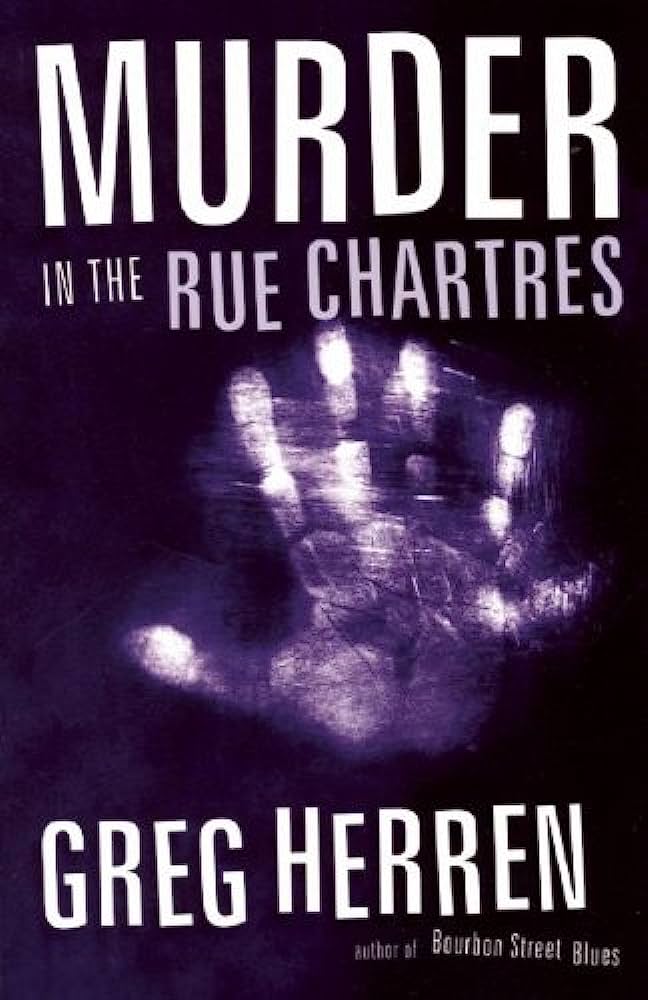
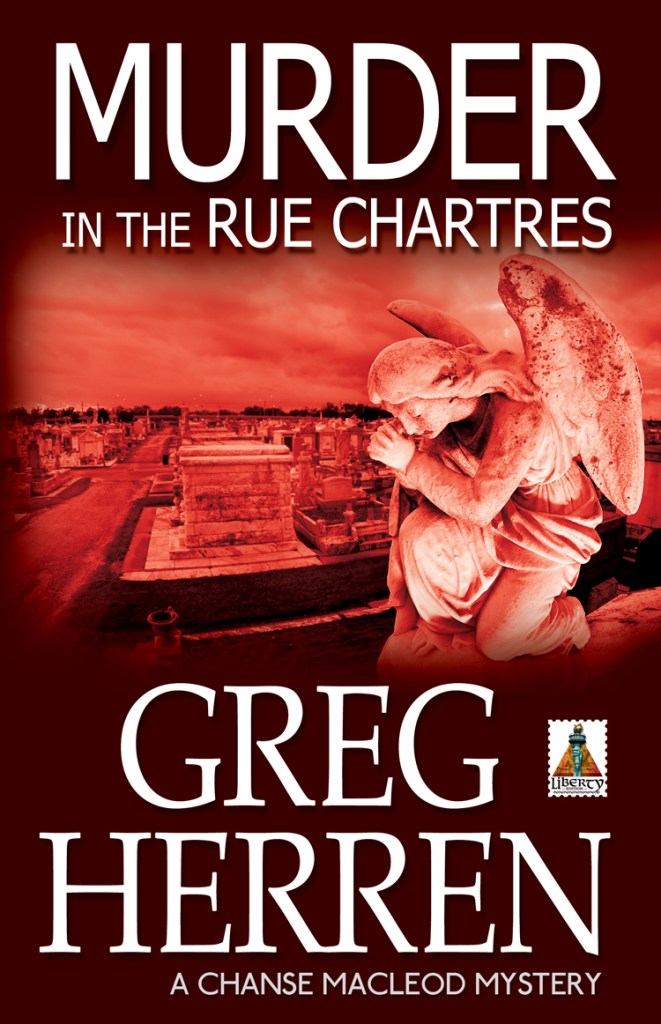
This is the original cover from Alyson Books.This is the new cover for the Bold Strokes ebook
It was six weeks before I returned to my broken city.
Usually when I drove home from the west, as soon as I crossed onto dry land again in Kenner, excitement would bubble up inside and I’d start to smile. Almost home, I’d think, and let out a sigh of relief. New Orleans was home for me, and I hated leaving for any reason. I’d never regretted moving there after graduating from LSU. It was the first place I’d ever felt at home, like I belonged. I’d hated the little town in east Texas where I’d grown up. All I could think about was getting old enough to escape. Baton Rouge for college had been merely a way station—it never occurred to me to permanently settle there. New Orleans was where I belonged, and I’d known that the first time I’d ever set foot in the city. It was a crazy quilt of eccentricities, frivolities, and irritations sweltering in the damp heat, a city where you could buy a drink at any time of day, a place where you could easily believe in magic. I couldn’t imagine living anywhere else. Any time I’d taken a trip before, within a few days I’d get homesick and started counting the hours until it was time to come home.
But this time wasn’t like the others. This time, I hadn’t been able to come home, and had no idea how long it would be before I could. Now, I was nervous, my stomach clenched into knots, my palms sweating on the steering wheel as I sang along to Vicki Sue Robinson’s “Turn the Beat Around” on the radio. It was everything I’d feared for the last few weeks when I thought about coming home, the anxiety building as the odometer clocked off another mile and I got closer to home.
It was different.
The most obvious thing was the lack of traffic. Even outside the airport, the traffic was usually heavy, sometimes slowing to a complete standstill. But other than a couple of military vehicles, a cement mixer, and a couple of dirty and tired looking sedans, I-10 was deserted. There was a film of dirt on everything as far as I could see, tinting my vision sepia. Huge trees lay toppled and debris was everywhere. Signs that used to advertise hotels, motels, restaurants, storage facilities, and pretty much any kind of business you could think of were now just poles, the signs gone except for the support skeleton. Buildings had been blown over, fences were wrecked and down, and almost everywhere I looked blue tarps hung on roofs, their edges lifting in the slight breeze. My breath started coming a little faster, my eyes filled, and I bit down on my lower lip as I focused back on the road.
No cars joined at the airport on-ramp, or the one at Williams Boulevard just beyond it. No planes were landing or taking off.
Most of the writing I did in the fall of 2005 was my blog, which at the time was on Livejournal. (The old stuff is still there, but I started making things private after a year because of plagiarism; I guess people thought they could steal my words if they were on a blog.) I documented as much of the experience as I could, so people outside of Louisiana could see that the city wasn’t fully recovered despite no longer being in the news. American attention had moved past New Orleans by the spring of 2006.
When I started writing the book, I was really glad I had done that with the blog, because more than anything else it reminded me of the emotions I was going through, that horrible depression and not remembering things from day to day, the need for medications, panic attacks, depression, and the way the entire city just seemed dead. I did repurpose a lot of stuff that was on the blog–rewritten and edited, of course–and I could tell, as I wrote the book, that I was either doing some of the best work of my life to that point or I was overwriting it mercilessly. You never can be sure.
But I also needed to flesh out the murder mystery I came up with, and I also wanted to write about a historical real life tragedy of the Quarter. The client who hired him that Friday before Katrina roared into the Gulf and came ashore was engaged, and she wanted Chanse to find her father, who’d disappeared from their lives when she and her brothers were very young. But what happened to her father? Who killed her, and why? Was her murder a reaction to her looking for him?
I had started using Tennessee Williams quotes to open my New Orleans novels with the third (Jackson Square Jazz: “A good looking boy like you is always wanted” from Orpheus Descending) and I liked the conceit so much I kept doing it. I knew someone who’d built a crime novel around the basic set up of Cat on a Hot Tin Roof, and I thought, what if the person who knows all the answers has been in a mental hospital for decades? Then what if Mrs. Venable had succeeded in getting Catherine locked up with all of Sebastian’s secrets lobotomized out of her head?
I named the family Verlaine as a nod to the Venables, and aged Mrs. Venable as well as gender swapping her (this was also a bit influenced by The Big Sleep), and I was off to the races.
My editor wrote me when he finished reading the manuscript and told me it was one of the best mysteries he’d ever read. The reviews! My word, I still can’t believe the reviews, and how good they were. I got a rave in the Times-Picayune, Library Journal and Publishers Weekly.
And yes, it won a Lambda Literary Award for Best Gay Mystery.
The irony that two books I wanted nothing to do with, let alone write or edit, ended up with each winning Lambda Literary Awards, does not escape me. ↩︎
Wednesday morning and the downhill slide into the weekend. Today I have to see my surgeon before I go into the office, which means this might get posted later than my usual. I am awake and feeling pretty good, actually. I am going to the gym to do my physical therapy on my own Friday, which is kind of scary. But I will muddle through somehow, and take my time with it rather than trying to rush through the way I always used to.
I made groceries after work last night and picked up the mail, so I don’t have to pick it up again until the weekend. I am going to be doing a lot, it seems, on Saturday morning. But this is the first free weekend I’ve had that’s normal in a while. I finished watching the Netflix Alexander when I got home, with Sparky asleep in my lap. I folded laundry, too. All in all, a slightly productive night, as I also worked on a short story a bit. I hope to get both of these (one a first draft, the other a revision) by the weekend, so I can work on other things over the weekend. We were super busy at work yesterday; it’ll be a bit slower today but still busier than usual. The post Mardi Gras boost in testing, I suppose.
I’m not sure what project to work on next. I’m actually thinking that this longer story I am writing could close the short story collection…the manuscript itself is sitting at about 72000 words right now, so either story could run long and the book would be finished and can be turned in. This is of course great news; I would also need to write an introduction to it as well, but maybe–just maybe–I could get it turned in by the end of the month, too. I also have to finish the sequel to Death Drop–which means revising what I’ve already written so I am back into Jem’s head and into his life and story again, which is also fine. I feel like I can really do the book justice now more so than any time since the surgery.
I also need to get back on the promotion interstate highway again, too.
But the appointment with my surgeon went well. I don’t have to see him again unless I have pain or something odd going on with my arm again, and I am going to be gradually phasing out the PT now. I should be fully healed by the sixth month (which would be April) but he thinks I’ll be fully healed before then, since everything has progressed so nicely with the healing thus far. I won’t be completely back to absolute normal, most likely, for at least a year. But the strength therapy will be enormously helpful in that; the real curiosity is wondering, when can I start working my chest and back and legs again? I don’t think legs would be too much of an issue, other than lifting the weight plates. I’ll have to ask my therapist next Friday when I see him again. But yay, right? Huzzah for progress! But the weather is also starting to get nice again, so I think it’s time for me to start taking walks regularly again. It’s staying light longer, too. I also need to start stretching at least every other day, too.
And the festivals are nigh, too. Woo-hoo!
And on that note, I am going to bring this to a close so I can eat my lunch and answer some emails. May you have a Wednesday that is as awesome as you are , Constant Reader.
Weeheeheehee dee heeheeheehee weeoh aweem away Weeheeheehee dee heeheeheehee weeoh aweem away
You’re welcome for that hellish ear worm.
Well, here it is Tuesday morning and I feel a lot better, more rested, than yesterday. I was extremely tired when I got home after work last night. I didn’t really do much of anything once I was home, other than cuddling with Sparky and watching this week’s Last Week Tonight with John Oliver, which I always enjoy, as well as two more episodes of Alexander on Netflix, which I am enjoying. I was always interested in Alexander when I was growing up–I liked Egyptian, Greek, and Roman history and culture before moving to United States history, then British, and ultimately European. I also watched some documentaries on forgotten kings and queens of Europe. Sparky mostly slept in my lap for much of the evening, and I retired early. PT was rough yesterday morning, but this Friday I get to go to the gym on my own for the first time in well over a year. YIKES. I only have a few exercises to. do there, and I am a little bit excited about going for the first time and getting back into the swing of working out regularly again.
I am starting to feel acclimated back to my life again, and I am also thinking I am feeling more like myself. I’ve been flooded with story ideas over the last few days (Alabama always does that for me, for some reason), solutions to issues in works in progress that I’ve been struggling with, and book ideas. This is, of course, a relief, as I’ve felt kind of stagnant creatively since the surgery. It’s like my brain is finally waking up again, something I was concerned about, obviously–when your identity and most of your life is wrapped around being a writer, the loss of creative energy in my mind is even scarier than falling from a great height or cutting myself (two of my biggest fears). I suppose it would be okay, but I also can’t imagine never writing again.
I actually have thought about it seriously during this time of forced solitude and recovery. Writing and publishing is like a roller coaster ride–filled with ups and downs and frightening hazards to get past. 2023 was obviously a bad year for me, but I did produce two books I am proud of, Death Drop and Mississippi River Mischief. Is it any wonder that I wasn’t able to get much work done after they were finished and proofed and approved? Bouchercon was at the end of August, and when I got back was when I had my teeth done and went on the soft diet–no surprise I was low energy and not able to write very much–and then came the surgery and the recovery. And of course Scooter died last summer…yeesh, what a shitty year, underscored by the grieving for Mom. So, having not really written much after the books went into production, and not really being able to create while I recovered, made me take some stock and wonder if I wanted to keep doing it–the publishing side, anyway. But now that my overactive imagination has been reignited, all those doubts and self-questioning seem like self-pity. Waaah, I’m not Stephen King. So what? Sure, more money would be nice, but it’s not really the be-all end-all of why I do this, anyway. I love writing, I love telling stories, and I love creating characters I genuinely am interested in and want to get to know better.
I feel good this morning. I woke up and didn’t feel fatigued, either. I got a lot of work done at the office yesterday, which was awesome, and tonight when I head home I am making groceries and have some chores to do around the house, too. And…hopefully will get some writing done, too.
And on that note, I am heading into the spice mines. Have a lovely Tuesday, and I’ll check back in with you later.
Monday morning and up too early for PT before work. Heavy sigh. My body aches this morning–my back is especially tight–which means today will be exhausting. It’s a paperwork/admin day anyway–unless I have to cover for someone–and it’s also terribly cold this morning: 41 degrees, to be exact. I collapsed into bed last night somewhere around nine, and was dead to the world in a matter of minutes. It was a good night’s sleep, but I really need to sleep late sometime soon–probably not till this weekend, alas.
I did listen to River Road by Carol Goodman in the car both ways instead of The Drowning Tree, and as always, loved every minute of it. I still had some time left to listen to something, but only had a short time left, so I went ahead and started an Amazon Short by Zakiya Dalila Harris, “His Happy Place”, which was decidedly creepy but also extremely well done. More on both to come, of course, once I’ve gotten back into (what passes for) a normal routine around here. This will probably be a rough, tiring week, but I hope to manage. This weekend I am going to drop off beads and books for donations, and will also hopefully keep working on the apartment.
The coffee is starting to work, which is nice. My brain and body are starting to wake up, which is great. I’m also a bit hungry, so will probably make something to eat before I leave. I have dry noodles at the office to have for lunch, and will take some breakfast snacky things with me. Tomorrow I know we are going to be super-busy in the clinic, which will make for a rough day as well. Fortunately, I enjoy my job! But this weekend will be the hard reset I need, and I just have to make it through this week, which seems to be stretching out far into the distance and is a bit overwhelming to contemplate. I also need to make a grocery list, and today I have to run some errands after I get off work. Tomorrow I’ll make groceries after work, and hopefully I’ll start feeling more settled in. Sparky was a bit stand-offish when I got home yesterday–just mewed at me reproachfully for a while, but after a few hours he forgave me and was very affectionate, obviously having missed me while I was gone. I do kind of feel like our earlier cats were more Paul’s than mine, but Sparky is kind of mine. Of course, I was chair bound for almost three weeks, so he had a place to cuddle and sleep and hang out all day, and now of course no one’s home with him all day. Once the Festivals are over, he’ll be home more and then he and Sparky can bond some more.
So really, my return to normality after Carnival has been pushed back on the calendar because of the trip over the weekend. My word, how my imagination was out of control while driving and staying in Alabama. I remembered stories and ideas I’d forgotten about as well as having more ideas (just what I need, right?) and I also figured out how to finish off my short story collection. I am hoping to get some more stories finished this week and get off to submissions while working and planning my next book. I also have a shit ton of unfinished drafts here I’d like to get done at some point so I can clear out the drafts folder.
I also took a lot of pictures this weekend, to help me describe places when I write about Alabama some more. I also realized that fictionalizing the place where I was born means it doesn’t have to be exactly the same in my work than it is in real life, you know? But that’s also my own stubborn brain trying to make everything correct when it doesn’t have to be, which happens a lot. It’s not like New Orleans, which appears as it is in my work. Corinth County is based on where we’re from, but it’s not the same. I had an idea for something completely new on my way up there; there was an In Cold Blood-kind of slaying there in the late 1960’s; a couple who ran a corner store were brutally killed and robbed, and so when I got home I started looking for information about it on-line (I’ve done this before, but not for a potential writing project; more out of idle curiosity when I was writing Bury Me in Shadows) and interestingly enough, there have been any number of crimes down there over the last forty or so decades; in fact, in one article about another murder I read a quote from someone at a café in town that the county “seems to be cursed”–which I must have read before because that has always been the underlying theme of the fictional county; it’s even in Bury Me in Shadows with people saying “the history of this county is written in blood.” Anyway, I would be interested in writing about that 1967 shooting–either fictionally or as true-crime.
And on that note, I need to get ready for PT and then heading straight to work from there. Have a lovely Monday; I may be back later as one never truly knows.
I’ll be driving back to New Orleans in a little bit, and I am exhausted. I went to bed last night ridiculously early–so early that I don’t want to admit to it publicly. I was very tired when I got here Friday afternoon. I made very good time despite some highway construction stupidity in Mississippi (which is always) but for the most part it was a nice drive and I got up here relatively easily. I stopped to get gas and eat in Toomsuba, which I’ve not done in a long time, and as I feared, once I slowed down and sat down to eat lunch, fatigue set in. I did have PT yesterday morning and left afterwards (and a few errands for good measure) and so, like always, was worn out by the time I got here.
It’s also cold here, which is hard for me to get used to as I haven’t been here during the winter very often in my life, so I always think of home as being hot and humid and muggy and miserable (going to Murder in the Magic City and Murder on the Menu doesn’t count because that doesn’t involve my kin in any way). It was bitterly cold here today as we drove around with Dad showing me places from his and my childhood. We went down to the bottoms of the Sipsey River on what used to be my grandfather’s land, which I hadn’t been to since I was a kid, and the river was really high and rushing quickly because of all the rain. (It rained really hard on Friday night). I actually slept well–which should be an indication of how tired I was, as sleeping in a hotel isn’t usually easy for me. Maybe the new drugs have helped in that regard too? I was very calm as I drove and didn’t feel the pressure of the ticking clock or the need to get there as fast as I could and feeling frustrated and irritated by any delays en route. I do not miss my anxiety in the least.
But, oh the memories that came back to me as we drove past my grandmother’s house (now crumbling and in disrepair) which was an indelible part of my childhood. My grandfather’s house, where my dad was born and raised, is also gone. I was also getting all kinds of ideas, as I always do when I come to or through this part of the state, and started really getting into this idea of a sequel to Bury Me in Shadows, only with Beau Hackworth was the main character. I really do want to write more about Alabama, and several other ideas of stories that are either in progress or exist in a very rough draft. It even occurred to me that I could do an entire collection of short stories set in Alabama. I have already published a couple of them, and I have enough ideas for another collection just for those alone–but I suppose I should finish my next one first before I think about another one, right?
This place will always have a hold on me, and it does worry me a bit that once Dad goes, my last connection to the county and my childhood summers here. And yes, I am aware that I am looking back through the nostalgic rose-colored glasses of sentiment. But summers here–how to describe them? Hot and humid, dragonflies and dirt daubers and five o’clocks, fried baloney sandwiches and buttermilk, sweat tea and cobblers, mosquitoes and watermelon and fresh blackberries from the woods, trips to town to the Piggly Wiggly and the library, long rows of cotton and corn and watermelon vines, red dust and orange clay roads, heat shimmering up from blacktop roads and how everything was so still in the lazy heat of the mid-afternoon, ghost stories and Civil War legends and lost treasure.
I miss my mom. It’s hard to wrap my mind around the idea that she’s buried here, that her remains are there under the ground between the big HERREN headstone and the foot-stone with her name and the dates underneath. It was such a cruel twist of fate for her to go on Valentine’s Day, which was also the anniversary of their first date sixty-six years ago. But in this time since she died I’ve also spent a lot more time with Dad and have gotten closer to him, which is really nice. I’ve also spent more time with the rest of the family, too, which is even nicer.
I know I’ll be exhausted tomorrow and I am starting the day with PT, so I will be really tired when I get home tomorrow night. I guarantee when the weekend rolls around again, I am sleeping as late as I feel like on Saturday, period.
Well, I didn’t get to post this before Dad called my room to get me to come downstairs for breakfast, after which I helped him load up his truck, I loaded my car, and we said our goodbyes and I headed for New Orleans while he made a detour on his way to Kentucky to say goodbye to Mom again.
The drive back to New Orleans was easy, little traffic, and I made it in slightly under four and a half hours, which is excellent time. I was exhausted once I got home, and then Paul and I got caught up on Abbott Elementary, we watched an unsettling documentary (but really, aren’t they all?) and then I started watching Alexander. Paul went upstairs to work, and so I did some chores and then remembered I never posted this. Not really sure what I’ll write about tomorrow morning, if anything at all. It’s going to be a long, tiring day.
And on that note, I am going to go sit in my chair and finish watching Alexander on Netflix. Maybe I can talk about that tomorrow? Have a lovely evening.
Thursday morning and I could have slept later for sure, LOL. But I did sleep well, which was nice despite being so rudely interrupted by my alarm. I have to get up early again tomorrow for PT before I drive to Alabama, but now I can listen to The Drowning Tree by Carol Goodman in the car (I started it when I drove to Florida last fall, but the drive was too short for me to finish, sadly), so hurray! And it’s better than driving to Kentucky, which I will be doing later this spring probably (unless airfares dramatically drop by then, which I rather doubt).
Yesterday was a weird day, obviously. I wasn’t feeling like myself yesterday. I didn’t sleep as deeply Tuesday night as I would have liked, and of course, it was probably sublimated grief. I managed to get my work done at the office, saw all my appointments and made groceries on the way home. The store was crowded, of course, because men were there buying flowers and chocolates and things for their significant others, which always makes me snicker to myself. I have a lot of thoughts about Valentine’s Day, most of them negative, but it’s going to always be the anniversary of Mom’s death from now on, and probably best to not talk about the so-called holiday going forward. The day will probably always be melancholy and sad going forward, and I really need to let go of the “stiff upper lip” thing and grieve. I have sublimated a lot of it by worrying about Dad, which I don’t think is all that healthy for me. Something else to work on for this year, I guess.
I was pretty tired when I got home, and so didn’t do a whole lot of anything. I had intended to empty the dishwasher and finish the laundry (it just needs to be folded and put away) but once I sat down, there was no getting back up again other than for necessities. Sparky is a bad influence, of course; all he wants from me when I get home is attention and it’s so easy to give in to quality time with my cat. He’s getting bigger and bigger every day, and getting smarter, too. Remember how I thought he turned the washing machine on by accident? Not an accident. If the washing machine lid is up, he’ll turn it on to watch it fill up with water, and stands on the dryer watching. So, not an accident, but deliberate. He’s also learned how to open the freezer, so I had to blockade the top of the refrigerator so he can’t climb or jump up there from the counter, which explains all those times I’ve found the freezer slightly open and not sealed and just thought need to be better about closing that.
Nope, it’s just Sparky. He is so lucky he’s adorable.
I also woke up this morning to yet another scandal about the Hugo Awards lighting up social media, making me glad my creativity doesn’t loan itself to the writing of science fiction. We do have our blow-ups in the crime fiction community (see Bouchercon 2024), but at least it’s never about the awards. Probably be more on that later–I’ve been itching to write about the Bouchercon 2024 kerfuffle and some other things going on in my corner of publishing, but it’s something that needs a gentle, delicate touch and probably needs to be more of an essay written off-line than an off-the-top of my head blog entry.
We finished season two of Abbott Elementary and started season three last night, which means we’ll be looking for something else to watch. I am intrigued by The New Look, which seems to be bent on portraying Coco Chanel as a resistance heroine, while ignoring her closeness to the Nazi occupation leaders during the actual war. It’s never been proven she was a collaborator, but it definitely tarnished her reputation a bit, and glossing over it doesn’t seem to be the right answer. I could be wrong, but I’ve never cared enough about clothes and fashion or Chanel to bother to read up on it and “do my own research”, as they say all over social media.
And on that note, I am going to get cleaned up and head into the spice mines. Have a great Thurday, Constant Reader, and I’ll chat at you probably later on.
Let me tell you about the very rich. They are different from you and me.
So F. Scott Fitzgerald wrote in his short story “The Rich Boys,” and he was, of course, very right in that observation, and that hasn’t changed in the hundred years since he typed the sentence.
It’s been very clear, since I started watching Capote v. the Swans, that my ignoring aspects of Truman Capote’s personal life because of my own internal distaste to his effeminacy (due to both internalized homophobia and self-loathing) was probably a mistake, and what I really needed to do was take a long hard look at myself as well as examine his life in more detail–I will read the Gerald Clarke biography at some point over the summer–and as such, while I was slightly aware of what happened between him and his swans, I didn’t know of the Ann Woodward involvement. When I bought the below book, I actually thought it was fiction, not true crime. Once I started watching the show, I decided to find the book and read it.
And I enjoyed it.
If Ann Woodward had resolved to live a quiet life in Europe, where she could mourn her late husband, Billy Woodward, far from the madding crowd of the American press, the town of Saint Moritz, high in the Swiss Alps, was certainly an unusual place to retreat to. Renowned for its winter sports, popular as a spa hamlet, and exclusive as a community where entertainers, celebrities, and assorted socialites gathered, Saint Moritzwas a lesser European sun around which various society moons revolved. While summer tourism was popular, it was in winter that this small city shined. Luminaries descended in head-to-toe furs inthe daytime and flashy jewels at night, their diamonds and bangles competing with the glittering snow. In the fall of 1956, Ann Woodward was once again the center of attention as she sat down for dinner at one of Europe’s most elite restaurants.
Back in the United States, those familiar with Ann Woodward–and lately there were few who had not heard of her, whether over lunch at the Colony on New York’s Upper East Side, or on the front pages of tabloids–believed that she had been banished to Europe by her formidable mother-in-law, Elsie Woodward, and was now likely leading a lonely life, without family or friends, much less a lover, with plenty of time to reflect on the transgressions that had forced her into exile.
But as Truman Capote watched her from a table across the restaurant, he saw that she was not the solitary widow they expected. Capote was not only surprised to see her in this particular location, but astonished to see her in the company of a man, which was cause for raised eyebrows, considering she had entered her widowhood by her own hand not so very long ago. But Ann Woodward did not seem rattled by the patrons staring with obvious disdain as she exchanged languid looks with her companion.
(The man with her was none other than Claus von Bülow, who would have his own notoriety splashed across newspaper headlines for decades, and about whose alleged attempts to murder his wealthy heiress wife, was the basis for the film Reversal of Fortune.)
I knew about the Woodward case before, but as I have mentioned numerous times, I didn’t know about Truman Capote’s role in her life and eventual suicide. I remember when Dominick Dunne published his first novel, The Two Mrs. Grenvilles, which was a huge bestseller and was made into a television film with Ann-Margret and Claudette Colbert. It was mentioned that the book was based on a real case, which I assumed was the murder of Zack Smith Reynolds, and the suspicion that his actress/wife Libby Holman might have done it and the tobacco rich Reynolds family covered it all up. (This was the basis for the Robert Wilder novel Written on the Wind, which was filmed–and altered–with Rock Hudson, Lauren Bacall, Robert Stack and Oscar-winner Dorothy Malone.) A few years later I heard about the Woodward case, and realized that it was the basis for Dunne’s book (all of his novels were based on actual murders; Dunne himself kind of took Capote’s métier after Capote’s death, writing about gossip and murder in the world of the rich and powerful; I could do another entry on Dunne’s work, and probably will. I downloaded the ebook of The Two Mrs. Grenvilles, as well as anthologies collecting his true crime reporting for Vanity Fair.) but still had no idea of the connection between Capote and Woodward.
I greatly enjoyed Montillo’s book. She covers the story of the Woodwards, and then moves onto the feud between Capote and Woodward; opening the book with the confrontation that made Capote viciously turn on her and nickname her “Mrs. Bang Bang,” and always talking about how she got away with murder. It’s well written and moves fast; it’s a marvelous and very quick read. If you’re interested in either true crime, Mrs. Woodward, or Capote, I do recommend it. I enjoyed it very much, and Montillo is kind to both of her main characters.
(While in one of the many Capote wormholes I’ve gone down, I’ve started getting an inkling of why Capote turned on his wealthy swans, writing about them so cruelly and viciously in that short story but the time is not right for this discussion–but I totally understand why he did, in terms of this explanation; whether it was true or not remains to be seen.)
Oddly enough, the second Chanse was the fourth novel I published, and therein lies a tale.
Funny how with these earlier books there’s always a story, isn’t it?
So, I sold Murder in the Rue Dauphine to Alyson in September of 1999–but the pub date wasn’t until February 2002. I saw no point in writing a sequel to the book immediately; primarily because there was a nearly two and a half year wait between signing the contract and when they were able to schedule me in. So, I figured I had about a year and a half before I needed to get it finished (everyone told me it would be released a year after the first, and in all honesty, what was the point of writing two or three books while waiting for the first to come out so the others could be scheduled?), and so, with time to spare and a lengthy period of time to “waste”, I decided to start thinking about the “what ifs”–what if the book sells super-well and is popular? What if this isn’t just a one-off standalone and could be turned into a series? The more I thought about it, the more I liked the idea and I liked letting my mind roam.
So, what would I do if the series took off and I needed to write more?
Being creative and full of energy in my late thirties, and thrilled to death that now I wouldn’t die without having published a novel, I reread the manuscript and my analysis of who Chanse was and why he was who he was, and I started mapping out a personal journey for him, that lasted several books. He was a cynical loner, with a couple of friends, and he was still really not adjusted to being gay when the first book opens. He was estranged from his immediate family of younger sister and brother and his parents; he never returned to Cottonwood Wells after leaving for LSU. He’s ashamed of his family but he also knows they will never accept his sexuality, either, so it’s very easy for him to cut them off almost entirely. So, his journey was going to be like that of the main characters of the show Moonlighting; each case would teach himself something about life and himself, and he would grow from the lesson learned in each book. Each book going forward would have a life lesson for him (Rue Dauphine did as well; the lesson was ‘you can’t just trust someone automatically because they’re queer.’); and the one he’d learn in the second book would be about love and trust (the third would be about sacrifice, the fourth would deal with his family, the fifth would have him fall in love with someone else, the sixth would deal with him dealing with losing his best friend to her husband and realizing he does need other people, and the seventh, the swan song for the story, would find him ready to finally commit to someone and live with them, so the series would be seven books long).
Shortly after I sold the first book, I again learned that lesson myself–the case in the first book was inspired by a gay con artist who’d gotten involved with a non-profit here in the city and then blew out of town overnight, having stolen/embezzled a shit ton of money and leaving a pile of debts behind. I had written to a local color magazine for the gay community (I can’t remember the name!) about writing for them. I wrote something for them, and they hired me to be editor of the magazine, as the business was expanding and it would free up the founder to focus on the new directions while I ran the magazine. It was fun, I got to work with a lot of fun new friends, and…then it all blew up in our faces. It was very similar to the earlier situation–a gay con artist blows into town, makes a lot of promises, runs up a lot of debt and then it just blew up completely. Turns out the guy was a con artist with a record of credit card fraud, and he was on the FBI watchlist so yes, I did get interviewed several times by the local office of the FBI.
The second book, which had the working title Murder in the Rue Royal, was based on that story, but I had already been playing around with a stalker storyline, and then I realized how I could cross the two stories into one seamlessly and write the book. I managed to get another first draft finished when a two-book deal to write the Scotty series for Kensington and Alyson dropped the option for the second book, saying “two mystery series with a gay main character in the same city by the same author are too similar to each other”–which I took as a challenge to make Bourbon Street Blues and Scotty as different as I possibly could to prove them wrong. So, the manuscript went into a drawer and I started happily working on Scotty instead…and again, it was a stand-alone that morphed into a series.
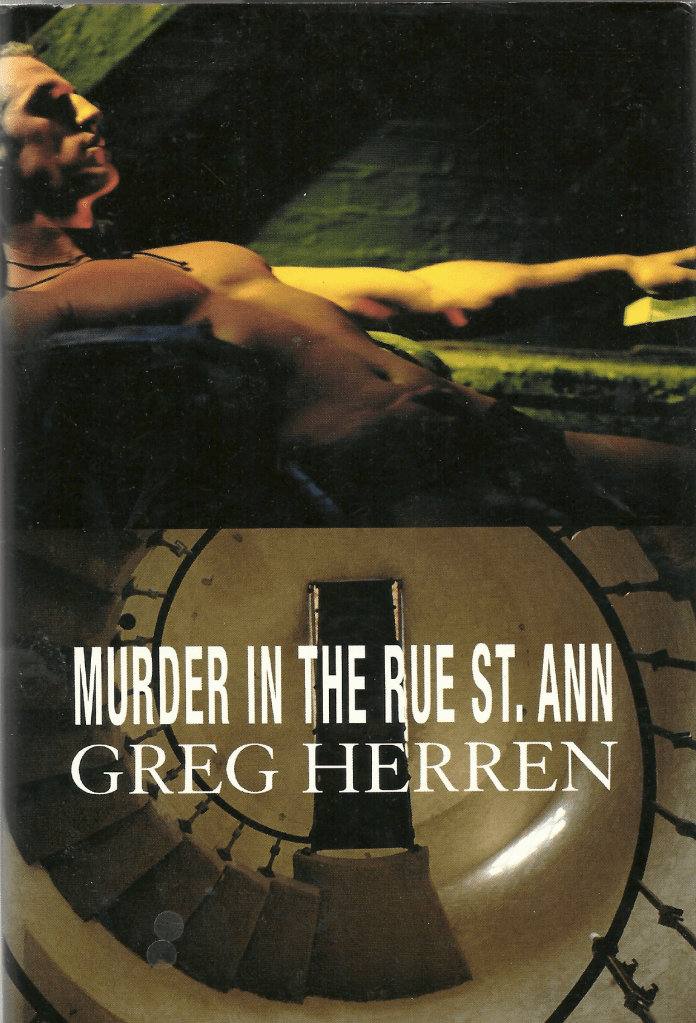
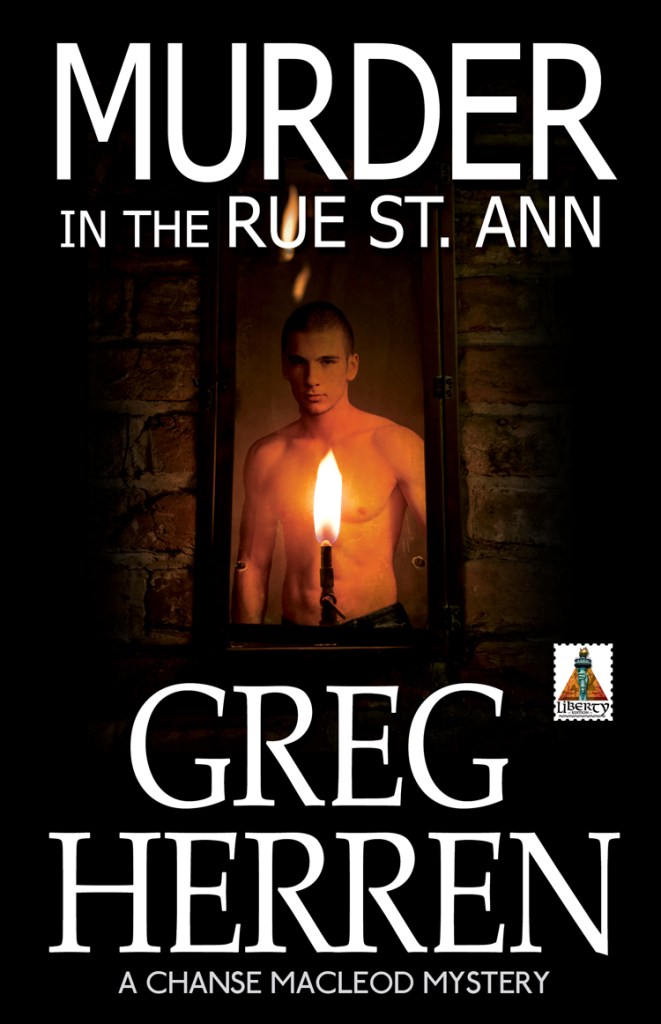
This was the Insightoutbooks edition cover of Murder in the Rue St. AnnThis is the new cover the book got when Bild Strokes Books republished the book as an ebook.
I took a streetcar named St. Charles down to Canal, crossed the street and walked down to Royal.
It was eleven o’clock in the morning on one of those splendidly sunny September days that makes you glad to be alive. Taking the streetcar had been a good idea. The long heat of summer had broken, and the air was crisp and in the mid-seventies. The sky was that blue unique to New Orleans, with wispy white clouds scattered across its expanse. There was just a hint of cool moisture in the air. There were a lot of people milling around the sidewalks on Canal— a good sign for the tourist season. Canal used to be the main shopping drag of the city, with huge department stores like Maison Blanche and D. H. Holmes. Those were long gone. They had either gone out of business or fled to the suburbs— now it was mostly hotels, fast food, and Foot Lockers.
There were hopes that putting the Canal streetcar line back in place would stimulate a recovery for the street. So far, all the construction work had simply made the Quarter difficult to get to from uptown. Add to that the chore of trying to find a place to park that would get me a ticket in two hours or cost ten dollars, and I was kind of glad I was having car trouble—the streetcar down and a cab home was very simple.
Not that riding the streetcar didn’t bring its own set of aggravations. If the cars ran on any fixed schedule, I’d never been able to figure it out. You could wait for one for half an hour and then three in a row, all packed to the gills, would show up. The streetcar ostensibly operated as public transportation, but was also a de rigeur tourist attraction. There was no way of telling when you’d be able to catch one with a place to sit. But when you did, it was nice to find a window seat on a sunny day and enjoy the city clacking by.
So, when Alyson chose to drop the Chanse series after I signed with Kensington, Murder in the Rue Royal went back into a drawer, which was fine–it wasn’t a good book–and I moved on with my life. The advance for signing with Kensington paid for our move back to New Orleans from Washington, and moving back here was absolutely worth ending the Chanse series for, seriously. I still didn’t have an agent, but I’d been signed to book contracts by two publishers already, and I figured it might be easier now. We accomplished the move, get our new apartment set up on Sophie B. Wright Place, and started putting our lives back together. I don’t remember the timeline of how it came to be, but I was still working with Alyson on my first and second erotic anthologies (Full Body Contact and FRATSEX), so I was aware when my editor left and a new person, that I knew slightly, moved from assistant editor to senior editor. We were talking on the phone one day about Full Body Contact and she casually mentioned, “I don’t see your second Chanse book here on the schedule, what’s going on?” and I told her the story, “Oh for fuck’s sake, when can you get it done by?” and that became the second contract for Chanse.
So, after finished Jackson Square Jazz and turning it in, I broke out Murder in the Rue Royal (the title had already been changed on the contract to Murder in the Rue St. Ann; my new editor didn’t like the alliteration) from the drawer, blew the dust off it, and reread the manuscript. I looked at my timeline for the series, and saw that this was the one where he was supposed to fuck up his relationship, but I didn’t see it in the manuscript. I reread the first book, thought long and hard about Chanse and who he was at this point in his life and after several long days of musing it hit me, between the eyes: jealousy. Jealousy would be what fucks up his relationship, and it only made more sense to me that Chanse would be the jealous one. Paul had a loving, accepting family and was more secure in and of himself as a gay man and what he wanted out of life. Paul was considering becoming ground-based at the New Orleans airport so he could settle down and have more of a life with Chanse, which also has Chanse very alarmed and makes the jealousy even more intense….so what would be the thing that would set Chanse’s jealousy off? Something from Paul’s past that Chanse didn’t know but finds out about in the worst possible way?
I had had some issues, believe it or not, with stalkers over the years. I had always wanted to write about a stalker, so what if Paul had a stalker? Why would Paul have a stalker? And then it occurred to me that Paul had a past he wasn’t ashamed of, but had never mentioned to Chanse. Not out of a fear that Chanse wouldn’t understand, but mainly because he had no need to tell him because it wasn’t anything dark. He had done some nude modeling when he was younger and he had also done some soft-core wrestling fetish porn, which is where the stalker came from. And what if I could work the con man he’s been hired by was someone Paul knew from the soft-core fetish porn? What if the guy contacted Paul because he’d been getting threatening notes on top of everything else going on in his life? And what if Chanse ran into Paul when he was leaving the con man’s offices, which brings all this out about Paul’s past? What if it shook a jealous, possessive, insecure Chanse enough for them to fight about it? And what if Paul disappears after the con man is murdered?
That was something I could work with, and so I did.
I’ve always called Murder in the Rue St. Ann my most under-appreciated work. By the time the book had come out, Paul had lost his eye to the muggers and we were in recovery mode. I didn’t do much of anything to promote the book (other than a signing at Outwrite in Atlanta, where I signed all of my books until they closed), and it kind of came and went quickly. I felt it was the most unappreciated of all my books. Jackson Square Jazz had come out earlier in the year before Paul was attacked, and it sucked all the oxygen up that year intended for me–it was the Lambda nominee, not Rue St. Ann–and I didn’t pay much attention to the book after it came out, either. The ‘christians” came for me a few months after the book’s release as well, and then Katrina…so yeah, Rue St. Ann got no press, got no attention, but somehow still managed to sell well.
I did have the next one planned, Murder in the Rue St. Claude, which there was a proposal in for, but Alyson was also going through other, deeply concerning changes that showed how little the higher-ups knew about anything, let alone publishing. But that’s a tale for another time, I think.



 Queer and Loathing in America