Snakedriver

Ah, Alabama.

Despite everything that is wrong with Alabama culturally, societally, spiritually, and politically, I’m not ashamed of being from there (and never will be). I do shake my head with every new law passage or court ruling there that flies in the face of decency and the Constitution, because it is sad that the majority of people there are not only so lost spiritually and intellectually, but also defiantly cling to their backwardness. My part of the state, where my people are from, used to be very remote and rural; many native Alabamians, when I tell them where I’m from, are often confused, having never heard of it before. It isn’t on any interstate, rooming options are limited, and you really have to drive for about an hour from the nearest interstate to get there. It’s not quite as remote as it used to be; many of the roads that were dirt and/or gravel when I was a kid are paved now…but there are still plenty of unpaved roads up there in the hills and along the countryside. It’s very different there now, too–the country stores are all gone, and there’s definitely a lot more McMansions than there ever was when I was a kid. (Dad and I often marvel at the palatial homes we come across driving around the county, as Dad shows me places from his childhood and when he and Mom were first married.)

And it’s not cheap to buy property there, either, which was also a bit of a surprise.

Dark Tide was my first attempt to deal with my history and where I am from, but was cowardly in the end and wound up editing most of the backstory of my main character out. It didn’t really fit and made the book something different from what I was trying to do with the book, but as I edited it all out I also felt that I was being a bit cowardly. I knew I was going to have to deal with the troubled history (and present) of the county and state, so I wrote Bury Me in Shadows to not only try to get a better understanding of the area, but to deal with that troubled past. It wasn’t easy–I often found myself cutting things to a bare minimum in a stupid attempt to not give offense, and there were many times while writing it when I’d wince or skip a scene because I wasn’t sure how to word it properly without being preachy. I wanted to show through the story how refusing to face the past with a realistic and jaundiced eye can cause generational trauma and how that, in turn, perpetuates societal racism and homophobia in an endless cycle that strangles growth.

But writing that book also took me down a research wormhole that I’ve never really climbed back out of, and being there last weekend also reawakened some memories as well as creativity and potential future stories. (Dad and I found a really sad set of graves in the same cemetery as my maternal grandparents and uncle; parents and two small children –one was only four months–who’d died on the same day. We speculated as to how that happened, tornado or car accident or house fire, but a distant relative my father also knew explained that the father killed them all and then himself…which naturally started churning things in my brain again.)

I also discovered, during the pandemic, a horrifying documentary called Alabama Snake, which focused on the snake handling churches of northeast Alabama and a minister who tried to kill his wife with snakes…and then discovered there was also a book about the culture from a reporter who’d covered the trial, and continued investigating and looking into the snake handling churches.

I finally read it last week.

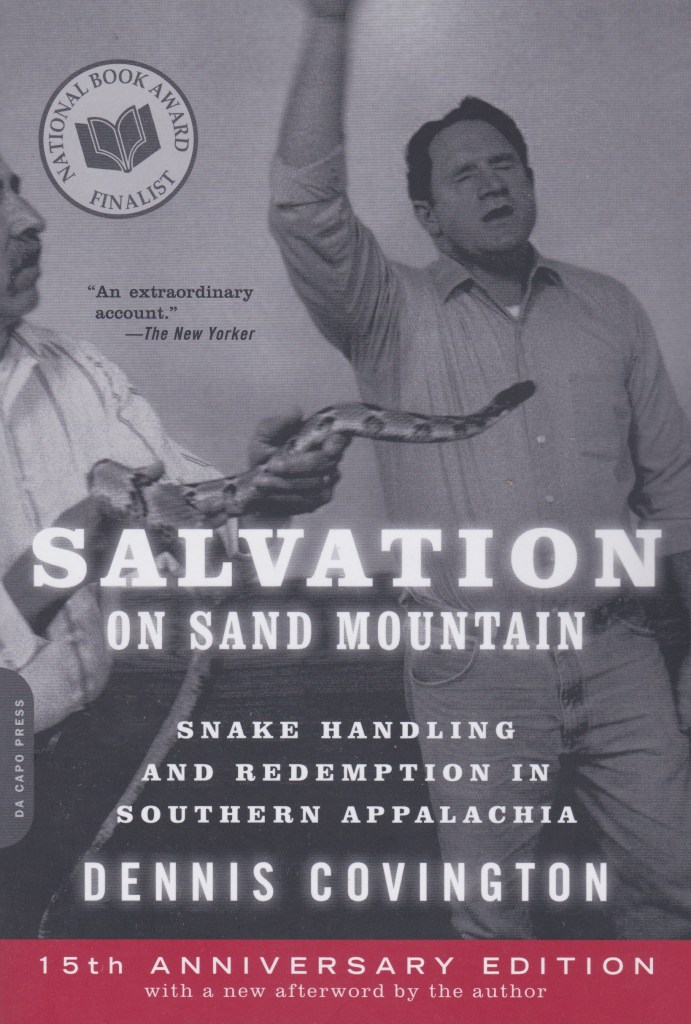
The first time I went to a snake-handling service, nobody even took a snake out. This was in Scottsboro, Alabama, in March of 1992, at The Church of Jesus with Signs Following. I’d come to the church at the invitation of one of the members I’d met while covering the trial of their preacher, Rev. Glenn Summerford, who had been convicted and sentenced to ninety-nine years in prison for attempting to murder his wife with rattlesnakes.

The church was on a narrow blacktop called Woods Cove Road, not far from the Jackson County Hospital. I remember it was a cool evening. The sky was the color of apricots, and the moon had just risen, a thin, silver crescent. There weren’t any stars out yet.

After I crossed a set of railroad tracks past the hospital, I could see the lights of the church in the distance, but as I drew nearer I started to wonder if this was really a church at all. It was, in fact, a converted gas station and country store, with a fiberboard facade and a miniature steeple. The hand-painted sign spelled the preacher’s first name in three different ways: Glenn, Glen, and Glyn. A half dozen cars were parked out front, and even with the windows of my own car rolled up, I could feel the beat of the music.

It’s very difficult to think about Alabama without religion being involved in some way. Alabama is a very religious state, with churches everywhere–one of the things I always comment on whenever I am up there driving around with Dad is “there sure are a LOT of Churches of Christ up here”–you really can’t go anywhere without driving past at least two. Both of my grandmothers were devout (paternal family was Church of Christ; maternal Southern Baptist, although both my mom and uncle married into CoC and joined), but only the CoC was a fanatic with a Bible verse for everything and the uniquely American/Christian methodology of interpreting everything to justify her own behavior and conduct–which wasn’t actually very Christian (memorization doesn’t mean comprehension). I can remember driving around down there once with my grandmother–either in Alabama or the panhandle of Florida, where she wound up after retiring–and driving past a church (I won’t name it because she was wrong) and I said something and she sniffed in disgust. “They speak in tongues and take up serpents,” she replied. “Which is apostasy.”

Apostasy. What a marvelous word, and one that has always snaked its way through my brain, and comes up often whenever I talk about religion. But I digress; I will someday finish the essay in which I talk about my relationship with Jesus and my rejection of dogma.

I also liked the phrase “taking up serpents,” and always wondered why she said that instead of snake-handling.

I had originally thought, when I bought this book, that it was about the attempted murder by rattlesnake and subsequent trial, like the documentary I mentioned; rather it’s an exploration of this sect of Christianity by a curious reporter, and how being exposed to this style of worship made him rethink his own past, his relationship with his own faith, and about Alabama people in general. One of the reasons I enjoyed the book so damned much–even as I was repelled by its subject matter (snakes are the source of some of my worst nightmares; even harmless little garden snakes turn my stomach and engage my flight mechanism)–was because Covington has a very easy, natural and authentic authorial voice, and he really can put you into his mind as he witnesses and experiences this uniquely American brand of Christianity. It was also interesting as he got caught up in the entire experience, as he talked to the members of the various sects (there’s no national structure to the snake-handling churches, as there is with say the Southern Baptists or the Methodists), and watched them actually take up their serpents in the name of the Lord.

There’s also interesting information in the book about how these sects were created–or how they were descended from, surprisingly enough, the Methodists and how that evolved into these Appalachian sects, as well as where the people of the Appalachian regions came from, and that entire Southern mentality of fighting for their traditions and their “way of life” (it was also interesting that it’s a white phenomenon, at least as best I could tell in the book); of how they secluded themselves up in their mountains and hollows and were self-sufficient…but modern technology has forced them into a world that has left them behind.

I’ve always wanted to write about snake handlers…but as I mentioned before, snakes are the stuff of my worst nightmares, so yeah going to witness in person their rites is a big “no” from me, but I feel like I can maybe do that now, or at least make an attempt. I don’t know how much more research I’d need to do to fictionalize snake handlers, but some day it will happen.

Down by the River

My appreciation of all things Gothic is at least partly due to the old soap opera Dark Shadows, which I watched as a child and has crept its way into my work, my reading, and the majority of my entertainment consumption ever since. I have always loved anything with a touch of the Gothic in it, and spent my teen years (and a lot of my twenties and thirties) loving and consuming Gothic fiction. The post-war style of Gothic literature, marketed primarily towards women, was being done by authors whom I loved like Phyllis A. Whitney and Victoria Holt and others (while Mary Stewart’s work was also considered Gothic and featured many of the tropes of Gothic fiction, I consider her books to be Gothic-adjacent, and I will probably explain that better and in more depth at another time) and I couldn’t get enough of them. Holt and Whitney, to me, were the two best at this subgenre, and when Gothics stopped being published in such great numbers, I was disappointed and mournful.

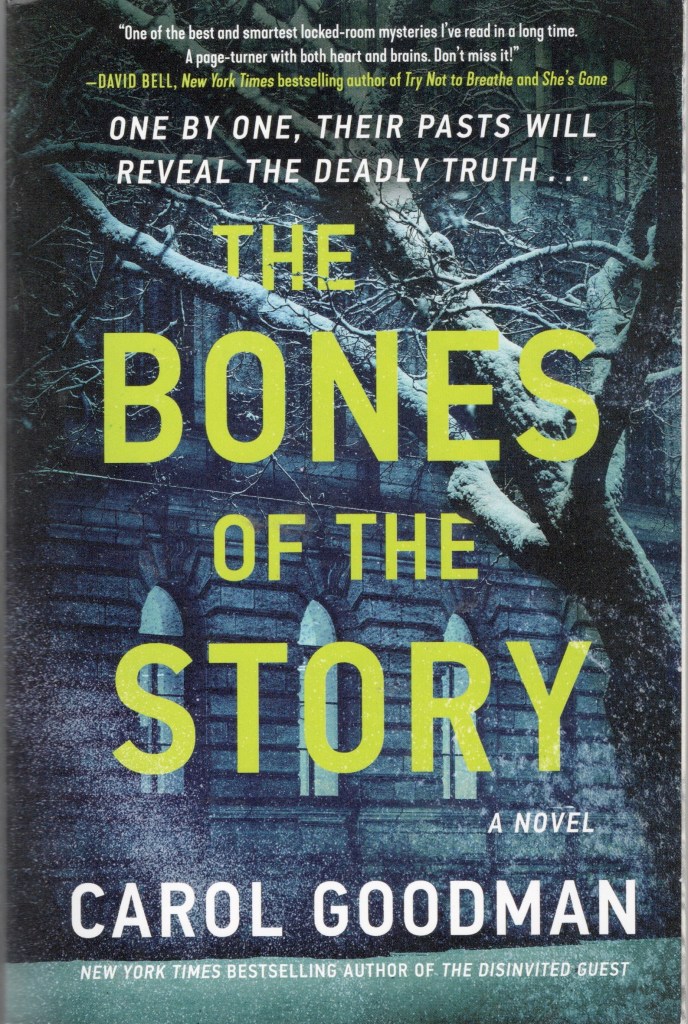
Which is why I love Carol Goodman’s books so much. Her books have that Gothic feel to them, are beautifully literate in their prose and structure, and they are also incredibly smart. The books also cover art, education, and the classics; every book is filled with classical references that inevitably make me feel smarter for reading them.

The Drowning Tree is no exception.

The river feels wider from the shallow boat, the humpbacked hills of the Hudson Highlands looming like the giants Dutch sailors believed dwelled there.

“Just put the water behind you,” he says.

I can’t see the man in the boat behind me, and I don’t want to risk my precarious balance turning to see him.

“You’re been through the drill,” he goes on.

And I have. Six weeks practicing in the indoor pool under the watchful eye of the kayaking instructior, tipping myself into blue chlorinated water and rolling up again, gasping, into the humid air, all in one long in-drawn breath. I’ve practiced it until it’s become second nature, but it’s one thing to turn over in the clear, warm pool water and another to imagine myself hanging upside down in the cold gray water of the Hudson, trapped in the currents…

“This is where the current is most dangerous,” the voice says. “The Dutch called it World’s End.”

Like many of Goodman’s novels, this book is set in the Hudson Valley and there’s also an institute of higher learning–Penrose College–involved. Our main character here, Juno McKay, runs a stained glass restoration business in the same town where she went to college and grew up; she also lives in the building that houses her glass works. Her best friend from college, Christine, is coming back to the college to give a lecture into her research into a stained glass window at the college that Juno’s company is in the process of being restored. But before the lecture, Juno sees Christine arguing with the school president, the most recent Penrose, and afterwards when they have drinks together before Christine catches her train back into the city, Juno gets the impression that somethings’s going on with Christine–and then she is found, drowned in a creek along the shoreline of the original Penrose estate, near a sunken sculpture garden, in a scene very reminiscent of the scene in the stained glass window Juno is restoring. IS there a connection? Was it an accident, or was it murder or suicide?

Like any intrepid heroine in a Gothic novel, Juno is soon drawn into the mystery Christine was looking into–what happened years ago, between the first Penrose, his wife and her half-sister? How many secrets does the abandoned estate (very Nancy Drew, too–it reminded me of The Clue in the Crumbling Wall a bit) conceal? What secrets did the original Mr. Penrose, an artist and painter, conceal in his paintings and art and stained glass windows? Briarwood, a local mental institution, also comes into play as well; years ago, Juno’s ex-husband tried to kill her and their infant daughter by drowning them in the river. They survived, but his mental health did not and he’s been in Briarwood ever since. The pattern of three from the past with Penroses and the half-sister also seemed to play itself out with Juno, Christine, and Juno’s ex-husband, pulling the reader into all these complicated skeins and twists and turns, until the book comes to an extremely satisfying end with all secrets revealed and life back to normal at the end.

What a great read, and a great example of why I love Goodman’s work so much.

So Fine

Well, I got all my tax stuff done yesterday and uploaded into my accountant’s portal and that’s the end of that shit for at least this year now. I don’t know why I always hate doing this; it’s not fun, to be sure, but it never takes super long and it’s such a relief when it’s done…praise Jesus. But that put me into a mood–not sure if it was depression or what, but I wasn’t exactly in the greatest mood after finishing. Not a bad mood, by any means, but just a kind of weird funky malaise of some sort. It didn’t help that it was raining and gloomy all day. I had to run errands after work (in the rain), made it home and just sat down for awhile and took a red pencil to “When I Die,” and there was a lot of deleted material. That also kind of made me feel not so great, either–even though a lot of the deletions had everything to do with switching the story from about two couples to three young men. Paul and I watched two more episodes of the Dead Boy Detectives, which is really quite good and we are enjoying it a lot. There’s some queer subtext going on with the show, but nothing truly overt other than the Cat King.

I woke up this morning to the news about Tulane calling out the cops and campus police to break-up a protest for Gaza on the campus last night…and they brought out horse cops. The irony that the cops only get called or try to break-up protests by progressives on college campuses doesn’t escape me, but no one ever cares about Nazi marches or things like what happened in Charlottesville not that long ago. I always hear people complaining about how college students and the young don’t vote, don’t get involved, etc etc etc. Well, now they are engaging in world affairs, and they really don’t like seeing genocide on their screens. So, I guess it’s about what they chose to be interested in? And I don’t think having them arrested or the police physically assaulting them is going to change their minds? It always bothers me whenever I see the police attacking protestors. It’s definitely a free speech issue, and of course with memories of Kent State lingering in my mind…I just don’t like it. If the protestors aren’t being violent or damaging property (remember, the police’s job is to protect property, not people), what’s the harm? Don’t come for me, either–I also feel Jewish students have the right to feel safe on campus and of course there’s no place for anti-Semitism anywhere in American society, but spare me the pearl-clutching from the right–you know, the people who believe there were good people on both sides in Charlottesville? I had read that the students had closed down St. Charles Avenue for a little while the other day–again, an annoyance to drivers, nothing terrible or serious or revolutionary in any way–and was kind of pleased. Apparently, Tulane’s president feels that the protestors aren’t students for the most part (the old “outside agitators” thing, thank you, George Wallace for that terminology), but again, I despair. I also despair at the people who think the protestors should be shot and killed, which…seems unconstitutional in ways you don’t have to be a lawyer or a legal scholar to recognize. The fear that the crowd might become uncontrollable or violent isn’t a justification for denying the students their First Amendment rights.

Again, property not people, and the sooner most white Americans wake up from their lifetime of brainwashing about what the role of cops actually is the better. And I say that as a crime writer. I don’t like the notion that the cops are above the law, can violate it with impunity as well as the legal rights we all share in theory. I was thinking about this lately, about how most crime writers never delve into police corruption or never really challenge the notion that the cops are the good guys when all too often their frail humanity gets in the way. I’ve thought about this a lot since the original police brutality protests about innocent Black people being murdered by the cops–at his point there are so many I can’t remember them all or what actually got the country riled up in the first place. I have taken to thinking that I write a lot of copaganda; my police officers–always supporting characters and never the lead–are honest, hard-working, not corrupt, and can be counted on.

I do not feel that way in real life. I have had an idea for a book about police corruption in New Orleans for a really long time now; the problem (for me) is that it’s a Venus story, and I don’t think I necessarily have the chops to write from the perspective of an older Black woman cop nearing retirement. I’ve wondered how I could turn it into a Chanse or a Scotty book, where Venus hires them to look into a case that’s been written off; I had wanted to call it Just Another Random Shooting, but if it’s a Chanse or a Scotty I have to stick to the title scheme I started with. Or I could spin off Jerry Channing, my true crime writer, who has appeared in several of my books already and who I’ve wanted to write about for quite some time.

Interestingly enough, my hearing aids haven’t been working that great lately and I was beginning to think I’d have to take them in again for repair…but last night after I got home from work, both ears popped (a pressure thing) and this morning my hearing aids feel like they are turned up way too loud! I had to turn them down. Today I can hear my fingers clicking on the keys, I could hear Sparky whining for treats upstairs, and so on. I feel pretty good this morning and it looks like it’s going to be another beautiful (borderline too hot) day today after the gloom and rain of yesterday. Huzzah!

And on that note, I am heading into the spice mines. Have a lovely day, Constant Reader, and I may be back later, stranger things have happened!

I Only Have Eyes For You

Sunday morning and I slept pretty well. Sparky of course annoyed me out of bed to feed him around six, and then I did go back to bed for two more hours. Our big day of errands wore us both out yesterday, and I also just realized the primary thing I went to Costco for? I didn’t get. AUGH. Oh, well, it’s just sweet-and-low packets; I can get some anywhere and then go for the three year supply the next time we head out there. Still irritating, though. After we got home and put everything away, we settled in to finish Vigil, which I greatly enjoyed, and then we moved on to a rather clever slasher flick called Bodies Bodies Bodies, and then we tried Baby Reindeer, which was very strange and really just kind of sad. I don’t think we’re going to continue with it, but it was something different, to be sure.

Yesterday wasn’t a total wash, just as today won’t be. It may be Paul’s birthday–I’m going to get us a pizza for dinner, and maybe rent something to watch, lie Dune Part II–but I can get some things done this morning before he gets up. I’m also not going to wake him up until he wants to get up, and I also promised to make him waffles, which I’ve not done in so long it’s almost shameful, frankly. Paul is 61 today, and I will be sixty-three in a mere four months. I did make some writing notes yesterday, and of course I was also thinking a lot most of the day about the things I’m working on. I also recognize my incredible skill at rationalization here as well…no one can rationalize or justify the way I can when it comes to excuses for not writing. I also downloaded some biographies of King James I–the influence of Mary and George, no doubt–but I am not entirely sure why I’ve avoided biographies of King James before. I have a lifelong interest in both his mother (Mary Queen of Scots) and his predecessor (Elizabeth I), as well as his Stuart descendants; yet have always avoided King James. I’m not sure why that is; but other queer kings and royals have often been of interest to me, but James didn’t come to a bad end the way most of the others did and so can be considered a successful queer King. (Frederick the Great is another.) It also seems like this Elizabethan/Jacobean era was rife with sodomy all the way through to the eighteenth centiury, both in England and France. The last son of Catherine de Medici, and the last Valois king of France, was gay (Henri III); so was the brother of Louis XIV and one of his illegitimate sons, the Duc de Valentinois; and of course James I’s great-granddaughter Queen Anne was a big ole lesbian. The queers disappear from European royal history for a while, certainly in England and France in the eighteenth century. I’ve always wanted to write about Louis XIV’s brother, and it may be interesting to write about Henri III from the point of view of one of his mignons. The French court in the 1580’s was a hotbed of intrigue, conspiracy, and murder; a very turbulent period I’ve always wanted to write about.

I’ve also come to realize that I need to be more ambitious with my writing rather than saying oh that’s too complicated or too hard or too difficult for me to write. I’ve been putting off my historical interest writing for quite some time, always thinking that someday I’ll feel competent in my skills to try it. It’s actually a cop-out; I should have written some of these years ago, or at least got started. My Sherlock story (still so incredibly proud of it) was my first real historical story (one written in a period of time I was not alive and cannot remember), and all of my fears about it were so clearly misplaced. You don’t have to know a period so intimately that you might as well have lived then in order to write about it. How much research is too much research? The difference between a short story and a novel, of course, are significant–clearly, you don’t need to know as much with a short story as you would with a novel–but again, how much is not enough and how much is too much? The problem (for me, at any rate) is research is like planting seeds–more ideas grow the more research I do, it’s an ADHD thing, I’m pretty sure. But I am definitely going to start the research for my seventeenth century novel, methinks; I love history, so why not? I can scratch two interests at the same time.

Saturday morning I will leave for Alabama for Decoration Day, or what I always thought it was called, The First Sunday in May. That’s what it’s always been called, it’s definitely what my grandmothers and mother called it, and that’s how it’s lodged in my memory banks. I’m going to help my dad put out the flowers and clean the graves, and then on Monday morning I’ll follow him north to Kentucky. It’ll be a nice week away, and I am going to try to get some work done and a lot of reading done while I am there. (Dad called it Decoration Day in an email the other day, and I thought, well, that makes a better name for it but for me, it will always be called The First Sunday in May.) I did notice last year that the only people out doing it were my age or older, so it’s probably one of those county customs that is dying out in these modern days of the Internet, cell phones, and streaming. A pity, to be sure, but sometimes traditions do die out. “The old ways”, as they say in creepy tones in Gothic novels that I love so much. I also imagine my creativity is going to explode while in Alabama as it always does.

And on that note, I am going to eat breakfast, get cleaned up, and head into the spice mines for the day. I may be back later, one never can be certain–but if not, have a lovely Sunday, Constant Reader, and I’ll check in with you again later.

Screenshot

Frankie

Saturday and a big day of being out of the house. I had planned on not doing much outside the apartment vis-a-vis errands, but Paul’s state ID expires today (and he only realized it last night) so somehow only getting the mail today has morphed into the DMV, Costco, lunch out, and the mail. Ah, well, I can come home and write in my easy chair. I finally figured out why my Macbook Air doesn’t sync with my Microsoft accounts; it needed to have Word updated and the passwords reset…so now I can access everything from the laptop, which makes life ever so much easier for me. I was actually working on the revision of “When I Die” yesterday when Paul decided he was done for the day and came downstairs so we could watch Mary and George (still superb) and more of the second season of Vigil, which is absolutely fantastic.

I did get some chores done around here yesterday–I laundered all the bed linens and another load of laundry, and worked on the dishes, which need to be finished this morning, and did some picking up and organizing–and while I am relatively certain these errands are going to wear me out today, at least I feel rested this morning. I was still a big tired yesterday from the week, and when I woke up was a little groggy. This morning I feel ever so much better, frankly, and so I hope I can go ahead and make it through the day.

I have been watching with macabre enjoyment this bizarre civil war within the Republican party, and am not entirely sure how this is all going to end up. Yesterday the news broke and went viral about South Dakota Governor Kristi Noem, one of the potential VP candidates for the right, who wrote in her self-promoting-I-am-to-be-taken-seriously-on-the-national-stage-book-about-me-in-an-election-year that she hated a fourteen month old puppy who “couldn’t” be trained (that’s a you failure, Madam Adulteress) so she decided to shoot him in a gravel pit–and then shot a goat she didn’t like on top of it when that didn’t sate her bloodlust. I immediately knew when I saw the Guardian article about it that she was 1) pretty much finished and 2) not really aware about the divide between urban and rural when she wrote that in her book. I know exactly the kind of mindset she has about animals–she’s rural–because it’s the same mentality my parents had about animals because they grew up on farms and you don’t have animals in the house as pets, for one thing, and for another, when you grow up on a farm and are used to killing animals for food–cows, pigs, chickens, etc.–you don’t get really sentimental about them because they die. I also knew it wasn’t going to play well with voters and most Americans, because most of us love animals and try to do whatever we can to save them, not shoot them. She also doesn’t get it, still; she defended herself with a post or statement of some sort where she talked about that very thing–and how many animals on her ranch/farm/whatever she’s had to put down recently. Way to throw gasoline on the fire, Madam Adulteress!

And way to not understand the American electorate. And if you don’t know that the vast majority of Americans love animals and especially dogs–you’re probably too ignorant and out-of-touch with most Americans to lead anywhere other than an extremely rural state, and most definitely not the entire country.

Interesting how many Republicans have been horrific dog owners–Noem, the Romneys, and the Huckabees of Arkansas.

My parents may not have had any sentimentality about pets, but they also didn’t have any.

Ah, Mary and George. I hope you are watching, Constant Reader–even if you aren’t into history, the show is the kind of bitchy back-stabbing plots and subplots and twisty/turny show that reminds me, with its wit and bitchiness, of some of the greater nighttime soaps and even of Real Housewives shows. I also like how fluid everyone’s sexuality is at the Jacobean court. I really need to read a bio of King James; I’ve certainly read enough about his mother Mary Queen of Scots and his son, Charles I, who lost his head during the second English civil war. I know Antonia Fraser, whose superb Mary Queen of Scots I read when I was eleven, wrote a bio of James that I always wanted to read but never did. Perhaps this is the proper time? I also should read bios of Louis XIII and Cardinal Richelieu to get a stronger sense of the time period…and I really am beginning to think I might be able to start writing Milady, my long-dreamed-of novel, later in this year.

And on that note, Constant Reader, I am heading into the spice mines to load the dishwasher and get the day’s business started. Have a fabulous day, and who knows? I may be back later.

Forty Miles of Bad Road

Work at home Friday, and all is well in Gregworld. Granted, I haven’t looked at the news today or checked in on social media (probably should avoid that, to be honest), so my cheery mood should last until at least I finish this entry. I do have to go to the gym today, and I need to run a couple of errands, but other than that I think I am going to at least try to stay inside for most of the weekend. I may take a walk tomorrow morning, depending on how I feel, but I can’t just keep pretending the stamina will come back on its own, and it’s going to be tough getting it back. My eating habits are getting better, I am sleeping better, and my anxiety is almost completely gone.

I did a little writing last night, and it felt kind of good, so I am hoping to get back on that horse this weekend completely as well. I felt off all week, not sure what that was about, but today I don’t anymore. This week was also one of those weird weeks where I was more tired at the beginning of the week than I was at the end, which I am sure has everything to do with changing the sleep schedule on the weekends and then having to adjust back. I am not going to get up at six on my off-days; that will never happen–I have never been a “spring right out of bed wide awake” person, and I think that will last my entire life. I can live with it, to be honest. I hope to have a great weekend. I don’t have to do much more than touching up around the apartment, so I can get into a deeper clean this weekend–more paper is going to be tossed, as well as more books being pruned for the library sale. I’m looking forward to reading more of Ford’s Suicide Notes and possibly finishing it this weekend…and then perhaps reading some nonfiction until I leave on the trip. I still haven’t finished Rival Queens, and that’s something I really need to finish so I can move on to another.

We also finished the first season of Vigil, which was terrific right up to the closing credits. We immediately dove into season two, which is another murder mystery with international intrigue involving military operations in a fictional country in the Middle East (it occurred to me yesterday that middle east is very Eurocentric; it probably started being called that during the Roman Empire, when that was, to them, the middle east; is there another way of referring to that region that I’ve missed somehow? Something to ponder), so it’s similar but extremely different from the first season. There’s also going to be a new episode of Mary and George today, which I am very excited about. Oh! I should read The King’s Assassin for nonfiction; the show is based on the book and I do have a copy! Perfect! The day just got that much better!

I still need to rein in and focus my creativity, which is still bouncing all over the place like a whack-a-mole. But I do think if I settle into writing and Sparky doesn’t harass me, I think I should be able to get a lot done. He did start trying to get fed at his usual time, and he is nothing if not determined. He didn’t relent until I finally gave up and got up at seven thirty, and now he is nowhere to be seen. I do love the little rascal, and he’s so happy to have us both home at night together that I hate to think I’ll be gone for about seven days starting next weekend. I also need to get my shit together for that trip, too. I think I have my audiobooks downloaded and prepared–Carol Goodman’s The Drowning Tree for the way up, and either a Lisa Unger or another Goodman for my drive back. I think I’m going to take the Tremblay, the Ford sequel, and one of the Koryta as Carson books.

I also dug out my old essay “Recovering Christian” to look over, with an eye towards revision/rewrite and possibly either sharing here or over on Substack (I”m not sure if we’re supposed to still be using Substack or not, but for longer form essays it’s probably better than here). I’ve been thinking a lot about Christianity lately, and how it’s been thoroughly debased and weaponized in this country (just as it was for centuries in Europe) and has become about everything except the teachings and ministry of Jesus Christ. The modern American version of Christianity is undoubtedly the whore of Babylon from Revelations; and false prophets abound in our modern times. See what I mean about my creativity? I saw some “christian” tomfoolery on social media the last few days, and it was enraging. I may not go to church anymore, and I may not consider myself to be an actual Christian, but I swear, how do I know the Bible and their faith so much better than so many so-called Christians?

“Blind faith”, I guess.

And on that note, I am going to get something to eat and start getting ready for my day. Hope you have a lovely Friday, Constant Reader, and I may be back later on.

Just Ask Your Heart

Thursday and my last day in the office this week. I wasn’t as tired yesterday as I had been the day before, thank the Lord, but was still a bit raggedy as I got to the end of the workday. I was efficient at the office yesterday, but man, there was a very weird vibe to the day. Maybe it was the use of the National Guard on college campuses? I don’t care what you think or what your opinions, values and beliefs are we should never be calling out the military to handle “security” on college campuses. I get that the right hates college students–they always have; they cheered the Kent State shootings fifty-four years ago–and it’s just astonishing to me that no one makes the connections to the last years of the North American colonial period? It was all protests until the war actually started in 1775–the Boston Tea Party was particularly a notable one. What did the British do to maintain order in Boston? They brought in the military to quench and quell dissent, outlawed protesting and criticism of the King and Parliament…and none of it worked, it simply agitated the colonials to more protest and eventually violence. I always laugh a bit when the right wing–the ones who scream about liberties and freedom all the time–call for ending protests, driving cars into protestors, etc. They are the British in this scenario. And yes, the conservative colonists were actually on Britain’s side. It was the radicals and the progressives who defied King and Parliament and created a country.

The right to peaceably assemble and protest is imbedded in our national DNA and included in the Bill of Rights. But no one seems to care about the actual Constitution anymore (looking at you, SCOTUS), just what they think it means so they can defend their indefensible and unconstitutional beliefs and values.

I also wrote a great opening line for my future project The Crooked Y: “I hated the place they took me to after they arrested Mom.”

We did watch some more of Vigil last night, and there’s only one episode left in the first season, which will we watch tonight and most likely move into Season 2. It’s very good; it’s. a murder mystery/suspense thriller where a lot of the action takes place on a British nuclear submarine on patrol. It’s very well written, well acted, and riveting. The British are the best at crime series, seriously–and they are consistently good. I’m not sure why our crime series aren’t as consistently good as theirs are, but there it is.

I continued on my research wormhole yesterday about the French Quarter Stabber–seriously, once I get something in my head it gnaws at me until I give in–and it’s okay, I think. I feel more rested this morning than I have all week, really, and so hopefully that will carry me through the rest of the day and into the evening. I think I’ll probably just come straight home from work tonight, since i can run errands on my lunch break tomorrow, and that way I can get here and get the laundry started while finishing the dishes and doing some writing before Paul gets home. I also want to get back to reading Suicide Notes and even dipping into some poetry. (Who am I?) But I am starting to feel like I am also starting to get it; I like discovering it for myself without having professorial expectations loaded onto me–which always made me hate whatever I was being forced to read unwillingly–and I always love figuring things out for myself. Perhaps I’ll be wrong, but at the same time, everything is dependent on the reader, right, and their interpretations? It’s subjective, so therefore there’s no wrong way of reading it. It’s not like I plan on starting to write it or anything.

And on that note, I am going to head into the spice mines. I hope to have a great day where I get a lot done, and perhaps I’ll be able to finish another draft post…stranger things have happened! Thanks for stopping by–I appreciate you taking the time from your very busy day to check in.

Tell Him No

I did get tired yesterday afternoon, but I think it was more from malnutrition somehow than anything else. My breakfast and my lunch did not fill me up1, and after I had lunch I did feel like my batteries were starting to run down a bit. It was, all in all, a good day for the most part. I did make it through the workday. I ran errands after work (got some things for Sparky from Chewy, and the last batch of new shirts arrived); started organizing the draft blog posts to determine which can be combined (same topic started on different days, months, years) and which can be finished and which can be deleted; I finished the revision of “Passenger to Franklin” (and I think it’s much much better now); and started getting my (delayed and extended) taxes together. Ideally, I can get that done this week and to my accountant by Friday so that will be one thing more that’s been hanging over my head like the sword of Damocles out of the way. Huzzah! I also took a look at “When I Die,” and while this one is going to take a lot of fucking work, it’ll be so much better when I finish it!

I slept well last night, and my coffee is rather delicious this morning. It was cold yesterday morning when I left for work–surprisingly so–but it warmed during the day so my car was very hot when I got into it after work. It’s going to get warmer consistently later in the week–I still can’t get over it being eighty-eight last Friday, it’s only April for Pete’s sake–which means it’ll probably be hot and sunny as I visit graveyards with Dad the weekend after next. I was thinking last night, as we watched Vigil (it’s terrific, highly recommended), that I’m almost in a good place again for the first time in almost ten years or so. My stress levels are way down, my moods generally are good and even, and I don’t have flashes of anger anymore (mostly while in my car). Other idiot drivers are still annoying, but don’t send me into a rage anymore. Now, it’s more like I get annoyed, say very calmly, “yes, you’re an asshole who can’t drive” or “yes, you are so much more important than all the rest of us”, but as I said, it’s calm–and I can absolutely live with that.

I got a short story rejection email yesterday, and I was completely ambivalent about it. The problem is you’re never sure if the story just doesn’t work for them or if the fact that the main character is gay was a problem for them. Sure, the rejection had the standard form please submit to us again, but…yeah, not so much. This is what straight white cisgender people don’t get, with all their whining about “merit”–the only people who they think actually earn their careers are straight white cisgender people, after all–because you can never be certain that it’s the story that they didn’t like enough or whether homophobic concerns come into play: our readers might get mad at is if we shove queer down their throats or we don’t want to become known as the queer crime publication and every other iteration of that you can imagine…any excuse not to publish a queer writer. Many years ago, I decided that I would never allow suspicions of homophobia affect my writing career, and I would always assume it was the story that was the problem. But…you have to wonder. When a magazine only buys your work when you send them things with straight main characters (twice) but rejects everything with a gay main character or even a gay theme, you have to start to wonder.

And given how few of the magazines that actually pay well for short stories (or pay at all) there are and how little queer work they actually publish…you begin to wonder. You don’t want to believe it’s homophobia or homophobic concerns, but here we are, you know. The stories I am working on now aren’t really crime stories, they’re more supernatural/horror stories, but I do think “The Last To See Him Alive” is not only a good story but it’s written really well. I need to revise it and edit it, of course, but it’s in really good shape already which is pleasing. “When I Die” needs a complete overhaul, but that’s fine. It’ll be a better story for it when it’s finished. And while these stories I am working on could complete the collection, this morning I am wondering if I should include horror in this book or not.

I really do not understand these new state laws (here in Louisiana we got one, too) allowing people to drive their cars into protestors, something which inbred morons Tom Cotton of Arkansas and eternal bitchboy Josh Hawley of Missouri are all about. Nothing says leadership like telling people to kill or injure other people. As always, these kind of Nazi-lite fascistic laws come to you courtesy of the Republican Party and MAGAt. I personally am looking forward to driving my car into a crowd of Trump protestors and hitting the gas pedal, frankly. When I saw this on social media yesterday, I responded with Never thought I’d see the day when the Kent State massacre would have fanboys, which prompted some responses which, of course, made the most sense: they had them at the time. I was too young to remember the right-wing response to the Kent State shootings, I just remember being appalled that the National Guard murdered four students on a campus, and I have always viewed it as a disgrace and a tragedy…but of course the right did not see it that way–just as they backed William Calley as a hero after the My Lai massacre in Vietnam. Even I–who have always known how vile and unpatriotic the right in this country is and always has been–didn’t think they were that callous and awful.

They are, they always have been, and they always will be.

The thing that always amuses me about this is the “patriots” of the right always forget that the only reason we exist as a country was because of mass protests….which led to a revolution. So, by that way of thinking, the most patriotic thing you can ever do is protest, really. Remember the Tea Party, the seeds that grew into MAGA? Remember the stolen election of 2000? Remember how Reagan dismantled and changed (and ruined) Social Security? The only reason there’s an issue with it now is because of Reagan, St Ronnie of the Right. The Republicans are the party of Joe McCarthy, Richard Nixon, Ronald Reagan, Henry Kissinger, and people like Cotton, Marjorie Taylor Greene, Josh Hawley, and Matt Gaetz are their heirs.

Remember back when I was thinking about starting to read and study poetry? I got a great recommendation from a dear friend at S&S of where to start–Mary Oliver’s Why I Wake Early–and I’ve been paging through it randomly, reading poems here and there, glimpsing fragments, and I think I’m slowly starting to come to an understanding of poetry I never had before. I am not going to review poetry on here as I am nowhere near knowledgeable enough and I don’t want to make a fool out of myself self-teaching and coming to what regular readers of poetry already understand from studying it. It’s a wonderful education, and one I kind of wish I had started earlier. Ah, well.

I also decided to postpone reading the Paul Tremblay and take it with me to Kentucky to read. Instead, I’ve decided to reread a book I don’t remember much of–Suicide Notes by Michael Thomas Ford. He published a sequel this past year that I would love to read, but not remembering the first one was a problem, so I decided to go ahead and reread it. I don’t talk about Ford much, but he really is one of the most underrated queer writers of our time. He can basically write anything (a blessing and a curse, as I know all too well), and he does it extremely well. Rereading the first chapter last night pulled me back into the story effortlessly, and the voice is so compelling and hauntingly real…and likable. I’m looking forward to reading more of it.

And on that note, I am heading into the spice mines. Have a lovely Tuesday, Constant Reader, and I’ll probably be back later.

  1. I also ate dinner late on Sunday night, which I usually don’t do and am sure that had something to do with it, but given I don’t really get hungry all that often it was kind of cool. ↩︎

Are You Lonesome Tonight?

Lonesome is a great word that doesn’t get as much use as it used to; it was a very popular emotion/feeling for songwriters (especially those in the genre then known as “country and western”) to write about back in the 50’s and 60’s. It’s a very evocative word, and I am not sure why I don’t hear it as often as I used to. I love the word, and one of my ideas is to write a book called Kansas Lonesome at some point. The premise would be that there’s a podcast called that, which covers Kansas true crime stories throughout the state’s history; I am not sure how that podcast will play into the story I want to write, but that’s the foundation of that book, whatever it turns out to be. I am currently in the process of writing a short story (one of many, by the way) with a college student investigating a crime site out in the countryside to sus out background information for a podcast episode for the producer/star of the podcast. I do think the book may be inspired (Kansas Lonesome) on a homophobic incident that occurred in my old school district in Kansas; a young lesbian was put off the bus and banned from riding for saying she was a lesbian. The school district tried to cover up everything, but it turned out the girl was the only one telling the truth, the bus driver was fired, and the superintendent lost out on a big career move…and a few months later, she disappeared. Her name was Izzy Dieker, and as best as I can tell, she’s not turned up yet and it’s been over two years since she went missing. There are just some articles noting her disappearance, and then….nothing.

That is a great premise for a crime novel, isn’t it? Kansas Lonesome is becoming what I will soon probably be referring to now as “the Kansas book,” now that the other one was finally finished and published. But I think I will probably write The Crooked Y first; there is so much material in Kansas for prairie noir, isn’t there?

It really is amazing how much crime–specifically brutal murders–have happened in such a sparsely populated, deeply Christian red state. (“But crime only happens in those scary big cities!” Fuck off, trash. And by the way, immigrants aren’t coming for your women or your jobs.) The Benders are another grisly story from Kansas’ blood-drenched past, and I’ve always wanted to write about them, too; and hope to do so before I run out of time on this mortal coil.

And last week I stumbled across another fascinating tale of corruption and illegality involving a district attorney, a judge, and a police chief…a truly horrifying tale about how justice can be (and is all too frequently) twisted to fit the agendas of people who are evil but so convinced of their own righteousness that bending rules and not turning over evidence to defense attorneys, suborning perjury and coercing confessions from people?

Sidebar: Yes, Sarah Palin, that’s the real America, you charlatan snake-oil salesperson. Hope you’re enjoying being completely forgotten, grifter and Grandmother of Bastards.

Anyway, that’s a lot of words to talk about how Kansas is actually a horrific true crime state, with lots of examples of horrible murders and desperate people. I sometimes wonder if has anything to do with how flat the state is, and how sparsely populated. I know sometimes those winter winds off the prairies are brutal, whistling around the house and rattling the windows, trying to find a way into the warm cozy inside. Sometimes that wind can whistle, too–and I can imagine in a time without electricity or much entertainment, listening to that wind and being so lonesome out on the prairie could easily drive you mad1. I could write a book of short stories and simply call it Kansas Lonesome, with the premise that the podcast host and researchers are doing the background research into these old crimes or something. That could be an interesting way of bringing those stories together…but I also think Kansas Lonesome is too good of a book title to not use it for the novel I was thinking about earlier in this entry–the one about Izzy Dieker.

Loneliness, though, while sad and depressing, is a writer’s friend. When you’re lonely, you have to entertain yourself, and I always drag out the journal at those times, or warm up my computer and start writing away. I think a lot of my creativity came from being lonely as a child, the recognition I clocked early that I wasn’t like other kids in many ways so I stayed away from them because I didn’t know if they were going to make fun of me or bully me. and so I retreated very often into my own mind. I read a lot, obviously, and watched a lot of television and movies (while reading), and I just kind of lived in my imagination for lengthy periods of time. I preferred my own world, frankly, and still do; I hate leaving my own world for the real one.

I do wonder sometimes if I would have still wanted to be a writer if I had felt like I belonged, if I was like every other little boy. But even when I was a kid, I looked at the future that was expected of me and found it wanting. A Lot. I hated the very idea of fitting into one of the ticky-tacky houses in the suburbs and the day job that was all-consuming and the wife and the kids and the lawn work and upkeep on the house and…yeah, that sounded always terrible to me, and the older I got the more I resisted that future. Had I followed the path laid out for me by society and family I would have been absolutely miserable by now. Would I have been so attached to books if I had friends, kids in the neighborhood and the comfort of knowing people did actually like me? It was the love of books and wanting to give other people the feeling I got when I read one I enjoyed that made me want to be a writer in the first place, and the more I read the more I wanted to write. I used to write all the time when I was a kid–things I didn’t take seriously at the time, and would completely dismiss…but I was always writing. I made up a world once, with its own countries and lineages and so forth, kind of a fantasy alternate kind of history. I wrote my own versions of the Hardy Boys and Nancy Drew. I wrote short stories in high school. I started writing a novel when I was seventeen, and while I might have gone months without writing at times, I always was writing, always coming up with titles and ideas, and I was always happiest when I was creating.

And now, here I am hurtling toward my sixty-third birthday with a lot of publishing credits to my name and boxes and boxes of ideas…that I want to digitize and throw away the paper files in an attempt to cut back on clutter. I have my next two years’ writing schedule pretty much figured out already. I’m happy. That’s the bottom line of everything, isn’t it? Being happy? I love my life. I love writing. I love connecting with readers and other writers. And I think I am continuing to grow and develop as a writer. I don’t ever want my best work to be behind me, and I don’t think it is. I’m feeling good and optimistic again, and that’s always a good thing.

  1. There was a really great chapter in James Michener’s Centennial that talked about this very thing; how on the prairies in the winter the wind could drive one mad. After I read that book I could never listen to the wind again without remembering that. ↩︎

Your Cheatin’ Heart

The other night I picked up an old favorite book I read originally when I was a teenager and realized, as I paged through it, that The Other by Thomas Tryon was probably one of the most influential books I’ve read, as far as my own writing style is concerned. Obviously the series books are different, but the stand-alones owe a lot to The Other, and probably one of the books I will write later this year will owe even more to it. I always forget it when someone tags me on social media to list books that made me who I am or influenced me or something like that, and I never remember The Other.

But looking through those pages, I remembered another book I read around the same time that also had a lot of influence on me as a writer, Larry McMurtry’s The Last Picture Show.

Sometimes Sonny felt like he was the the only human creature in the town. It was a bad feeling, and it usually came on him in the mornings early, when the streets were completely empty, the way they were one Saturday morning in late November. The night before Sonny had played his last game of football for Thalia High School, but it wasn’t thet that made him feel so strange and alone. It was the look of the town.

There was only one car parked on the courthouse square–the night watchman’s old white Nash. A cold norther was singing in off the plains, swirling long ribbons of dust down Main Street, the only street in Thalia with businesses on it. Sonny’s pickup was a ’41 Chevrolet, not at its best on cold mornings. In front of the picture show it coughed out an had to be choked for a while, but then it started again and jerked its way to the red light, blowing out spumes of white exhaust that the wind whipped away.

At the red light he starts to turn south toward the all-night café, but when he looked north to see if anyone was coming he turned that way instead. No one at all was coming but he saw his young friend Billy, headed out. He had his broom and was sweeping right down the idle of the highway into the gusting wind. Billy lived at the poolhall with Sam the Lion, and sweeping was all he really knew how to do. The only trouble was he overdid it. He swept the poolhall in the mornings, the café in the afternoons, and the picture show at night, and always, unless someone specifically told him to stop, he just kept sweeping, down the sidewalk, on through the town sometimes one way nd sometimes another, sweeping happily until someone noticed him and brought him back to the pool hall.

Sonny drove up beside him and honked. Billy quit sweeping at once and got in the pickup. He was a stocky boy, not very smart, but perfectly friendly; picking him up made Sonny feel less lonesome. If Billy was out the poolhall must be open, and when the poolhall was open he was never lonesome. One of the nice things about living in Thalia was that the poolhall often opened by 6:30 or 7 a.m., the reason being that Sam the Lion, who owned it, was a very bad sleeper.

I think it was seventh or eighth grade when I first read The Last Picture Show. I had a battered copy that I got at a flea market (my grandmother’s second husband loved a flea market, and I always went with him whenever possible to look for books), and I hadn’t known the Oscar winning film (which I wouldn’t see uncut for over a decade until VCR’s became a thing and video rentals) was based on a book. There were some differences between the book and the movie–I never understood why they changed the name of the town from Thalia to Anarene–but for the most part, the movie was pretty faithful to the book.

I had meant to reread the book a few years ago–it had been years–but quit when I got to the part where the town’s older teenage boys decided to fuck a calf; I didn’t remember that from early reads and…it yucked me out. Interestingly enough, it never used to bother me, and I am not sure how I feel about that…or if I just went yuck and kept reading, or skimmed and moved on, but as an adult, I appreciate the book all the more, especially since I wound up living in a small rural town and going to a small rural high school several years after that first read. I never asked any of the kids I went to school with if they ever fucked animals–definitely didn’t want to know for sure–but I always did wonder, and there were definitely some kids I thought oh yeah.

But the book, about these kids learning about love and life and sex and growing up in a dying dusty small town whose best days are already past, has always resonated with me. My parents grew up in that same kind of environment in Alabama during the same time period, and there was so much…I don’t know, boredom and poverty in those small rural towns? The book and movie both were billed as the story of the explosive boredom in a small town. And that’s the part that people generally forget when thinking about the past and rural living–how boring it was. You had to find things to entertain yourself as a teenager, and that can lead to all kinds of trouble. McMurtry gave all of his characters humanity, and they were completely believable. There was the preacher’s kid, so uptight with his Christianity and strict life that he eventually takes a little girl with what is generally assumed as molestation in mind, and yet you can’t feel a little bit of sympathy for this poor kid with his horrific cruel parents (spare the rod and all that nonsense) who finally snaps. Everyone thinks he’s a “homo” anyway–which is really funny, because the person who really torments poor Joe Bob Blanton is the football coach, Coach Popper–who, despite being the embodiment of the town’s thoughts on masculinity (toxic, of course) is the town’s real homosexual–and he also accuses the English teacher of it, because he’s kind and gentle, and ruins him.

Very 1950s there, actually, and only emphasized to me how dangerous letting anyone know I was gay could be, and why I was so scared of my true self.

Great book, great movie–but please don’t mention Texasville to me. I hated that book.