I’m Just a Country Boy

Thursday and my last day in the office for the week. I have a lot to get done over the weekend–errands and chores and things, oh my! I’ve arranged for medical appointments and examinations, have gathered everything I need for the OMV, and I even spent a little time writing yesterday. Who am I, and what have I done with Gregalicious?

I slept better on Tuesday night than the previous nights, and it felt great. I didn’t feel tired or worn out or dragged out–and of course, while it was still fucking hot here, it was normal August hot, not Satan’s taint hot. I can handle normal August hot. Sure, I’ll complain, but if this summer thus far has proven anything to me, it’s that I’ll be grateful for a regular Louisiana summer from now on. Yesterday was a good day at work as well; I feel like I helped some people and was able to be a good listener for some others who needed to get some things worked through. I love my job because I get to feel like I’ve made a difference in someone’s life, and there’s always at least one client per day who makes me feel that way. It’s a good feeling. I know I am helping everyone I see, but the ones where you have to go a bit deeper than is usually necessary are really special for me. That’s what I really needed from a job all along, and if I didn’t find that out until I was in my forties, at least I finally did find out. I’ve been at my day job longer than any job I’ve had previously, and by the time I retire at sixty-seven (roast in hell for all eternity, Ronald Reagan) I will have worked there longer than I worked at all my other jobs combined. (I’m not counting writing or editing in this, by the way; those are contract jobs, not a regular paycheck with benefits, which also includes fitness instruction. No benefits nor regular paycheck there, either.)

I also loved being a personal trainer because I enjoyed helping people feel better–so much of fitness training is mental, and reshaping mindsets and attitudes and mentalities, you have no idea. I used to actually write a syndicated queer-specific fitness column, which took a holistic approach to fitness and well-being, and so sometimes I would get into the mental health/self-image stuff. I always wanted to write a holistic health and fitness book targeted to a queer audience, but the performance aspect of promoting a health and fitness book wasn’t anything I was interested in; it would mean staying in shape constantly, watching everything that I put into my mouth and limiting myself, cutting out alcohol., and above all else, quitting smoking. Once I got myself back into shape, in 1994 and then again in 2001 (after that Horrible Year That We Never Discuss), I gradually became less obsessed about the regimen I needed to maintain to continue to work toward underwear model-type body and decided I was okay with a slight roll around the middle, and not having a six pack, or veins bulging out from under the skin everywhere. Fitness instruction, and fitness writing, weren’t my passion though; I wanted to be a fiction writer and I didn’t want to use my discipline and self-control and will to push myself into trying to compete for dollars and eyes and influence in the fitness world–I wanted to use that to write the best fiction I could and get it published so people could read it.

I was also thinking that I might want to think about doing something to mark Scotty’s turning twenty-one next year (I honestly cannot believe I’ve been writing this series this long. It was supposed to a stand alone!) I am thinking I should probably write another Scotty book, so the tenth will come out during his twenty-first year of existence, but I am not quite sure what I want to do with the boys next. I have some titles and possibilities–French Quarter Flambeaux about a Mardi Gras murderer; Quarter Quarantine Quadrille which of course takes place during the quarantine; and Bywater Bohemia Bougie, which would be a long look at real estate, gentrification, and how New Orleans has lost some of its soul since Katrina. I probably should write a Scotty every year. But I don’t want him or the series to get stale; that’s what happened with Chanse and I’d originally planned to only do seven, and I was on book seven so I said, fine, we’ll end it here. I do think there are more Chanse novellas to be written at some point; I think the shorter form will force me out of the “paint by numbers” way I was feeling with that series by the end. (For the record, I think the last two books of the series are just as strong, if not stronger, than the books that came before them. The quality wasn’t slipping, but the challenge of writing them wasn’t there anymore.)

The last thing I want to feel when I’m writing something is bored. Sick of it is one thing and is perfectly acceptable to feel; by the time you’re doing the page proofs you should be so fucking sick of your book and those characters that you don’t ever want to think about them again….and the time between turning in those final corrections and the release/promotion is just long enough of a time to pass so you don’t want to slit your wrists when the subject of the book comes up. I have yet to feel boredom with writing Scotty; the fact that the stories can be insanely ridiculous and completely over-the-top helps a lot in that regard. And yet…I’ve noticed things, looking back at the older books in the series, while I was writing Mississippi River Mischief, that I need to pay more attention to in the future. A reader asked me, sometime after the release of Royal Street Reveillon, “how many car accidents has Scotty been in?” And when I started thinking about it….was like yeeesh, quite a few–to the point where I probably wouldn’t get into the same car with him. I noticed that there are books where Frank and Colin’s presence is so minimal that they aren’t even supporting characters but rather cameos; and I don’t use Scotty’s family nearly as much in the later books as I did in the earlier ones. So, when I write the next Scottys, going into them I am going to be more conscious of these things, and I am going to try to work them out organically through the manuscript. Scotty’s getting older, as are the others (my editor was very enthusiastic about how much she loved that Scotty ages in real time), and I’ve started addressing that. I do think the next case is going to have to heavily involve Scotty’s family; I’m thinking it’s about time his sister Rain took center stage in one of his cases. I love Scotty’s entire family, to be honest, and I am really glad I brought his best friend David–missing from the last four or so books–back into this one.

As you can probably tell, I was a bit concerned about my editor’s response to this one. Someone who has anxiety to the degree I do probably shouldn’t be a fiction writer, but it’s too late now, over forty novels in. But….it’s never too late to enter a new chapter of my career, either.

I slept great again last night–the slight cooling off this week has been marvelous; the air conditioning finally caught up, and I was laughing last night because I was taking some stuff out to the recycling and realized…it was chilly enough in the apartment for me to wear a sweatshirt and sweatpants (which means the temperature inside is correct), and when I was walking the stuff out I didn’t break a sweat and thought it was actually pleasant outside…and it was 94. Today I have to get through, run some errands on the way home (post office mostly–I can’t decide about the grocery store but I don’t think we need anything; I have developed the habit of making groceries whenever I get the mail since I’m already uptown) and then settle in for the night. Paul was late last night working on a grant, so when he got home we watched the first episode of Only Murders in the Building, which was a very pleasant surprise (we weren’t wild about season two, but season three got off to a great start, and of course, Meryl Streep!), and finished the evening off with an episode of Awkwafina is Nora from Queens, which is just hysterically funny. It’s nice to feel rested before the last day of getting up early and going into the office.

And on that note, I am heading into the spice mines. Have a lovely day, Constant Reader, and I’ll check in with you again later.

You Make Me Feel Mighty Real

Growing up as a queer kid in the 1960’s and the 1970’s wasn’t the easiest path to trod. First came the realization that my wiring was different from everyone else’s, followed quickly by the shame from being different and of course, the ever-popular feeling among queer kids when they recognize their queerness that I was the only one in the world and no one, under any circumstances, could ever know. I honestly don’t remember the first time I came across a gay character anywhere–it had to be in a novel, though–and I slowly became aware that it wasn’t just me, but there weren’t any others like me anywhere around me. (I do sometimes wonder how differently my life would have turned out had we never left the Chicago suburbs for the empty plains of Kansas; I certainly would have met other gay men much earlier in my life but….being an out gay man in Chicago in the 1980’s might not have boded well for me otherwise in the long term, if you catch my meaning.) I do remember the first gay characters I saw in film and television; I remember being highly entertained and feeling connected, in some way, to celebrities like Paul Lynde and Charles Nelson Reilly; but Liberace’s flamboyance repelled me. The few times I’d seen gay characters they were horrific stereotypes, and I can remember being confused, thinking I’m not like that, though. I can remember TV movies like That Certain Summer which was about a gay man coming out to his son and his son having to deal with it; I didn’t watch because I was afraid that watching it, even though it was an ABC Movie-of-the-Week, would tip off my parents and my sister that I was like that–or even just curious about it, which wouldn’t fly.

It was Billy Crystal as Jodie Dallas on SOAP that gave me my first real exposure to a continuing regular series character who was a gay man–and his confusion (which had a lot to do with the writers fighting with the network censors and trying to appease the gay community) about his gender and sexuality in that first season struck me as a bit on the absurd side–but I also understood his thinking well had I been born a woman this would have been all a lot easier.

Of course, now, as an adult gay man with years of living the life behind me as well as writing about it, I see how incredibly absurd on its face was that story-line.

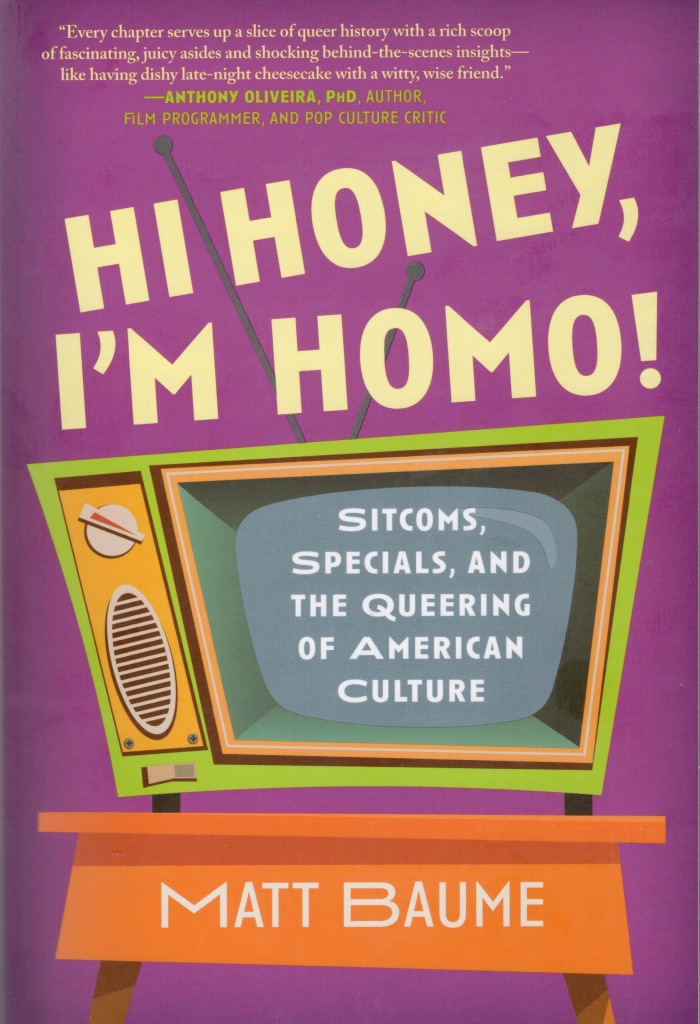
I first found Matt Baume’s Youtube channel during the pandemic, as I was scrambling to find things to watch while i made condom packs and did other make-work at home duties to maintain my paycheck. I may have found him through James Somerton’s channel? But while Somerton is often very dour and doom-and-gloom and “this is how they betray us” (don’t get me wrong, there’s a place for that and it’s needed), Baume is much more cheerful and positive about representation: he presents queer rep in popular culture in the context of the time; what the show/movie creators were trying to do with the rep; why they chose to do the rep in the first place; and the battles and struggles they had to make sure their rep made it to the viewers the way they wanted it to–and how that representation may have helped change hearts and minds when it comes to queer representation in art and culture. So when I found out Baume had written a book about queer representation in network sitcoms–written versions of his Youtube channel most likely–I had to have it.

I’m really glad I read it, too.

The essays contained within are well-written in a light, easy to read and comprehend way, without all the academic language that inevitably drags these kinds of things into the impenetrable territory that gets cited in other academic papers but otherwise never get read. Each chapter, from Bewitched through Modern Family, also contextualizes the queer representation in its time and place within the sociopolitical climate of each show, as well as the queer influences. Bewitched was probably the queerest show to ever air, be a hit and win Emmy Awards before Will and Grace; which makes it all the more memorable is that it was all coding and subtext, with witches standing in for queer people–and the similarities were obvious: they had to hide who they were from mortals for fear of persecution, bigotry, and violence. Sound familiar?

Baume also names and shames all the anti-queer activists of my lifetime, from Anita Bryant to Donald Wildmon (my own personal nemesis) to A Million Moms and so forth; Wildmon himself is probably the worst of them all; much as I loathe Bryant, I think she sincerely believed that queer people were a danger and sinful. I also think Bryant and Phyllis Schlafly were the last true-believer homophobes to lead movements; everything since has been a cynical grift for money and political power. Ronald Reagan and the Republicans saw, in 1980 and with the evangelical turnout in 1976 that carried an actual Christian to the White House (Carter was perhaps the most truly Christian president we’ve ever had; his religious values colored his policy. It’s ironic that Christians hate him as a general rule and always point to him as an example of a failed presidency rather than what his presidency actually proved; a true Christian believer isn’t pragmatic enough to lead a country; because sometimes, as The West Wing noted in an episode title, sometimes you have to kill Yamamoto; things for the greater good that are horrific on a personal level) and noted that “lip-service” to “Christian ideals” was all it took to get “Christians” to vote for you.

And this is a good place to serve as your regular reminder that the “party of family values” elected our only divorced presidents, yet are the same people who tried to remove Bill Clinton from office for lying about a blow job because it was evidence of his poor character and someone with such poor character shouldn’t be president.

I recommend this book, not only because it’s an interesting look at the evolution of queer representation in television comedy series, but because it also is educational by tracing the opposition to queer equality during the same time period.

I also learned by reading the book that Baume was the Communications Director for AFER, an organization that fought for marriage equality. So, buying and reading his book is also an excellent way to say thank you for his advocacy.

The Man of Metropolis Steals Our Hearts

I have always loved Superman, ever since I accidentally pressed the wrong button on the comic book vending machine at the Jewel Osco on Pulaski Avenue in Chicago as a child and got Action Comics instead of the Betty and Veronica I wanted. I was disappointed, and asked my mom for some more change so I could get what I actually wanted, which was when my mom decided to teach me a valuable life lesson: if you hurry and don’t pay attention you won’t get what you want–and sometimes that’s the end of it. So always, always make sure you’re picking the right thing. (I still do, to this day, and whenever I “forget” and rush–it inevitably ends badly.)

I wasn’t happy about it, but made the best of it. I had a comic book, after all, and while I had never shown any interest in super-heroes and their comics before, I decided to read it when I got home.

Once I did, I was done with the Archie and the world of Riverdale for good. I started reading DC Comics–I already knew about Batman from the television show, which we watched every week with its epic cartoonish campiness–and all the other titles that involved Superman even if only in a peripheral way. Both Jimmy Olson and Lois Lane also had their own titles, there were at least three titles alone devoted to Superman, and of course, Justice League of America. There was a Superboy title, too, and of course we can’t forget Linda Danvers, Supergirl. I read them all, and finally stopped buying them when they reached the (to me then) insane price of a dollar per issue. But I never lost my sentimental attachment to DC Comics and their heroes. I was also terribly bummed when the peripheral titles, like Superboy, Jimmy Olson–Superman’s Pal, and Superman’s Girlfriend, Lois Lane–were cancelled. For the most part, Lois’ adventures that didn’t involve Superman–when she was actually doing her job as an investigative reporter–often involved her in mysteries she had to solve, which were a lot more interesting to me than her schemes to expose Clark as Superman, or to get Superman to marry her. The old television series, with George Reeves, was often shown in reruns on alternative non-network local channels, and while I of course watched, I was kind of disappointed with how bad and cheap the effects looked. Batman’s television show was campy, of course, and highly entertaining–but campy. Wonder Woman was also campy and cheesy, but had Lynda Carter, who personified both the super-hero and her alter-ego, Diana. (When I was watching Superpowered: The DC Story the other night Carter said something I thought was very perceptive and explained thoroughly her role on the show: “I didn’t play them as separate characters–I just played her as Diana, the Amazon Princess, with a strong belief in equality and that there’s a better way than fighting.”)

So, when they Superman movie was announced sometime in the mid-1970’s, I knew I’d go see it, but didn’t have a lot of high hopes. But the tagline was fantastic.

You’ll believe a man can fly.

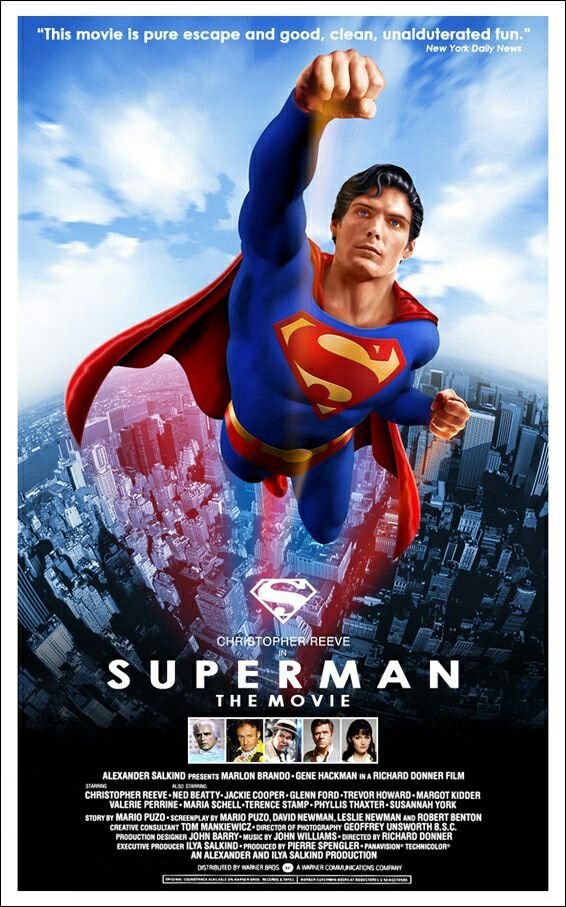
I think I was at the theater, waiting to watch either The Deer Hunter or Animal House, when they played the preview for the upcoming December release Superman The Movie, starring Christopher Reeve and Margot Kidder (among many other major names in supporting roles–from Marlon Brando to Gene Hackman to Ned Beatty to Valerie Perrine). I knew they were making the movie, and I had allowed myself to get a little excited about it as a Superman fan. I’d always found previous Superman adaptations–mostly the television show–to be so inexpensively done that it was almost comical. But special effects had been changed forever by the one-two punch of 1977’s Star Wars and Close Encounters of the Third Kind, and I also knew they were spending a LOT of money on this adaptation, so when the screen and theater went dark, and you just heard a voice saying “You’ll believe a man can fly” and then…there he was, flying. I caught my breath because it looked so real. And when Christopher Reeve turned his face to the camera, smiled, saluted and somehow got his eyes to twinkle, I also knew the movie was perfectly cast. I couldn’t wait for the movie to finally open (I think I also saw the sequel on its opening weekend), and yes, when it finally came to the Petite Twin Theater (apparently still there? No, no movie theater on Commercial Street anymore, alas) I saw it on that first weekend.

I’ve always loved Superman, and Christopher Reeve was fantastic in the part; the bar every actor who puts on the suit has to clear.

Obviously, the recent announcement that David Corenswet has been cast to play Clark/Superman in the new reboot of the film franchise, replacing Henry Cavill, has me thinking about Superman again. I was very pleased, frankly, when Cavill was originally cast; I’d first noted him playing Charles Brandon on The Tudors and thought, “that is one fine-ass man.” I thought he was the perfect choice to play the dual roles of Clark and Superman; he is drop dead gorgeous, for one, and his eyes have the ability to twinkle when he smiles and the dimples? Just take me now, Henry.

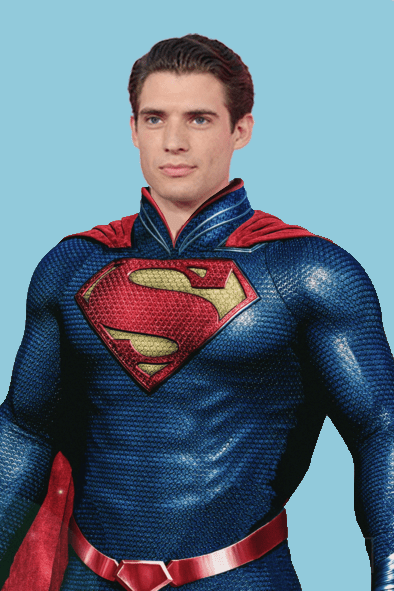
Mr. Cavill fills out the suit rather nicely, does he not?

The Henry Cavill version of Superman, which followed on the heels of a failed reboot with Brandon Routh (who returned to the televised DC Universe–the Arrowverse–in Legends of Tomorrow. I always felt bad for Routh, who I didn’t think got a fair break, either), wasn’t the best interpretation of the character but that wasn’t Cavill’s fault; that was the vision of the director and writers and the studio; and while I think I can understand the need to update Superman, the need to darken his story a la The Dark Knight 1980’s Batman reboot was a mistake. Superman is the World’s Biggest Boy Scout; he stands for hope and truth and all those things we used to believe embodied the United States; if anything, Superman was the personification of the idea of American exceptionalism.

David Corenswet certainly has the right look for the part; he’s from the Ryan Murphy stable of dark-haired blue-eyed square jawed hunks who regularly appear on his television series. I first saw Corenswet in The Politician, and then again in Hollywood. I found the following fan art through a Google search, as there are no available official images of him as the Big Blue Boy Scout. James Gunn’s vision for the DC Universe is one I am interested in seeing; while I didn’t enjoy the second and probably won’t watch the third (I’ve come to detest everything about Chris Pratt over the last few years), I did think the first Guardians of the Galaxy movie was pitch-perfect for a popcorn super-hero type movie.

But I do hope they move away from the dark broodiness of the Cavill version. I enjoyed them (and love Henry Cavill for reasons that should be obvious; look at the posted picture above again), but they didn’t feel right for Superman movies. The underlying theme and element of all the Superman stories is his positive energy and determination to protect people from harm and most importantly, lead by example. One of the core elements of the original Superman series (before the first of many DC reboots of their universe) was that Superman’s most sacred vow was that he would never take a life, no matter who or how much they deserved death. That didn’t matter to Superman, whose pursuit of justice was limited to capturing the bad guys and turning them over to the judicial system. It wasn’t his job to determine justice and punishment.

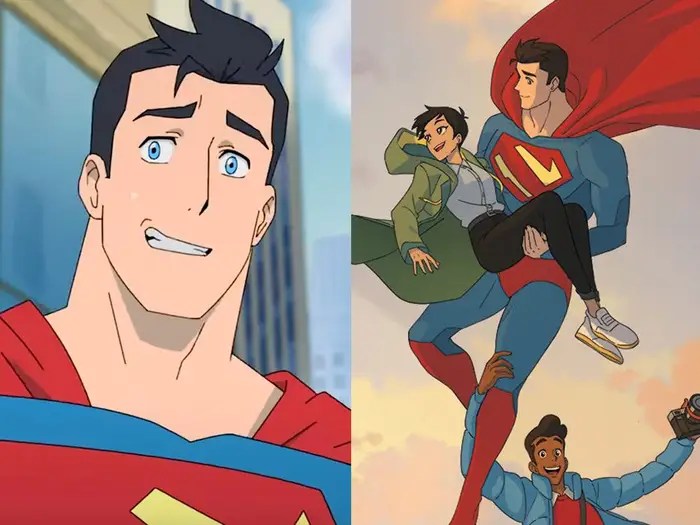
I keep hearing good things about the animated DC movies and series, but have yet to really watch any of them. I don’t know why I have this automatic resistance to animated super-hero shows/movies; I love Disney animation, and there are literally hours of DC animated entertainment available for streaming. I’d been hearing good things about a new DC animated series on MAX called My Adventures with Superman, so while I was waiting for Paul the other night (and was tired of LSU football highlight videos) I decided to give My Adventures with Superman a chance.

Constant Reader, I am so glad I did.

The show is utterly charming. It’s very well animated, for one–Clark/Superman is handsome, which is weird to say about a cartoon–and it’s refreshingly well-written with more emphasis on the characters and who they are, as well as their relationships with each other, over the adventure aspects of it, which makes it all the more likable and enduring. The premise is that Clark, Lois, and Jimmy Olson are all interns at the Daily Planet; Clark and Jimmy are just starting, and Lois is given the job of breaking them in and showing them the ropes. Lois is ambitious and determined to become a star reporter, and her impetuosity and ambition quickly leads them all into trouble–not only with the bad guys, but with Perry White back at the paper. Fortunately, Clark is, well, Superman, so all turns out for the best and Lois gets the scoop of all time: there’s a super-man amongst us! Which gets all three of them hired on staff. Clark is exactly the way he should be: kind, thoughtful, empathetic, a little bit shy–and the cold open of episode 1, which has young Clark suddenly discovering that he can, actually, fly; and his excitement and wonder at discovering this sudden new ability slowly begins to fade–imagine learning at age ten or eleven that you have super-powers–and he begins to wonder not only who he is, but what he is….then after the opening credits it flashes forward to Metropolis and Clark and Jimmy–roommates–getting ready for their first day as interns. The chemistry between the three of them–truly the Holy Trinity of the Superman stories is Clark, Lois and Jimmy (it’s so nice to see Jimmy Olson finally getting something to do and being included as something more than just a bit part, which is a nice nod to Superman history), and I am really looking forward to watching more of it.

And the art is fantastic.

Well done, DC. I hope this series lasts and is a hit–and I hope James Gunn is watching so he can see how to do the Big Blue Boy Scout properly.

Violaine

Oh, I got my final panel schedule from Bouchercon over the course of the weekend; as expected, I got my Anthony nominee panels only–but there are three of them, he typed modestly.

You can find me at:

Thursday, 2 pm: Best Humorous Mystery panel, moderated by Janet Rudolph, with Catriona McPherson, Jennifer Chow, Raquel Reyes, and Ellen Byron.

Friday, 9 am: Best Anthology panel, moderated by Holly West, with Art Taylor, Josh Pachter, and Mysti Berry.

Friday 1 pm: Best Children’s/ Young Adult Panel, moderated by Alan S. Orloff, with Fleur Bradley and Lee Matthew Goldberg.

Not bad. I have to get up early on Friday morning, but the others are at times when I am usually coherent and functional, which will be incredibly cool. I also am finished with everything by Friday afternoon, so I had all day Saturday free until the Anthony Awards presentation that night. This year, I get to lose three times, as opposed to my two losses at last year’s. There is, however, no disgrace in losing to any of my fellow finalists, as I like and respect them all very much; they all are great people who do phenomenal work and they all deserve much more recognition than even this will give them. And that Best Humorous panel? I think I shall say nothing and simply sit there being entertained by the quick wits of the four comic geniuses I will be on stage with.

Coming home from work last night was just as sad as I thought it would be. I ran errands after work–mail, grocery, gas–and had bags to carry and so forth. I was putting the groceries away when I realized I was listening for Scooter to come downstairs. I shook that off, put everything away, and then went to sit in my easy chair like always to rest for a moment before doing something else productive–I have a sink full of dishes–and as I flipped through Youtube channels I was bored out of my skull…and then realized there wasn’t any need to sit in my chair because Scooter didn’t need or want my lap anymore. That made me tear up, so I watched highlights of the College World Series, but watching Florida lose (almost as much fun as watching LSU win, which makes the College World Series final from this year almost more than I could hope for as a happy place for me) but it didn’t shake off the gloom… and I also realized I was staying in the chair so as not to disturb sleeping Scooter, who wasn’t there. I cried a bit and got up to start doing some more things around the kitchen. Paul came home from the office, and he was sad because Monday was a work-at-home day for him as a general rule, but he spent the morning missing Scooter so he went to the office after his trainer. I’ve been looking at adoptable cats on-line, but of course I want them all. There’s a gorgeous fourteen-year-old ginger that I am sure is going to be hard to adopt, but much as I would love to give his final years a good home losing another one so soon would be too hard on both of us. We need a cat that’s going to give us at least thirteen years!

But then I think do I have another thirteen years? Which I don’t like to do, because it will talk me out of having a cat because I don’t want to die on my cat. Sigh.

Yesterday turned out to be okay at the office, in case you were wondering how that went. There’s no telling, of course, what is to come down that road, so as Mom always said, why borrow trouble worrying about it? I’ll be coming straight home from work tonight; I have tomorrow off for doctor’s appointments so I don’t have to get up early and there’s certainly no need to run any errands since I can run them tomorrow. It’s a bit weird and awkward around there–I think the entire department is a bit in shock–but we’ll see how it all goes. The only constant is change, right?

I started doing some more research for a short story I want to write about an urban legend–it’s for my Sisters’ chapters next anthology–and I realized yesterday that I don’t have to do something Louisiana based, and it’s not like there aren’t plenty of urban legends in Alabama. I got another Alabama history book in the mail yesterday, Hidden History of North Alabama by Jacquelyn Procter Reeves, which is mostly about urban legends and secrets from the past of the north part of the state. Where we’re actually from is more central than north; the foothills of the Appalachians, if you will. There were some horrible atrocities committed on Union sympathizers in that part of Alabama by the Home Guard–I’ve heard and read some truly horrific stuff, seriously–which might be a good urban legend to write about. I’m having the best time looking into both Louisiana and Alabama history; it’s so much easier to write about a place once you know more about it; the more you know the easier it gets, hence research.

I’ve also been reading Matt Baume’s Hi Honey I’m Homo, which is about sitcoms of the 1970’s and their fledgling attempts at gay representation. I already have been enjoying Baume’s Youtube channel for years–queer rep in culture–and I’m also really loving his book. It’s fun revisiting these shows and remembering how closeted gay teenaged me watched the shows for their queer content, eager to see if that was, indeed, who I was as a human being. I’ll talk about that more when I blog about the book–some of the rep was good, some of it was confusing–but it is fun revisiting these shows from a present day point of view and perspective.

And on that note, I am heading into the spice mines. Have a lovely day, Constant Reader, and I’ll check in with you again later.

Suckling the Mender

Work-at-home Friday! Woo-hoo! It’s almost the weekend! I felt funky yesterday; more than just my usual end-of-the-getting-up-at-six-every-day tireds. My stomach started bothering me on Wednesday night, and I chose to eat breakfast and lunch yesterday with soft foods–yogurt, cereal, mozzarella salad–as I had the day before and that didn’t seem to be much help, as my stomach ached all afternoon. This continued throughout the evening, and I also was terribly tired when I left the office. I felt so bad–the combination of the exhaustion and the stomach issue–that I did something I never do; I laid down on the couch. I floated for about three hours in the in-between sleep and awake state of consciousness, which was where I was when Paul came home. I ate a little bit and felt better, but it’s still odd. I think it’s not eating enough, maybe? This was how I felt on Sunday after getting home from the trip–so I must eat solids and more regularly. My bad eating habits catching up to me at long last, and I really need to focus on eating regularly and more healthy. (I lost twelve pounds in Kentucky.) It’s also achy and sore this morning, too, but not nearly as bad as it was yesterday. I’ll try to eat more today than I have the last few days.

I have some errands to run after work-at-home duties are completed today, which will probably suck the life right out of me. Running errands in New Orleans in the summertime is always a draining chore, but if I can get all of that done today I won’t have to leave the house at all until Monday morning when I go back to work. It doesn’t look too bad out there this morning, but a quick check of my phone tells me it’s 82, which is practically a cold spell for July down here.

We finished watching Red Rose last night, and what a ride that was. Intense suspense, wild out of nowhere plot twists, and all the young British actors were very appealing and good in their roles. I do recommend it; it’s a new trope for horror (maybe it’s already tired, I don’t know, but it’s my first experience of it) by using apps and your phone to terrorize you. It was also a terrifying commentary on how careless we all can be about our online security. Now, of course we have to start watching something new–often a challenge to decide–

I kept waking up a lot last night–pretty much every hour on the hour–and of course, was wide awake at six. I fed and watered Scooter, since he expects it at that time every day now, and went back to bed for a little while longer. I don’t know whether iI actually slept any more, but I don’t feel spacy-tired or loopy-tired this morning, so that’s something, I suppose. Hopefully it will turn out to be a most productive day for me. I do have laundry and lots of dishes and cleaning and straightening up around here to get done, too.

I joined Threads, the new Instagram version of Twitter, last night and I have to say, I like it so far. It was nice that your followers and who you follow from Instagram transferred over, and if any of those folks aren’t there, it will automatically follow them when they join and if they follow me, it will follow them automatically, too. That was kind of cool, and it was also kind of cool to go onto social media and not have bigotry and hatred shoved into my face every time I turn around. It also made me think about something else–Pride is more than just June, and why should I only write about my experiences as a gay male and as a gay male writer during that month? Firing off snarky tweets in response to bigotry is a nice little dopamine rush, but I also feel like I’m not doing enough to counter the rise of the Fascists; what better way for a writer to do that than write about it? There is an element of “preaching to the choir” to blogging about homophobia and bigotry, but if it changes one mind…then it was all worth it, was it not? I know there are people who think of me as one of the “good ones”–if you don’t know what that means, congratulations on your privilege–because I am, in person, usually very conciliatory and understanding (conflict-averse, and a trained counselor, remember) and because I generally don’t go on my old Julia Sugarbaker rants much anymore, if at all. That doesn’t mean that I don’t have them in my head anymore; barely a day passes without me seeing something, either on social media or in the news or both, that raises my blood pressure and makes me want to strangle someone. So, I am going to try to channel that anger and rage into something productive; blog posts. I don’t worry about offending potential readers of my books because all anyone ever has to do is look at my social media or even this blog to get a sense of my politics. I probably should have developed a public persona who is just charming and funny and apolitical, but that really just opens you up to more homophobia when you’re a gay man.

I can never decide if its worse for someone to be homophobic to me because it is so ingrained in them that they don’t ever realize it, or if it’s deliberate. I guess it depends on how you call out the homophobia and how they react to it. I do, however, generally always default to “doesn’t know any better” and correct them; I also don’t ever say someone is a homophobe unless I am 100% certain it was deliberate. I just say, “that’s a homophobic thing to say” or “that’s a homophobic comment” rather than saying “you’re a homophobe”–but if you continue to not do better, well, then you’re a homophobe. The thing that I never understand is how people react to things they don’t understand automatically with dislike bordering on hatred; it’s actually okay to not understand. I don’t completely understand every experience in the world, but that doesn’t mean I can’t be sympathetic, empathetic, and respectful. One of the wonderful side effects of my day job is that training and experience as a counselor, and recognizing that experiences should be met with respect and sympathy and empathy instead of judgment. Who am I to judge anyone? The only people I don’t respect and I will judge are racists, sexists, homophobes or transphobes; anyone who uses lies, deceptions, and stereotypes to categorize any one group as lesser and less worthy. I will judge you for judging others–and I will judge very harshly.

This weekend will be about tying up loose odds and ends, working on my page proofs, and trying to straighten up around here. I want to prune the books some more, and maybe even take another box down from the attic to go through. I also want to look through that box of clippings and other Greg memorabilia from my past career to see what can be kept, what can be scanned, and what can be tossed. I really want to get that attic cleaned out this year.

And on that note, I am heading into the spice mines. Have a lovely Friday, Constant Reader, and I’ll check in with you later.

Song of the South

I am both of the South and not of the South.

I was born in Alabama but didn’t grow up there. I was two years old when my parents migrated north in search of work, good jobs, and a better life for our family. My parents, however, were very Southern, so I was raised with their values and beliefs (which were very Southern and of their time) but being confronted with very different values and beliefs at school every day opened up my mind in ways that it may not have been had I grown up in Alabama. Our neighborhood in Chicago, near Lawndale Park (our nearest major cross street was 31st and Pulaski), was the perfect representation of America’s vaunted ‘melting pot’; our neighborhood was filled with first or second generation European immigrants; many from eastern Europe, who fled either before or after the war. There were Czechs, Poles, Austrians, Hungarians, and Serbs; in the fourth grade we even had a Muslim girl from Yugoslavia. She had the most delightful first name which I’ve never forgotten–Zlatiça–even as her last name is lost in the clouds of memory. It was also very confusing trying to figure out where the immigrant kids (either they were born in another country or their parents/grandparents were) came from, given that the maps of Europe had been redrawn barely twenty years earlier. The Czech children I knew didn’t identify as Czech but rather as Bohemian; they also called their language that. It took years of study and reading up on history to realizing Bohemia became Czech after the first world war; for many years I believed Bohemia still existed under that name but had somehow been folded into another country or something; I don’t remember. I do remember being confused. Until I finally wrapped my mind around the post WWI renaming of the region, I always just assumed Bohemia was a German region. Reading history didn’t help much in that regard, as Bohemia was part of the Holy Roman Empire for centuries (in fact, the Thirty Years’ War kicked off in Bohemia).

But there was a lot of racism in our neighborhood too; the white European immigrants detested the brown immigrants from Mexico and Central America; I vividly remember the way our babysitter would sneer the word Mexican when referencing anyone brown. There was also a lot of strife in Central America at that time; I think both Guatemala and Nicaragua were enduring civil wars of some sort, hence the influx of Central American refugees and immigrants. I remember Martha, a girl in the sixth grade, telling me about how soldiers came and shot up her village, killing dozens of people she knew and members of her family. She was very calm and unemotional as she told me about it, which is pretty remarkable for a child who couldn’t have been more than ten or eleven, talking about a trauma she witnessed when she was six or seven. (Now I know she was dissociating; and I do remember her telling me calmly that she felt like she wasn’t even there as it happened; like she was watching it all happen from a distance.) Ironically, we became friends because we exchanged Nancy Drew or Hardy Boys mysteries; this conversation came about because we were reading a Hardy Boys book set in Central America; I want to say Footprints Under the Window, but it may have been something else….but she wanted me to know that the depiction of Central America in the book was nothing like the reality.

My grandmother used to tell me wonderful stories when I was a kid about my family history and the history of the county we’re from in Alabama. As a wide-eyed innocent and naïve child, I believed everything she told me, and always wanted to fictionalize those stories. I was in my early twenties when I wrote a short story based on one of those tales; about the Lost Boys and the evil renegade Yankee soldier who burned the house down and presumably murdered the two boys of the house. The story was called “Ruins,” and while I was pleased with the story I felt the story was too short; there was more to the story than I could fit given the length restrictions. I always thought of the story as a kind of an abstract or lengthy synopsis of the novel I would write someday. But it was also a Civil War story, and I wasn’t sure how I could write a Civil War ghost story without being, frankly, offensive. I tucked it away in a drawer and would think about it from time to time–usually when driving through Alabama on my way north–but still couldn’t wrap my mind around it. I worried and fretted and feared and doubted myself constantly. I told the story once to another writer friend of mine, and she urged me to write it…in fact, she hounded me about it for about twelve or thirteen years before I decided to take a deep breath, put on my big boy pants, and take that risk.

“Was this an accident, or did you do it on purpose?”

I opened my eyes to see my mother standing at the foot of my hospital bed, her heart-shaped face unreadable as always. The strap of her Louis Vuitton limited edition purse was hooked into the crook of her left arm. Her right hand was fidgeting, meaning she was craving one of the rare cigarettes she allowed herself from time to time. Her dove gray skirt suit, complete with matching jacket over a coral silk blouse, looked more rumpled than usual. Her shoulder length bob, recently touched up as there were no discernible gray roots in her rigid part, was also a bit disheveled. She wasn’t tall, just a few inches over five feet, and always wore low heels, because she preferred being underestimated. Regular yoga and Pilates classes kept her figure slim. She never wore a lot of make-up, just highlights here and there to make her cheekbones seem more prominent or to make her eyes pop. Looking at her, one who didn’t know better would never guess she was one of the top criminal attorneys in the country or that her criminal law classes at the University of Chicago were in high demand.

I could tell she was unnerved because she’d allowed her Alabama accent to creep slightly back into her speech. She’d worked long and hard to rid herself of that accent when she was in law school, because she said no one took her seriously when she spoke or else thought she was stupid once they’d heard it. The only times she used it now was when she wanted someone to feel superior to her, or she’d been drinking, or she was upset.

It worked like a charm getting her out of speeding tickets.

I hadn’t been asleep, nor had I been awake either, hovering in that weird in-between state where it seemed like I’d been living for the last three or four days.

“It wasn’t on purpose.” I managed to croak the words out. My throat was still raw and sore from having my stomach pumped. My lips were dry and chapped, and my eyes still burned from the aftermath of the insane drug-and-alcohol binge I’d gone on in the aftermath of the break-up with fucking Tradd Chisholm. “It was an accident.” I shifted in the hospital bed, trying to sit up more, the IV swinging wildly. The memory of that last and final fight with Tradd flashed through my head.

The main character in the original short story was only twelve, and the cousin he shares the adventure with was supposed to be fourteen. I was writing a lot of short stories at the time set in Alabama, with the idea to tie them all together in some ways–and was also reading a lot of Faulkner at the time, so yeah, a fictional county in Alabama where all the stories were set and were interconnected was kind of derivative; I kind of smirk to myself now when I think about the hubris of aspiring to be Faulkner-esque, especially at that time, when everything I wrote was pretty much garbage. Ah, the hubris of youth. But I did write a lot of “Corinth County” short stories back in the day, and while the writing may have been atrocious, the idea behind them and the core themes were good and had potential.

When I started thinking about turning the short story into a novel, I soon realized that the characters were too young, so I aged them. I originally aged them to teenagers, and in the first attempt at a rough first draft, I got about two chapters in with my main character, Jake, being banished the summer before his senior year to help take care of his dying grandmother back in rural Corinth County. The original first line was something like The summer before my senior year my mother ruined my life. Properly self-absorbed, narcissistic, everything’s about me teenager, right? My original thought was he was a student at a Catholic all boys’ school, was openly gay, and had a crush on a classmate…and having just found out said classmate had gotten a summer job lifeguarding, managed to get himself and his female best friend jobs at the concession stand at the pool, so he could be around his crush and see him all the time. His banishment for the summer had to do with his lawyer mother accepting a co-counsel role in a major trial in California and being gone; she has also kicked out her fourth husband (a much younger tennis pro) and so she can’t leave him alone in Chicago for the summer. The other option was staying with his father and his second family in the suburbs, which was equally unappealing, so he choses Alabama…and is picked up at the airport in Birmingham by another teenager who’d been taken in by Jake’s grandmother when his own mother died. This character, Kelly Donovan, was originally meant to become close with Jake and participate in all the mysteries Jake encounters at his grandmother’s. I also wanted to play with Jake’s being strongly attracted to Kelly, who is some kind of distant cousin, and straight.

But I scrapped that beginning, too. Would a young senior in high school in rural Alabama, a star athlete, be so accepting and open to Jake’s sexuality? Probably not…and he would also be worried and nervous about his patron’s grandson coming to stay there. As I delved more deeply into Jake’s character and who he was, I started thinking it made more sense for him to be older. Why not have him be a student at Tulane, and living in New Orleans? But if he was living in New Orleans, what would make his mother exile him to rural Alabama for the summer? And the more I thought about Jake…the more I realized there was underlying trauma in his life. I didn’t want his mother to be homophobic, but her mother, the dying family matriarch? Yes, yes, that worked better. I made him a loner, but someone who didn’t want to be a loner. He didn’t ever feel like he had friends at his Catholic school; and coming to Tulane he met his first, real boyfriend…which ended up being a disaster. And then realized, what if he goes on a binge–easy enough to do in New Orleans–after a bad break-up and winds up in the hospital? And if he had tried once before to kill himself…yes, yes, this is a MUCH better backstory and pulls the actual plot of the book together much better.

I also knew I wanted to touch on themes of homophobia in the rural South, as well as the horrors of modern-day Southern racism and the South’s racist past.

When I started doing research for the book, I soon learned that many of the old family/county stories my grandmother used to enthrall me with were all apocryphal; almost every region of the South has some version of the stories she told me; the story of the Lost Boys, a local legend which was the foundation of the book, pops up all over the old South–almost every state and every region of the old Confederacy has a version of the story, complete with renegade Union soldier (think Gone with the Wind), and so I decided to address that trope in the book while also using it. But I also added another layer to the story–the Lost Boys may not be the only ghosts at the old Blackwood place, which has a tragic and bloody and horrifying history, as does the entire county. I also started lessening Kelly’s importance to the story–he’s still there, he’s still a character who also gets a big reveal later in the book–but Kelly’s behavior to Jake is abominable and homophobic, establishing some conflict between the two of them as well. Part of this was because of the change in the story, but then I needed to partner-in-crime as well as potential love interest, so I came up with Beau Hackworth (the Hackworths are a large and poor family in the county; I’ve used that family before in stories; my main character in Dark Tide was a Hackworth from Corinth County).

And of course, when you’re writing about a Southern rural county and the Civil War, you cannot avoid the issues of race, prejudice, Jim Crow, and enslavement. I wanted to make it very clear that this wasn’t some “Lost Cause” romantic fantasy that perpetuates the lies and mythologies that sprang up in the South decades after the actual war ended. Jake’s mother raised him not to be racist or prejudiced, as she tells him several times, “We do not take pride in the fact our ancestors enslaved people. The heritage is hate, and don’t ever forget that.” I did wonder if I was being too generous to white people with this, but on the other hand I wasn’t interested in writing from the perspective of someone racist. I will be the first to admit that I worried about being offensive in this book; the last thing I would ever want to do is be insensitive on the subject of race. But I also knew and trusted my editor enough to know she wouldn’t let me get away with anything, and I also had to trust myself to handle it all sensitively. There were a couple of things she saw in the manuscript that could potentially be considered problematic–but they were also easily fixed.

I was very pleased with the end result, and I do think it is one of my best books. I was absolutely thrilled when it was nominated for two Anthony Awards last year at Bouchercon.

And it also goes to show that you cannot play it safe, and things that scare you are precisely the things you should write about .

(For the record, I will add Cheryl A. Head’s Time’s Undoing is one of the best crime novels ever written about racism in Alabama. Beautifully written and brilliantly told, it should really be required reading.)

The World Turned Upside Down

Happy Second Class Citizen Independence Day, Constant Reader!

I am so tired of being Cassandra on the walls of Troy, warning people of the impending doom from the consequences of their narcissistic privilege, only to be either ignored or patted on the head condescendingly and told I don’t understand or am being terribly overdramatic. Well, too many of you didn’t listen and here we are.

But I am not going to talk about the fraud perpetrated on this country recently by six illegitimate and corrupt justices on the Supreme Court. This is the date designated as the nation’s birthday, and it’s a day of celebration as well as contemplation.

Despite its flaws and faults; its checkered history and immoral lapses in policy; and the current turmoil of bigotry and hatred and divisiveness, I still love my country. Despite the slanders and slurs hurled against people like me, I am a citizen just like anyone else in this country. I pay taxes like everyone else. There is nothing in the Constitution prohibiting my existence or my life or my reality; yet religious zealots, over and over again throughout our history, keep trying to seize control of the government in order to legislate their version of morality, theoretically based in their religion. I was raised in that religion, read the Bible and went to worship and prayed and Sunday school and all of that–as a child and without my consent. I know the Bible. I’ve read it, many times. I’ve studied it, read religious philosophy and religious studies. I’ve studied and read up on the history of Western civilization, which is forever yoked to the history of the rise of Christianity. I know when doctrine was decided as legitimate and what was heresy; what texts were left out of the Christian Bible and why; as well as the relationship of the New Testament and law to the Old. I’ve read up on the basic messages of many religions, from Islam to Hinduism to what most would call “voodoo” to the mythologies of ancient civilizations. The conclusion that I came to, from my reading and studying and so forth, was that the modern religions I considered all have, at their core, the same fundamental principle: be kind, be helpful, have empathy and compassion for others, and most importantly, do not judge. Judgment is reserved for God, however you choose to see him, and He is very jealous of that privilege. None of us are perfect and we are all sinners–but our sins are between us and God and are none of your fucking business.

Winston Churchill once said about the United States, “You can always count on Americans to do the right thing–once they’ve exhausted every other possibility.” It’s true. In his farewell address George Washington warned of our nation being dragged into “the broils of Europe” (which would make a great title), and that was the cornerstone of our foreign policy for generations. American soldiers did not fight a war in Europe until the first World War–and even then we only came in during the third year of the conflict. Likewise, we stayed out of the second World War, as the world erupted into flames, until we ourselves we attacked two years into the war, and the European allies of Japan also declared war on us. We have been participating in the broils of Europe ever since.

Those are realities. But our entrance into each war changed its course, and enabled the Allies to emerge triumphant. Defeating the Nazis is something we can be proud of, even as we essentially had an apartheid system of our own at home. Defeating the Japanese and putting an end to their war crimes is something we can also take pride in–even though there was a very strong element of revenge to the war–but using nuclear weapons on civilians to bring a close to the war is still morally and ethically questionable. (The horrific racism against the Japanese during the war was also abominable, and that’s doesn’t even take into consideration the horror of the unconstitutional incarceration of thousands of Japanese-Americans, while also robbing them of their belongings and destroying their businesses.)

But the ideals on which this country was founded–freedoms essentially from the potential tyranny of the Federal government–are very high-minded and noble. We have not lived up to those ideals too many times, and the fact that people who are straight, white, and cisgender have always been given priority over everyone who doesn’t fit into that demographic isn’t something we should be proud of–our system is flawed because human beings are flawed. Loving your country doesn’t mean turning a blind eye to its faults and problems, and critiquing and discussing moral, legal and ethical failures in our history, in my mind, is further proof that you do love the country and want it to live up to its ideals of equality and justice for everyone regardless of any adjectives that can be placed in front of the word American. My country has disappointed me, never more so than recently with a renegade Supreme Court discarding precedent, accepted law, and essentially pissing on the very idea of equality while pursuing what can be best be called a completely unAmerican agenda to undermine the basic principles of justice and liberty for all. Patriotism doesn’t require blind obedience and loyalty; which is why the Founding Fathers tried very hard to protect dissent.

I seriously doubt Benjamin Franklin or John Adams would ever agree that corporations are people, entitled to all legal protections of the individual while also not being held accountable legally than the individual; therefore the “citizenship” of corporations is also higher class than that of the individual.

But how can you not love and admire and respect the ideals the country strives to achieve? We haven’t always lived up to those ideals; many times we have failed, horribly.

I have always believed that the arc of justice always bends towards justice, and that we as a country can and should always be looking for ways to make things better, pass legislation to correct flaws and defects in the system, and always keep a wary eye out for corruption. The Founding Fathers also could not conceive of anyone making a career out of politics, either, which is why they established no term limits, which was a huge mistake. We have a presidential term limit now, but none for either house of Congress or the Supreme Court, or any federal bench for that matter. That was a major flaw and oversight in the drafting of our remarkable Constitution, with the end result we have a corrupt system where our politicians are often up for sale, and aren’t even ashamed. How does someone middle class or from a poor background go into politics and retire wealthy?

But, like Churchill, I have faith that my fellow Americans will always, inevitably, do the right thing–once every other possibility is explored and exhausted.

May you have a fabulous fourth of July, Constant Reader. I’ll probably make several posts today; who knows?

YMCA

Ah, the Young Men’s Christian Association.

One of my favorite things about homophobic straight people is how clueless they are (the homophobia is really a tipoff) when it comes to queer stuff. (In fairness, if they don’t know any queer people why would they know anything about queer stuff?) Nothing amuses me more than watching crowds of straight people–whether it’s a sporting event, wedding, or a party– start doing the “YMCA” dance when the deejay puts it on. It’s particularly funny to me when it’s a sporting event, particularly something more on the unenlightened side with their fan base when it comes to queer equality, like NASCAR or hockey (although NASCAR had been doing rainbow stuff all month…). As I watch them all stand up and do the ‘YMCA dance”–always out of rhythm, never to the beat–I smirk to myself and think, you clearly don’t know that this song is about the sexual smorgasbord a YMCA was back in the day for gay men, do you? It’s about GAY SEX, homophobes! You’re singing along to a song about getting fucked at the Y!

It always makes me laugh. Every. Single. Fucking. Time.

I’m sure the founders of the YMCA system would have been quite nonplussed to know that in some major cities, gay men turned YMCA’s into essentially bath houses. There were a couple in Manhattan that were notorious for hook-ups, but of course a YMCA would draw gay men. For a long time they were the only places for men to go and get exercise, unless they belonged to a men’s club, like the New Orleans Athletic Club (which used to be for men only), and since gay men, especially after Stonewall, liked to be fit and keep their bodies worked out and in good shape (to draw lovers, of course) they wound up at the Y. And when you get a bunch of gay men thrown together in an environment that includes pools, weights, saunas, steam rooms and showers, you’re going to get hook ups. YMCA’s also provided cheap rooming alternatives, too–and of course, that meant that you could get a room at the Y (just like you could at a bath house) which meant you could bring partners back to the room for sex.

When we first moved to New Orleans there was still a Y at Lee Circle (now Harmony Circle); the Lee Circle Y had been there forever and was actually kind of historic; one of the Israeli athletes murdered at the Munich Olympics was a Tulane student who worked out at the Y. I thought that should at least have some kind of commemorative memorial plaque–and had preservation-minded folk cared about the Lee Circle Y, it could have been declared a historic landmark, instead of closing and the land being sold for yet another hotel. Maybe a murdered Israeli athlete isn’t enough of a connection for historical landmark status. But I used to train people there, and also taught aerobics until it was closed permanently. They had redone the weight room and bought all new equipment a few years earlier, too. Some things–like the locker room and so forth–were musty and moldy smelling, with that distinct stench of decades of male sweat baked into the walls.

But yes, the Village People of “YMCA” fame–every one of them was dressed as a particular gay archetype (leather man, Indian chief, fireman, cop, etc.) and all of their songs were thinly veiled odes to the joys of being gay and having lots of no-strings-attached sex; “Macho Man,” “In the Navy,” “YMCA,” “San Francisco”–and the village in their name was Greenwich Village, the gayborhood in Manhattan. (The promotional video for “YMCA”–taken mostly from the movie Can’t Stop the Music–which is a topic for another time, because yes, that movie needs discussion–really says it all.)

There were bath houses, of course (Bette Midler famously got her big break performing at the Continental Baths in Manhattan); New Orleans had two when we first moved here–the Club New Orleans in the Quarter on Toulouse Street and Midtown Spa on Baronne in the CBD, across from where the Rouse’s is now. Both are long gone now, ain’t dere no more as we say down here. We used to do testing in the bath houses, which was always a weird experience. Every room had a television with porn on a loop; the room they used to let us at CNO to test in also was the sling room. So I’d sit on the bed/cot, with porn playing on the television hanging from the ceiling in the corner, and a sling in the opposite corner from the television. I bet that sling could tell some tales….or could have before it was consigned to the dustbin of history.

I also remember the battle over closing bath houses during the height of HIV/AIDS. Rewatching It’s a Sin reminded me of a lot of the struggles back when the disease was new and we didn’t know much about it other than almost everyone who got infected died. It seems kind of counter-intuitive now, but there was an argument that could be made that restricting gay sexuality was also a repressive attempt to push gays back into the closet as well as further stigmatizing gay men. It seems silly now, of course, knowing what we know now, but the mask argument during the pandemic kind of took me back to the struggle to get gay men to wear condoms. (I’m so old I remember when herpes had everyone freaking out in the late 1970s.)

I keep thinking I should write about the Lee Circle Y, just to preserve that piece of New Orleans history. “Never Kiss a Stranger” originally started with my main character getting off a Greyhound bus and lugging his duffel bag down Howard Avenue to the Lee Circle Y, where he gets a room while looking for a place to live. (I later realized the story actually begins with him finding that place to live; the rest is just filler and not very interesting.)

Maybe someday.

Don’t Leave Me This Way

One of the biggest amusements I get in life is from looking back at my past and marveling at my incredible, almost child-like naïveté. Sometimes I shake my head in embarrassment, wondering, how could I have been so naïve? From the perspective of an over twenty-year career in publishing (technically we could say twenty-seven years, because I was first paid to write in Minneapolis in 1996), and being an openly out queer man now for thirty-three years or so, how did I ever expect to be treated as an equal member of the mainstream mystery community in 2002? I suppose there’s something to be said for my innocent, almost child-like belief that being gay wouldn’t impact my writing career–beyond not making as much money as my straight colleagues–in any meaningful way. Constant Reader, I was very wrong. In the months before my first book came out, my publisher’s publicist tried to set up signings for me in mystery bookstores (bless his heart, he didn’t think it would be an issue, either).

I don’t carry those kinds of books in my store.

That was what one mystery bookstore owner told the publicist my publisher assigned to me when my first book came out, when he was trying to arrange appearances for me to promote the book. Those might not have been the exact words, but the gist was the same.

I don’t carry those kinds of books in my store.

I think I may have actually reeled back from my computer in shock when I read those words, forwarded to me by said publicist, who had no reason to lie to me about why this particular store didn’t want me to come sign my debut crime novel, Murder in the Rue Dauphine, in the sacrosanct, apparently holy sanctum of her precious mystery bookstore.

I don’t carry those kinds of books in my store.

Perhaps, to paraphrase Poppy Z. Brite, she was afraid “the other books in the store would catch the gay” from mine.

I don’t carry those kinds of books in my store.

After the shock and hurt and offense wore away, I got angry. And I got angrier as every single mystery bookseller in the continental United States recommended to me by other mystery writers for potential events refused to allow me to sign in their store—the sole exception being Murder by the Book, in Houston. Some had the decency to say things like well, debut authors generally don’t draw well, and I’d hate for you to waste your budget coming here rather than the blatant homophobic responses others had no problem sharing. I mean, as a gay man, how did I even dare to think I would be welcome in independent mystery bookstores?

I don’t carry those kinds of books in my store.

Ultimately, no matter what the reason, a bunch of heterosexual white bookstore owners and managers were letting me know, in no uncertain terms, that I wasn’t worthy of being in their store; that they would never carry anything I wrote, and that no matter the quality of my work and how hard my publisher and I worked on my books, I needed to know my place, and the mainstream mystery world wasn’t it.

I don’t carry those kinds of books in my store.

And like a good boy, I took the hint and stayed away from their stores, other than Murder by the Book in Houston. I didn’t bother going to mystery conventions or conferences; there was no need for me to join writers’ organizations, either—a friend had bought me a membership in one as a gift, which was incredibly exciting…until I started seeing things in their newsletter and on their list-serves (dating myself; remember list-serves back before social media?) that were not just horribly homophobic but misogynistic and racist as well. I quit the list-serves, threw the newsletter in the trash the day it arrived in the mail unopened, and didn’t renew my membership when it came due. I only did mainstream conferences and events and conventions if they were held in New Orleans.  When my books came out, I did signings at queer bookstores, Murder by the Book, and Garden District Books here in New Orleans (I also signed a few times at the late lamented Maple Street Books as well). I never bothered contacting, or having the publicist contact, mainstream mystery bookstores again…

I don’t carry those kinds of books in my store.

Let me state here for the record, before someone comes at me, that I do love independent bookstores, and try to support them whenever I can. (Whenever I do a signing in a store, I inevitably lose money because I buy more books than I made from whatever was sold.) But–and this is a very important but–most independent bookstores that aren’t specialty stores (i.e. mystery bookstore, queer bookstore, SFF bookstore, etc.) generally have a rather jaundiced and condescending attitude towards genre fiction, and carry very little of it outside of bestsellers. Add queer to crime as adjectives before my books and that is two very big strikes for most independent bookstores.

I don’t carry those kinds of books in my store.

And that’s fine; I get it. I am a niche writer, and niche writers aren’t going to sell enough books in your store to make it worth your while to stock them. That’s a business decision, and businesses have to do what they have to do to keep their doors open. That isn’t personal. But…if you never have events for queer authors or mystery writers in your store, that’s sending a very loud and clear message to those of us who fit those descriptions.

I don’t carry those kinds of books in my store.

I guess in retrospect it’s funny that I didn’t expect to deal with homophobia in the publishing world. I knew I wouldn’t make as much money writing about gay men as I would if I wrote about straight ones, but I was fine with that: I knew that going in. People only have so much time to read and most readers do it strictly for the pleasure of reading, for the escape; I certainly have any number of times in my life. So, if someone is straight or has no interest whatsoever in gay men, why would they pick my book off the shelf rather than something that won’t challenge their life paradigms? But I didn’t expect the nastiness from mystery booksellers (lesson learned; again, Murder by the Book is the exception) and outright homophobia. Sorry not sorry, when one of those stores go out of business I do feel bad for their customers, who liked to browse their aisles, but I don’t feel sorry for the store owners and/or managers; as far as I’m concerned, if you’re homophobic, enjoy your well-deserved bankruptcy.

You didn’t have to be homophobic when saying no to an event. Period.

And what I’d been expecting really was nothing more than simple professionalism. One store manager did tell me that she’d love to, but she was having trouble drawing audiences for events and she was going to be closing the store gradually. I appreciated the honesty and I sent her a card when her store closed for good. It’s really interesting to me, who’s been to so many classes and trainings and seminars on professionalism in the workplace or in dealing with the public, that people allow things like racism, misogyny and homophobia to take precedence over being professional? Why would you ever make potential customers–people willing to give you money and patronize your business–feel unwelcome or unwanted?

I’ve no doubt that the world has changed in that regard, too–I see queer writers doing bookstore events all the time, and being invited to speak at literary festivals and conference, which is amazing progress from twenty years ago. We’re getting nominated for mainstream awards now, too, which is also cool (and incredibly good for my ego–seven Anthony noms to date; along with a Lefty, an Agatha, a Macavity, and a Shirley Jackson)–and even winning here and there (John Copenhaver deservedly won a Macavity a few years back, and Mia Manansala won several awards for her debut novel, also deservedly so). This is enormous progress, and change for the better within the community. It’s been lovely to see the mystery and crime fiction community working so hard to be more inclusive and welcoming to non-white, non-straight, non-cisgender writers.

But I do think it’s important to remember the not-so-distant past–so we can always say, with assurance, when someone says they want to go back to the good old days…they weren’t that good for all of us, no thank you. I also know I was luckier than a lot of other queer writers at the time I started; I had the support of my local newspaper, which always reviewed my books and I also had the support of the local literary community, which was crucial. I was also lucky in that there were still queer bookstores I could do events at; queer publications that would review my work and interview me; and even more crucially, Insightoutbooks existed–a queer Book of the Month Club, pretty much–which was always hugely supportive of me and my career. Had it not been for those things, I may not be here today writing this entry; or I would have had to rebrand myself and written mainstream years ago.

We’re not all the way there yet…but we’re much closer than we were in 2002.

Speak No Evil

Well, if there was any doubt left, summer has returned in full force to New Orleans. It’s a heat wave; in which the heat index has been over 110 for several days. When I ran my errands yesterday I was completely exhausted after getting back home and the groceries inside; this kind of heat saps your strength and your energy and sometimes, even your will to live. Opening the apartment door was like opening a preheated oven. I managed to get all my work-at-home duties taken care of, but tried to spend the rest of the day battling feeling tired and getting chores done. This is a three-day weekend, and I have a lot of work to try to get through over the course of this holiday weekend. I am also hoping to not set foot outside at any time until I have to go back to work Tuesday morning. It’s nice having another short work week, and then of course the next week I am heading north to spend some time with Dad. It’s hard to believe this year is nearly half over, isn’t it?

I was thinking yesterday that Elmore Leonard’s most famous piece of writing advice was “never start with the weather,” which is a “rule” that I break all the fucking time. The weather, especially in New Orleans, is almost a character here; it tells you everything you need to know about the time of year the story is set, for one thing. You can’t set a book or story in New Orleans in the summer time and not mention the weather; you just can’t. The weather impacts everything here, because we have what I lovingly and sort-of-jokingly refer to as “aggressive.” The heat and humidity is aggressive; hurricanes and thunderstorms here certainly are, and even the cold spells we get every winter (brief, always brief) can be also considered aggressive. It impacts people’s moods and what happens, really; so that advice cannot be followed when writing about New Orleans. I was primarily thinking about this yesterday when I was out in the heat and losing my will to live, mostly, which was completely understandable. Paul walked to the gym to ride the bike for a while yesterday and went through two bottles of water. So, yes, the weather here is aggressive and oppressive, and impacts story and character and setting and scene and place in New Orleans.

We started watching an ID true crime documentary series about the serial killers in Baton Rouge around the turn of the century and just after, Butchers on the Bayou, which is kind of interesting. I remember when it was happening–yes, a serial killer in Baton Rouge will make the news in New Orleans–and I remember when the first one was caught; I didn’t remember there was a second one operating at the same time. No wonder the police were overwhelmed; especially with all the crossing of jurisdictions and so forth–it’s the same problem they had with trying to solve the murders of the Jeff Davis Eight (eight women murdered over a several year period in Jefferson Davis Parish). And yes, I do at some point want to base a novel on the Jeff Davis Eight case; I keep thinking it fits more as a Chanse story but I’m not really sure I want to write another Chanse book. It wouldn’t really work as a Scotty story, and I have wondered and considered writing a new series–I have a character, Jerry Channing, who writes true crime and is a gay man that has appeared in several different books of mine; the problem with Jerry was when I was fleshing him out I realized what I was doing was combining Chanse and Scotty into a single person, and that wasn’t working for me. This also probably had something to do with me trying to come up with something whilst I was immersed in numerous other projects and not really being able to give it my full attention. I still might just go ahead and do it once I have all these current projects off my plate once and for all.

It is a good story, and it makes sense for him to be the one to investigate it–since he writes true crime. My primary concern about this is, obviously, there’s tons of novels about true crime podcasts and true crime writers and bloggers–Only Murders in the Building, anyone?–but it does make sense and works better. I guess there’s naught to do but give it a try and see.

I’m hoping to be able to spend some time reading this morning, too, before i head into the spice mines. I want to finish writing this and maybe write another Pride post over the course of the weekend; I’ve started several, but am trying to decide if I want to be Angry or if I want to be up-lifting. Some of the posts are angry–it’s hard to write about homophobia you’ve experienced without getting angry; and in one of them I am calling out homophobia I’ve personally experienced from the mainstream crime community. Sometimes I wonder if I should call this stuff out; there’s a part of me that sees talking about it and calling it out as vengeful–like ha ha ha, you were awful to me so now I am calling you out years later–and there’s a part of me that worries that I’ll come across as self-serving. (There’s nothing I hate more than the narcissistic activist; those who are only in it for themselves and don’t care about the broader picture and the macro.) I’ve known and seen some of this over the years more times than I’d care to–like the author who was all over #ownvoices, until she won a major award and now no longer mentions it at all, or “we need diverse books”–so, now that you’ve made it the work no longer needs to be done? Way to pull up the ladder behind you, sister! I certainly don’t want anyone to think that my primary concern is revenge or for me to become more successful; my mentality is “this happened to me and I don’t want it to happen to anyone else because it really sucked for me.” But times have changed, and while there are still instances of it that pop up from time to time within the community, it’s becoming a thing of the past and people are starting to call it out when they see it–which is a huge switch from when I was first getting started. The crime fiction community is a lot more welcoming to queer people in 2023 than it was in 2002. It’s lovely, of course, but I do think we should never forget our less progressive past–particularly since it wasn’t that fucking long ago.

Some things for me to ponder, I suppose.

And on that note, I am going to drink some more coffee and do some chores around the kitchen before I read for a bit and then work. Have a lovely Saturday, Constant Reader, and I will check in with you again at some point.