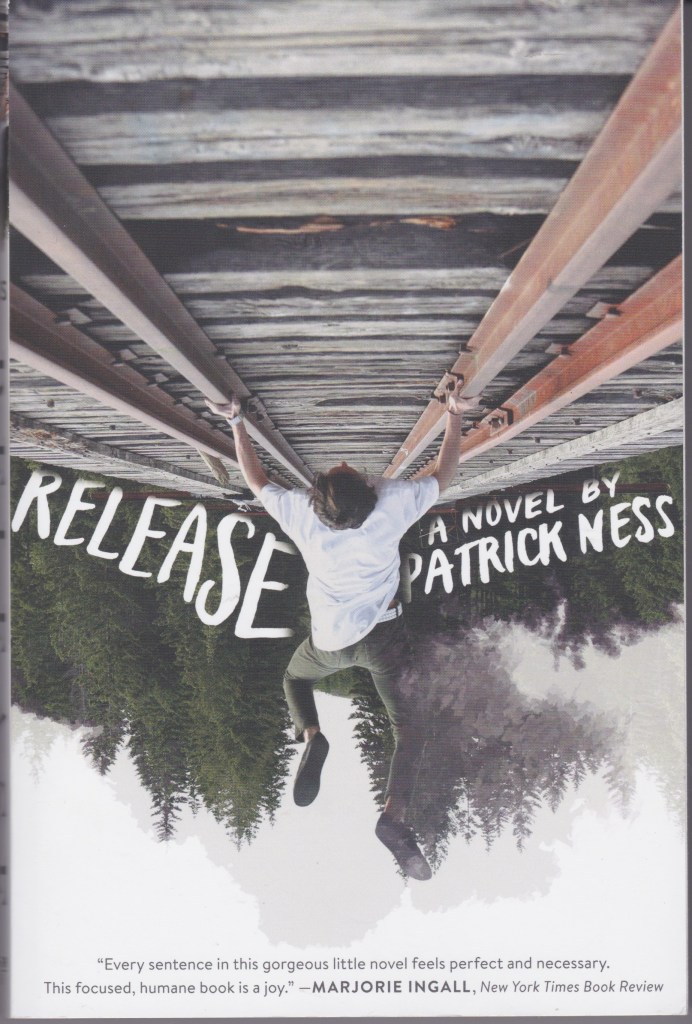
It’s been awhile since I’ve read a young adult novel, and it’s certainly been awhile since I read one that I enjoyed as much as I did Patrick Ness’ Release.
The other day when I finally finished writing and published my blog about writing queer young adult fiction, I reread the articles I linked to in the piece–the ones that triggered me writing it in the first place–and discovered that one of the books considered “problematic” for its depiction of gay teen sexuality was Release by Patrick Ness. I looked it up, and discovered I had already purchased it back when I was originally writing the entry, shelved it, and forgotten about it. It was right there on the top of the first bookcase I went looking for it in, and I took that as a sign that I should go ahead and read it.
I’m really, really glad I decided to go ahead and finish those pending draft entries, because that led me to reading this delightful book.
Adam would have to get the flowers himself.
His mom had enough to do, she said; she needed them this morning, pretty much right now if the day wasn’t going to be a total loss; and in the end, Adam’s attendance at this little “get-together” with his friends tonight may or may not hinge on his willingness/success in picking up the flowers and doing so without complaint.
Adam argued–quite well, he thought, without showing any overt anger–that his older brother, Marty, was the one who’d run over the old flowers; that he, Adam, also had a ton of things to do today; and the new chrysanthemums for the front path weren’t exactly high in the logical criteria for attendance at a get-together he’d already bargained for–because nothing was free with his parents, not ever–by chopping all the winter’s firewood before even the end of August. Nevertheless, she had, in that way of hers, turned it into a decree: he would get the flowers or he wouldn’t go tonight, especially after that girl got killed.
“Your choice,” his mom said, not even looking at him.
Release was, for me, kind of a revelation, and what more can anyone ask for from a novel?
As I mentioned the other day, one of the primary issues I’ve faced–and worried about–in writing queer young adult fiction is the issue of sex and sexuality; times have changed in many (and better) ways since I was a terrified teenager deep in my closet and afraid someone, anyone, might find out my actual truth. There’s also the endlessly cliched trope of the coming out story; there have been many of those stories written and published; what else can you do that’s fresh and new? The trope of the deeply religious parents and their inability to accept and love their child has been done plenty of times; to the point where I’ve really not ever wanted to go near it. Release is yet another one of those, but it’s actually done so well it seems fresh and new; Adam’s dad is an evangelical pastor at a wannabe megachurch, but their church exists in the shadows of a much more successful local one, and so Adam’s family is a bit cash-strapped, particularly since his mother lost her job.
But the most refreshing part of the story is that Adam actually not only thinks about sex, he actually has it. He is currently on his fourth (secret) boyfriend, one of the only out kids at his high school, and still mooning over Enzo, with whom he was involved for fourteen months and then was transitioned into the “friend zone”–while Enzo moved on and went back to dating girls. He still has unresolved feelings for Enzo–what teenager hasn’t been dumped by someone they still love?–that interfere with, and complicate, his relationship with Linus, who actually does love Adam. The “get-together” that night is Enzo’s going away party; he and his family are moving to Atlanta, and this will be the last time Adam will ever see him. It’s teen melodrama, worthy of Gossip Girl orany number of teenage melodramas, but it’s done so well and Ness makes Adam so likable and relatable, you can’t help but root for him to figure it all out and not mess it up.
There’s also an absolutely lovely sex scene between the two of them–Adam and Linus–that, while undoubtedly making certain people uncomfortable (Oh no! Two gay boys in bed together! HAVING THE GAY BUTTSEX!!!!) is actually neither explicit nor graphic, and says a lot by saying very little; which also made me realize that yes, indeed, Greg, there’s a way to write sex scenes so that they are expressions of desire and need, yes, but also of emotion and love. (Mine–when I used to write erotica–were athletic and nasty and passionate.)
I highly enjoyed this book, and while there is a weird subplot story going on at the same time as Adam’s story–one that never really is explained the hows and whys of, or of how these supernatural creatures are somehow connected to Adam–it’s not jarringly off-track, even though possibly unnecessary or connected.
It’s a terrific book. I will definitely read more of Mr. Ness’ work.
Operation Scooter is going well so far. He doesn’t run away when we get out the syringe, he’s eating the wet food–although he’s not eating enough, I don’t think–and we’ve successfully convinced him his tartar control dry food (which is what he used to eat) are treats. We’ve also noticed behavior change in him since we started the insulin; he seems more alert, more active, and his fur is softer and sleeker than it was. He’s also more affectionate than he has been for a while–he’s never been much of a “hey let’s play” cat; he just wants to cuddle and purr. He also doesn’t seem to be drinking as much water as he was–that was when we noticed the change; he was drinking more water and his litter box became insane to deal with–and so I’m pretty happy about the whole situation now. It doesn’t phase me anymore to get the syringe ready or give him the shot. We’re hoping he’ll do so well with the change in diet and with the insulin now that he won’t need the shots anymore in a few months.
I’m so glad this is going so well. As I mentioned before, we’re very close to the ten year anniversary of when we lost Skittle and Scooter rescued us, and losing him around this time would have been rough. It’s going to be whenever it does happen, regardless, but I’m delighted we are going to be able to enjoy Scooter cuddles for a while longer.
The weather–and daylight–have definitely changed around here now; last night it dipped into the sixties (I could tell; I slept deeply and well, and my bed was so warm and comfortable this morning I didn’t want to get out of it). I feel very rested this morning. Yes, I certainly could have stayed in bed for longer than I was able to, but the summer weather has definitely broken and we are now in our beautiful, marvelous, gorgeous fall. (It’s very dark outside my windows this morning)
I finished reading Patrick Ness’ Release last night, and it was quite marvelous. I am looking forward to putting my thoughts together about it into a blog entry–it definitely made me think, and rethink, a lot of what I knew, or thought I knew, about writing for the young adult market. I think next up on my reading is going to be John Vercher’s Three Fifths, which was an Edgar finalist for Best First Novel this past spring, and I’ve heard a lot of truly terrific things about it. I also got two Kindle books for a ridiculously low sale price–John Ball’s In the Heat of the Night (which the Oscar winning film was based on, and I think it won an Edgar Award) and V. M. Burns’ The Plot Is Murder, which looks absolutely delightful. I should really read more of the books on my iPad book apps, shouldn’t I? There are quite a few of them, and I keep acquiring more, and since I’m not traveling at all….
I also managed to get a lot of my email cleared out yesterday, which was not only productive but felt amazing. I don’t feel sleepy-tired today, either, which means I should have yet another productive day. Yay! I had a lovely day at the office yesterday–all of my clients kept their appointments, and that’s really my favorite part of my day job, helping people–even if it’s just in the small way that I can through my work. I enjoy those interactions with my clients; and I miss seeing clients every day. I’m not sure when or if I will ever be back to full time counseling, but I really do hope it’s sooner rather than later.
Paul didn’t get home until late last night, after I had already gone to bed–he’s working on grants and proposals–and I have to admit, I was plenty tired when I got home from work yesterday, which was why I read my book rather than doing any cleaning or writing or revising. Hopefully, he will be home at his usual time tonight–I just let music videos stream endlessly on Youtube on the big television while I read, and thought about Bury Me in Shadows some more. I pitched both it and the Kansas book to my publisher yesterday–biting the bullet and realizing the stress of a deadline is what I need to finish pushing through them and getting them both finished–so hopefully they will agree to take both books and I can get the contracts signed and the deadlines set relatively soon. I’ve still not heard back on the Secret Project, but I still have hope an offer might come through; although the longer it takes the less confidence I have that one will be forthcoming.
Worst case scenario: it’s turned down and I use the plot for another Scotty book. Worse things have happened.
And on that note, tis back to the spice mines with me. Have a lovely Tuesday, Constant Reader.
Not only do I write two private eye series, erotica, and the occasional stand alone, I also, sometimes, write what’s classified as young adult fiction. I have not published anything that could remotely be considered y/a in quite a while, and therein lies a tale (I think the last book I published that could be considered “young adult” was Dark Tide; I could be wrong. I no longer remember when and in what order my non-series books came out).
To be clear, the fact that I even call those books “y/a” even though I don’t really think of them as young adult fiction is a marketing thing, really; in my mind, they’re simply novels I wrote about teenagers. I started writing about teenagers when I actually was one; the stories I wrote in high school weren’t bad, for a teenager, and were the first indication–from my fellow classmates, and my English teacher–that I could seriously become a published writer if I chose to try to do so; the utter lack of seriousness my writing aspirations received from my family was kind of soul-crushing. But I always wanted to write about teenagers, from the very beginnings; I wanted to do my own Nancy Drew/Hardy Boys style series, and then progressed to other stories.
I progressed as a reader pretty quickly when I was growing up; I went from the series books, like the Hardy Boys and Nancy Drew, and the Scholastic Book Club mysteries, to Agatha Christie, Charlotte Armstrong, and Ellery Queen when I was around eleven or twelve, if not younger; I know I read both Gone with the Wind and Antonia Fraser’s Mary Queen of Scots when I was ten. The few books I read that were considered “children’s books” (there was no such thing as young adult fiction then) were books like The Outsiders and The Cat Ate My Gymsuit and I did enjoy them; I just didn’t think of them as either being particularly authentic or realistic. Nor did they have any bearing on my life, or the lives of my friends–I viewed them like youth-oriented television shows like The Brady Bunch, existing in some bizarre alternate universe that has no basis in actual reality or what those of us who were that age were actually experiencing. I always thought there was something missing–complicated and authentic books about the lives of real teenagers and the real issues they faced everyday, without getting into the insanity of the preachy-teachy “issue” books that usually wound up as ABC After-school Specials, which I loathed.
Not all “issue books” were bad, in all fairness; some, like Lisa Bright and Dark, about a girl struggling with mental illness whose parents refused to face their daughter’s reality, so her friends tried to help her by serving as amateur psychologists, and I Never Promised You a Rose Garden, about a teenaged girl in a mental hospital dealing with her illness were actually quite good. But I loved books like The Cheerleader, about a poor girl in a small New England town with ambitions and dreams that far exceeded those of most of her friends…dealing with issues of popularity, sex, and first love. David Marlow’s Yearbook was also a favorite, and while not marketed to kids, was about high school, but had some themes and plot-lines considered far too heavy for teens to digest in the 1970’s. You can also see it in the pap that was considered movies for teenagers; G-rated bubble-gum like The Computer Wore Tennis Shoes, and inevitably came from Disney and starred Kurt Russell. (These movies are an interesting time capsule; I did try to watch one of them recently on Disney Plus and didn’t last three minutes in that squeaky clean, sex-free college environment.)
(Also, I would like to point out at this time there were terrific books being published in the 1970’s for teens that dealt with major issues and were groundbreaking; Sandra Scoppetone was writing about queer teens back then, and there were some others doing terrific work at the time–I just wasn’t aware of those books until much later.)
My first three young adult novels–Sorceress, Sleeping Angel, Sara–were written as first drafts in the early 1990’s, put in a drawer, and forgotten about for nearly twenty years. Sorceress had no queer content in it at all; it was my version of the truly popular trope of romantic/domestic suspense where an orphaned girl goes to live in a spooky mansion far away from her old life (Jane Eyre, Rebecca, almost everything written by Victoria Holt), and slowly becomes aware that everything in the house isn’t as it seems. It was a lot of fun to write–I loved those books and I loved putting a modern spin on them. Sleeping Angel’s first draft was never completed, and the published version is vastly different than what the original first draft contained; there are still some vestiges of the original plot there in the book that are never truly explained, and by the time I realized, after many drafts, that I hadn’t removed those vestiges from the book it was too late to do anything about it other than hope no one noticed. The book did well, won an award or two, and is still a favorite of my readers, according to what I see on social media. One of the things I added to the story was a queer subplot about bullying, which is what I think readers truly responded to, and I also feel like adding that to the story in addition to the other changes I made to it made it a stronger book. Sara was always intended to have gay characters and a gay plot; I originally started writing it as a novel for adults and realized, over the course of writing it, that actually the teenage story was the most interesting part and I could deal with some issues there if I switched the focus of the book to the teenagers. One thing that changed from the 1991 first draft to the draft that was published is that the character I originally had being bullied for being gay, even though he wasn’t (another character, one of the biggest bullies, actually was), was actually not only gay but had come out, and so the book also talked about the reverberations of a popular football coming out, and what impact that had on the school social structure and hierarchy.
Sara, incidentally, is one of my lowest selling titles–which also kind of breaks my heart a little bit.
Since those three, there have been others I’ve written–Lake Thirteen, Dark Tide–and I’ve also dabbled in what is called “new adult fiction”–books about college-age or just out of college-age characters–this is where The Orion Mask and Timothy and the current one I’m working on, Bury Me in Shadows, fall on the marketing spectrum.
One of the questions I had to deal with in writing young adult novels with queer content was the question of sex. I had already been through being banned in Virginia because I had written gay erotica (a really long story that I revisited recently with Brad Shreve on his podcast; I really do need to write in depth about the entire experience); what would happen if ‘notorious gay porn writer’ Greg Herren began writing fiction specifically aimed at teenagers? But the truly interesting thing about being used as a political pawn by the right-wing fanatics in the power games they play is that once they’ve made use of you, they forget about you and move on. My young adult fiction was released without a single complaint, protest, or any of the sturm und drang that my speaking at a high school to a group of queer and queer-supportive youth created scant years earlier.
Interesting, isn’t it?
And yet…there is no sex in any of those books. None. I don’t remember my gay teens even getting a chaste kiss, let alone a sex life, or fantasies, or a boyfriend.
And what about desire?
A couple of years ago someone tagged me on Facebook on an article about just that very subject; that was when I started writing this post (three yeara ago, looks like) but I never finished writing this until this morning.
I know, it’s a lot of information to process, but it’s something we should all be thinking about, particularly as the calls for diversity in publishing and popular culture continue. Sex is, quite obviously, a touchy subject when it comes to young adult fiction, but when it comes to questions of sexuality and being a sexual minority, what is too much and what is not enough? Even depictions of straight sexuality is frowned on and controversial when it comes to young adult fiction. (For the record, that is also considered the case for crime fiction–no explicit sex scenes–or at least so I was told when I was first getting started; doubly ironic that my mystery series were what the right-wing Virginian fanatics considered porn–I really do need to write about that.)
I also have noticed the elitism evident in hashtags like #ownvoices and #weneeddiversevoices that have come and gone and return periodically on Twitter; those actively involved in promoting those tags, when it comes to queer books, make it abundantly clear they only care about those published by the Big Five in New York–which is a good target, I agree, and they do need to be doing better when it comes to diversity and “own voices” work–but this focus also ignores the small presses, particularly the queer ones, who have been doing this work all along and making sure queer books were still being published for all ages and getting out there and made available to those who want and need them. I am absolutely delighted to see queer books by queers being published by the Big 5, and young adult work in particular…and yet…there are some serious issues still with the Big 5–and with what is called ” young adult Twitter”.
I do find it interesting to see who they decide are the “cool kids” and who they banish to the outer tables with the freaks and geeks.
It’s part of the reason I don’t engage with young adult twitter, to be honest. I really have no desire to return to the high school cafeteria at this point in my life.
And I’ll write about teenagers whenever there’s a story I want to tell involving teenagers–which currently is the Kansas book; I turned my protagonist in Bury Me in Shadows into a college student because it actually works better.
And on that note, tis back to the spice mines with me. (And huzzah for finally finishing this post!)
I got my flu shot yesterday, as well as the second and final vaccination for shingles, and just like the first shingles shot, my shoulder (flu went into the left, shingles to the right) is achy and sore again this morning. But I have absolutely no regrets–a few days of sore shoulder is certainly worth never having shingles. Ironically, one of my goals for this year was to be better about my health in general; who knew, of course, when setting my goals there would be a global pandemic and all of the resultant fallout? But while I still need to get that damned colonoscopy scheduled, I have managed to get the lumps in my chest X-rayed (fatty cysts, RUDE!) and my shingles vaccination. I was in a regular routine of going to the gym again before it closed (and I really really miss it), and need to get into at least a regular routine of stretching, push-ups. and abs every morning (which hasn’t happened yet). I think that will help with what I call malaise, but really is depression.
Malaise just somehow sounds better to me than depression–but that’s also due to stigma. I don’t know why I am so reluctant to admit that I have depression sometimes–it never gets truly bad, just bad enough that I fail to see the point in doing anything of any kind–but of course, when i had to go to the office every day and see clients that helped keep it under control; helping people every day and talking to them about their own problems and issues made me feel better about myself–hey at least you’re helping people and you can do that even during a bout of depression–so obviously, only working with clients two days a week now does not help as much with that. I also am not one who likes to admit to weakness of any kind–thank you, systemic toxic masculinity–and so talking publicly about it, let alone admitting to it, has always been an issue for me.
I did watch The Believers while making condom packs yesterday, and yes, I was right; it doesn’t hold up and it’s really terrible about what is essentially just as valid a religion as Christianity. At one point an expert in santeria does explain to the main character–played by a very handsome younger Martin Sheen–that there is a difference between santeria (white magic; the forces of good) and brujeria (dark magic; the forces of evil)–but throughout the film it’s only referred to as santeria, and the entire point of the film is to exoticize an ancient African religion, make it seem mysterious and evil. Ironically, even though the film was made in 1987 or so, it actually fits into my Cynical 70’s Film Festival because it, too, is about paranoia and conspiracy and not being able to truly trust anyone. There was also a fear of Satanism rampant in the 1980’s; devil cults and so forth–and a lot of it had to do with heavy metal music as well. I suppose this swing back in the 1980’s was to be expected, almost predictable; after the social upheavals of the 1960’s and the cynicism of the 1970’s, the 1980’s saw a swing back to older values of a sort. Evangelicalism–which began to uptick somewhat in the 1970’s, on the wings of end-times religious theory, like The Late Great Planet Earth and The Omen, began preaching about “family values” and trying to censor film, books, television, and music. The film, which I didn’t really remember much of, played down some of the paranoia and motivation of the novel (which was called The Religion, until the release of the film); in the book the religion followers were being warned by the Seven Powers that child sacrifice–three children, in total–was necessary to prevent the coming end of the world; and the stakes of the novel lie in the fact that the main character’s son was to be the third. This plot point was written out of the movie, which obviously turned them into crazy child sacrificers; at least their motivations in the book were sort of pure–an end justifies the means sort of thing, which was a very popular mentality in the 1980’s, as I recall. The book ends with the main character, his new second wife (love interest throughout the book) and the son, saved from sacrifice, living on a farm somewhere; their radio and television goes out, and the adults look at each other with worry as the sky outside also begins to change to an eerie color…the movie obviously ends differently, and not as satisfyingly; I liked that the book depicted that their unwillingness to allow their son to be sacrificed in order to save the world–selfishness, really–doomed the entire world. (The Cabin at the End of the World by Paul Tremblay also does a most excellent job of portraying this same dilemma–seriously, Constant Reader, you need to read that book.)
Thinking about this book, and rewatching this movie, naturally has me thinking about the connections between santeria and brujeria to the type of voodoo that was practiced in New Orleans; something I’ve long been interested in but hesitant to write about, particularly, as I’ve said before, because the historical writings about New Orleans and voodoo culture is extremely, horrifyingly dated and racist. My story “The Snow Globe”–coming next year in the Chesapeake Chapter of Sisters in Crime’s anthology Magic is Murder–touches on New Orleans voodoo, and I was absolutely terrified of getting it wrong. The primary issue I have with both fictional and historical depictions of voodoo under any name is that it’s always painted as devil-worship and evil, which is predicated on the notion that Christianity is the only good religion. (I’ve also, often, noted that horror fiction–film, television, novels–while always attacked by Christians, actually almost always portrays Christianity as good, and true, and real; a confirmation of its beliefs and value systems. Vampires inevitably recoil from the cross and holy water; same with demonic possession–and inevitably not just Christianity but Catholicism in particular. I’ve always thought that rather curious.)
Scott Heim’s wonderful story “Loam”–available here at Amazon–was very interesting (not just because he’s a terrific writer and it’s very good) to me because it was about the after-effects, years later, of one of those devil-worshipping/Satanic cult scares from that time period, in which child abuse and so forth were also alleged, and convictions gained, only to later discover the kids had “false memories” that were implanted by the questioning (similar to what happened to Greg Kelley in that documentary we recently watched, where he was falsely accused and convicted of molesting two children). I’ve always been curious about the after-effects of these kinds of traumas, not just on the children but the adults involved as well. How do you parent in that situation? I have a book idea that’s been lying around here for quite some time called I Know Who You Are, which is sort of based on that idea; someone escaping a deeply troubled past and starting a new life with a new name somewhere else, only to have someone from that past turn up, because you can never escape the past. It’s a great idea, and one that I was originally intending to use as a Paige novel in that aborted series, but I think it will also work as a stand-alone–I’ve considered using it as the spin-off from my true crime writer Jerry Channing, who has shown up in the Scotty series a couple of times.
But I must get through these other manuscripts before I can even consider writing anything else.
And on that note, tis off to the spice mines with me.
Wednesday morning and the sun is shining, which is always a lovely thing. After the last few days of incessant rain and gloom–but not as bad as a tropical storm coming through–it’s nice to see the sunshine again. The weather is also beginning to take that shift towards cooler, which is also incredibly lovely. I slept really well last night– I inevitably do on the morning after two consecutive days of getting up at six–and as such, I don’t feel very tired today. Also a lovely thing. I am working from home today–I think I am going to pick an 80’s movie today for watching during the inevitable making of the condom packs; I had already cued up Martin Sheen’s The Believers, a horror movie about santeria, because I wanted to see how it held up after all these years–and i am relatively certain it is probably guilty of a lot of things that would keep the film from being made today; not the least of which would be portraying a non-Abrahamic religion as a tool of evil. I read the book the film was based on as well, The Religion by Robert Stuart Nathan, and a quick google search brought up this: The Religion is a horror novel written in 1982 by Nicholas Conde*. It explores the ritual sacrifice of children to appease the pantheon of voodoo deities, through the currently used practice of Santería. (*Nicholas Conde was the pseudonym he used for the novel.)
Yeah, that doesn’t sound terribly promising.
As I said, it’s probably a terribly offensive movie (and book), but reading/seeing it made me more interested in both voodoo and Santeria, and was the first place I learned about how the enslaved Africans in this hemisphere adapted their religion by replacing their gods and goddesses with Catholic saints to fool people into thinking they’d converted to Christianity. Voodoo was something I didn’t know much about at the time–I still don’t really know much about it–and I’d never heard of santeria before; I’ve always wanted to learn more about it, but the problem is so much of the available material cannot be trusted, particularly when it comes to the New Orleans version of the religion; so much history here is word-of-mouth legend, and when people started to write “histories” (such as Robert Tallant’s Voodoo in New Orleans) most of what they wrote was deeply racist and most likely inaccurate–and can one really trust white Southern historians writing about the culture of people of color?
Probably not. At any rate, it’ll be interesting to rewatch the film through a modern lens.
We finished watching Ratched last night. It was highly entertaining, and visually spectacular, but you also kind of had to turn off your brain a bit, as there were enormous plot holes and there were more than a few things didn’t make sense; not to mention the connection to the character in One Flew Over the Cuckoo’s Nest was marginal, at best, and completely absent at worst. But the sets, costumes and visual aesthetic of the show was stunningly gorgeous, similar to the old Douglas Sirk films of the 1950’s. And it did keep me entertained, which is saying something–I don’t have much of an attention span these days, which is why I am having difficulty reading these days again. It’s so weird; I’ll have some sort of reading breakthrough and then tear through a bunch of novels in a short period of time, and then go back to not being able to focus again. I intend on working on the book again tonight once my workday is finished–I wasn’t joking about that mess of a chapter–and I also haven’t worked on anything short-story related at all this week either; even if it’s just to reread and figure out how to fix one that has a finished draft already, or one that is unfinished while trying to figure out how to keep going with it.
And on that note, I am going to get some more coffee and get this day started. Have a lovely Wednesday, Constant Reader.
While I am not, precisely, starting over again with Bury Me in Shadows, I am in some ways returning to the drawing board; my memory has become more and more useless the older I get, and the daily beating my psyche and consciousness has taken this year hasn’t helped much in that regard. But it’s kind of sad that it’s been so long now–and really, it’s not been much more than a week–that I’ve worked on it that I don’t remember where I was at and what was going on; I don’t even remember what happens next and where the story goes, or even the ending I wrote for it–which is part of the problem with writing a book while having, for want of a better term, pandemic brain. (I don’t think I should blame my faulty, horrific memory completely on the pandemic, but I think I am willing to agree that it has not helped one little bit with my short or long term memory.)
I started reading The Heavenly Table yesterday–Donald Ray Pollack is the author, and he also wrote The Devil All The Time–and it’s really quite well written. He really knows how to hit that rural poverty note, and does it really exceptionally well; like Daniel Woodrell, Ace Atkins, and William Faulkner. As I was reading it, I was remembering those summers in Alabama when I was a kid, and thinking about the way my parents grew up–and how difficult that must have been for them, even though they didn’t know any different. This also put me in mind of things that I may need to put into Bury Me in Shadows, or save for something else; another novella that I’m writing, “A Holler Full of Kudzu”, keeps going through my mind when I am reading this book.
I didn’t do much writing yesterday; I was interviewed yesterday for Brad Shreve’s Gay Mystery Podcast (link to come) and, as always after something like that, when I was finished I felt terribly drained (caffeine rush wearing off, perhaps? Also a possibility) and so I wound up sitting in my chair, reading the Pollack novel and thinking about my various writing projects. we eventually watched this week’s episode of Ted Lasso, which continues to be quite marvelous and lovely, and then started Ryan Murphy’s Ratched. It’s entertaining and beautifully shot; the costumes are amazing, as are the sets and visuals, and it’s reminiscent of the Douglas Sirk film stylings from the 1950’s–and for a state mental hospital, the place is gorgeous and impeccably decorated and sparkling clean. The acting is quite good, but I am really not seeing the connection to One Flew Over the Cuckoo’s Nest other than as a clever marketing tie-in to draw viewers in, but other than Sarah Paulsen’s character being a younger Nurse Ratched, there really is no connection. It could have just as easily been another season of American Horror Story, and it does have connections, in some ways, to the afore-mentioned show’s Asylum season: the menacing and dangerous nurse; the aversion to lesbianism; the crazy and criminal doctor using his patients as guinea pigs; the serial killer; and so forth. We’re interested and intrigued enough to keep watching, and it’s also interesting seeing the additions to what I call the Ryan Murphy Repertory Company–the young actor who played Justin on 13 Reasons Why, Charlie Carver, Sharon Stone, and Judy Davis. (I do give Murphy a lot of credit for casting openly gay actors in his series, playing either gay or straight or bisexual men.)
It’s gray and drizzly outside the windows this morning, and it feels very cool here inside the Lost Apartment. I know this is the outer edges of Beta–I’ve not yet had the heart to look the storm up and see where it is and where it is projected to be going this morning so far–I’m just not in the mood to see what new potential destruction and flooding is now possible for somewhere along the Gulf Coast. Yay.
I do want to get some writing done, even if it’s merely the tedium of taking the second half of the book and adjusting it from present tense to past tense (a decision I made between drafts; I was trying present tense to see if it added urgency to the story, and I don’t think it really did, so am switching it back to past, which is something i am more comfortable with anyway. If it worked the way I had wanted I would have left it that way, but it really didn’t, and so I am changing it back) so that they are more ready for the revising. I would love more than anything to maybe get two or three chapters revised–but I also need to go back and add at least one scene to the chapters I’ve already got done; a scene I put off until later in the book because I wasn’t completely sure how to deal with it earlier. (I also need to reread the stuff that’s already been revised, so I can remember where I am at and what needs to be done with the next revisions; again, as I said before, the problem with allowing one’s self to procrastinate writing for as long as I have is you forget what you’re writing, which is terrifying) But I intend to be as productive today as I can be, and I feel confident, which I haven’t in quite some time. Not sure what that’s about, but I am going to ride that wave as long as I can.
I’m also setting a goal of a short story per week; both reading one and writing/finishing one. This week’s short story to finish is one I started a while back called “Please Die Soon,” which is a Rear Window/Sorry Wrong Number type pastiche; is there anything more terrifying than being bedridden and beginning to suspect the people trusted with caring for you are actually trying to kill you? It’s a terrific title, and I know exactly how I want the story to work, but I’ve never had a lot of confidence in my ability to actually get it written properly. As I said the other day, I really want to get some more short stories out there to markets–you can’t sell if you don’t submit–and I’ve also began to understand that some of my stories aren’t really crime stories/mysteries; which makes finding markets for them even harder. “Burning Crosses” isn’t really a crime story–even if it’s about two college students looking into a lynching from sixty or so years ago–and it might make some markets deeply uncomfortable. Hell, it makes me uncomfortable–I question whether I should even be writing this type of story about racism, but I also need to stop second guessing myself. If I don’t do a good job of it, then the story isn’t any good, and I think the point that I am making with it–the cowardly discomfort white people experience when confronted with past racism–is a valid one. It’s most definitely not a white savior story, for sure–which is something I definitely don’t ever want to write.
There are already plenty of those stories already in print.
The trick is, as always, going to be focus, which has always been my mortal enemy.
And on that note, tis back to the spice mines with me.
It’s always something, isn’t it? If could go back in time and tell my younger self anything in the way of advice or assistance in dealing with life, that’s the lesson I would try to get through: it never stops, there’s always something, and sometimes you just can’t get away from things–but you also can’t get away from dealing with these things. Sometimes, if you’re lucky, they will be minor and small annoyances; but they will inevitably include things that are an enormous pain in the ass, and if other people are involved….well, inevitably they will make things worse rather than better.
You rarely will go wrong underestimating the intelligence of others. Sometimes, rarely, they will surprise you–but those moments are both lovely and rare.
This has been a week, of ups and downs and emotions all over the place and irritations and trying to fix things that shouldn’t need to be fixed in the first place; another thing you can never go wrong with is assuming that no one will ever take responsibility for their mistakes, their incompetence, or their stupidity. I am very glad to have reached Friday with the shreds of what’s left of my sanity somewhat intact; I intend to spend this weekend cleaning and writing. I had, in a conversation with a writer friend yesterday, one of those marvelous epiphanies about why my writing has stalled or is taking me so long to get this manuscript finished; which is that I am trying to make it perfect–and while there’s certainly nothing wrong with striving to write a book that is perfect, there’s also no such thing as the perfect book; it’s an impossible standard to reach, and what I really need to be doing is focusing on writing the best book that I can.
The weather yesterday was beautiful; there wasn’t a lot of humidity, so it felt lovely and cool–even though according to the weather when I got home from work, it was 83 degrees outside and “felt like 90.” It really did not; I wasn’t even mildly hot or sweaty carrying things out to the car in the morning on my way to work or out to the car on my way home from work (condom packing supplies; and condom packs on the way in), and it didn’t feel either hot or stuffy in the house once I got inside–which it always does, when it’s miserably hot and humid out.
I also looked at the forecast, and we are getting low 80’s/mid-to-high 70’s next week; it looks like fall has arrived in New Orleans and the heat may have broken. MAYBE. Possibly. Could be. Maybe. It’s gray and hazy outside the windows this morning; thunderstorms in the forecast for the day, and a tropical system of some sort out in the Gulf off the coast of Mexico trying to form and become something. With any luck today I won’t have to even go outside, and if I do, it won’t be for very long. I do have condoms to pack today–not sure what today’s film will be, either; I may break with the Cynical 70’s Film Festival and may start another–the Problematic 80’s Teen Movie Festival; Fast Times at Ridgemont High is available on one of the ridiculous amount of streaming services we subscribe to, and since it was really one of the first teen movies of its type, it seems like the perfect place to start. Has anyone ever written a book about the development of the teen movie, from its origins in the Andy Hardy films up through the sex comedies of the 80’s and to what we see today? That would be interesting.–especially in deconstructing the underlying messages imbedded in those 80’s movies we all grew up with and loved.
Which reminds me, I had an interesting point about Grease I’d intended to make when talking about American Graffiti, and never made; and of course, now I can’t really remember what it was–something along the lines of how American Graffiti, while nostalgic, was also dark; and Grease was the other extreme–nostalgia taken to the point where everything was presented as harmless…but if you look past the gloss, Grease itself is a pretty dark film as well. My point is in there somewhere, I suppose.
This week wasn’t a good one for reading; I didn’t read anything outside of the occasional email or website. I think Babylon Berlin might be a little too densely written for me to get into right now, so I am going to put it aside and read some short stories–the Short Story Project has, in fact, been idle for far too long, and I have all kinds of gems lined up to get into. I also may reread one of my long-time favorite comfort reads, either Rebecca or In Cold Blood, something like that, or perhaps a Mary Stewart ebook already loaded into my Kindle app. I definitely need to spend some more time reading and writing; I think the absence of both from my life this past week has been part of the emotional downturn i’ve been dealing with.
We’re still enjoying House of Flowers, but are now into the second season, and the changes between seasons is quite startling and may take some getting used to. We’re going to go another episode or so before giving it up; but that first season is absolutely golden, and again, there on a Mexican show is inclusion of bisexuality and transgender representation, which is quite marvelous.
And on that note I am heading into the spice mines. Have a lovely Friday, Constant Reader.
As I typed it, I realized what a New Orleans-like thing it was to say; and it made me smile a little bit. The coroner in question wasn’t currently serving New Orleans; he had retired in 2014 after ten terms in office, and his name was Dr. Frank Minyard. He played the trumpet, and was actually a gynecologist rather than a pathologist. Was he good coroner or a bad one? A little of each, I would gather, based on the obituary by John Pope you can read by clicking here.
But he was, like so many New Orleanians used to be, quite a character. New Orleans has always been a city full of characters, which is why so many people write about New Orleans, and write about it well. Not only can you probably get away with writing anything crazy-seeming about New Orleans; chances are if you dig a little into our history here, you’ll inevitably find crazier shit than anything you could dream up on your own. I have to say I have really been enjoying reading up on our local history here.
Hurricane Sally came ashore earlier this morning, and it had continued turning enough to the east that we didn’t get much of anything here in New Orleans. The panhandles of Alabama and Florida (in particular Mobile and Pensacola) are an entirely different story; my heart sank down into my shoes (well, my slippers) on seeing footage and images from that section of the Gulf Coast. Hurricane season is so emotionally exhausting, really; all that stress and tension and worry, and then when it goes somewhere else the enormous guilt one feels about the relief that your area escaped unscathed while others are losing everything–including some lives–is horrible, just horrible. It’s oddly gray and hazy-seeming outside the windows this morning, with the crepe myrtles and the young live oaks in the yard on the other side of the fence doing their wavy dance thing they do when the wind blows; the sidewalk outside also looks wet so we must have gotten some rain as well overnight, but not enough for me to notice anything as I slept through it all. (That’s the other thing about hurricanes, particularly the ones that come ashore overnight; you go to bed wondering what you’ll wake up to find in the morning–or worse yet, disaster will rip you out of a deep sleep.)
So, yes, this morning I feel very emotionally drained; well rested, but exhausted emotionally.
And then, of course, once the danger has passed, you have to reset yourself and get back to normality–whatever the hell that is, or what passes for it, at any rate.
Yesterday’s entry in the Cynical 70’s Film Festival was The Omen, which was a huge hit back when it was released in 1976 and spawned two sequels, Omen II: Damien and The Final Conflict. I had never seen the sequels, and I think I originally rented the film–I don’t think it played at the Twin Theater in Emporia–but I did read the book (the book was written by David Seltzer, who apparently, according to the opening credits of the film, wrote the screenplay; which came first? I don’t care enough to look it up) and of course, was put in mind of it by paging through The Late Great Planet Earth, which laid the groundwork for the movie. Obviously, it’s about the anti-Christ, who is Damien Thorn; the movie opens with the Robert Thorn (played with an almost wooden-like quality by Gregory Peck) arriving at a hospital in Rome only to be told that the child his wife has given birth to has died; he worries about her mental stability and how she will handle the news–and so a priest offers a substitute baby whose mother died giving birth. (And this is the first place I called shenanigans on this rewatch; one, he is about to start a lifetime of lying to his wife and two–was there any need to tell Robert Thorn his child died? If the idea was to have the Thorns accept the anti-Christ into their home as their child, wouldn’t it simply make more sense to swap the babies, so neither of them knew? Because how could they have been so certain Thorn would accept this literal deal with the devil?) The movie is paced fairly well, and it moves right along–there’s not a lot of gore or blood and guts, but it does beggar credulity at more than one point–and perhaps I am looking at it with jaded eyes some forty years later, but both Peck and Lee Remick, who plays his wife, seem to just be phoning it in for the paycheck and there’s also the element of their age; they seem to be fairly old to just be trying to start having a child at the opening of the movie. (I think the book plays this up more, stating that Kathy Thorn has suffered innumerable miscarriages leading up to this birth and it has shaken her mental stability; kind of hard to do that on film but it certainly would have made his motivation in accepting this needless deception–again, they could have just as easily substituted the baby without having to go through this entire risky rigmarole.) After finishing, I looked for Omen II but it’s not streaming for free anywhere; I then watched The Final Conflict, which was simply terrible (outside of Sam Neill, who was terrific and charismatic as an adult Damien, saddled with an incredibly bad and far-fetched script).
The movie does fit, however, with the Cynical 70’s Film Festival, because here we have yet another conspiracy, one in which some members of the Catholic Church have turned to Satan to try to bring about the end times as well as the birth of the Antichrist–because whereas in the 1950’s and the early 1960’s, it would have been unimaginable for such a film to be made, but also to be believable; who would have ever believed such a thing was possible? Of course, both book and film of Rosemary’s Baby set the stage for The Omen, but both were later 1960’s, when things were starting to change, times were getting more cynical, and so were people. Rosemary’s Baby changed almost everything, both in the world of novels and film, in showing that horror was both bankable and mainstream. The early 1970’s saw the publications, and enormous success, of books like Ira Levin’s The Stepford Wives, William Peter Blatty’s The Exorcist, Thomas Tryon’s Gothic horror masterpiece The Other, and eventually, Stephen King’s out-of-nowhere bestseller Carrie. Soon Peter Straub would publish Ghost Story and Carrie would become a hit movie, triggering a horror revival that brought both the literature and the films into the mainstream. This revival didn’t lose steam until the 1990’s, and frankly, I think horror is on the verge of another revival.
I could be wrong, of course. I certainly have been before, but I am seeing some really terrific work as well as amazing new voices–over the past year alone I’ve read some astonishing work by new-to-me writers, and I only wish I had more time to read everything I really want to. Paul Tremblay is amazing, and so is Bracken MacLeod, Christopher Golden, and Silvia Moreno-Garcia, among others; I’m seeing a lot of new and interesting looking titles being announced or reviewed almost every time I turn around.
I guess today is Wednesday? I am really not sure, living in this weird world that comes with hurricane watches, where it is very easy to lose track of dates and times and what day of the week it actually is. But a quick glance at Weather.com assures me that all the other storms out in the Atlantic basin pose no threat to Louisiana, so I guess we can relax for a little while, at least.
I went down a wormhole thought pattern of sorts this morning, triggered by reading a Crimereads essay about spy novels, and their genesis; it mentioned that Rudyard Kipling’s Kim was one of the first spy novels, and I also realized that only had I not read Kim, I’m not entirely sure I’ve ever read Kipling; however, a quick Internet search just not has reminded me that I have, indeed, read Kipling: Rikki-Tikki-Tavi, The Jungle Book, Captains Courageous, but I really don’t remember anything about them (let’s be honest, all my memories of The Jungle Book are naturally from the Disney animated film). I may have also even read Just So Stories, but am not entirely sure. I’m sure Kipling’s work does not stand the test of time–just the title of the poem “The White Man’s Burden” made my eyes almost pop out of my head when I came across it this morning–as they undoubtedly reflect the white supremacist view of Imperialism and the need for the British Empire.
On that same note, I feel relatively certain that the M. M. Kaye novels I once enjoyed (Shadow of the Moon and The Far Pavilions) probably wouldn’t hold up well, either.
I always read for pleasure and for enjoyment; to escape the world in which I found myself inhabiting and feeling like a changeling for the most part; I still do, for the most part. I haven’t been paid to write a book review in over a decade; I’ve always felt that as an author myself, there was a conflict of interest in accepting pay to read and critique another author’s work, and there was always, inevitably, the possibility that an honest view on something that didn’t work for me as a reader would be seen as a vindictive move on my part to torpedo another author, out of jealousy or spite or both. There are any number of these reviewers being employed, and paid quite handsomely, by major newspapers, and I don’t want to be one of them. I don’t like writing negative reviews, and if I am reading something I don’t care for, having to finish reading it because I am being paid to write about would inevitably make me resent the book and its author and would thus color the review.
I generally read things I think fall under my purview as a writer–mostly crime novels, some horror now and then, and maybe something every once in a great while, that would be considered literary. Often these are books by writers I already have discovered, or new ones recommended to me by others whose tastes I respect–The Coyotes of Carthage came to me in this way; Lisa Unger was recommended to me by numerous friends; and yes, Paul Tremblay came to me as a recommendation from a friend. I know I need to expand my horizons to improve as a writer, which is why I am not only committed to the Diversity Project (books by marginalized writers) but also to the Short Story Project. The Diversity Project has been a terrific learning experience, and the Short Story Project has helped me become a better short story writer. I’ve been trying to read New Orleans history lately–with a dash of Louisiana thrown in for flavor–in order to get a better sense of the city and state, so that I can write about them both more knowledgeably; plus there is so much inspiration in reading about the past of both city and state! It’s also incredibly humbling to know how little of that actual history I did know, and even though I knew how rich that history was, I had no idea just how much of a gold mine of inspiration and ideas it would prove to be.
Like I said, I tend to read things I think I will enjoy, and if I am not enjoying the experience, I inevitably stop reading. I have started things and put them aside, only to go back to them again and greatly enjoy them; Paul Tremblay’s A Head Full of Ghosts being the best and most recent example of this I can remember; I started it, got several chapters in, and wasn’t feeling it. I went back to it months later and couldn’t put it down, and frankly, after The Cabin at the End of the World, Tremblay is becoming one of my current favorite authors.
So, I’ve been wrong about books before, and I’ve also been wrong about authors before. Hence the dilemma in being a book reviewer, and why I have chosen for many years now to seek extra income by reading for reviews. I enjoy writing about books I enjoyed on here, my blog; that’s part of its reason for existence, and I also curate what I read and write about here. No one chooses for me what I read or what I write about; and I will only review something negatively if the writer is, frankly, long dead; and even then, it’s simply an explanation of why the book didn’t work for me (an example of this latter type was Night Has a Thousand Eyes by Cornell Woolrich; I appreciated the book but there were things about it I didn’t like, that I felt didn’t “play”, but since he is long dead–over fifty years–I wasn’t overly concerned about hurting his feelings….and I have enjoyed other works of his).
I often talk about how my education in what the Academy considers to be classic American literature (British, too, for that matter) is sorely lacking. It’s something that I occasionally wonder about; should I go back and read these so-called classics as decided by a group of people whose opinion I generally don’t respect very much? It’s entirely possible, I know, that books I was forced to read as a teenager in high school and college were actually better than I thought at the time because I loathed being forced to read anything and I despised the way they were taught by pompous pseudo-intellectuals with tenure (I really enjoyed mocking that world in my story “Lightning Bugs in a Jar”, and will probably mine it again at some point as story fodder).
But I can honestly say I went back twice to reread The Great Gatsby only to discover that I loathed it even more than I remembered loathing it the first time; I also spent some time in my twenties trying to read other works by the writers I was forced to read and found that I did, in fact, enjoy some of them. I hated Sinclair Lewis when I was forced to read Main Street in college; I later went back and enjoyed both Elmer Gantry and It Can’t Happen Here very much. I disliked Fitzgerald’s This Side of Paradise very much, and I loathed the Hemingways I was forced to read (The Old Man and the Sea, A Farewell to Arms) so much that I just can’t bring myself to read anything else of his. I was very surprised, actually, to find myself enjoying Faulkner quite a bit, and I keep meaning to go back and reread both The Sound and the Fury and Sanctuary–but there are also a lot of other Faulkner novels I’ve not read, and probably should. I also despised Tom Sawyer and the other, celebrated Mark Twain short stories I was forced to read; but as an adult greatly enjoyed Puddinhead Wilson, The Prince and the Pauper, A Connecticut Yankee in King Arthur’s Court, and Life on the Mississippi.
But I am not someone who became a writer because I wanted to have a legacy, or be lionized; I became a writer because I wanted to tell stories, and I wanted to tell the stories that I wanted to tell. I never had any desire to have my work be taught in colleges, or for students to be forced to write papers about my work. I always say that sort of thing isn’t up to me to decide, and it’s never been my aim. If I’m forgotten after I die, well, I won’t be the first.
I justify to myself not reading a lot of literary fiction by saying there simply isn’t enough time for me to read everything that I actually want to read, let alone find the time things people think I should read. But I also have this sense in my mind that perhaps I am missing out on something; I know I’ve read books that have gotten critical acclaim that were more on the literary side and liked them very much and learned from reading them. Colson Whitehead, for example, is simply brilliant while also writing genre fiction–The Nickel Boys and Underground Railroad were stunningly brilliant; I really need to read more of his work–and thinking about Colson Whitehead led me to thinking about, of all people, Cormac McCarthy. I’ve not read McCarthy, but from what I have gathered from what I have heard about his work is it technically is also genre fiction; The Road is a post-apocalyptic dystopian novel, after all–a friend whose opinion I respect read and hated the book, so I’m probably not going to go there–so I started going through his canon on the web and I finally settled on one to add to my TBR pile at some point, Outer Dark, because it too sounds like genre fiction. We shall see how that goes, shan’t we?
Laura Lippman often says that genre fiction is literature, and by claiming literary classics as genre (the most common is, of course, Crime and Punishment) we are demeaning the great genre work, which stands on its own without the necessity of claiming Dostoevsky or Faulkner’s Sanctuary as crime fiction (although I do believe Sanctuary is pulpy noir of the best kind). I do agree with her to some degree; as I said, I do think Sanctuary is noir, and an argument could be made that An American Tragedy by Dreiser is as well. (I’ve also pointed out numerous times that The Great Gatsby is really a murder mystery told in reverse) But her point is spot on: genre fiction doesn’t need to claim classics from the Academy in order to be recognized as literature, and claiming those books does make it seem like trying to make fetch happen.
I also like to believe that my best work is still ahead of me.
And it’s already Wednesday! Well done, everyone, for making it this far.
Okay, so it wasn’t as big of a deal as usual, since this is a short work week (huzzah for Labor Day!) but there it is, you know. And it is a Wednesday, nevertheless, and we should be truly grateful that we have again made it to the midway point of the week, even if was relatively easier (comparatively speaking) this week than usual. But you know what? It’s still Wednesday, and I may–just may–take this Friday off and have another three day weekend. How’s about that?
I was very tired yesterday; we were busy during clinic hours and since I had to get up early, of course I had insomnia Monday night. So by the time I got home from work I was very tired–too tired to really think about starting to read Babylon Berlin, or to work on the book much–I did get a bit into the seventh chapter, but still, not very far–but I did decide to rename my story “After the Party” to something else: “No Place Like Home,” which I am still not crazy about, but it’s much better than “After the Party,” which is one of the lamest story titles I have yet to come up with, and I was quite happy to change the name of the file and folder on my computer, as well as print out the thousand words or so I’ve written on it with the new title on it, so I can get rid of the old print out and can deny to myself that I ever gave a story such a shitty title. It’s also a bait-and-switch story; it starts out going in one direction and then completely switches gears; the problem is I’ve gotten to the gear switch and am not entirely sure how to drive it in the new gear.
I really hate when that happens.
Then a friend on Facebook recommended everyone watch a show I’d had my eye on, Ted Lasso, and I clicked on the Apple Plus app, queued up the first episode, and was immediately entranced. The premise of the show is one of those that seems sort of predictable, like Schitt’s Creek was as well; a small-time American college football coach is hired to manage a major league (Premier league? I don’t really follow soccer, my apologies) team in England that has been fairly mediocre for a time. My first thought, when I first saw a preview for it, was why on earth would anyone do such a thing? And again, like I did initially with Schitt’s Creek, I thought, so of course his small time ways will be mocked and the Brits will be brutal with him and then he will win them over and they will become champions and I’ve seen this before, so I didn’t make it a priority to watch until last night, when I saw my friend’s post about it, so I thought, well, let’s give it a whirl.
Wow.
I’ve been a fan of Jason Sudeikis for a while now; not the oh I have to see everything he’s in type but the I’ve certainly enjoyed everything of his I’ve seen; the movie We’re the Millers was surprisingly sweet, funny, and enjoyable. The premise of the show goes a bit deeper than what it appears at first; a loathsome British billionaire has been divorced after thirteen years by his long-suffering wife, and in the settlement she got his soccer team; which is his pride and joy, and she has hired Ted Lasso for no reason other than she wants to punish her loathsome ex by driving his beloved team into the ground; her exact words are “burn it to the ground completely.” She manages to somehow play off the mysterious coaching hire very well–and Game of Thrones fans, I had to look her up because she looked familiar to me; imagine my surprise to see that Hannah Waddington, who plays her and is stunningly beautiful, tall and sexy; PLAYED THE SEPTA, the one who followed Cersei on her Walk of Shame ringing the bell and saying “Shame”–and the character of Rebecca, whom she plays, is pretty awful; but you also understand why–which is a credit to the show nd the writers, frankly. Horrible Malcolm publicly and openly cheated on her for years, playing out in the tabloids, and often she is mocked and humiliated by them as well. She treats her assistant, Higgins, terribly; but Waddington also plays her so well you also can’t help but feel for her even as she is terrible.
But the key to the show is Jason Sudeikis as Ted Lasso, who is the kind of person who always looks for the best in everyone and genuinely is a nice guy; no matter how rude or nasty someone is to him, he sees their humanity and rather than thinking what a dick or what a bitch, he thinks how can I get through to this person? And he does it with kindness, by treating everyone with respect and dignity. The show walks a very tight rope, as it could easily descend into schmaltzy sentimentality, but it never does, and that’s not an easy trick by any means. The show follows Ted as he slowly begins to win over everyone in Richmond (the town where it’s set) and the team, by being a genuinely kind person. There’s a very strong episode where Ted spends the day with a very cynical journalist who can’t quite figure out what the point of hiring this buffoonish-seeming American could possibly be; a coach/manager who flatly tells the press he doesn’t care about wins or losses. The point of the interview is, of course, so that this cynical journalist who has asked him pointedly insulting questions at press conferences can write a hit piece on him that will further damage the team, and it was all set up by Rebecca; but as the journalist, whom he always treats with respect and kindness and appreciation, spends the day with him and watches him interact with people, he’s won over. He writes the piece, and he still thinks Lasso is going to fail managing the team, but its not a hatchet job at all; the final line of the piece winds up being something along the lines of “I still think he is going to fail, but I am not going to enjoy watching it the way I thought I would.”
The show sneaks up and hits you in the feels, the same way Schitt’s Creek did, and it makes you laugh and it makes you tear up because you find yourself loving the characters so much, and caring about what happens to them. Six episodes have already aired, and we blew through them all last night; the next will air on Friday, and I am already looking forward to it.
It’s also wonderful watching the character of Rebecca, so determined to avenge herself on her husband, becoming conflicted with her plan because she isn’t really the icy bitch she thinks she is, and responding not only to Ted’s kindness but that of other characters.
I do recommend it highly.
And Archer comes back next week!
I have to also add that Apple Plus is really upping their game. The first two shows there we tried to watch didn’t hold our interest and we abandoned them after a couple of episodes–the story and the characters didn’t hold out attention, despite how well the shows were produced. But The Morning Show and Ted Lasso are exceptional television, and the previews for the service’s adaptation of Azimov’s Foundation series looks amazing, airing in 2021.
And on that note, tis back to the spice mines with me. Check out Ted Lasso; if you liked Schitt’s Creek, this is right up your alley as well.