The Archer

It’s always something, isn’t it? If could go back in time and tell my younger self anything in the way of advice or assistance in dealing with life, that’s the lesson I would try to get through: it never stops, there’s always something, and sometimes you just can’t get away from things–but you also can’t get away from dealing with these things. Sometimes, if you’re lucky, they will be minor and small annoyances; but they will inevitably include things that are an enormous pain in the ass, and if other people are involved….well, inevitably they will make things worse rather than better.

You rarely will go wrong underestimating the intelligence of others. Sometimes, rarely, they will surprise you–but those moments are both lovely and rare.

This has been a week, of ups and downs and emotions all over the place and irritations and trying to fix things that shouldn’t need to be fixed in the first place; another thing you can never go wrong with is assuming that no one will ever take responsibility for their mistakes, their incompetence, or their stupidity. I am very glad to have reached Friday with the shreds of what’s left of my sanity somewhat intact; I intend to spend this weekend cleaning and writing. I had, in a conversation with a writer friend yesterday, one of those marvelous epiphanies about why my writing has stalled or is taking me so long to get this manuscript finished; which is that I am trying to make it perfect–and while there’s certainly nothing wrong with striving to write a book that is perfect, there’s also no such thing as the perfect book; it’s an impossible standard to reach, and what I really need to be doing is focusing on writing the best book that I can.

The weather yesterday was beautiful; there wasn’t a lot of humidity, so it felt lovely and cool–even though according to the weather when I got home from work, it was 83 degrees outside and “felt like 90.” It really did not; I wasn’t even mildly hot or sweaty carrying things out to the car in the morning on my way to work or out to the car on my way home from work (condom packing supplies; and condom packs on the way in), and it didn’t feel either hot or stuffy in the house once I got inside–which it always does, when it’s miserably hot and humid out.

I also looked at the forecast, and we are getting low 80’s/mid-to-high 70’s next week; it looks like fall has arrived in New Orleans and the heat may have broken. MAYBE. Possibly. Could be. Maybe. It’s gray and hazy outside the windows this morning; thunderstorms in the forecast for the day, and a tropical system of some sort out in the Gulf off the coast of Mexico trying to form and become something. With any luck today I won’t have to even go outside, and if I do, it won’t be for very long. I do have condoms to pack today–not sure what today’s film will be, either; I may break with the Cynical 70’s Film Festival and may start another–the Problematic 80’s Teen Movie Festival; Fast Times at Ridgemont High is available on one of the ridiculous amount of streaming services we subscribe to, and since it was really one of the first teen movies of its type, it seems like the perfect place to start. Has anyone ever written a book about the development of the teen movie, from its origins in the Andy Hardy films up through the sex comedies of the 80’s and to what we see today? That would be interesting.–especially in deconstructing the underlying messages imbedded in those 80’s movies we all grew up with and loved.

Which reminds me, I had an interesting point about Grease I’d intended to make when talking about American Graffiti, and never made; and of course, now I can’t really remember what it was–something along the lines of how American Graffiti, while nostalgic, was also dark; and Grease was the other extreme–nostalgia taken to the point where everything was presented as harmless…but if you look past the gloss, Grease itself is a pretty dark film as well. My point is in there somewhere, I suppose.

This week wasn’t a good one for reading; I didn’t read anything outside of the occasional email or website. I think Babylon Berlin might be a little too densely written for me to get into right now, so I am going to put it aside and read some short stories–the Short Story Project has, in fact, been idle for far too long, and I have all kinds of gems lined up to get into. I also may reread one of my long-time favorite comfort reads, either Rebecca or In Cold Blood, something like that, or perhaps a Mary Stewart ebook already loaded into my Kindle app. I definitely need to spend some more time reading and writing; I think the absence of both from my life this past week has been part of the emotional downturn i’ve been dealing with.

We’re still enjoying House of Flowers, but are now into the second season, and the changes between seasons is quite startling and may take some getting used to. We’re going to go another episode or so before giving it up; but that first season is absolutely golden, and again, there on a Mexican show is inclusion of bisexuality and transgender representation, which is quite marvelous.

And on that note I am heading into the spice mines. Have a lovely Friday, Constant Reader.

Holy Ground

I came across the coroner’s obituary last night.

As I typed it, I realized what a New Orleans-like thing it was to say; and it made me smile a little bit. The coroner in question wasn’t currently serving New Orleans; he had retired in 2014 after ten terms in office, and his name was Dr. Frank Minyard. He played the trumpet, and was actually a gynecologist rather than a pathologist. Was he good coroner or a bad one? A little of each, I would gather, based on the obituary by John Pope you can read by clicking here.

But he was, like so many New Orleanians used to be, quite a character. New Orleans has always been a city full of characters, which is why so many people write about New Orleans, and write about it well. Not only can you probably get away with writing anything crazy-seeming about New Orleans; chances are if you dig a little into our history here, you’ll inevitably find crazier shit than anything you could dream up on your own. I have to say I have really been enjoying reading up on our local history here.

Hurricane Sally came ashore earlier this morning, and it had continued turning enough to the east that we didn’t get much of anything here in New Orleans. The panhandles of Alabama and Florida (in particular Mobile and Pensacola) are an entirely different story; my heart sank down into my shoes (well, my slippers) on seeing footage and images from that section of the Gulf Coast. Hurricane season is so emotionally exhausting, really; all that stress and tension and worry, and then when it goes somewhere else the enormous guilt one feels about the relief that your area escaped unscathed while others are losing everything–including some lives–is horrible, just horrible. It’s oddly gray and hazy-seeming outside the windows this morning, with the crepe myrtles and the young live oaks in the yard on the other side of the fence doing their wavy dance thing they do when the wind blows; the sidewalk outside also looks wet so we must have gotten some rain as well overnight, but not enough for me to notice anything as I slept through it all. (That’s the other thing about hurricanes, particularly the ones that come ashore overnight; you go to bed wondering what you’ll wake up to find in the morning–or worse yet, disaster will rip you out of a deep sleep.)

So, yes, this morning I feel very emotionally drained; well rested, but exhausted emotionally.

And then, of course, once the danger has passed, you have to reset yourself and get back to normality–whatever the hell that is, or what passes for it, at any rate.

Yesterday’s entry in the Cynical 70’s Film Festival was The Omen, which was a huge hit back when it was released in 1976 and spawned two sequels, Omen II: Damien and The Final Conflict. I had never seen the sequels, and I think I originally rented the film–I don’t think it played at the Twin Theater in Emporia–but I did read the book (the book was written by David Seltzer, who apparently, according to the opening credits of the film, wrote the screenplay; which came first? I don’t care enough to look it up) and of course, was put in mind of it by paging through The Late Great Planet Earth, which laid the groundwork for the movie. Obviously, it’s about the anti-Christ, who is Damien Thorn; the movie opens with the Robert Thorn (played with an almost wooden-like quality by Gregory Peck) arriving at a hospital in Rome only to be told that the child his wife has given birth to has died; he worries about her mental stability and how she will handle the news–and so a priest offers a substitute baby whose mother died giving birth. (And this is the first place I called shenanigans on this rewatch; one, he is about to start a lifetime of lying to his wife and two–was there any need to tell Robert Thorn his child died? If the idea was to have the Thorns accept the anti-Christ into their home as their child, wouldn’t it simply make more sense to swap the babies, so neither of them knew? Because how could they have been so certain Thorn would accept this literal deal with the devil?) The movie is paced fairly well, and it moves right along–there’s not a lot of gore or blood and guts, but it does beggar credulity at more than one point–and perhaps I am looking at it with jaded eyes some forty years later, but both Peck and Lee Remick, who plays his wife, seem to just be phoning it in for the paycheck and there’s also the element of their age; they seem to be fairly old to just be trying to start having a child at the opening of the movie. (I think the book plays this up more, stating that Kathy Thorn has suffered innumerable miscarriages leading up to this birth and it has shaken her mental stability; kind of hard to do that on film but it certainly would have made his motivation in accepting this needless deception–again, they could have just as easily substituted the baby without having to go through this entire risky rigmarole.) After finishing, I looked for Omen II but it’s not streaming for free anywhere; I then watched The Final Conflict, which was simply terrible (outside of Sam Neill, who was terrific and charismatic as an adult Damien, saddled with an incredibly bad and far-fetched script).

The movie does fit, however, with the Cynical 70’s Film Festival, because here we have yet another conspiracy, one in which some members of the Catholic Church have turned to Satan to try to bring about the end times as well as the birth of the Antichrist–because whereas in the 1950’s and the early 1960’s, it would have been unimaginable for such a film to be made, but also to be believable; who would have ever believed such a thing was possible? Of course, both book and film of Rosemary’s Baby set the stage for The Omen, but both were later 1960’s, when things were starting to change, times were getting more cynical, and so were people. Rosemary’s Baby changed almost everything, both in the world of novels and film, in showing that horror was both bankable and mainstream. The early 1970’s saw the publications, and enormous success, of books like Ira Levin’s The Stepford Wives, William Peter Blatty’s The Exorcist, Thomas Tryon’s Gothic horror masterpiece The Other, and eventually, Stephen King’s out-of-nowhere bestseller Carrie. Soon Peter Straub would publish Ghost Story and Carrie would become a hit movie, triggering a horror revival that brought both the literature and the films into the mainstream. This revival didn’t lose steam until the 1990’s, and frankly, I think horror is on the verge of another revival.

I could be wrong, of course. I certainly have been before, but I am seeing some really terrific work as well as amazing new voices–over the past year alone I’ve read some astonishing work by new-to-me writers, and I only wish I had more time to read everything I really want to. Paul Tremblay is amazing, and so is Bracken MacLeod, Christopher Golden, and Silvia Moreno-Garcia, among others; I’m seeing a lot of new and interesting looking titles being announced or reviewed almost every time I turn around.

I guess today is Wednesday? I am really not sure, living in this weird world that comes with hurricane watches, where it is very easy to lose track of dates and times and what day of the week it actually is. But a quick glance at Weather.com assures me that all the other storms out in the Atlantic basin pose no threat to Louisiana, so I guess we can relax for a little while, at least.

And on that note, tis back to the spice mines.

King of My Heart

I went down a wormhole thought pattern of sorts this morning, triggered by reading a Crimereads essay about spy novels, and their genesis; it mentioned that Rudyard Kipling’s Kim was one of the first spy novels, and I also realized that only had I not read Kim, I’m not entirely sure I’ve ever read Kipling; however, a quick Internet search just not has reminded me that I have, indeed, read Kipling: Rikki-Tikki-Tavi, The Jungle Book, Captains Courageous, but I really don’t remember anything about them (let’s be honest, all my memories of The Jungle Book are naturally from the Disney animated film). I may have also even read Just So Stories, but am not entirely sure. I’m sure Kipling’s work does not stand the test of time–just the title of the poem “The White Man’s Burden” made my eyes almost pop out of my head when I came across it this morning–as they undoubtedly reflect the white supremacist view of Imperialism and the need for the British Empire.

On that same note, I feel relatively certain that the M. M. Kaye novels I once enjoyed (Shadow of the Moon and The Far Pavilions) probably wouldn’t hold up well, either.

I always read for pleasure and for enjoyment; to escape the world in which I found myself inhabiting and feeling like a changeling for the most part; I still do, for the most part. I haven’t been paid to write a book review in over a decade; I’ve always felt that as an author myself, there was a conflict of interest in accepting pay to read and critique another author’s work, and there was always, inevitably, the possibility that an honest view on something that didn’t work for me as a reader would be seen as a vindictive move on my part to torpedo another author, out of jealousy or spite or both. There are any number of these reviewers being employed, and paid quite handsomely, by major newspapers, and I don’t want to be one of them. I don’t like writing negative reviews, and if I am reading something I don’t care for, having to finish reading it because I am being paid to write about would inevitably make me resent the book and its author and would thus color the review.

I generally read things I think fall under my purview as a writer–mostly crime novels, some horror now and then, and maybe something every once in a great while, that would be considered literary. Often these are books by writers I already have discovered, or new ones recommended to me by others whose tastes I respect–The Coyotes of Carthage came to me in this way; Lisa Unger was recommended to me by numerous friends; and yes, Paul Tremblay came to me as a recommendation from a friend. I know I need to expand my horizons to improve as a writer, which is why I am not only committed to the Diversity Project (books by marginalized writers) but also to the Short Story Project. The Diversity Project has been a terrific learning experience, and the Short Story Project has helped me become a better short story writer. I’ve been trying to read New Orleans history lately–with a dash of Louisiana thrown in for flavor–in order to get a better sense of the city and state, so that I can write about them both more knowledgeably; plus there is so much inspiration in reading about the past of both city and state! It’s also incredibly humbling to know how little of that actual history I did know, and even though I knew how rich that history was, I had no idea just how much of a gold mine of inspiration and ideas it would prove to be.

Like I said, I tend to read things I think I will enjoy, and if I am not enjoying the experience, I inevitably stop reading. I have started things and put them aside, only to go back to them again and greatly enjoy them; Paul Tremblay’s A Head Full of Ghosts being the best and most recent example of this I can remember; I started it, got several chapters in, and wasn’t feeling it. I went back to it months later and couldn’t put it down, and frankly, after The Cabin at the End of the World, Tremblay is becoming one of my current favorite authors.

So, I’ve been wrong about books before, and I’ve also been wrong about authors before. Hence the dilemma in being a book reviewer, and why I have chosen for many years now to seek extra income by reading for reviews. I enjoy writing about books I enjoyed on here, my blog; that’s part of its reason for existence, and I also curate what I read and write about here. No one chooses for me what I read or what I write about; and I will only review something negatively if the writer is, frankly, long dead; and even then, it’s simply an explanation of why the book didn’t work for me (an example of this latter type was Night Has a Thousand Eyes by Cornell Woolrich; I appreciated the book but there were things about it I didn’t like, that I felt didn’t “play”, but since he is long dead–over fifty years–I wasn’t overly concerned about hurting his feelings….and I have enjoyed other works of his).

I often talk about how my education in what the Academy considers to be classic American literature (British, too, for that matter) is sorely lacking. It’s something that I occasionally wonder about; should I go back and read these so-called classics as decided by a group of people whose opinion I generally don’t respect very much? It’s entirely possible, I know, that books I was forced to read as a teenager in high school and college were actually better than I thought at the time because I loathed being forced to read anything and I despised the way they were taught by pompous pseudo-intellectuals with tenure (I really enjoyed mocking that world in my story “Lightning Bugs in a Jar”, and will probably mine it again at some point as story fodder).

But I can honestly say I went back twice to reread The Great Gatsby only to discover that I loathed it even more than I remembered loathing it the first time; I also spent some time in my twenties trying to read other works by the writers I was forced to read and found that I did, in fact, enjoy some of them. I hated Sinclair Lewis when I was forced to read Main Street in college; I later went back and enjoyed both Elmer Gantry and It Can’t Happen Here very much. I disliked Fitzgerald’s This Side of Paradise very much, and I loathed the Hemingways I was forced to read (The Old Man and the Sea, A Farewell to Arms) so much that I just can’t bring myself to read anything else of his. I was very surprised, actually, to find myself enjoying Faulkner quite a bit, and I keep meaning to go back and reread both The Sound and the Fury and Sanctuary–but there are also a lot of other Faulkner novels I’ve not read, and probably should. I also despised Tom Sawyer and the other, celebrated Mark Twain short stories I was forced to read; but as an adult greatly enjoyed Puddinhead Wilson, The Prince and the Pauper, A Connecticut Yankee in King Arthur’s Court, and Life on the Mississippi.

But I am not someone who became a writer because I wanted to have a legacy, or be lionized; I became a writer because I wanted to tell stories, and I wanted to tell the stories that I wanted to tell. I never had any desire to have my work be taught in colleges, or for students to be forced to write papers about my work. I always say that sort of thing isn’t up to me to decide, and it’s never been my aim. If I’m forgotten after I die, well, I won’t be the first.

I justify to myself not reading a lot of literary fiction by saying there simply isn’t enough time for me to read everything that I actually want to read, let alone find the time things people think I should read. But I also have this sense in my mind that perhaps I am missing out on something; I know I’ve read books that have gotten critical acclaim that were more on the literary side and liked them very much and learned from reading them. Colson Whitehead, for example, is simply brilliant while also writing genre fiction–The Nickel Boys and Underground Railroad were stunningly brilliant; I really need to read more of his work–and thinking about Colson Whitehead led me to thinking about, of all people, Cormac McCarthy. I’ve not read McCarthy, but from what I have gathered from what I have heard about his work is it technically is also genre fiction; The Road is a post-apocalyptic dystopian novel, after all–a friend whose opinion I respect read and hated the book, so I’m probably not going to go there–so I started going through his canon on the web and I finally settled on one to add to my TBR pile at some point, Outer Dark, because it too sounds like genre fiction. We shall see how that goes, shan’t we?

Laura Lippman often says that genre fiction is literature, and by claiming literary classics as genre (the most common is, of course, Crime and Punishment) we are demeaning the great genre work, which stands on its own without the necessity of claiming Dostoevsky or Faulkner’s Sanctuary as crime fiction (although I do believe Sanctuary is pulpy noir of the best kind). I do agree with her to some degree; as I said, I do think Sanctuary is noir, and an argument could be made that An American Tragedy by Dreiser is as well. (I’ve also pointed out numerous times that The Great Gatsby is really a murder mystery told in reverse) But her point is spot on: genre fiction doesn’t need to claim classics from the Academy in order to be recognized as literature, and claiming those books does make it seem like trying to make fetch happen.

I also like to believe that my best work is still ahead of me.

Of course, that means I actually need to do it.

And on that note, tis back to the spice mines.

Only the Young

And it’s already Wednesday! Well done, everyone, for making it this far.

Okay, so it wasn’t as big of a deal as usual, since this is a short work week (huzzah for Labor Day!) but there it is, you know. And it is a Wednesday, nevertheless, and we should be truly grateful that we have again made it to the midway point of the week, even if was relatively easier (comparatively speaking) this week than usual. But you know what? It’s still Wednesday, and I may–just may–take this Friday off and have another three day weekend. How’s about that?

I was very tired yesterday; we were busy during clinic hours and since I had to get up early, of course I had insomnia Monday night. So by the time I got home from work I was very tired–too tired to really think about starting to read Babylon Berlin, or to work on the book much–I did get a bit into the seventh chapter, but still, not very far–but I did decide to rename my story “After the Party” to something else: “No Place Like Home,” which I am still not crazy about, but it’s much better than “After the Party,” which is one of the lamest story titles I have yet to come up with, and I was quite happy to change the name of the file and folder on my computer, as well as print out the thousand words or so I’ve written on it with the new title on it, so I can get rid of the old print out and can deny to myself that I ever gave a story such a shitty title. It’s also a bait-and-switch story; it starts out going in one direction and then completely switches gears; the problem is I’ve gotten to the gear switch and am not entirely sure how to drive it in the new gear.

I really hate when that happens.

Then a friend on Facebook recommended everyone watch a show I’d had my eye on, Ted Lasso, and I clicked on the Apple Plus app, queued up the first episode, and was immediately entranced. The premise of the show is one of those that seems sort of predictable, like Schitt’s Creek was as well; a small-time American college football coach is hired to manage a major league (Premier league? I don’t really follow soccer, my apologies) team in England that has been fairly mediocre for a time. My first thought, when I first saw a preview for it, was why on earth would anyone do such a thing? And again, like I did initially with Schitt’s Creek, I thought, so of course his small time ways will be mocked and the Brits will be brutal with him and then he will win them over and they will become champions and I’ve seen this before, so I didn’t make it a priority to watch until last night, when I saw my friend’s post about it, so I thought, well, let’s give it a whirl.

Wow.

I’ve been a fan of Jason Sudeikis for a while now; not the oh I have to see everything he’s in type but the I’ve certainly enjoyed everything of his I’ve seen; the movie We’re the Millers was surprisingly sweet, funny, and enjoyable. The premise of the show goes a bit deeper than what it appears at first; a loathsome British billionaire has been divorced after thirteen years by his long-suffering wife, and in the settlement she got his soccer team; which is his pride and joy, and she has hired Ted Lasso for no reason other than she wants to punish her loathsome ex by driving his beloved team into the ground; her exact words are “burn it to the ground completely.” She manages to somehow play off the mysterious coaching hire very well–and Game of Thrones fans, I had to look her up because she looked familiar to me; imagine my surprise to see that Hannah Waddington, who plays her and is stunningly beautiful, tall and sexy; PLAYED THE SEPTA, the one who followed Cersei on her Walk of Shame ringing the bell and saying “Shame”–and the character of Rebecca, whom she plays, is pretty awful; but you also understand why–which is a credit to the show nd the writers, frankly. Horrible Malcolm publicly and openly cheated on her for years, playing out in the tabloids, and often she is mocked and humiliated by them as well. She treats her assistant, Higgins, terribly; but Waddington also plays her so well you also can’t help but feel for her even as she is terrible.

But the key to the show is Jason Sudeikis as Ted Lasso, who is the kind of person who always looks for the best in everyone and genuinely is a nice guy; no matter how rude or nasty someone is to him, he sees their humanity and rather than thinking what a dick or what a bitch, he thinks how can I get through to this person? And he does it with kindness, by treating everyone with respect and dignity. The show walks a very tight rope, as it could easily descend into schmaltzy sentimentality, but it never does, and that’s not an easy trick by any means. The show follows Ted as he slowly begins to win over everyone in Richmond (the town where it’s set) and the team, by being a genuinely kind person. There’s a very strong episode where Ted spends the day with a very cynical journalist who can’t quite figure out what the point of hiring this buffoonish-seeming American could possibly be; a coach/manager who flatly tells the press he doesn’t care about wins or losses. The point of the interview is, of course, so that this cynical journalist who has asked him pointedly insulting questions at press conferences can write a hit piece on him that will further damage the team, and it was all set up by Rebecca; but as the journalist, whom he always treats with respect and kindness and appreciation, spends the day with him and watches him interact with people, he’s won over. He writes the piece, and he still thinks Lasso is going to fail managing the team, but its not a hatchet job at all; the final line of the piece winds up being something along the lines of “I still think he is going to fail, but I am not going to enjoy watching it the way I thought I would.”

The show sneaks up and hits you in the feels, the same way Schitt’s Creek did, and it makes you laugh and it makes you tear up because you find yourself loving the characters so much, and caring about what happens to them. Six episodes have already aired, and we blew through them all last night; the next will air on Friday, and I am already looking forward to it.

It’s also wonderful watching the character of Rebecca, so determined to avenge herself on her husband, becoming conflicted with her plan because she isn’t really the icy bitch she thinks she is, and responding not only to Ted’s kindness but that of other characters.

I do recommend it highly.

And Archer comes back next week!

I have to also add that Apple Plus is really upping their game. The first two shows there we tried to watch didn’t hold our interest and we abandoned them after a couple of episodes–the story and the characters didn’t hold out attention, despite how well the shows were produced. But The Morning Show and Ted Lasso are exceptional television, and the previews for the service’s adaptation of Azimov’s Foundation series looks amazing, airing in 2021.

And on that note, tis back to the spice mines with me. Check out Ted Lasso; if you liked Schitt’s Creek, this is right up your alley as well.

Sad Beautiful Tragic

And here we are, Tuesday morning before the sun comes up. Huzzah?

I’m very pleased that I did manage to read three terrific books over the course of the Labor Day weekend, even if it meant not getting as much writing done as I would have liked. But sometimes, as I rationalize to myself fairly regularly, one has to allow the creative mind and batteries to rest and recharge, and it never hurts to read works by really gifted writers while allowing the creativity to recharge. I do, however, pity the author of the next book I read, as Celeste Ng, Steven Wright, and Paul Tremblay have truly set the bar ridiculously high.

Ergo, I must choose wisely.

But I do believe I have chosen wisely: next up is Babylon Berlin. I loved the show, and from a glance over the first page it looks to be really well written (or should I say translated? I’m never really sure about these things), and I love the idea of going back in time with my reading.

I did work on a chapter yesterday, adding some important things to it, including a scene where my main character goes to the grocery store in town and is recognized by someone he doesn’t know; this happens to me every time I go back to where we are from in Alabama, without fail, and I was realizing, as I looked at the chapter yesterday, that several things were missing from the story thus far: him running into someone who recognizes him because of the family resemblance (including the unsettling “I changed your diapers!” which always bothers me, and I am only sorry I never said what I always think when someone says that to me, “Why do you want me to know you’ve seen my dick?”), any mention of guns or church; and more information about what the town is like. The book is already too long; the next draft/version will be about trimming the fat and making it more lean, but I am still pretty pleased with it and how it’s coming, even if it is coming more slowly than I would like.

When I get through this version, I think I am going to have to take some time off from work and spend like five concentrated days with it.

I am also still thinking about Paul Tremblay’s The Cabin at the End of the World, which is really saying something; and I keep thinking about things I could have said in my review yet somehow didn’t. I am really looking forward to my next venture into reading Mr. Tremblay, which will most likely be Disappearance at Devil’s Rock. He also has another one coming out soon, Survivor Song, which sounds absolutely terrifying.

I am treating myself to cappuccinos this morning, as a reward for having to get up so early. I do love my cappuccinos, even if they are made with a rather cheap machine I got somewhere as a kind of back-handed gift to myself, but I now have a really terrific milk frother that I love and does a truly terrific job on making my milk nice and warm and frothy. (Plus I need the extra kick from the concentrated caffeine to help me get underway with my day.) I had insomnia again last night–which seems to always inevitably happen the night before I have to get up early; I wonder if stress about oversleeping or sleeping through the alarm is part of the problem? If so, it’s not something I am consciously aware of, and perhaps something I should take some kind of initial steps to take care of–less caffeine the day before, etc.

We started watching a new crime show last night on Showtime, We Hunt Together, which seems to be rather clever; particularly in depicting the police team investigating the crimes as a mirror image of the couple committing the crimes; white woman, Black male immigrant. So far their victims have been pretty awful men who kind of had it coming, so there’s that, and it’s cast very well. We also watched the older Netflix film The Babysitter, which was interesting and funny in parts; we primarily watched because a sequel is being released soon that is highly recommended. You also can never go wrong with Robbie Amell shirtless–he is absolutely beautiful, and he must have a Netflix contract because he shows up in a lot of their movies/shows…as do any number of other young actors and actresses; makes you wonder if the studio system is sort of coming back.

But this is a short week–feels like Monday, even though it’s really Tuesday–and so that’s also a win.

I’ve also decided not to stress too much about what I get done this week; I always have extremely high hopes going into the week every week, only to suffer crushing disappointment at my inability to get things done. Maybe it’s not the best thing to lower expectations, but it’s better to feel good about getting things finished rather than bashing yourself for not getting more things done, isn’t it?

And on that note, tis back to the spice mines with me. Have a lovely Tuesday, everyone.

End Game

I’m really becoming a huge fan of Paul Tremblay.

I’ve always enjoyed horror, ever since I was a kid; I used to love watching Creature Features on WGN in Chicago, and getting scared–sometimes having nightmares. But the supernatural has always interested me, as well as horror; in the 1980’s and even into the early 1990’s I saw myself as becoming a horror writer rather than a crime writer. And while I’ve written some “scary” stories and novels, I don’t know that I could classify them as horror– I think Sara and Sorceress are probably the closest I’ve ever come to writing horror; maybe even Lake Thirteen would count (it certainly bears my favorite cover of all my novels). But I see myself as more of a fan of horror than a writer of it; as I’ve said many times, I tend to write more about human monsters than supernatural ones. I had heard great things about Paul Tremblay before I started reading his actual work; my friend Megan in particular is a big fan of his, and based on her recommendation I started reading A Head Full of Ghosts, but it didn’t really strike my fancy that first time, and so I put it aside and moved onto something else. I did pick it up again later, and then, of course, I couldn’t put it down.

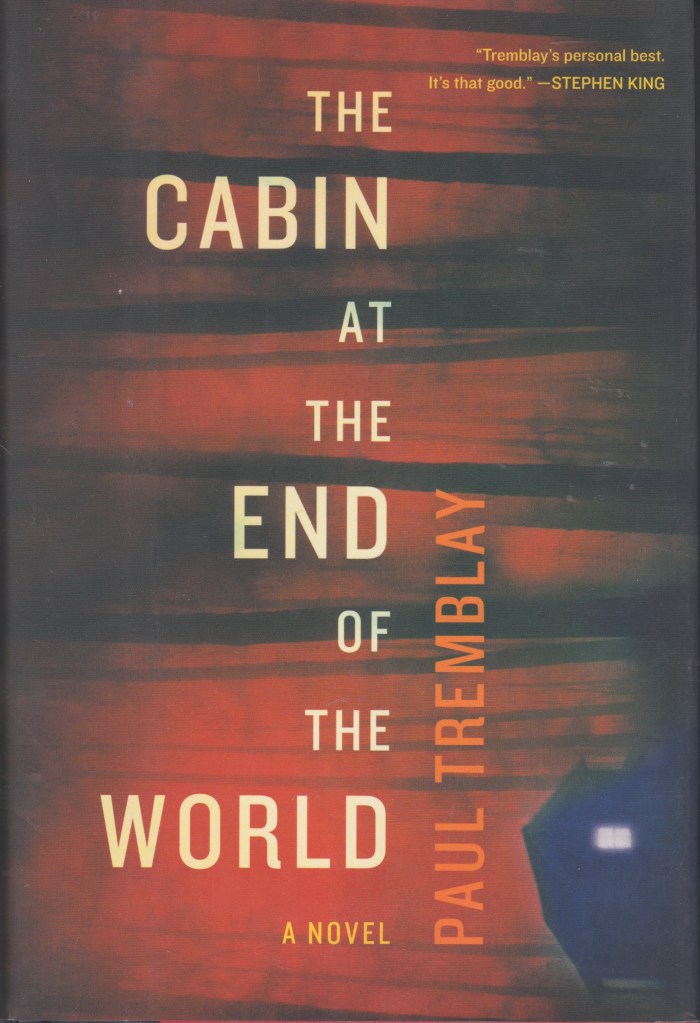
After finishing The Coyotes of Carthage, I was looking through the TBR piles, pulled out a book or two before putting them back, and then finally decided to read a second Tremblay, The Cabin at the End of the World.

It was a most excellent choice.

The girl with the dark hair walks down the wooden front stairs and lowers herself into the yellowing lagoon of ankle-high grass. A warm breeze ripples through the blades, leaves and crab-like petals of clover flowers. She studies the front yard, watching for the twitchy, mechanical motion and frantic jumps of grasshoppers. The glass jar cradled against her chest smells faintly of grape jelly and is sticky on the inside. She unscrews the aerated lid.

Wen promised Daddy Andrew she would release the grasshoppers before they got cooked inside the homemade terrarium. The grasshoppes will be okay because she’ll make sure to keep the jar out of direct sunlight. She worries, though,, that they could hurt themselves by jumping into the sharp edges of the lid’s punched-in holes. She’ll catch smaller grasshoppers, ones that don’t jump as high or as powerfully, and because of their compact size there will be more leg-stretching room inside the jar. She will talk to the grasshoppers in a low, soothing voice, and hopefully they will be less likely to panic and mash themselves against the dangerous metal stalactites. Satisfied with her updated plan, she pulls up a fistful of grass, roots and all, leaving a pockmark in the front yard’s sea of green and yellow. She carefully deposits and arranges the grass in the jar, then wipes her hans on her gray Wonder Woman T-shirt.

Ironically, in my earlier paragraphs I talked about writing crime because I want my monsters to be human; ironically, the monsters in Paul Tremblay’s latest, sublime entry into the horror genre could easily be considered a crime thriller as well because his monsters are all too human, and this set-up is just as terrifying as any supernatural horror novel I’ve ever read. Being out in the country has never really appealed to me very much (ironically, my current work-in-progress is set out in the country) precisely because it’s no safer out in the country than it is in the city; at least in the city someone will hear your screams or cries for help. The very isolation of the country is part of its terror for me; in no less part because country people always smugly assert (and reassure themselves) that crime and murder are MUCH more likely to happen in the big, bad, dangerous city.

Sidebar: I still think there’s a terrific essay to be written about the proliferation of rural horror/crime novels in the 1970’s, directly tied to the inherent racism of white flight from integrated schools and neighborhoods to the suburbs and the country, and perhaps someday I will have the confidence to write the essay based on that abstract theme.

Tremblay has set his terrifying tale in a small cabin on a lake in upstate New Hampshire, close to the Canadian border, where our heroes–a married gay couple (Andrew and Eric) are spending a ‘back-to-nature’ vacation with their adopted child, Wen. The story is told in the present tense (always creepier in horror, seeing the action unfold as it happens rather than in the much safer past tense–it’s happening as opposed to it’s already happened) and the point of view shifts between the two dads and their young daughter. Wen is out on the lawn catching grasshoppers and naming them when a big man appears suddenly out of the woods, friendly and nice, he tries to win her over but ultimately fails, sending her running inside to warn her daddies that they are no longer alone in their rustic cabin–with no cell service and no wi-fi (which, ironically, was part of the cabin’s original appeal–to unplug; that appeal will righteously bite the in their ass now that a Dionysian influence has arrived in their idyllic world).

The big man, Leonard, isn’t alone; he has three friends with him, all wearing similar button-down shirts in different colors and jeans: Redmond, kind of an asshole every-straight-man; Sabrina, a nurse; and Adriane, who is older. As the three family members barricade themselves into the cabin, the four seemingly normal visitors let them know they are there to present them with a horrible, horrific choice: they have seen, in visions and dreams, that the apocalypse is nigh, but have been shown the cabin and the small family, and told that if one of them will voluntarily sacrifice himself, the end of the world will be stopped.

This is, of course, every parent’s worst nightmare: a threat to not only their family but to their child, and Tremblay does an amazing job of letting us, the readers, get to know all three of the family members, developing them into complicated, realistic characters with backstories and levels and layers; I also applaud him for writing about a same-sex family and making the characters absolutely real. (This is how you do it, people; read the book and take notes). Wen is completely believable as a little girl; the family bond and love is absolutely real; and that makes the horror even more horrible, more horrifying, more of a gut-punch…as we go through every step of the process with them, all over the course of less than twenty-four hours, as their lives are irrevocably altered and changed, as they refuse to believe the story of their visitors, but slowly but surely the wonder begins to creep in…what if this is absolutely real and they are indeed messengers from God?

I will leave it to the horror academics to discuss the symbols and symbolism threaded throughout the story–but I have to bring up the colors of the shirts the visitors are wearing, and the fact there are four of them: representing the four horsemen of the apocalypse along with their warnings of doom. The questions of faith, of existing as gay in a heterosexist society, of family and love–all of these are beautifully explored and written about, and the building of tension and suspense is unparalleled; it’s really hard to put the book down and walk away from the story without finding out how it all ends–will they make the sacrifice, or will the world end? Are the visitors right–and how will anyone ever know if they were, because the world not ending doesn’t prove anything if the sacrifice occurs.

Or are they just insane?

I highly recommend this book, and cannot wait to read more Tremblay.

Invisible String

Labor Day morning, and I feel rested. I’ve not felt this good in quite some time, frankly–I am sure ignoring my emails and staying away from social media over the course of the long weekend has something to do with that, indubitably–and now I am having my morning coffee and slowly coming alive. May as well enjoy it while I can, since tomorrow I have to get up unbearably early, but we only have one clinic day this week and it’s also a four-day work week, so maybe it won’t be so bad on my physically.

I worked on the book for a little while yesterday; not very much, not nearly as much writing as needed to be done over the long weekend–which is inevitably always the lament, is it not? But getting rest–both physical and mental–is also inevitably necessary and a necessity. I did manage to not only finish reading Little Fires Everywhere over the course of the weekend, but I also finished The Coyotes of Carthage (which will be getting its own entry eventually) and started reading Paul Tremblay’s The Cabin at the End of the World, which is not only extraordinary but nothing like I was expecting–and I was also going in blind, knowing nothing about the book other than I had read his earlier novel A Head Full of Ghosts and really enjoyed it. It features and centers, for example, a happily married gay couple and their adopted child; didn’t see or expect that coming. I’m about halfway through the book, and while I certainly don’t want to give anything away, I am already planning on spending some more time with it today. Reading is such an escape (always has been) and a pleasure for me my entire life; I never really understand what it’s like for people who don’t read, or who don’t like to read–its so outside of my own experience I’m not sure I could ever understand choosing not to read.

The work I did on the book yesterday, while not a lot, was also quite good work, and I am certain that the rising quality of this novel I am writing has everything to do with the high quality of what I am reading these days. I mean, between Matt Ruff, Celeste Ng, Steven Wright, and Paul Tremblay, one really cannot go wrong, can one? I’ve also come to understand that my deadlines–while arbitrarily set–are also set up to maximize time, and are also predicated on the idea that I can actually have the energy–both physical and creative–to do good work every day. I’m not sure that I can anymore–not sure that I ever could–but the mindset is the key, and I know after seeing clients for eight hours, I really don’t have the bandwidth to write anymore the way I used to; which inevitably, I am sure, has something to do with the malaise this current world in which we live has created. Malaise is probably not the right word; depression is probably closer to what I really mean–there’s this weird depressive thing going on in my subconscious that makes macro issues I would ordinarily blow off or ignore or brush off much more micro and much more draining on me.

So, what is a writer to do in these days? Self-care, as I have noted before, is more important than ever. I am going to use the massage roller this morning, and possibly do some stretching exercises as I get ready to face this day–I intend to write today; it’s been lovely dipping my toe into it most of the weekend but I really need to dive into the pool today–and I’d also like to get some more cleaning done at some point. There are electronic files to sort as well, and filing to be done; floors to be cleaned and laundry to fold; all the endless minutiae I always intend to keep up with as I go but inevitably push the back of the priority list and do nothing about until they reach a point like the one they are at now: a literal mess that requires more focused work than ordinarily they would. And while my energies are frequently scattered…I have found that the binge reading I’ve been doing has done a lot to create a sort of inner peace that I’ve been missing lately. I also think I’ve sort of been in mourning about the loss of football season–yes, I know they are going to try to have a season, but it’s not a real season and thus not the same thing; this will be the first year since 2010 that Paul and I have not gone to at least one game in Tiger Stadium–but at the same time, that has also freed up my weekends. My goal for this week is to read a short story a day, as well as a chapter or two per day of whatever book I am currently reading–I suspect I may finish the Tremblay today, it’s that good and that unputdownable–as well as to do some stretches every morning after I get up and before I take my shower. I think regimenting my days into a sort of routine–since I clearly love routines when I can manage to stick to them–is perhaps the smartest way to go.

We watched the new episode of The Vow last night, and it’s getting more and more chilling the deeper into the series we go; I’m glad it’s currently not binge-able, because watching one episode per week makes it more easily digestible. They are doing a most excellent job as well of showing how attractive NXIVM was; a lot of the things they talk about, when it comes to taking responsibility for yourself and changing your mentality and behavior to become more successful, sounds like practical advice you can apply to improve your life–but there’s certainly a dark side to the whole thing. Last night’s episode, which brought up the branding and master/slave “sorority” within the organization, was positively chilling.

We also started watching the new Ridley Scott series for HBO MAX, Raised by Wolves, which is extraordinary. We watched all three episodes that were made available immediately, and it’s quite an accomplishment; it looks very expensive, with no expense spared on production design and special effects. The story itself is also interesting, if a bit hard to understand to begin with; it’s set in 2145, and Earth has been ravaged to the point of becoming unlivable because of a religious war, between Mithraic religion (worship of the sun) and atheists. Since Earth was becoming uninhabitable, both sides launched space ships to another Earth-like planet to save humanity; and it gets a lot more complicated from there. It’s a very high-concept show, and I am curious to see how it all plays out going forward. If you’re a science fiction fan, I’d recommend it; I don’t know if people who generally don’t watch sci-fi would like it as much–I could be wrong. I would have never guessed, for example, that Game of Thrones would have become the cultural phenomenon that it was.

And I still haven’t decided what short stories to focus on writing, although I am leaning towards “After the Party”, “The Flagellants”, “Waking the Saints”, “Please Die Soon,” and “He Didn’t Kill Her.”

And on that note, tis back into the spice mines with me.

Starlight

And so now it’s Sunday.

I won’t lie; I’ve lost my sense of time and date and day already this weekend and I’m perfectly fine with it. I hope everyone who has the good fortune to have the weekend off–I know there are many who do not–are in the same state of what day is this that I found myself in most of yesterday and when i woke up this morning–I overslept again, which was amazingly lovely, but i really need to stop indulging myself this way–and am now awake, on my first cup of coffee, and ready to get shit done today. I did get shit done yesterday–I cleaned and organized quite a bit (not enough, it’s never enough) and while I do have some little bit of cleaning and a lot of organizing left to get done, at least I made a start on it yesterday. My desk, for example, this morning is clean and clear; which will make writing later much easier.

I finished Little Fires Everywhere yesterday–I blogged about it already, so I won’t repeat anything other than that it’s a fantastic book I encourage you all to read–and started reading The Coyotes of Carthage, which was originally recommended to me by my friend Laura, who was lucky enough to receive an advance copy. It, too, is fantastic and unlike anything I’ve ever read before, and I am really looking forward to getting more into it–I will undoubtedly take a reading break or two at some point today. It seems to be a political thriller about dark money and political consultants in a very rural county in South Carolina, with a Black male protagonist, so I am sure it’s going to be quite interesting to read.

But I really also need to write today; I’ve not looked at the manuscript since last weekend, and this “only writing on the weekends for one day” simply cannot continue to stand, really. I have too much to write, and I need to stop giving into the laziness or the tiredness or self-destructive patterns or whatever the hell it is that keeps me from finishing this damned book. Heavy sigh. I also have any number of short stories I need to wade through to pick out some to work on for submission calls.

Again, I think there’s something to that I am so overwhelmed believing I’ll never get everything done so why bother doing any of it thing.

Repeat after me: SELF-DEFEATING.

While I waited for Paul to finish working on a grant last night I watched, or rather, rewatched (although I didn’t really remember watching it before, and I figured, meh, if I’ve already seen it I can do stuff on my iPad while it’s on in the background) a documentary called Master of Dark Shadows, about Dan Curtis and how the show came about, and its legacy (I’m sure most people don’t remember Curtis also produced and directed the mini-series based on Herman Wouk’s novels The Winds of War and War and Remembrance). I was one of those kids who watched Dark Shadows only in the summertime, because my elementary school didn’t get out until 3:15; even though we lived only a block away from the school I couldn’t ever get home fast enough to watch even the end. I did love Dark Shadows–our sitter/caregiver, Mrs. Harris, also watched One Life to Live and General Hospital, which were my first exposures to soaps–and it always stuck in my mind; I always give it credit for my interest in horror and the supernatural. I enjoyed watching the documentary (and for the record, I loved the NBC reboot of the series in prime time in the early 1990’s, and was crushed when it was canceled; I rewatched it with Paul and he too was disappointed it ended on its cliff-hanger) and then we started watching a documentary about a double murder in India called Behind Closed Doors, in which the investigation was so incredibly fucked up–I mean, if the primary take-away from all the other true crime documentaries we’ve been watching has been man is our system seriously fucked up, the takeaway from this one is yeah, but ours is clearly better than others.

Which is kind of scary, really.

While I was also bored yesterday waiting for Paul–and only really sort of watching Master of Dark Shadows–I was right, I’d seen it before–I started looking things up on-line; which was an absolutely lovely example of how one can fall into a wormhole on the Internet. As you know, I’ve been having this Cynical 70’s Film Festival, and thinking about the rise, and proliferation of, conspiracy theories in that suspicious, paranoid decade, and one that I hadn’t remembered until yesterday sprang up into my min, completely unbidden, while I was reading about the Bermuda Triangle: Chariots of the Gods? by Erich von Daniken. Does anyone else remember von Daniken and his theories, which were based in nothing scientific or archaeological? Von Daniken believed that ancient texts–the Bible, the Code of Hammurabi, etc.–all contained evidence that in Ancient Times the Earth was visited by space aliens–Alien Astronauts, as he called them–who brought knowledge and information with them to the primitive creatures of our planet at the time, and also assisted them in the massive building projects that modern man cannot conceive of them building back then–the pyramids, for one thing, and the lines on the plains of Nazca (which I first read about in the Nancy Drew volume The Clue in the Crossword Cipher)–and those aliens with their vastly superior technology, were seen as gods by the primitives and those visits have come down to us in the form of mythology. It’s an interesting idea for sure–but it was all conjecture, with no proof. I read all of von Daniken’s books back in the day; others included The Gold of the Gods, and were simply further conjectures, but he developed quite a following, and set the stage for what is called the pseudo-science of Graham Hancock, his modern day successor. (I’ve also read some of Hancock’s work; his theory that the Sphinx is far older than we suspect based on water wear on its base is interesting, as is his other theory that the Ark of the Covenant’s final resting place is in Ethiopia; before reading that book I had no idea that Christianity was so firmly entrenched there) So, I spent some time looking up von Daniken’s theories yesterday, as well as some other conspiracy theories of the time–I also did a deep dive into the entire Holy Grail Holy Blood thing which provided the basis for The Da Vinci Code and Dan Brown’s entire career; and of course we certainly cannot forget the apocryphal writings of Hal Lindsay and The Late Great Planet Earth–which, really, is where The Omen came from; we forget how “end times” theory truly began flourishing in the 1970’s.

I’ve always been interested in stories about lost books of the Bible, or lost Biblical theory, along with the end-times prophecies Lindsay wrote about; Irving Wallace’s The Word, which was built around the rediscovery of a lost testament of Jesus which would revolutionize and make-over the Christian theology was one of the first novels of this type I read; it was also made into a mini-series, which made me aware of it in the first place (Irving Wallace isn’t really remembered much today, but he was a huge bestseller back in the day, and he wrote incredibly thick novels, mostly about international conspiracies or legal issues–The Seven Minutes, for example, was about censorship and “blue laws”; The Second Lady was about a Soviet conspiracy to replace the First Lady with a lookalike imposter who was a Soviet spy; The Prize was about the machinations around how the Nobel Prize was given out; etc etc etc). The Da Vinci Code fits clearly into this category, as does The Gemini Contenders by Robert Ludlum and The Fourth Secret by Steve Berry (which is about the fourth secret Our Lady of Lourdes–or was it Fatima?–revealed to either Bernadette or the peasant children; Irving Wallace also covered this in The Miracle); Raiders of the Lost Ark and Indiana Jones and the Last Crusade also kind of fit here, as both films are about the search for Biblical relics. I’ve always, always, wanted to write one of these. Years ago I had the idea for one, in which there was a secret document or testament hidden in the Hagia Sophia in Constantinople for years, and that part of the reason the 4th Crusade sacked the city was the Pope’s desire to get his hands on those documents, which were thus smuggled out of the city by the Patriarch and lost forever…this is the idea I always come around to for a Colin stand-alone (I also realize I could do Colin stand-alones set at various times throughout the last twenty years or so of Scotty books, as he is gone a lot of the time on missions), and the working title for it always is Star of Irene, because the Byzantine Empress Irene–contemporary of Charlemagne–has always fascinated me.

But I will never write a Colin stand-alone, or series, unless I get this fucking book finished, so I suppose it’s time for me to head back into the spice mines.

Have a lovely Sunday, Constant Reader.

Picture to Burn

Thursday, Thursday, is today’s child full of woe? I used to know that rhyme when I was younger–one of those things that would pop out of my mouth and brain every now and then when I wasn’t expecting it to–and now I cannot seem to summon it from the depths of my memories. I think it was Tuesday’s child, anyway; was Thursday’s child full of grace or something like that? Possible, I suppose.

Another good night’s sleep was had yesterday evening, which is lovely. I have to go into the office today and run errands on the way in.  I’m just glad to be feeling more rested, to be honest, and then tomorrow is a work-at-home day, and then I slide into the three day weekend, which is kind of nice. I hope to finish reading  Little Fires Everywhere this weekend, start reading The Coyotes of Carthage, and perhaps dip my eyes back into the Short Story Project–I have Sara Paretsky’s short story collection glaring at me from the end table as well as the new Lawrence Block anthology, and so many others I’ve not finished reading–and of course, I want to get a lot of writing done. I want to spend some time on Bury Me in Shadows, as well as maybe get some short story writing done, which would be lovely.

One can certainly hope, can’t one?

But I’ve also learned my lesson about over-planning for the weekend; I know I need to just make a list of things to do that need to be done and not overly pressure myself to get it all done over the course of the long weekend, while recognizing that I also need to recharge my batteries and I also need to do some cleaning; perhaps even work on that damned file cabinet which I never finished working on.

Yesterday’s Cynical 70’s Film Festival choice wound up being nothing I was considering. Instead, I choose to rewatch The Exorcist, which I’ve never seen other than the “edited for television” version. The Exorcist was a phenomenon at the time, and most people still, to this day, consider it the scariest film they’ve ever seen and it regularly pops up on lists of best horror films ever made. I read the book at the height of its popularity, when I was in junior high school, and while it didn’t precisely scare me, it was lurid–we all read it for the lurid parts, like the crucifix masturbation scene and so forth; there was something sacrilegious about reading it, like actually reading it was an act of subversion. The film broke all box office records of the time and was nominated for a lot of Oscars, and the soundtrack–Mike Oldfield’s “Tubular Bells”–always brings up mental associations with the film. It was the first outright horror film to get that many Oscar nominations, or to be nominated for any, really, other than Rosemary’s Baby, which wasn’t nominated for a lot; William Friedkin, fresh off his Oscar winning outing with The French Connection–which is also on my list–directed it. A more traditional entertainment, The Sting, wound up sweeping the Oscars that year. A few years ago, I reread the book to see how well it held up, and as an adult who is also now a writer and has been a reviewer, and has read thousands of other books in the interim, I can say it doesn’t hold up well at all–it really isn’t all that scary, either; it was a product of its time and it might not even get published were it written today. The characters were very cardboard and one-dimensional and behaved in ways that made no sense whatsoever; the focus was on the sacrilege, really, and the shock. I wondered if that would be true of the movie, as well, in its unedited version.

The acting was fine, really; Ellen Burstyn is never bad in anything, and Linda Blair was also fine; but the truth is the direction of the film doesn’t really develop the characters enough to make the viewer empathize with them, or identify with them. The scares weren’t as scary as they were; it’s hard to be scared when you know something is coming and you’ve already seen it, after all; part of the thrill of a horror film is not knowing when the scares are coming, so rewatches never have quite the same effect. I watched this time in a more analytic way, rather than as a viewer–but while others I’d seen before–Aliens comes to mind–really hold up incredibly well, The Exorcist doesn’t; I don’t feel like I got to know enough about Chris MacNeil or Father Karras enough to care about either one of them; and I found that I had more questions about them and who they were than I did when I viewed it as simply an entertainment. I think had the film been filmed more intimately, rather than from a cold distance, it would have held up a lot more; I don’t know, I am neither a filmmaker or a critic. But it didn’t trigger much of a reaction in me, and that’s rather telling. I think the problem, from a story-telling point of view, is that it couldn’t make up its mind whether it was about the MacNeils or Father Karras; although the title would tend to make you think the focus was on Father Karras; it should have been titled The Exorcism, really, and that, I think, was the end problem result for me: the book and film were really about Father Karras and his struggle with his faith, but only touched on that issue glancingly; because it also wanted to focus on how dismissive we are of spiritual issues in our modern scientific world, and wanted to show how an atheist, irreligious woman would try to get her child scientific treatment and slowly come around to the idea that in the modern world, something rooted in past superstition was the issue. Both are great stories, but for me, it failed in trying to tell both and wound up just skittering across the surface like a needle on a warped vinyl record.

Ultimately, though, The Exorcist–both book and film–are important works in both disciplines; along with Rosemary’s Baby, ushered in the 1970’s revival and rejuvenation of horror, in both film and literature, and that influence cannot be denied. Without either of those books, would Carrie have been published, or Peter Straub’s first horror novel? It was The Exorcist, after all, that first really introduced me to horror.

And I absolutely loved the television series inspired by it.

And on that note, tis time for me to return to ye old mines of spice. Have a lovely day, Constant Reader, and I’ll catch you again tomorrow.

IMG_4201

This Is Me Trying

And so here we are, sliding into Wednesday like we’re stealing third base.

I just realized yesterday morning that this coming Monday is Labor Day. A three day weekend! Huzzah! And one that I completely forgot about until Facebook memories reminded me about past Southern Decadence weekends, which are always Labor Day weekend–except for this year, of course.

Maybe, at some point this weekend, I’ll curl up with Frank Perez and Howard Philips Smith’s definitive history of the event, Southern Decadence in New Orleans. You should really consider getting a copy–and while you’re at it, you could get the e-book of Bourbon Street Blues, which is set during Southern Decadence. It’s so weird not having Decadence this year–this year has really sucked for everyone. I feel bad for the few people who are having a good year in some way, because the massive suckage has ruined everything–which really makes celebrating those successes all the more important for the rest of us, to claim a small victory over this shitty year whenever we can.

In my sad, almost desperate attempt to find something good in this year, I realized that, failing everything else, I’ve read some amazing books this year; have watched some excellent television shows; and the pandemic work-at-home-making-condom-packs has also enabled me to watch a lot of films I’ve never seen, which has also been not only educational but interesting. The Cynical 70’s Film Festival, for example, has been pretty awesome, and has reminded me a lot of what it was like growing up in that decade of earth tones and mood rings and disco balls and bell bottoms–just yesterday at the office between clients some of the kids and I–I wasn’t the one who brought it up either–started talking about the Bermuda Triangle, which was a thing in in the 1970’s (this was triggered by the storm system heading up the Atlantic coast, which startled both of my co-workers, who’d always thought Bermuda was in the Caribbean–I laughed and said, yes, I’d always thought the same until I read The Deep and this led into an entire discussion of Bermuda’s geographic location which led, as free form conversations tend to do, a lot of jumping around on the topic of Bermuda, which led to the Bermuda Triangle). It wasn’t a real thing, after all; just another one of the many weird conspiracies and so forth that existed and proliferated in that crazy decade–although Area 54 and UFO’s seem to be turning out to be an actual thing (both of which were very popular topics of discussion and wonder in the 1970’s–hence Close Encounters of the Third Kind).

Maybe I should look into the Bermuda Triangle. Hmmmm.

Last night the Insomnia Curse was broken and I slept like the dead. I woke up at five, looked at my alarm, and rolled over and went back to sleep. My alarm–which I hadn’t set–went off  at seven this morning (maybe I dreamed it; it was set for six from the last two mornings) and so I was able to shut it off and sleep a bit more. I feel marvelously rested and awake this morning (despite the Internet outage; I am freeloading off the Cox Wi-fi–which I don’t understand; I have access to this as a Cox customer, but my home wireless is out; how can one work without the other? I don’t know and I don’t want to hurt my brain by trying to figure it out). Anyway, according to the Cox website our home wireless should be back up by around 1:30, so I am okay with using this until such time as ours comes back up. It’s okay; there’s any amount of on-line work stuff I can do until the wireless comes back up and I can stream movies whilst making condom packs again–today’s choices range from Bonnie and Clyde (technically a late 1960’s movie, but it was one of the films that signaled the change in Hollywood film), All the President’s Men, and Klute–but I am always amazed at how helpless we’ve become without the Internet or access to it, you know?

I was extremely tired last evening when I got home from the office; I was tired a lot during the day, but kept having these weird spurts of energy, and even had one after i got home from work. I sat down in the easy chair after doing the dishes and unpacking my backpack and rewatched this week’s episode of The Vow, which I kept dozing off while trying to watch on Monday night. It’s a very interesting show–cults have always been of interest to me (the 1970’s, by the way, was a big time for them) and I have always kind of wanted to write about one. When we were living in Kansas, there was actually a local one; the Way. There had used to be two colleges in Emporia, the county seat: Kansas State Teachers College (which evolved into Emporia Kansas State College and finally to what it is now, Emporia State University) and the College of Emporia. C of E was a religious school; Presbyterian, to be exact, but it had gone bankrupt and closed down in or around 1973, after which the campus was purchased by the Way International–which was a cult. When we first moved to Lyon County, since my sister and I were both teenagers, everyone warned us about the Way College of Emporia and to be careful. The members were easy to identify, really; for one thing, they always traveled in pairs, wore Polo-style shirts with name tags identifying them as members of the Way International, and they also wore khaki style pants. They also were always smiling and had a glazed look to their eyes. There were also all kinds of rumors about what went on at the campus; armed guards–and I remember seeing them–patrolled the grounds and the boundaries, keeping the curious away; and of course there were always stories about weird bonfires and ceremonies being seen from a distance, and “this guy I know is friends with a cop and they always get calls from the people who live around the campus about dogs disappearing and hearing screams from the campus and…” you know the type of thing; the story that has grown exponentially from what was originally said so you aren’t really sure what the kernel of truth in the story actually was; I actually have a file folder labeled The Cult in my file cabinet with some research I did about the Way International over the years, with an eye to writing a novel about it some day. (Obviously, The Cult is too obvious a title to actually use for such a book)

Who knew Kansas in the 1970’s was such a gold mine of material for a writer?

I’ve also been researching Chlorine while being too tired to focus on either reading or writing anything–I am definitely itching to get back to Little Fires Everywhere, and when I finish working today I am going to get Chapter Seven of Bury Me in Shadows whipped into shape for sure–and there’s such a glorious wealth of material about the closeted stars and closeted Hollywood of the time; I am kind of surprised no one has done a noir about underground gay Hollywood of the time already. (Of course, now that I’ve said that, there will probably be eighty-five million of them before I get this damned thing done) It was such an interesting period–obviously, there are biographies of the gay stars of the time (Rock Hudson, Montgomery Clift, Anthony Perkins, etc.) and there’s even a biography of Henry Willson, the gay agent played by Jim Parsons in Ryan Murphy’s Hollywood, who represented all the beefcakes male stars of the time–but I am also interested in the ones who never quite made it as movie stars, either, and the clients of Willson who were beefcakes but not gay–like Guy Madison, who was certainly gorgeous and hunky and eventually had a hit TV show. I bet their stories are just as interesting as Rock Hudson’s and the other big closeted stars.

And on that note, tis back to the spice mines with me. Have a lovely Wednesday, everyone.

IMG_4209