And here we are on Monday again, with the dark not yet fading as the sun rises over the horizon. This is an abbreviated work week for me, as I have undoubtedly mentioned (essentially daily for over a week; one would get the impression I like when I don’t to report for the day job or something) before. I was quite pleased with how the weekend turned out; I was a bit pressed going into it because there was so much to do and get done, and while I of course didn’t get everything finished that I wanted to (do I ever?) I managed to get quite a bit done. The proofs of the manuscript and the cover for Bury Me in Shadows are now completed and out of my hair; I got the writing for my friends’ website finished, and if the Lost Apartment isn’t as neat, tidy and organized as perhaps I might want, so be it.
I mean, I am always going to have more things to do, no matter how hard I work to get caught up.
Yesterday I didn’t work on Chlorine–at least there’s no word count to show for the day, at any rate. I was thinking about Chapter Four and how to actually write it, but decided that where my mind was going as far as it was concerned, was the wrong direction–and if I were to follow the direction my mind was going, I’d end up writing a bunch of stuff I wouldn’t be able to use in the long run, so I decided that since my mind was going in a direction I didn’t like nor wanted my story to go, I wasn’t going to waste any time or energy trying to make it work, make it right, or do anything with it. I did type up “A Midnight Train Going Anywhere” and soon realized the amorphous idea I had/have for it, wasn’t really going anywhere–it needs more thought, and it needs more of a plan for a story rather then just keep writing and hope something shakes out there as I write. So off into the drawer it goes, until I have a better idea about how to write a train crime story set in the days before Amtrak and while there was whistle stop service at all those little towns spread across the Kansas prairie. But that opening scene I wrote–the base idea I had for it–is still pretty amazing.
And yes, the tiny little town the train stops in is where my main character in Chlorine is from.
We started watching the second season of Ted Lasso last night and while the first two episodes were, while quite good and entertaining, not quite at the level of heartwarming and funny I’d come to expect, it was in episode three that I got that old Ted Lasso feeling again–the kind where the show makes you laugh but also gets you in the feels, too. As Paul said, “it always makes me tear up, which is weird for a comedy, isn’t it?” and I replied, “That’s why we enjoy it so much–because it touches us while it makes us laugh.” had wanted to wait until there were more episodes to enjoy, but alas, we couldn’t put the show off any longer but now have to wait until every Friday for a new one, more’s the pity. But I will say Apple Plus is going a great job with its shows–this and The Morning Show alone are worth the monthly subscription, as well as Physical and I cannot wait for Foundation to finally drop, either. Yes, we have too many streaming services, most likely–but on almost all of them there’s something we love so much that we can’t really drop it.
My God, I have so much to do it’s not even funny.
And on that note, I am heading into the spice mines. Have a fabulous Monday, Constant Reader, and I will check in with you again, as always, tomorrow.
Saturday and there’s a lot to get done for me today. What else is new? I slept very well last night, which was as marvelous as I could have hoped; I feel rested and relaxed this morning, despite everything I have to get finished today; it just seems more tiresome than it actually is, if I am going to be completely honest. Time-consuming, more than anything else. Paul has his trainer and then is going to the office for the afternoon, so the coast will be clear around here for me to get as much done as I would like. I replaced my bluetooth speaker system yesterday–it wasn’t playing nice with my new phone for some reason (for that matter, neither is the car’s stereo, but I’ve managed to work around it somehow) and so I can once again listen to music while cleaning the house, which is also very necessary this morning. We also made a Costco trip yesterday after work, and I spent a good portion of my evening rearranging thing so I could get everything put away at long last. I have to run get the mail later, and pick up a few things– a very few things–at the grocery store, so here’s hoping venturing out into the heat won’t strip me of any and all desire to get things done, the way it usually does.
We watched the latest episode of American Horrror Stories–this past week’s episode was a little lower in quality that the preceding ones, but over all, we are enjoying the show. Since each episode is self-contained, they don’t really have the time or opportunity or space to go off the rails the way every episode of American Horror Story inevitably does (not every season, but most of them), and the ones thus far have been pretty enjoyable. Like I said, last night’s didn’t do much for me, but it was an interesting concept and I’ll give them props for it. This series digs into the underlying morality that most horror stories buy into; the moralistic trope that bad people will inevitably punished for their crimes, even if it takes a supernatural force to do it. The show is a throwback to The Twilight Zone, The Outer Limits, and Alfred Hitchcock Presents–all of which had a far greater influence on my short story writing than I probably recognize (also, the old horror comics like House of Mystery and The Witching Hour).
I also would like to finish reading The Other Black Girl this weekend, especially now that I have The Turnout by Megan Abbott in my TBR Pile. I am literally itching to get to it; it feels like I’ve been waiting for a new Megan Abbott novel forever–of course, the weird pandemic time thing hasn’t helped in that regard in the least–and there are so many other books I need to get to….*sobs in despair at ever finishing everything*.
And of course, the kitchen and the area around my work-space are a complete disaster area. So I think this morning after I finish this and as I continue to swill coffee, I am going to do some busy work around the kitchen/work space area; and who knows–I may even get organized. PERISH THE THOUGHT. #madness. But I want to get a lot accomplished today so I can get to the gym tomorrow as well as finish writing Chapter Four of Chlorine, and maybe even start writing Chapter Five. I know, crazy, right? I haven’t written hardly anything this past week, which is gnawing at my conscience–but so much was going on this past week I literally felt completely drained when writing time rolled around every day–and I was even too worn down to get to the gym again last week. (So it will be one full week tomorrow when I roll into the gym since the last time I was there–or am I just remembering wrong? My memory is something that simply cannot be trusted anymore…so I am going to say no, I haven’t been to the gym since last Sunday and feel confident that it’s factually true) Shameful. I am going to be doing something new this week; two days of upper body and one day of lower body. Tomorrow will be upper; Tuesday or Wednesday will be lower, and then Thursday or Friday will be upper again. The next step, after a few months of this, is to divide my workouts into even more concentrated body parts: chest and back; arms and shoulders; legs. And if I stick to it–eventually adding the great joy of cardio to it, I should get back into fairly decent shape sooner rather than later.
We shall see, I suppose.
The Olympics conclude this weekend…but I’ve not really been paying much attention to them these last few days; the sports I enjoy watching are already over, and while I enjoy watching track somewhat, at the same time I’m not as vested in it as I am in its water version, swimming. As such, we also watched the Vince Vaughn horror-comedy reboot of Freaky Friday, Freaky, which, while fun, wasn’t as fun as it could have been. I appreciated that Millie’s best friends included an out gay boy–diversity; you can rarely go wrong by including it, and I also am looking forward to the rapidly approaching day where diversity in film and television is so commonplace it doesn’t merit mentioning anymore–and Vince Vaughn was hilarious once their souls had switched bodies (I don’t much care for his politics, but Vaughn is a great comedic actor), but they didn’t lean into it as much as I would have thought–it was one of the movie’s strengths, and there’s a great scene between Vaughn-as-Millie and the boy she has a crush on–but it inevitably ended up being a trifle disappointing and with me thinking about wasted opportunities.
It’s almost like, with all the blockbusters and super-hero movies, Hollywood has forgotten how to make other kinds of pictures.
As I’ve mentioned on social media lately, I am really enjoying writing Chlorine, which is yet another reason having things to do that aren’t writing annoys me so much. I really feel like I’ve found Logan’s voice, and it came to me organically; I wrote my way into his voice rather than trying to determine what it was and trying to write it that way, which of course was a big concern for me. Voice is, to me at any rate, very crucial when it comes to writing; the reader has to feel some connection with the character, and that comes from Voice, really; the reader connects with the character and that starts rooting for him. It’s very important for me to not have Logan bemoan any of the situations he’s in–gay man in a homophobic society, culture, and industry–but rather cynically accept them as his reality, but that reality he accepts is why he doesn’t behave in what could be considered a “moral” way; his life is immoral, so he doesn’t feel bound by the same societal and cultural norms about behavior that others might–as he says in chapter two, “Everything in Hollywood is a lie.” (In fact, just talking and thinking about the book makes me want to finish this and work on it a bit; yes, I actually want to write, can you believe it? That has to be some kind of miracle, and also says something about how committed I am to this book.)
And on that note–if I want to get back to Chlorine, I have all this other stuff I need to get done first, so it’s best that I head into those spice mines and get started. Happy Saturday, Constant Reader!
New Orleans Bouchercon was canceled (well, postponed until 2025, at least) yesterday; it was inevitable, I suppose, but it was still a let down. I kind of feel like Charlie Brown trying to kick the field goal with Lucy holding the football–so so close–but it was the right decision, if a difficult one. As someone who has worked on more than his fair share of events, I am very well aware of how hard it is to keep all the plates spinning and how much work it is and even as someone who occasionally derives a perverted, sick sense of pleasure from organizing events from time to time…canceling an event is always a hard call, always heartbreaking, and always an enormous disappointment. Watching all that work circle the drain is overwhelming…as I well know. I watched it happen with the Tennessee Williams Festival and the Edgars in 2020; for 2021 both were planned as virtual from the very beginning–which wasn’t the same, but was still lovely. I have also decided to keep the requested time off–it’s not quite a week, one day short, really–yet I think it will be absolutely lovely to have that time to get things done, get caught up, read, clean and rest and relax, really.
I was exhausted last night when I got home from the office–although I was able to pick up my copies of Megan Abbott’s The Turnout and Stephen King’s Billy Summers on my way home. (God, I am so far behind on my King reading it’s not even funny; like I said the other day, I may have to simply devote October to trying to catch up on King) We finished watching the second season of Outer Banks, which continued its bonkers ways right up to the very end, setting up season three–which I can only assume will be even more bonkers than the first two–and it really is quite fun. (Although Paul periodically would say, at a particularly bonkers part, they’re just high school students!) But…it’s because the show is so completely bonkers that makes it fun; it’s like a teen version of Dirk Pitt or Indiana Jones; that sort of thing. Just great fun to watch and experience.
Although now we have binged through the entire thing and will have to wait another year for season three… DAMN IT!
Today I am working from home (hello condom packs!) and so got to sleep a little later this morning. Emotionally and physically I feel a bit drained; the rollercoaster of the Bouchercon stuff all over social media and the eventually cancellation absolutely wore me out. It’s weird to realize that it’s actually August already, and the last days of my fifties are slipping through my fingers like quicksilver. Today is the 5th, I believe; which means two weeks from tomorrow is the BIG DAY. I am not overly concerned–although it may seem that way, given how often I bring it up–about turning sixty; the real truth here is that I am more amazed than anything else. I certainly never thought I’d make it this far (and to be fair, there’s still a chance I won’t make it to sixty); when I was a kid I was certain I would die young–and even knew how; I had a recurring nightmare that I would die in a car accident, which is why I loathe driving, try to avoid getting into cars as much as possible, and am always terrified when I am the passenger and someone else is driving. I’ve taught myself coping mechanisms over the years to deal with being in cars (whether driving or riding), amongst which are listening to music I like (the last big drive I took I discovered that books on tape work just as well), and when I am a passenger I very definitely have trained myself not to watch the road or other cars, but to look mostly out the passenger window–and if there are people in the back seat, I always turn and face them when I talk to them. I know it’s irrational–and for fuck’s sake, I’ve made it this far without being killed in a car accident, haven’t I–but it’s one of those weird quirks I have.
There’s also a part of me that thinks that if i ever get over that fear–that’s when it will happen.
It’s probably also why I write so many car accidents into my work.
I am pretty strange, aren’t I? I know I find myself to be fascinating, with all of my weird little quirks and beliefs and fears and superstitions. Stephen King writes about his fears and obsessions and quirks–became a best seller and an icon in the process–so maybe I should have begun my career exploring my fears and obsessions and quirks. I don’t know, sometimes I sit and think about how I probably could have done my career differently, but in all honesty, I am pretty pleased with where I am with it right now. Sure, more money and more acclaim would have been lovely to experience, but those are all surface things; side-effects, really; I’m pretty happy to be able to just write what I want to write and not ever worry about those sorts of things. I’ve seen other writers literally make themselves unhinged worrying about their “legacies” or the lack of success they think they deserve; being gay and writing gay, I guess, eliminated that concern for me, as I knew it was highly unlikely that I would ever achieve either. Sometimes I wonder if holding on to all my papers–correspondences, drafts both corrected and uncorrected–is a vestige of vanity; the whole I need to preserve my papers and find a place to donate them to mentality is one of those things that, when I stop to think about it further and in more depth, turns into what the fuck do I care? No one is going to study my little career in the future anyway.
On the other hand, as was pointed out to me once, my papers and books document gay life in New Orleans before Hurricane Katrina and after; and could prove to be a valuable source of material for future queer scholars studying the gay history of New Orleans. Would simply destroying my papers rather than donating and archiving them be a loss of source material, just as I wonder about all the source material about queer lives in the past being destroyed and not surviving?
And then I laugh at myself for taking me and my career so ridiculously seriously.
After all, thanks to ebooks, my books will live on forever. Are my personal papers really that valuable to any future scholar? Probably not.
And on that note, my condom packs are calling me. Check in with you tomorrow, Constant Reader.
Wednesday and yet another episode of Pay-the-Bills Day; although it’s not going to be as horribly painful as it usually is. I am caught up already–a bit ahead, if you will–of the bills already, so my checking account and paycheck aren’t going to dwindle/disappear the way the usually do on Pay-the-Bills Day, which is a rather marvelous feeling.
It’s gray outside this morning–not sure if it’s rained or simply overcast, but it’s certainly gray out there this morning and there’s condensation all over my windows, so it’s definitely humid, if nothing else. Yay? This is, of course, my last in-office day of this week; and of course that exponentially means my last day to get up this early this week. The next two weeks are short weeks, and then of course is my Bouchercon/vacation week…which is going to be sad more than anything else, really; I’m debating whether or not to keep my hotel room or not. The organization is obviously going to take a massive financial hit with all the cancellations due to the variant outbreak here in New Orleans; but will using one room at the hotel help that much? I am not sure. I am not sure about a lot of things, other than some friends are definitely coming to town for the lengthy weekend for it still, and I do want to see them. It’s really a shame, too. I was really looking forward to it–and seeing everyone for the first time in years (last year’s went virtual; the year before i was sick and couldn’t travel, so I’ve not been since St. Petersburg three years ago)–only to have it literally snatched out of my grasp when I almost had it in my hands. It’s bitterly disappointing, and I feel bad for everyone–the organizers and all their hard work; the volunteers; and everyone who registered and is eating the cost of registration and plane fare. The majority of writers aren’t rich; some barely make enough from writing to cover their expenses for writing and promotion and all of the other things that are part of being a writer.
I also have concerns about what this means long term for the organization to take another such hit this year.
Yesterday was an interesting one to say the least; this entire week has been a strange one thus far. Romancelandia and RWA are on fire again–something about their awards I’ve not followed too closely, but surprise! It has to do with their Inspirational Romance category giving an award to a book that gives a romantic redemption arc to someone who commits genocide (seriously?), and then of course yesterday crime fiction caught on fire as well…it was unfortunate, it was terrible, it was ugly, and it was completely unnecessary. After watching all day between clients and after getting home–when it all seemed to finally die down–all I could think was was this even necessary? It really wasn’t, and a lot of people lashing out at each other and feelings being hurt–things at one point tragically dipped down into the cellar of racism, which was truly appalling–solved absolutely nothing, except exposing several individuals to the entire community as questionable people (in some cases, it wasn’t new information for me but it clearly was for a lot of other people) and all I could think last night, recounting it all to Paul, was what an incredible waste of energy and time and emotion that could have been better utilized organizing the community to try to solve a problem–and how completely unproductive this is.
People gotta people, though, I guess.
The galley proofs for Bury Me in Shadows arrived in my inbox over night, which is lovely; now I get to go over them and try to catch typos, missing or superfluous punctuation and words, etc. etc. etc. I have to admit I am relatively pleased with the book overall (if getting a little sick of it again) but I think I can stand to go through the book one more time–at least this time I don’t have to wince or be concerned about the writing aspects of the story itself. I do hope that people like and enjoy it when they do read it.
And on that note, I am heading into the spice mines. Yesterday delayed me dramatically, and that cannot be yet another day’s story!
I slept better last night than Sunday night; being tired was definitely a big help in that regard. It rained a lot yesterday, which is always Kryptonite when I’m tired; rain just makes me want to get under a blanket and go to sleep (there’s nothing better than sleeping while it’s raining, is there?), which also always makes me a bit on the loopy side for the time it’s raining. Being tired I didn’t get as much done when I got home as I had wanted (quelle surprise)but I did get most of the dishes cleaned up and loaded into the dishwasher, and I did get the mail and make groceries on the way home from the office, so that should count for something, right? I also tried to read when I got home, but my mind was too tired to focus, so yes–it was back to Youtube and history videos for me until Paul got home from the gym and I was able to put on Outer Banks, which is not disappointing at all in its second season. I’m a little bit Olympics-ed out; the shitty coverage and commentators from NBC aren’t exactly lighting up the screen with their amazing work, frankly.
I do rather miss the days when ABC Sports actually operated as a news reporting team; actually doing in-depth coverage as opposed to the “entertainment news” style coverage NBC has given us this Olympiad. I’ve never been pleased with Olympic coverage ever since it left ABC, frankly–and even ABC Sports isn’t what it once was when I was a kid watching–which probably all is tied together in the weird shift from actual journalism to journalism as entertainment.
But at least I am feeling pretty good this morning, which hopefully will mean a more productive–and useful feeling–day than yesterday was.
I really need to get back to work on my own stuff. Chapter Four of Chlorine is calling, of course–and I need to do some revisions of short stories, and I also need to get those notes for the Kansas book typed up so I can start working on those for next weekend. I also have to do some writing for my friends’ website, which should have been done over this past weekend, but it was also a low-energy weekend for me and therefore one that I rode out rather than trying to force anything, other than the completion of Chapter Three. I did finish reading Razorblade Tears, which was great, and started The Other Black Girl, also terrific, so the reading life is coming along. The new Stephen King and Megan Abbott novels should also be in my hot little hands today or tomorrow as well, which is absolutely lovely to contemplate (although I am so far behind on my Stephen King reading I despair of ever getting caught up; perhaps I should spend October catching up on King? There’s a thought, isn’t there?).
God, there’s so many good books I need to read! GAH! (And this is why I end up hoarding books, you see.)
I’ve also noted that I am starting to hoard food again–this is always a problem for me; it comes from years of being poor; whenever I have a surplus of cash (as I do currently) I tend to buy more food than we need, or could eat, which comes from the mentality that oh this stuff will keep and if I can’t ever afford food again we’ll be able to eat this along with oh I want to try this recipe but I don’t have this ingredient in the cupboards okay I will go ahead and buy it even if I only use it once and then it sits in the cabinet connecting dust….and then I will forget I have it and wind up buying another one when I need it again (hello, three bottles of red wine vinegar in my cupboard!), which is yet another sign of my lack of organization and my inability to prep before shopping (in other words, check what I have on hand before adding things to the grocery lists).
I really do need to get better organized so I can maximize my use of time.
And speaking of which, I should probably get ready for my day at the office. Have a great Tuesday, Constant Reader!
Monday morning, and I am not so certain that my weekend was nearly as productive as it needed to be. Sure, I finished going over the line/copy edits of Bury Me in Shadows, and I did manage to get caught up on some other things, but as always, as I Monday morning quarterback my weekend over my first cup of coffee–I find myself thinking I should have gotten more done, should have spent more time with some things, and am trying not to allow the inevitable desire to get down on myself take deeper hold. Part of my goals for this year is to be easier on myself, and beating myself up over not being as productive as I would like to be–which is often unattainable for even the most Type A facet of one Gregalicious–is definitely not the road or path I need to be taking this Monday morning. This is my last full week of this month–after this week is completed, next weekend (the one after this coming one) is when we have our lovely four day long weekend where the agency is closing (but still paying us), and then after that week will be Bouchercon here in New Orleans–although very little is left of what was going to be my first in-person event with my mystery peeps since I went to New York for the annual board meeting for Mystery Writers of America in January of 2020(!). People are canceling and I can’t blame them for not wanting to come to a hot spot of COVID variant strains.
This coming weekend is earmarked for the revisions/edits/clean up of #shedeservedit, which will be so lovely to finally be almost completely finished with. I wrote the first draft in July of 2015; ninety-seven thousand words in thirty-one days, and now it’s going to finally see print. It is (the town, the characters) been in progress of some sort or another since I was in high school, really, and…when it finally comes out, it’s kind of the end of an era for me. Oh, I’ll probably write more about that county and town; that region in general, for that matter–but along with Sara, it finally closes the publication door on the things I’ve been working on or thinking about for the last forty years or more.
And when you put it that way….
And here it is Monday evening already. I never finished writing this before leaving for the office this morning; I didn’t sleep well and of all mornings that needed cappuccinos, it was clearly this one, and yet I was too tired to get everything out and make one, so I just had regular coffee instead. Not ideal, perhaps, but I managed to make it through the day somehow. I even picked up the mail and made groceries on the way home, how’s about that? Shocking, I know–but I am probably going to pour myself into bed relatively early tonight. Tomorrow is a big “after work” day; I am switching to doing legs as my second workout of the week. Not a real leg day, mind you–just a focused workout with my legs with a few intense and difficult exercises.
I also finished the third chapter of Chlorine yesterday; taking it from the 1300 I had to a robust 3500 or so. Is it probably a sloppy sloppy mess? Probably. But it was also kind of fun to write once the hole in the page opened and I fell into it. This is enormously pleasing to me still–I am not as pleased as I was last night, to be clear, but am still pretty darned pleased–and when I finish writing this, I am probably going to go over to my easy chair and reread what I wrote yesterday, and probably will spend some time with The Other Black Girl, which I am also really enjoying.
And of course, we spent some time last night with the great cheesy fun that is Outer Banks’ second season. I love that they aren’t reeling any of it in this season, either; batshit nuts and over the top and WAY WAY fun.
You know, everything I love in a television show.
Man, I am tired. We had a weird day today; my program coordinator is on vacation so everything was silence back in the cubicle area, and I had no one to talk to all day. We also had a lot of clients no-show or cancel today–not sure if that was COVID-surge-related, or the thunderstorm (it’s been raining all day), or just the first Monday in a new month blues or something, I don’t know. But I would have rather had clients–I’d rather be busy than sitting at my desk twiddling my thumbs waiting for something, anything, to do (I have other things to do, but it’s all tedious make-work sort of stuff, like printing forms, stocking rooms, and so forth–and yes, I did all that but it’s tedious; I’d rather be interacting with clients and getting them tested).
Ah, well, at least I have a job that I love doing and don’t mind getting out of bed for. It’s one of the many blessings I’ve been gifted with in this life–a great day job that I enjoy and where I feel like I’m accomplishing something every day I go into the office. A lot of people don’t even have that, so…would it be great if my salary were twice its size? Of course, but if that increase were to come with a decrease in working with clients face to face on risk reduction strategies for STI infections and testing them for same (as well as connecting them to treatment) I don’t know that I would take it, frankly.
And now, without further ado, I am going to read for a bit before Paul gets home. Have a lovely Monday evening, Constant Reader!
The first Sunday in August. I think we’re in the midst of yet another excessive heat warning today–I’d swear I’d heard that last night on a newsbreak during the Olympics, but haven’t bothered to check yet again this morning. I slept in yet again–again–and am only now getting to my morning coffee, which tastes marvelous. Yesterday wound up being one of those days; the ones where I get very little done and just kind of gave in to the mental and physical exhaustion, turning it into essentially a “rest and recover” day. Finishing Shawn’s book had a lot to do with it; I kind of just sat around for a couple of hours, thinking about it and figuring out what I wanted to say about it when I sat down to write my blog piece about it. I’m still thinking about the book a bit this morning, to be honest; it’s really thought-provoking and very well done. I also spent some time reading the first few chapters of The Other Black Girl by Zakiya Dalila Harris, which is also quite remarkable–definitely off to a good start, and made me feel much better about selecting it as my next read after finishing Shawn’s–and I think I’m going to have a lot of really great reading ahead of me, which is, as always, incredibly exciting. There’s also a new Stephen King and a new Megan Abbott dropping this week, too–life simply doesn’t get better than that, methinks.
All I know is yesterday I overslept, read for a while, wrote a second blog entry and before I knew it was already after four–shocking, to say the least–with the end result that yesterday wound up being an off-day, and you know what else? I think I must have needed an off-day, which is the only proper response. I am trying not to beat myself up over having a lot to do and yet still taking a day off–because most people get to occasionally take a day off, and it’s not the end of the world when and if I myself chose to take one. Today I have things to do to get caught up on, of course–my email inbox is completely out of control, as always, and the Lost Apartment could stand another cleaning, and there’s always writing to do, and I also have to go to the gym this afternoon–but all of those things will inevitably get done, as they always inevitably do. I shall have to consult the to-do list, of course; and perhaps make another one with additional things, like I want to get my various state “bibles” made eventually, starting with Alabama (in this instance, a ‘bible’ means recording names, places, geography, etc. so it’s all in one place and easily consulted when writing something new set there; I want to do one for Alabama, Louisiana, Kansas, and California, as well as one for both the Chanse and Scotty series; it’s way overdue in each instance, which is why there are so many continuity errors–but mostly in the state stories more than anything else). I guess this is what one calls “world-building”? All of my books are inevitably, in some roundabout way, connected; even the main character in Chlorine is from Kahola County (he’s from the tiny, population 63, town of Furlong, a whistle stop on the Missouri Pacific railroad line) and thus it is connected with the others, too. (I really need to finish Chapter Three today if it kills me; it’s a transitional chapter and as we know, I always have trouble with transitional chapters). I also need to type up my notes from my editorial call as a guideline to the final polish on #shedeservedit; which I need to focus on this month–which will not be easy to do with an unfinished Chapter 3 hanging over my head, you know?
But I think I am going to try to keep the burner on beneath Chlorine; it’s just on a slow cook rather than being brought to a boil at the moment. It would be great to be able to get these revisions done and then be able to get the first draft of Chlorine finished this month as well; almost too much to hope for, really. I also need to get some other things further under control, and much as I would like to take yet another day off from everything and just spend the day reading, I don’t think that’s either wise or in the cards. I am going to try to get this finished, spend an hour with The Other Black Girl, and then get to work on other things that need to be worked on before heading to the gym. I generally am exhausted when I get home from the gym–inevitable, particularly with us in a excess heat warning–and while drinking my protein shake I’ll probably spend some more time with The Other Black Girl. This is the last full week of work I have for a while; the following two weeks we are being given a long holiday type weekend with the agency closing on the 13th and the 16th; and then the following week after that second short week Im on vacation for most of it because of Bouchercon–and no matter what happens (or doesn’t, for that matter) with Bouchercon I am still going to take that time off, and then it’s Labor Day, and you know…it’s August, and August, from all indicators, is going to be miserably hot this year anyway, so I need to take what I can get from all of this.
And once the Olympics are over, and our moratorium on watching outside television ends, we are going to have a lot to watch–Ted Lasso, Outer Banks, and several others as well, which is quite interesting and exciting, methinks.
I also saw a wonderful looking Spanish series, set in the 1720’s, on Netflix that looks like it could be quite entertaining, The Cook of Castamar–and you know Paul and I are crazy about some Spanish language shows.
I am also kind of pleased to have Bury Me in Shadows all finished except for the proofing. That’s always a lovely feeling, really.
So–let’s tally everything, shall we? I am in the midst of writing a new novel, the midst of revisions of another, and planning yet a third; I am pulling together a short story collection AND an essay collection; and a collection of novellas. That’s six books right there that are in some sort of progress for me; and of course I am also co-editing the Bouchercon anthology for Minneapolis. So, seven books in some sort of progress–no wonder I am so fucking scattered and on edge all the time, always certain I am forgetting something!
And on that note, I should probably get another cup of coffee and take a look around and see what I need to get to first–after an hour of reading the Harris novel, of course.
Sometimes I try to remember the first time I saw or heard or watched or read something, anything, that made me feel less weird, less like an outsider…often to no avail. I can never remember if it was That Certain Summer (a very SPECIAL ABC Movie of the Week), or reading Larry McMurtry’s The Last Picture Show, or discovering The Front Runner on the paperback racks at the News Depot on Commercial Street in Emporia; and then I will remember something else, some vague memory of something–hints about Richard the Lion-Hearted in Norah Lofts’ The Lute Player, or subtle hints here and there throughout history (Edward II and Piers Gaveston; Louis XIV’s brother Phillippe Duc D’Orleans; James I and Robert Carr; Achilles and Patroclus)…Mary Renault’s Alexander the Great series…I can never remember precisely the first time I was exposed to who and what I am in popular culture, nor can I remember if it was positive or negative. I do know that in my own life, it was made very clear to me when I was very young that what I am was not normal, was unacceptable, wasn’t what I was supposed to be. My earliest memories are of me not being like other boys, and it took me a while to realize that the others were just playing at being boys (something I was never very good at) and were actually like that; that they weren’t, underneath, just like me, just better at pretending than I was.
This is why we have emphasized, as a community, the importance of representation in popular culture; kids needs to see themselves reflected in the culture they consume so they don’t feel like they don’t belong. Queer kids aren’t raised queer; we don’t learn how to be queer by interacting with our peers (who are mostly straight when we are kids), nor do we learn anything about being queer while we are inside the educational system in this country. I’ve always firmly believed that queers take longer–at least in the olden days–to form lasting romantic relationships because we don’t have “trial runs” when we are kids; we don’t get to date, we don’t get to “go steady”, etc. We don’t get to play House with other kids of the same gender, we don’t learn societal and cultural expectations about relationships and how they work when we are actually kids. Our queer adolescence doesn’t actually start until we come out–admit it to ourselves without shame, and then start telling our family and our friends and our co-workers that we aren’t wired the same way they are. It’s very tricky, and very complicated and sometimes very messy.
Representation absolutely matters.
And we cling to that representation when it shows up. When a prime time show like SOAP introduces the first long-running gay character to the world in Jody Dallas (does anyone even remember this was Billy Crystal’s big break, playing gay on a sitcom in the 1970’s/early 80’s?), we watch–even if the depiction is problematic to the extreme (you also learn very early that your hunger for representation will also force you to turn a blind eye to some things). Steven Carrington on Dynasty, the terrible film Making Love from the early 1980’s, as well as some other problematic depictions and films along the way–we took what we got, and always had to remember that these characters and stories also had to be palatable to straight people…that, in fact, these characters and stories were created with straight people in mind.
As they used to say, “but will it play in Peoria?”
As i stare down sixty this month, I am very happy to see that representation becoming common-place. It’s lovely to see gay books–THRILLERS, even–being published by major presses with queer characters in them. It’s lovely seeing straight writers including sensitive depictions of queer characters and their stories in their books.
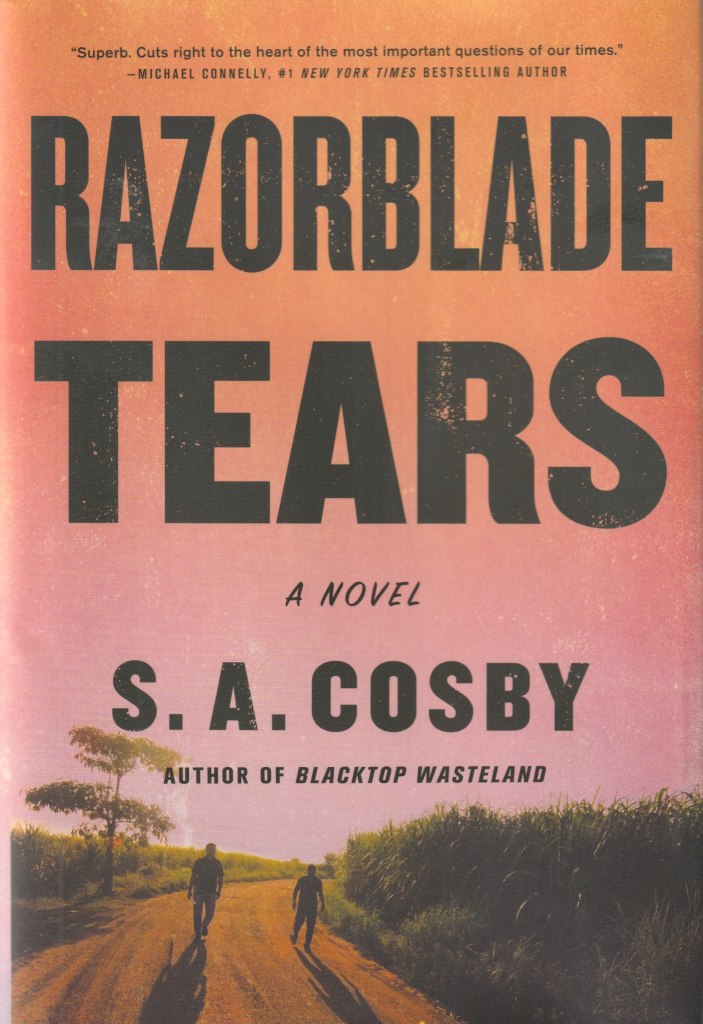
And over the year, yes, problematic tropes that can make you very, very tired have also developed–which makes me wary every time I approach a book by a non-queer person that takes on a trope without hesitation, as S. A. Cosby’s Razorblade Tears does, and that trope is one of the biggest and most hated by the queer community: bury your gays.
Ike tried to remember a time when men with badges coming to his door early in the morning brought anything other than heartache and misery, but try as he might, nothing came to mind.
The two men stood side by side on the small concrete landing of his front step with their hands on their belts near their badges and guns. The morning sun made the badges glimmer like gold nuggets. The two cops were a study in contrast. One was a tall but wiry Asian man. He was all sharp angles and hard edges. The other, a florid-faces white man, was built like a powerlifter with a massive head sitting atop a wide neck. They both wore white dress shirts with clip-on ties. The powerlifter had sweat stains spreading down from his armpits that vaguely resembled maps of England and Ireland respectively.
Ike’s queasy stomach began to do somersaults. He was fifteen years removed from Coldwater State Penitentiary. He has bucked the recidivism statistics ever since he’d walked out of that festering wound. Not so much as a speeding ticket in all those years. Yet here he was with his tongue dry and the back of his throat burning as the two cops stared down at him. It was bad enough being a Black man in the goo ol US of A and talking to the cops. You always felt like you were on the edge of some imaginary precipice during any interaction with an officer of the law. If you were an ex-con, it felt like the precipice was covered in bacon grease.
“Yes?” Ike said.
My faulty memory doesn’t remember how and when I first became aware of S. A. Cosby. What I do remember is that I bought and read one of his earlier works (perhaps his debut?) My Darkest Prayer, and enjoyed it thoroughly. Hard-boiled with a healthy dose of noir, I had a great time reading it–and was thrilled when his Blacktop Wasteland debuted to raves and attention and lots of recognition. Cosby can write like a house afire; and while he keeps up a rat-a-tat pace of story, he also manages to construct sentences and paragraphs beautifully, with a poet’s gift for language–spare and tight, yet poetic and beautiful at the same time (Megan Abbott is the Galactic Empress of this).
So, when I heard the “elevator pitch” for Razorblade Tears, I inwardly winced a bit, even as I had to admit Shawn’s guts; taking on bury your gays is a ballsy move–and also a bit of a dangerous one. If you don’t stick the landing…you’re fucked.
For those of you who don’t know what bury your gays means, it’s very simple: a show, or a book, or a movie, will introduce gay characters (lesbians, queers, whatever initial in the all encompassing umbrella those characters might choose for their identity), get the audience (and especially the queer viewers) deeply vested in them–and then kill them off suddenly and unexpectedly, all so the other queer characters (but usually the straight ones) will experience some kind of personal growth…in other words, you introduce a gay man into your narrative simply to later use him as a plot device, so the other characters can mourn and experience personal growth.
That’s probably explained badly, but you get the gist: gays will inevitably die. A good example of this is the so-called groundbreaking AIDS movie, Philadelphia–but the Tom Hanks character in that movie existed so that Denzel Washington’s character could grow and develop and move on from his own homophobic beliefs and fears about HIV/AIDS; as Sarah Schulman, one of our community’s finest minds, once said, “the entire point of Philadelphia is to make straight people feel better about HIV/AIDS and the gay men dying from it.” (Sections of her book Stagestruck: Theatre, AIDS, and the Marketing of Gay America are absolutely brilliant; it should be required reading for any Queer Studies course.)
The plot of Razorblade Tears is so deeply steeped in “bury your gays” that the gays are already dead when the book opens. The gays in question–Derek and Isiah–were brutally murdered, and the police don’t seem to care too much about looking into who killed them. Their homophobic fathers–both ex-cons–decide to look for their son’s killers. Both Ike and Bobby Lee feel a lot of guilt about their sons and how they rejected them both–their relationship, their eventual marriage, their child–while they were alive; finding their killers isn’t just about revenge but also a matter of atonement. In some ways, it’s like this book is borne from the anger every queer child rejected by their parents feels–you’ll be sorry when I’m dead.*
Ike and Bobby Lee are, indeed, sorry now that their sons are dead.
This also falls into another long-existent fictional trope: don’t fuck with a father. How many films (I’m looking at you, Liam Neeson), books or television shows are about a father’s rage, a father’s revenge, what a father will do to save or avenge their children?
Ike and Buddy Lee aren’t supermen, though. Cosby’s strength (besides his ability with words and images) is how well he creates characters and makes them human through their faults and frailties. Ike and Buddy Lee don’t much like each other as the story begins to move along–I kept thinking of the old Sidney Poitier/Tony Curtis movie, The Defiant Ones–but their ability to look past their own internal prejudices to see the commonalities between them as they unite in this foolhardy crusade to avenge their murdered sons is the real strength of the book here. (As well as the language.) You eventually start to understand them, care about them, want them to get their vengeance…even as you know it will bring them no peace.
I have to admit, I was hesitant to start reading this. I really was concerned I wasn’t going to be able to read it with the empathy necessary for Ike and Buddy Lee and their suffering–that I would think, yeah, well, maybe you should have thought about that when he was alive–but the book ultimately isn’t about their redemption, either; which is a genius move by Cosby. He makes their pain all too real–I cannot imagine the pain any parent should feel when their child dies–but he makes it clear there’s no easy answers here for Ike and Buddy Lee, and that pain will go on even if they get justice for their sons.
Shawn is also a master of writing about the Southern working class–about the poverty, the lack of opportunity, the societal neglect and how those factors all combine to keep those already mired in it trapped with little chance of escape; he clearly loves the rural South but not so much that he can’t expose the tragedy and ugliness that exists there.
It’s a powerful book, and I do recommend it….although the people who probably should read it inevitably won’t. I can recommend it, and do, enthusiastically; it’s a very powerful book, and it made me think–and what more can you want from art?
*sadly, I have seen all too often that a lot of those parents aren’t sorry when their rejected child dies; far too regularly they will say something along the lines of “So-and-so died for me years ago.”
My GOD, it was hot yesterday. I walked to the gym after work and by the time I got there was drenched in sweat and felt exhausted. I wound up cutting my workout short–I didn’t have the energy to make it through the whole workout; just the partial I was so tired and sweaty and hot that the walk home was absolute misery. I’m glad I went; I just wish the heat hadn’t been so damned extreme. The heat and humidity just suck your energy right out of your body sometimes–and it absolutely felt like 115 degrees as I walked. The ground felt hot, even when I cut through Coliseum Square. Yesterday morning it was cool in the house but I could tell it was hot outside, and as the day passed I had to turn on the ceiling fans and at one point considered getting out the portable air conditioners–but finally decided I was being ridiculous on that score and left them alone. I took a long hot shower once I got home and had my protein shake, and just then luxuriated in that clean, not hot and not sweaty (or that sticky feeling when sweat has dried on your skin–yuck) feeling the shower left me feeling rejuvenated and relaxed. I sat down and read through the edits on the next two parts of Bury Me in Shadows–there’s only one small 30 page section left to get through–and I am feeling content with the book. It’s good work. I like my main character and his instabilities; the weird mystery of what is going on there at the old Donelson place in the country is interesting and intriguing, and it’s also kind of nice to see that some of the points I wanted to make worked and didn’t sound overly preachy (which worried me).
So, yay! I feel much better about the book now, and am kind of interested in getting back to #shedeservedit this weekend. I think I am going to probably do some filing when I am finished here–it never hurts to get better organized–and spend some time with Shawn’s Razorblade Tears this morning, and then do some writing on Chlorine and possibly, just possibly, start rereading #shedeservedit–but I also need to type up the notes from our call the other day.
Huzzah!
I overslept again this morning, but fully intended to when I went to bed last night so I don’t feel any guilt this morning about being a lag-a-bed until nine. I do have things to do today but right now I am enjoying feeling rested and my coffee tastes remarkably delicious this morning. I am feeling good–particularly about not having to go outside today as we move into yet another excessive heat warning day. Paul is working out with his trainer this morning (later this morning, I should clarify) and then will probably head to the office, so I have the Lost Apartment to myself for most of the day–so i should be able to finish reading Shawn’s book, get some writing and cleaning and so forth taken care of, before heading back into the Olympics tonight. The second season of Outer Banks also dropped on Netflix yesterday, which is terribly exciting; Paul and i had kind of made up our minds to not watch anything other than the Olympics until they were over, so we’d have a vast variety of things to watch for the rest of the month of August…but damn me, if Outer Banks isn’t tempting. (Paul even mentioned it was dropping yesterday last night as we watched the swimming –Caeleb Dressel is incredibly pretty)
I was also, of all things (because I don’t have enough writing to do on my plate already) about my next Scotty book, Mississippi River Mischief–this was a direct result of finishing going over the copy edits/line edits of Bury Me in Shadows, I should add–and how complicated that story is going to be; I think maybe part of the reason I’ve been avoiding it for so long is because I know how hard plotting that story is going to be; I left the Boys in an incredible personal dilemma or two that needs to be resolved, and I don’t really know how to resolve those issues quite yet. I know what the case is going to be, and it, too, is going to be complex and difficult to plot out and make work. Don’t get me wrong–I know I can do it, but that’s when the lazies kick in.
And on that note, I am going to go finish my coffee with Shawn. Talk to you later, Constant Reader!
Another lovely night’s sleep was enjoyed by one Gregalicious, and my mood is pleasant as a result. It really is insane how much better I feel when I’m getting regular sleep that is good; hopefully today I’ll be able to get a lot accomplished–despite the horror of knowing that we are in an excessive heat warning, with the heat index potentially climbing up to 115 this afternoon and staying there for most of the rest of the day. Yikes! I do have to go to the gym today–which would be on foot, which will send me out into the madness of the heat–but I shall survive. New Orleans and heat kind of go hand-in-hand, after all, and while this summer seems a bit more extreme than past ones, at least we have a working a/c system in the house now (which has also made a remarkably marked difference from the last two summers around here).
I need to make a to-do list, and I have a shit ton of emails to answer. Heavy sigh. It never ends.
I also need to type up my notes from my meeting with my editor yesterday, so that I am prepared to fix what’s wrong with #shedeservedit, so I can get it finished by the end of the month, which is when it’s due. I also have to finish going over the edits for Bury Me in Shadows, so I can get that finished as well–just to ensure that everything with it that she did (this is the line/copy edit) I’m okay with; fortunately I trust her but there are a few things she wants me to check. And while I do hate putting Chlorine aside for a little while, if I can get the Bury Me in Shadows things finished on time I can go back to working on it for Sunday. I don’t know, we’ll see how the weekend goes, I suppose.
Gregalicious plans, and the gods laugh.
But this morning my coffee is wonderful, and I am basking in the glow of feeling good about a lot of things. I’ve not felt good for a while; my memory is such a joke these days that it seems as though I haven’t felt good in a while about myself and my life and my writing in general for a long time. Not sure how true that is, or if it’s really just another side effect of a nasty pandemic (on-going!); but I definitely am hopeful this lasts for a while.
I watched the Olympics yet again last night; it was terrific to see Sunisa Lee become the first Asian-American all around gymnastics gold medalist, and I think possibly the first Olympic medalist of any kind of Hmong descent. The Hmongs are an ethnic minority of southeastern Asia, spread out over Vietnam, Cambodia and China; and they were recruited and used by the American military during the Vietnam War to fight the illegal war in Laos–and then of course, once we pulled out, we pretty much left them out to dry (see also: Iraqi Kurds after the First Gulf War. Sensing a theme?), and they were finally welcomed and recognized as political refugees and allowed entry to the US (big of us, right?) in the early 1980’s. I first became aware of the Hmong people and culture when I lived in Fresno–a large number of them settled there–and my parents also lived next door to a Hmong family in Houston (my mother became rather fond of the family matriarch over their years of being neighbors). I’m not sure if there are any Hmong-Americans in New Orleans; I do know there’s a large Vietnamese community here in the East (that French colonial tie between New Orleans and Vietnam–banh mih is like the Vietnamese version of a po’boy, although I think banh mih might have, probably, existed first).
Then again, there are a lot of other cultures in New Orleans that rarely get written about–Greeks, Vietnamese, the Isleños from the Canary Islands, the Haitians and Dominicans–which is yet another indication of how I could be writing about the city for the rest of my life and never scratch the surface of all the different cultures and ethnicities and influences here.
I also watched 54: The Director’s Cut again–I rented it a few years ago on Prime, I think–and while I remembered it as a much better movie than the theatrical release (which was really sappy and terrible and borderline homophobic), I’d forgotten how completely queer the director’s cut is. I was actually thinking last night about writing an essay about Studio 54-despite never having been there–but knowing that it existed was one of the first times in my young gay life that I became aware that it was possible for people like me to live differently than what I had been raised to believe was my life path and what was the cultural norm (“Looking for Studio 54” is the title I jotted down in my journal), and watching this (much better) version of the film while I made my condom packs yesterday was interesting (I also thought about doing a compare/contrast between the two different versions of the film, “A Tale of Two Studio 54’s”, but I can probably write that into my “Looking for Studio 54” essay); I think the first time I watched the director’s cut I was still completely in the headspace that Shane, the main character (a dazzlingly beautiful Ryan Philippe in all of his youthful glory) was straight but willing to do what he needed to do to get ahead; on second watch, it’s even more clear that Shane’s sexuality is incredibly fluid and while it was possible that he might be gay and just coming to realize it, it’s also not impossible that he could be bisexual. This film is a lot more sexual than the theatrical release, and has no problem exploring the gory details of the hedonism–the drugs and sex–that were the hallmark of that period and of the club itself. There are also some parallels between this movie and Saturday Night Fever–the good looking kid going nowhere who loses himself in the joys of a disco, the only really joy in his life–and there’s also the sense of Shane, rejected by his father for being a disappointment (how many gay men can relate to that experience?) and finding and making his own family; while Shane’s sexuality definitely is fluid in the film, and it never really answers the questions it raises, so much of Shane’s journey parallels the journey of so many young men in the 1970’s drawn to the glittering lights of New York away from their drab lives wherever they were originally from…yes, there’s definitely an essay there, and one that requires watching the film again and probably the theatrical release as well.
And on that note–hello spice mines! Good to see you–and Constant Reader, I will see you tomorrow.