Meet Me Half Way

LSU won last night, 58-37, over Mississippi at Vaught-Hemingway Stadium in Oxford; but the defense gave up a lot in the second half–yards and touchdowns–and at times had me wondering if this would indeed turn into a trap game. A couple of offensive mistakes that the Rebels capitalized on, and suddenly they had pulled back within two touchdowns to 44-30 before the Tigers scored twice more to effectively ice the game. I may have sworn at the television a few times, as LSU’s pristine, well-oiled precision in the first half got sloppy in the second.

I suppose it is a measure of LSU’s success this season that a 21 point win in a rivalry game on the road felt disappointing; I guess this is what it means to become a member of an incredibly spoiled fan base. 58 points and over 700 yards on offense–and I was swearing at the television. Lord.

But the defense is going to have to play better than this if LSU is going to win the SEC title game against Georgia, who clinched the East by beating Auburn yesterday.

Yesterday was a good day on many fronts. I cleaned and organized, which of course always makes me happy; I didn’t get to the floors yesterday, but everything else is cleaned and organized, with a few more things to finish off this morning before I get back to work. I did have a relatively good day yesterday–cleaning and organizing capped by an LSU game is always the best Saturday possible for me. I also managed to read some more of The Ferguson Affair, and making notes on it. It’s not one of the stronger MacDonald novels–definitely not as good as some Lew Archers I’ve read–but it’s an interesting story, and I do like how the entire case begins with the main character, an attorney, being called in to represent a young woman accused of stealing, or rather, being part of a burglary gang robbing wealthy residents of the small city–and how it unrolls from there. I also made some notes on my current work-in-progress; dissecting why the story isn’t playing well in my head and realizing that it’s my own stubbornness and refusal to change things–even when they aren’t working. I always try to  make it work somehow before recognizing finally that it’s not working and must be changed; I have to go back and redo the first chapters of the book–which I’ve already kind of done. Part of the reluctance to see things clearly is because I don’t want to redo work I’ve already done—but if the work doesn’t work, accept that the time was wasted and redo it, for fuck’s sake. And so that is the task that lies before me today. I am going to go ahead and finish redoing chapter 13, because I’ve been in the middle of it for quite some time now–not finishing because deep down I knew I was going to have to go back and rework the earlier stuff, and why keep going when you know you’re going to have to revise and edit and rewrite what you are currently revising and editing and rewriting? Not an effective use of time or energy…and sometimes you have to just accept that you’ve wasted the time and be done with it. But I do believe I have now solved the key problem with my story, and it will now work going forward.

The other day I talked about the Stephen King short story “The Raft” (filmed as part of Creepshow 2), primarily in the terms of a book idea inspired by the trope of the story–essentially, four (or more) young people go somewhere no one knows they are, and something bad happens to them there–and they know rescue isn’t coming because no one knows where they are, and even if they did, it would take a while before anyone figured out they needed help–and wouldn’t know where to find them. Because of this, I kept thinking about “The Raft,” and finally at one point yesterday I got down my copy of Skeleton Crew and reread the story.

It’s extraordinary, really, and a good reminder of why Stephen King is one of my favorite writers.

It was forty miles from Horlicks University in Pittsburgh to Cascade Lake, and although dark comes early to that part of the world in October and although they didn’t get going until six o’clock, there was still a little light in the sky when they got there. They had come in Deke’s Camaro. Deke didn’t waste any time when he was sober. After a couple of beers, he made that Camaro walk and talk.

He had hardly brought the car to a stop at the pole fence between the parking lot and the beach before he was out and pulling off his shirt. His eyes were scanning the water for the raft. Randy got out of the shotgun seat, a little reluctantly. This had been his idea, true enough, but he had never expected Deke to take it seriously. The girls were moving around in the back seat, getting ready to get out.

Deke’s eyes scanned the water restlessly, side to side (sniper’s eyes, Randy thought uncomfortably) and then fixed on a point.

“It’s there!” he shouted, slapping the hood of the Camaro. “Just like you said, Randy! Hot damn! Last one in’s a rotten egg!”

“The Raft” is a terrifying story, and one that is all too easy to relate to. Randy is the main character of the story, and we see it all through his point of view. Deke is his best friend and roommate, on a football scholarship, handsome and well-built and holding the world in the palm of his hands; things come easily to him, especially women. The two girls with them on this adventure are Rachel, Deke’s current girlfriend, and LaVerne–who, as it turns out, isn’t a particularly nice girl in how we tend to define that sort of thing. Randy likes Rachel but really is into LaVerne; one of the dynamics of the story is that Deke and Rachel’s relationship is ending (but she isn’t aware) and LaVerne is poised to move in on Deke–and it happens during the course of the story. Randy loves Deke, Deke is his best friend and he admires him and would do anything for him; but he also harbors a bit of resentment for his beloved best friend–for whom everything seems to be easy, and women willing to crawl into his bed are easy to find; he also resents that women don’t seem to notice him when Deke is around. This is excellent character building by King; this makes Randy relatable.

(When I first read this story in the mid-1980’s, I had already become accustomed to being the “friend no one notices”; I always had male friends who were good looking and well-built and a lot of fun to be around, so I always felt eclipsed and that no one noticed me. This continued for many years, even after I came out in every aspect of my life–that weird mixture of love and resentment one can have for a friend who is always the center of attention who doesn’t even try to be; it just happens. It also reminds me of the dynamic at the root of A Separate Peace, which I read as a teenager; I need to go back at some point and reread that book to get a better sense of the novel and the queer undertones that even I–a closeted and terrified thirteen year old–was able to pick up on.)

The building of suspense–and the terror that comes when they realize the weird little oil slick on the water not only has intelligence but is a predator–is phenomenal, and yet another example of King’s story-telling genius.

I also could relate to the story because when I was a teenager in Kansas, there was a nearby lake we often went to, for swimming and so forth; it was out in the middle of nowhere, and it, too, had a raft you could swim out to and sunbathe on. (I used that lake in my novel Sara; in what I think is probably the best, most frightening horror I have ever written–that chapter at the lake is absolutely terrifying–or at least I think so, at any rate.)

But remembering–and rereading–“The Raft” also reminds me of the Short Story Project from last year, which I hadn’t intended to stop doing, but I got sidetracked with this year’s Diversity Project, among other things. But it’s time for me to get back to work on everything this morning, and so, Constant Reader, I bid you adieu as I head back into the spice mines.


aussiebum

Causing a Commotion

Last Saturday, as you may know, the Hard Rock Hotel, currently under construction at the corner of Rampart and Canal Street in the French Quarter, collapsed. Today, they are going to set off some controlled explosions to bring down the damaged cranes, which are no longer attached to the construction and present a clear and present danger to the area. Many of the businesses in a very large radius from the construction site are closed until further notice, causing the businesses and their employees financial hardship.

Several people were also killed as a result of the collapse.

I no longer drive to and from work on Rampart Street–we moved into new offices for the day job last November; it’s much easier for me to get on the Interstate coming and going to work now–but I pretty much made that drive every day from 2005 through last November, other than the years the street was torn up in order to resurface it as well as put in the Rampart/St. Claude streetcar line. The construction site was where the Canal Street Woolworth’s was for decades; the very Woolworth’s whose lunch counter was protested during the Civil Rights era because it was segregated. I always hated that the Woolworth’s closed and was torn down, because I felt that it was of no little historic significance; particularly at a time when the Confederate monuments still polluted the city.  But Woolworth’s is no longer in existence, and what else to do with a prime real estate lot that wasn’t being used? There’s already a Hard Rock Hotel on Bourbon Street, but this complex was going to be much larger and was, I think, going to house a Hard Rock nightclub, if I’m not mistaken–because a nightclub at that corner is precisely what the city needed (eye roll).

The construction collapse also exposed some typical New Orleans corruption; the contractor is allegedly shady and has an apparently well-earned bad reputation on every level. There was also some bribery going on, and someone at City Hall, who was signing off on permits, and safety inspections that weren’t being done, was also arrested this week. I am very curious as to what that is going to mean for the future of the Hard Rock Hotel; even if they hire a reputable contractor, I would imagine everything already built will need to come down and be rebuilt; and how do you recover your reputation from that?

It will be interesting, and of course, I am thinking there’s a book or a story in this somewhere. I’ve already created a shady contractor in New Orleans, by the name of Sam Dreher, in Royal Street Reveillon; I can certainly use that character again, and who knows? French Quarter Flambeaux just might make a terrific Scotty novel.

It’s hard to imagine, though, at this point how the Hard Rock Hotel can continue to be built–I would imagine it would have to be torn down completely and started over, but what do I know? I am neither an engineer nor an architect. But I would also think it would be hard to get past the fact that several people died in a construction disaster while it was being built; here is the perfect set up for a French Quarter horror novel about a haunted hotel, don’t you think? One that is cursed with death and tragedy; similar to the Overlook in The Shining.

Interesting.

This also reminds me that Arthur Hailey’s bestselling novel Hotel, which was adapted into a television series in the 1980’s (it came on after Dynasty), was also set in New Orleans; the St. Gregory Hotel in the novel was on Common Street in the CBD, one block from the French Quarter–a grand old hotel of the city (the television show moved the setting to San Francisco; which I still think was a mistake. An anthology television series along the lines of a more serious The Love Boat, set in a hotel with guest stars every week playing out individual stories as they visit the hotel, to me, would work better in New Orleans than San Francisco; then again, I may be biased heavily) in desperate need of some financial investment.  Hailey, who is not so remembered today, was a huge bestseller of his time, and he wrote sprawling novels about industries, and the people who worked in them, and the people who got involved with said industry somehow; with the stories all intermingled. He also wrote Airport, which became one of the first disaster movies, and eventually a series of sequels about plane disasters; he also co-wrote the novel Runway Zero-Eight, also filmed–and that film was what Airplane! spoofed. He wrote about banks (The Moneychangers), hospitals (The Final Diagnosis), power companies (Overload), drug companies (Strong Medicine), car companies (Wheels), and news broadcasts (The Evening News). He also wrote a political thriller, In High Places, which was one of the most thoughtful cold war thrillers; it was written from the perspective of the Canadian government, negotiating desperately with the United States since the skies over Canada were going to be the battleground between the US and the Soviet Union.

I reread Airport after I actually went to work at an airport, and have to say, Hailey’s research was excellent; he really captured the behind-the-scenes activity of an airport impacted by a blizzard perfectly. Likewise, I read The Moneychangers when I was working at a bank–he actually researched Bank of America for the book, which is where I worked–and again, spot on.

Now I’m thinking about rereading Hotel, if only to see how it was done, and how he depicted New Orleans in the 1960’s.

Anyway. I’ll continue to follow the story of the Hard Rock Hotel collapse, and see where it goes, and maybe–just maybe–it could be the basis for something. As you can see, I’ve already had any number of ideas spring from the incident…as always.

And now back to the spice mines.

11707499_10205581348306753_1410007181850364070_n

U Got the Look

This week, The CW debuted a new version of Nancy Drew. I sort of watched it Thursday night, and will probably watch again so I can pay better attention. It’s definitely a reboot, with a lot of changes–Nancy’s mom died much later in her life, for example, and there’s no Bess. The story is also set in Horseshoe Bay rather than River Heights, and Nancy has hung up her sleuthing cap since her mother’s death and is now working as a waitress in a diner. George Fayne isn’t a close friend but now her boss, and they don’t get along–I expect that to change. Ned Nickerson is not white–a change I liked a lot–and prefers to go by Nick. It’s also a bit more in the vein of Riverdale than the classic Nancy Drew stories, but let’s face it–the real Nancy as originally written is kind of insufferable–bit more on that later.

I’m also sure these changes will enrage the Nancy Drew fanbase–anything other than the way she was originally written by a lot of ghostwriters generally sets them off. I am not such a purist–I recognize that changes have to be made for a different medium, for one thing, and for another–as I said earlier, Nancy was a bit insufferable as originally written.

I did enjoy the movie a few years ago with Emma Roberts (it might be the only time I’ve ever actually enjoyed an Emma Roberts performance, frankly); a lot was changed from the books to the series.

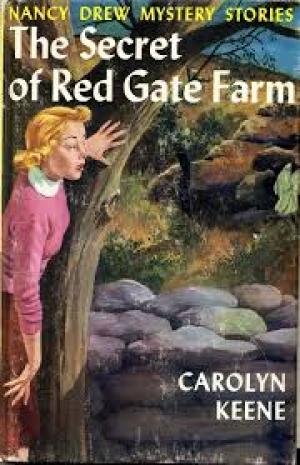
Nancy Drew and I go back to my fifth grade year at Eli Whitney Elementary in Chicago. I was already reading as many mysteries as I could get my hands on–those Scholastic Book Fairs were my favorite part of school–and I was checking out as many mysteries from the library as I could. (This was also the period of time when I discovered Phyllis Whitney’s mysteries for children; the first I read was The Secret of the Tiger’s Eye.) My fifth grade teacher had a big table in the back of the room with books for kids on them; we were on the honor system. We could borrow a book but we were supposed to return it when we finished reading it. The first day of school I wandered back there and looked at the books on the table; the first title to jump out at me was The Secret of Red Gate Farm. Above the title was NANCY DREW MYSTERY SERIES, and on the cover was a picture of a girl with wavy blonde hair, wearing a sweater and a long skirt, hiding behind a tree and looking, her mouth wide open in shock, fear or surprise, staring at the entrance to a cave  as some strangely robed figures entered it. I took it back to my desk, and started reading it.

red gate farm

“That Oriental-looking clerk in the perfume shop certainly acted mysterious, ” Bess Marvin declared, as she and her two friends ended their shopping trip and hurried down the street to the railroad station.

“Yes,” Nancy Drew answered thoughtfully. “I wonder why she didn’t want you to buy that bottle of Blue Jade?”

“The price would have discouraged me,” spoke up Bess’ cousin, dark-haired George Fayne. Her boyish name fitted her slim build and straight-forward, breezy manner. “Twenty dollars an ounce!”

“Oriental-looking.”

Sigh. The great irony is that both the Nancy Drew and Hardy Boys series were rewritten and revised to remove racist stereotypes and language…

Anyway, The Secret of Red Gate Farm enthralled me, as Nancy and her friends tried to help a young girl and her grandmother save Red Gate Farm from mortgage foreclosure while also trying to expose a ring of counterfeiters. There was a list of intriguing-sounding Nancy Drew titles on the back of the book, and back on the table in my fifth grade classroom there were three more titles: The Mystery at Lilac Inn, The Haunted Showboat, and The Clue of the Leaning Chimney. As I scoped around, there was another series novel, but it wasn’t Nancy Drew; it was the Dana Girls The Secret of the Old Well, allegedly written by the same person: Carolyn Keene.

Nancy Drew introduced me to the world of Grosset & Dunlap series–which were actually all produced, for the most part, by the Stratemeyer Syndicate. I eventually found myself reading–and collecting–many of those series, including the Hardy Boys, Dana Girls, Ken Holt, Rick Brant, Biff Brewster, Chip Hilton, and Judy Bolton, among others–I also wound up collecting Trixie Belden and the Three Investigators, too.

I always wanted to write a series like these when I was a kid; I even came up with a list of about forty titles I could use. I wrote one, actually, when I was in the fifth grade–called The Secret of the Haunted Mansion–which, to the best of my recollection, might be the first fiction I ever wrote; alas, it is lost in the mists of time. Periodically, I come back to the thought of writing such a series, but I don’t know that there’s a market for them anymore. Most of the series have gone out of print, with only Nancy Drew and the Hardy Boys, as far as I know, still available; Trixie Belden might be but I’m not sure. I still collect the books–it really pleases my OCD to have the series completed. I’m still missing a few from some of the harder to find series–like Biff Brewster and Ken Holt, and I do think I am missing a couple of Judy Boltons and Dana Girls as well–but I’ve stopped scouring eBay over the last few years because, well, money.

But at some point, I imagine I will go back and try to complete the series.

I do credit these series with a lot of my devotion to the world of crime and crime writing; while I always loved mysteries, it’s entirely possible I would have moved on to something else had I not discovered, and become addicted, to these series. These series led me eventually to Agatha Christie, Mary Stewart, Charlotte Armstrong, and Ellery Queen; and those authors eventually led me to others…and wanting to write crime fiction of my own.

So, thank you, Nancy Drew. It’s kind of your fault.

Jacob’s Ladder

Tuesday morning and all is fine…at least so far.

I managed to finish the reread/outline of Bury Me in Shadows last night, which is very cool, and as I said the other day, it doesn’t need nearly as much work as I thought it did–which, given how it was written in fits and starts over the period of a few months, I figured there would be tons of repetition. As it is, I did repeat something–the first time my main character, Jake, was ever called a gay slur–about three or four times. Obviously, I only need to have that in there once.

What’s funny about it, though, is that each instance is based on a different time it happened to me when I was a kid–and I managed to remember four different times. Who knows how many others I can remember? Ah, the joys of being a queer kid in America back in the day.

But the book is, as I said, in much better shape than I remembered or thought, and so it’s not going to be as much work to finish it as I thought. Don’t get me wrong–it’s still going to be a lengthy slog, it’s just not going to take me as a long to finish this final edit than I thought it might. It’s still entirely possible that I could have it finished and ready to go sometime next week, which would be really lovely. One can certainly hope, at least.

I’ve managed to sleep well both nights so far this week–I didn’t even feel tired yesterday until after I got home from the office. I somehow managed to make it through an entire twelve-hour day without feeling exhausted or worn out. On the other hand, we were also pretty slow yesterday; perhaps not having client after client after client made the difference.

We finished watching Big Mouth last night, which is easily one of the funniest things on television right now, and will now slide back into watching our other shows each evening, trying to get caught up on them all. A plethora of riches for us to choose from, and we still have only watched the first episode of the first season of Succession, so there’s also that.

I’m not as energetic this morning as I was yesterday; but that’s probably par for the course. I may not have been as worn out as I usually am on Monday evening last night, but it was still a twelve hour day, and today is probably a vestigial hangover from that. That doesn’t bode well for the day, but I”m hoping it’s just a slow waking up morning type of thing. I’ve still got so much to do it’s not even funny. Motivation is the primary problem I am having this morning, and my coffee doesn’t seem to be working the way I generally expect/need it to. Oh, wait–there it is. Hello, caffeine!

There was a cold front that came through last night so today is supposedly going to be cooler than it has been–sad that temperatures in the mid-80’s is “cooler than it has been,” but that’s life down here in the swamp. This summer has certainly lasted longer than any have seemed to before, but that could also just be my own faulty memory. My memories are questionable, it seems. That’s why people who can write their own memoirs or autobiographies amaze me so much–how do you remember all of that? There are so many gaps in my memories, and memories that are simply flat out wrong; for example, I would have sworn on a Bible and testified to it in court that we moved from Chicago out to the suburbs in the winter of 1969, which is incorrect. We moved in the winter of 1971, two years later; I was ten years old and in the sixth grade. I knew I was ten when we moved, and yet somehow I always managed to convince myself we moved in 1969. Why or how or when that year became fixated in my brain as the year we moved is beyond me; I’ve always been able to remember the year we moved to Kansas because it was the summer before my junior year. I graduated in 1978, so we had to have moved to Kansas in 1976. It was also the Olympic year–Montreal–and the same Olympics where Nadia Comenici started throwing perfect 10’s in the gymnastics competition.

Why have I been thinking about the past so much lately? I’m not sure. Maybe because Bury Me in Shadows is set in a fictional county that is based on the county where my family is from, so I’ve been drawing on childhood memories to construct a fictional place based in reality from my past. It’s strange to look at Google Earth renderings of where we’re from, and see that my memories are, in fact, incorrect; but in fairness I never drove anywhere in Alabama. I was always a passenger, and I think driving cements directions and so forth in your mind–when you’re just riding in the car you don’t pay as much attention as you would if you were driving. I’m also writing “Never Kiss a Stranger,” which is set in New Orleans in 1994, so I’m having to delve into my memories of visiting here and remembering what the city was like then. It does seem different now than it was then–certainly the city has changed since that first visit all those years ago, when I first explored the gay bars and the Quarter and fell in love with New Orleans; part of the reason I am writing the story and setting it in that time is to write about, and preserve in fiction, my memories of the city back then and what it was like. I’m also glad I decided to turn it into a novella–I may do a book of four novellas, like Stephen King’s Different Seasons and Full Dark No Stars–which would be kind of a departure for me. I already have “Never Kiss a Stranger” in progress, and there’s also “Fireflies,” and perhaps I have two other stories on hand that could easily be adapted into longer novellas….often the problem I have with writing short stories is the word counts; some stories struggle to come in under 6000 words.

Which, now that I think about it, could easily make “Once a Tiger” and “Please Die Soon” and perhaps even “Death and the Handmaidens” work; simply make them longer and that will probably solve the issues with all three stories.

An interesting and intriguing thought.

And on that note, tis time for me to head back into the spice mines. Have a lovely Tuesday, Constant Reader.

644625_220760894720005_1824093505_n

Mony Mony

Wednesday.

So, the short story is coming along, which is a good thing as it is due in a week. I just wish I could find a good three hour break to just sit down, listen to Stevie Nicks, and get it finished.

One can but dream.

I’ve been very tired this week. Not sure what that’s about; my sleep might not be deep but it’s been restful. I’m trying to wean myself off sleep assistance, and have cut back even further on my daily caffeine intake, but there it is, you know? I think it’s mostly because I work the long days on Monday and Tuesday, plus I’m always tired when I wake up to an alarm as opposed to organically. Today is half-day Wednesday, and I get to make groceries and run some errands when I get off at three-thirty this afternoon before coming home to make dinner. I still need to get my short story written; after I finish this and answer some emails I’m going to see if I can get some work done on that before I have to get ready for work. It is, after all, due a week from today.

I also want to spend some more time with Lisa Lutz’ The Swallows. I’ve been too tired the last few nights to read, so have been watching television when I get home from work. But I think tonight I’ll have some time. My primary concern is the reluctance to put it down and do other things I need to get done. The Lost Apartment is a disaster area, to say the least. Since there isn’t an LSU game this weekend, maybe I can spend some time writing and editing and cleaning this weekend. One can hope, at any rate. The windows around my workspace are filthy, I don’t even want to look at the baseboards and the floor, and as always, there’s a sink full of dishes. I’m doing some laundry this morning, and maybe can get those dishes and some other things here in the kitchen taken care of before I head in to the office.

I’ve been watching a documentary series about Southeastern Conference football on ESPN, Saturdays in the South, which I highly recommend. College football is huge in the South, and always has been; the series is doing a great job of exploring the reasons behind that as well as the history of college football in the region. The episode I watched last night took a look at the conference from the 1970’s through the early 1980’s–and these are the games I remember watching, all those years ago. It was kind of fun seeing the “Punt Bama Punt” game explored, as well as the great Alabama goal line stand against Penn State that won them the 1978 national championship. I’ve always wanted to write about SEC football–maybe someday I will, mainly from the point of view of being a lifelong fan of the sport and the conference.

Perhaps for my book of essays.

I’m also still reading James Gill’s Lords of Misrule, and it’s spurring a lot of interesting thoughts. I’m greatly enjoying the book, even as I am appalled by the horrors of white supremacy in New Orleans over the rich, dark history of the city; as I always say, I am not, by any means, an expert on New Orleans–what I don’t know would fill a library–but it’s a lot of fun to become more knowledgeable about the city’s dark, bloody, and violent history…which of course only inspires me to want to write more about the city’s past. I’m so behind on everything writing related–this volunteer project has really knocked me for a loop, delaying everything and pushing everything further back, and it never seems to end–but I am going to focus on writing and cleaning this weekend. I want to get all my errands taken care of before the weekend so I can have yet another weekend–like last weekend–where I don’t have to leave the house other than to take out the trash. Errands drain me of energy and leave me with no desire to write, for some reason.

Maybe because I am getting close to sixty. Who knows?

All right, perhaps it is time for me to head into the spice mines for a while. I’m on my second cup of coffee and the clouds in my head are starting to clear a little bit.

Have a lovely day, Constant Reader!

534547_440380639354114_1428070532_n

Funny Face

Monday, Monday. Can’t trust that day, you know?

Saturday night I watched a documentary about college football on ESPN, Football is US: The College Game. It was interesting–I didn’t know who Walter Camp was, but I’d heard the name before. I also knew who Amos Alonzo Stagg was–there’s a high school in Chicago named for him, and I also knew that the University of Chicago was an early power in college football, until they disbanded their team and stopped playing. It lightly touched on how college football parity helped desegregate the Southern universities–their football teams were mediocre, once other schools started recruiting, and playing, black players–but there was one line, when talking about the civil rights struggles in the 1960’s, and how Southern people, especially those in Alabama, focused on football as a source of pride for their state, that was particularly true and honest, and I wished they would have followed up on it some more: they didn’t like the way their state was being portrayed on the news, and felt like these representations of Southern states as hotbeds of racism was unfair.

Yes, indeed. It was incredibly unfair how the national news depicted Southern racism as how it actually existed in the real world. This resentment of how they are viewed by outsiders is keenly felt down here, and that sense of resentment is very key to understanding their behavior.

I reread the final few chapters of Bury Me in Shadows yesterday, and then planned out the final three, so I have a good shot at making my deadline of finishing the first draft by September 1. I also revised both “Moist Money” and “This Thing of Darkness” yesterday, so it was a fairly productive day for me on the writing front. Both stories need to be gone over again before sending them out into the world–both are rather dark stories; I sometimes shock myself with how dark I can go if I set my mind to it. (Fully cognizant of the notion that other people’s opinion of what dark is can vary wildly.)

We are still watching the third season of Thirteen Reasons Why, and I have to say, the show is both ridiculous and over the top–last night I said to Paul, “you know, this high school is completely fucked up–I can’t imagine anyone I went to high school with being murdered, let alone that almost everyone I was friends with would have a motive for killing another classmate”–but the show’s true appeal lies in the cast, how good they are in their roles, and the chemistry they have with each other. And let’s be honest–it hasn’t come remotely  close to Riverdale when it comes to plots going over the top. While watching last night, it occurred to me that the show is really kind of an Edge of Night type serial, only set in high school; every season’s plot has had something to do with death and crime. There has been at least one suicide, one suicide attempt, an almost-school shooting, several rapes–one particularly brutal one involving a young man and a broom handle–and so I can see why teenagers who’ve been through a trauma of some sort would find the show hard to watch.

I also watched Roll Red Roll, a horrifying documentary of the Steubenville rape case–which also is an exploration of rape culture in small towns–and that case was what initially inspired my own in-progress manuscript about the same thing; rape culture in a small town. Watching the documentary, and remembering how awful the story was as it unfolded–several other cases broke around the same time; there was another in Marysville, Missouri, and another in southern California, which were the subjects of another documentary–also made me see, again, what are the many problems and holes in the plot of the book I wrote on the subject, and what needs to be fixed about it.

And on that note, it’s back to the spice mines with me.

Happy Monday, everyone.

24478_1476397189225_1212580313_1400813_1618496_n

Reelin’ in the Years

Sunday morning, and times keeps on slippin’, slippin’, into the future.

I slept in this morning–this life of “sorta leisure” is one that I could easily adapt to–and now sit, inside my condensation-covered windows, sipping my morning coffee and reflecting on what the day ahead has in store for me. I finished both interviews yesterday–despite the best attempts of my computer to thwart me, with freezing programs and even an operating system that locked up at one point, requiring me to force-restart the thing–but this morning, it appears to have updated its operating system overnight and is running quite smoothly this morning. I am not, of course, taking this as a sign that this latest update may have removed the bugs from the operating system–this has been a consistent problem since the Mojave update back in December, which created the Great Data Disaster of 2018, from which I still seem to not be completely recovered from–because it’s still early in the day and there’s plenty of time for this thing to malfunction all over the place yet. It did make doing the second interview difficult, but I finally managed to get it saved and emailed off yesterday. I have to do that group thing yet today–I was going to do it  yesterday but after all the functionality problems I was facing, thought it probably best to not try to do the round table and push it off until today. I also need to work on some fiction writing today as well, and of course, I have a toothache again, one of the few molars I have left, and it’s making chewing a bit of a challenge.

Yay, vacation.

I also want to start reading Laura Lippman’s Lady in the Lake today; alas, while I was watching things on the television yesterday I got sucked into City of Nets–and there’s nothing more distracting for me than Hollywood history. I read about half the book yesterday–sometimes making notes, other times just getting enthralled in the story–and around nine last night I thought, oh, I should be reading Laura’s book but instead couldn’t stop reading about Hollywood corruption and morality. I’ve always been interested in Hollywood history but have never really thought about writing it–I’ve always been reluctant to write much of anything not set in the present day–but I’m slowly coming around to writing recent history. As I said in one of my interviews, I am working on something set in 1994–“Never Kiss a Stranger”–and immersing myself in that period whenever I can, and originally went there for my story “A Whisper from the Graveyard.” As a result I am finding myself vastly interested in writing about the recent past–so much has changed in so quickly a time that it’s really amazing; the 1950’s, for example, might as well have been 1776. (Which, of course, reminds me that my story “The Weight of a Feather” is set in the early 1950’s/late 1940’s; not specifically in any year, but it’s definitely that post-war time.)

But I hope to get my round-table participation finished this morning, and then I am going to work on “Moist Money” for a little while, and then perhaps start Chapter 23 of Bury Me in Shadows. I’d like to get the first draft finished before September 1; and I’d also like to get to work on some other things that are just hanging around. I’ve already been much more productive than I’ve been on any of my previous long weekend vacations, which is a lovely sign, and I absolutely must get moving.

The end of the year will be upon us before we even know it.

I mean, LSU’s first football game is merely a couple of weeks away; and the Saints are already going through their preseason games. Football season is nigh; and shortly behind it will come the cooler weather. This summer hasn’t been that bad–despite the series of heat-advisory days we’ve been dealing with this month–and the river is finally no longer in flood stage, which is lovely and a bit of a relief; when the river is in flood stage there’s always this sense of impending doom hanging over our heads.  I would like it to get cooler, because I do want to spend some time exploring the Quarter–it’s been a hot minute–just to see what down there is different and what has changed; I used to work a block away, for example, from where Scotty lived and I could walk down there and check out his home and the rest of his block from time to time. It’s going to be awhile before I start writing another Scotty novel, and one of the things I do want to address/tackle in the new Scotty is the gentrification/short term rental issue; which will also require bringing back one of the characters from Royal Street Reveillon. (I do this often; bring characters back from previous books to impact the current one. Life kind of does that, too, so it only makes sense from a realistic standpoint to do this periodically.) But I’ll probably write the Chanse before the next Scotty; once I get all these partial novel manuscripts out of the way and submitted I am going to focus on writing Chlorine, then the Chanse, and then the Scotty. So, really, I need to be reading Hollywood history this fall, so I can be prepared to write Chlorine. 

As I love Hollywood history, this is not going to be a horrific chore. I also think I can justify reading James Ellroy’s L. A. Confidential as well for research.

It will also give me an excuse to reread In a Lonely Place by Dorothy B. Hughes, which will always be a pleasure to read. (I also have some other Hughes novels on hand, and the entire canon of Margaret Millar, which I would also like to  finish working my way through)

And on that note, I should probably get back to the spice mines. If I work on the round table for a bit, I can justify spending some time with the new Lippman novel.

Have a lovely Sunday, Constant Reader.

6-copy-1024x683

Hocus Pocus

Tuesday morning, and I somehow managed to survive yesterday. Sunday night’s sleep wasn’t terrific, and by the late afternoon I was plenty exhausted and tired. I had to persevere, and what’s more, I was interviewed for a podcast last night when I got home from the office. Somehow I managed to get through that, and within half an hour of disconnecting from Skype, I was in bed and asleep within moments. Last night’s sleep was quite lovely–I feel amazingly rested this morning–and so this day might not be as terrible as the previous.

Today is going to be a good day.

I started writing two new short stories yesterday, “The Spirit Tree” and “Moist Money.” “Moist Money” is for an anthology I was asked to write a story for; it finally came to me sometime either Sunday evening or sometime during the day yesterday, and I scribbled down the first two paragraphs in my journal, which I transcribed yesterday, and then added another couple of hundred words. “The Spirit Tree” was inspired by moving books around on Sunday, and one of them–a nonfiction book about snake-handling churches in southern Appalachia–I opened the cover and looked over the first page–which was about “spirit trees”; trees that rural Appalachian folk, superstitious and religious as they are, create to keep bad spirits away. What they do is put glass bottles on tree branches, so the bottles clink together in the wind (“warriors, come out and play”) and the sound the glass tinkling against other glass makes supposedly scares away evil spirits and keeps them from infesting the house. I hadn’t thought about spirit trees since I was a child, and I thought, not only is that a great title, I can actually think of a rural noir story to write that matches it. Yesterday I got down about five to six hundred words of the opening; this is a story, I think, I might try to sell to Ellery Queen or Alfred Hitchcock when finished. I was too tired to do much more than write the openings of both stories last night; but I am hoping to get more written on them this week. I also need to get those three chapters of Bury Me in Shadows written, so it can sit and percolate for the next couple of months until I can get back to it.

It’s also weird to think Royal Street Reveillon will be out into the world next month. It seemed like it took me forever to write that book, and I guess it kind of did? But it’s nice; I’m glad to be putting another Scotty out there into the world, and I’m also not sure when I’m going to write the next one. I already know what it’s going to be–Hollywood South Hustle–but I’m just not sure when I’m going to get to it. I want to, as I have said in previous blogs, get all these books about teenagers I’m in some stage of writing cleared off my plate and out into the world before I start writing anything else–a cleansed palate, as it were–and keep writing my short stories and essays along with writing those. I’d love to get my second short story collection out into the world by 2021–that would be the one I’m calling Once a Tiger and Other Stories–and I also want to get “Never Kiss a Stranger,” a novella, finished sometime before the end of the year, as well as “Fireflies,” my horror novella, as well.

So much to do, right? And I really need to proof Jackson Square Jazz so the ebook can finally go up for sale again. Maybe I can make that a goal of my long weekend for my birthday? Stranger things have happened. I really need to get all these things that are hanging over my head finished and out of the way, so I can focus more easily on writing Chlorine next year.

And on that note, I am heading back into the spice mines. Have a lovely Tuesday, Constant Reader.

9_af

I Believe in You (You Believe in Me)

I really need to focus and stop being distracted by shiny objects.

Stupid fucking shiny objects, anyway.

But there are so many, and they’re all so glittery and pretty and interesting.

It’s a wonder I get anything done.

Every once in a while, like now, I allow myself to get completely scattered and my inability to say no to people gets me into trouble; I then get overwhelmed and paralyzed with fear that I’ll never get everything done…thereby ensuring I won’t get everything done–or if I do, I’ll basically have to kill myself to get it all done on time. Heavy heaving sigh.

But at least now I’m aware I’m doing it again, which should count for something.

I took stock yesterday of everything I am doing, everything I’ve promised, and everything I’m in the middle of–and it was quite staggering. I have, as I said before, promised three short stories, only one of which has a completed draft (the others are still just ideas, waiting to be born on the page); I am working on a massive short-term project; a massive long term all year one; I am five chapters shy of finishing a first draft of a novel; have another novel manuscript that will need at least another two drafts; have written the first drafts of two first chapters of new novels; have a lengthy novella whose publication fell through that can be revised and rewritten and turned into a novel; and have about thirty or forty short stories and essays in some form of being written….and I keep having ideas, new ones for stories or novels, every day. Just this week I came up with another book idea called Another Random Shooting, which I quite like, and three short stories–“Festival of the Redeemer,” “Hot, Humid, Chance of Rain,” and “Flood Stage.” Yikes. I also have to run errands today–mail, bank, groceries–and am hopeful I will get some things done today and tomorrow. I slept really well last night–am still a bit groggy this morning, while i wait for the coffee to kick in. I think, probably, when I finish this I am going to go sit in my easy chair and read the Steph Cha novel. It’s really quite good, and I like the idea of spending my Saturday mornings reading a good book.

Yesterday when I got home from the office, I finished doing the laundry (bed linens every Friday), cleaned the kitchen and did the dishes, cleaned the Lost Apartment (still need to do the floors), and did some filing. My office space is always, it seems, a mess; something I’m never sure how to resolve. The truth is my office space is too small, always has been; but the primary problem that goes along with that is there isn’t any other place for my office to be located here in the Lost Apartment. Our apartment is, especially by New York/DC standards enormous, especially given what we pay for it–we’ll never be able to move because we will never find anything comparable at the same price; I’m not even certain one can get a studio for what we pay in rent. And, if I’m being completely honest, having a room dedicated to being my office would eventually not be big enough, either, as I tend to expand to fill space. But I still dream of the day when I’ll have an entire room for my office space. Anyway, when Paul got home I made Swedish meatballs (I do love cooking, I just rarely get the chance to do it anymore), and we got caught up on Animal Kingdom, and then finished The Boys, which is fucking fantastic. It occurred to me last night as I watched those final two episodes, that a world with super-heroes would probably be more akin to Greek mythology than the comic book worlds we see in most super-hero stories; capricious, mercurial beings with amazing, seemingly limitless powers, and all humankind would be at their mercy. I also liked that the human male lead, Hughie, is played by Dennis Quaid and Meg Ryan’s son Jack–and he’s quite good, and looks nothing like either of his parents–although sometimes you get a glimpse of one or the other. I have to say I liked this show a lot more than I thought I would, and we’re both looking forward to Season 2.

I think tonight we might dip into Years and Years on HBO. One can never go wrong with Emma Thompson.

Yesterday I reread my short story “Fireflies” in order to make some notes on it. I originally wrote “Fireflies” in long hand in a notebook back in the 1980’s–it’s another one of those “from the vault” stories–and I’ve worked on it, off and on, since the original draft was written. It was always slightly off, and the original ending was terrible. Fast forward, and last year I was looking at it again, and thinking about revising it, when I was invited to submit a short story to a horror anthology. I decided to use “Fireflies,” and I revised it and rewrote it a bit, smoothed over the rough transitions, made it flow better, and changed the ending along with some additions to the narrative to make it not only tighter but stronger. After submitting the story, I was contacted by the publisher and officially commissioned to write a story for the book. The anthology had a broad submissions call, anything from noir to pulp to outright horror, but every story had to have a paranormal element to it. They commissioned a pulpy noir story, and when I mentioned I’d submitted something already, they were very nice about specifically wanting the new story and would still consider the other; I wound up writing “A Whisper from the Graveyard” for it, and a few months ago they finally decided not to use “Fireflies”–but were interested in it as a novella; the true problem with “Fireflies” was its length. I immediately saw the value of the critique; I never think of writing in terms of novellas or novelettes (primarily because there really isn’t a market for these longer stories that are too short to be novels), and so made a note to reread the story and see what possibilities there were for it. So, I did that yesterday, and I was correct–the story would work better as a longer novella. I’ve written novellas before–“The Nightwatchers” and “Blood on the Moon” for those Kensington omnibus books, and I self-published “Quiet Desperation”” myself on Amazon. One of the projects I am in the midst of, “Never Kiss a Stranger,” is also going to be a longer, possibly novella length, story; I’d always thought of it from the beginning that way, and will probably self-publish it at some point on Amazon once I finish it.

“Fireflies” is another Alabama story, which means another “Corinth County” story. It was inspired by the Fleetwood Mac song, “Fireflies”, even though they have nothing to do with each other as far as content. The only connection other than the title is mood; I wanted to get the mood of the song into the story, and I think I succeeded. The song is one of my favorite Fleetwood Mac recordings, and only appears on the Fleetwood Mac Live double album. Ironically, it’s a studio recording they mixed crowd noises into, so it wouldn’t seem out of place on the live album; the original version is on Youtube without the crowd noises. I’d say the story is also strongly influenced by Thomas Tryon’s The Other, which is one of my favorite novels of all time (and overdue for a reread, as are The Haunting of Hill House and Rebecca), and I still think someone should do a biography of Tryon. I’d do it, but my research skills are subpar and non-fiction is also not my strength. But Tryon is fascinating to me–a relatively successful actor who was closeted and never quite attained stardom; then gave up on acting and turned to writing. He was also the longtime lover of the first gay porn star, Casey Donovan, of Boys in the Sand fame. Anyway, I digress (damned shiny objects, anyway). The point is there are so many Alabama stories in my files that have never been published; I think the only Alabama/Corinth County stories that have been published are “Small-town Boy” and “Son of a Preacher Man,” as well as the novel Dark Tide, which may not be actually set there but the main character is from there. Bury Me in Shadows is the first full-length thing set in Alabama for me to get this far with, and it–and “Fireflies”–are reconnecting me to everything.

I also keep thinking I need to go back there, just to drive through and take pictures, get a feel for the place again, refresh my memories.

This is how the story opens:

Jem slapped at a horsefly buzzing around his ear. He hated horseflies. They bit and left welts that hurt.

“God commands us to HONOR THY FATHER AND THY MOTHER!” Brother Killingsworth thundered from his pulpit to a chorus of scattered amens inside the little chapel. Jem could hear the sermon clearly because the screened windows were open to catch whatever cooling breeze there might be on this hot July Sunday. He could hear the fluttering of paper fans, the creak from the turning of the blades of the ceiling fans.

The Church of Christ Our Lord and Savior didn’t believe in air conditioning because the faithful suffered in the heat to listen to the Lord preach back in the Holy Land, wiping the sweat from their brows and letting the cloth stick to their wet bodies. And if that was good enough for the ones who gathered to hear the word of Jesus, it was the least the flock of the Church of Christ Our Lord and Savior could do, am I right and can I get an amen, brothers and sisters?

“Little better than snake handlers,” Jem’s mama would sniff with that mean look on her face, shaking her finger in his face, even though it wasn’t polite to point, “and you’d better stay away from there. You hear me, boy?”

Not bad at all.

And now back to the spice mines.

IMG_1995

Dueling Banjos

Writing about the rural Deep South is difficult.

I’m from the deep south, yes, but I didn’t grow up there. I spent a lot of time there, my parents were Southern, and so a lot of my values and mind-view for a number of years were patterned in the Southern mindset. I draw from my memories of summers in the rural backwoods of the mid-central-western part of the state, about seventy miles from the Mississippi state line or so, but there are also so many attitudes and mentalities and stereotypes and tropes about the rural Deep South that it is easy to become lazy and fall into those. I am trying very hard not to do that, but as I said, it’s hard. Stereotypes and tropes exist for a reason, after all–they weren’t created from nothing; there’s always a core kernel of truth in them, whatever they’ve become once the seeds were planted–but the key is to burrow into them to dig out the core kernel of truth to build upon, so you’re telling the truth. But I worry, as I continue to excavate into this book, that I am relying on negative tropes and stereotypes.

I think I was thirteen when Deliverance was released; we saw it at the drive-in, which was something my parents loved to do with us when we were kids. I didn’t understand a lot of what was going on in the movie–it was the kind of macho bullshit I loathed as a child, a loathing that has only somewhat lessened as an adult, so I stopped paying attention to it and I think I may have even dozed off. But I did see the scene early in the movie which has forever cemented into people’s minds a link between the backwoods South and redneck morons–“Dueling Banjos.” The open notes of the song are all that is needed to reference a joke about passing from civilization into the land of the uneducated, probably inbred, backwoods hillbillies; it has come to symbolize moonshine-makin’, overalls-wearin’, cousin-marryin’, dangerous rural Southern people. I’ve made the joke myself from time to time–driving through the Southern countryside at night, “You can almost hear the banjo notes, can’t you?”

Deliverance and “Dueling Banjos” are such a part of our zeitgeist and popular culture that the book and film have become kind of shorthand Southern references–even for people who don’t know the origins of the references. I’ve never read the book, but I bought a copy a few years ago because I heard one of the references in something–a talk show, a book, a film, a television show; I don’t remember which–but I thought it was time for me to read the book and possibly watch the film in its entirety; that there was a possibly an essay in both about masculinity, rape culture, and the American male. (For those of you who don’t know, many male-on-male rape jokes were born directly of Deliverance.) I never did get around to reading the book or watching the movie; to be honest, I’d completely forgotten about them and the essay idea until recently. I also never got around to reading the book because I’d heard bad things about James Dickey, who wrote the novel. Dickey was primarily a poet, and considered one of the better American ones of the second half of the twentieth century by the Academy, and Deliverance was his only novel. I knew people who knew Dickey, and the reports back on him were terribly unpleasant, if not surprisingly so. (American letters has produced some horrific examples of toxic masculinity with its iconic, deified authors.)

Southern people are masters at grievance; they’ve been aggrieved for quite some time now–probably as far back as when the rumblings in the northern states began against slavery.  Everything is always someone else’s fault; even that language from the 1960’s came back to haunt Alabama during the special election to replace Jeff Sessions in the Senate: “outside agitators.” That was always a favorite fallback of Southern white supremacy; people of color in the South were perfectly happy with the way things were set up, with not voting or having opportunities, and being segregated away from white people, until “outside agitators” stirred them up against their kind, genial white overlords. Outside agitation goes all the way back to slavery; Southern politicians and leaders railed against “Yankee agitation on the slavery issue.” It’s all there, in black and white, in the history books–if you know what to look for.

The politics of race in the South have always been problematic, but nothing is more irritating to me than white apologia fiction set in the South; in which the white people aren’t racists; those nasty lower class white trash people are the real racists, not the educated whites. I’ve seen this in any number of books and it never ceases to irritate me when I come across it; this historical revision that relieves the guilt of Southern white people is kind of like, as my friend Victoria says, how after the Second World War  no Germans had really been Nazis and everyone in France was a resistance fighter.

Bitch, please.

I guess all those southern white civil rights activists were working undercover, because they sure weren’t public in their opposition. (And yes, I know–not all Southern white people; but I sure don’t see any white faces in any of the footage from the civil rights marches and school integrations that weren’t in military uniform…or certainly not as many as novels and fictions would have us believe.) To Kill a Mockingbird is problematic to me in that I don’t believe for a minute that the sheriff and the cops in Maycomb, Alabama, were worried about the rednecks from the county lynching Tom Robinson and gathering up some of the good white people from town to defend the jail; history shows that the police were often Klansmen, or at least more sympathetic to the cause of white supremacy than they were to civil rights. That scene, while powerful, doesn’t ring true to me–it again divides Southern whites into the educated professionals and the uneducated racist rednecks, and I am not certain of the accuracy. The publication of Go Set a Watchman upset a lot of fans of the original work with its depiction of Atticus as a segregationist; they felt betrayed that the heroic white champion of racial tolerance and justice from Mockingbird was turned into a segregationist…but it was honest and real and rang true to me.

And seriously, I highly recommend anyone interested in looking at how Southern white people viewed civil rights during the 1960’s dig up The Klansman by William Bradford Huie.

This is, of course, part of the problem I am having with writing this first draft of a book set in the rural South that deals, in part, with issues of race in the modern rural South. I don’t want to be heavy-handed, nor do I want this to be another oh look another white person discovers how terrible racism is book, nor do I want it to be another “white savior” book; there are plenty of those already. But I also want to be honest; and how does one do that? There are always going to be those who criticize such a book for failing, or trying too hard, or some such. Southern racism, xenophobia, homophobia, and misogyny do exist, and having an openly gay teenager with roots in Alabama spend the summer there helping take care of his dying grandmother, while dealing with some other issues that arise during his visit, seems like a good lens to view all of these things through.

Or at least, seems to be one, at any rate.

I think this is one of the reasons I am having so much trouble writing this book and getting this draft done; I am so worried about being offensive or crossing some line as well as wanting to do it well and do it right that I am overthinking everything, and it’s like I have this incredible overwhelming sense of confidence about my abilities as a writer. But I am going to press on, all the while worrying…but I must needs remember: I can always fix everything in future drafts.

Part of my goals for the weekend are to finish writing a promised essay, to get three chapters of the book written, and to finish reading Steph Cha’s amazing Your House Will Pay. I also need to reread everything I’ve written for Bury Me in Shadows, and make notes as I go.

Heavy thoughts for a Friday morning, Constant Reader.

And now back to the spice mines.

IMG_2015