Mad Woman

And now we ease into Friday and what will hopefully be an enormously productive weekend for one Gregalicious.

Yesterday was a lovely day, if not as productive as one would have hoped. When five pm rolled around, my mind was fried from the condom packing (I watched The Stunt Man while making them; more on that later) and so instead, I cleaned up around here and did some brainstorming. I did a shit ton of laundry last night, and did some other cleaning as well….but I really hate that I didn’t get to the book yesterday evening. Definitely tonight it’s on my agenda, and hopefully if I stay motivated I can get quite a bit finished this weekend. I am still hoping to get this draft version finished before next weekend, so I can stick to the plan of writing some short stories next week before getting back to the final polish on this manuscript so I can get it turned in. The next deadline–the two months for #shedeservedit–is going to be much rougher on me than this revision was, so getting this one finished sooner rather than later is definitely something I need to be focused on.

We watched The Flight Attendant’s new episodes last night–I’m not sure why the release two at a time, quite frankly–but it definitely feels like the show is being padded to fill it out to the necessary (or needed) length. My mind started to wander during the first of the two episodes, but the second one picked up and became more interesting. Kaley Cuoco is a very charming and likable actress, so playing such an unlikable character is, I am sure, quite a stretch for her as an actress; yet the character is so unlikable–and as the show progresses, becomes more and more unlikable–that it becomes very hard to continue rooting for her as she makes bad decision after bad decision–and of course, she is clearly an alcoholic, and the alcoholic fog helps keep her from dealing with her own deeply problematic past. There were some big reveals in the second episode–although one was pretty predictable from the get-go, and the second one didn’t make nearly as much sense as the writers perhaps wanted it to; I won’t get into it here because SPOILERS, but while the show is very well done there are some things that feel rather self-indulgent and unearned. But Kuoco is, as I said, eminently likable and interesting to watch, so we’ll probably see it all the way through.

I signed a contract yesterday to allow Wildside Press to republish my story “Annunciation Shotgun” on the Black Cat Ebook Site as a “Barb Goffman Presents”, which is very exciting. “Annunciation Shotgun” was one of my first mainstream publications for a story with queer characters–although the queerness wasn’t important to the story, which was part of it’s subversive fun, and made it incredibly fun to write–and I do love the story. It was originally published in New Orleans Noir over a decade ago, and of course, was included in my collection Survivor’s Guilt and Other Stories; in fact, I had originally intended to call the collection Annunciation Shotgun and Other Stories. Ironically, part of the credit for the idea for the story belongs to none other than Poppy Z. Brite; I was reading his novel Liquor and at one point, the book made reference to Ricky and G-man living in a shotgun house on Constantinople Street, and I thought to myself, “Constantinople Shotgun is a great title” and I thought about gay friendships and having that one friend who always seems to be an agent of chaos–the one you’re always have to bail out but he’s so charming and lovable you always, always, get out of bed and throw on some clothes and run bail him out of whatever he’s gotten himself into. It was also born out of my fascination with how we live in such intimate closeness to neighbors here in New Orleans–shotgun houses means you share a wall running the length of the house with someone who might be a complete stranger–and that invasive intimacy with people you barely know is something I’ve turned to, again and again, in my short stories. I started writing it originally when the idea struck; when I was asked to write for New Orleans Noir I was assigned the lower Garden District as my neighborhood, which is where I’ve always lived in New Orleans since moving here–which meant the title no longer worked; Constantinople Street is in Uptown. But Annunciation Street runs through the LGD (it also runs all the way uptown to Riverbend), and it’s an unusual, multi-syllabic name, so I chose it for the title. (I still love the title “Constantinople Shotgun”–but I don’t know that I can get away with writing another “shotgun” titled story; but “Constantinople Camelback” is also not a bad title….hmmmmm.)

But I do love the story, and am glad that this opportunity has presented itself…and I’m making a title note to use “Constantinople Camelback” because of course I am.

I’m also waiting impatiently to get the final cover design for Bury Me in Shadows because I’ve seen it and I love it, and it’s one of my favorites of my own books thus far. The book itself is taking shape nicely; I am refusing to listen to my doubts and imposter syndrome and choosing instead to believe in myself and my abilities and skill as a writer.

So, other than refreshing my mailbox, my plans for the weekend include revising at least four chapters of the book, perhaps some thinking about the short story I want to submit to the newest MWA anthology (I swear to GOD I will get a story accepted into one of those anthologies if it kills me), and I definitely want to finish reading The Spy Who Came in from the Cold.

So, yesterday I watched The Stunt Man. I saw it many many years ago–I think maybe on one of the pay cable networks in the early 1980’s? HBO, perhaps?–and it was so strange and so interesting that it really took my fancy. I fucking loved Peter O’Toole, since I watched him and Richard Burton chew up the scenery in Becket, and this was only the second film of his I’d seen. He got an Oscar nomination for this–losing to Dustin Hoffman in Kramer vs. Kramer, of all things; O’Toole’s failure to win a competitive Oscar is one of the biggest crimes of the Academy–and while this movie isn’t my favorite of his, I’ve always wanted to rewatch it. Essentially, the plot of the movie is this: Steve Railsback (breathtaking in his youthful beauty) is an escaped convict, or is on the run from the cops (and we never really find out why), and he is also a Vietnam vet. While he is running he accidentally stumbles into a movie set and is responsible (this responsibility never really makes sense to me, and over the course of the movie becomes even more and more weird) for the death of a stunt man. The crazed director, Eli, played by Peter O’Toole, doesn’t want to stop filming as he is on a tight schedule and also doesn’t want to deal with the scandal involved with a stunt man’s s death, so he makes a deal with the Railsback character–fill in for the dead stuntman so they can cover it up until the movie is finished, get paid, or turn himself in. Railsback becomes a stuntman–some of the best scenes in the film are him working with a veteran to learn how to do the stunts without harming himself (note: the performance of the guy teaching him to do stunts–an actual stuntman named Chuck Bail–should have gotten an Oscar nomination at least) and of course, O’Toole is stunningly brilliant, as he is in everything. Barbara Hershey is also terrific as the actress Railsback falls for…I also had no idea it was based on a book, which I am now going to have to read. It’s also very cynical–definitely fits in the the Cynical 70’s Film Festival.

Sigh, Peter O’Toole. So talented, so gorgeous. My Favorite Year is also one of my all-time favorite movies, and his failure to win an Oscar as fading star and alcoholic Alan Swann is yet another Academy crime. It’s one of the great performances of all time, and I’ve also always thought someone should turn that movie into a television series–a behind the scenes look at how a television show like that in the 1950’s was made–with a new guest star in every episode and so on. (Just send me my check, Netflix, and you’re welcome.)

Not sure what today’s film is going to be, but it may be another O’Toole 70’s classic, The Ruling Class.

And on that note tis back to the spice mines with me. Have a lovely day, Constant Reader.

This Love

Today’s working from home adventure will be interrupted by a trip to the office for a working lunch! I love when we get paid to do work and get fed at the same time. One of the drug companies is doing a brief training for us, and they are treating us to lunch from Mona’s on Frenchmen. I miss Mona’s; when I worked all those years at the office on Frenchmen Street I used to treat myself to Mona’s periodically–their gyro plate was my go-to, always, and I’ve been missing my gyros, so you can imagine my delight when I learned about this training.

Huzzah, indeed!

Free lunch is always a plus.

I also have errands to do at some point, and I probably should go to the gym this evening. I plan to be super-productive today–I am going to watch The Stunt Man while I am making condom packs this afternoon as well–and of course, there are any number of household chores that need to be completed. Ugh, so much cleaning and picking up to do around here, as well as writing to do. I made a pretty decent start on Chapter 17 last night, so hopefully tonight I can get through it and Chapter 18; and with a strong push this weekend I can almost get all the way through the rest of the book, which would be amazing and would put me way ahead of schedule. So, that’s the goal for this weekend, at any rate. I also want to finish The Spy Who Came in From the COld, because I got a very advance copy of the next Alison Gaylin novel, The Collective, which I cannot wait to dive into.

If I can get the book finished this weekend, I can then spend next week working on short stories before diving back into the book’s final pass, and I might even be able to get it turned in early. I am also looking forward to getting the final cover design–which I fucking love–at any minute. I approved the final proof of it yesterday, and so it should be arriving in my inbox at any time. I am also feeling a lot more confident about the book itself, which is always a good thing; this final revision, I think, is helping to really pull it all together.

We tried watching His Dark Materials last night. I’ve never read the books, but that doesn’t mean I can’t watch and enjoy the show (I’ve still only read the first book in A Song of Fire and Ice, but that didn’t stop me from enjoying Game of Thrones both before and after I read the book), but there was too much going on that I didn’t understand and thus made it much harder to follow. Paul fell asleep–which should give you an indication of his level of enthrallment–and so I think we’re going to take a pass on it. We also started watching the new Hulu adaptation of The Hardy Boys (if you will recall, I was highly amused that the kids’ series fan pages were in a major uproar about the show and the changes made to it from the books, and I will agree, those changes are substantial enough to make you wonder why they bothered calling it The Hardy Boys–but would a show called something else get any traction?), which I liked just fine, even if it was a lot darker than anything ever seen in the books. I mean, their mother is murdered in the very first episode–the Hardy Boys, at least in the original series, never dealt with anything so dark and scary as a murder–and instead of the Hardys having always lived in Bayport, they live in “the city” and move to “Bridgeport” during the premiere. They’ve also turned Biff Hooper into a girl (I don’t have a problem with this) and overall, it’s not bad and we’ll probably continue watching. (I will, at any rate; Paul may not) I also want to give the CW series adaptation of Nancy Drew another shot; I actually liked the premiere, but never went back to it from there.

And seriously, there is such a book in these rabid fans and their reaction to changes to their sacred texts.

I also would like, at some point in 2021, to start pulling together my own kids’ series. It has been something I’ve wanted to do since I was a kid, and lately I’ve been feeling that gravitational pull to writing a kids’ series again. Oh, I know I have two books scheduled for deadlines already and that I need to dive into Chlorine once I get these both out of the way–and there’s probably another Scotty book out there I should write (at least the one)–but as I have mentioned more and more lately, I am becoming much more conscious of running out of time; when I was in my forties, it seemed like there was all the time in the world to write everything I wanted to write. Now that I am approaching sixty like a bullet, and more ideas come to me all the fucking time, I am becoming highly aware of the finite amount of time I have and that I am not going to be able to write everything I want to write. It’s a shame–I really have too many good ideas that will probably go to waste–but you know, that’s kind of how life works.

And on that note, tis off to the spice mines with me. Happy Thursday, everyone.

Superstar

Good morning, Tuesday, and how are you doing and feeling this morning?

I’m not terribly fond of Tuesdays, in all honesty. Tuesdays are the middle of my “have to be at the office way earlier than I’d prefer if I had a choice” three day work week (and seriously, how shitty is it to even feel snarky about having to be in the office three days a week when at this time last year I had to come in five days per week? But in self-defense, back in those days I only had to come in early twice a week), and as we all know, I am not a fan of getting up to an alarm. I always feel like my sleep has been interrupted, and a lot of the time my mind and body kind of go on strike and don’t really want to get up, and despite the cappuccinos it takes me much longer than necessary to become completely functional.

Well, as functional as I get.

I slept really well last night. I got a lot accomplished yesterday (I know right?) and while I didn’t get an entire chapter of the book revised, I made good head way and maybe tonight, after the gym, I’ll be able to get that one and another done, so I am sort of back on schedule? I’m almost a little nervous to confess that I have almost everything seemingly under control; for fear that’s an invitation to the universe to have things blow up in my face again, as they always seem wont to do. But for this morning, I am going to sip my cappuccino and feel good about where things stand in the life of one Gregalicious.

I should have read when I got home from work yesterday as well, but by the time I called it quits on writing for the evening, my brain was tired and couldn’t really focus, so I fell into a wormhole of history videos on Youtube. I always think I know a lot about world history, but I don’t–my education was primarily limited to European history while it was called world history–with China, India, Africa, and the Middle East only really examined in terms of how they affected European history. (This is, by the way, what is meant by “white supremacy education”; that the history of white Europeans is “world” history, while the rest of the world’s two major continents are completely ignored, and really, Europe is just a small peninsula attached to the Asian land mass, yet we call it a “continent”. We also don’t learn much South American history, either; so calling it American history while ignoring all of Spanish and Portuguese speaking America is also inaccurate. It really is quite astonishing once you know to start looking for these things rather than simply taking the education on its face as accurate) I know that these videos might not be factually accurate–it’s the Internet, after all–and when I recognize something as wrong, I generally stop watching, as I am only an amateur historian, and if I know something is factually incorrect, well–there’s no excuse for it.

But I feel good this morning; I woke up before the alarm (which, of course, didn’t stop me from hitting snooze several times; it was cold up there this morning–I have the space heater blowing on me right now), and I am awake and don’t feel physically tired in the least. Tonight is the gym night, after work, so here’s hoping I’ll still have energy and not be tired when I get home from work. If I am, I can always make up for it tomorrow night, can’t I? But I’d rather stick to the schedule, frankly, and I am really getting back into working out. Yes, I hate schlepping there and back and yes, I have to make myself go and yes, while I am there all I can think about is getting it all over with so I can go home and chill out, but I can actually feel the difference already. I am not getting bigger–that isn’t the intent of the program I am doing now–but I can feel my body getting harder and tighter. The working out is improving my posture–I noticed yesterday at work I wasn’t slouching nearly as much as I had been before, because my lats are being worked and they are are holding my shoulders up better than they were before. I stretched during a yawn this morning, and my arms felt more solid than they have in a long time. This is, needless to say, very pleasing in my eyes.

Not to mention, I feel better all over. The stretching and weight lifting makes me feel physically better. And that, my friends, is priceless for me. I just am sorry it took me so long to get back into it again, but at least this time it has really taken.

And on that note, I need to get into the spice mines this morning. Have a lovely Tuesday, Constant Reader.

Mean

When I was a child and lived on the south side of Chicago, elementary school was dismissed every day at 3:15 pm. It took about ten minutes for my sister and I to walk the block home, meaning we usually could just catch the last minutes and closing credits of Dark Shadows every day. This was disappointing, of course, because we loved the show and tried to keep up with it; the older woman down the street with whom our mother left us every morning on her way to catch the bus for her shift spooling wire at an electronics factory in Cicero and fed us both breakfast and lunch also watched, and would tell us the following morning what was going on in Collinwood (she also got us to watch One Life to Live and General Hospital with her; but we weren’t as veste in Llanview and Port Charles as we were with the haunted Collins family).

But at three thirty every day one of the affiliate networks in Chicago showed reruns of old movies, and we generally watched the movie–we weren’t allowed outside unless our mother was home–and she usually got home around four. My grandmother had already given me a taste for old movies and mysteries, so watching the afternoon movie wasn’t a hardship for me, and it kept my sister and I quiet while Mom made dinner and did whatever housewifely and motherly chores she had to take care of before Dad came home.

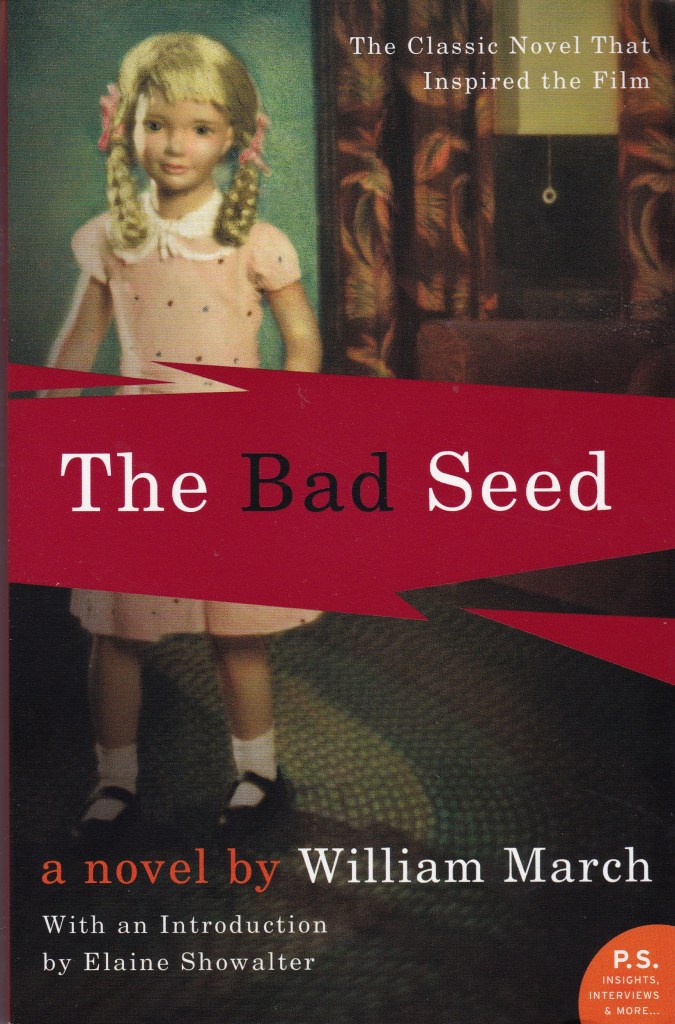
It was watching those afternoon movies where I first encountered The Bad Seed.

Later that summer, when Mrs Penmark looked back and remembered, when she was caught up in despair so deep that she knew there was no way out, no solution whatever for the circumstances that encompassed her, it seemed to her that June seventh, the day of the Fern Grammar School picnic, was the day of her last happiness, for never since then had she known contentment or felt peace.

The picnic was an annual, traditional affair held on the beach, an among the oaks, of Benedict, the old Fern summer place at Pelican Bay. It was here that the impeccable Fern sisters had been born and had lived through their languid, eventless summers. They had refused to sell the old place, and had kept it up faithfully as a gesture of love even when necessity made them turn their town house into a school for the children of their friends. The picnic was always held on the first Saturday of June since the eldest of the three sisters, Miss Octavia, was convinced, despite the occasions on which it had rained that particular day, and the picnic had to be held inside, after all, that the first Saturday of June was invariably a fine one.

If The Bad Seed has lost its ability to shock and horrify, it’s because in the decades since it was published (and adapted into both a play and film) the notion of a child being a killer has gone from being shocking to the general public to one that is kind of accepted; children do kill, and despite all the societal push towards sentimentality toward children. Rhoda is a sociopath, if not a psychopath; her inability to feel remorse or empathy or any other kind of human emotion is chilling to read about–she’s a stone cold killer, and clearly, she thinks nothing of killing to get something she wants: whether it’s the penmanship medal from her school, or a nice trinket promised to her, and then to shut up the janitor who sees through her and threatens to expose her; there’s a progression there. First she kills on impulse to get something she wants, then she coldly and calculatedly kills to protect herself. Rhoda is maturing as a killer, which is very chilling for the reader. The book is told entirely from the point of view of Rhoda’s mother, Christine–who is very slowly coming to realize, time after time, that her child is a monster, despite the innocence of childhood and everything we are taught to think, sentimentally, about children.

Psychology was starting to come into its own in the United States during the 1950’s, and you can see how crime writers took to psychology in that decade: The Bad Seed asks the question of nature v. nurture (although its answer is that it’s nature, genetic, and cannot be helped–and there’s some truth to that. I’m not entirely sure that sociopathy or psychopathy is learned behavior; are these cold-blooded killers born that way or are they creations of their environment? The solution Mrs. Penmark comes up with and executes in the novel is dramatically different from the film–the film had to abide by the Production Code, whereas novels had no such restrictions on them–and I believe the book’s ending actually works better than the film’s.

One thing that the book does brilliantly is depict the emotional turmoil and distress of the mother, slowly beginning to suspect and find proof that her child, that she loves so dearly, is actually a monster.

I first read this book when I was a teenager; I’d already seen the movie when I discovered the book on the shelves at the library, and so I checked it out and read it. I enjoyed it tremendously at the time–and it also had me watching other teens and young children for signs of sociopathy for a few years–and so thought it might be worth a revisit. It was, most definitely; it’s a bit dated, and of course the notion of a killer child isn’t quite so shocking as it was back during the Eisenhower administration–we’ve seen too many real life examples of this, and of course the trope of the killer child has been used, over and over again, in crime fiction and in films, so it’s not the brace of cold water in the face that it once was (kind of like how Beast in View by Margaret Millar was groundbreaking in its time–its still a great read–but what Millar did in that novel has been copied and imitated so much that it’s almost a cliche; one has to read these books with those sort of things in mind). Agatha Christie also used the trope of the sociopathic child (although in a quick google search it turns out Christie’s sociopathic child killer predated The Bad Seed; honestly, Christie did everything first).

It was a very pleasant reread, and as always, it’s interesting to visit (or revisit) books that were considered shocking in their time, only to have them turn out to be fairly tame–I’m looking at you, both Peyton Place and Valley of the Dolls–as well as to see how far the crime fiction genre has progressed. (I still consider Peyton Place to have a place in crime fiction, even though most people don’t. And while the crimes in the book may not be the driving point of the story, those crimes do impact everyone in the town in some way….there’s another essay to be written, probably after I reread the book at some point. It’s been awhile since I’ve revisited both Peyton Place and Valley of the Dolls….perhaps that can be my Christmas present to myself.

Speak Now

I’ve always been fascinated by politics and history; the two go hand-in-hand, and you really cannot understand one without understanding the other. (Economics are also a lot more important than is ever given credit in most histories–wars and exploration and colonization was, inevitably, always about markets and trade and thus money) I’ve maintained for years that history should be taught as the advancement of individual rights–the ups and downs of individual freedoms, rather than dates and battles and Kings and Queens and Emperors–and that study of individual rights also needs to examine prejudices and bigotry and zealotry, and how those three factors have poisoned civilization and humanity throughout much of its history. I also feel that, while the study of wars are important for their impact, the fact that the impact these wars had on the citizens of the country (countries) being invaded was also important. Putting humanity in the study of human history would not only make it more interesting, but would also further the understanding that should come with the study.

I tend to avoid books about politics, or political thrillers–the news provides enough stranger than fiction moments every day–and as a general rule, fictional films about politics rarely interest me, either. Paul and I avoided The West Wing for years, thinking a fictional show about our government couldn’t be interesting enough for us to get vested in; we were clearly wrong (but I still refuse to watch The American President.) Fletcher Knebel, a long forgotten writer of the mid-twentieth century, wrote political thrillers, and while I was aware of him when I was young, I never read any of his books; why read about fictional politics when actual history is available to read and study? But a few years ago, I read an article about one of his books, recently brought back into print, and intrigued me enough to want to read it.

It’s premise: what if a sitting American President begins to slowly lose his mind and grip on reality?

And I am sure you can imagine why that premise was intriguing.

Jim MacVeagh’s burst of laughter came so unexpectedly, his hand jiggled the stem of the wineglass, and a splash of champagne spotted the linen tablecloth. Sidney Karper, the Secretary of Defense, sitting on his right, grinned in shared appreciation and shook his head.

“Unbeatable, isn’t he, Senator? He just won’t be topped.”

“Nobody can touch him when he’s determined,” agreed MacVeagh. He wiped at his eye with a corner of his napkin and turned back toward the center of the long head table, cluttered with late debris of ashes and crumpled menus amid the sparkle of glassware.

The speaker, President Mark Hollenbach, was mock-solemn again after flashing a responsive smile for the spray of laughter which greeted his first sally. His was the honor chore of the night–the brief reply to the toast to the President of the United States which signaled the closing of another annual Gridiron dinner. The news correspondents had lampooned the Hollenbach administration and its foes in a series of musical skits, some sharp as stilettos but one belabored in its buffoonery, while the Marine Band orchestra in shining scarlet coats. played for the 550 diners.

I finally read this book while I was on vacation over Thanksgiving week, and found myself enjoying it tremendously. It’s a thriller, of course, and the main character is junior Iowa senator Jim MacVeagh. Jim’s a good guy, without too much ambition, with a wife he loves and a tween daughter he adores; he also is having an affair with the chair of the DNC’s secretary–not really a smart thing to do, but we see this self-destructive behavior from politicians all the time (although the idea that adultery is disqualifying for higher office has long since been shown up as a lie). After the Gridiron Club dinner, Jim is invited by the president to join him for a talk at Camp David–and it is there the story kicks into gear. Enormously popular President Mark Hollenbach has decided to dump his vice-president for the upcoming campaign–he’s been tainted with a whiff of scandal regarding a building project a campaign donor was awarded–and the President is interested in having Jim join him on the campaign trail.

Naturally, this is very exciting for Jim, awakening ambitions he wasn’t aware he’d even had, and realizing that, if selected, this would make him the front runner for the top of the ticket in four years–which of course is very exciting for any politician, particularly a young one–but as the conversation continues, Jim begins to become concerned, as some of the things the President wants to do in his second term are not only unconstitutional but borderline insane–for one example, he wants to wire tap every American’s phone, so as better to track and prevent crime, espionage, and foreign agents–and he also displays paranoiac tendencies. As Jim gets closer to the President and one step closer to being on the ticket, more and more evidence of the president’s instability is revealed to him….and he has to. ask himself–party or country? Patriotism or partisanship?

This is a terrific read, and certainly one any American today could identify with and get caught up in the story.

I’m now curious to read other works of Knebel’s, and then of course, Allen Drury’s terrific series of novels about Washington, beginning with Advise and Consent.

I do remember reading an Arthur Hailey novel about politics–yes, government was one of the industries he turned his research and writing to–called In High Places. (I read this during my Arthur Hailey phase; I learned alot from his books. I read The Moneychangers when I worked at a bank; he was spot on about day to day operations on the floor. I reread Airport when I worked at an airport; again, pretty spot on, despite the decades of changes to the industry since he researched and wrote the book.) And The Coyotes of Carthage, which I read earlier this year, was one of the best books I’ve read about rural politics.

I think you might enjoy Night of Camp David. I certainly did.

Style

Friday morning, and I had an absolutely lovely night’s sleep, thank you for asking. It’s the final day of the work week, the weekend looms, and as always, I have a million and a half things to get done before Monday. I somehow managed to fall behind on the writing again–by the time I was finished with my work-at-home duties yesterday I was exhausted again–and as such, didn’t write another word. So I need to get my writing going again today, knowing I am at least two chapters behind that need to be caught up, and yes–NO PRESSURE THAT AT ALL, is there?

I have some copy edits for an essay that dropped into my inbox this morning, which shouldn’t be too terrible an issue to deal with over the course of the weekend–then again, I’ve not really looked at them, either, so it could be absolutely horrifying once I open the document–but again, I don’t see that I won’t be able to get caught up on everything that must be done this weekend. What I really need to do is make a to-do list; I’ve been meaning to all week and yet somehow have not managed to get around to it yet. Gah. But that’s the kind of week this has been; 2020, after dragging all fucking year, seems to have now speeded up time now that it’s coming to a close, continuing to prove itself to be a shit-bag of a year.

Given how much optimism we all had for 2020 and what we ended up receiving, I am a bit afraid of 2021, to be completely honest.

I did manage to get some things done yesterday, and I managed to watch Superman whilst making condom packs yesterday; the 1978 version with Christopher Reeve. I hadn’t seen the movie in years–I saw it originally in the theater and then watched again when it was on HBO in the early 1980’s–and wasn’t really prepared for the impact it would still have, many years later, on a rewatch. As I watched, my nimble hands breaking off condoms in groups of four and shoving them into little plastic bags, along with a packet of lube and instructions on how to properly use them, I found myself catapulted backwards in time and remembering the time period. The movie’s slogan was You will believe a man can fly and you also have to remember the late 1970’s was when films–and special effects–were changed forever after Star Wars and Close Encounters of the Third Kind. Superman was the acme of super-heroes; perhaps the most famous, the most loved, and possibly the very first comic-book hero with superpowers, and bringing him to the big screen with a huge budget and special effects to make it look like he actually had powers was a huge deal. It was a huge hit, set the stage for several sequels, and showed Hollywood that comic book heroes were big-ticket items–it can easily be argued that there would be no MCU, no Arrowverse on television, and no Batman movies had there never been Superman first. The first sequel was also a huge hit, but the franchise began to run out of steam with the third, and the fourth was misbegotten from the very beginning.

On this rewatch, Christopher Reeve was even more perfect than I remembered, and Margot Kidder, whom I always believed was miscast, actually fit the role much better than she had in my memories. But what made the movie work–just as how the Patty Jenkins Wonder Woman worked–was how Reeve, at that point a complete unknown whose biggest role had been on the soap Love of Life, fit the role like a hand in a glove. He looked the part, had the right body for the part, and he just was Clark and Superman–and the physical differences between the two different characters–entirely dependent on how Reeve held himself, stood, and his posture–I could see how you wouldn’t see one as the other. Obviously, there were some flaws–how on earth did Lois Lane afford a penthouse with that glorious view and patio deck on a reporter’s salary? How did reversing the Earth’s spinning turn back time so he could save Lois–and didn’t turning the clock back change a lot of other things as well? DC was still in its Golden Age–the Crisis on Infinite Earths reboot was still some years in the future–and so this film fits into that comic book era; they were trying to update the comics and giving their characters more of modern flare and new costumes for the most part at this time, before realizing their universe was so convoluted and confusing they needed to start over. This was the period when Wonder Woman had gotten rid of her powers; when Supergirl was poisoned, which led to her powers becoming unreliable and actually coming and going beyond her control; when two more Green Lanterns turned up on earth in addition to the original; and Green Arrow going more in a Batman-like grim direction.

But it was an uplfiting movie, putting a clear-cut hero on the screen, and it is to Reeve’s credit that he made Superman’s integrity, code of ethics, and kind concern for all humanity from a two-dimensionality to a fully fleshed out, completely believable character that you root for. The John Williams score was excellent, and it really was perfectly cast–I apologize to Margot Kidder for hating her performance for all these years. It was also interesting to see the New York of the 1970’s (passing off as Metropolis), and remembering the way the culture saw the city in that decade (the Cynical 70’s Film Festival has also done a really good job of this); in some ways the perception of New York hasn’t really changed much since then, but it isn’t the same city today that it was back then. It was, I think, in the latter half of the 1970’s that Hollywood began to turn away from the cynicism of the decade and began making movies with happy endings or that were more uplifting in general–Star Wars, Superman, Rocky–the melding of those polarities in film deeply influenced the films of the 1980’s.

And on that note, I am heading back into the spice mines. Have a lovely day, Constant Reader.
Treacherous

And it’s Saturday, and my vacation is slowly but surely drawing to a close. Heavy heaving sigh,

It’s been lovely, actually, even if I haven’t been particularly inspired to do a whole lot this entire time. It’s always easy–and kind of a cop-out–to say, well, you needed the physical, intellectual, and emotional rest, but I really need to cut myself a break every now and again. The endless struggle between “feeling lazy” and “everyone needs a break” is an endless war inside my head; inevitably, the things I need to get done will get done and at some point, I’ll forgive myself for the rest.

I had a very strange inspiration for a short story the other day, which I scribbled down and have some vague idea of where the story will go; it’s called “The Sound of Snow Falling” and the first line is: It was the ice storm that finally broke him. I love that first line; whether it will wind up being a good story remains to be seen. But one thing I’ve never mined in my fiction is my utter hatred for cold weather; perhaps it’s time.

I actually worked on the book yesterday afternoon! It was lovely, and while it still needs polishing up some, I am confident that now that I’ve gotten past whatever the fuck it was that kept me holding back from working on it, I am certain I am going to get this done sooner rather than later–which is a very good thing, as time is running out very quickly. Today I have to run some errands, so I am planning on working on the book before I do that. The Iron Bowl (Auburn-Alabama) is today, and LSU plays Texas A&M tonight, so I need to try to get as much done as I can before the 2:30 kick off.

I did go to the gym yesterday and today my back muscles are sore and tight, so I am going to need to use the heating pad at some point today–probably while I drink more coffee and read some more of Night of Camp David, which is kind of scarily prophetic, given it was published originally in 1965. We also watched this week’s episode of The Mandalorian, which did a marvelous job of tying the show into the the original trilogy, the prequels, and the final trilogy–apparently, it also tied the show into The Clone Wars, which I’ve never watched (and perhaps should). We also found out the Child’s name–Gorgu–and as always, the show was enormously entertaining (also: a guest spot by Michael Biehn, of The Terminator and Aliens fame!) and visually stunning and splendid. It did occur to me last night that the show–in which the Mandalorian’s quest is to find Gorgu’s people–can’t ever really separate them, as their relationship is at the beating heart of the show.

The show is really one of the highlights of my every weekend, frankly.

We weren’t ready for bed yet, and were trying to find some stand-up comedian special to watch before hand–to no avail–when Amazon Prime suggested Porky’s to us. I had actually run across the movie when looking for things to add to my watchlist, and the film–from 1981–was a watershed moment in “teen movies”–when they turned from the unrealistic fluff from Disney or message movies to sex comedies. I assumed the movie wouldn’t hold up–I remember thinking it was really funny when I was twenty and saw it in the theater–and I was correct; the humor falls very flat in almost every case; the way women are treated–and the way they are expected to simply put up with it (and do) is horrifying, It’s a comedy predicated on the idea that high school boys are always horny and always trying to get laid–none of the boys have a relationship of any kind with any women–and the only female cast members exist only as potential sex partners–Wendy is the female equivalent of the boys, and despite her easy way with her own favors, (basically the boys see her as a willing sex partner who can be persuaded to have sex with just about anyone) she is actually popular and has a lot of friends. (This struck me as wrong when I originally saw it–she would have had a bad reputation-and none of the girls would have been friends with her) The other women in the cast are Miss Honeywell (a very young Kim Cattrall)–again, everyone calls her Lassie because she gets very aroused by the smell of the equipment room and howls loudly as she gets laid–and an uptight, overweight, gym teacher known as Beulah Ballbricker, that they all call Ball-breaker and I suppose her sexual repression and determination to keep the girl students safe from the lusts and perversions of the boys is played for laughs. She represents the sexual frustration and repression of the time, I suppose, that all the kids are rebelling against; but you also can’t help feel sorry for her in some ways.

The movie clearly doesn’t hold up–there are still some moments that are funny–but it depends entirely too much on very low sex humor for laughs, and its very vulgarity was what made it funny; it was shocking, and you would laugh back then because you couldn’t believe they were doing these things in a movie for laughs. Some forty years later, it’s no longer shocking, so it’s not funny anymore and it’s just plain vulgar. They also tacked on a subplot about prejudice and anti-semitism to, I suppose, give the movie a “serious” message about how stupid bigotry actually is in reality. And yet it–along with Fast Times at Ridgemont High and Animal House of a few years earlier–changed the teen movie forever, and paved the way for other movies of the 1980’s like Risky Business, Sixteen Candles, and The Last American Virgin. With the enormous success of this low-budget indie film, along with Ridgemont High and Animal House, Hollywood finally got the message that you can’t go wrong with sex comedies for teens–and teen movies, while still kind of extreme in some ways, began to more accurately reflect what life was like for teenagers, as opposed to the Frankie-Annette movies of the 1960’s and the Kurt Russell films for Disney in the 1970’s; or began developing films in which the teens were actually fully realized characters–I’m not sure how realistic the notion of running a brothel from your parents’ home in a wealthy suburb is. (Although now that I’ve said that, Risky Business was probably based on something that actually happened.)

There’s a really interesting essay or dissertation or even book there, methinks, but I’m not enough of a film expert to do such a thing–although it would make for interesting reading.

And on that note, I am heading into the spice mines. The caffeine is beginning to kick in, which is most lovely, and I am most anxious to get functional and to work on the book as quickly as I can. Have a lovely Saturday, Constant Reader.

Lover

And now it’s the day after the holiday, where Americans ignore all sanity and safety precautions and slam into stores long before sun-up for bargains and to get their Christmas shopping finished. I don’t know if this is actually happening this year or not–I flatly refuse to participate in the nonsense of greedy consumerism (the antithesis of the holiday they intend to celebrate) known as Black Friday; for years, this was the day I drove home to New Orleans from Kentucky. In these pandemic times, I have not bothered to find out what the retailers are planning or planned in terms of safety and so forth; there was no need for me to know, frankly, and at some point today I’ll go to some news sites and see the horrors that transpired for myself.

No thank you.

I finished reading The Hot Rock yesterday, which I enjoyed very much, and then moved on to Night of Camp David, by Fletcher Knebel, which is also interesting. Knebel–I don’t know if anyone else remembers him, but he used to write political thrillers back in the 60’s and 70’s (probably the best known work of his would be Seven Days in May, primarily because it was also made into a film, and the subject–the US and the USSR on the brink of nuclear war–was timely and always in the back of everyone’s mind, right up until the day the USSR collapsed). I’ve never been a big fan of political thrillers, to be honest–political fiction has never really interested me too much, primarily because the reality is too much like fiction as it is, and for another, so much world building to do, even if you simply take the US government and political system as it is and simply graft your story and characters onto it–even if you use the actual history as the history of your new world. Paul and I avoided The West Wing for years for this very reason–why get vested in a fictional world of American politics when the real world is right there in front of you all the time–but we discovered it one day when Bravo used to do the marathons all the time, and went back and watched it from the beginning, and it remains one of our favorite shows of all time.

So, it’s entirely possible I would thoroughly enjoy political thrillers after all–I’ve certainly enjoyed, or at least never minded, when thrillers (like those of Robert Ludlum) brushed up against reality or created their own fictional American political world.

Like I don’t have enough to read already, right?

I was reminded of Knebel and his work back sometime during the past four years, as some website (maybe Crime Reads?) did a piece on this particular book, which had returned to print, and focused on a president who was losing his sanity, and the only person who really was aware is the first term, junior senator from Iowa, whom the president has taken a liking to, and keeps inviting to Camp David for late night conversations where the president tells him his insane, Fascistic intentions for his second term. (Yeah, can’t imagine what triggered the publisher to bring this back into print, can you?) I had never read Knebel back in the day, but reading this piece made me curious, not only about this book but about Knebel in general. The Cynical 70’s Film Festival has also reminded me of the deeply cynical political fictions of the time (I really want to read The Manchurian Candidate)–so many thrillers set in or around politics back in the day–and, of course, conspiracy theories flourished. (The true heyday of the JFK conspiracy theories was clearly the 1970’s.)

All in all, yesterday was a highly enjoyable, relaxing day; today will be more of the same. Sure, I did some cleaning–I cleaned out two of my kitchen cabinets, reorganizing them to make them more functional–and of course i made a turkey roast in the slow cooker, which was quite marvelous. We finished watching season one of Mystery Road, which was quite good, and then moved on to the first three episodes of the HBO MAX series, The Flight Attendant, which was based on a Chris Bohjalian novel, and stars Kaley Cuoco of The Big Bang Theory in the lead. Cuoco is tremendously appealing and quite talented. Working the first class cabin on a flight to Bangkok, she becomes involved with one of her passengers, played by Michiel Huisman, and agrees to go to dinner with him in Bangkok. She blacks out during the evening–she’s an alcoholic and in severe denial about it–and wakes up next to his bloody, dead body (his throat was cut) and has absolutely zero memory of the evening before. It’s an interesting mystery, and as I said, Cuoco is terrific in the lead, and is surrounded by a terrific cast.

There really aren’t enough books–particularly crime thrillers–built around flight crews, frankly. I kept thinking about that last night as I watched; I have a short story in progress about a gay flight attendant called “The White Knuckler”, which I’ve never finished, and it also reminded me of how much I love the Vicki Barr Stewardess mystery series for kids.

So, what’s on the agenda for today? At some point I need to get to the gym, and of course the kitchen is in ruins. I am probably going to clean up the mess in the kitchen this morning, then move onto my easy chair to read some more, and then I am going to write all afternoon before going to the gym. Since we watched all the episodes of The Flight Attendant that are currently available–there won’t be a new one again until Thursday–we’re going to need to find something else to watch tonight to entertain us. Which can sometimes prove challenging, but there are worse things.

Have a lovely day, Constant Reader.
Dress

And it’s Thanksgiving, and a holiday! Huzzah for holidays! Thanksgiving isn’t really one of my favorites (other than the obligatory four day weekend that results; I wonder who had the brilliant idea to have the holiday fall on a Thursday instead of Friday in the first place? Give that person a Nobel Prize, please, even if it’s posthumous), but I’m really not much of a holiday person now, nor have I ever really been.

For me, it was always about time off–from school, from work, from responsibility–and now as an adult? I just appreciate paid time off from work, which is always welcomed.

I actually slept late this morning, too–almost all the way to nine thirty, without waking up once and looking at the clock and thinking oh go back to sleep for a bit. This is, obviously, unusual; I must have needed the rest, frankly, so I am not going to question it at all. I am taking the day off from everything guilt-free–it’s a goddamned holiday, so my guilt can just fuck right off–and in a moment, once this is finished, I am going to take my cappuccino into the living room and embrace The Hot Rock and some short stories.

I am making a turkey breast roast (that sounds just wrong) in the slow cooker today in a nod to the holiday–it’s a very simple recipe and then when it’s done I shred the meat with a fork, so it’s really pulled turkey–and yes, I make boxed stuffing because a) it’s perfectly edible and fine and b) if you use chicken broth instead of water, it’s even better. Plus, it’s easy. And the older I get, the more I embrace easy. (I still, however, will make a cheesecake from scratch because it’s so much better.)

I try not to engage much on Twitter–tempting as it may be, the amount of trolls there is truly amazing, and I certainly don’t have the time to bother with keyboard warrior trash– but at the same time, Twitter can be highly entertaining. (My standard rule of thumb for engagement is this: if I start writing an angry and/or snarky response to something someone has tweeted, I either report the original or block the person. It’s enormously cathartic.) I remember being riveted last Christmas, for example, by the massive meltdown of RWA (hard to believe we haven’t reached the one year anniversary of that, isn’t it?).

One of the most enjoyable things I’ve watched/read/scrolled through was the conservative reaction, led by Grifter Supreme Candace Owens, to Harry Styles appearing on the cover of Vogue in a dress. Harry, obviously, doesn’t have a fuck to give about pearl-clutching trash like Owens and her audience; it’s actually lovely to see such a handsome young man with a big career secure enough in his own masculinity to don a dress on a major fashion magazine cover–and it’s also historic, as he is the first male to ever grace a Vogue cover (something Owens herself will never do, but the thirst for it is fucking real). As RuPaul has famously said, “we’re all born naked and everything else is drag.” Fashion and styles change all the time–and it really wasn’t all that long ago that men wore make-up, wigs, heels, and tights. So, apparently, Owens doesn’t believe the Founding Fathers were masculine enough for her?

Anyway, it was thoroughly enjoyable watching her get dragged for the filth she is on Twitter. Like so many on the right (and let’s be honest–there are some on the left as well) she’s in it for the grift; being the go-to female black voice for the right is apparently lucrative enough for her–married to a white male whose own “masculinity”, as defined by the right, is questionable–to continue being a sideshow barker trying to stay relevant and keep the cash coming in.

And speaking of grifts, Ann Coulter certainly has become irrelevant, hasn’t she? (I am NOT complaining. Back in the day, I used to read her books–I used to read a lot of right wing polemics passing as non-fiction political tomes because I thought it was important to not only see what they were actually selling and saying, but to try to understand their position. All it did was convince me that they were sideshow hucksters hawking snake oil and grievance, so I abandoned that around 2003. And trust me, if you’ve read one Ann Coulter pack of lies from cover to cover, you don’t need to read any others.)

There’s only so much toxicity one brain can handle, frankly.

We started watching an Australian series on Acorn last night, Mystery Road, which stars Judy Davis and a lot of indigenous Australians (which is awesome); it’s interesting and entertaining, and I would imagine is going to have a lot to say about Australian racism and how the indigenous there are treated. Judy Davis is always marvelous in everything (I can never watch the Renee Zellweger Judy Garland film because I’ve already seen a definitive Judy Garland, and that was Judy Davis’), and the rest of the cast are quite good as well. The premise is very simply that two young man vanish in the middle of a wasteland–taken from their vehicle, with the doors left open and the motor running–and it also is taking a look at the community itself; I suspect the show is a slow burn. They also bring in police detective from elsewhere who is indigenous himself (played by Aaron Pederson). The two boys who disappear are a white backpacker and a local indigenous soccer hero; it’ll be interesting to see where the show goes. (I had to look up the actor, and apparently the second season is set elsewhere, with Pederson working with a new local cop in a different location)

I’m not sure how we’ll spend today, but whatever we do, it will be relaxing and chill.

Have a wonderful Thanksgiving!

How You Get The Girl

Friday morning and all is right in my world–at least so far so good, one would think.

The weather has been truly spectacular here these past few weeks–despite dipping into the “almost too cold for Gregalicious” category after the sun goes down–and I’ve been really enjoying it. LSU is playing tomorrow–although I don’t have very high hopes for the game, since the program is now in turmoil, not only from having a surprisingly bad season but from allegations of sexual assault from players and ensuing cover-ups, which is despicable, frankly–and of course the Drew Brees injury has things looking rather bleak for the Saints as well. Ah, 2020 football season–so much worse than I’d ever thought it could be for fans in Louisiana. Heavy heaving sigh.

I reluctantly came to the conclusion yesterday that I am not going to try to get my story finished for that “monsters of Christmas” anthology. Much as it would be fun to be in the book if accepted, while the pay would certainly be lovely and welcomed, and I also loved the idea of trying to get a story written and publishable (maybe) in such a short period of time–despite all of those things, I really shouldn’t take time away from either the book or the other story already in progress that is developing nicely. It’s not the smartest thing in the world to do, and can I really spare the necessary time to get it done? Probably not, so while I am not crossing it off my to-do list entirely, I am not going to pressure or push myself to get it done.

My back is still sore this morning–but sitting in my easy chair with the heating pad while making condom packs certainly helped dramatically. I’m still not entirely sure what I did at the gym to cause this soreness, and the last time I went to the gym I didn’t feel it getting worse as I went through my workout, so who the hell knows? More heating pad today, and hopefully when I go to the gym later it’ll be okay.

Yesterday I watched two films while making condom packs, and while both fit squarely into the Cynical 70’s Film Festival, the other also crossed over, theoretically, into the Halloween Horror Film Festival–or would have, had it not been so incredibly terrible.

The first was Deliverance, which was an enormous hit on its first release, made Burt Reynolds a bonafide movie star, and has added so much to the common vernacular that people probably quote it without knowing the source material. While I knew the whole “squeal like a pig” thing came from Deliverance, I did NOT know “he’s sure got a pretty mouth” also came from the film. My parents took my sister and I to see it at the drive-in (and in retrospect, what in the name of God were they thinking? That movie is definitely inappropriate for junior high school students), and while I do not recall the other movie that played with it (which might have explained the choice better), I was pleasantly surprised in some ways by Deliverance. For one thing, it’s beautifully shot in the back woods/mountains of Georgia–breathtakingly beautiful. James Dickey wrote the screenplay based on his only novel–he was primarily known as a poet, and was also an alcoholic–and I’ve tried several times to read the book; I have a copy on my shelves somewhere right now. The film definitely fits in that paranoid 1970’s sub-genre of city people discovering how truly terrifying the country can be, despite the entire American mythology of the country and rural communities being the real America (which still rears its ugly head from time to time today). I could write an entire essay debunking that myth, frankly, as I am rather surprised no one has ever written (doesn’t mean someone hasn’t) an essay or a treatise about this entire sub-genre of film and fiction novels.

Deliverance is also an interesting exploration of 1970’s masculinity; the concept of masculinity, and what is traditionally masculine, was already starting to change and shift around the time the book was written and the film made; in its four characters we see the four masculine archetypes of the time, and how they compare/contrast with each other. The basic premise of the story–a river is being dammed to create a lake, and the dam will provide hydroelectric power for Atlanta, while the lake will flood towns and force communities to relocate away from land held in their families for generations, so these four men decide to canoe down the river one last time in a kind of “back to nature” type weekend thing that was becoming more and more popular with city-dwelling men whose city lives were beginning to make them think they were soft. Burt Reynolds, with his rubber zip up sleeveless vest, with the zipper strategically unzipped enough to show off the thick black pelt of hair on his chest, stood in for the masculine ideal; a strong man who, despite living in the city, only truly comes alive when pitting himself against nature in a game of survival; he is also the only member of the party who understands the dangers of the wilderness–the other three men in the party all think of it as a fun lark. He keeps referring to the Ned Beatty character as Chubby–he’s out of shape and not as fit; out of his element in the wilderness and often complaining and unable to meet the physical demands of the trip. Jon Voight, still at the height of his blonde youthful beauty, is prettily masculine–overshadowed by Reynolds’ machismo, but able to rise to the occasion and do what needs to be done. The fourth member of the trip–played by Ronny Cox–is yet another soft city type, definitely out of his element; while not seen as useless as the Ned Beatty type, also not as useful in a crisis as he could have been. The film’s bottom line is ultimately about survival, and who will survive when a fun weekend goes wrong. Deliverance also plays into a lot of the stereotypes about poor rural Southern white people–in fact, I would go so far as to say that Deliverance is responsible for cementing a lot of those stereotypes into the public consciousness. It’s a very good, if slightly bizarre, film; it certainly has to be one of the first films to depict male-on-male rape (and that’s one of the flaws in the film; why on earth did that happen? Why did the two rednecks attack them? Maybe it makes more sense in the book), and one of the reasons I always wanted to read the book was to see if there was more information, more explanation, to make the story work better. But I never have been able to get past the first chapter–Dickey was also one of those hard-drinking macho bullshit Hemingway-type writers, oozing with toxic masculinity, and that really comes through in the first chapter of the book, which is as far as I’ve ever gotten without putting it aside with a wince. But there’s an interesting essay to be written about masculinity and how it is portrayed in the film; reading the book and including it, with a comparison/contrast, could be enlightening.

The second half of my double header was Damien: Omen II, which is now available on Amazon Prime–but wasn’t back when I rewatched The Omen and The Final Conflict, the third part of the trilogy. Damien is just a bad movie, from beginning to end; it opens shortly after the conclusion of the first film, and the archaeologist in the Holy Land, Bugenhagen, telling a friend that Damien Thorn is the anti-Christ, proving it by showing him a newly excavated wall where a medieval monk who was visited by the devil and went mad, painted the images the devil showed him; amongst those images are the anti-Christ at numerous stages of his life–and he looks like Damien Thorn. Bugenhagen also has the ritual daggers that must be used to kill Damien…which is interesting, since he gave them to the Gregory Peck character in the first film, who was trying to use them at the end when he was killed; how did the old man get the daggers back? Was there more than one set? The rest of the movie is about Damien slowly learning who he is, while people continue to die around him, including his cousin/best friend. Damien was taken in by his father’s brother and his second wife, played by William Holden and Lee Grant (and just like in the first film, they are way too old to have thirteen year old sons), and the movie makes no sense, isn’t scary in anyway, and just really comes across as a pale imitation of the first, which wasn’t very good to begin with.

I also read a short story last night, from The Darkling Halls of Ivy, and while I did enjoy reading the story, “Einstein’s Sabbath,” by David Levien, in which a Princeton student after the second world war, one who was on the ship that sent the planes with the atomic bombs to Japan, comes to Professor Einstein’s home to blame him for the use of the bombs, and their creation. It’s an interesting story, but like the Jane Hamilton, not really a crime story per se; which is the only real problem I had with it.

And on that note, I am heading back into the spice mines. Have a lovely Friday, Constant Reader.