Lightnin’ Strikes

I have mentioned numerous times that I was asked last year–early last year? I don’t recall precisely, but that’s a pandemic year for you–to write a Sherlock Holmes story. I was enormously flattered–and let’s face it, if anyone offers to pay me to write, I will–as I inevitably am whenever someone wants me to write for them; as I have mentioned before (a lot), it’s rare for me to get validation for my writing, and so being included (which is a whole other neurosis I will inevitably write about someday) is so enormously flattering that I feel like I can’t say no; being asked to write something also is such a rare thing for me that I am always afraid to say no because I fear I won’t ever be asked again.

Ah, the joys of being a writer. I probably could stand to be a little more egocentric when it comes to my writing, and build up more confidence…I seriously aspire to the confidence of a mediocre straight white male writer.

In those first few years during which I shared the upper floors at 821 B Royal Street with Mr Sherlock Holmes, it was my custom to rise early in the mornings and take a walk on the earthen levee containing the mighty river. Holmes was by habit a late riser, rarely springing out of bed before the noon-time whistle rang along the waterfront, but taking such exercise was good for the damage to my leg caused by the wound – a souvenir of the Spanish War.

I enjoyed those quiet, early mornings, watching the ships sailing up the river to the docks from foreign ports, and the barges floating down the currents from points as far north as Cincinnati, St. Louis and Memphis, all while I strolled with my walking stick along the levee. Seeing the large bales of cotton being unloaded as the morning mists arose from the dark muddy water, the unloading of crates of coffee and bananas from the central American republics, I marveled each morning at the hubbub of activity that created and maintained this most curious of American cities, rising from the swamps like something from a forgotten myth.

After, I would adjourn to my favorite café, the Aquitaine, mere blocks from my home, where I would read the morning papers while enjoying coffee and Italian pastries.

This particular morning in early December, I cut my morning walk short. The temperature had dropped most precipitously overnight, and I had not chosen a heavy enough jacket. My leg ached terribly from the damp and the cold, and I limped along the banquettes to the café. My usual table was in the back, away from the hustle and bustle and smells of Royal Street. In those days, the French Quarter stank to high heaven, malignant odors hanging in the thick wet air from breweries and sugar refineries and, of course, seafood. Holmes often burned heavily scented candles in the various rooms of our apartments, particularly the parlor whose windows opened out onto our third-floor balcony facing Royal Street.

But on this morning, there were no tables to be had. The cold and damp had driven others inside, seeking the solace of warm air, fragrant Italian pastries, and piping hot café au lait. So, disgruntled, I paid for my papers.

I noticed a headline in the lower right corner of the front page of the Daily Picayune: FAMED ITALIAN OPERA SINGER ADDS DATES FOR NEW ORLEANS ENGAGEMENT.

I have mentioned before that I’ve never been much of a Sherlock fan, as written by Doyle. I read The Hound of the Baskervilles when I was a child, and didn’t really like it near as much as I felt I should, and never went back to read the rest of the Holmes canon (yet another reason I say my education in the classics–in general and in my chosen genre–was sorely neglected). I read the Nicholas Meyer pastiches in the 1970’s, and have since read other Holmes-fiction by modern writers; there was a story in particular by Lyndsay Faye in one of The Best American Mystery Stories collections I particularly enjoyed, and of course I am completely smitten by Laurie R. King’s take on the character in her marvelous Mary Russell novels. I’ve watched a lot of Holmes film and television adaptations (not caring particularly for the Robert Downey Jr version, alas), and of course like so many others was completely smitten by Benedict Cumberbatch’s interpretation in the modern series (I also liked Elementary, but we never finished watching its run). I had bought the Baring-Gould compendiums a few years back from eBay; lovely, enormous and richly bound editions that I treasure. In preparation for writing my own story I went into the Baring-Gould to read some of the short stories, to get a feel for Doyle’s style and his characterizations.

(It is interesting, though, that my favorite fictions about Holmes are written by women…and King’s stories center a woman.)

I had come up with this title, “The Affair of the Purloined Rentboy,” years ago. Little known fact: I originally envisioned the Chanse series to have titles all derived from Poe: Murder in the Rue Dauphine of course was paying homage to “The Murders in the Rue Morgue; and I thought the next would be The Purloined Stripper and go from there. Alyson Books said not to the Poe conceits, although they liked Murder in the Rue Dauphine as a title (another little known fact: the book was originally called Tricks; when I first met Felice Picano and picked him up at the airport here for the Williams Festival we chatted on the drive into the city and he nixed Tricks, and the Poe homages were HIS idea, which I don’t even think he himself remembers) and wanted me to brand the book with “Murder in the” titles. But I always liked The Purloined Stripper and kept that title in my back pocket, as it were, and when editor Narrelle Harris reached out to me for a Holmes story, to be set in New Orleans during any time period I chose, that title sprang into my mind and, having only recent read some New Orleans history (and been fascinated, at long last, by Storyville and the tales of the old Quarter) I thought to myself, yes, I can write about the pre-Great War period and include Storyville in it…and instead of a stripper I’ll use a rentboy. There had been allusions to rentboys and gay bars in the Quarter in the New Orleans histories I’d been reading–often times, when a client’s tastes ran that way, a madam would send one of her bouncers to the gay bars to find someone who fit what the client was looking for, appearance wise; I thought that was interesting. Only a few bordellos houses actual rentboys permanently; even in the bawdy houses of Storyville men who were interested in other men were reticent about putting voice to their desires….and isn’t “The Affair of the Purloined Rentboy” a lovely title?

And yes, it’s one of my favorite titles, and one of my favorite stories of my own.

As I said, it was a challenge for me to write it–the original submission required a significant revision; but as someone who appreciates editorial input I didn’t mind in the least–and as previously mentioned, it also inspired an appreciation for Sherlock Holmes and Conan Doyle in me. I keep thinking it would be fun to do more “Sherlock in New Orleans” stories; I may do just that very thing. I have some ideas that have been bouncing around in my head for him since finishing this story; I also liked the new universe of New Orleans I created for him–which inevitably will be tied in some way to my other New Orleans universe as well– I really cannot help myself when it comes to linking all of my work together.

Here is a short interview I did about my story: https://www.clandestinepress.net/blogs/clan_destine_press_blog/the-only-one-in-the-world-greg-herren-interview?fbclid=IwAR10KeDfVRv9Tcp9xioQ4aE7Fj4CUNdibVdVwdsjONN7ozvxKVFfF6gUTxw

And here is the editor talking about my story: https://narrellemharris.com/short-stories/narrelle-m-harris-on-greg-herren/?fbclid=IwAR0ei8LLFJjZaB0ATV3IKwg1s8NBcgapvQOFYe0PaGVNdV2LFMBOf5bw_8A


Unlearn This Hatred

Tuesday morning and it seems quiet outside; rain is still in our forecast (every day for two weeks, with the exception of this Saturday) with thunderstorms predicted to roll in around this very time that I sit here writing this–but as I said, at the moment there’s nothing but stillness and quiet outside my windows. How long that will continue to hold remains to be seen, however; although the old adage about our weather forecasts from May thru October certainly holds true all too often: every day’s forecast is hot , humid, chance of rain.

I slept pretty decently again last night, which is remarkable and lovely; I was very tired last evening and as such, was fairly confident that a good night’s sleep could be had, and I was correct. I forgot to set the alarm last night, but woke up five minutes before it would have gone off had I turned it on, so rather than risking it, just went ahead and got out of the bed. Yesterday was a fairly good day, all things considered; I got my inbox under control (thanks primarily to all the work I did on it Sunday afternoon; now it’s a matter of keeping up with it so it doesn’t get so out of control again) but I can also look at it now and not feel defeated before I even get started with it this morning, which is an enormous plus. I do have some things to take care of today; the kind of odious chore I inevitably always put off–I have to make phone calls. Yesterday I made two of the odious calls I hate making; scheduling an appointment to take my desktop computer into the Apple store to see if they can install an OS into it (scheduled for this Friday morning) and I also scheduled an eye appointment in Metairie that same morning (the Apple Store is actually in Metairie, at Lakeside Mall); today I have to schedule the dentist and I have to call my doctor’s office regarding prescriptions. I am not certain why I hate doing these sorts of things and put them off always; they inevitably are never painful to experience and yet somehow…I just can’t make myself do them, ever; I just don’t like doing things that other people describe as adulting.

I suppose it has something to do with my innate refusal to accept the fact that I am, in fact, not only an adult but an older one, at that.

We watched some more episodes of Jupiter’s Legacy last night, which is entertaining in and of itself, but there are some issues with it–we really don’t like the character of Chloe, and they seem determined to shove her down our throats all the time–although I imagine had we read the graphic novels the show is based on (as were Watchmen and The Boys) that might have made a difference in our perceptions. I would go so far as to say of the three shows about alternative superheros (non-DC and non-Marvel, which have become cultural touchstones for us all), this is probably the weakest entry; it clearly didn’t have the money behind it that the other two shows did, and sometimes the cost-cutting measures are fairly obvious. It’s also incredibly difficult to structure a limited series with two different timelines (I frankly admire the attempt to do so), one which is set in a distant past and intended to show how the original superheroes on the show got their powers in the first place, as well as a modern timeline in which the question of adapting the heroes’ code of honor and behavior must needs be changed and adapted to fit threats which are becoming more and more dangerous and lethal; with some heroes dying as a result. That, to me, is the heart of the show’s present-day story, and much more interesting than the one set in the past; if the story of how they originally got their powers doesn’t somehow tie in conclusively to the current time story, then the origin story (not really explored in either Watchmen or The Boys) will seem as though it was merely filler, padding the show out to more episodes than perhaps necessary.

On the other hand, maybe I should just kick back and enjoy the show for what it is and not think about it too hard: sometimes a show is, in fact, merely intended as an entertainment with no deeper meaning.

Although sometimes I wonder if that is part of the problem with my writing; I never think about a “bigger picture” when I come up with an idea for a book or a short story; I just want to tell the story I am thinking about, rather than trying to place it into the context of our modern day world or culture and just try to tell it. It’s definitely harder when you do try to make a bigger point, and incredibly disappointing when people consistently don’t see it–which is, of course, the writer’s issue, not the reader’s; which also leads to the beginning of the spiral into Imposter Syndrome, which I usually don’t need any help to reach–but I do remember that I used to take those things–themes, points, underlying messages–into consideration when I used to write my books. Of course, it’s entirely possible that I have continued to do so, and simply don’t remember anymore; it is truly terrifying how bad my memory has become over the years.

Ah, there’s the thunder–which means today’s storm is arriving just in time for me to leave for the office! Hurray. Can the flash flood watch be far behind? I think not.

And on that note, best to head into the shower so I can go to work. Have a lovely Tuesday, Constant Reader!

Plastic

Sunday and a gray morning here in New Orleans. We’re supposed to have thunderstorms (some severe) throughout the day; of course I have to make groceries and go to the gym at some point–which means watching the weather to see when I can make a break for it. But other than that, I have the entire day relatively free; I finished the revisions of Bury Me in Shadows and turned them in yesterday to my editor. I think I caught everything; it’s a tricky manuscript. But as I revised and edited yesterday, I was pretty pleased with it, overall; which is a switch from the usual. I also realized one of my problems with reading my work once it’s finished is that I am rarely, if ever, able to turn off editor-mode; because I generally read my work with an eye to editing and fixing and making it stronger–and I use that mindset when I go back and read things after they’ve been published. I don’t know if there’s a switch in my head I can flip to make that change, but here’s hoping.

Paul went to a party last night–I could have gone, but was a little worn down from finishing the edits, so I stayed home and watched a documentary series on the Smithsonian Channel called Apocalypse: The Second World War, which was quite interesting to watch. Almost all of the footage used in the series was shot either by professional documentarians or journalists covering the war, or amateurs…I never cease to be amazed when I see how young the American military were during this conflict. World War II is endlessly fascinating to me, because it was such an enormous turning point for the world and civilization; the world was a vastly different place after the Axis surrender than it was before the Nazis invaded Poland in 1939. It’s been a while since I read any fiction about the war–when I was a teenager I read a lot of it, as well as a lot of post-war fiction–and I realized I’d rarely read any fiction from the point of view of soldiers actually fighting on the ground or in the air (other than The Young Lions by Irwin Shaw, for the most part I read things like Herman Wouk’s The Caine Mutiny, The Winds of War/War and Remembrance, etc.). I’ve never read Norman Mailer’s The Naked and the Dead, for example, or any of the post-war novels that sort of glutted the market in the decades following. I got down James Jones’ From Here to Eternity–I bought a copy of the unabridged version, which was released by the estate sometime in the last decade, with all the parts the publisher originally removed restored–and I think I am going to take that with me to read when I go visit my parents later this month. It’s one of my father’s favorite books and movies–it’s also been a hot minute since I’ve seen the movie–and since my main character in Chlorine served, it’s probably not a bad idea for me to read it. I read the first couple of pages yesterday evening before I went to bed, and it’s actually quite good…so I am looking forward to reading it. After I finish the things I need to get done today, I am going to curl up and read The Butcher’s Boy with an eye to finishing it today, so I can dive into A Letter of Mary by Laurie R. King.

One of the more interesting things about having all these streaming services and apps is the ability to find treasures like the Smithsonian Channel buried inside of them. As Constant Reader has undoubtedly noticed, I love documentaries, and now that we have such a glut of streaming services we pay for, I am now searching through them for documentary channels and so forth, and have been enormously pleased with what I have found thus far. (I also took advantage of a special deal for Shudder yesterday–two months at 99 cents each, before reversion to regular pricing, so am going to up my horror game for a while) There’s really never a reason to be bored, is there, with the wealth of streaming services out there? I can certainly always find something, no matter how obscure–which is also why I refuse to “rent” something to stream–although I am thinking about biting the bullet and paying to stream The Last Picture Show, which I really do want to see again.

I cleaned and organized and filed yesterday as well, which has left the kitchen looking–well, if not tidy, certainly in much better shape than it had been in–and I also started another donation box of books. I also want to start clearing out the storage attic here in the Lost Apartment, which isn’t going to be easy, and will certainly make a mess in the living room–which still looks like a storm struck it–but I really do want to start getting rid of things we don’t really need anymore, and there are a shit ton of boxes up there of unnecessary things. Progress may be incremental, but progress is progress.

And I should probably, at some point, start revising and editing the Kansas book, but I think I am going to take this week off from novels.

I started writing a short story this past week–really, just the opening sentence and a second paragraph–which also came from a novel idea. The book idea arose from a joke with some writer friends about noir fiction and noir covers, with their scantily clad sex bomb femme fatales; I joked that someone should write a noir about a strip club in the French Quarter and call it Girls! Girls! Girls! so the cover could have poll dancers and so forth on it; which then of course started the wheels in my creative brain turning and meshing the gears. A character I introduced in the later Chanse books–who eventually got her private eye license and he took her on as a partner–had worked as a stripper in the Quarter to put herself through UNO; I liked her a lot (even though her name is escaping me at the moment) and had even thought about making her the main character in a series, with Chanse as part of her supporting cast. But this was different, and called for a different character–for a while, when thinking about this, I toyed with the notion of an undercover cop or FBI agent; but then thought, in this time, could a woman be assigned to go undercover as a stripper? Maybe, but it could prove problematic. And then I remembered an intern from years ago, when I worked at the Community Center, who worked part time at the Hustler Club as a “shot girl”–her job was walking around with a tray with shots in test tubes. When someone bought one, she’d place the test tube in her cleavage and have to lean forward to dump the shot in his mouth. She hated it–she was a lesbian–but the money was so damned good she only had to work two nights a week and made enough to pay the rent and the bills and so forth. Someone could easily go undercover a shot girl–which, while still demeaning, wasn’t as demeaning as stripping. But the other day for some reason I was thinking about this again, and the thing that made the most sense was that one of the shot girls gets picked up by Vice and is forced to become an informer….which would make her walk the line between the cops and her crooked, organized crime employers, as well as with her co-workers. So, when the opening occurred to me the other day, I wrote it down and saved the file as a short story called “Shot Girl” (thereby adding yet another file to the “unfinished short story” list). I think maybe this week I’ll work on one of the unfinished stories in the drawer.

And on that note, it’s time to head into the spice mines. Have a lovely day, Constant Reader, and I will check in with you again tomorrow morning.

Salvation Theme

Reading has always been my escape from the realities of the cruel, cold world. As long as I can remember, I found solace in books–I could always open a book and escape from realities I didn’t want to participate in, or when the world became too much, there was always the comfort of a story about other people and another world where I could go to get away from it all.

When I was a kid, I was more interested in stories about women and girls than I was in stories about boys; I couldn’t really relate to boys as easily as I did to girls. This was, I think, a part of the strict gender divide in the society and culture I was born into; there were specific and clear differences between things for boys and things for girls. Girls played at housekeeping and mothering; boys were supposed to be outdoorsy and adventurous and active. I was not an outdoorsy, adventurous, active little boy; all I wanted to do was be left alone with a book–and the more my parents tried to get me interested in boy things the harder I stubbornly resisted. I never understood why it was so wrong that all I ever wanted to do was read.

I think that part of the reason I’ve always preferred books by and about women are because I can relate to them more, if that makes sense. As someone who never became vested in what society viewed as what masculine behavior is, those behaviors–not always necessarily toxic, but certainly steeped in it–inevitably make me lose interest in the character and their story.

Likewise, one of the reasons I preferred Mary Stewart to Victoria Holt and Phyllis A. Whitney (still love Holt and Whitney, though) is because her heroines weren’t passive; they didn’t sit still for being victimized or playing the victim but rather took charge of the situation and were just as capable as any man. This is why one of my favorite fictional series characters of all time were those created by the great Elizabeth Peters: Jacqueline Kirby and Vicky Bliss were also take-charge characters who didn’t suffer fools gladly, and of then there’s her creation who may be my favorite series character of all time: Amelia Peabody. God, how I love Amelia Peabody. Peters’ death was a blow for me; knowing there would be no more books with Peabody and Emerson and Ramses and Nofret and Walter and Evelyn and David….

But then I had the enormous good fortune to discover Mary Russell.

I sat back in y chair, jabbed the cap onto my pen, threw it into the drawer, and abandoned myself to the flood of satisfaction, relief, and anticipation that was let loose by that simple action. The satisfaction was for the essay whose last endnote I had just corrected, the distillation of several months’ hard work and my first effort as a mature scholar: It was a solid piece of work, ringing true and clear on the page. The relief I felt was not for the writing, but for the concomitant fact that, thanks to my preoccupation, I had survived the compulsory Christmas revels, a fete which ha reached a fever pitch in this, the last year of my aunts controls of what she saw as the family purse. The anticipation was for the week of freedom before me, one entire week with neither commitments nor responsibilities, leading up to y twenty-first birthday and all the rights and privileges pertaining thereto. A small but persistent niggle of trepidation tried to make itself known, but I forestalled it by standing up and going to the chest of drawers for clothing.

My aunt was, strictly speaking, Jewish, but she had long ago abandoned her heritage and claimed with all the enthusiasm of a convert the outward forms of cultural Anglicanism. As a result, her idea of Christmas tended heavily toward the Dickensian and Saxe-Gothan. Her final year as my so-called guardian was coincidentally the first year since the Great War ended to see quantities of unrationed sugar, butter, and meat, which meant the emotional excesses had been compounded by culinary ones. I had begged off most of the revelry, citing the demands of the paper, but with my typewriter fallen silent, I had no choice but crass and immediate flight. I did not have to think about y choice of goals–I should begin at the cottage of my friend and mentor, my tutor, sparring partner and comrade-in-arms, Sherlock Holmes. Hence my anticipation. Hence my trepidation.

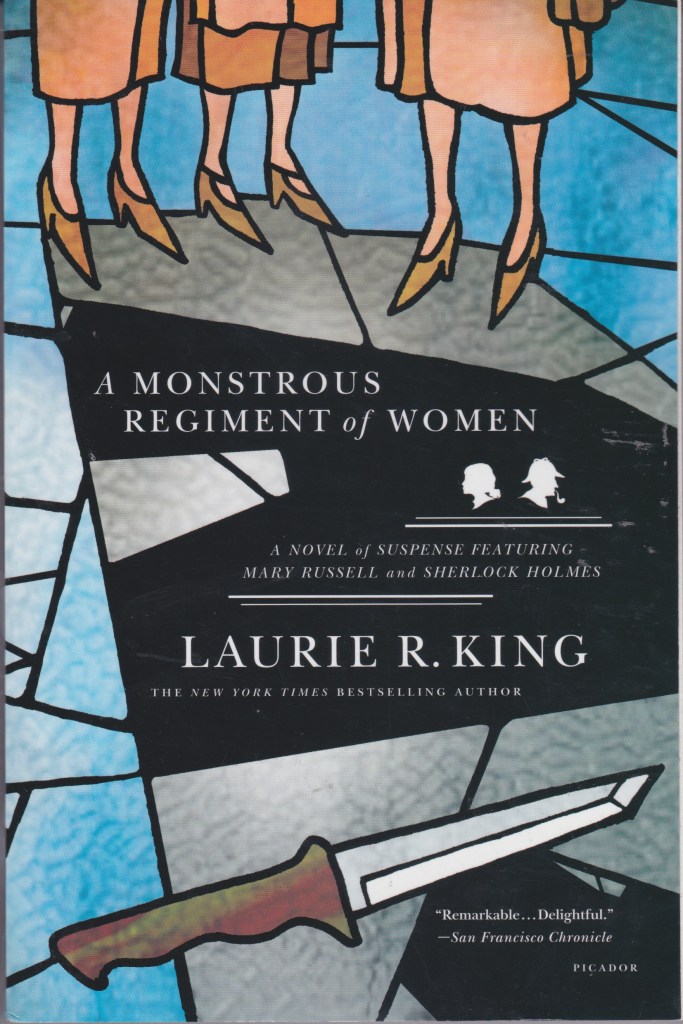
I first encountered Mary Russell last year when I read the first of her adventures with Holmes, The Beekeeper’s Apprentice, which took place over several years and was really a loosely connected series of different stories that showed the growing bond between the teenaged girl and the retired detective. Her wit, her style, her fierce intelligence–and her refusal to be a sidekick or passive made me fall madly in love with her–despite my long-held antipathy towards Sherlock Holmes. (I have since read more of Doyle, and find the antipathy I once felt fading; in no small part, I think, because last year I had to write my own spin on Holmes and Watson, which really changed everything I thought, felt, and believed about them.) I’m not sure what made me select the second Mary Russell to read recently; I do intend to read them all, of course, but there are sixteen or so (!) of them, and then there are King’s stand alones, and I’d also love to revisit her Kate Martinelli series, which is how I first came to read King in the first place. But I digress.

A Monstrous Regiment of Women is, of course, a terrific title; and I knew, of course, the source for it: the tedious Scot religious bigot John Knox’s 1550’s pamphlet primarily attacking Queen Mary I of England (aka Mary Tudor), “The First Blast of the Trumpet Against the Monstrous Regiment of Women,” in which he blamed the sad state of Christendom at the time at the irreligious and unprecedented amount of women in power at that time in Europe–and, as I have said many times before, the sixteenth century had more powerful women running countries than any century before or since (and I’ve always wanted to write a history of that century, focusing on those women, and using that very same title King used here). So, going into the book, and knowing that Mary was studying theology at Oxford in the latter half of the first book, I assumed (correctly) that this book would have religion, and women, at its heart, so I sat down with the book rather eagerly.

It did not disappoint.

The book opens, as noted above, around Christmas time, just before Mary finally achieves her majority and comes into the inheritance her benighted aunt/guardian has been enjoying herself with since Mary’s family perished in an auto accident when she was fourteen. Rather the celebrate the holiday with her aunt and the aunt’s hangers-on, Mary escapes the house and goes in search of her old comrade, Holmes. This leads her to London and an encounter with a friend from earlier in her education at Oxford, which in turn leads her to the New Temple of God and its leader, Margery Childe–charismatic, suffragette, and also a religious mystic. (I was put in mind of Aimee Semple McPherson, who has always fascinated me and I’ve always kind of wanted to write about.) But there’s something unholy going on at the New Temple, and perspicacious Mary can’t quite put her finger on what’s wrong there–but it intrigues her and she gets deeper and deeper into what’s going on there.

There’s also a switch-up in the dynamic between her and Holmes in this book, but it is also to King’s credit that the groundwork for this was laid almost from the very beginning of The Beekeeper’s Apprentice, and it neither seems out of place or untoward, either for the story or the characters–and despite the awkwardness this change-up creates between the two of them in their all-too-brief encounters in the story (for make no mistake about it; this is clearly Mary’s story, and Holmes no more than a supporting player on this stage), it makes sense and it also answers one of the questions the first book aroused in me; how can King keep writing about this opposite-sex pair through an entire series without the question of chaperoning and so forth not coming up, or them simply remaining good friends while the deep and growing affection between them is so plainly right there on the page?

The writing is masterful and intelligent, and the story–with its interesting twists and turns, along with some exciting ventures along some of the more disreputable sections of London–is so well paced and plotted that you simply cannot put the book down. I was, quite literally, only on chapter three when I picked the book up again yesterday morning; within moments I was a captive of King’s magic and completely incapable of putting the book down–to the point that I resented having to take breaks to get coffee or go to the restroom or feed the cat. I had decided, when I sat down with the book, that I had to stop reading at noon so I could get back to my own manuscript. Noon came and went, and still I kept reading. At one I flipped to the back to see how many more pages were left, and decided that it was ridiculous and incomprehensible to stop reading so close to the end, and I wouldn’t be able to completely focus on my own while I was so worried about how Mary was going to escape the peril in which King had placed her. So…rationalizing if I don’t finish my own editing today I can always finish tomorrow I plowed forward.

And–without spoilers–I will say King did an incredibly accurate and chilling depiction of how drug addiction takes hold of people.

She also explores the question of women’s role in the Christian religion beautifully, weaving these theological questions and issues seamlessly into the narrative. Each chapter begins with a quote about just that–either from the Bible or the great Christian philosophers, exposing the vicious misogyny that has poisoned that faith almost from the very beginning.*

I loved this book, loved loved loved it, and am really looking forward to the next, A Letter of Mary.

If you’ve not yet started this series, wait no more.

*I also made note of these quotes so I can shamelessly use them myself!

Face Up

Wednesday has rolled around again, as it always does, and last night was another restful sleep of the same sort I had on Monday; restful but awake or half-awake the majority of the time. I am beginning to wonder, quite frankly, if this is just another affect of getting older; the inability to sleep deeply every night. Yesterday I wasn’t as tired as I feared I would be, which actually was kind of nice, and I do think this will be the case this morning too. I intend to go to the gym this evening for a workout with weights after work–so being tired will not be helpful in the least. Maybe that will put me into a deep sleep tonight.

Maybe it won’t–which is more likely.

We watched two more episodes of The Capture last night on Peacock, which is incredibly good. I still have absolutely no clue what’s going on, but the suspense is so ratcheted up that I cannot wait to get home tonight so we can finish watching it. I want to start reading Laurie R. King’s A Monstrous Regiment of Women, the second in her Mary Russell series, but focus is so important when reading and what little focus I have these days really needs to be spend on the revision of Bury Me in Shadows, which needs to be finished by the end of the month–so time is running out on me, as always. I was thinking about how I reacted to rereading the manuscript with an eye to edits last weekend, and how I always am enormously dissatisfied with the final product when it is released. Don’t get me wrong, I am proud of every book I’ve written, as each represents surmounting a struggle of some sort in some way, and finishing and publishing a novel is always an accomplishment, regardless of how it turned out in the end. I was dissecting this in my head last night while I was making tacos for dinner (nachos for Paul); my strengths are premises, titles, and character–but inevitably whenever I start writing a book most of the time I don’t know how it’s going to end. I try to figure out how to end a book before I start writing it–but on the rare occasions when I have figured out the end beforehand, I question that as I write and inevitably change my mind at least once, if not twice, and as a result, I never am completely confident in my endings. Adding to the neuroses in my brain, the last few chapters of a book generally don’t get as much attention as earlier chapters, either, which makes my insecurity even worse.

I really do wish I could slap my first creative writing teacher across the face for doing such a number on me that it has lasted all these years. FUCKER.

Then again, he typed smugly, I’m about thirty-six novels, five novellas, and fifty short stories into my career; he’s still unpublished, forty years later. So, there’s that…and the fact I never forget a grudge.

I’ve also been toying with some 1970’s research in my spare moments–looking up things and trying to remember things from my tween years–like “sissy bars” (and no, it’s not a bar for effeminate gay men, though it is a great name for a gay bar). I remembered “sissy bars” as being the high bar on boys’ bicycles that girls’ bikes didn’t have back then; turns out it’s actually the back bar at the end of a bike that the passenger behind the driver/rider can lean back on for balance. (I still remember it the other way; and that other bar doesn’t seem to have a name, which is weird.) I’ve been wanting to write about the early 1970’s in the Chicago suburbs for quite some time–I have an idea based on a murder that happened in our suburb when I was a freshman in high school, You’re No Good, which could be a lot of fun to work on and write–and my main character from Lake Thirteen (Scotty?) was from that same fictional suburb…which leads me back into that weird Greg Universe where all of my books are somehow connected, between New Orleans, Alabama, Chicago and it’s suburbs, California, and Kansas–which I completely forgot that I was doing. (Aside: Bury Me in Shadows is set in Corinth County; which is where the main character in Dark Tide was also from; where I set the story “Smalltown Boy”; and where Frank and Scotty’s nephew Taylor is from, making his first appearance in Baton Rouge Bingo.) But the early 1970’s was an interesting and somewhat volatile time, between Vietnam, the economic crisis, and Watergate; where television gave us stuff like The Partridge Family and Love, American Style and horrible variety shows; when the post World War II economic boom in the United States was beginning to crumble and fade away; when Top 40 radio ruled the AM channels and everything was still on vinyl or eight-track tapes, before cable television and 24 hour news and no Internet or cell phones. But… as I mentioned earlier, while I have a great premise and a terrific title, I don’t know the story or how it ends…but that won’t stop me from obsessively researching the period.

And on that note, tis time to head back into the spice mines. Have a great day Constant Reader!

Candyman

I moved to Houston in the spring of 1989, basically to put the past into the rearview mirror and get my shit together. A fresh start was called for, my parents lived there, and so I shipped some stuff and whatever I couldn’t check as luggage or carry on was thrown away. It wasn’t what I wanted to do, but rather what I needed to do; I was on a horrible downward spiral of depression and self-loathing and I didn’t see any way to break that cycle while remaining in California. So I boarded an early morning flight and moved to Houston.

I knew relatively nothing about the city. I knew it was in Texas and was a major port, but it didn’t appear to actually be on the Gulf Coast (I would later learn that the Houston Ship Channel was how the city had become a major port), it was big, they had a baseball team (the Astros) and a pro football team (at the time, the Oilers) and a basketball team (the Rockets) and the Astrodome was there. Anything else I knew about the city came primarily from reading Thomas Thompson’s Blood and Money–still one of my favorite true crime books–but admittedly, that wasn’t much. That book had been published fourteen years earlier, and one thing that is very true about Houston, and remains true, is that it changes all the time, sometimes very quickly.

I liked Houston, but as always, whenever I’ve moved there was some severe culture shock. Texas is most definitely not California…and I had never really driven on major highways in a city before. I was soon to learn that it was impossible to exist in Houston, for the most part, without spending time on highways. I was also kind of taken aback by the amount of gun racks in the back windows of pick-up trucks, and was also amazed at the size of some of those trucks. It was a weird, interesting, sprawling city, and I had no idea where anything was or how to get around or how to adapt…but I learned. I liked it there, and it was there, at my first job (selling natural gas, of all things) that I first heard about Dean Corll. I don’t remember how it came up in conversation–maybe a serial killer had been caught, I don’t remember, it’s lost in the mists of time–and she told me about Dean Corll–and even brought me a copy of a book about the killings–Mass Murder in Houston, by John K. Gurwell. It was very short–it was one of those quick books about true crimes that was cobbled together undoubtedly in a hurry to capitalize on the notoriety, but the one thing that always stuck with me was that one of the ways he and his accomplices would torture the boys was to insert glass rods into their penis and break it off.

After I returned the book, I never really thought much about Corll again, until we watched the Mindhunter series on Netflix. In one of the episodes the FBI guys interviewed Wayne Henley–and that reminded me. Paul had never heard of Corll, and the show reignited my interest in him, so I ordered a copy of Jack Olsen’s The Man with the Candy: The Story of the Houston Mass Murders. But I was in the midst of something–probably writing another book or who knows what–and so I simply shelved the book and forgot about it….until we watched The Clown and the Candyman…and I hunted up the book and started reading it.

In his canary-yellow house on shady Twenty-seventh Street in The Heights, a worn-out section of Houston, Fred Hilligiest got up long before the sun. A gaunt, wind-dried man of forty-nine, he striped streets for the city of Houston no weekdays and ran a small painting business in his spare time. This morning he had to be on the job at five; the Gulf sun would catch him soon enough and sear another layer of brown into his deep-lined face, as dark and dry as old parchment.

Dorothy Hilligiest, a radiant, pudgy woman with china-doll hands and a small voice to match, saw her husband off and began to work through a list of chores. In a few days, the family would being its annual vacation to the riverside town of Kerrville and there were still errands to run–to the bank, the car wash, the grocery, the hardware store, to Sears for the last few pints of paint to finish trimming the windows. The Hilligiests worked on their house endlessly, landscaping and painting and decorating till the little bungalow gleamed like a model home on its corner lot. The fact that The Heights was generally considered run-down did not discourage the Hilligiests. A family could live in only one house at a time, and theirs was more than adequate. Others had weakened and lost heart, but Fred and Dorothy, deeply religious Catholics, intended to complete their ordained task of raising a family within these familiar walls.

Two children were already married and gone; three sons and a daughter remained, and by the time Mrs. Hilligiest returned from her first batch of errands in town, they were up and babbling about the vacation to come. It was May 29, 1971, Memorial Day weekend blazing hot in Houston. There was talk among the three boys about going to the pool at the Bohemian lodge to perfect a few strokes they would use later at the river. On the previous year’s visit to Kerrville, they had met a couple of young water nymphs who had impressed and outswum them; this year would be different.

David, the family’s blond-haired court jester and jazz drummer, called a friend to suggest a swim, but the friend was busy. By lunchtime, David still had not been able to round up a swimming companion for himself–being thirteen, he did not relish accompanying his younger brothers–and he ate his customary skimpy meal, a hot dog and a glass of root beer. As usual, Dorothy Hilligiest worried about him. He was a small boy with delicate features, five feet three inches tall and not yet a hundred pounds in weight, and he ate like a gerbil. “Don’t worry,” Fred Hilligiest had told his wife. “He’s as strong as a li’l ol’ bull.” Sometimes the boy earned a dollar an hour working for his father’s striping company and pulled a man’s load without complaint.

Like Blood and Money, one of the strengths of this book is its focus on the city of Houston as a character. He also picks a couple of families who lost their sons to Dean Corll and his accomplices, tracing their suffering from the day their child goes missing out of the blue to the discovery of the bodies. It’s hard not to feel sorry for them, and Olsen does a great job of exploring what they went through without being exploitative, as well as their shock and surprise that the Houston police aren’t in the least bit interested in looking for their sons, telling them their child clearly just ran away. (This is a common thread through a lot of the serial killer documentaries and stories from the late 1960’s through the mid-1970’s; the assumption that missing kids just ran away because a lot of that was going on within the youth culture of the time–San Francisco, of course, being a primary destination for the lost kids running away. It’s also why the serial killers got away undetected for so long; the cops dismissed the concerns of parents–you can almost see the knowing smirk on their faces as they listened to parents insisting their child wouldn’t have run away.) That actually is haunting; the incredible suffering the parents must have gone through, knowing their child didn’t run away and being turned away by cops.

Olsen also explores Corll’s background–his many-times married mother, his own aversion to actual gay men despite his own sexuality–he wasn’t into going to gay bars or meeting other men of his own age, always being interested in young boys and children (his victims were of all ages, but I don’t think any were younger than twelve; I’d have to check to be certain though). There aren’t any answers here, though; why did he become what he did? How did he somehow convince two young men (Wayne Henley and David Brooks) to not only be accomplices but to lure in victims? Did Henley and Brooks tell the whole truth, or did they push most of the blame off on Corll?

I’ve been wrapping my mind around this horrible story since watching The Clown and the Candyman, and reading this book is currently an inspiration for an idea that is developing in my own head for a fictional approach to telling this story. I can see telling it from two directions, actually; which could also make for an interesting book, or two completely separate ones entirely.

It’s also weird that Corll is so completely unknown to most people these days; Gacy stole most of his thunder, and there haven’t been any books about Corll published, new scholarship or investigative reporting, in decades.

Evil Dust

The sun is actually out today and there aren’t many–if any–clouds in our beautiful blue sky this morning, which is lovely. It’s rained pretty constantly ever since Tuesday afternoon, and everything outside is still wet from nearly a week of rain. I love rain–especially thunderstorms–but even I thought five straight days of them was a bit extreme. I wound up running my errands in the rain yesterday–I dropped off another five boxes of books to the Ladder Library sale yesterday (you actually can tell now that I’ve gotten rid of books)–and made groceries and got the mail. It was pouring while I did all of this, so my plans to go to the gym yesterday were finally scrapped. I also wound up taking the day off from almost everything yesterday–I think I needed a brain-free day, frankly–and so we watched a lot of television–we binged all the way through a delightful comedy called The Other Two, watched the Tom Holland movie Cherry on Apple Plus, and then switched over to Acorn for a riveting crime show called The Cry.

Yes, I was a slug all day and I am not a bit ashamed of it.

Oh, sure, I had my journal with me and scribbled notes freeform all day–my favorite is that I came up with a short story title I now HAVE to use, “To Live and Die in La.”, while having absolutely no idea what the story would actually be, but I laughed at the title and now want to. use it–so I did do something. But today I have to start revising/copy editing/making notes on Bury Me in Shadows–due to be returned to my editor no later than the first of May–and so, if I do go to the gym today (leaning towards it, since it’s sunny out) I can curl up in my easy chair to do it, so that’s a start. I really need to work on my story–the deadline for that submission call is May 15, I believe–and so I need to kick everything up a notch this week. I am getting caught up on a lot of other things as well–it’s never-ending, and have also accepted that I only have so much bandwidth for things. The emails, for example…I’ll never get caught up on those, ever…so I need to prioritize and so forth in order to get through everything that absolutely needs to be responded to immediately.

I also need to spend some time getting organized and cleaning a bit this morning. There’s filing to be done, of course–always–and somehow the kitchen looks like a tornado ripped through here (not completely an exaggeration, to be honest) and I need to get that taken care of this morning. I have a load of laundry to do, and there’s always dishes–always. I also want to organize the refrigerator a bit more this morning. Since the sun is out, I’ll probably grill hamburgers later on this afternoon, which is always an absolute treat (I really prefer all meat to be cooked over hot charcoal, frankly–or at least, most). I am also a bit excited that the next step of book decluttering (and yes, I am aware I am completely Marie Kondo-ing my apartment) is to go up into the storage attic and start clearing the boxes up there. This will, of course, be more complicated than the bookcases and the hidden boxes in the living room, since I’ll have to bring them down and go through them, combining the ones to keep (I can’t imagine there will be many of those) while putting aside the ones to donate. The goal is to clear out enough space in the storage attic so I can clean out my storage rental and close that account; most of the books in the storage are copies of my own books (and my kids’ series collection) along with some other things–mostly papers–and it would be nice to either no longer have that bill every month, or to use that space for other things…but at the moment I can’t think of anything that we’d need to keep it for.

But it would be great to lose that bill by the end of the summer.

Not as great as paying off the car, but still pretty good.

I think I’m going to add Semi-Tough to the donate pile. The first three pages are nothing but racial slurs as well as justifications for using them, and how the main character–it’s a first person narrative–isn’t really racist and the slurs are just words that don’t mean offense and so on–and yeah, I really don’t feel like spending any of my time with that kind of character. I certainly wouldn’t in real life–imagine being at dinner or a cocktail party and the person you are talking to says, and this is a direct quote from page one: Just because I may happen to say (the n-word) doesn’t mean I’m a racist.

Um, actually it does. It says a lot about you, who you are, and how you were raised, as well as how you see people and the world.

And I really have no desire to read a book filled with racial slurs…because you KNOW its also full of gay slurs, too–and most likely without the caveat justifying the racial slurs: Now listen, just because I say “faggot” doesn’t mean I’m homophobic.

Sure, Jan.

There are so many other good books to read, why reread something I originally read as a teen that plays on racism and homophobia and misogyny for humor? I stopped rereading The Last Picture Show, a book I absolutely loved, a few years ago when it got to the part about bestiality, and how it was perfectly normal for the teen boys to fuck animals…I closed the book and put it away. I may go back and reread the entire thing at some point–the reason I was rereading it in the first place was to examine how it handles homosexuality–which I distinctly remembered it doing–but I don’t think I was able to get far enough into it to get to that part. I know that Coach Popper–long-suffering Ruth’s awful husband–was a deeply repressed one, who favored one of the more athletic boys primarily because of his attraction to him; that the preacher’s son Billy Bob Blanton was often mocked and teased and bullied and humiliated for being a “four-eyed queer” (before he molests a little girl, after which he’s taken away as a pervert); and that the heterosexual English teacher, who was cultured and sensitive and kind, was accused by the coach of impure thoughts and fired (everyone, of course, would never suspect the manly football coach of anything, or question him); and I remembered a particular poignant scene between the fired English teacher–who’s been fired, whose wife has left him and taken their daughters and filed for divorce–and Ruth, where he’s just so beaten down and defeated that it’s heartbreaking. But yeah–that whole “boys will be boys” attitude towards bestiality was too much for me to get through again.

The Last Two is a terrific show, and quite funny. Paul and I really enjoyed it; the premise of the show is the two older children are in their late twenties–one is a struggling actor whose most recent audition was for a commercial in which he would play “Party-goer who smells a fart”; the daughter had wanted to become a dancer until she broke her ankle and dropped out of dance school and cannot figure out what she wants to do with the rest of her life–when suddenly, their thirteen year old brother puts up a video of him singing a ridiculous song (“Marry Me at Recess”) and becomes an overnight viral sensation with a record deal and a manager under the name “Chase Dreams”; which makes them feel even more like losers. The older brother, Cary, is also gay and in a weird relationship with his straight roommate; the daughter has broken up with her boyfriend and is now homeless at the beginning of the show. I thought it was terrific, frankly, and look forward to season two.

My primary takeaway from Cherry is that Tom Holland is an amazingly talented actor–he really gives a stunning performance as a poor young man who falls in love, gets his heart broken and joins the military, serves as a medic in Iraq and comes home to nothing but PTSD and drug addiction, which leads him to a life of crime. It’s a very dark story–but also weirdly a love story at the same time–and I don’t think the film, worked overall; the Russo Brothers, who directed, turned it into this big grand opera style thing in the way they shot it; to the point where the beautiful imagery is almost intrusive. It’s a very real story–based on a true story–and it highlights, very powerfully, how we abandon our troops completely after their service is over (since they’re no longer the troops….”support the troops” makes me angry because it is used primarily as a political prop and the actual soldiers themselves suffer in silence and neglect while we give billionaires and corporations every break in the world), but it’s worth watching for Tom Holland’s performance–he was also fantastic in The Devil All The Time–and it’s really nice to see him pushing himself in his non-superhero roles (he’s also the best, in my opinion, Spider-Man).

And on that note, I am heading back into the spice mines. Have a lovely Sunday, Constant Reader!

Mesh

Day three of heavy weather in New Orleans; there was a marvelous downpour around six this morning or so that lasted over an hour, complete with lightning and thunder. It’s still gray outside, not currently raining–but there’s a thunderstorm somewhere nearby, as there’s still lightning flashing but with a nice little break before the thunderclap, the kind that lasts for several seconds or more. I didn’t go to the gym last night because the rain was so heavy and had planned to go today–perhaps when I am done with my work-at-home duties today there will be enough of a break in storm bands for me to get over there. I could drive, of course, but that just really seems kind of silly to me since it’s so close. Why yes, I drove the four or five blocks to the gym to work out my body. Granted, rain changes everything, especially New Orleans’ kind of drenching rain, and since we are going into day three of it, the ground is already saturated and can’t absorb it so there’s more standing water than there usually is–and there’s inevitably a lot of standing water any time it rains here.

It just started raining again.

I came home last night fully intending to get a lot done, since the rain precluded the walk to the gym, and while I did do some piecework on Chlorine, I didn’t really do a lot. I was feeling tired, the way I usually do on Wednesday nights anyway, and I also didn’t even bother to unpack my backpack last night, which is not a good sign. I read some more of The Man with the Candy, which is so well-written! I’m really enjoying the book–it reminds me a lot, in how well it’s written, of my favorite true crime books of all time, Blood and Money, and not just because they are both set in Houston–it’s about how well the two different writers wrote about Houston itself, turning the city into a character in the books. This is what I always try to do when writing about New Orleans–giving the reader a strong enough sense of place that the city itself is almost a character in and of itself in my books. This is also triggering the memory that Blood and Money was part of the reason (besides living there) I wanted to set the Chanse series there originally–don’t get me wrong, I am not in the least bit regretful that the Chanse series exists in my own personal New Orleans fictional universe, but there’s always a bit of a pang for me that I have never written about Houston and probably never will, other than as an aside or something in a book. I have several ideas that begin with the character either living in, or being from, Houston; but nothing actually set there.

We also finished the second season of Very Scary People, with the two episodes on Dr. Swango, aka Dr. Death; I’d actually never heard of him before, so he was obviously new to me. We skipped the Bobby Durst episodes–after watching all six or so episodes of The Jinx I didn’t see any real need to spend another hour and a half with Bobby Durst–who, while interesting enough, doesn’t really deserve any more of my attention than he’s already had, frankly. There’s also a new limited series on Netflix, The Serpent (it may be HBO; it’s hard for me to keep track of whichever streaming service these days since there are so many), which is about Charles Sobhraj, a criminal and murderer who operated in Southeast Asia mostly. I read a book about him many years ago called Serpentine, which was also written by Thomas Thompson, who also wrote Blood and Money. It was interesting, and clearly I’ve never completely forgotten it–as soon as I saw The Serpent‘s trailer and its lead actor, I knew exactly who and what it was about–which we may be diving into tonight. There’s also a new mini-series on HBO with Kate Winslet that looks interesting, so there are a lot of options for us to choose from….maybe too many, really.

I’m not really sure why I am having so much trouble getting started on my day–although I suspect the weather has a lot to do with it. When it’s like this I really would much prefer being under a blanket and reading–there’s no better reading weather than rain, is there? It’s just so comforting to be inside and warm and dry while the house is being battered with rain and wind and the sky is rent with lightning and loud thunder….and even though it sometimes means flash flooding and so forth, one of the many things I love about living in New Orleans is the rain (Houston also has marvelous thunderstorms, as did Tampa). I lived for eight years in San Joaquin Valley in California, where it rarely, if ever rained–and we certainly never had this kind of amazing thunderstorm there.

All right, I’ve procrastinated quite long enough. Onward and upward into the spice mines, Constant Reader!

Vicious Circle

Ugh, Monday morning. I slept really well again last night–woke up before the alarm, in fact–and feel relatively well rested, if not completely mentally awake yet. I am sort of feeling like myself again; like my batteries have finally recharged, even if it meant putting some things off for a few days and just allowing myself to relax completely. The Lost Apartment is all pulled back together again; I’ve made some terrific progress with my writing, and my creativity is firing on almost all of its cylinders again, which is more than I ever thought would happen for me again. I finished reading The Russia House yesterday–it’s quite good, if unexciting; the writing itself is so marvelous the coldness of the story itself doesn’t matter, really–and we started watching season two of Very Scary People, getting through the Son of Sam and Night Stalker cases, and then part one of the Coed Killer (honest takeaway from this series: California sure has a lot of mass murderers and serial killers/rapists) before retiring for the evening. I also started reading Jack Olsen’s The Man with the Candy: The Story of the Houston Mass Murders (interesting title, because the term “serial killer” hadn’t really been coined yet), which is extremely well written, and also paints an interesting picture of Houston; coupled with Thomas Thompson’s Blood and Money–I’ve always wanted to write about Houston. I lived there for two years, and then six months again a few years later, and it’s an interesting, complicated city that no crime writer, at least that I am aware of, has set a crime series in, or written a crime novel set there….which is something I find interesting. I think it’s also true of Dallas.

Interesting trivia Greg fact: the Chanse series was originally set in Houston, and the first book was called The Body in the Bayou. I later, when I started writing it seriously (and got beyond two chapters) I moved the series to New Orleans and the story evolved into Murder in the Rue Dauphine, which is the real reason why Chanse was from Texas: he was originally supposed to have lived in Houston, playing for the (at the time) Oilers after attending Texas A&M before getting injured and becoming a private eye. (In the published series, Chanse went to LSU instead of A&M, and was injured in his final college game, which kept him from playing in the pros.)

I still think someone should write a cop or private eye series set in Houston. As wild and crazy as these true crime books set there make Houston seem, I doubt very seriously that the city isn’t wild and crazy still. I remember going to see the stage version of Disney’s Beauty and the Beast at Theatre Under the Stars (TUTS) there, the very first time it was publicly performed (little known Greg fact), and the audience was interesting….I loved the guys in their formal jackets, ties, Wranglers and boots escorting women in evening gowns and furs and dripping with diamonds ( needless to say, I was wearing a nice pair of slacks and a dress shirt, but I spent the intermissions and the pre-performance time in the lobby literally just staring at the fascinating fashion choices for Houston’s moneyed class).

Oddly enough, there were not many children there; considering it was the stage production of a Disney animated film, you’d think there would be more kids there…but it was a world premiere, and more about Houston’s higher class showing off jewels, furs, and gowns more than anything else.

I also had fun brainstorming the background work for Chlorine over the weekend; naming characters and loosely sketching out bios for them, as well as trying to figure out how to pull off the plot and how to make it work. This is the really fun part of a book–figuring out everything–before the drudgery of actually writing it starts. I am very excited about writing this book, though, and it’s been a hot minute since I was excited about writing a book–in fact, so long that I can’t remember the last time I was actually excited to write a book–it may have been Lake Thirteen, all those years ago–which is different than being happy to write a book. I also have to be careful not to worry about expectations of other people, too–Chlorine began its life as just a vague idea I had one morning while writing my blog, which somehow caught on with some of my friends on Twitter who started tweeting at me (some of them still, periodically, will bring up Chlorine on social media, wondering where it is and when I am going to write it), excited about the idea.

I also spent some time yesterday coming up with a to-do list, which I always enjoy doing when I’m not stressed and worn out. When I am stressed and worn out (hello, first three months of this year), to-do lists simply make things worse more than anything else; emphasizing how far behind I am and how much I have to get done and sometimes–not always, just sometimes–the to-do list defeats me once it’s written. Just looking at it causes me stress. I’m not sure how long I am going to be able to hold off stress at the moment–it’s always just lurking there, in my peripheral vision, waiting to pounce on my like a tiger and hold me down–but I am hoping that having the apartment back together and having the two deadlines in my rearview mirror will help stave off it’s inevitable return for a little while, at least.

Tonight I am planning–we’ll see how that goes–to return to the gym for the first time in a couple of weeks, which means basically starting over with one set of everything, which means I won’t be there for terribly long, which for a Monday night is a good thing, most likely. Here’s hoping this will also help me fall asleep tonight; insomnia so frequently derails me. The office is also on track to going back to full staffing and regular open hours, possibly as early as May; I am curious to see how that winds up going. I’ve gotten used to the tumbleweeds blowing through our mostly empty department, and it will seem weird having other people around when they actually starts to happen.

And on that note, tis off to the spice mines with me. Have a lovely Monday, all, and I’ll check in with you again tomorrow morning.

Touched by the Hand of God

Sunday morning, and I am swilling coffee and eating coffee cake and trying to wake up. I slept very well again last night, and am starting to feel more…normal, whatever that means for me, since I am anything but normal. I have things to get done today, but the apartment is starting to feel like home again for the first time in a while (since everything went haywire week before last). The laundry room is mostly reassembled, and the book shelves in there look neat and tidy and organized, which rather pleases me. The living room is….well, the living room. I am always going to have too many books in my house (even typing that a voice inside my head was shrieking you can never have too many books what are you talking about?); but I am developing a certain heartlessness as I continue to fill boxes with books for the library sale. At some point, I am going to have to start going through the boxes of books on top of the kitchen cabinets and the ones in the storage attic, and my goal is to have cleaned out not only the attic but the storage unit I’ve rented for far too long.

We finished the first season of Very Scary People on HBO last night, concluding with the two-parter on Jim Jones (we skipped Gacy–have seen enough of him lately already–and Aileen Wuornos, because we watched one on her already recently) and will be moving on to season two probably this evening. I am way behind on Superman and Lois–mainly because it’s something I started watching without Paul and so, rather than trying to get him caught up, I am just going to continue watching without him (I always, inevitably, have to fill him in on super-hero backstory and so forth anyway in most cases, though I think he knows enough Superman lore–doesn’t everyone, really–that he wouldn’t need explanations in this case).

I’ve started–sort of–working on Chlorine this weekend, mostly free hand and mostly in my journal, mapping out backstory and so forth for the main character, and I’ve also started working on the backstory for the body in the surf, and the plot–which was kind of amorphously planned in my head, but yesterday I started nailing down specifics in the plot. It’s going to be kind of fun to write, I think–I always think that going into a manuscript; ever the optimist–and while it’s very tempting to use real people as characters, I think I will make the ones who actually are on the page and participating in the story fictional, but mention others–Joan Crawford, Bette Davis, Errol Flynn, etc.–in passing. I know the studio is going to be fictional–tempted as I am to use Fox or MGM–and I also know I need to sprinkle in some of the conservatism that reigned then, as everyone was afraid of Communists and having to testify in front of HUAC in Washington; it was the time of ‘the lavender scare” (also the title of a terrific history of the period and this very thing, by David Johnson; I highly recommend it) and so homosexuality was also driven even further underground because we were seen as security risks, particularly if we worked in government since it put us at risk for blackmail by Communists (I touched on this briefly in my story “The Weight of a Feather”, collected in Survivor’s Guilt and Other Stories).

I also worked on getting organized yesterday. I did a lot of filing, and took a lot of books off my desk and replaced them with ones I’ll be using for research and background for this book. I kind of feel like I already know my main character (even though I couldn’t remember his name yesterday as I wrote notes in my journal); he grew up in Kansas, was caught by his father in a “compromising position” with his high school basketball coach in the tiny little town he grew up in and was forced to enter the military at age 17–going into the Navy and serving in the South Pacific, where he found other men like himself, and thus became familiar with the underground gay community within the military, as well as in Honolulu and Los Angeles (on leaves). After mustering out in 1946 he comes to LA to become a movie star, is discovered by a Henry Willson type agent, and at the start of the story his seven year control with Pacific Pictures is coming to an end, they aren’t going to renew his contract, and he is in fact being sacrificed to a tabloid in order to protect another client, a rising star the tabloid was going to out–loosely based on how Henry Willson sold out Rory Calhoun and Tab Hunter to Confidential to save Rock Hudson; but unlike them, my character’s agent has a plan for him: a long-term contract to work with an Italian film company making sword-and-sandal epics.

It’s a great set-up, and one that I hope to not let down…right now I am feeling confident that I can write this and it will be amazing; of course, once I start the doubts and imposter syndrome will start creeping in and I will spend most of my time wondering what the hell I was thinking to try to write such a thing in the first place.

I couldn’t have picked a better career path for a neurotic, could I?

I also lined up all the potential short story calls I am interested in submitting to, matched them up with an in-progress story that fits their call (or at least what does in my mind; I am really not that great a judge of these things, in all honesty) and need to plan out when to reread and when to rewrite. It’s very strange; now that I am coming out of the exhaustion from the writing of the two books back to back I am amazed at how light I feel; I don’t feel that oppressive burden nor the stress that comes from carrying it. I know both manuscripts need work and I need to revise and rework and edit one last time with each, and there’s a deadline for the first for sure–but I am going to put that off until next weekend, when I have the time to sit and go through Bury Me in Shadows from beginning to end, making notes, making corrections, and so on and so forth to get it polished into a diamond…or as close to one as I can get one of my books.

So, I am going to spend the rest of this morning swilling coffee and trying to finish reading The Russia House. I love LeCarré; he is such a terrific writer I can get lost in his sentences and paragraphs forever–but I find myself not loving the plot or the characters in this one, which is why it’s taking me so long to get through this one, I think. He also does an excellent job of taking me back into that 1980’s world/mentality of the Cold War and the collapse of the Soviet Union–that halcyon time when the fear of nuclear annihilation began to fade somewhat but at the same time the worry of what would fill the vacuum created by that collapse was almost nearly as intense (it didn’t take long for conservatives to replace Communists with Muslims as the scary other from another part of the world determined to destroy us); not to mention the wondering if glasnost and perestroika weren’t real or sincerely meant; LeCarré does an absolutely amazing job with that cold intelligence paranoia.

And then, for something similar yet completely different, I am going to reread Dorothy Gilman’s The Unexpected Mrs. Pollifax.

I also would like to get back to the gym today; it looks absolutely lovely outside, and the walk will be lovely.

Until tomorrow, Constant Reader. Have a lovely Sunday!