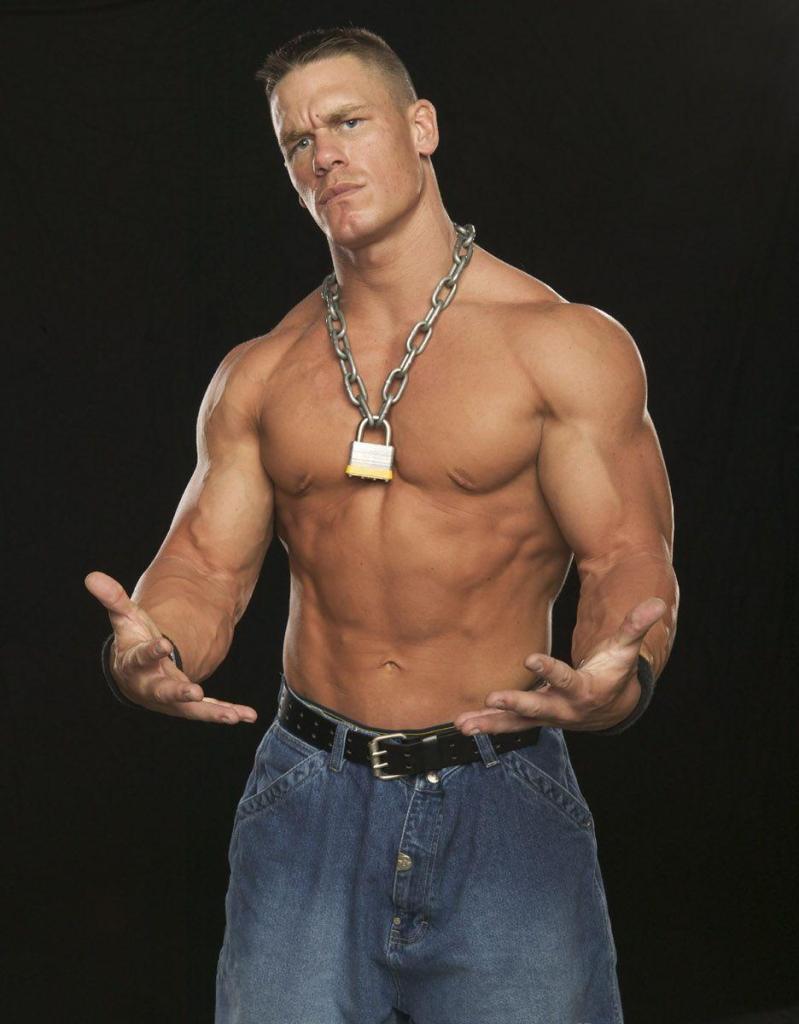
I have always been a fan of John Cena since the first time I laid eyes on him.
I am nothing if not shallow.
But his unique charisma, outstanding physique, and handsome, expressive face caught my eye the first time I caught a glimpse of him while flipping through the channels. Despite my lifelong passion for professional wrestling, however, I never watched any of his matches–my disdain for WWE, which began when they were WWF back in the day, has never abated, despite the hiring of so many heavily muscled guys with spectacular bodies–and was really happy to see him start making the transition to acting (following in the footsteps of Dwayne Johnson, Dave Bautista, and numerous others). I bought a DVD of his first film years ago relatively cheaply in a bargain bin (The Marine, if you are so inclined), and thought, at the time, “this dude could go far in films–he’s naturally charismatic and can act. He’s not Olivier by any means, but he can act enough to carry a scene and create a believable, likable character”.
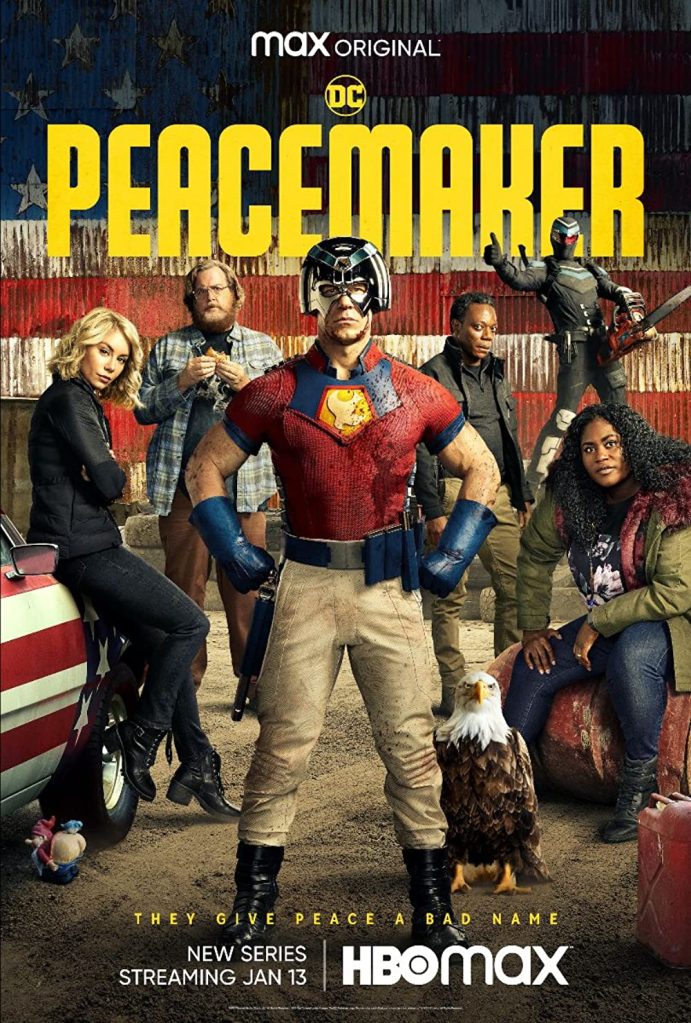
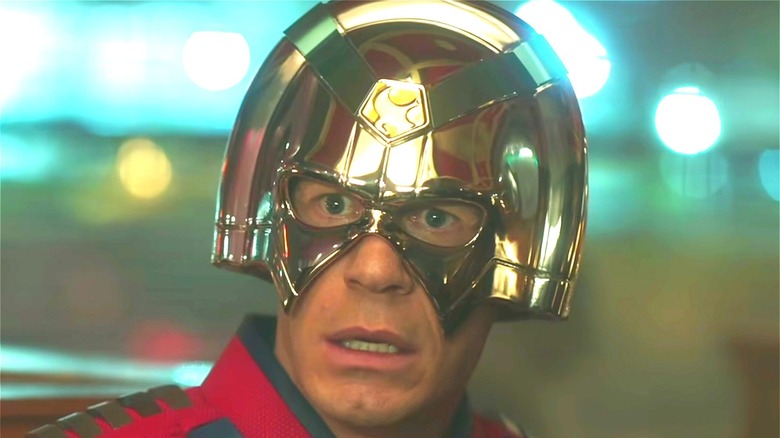
But the film itself wasn’t good–it was produced by WWE, of course–and I hoped he would get another shot in something not WWE related. He has since proven he can carry a scene, and has done some really great character work in small roles over the years. I did keep thinking–I think this often–that he (and other professional wrestlers) should be cast as super-heroes; it’s not like they have to build up their bodies the way Henry Cavill or Chris Hemsworth had to, so was relatively pleased when he was cast as Peacemaker in the reboot of Suicide Squad–a DC Comic I had no familiarity with; likewise I knew nothing about the character of Peacemaker. But…as a Cena fan, I wanted to watch–and Paul enjoys a good superhero show/movie, too.
I didn’t realize the show was directed and written by James Gunn–whose Guardians of the Galaxy remains my favorite Marvel Universe film–but could immediately detect that Gunn sensibility I loved in Guardians in the very first episode. Not knowing what to expect, I was a little taken aback by the first episode–I thought the opening credits were strange, for one thing; and I wasn’t sure about the show’s tone, or if the characters were going to work or not. We were very close to giving up after the first episode, but decided to keep going.
I am very glad that we did.
It took about three episodes for us to completely buy into the story and the characters, but once the show gets its feet underneath it, it is actually quite fun and darkly funny. All the acting is good, the characters are clearly defined and their inner lives (and inner struggles) make them not only relatable but understandable and likable. They are, of course, on a secret mission to combat an alien invasion (code name: Operation Butterfly), and while the mission is kind of crazy, it works within the context of the show. Freddy Stroma–who is actually gorgeous–downplays his looks to play nerdy Vigilante, and Danielle Brooks is also fantastic. Robert Patrick is also perfectly vile as Peacemaker’s racist father, a super-villain known as the White Knight.
And yes, the opening credits eventually–as we got deeper into the show–became one of our favorite parts of the show.
And Peacemaker’s best friend, an eagle cleverly named Eagley, is also pretty hilarious.
We enjoyed the hell out of this show, and I highly recommend it. Can’t wait for season two–and may even go back and watch Suicide Squad.
Yesterday was not only Work-at-Home Friday, but also one of the rare days where I never finished my blog entry for the day. I got up earlier than usual–part of my plan for days when I don’t have to go into the office early is to get up early anyway, with the weekend (like this morning) designated as sleep-in days where it doesn’t matter. I had to do a visit with a college fiction class–I’m not sure whether it was a writing class or a short fiction class, to be honest–over ZOOM about my story in Josh Pachter’s anthology The Beat of Black Wings, which was themed as crime stories based on Joni Mitchell songs. (My story was “The Silky Veils of Ardor”, for the record) That was nice, and then I did some condom packing before I had to go into the office for a meeting with the new head of my department at the office (another transition I have to get used to, not easy for someone who easily falls into routines and ruts) before returning home for some data entry work before Paul got home. I was drained last night from unusual Friday activities, so I just settled in to wait for him to come home while starting to watch this season of Real Housewives of Orange County (I’ve become ambivalent about these shows which I used to love; but that’s a topic for another time). Paul got home in time for the LSU-Alabama gymnastics meet (LSU won, GEAUX TIGERS!), after which we watched the season finale for Peacemaker (which was terrific) and then watched the first episode of Reacher, which we both loved (Alan Ritchson is perfect, an excellent cast, great production values, and good writing; what more can one ask for? We’re all in on Reacher). There were parades last night, but I was tired and worn out and I am also kind of iffy about parade attendance….but I do have at home COVID tests, so I can at least self-test if I do go to the parades before I go into the office as Typhoid Mary. There are parades all day today, starting at one.
So, this means St. Charles Avenue will be closed by noon, and I will be trapped inside my neighborhood essentially until King Arthur passes tomorrow.
Today I intend to work on stuff and clean the house. It feels cold and chilly in the Lost Apartment this morning, and it’s not as sunny as I would like for a day of parades (clouds everywhere) but by Wednesday it will be 81 degrees in New Orleans. Yikes! Talk about unseasonal weather…sure, sometimes we do have gorgeous and warm weather during Carnival–I remember any number of gorgeous weather Fat Tuesdays over the years–but it’s been a hot minute since we’ve had that kind of weather on the last weekend of Carnival, which means the corner will be INSANE for all the big parades. I didn’t go out there myself last night, but Paul walked up the parade route to come home from work and eventually detoured off St. Charles because it was so crowded and insane. He did go look at our corner to see how big the crowds were here–not too bad, certainly not as bad as further down river, but still more people than usual for the first weekend of parades with not terribly pleasant weather–but if it’s sunny and warm next weekend it will literally be insane out there.
I had also intended to go to the gym yesterday but that never happened; as I said, when I got home from my meeting I was exhausted and it just didn’t seem like the smartest decision. I will probably go later this morning/early afternoon most likely; after getting some things done around here. I hate that I was so tired yesterday, but in retrospect, I shouldn’t be surprised. Doing events where I have to be “on” are always debilitating to me and wear me out; even if it is on ZOOM and not in person. I don’t know why I always forget that…but it was a wonderful experience–those sorts of things always are, really, I just wish I weren’t so damned introverted and shy that putting forth the effort to not be introverted and shy is inevitably so exhausting. I really felt drained the rest of the day–I still have a bit of residual hangover this morning from it, despite not getting up until after eight. But I am having coffee and king cake–if caffeine and a plate full of sugar doesn’t revive me completely, it’s really a hopeless case–and hope to really kick it up a notch. I need to finish the first draft of “Condos for Sale or Rent”, and I would also like to start editing my manuscript. Reading would also be nice–I’ve not read a novel in a while, and I really do need to get back into the reading habit. I’m hoping we can watch more Reacher tonight…but I have to get a lot done today in order to watch and enjoy without guilt.
I’ve not commented on the Olympics in a few days, but seriously–I am so utterly appalled by the disgusting exhibit put on by the Russians, particularly when it comes to those young girls. The entire world got to see child abuse put on full display in all of its ugly callousness this week, and my heart breaks for all three of those girls, but especially poor Kamila. Shame on the Court of Arbitration for Sport– which really needs to be investigated itself and perhaps recalibrated–because what they did in allowing that poor girl to skate has psychologically damaged her for the rest of her life. I doubt seriously we will ever see or hear anything from or about her again after she returns to the hell her life will now be in Russia, and those disgusting abusers will not be punished and this torture and abuse of young girls will continue for the greater glory of Mother Russia. I refused to watch the ladies’ final, and I am now incredibly glad that I didn’t–I won’t even watch highlights (or lowlights, as it were) because I have no desire to see abused children suffer more. The CAS destroyed these Olympics, and perhaps it’s time for there to be serious consideration of ending the entire Olympic movement. If ever there was a time when the world needed to come together to celebrate athletic accomplishment, it was this year–and boy, were we ever let down. If this is what we are going to have to witness in future Olympics, count me out–and I am a lifelong fan.
And on that note, these dishes aren’t going to wash themselves, the floors aren’t going to vacuum themselves, and my stories aren’t going to write themselves, either. Have a lovely first Saturday of Carnival, Constant Reader, and I will shout at you again tomorrow.
I’ve always considered myself to be a child of the seventies.
Sure, I was a child for during the sixties, but I turned nine in 1970. While I am sure that turbulent decade provided some (a lot of) influences on me, my personality, my likes/dislikes, and my future, I am equally confident that my values and thoughts and beliefs probably weren’t as shaped from that turbulent decade as they were by the 1970’s. The seventies are really the first decade for which I have a lot of recall (recently, a friend was amazed that I remembered those horrible Rag City Blues jeans for women that were, for some reason beyond my thought processes, popular in the latter part of the decade; what can I say–I do remember the decade fairly well for the most part–or at least as far as my memory can be trusted). I’ve always wanted to write books either set in the seventies completely or even partly; Where the Boys Die, my 70’s suburban Chicago novel, keeps pushing its way to the forefront of my increasingly crowded (and clouded) mind. (NO I AM WRITING CHLORINE NEXT WAIT YOUR TURN)
I remember Watergate and how the scandal grew. I remember the 1972 landslide reelection of Nixon, and the country’s negative reaction to the Ford pardon of the man who brought him to power; I also remember Jimmy Carter running for president out of seemingly nowhere and getting elected. There was The Brady Bunch and The Partridge Family and Archie Bunker and Mary Richards; Sonny and Cher and Carol Burnett and Donny and Marie and the Jackson 5 and Grand Funk Railroad. Top Forty radio ruled the AM airwaves; not every car came equipped with FM capabilities, and the only way you could play your own music in your car was with an eight-track player. I started the decade reading the Hardy Boys and Nancy Drew and The Three Investigators; by the end of the decade I was reading John D. MacDonald and Sidney Sheldon and Harold Robbins. It was a very weird decade…of odd color and fashion choices; avocado greens and browns and American cheese orange were ridiculously popular, as was shag carpeting, velour, clingy polyester shirts, corduroys, bell bottoms and slogan T-shirts. Baseball shirts and rugby sweaters also became popular later in the decade. People had feathered hair parted in the center, and there was this weird sense of, I don’t know, missing out? Movies were grittier, harsher, more realistic; actors went from the polished shine of the old Hollywood system glamour to warts-and-all realism. Television was also beginning to change but was still heavily censored. Boogie and truckin’ and shake your booty became part of the vernacular; the decade began with the break-up of the Beatles and ended with disco’s last gasps while new wave and punk and rap started their rise.
It was the decade I went through puberty and realized that I was attracted to other boys instead of girls; I wasn’t quite sure what that meant but definitely found out in the seventh grade it meant I was a faggot, fairy, queer, cocksucker, and all those other lovely words that were burned into my brain that year. It was the decade where I read Harold Robbins’ Dreams Die First (a truly execrable novel) over and over again because the main character had sex with both men and women, and if I am not mistaken, contained the first male-on-male sex scene I’d ever read (oral); it was also the decade where we moved from Chicago to the suburbs to the cornfields of Kansas and I graduated from high school. (Ironically, it was in Kansas that I discovered gay books with explicit gay sex scenes in them–the News Depot on Commercial Street not only carried The Front Runner by Patricia Nell Warren and her other novels, but also Gordon Merrick; and their magazine racks also had gay porn magazines–which, now that I think about it, meant there were others there in Lyon County and environs; I didn’t realize it at the time, of course.) It was when Norah Lofts’ The Lute Player made me aware that Richard the Lion-Hearted was like me, too; and Susan Howatch’s Cashelmara and Penmarric also had gay characters and plots involving them…
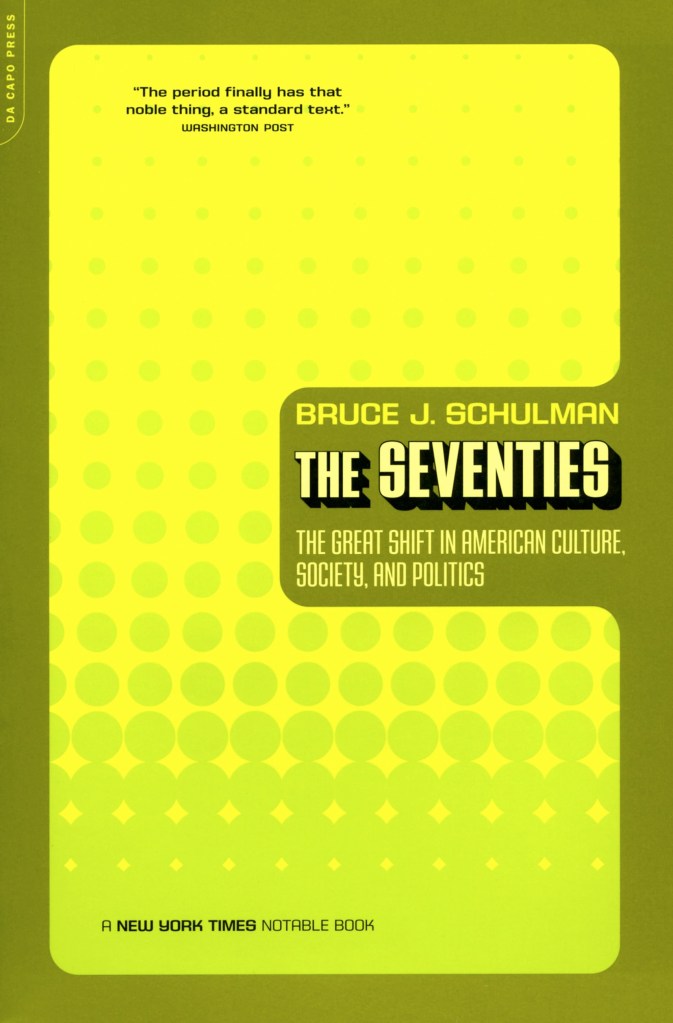
I’ve always thought the seventies was a much more important decade than ever given credit for; usually it is merely considered a connecting time from the 60’s to the 80’s…but almost everything that came after–socially, politically, culturally–got started in the seventies. So I was glad to see this book about that frequently dismissed time.
As I mentioned previously, the Seventies were turbulent; they were the decade that also saw the beginning of the end of the post-war economic/prosperity bubble. Gas shortages, skyrocketing inflation, and the insidious use of racism to break the Democratic coalition began–everything we find ourselves dealing with today had its roots in the Seventies–and it did seem, to those of us growing up in the shadow of the mushroom cloud, that the world had lost its mind and our country (or rather, its mythology) had lost its way. Schulman’s study of the decade, breaking down how the shifts in culture, politics, and our society began, were exploited for divisive purposes, and permanently changed attitudes moving forward was a fascinating, if chilling, read. I remember the terrorist attacks. I remember watching the Munich Olympics that ended in bloodshed on an airport runway and murdered Israeli athletes. The book brought back a lot of memories; I am not so sure I agree with all of Schulman’s assertions about the decade–there certainly wasn’t very much about the burgeoning gay rights movement, other than how it chased lesbians off into the Women’s Movement–but it was interesting to read the book and relive the decade a bit, as well as the memories it triggered.
I do highly recommend this book for people who weren’t around for the Seventies and might be wondering how the fuck did we end up in this current mess?
As Constant Reader is aware, I have a kind of love/hate relationship with short stories.
I love them as a form. I love reading them–there are few pleasures greater than a biting short story with a sting at the end (I’m looking at you, Karin Slaughter’s “An Unremarkable Heart”)–and I love writing them…but I also hate writing them. I hate that there are fewer and fewer paying markets for them. Every writing class I took when I was younger always emphasized the short story and its importance (although I know any number of novelists who can’t or won’t or don’t write them), so it’s always a bit sad for me to see markets drying up and going away. I’ve had some great highs in my writing career thus far, and some of them have been thanks to short stories.
The thing about short stories is there are two ways to write them: you either get the idea for one and start working on it, or you’re asked to contribute one (or come across a call for submissions). I am not so great at writing for a submission call; I am inevitably on deadline for a novel (when am I not?) and the time frame inevitably for the calls never works out for me. I’ve had some luck with selling to markets with submission calls, but often I end up submitting a story I don’t feel is 100% there yet because it’s the day of the deadline and I’ve run out of time…so I will send it in, hoping I’m wrong and the story actually IS finished.
I am rarely wrong.
So, I generally just write stories when I get the idea. Sometimes I can get the first draft finished before the well runs dry or I have to put it aside to move on to something else I have to write; sometimes I just scribble down the title and the concept behind the story.
“This Thing of Darkness” was originally written for one of the MWA anthologies; I believe it was for the Michael Koryta When a Stranger Comes to Town. I didn’t think the story was actually ready to be read by anyone outside of my apartment, but it was the deadline and I thought why the hell not, nothing ventured nothing gained, and it’s an anonymous read so the judges won’t judge me PERSONALLY if it sucks. It was rejected–as I’d figured it would be, which was fine; those are such a long shot getting in through the hundreds of slush submissions is truly an accomplishment, kudos to those who have!–and so I tinkered with it here and there, now and then, over the years since that first submission. I didn’t think it was appropriate for most crime markets–it’s about a gay man to whom something horrible happened when he was a teenager, and I kind of went into detail about what happened to him–so I wasn’t surprised when I sent it to one and it was deemed “inappropriate” for their readers. So, I sat on it and figured it would be included in This Town and Other Stories.
Then Frank W. Butterfield contacted me for a story for his anthology of Valentine’s crime stories, and I thought, “You know, “This Thing of Darkness” is set during Halloween…you can change it from Halloween to Valentine’s Day” and so I did–and Frank graciously took the story.
Climbing the steps alongside the fenced in wooden deck, he couldn’t help but smile. He’d always loved that the place was named Tacos and Beer. So simple and unpretentious, in a world growing more complicated every day. The patio deck was crowded, filled with what he guessed were hipsters, with bare arms covered in vibrant multi-colored tattoos, the young men with their greasy-looking hair pulled back into manbuns, the women’s streaked with bright, vibrant colors and cut in a variety of styles. They seemed to all wear clunky boots and old, long out of style clothing stained and worn and riddled with holes. The sun glittered on their numerous piercings. He guessed their employers didn’t care about the artwork on their skin, or the posts and hoops bedazzling their faces.
He knew he was hopelessly, tragically, unhip. He’d never been one of the cool kids, and long since lost the desire to be one.
Although he would have thought they’d be too cool to celebrate Valentine’s Day? But many of them wereobviously couples. Flowers wrapped in tissue paper adorned tabletops: carnations in various shades of pink, white and red; bullet-headed roses with baby’s breath; and arrangements of lilies and snapdragons and blooms he couldn’t identify. Heart-shaped boxes of chocolates, still tightly wrapped in cellophane, sometimes caught the light of the dying sun while he glanced at them.
He sat down at a tall table-top for two inside, perching on a stool facing the door. The inside wasn’t nearly as crowded as the deck. It was the first sunny warm day in New Orleans in quite some time—Carnival had been cold and gray and damp and miserable– and what young person didn’t want to be outside basking in the sunshine while drinking their artisanal craft beers and munching their tacos, laughing, enjoying being young and in love? He watched through the window, imagining he could hear the youthful spirit in their voices.
Oh, to be young again.
Or to be in love, for that matter.
This is, even though it is set in one of my favorite (or used to be, anyway; I don’t know if it’s still there or not) places to eat in my neighborhood, Tacos and Beer on St. Charles Avenue, really not a New Orleans story; it’s one of my Kansas stories. Glenn, my main character, grew up in Kansas and now is a writer living in New Orleans. (Hmmm.) The premise of the story is that, years after he left Kansas never to return, he gets an email out of the blue from someone he went to high school with, someone he hasn’t seen since Graduation Night, David Zimmer. David was the first friend he made when he moved to rural Kansas and started up new as a junior at Kingston County High. David stayed his friend even as he moved on to hanging out with more popular kids and, having been the bullied gay kid at his old high school, Glenn gives in the allure of being a football player and being part of the “in” crowd, having friends and not being picked on, desperately afraid that the gay rumors and bullying will somehow catch up to him at Kingston County High. Sadly, it does…and then one night at an end of the school year party, Glenn gets deeply into trouble, and needs David’s help–David, the first friend, the one he left behind in his need to be a “cool kid,” is the only person to whom he can turn in his hour of need.
At Graduation, they both agreed it was best they never see or speak to each other again.
Until now, and David is coming to New Orleans and wants to meet.
The idea for this story originated in something that actually happened; I did hear from an old friend I went to high school with; whom I’d neither seen nor spoken to since we graduated from high school (he went away to school at MIT; I eventually left Kansas, never to return), and he was coming through New Orleans on his way to run a marathon or something in Mississippi, so we decided to have dinner together and catch up. We did indeed meet at Tacos and Beer–but the horrible thing that happened to Glenn in high school never happened to me at any rate, and I’d certainly not turned to him for help in a dire situation we’d kept secret for forty years. I did, as the character in the story did also, arrive early. In fact, while I was sitting there waiting for my friend, watching the people out on the deck, that the idea for the story came to me.
I think it went something like I should write a story about two high school friends meeting up for the first time in nearly forty years to but what would the story be about to ah, they covered up something when they were in high school, were never found out, and have avoided each other deliberately for all that time, so of course the email out of the blue has made my main character nervous–what could he want after all this time?
And the longer I waited, the more I delved into the story in my head (and yes, this is also a cautionary tale about knowing writers: literally everything is material for us, and we can find inspiration for a new story almost anywhere), the more I liked the idea behind it, and when I got home (I only drank iced tea so I could write the story down when I got home) I parked at the computer and started writing.
I am very happy with the story and how it wound up turning out; dark and twisted, yet all under the happy veneer of a busy restaurant on St. Charles Avenue.
And if you’re interested in a copy of Cupid Shot Me, order it here.
Friday morning and all is quiet in the Lost Apartment.
It’s in the thirties here this morning and very gray outside, which is not typical unless it’s raining. Rain is in the forecast today–yesterday’s dramatic thirty degree temperature drop was supposed to be the result of rain but we never really got much, in all honesty–but it also doesn’t feel as cold as it should at this temperature, if that makes any sense? The last time it was in the 30’s here a week or so ago it was bitterly cold inside the Lost Apartment, but it’s not that bad today. Maybe because I knew it was coming so I layered when I got up this morning and turned on the space heater next to my desk? (Our heat is still not working.) Regardless, I don’t feel as miserable today as I did the last time it was this cold, so I am taking that as a win.
Paul has been buried with work trying to get the programs for the festivals finished, so I’ve been at loose ends in the evenings this week. I’ve been very fatigued every night, and with Scooter sleeping in my lap (not affection, he’s cold–don’t get me wrong, he is affectionate, but I can tell when body heat is the driving factor in his affection; it has to do with how he cuddles when he’s cold), I’ve found myself dozing off in my chair while I watch some documentary about history (last night, I learned how and why Hanover and Great Britain went their own separate ways; about Queen Barbara Radziwill of Poland; how Catherine de Medici earned her horrible reputation and was it deserved; and how the curse of the last Grand Master of the Knights Templar is often given credit for the extinction of the main line of the Capetian royal family in France–some of these things I already had some knowledge of, but it’s always nice to learn more. Sometimes these documentaries are intended for people with absolutely no knowledge of history or the time period being discussed; I find that ones that originated with the BBC, National Geographic, or the Youtube channel Kings and Generals often have interesting little nuggets of information I didn’t know before; I was just thinking last night how much more interesting French history is than English–no offense to the English, of course; the French are just more all over the place). Barbara Radziwill was an important player in the sixteenth century, which was what sucked me into that video; as Constant Reader is already aware, I’ve always wanted to write a popular history of the sixteenth century by examining all of the powerful women of that century; it was one of the few times in history when women rose to power regularly and across Europe, and naturally the title would be The Monstrous Regiment of Women, taken from the misogynistic tome by John Knox and about that very thing: women in power.
I did manage to work on the book last night, which was nice–I was starting to worry about it, frankly–and I did get some other work done that needed doing. Today I am data entering for the day job most of the day, as I shiver a bit and try to figure out if I actually want to leave the house today (I am leaning towards not, frankly) before digging back into the manuscript. I also need to consult my to-do list to make sure I am following it despite not looking at it–and I suspect I will be horribly disappointed in myself when I finally get to it and see how there’s nothing to be crossed off from it. Heavy heaving sigh. But avoiding the list is also avoiding the tasks, so the list must be faced.
So many things must be faced this morning. My email inbox is getting more under control, so that’s always a pleasant thing and a big surprise, but there are emails that need responses that I haven’t gotten to yet–which just reminded me I had a DM on Facebook I need to reply to; please don’t ever contact me there if you want a response because I get a lot of junk DM’s there and so things tend to get pushed down and not get answered unless I remember to go looking for it (that is today’s PSA of how to reach me and get a response).
I also managed to proof my story “This Thing of Darkness” for Cupid Shot Me, which will release on Valentine’s Day (natch). It’s always lovely to get another short story out there for people to read; I love short stories and I love writing them–I do find them much harder to do than writing novels, for example–and it’s also an excellent editorial exercise for me: why is this story not working? Sometimes I can figure it out, sometimes I can’t. I just got asked this morning about writing for another anthology, which I even already have a story ready for; which means I need to take it out and reread and revise it. Yay!
And on that note, tis time to return to the spice mines. That data ain’t gonna enter itself, alas. Talk to you tomorrow, Constant Reader, and have a wonderful Friday.
Saturday morning in the Lost Apartment and I slept fairly well. I will be spending most of my day on ZOOM with the new Board of Directors for Mystery Writers of America doing Orientation (we should be doing it in person in New York today, but yet another event is a victim of the coronavirus variants). I am not a fan of ZOOM, for obvious reasons–I cannot stand seeing myself on camera, and hate the sound of my voice–and while I can’t necessarily hear my own voice, I can see my face on screen, and I really don’t like that. I don’t really have space for a ZOOM studio in my little nook office right off my kitchen–and I need to make sure all the counters are cleared off and the cabinets are closed, etc.–and so I’ve avoided doing ZOOM things like the plague during these plague years. I am not an extrovert by any means (and yes, well aware that my claims to be painfully shy, socially anxious, and introverted are often greeted by laughter; but the appearance of calm and ease I project in these situations is always just pure dumb luck because I am always a twisted tangle of anxiety-ridden knots on the inside the entire time, and completely exhausted when it’s over), and thus these things are never easy on me. I imagine this afternoon when the calls ends I will adjourn to my easy chair with a drink and will spend the rest of the day there.
Yesterday we started watching Peacemaker with John Cena on HBO MAX; it took a minute for us to get involved in the story but we eventually got sucked in. It’s an odd kind of super-hero show, really; Peacemaker is theoretically a villain (I’m not familiar with the Suicide Squad and haven’t seen any of the movies) but he sees himself as a hero. John Cena is a very charismatic leading man; there’s something about him that is very watchable, and he plays comedy very well; which is surprising, since he comes from the world of WWE (then again, Dwayne Johnson and Bautista also did, and also play comedy very well, so maybe it’s not surprising), and he really shines in this part. I’ve always been a fan, and am glad to see his career outside of WWE taking off. I’m looking forward to seeing more of the show. We also started watching a docuseries on HBO MAX after we finished the three episodes of Peacemaker that have been loaded for streaming called Murders at Starved Rock, which is interesting enough but probably isn’t going to have a resolution.
I did started reading Alafair Burke’s Find Me yesterday and am enjoying it thus far–maybe when the meeting is over I can spend some time with the book, which would be marvelous and a definite reward for spending so much of the day talking to my computer (which is some seriously weird Jetsons shit). I started making a to-do list yesterday so I can keep track of everything I need to do and need to get done and with some sort of time-line involved; I am confident I can get everything done but it’s going to take some serious focusing on my part to get it all done. It’s a bit overwhelming and stressful to be sure, but as long as I can get a handle on everything I need to do, it can all get done. Over the next two days I am going to work, over my morning coffee, on getting my email inbox cleared out once and for all; I am going to get some filing in order; and I’d like to finish reading Alafair’s book. I think we’re probably going to watch some movies in the evening–Power of the Dog and The Tragedy of Macbeth are at the top of my list–over the next couple of days, and I am also hoping to start back at the gym tomorrow morning (after getting all my morning chores finished); hope springs eternal. My weight has climbed back up somehow, and so getting back to the gym is a lot more important than it has been. I hate that my weight is climbing again, and I am sure it has to do with me being more sedentary over the last few months than I had been in the months before. (Just thinking about how good it will feel to stretch and work my muscles out again just sent a shiver of delight down my spine.)
But making the list made me feel much better about things, honestly; I don’t know why I have so much trouble falling back into the habits that help me get things done and reduce my stress.
I bought our first King cake of the season yesterday–and yes, it’s quite delicious. I don’t think I bought any last year, since there were no parades or hardly anything Carnival-like; I doubt very seriously that Paul and I will be heading down to super-spreader central out on the corner this year. It’s a shame because we’ve always loved the parades and catching throws, even when the weather is bad; how many times have we stood out there in the rain to catch things? (It’s actually more fun in the rain because most people leave and there’s more room and they throw more because there are less people to throw to…) But I just can’t see taking the risk of getting sick out there–and you know there are going to so many unvaccinated people out there who won’t wear masks at all; the parishes surrounding Orleans are ridiculously defiant when it comes to taking measures to protect other people, which is terribly sad–but those are also the people who drive in to the city and hang out along our parade routes (while posting comments on news articles about how much they hate New Orleans and how the city is so dangerous and riddled with crime–keep your racists asses out in your paradise parishes then, trash), so yeah, no desire to put myself at that much risk, thank you very much. I can only imagine what Carnival is going to do to our infection rates.
Given how many people used to die annually in New Orleans AND Louisiana from malaria, yellow fever, and other pandemics that used to rage through the population, you’d think we’d handle things better as a state, city and parish, but nooooooooo….(if you ever want to read a great book about the horrors of a pandemic and massive death in New Orleans during the nineteenth century, Barbara Hambly’s Fever Season is pretty amazing)
And on that note, I am heading back into the spice mines. I have to hide things from the computer camera and do some straightening up as well as preparing. Heavy heaving sigh. And I will see you tomorrow, Constant Reader.
The late Joan Didion famously said we tell ourselves stories in order to live. I’ve parsed the statement any number of times–it’s most commonly taken to mean that it’s important we tell stories of the human experience (the good, the bad, the mediocre and all the varieties in between) to better understand ourselves, our society and culture. I had never read Didion myself until several years ago; of course I knew who she was and what she had written–although if asked before reading her work, I would have only been able to name Play It as It Lays, which I still haven’t read. One of my co-workers had a library copy of her Miami in his officer a few years ago, and I idly picked it up when I was in his office. He recommended very strongly that I read Didion, and so it was with Miami I started; the opening line (Havana dreams come to dust in Miami) sold me on the book. I enjoyed it, and went on to read other works of hers: A Book of Common Prayer, Slouching Toward Bethlehem, and After Henry, among others. I loved the way she wrote; that the complexity of her work came from her poetic use of language and words rather than on complicated sentences. It was reading Didion’s essays (and Laura Lippman’s) that made me start thinking about writing essays myself; I started one trying to use a similar style to Didion–which was interesting–but think it’s rather more important to stick to my own voice, for better or for worse; there was only one Didion, and there should only be the one.
As I was being interviewed the other night I was talking about my re-education; about having to unlearn and relearn things from when I was a kid. I’ve been thinking about this a lot lately; part of it was turning sixty this past year, part of it was writing two books back-to-back that are sort of based in my own personal history–so remembering what Alabama and Kansas were like for me meant exploring a lot of my past, reliving and rehashing it with the perspective of time having passed and with a coldly sober, unemotional eye. I remembered, as I was talking about the Lost Cause and other American mythology we are taught as children (Washington and the cherry tree; Honest Abe the rail-splitter; and so many other Americans of the past we have deified) , the Didion quote and found a new meaning in it. When I was a child, I remember that in the South, for some reason, my cousins and their friends and the adults never would refer to someone as a liar; etiquette, perhaps, or politeness being behind this oddity. What they said instead of saying you were lying was “Oh, you’re telling stories.” If someone was a liar, you’d say “he tells stories.”
We tell ourselves stories in order to live.
Given this weird rural Southern thing about “telling stories”, this can be reinterpreted as we tell ourselves lies in order to live–and it all falls into place, because we do tell lies to ourselves in order to live with ourselves, within this culture, within this society. Never has this been more evident than is this strange battle the right has started about Critical Race Theory–which wasn’t being taught in any American public school below the collegiate level. If there’s nothing in American history that we should be ashamed of, why is there so much opposition to the truth? Why are we taught lies in order that we may live?
The war cry of the white Southerners who want to keep their monuments to white supremacy and treason has been “Heritage not hate!” But the heritage is hate, which was the entire point of Bury Me in Shadows. You cannot have it both ways: you cannot celebrate a history of treason against the United States, while claiming to be “more patriotic” that other Americans who do not celebrate the killing of American soldiers (ask Jane Fonda about how posing on an enemy gun goes over). The bare facts of the matter are that some (not all) of the states where it was legal to enslave people were afraid they would lose their right to enslave people, and as such they decided they were better off starting their own country. They wanted a war they couldn’t possibly win, and the fact that it didn’t end quickly has more to do with the incompetence of the Union generals and their political ambitions (there are reasons there are no statues of George McLellan anywhere to be found) than the righteousness of the Confederate cause and the brilliant leadership of Robert E. Lee. They abhor Sherman as a war criminal (“he waged war on civilians!” Um, we also firebombed Dresden during the second world war, and what were Nagasaki and Hiroshima if not the obliteration with atomic weapons of civilian populations? Sherman said “war is hell”–you cannot start a war and then complain about how the other side chooses to fight it.). They claim it had nothing to do with slavery and everything to do with “states’ rights”…when the reality is the only state right they were concerned about was the right to enslave people–they certainly wanted the federal government to enforce the Fugitive Slave Act against the wills of the free states, didn’t they? Their end game in Congress and the courts was to force the federal government to permit enslavement in every state of the union and every territory; this was the crux of the Dred Scott Decision of the Supreme Court, which more than anything else set the stage for the war.
If there’s nothing terrible about the actual history, why so much fear around the truth?
We tell ourselves lies in order to live.
If the truth is too terrible to be faced, then it absolutely needs to be.
There’s nothing quite so romantic as a lost cause, is there? Whether it’s the Jacobites in England with their toasts to “the King across the water”; the emigres from the French Revolution; or the Confederacy, losing sides inevitably always romanticize their defeat and the loss of a better world their victory would have created. An entire industry has developed in this country around the mythology of the Lost Cause; how could it not when one of the most successful American films of all time portrays the Lost Cause so sympathetically? The opening epigram of Gone with the Wind reads “There once was a land of Cavaliers and cotton fields known as the Old South…” And yet the movie depicts an incredibly classist society, predicated on the enslavement of Africans; the entire idea behind the founding of this country was the elimination of class distinctions–the equality of all.
But even Margaret Mitchell, when asked if the Tara in the movie was how she pictured it as she wrote about it, scoffed and said, “Tara was a farm.”
And not everyone in the old South was rich or owned a plantation. Not everyone was an enslaver, and not everyone was on board with the Lost Cause. But we rarely hear about the Southerners who fought on the Union side in the war; we never hear about Southerners who were abolitionists; and we never hear about the atrocities inflicted on those loyalist Southerners by the rebels, either.
And speaking of war crimes, what about Andersonville?
We tell ourselves lies in order to live.
We cannot celebrate our achievements without acknowledging our failures. It is far worse to not learn from a mistake than making the mistake in the first place. It is not unpatriotic to look at our history, culture, and society critically, to examine and evaluate how we are failing to live up to the ideals upon which our country was founded. The Founding Fathers were not mythical gods of infallibility; they were all too human, with all the concomitant jealousies, pettiness, arrogance and ego that comes with it. They were, for one thing, mostly unable to conceive of a society where women and non-white people were deserving of equality under the law. But they also knew they were not perfect, which was why they created a system that could adapt to the changing tides of history.
George Santayana’s famous quote, “Those who cannot learn from history are doomed to repeat it” is something I think about every day. I also love the George Bernard Shaw quote, “What we learn from history is that we learn nothing from history.“
We need to stop telling ourselves lies. The truth might seem to be too much to be faced; it might be ugly and hideous and shameful…but it will also set us free.
As I mentioned yesterday–these blog post titles taken from the Supremes discography sometimes feel a bit off as I do some Blatant Self-Promotion about my new soon-to-be-released novel #shedeservedit.
I got my first ignorant comment on one of those blog posts yesterday; someone posted a link to a video about “toxic femininity” and how it’s “as bad if not worse” than “toxic masculinity.” Needless to say, I not only didn’t approve the comment but marked it as spam and blocked the user from commenting/reading my blog. For those of you who are new here–I don’t engage with trolls, not do I permit them the energy or the oxygen of allowing their ignorance to be seen by anyone here. This is my blog and I pay for it; therefore I will curate the content here and if you want to troll me, well, it’s just going to earn you a comment marked as spam and get you blocked, so don’t waste your time or energy on me. You may, of course–I cannot stop you, but I won’t engage with you nor will I allow Constant Reader to see your ignorance, so there you have it.
I wrote yesterday, and it felt good to get another chapter down. I only have two more to go and the revisions, and I have to say, pantsing this thing on a tight deadline hasn’t been the easiest way to write this book, but it’s working. I’ve got the plot all worked out now, who the killer is and why, and now all I have to do is cram the resolution into the last two chapters and we are finished, done, ready to go off to the editor with prayers that she likes what I’ve done and doesn’t require a complete overhaul, which is also entirely possible and within the realm of probability–one of the reasons, frankly, that I’ve not signed. a contract to dive straight away into another book when this one is finished; I thought it best to leave my time free just in case. (I am going to start working on Chlorine and Mississsippi River Mischief while waiting for my edits; there’s always something to write, after all–I can also work on the revisions of the novellas in the meantime as well.)
There’s always something…
Today’s BSP is going to focus on writing about small towns, rather than what I’ve been covering (toxic masculinity). The first book I remember reading about a small town that really stands out to me–as an examination of small town dynamics, rather than merely a setting for the story–was Ellery Queen’s Calamity Town, which was, if you are an Ellery Queen fan, the first Wrightsville story. There were several of these novels–the second, I believe, was The Murderer is a Fox–and I enjoyed them all; Queen clearly loved writing about Wrightsville, since he kept returning to the scene of the crimes, as it were, but the best, the true standout for me, was the first: Calamity Town. This book–published well over a decade before Grace Metalious scandalized the world with Peyton Place–also covers the same territory as Peyton Place: scandal and hypocrisy and the paralyzing power of gossip in small town America. Calamity Town remains a favorite mystery novel of mine to this day; I should reread it. It’s plot is ingenious and entirely rooted in human psychology, and it also contains one of the best and most clever misdirections in crime fiction history. It was Calamity Town that made me first start thinking about how small town society is actually a microcosm of American society as a whole, all encapsulated in a small package, and also that made me realize, for the first time, how claustrophobic small towns can be; where everyone knows everyone and you can’t really do anything without someone knowing; and how secrets kept can become very damaging over time. Queen is, at first, struck by the apple-pie Americana of Wrightville…and then he begins peeling back the layers.
Peyton Place, which I found to be far less scandalous than either General Hospital or All My Children by the time I got a copy at a secondhand bookstore in Emporia when I was seventeen or eighteen, also showed me again how claustrophobic small town life could be. Sure, there’s some bad to the point of laughable writing in the book (“your nipples are hard as diamonds”, anyone?) but other than those brief moments, overall it’s a very well-constructed book and a damning indictment on the hypocrisy of American small towns. I also read Sinclair Lewis’ Main Street around the same time for an American Literature class (I still think we should have read Elmer Gantry instead, or It Can’t Happen Here, but I was not in charge of the syllabus), which is also about the falseness of keeping up appearances and worrying what the neighbors think. I find it interesting that “small town American values” are frequently–particularly by conservatives–pointed out as what is the backbone of our country and so on and so forth (part of the entire “cities are BAD” thing we have had going on culturally for decades, if not centuries), but when that veil is peeled back, there is just as much rot and decay as in any “wicked” city. As I pointed out on Susan Larson’s radio show the other day, the vast majority of the soaps were originally set in very small towns, rather than urban centers.
Nobody does small towns quite like Stephen King, and the first time he really addressed small town life was in ‘salem’s Lot–although it can be argued he did a masterwork on small town life with Needful Things–and it was in his tale of small town Maine being overrun by vampires, he also did an incredible job of painting the town, it’s working class citizens and the minutiae of their lives; how circumstances trapped some of them and killed their dreams–and how others never had any dreams to be killed in the first place. The way he interweaves the lives of his small town characters, their relationships and histories and how everything is interconnected is masterful; has anyone ever done a critical analysis of King’s work with small towns? It also falls into this group; what King does with Derry is just as exceptional as his work on Castle Rock and Jerusalem’s Lot in the other works.
I based Liberty Center on Emporia, Kansas, geographically; my town is loosely laid out the same way Emporia is; there’s a small college there, as in Emporia, and there’s a meat packing plant on one side of town that reeks of death and stale blood on the south side of town, and of course, the waterfall on the river on the way out of town heading south and the park that goes with it. Other than that, it’s memory and invention; I’ve not set foot in Emporia in nearly forty years and have no plans to ever do so again. (Likewise, when I write about my fictionalized county in Alabama–it’s loosely based on where my family is from, but I haven’t been there in thirty years and will most likely never go visit again, so it’s all memory and invention for me.) I don’t know if I will write another novel about Kansas–I have some other ideas, of course, don’t I always–but it seems weird to create another fictional small city so similar to Liberty Center, but at the same time it seems even weirder to set another book there after having already done so (although i should probably revisit Sara sometime and see how I did it–and what I called the towns in Kahola County–before deciding one way or the other).
Heavy sigh.
Today I need to write another chapter, and I also need to work on revising a short story as well as writing a promotional article–and of course, there’s the horror that is my email inbox which needs to be dealt with this week once and for all (it’s all relative; answering everything and emptying it out inevitably means generating more emails there; my email responses will trigger emails in response which turns it into a Sisyphean task without end), and today is the men’s US figure skating championships, which naturally I plan to watch so I need to get my writing done before then, don’t I?
So on that note, I head into the spice mines. Have a lovely Sunday, Constant Reader.
Sunday morning and reality again looms on the horizon. No more long weekends, no more extra days off from work for a while, and back to the regular grind of living this life, which is–you know, fine, as a general rule, but don’t mind me if I whine a bit about it, you know?
I mean, I wouldn’t be me if I didn’t whine, would I?
I got some work done on the book yesterday, and I plan to do even more today. I also need to spend some time reading what’s already written and trying to figure out how to fix the mess that the manuscript has become–it’s really all over the place, but everything I want the book to say and do it does; it’s just going to need some serious editing. The deadline looms to get it all fixed and decent and publishable; which means I am going to be revising and editing my ass off next weekend. Which is fine, and do-able, just an enormous pain in the ass, but as long as I am sleeping well and getting rested, that’s really all that matters, isn’t it?
I spent yesterday afternoon writing my book, and then spent some time doing what I usually do; puttering around and trying to get organized, which will also encapsulate most of today as well. I also have an article to write, and a short story to revise/edit…it’s really endless, isn’t it? And of course this week is a work week, and I have other things on the agenda to get done as well. We also watched Landscapers on HBO MAX last night, which was interesting. Olivia Colman and her co-stars are amazing, as always, but at the same time the producers/directors made some interesting artistic choices that didn’t always, at least in my mind, pay off completely. We then moved on to the second season of Control Z, a Spanish language show whose first season we greatly enjoyed, and this second season is also pretty interesting, once you get the hang of what’s going on again; the problem with bingeing so many shows over the course of time is that it’s impossible to remember the plots and subplots when the show comes back around for another season….supporting actor Andres Baida is also incredibly good looking. But finishing Gossip Girl means needing to find new things to watch regularly, and this is quite the pain in the ass now…maybe we need to find another show from that same period that ran for years so there’s plenty for us to watch without having to think too hard or make a false start with watching something else. (I do want to watch the new John Cena super-hero show, if and when it finally premieres; also, there’s all those Marvel shows over on Disney to watch; we’ve never seen WandaVision, for one, and of course there are others now, too; I greatly enjoyed Loki, despite its slow start, and I think there are other shows coming back that we enjoyed as well.)
I also watched bits and pieces of some of the college football games that were on yesterday, many of which were highly entertaining.
Right now, of course, I feel a bit groggy from the sleep hangover; I slept late again this morning and so am a bit behind on the waking up thing. The coffee, as always, is helping enormously, which is a good thing–as a general rule–and as my brain slowly but certainly comes back to life again, and into consciousness, I am beginning to think I am going to be able to get a lot done today as long as I stay focused. I’ve been mostly ignoring my emails since this long weekend began; deleting spam and junk, of course, and noting bill reminders on my calendar. I am also kind of excited because Paul bought me a datebook–the first one I’ve had in an eternity–because using the digital calendar–while it works perfectly for paying the bills, it’s not so great for to-do lists and deadlines. (note to self: make notes on everything you’ve agreed to write and revise and put it in the date book for now) I know I have some stories to get done, and I’ve got to get this book done, and yes, I need to stop saying yes to things.
But the new book is dropping next week too–yeesh, how quickly this seems to happen!–and I’ve not been doing any Blatant Self-Promotion, have I? Seriously, it’s a wonder how I still manage to have a career; imagine were I to focus my inconsiderable energies directly on my career–then again I could do that and have it turn out to make not the slightest bit of difference whatsoever. That is this kind of life, where it is so incredibly easy to feel defeated and give up without trying very hard. I’ve been thinking about retirement–still five years into the future–and yes, well aware that I am late getting started on retirement planning (when a sprightly young girl, fresh out of college and doing one of those benefits fairs at the office said “well, you’ve certainly waited much too long to start this!”–and yes, I know it’s awful, and yes, I should NOT have said it–but I really couldn’t resist replying, “I didn’t think I’d live to see my retirement”) but I think writing was always intended to be a part of my retirement; I’ll keep writing as long as someone will keep publishing me, and as long as my brain continues to function properly in order for me to do so. My career has always been, from the very first, about writing the kind of books I want to write with no thought as to whether it would become a huge seller or not; I’ve always felt that’s kind of a fool’s game. No one really knows what will sell, no one knows what makes a book climb the bestseller lists or capture lightning in a bottle otherwise everyone would be doing it, you know? Who knows what will capture the imagination of the public? I’m always amazed when another writer will say something like, “So I looked at what was selling and decided, ‘okay I’ll write this’.” I like to think I’m not cantankerous when it comes to writing, but I know when I agree to write something for money, I always struggle more writing that than something I came up with on my own, that I wanted to write about.
#shdeservedit was written because I wanted to take a stand against societal misogyny and the notion that boys’ lives are of more value to society than girls’. Sexual assault and sexual harassment, while hand in glove with each other, aren’t the same thing–but they do accomplish the same thing; the devaluing of female lives, making women feel like they are less than; that they don’t enjoy the same rights and privileges that males do in our culture and our society. I’ve spent most of my writing career writing about homophobia–no real surprise, as it directly impacts me and my life on a daily basis and has for most of my life–but now that I am getting older, I am wanting to expand my writing out to address societal issues that may not directly affect me (although the argument can be made that toxic masculinity is the common denominator in all oppression in this country) but injustice for one is injustice for all, which is something I firmly believe.
And on that note, I have a kitchen to clean, floors to vacuum and some filing to do before I get to work on the short story, the chapter I need to write, and that pesky article I need to get written.
Have a lovely first Sunday of 2022, Constant Reader!
And so we have reached the last day of 2021 at last (it’s still hard for me to wrap my mind around the fact that it has been 2021 for a year; 2022 is going to seem even stranger, methinks). I’m on a holiday, so there’s no work for the day-job to be done today, but there’s plenty of other things that need to be done. I need to work on the book some more, I need to clean, I need to run some errands, and I’d also like to do some reading. It’s a lot, I know, and who knows how much I can or will actually get done around here? Yesterday I did data entry, made condom packs and rewatched the original Clash of the Titans (starring a very young Harry Hamlin and his nipples; seeing this in the theater made me a Harry Hamlin fan for life) while I did so. I also was able to pick up two boxes of home COVID-19 tests (the day-job procured you them for the staff as a preventive measure, which are apparently like gold these days.
It was a very challenging year in many ways. I suspect that if I looked back at a list of my goals for the year, two of the most key things–getting an agent and finishing Chlorine–would not be able to be checked off the list. My faulty memory–I keep, for one thing, conflating the last two years as one and the same mentally–has something to do with it. I know I wanted to write more short stories in 2021, and I don’t know that I succeeded at that. I know I had a couple of stories of which I am very proud come out this past year (my first ever attempt at writing a Sherlock Holmes story for one), and of course I finished writing two books while trying to finish yet a third under contract, and trying to get Chlorine done.
I always feel sort of weird at the end of the year when I compile my favorite things (books, movies, television) because I never limit myself to things that were new to the year, but rather new to me during the year; I am always so woefully behind on everything I read and watch that it doesn’t seem fair to leave off things that didn’t debut in 2021. Besides, it’s always kind of fun, I think, to remind people of things they themselves might have missed and forgotten about. But when I started thinking about all the books I read this past year, I would have sworn that I hadn’t read this much, or that I couldn’t have possibly read this many books–and I know I am also forgetting some, and these are the ones that stand out enough to be remembered. My favorite reads of the year were, in no particular order, The Turnout by Megan Abbott; The Collective by Alison Gaylin; Dream Girl by Laura Lippman; The Gift of the Magpie by Donna Andrews (I read three or four Andrews novels this past year, and loved them all, frankly); Velvet was the Night by Silvia Moreno-Garcia; Jar of Hearts by Jennifer Hillier; Razorblade Tears by S. A. Cosby; A Beautiful Crime by Christopher YBollen; Yes Daddy by Jonathan Page-Ramage; The Other Black Girl by Zakiya Dalila Harris; These Toxic Things by Rachel Howzell Hall; Invisible City by Julia Dahl; and By Way of Sorrow by Robyn Gigl. I also read a lot more cozies than I generally do, which were quite fun–I highly recommend checking out Leslie Budewitz, Vivien Chien, Sherry Harris, Ali Brandon, Miranda Harris, and Carolyn Haines, among many others–my TBR pile is nothing if not a treasure trove of terrific reading–and I am hoping to get even more reading done in the new year as well.
As for movies, I also watched a lot of movies. I saw a lot of classic cinema of the past I’d never seen before–my Cynical 70’s Film Festival had some marvelous entries this past year–as well as revisited some favorites. I greatly enjoyed Dune, which I thought was incredibly well done, and Shang-Chi and the Legend of the Ten Rings was a great super-hero film, with just the right amount of spectacle, humor, and humanity to ground it in enough reality that an audience could relate to it. I don’t remember any other new films that we saw in this past year, but I am sure there were some–the direct-to-streaming/limited theatrical release model for the pandemic ensured that I saw some things much sooner than I probably would have otherwise–but give me a break, I am still on my first cup of coffee after a lovely and deep night’s sleep.
Television again is something a bit blurry for me; the lines between 2020 and 2021 also blurring a bit here. I know we loved Mare of Easttown, Ted Lasso (a true gem of a show), The Mandalorian, Elité, Superman and Lois (probably the best version of Superman since the first two Christopher Reeve films), the original Gossip Girl (which is winding down now with a last season that is rather disappointing, alas), Hacks,One of Us is Lying, Cruel Summer, and Only Murders in the Building, which was also a jewel. But maybe my favorite show of the year was HBO’s It’s a Sin, which was not only well done, but powerful and thought-provoking. I had debated whether I wanted to see it or not; entertainment about HIV/AIDS, particularly about the height of the plague, has never sat well with me–either pandering nonsense or heavy-handed. The gold standard for me has always been Longtime Companion, but after watching I had to say It’s a Sin belongs up there. It was hard to watch at times–and I realized that the reason was the characters were all the same age that I was when it all started, which was a big part of it–but it also made me acknowledge and understand any number of things about myself and my past; namely that I had never grieved, just going numb at one point and deciding to keep moving forward and not think about anything. Watching the show brought back a lot of memories which, while painful at times, was necessary and needed.
I also spent time writing and working on two novellas, “Festival of the Redeemer” and “Never Kiss a Stranger”; one thing I really want to be able to do in the new year is get the novella collection together as well as another collection of short stories. Lots of plans for the new year, including a new Scotty novel I’ve been itching to get to, and another stand alone, in addition to Chlorine. I was able to visit my parents twice this past year, and I was also about to make it to New York and then Boston for Crime Bake, which was simply marvelous. I have lots of travel plans for the new year that I am hoping new pandemic variants aren’t going to jettison–I really do want to be around writers again, seriously–and over all, the year wasn’t as terrible as it easily could have been (2022, do not take this as a challenge). I got a new computer, paid off a lot of debt, and over all, I have to say, all things considered, 2021 wasn’t altogether terrible. I wish I had been more productive, but I also wish that every year.
And on that note, this next chapter isn’t going to write itself, is it? Have a lovely New Year’s Eve, Constant Reader, and I’ll talk to you next year!







 Queer and Loathing in America