Saturday morning and LSU plays at eleven, which means I have an extremely short window to get things this morning. I fell asleep in my chair watching the debut episode of Dangerous Liaisons, which was a great idea for a series in theory, but I wasn’t impressed with the execution. I doubt we’ll continue with it–a shame, because it’s one of my favorite stories of all time; I read the original novel after the Glenn Close film was released in the 1980’s and have loved it ever since. (I also love the Cruel Intentions adaptation of it; I even adapted it into my gay erotic fraternity novel Wicked Frat Boy Ways) It also rained overnight–I slept very deeply and well last night–and of course I woke at five again this morning but napped on and off until rising just before eight.
LSU can actually clinch the West Division of the SEC today with a win over Arkansas–either outright and a share of it; should Alabama beat Mississippi today, it’s theirs if they win. If Mississippi wins, the pressure is back on LSU to win out; both would end up tied for the West if they both win out, but LSU goes to the championship game by virtue of having beaten Mississippi when they played. It’s a very chaotic college football season, folks; the kind that rarely comes around and things happen that never usually happen. (I still can’t believe LSU beat Alabama last week.) Just a month ago, things looked very bleak for the season indeed for LSU, and I am so proud of how they bounced back after that embarrassing loss to Tennessee. Several things happened this year that have never happened before: LSU had never beaten both Auburn and Florida on the road in the same season before, let alone beaten them both on the road AND beat Alabama. LSU hadn’t beaten Alabama in Baton Rouge since 2010 (the last time Alabama had lost twice this early in the season–but I doubt they will go on to lose to Auburn in the Iron Bowl as they did in 2010), hadn’t beat Florida four years in a row since 1977-1980, and the Tennessee loss was the first time the Vols have beat LSU since 2005.
Okay, I’ll stop boring you with my football fandom. GEAUX TIGERS!
Although I have to add I don’t know how I’ll manage to stay calm during the LSU game–and today I find myself rooting for Alabama. College football always gets interesting later in the season…
I’m going to try to work on edits during the games today; I am not sure how well that is going to go. I’m probably not going to leave the house this weekend outside of a lunch date tomorrow; I really need to work on the book and I’m even going to have to (sigh) not watch the Saints game tomorrow and work instead. I’m running out of time on my deadline, which is terrifying to me, and I have a lot of other things I have to write as well. I really need to make a thorough and complete to-do list; maybe after I finish and post this. I did get a lot of chores done yesterday around the work-at-home duties; laundry and dishes and the kitchen are under control this morning, so I don’t need to do anything this weekend on that score. But whoa boy, was I worn out once five thirty rolled around. I repaired to my chair and watched Youtube videos (and yes, I watched the LSU-Alabama highlights again because I still can’t believe LSU beat Alabama)–I watched a really great historical one about the fall of Constantinople in 1204 to the 4th Crusade, and another interesting one about the camp aesthetic of Mommie Dearest–until Paul got home, and we got caught up on Andor, which I am really enjoying; I’ve actually enjoyed all the Star Wars television shows other than The Book of Boba Fett, which I should probably give another chance to, before switching to Dangerous Liaisons, which was, frankly, boring and the revised plot doesn’t make much sense–a wealthy older noblewoman would not be able to confer a title on anyone; that was the prerogative of the King and the King only, especially in absolutist France of the eighteenth century, so yeah–it wasn’t just being tired. I can forgive historical inaccuracies as a necessity for dramatizations, but being so blatant and deliberate in being wrong like that for the purpose of plot and story is something I cannot condone by rewatching. I am not a purist either when it comes to adaptations of novels into series and films, either–I enjoyed Cruel Intentions, after all–but in all honesty, there was so much more to the original story that had to be cut and removed from any film adaptation of Les Liaisons Dangereuses that could have been implemented into telling the story over the course of a season–perhaps even a second–and the fallout and aftermath from the exposure of the Marquise de Merteuil’s letters could have also been interesting.
Ah, well. Great idea, poor execution.
And on that note, I am heading into the spice mines. The game starts in less than two hours (!!!) and I need to get some things done. Have a happy Saturday, Constant Reader!
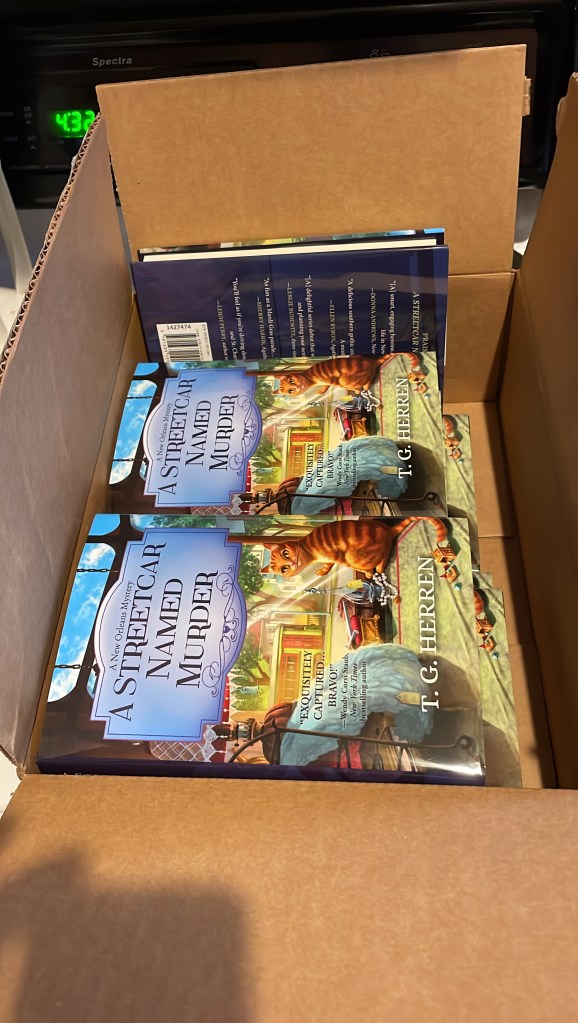
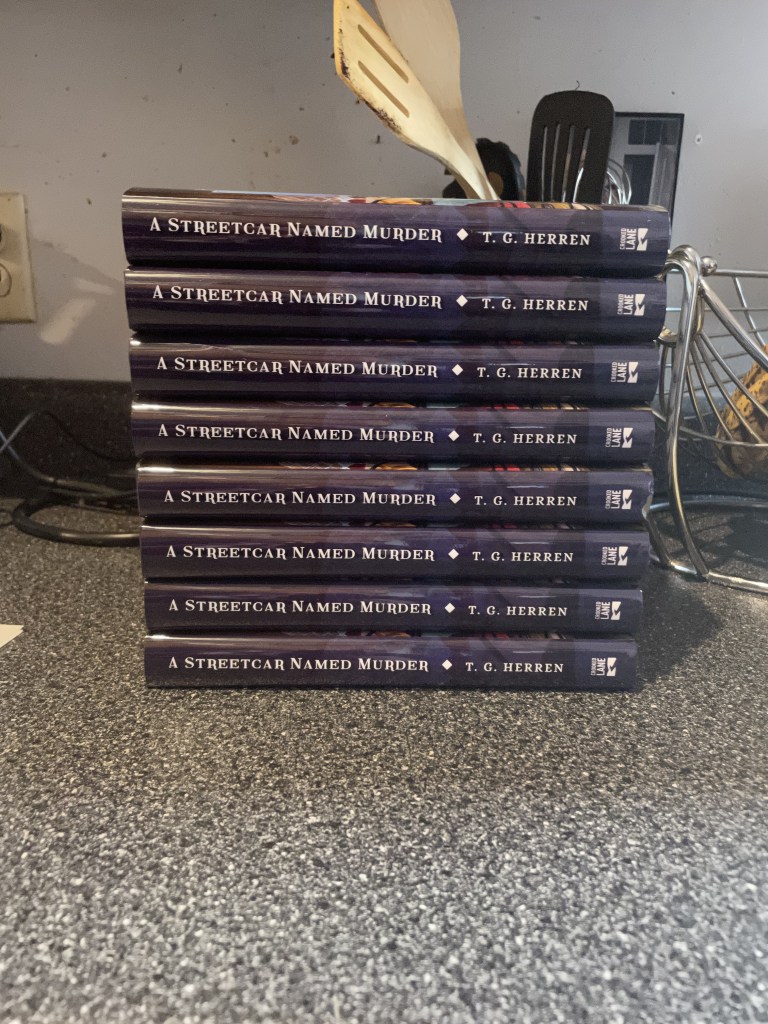
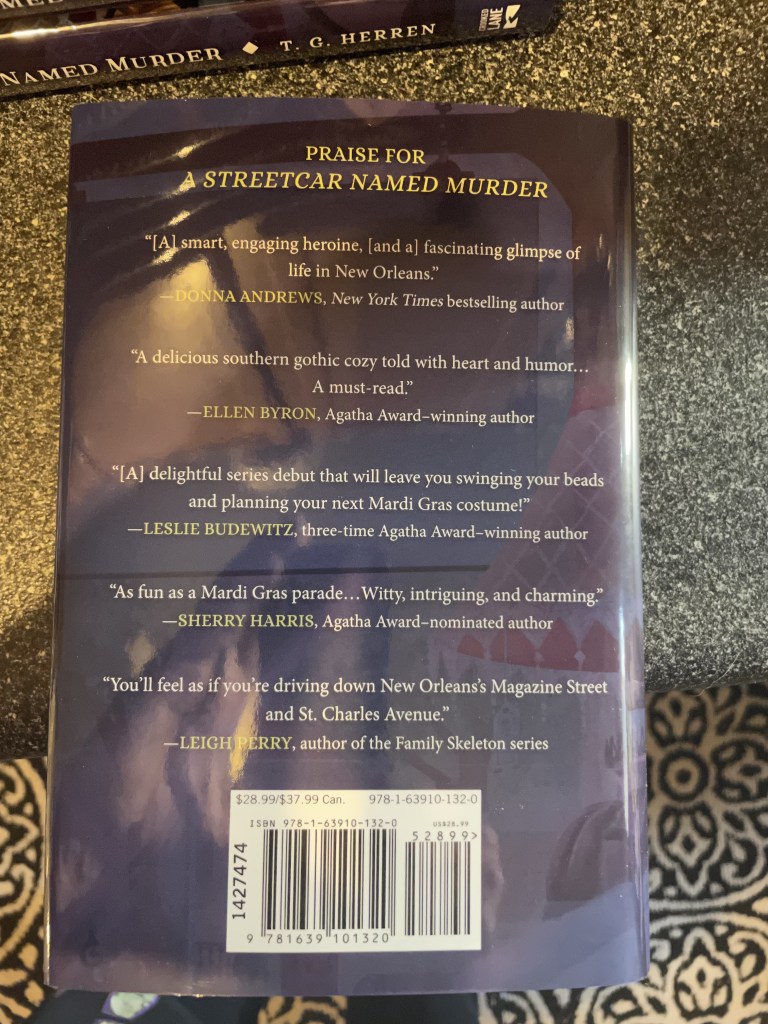
If you follow me on social media you will know already that I got my box o’books of A Streetcar Named Murder this week. The book looks stunningly beautiful, seriously; I couldn’t be more pleased with everything about the book’s packaging. The cover is gorgeous; and stacked up together they look especially gorgeous, as you can see in these delightful images from my kitchen counter.
So, Greg, why did you write a cozy mystery?
The same reason I write anything–primarily because I wanted to, and to see if I could, you know. actually write one. I’ve always liked them–I love traditional mysteries, always have–and have always admired how authors pull off the crime aspect of the story. Sure, there’s a bit of an imaginative stretch required to read a series–how realistic is it that an every day citizen will continually get involved in the solving of a crime, through no fault of their own? But…no one bats an eye about the realism of private eye series, and let’s face it: private eyes involved in murder investigations are just as rare. They spend most of their time on insurance claims or, you know, infidelity. Likewise, police investigations are often very straight-forward, without the usual twists and turns and surprises a writer needs to include to keep the reader turning the pages. The Scotty series–despite him actually becoming a licensed private eye, fits more into the cozy genre than it does the private eye; for one thing, it’s funny, and for another, Scotty is never hired, he always stumbles over a body somehow–to the point that it’s almost a running joke in the series.
I had always wanted to write a mainstream series centered around a straight woman, to be honest. I mean, let’s face it, I’ve done that queer mystery, both series and stand-alones, and I always like to keep my work fresh and interesting for me–I cannot imagine the hell writing something that bores me would be. Early on, before I sold my first book, a major figure in the crime fiction world told me that every so often she wished she could write something else, but “all anyone wants from me is *series character*,” but very quickly added, “But I’m still grateful people want that.” I always remembered that–obviously, I still do–and so while I would be eternally grateful were I ever to achieve that level of great success, I tried to always diversify my writing so I’d never get bored. The Chanse series was very different from the Scotty series; the stand-alone novels are rarely set in New Orleans; and so on.
I’ve tried spinning off my Paige character from the Chanse series into her own series; I always liked the character and thought she was a lot of fun and could carry her own stories quite nicely. I still think so, but audiences didn’t respond to her when I did finally give her those own stories–but there could have been any number of reasons why that didn’t work. The books were marketed and sold as cozies–which I think was a mistake, because I didn’t write them as cozies. Sure, Paige was a single woman, working for Crescent City magazine and a former crime reporter for the Times-Picayune, which gave her some credibility as an investigator, but Paige was sharp-tongued and foul-mouthed. Had I known that the books would be marketed to the cozy audience, I wouldn’t have used Paige–she was too centered in my head as who she was for me to change her significantly in her own series–and would have simply come up with someone new. The books were also electronic only, and oddly enough, my readers tend to prefer to read me in print hard copies.
I had actually tried writing a cozy series before–I had this great idea for one, about an English professor at a university in a fictional Louisiana town on the north shore (based on Hammond); I called it A Study in Starlet and wrote a strong introductory chapter, trying to channel my inner Elizabeth Peters/Vicky Bliss; sarcastic but not bitchy, but it never got anywhere. I actually became rather fixated on my fictional Hammond (which I called Rouen, pronounced “ruin”, and I did want to call one of the books The Road to Rouen), which I may still write about at some point–I never say never to anything–but I am digressing. But I always had it in the back of my head that I should try writing a mainstream cozy at some point in my career. And this came about in a very weird way–it’s a long story–but I wound up pitching the idea I had to Crooked Lane and they offered me a contract, which was quite lovely. (Incidentally, I signed the contract electronically on the Friday before Hurricane Ida; the last email I got from Crooked Lane that Friday afternoon after signing the contract said you’re going to be getting some emails from the team next week so keep an eye out for them and welcome aboard! So, of course the power went out on Sunday morning…)
I originally was going to write about a costume shop. There’s one across the street from Paul’s office that has a showroom and an enormous warehouse; they do a lot of costume work for film, theater, and television, which seemed like a great backdrop for a series with all kinds of potential stories for the future. Crooked Lane didn’t like that, and asked me to come up with something else, so I walked down Magazine Street writing down the kinds of businesses I saw. An antique shop was one of them, and that was what they liked. My working title for the book was Grave Expectations, because it involved an inheritance, but they didn’t like that title either, and I reached back into my archives for a title for the original spin-off idea I had for launching the Paige series–I wrote like 100 pages of the first Paige book in 2004 and it never got used–and grabbed the title from it: A Streetcar Named Murder, and hence, the title was born.
And…I had three months to finish the book, as they wanted it by January 15th. And of course there was the power situation in New Orleans, and…
Heavy sigh. I will leave the rest of the story for another day and time.
I slept really well last night; woke up again at five and since it wasn’t the alarm yanking me out of the clutches of Morpheus this morning, I feel rested. I was very tired last night when I got home; I hit the wall around three yesterday afternoon and when I got home it was the easy chair for me. We watched more Big Mouth, and then I retired to bed around ten. I am working at home tomorrow, so am hopeful this will be a good weekend for writing. I do want to watch both the LSU-Arkansas and Alabama-Mississippi games this weekend–as they could determine who wins the SEC West for the season (and I cannot believe that LSU is in the driver’s seat; I was hoping for an 8-4 season and feared that was unlikely), but I also need to get caught up on my writing and everything. Yikes.
And on that note, I am heading into the spice mines. Have a lovely Thursday, Constant Reader!
I don’t remember how old I was the first time I saw Robert Wise’s film The Haunting; all I do remember was it was late at night–in Chicago, one (maybe more) of the local affiliates always ran films after the news at 10:30; they also ran afternoon movies at 3:30 Monday thru Friday–which is where I got most of my education in classic Hollywood movies. But The Haunting was probably the most terrifying movie I’d ever seen; it wasn’t until a rewatch later in my life that I realized that perhaps the most terrifying and unsettling thing about the movie was you never saw whatever it was that was creating the happenings at Hill House–and they were never really explained, either. I had nightmares after watching it the first time, and those nightmares became recurring. To this day I am not comfortable climbing a metal spiral staircase…
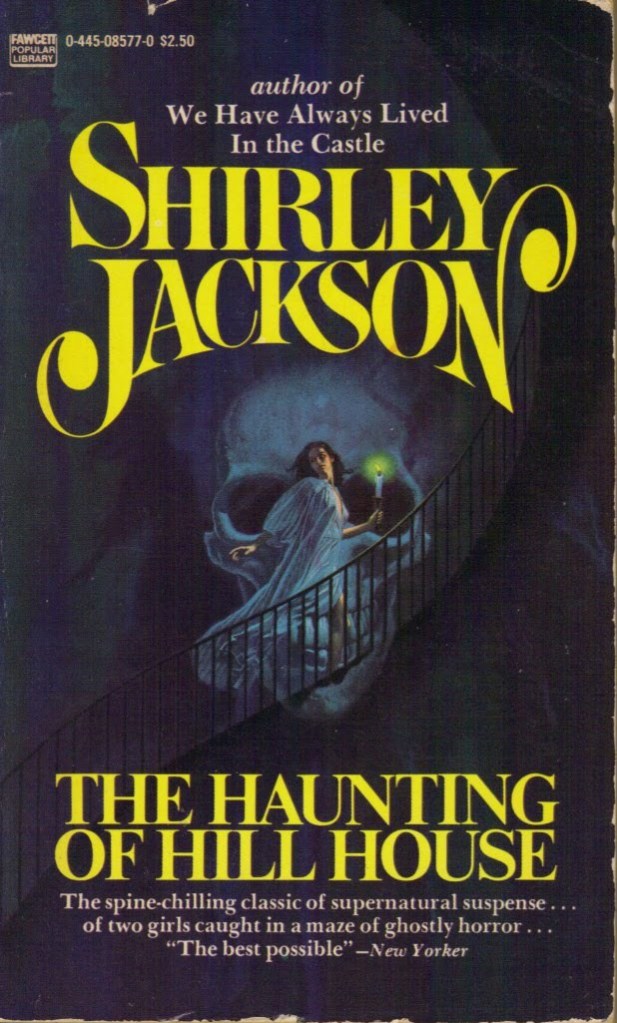
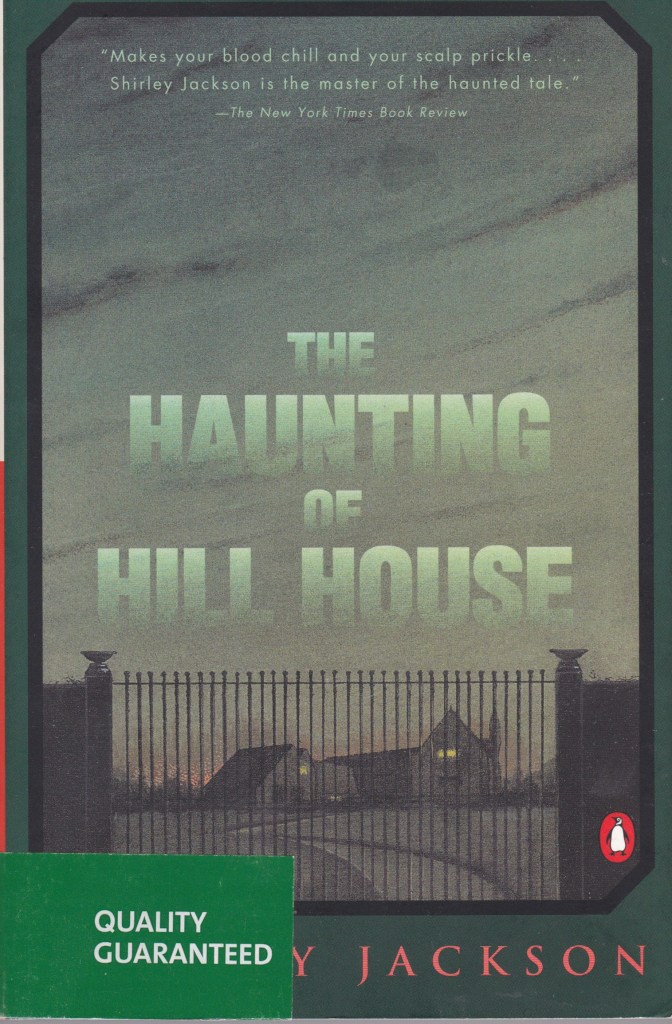
One afternoon when we were at Zayre’s for whatever reason–we went there almost weekly, although I am not sure why–I found a copy of Hell House by Richard Matheson on the paperback racks. It sounded, from reading the back, similar to the movie that had scared me so when I was younger, and I couldn’t help but wonder if the movie was taken from the book? I bought it and read it–loved it, in fact–but while it was similar to the story of The Haunting, it was also different enough for me to be certain they weren’t the same. (Hell House was filmed actually as The Legend of Hell House, which was also a terrifying film–more on that later). It wasn’t until years later, when I was in a used bookstore in Emporia, that I stumbled across this:
It was only a quarter, and looking at the back I recognized the characters–Nell, Theo, Dr. Montague, Luke–and of course, the name of the haunted house–Hill House. I bought it and a couple of others, and I started reading at the first opportunity, and was completely mesmerized. It quickly became one of my favorite novels of all time–I already knew Jackson’s story “The Lottery”, because at some point in school I’d been shown the film (why was this appropriate school viewing? Imagine trying to show it to students today!) and in a Drama class we’d actually read the stage adaptation and even put it on for the school (I think I had one line in our production?). Reading Stephen King’s Danse Macabre also told me more about both Jackson’s writing and the Robert Wise directed film, which was my first exposure to Julie Harris; I also remembered that the opening of Jackson’s novel was used by King as an epigram in ‘salem’s Lot; he also dedicated a book to her “because she never had to raise her voice,” which is a very poetic way to describe the softly macabre writing style and voice she used in her works. I lost my original copy at some point during moves over the years, and I acquired another copy after we returned to New Orleans in 2001 from our brief, preferably forgotten interlude in Washington DC–and have made a point to reread it every year since.
And no matter how many times I reread it, I never tire of its haunting, terrifying beauty.
No live organism can continue for long to exist sanely under conditions of absolute reality; even larks and katydids are supposed, by some, to dream. Hill House, not sane, stood by itself against its hills, holding darkness within; it had stood so for eighty years and might stand for eighty more. Within, walls continued upright, bricks met neatly, floors were firm, and doors were sensibly shut; silence lay steadily against the wood and stone of Hill House, and whatever walked there, walked alone.
Dr. John Montague was a doctor of philosophy; he had taken his degree in anthropology, feeling obscurely that in this field he might come closest to his truest vocation, the analysis of supernatural manifestations. He was scrupulous about the use of his title because, his investigations being so utterly unscientific, he hoped to borrow an air of respectability, even scholarly authority, from his education. It had cost him a good deal, in money and pride, since he was not a begging man, to rent Hill House for three months, but he expected to be compensated for his pains by the sensation following upon the publication of his definitive work on the causes and effects of psychic disturbances in a house commonly known as “haunted.” He had been looking for an honestly haunted house all his life. When he heard of Hill House he had been at first doubtful, then hopeful, then indefatigable; he was not the man to let go of Hill House once he had found it.
Dr. Montague’s intentions with regard to Hill House derived from the methods of the intrepid nineteenth-century ghost hunters; he was going to go and live in Hill House and see what happened there. It was his intention, at first, to followthe example of the anonymous Lady who went to stay at Ballechin House and ran a summer-long house party for skeptics and believers, with croquet and ghost-watching as the outstanding attractions, but skeptics, believers, and good croquet players are harder to come by today; Dr. Montague was forced to engage assistants. Perhaps the leisurely ways of Victorian life lent themselves more agreeably to the devices of psychic investigation, or perhaps the painstaking documentation of phenomena had largely gone out as a means of determining actuality; at any rate, Dr. Montague had not only to engage assistants but to search for them.
That opening paragraph alone is a masterpiece.
I parodied it for the beginning of one of my Scotty books–it gave me great pleasure to write the words New Orleans, not sane, stood by itself within its levees–and of course, this book was a pretty heavy influence on Bury Me in Shadows. The book reads almost like a fever dream, with its rhythms and poetries of language, and the story itself is as mysterious as one could possibly hope. The genius of Jackson is knowing that the biggest fear of all is the unknown; so we never know what is actually going on at Hill House–is the house actually bad, or just unlucky? The house’s history is bad and tragic from the very beginning, as we are told in Jackson’s spellbinding voice; who precisely was Hugh Crain, who built the house for his wife and family but never knew any kind of peace within its walls? What went wrong? Jackson never lets us know anything other than that the house is bad. Her primary point of view character is perhaps the must untrustworthy and unreliable of narrators, Eleanor Vance, Nell. Dr. Montague invited Nell because of a strange occurrence that happened when she was a small child; stones rained down on their house out of clear blue sky; her mother darkly blamed it on the neighbors (this also happened to Carrie White’s house when she was a little girl in Stephen King’s Carrie–in the newspaper write-up included in the book Mrs. White also blamed it on “the neighbors”), but other than that, Nell is pretty ordinary and small. She’s wasted most of her adult life taking care of her invalid mother; she’s now in her early thirties and living with her sister’s family, sleeping on the couch. She’s meek but capable of anger–she has a lot of anger and rage buried deep inside of herself–anger at the world, at the injustice of her wasted life, at the lack of a viable future; she has no prospects, no job, no friends, no nothing. The invitation to Hill House awakens a joy in her that she’s never known–she’s wanted somewhere. Her sister and brother-in-law refuse to let her take their mutual car; she gets up early and rebelliously takes the car anyway and heads to Hill House. As she drives she daydreams and observes everything along the road, making up a lovely fantasy for herself about living in a house with stone lions at the foot of the driveway; she stops for lunch and observes a little girl who refuses to drink her milk because she doesn’t have her special cup with stars on the bottom she can she as she drinks. Mentally, Nell urges the little girl not to give in, to not surrender to the injustice of not having her proper cup–as it will be the first of many surrenders of herself she’ll end up making throughout her life until she, like Nell, becomes invisible.
And then, hopeful and happy and excited, she arrives and gets her first look at Hill House:
The house was vile. She shivered and thought, the words coming freely into her mind, Hill House is vile, it is diseased; get away from here at once.
Which then gives Jackson the opportunity, as the next chapter opens, to describe Hill House:
No human eye can isolate the unhappy coincidence of line and place which suggests evil in the face of a house, and yet somehow a maniac juxtaposition, a badly turned angle, some chance meeting of roof and sky, turned Hill House into a place of despair, more frightening because the face of Hill House seemed awake, with a watchfulness from the blank windows and a touch of glee in the eyebrow of a cornice. Almost any house, caught unexpectedly or at an odd angle, can turn a deeply humorous look on a watching person; even a mischievous little chimney, or a dormer like a dimple, can catch up a beholder with a sense of fellowship; but a house arrogant and hating, never off guard, can only be evil. This house, which seemed somehow to have formed itself, flying together into its own powerful pattern under the hands of its builders, fitting itself into its own construction of lines and angles, reared its great head back against the sky without concession to humanity. It was a house without kindness, never meant to be lived in, not a fit place for people or for love or for hope. Exorcism cannot alter the countenance of a house; Hill House would stay as it was until was destroyed.
Nell’s sanity, never the strongest, is affected deeply by the house–she both hates and loves it, separate parts of her nature begging her to flee while the other telling her she’s come home, to stay. The other three in the party–Dr. Montague, Theo the lesbian with some psychic ability, and Luke, due to inherit the house one day–become aware very quickly that the house is having an odd effect on her; they also hate and fear the house, but that welcoming feeling Nell experiences, that desire to never leave, is for her and her only. The rest of the book is quietly terrifying–the noises in the night, the realization that whatever is going on in the house has a sly intelligence of a sort–and the scene where Nell is terrified in the night and holds Theo’s hand…until Theo turns on the lights and Nell realizes she was across the room so whose hand was I holding? is one of the most horrifying moments in horror fiction. And then, the chilling, tragic end.
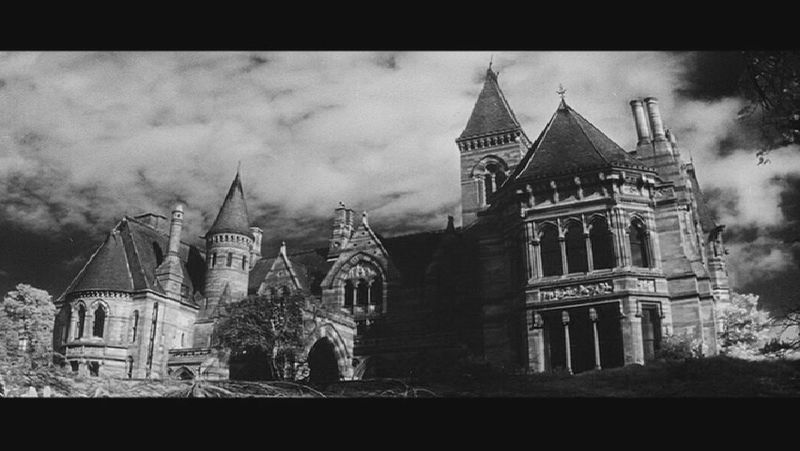
I also always see the house the way it was shown in the movie.
I also rewatched the movie while I was rereading the novel–not the execrable remake but the original–and it holds up just as terrifying and unsettling as it was the first time. Julie Harris is fantastic as Nell, fragile and frayed and slowly unraveling; in the movie isn’t not quite as left to the viewer as it is to the reader the notion that Nell herself is the one haunting Hill House; the house gains its power through her. (This was done beautifully in the Netflix adaptation, The Haunting of Hill House, which is loosely based on the book but updated and adapted and changed significantly; I thought the series was fucking fantastic and an excellent homage to both the book and the original film. You can’t improve on what came before, so why not reinterpret it? I know Jackson purists were outraged, but having seen the dreadful 1999 remake…yeah, this wasn’t that, for sure.)
Also, because of the movie, whenever I read the book I see it in my mind in black and white. The film wouldn’t work in color, either.
If you’ve not read the book, you really should. It’s a masterpiece on every level.
Work-at-home Friday has rolled around again, and today I get to do data entry and quality-assurance on forms until my eyes cross. I have a couple of errands to run this afternoon–but other than that, I am looking forward to a nice, peaceful day at home doing my work-at-home duties and my chores. Later on, I hope to get some good work done on the book before I repair to my easy chair with the latest Wanda Morris novel. It was a tough choice between that and the new Donna Andrews, but I am thinking since Dashing Through The Snowbirds is a Christmas tale, I may save that for Christmas reading this year–it makes the most sense, and since I generally don’t watch any Christmas movies or specials anymore (I do sometimes watch A Charlie Brown Christmas–it’s my favorite), maybe I could read Christmas-themed books and stories this year in December; maybe call it “The Twelve Reads of Christmas” or something like that. Hmmm, it’s a thought.
It really is amazing what a good night’s sleep will do for you after a few days of insomnia and exhaustion/fatigue.
Last night I didn’t sleep as deeply or as well as I did on Wednesday night. I kept waking up, partly due to Scooter’s restlessness and sometime need to let me know his outrage about something, but was always able to fall back asleep. I had to have bloodwork done this morning; I got an email from the lab telling me I had lab orders waiting for me, so I scheduled it. I got there this morning and checked in–mind you, I needed to fast, so I didn’t eat last night or have anything to drink or eat this morning before leaving the house–only to find out they didn’t, in fact, have lab orders for me. Hilariously, I am terrible about remembering to do the labs after my doctor appointments, so this last time in July I made the appointment for Labs the same week as my doctor appointment and had them done. Once they told me I didn’t have orders in, I looked in the app and saw that I had, indeed, had them done back in August. So, no need to fast overnight, no need to not have coffee before leaving, no need to leave, in fact. Heavy sigh. But I did start reading Wanda Morris’ new book while waiting to be told I didn’t really need to be there, and it’s quite marvelous already. I knew it would be–her debut novel was superb–and it’s such a delight, as always, to see exciting new voices grow and become even stronger as their career progresses.
Last evening as I relaxed before heading to bed I watched another documentary about the history of gay pornography–I’ll probably watch another one later today–which of course put me in mind of writing about that history. I really do need to focus on getting this Scotty book and the next thing I have to write finished so I can get back to Chlorine; my goal for the rest of this year and 2023 is to get these two books finished, finish two other in-progress projects, and wrap up some other things that are unfinished but need to be finished so I can cross them off the list. I may do another short story collection; I’m not sure but I think I have enough sold and/or published for another collection to actually be possible. This one, when it materialized, will be called This Town and Other Stories, because the strongest story I’ve done since the last collection was “This Town”, which was in Holly West’s anthology Murder-a-Go-Go’s. At least in my opinion, although The Affair of the Purloined Rentboy and Other Stories would probably sell better…
And of course, tomorrow is a big day for the Southeastern Conference, with division championships on the line. LSU can actually get a leg up in the West by accomplishing the gargantuan task of beating Alabama in Baton Rouge for the first time since 2010–but I don’t think that’s going to happen. Sure, it’s possible–anything is possible in college football on any given Saturday; I am sure no one would have thought Kansas State would shellack Oklahoma State the way they did last weekend–but despite all the hype chatter, I’m not getting my hopes up terribly high. Yes, I want the Tigers to win–but I don’t have any expectations, just as I really haven’t all season. I’m just delighted the program seems to be on the rise again after the last two horrible years. I certainly would have never thought LSU would be coming into the game with Alabama tied with them and Mississippi for first place in the division. And earlier in the day Georgia and Tennessee will play for the leg up in the East–which again, no one would have seen coming before the season started; no one really give Tennessee much thought as the program has been moribund since at least 2007, the last time they won their division (which also happened to be the year a two-loss LSU team won the national championship–see how you can see omens and portents in everything?). I am not a Tennessee fan by any means–I rooted for them during the Peyton Manning years because I thought he was a phenomenal athlete plus I despise Florida with every fiber of my being, but that was about it. I only root for them in non-conference games and bowls, but I am happy for their fans–just as I was happy for Georgia fans last year as they finally beat Alabama and won the national title; I always think back to what a glorious ride 2019 was for LSU fans, so it’s always nice to see a long-starved fan base finally get something they can be excited about. Pundits and fans are already comparing 2019 LSU and 2022 Tennessee…but it’s really not even the same. Sure, no one thought LSU would be as great as they were in 2019, but they were also coming off a 10-3 season. Tennessee was 7-6 last year, so it’s an even bigger turnaround for them on that level. I plan to get my writing and my errands and chores finished tomorrow morning well before the 2:30 Georgia-Tennessee kick-off, so I can spend the rest of the day nervously cleaning with the games on in the background. Paul also comes home tomorrow (yay!) so I am going to need groceries, too.
And my kitchen, as always, is a disaster area on a Friday morning, so it’s perhaps time for me to head into the spice mines. Have a lovely day, Constant Reader, and I’ll check in with you later or tomorrow.
Thursday morning and I slept really well last night. About time, right? But it’s amazing what a good night’s sleep makes, especially coming after two consecutive nights of insomnia. It’s lovely not to feel tired, you know? I was so tired when I got home from work yesterday that my eyes were almost crossing. I was too tired to think, too tired to write, too tired to do much of anything, so I just collapsed into my easy chair–Scooter actually slept in my lap all evening, and when I got up, he’d curl up in the chair again waiting for me to come back, which was very sweet–and then I watched the documentary God Forbid, which focuses on the Jerry Falwell Jr. pool boy scandal that ended Falwell’s career, from the pool boy’s point of view, which made it a lot more interesting.
It also explored how Falwell’s father led the evangelicals into politics and set us on the downward path that put our entire democracy into the peril it still faces today. The original Falwell was a monster–racist, homophobic, misogynist–and perverted Christianity for money and power. He isn’t the first to do this–look up “Father Coughlin” sometime–and maybe not event the worst (anything is possible), but the damage done to the fabric of the culture and society, predicated on the evangelical desire to make this a Christofascist nation (definitely not what the Founders wanted), by this man and his son may even prove irreparable in the long run. Who knows? Falwell Jr. was important to the election of Trump and the evangelical embrace of this thrice-married ungodly and unChristian wannabe dictator, too. And it got the evangelicals what they’ve wanted since Falwell Senior realized that open racism wasn’t a winning ticket–but abortion could be: the overturn of Roe v. Wade. Would Falwell have backed Trump if Michael Cohen hadn’t known about the sick sexual games the Falwells were playing with a young, naïve young man named Giancarlo Granda? It would make an epic crime novel, truly–I loved John D. Macdonald’s examination of a Midwestern megachurch, One More Sunday, which I really enjoyed.
I have had this idea for a crime novel built around a cult-like church for quite some time. When I was living in Kansas, there was a college in Emporia that was owned and operated by just such a cult-like church. The College of Emporia, a Presbyterian school, had gone bankrupt and closed in 1973. A few years later it was purchased by The Way International and transformed into The Way College of Emporia. The Way College was strange. Their campus was closed to outsiders and patrolled at night by armed guards. There was all kinds of gossip around the county about what went on there and the kinds of things they believed and did; the students always wore name-tags and travelled in pairs–and would often try to corner other young people and proselytize. When I was working at McDonalds, for example, I observed them do this to a girl who was cleaning tables in the lobby. They essentially waited until she was in a part of the place that had only one way out, and once she was back there cleaning tables, they blocked the way out to talk to her. They always had this weird look on their faces, too–their eyes always seemed either glazed or vacant or both, and they always had a zombie-like smile that didn’t reach their eyes. One of the many iterations of the Kansas book took place over two time-lines, one in the 1970’s and the other the present day; where the quarterback’s murder in a sex scandal in the 1970’s gave rise to a megachurch in the town. I have done some research in the Way International (they sold the Way College and its campus to Emporia State University sometime after we left Kansas) and even have a book written by someone who belonged and got out.,,so I would never say never.
Oh, and thank you, Brazil, for ousting your Fascist. Well done!
Unfortunately, my exhaustion last night means that I have fallen another day behind on the book, which isn’t good. But it was really out of my hands, to be honest. I was so tired I don’t even really remember driving home from work last night–which is NOT a good thing at all. But I am hoping that feeling rested and not being exhausted will make a difference tonight. I am halfway done–it’s planned to be twenty chapters, and I finished Chapter Ten on Tuesday–so tonight I am going to go back and reread and edit the first half of the book. It’ll take some serious work–the kind where I have to close the Internet browsers to avoid distraction–because some of the earlier chapters need to be moved around and rearranged; the order in which the story unfolds needs to be switched up a bit–and I need to outline the first half as well as make a character list and due a timeline. I also realized that my usual Scotty thing to do–parody the opening of a famous novel–doesn’t have to be a parody of a famous novel opening–and I’ve always wanted to write something that opened the way Dark Shadows did (“My name is Victoria Winters”), so why not do that? “My name is Scotty Bradley” or something along those lines. I wonder if Victoria’s opening monologue from episode one is on-line anywhere? Better add that to the list.
And on that note, Constant Reader, I am going to head into the spice mines. Have a great Thursday, and I will talk to you again tomorrow.
Here we are back on another Monday morning with another work week staring us in the face and not blinking. Great, right? It was a lovely weekend around the Lost Apartment, if a bit lonely; Scooter was definitely needy all weekend and it’s weird to have the bed almost entirely to myself (not including Scooter). I felt well rested both weekend mornings when I arose; yet after running my errands on Saturday and doing some cleaning I became extremely fatigued, which sent me to my chair. I did manage to get some things done once the fatigue set in–I think low blood sugar had an awful lot to do with it, to be honest–and it’s irritating, frankly. I had wanted to be a lot more productive on Saturday than I actually was; but c’est la vie and all that nonsense. I do think I am going to need to do some restructuring of the opening chapters on my book, but that’s cool; it certainly makes more sense for me to order it the way that I am going to restructure it all. And no, I didn’t get a lot done this weekend. Maybe a restful weekend of recharging my batteries was just what the doctor ordered; who knows? I am trying not to get overly stressed out about everything that is pending for me.
Stress is the mindkiller.
I’ve oddly enough been sleeping better and more restfully recently, despite the addition of cappuccino to my morning routine every morning–but maybe the caffeine crash is why I am so tired in the afternoons. Maybe, but I was also tired in the afternoons before I got the new espresso machine (which I love, if I’ve not made that clear enough already) so who knows what the new normal/Greg’s reality is anymore? I certainly don’t know.
And it’s Halloween, of course. Happy Halloween!
I was going to rewatch the original Halloween last night, but instead I rewatched Robert Wise’s 1962 adaptation of The Haunting, based on the novel by Shirley Jackson. I originally saw this movie when I was a kid, staying up late one night to catch it on the late movie, and it was absolutely terrifying. It’s exceptionally well done, and Julie Harris is so definitive as Nell–the cast is all so definitive in their roles, really–that I can’t help but see them every time I reread the book. It really is a stunning performance by Harris–she really embodies Nell–and the entire thing is so claustrophobic and terrifying, really; the concept of what you cannot see being more terrifying than what you can played up perfectly by Wise’s incredibly capable direction and camera shots–and the editing ratchets up the suspense and terror perfectly. It follows the book incredibly closely–one of the most faithful adaptations of book-to-film; up there with Rosemary’s Baby, really–and as I watched, not terrified because I’ve seen it so many times so thus able to watch for the direction and the editing, which were superb, as was the black and white cinematography, I couldn’t help but marvel at what a great job Wise did with the cast and the film. The remake was terrible, absolutely terrible–unwatchably bad; which remake a classic in the first place, especially when you’re just going to go crazy with the CGI budget, which takes away the most important suspense/terror aspect of the book and the original film: you don’t see the monsters, you don’t see whatever it is that is haunting Hill House and it is never explained. I also don’t usually like movies that have voiceovers to show a character’s thoughts, but the book itself is so intimately from Nell’s point of view that it would be hard to translate that on film and get the same feeling–and the emotive way Julie Harris does the line reading makes it work, draws the viewer in, and makes the viewing experience incredibly intimate and claustrophobic at the same time, which is exactly how Jackson wrote the book.
I also recorded Alexia Gordon’s Cozy Corner podcast yesterday, and it was a lot of fun. We talked for a very very long time–we both lost track of the time, really–and talked about a lot of things. It was seven by the time I got off the ZOOM call, and when I got up to make myself something to eat was when the fatigue hit me. Was it related to the podcast and social intercourse, which also required me to think and be smart and actually put thought into my answers? I don’t know, maybe it was but I was pretty tired by the time I made my grilled-cheese-and-bacon sandwich for dinner and repaired to the living room to watch the movie. I didn’t stay up much longer after I finished watching either; I was watching some documentary on Youtube about the Hapsburgs and started nodding off, so I decided to just go on up and go to bed early–more sleep never hurt me, after all.
I may even go to bed at nine tonight. Perish the thought!
But I think my restful weekend did the trick, and it was clearly what I needed. I do feel refreshed and alive and rested, both physically and mentally, this morning–or it could be the cappuccino. I guess we’ll find out this afternoon when the caffeine wears off.
So on that note, without further ado, I am heading into the spice mines on this lovely cool Monday morning in New Orleans. And may your day be lovely and bright, Constant Reader–I will talk to you again tomorrow morning.
Sunday morning and I guess there’s probably a Saints game today? I am a terrible fan this year–I can’t seem to remember ever to check on the schedule to see when the games are, so maybe it’s my fault they’re having a really terrible year? (Yes, Greg, because that’s exactly how professional sports work…)
The sun is bright this morning–it was gloomy, overcast and humid yesterday; I also got rained on while running my errands. I am having my morning cappuccino, which is marvelous, and feel like I again slept extremely well again last night. Ironically, despite the same feeling yesterday morning, I succumbed to fatigue much earlier than I thought I would yesterday, which didn’t bode well for getting things done the way I had hoped and/or wanted to. So, no, I wound up not getting nearly as much done yesterday as I had originally hoped I would; but I am also still at the point where I think any progress is better than no progress so I am taking the day as a win. I did have the football games on in the background while I tried to get things done around here, and they kind of turned out the way I figured they would: Mississippi taking down Texas A&M; Tennessee embarrassing Kentucky; and Georgia made a fool out of Florida. Missouri surprised South Carolina, and Arkansas embarrassed Auburn at home. The big surprise of the day was the way Kansas State embarrassed top ten ranked Oklahoma State–no one, I think, saw that coming. But this weekend did a good job of setting up next weekend: the winner of LSU-Alabama takes control of the West, while whoever wins Georgia-Tennessee will do the same in the East. I try not to get involved in the whole “conspiracy theory” aspect of fandom, in which some controlling elite wants certain outcomes to drive their ratings, but I can’t help but think everyone at ESPN and all the college football reporters are hoping for an Alabama win, to make the Alabama-Mississippi game matter in two weeks as a “winner takes all” battle for supremacy in the West. I don’t expect LSU to win, honestly; that’s almost too much to hope for (although I do hope it happens), and all I am really hoping for is another great game, not a blow out.
I think the weather had something to do with the doldrums I was suffering from yesterday. I don’t have that same feeling this morning, but at the same time I think maybe not waking up three mornings in a row to an alarm helps make me feel more rested for some reason. It doesn’t make sense (little does, really, when it comes to my mind and my theories about my life and so forth), but I am hoping that once I get this done and the kitchen repaired a bit (the sink has dishes, things need to be put away) I can dive into working on the writing and some other things I want to get done. I’m going to take a break momentarily after finishing this to read a short story by Paul Tremblay, after which I’ll get cleaned up and get a move on with everything.
Or so I hope, at any rate.
I watched an episode of American Horror Stories before I went to bed last night–the one called “The Lake”–and it was much better than the earlier episodes I’d seen. Alicia Silverstone, Teddy Sears, and pretty young Bobby Hogan were an appealing cast, and while the story was terribly derivative (the curse of towns flooded by dams is an old trope; there’s a great German show with a similar premise–but it’s also a trope I’ve always wanted to use as well), the acting was fine and the ending–while a little like The Fog, it worked within the construct of the story and was really the only way for it to actually come to an end. It reminded me, in some ways, of another idea I had for a story a long time ago–about college kids camping out in ghost town in the Sierra mountains in California that I’ve always wanted to write–but who knows if I will ever get around to that or not? It was entertaining, though, and now of course it’s Sunday–several of the shows we watch drop episodes on Sundays, but I can’t watch any of them until Paul gets home. Heavy sigh. Although I think tonight I’ll rewatch Halloween–the original. It is, after all, the seminal slasher movie and the one that kicked off the slasher craze of the late 1970’s/early 1980’s (along with Friday the 13th).
On the other hand, one can never go wrong with Scream, for that matter.
Well, I can figure out what I am going to watch later, right? It’s not like it is of the utmost importance to figure this out right now, either.
Or maybe I’ll watch a horror movie I’ve never seen before–there were so many in their heyday that I’ve not seen them all, like Terror Train or Prom Night–then again, on the other hand, there are so many it’s entirely possible I’ve seen some of them and forgotten that I have, as well. My memory is no longer trustworthy, after all–as I am finding out while writing this book–which makes me wish I’d written more things down over the years or been more faithful to keeping a journal; I’ve never been as faithful to a journal as I have been to this blog, for example. Yet another reason why I don’t write a memoir or many personal essays; I don’t trust my memory, and I know I have most likely revised my own personal history to make myself more of the hero of the story than I should be–it’s something we all do, really; it’s also how we perceive things, through our own lenses with all of our foibles and miscues and flaws helping to interpret and record things in that great back-up hard drive inside our skulls. We are all the heroes of our own story, even if we are the villain in someone else’s.
And on that note, I am heading into the spice mines. Have a lovely day, Constant Reader, and I will check in with you again tomorrow morning.
Well, Paul left yesterday and suddenly I find myself living alone in this enormous apartment. It’s weird how that works. I guess Paul just is a very large personality or something like that? It’s just weird to me how the apartment can seem so different while he’s gone. I do sometimes, as I am morbid by nature, sometimes think when he goes away like this and I get bored and/or lonely and/or feel like I’m rattling around in this big huge empty space, well, if you outlive him this will be your future and I’m not quite sure how I feel about that? I know I don’t like thinking in those terms, but as the years pass and more things happen and we have different things happening to us health-wise and so forth, you do start getting a stronger sense of your own mortality, whether you like it or not. I always thought I would die relatively young, so I always feel like I am already living on bonus time I wasn’t meant to have–and yet, I keep going on somehow. It’s a complete mystery to me.
Sometimes I feel like Ishmael.
LSU has the weekend off like they always do the week before the Alabama game, so there’s no reason for me to have the television on for much today. Oh, sure, I won’t be able to resist having Georgia-Florida (“The World’s Biggest Cocktail Party”) game on, as I am expecting Georgia to humiliate the Gators (sorry, UF fans, I very rarely–if ever–want your team to win, but I am sure you return the favor and want LSU to lose every game they play as well), and I am not really all that sure who else is playing today, to be honest–I know Mississippi is at Texas A&M, which is a tough one for me to chose a favorite in; although I think I am going to have to lean towards Mississippi a bit–but again, my plan is to work this morning, run my errands (including making groceries–not much, but some), and then come home to clean and organize the apartment. I’m also going to take my laptop upstairs as well as a flash drive so I can use Paul’s computer if I need to write (and don’t want to use the laptop), and spend the rest of the day cleaning upstairs and trying to get things under control somewhat more up there. One can hope, at any rate.
I like my new espresso maker! I tried it out yesterday morning and it worked wonderfully. I think I may go back to having one in the mornings before I head into the office; that bold shot of caffeine certainly did its trick yesterday morning. I am currently having a homemade cappuccino as I type this, and it’s quite delicious, if I do say so myself. Having one yesterday didn’t affect last night’s sleep, as I feared would turn out to be the case. I slept great last night, despite being alone in the bed–Scooter helped a lot, as a cuddly purr-kitty–and I feel very rested and well this morning. Which is good, because I have a very big day planned here around the Lost Apartment–cleaning and writing and organizing–and I also have those errands to get to.
I must confess that after my work-at-home duties were completed yesterday I was terribly lazy. I didn’t write a word, which is shameful–I was mentally fatigued, plus off-balance because it was my first Paul-free evening–and so I rewatched Nicholas Roeg’s film of Daphne du Maurier’s Don’t Look Now on HBO MAX. I highly recommend the movie and the story; it’s really one of my all-time favorites, and the film does an excellent job with the story–far more so than Hitchcock did with her story The Birds (if you like Hitchcock’s film, you really need to read the original story, which is vastly superior in my opinion). I also finished my annual reread of Shirley Jackson’s The Haunting of Hill House, which as always was completely captivating. I cannot get over marveling at what an incredibly lyrical writer Jackson was, or how her prose just sings from the page while magnificently creating a morbid, melancholy tone that is, in and of itself, haunting. (I was thinking about watching the Netflix adaptation of Jackson’s We Have Always Lived in the Castle, another one of my favorites; Merricat Blackwood is one of the great fictional characters of the twentieth century in my opinion) I may dive into some Paul Tremblay short stories this weekend since I don’t have the time to finish reading another Halloween Horror novel, but tonight I may rewatch the original, classic film of Halloween again. I think I do owe it to myself to watch some horror films leading up to Halloween, don’t you think? Don’t Look Now, while not quite horror, certainly does fit the bill somewhat for my mini-film festival…I wonder if Robert Wise’s The Haunting is free to stream anywhere? That is probably my favorite horror film of all time–it scared me shitless when I was a small child, and still does to this day; skip the execrable remake, but the Netflix series adaptation is quite good, actually; the episode called “The Bent-neck Lady” is one of the best episodes of television ever filmed, in my opinion. I also want to spend some time today revisiting what I’ve written so far for Mississippi River Mischief to get an outline done and a character list, which I really need to get done, and I also plan to revisit another project I’m working on and am quite far behind on now.
I do have some laundry to do, some clean dishes to put away, and of course the floors always need to be done. I am going to spend the rest of this morning cleaning the kitchen and making a list for my mini-grocery making today; there are a couple of things I need to pick up–nothing much, really–and of course I have to drop off yet another box of books to the library sale. I also need to put air in one of my tires, and ugh, I have so much to do before my trip home for Thanksgiving. Heavy heaving sigh–sometimes it doesn’t help to look ahead, does it?
And on that note, I am going to bring this to a close and head into the spice mines. Happy Saturday, Constant Reader, and may your day be as lovely as you are.
It’s a work at home Friday and Paul is getting ready to head out to the airport. Heavy heaving sigh. While alone time is something I can always appreciate, it doesn’t take more than a day or two before I start missing him. But I have a lot to keep me busy, so if I just focus and work my way down the to-do list, I should be able to keep busy enough to not miss him while at the same time getting a lot of things done–always a plus, especially given how behind I am on this book–but a Gregalicious at rest tends to stay at rest, so the big thing for me is going to be staying motivated.
Ugh, I hate when Paul goes away.
I was tired again yesterday when I got off work and came home, so spent some time organizing and doing mindless chores once I got home until Paul got home from work. By the time he’d gotten home I’d already finished the chores and given in to Scooter’s demands for a lap to sleep in, and was watching the latest iteration of ESPN’s show Saturdays Down South, which of course is a history of the Southeastern Conference. This episode was for the decade 2010-2019, and while it naturally focused on the Alabama supremacy, it was fun revisiting some of that football history from that decade: Auburn’s runs in 2010 and 2013 (the “Kick Six” win against Alabama included); the runs for both Mississippi and Mississippi State in 2014 that ended disappointingly but had them both ranked in the Top Three at the same time (until they lost to LSU and Alabama, respectively, on the same day), and of course ending with the incredible LSU season in 2019. Much as I would love to climb on board this year’s LSU hype train, I’m reserving that excitement until a week from tomorrow. Alabama is the stumbling block as it always is (only one national champion since 2006 was able to claim the title without having to beat Alabama–hence The Alabama Supremacy), and even the game being in Tiger Stadium means nothing. LSU has beaten Nick Saban exactly four times (2007, 2010, 2011, 2019) with three of those games being in Tuscaloosa. LSU hasn’t beaten Alabama in Baton Rouge since 2010–twelve years.
So, yes, I am a huge LSU fan but I am also realistic. I’ll be cheering for the Tigers, you bet, and I want them to win…but I am not expecting them to win. I am hoping for it to be a great game.
After Paul got home we caught up on American Horror Story: NYC, which weren’t as interesting to me as the first two episodes. In other words, as we get deeper into the season the plot is beginning to derail a little as so often happened with seasons of the show. However, since the story is set so strongly in the gay community of the early 1980’s, I’ll keep watching. I somehow always manage to keep watching this show (Double Feature we bailed out of during the aliens second feature; we also gave up on Hotel but somehow managed to watch both Roanoke and Apocalypse all the way to the bitter end) despite how far off the rails some of these seasons inevitably wind up going–it’s the completist in me, I think–although I feel pretty confident we’ve also given up on A Friend of the Family as well. (Paul: “This could have been a two-hour movie; it didn’t need to be an ongoing series.”) I am now at a loss for what to watch with Paul gone–I can’t watch anything we’re watching together, or something we’d watch together–but I think I am going to revisit the latest Nancy Drew series; I watched the debut episode and kind of was intrigued by it, but Paul wasn’t interested so never went back to it. I checked yesterday and was stunned to see three seasons have aired, which is cool. I hope The Hardy Boys also gets another season, in all honesty; I enjoyed the show. Having grown up on the Hardy Boys and Nancy Drew, I am always interested to see how the characters/stories get adapted for a modern audience (and belonging to several fan groups on social media for the books is equally interesting, particularly in how imprisoning and limiting so many people can make of nostalgia for something from their childhoods), just as I was interested in seeing Riverdale’s approach to the Archie characters.
I wound up going to be relatively early as I started falling asleep in my chair while watching AHS: NYC last night (I will probably have to rewatch the latest one because I kept dozing off; I also rewatched Andor last night for the same reason before Paul got home). I also got a new espresso maker yesterday which I am dying to try out this morning. I also want to finish my reread of The Haunting of Hill House before moving on to something by Paul Tremblay. I didn’t do well with my “October horror reading month”–I didn’t read very much this month at all, which is shameful, especially since I got Wanda Morris’ new book this week as well–can’t wait to dig into that.
Sigh. Am I being overly ambitious with my plans to get things caught up while Paul is out of town? It’s entirely possible, and I could possibly be setting myself up for a terrible disappointment, but there it is.
And on that note, I am heading into the spice mines. Have a lovely Friday, Constant Reader, and I will check in with you again tomorrow.
Thursday morning and my last day in the office for the week–woo-hoo! (I really do make it sound like I hate my job, don’t I? I actually don’t; I like my job a lot…but I’d prefer to stay home, always.) Paul is leaving tomorrow and I am trying to prepare myself for the emptiness; Paul is not a big man and he’s not loud, either–but when he is gone the house just feels enormous and empty. Scooter also gets lonely and needier–he’s used to having Paul to sleep on/with most of the time–and so I’ll probably spend a lot more time with my laptop in the bed with Scooter than I usually do. I also want to clean the upstairs while he’s gone, which is probably what I will do most of the day on Saturday; clean the upstairs while football games play on the television. Sounds like a good plan to me! I also have to take some more books to the library sale, and I can swing by and get the mail and stop at Fresh Market on the way home.
I feel rested again this morning. I had a very good night’s sleep last night, which was marvelous, and I hope this means a productive day. Yesterday was a pretty good day, actually; I managed to get quite a bit done and stopped to get the mail and to make a little groceries (amazing how you cannot get out of a store without spending a minimum of fifty bucks anymore) before coming home and relaxing a bit. I finished writing Chapter Eight (huzzah!) and am now going to move on to Chapter Nine. I am still further behind than I would prefer to be, but a strong push this weekend (Sunday all I plan to do is write) should get me back on schedule. I had wanted to be finished with the first draft by the end of the month, but somehow the month slipped through my fingers; Monday is Halloween, and this weekend of course is Gay Halloween, aka Halloween New Orleans. That, in the olden days, would have been my plans for the entire weekend, and whatever my costume for the Ball on Saturday might be would always start with the adjective “slutty.” Those days are past, long past, alas; no one wants to see sixty-one year old Greg in anything that starts with slutty, but hey–I had a great time back when I could get away with the look. And I got away with it, he typed modestly, far longer than I ever would have thought I could.
Last night we watched the new episode of Andor, but I am probably going to have to watch it again after Paul leaves, because my mind kept wandering–not because the show isn’t good, but because my mind kicked into “book mode” while I was sitting there watching and I kept thinking about the work I need to do on the book and how to revise the opening to make it stronger and move faster. I hope to get a good portion of the next chapter done today and another tomorrow before taking Saturday to rest and then diving back in headfirst on Sunday. I really need to update my to-do list because there are things I need to do that I keep forgetting about and they aren’t written down on the list which makes remembering them that much harder. Heavy heaving sigh.
I then watched the conclusion of the Real Housewives of Beverly Hills reunion, which was interesting. I still might have to do an entire entry about this past season; I generally try not to get involved in conversations about reality television publicly–it’s ever so much more fun to do privately with friends–but I am often reminded of how vested viewers would get in soaps, both daytime and primetime; we used to have watch parties for Dynasty when I was in college, after all, and talked about the show incessantly, living for the bitchy cattiness and the surprise twists in the plot. Someone with whom I rarely ever agree–Camille Paglia–actually said something insightful when talking about these reality shows so many watch fervently: she said they were the modern-day versions of the 1980’s prime time soaps, and she wasn’t wrong. They aren’t the same kind of shows at all, but in some ways they are; the housewives shows have certainly taken the place of the old night time soaps, and just like them, the housewives began with a show with modest success and then branched out to replicate the formula, just as Dallas was the first and the rest sprang from its success. And I have to say, there were times last night once Kathy Hilton made her entrance that I was reminded, over and over again, of Dynasty: her entrance reminded me of Alexis entering the courtroom to appear on the show for the first time, and as Kathy sat there, shredding her foes with a razor-sharp tongue I kept seeing Alexis on the stand tearing down Blake, over and over again.
And yes, I can see my friends from college all sitting around today watching this show while getting really high and drinking lots of beer.
I also just realized that with Paul out of town I won’t be able to watch any of the shows we are watching together; I’m really glad House of the Dragon has already ended because I wouldn’t have been able to wait to watch! Hence I will be bored every night and therefore should use that time to either read or be productive.
We’ll see how it goes.
And on that note, tis the spice mines for me. Have a lovely day. Constant Reader.