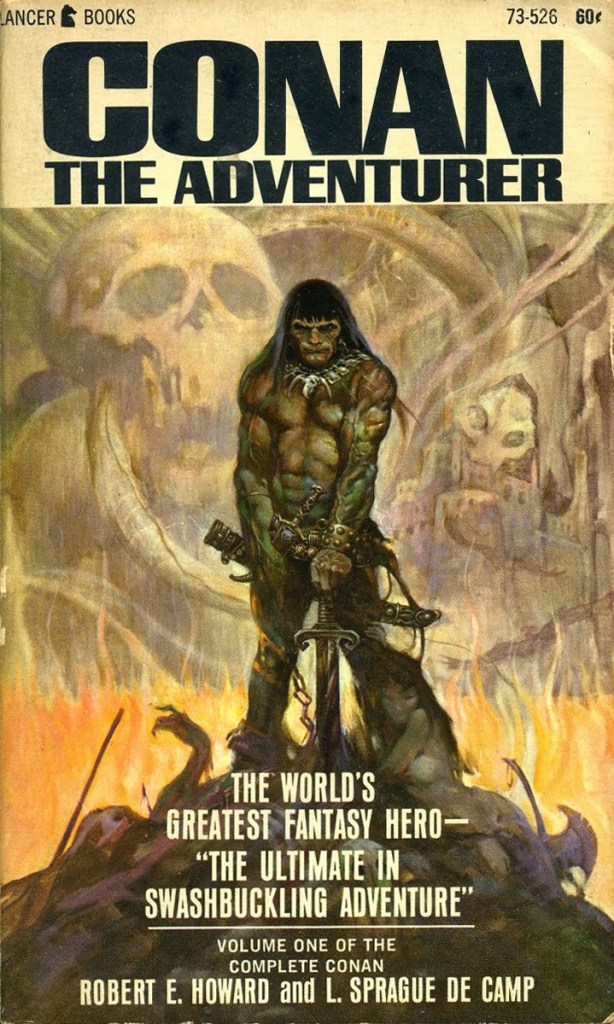
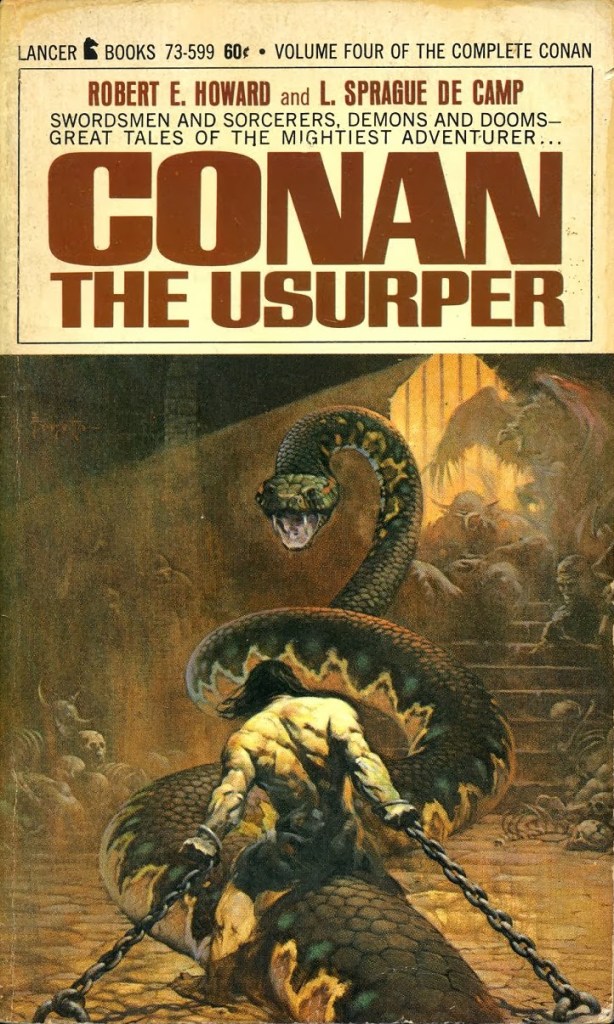
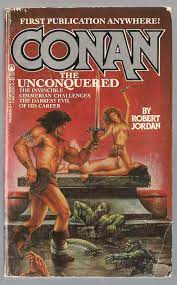
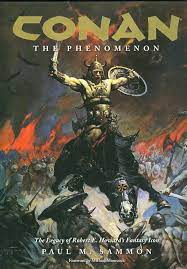
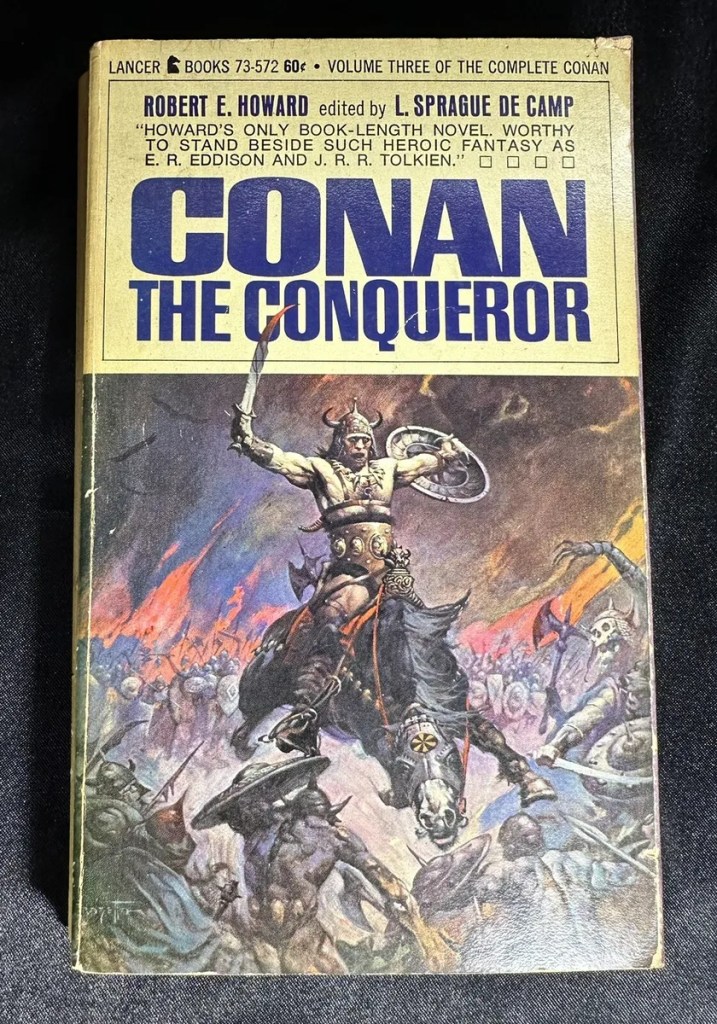
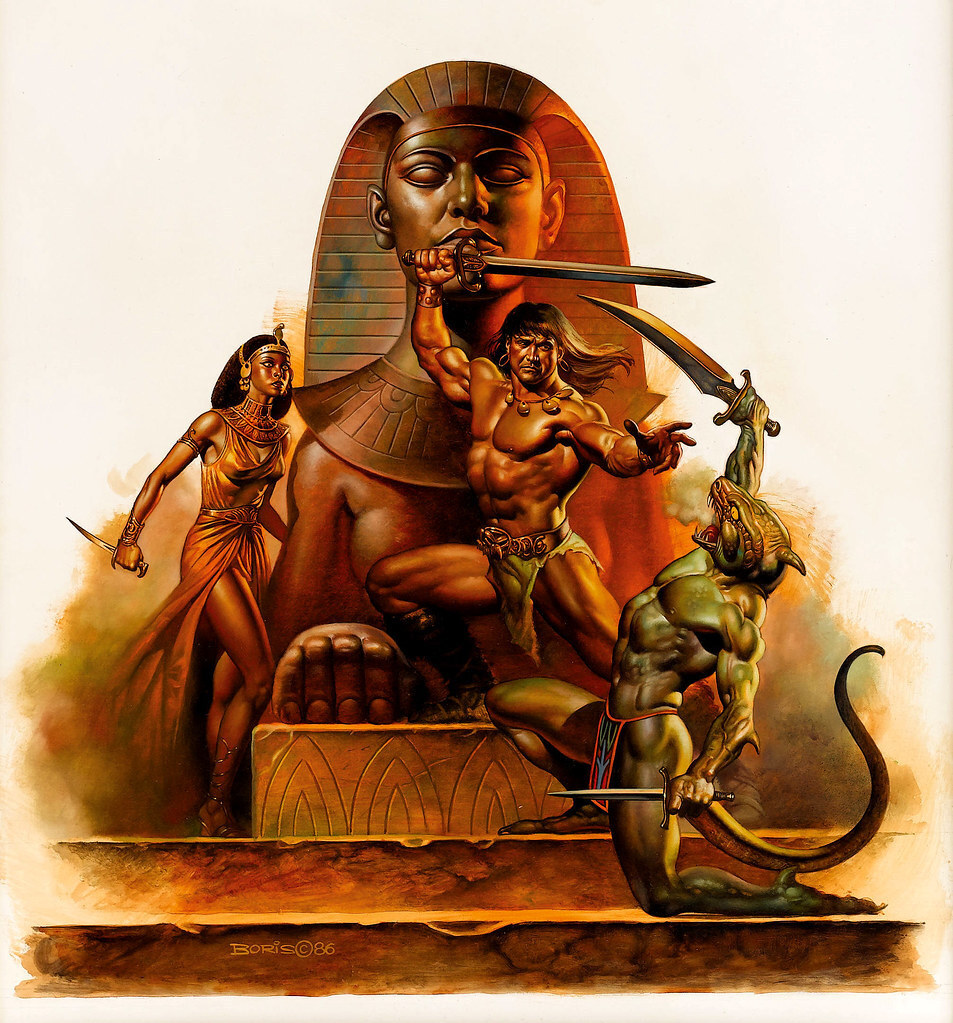
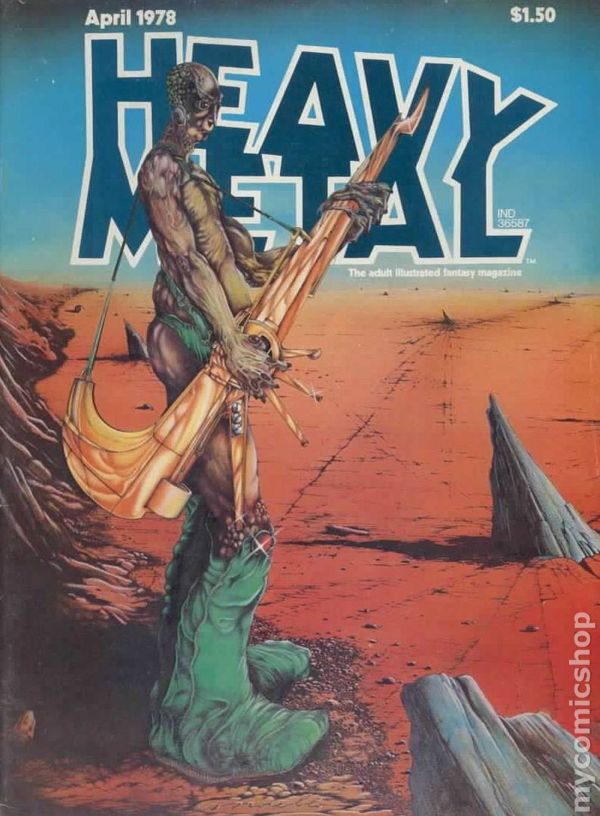
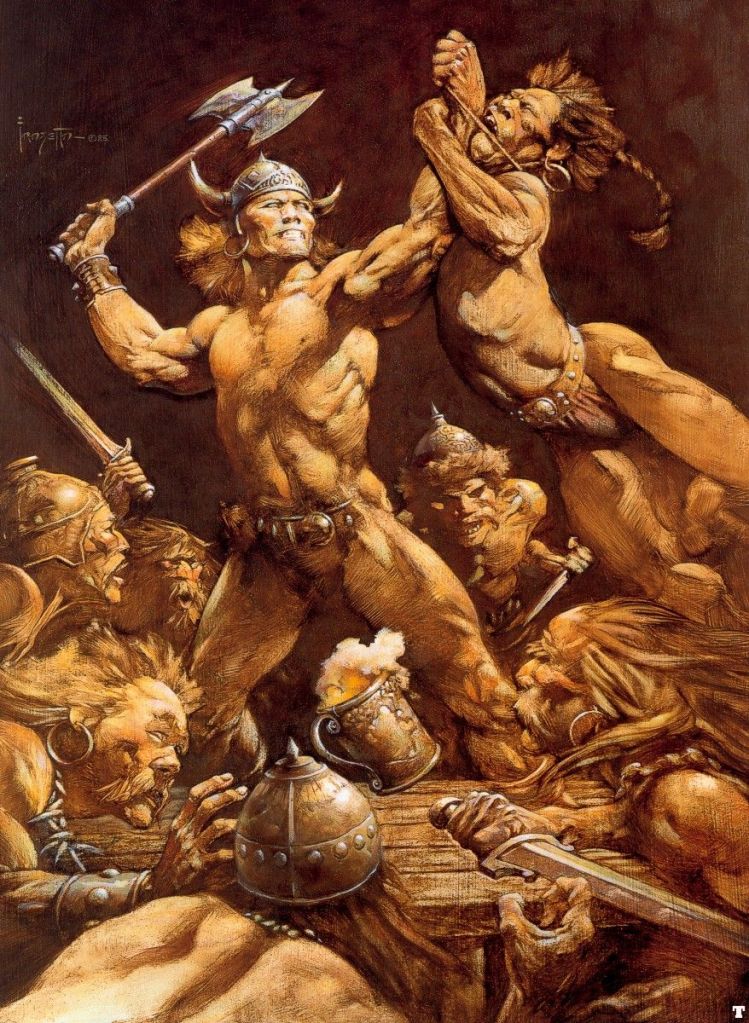
One of the best places for a young gay kid to see almost naked, really muscularly developed men was on the covers of fantasy novels, like the Conan books and others of their ilk. There were also a lot of fantasy cartoon magazines, Heavy Metal and others like it, that often had scantily clad, beautifully built men and women…and the occasional full frontal male nude.
Did these magazines play a role in my love of muscles (and society’s adaptation to sexualizing men for women and gay men), or did the magazines just give me something to look at that played into said obsession with muscular male bodies? I was very desperate for that sort of thing when I was in high school–and my interest in this kind of fantasy art wasn’t a giveaway clue to my sexuality. Because of the naked big breasted women, most boys liked looking at them too–and the artists and more intelligent of them loved the artwork itself and the stories– there was more going on there than just gratuitous nudity and sex.
The books, of course, were called “sword-and-sorcery” books, as were the few films that came out of them (or were inspired by them), that had a time in the sun during the 1980s, thanks to the Conan movies that made Arnold Schwarzeneggar a star, and also influenced every sword and sorcery movie that followed. S&S books were always a successful niche market, and the success of Conan as a film led to a lot of S&S movies in the 1980s.
Two of the biggest names in the S&S fantasy art field were Frank Frazetta and Boris Vallejo. I absolutely loved their work.
Boris Vallejo’s “Egyptian Warrior”
As an Egyptophile, I love that image and would love to have it hanging on my wall.
Heavy Metal magazine launched in the late 1970’s, and even was made into a great animated movie in the 1980s–its soundtrack includes Stevie Nicks’ “Blue Lamp.” We used to get high and watch it when I was in college, and just got sucked into the vividness of its art and color and style and music.
A work by Frank Frazetta
I don’t know if S&S ever went out of style in books and magazines, but you don’t see many book covers with this type of art on them anymore. It’s a shame; they were very fun tales of treachery and betrayal and magic and vengeance. I never read any of the Conan stories, or any of the other fantasy S&S type books, but I did watch a lot of the movies–those scantily clad musclemen are lots of fun to look at. These movies also don’t get made much anymore–John Carter‘s failure at the box office (which it didn’t deserve; it’s much better than critics and audiences thought it was when released) pretty much killed any interest in these style movies.
Ironically, Game of Thrones was really another one of these style stories; the primary difference being it was done on a much grander scale than the classic S&S genre usually permitted.
The first time I went to a midnight movie1 was when I was either eighteen or nineteen. I still lived in Kansas then, and the midnight movie was playing at the old movie theater on Sixth Street that was rarely open other than for some special occasion. They’d been doing midnight movies for a while before I went that first time, and I was going with a co-worker who promised me I was going to have an amazing time. I wasn’t so sure. The line outside the Granada Theater was a bizarre sight–many of them dressed up freakishly, and a lot of them were carrying paper bags full of stuff, which I also thought was odd.
I was about to watch, and experience, The Rocky Horror Picture Show for the first time.
I had no idea what was to come.
At the late night, double feature, picture show…
The crowd started chanting for “lips” as the lights in the theater went down, and then I saw what they were chanting for, as two bright red lips appeared on the black screen and started singing as everyone cheered….and started shouting responses to the opening credits.
And I liked the song.
What followed was ninety-eight minutes of insanity. I had never heard of an “interactive” movie before, and it really caught me off guard. How did people know what to yell, and when to yell it? They sang along with the movies, and I soon was caught up in it; getting sprayed with water, ducking out of the way of flying pieces of toast and toilet paper and tampons, and it was all so delightfully subversive in terms of questioning gender and sexuality. You still couldn’t swear on prime time television shows, and you definitely couldn’t say “sex” (I always hated the coy and cheesy ways television writers came up with as a workaround).
And then of course, there was Tim Curry’s Dr. Frank-n-furter.
I’d never seen anything like that before in my life…and I howled with laughter as he removed his robe to reveal what he was wearing beneath, and several people shouted in unison, “Ladies and gentlemen, Mr. Liza Minnelli!”
And after ninety-eight minutes of madness and mayhem, I was a convert. I walked out of the theater with my head still reeling from all the subversion a still moralistic 1970’s American culture had taught me was wrong on every level, disgusting sin and decadent morality, and I wanted more.
I bought the soundtrack shortly thereafter, both vinyl and eight-track, and it didn’t take long for me to have the entire thing memorized. I don’t remember seeing it again while I lived in Kansas–we moved to California shortly thereafter–but I did discover the theater in Fresno that showed it, and I started going weekly. It was more of a production in Fresno–people dressed up and acted out the parts in front of the screen (they tried to recruit me once to play Brad, but I said no; it would be over another decade before I was comfortable enough to wear only underwear in public; I was really uptight). Eventually, after memorizing the film and soundtrack, learning everything there was to know about the movie and play, I finally stopped going to the midnight movies. HIV/AIDS ripped a lot of the joy out of life in the 1980s for me, and once I was out of the habit of the movie, I was out of the habit and looked back on it as a past experience with nostalgia and joy.
The Rocky Horror Picture Show was the perfect amount of subversion at precisely the right time for me. It opened a world of possibilities to me, but at the same time, it made me very aware that I needed, more than anything else, to get out of Kansas. Much as I loved the movie, those memories of seeing it that first time–and the self-actualization and realization that came in its wake–are also tied up with my growing misery and dissatisfaction with living in Kansas. It’s also tied to discovering actual queer people in Fresno, and recognizing that even this little bit of subversion, something I could go see with the straight friends without any questions or fears, kept me going through the early 1980s as everything started turning even darker than they had ever been in Kansas.
Watching it on television just isn’t the same, either.
But the movie always holds a special place in my heart–and I imagine it does with many other queers for whom it proved an awakening of their true freak selves–and I became a lifelong fan of all the stars, whose careers and successes I followed…but one is now dead to me forever, and Her Name Must Not Be Uttered….and her being in the film has also kind of tainted its legacy with me.
But seriously, what a great movie. I may write an essay about the movie someday, you never know!
I’m not counting the night of the senior prom, when the school districts got together and got the Twin Theaters (I think that was the name) to show a midnight movie to keep us all out of trouble. It was Smokey and the Bandit, by the way. ↩︎
Nothing gives me greater pleasure than flaunting my sin in the face of hypocritical Christians who don’t understand their own holy book. I love using their archaic language on them, too–fornicators, adulterers, heretics, apostates, blasphemers, the Lake of Eternal Fire, etc.–because there’s nothing I despise more than the self-righteous apostates who think they are better than everyone else because “they’re saved.” Are you? Are you so sure?
I’ve always thought the proper response to the question of whether you were going to heaven or not was simply, “I don’t know, that’s God’s decision and so I hope he views me and my life with grace, charity, and compassion.”
And when I was about eight or nine, my grandmother bought me a copy of The Children’s Bible, which was filled with illustrations (amazing how all those Middle Eastern Israelites were white, and even some had blond hair and blue eyes)…and maybe (probably) it wasn’t the intent of the publisher, but there was some seriously homoerotic imagery in the book. About ten years ago I was thinking about The Children’s Bible and wondering whatever happened to my copy…and remembering some of the illustrations in it, I thought no, you can’t be remembering that correctly and so I went on eBay and bought a used copy.
And when it arrived, my memories were actually correct.
I mean, look at the muscles on Goliath. That image was burned indelibly into my brain, and it’s entirely possible my appreciation of muscles comes from….The Children’s Bible.
Perish the thought!
Grooming!
Indoctrination!
And of course, my favorite story in the book was David and Jonathan.
I mean, look at how they drew David!
I mean, it may not be Michelangelo, but damn.
(I also love that a Bronze Age Middle Eastern Jew somehow had pearly white skin, blonde hair, and blue eyes. Riiiiiiiiiiiiiight.)
I think my parents really liked that I was so devoted to The Children’s Bible, but they definitely had no idea why I was staring at the pages every day.
When I was a kid, I’d always reread the David and Jonathan story (can’t imagine why it was my favorite…). I wanted a best friend like David–I always saw myself as Jonathan, the supporting player, the way I always did–gorgeous and charismatic and beautiful and beloved of God. I would think about the story and while I was too young and innocent to conceive of it as anything other than friendship–the same way I thought of the “friendship” between Achilles and Patroclus in tales of the Trojan War–when I got older, whenever I thought about the story I wondered about how deep that friendship between Prince Jonathan and David son of Jesse was. Why include the story at all? It really doesn’t add a whole lot to the tale of David’s life, and did it really matter for King Saul to have a son who was David’s friend and great love? Jonathan dies–not even the Bible was immune from bury your gays–and David mourned him with a great grief that seemed a bit more than “my best bro died.” I wanted to write the story myself, despite my lack of historical knowledge of the period or even when it was actually set, but I wanted to write about their love, their falling in love–and let’s face it, God didn’t really seem to have a lot of problems with their relationship, did he? He didn’t come to David and tell him to stop giving it to Jonathan; God didn’t curse the two of them or punish Israel for it; and yes, Jonathan is eventually killed…but even then God doesn’t come to David and say, did you not read Leviticus? I could hardly let you go on fucking him forever, you know.
So, I guess I am supposed to read it literally and just think they were best friends and loved each other as brothers. Yeah, no. There’s absolutely no reason for this story to be included in the David story in the Bible; none, unless of course there’s a kernal of truth in the story (don’t come for me, I’ve never bothered to find out if the Bible’s Old Testament kings of Israel were real people; I do know that real people turned up in the Old Testament that existed in history–Babylonians and Assyrians, for example, as well as Egyptians)but the mystery for me of why this story was included, why it was included if its merely legend or why was it included if they were real is the real question. There’s no moral lesson to be learned from the story of their friendship; their love and loyalty to each other was an issue for Jonathan because his friend’s greatest enemy was Jonathan’s own father, a king anointed by God–despite God capriciously turning His back on Saul for really such an insignificant reason that it really just boiled down to God just liked David better; I always felt sorry for Saul–how much would it suck to lose God’s favor for no good reason? Just because God found someone He liked better? (And considering the things God forgave David for, or just overlooked, really makes the hard turn away from Saul that much more petty and bitchy.)
God’s kind of an asshole in the Old Testament, frankly.
But yes, I’d love to write this story sometime. (Because I don’t have enough else to do, right?) I’d also want to write it from Jonathan’s perspective, although the death would be hard to do (Madeline Miller managed it with Song of Achilles quite beautifully) story-wise; but is the kind of challenge I love. Maybe someday, and maybe writing it will help me in my constant and never-ending life quest to come to terms with the religious grooming drilled into my brain as a child. I even have a great title for it, too.
I also have a novel in mind revolving around Michelangelo’s statue of David, too; maybe I could combine research and do them at the same time. THAT would be a challenge, would it not?
Paging through it again this morning, I see that there are a lot of sexy men in little clothing in the illustrations, so I have to wonder, if like all the statuary and paintings in European churches and cathedrals, the artist was a gay man so he slipped in imagery for the viewing of other gays. Here are some of those images, culled from just flipping through a few pages.
Okay, maybe Samson isn’t a fair comparison as he was a strong man.Apparently, ancient Egypt came up with a great exercise and diet plan for Joseph.Again, Hebrews looking healthy, and Pharaoh’s milkshake brings the boys to the yard.I also love that they went with daddy/twink for Cain and Abel.
And no need to worry about my blasphemy–“christians’ have told me all of my life that I’m going to hell, so as a friend says, “might as well grease up the hell-slide.”
Work at home Friday, and I am delighted to have made it through another week, which was at the least bizarre and at most a really screwy one. Next week will be screwy, too, because of July 4th, but oh, well. I am taking the 5th off too so I can have a four-day weekend next weekend, which means more organizing and getting rid of things. I am going to do some more book pruning this weekend, and am going to dump more files, too. My end goal is to stop using the shelves in the laundry room for book storage and turn it into an overflow pantry, with extra stuff moved in there to clear out cabinets and so forth. I have some errands to run later today and more errands to run tomorrow; but I am hoping to make progress.
Paul was late getting home last night–he had meetings, and then stayed at the office during the massive thunderstorm that rolled through here last night. I didn’t get much done last night after I got home because I got very tired in the late afternoon and after getting the mail, I just basically collapsed into my easy chair and played with Sparky. Again, I couldn’t focus on reading, but I am hoping to finish Horror Movie this weekend and start Hall of Mirrors. The US Gymnastic Team Trials for the Olympics are this weekend, so we’ll be spending some time watching that, of course–I keep forgetting the Olympics are this summer–and I had another breakthrough on the new book last night, so I guess I can claim that I wrote last night–thinking and planning counts as writing, after all, and am getting a bit more excited about what I am doing with it, and the imposter syndrome seems to be taking a back seat at long last. I also have to do one more pass on that short story, which is due on Sunday.
I also need to bang out some more Pride Posts, which will finally come to an end on the 4th of July, and I have some plans and thoughts for that final post, too.
Something I just realized last night during my thinking session in my chair was that this weird nostalgia kick I’ve been on since Mom passed was naturally triggered by that (and all the conversations I’ve had with Dad about their early life together and his childhood) and of course, by the fact that I am writing two “historicals” in a row, both set in periods I lived through so I am trying to remember what it was like; how it felt to be gay in New Orleans during the early 1990s, and of course a lot of immersion into the early 1970s. I’ve already decided to set the book in 1994–the year my life actually truly began–so trying to remember what was where and what the city was like back then has also been flooding me with memories. The kids at work have also been asking questions about my life and past.
That, along with some other things I’ve been noticing lately, also has had me thinking deep thoughts. There was a social media post about becoming a daddy, and how people in my generation and the one right after…well, we didn’t really have a lot of men a lot older than me that were out in the 1990s to serve as mentors and/or guides to the community. HIV/AIDS had killed off a good number of them, leaving a void amongst the survivors without that oral history of the community being passed from generation to generation. There was a conversation about “role models” somewhere the other day, which is something I never wanted to be or ever thought I could be, and I’ve actively avoided it. Hanging out with and bonding with the Queer Crime Writers at conferences over the last few years was marvelous, and I actually started feeling like a part of the queer writing community again. That has also made me realize that while twenty years or so may have passed since my first publication–twenty-four in August, actually–I have done a lot, written a lot, and been nominated for a shit ton of awards, both queer and mainstream. (Hell, next year will be the twentieth anniversary of Katrina; which means it’s been almost as long ago as Betsy was when I started coming here) I’ve lasted a long time, if nothing else, and that longevity has to count for something, right? I don’t think I am the most prolific queer writer (I think Neil Plakcy and Mark Zubro are more prolific than I am, at least with the crime writers, anyway), but I have been around for a very long time, with minor breaks of a year or so here and there. Like it or not, I’ve become a community elder, and I intend to try to be better about helping out queer writers and lending a hand when I can.
And on that note, I am going to head into the spice mines. Have a lovely Friday, Constant Reader, and I’ll most likely be back later on.
Or so the song by the Village People would have us believe, at any rate.
I’m not sure what it is about Hollywood, movies, and stars that draws gays like moths to an outdoor night light, but there you have it. We’ve fallen in love with movie stars and made them into icons–and interestingly enough, we always seem to like the same ones for the most part–Joan Crawford, Bette Davis, Katharine Hepburn, Judy, Liza, Barbra, Cher, Madonna, Lady Gaga, and so on; almost like there’s some kind of weird genetic link between the majority of gay cisgender white men that draws us all to the same things, so much that even straight people know who the women are that we idolize.
Why this is the case, I have no idea. But gay men have also significantly impacted how we as a society and culture look at men’s bodies, too–see previous post about how what was considered sexy in a man began changing in the 1970s, and continued evolving until what gay men (theoretically) found hot was what everyone considered hot for a man.
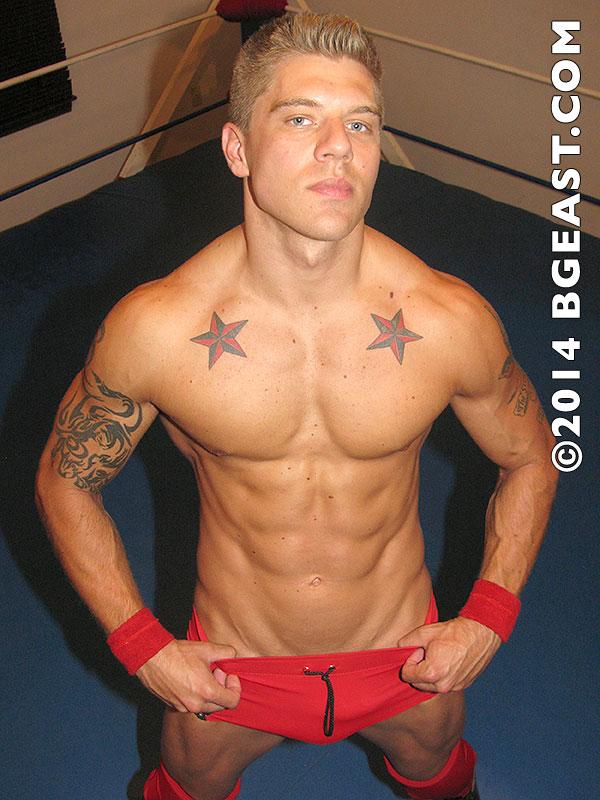
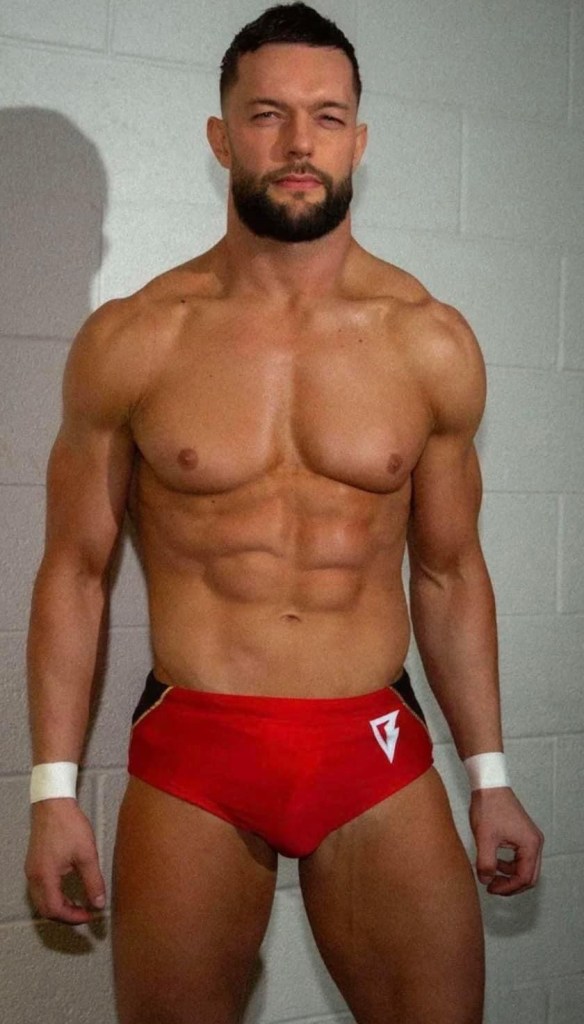
When I was a kid it was also believed that bodybuilders were mostly gay, too–because only gay men had the free time to develop and work their bodies…so the gay male attraction to muscular fit men was enough for society to say that about bodybuilders. (I have always appreciated bodybuilders aesthetically, but they leave me cold. They are so not sexy, despite the skimpy bikinis they pose in (gay men were also, for a long time, the only ones who weren’t competitive swimmers who wore speedos), and they never really have been.
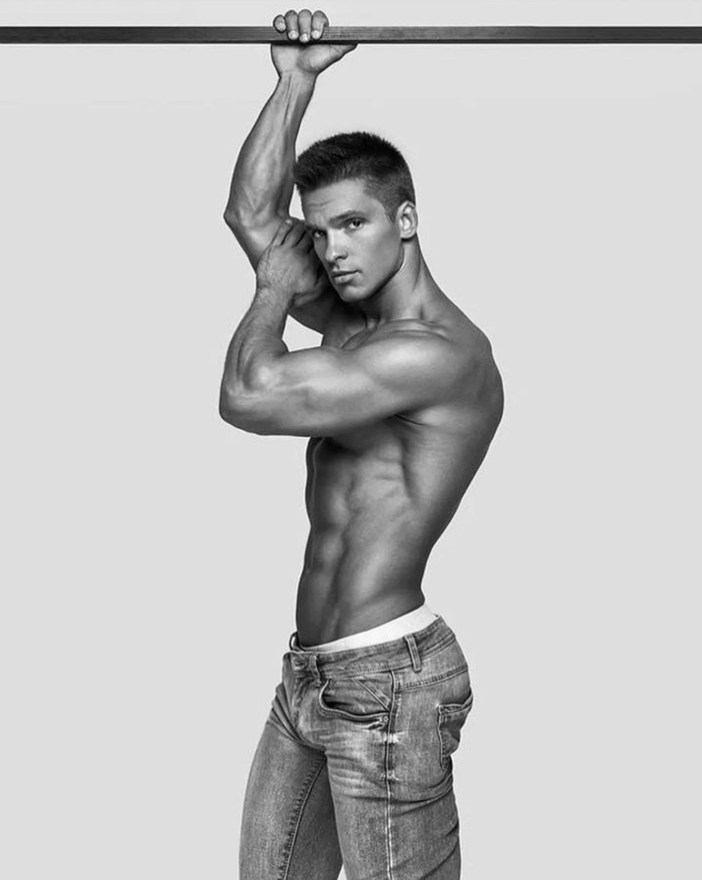
But gay photographers began making bank in the late 1940s and 1950s by launching “physique magazines” as a cover for gay eroticism; they would find incredibly handsome men with worked out bodies and photograph them in “classical” poses. This dodge was how they got around pornography and postal obscenity charges; no visible penises, and the men were always posed like classical paintings or statuary to “show off their physiques”. Some of the men who posed for these photographers often did so early in their careers (Yul Brynner was one of many who did these kind of photo shoots to pay the bills), and never really hid their past as physique models–but they also didn’t bring it up much. Nudes for a male (or scantily dressed at least) weren’t as big an issue as they were for women; but male nudes weren’t exactly a boost to one’s career.
The gorgeous Ed Fury, who did some Hercules/hero type roles in movies in the 50s/60s
These old photos–and 8 mm physique films that were sold to private viewers–are astonishing to come across in the modern day and leaves so much to be explained1. Hollywood has always done a great job about covering up the same-sex attractions and predilections of movie stars; look at Randolph Scott and Cary Grant’s five years living together, or any number of other male stars. I’ve started looking into this a bit more because it’s all research for Chlorine, and it’s a plot point in the book. (It also gave me an idea for another noir, called Obscenity.) It’s very fascinating to me. The more I learn about Hollywood, and how things worked, and how rife with homosexuality that the studio assiduously kept secret, the more interested I am in those decades when studio bosses held all the power, when their fixers went around cleaning up after their stars, and the secret homosexuality just out of view there. Tab Hunter, Rock Hudson, and of course, the agent who represented all the beautiful boys: Henry Willson, who more than anything else is a tragic figure that I can’t help feeling sorry for, despite how awful he actually was…I am more willing to give queers forgiveness because of the toxic times they lived in and how they had to survive. (Roy Cohn, on the other hand, can burn in hell right next to J. Edgar Hoover and Clyde Tolson) Reading The Man Who Made Rock Hudson, a very well written biography of Willson, really made me feel sorry for him in many ways and understand perhaps why he was so damned awful.
It was also the times.
William J. Mann, by the way, has done some excellent queer Hollywood history non-fiction, if you want to a good place to start reading up on it.
I’m really looking forward to doing more research on physique magazines.
This was the birth of gay porn, really, which makes it all the more interesting to me. ↩︎
Tuesday and back to the office this morning with me. It feels right, you know? Yesterday I was kind of bored and low energy. I did some chores, worked on the files some, did some writing, and reading (Horror Movie is terrific; Paul Tremblay is really a spectacular writer), but overall I was feeling pretty low energy by the time the late afternoon rolled around, and I didn’t have a problem with it, really. I got up early, after all, to get used to it, and I’d done a lot over the previous two days; and everything else that needs to be done in here can be broken down into separate small chores, which is far easier to scratch off the list and a lot more satisfying. Paul had to go out for the evening last night to go to a reading, and didn’t get home until after I went to bed. I slept very well, too.
So I am feeling up for going back to work this morning; I feel very rested and relaxed, and I only have to be in the office for three days this week, and three days next, too. I think I am going to take Friday the 5th off, might as well have another four day weekend when it presents itself this way, don’t you think? I thought it would take much longer to get through the filing, in all honesty, and to be sure, it’s not exactly finished either. But I would have never dreamed I could get so much done so quickly, either. I have another drawer to go through, and then everything needs to be alphabetized…but most of the duplicates have been combined, all the files pertaining to a certain book have been also gathered togetherm and now I have to start finishing books, you know? Tonight I have to get the mail and go to the gym before I get home, which will be nice. There are a couple of chores I started and need to finish–laundry and dishes, as always–before I can settle in to write and/or read tonight. (I suspect I’ll be tired and reading is the most likely option. I do want to get Horror Movie finished so I can start another one.) It also rained overnight–more rain later in the week to come–and so I can probably put off washing the car for another weekend.
We’re also running out of Pride Month, and I have a lot of entries left to complete. Heavy sigh. It’s not easy when you don’t really have a plan. The ones that are left will wind up lengthier than the ones I’ve already done, and I don’t think I’m necessarily the best at winging it, you know? There are a couple that I’ve been wanting to finish for several years now–including one about masculinity, one about old Hollywood and physique magazines (which I want to write a book about eventually), and one about The Children’s Bible, because I looked upon those images inside with desire when I was a child. I should also probably do Playgirl magazine as well. So many potential entries, so few days. Heavy heaving sigh.
But I like the uncluttered look the apartment is now getting. I still want to do the drawers and the cabinets, and of course the attic is a big project I may save for Labor Day weekend. It’s so lovely to be making progress again.
It was also kind of nice that I really did take most of the day off yesterday because of the low energy and it seems to have worked its magic, so on this note, I am heading into the spice mines. Have a lovely Tuesday, Constant Reader, and I’ll check in with you again later.
I don’t remember the first time I saw that phrase somewhere, and I don’t know where it originates from, but actually–being gay used to be a crime (and our “supreme court” seems determined to make that so again), so I’ve always wondered if that was where it started from. I do like the phrase, though.
I also don’t remember how Sins of the Black Flamingo came to my attention, but it did. I subscribed so as not to miss an issue, and intended to read it all in one sitting so I could write about it…but never got around to it, like a loser, and as I was looking through the draft entries for the blog the other day, I saw that I’d started an entry after reading the first issue…but never finished reading the book nor, obviously, finished writing the entry.
the book nor, obviously, finished writing the entry.
And since the main character is gay…what better time to finish reading it, and blogging about it, then during Pride Month?
It did make sense to me.
I’ve read comic books for most of my life (in fact, comics are why I bought an iPad in the first place), but I’ve also taken long breaks from them, so am neither an expert nor even a super fan (although I would love to do a crime novel set in and around a comic books store; which could be fun and comical). I remember comics I read as a kid, and have some vague memories of other times when I dipped into the comics world as an adult. My iPad is filled with comics that I’ve never gotten around to reading—but what a lovely long weekend reading them all would make! Or maybe just take the iPad with me on a trip and read comics the whole time?
Anyway, I digress. I do need to do a longer form essay about my comics history while stressing the importance of how little I do know about my beloved comics…maybe for Pride next year, since it would take some serious rereading and research to do properly…and it could tie into one of the books currently in progress…but I am getting away from the purpose of this post: Sins of the Black Flamingo.
I mean, isn’t this art amazing?
Comic books helped shape me and my tastes. The original DC superheroes I followed were still drawn as ideal men of the past, like the 40s and 50s, big with a barrel torso, and muscular but not defined. DC Comics hadn’t really updated its characters from their early days much; but it was during my childhood at the end of the 60s and early 70s that they began modernizing their comic characters, their costumes, and how they looked—which I also noticed. This was also around the time that men’s bodies became more sexualized, and what was hot and sexy for men began to change. The women super-hero’s costumes also became more sexualized, as were their bodies (the Legion of Super-Heroes ALONE had some of the more revealing sexy costumes. Queer super-heroes (although why I never made the connection about Wonder Woman and the Amazons with their island of women only is a mystery to me) were non-existent and wouldn’t start showing up until the late 1980s and early 1990s—and it’s still a few and far-between kind of thing (the Will Peyton Starman run always seemed queer to me, which I’ll need to explore at another time).
So, you can imagine my delight to find this run with a gay burglar as the main character, who wears a costume and is extremely good at his job (I’ve always had a soft spot for burglars in fiction) and that was why I subscribed to the series. (Still shaking my head at how long it took me to finally read them all, and there was an pretty amazing cliff-hanger at the end of #1.)
But when I was a kid, the characters and story interested me more than the artwork, and even with my love of the characters and stories, I never followed either artists I enjoyed or writers, either. Which is probably not the best way to enjoy them, really; it was a friend who was an exceptional artist and comics fan in the 1980s who made me aware I should be paying attention to the artists and the writers…and I did find some extraordinary comics by looking for artists and writers of books from there on. The two I remember the most from that time are Todd McFarlane and John Byrne.
Sins of the Black Flamingo is self-classified as “occult noir,” which is a term I absolutely love and now can recognize that occult noir is something I absolutely love and probably write…and will most likely explore more in my own work going forward, since I now know what to call it, because supernatural never really fit in the same way and I don’t feel like the books I write are actually full-fledged horror, but occult noir? Oh, hell, yes.
Anyway, the Black Flamingo is the alter-ego of our hero, Sebastian Harlow. The Flamingo is probably one of the top cat burglars in the world (as you may know, I love cat burglars and originally made Colin one in Bourbon Street Blues), and Sebastian is this interesting combination of my two series characters, of all things; he looks and is built like Scotty, with the same approach to sex as he did before he met the boys, but has the dark worldview and cynicism of Chanse MacLeod…so naturally, I was going to be drawn to the character. IN the very beginning of Book One, he is hired to steal something from a right-wing museum—basically a museum dedicated to honoring white supremacy. It isn’t until he steals the item they’ve hired him to find that we learn the backstory behind the item…and a golem named Abel is brought to life, and Abel is hunky AF, I might add.
We also meet Sebastian’s close friend and ally, Ofelia, a Black witch—and yes, this is very much occult noir. The art is fantastic, and done by Travis Moore, with Tamra Bonvillain as colorist, Aditya Bidikar, and editor Andy Khouri, and Andrew Wheeler was the writer.I highly recommend this—if for no other reason than it’s a great gay story with an interesting main character, and who would have ever thought they’d see a gay circuit party within the pages of a comic?
I do hope there’s more adventures in store for the Flamingo in the future. Highly recommended.
They were everywhere when I was growing up—movies and television shows—and my father has been a lifelong fan, so whenever there was a Western on TV, our set was tuned to it. Gunsmoke, Bonanza, The Rifleman—you name it, we watched it. Looking back, my dislike of Westerns was rooted in several things: toxic masculinity, racist depictions of indigenous peoples, and how entertainment in this genre was primarily used to create a mythological portrait of the settling (colonizing) of this continent and make it seem as though Europeans were doing the right thing (even using religion) even though they really weren’t. I never saw the natives as villains, and I didn’t like how easily Westerns picked up the trope of heroic white people and savage natives. Even as a child I could see it was all bullshit and I didn’t buy into it. I was about eleven or twelve when indigenous people occupied the massacre site at Wounded Knee, bringing attention to those false narratives and trying to change what was then culturally-accepted racist viewpoints on the indigenous Americans.
Look at the words used for the indigenous people–“savages”, “redskins”, “braves”, etc.; all dehumanizing and differentiating; “they are not like us so have no rights or privileges and we need to kill them all” was pretty much the US government’s policy to the natives.
Many sports teams still perpetuate this—how many teams still used these offensive names until recently? How many still do? And how upset do people get when those names are changed?
Anyway, I also mentioned in passing on another post that I’d like to explore Western tropes and why I’ve never been terribly interested in them as a genre. When I was in Kentucky the last time visiting Dad some movie channel was having a John Wayne film festival, which kind of made my heart sink. I’ve never really been much of a John Wayne fan (although I do love both True Grit and Rooster Cogburn) and generally avoid his films. The first movie was Hondo, with Geraldine Page (of all people; I wonder what she thought of the experience), and you know, I actually enjoyed it…and it made me think maybe I should revisit John Wayne and check out some of his other, better films. But Christa Faust, who is one of my favorite people in this community, commented she’d love to hear my thoughts on Westerns and their tropes.
She also turned me on to this:
If you aren’t aware of Christa Faust and her work by now, you really should be ashamed of yourself.
Redemption is an amazing Western graphic novel she wrote, and I very happily downloaded it as soon as she let me know of its existence. It also made me recognize and understand my own comics-fandom to a degree, too, and I may need to reevaluate that and explore it. I had thought about doing a Pride post about comic books and super-heroes, but it might need to be a longer form personal essay. Anyway, I don’t read enough graphic novels. I’d known that Christa had done scripts for comics before, but it never occurred to me that I should read them as well as be supportive of my friends who create this way. It is just another form of writing, really.
Christa is one of my favorite writers, and Money Shot remains to this day one of my favorite American noir novels. She’s also one of my favorite people; I love just sitting around shooting the shit with her.
And what she does with Redemption is absolute feminist magic.
You see, the thing about Western tropes is they can often be adapted to other genres–including literary (Lonesome Dove is my father’s favorite novel)–and the first Star Wars movie (I will never call it anything other than Star Wars) borrowed heavily from Westerns, as does The Mandalorian. You can see the influence of Westerns on pop culture almost everywhere you look, really (and really, Western tropes are often influenced by medieval tales of lone knights and paladin, which in turn were influenced by Greek mythology), and Redemption isn’t a classic Western set in the 1800’s; this Old West is the result of some kind of apocalyptic happening, with the end result that the town of Redemption has walled itself off from the rest of the world (for their own safety) and is being run by your typical right-wing doom-and-gloom Christian type, who uses God and the Bible for control rather than for inspiration. The town’s doctor, who is not only a Latina woman but a fierce feminist, has been tried and convicted for providing an abortion to a woman whose child died in the womb and was endangering her life.
She has also been sentenced to death.
If you are seeing parallels between this and our modern world, well, I am pretty fucking sure that’s entirely intentional.
The doctor’s daughter’s only hope to save her mother is to find a legendary gunslinger called the Butcher–who had a past with the doctor when they were young. No one is even sure if the Butcher is real, or if she’s merely a legend.
And in the character of the Butcher, Faust sets Westerns on their ear by taking the typical closed-mouth gunslinger (think Clint Eastwood in all those movies about the Man with No Name) and made her a woman, but without stripping any of the gender expectations for men in Westerns. She’s old, she’s tired, and she’s done with bullshit–but she can still outdraw and outshoot any and every man she runs up against.
The art by Mike Deodato is also incredible.
Highly recommended; and again, check out her other work if you’re not familiar with it. You can thank me later.
I was a voracious reader from the moment I learned how to read–all things considered, my favorite waking activity was reading. I loved nothing more than those enormous doorstops of books that used to get published (apparently when the cost of ink and paper was considerably less), and during the Bicentennial madness, James A Michener released a book called Centennial, the history of a small town on the Platte River in Colorado that was renamed Centennial in honor of Colorado becoming a state in 1876–the nation’s centennial year. (I’ve always thought it odd that we trace our nation’s birth back to the Declaration of Independence, rather than the ratification of the Constitution, which created the United States government.) I really loved the book, even the several hundred pages about dinosaurs and how the ancient swamps gave way to the Rocky Mountains and the plateaus. Another thing that was big in the 1970’s was the “mini-series”–although at first they were all adaptations of novels and sometimes were called “books for television.” NBC, I believe, filmed Centennial, and I watched and enjoyed it thoroughly.
But the standout for me was Gregory Harrison, a young new-to-me actor who played the pivotal character of Levi Zendt, who actually founded the town (it was called Zendt’s Farm before the renaming in 1876) and I could not get over how good looking he was. There was also a shirtless scene, and I became a big fan. He was, looking back, absolutely one hundred percent my type; how many characters have I written about a hot lean muscular man with blue eyes and curly dark hair? Okay, his eyes were gray but that’s close enough for atom bombs and hand grenades, is it not? He then was on Trapper John, MD, which I didn’t watch (outside of General Hospital, I’ve never really watched many medical shows, and not sure why that is), and then he made a made for TV movie in which he played an actor who becomes a successful Chippendales-type dancer, For Ladies Only. It wasn’t a great movie, but he danced in thongs and bikinis and quite lustily, I might add, and that was really all I was watching for–but Marc Singer, player an older, mentor type, kind of stole the movie out from under him (more on Marc Singer another time)
I mean, what’s not to like?
For Ladies Only was an attempt to cash in on the Chippendales craze, and they were everywhere in the early to mid 1980’s–Donahue, Oprah, every talk show during daytime you could imagine–the entire concept of women appreciating men as sex objects, the way they’ve always been seen by men historically–and even The Young and the Restless had a regular cast member who was a male stripper (who mentored Nikki when she became a stripper; yes, Nikki had a rather sordid past on that show). It was the time period when what I call “the gay gayze” really kicked into gear.
The movie For Ladies Only wasn’t the greatest movie ever made, but Harrison was one of the few actors at the time who could pull off playing a male stripper and actually not need a body stand-in or anything (neither did Marc Singer–and if you need to know anything else about Singer, google image search “Marc Singer the Beastmaster”; he was also a big crush of mine after I saw this film). It was one of those sad morality plays that always wins big in the end. Harrison’s character was a struggling actor who gets recruited to join a Chippendales type show, his popularity begins to grow but now when he goes on auditions, no one will cast him because he was a stripper (how did that work out for Channing Tatum, you ask? Three smash hit films about Magic Mike, that’s how). I recorded For Ladies Only, and kept that videocassette for many years, finally discarding it in a purge before leaving California.
Thank you again, Mr. Harrison, for helping to define my taste in men–especially fictional one; how many characters have I written with curly dark hair and blue eyes?–as well as realizing for sure just how not straight I was at heart.
Hey! Hey! Hey! Hey! Hey! Machomacho man…I’ve got to be a macho man….
Sadly, this entry isn’t really about Macho Man Randy Savage, but I did meet him once, and yes, I always did think he was sexy; that body, the wild hair, the voice–the skill in the ring, and that amazing ass…yes, I was a fan of his. How I met him was when I worked at the airport–a lot of pro wrestlers lived across the bay from Tampa in either St. Petersburg or Clearwater or any of the communities on the peninsula, which means they had to fly in and out of the airport. One night I was covering Baggage Service, and was doing the fun thing of sending messages through the system about whatever bags were misdirected to us, or were simply late arrivals that needed delivering. I was by myself and merrily typing away at my keyboard when I heard the door open and before I looked up heard that unmistakable voice asking if a flight had arrived. Startled and wide-eyed, I gave him the information, and I could see he knew I recognized him–he scribbled his name on a ticket envelope, I babbled out that I was a fan, and he was very kind, friendly and gracious…which is why what eventually became of him was very sad to me. We never know what demons people are battling inside, do we?
The word macho is Spanish, and el macho or la machismo are Spanish terms that bled over into, and was appropriated by, American English, and it’s something, in all honesty, I’ve never cared for; it isn’t Spanish for toxic masculinity, but it might as well be. I first became aware of the term in the 1970s, which was also the time when the women’s movement was getting underway and feminism became a thing. Suddenly, all the things that were “manly” were under review (some straight white men certainly felt they were under attack instead; words matter); and the established protocols of what was and wasn’t ‘manly’ began to be reexamined and frankly, found wanting. Macho, or toxic masculinity, also wasn’t good for men either; they are trapped in a gender role that is kind of outdated but at the same time they may not fit into comfortably, either. The strong, silent type–remember that? That was the definition of manly; no emotions, no feelings, the provider and protector of the nuclear family…which begs the question, isn’t that emotionally crippling in some ways?
And where do gay men fit into this?
I sometimes think queer equality also threatened the role of the ‘macho’ male in our society and culture; straight men were supposed to be so deadly dull in real life, in the way they dressed and played and wore their hair and did all their manly things in that John Wayne/Gary Cooper mold…but gay men? Gay men could dress to accentuate their positives and look good. They cared about their hair and how they presented themselves to the world. There were some professions or sports that weren’t considered ‘manly’ enough–despite the fact that those things might actually demand more from the male body than other sports–football is manly because it’s violent and involves hitting other men with great force; while figure skating and ballet are not manly because it requires beauty of movement, and being graceful: men aren’t supposed to be grateful.
And that freedom to be ourselves was something to be envied by men trapped by conditioning, both socially and culturally, to be unemotionless drones with no way to express themselves other than through violence and anger.
I’ve always theorized that homophobia is subconsciously rooted in envy (of course, most people immediately zero in on ‘rejecting their own attraction to men’, which is also probably accurate in some cases). The stereotyped gay man has a lot more sex with a lot more different partners than straight men (not always the case, of course) and the idea of gay sex clubs (bathhouses, backroom bars, that sort of thing) where someone can go and have their fill of anonymous sex as long as they are capable and willing drives straight men crazy because most of them don’t have anything like that in their lives. Gay men were free from responsibility, from being what society sees as manly, and didn’t have to have kids or any of the other responsibilities that weigh down straight men and keep them, sometimes, from chasing dreams and living their life the way they want to; to paraphrase, ‘forced into a life of quiet desperation with no way out.’
I always found it amusing that the Village People, who had their moment in the sun during the disco years, always recorded gay-flavored songs cheerfully that were also dance hits that infiltrated the pop charts and the straight dance clubs, songs alluding to the gay world simmering just below the surface of American culture at that time.. They wore outfits that featured male images that gays saw as sexy icons of masculinity–the Native American, the cop, the sailor, the biker–and had hit songs that hinted about the pleasures of gay life. Some members of the band were gay, and the Village in their name referenced one of the more famous gayborhoods in the county, Greenwich Village in Manhattan.
Come on. I lived in Kansas during the heyday of the Village People–they were already out of fashion by the time we moved to California; but even I knew what their songs meant and what their costumes meant.
And the songs? Please. “Macho Man” was about hyper-masculinity, which was a gay fetish; “In the Navy”–well, everyone has always considered the Navy, going back to the British Empire, as a hotbed of homosexual activity (what with them being at sea for months at a time only in the company of other men; “YMCA” was about all the endless possibilities for.gay sex at the Y–also a notorious cruising spot for gays; “San Francisco” was of course the motherland for gays; and so on). I have always found all the straight people at sporting events, dancing and singing along to “YMCA” hilarious–because they don’t know they are singing and dancing to a song about the availability of gay sex there. I also found The Traitor dancing to “Macho Man’ at campaign rallies hilarious because of how much more stupid he looked because he and no one around him had any idea of what that song was about.
Straight people can be so clueless sometimes–but it’s always good to have the occasional hearty gay laugh at their expense, isn’t it?