Christmas Must Be Something More

Christmas came a little early last night for LSU fans and Louisiana.

23 point underdogs. Only 54 scholarship athletes–one more than required to field a team–and then lost four more players in the first half to injury. Starting true freshmen all over the place on both sides of the ball, including a quarterback starting his first time ever. Playing the team ranked sixth in the country , arguing they deserve a spot in the play-offs, and scheduled to play Alabama next week in the SEC title game. An LSU team that had just lost to Alabama 55-17 last week, and has had offensive records broken against it all year long. Probably the worst LSU team in twenty years, a possible losing season for the first time since 1999, and all of this coming one year after having one of the best teams and seasons in college football. No one, including me and Paul, gave LSU a chance last night.

And in true LSU fashion, they somehow managed to pull off one of the biggest upsets in LSU football history, one of the biggest ones of the season nationwide, and destroyed any hopes Florida had of backing their way into the play-offs. You’re very welcome, Ohio State. It was one of the craziest, wackiest, most insane games I’ve ever seen–and as an LSU fan, I’ve seen some pretty fucking wacky, insane games over the years.

GEAUX TIGERS!

The game started looking like it would be the same as every other game all season, and while I held out desperate, long-time fan hope that LSU would somehow rise to the occasion–I couldn’t believe my delighted eyes as I watched the game unfold. LSU’s defense–beleaguered all season, beaten up and bloodied–somehow managed a goal line stand to open the game. Exciting, but probably not going to happen again, I thought. Sure enough, LSU had to punt and Florida marched right back down the field to go up 7-0. Then–LSU’s true freshman quarterback Max Johnson took the Tigers right down the field to tie it up, 7-7….and on Florida’s next possession, an LSU true freshmen defensive back managed a Pick 6 to put the Tigers up 14-7. Another completely insane interception on the next Florida possession–and thanks to another defensive stand, Florida was later held to a field goal, 14-10. The Gators scored next to make it 17-14–and then more insanity. LSU scored to take the lead back 21-14, forced a fumble in the closing seconds of the first half and kicked another field goal, LSU 24-14. LSU got the ball first in the second half; another field goal: 27-14. And then Florida took control…three possessions, three scores: 31-27. LSU scored another touchdown, and Florida kicked another field goal: 34-34, with time running out. LSU’s drive stalled on third down–and I thought, ah, well, we gave it a good shot, they’ll get a field goal for sure…but wait. In a moment of complete insanity that will go down in college football history, the LSU tight end’s shoe came off, and a Florida player (I won’t name him, since his name will go down in infamy and this moment will be replayed, over and over and over again, for years to come) threw that shoe twenty five yards down the field….for an unsportsmanlike conduct penalty. 15 yards and an automatic first down. Some questionable play calling put the game on the foot of kicker Cade York: 57 yards, longest of his career and an LSU record. He nailed it, 37-34. Florida tried desperately to get their own in the closing seconds–but missed a 51 yarder and LSU escaped the Swamp with a major upset.

In the fog.

And stunned an entire nation of college football fans.

And when it was all over, all I could do was shake my head. This is why I love LSU football so much; even in mediocre seasons, they will always manage to pull off a signature win and a major upset (10-7 over number 4 Mississippi in 2014; 26-21 over top ten Auburn in 2017 after losing to Troy, the 28-21 upset of Number One Florida in 1997, and there are so many others), and not only knocked Florida out of any shot at the play-offs, but also probably cost Kyle Trask his shot at a Heisman trophy–and going into the game, I thought it was for sure between either him or Mac Jones at Alabama.

As someone said on Twitter last night, “Florida just lost to a the worst LSU team in twenty years’ BACK-UPS.”

LSU still has to play Mississippi this coming weekend; Florida is off to the SEC title game to face the Alabama juggernaut–which could go one of two ways: Alabama will either blow them out, or Florida–playing with nothing to lose–could rise up and smite the Tide. The East has only won the SEC once since 2008 (!), so who knows? I didn’t have much interest in watching the game, frankly, but I might now.

So, yes, it was a lovely Saturday in the Lost Apartment. I finished reading The Spy Who Came in From the Cold–loved it–and also wrote; I didn’t do a lot of cleaning or anything else, but I got some work done on the book which was lovely, finished reading a book, and got to watch LSU beat Florida. The Saints play today–I think at three?–which will give me some time this morning to get some emails answered, some work on the book done, and even a trip to the gym out of the way.

And I slept deeply and well, which was also quite marvelous.

And on that note, tis time to go back into the spice mines. Have a lovely Sunday, Constant Reader.

Style

I often talk about how my education in the classics is sorely lacking; this applies across all spectrums and all genres. I was in my thirties when I began to appreciate John D. MacDonald, for example; I didn’t start reading Ross MacDonald until I was in my forties. There are any number of classic works of fiction I’ve not read, and I am sorely under-read in my own genre. I am trying to rectify that as I age; it’s, like almost everything else I do, a project.

I am not nearly as well read in spy thrillers as perhaps I should be; I certainly went through a Robert Ludlum phase (although I am not entirely sure that’s where Ludlum belongs–only rarely are his main characters, at least in the volumes I’ve read–actual spies), and over the last decade I’ve started reading Eric Ambler. I also gave, back in the day, both Helen MacInnes and Alistair MacLean a whirl; and of course, I’ve read some Ian Fleming–but not all. (I really want to reread Live and Let Die to see if it’s as racist as I remember; I also want to rewatch the film again–and not just because a lot of it was filmed in Louisiana; I want to see if the book’s racism carried over into the film, which I strongly suspect it did)

So, John Le Carre. I’ve never read his books nor seen anything adapted from one of them (other than the wonderful The Night Manager starring Tom Hiddleston; highly recommended, and now I need to read the book), but of course I’ve heard of him. His most famous book is probably The Spy Who Came In From the Cold, and I acquired a copy of it from somewhere at some point. I recently decided to give it a read–my attempt to improve my education in crime classics at work–and I finished it this morning.

The American handed Leamas another cup of coffee and said, “Why don’t you go back and sleep? We can ring you if he shows up.”

Leamas said nothing, just stared through the window of the checkpoint, along the empty street.

“You can’t wait forever, sir. Maybe he’ll come some other time. We can have the polizei contact the Agency: you can be back here in twenty minutes.”

“No,” said Leamas, “it’s nearly dark now.”

“But you can’t wait forever; he’s nine hours over schedule.”

This is how the book opens, and it does draw the reader directly into the story; the action is already underway, and LeCarre masterfully choses this method–entering the story in progress, with dialogue–to draw the unwary reader into the story. The use of polizei and the year it was written gives the clue that this is very likely occurring in Germany, and most likely the divided city of Berlin. Alec Leamas, a British agent, is the main character of the story, and one of his spies on the other side–East Berlin/East Germany–has had his cover blown and is trying to make his escape to the west. As Leamas watches, the mission fails spectacularly and his final agent on the other side is shot to death by guards as he tries to make through from east to west. Leamas is tired of spying, tired of betrayal, tired of dealing with the worst aspects of international espionage and how it exposes the smallness of most people on either side of the capitalism/communism divide; he is alsi very tired of deaths that eventually mean nothing in the long run. Agents are merely pawns of their states, expendable and disposable. Brought back to England, he is informed that his counterpart in east German intelligence, who has been killing off his agents left and right, must be brought down, and his final job for British intelligence will involve deep cover and a plan that will inevitably lead to the Communists bringing their master intelligence agent, Mundt, down on their own as a traitor.

The Berlin Wall came down during my lifetime; 1989 to be exact, and its construction began the week before I was born. The division of Germany into two halves–one a democracy, the other a Communist autocracy–occurred after the utter defeat and collapse of Nazi Germany in 1945. The Berlin Wall was itself a symbol of the ideological divide between east and west; the cold war itself a world-wide struggle for hearts and minds that didn’t always go so well for the west–primarily because of the West’s determination to uphold Fascist dictatorships that violated the freedoms of its citizens repeatedly as bulwarks against Communism. It’s been thirty-one years since the Wall came down and Communism collapsed in most of the world, and there are at least two generations of Americans who have grown up without the the constant threat of the mushroom cloud’s shadow–yet the right’s constant portrayal of the left as communist/socialist/enemies of American freedoms and liberty persists to this day, and there are any number of American voters still alive (and voting) who will knee-jerk reflexively react to anything being labeled socialism or communism. The Republican party began their decades-long policy of red-baiting during the Truman administration, initially behind the demagoguery of Joseph McCarthy of Wisconsin. Nixon was an acolyte of McCarthy’s (which should have been enough to disqualify him from public office thereafter); and it was under Nixon that the right began its gradually lurch toward authoritarianism which we see bearing fruit today.

The Spy Who Came in From the Cold is dramatically different from any other “international espionage/intrigue” spy novel I’ve read to date–and while LeCarre despised Ian Fleming’s work and often stated that he wrote his novel in reaction to the popularity of the Bond novels, the same moral ambiguity permeates both. Both Bond and Leamas are merely doing their jobs in both, and neither is particularly vested in ideology or politics or even nationalism. They are simply professionals, doing their jobs. LeCarre’s novel isn’t very action-packed, but it is written stylishly, and the suspense comes from whether or not Leamas will prevail in his task of bringing down an important figure in East German intelligence. Once the book got going-after an admittedly slow start–I simply couldn’t put it down, and now I am definitely interested in reading more of LeCarre’s fiction. It’s extremely well done, deeply cynical, and there are twists and turns that not only come as complete surprises–but really, shouldn’t have.

I highly recommend it.

Me!

Hey there, Saturday! It’s gray and raining here in New Orleans, which explains why I slept so deeply and well last night–there’s really nothing like the sound of rain to put me to sleep. (I wish it would rain every night, quite frankly.)

I didn’t write at all yesterday. After I finished work I went to the gym and did my workout, then came home and was quite tired, both physically and mentally. I repaired to the easy chair with a bottle of Sunkist (I’m trying to reduce my caffeine by not drinking as much Coke, but I also like sugary fizzy drinks, so non-caffeinated Sunkist works just fine as a substitute; I am also considering 7-Up) and switched on the television, going into a loop of Ted Lasso reviews, clips, etc. Everyone is already starting to prepare their Best of the Year lists, and I wish that I could do the same, but trying to remember 2020 isn’t particularly easy. I know I didn’t read as much as I usually do, and most of what I did read I’ve forgotten already–even forgotten that I read them, to be completely honest. I also really can’t remember much of what I watched on television or what films I watched or what short stories or documentaries or movies. But Ted Lasso continues to stand out for any number of reasons–it also helps that I regularly recommend it to people who then wind up loving it as much as Paul and I did. I know a book I read early in the year–Elizabeth Little’s Pretty as a Picture–is making a lot of Best of lists; I read that before the pandemic shut down when the world changed, and literally, it seems like it was a million years ago when I read it.

Then again, I also don’t limit myself to things that came out during the calendar year when I make a best-of list; my list is the best things I read or watched during the calendar year, regardless of when they were actually released. My list, my rules. So, at some point I guess I will go through my blog entries and find the things I enjoyed enough to talk about on here, and will thus pull together a list of what I enjoyed most in 2020. (I know that television is going to be a three way tie between The Mandalorian, Schitt’s Creek, and Ted Lasso–and I am also going to have to come up with a foreign-language television so I can mention Dark and Elite and Toy Boy.)

Today I plan to write all day–or most of it–around doing household chores and so forth. There’s literally no need to turn on the television and watch football–although as a diehard LSU fan I’ll have to tune in to the horror that will be the Florida game tonight–and so I might as well take as much advantage of a free-from-football day to write and get caught up on the book. Two chapters a day this weekend will take me to Chapter 21, with only five left in this draft, which will–again, as I have reiterated over and over–give me some down time to let it rest before going over it one last time before turning it in. I am also very excited about the prospect of getting back to work on the Kansas book one last time before turning it in and calling it a day on it as well.

I also want to spend some time reading The Spy Who Came In From the Cold. John LeCarre is widely considered one of the greats when it came to spy novels–or whatever the genre is called–and while it has been quite some time since I read Ian Fleming, Helen MacInnes, Robert Ludlum, and Alistair MacLean, I am very interested in reading LeCarre. The first few chapters of this book haven’t exactly grabbed me, but I do appreciate the writing. One of the things I love the most about the mystery genre is there are so many fascinating and interesting subgenres–the broad spectrum of what is routinely considered mystery fiction is quite vast; everything from traditional mysteries to romantic suspense to police procedurals to international intrigue. (I also want to finish it so I can move on to the new Alison Gaylin, and I also have the new Lisa Unger–and I think I have the new Ivy Pochoda as well) Spending the rainy morning reading really sounds like a lovely way to spend the morning, does it not?

Yesterday I watched The Ruling Class while I was making condom packs for the Cynical 70’s Film Festival. The film hangs entirely on yet another award-worthy performance by Peter O’Toole as the fourteenth Earl of Gurney, who is completely insane–and yet because of the terms of his father’s will (his father was into auto-asphyxiation, which finally went terribly wrong and he hung himself while wearing a military jacket and a tutu) the entire estate is his–and any attempt to break the will means everything will go to a charity. So his vile family cooks up a scheme to get him married and produce an heir, after which they will promptly have him committed. It’s a satire, and occasionally the cast will suddenly break into song-and-dance; which was disconcerting the first time it happened, but after that I went with it. Coral Browne–most famous for playing Vera Charles to perfection in Auntie Mame–is also a standout here as his grasping aunt-in-law; she really should have had a bigger career. When we first meet the new earl he thinks he’s God and insists on being called “J.C.”–and as the family continues to try to either cure him or have him committed, O’Toole could easily have started chewing the scenery and gone over the top; yet he is remarkably restrained and completely believable in the part. He was nominated for an Oscar (losing to Marlon Brando in The Godfather), and deservedly so; his great misfortune as an Oscar contender was to always be nominated against performances that became legendary. The film is quite a send up of the British class system and how it rotted and how it really didn’t make sense from the very beginning–noblesse oblige, indeed, and yes, cynical. It would be interesting to see how a remake/reboot could work, with one of our fine British actors of the present day in the role–but I also can’t see how anyone could ever outdo O’Toole.

And now, I am going to repair to my easy chair with John LeCarre, get under my blankets and hope that Scooter joins me for some kitty cuddling–if he hasn’t gone back upstairs to bed with Paul. Have a lovely Saturday, Constant Reader!

Mad Woman

And now we ease into Friday and what will hopefully be an enormously productive weekend for one Gregalicious.

Yesterday was a lovely day, if not as productive as one would have hoped. When five pm rolled around, my mind was fried from the condom packing (I watched The Stunt Man while making them; more on that later) and so instead, I cleaned up around here and did some brainstorming. I did a shit ton of laundry last night, and did some other cleaning as well….but I really hate that I didn’t get to the book yesterday evening. Definitely tonight it’s on my agenda, and hopefully if I stay motivated I can get quite a bit finished this weekend. I am still hoping to get this draft version finished before next weekend, so I can stick to the plan of writing some short stories next week before getting back to the final polish on this manuscript so I can get it turned in. The next deadline–the two months for #shedeservedit–is going to be much rougher on me than this revision was, so getting this one finished sooner rather than later is definitely something I need to be focused on.

We watched The Flight Attendant’s new episodes last night–I’m not sure why the release two at a time, quite frankly–but it definitely feels like the show is being padded to fill it out to the necessary (or needed) length. My mind started to wander during the first of the two episodes, but the second one picked up and became more interesting. Kaley Cuoco is a very charming and likable actress, so playing such an unlikable character is, I am sure, quite a stretch for her as an actress; yet the character is so unlikable–and as the show progresses, becomes more and more unlikable–that it becomes very hard to continue rooting for her as she makes bad decision after bad decision–and of course, she is clearly an alcoholic, and the alcoholic fog helps keep her from dealing with her own deeply problematic past. There were some big reveals in the second episode–although one was pretty predictable from the get-go, and the second one didn’t make nearly as much sense as the writers perhaps wanted it to; I won’t get into it here because SPOILERS, but while the show is very well done there are some things that feel rather self-indulgent and unearned. But Kuoco is, as I said, eminently likable and interesting to watch, so we’ll probably see it all the way through.

I signed a contract yesterday to allow Wildside Press to republish my story “Annunciation Shotgun” on the Black Cat Ebook Site as a “Barb Goffman Presents”, which is very exciting. “Annunciation Shotgun” was one of my first mainstream publications for a story with queer characters–although the queerness wasn’t important to the story, which was part of it’s subversive fun, and made it incredibly fun to write–and I do love the story. It was originally published in New Orleans Noir over a decade ago, and of course, was included in my collection Survivor’s Guilt and Other Stories; in fact, I had originally intended to call the collection Annunciation Shotgun and Other Stories. Ironically, part of the credit for the idea for the story belongs to none other than Poppy Z. Brite; I was reading his novel Liquor and at one point, the book made reference to Ricky and G-man living in a shotgun house on Constantinople Street, and I thought to myself, “Constantinople Shotgun is a great title” and I thought about gay friendships and having that one friend who always seems to be an agent of chaos–the one you’re always have to bail out but he’s so charming and lovable you always, always, get out of bed and throw on some clothes and run bail him out of whatever he’s gotten himself into. It was also born out of my fascination with how we live in such intimate closeness to neighbors here in New Orleans–shotgun houses means you share a wall running the length of the house with someone who might be a complete stranger–and that invasive intimacy with people you barely know is something I’ve turned to, again and again, in my short stories. I started writing it originally when the idea struck; when I was asked to write for New Orleans Noir I was assigned the lower Garden District as my neighborhood, which is where I’ve always lived in New Orleans since moving here–which meant the title no longer worked; Constantinople Street is in Uptown. But Annunciation Street runs through the LGD (it also runs all the way uptown to Riverbend), and it’s an unusual, multi-syllabic name, so I chose it for the title. (I still love the title “Constantinople Shotgun”–but I don’t know that I can get away with writing another “shotgun” titled story; but “Constantinople Camelback” is also not a bad title….hmmmmm.)

But I do love the story, and am glad that this opportunity has presented itself…and I’m making a title note to use “Constantinople Camelback” because of course I am.

I’m also waiting impatiently to get the final cover design for Bury Me in Shadows because I’ve seen it and I love it, and it’s one of my favorites of my own books thus far. The book itself is taking shape nicely; I am refusing to listen to my doubts and imposter syndrome and choosing instead to believe in myself and my abilities and skill as a writer.

So, other than refreshing my mailbox, my plans for the weekend include revising at least four chapters of the book, perhaps some thinking about the short story I want to submit to the newest MWA anthology (I swear to GOD I will get a story accepted into one of those anthologies if it kills me), and I definitely want to finish reading The Spy Who Came in from the Cold.

So, yesterday I watched The Stunt Man. I saw it many many years ago–I think maybe on one of the pay cable networks in the early 1980’s? HBO, perhaps?–and it was so strange and so interesting that it really took my fancy. I fucking loved Peter O’Toole, since I watched him and Richard Burton chew up the scenery in Becket, and this was only the second film of his I’d seen. He got an Oscar nomination for this–losing to Dustin Hoffman in Kramer vs. Kramer, of all things; O’Toole’s failure to win a competitive Oscar is one of the biggest crimes of the Academy–and while this movie isn’t my favorite of his, I’ve always wanted to rewatch it. Essentially, the plot of the movie is this: Steve Railsback (breathtaking in his youthful beauty) is an escaped convict, or is on the run from the cops (and we never really find out why), and he is also a Vietnam vet. While he is running he accidentally stumbles into a movie set and is responsible (this responsibility never really makes sense to me, and over the course of the movie becomes even more and more weird) for the death of a stunt man. The crazed director, Eli, played by Peter O’Toole, doesn’t want to stop filming as he is on a tight schedule and also doesn’t want to deal with the scandal involved with a stunt man’s s death, so he makes a deal with the Railsback character–fill in for the dead stuntman so they can cover it up until the movie is finished, get paid, or turn himself in. Railsback becomes a stuntman–some of the best scenes in the film are him working with a veteran to learn how to do the stunts without harming himself (note: the performance of the guy teaching him to do stunts–an actual stuntman named Chuck Bail–should have gotten an Oscar nomination at least) and of course, O’Toole is stunningly brilliant, as he is in everything. Barbara Hershey is also terrific as the actress Railsback falls for…I also had no idea it was based on a book, which I am now going to have to read. It’s also very cynical–definitely fits in the the Cynical 70’s Film Festival.

Sigh, Peter O’Toole. So talented, so gorgeous. My Favorite Year is also one of my all-time favorite movies, and his failure to win an Oscar as fading star and alcoholic Alan Swann is yet another Academy crime. It’s one of the great performances of all time, and I’ve also always thought someone should turn that movie into a television series–a behind the scenes look at how a television show like that in the 1950’s was made–with a new guest star in every episode and so on. (Just send me my check, Netflix, and you’re welcome.)

Not sure what today’s film is going to be, but it may be another O’Toole 70’s classic, The Ruling Class.

And on that note tis back to the spice mines with me. Have a lovely day, Constant Reader.

This Love

Today’s working from home adventure will be interrupted by a trip to the office for a working lunch! I love when we get paid to do work and get fed at the same time. One of the drug companies is doing a brief training for us, and they are treating us to lunch from Mona’s on Frenchmen. I miss Mona’s; when I worked all those years at the office on Frenchmen Street I used to treat myself to Mona’s periodically–their gyro plate was my go-to, always, and I’ve been missing my gyros, so you can imagine my delight when I learned about this training.

Huzzah, indeed!

Free lunch is always a plus.

I also have errands to do at some point, and I probably should go to the gym this evening. I plan to be super-productive today–I am going to watch The Stunt Man while I am making condom packs this afternoon as well–and of course, there are any number of household chores that need to be completed. Ugh, so much cleaning and picking up to do around here, as well as writing to do. I made a pretty decent start on Chapter 17 last night, so hopefully tonight I can get through it and Chapter 18; and with a strong push this weekend I can almost get all the way through the rest of the book, which would be amazing and would put me way ahead of schedule. So, that’s the goal for this weekend, at any rate. I also want to finish The Spy Who Came in From the COld, because I got a very advance copy of the next Alison Gaylin novel, The Collective, which I cannot wait to dive into.

If I can get the book finished this weekend, I can then spend next week working on short stories before diving back into the book’s final pass, and I might even be able to get it turned in early. I am also looking forward to getting the final cover design–which I fucking love–at any minute. I approved the final proof of it yesterday, and so it should be arriving in my inbox at any time. I am also feeling a lot more confident about the book itself, which is always a good thing; this final revision, I think, is helping to really pull it all together.

We tried watching His Dark Materials last night. I’ve never read the books, but that doesn’t mean I can’t watch and enjoy the show (I’ve still only read the first book in A Song of Fire and Ice, but that didn’t stop me from enjoying Game of Thrones both before and after I read the book), but there was too much going on that I didn’t understand and thus made it much harder to follow. Paul fell asleep–which should give you an indication of his level of enthrallment–and so I think we’re going to take a pass on it. We also started watching the new Hulu adaptation of The Hardy Boys (if you will recall, I was highly amused that the kids’ series fan pages were in a major uproar about the show and the changes made to it from the books, and I will agree, those changes are substantial enough to make you wonder why they bothered calling it The Hardy Boys–but would a show called something else get any traction?), which I liked just fine, even if it was a lot darker than anything ever seen in the books. I mean, their mother is murdered in the very first episode–the Hardy Boys, at least in the original series, never dealt with anything so dark and scary as a murder–and instead of the Hardys having always lived in Bayport, they live in “the city” and move to “Bridgeport” during the premiere. They’ve also turned Biff Hooper into a girl (I don’t have a problem with this) and overall, it’s not bad and we’ll probably continue watching. (I will, at any rate; Paul may not) I also want to give the CW series adaptation of Nancy Drew another shot; I actually liked the premiere, but never went back to it from there.

And seriously, there is such a book in these rabid fans and their reaction to changes to their sacred texts.

I also would like, at some point in 2021, to start pulling together my own kids’ series. It has been something I’ve wanted to do since I was a kid, and lately I’ve been feeling that gravitational pull to writing a kids’ series again. Oh, I know I have two books scheduled for deadlines already and that I need to dive into Chlorine once I get these both out of the way–and there’s probably another Scotty book out there I should write (at least the one)–but as I have mentioned more and more lately, I am becoming much more conscious of running out of time; when I was in my forties, it seemed like there was all the time in the world to write everything I wanted to write. Now that I am approaching sixty like a bullet, and more ideas come to me all the fucking time, I am becoming highly aware of the finite amount of time I have and that I am not going to be able to write everything I want to write. It’s a shame–I really have too many good ideas that will probably go to waste–but you know, that’s kind of how life works.

And on that note, tis off to the spice mines with me. Happy Thursday, everyone.

White Horse

Monday and another week has begun.

Christmas draws ever closer; but it doesn’t seem quite real. No holidays have actually seemed real this year, and this is going to continue, methinks, deep into 2021. No Carnival parades, no in-person literary events all spring (Saints and Sinners, Tennessee Williams Festival, Edgars, probably no Malice Domestic or Left Coast Crime) and even summer is questionable. Heavy heaving sigh.

Yesterday was lovely. The Saints hung on to beat the hated Falcons in Atlanta, which was nice, and I spent some time with The Spy Who Came In From The Cold. I’m not as in to it as I would have hoped, but I suspect once the story kicks into gear that will change. It’s exceptionally well written–I can see why it won so many awards, and LeCarre is held in such high esteem–and of course, there’s that whole disconnect with the Cold War. Can you believe there are people in their early thirties now who have no memory of the Cold War? The USSR officially collapsed and began breaking up, and the Berlin Wall came done, about thirty years ago. There are, for that matter, kids in high school who weren’t born yet when 9/11 happened; tweens are too young to remember Hurricane Katrina and the flooding of New Orleans directly after. That’s kind of staggering, in many ways, to imagine that seminal life-changing paradigm shifting events occurred so long ago that the young of today aren’t old enough to remember. I, of course, don’t remember the JFK assassination–I was only two when it happened–so I myself was too young for some seminal, life-changing, paradigm shifting moments myself.

We finished the new season of Big Mouth last night–it’s so funny and filthy and brutally honest about the awful age when you go through puberty (it’s a wonder more people aren’t horribly scarred)–and we also caught the finale of Murder on Middle Beach, which ended without a resolution. I looked at Paul–the episode pretty much closed with the documentarian winning his Freedom of Information lawsuit to gain access to the ten year old police files about his mother’s murder–and said, “Um, I think they finished the documentary too soon–what did they find out?” This was annoying in some ways–but I also didn’t expect the series to solve the murder, either. It was like an incredibly unsatisfying crime novel–a murder divides a family, the kids grow up and try to solve their mother’s murder which has aversely affected their lives, only to have the book close without resolution?

Not nearly as disappointing an end as The Undoing, frankly–we’ll go a long time before we see another series that ends so badly and disappointingly as that.

But now we have to find something new to watch, heavy sigh.

I didn’t write this weekend nearly as much as I should have, but I reread all my notes from the entire writing process, and reread the final fourteen chapters, so I have an idea where I need to go and what I need to do from now on, so that’s a win, methinks. I also went over the copy edits on an essay, and got that finished. I also went to the gym yesterday, which was lovely. My body seems to be adjusting to exercising again–and it’s starting to respond to it. My muscles are getting firm again, and starting to get bigger again. I suspect this is going to wind up being yet another repeat of every other time I’ve gotten into the swing of working out my entire life–I am never going to feel sufficiently lean, will always think I’m carrying too much fat weight, etc etc etc ad nauseum ad finitum, and I am preparing myself for that particular neuroses. Plus, I am sixty–time to let go of the extreme vanity and the need for reassurance from other people.

I’ve also had some second thoughts about Bury Me in Shadows, but they are quite literally the same ones I’ve had almost this entire time since I started writing the damned thing. I spent most of the weekend in the weeds on this book–rereading chapters, rereading notes, looking at things I’ve deleted, trying to figure out if I am doing a good job telling this story or if I’m being too lecturing in places…I don’t think I can remember the last time I’s second guessed and doubted myself as much on a book as I have with this one. But that’s, I hope, a good thing? We shall see. I can’t wait to see the final cover.

And on that note, it is back to the spice mines with me. Have a lovely Monday.

Mean

When I was a child and lived on the south side of Chicago, elementary school was dismissed every day at 3:15 pm. It took about ten minutes for my sister and I to walk the block home, meaning we usually could just catch the last minutes and closing credits of Dark Shadows every day. This was disappointing, of course, because we loved the show and tried to keep up with it; the older woman down the street with whom our mother left us every morning on her way to catch the bus for her shift spooling wire at an electronics factory in Cicero and fed us both breakfast and lunch also watched, and would tell us the following morning what was going on in Collinwood (she also got us to watch One Life to Live and General Hospital with her; but we weren’t as veste in Llanview and Port Charles as we were with the haunted Collins family).

But at three thirty every day one of the affiliate networks in Chicago showed reruns of old movies, and we generally watched the movie–we weren’t allowed outside unless our mother was home–and she usually got home around four. My grandmother had already given me a taste for old movies and mysteries, so watching the afternoon movie wasn’t a hardship for me, and it kept my sister and I quiet while Mom made dinner and did whatever housewifely and motherly chores she had to take care of before Dad came home.

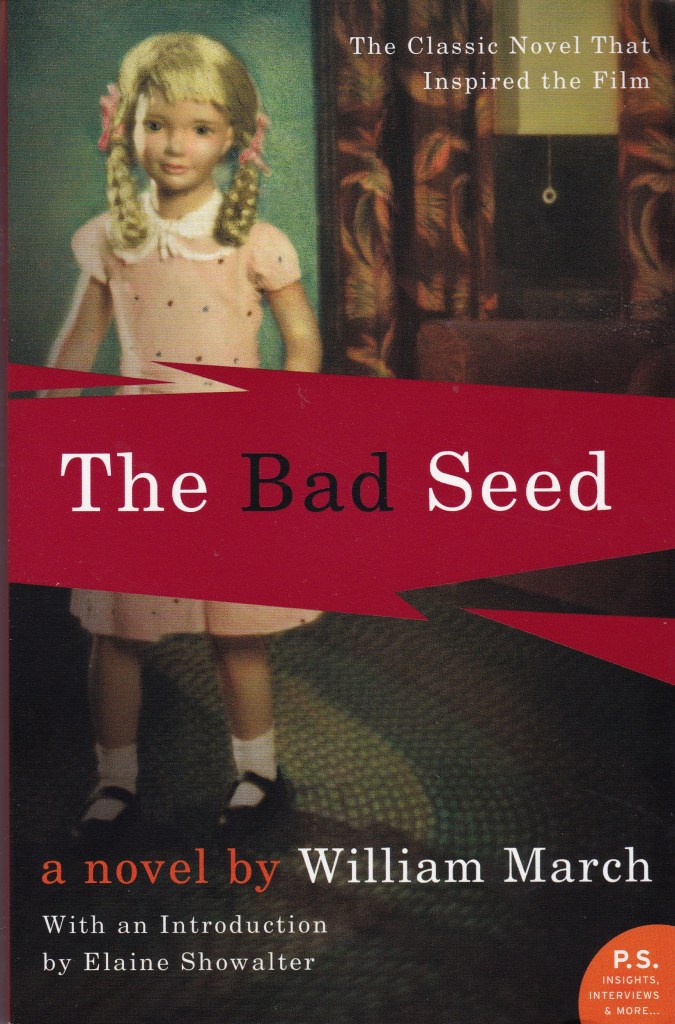
It was watching those afternoon movies where I first encountered The Bad Seed.

Later that summer, when Mrs Penmark looked back and remembered, when she was caught up in despair so deep that she knew there was no way out, no solution whatever for the circumstances that encompassed her, it seemed to her that June seventh, the day of the Fern Grammar School picnic, was the day of her last happiness, for never since then had she known contentment or felt peace.

The picnic was an annual, traditional affair held on the beach, an among the oaks, of Benedict, the old Fern summer place at Pelican Bay. It was here that the impeccable Fern sisters had been born and had lived through their languid, eventless summers. They had refused to sell the old place, and had kept it up faithfully as a gesture of love even when necessity made them turn their town house into a school for the children of their friends. The picnic was always held on the first Saturday of June since the eldest of the three sisters, Miss Octavia, was convinced, despite the occasions on which it had rained that particular day, and the picnic had to be held inside, after all, that the first Saturday of June was invariably a fine one.

If The Bad Seed has lost its ability to shock and horrify, it’s because in the decades since it was published (and adapted into both a play and film) the notion of a child being a killer has gone from being shocking to the general public to one that is kind of accepted; children do kill, and despite all the societal push towards sentimentality toward children. Rhoda is a sociopath, if not a psychopath; her inability to feel remorse or empathy or any other kind of human emotion is chilling to read about–she’s a stone cold killer, and clearly, she thinks nothing of killing to get something she wants: whether it’s the penmanship medal from her school, or a nice trinket promised to her, and then to shut up the janitor who sees through her and threatens to expose her; there’s a progression there. First she kills on impulse to get something she wants, then she coldly and calculatedly kills to protect herself. Rhoda is maturing as a killer, which is very chilling for the reader. The book is told entirely from the point of view of Rhoda’s mother, Christine–who is very slowly coming to realize, time after time, that her child is a monster, despite the innocence of childhood and everything we are taught to think, sentimentally, about children.

Psychology was starting to come into its own in the United States during the 1950’s, and you can see how crime writers took to psychology in that decade: The Bad Seed asks the question of nature v. nurture (although its answer is that it’s nature, genetic, and cannot be helped–and there’s some truth to that. I’m not entirely sure that sociopathy or psychopathy is learned behavior; are these cold-blooded killers born that way or are they creations of their environment? The solution Mrs. Penmark comes up with and executes in the novel is dramatically different from the film–the film had to abide by the Production Code, whereas novels had no such restrictions on them–and I believe the book’s ending actually works better than the film’s.

One thing that the book does brilliantly is depict the emotional turmoil and distress of the mother, slowly beginning to suspect and find proof that her child, that she loves so dearly, is actually a monster.

I first read this book when I was a teenager; I’d already seen the movie when I discovered the book on the shelves at the library, and so I checked it out and read it. I enjoyed it tremendously at the time–and it also had me watching other teens and young children for signs of sociopathy for a few years–and so thought it might be worth a revisit. It was, most definitely; it’s a bit dated, and of course the notion of a killer child isn’t quite so shocking as it was back during the Eisenhower administration–we’ve seen too many real life examples of this, and of course the trope of the killer child has been used, over and over again, in crime fiction and in films, so it’s not the brace of cold water in the face that it once was (kind of like how Beast in View by Margaret Millar was groundbreaking in its time–its still a great read–but what Millar did in that novel has been copied and imitated so much that it’s almost a cliche; one has to read these books with those sort of things in mind). Agatha Christie also used the trope of the sociopathic child (although in a quick google search it turns out Christie’s sociopathic child killer predated The Bad Seed; honestly, Christie did everything first).

It was a very pleasant reread, and as always, it’s interesting to visit (or revisit) books that were considered shocking in their time, only to have them turn out to be fairly tame–I’m looking at you, both Peyton Place and Valley of the Dolls–as well as to see how far the crime fiction genre has progressed. (I still consider Peyton Place to have a place in crime fiction, even though most people don’t. And while the crimes in the book may not be the driving point of the story, those crimes do impact everyone in the town in some way….there’s another essay to be written, probably after I reread the book at some point. It’s been awhile since I’ve revisited both Peyton Place and Valley of the Dolls….perhaps that can be my Christmas present to myself.

Invisible

Sunday morning and a lot to get done today. I was horribly lazy yesterday; I wound up doing very little other than reading–I finished The Bad Seed and then moved on to The Spy Who Came In From the Cold (I’ve never read John LeCarre, and am trying to get better read in my. genre’s classics, both titles and authors) and got some chores done, but other than that–not a goddamned thing. So today I I have to play catch up as well as go to the gym and somehow pay some attention to the Saints game, which is at noon. (I’ll most likely do some things around here, go to the gym around elevenish, and then come home and do things while the game is on.) The LSU game went about the way I expected it to last night–55-17 final score–so congratulations to Alabama’s players and coaching staff; I can’t imagine there’s a better team in the country this season, so it’ll be fun watching y’all go all the way again. LSU has to play Florida next weekend, which will most likely be another horror show like yesterday’s, but at least at that point the season will be over.

This football season is yet another gift the year 2020 has given me. Thanks, 2020, thank you.

It feels cold again this morning in the Lost Apartment–I have my space heater on and a cap on my bald scalp–but it doesn’t look so bad outside, really. Lots of clouds hiding the sky and the sun, but this week is supposed to be warmer than last, so I think I’ll be able to hang this week after last week’s cold spell.

Once I finish this I am going to make a to-do list for this week–I really need to make a point of doing that every Sunday, so I have a roadmap for my week–and also so that things won’t slip through the cracks and be forgotten. This has been a really bad year for me to try to remember everything I have to get done–I keep forgetting things, which isn’t good–so I am trying to be ever so much better about this. The whole year I’ve felt like I’ve been in this weird state of limbo, just drifting and trying to get by, keep dog-paddling and keeping my head above water, and it’s not been easy. (It’s not really been an easy year for most people, I suspect.)

Last night as we binged Big Mouth after the LSU game, I was trying to remember the highlights of the year–the good things that happened that I am grateful for, and realized that, sadly, most of the things I was thinking of was television or movies I’d watched, or books I’d read and greatly enjoyed. I had a pretty good year at the beginning of the year in selling short stories–I sold quite a few this year, continuing a trend from last year, to the point where I keep forgetting story sales I made, which is so weird–but also means that in 2021 I am going to have some stories appear in anthologies or publications, which is terribly cool. I know I stretched myself as a writer–hell, I wrote a Sherlock Holmes story this year, and created a Sherlockian world in 1916 New Orleans–and while there were anthologies and things I tried (and failed) to submit to, I have some terrific stories now that are in some state of writing that could turn out to be something interesting. I am looking forward to spending some more time with both “The Sound of Snow Falling” and “The Rosary of Broken Promises”–and there are any number of others I’d love to dive back into. The problem being, of course, that I have limited writing time, and for the rest of this month I have to focus on finishing the one book and then the first two months of 2021 finishing the other. I’m not really sure what I want to spend the rest of 2021 doing; I know I am co-editing the Minneapolis Bouchercon anthology and that’s going to take a chunk of time to read all those submissions and make decisions and then edit them all, but let’s face it, it’s also not my first time at the anthology rodeo. I want to try to write another Scotty at some point in 2021, and I know I also have Chlorine to work on, but…I guess we’ll just have to see how the year pans out.

I know I want to pull another short story collection together, too, and of course there’s the novellas…

I also polished off a journal last night, so I get to start a new one this morning, which is kind of fun. I’ve been blasting through journals at a pretty good pace since I started using them again, and while I cannot say that they’ve been enormously helpful in keeping my act together and keeping me on track with any of the writing I’ve been doing, they’ve been wonderful for me to jot notes and ideas in, and I’ve been doing much better about going back into them and rereading them and getting the unpolished jewels out of them. I have a really nice one that has a magnetic clasp that I got at Garden District Books, and then got a pack of three the last time I went to Costco, so I am certainly set for journals for the year.

I’ve also got to get the copy edits on my essay finished.

I also spent some time yesterday slowly but surely pruning the books. I’ve done a great job of pruning them already, so much so that there’s slim pickings for getting rid of things I will most likely never read–I always stop myself and have to think, long and hard, about whether I should get rid of an unread book–but I also need to keep making room for more–because at some point I’ll start buying books again. Not sure when that will be financially feasible–right now, books are filed in the “luxury item” column, especially when I already have so many on hand that I’ve not read–but I have quite a list of books that I want to get when I can.

There are never enough books, frankly.

And on that note, I need some more coffee as well as fold some laundry. Have a great Sunday, Constant Reader!

Speak Now

I’ve always been fascinated by politics and history; the two go hand-in-hand, and you really cannot understand one without understanding the other. (Economics are also a lot more important than is ever given credit in most histories–wars and exploration and colonization was, inevitably, always about markets and trade and thus money) I’ve maintained for years that history should be taught as the advancement of individual rights–the ups and downs of individual freedoms, rather than dates and battles and Kings and Queens and Emperors–and that study of individual rights also needs to examine prejudices and bigotry and zealotry, and how those three factors have poisoned civilization and humanity throughout much of its history. I also feel that, while the study of wars are important for their impact, the fact that the impact these wars had on the citizens of the country (countries) being invaded was also important. Putting humanity in the study of human history would not only make it more interesting, but would also further the understanding that should come with the study.

I tend to avoid books about politics, or political thrillers–the news provides enough stranger than fiction moments every day–and as a general rule, fictional films about politics rarely interest me, either. Paul and I avoided The West Wing for years, thinking a fictional show about our government couldn’t be interesting enough for us to get vested in; we were clearly wrong (but I still refuse to watch The American President.) Fletcher Knebel, a long forgotten writer of the mid-twentieth century, wrote political thrillers, and while I was aware of him when I was young, I never read any of his books; why read about fictional politics when actual history is available to read and study? But a few years ago, I read an article about one of his books, recently brought back into print, and intrigued me enough to want to read it.

It’s premise: what if a sitting American President begins to slowly lose his mind and grip on reality?

And I am sure you can imagine why that premise was intriguing.

Jim MacVeagh’s burst of laughter came so unexpectedly, his hand jiggled the stem of the wineglass, and a splash of champagne spotted the linen tablecloth. Sidney Karper, the Secretary of Defense, sitting on his right, grinned in shared appreciation and shook his head.

“Unbeatable, isn’t he, Senator? He just won’t be topped.”

“Nobody can touch him when he’s determined,” agreed MacVeagh. He wiped at his eye with a corner of his napkin and turned back toward the center of the long head table, cluttered with late debris of ashes and crumpled menus amid the sparkle of glassware.

The speaker, President Mark Hollenbach, was mock-solemn again after flashing a responsive smile for the spray of laughter which greeted his first sally. His was the honor chore of the night–the brief reply to the toast to the President of the United States which signaled the closing of another annual Gridiron dinner. The news correspondents had lampooned the Hollenbach administration and its foes in a series of musical skits, some sharp as stilettos but one belabored in its buffoonery, while the Marine Band orchestra in shining scarlet coats. played for the 550 diners.

I finally read this book while I was on vacation over Thanksgiving week, and found myself enjoying it tremendously. It’s a thriller, of course, and the main character is junior Iowa senator Jim MacVeagh. Jim’s a good guy, without too much ambition, with a wife he loves and a tween daughter he adores; he also is having an affair with the chair of the DNC’s secretary–not really a smart thing to do, but we see this self-destructive behavior from politicians all the time (although the idea that adultery is disqualifying for higher office has long since been shown up as a lie). After the Gridiron Club dinner, Jim is invited by the president to join him for a talk at Camp David–and it is there the story kicks into gear. Enormously popular President Mark Hollenbach has decided to dump his vice-president for the upcoming campaign–he’s been tainted with a whiff of scandal regarding a building project a campaign donor was awarded–and the President is interested in having Jim join him on the campaign trail.

Naturally, this is very exciting for Jim, awakening ambitions he wasn’t aware he’d even had, and realizing that, if selected, this would make him the front runner for the top of the ticket in four years–which of course is very exciting for any politician, particularly a young one–but as the conversation continues, Jim begins to become concerned, as some of the things the President wants to do in his second term are not only unconstitutional but borderline insane–for one example, he wants to wire tap every American’s phone, so as better to track and prevent crime, espionage, and foreign agents–and he also displays paranoiac tendencies. As Jim gets closer to the President and one step closer to being on the ticket, more and more evidence of the president’s instability is revealed to him….and he has to. ask himself–party or country? Patriotism or partisanship?

This is a terrific read, and certainly one any American today could identify with and get caught up in the story.

I’m now curious to read other works of Knebel’s, and then of course, Allen Drury’s terrific series of novels about Washington, beginning with Advise and Consent.

I do remember reading an Arthur Hailey novel about politics–yes, government was one of the industries he turned his research and writing to–called In High Places. (I read this during my Arthur Hailey phase; I learned alot from his books. I read The Moneychangers when I worked at a bank; he was spot on about day to day operations on the floor. I reread Airport when I worked at an airport; again, pretty spot on, despite the decades of changes to the industry since he researched and wrote the book.) And The Coyotes of Carthage, which I read earlier this year, was one of the best books I’ve read about rural politics.

I think you might enjoy Night of Camp David. I certainly did.

Seven

Saturday morning and it’s rather chilly in the Lost Apartment . The sun is shining and there aren’t many clouds in the sky–I see plenty of blue up there at the moment–and I haven’t checked the weather yet. All right, I just looked and it’s currently forty-nine, with a high of fifty-three predicted for the day. Sounds like the kind of day when one just wants to stay indoors all day and under a blanket, does it not? I have a lot to get done this morning–the sink is full of dirty dishes; more than will fit in the dishwasher, so I am going to have to do two loads–and of course, there’s filing to do and organizing to be done; notes to be read on the work-in-progress as well as chapters to be revised; and I’d like to be able to read some more of The Bad Seed, if not finish reading it today. LSU is playing Alabama tonight, and it’s not going to be pretty, but at least it won’t be disappointing. It’s very weird, there’s always a minor hope, even in bad years, that we might beat them, but not this one. I love my Tigers and I’ll tune in–but I am under no illusions that they’ll pull off a major upset here. Our only hope is a sustained three and a half hour miracle, really; but this entire football season has been such a wash anyway–I really think it should have been skipped, which is what I’ve thought all along–yet here we are.

I do occasionally think that LSU having one of the greatest football teams and seasons of all time last year somehow broke the world, and if LSU having a shitty season is what it takes to reset everything, I can live with that sacrifice.

Yesterday was a good day. I had to swing by the office because I had run out of lube for the condom packs–I brought home flavored–so I had to swing by there to pick up regular lube tubes–and then after returning home, I made condom packs while watching Logan’s Run, yesterday’s entry into the Cynical 70’s Film Festival. I had never before seen it; I, of course, remember what it’s plot was–a world where everyone dies at thirty; the title character is about to turn thirty and he runs. Well, turns out that was a vast over-simplification; Logan, played by a stunningly beautiful young Michael York (I’ve waxed euphoric over his beauty before; I had a major crush on him throughout the 1970’s; have continued to appreciate his work as I got older; and he came to the Williams Festival one year, so I not only got to meet him but was delighted to find he was very charming), is a “sandman”–in the future, after over–population and depletion of resources and so forth, society collapsed and a utopian human city was built under a dome, and all humans devote themselves merely to pleasure, and when they turn thirty, they are renewed; in a ritual, everyone gathers to watch them sacrifice themselves, to be reborn–someone has to die in order for someone to be reborn. The “sandmen” are those who hunt down the ones who decide they want to live and run for their lives. When caught, they are killed and are dead forever–no chance of being reborn. Logan actually has about four years left before he turns thirty, but he is given the job to search for Sanctuary–a place all the runners try to get to safely–and the controlling computer also speeds up his life, turning the life clock in his hand all the way up to almost time for him to die. Jenny Agutter plays the love interest who can help him get to Sanctuary; they run, and it becomes very weird once they escape. The special effects are pretty bad–the movie was pre-Star Wars–and so are the sets and costume designs. It does, I decided, fit into the film festival because the film itself is kind of cynical; it basically took American youth obsession and created a world based entirely in youth; and it’s interesting they chose thirty as the end point of life–after all, the youth movement of the 1960’s always said “never trust anyone over thirty.” As I watched, I couldn’t help but think of all the possibilities they couldn’t explore in a two hour film–and thought, you know, this show could easily rebooted as a mini-series that could go into all of those explorations–the collapse of society, who built and created this new world, who actually is in power in this utopian paradise, how did they get the initial buy-in necessary–and so on and so forth. And with our country growing evermore obsessed with youth and beauty–yeah, this could be really good. Logan would be a good role for someone like Nick Jonas or Alexander Dreymon or any number of beautiful young actors in the business today.

The lovely thing about HBO MAX is they are continually adding more and more films to their TCM app–you can only imagine my delight to see the delightful Peter O’Toole film The Stunt Man was recently added; The Ruling Class is already there. I am a huge Peter O’Toole fan–the fact the man never won a competitive Oscar despite giving career-defining performance in those two films, along with My Favorite Year, The Lion in Winter, Becket, and Lawrence of Arabia never ceases to amaze me. Both The Stunt Man and The Ruling Class certainly fit into my Cynical 70’s Film Festival–they have also added the original The Omega Man and Soylent Green, both of which I intend to watch despite the fact both star Charlton Heston, the king of over-acting. But…both definitely belong in the Festival, and I really wish they would add Serpico.

I also would like to watch Cruising again–to see it from a present day perspective.

The Mandalorian continues to delight as well, and our favorite raunchy junior high puberty comedy, Big Mouth, also came back yesterday.

And on that note, I am heading into the spice mines. Have a lovely Saturday, Constant Reader.