Girl, You Make My Day

One of the things I’ve greatly enjoyed over the last few years has been the sea change in how publishing views works by non-white and non-straight authors; the push for more diverse voices in the publishing community has already borne wonderful fruit. I’ve been saying for years that the world of crime fiction was in danger of getting stale again, much as it did in the late 1970’s and early 1980’s; particularly the private eye novel. The arrival of Sara Paretsky, Sue Grafton, and Marcia Muller on the scene shook things up and shook things out; the private eye novel got a much-needed shot in the arm of adrenaline with these three women and the others their work inspired; I strongly believe the move toward diversity is going to bear fruit in much the same manner–and it already has, frankly; the works of diverse writers like S. A. Cosby, Kellye Garrett, Rachel Howzell Hall, Alex Segura, Tracy Clark, Cheryl Head, and so many others have joined the great pioneers like Walter Mosley and the wonderful Barbara Neely to open up new perspectives on crime and crime fiction; our society and world; and again, this was desperately needed–and is necessary every so often, for our genre to refresh and expand and become more inclusive. We’re also seeing more queer books being sent out into the world from the big houses in New York, which is also incredibly exciting (another shout out to Yes Daddy By Jonathan Parks-Ramage and A Beautiful Crime by Christopher Bollen).

It’s a very exciting time to be a fan of crime fiction.

Noir has always been one of my favorite sub-genres of crime fiction, and I always enjoy reading modern takes on it. I want to write more noir, quite frankly; Chlorine would be the first of at least four I want to write, if not more (for now, I have ideas for four of them, with Chlorine being the most full formed). I always enjoy modern takes on noir–Laura Lippman’s Sunburn was quite marvelous, as was Christa Faust’s Money Shot and Choke Hold)–and of course, S. A. Cosby is a master of rural Southern noir; both Blacktop Wasteland and Razorblade Tears are destined to be considered classics, I think.

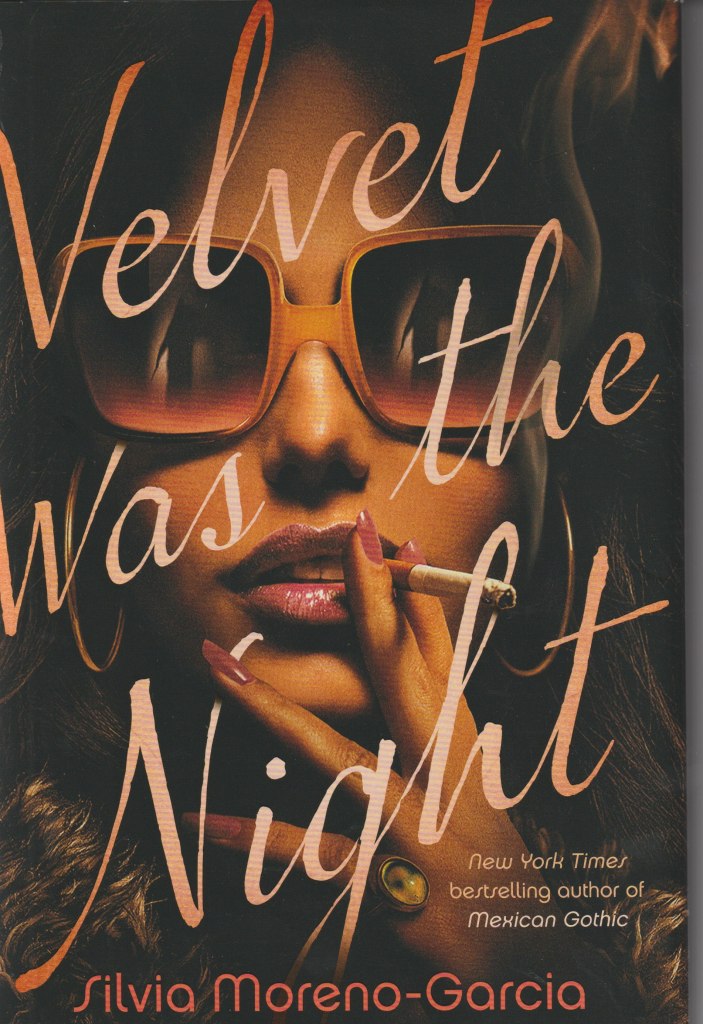
So, I was very curious to read Silvia Moreno-Garcia’s take on modern noir, Velvet Was the Night. It took me a very long time to finish–which is not indicative of the quality of the book, I hasten to add–because after I read so much during the post-Ida power outage, I kind of broke my brain and thus haven’t been able to really focus as much on reading as I would like; yesterday after the LSU game I sat down and finished it with Georgia-Kentucky on as background noise.

And what a fun ride it was.
He didn’t like beating people.

El Elvis realized this was ironic considering his line of work. Imagine that: a thug who wanted to hold his punches. Then again, life is full of such ironies. Consider Ritchie Valens, who was afraid of flying and died the first time he set foot on an airplane. Damn shame that, and the other dudes who died, Buddy Holly and “The Big Bopper” Richardson; they weren’t half bad either. Or there was that playwright Aeschylus. He was afraid of being killed inside his house, and then he steps outside and wham, an eagle tosses a tortoise at him, cracking his head open. Murdered, right there in the stupidest possible way.

Often life doesn’t make sense, and if Elvis had a motto it was that: life’s a mess. That’s probably why he loved music and factoids. They helped him construct a more organized world. When he wasn’t listening to his records, he was poring over the dictionary, trying to memorize a new word, or plowing through one of those almanacs full of stats.

No, sir. Elvis wasn’t like some of the perverts he worked with, who got excited smashing a dude’s kidneys. He would have been happy solving crosswords and sipping coffee like their boss, El Mago, and maybe one day he would be an accomplished man of that sort, but for now there was work to be done, and this time Elvis was actually eager to beat a few motherfuckers up.

He hadn’t developed a sudden taste for blood and cracking bones, no, but El Güero had been at him again.

The recent rise of Silvia Moreno-Garcia has been meteoric, although I am sure to her it has seemed anything but. I read her terrific vampire novel, Certain Dark Things, a while back, loved it, and have been following her career ever since as she has turned out novels at a terrific rate–Gods of Jade and Shadow, Untamed Shore, Mexican Gothic–all of which have been critically acclaimed and sold very well; I love that she bounces from genre to genre–horror to fantasy to crime; even bouncing around in the sub-categories of the crime genre. This is only my second read of her work–I have them all, of course–and had been meaning to get around to her take on noir with a Mexican flourish for quite some time. (I am really sorry I broke my brain with all the reading I did after the power went out; I greatly enjoyed this book, but it was so hard for me to focus for some reason…but am glad I sat down yesterday with the book, determined to finish it at last.)

One of the things that strikes me about Moreno-Garcia’s work is that I am seeing Mexico, a place I greatly love, through a fresh new perspective; like all Yanquis, I always view Mexico through the prism of a tourist. I’ve always wanted to write about Mexico, and have several short stories in the files that are set there (I did write one erotica story as Todd Gregory set in Acapulco; from the perspective of a tourist, of course: “Oh, What A Friend I Have in Jesus”)…but reading Moreno-Garcia makes me aware of how scant my knowledge of our Southern neighbor is–all of the counties south of the Rio Grande, frankly–which is a stinging indictment of our education system. (Don’t even get me started on the concept of Latin America vs. “America”) I know very little of Mexican history after the Spanish conquest, other than the Mexican War and the French empire set up under a Hapsburg by Napoleon III during our civil war. I know very little history of any of the countries that make up the rest of the American continents, really–and isn’t that more than a little bit disgraceful? I also know very little about their cultures, their politics, and what goes on there; a quick glance through the news also will show very little information or news being reported about those non-United States/Canada American countries, which is really a shame.

Velvet Was the Night is set un 1971, a particularly politically rife period in Mexico. The US was terribly concerned about communism being spread by the Soviets in what has always been considered the American soft underbelly–I mean, look at our reaction to Cuba–and there’s no question that CIA operatives and money were working to subvert Communism while supporting borderline Fascist governments because that was preferable to Washington than another potential Soviet satellite state in our hemisphere. The vast paranoia of that time–which really lasted from 1945-1990, really–cannot be underestimated or understated. By rooting her story in actual events of 1971–the crackdown of the Mexican government on dissidents–Moreno-Garcia slyly gives us a taste of how American foreign policy of the time affected everyone in Mexico, as well as a history lesson. (One of the great modern deceptions of our society is this idea that we always act benevolently as a nation; we’re doing this for your own good.) The book has two point of view characters; one, depicted in the opening above, is “Elvis”, a very young man who works as a thug, basically, for an oppressive group of anti-Communists that try to infiltrate dissident groups and haunt protests in order to make them turn violent, so the military can intervene on behalf of the “people.” Elvis grew up very poor and sometimes imagines what his life would be like if he were able to pursue his primary interests–educating himself and music. He doesn’t know what his future holds but is vaguely aware the path he is on–violence and more violence–will not end well. Over the course of the book he begins to question the values he’s been taught to believe in his gang, and begins to aspire to get out of it.

The other main character is Maite, a legal secretary barely getting by on her low salary and barely able to afford food. Her car has been in the shop unclaimed because she cannot afford the mechanics’ bill. She leads a lonely and solitary life, has a very vivid imagination and fantasy world she prefers to inhabit, colored strongly by her love of romance comic books and the music she likes to listen to. Maite’s lovely neighbor, Leonora, asks her to feed her cat while she is away, and when she agreed, Maite unknowingly enters the world of political struggle and upheaval. The riot depicted in the first chapter, that Elvis helps engineer? A friend of Leonora’s has taken pictures that prove that the riot was started by government forces, and those two rolls of film are the McGuffin everyone in the book is after–except poor innocent Maite, who, like any main character in a great Hitchcock film, becomes involved in something life threatening by simply agreeing to feed a neighbor’s cat–something she resents agreeing to do. When Leonora doesn’t come back, Maite starts looking for her–primarily motivated by the fact she can’t afford to keep feeding the car, and Leonora promised her money for feeding it–money she needs to get her car back. Motivated by her own poverty, Maite finds herself getting involved more and more in this clandestine world, and her own life is in danger soon.

The true strength of the book lies in the careful characterizations of both Elvis and Maite; two desperate people trapped by poverty in lives they want to escape, and the parallel journeys they both follow that lead their paths to cross; and the richness of the reality of what life in Mexico City was like during the turbulent time when the book is set. Moreno-Garcia shows us, as she did in Certain Dark Things, what the reality of life is like in one of the world’s largest cities, the reality the tourists rarely, if ever, get a chance to see. And while the hopelessness of both their situations seem unresolvable at times, the pacing is strong and the story construction so tight, and you the readers finds yourself rooting for them both to get out safely.

I really loved this book, and am sorry my inability to focus forced me to take so long to finish reading it. It’s extraordinary, and I recommend it highly.

Ship of Fools

G’morning, Sunday. How’s everyone doing today?

Yesterday was a weird one, beginning with the stunning LSU 49-42 upset of Florida. For the second year in a row, an underachieving LSU team riddled and depleted by injuries, somehow managed to outscore and upset Florida (a third consecutive win over the Gators, no less) that will quiet the complaints about the coaching staff and the team for at least a week–until the Mississippi game on the road this week, followed by a trip to Alabama two weeks later. The game was also ridiculously early–11 am start time–so the game was well over by two thirty, but I was too worn down from the rollercoaster of the game to have much energy to do much of anything else for the rest of the day. Being an LSU fan is a rollercoaster, and sometimes it’s not very fun; but no matter how bad of a season the Tigers might be having, they always manage to somehow beat someone they shouldn’t–for the last two seasons, that has been Florida. As I said to Paul as time ran out yesterday and the Tigers managed to wreck yet another season for the Gators, “No wonder they hate us so much.” That’s three losses for a Gator team that everyone thought would challenge Georgia for the East title, and might even have a shot at beating Alabama during the regular season (they lost by two points)…and they still have yet to play Georgia, who remained undefeated by shellacking an also undefeated Kentucky team yesterday.

I finished reading Silvia Moreno-Garcia’s Velvet Was the Night at long last (I cannot reiterate how much that has to do with my inability to focus rather than the quality of the book; the book is quite marvelous; a modern take on a historical noir built around events that actually happened) and then moved on to finish watching the rest of Eli Roth’s History of Horror, (I skipped the episodes on body horror and torture porn–no thanks!) before tuning in to see the ridiculous and insane end of the Tennessee-Mississippi game–which people are still talking about today. There were some extremely questionable calls in the LSU game; while there’s no excuse for the way the fans in Neyland Stadium reacted, they were also reacting to an incredibly bad call that was upheld under review (!) that essentially took their chance to win the game away from them. After the incident was over and they were able to finish the final 54 seconds of the game, Tennessee managed to get the ball back with another shot at winning, only to fail in the end.

Today is one of those days where I get to play catch-up. I didn’t get nearly as much done yesterday–once I am ensconced in my easy chair, with the cat in my lap and college football on the television, it’s hard for me to get back up out of it to do anything. I did get the dishes done–still have some to put away–and I didn’t get around to the floors or anything else that I wanted to get done yesterday, which means I have to get to it today. I also need to get some serious writing done today–I am much too far behind, and the clock is ticking on everything–so I also need, once I am finished here and after I write my entry about Velvet Was the Night, to make a to-do list. I still have a lot of filing and organizing to get done as well; which I am hoping to do while I wake up and drink my coffee this morning. I need to make it to the gym at some point today, and I should see what time the Saints game is; oh, look at that, it’s the BYE WEEK, so there’s no reason to turn on the television at all; they also don’t play next Sunday–the next game is on Monday Night Football. So that’s two free Sundays I have ahead of me on the agenda, and this is a lovely, very lovely, thing. In fact, that weekend of the Saints on Monday night is also LSU’s bye week, so again–no need to turn on the television at all that weekend….so I should make that my most productive weekend of the month.

This week is also going to be weird because I have a procedure scheduled for Thursday morning; a way overdue colonoscopy. The saga of the colonoscopy is a long messy one, having to do with insurance issues, out of network charges, and so on. I finally had everything finally sorted and it scheduled last spring…only to have it canceled because of COVID-19 and then the endless attempts to get it rescheduled and out of the way. In a way, my colonoscopy feels almost like a quest for the Holy Grail–alway unattainable, so close sometimes you can almost touch it, but then it skitters away again, out of reach. I’m nervous about it, of course; any kind of medical testing can lead to bad news; any procedure can take am unexpected left turn at any time–not pleasant to consider or think about, really. But it’s always better to know something’s wrong than to go on like nothing is…until you can’t pretend anymore because your health takes a particularly nasty turn. But I am sixty, and I have to stop playing groundhog with my health. My body isn’t young anymore, and while I still feel good and go to the gym on a (fairly) regular basis, I’ve also eaten crap most of my life and have really beaten and battered my body during my younger years. (Teaching aerobics 7-21 hours a week wreaks havoc on your leg joints–and mine weren’t so great to begin with.)

The weather also turned cooler this weekend; dropping into the high sixties over night. The time change is coming soon, as well…autumn is here, clearly, and soon I’ll be leaving for work in the dark and coming home in the dark, which I hate because it feels like your day has been completely used up and is over by the time you get home. I also have to pick out my next book to read; since my reading has been so off lately I am going to pick out one of my unread Stephen Kings (if someone would have told me thirty years ago that I would have King novels on my shelves I hadn’t read, I would have laughed hysterically in their face) to read in honor of Halloween season; I try to read horror every October. There’s also a Paul Tremblay or two I’ve not gotten to yet as well; if I can get through whichever King I choose before the end of the month (and with a football free weekend coming up shortly, it’s possible) then I will move on to another Tremblay, who’s becoming my current favorite contemporary horror writer very rapidly; the books of his I’ve read still haunt me.

And on that note, I am going to head into the spice mines. You have a great Sunday, Constant Reader–will check in with you again later with my thoughts on the Moreno-Garcia novel, and then will check in again on the morrow.

Chains of Love

Thursday morning coming at you like a burning ball of pitch hurled at the city walls from a catapult by the invading Huns.

I did two entries yesterday, neither of which was blatant self-promotion (I know, right?); one was my regular entry for the day and the other was…well, it was a really old entry I started writing a long time ago, about my love for Superman and how that actually began when I was a kid. I never finished the post–there are about thirty post drafts that I will someday finish, even though some of them are now YEARS old–but when the news broke about Superman’s bisexuality this week, I knew it was time to finish it and put it out into the world. I also knew when I read that piece of shit’s post on Medium that I was going to conclude by mentioning it, and taking a few nasty digs at his sorry, pathetic, will-die-alone-and-unmourned self. Was I perhaps more petty and mean-spirited, even perhaps nastier, than I usually allow myself to be on here over the last twelve or so years? Probably. Am I sorry? Not in the fucking least.

I woke up this morning at five, as I am wont to do every morning, and moaned a little softly to myself, well, at least I have another hour before I have to get up and then it hit me: It’s Thursday, fuckwit, you don’t have to get up before the sun comes up today, and thus happily burrowed back into my blankets and went back to sleep for a bit. It was lovely, frankly; I feel very good this morning and very alive and ready to get to it. I have a bunch of trainings I have to do on-line today around the condom packing and the data entry (the data entry website was updated, one of the trainings is on that); there’s laundry to do; files to file and an inbox to empty; Leg Day to get through; and of course the apartment is, as always, an utter disaster area. Typical Thursday, really, when you think about it. Yesterday was actually relatively lovely, for the most part; my piece on my favorite Gothic inspirations went live on Crime Reads’ website yesterday, and received an absolutely lovely response–and the afore-mentioned Superman blog piece I did yesterday also got a lot of attention and shares, which was also very nice. The event with Murder by the Book went well for the wonderful John McDougall, our wonderful host and moderator, and I really enjoyed listening to David R. Slayton talk. (I am reading his White Trash Warlock and really, it’s quite marvelous; do yourself a favor and pick up a copy.) Paul had dinner plans last night with friends, so I had the apartment to myself for most of the evening; by the time he got home we were both already exhausted–doing public things always drains me on all three levels (physical, emotional, intellectual) and so we both went to bed relatively early.

So, Bury Me in Shadows is out into the world, and it really was a nice, somewhat soft, release; one of the things I hate about the business side of being a writer is the self-promotion. I was raised in the worst possible way when you want to become a writer; I don’t know if my reluctance to promote myself and push myself on people is inherent, or if it was something I was trained from childhood to have. I was always told if you do good work, let others decide rather than telling them; if the work is good it will speak for itself. That doesn’t really work in this business, and while I am always comfortable to talk about books and writing publicly, I am not very comfortable with talking about myself or my own work or trying to convince people to read/buy it; I can sort of do that kind of thing on here because, well, it’s written and I am not speaking in front of an audience or for a camera. It’s always difficult, and I never think quickly enough to come up with good answers for the questions. I also tend to ramble and get sidetracked and go off on tangents when I talk–as anyone who has ever had a conversation with me in person can easily and happily attest to–which, when you are sharing the stage with another writer, isn’t a good thing. So, with much thanks to John and Murder by the Book for setting the entire thing up and for hosting, and to David for being so gracious and fun to chat with; and I will add my deepest apologies for my feral self and my incompetence at presenting myself as a competent publishing professional.

I also suppose I am far too old to get better at it, as well.

I also got my copy of Best American Mystery and Suspense Stories 2021, edited by Steph Cha and guest editor Alafair Burke–you know, the one where I am mentioned in the back for my story “The Dreadful Scott Decision” from The Faking of the President, as “other distinguished work”, which is still an enormous thrill (I may still be picking up the book and opening to that page and marveling at the appearance of my name there)–which I am very excited to start dipping into again. My Halloween Horror Month hasn’t exactly worked out the way I had planned; too much other stuff going on, the release of a book, so on and so on and so on–but that’s okay. Things happen, life happens, and things get thrown off track, but I do always believe things work out the way they are supposed to in the end.

And on that note, I am going to get some things done before it’s time for me to start the endless rounds of training courses and meetings I have to attend virtually today. Have a lovely Thursday, Constant Reader, and I will talk to you again on the morrow.

Heavenly Action

I’ve always been—undoubtedly in part because I love history so much—an enormous fan of books where secrets from the past (even the far distant past) play an enormous part in the present lives of the characters in the story, and that solving those mysteries, learning the truth about the past, is necessary in the present for conflict resolution. As a history buff, the lack of a lengthy history as a nation is something I’ve always thought unfortunate; without ancient buildings and the way that history isn’t sort of always there in our faces the way it is in Italy or other older nations, it’s difficult for many Americans to either grasp, be interested in, or give a shit about our history—we have as a nation the attention span of a goldfish (thanks, Ted Lasso, for that reference).

To make a side by side historical comparison, for example, the Habsburg dynasty dominated central Europe for almost six hundred years, whereas the first European to actually arrive and establish a colony were under the aegis and flag of the Habsburg king of Spain—and that was in the early sixteenth century.

Secrets of the past casting a shadow over the lives of the living is often a theme in Gothics, my favorite style of novel/writing (noir is a close second). Rebecca is of course the master class in secrets of the past; the first Mrs. deWinter might not actually be haunting the halls of Manderley literally, but her ghost is definitely there. Victoria Holt’s romantic suspense novels inevitably were set in some enormous old mansion or castle, with potential ghosts a-plenty everywhere you turn. Phyllis A. Whitney’s one novel set in Britain—Hunter’s Green—also has a classic old British mansion with a potential ghost in it. Maybe it was the childhood interest in kids’ series, with the reliance on secret passages, hidden rooms, and proving that ghosts were frauds; every episode of Scooby Doo Where Are You? had the gang proving something supernatural was quite human in origin.

One of my favorite Nancy Drew books when I was a kid was The Ghost of Blackwood Hall; I don’t really remember much of the story now, other than a fraudulent haunting was involved and a woman—Mrs. Putney—was being swindled by a medium? (Reading the synopses on a Nancy Drew website, apparently part of the story involves Nancy and the gang coming to New Orleans, which I absolutely do not remember; my only Nancy Drew-New Orleans memory is The Haunted Showboat—involving yet another haunting. Interesting.) When I was writing the original short story (“Ruins”) I needed a name for the old burned-out plantation house; I decided to pay homage to Nancy Drew by naming it Blackwood Hall, and naming Jake’s maternal ancestor’s family Blackwood (his grandmother was a Blackwood, married a Donelson; Jake has his father’s last name, which is Chapman). I did think about changing this from time to time during the drafting of Bury Me in Shadows, but finally decided to leave it as it was. It might make Nancy Drew readers smile and wonder, and those who didn’t read Nancy Drew, obviously won’t catch it.

Hey, at least I didn’t call it Hill House.

But writing about ghosts inevitably makes one wonder about the afterlife and how it all works; if there is such a thing as ghosts, ergo it means that we all have souls and spirits that can remain behind or move on after we die. So what does writing about ghosts—or writing a ghost story—mean for the writer as far as their beliefs are concerned?

Religion primarily came into existence because ignorant humans needed an explanation for the world around them, combined with a terror about dying. It is impossible for a human mind to comprehend nothingness (whenever I try, I can’t get past “there has to be something in order for there to be nothing, you cannot have nothing unless you have something” and that just bounces around in my head until it starts to hurt); likewise, whenever I try to imagine even the Big Bang Theory, I can’t get past “but there had to be something to explode” and yeah, my head starts to hurt. Even as a kid in church, studying the Old Testament and Genesis, I could never get past “but where did God come from?” I don’t begrudge anyone anything that gives them comfort—unless it starts to impede on me. I’ve studied religions and myths on my own since I was a kid; the commonalities between them all speak to a common experience and need in humanity, regardless of where in the world those humans evolved; a fear of the unknown, and an attempt to explain those fears away by coming up with a mythology that explains how everything exists, why things happen, and what happens when you die. (I am hardly an expert, but theology is an amateur interest of mine, along with Biblical history, the history of the development of Christianity, and end-times beliefs.)

Ghosts, and spirits, have been used since humanity drew art on cave walls with charcoal to explain mysterious happenings that couldn’t be otherwise explained. I am not as interested in malevolent spirits—ghosts that do harm—as I am in those who, for whatever reason, are trapped on this plane and need to be freed. This was a common theme in Barbara Michaels’ ghost stories (see: Ammie Come Home, House of Many Shadows, Witch, Be Buried in the Rain, The Crying Child) in which the present-day characters must solve the mystery from the past; why is the ghost haunting this house and what happened to them that caused them to remain behind? I used this theme—spirits trapped by violent deaths in this plane whose truth must be uncovered in so they can be put to rest—in Lake Thirteen and returned to it with Bury Me in Shadows. I did, of course, worry that I was simply writing the same book over again; repeating myself is one of my biggest fears (how many car accidents has Scotty been in?), but the two books, I think, are different enough that it’s not the same story.

At least I can convince myself of that, at any rate.

There’s a few more ghost stories I want to write, actually; (it also just occurred to me that there was a ghost in Jackson Square Jazz, the second Scotty book) any number of which come from those legends my grandmother used to tell me as a child. I have this great idea for one I’ve been wanting to write set here in New Orleans for a very long time called “The Weeping Nun;” I have the entire ghost’s story written in my head, I just don’t have a modern story to wrap around it (same issue I have with my New Orleans ghost story book, Voices in an Empty Room) and of course there’s “The Scent of Lilacs in the Rain,” a short story about another Corinth County ghost I started writing and got to about five thousand words before the ghost even made an appearance. That great length is why I shelved the story—and now, of course, I realize I can do it as a novella, which is amazing news and life-changing, really. “Whim of the Wind,” the very first Corinth County story I ever wrote, is also kind of a ghost story, and maybe someday I’ll find the key to making it publishable (although I think I already did figure it out, thanks to the brilliance of an Art Taylor short story).

I’ve always believed part of the reason I was drawn so strongly to New Orleans is because the past is still very much a part of the present here—though not so much as we New Orleanians would like to believe, as several Facebook groups I belong to about the history of New Orleans often show how often and rapidly the cityscape has changed over the years—and you can sometimes even feel here, at times, under the right conditions (fog and/or mist are usually involved) like you’ve gone back in time, through a rip in the time/space continuum; which is something I’d actually like to write someday here—but that’s just an amorphous idea skittering through my brain.

And of course, I have an idea for a paranormal series set in a fictional parish here in Louisiana. I think about it every now and again, but am really not sure how I want to do it. I know doing a paranormal Louisiana town series will get me accused of ripping off Charlaine Harris’ Sookie Stackhouse novels, but that’s fine. I don’t think I would be doing vampire kings or queens or any of the directions Ms. Harris went with her series. (Monsters of Louisiana and Monsters of New Orleans—paranormal/crime short story collections—may also still happen; one never knows, really.)

As hard as it was sometimes to write, I think Bury Me in Shadows turned out better than I could have hoped. I think it captured the mood and atmosphere I was going for; I think I made my narrator just unreliable enough to keep the reader unsure of what’s going on in the story; and I think I managed to tell a Civil War ghost story (it’s more than just that, but that’s how I’ve always thought of it and that’s a very hard, apparently, habit for me to break.

I hope people do read and like it. We shall see how it goes, shall we not?

Love Must Be The Answer

And here we are on Monday again. It was overall a pleasant weekend, really; I love being able to get up without an alarm, whenever I simply decide I’ve had enough of being lazy and lolling about beneath the covers and so forth. I was deeply asleep when the alarm woke up–I was charging the Fitbit, so have on report on how the sleep actually was, but I think it was deep for most of the night. The alarm was definitely invasive and jarring this morning. But I do feel very well rested and awake–even though I do think I could very easily fall right back asleep if I got back into my bed–and that’s a very good sign for a day in which I have a lot of things to get done.

(Incidentally, I did look up what the normal stages of sleep are at night for a good sleep, and I am hitting the percentages properly every night per my Fitbit–who knew you only needed about two hours of DEEP SLEEP and ninety minutes of REM to be and feel perfectly rested the next day, and that those hours of light sleep aren’t, in fact, a bad thing at all? The more you know…)

I went to the gym during the Saints game–it really is much easier on my stress levels and blood pressure to just periodically check in on the score, or to have the game on while I do other things. AND THEY WON! YAY! GEAUX SAINTS! I’m also following Joey Burrow and Cincinnati–I will always be a fan of Joey B–and they lost in overtime, but they don’t seem like the Bengals of old anymore. I think they will be in the Super Bowl within a very few years.

The gym felt marvelous, as it always does once you get past that deeply painful “back-to-the-gym-after-a-break” workout. For the first time in a while yesterday, I noticed in the gym mirrors that my muscles were responding to the working out and were getting pumped up, which was a shock and a pleasant surprise at the same time; as always an extremist, I think my muscles shrink and fade away if I don’t work them out regularly and I forget sometimes that I am actually fairly big in muscle mass…but all I see, of course, is spaghetti arms, drooping moobs, love handles a gang can grasp, and a big belly. I also am enjoying seeing my flexibility slowly coming back from the abyss; I was able to stretch more deeply yesterday than I have in a very long time. Once I get going again and am doing three sets with added weights for several weeks in a row, I am going to add some more exercises and increase the difficulty of the workouts. I’m actually kind of looking forward to it, frankly–although I am going to be missing two weeks in November (two trips planned!).

And yes, I am very excited to be traveling again. I am going to New York for MWA business for a few days, then taking the train to Boston for Crime Bake, a joint event sponsored by MWA’s New England chapter and the local Sisters in Crime chapter. I’ll be going to visit my parents for Thanksgiving, so that will be quite the lengthy drive to and fro; I believe I will listen to books on tape that I will get from the library; and who better to while a lengthy drive away with than Stephen King? I think I’ll listen to Black House on the way up and Dr. Sleep on the way home. That definitely sounds like a plan, does it not?

I’m also going to have to be very careful and keep an eye on my schedule so my writing schedule doesn’t get fucked up by these trips. Deadline is 1/15 for A Streetcar Named Murder; definitely need to keep my eyes on that prize; I am going to start revising the first four chapters this week and hopefully will get the ball going again on that.

I’ve been seeing a lot of hate for Nate the Great from Ted Lasso recently on Twitter, and while I can certainly understand the turn of the audience–what a terrific job they did on this villain origin story–I also kind of understand where Nate is coming from, if that makes sense? Yes, his behavior is shocking, but it’s not unearned and it didn’t come from left field, and kudos of all kinds to the writers for not taking the easy way out with this character. It would have been very easy for Nate, who was so shy and reticent and cowed by being bullied by everyone on the team and his father, to slowly bloom under Ted and Beard’s belief in him, and how the team has not only stopped bullying him but come to accept him as one of them….as I said, that story was easy; all that was left for the icing on the cake was for Nate’s confidence to keep growing and for him to fall in love and so on and so forth; a nice easy audience-pleasing character arc for the poor bullied boy everyone felt sorry for in the beginning. But the underdog we always want to root for isn’t always this nice person being held down by others. Bullying, and being bullied, isn’t really that simple, nor are all the bullied kids lonely and desperate for just a chance, any chance, and once given that chance, blossom into great people and achieve the potential they’ve always had. Being bullied–and I am speaking as someone here who has been bullied, for most of my childhood and some of my early adulthood–has a very toxic effect on the victim. You often wind up hating yourself intensely; after all, they have a reason for bullying you, don’t they? You must deserve what’s happening to you. And when people cut you down and insult you, you always respond in your head, hating them, wishing you had the courage to say something nasty right back to them. You spend your alone time reliving the humiliations and embarrassments, practicing the vicious and nasty things you should have said in response. There’s a lot of anger there, and often, in the narratives we are used to seeing in fiction, that anger never gets resolved; it just magically dissolves away once the bullying ends. I think that the show writers are doing an excellent job of showing how Nate’s character development/arc has run; remember, he has always lashed out angrily when he felt safe enough to do so; and people who are bullied often become bullies themselves; it’s really the only interpersonal interaction they are most familiar with. Nate began coming out of his shell with the encouragement of Ted and Beard and the acceptance from the team; the promotion to coach; and actually being good at soccer. When he began to see Ted and the others no longer applauding him, giving him the attention he believes he has earned and now deserved, that anger that was always there began to curdle within him. The final episode turn didn’t come as a terrible surprise to me; I saw it building all season, really. I applaud them for taking Nate–obviously a fan favorite–and turning him into the antagonist for Season Three.

Although it must be a strange ride for actor Nick Mohammed, who went from being beloved to reviled over the course of twelve episodes.

And on that note, I am off to the spice mines. Have a lovely Monday, everyone.

We Gotta Get Out of This Place

Saturday morning in New Orleans and all is right–for now–in the world. I slept in this morning, which felt great, and while I have some errands to run–mail, drop off a return, make groceries, take books to the library sale–overall I pretty much have the day free. The LSU-Kentucky game isn’t until six thirty, and I don’t have any need to actually watch any of the other games today–although I will undoubtedly have the television on and tuned into said games–but I want to work on cleaning today, getting organized, and potentially doing some writing. I started writing another Blatant Self Promotion (BSP) post for Bury Me in Shadows the other night, and I really would like to get that finished and posted (I had hoped to write a post a day to try to sway you, Constant Reader, into opening your wallet and buying the book, but there’s only so much time in a day and I do need to rest and refresh both body and brain) at some point either today or tomorrow. But the book–and therefore the self-promotion–walk a line that I have to be very careful with, which always makes me nervous. It’s never my intent to ever offend or upset anyone, but my books are my books and my personal politics, values, and beliefs do affect what I choose to write about–and if you’re looking for a conservative point of view (or a white supremacist one) you are definitely buying the wrong books should you buy one of mine.

Yesterday was actually kind of lovely. I did some work, I made some condom packs, and I rewatched a film from the 1970’s that fits both into the Cynical 70’s Film Festival as well as the Halloween Horror Film Festival: Brian de Palma’s The Fury, based on a book by John Farris, which I read at the time (I eventually originally saw the film on HBO; I never rented it nor saw it in the theater). Horror fiction and films made an enormous comeback in the 1970’s; one could see the genre actually achieved never before see heights in that decade. Part of this, naturally, was the publication of Stephen King’s first novel, Carrie, and the enormously successful, Oscar-nominated film adaptation of it a few years later (still one of the best King adaptations of all time). Both publishing and film responded accordingly, and also in the late 1970’s the one-two punch of Halloween and Friday the 13th took the slasher film to new heights, taking the horror genre along with them. The 1970’s also saw the debut of Anne Rice’s Interview with the Vampire, which wound up spawning an enormously successful series of books that completely changed the vampire dynamic in fiction–following the lead of Dark Shadows and making vampires into deeply flawed, romantic heroes. But horror was everywhere in the latter part of the decade (you should really check out Grady Hendrix’ marvelous Paperbacks from Hell, which examines the proliferation of horror titles in the 1970’s and 1980’s, through the window of their cover art), and so, naturally, The Fury–with the same director as Carrie, Brian de Palma–was primarily viewed as a rip-off trying to cash in on the success of Carrie.

But if The Fury is similar to Carrie in some ways, it is much more like Firestarter than any other King work; as I rewatched I kept being reminded of Firestarter and thinking about it (and thinking it, too, was due for a reread). The premise of the film/book is that there is a secret government agency (1970’s paranoia again) tasked with exploring and examining the potential of young people with some psychic gifts, whether it’s ESP, telekinesis, etc., with an eye to weaponizing them as well as advancing science (the government will turn anything into a weapon of war; this moral debate is mentioned very briefly during the film but to no great degree). Kirk Douglas plays the father of an extremely gifted young man, played by Andrew Stevens (which may or may not have been my first exposure to the handsome son of Stella Stevens; he also appeared in a two-part television adaptation of John Jakes’ The Bastard, and I don’t remember which came first. Nevertheless, he was quite handsome and had a terrific, sexy body). The very first scene of the film shows them on the beach somewhere in the Middle East; there’s a terrorist attack and Douglas is the target, but Stevens is kidnapped by the bad guys and Douglas manages to escape, embarking on a lifelong quest to find and rescue his son from these bad guys operating under the aegis of the government (I cannot emphasize how deeply distrust of the government ran in this time, in the wake of Watergate and Vietnam, there was a definite shift in public perception). The movie then switches over to Amy Irving, daughter of wealthy parents attending an extremely exclusive girls’ school in Chicago. Amy (another tie to Carrie) also has powers she doesn’t understand and can’t control; a bully starts harassing her in the cafeteria, and Amy blurts out the girl is pregnant–and the girl starts bleeding from her nose profusely, causing a panic, etc. Amy is then recruited to a school to test her talents–the same people who kidnapped Andrew Stevens, but their end game is never really explained; they’re all just bad guys who work amorphously for the government. Amy and Andrew are somehow connected; being able to see each other’s thoughts and so forth, so Douglas helps her escape from the school and they go looking for Stevens. SPOILERS: Stevens and Douglas finally end up dead, basically killed by the government people–not really, but they are definitely the reason they do–and in the final scene Amy uses her powers to punish the bad guys (again, very similar to Firestarter, which The Fury predates by several years). It’s not a bad movie, per se, but it’s also not a great one; it’s certainly not as engaging as Carrie–and I remember thinking that about the book as well; that it was just a quickly written attempt to cash in on King’s success.

What was interesting–what is always interesting–about watching these old movies is seeing actors who have not yet made it big in bit roles. There were three I picked out in this one: Melody Thomas, yet to become Nikki Newman on The Young and the Restless for decades; Daryl Hannah as one of the bitchy mean girls at the private school Irving attends; and Dennis Franz, playing a cop years before NYPD Blue.

We watched the season finale of Ted Lasso (oh, Nate, you poor broken man) which made us both laugh and cry, as it always does; the show really is a joy and I am rather distraught we have to wait now for the next season, and then a new show on Apple TV called Acapulco. This show is interesting; a wealthy older Latino man is explaining to his nephew his life story; how he came up from nothing to become wealthy, and how it all began with him getting his first job at a ritzy resort hotel in Acapulco called Las Casinas when he was a teenager. The parts with the older man talking to his young nephew are not engaging at all; there’s a mimicry of The Princess Bride with just a hint of the story-telling structure of How I Met Your Mother as well; it didn’t work for me in this instance. But the teenagers working at Las Casinas back in the 1980’s? Very charming, engaging, and likable. We’ll keep watching, but I want to see less of the present and more of the past, which is the show’s true strength.

That’s about it here from the spice mines. I think I’ll have some more coffee and try to get that BSP post finished. Have a great Saturday, Constant Reader!

As Long As You’re There

And now it’s Friday.

I slept very well again last night, which was lovely–I’ve really been getting excellent sleep ever since The Power Came Back On, which is delightful–and I am looking ahead to this lovely weekend with great excitement and joy. The LSU game tomorrow is a night game, at undefeated Kentucky (when was the last time the teams played and KENTUCKY was the undefeated and ranked team of the two? Probably never), so I have tomorrow’s entirety free to get things done, run errands, go to the gym, and essentially do as I please until the game. I also am working at home today, and thus trying to find some horror to watch while I make the condom packs.

I started watching Friday the 13th Part II yesterday, and wasn’t far along into it before it started seeming familiar, like I’d seen it before–and I soon realized that I probably had, last year in October, so I switched it off in disappointment (not really; it was actually quite terrible) and switched over to the final episodes of The Real Housewives of Beverly Hills, which I had not been watching because I was sick to death of Erika Girardi using the show to try to gain sympathy for herself as one of her husband’s “victims.” But I had read a piece somewhere about the show being the “best thing on television right now”, and then I read a piece run recently in the Los Angeles Times, an interview with the three ‘outsiders’ on the show (Garcelle, Sutton, and Crystal) talking about the season and the filming of the lengthy finale, and I thought, swallow your disgust at the behavior of this criminal accomplice and watch. Interestingly enough, the cringe-aspect of watching I was experiencing before taking a break was now gone; and while I still felt a bit squeamish about watching–de facto condoning her behavior by giving them ratings, which will lead to her getting signed for another season, which is again a reward for her terrible behavior–I found myself actually enjoying watching again. I still loathe two members of the cast completely–looking at you, Kyle and Lisa Rinna, and will continue to hope to see them humbled, humiliated and (best case) let go–but I think I can watch again. The show, which the cast had been overly producing for quite some time, kind of had that rigid artifice stripped away from it with the Girardi criminal case; there really was no way they could escape the litigation or comment on the investigations of the growing scandal.

Or maybe I’m not in a really dark place anymore? There’s still something that seems wrong about watching this…but I can’t get to the bottom of it, frankly. I guess I’ll just keeping discussing it here until i get to the bottom of why it feels so wrong.

Who knows? I may never get to the bottom of it.

We got caught up on some of our shows last night–Only Murders in the Building, American Horror Story: Double Feature, and Archer–which was lovely and relaxing. I think it was the last episode of Archer ever; it ended with a tribute to Jessica Walter, and I can’t imagine having the show without her character, so it most likely was. Archer has never been as funny in its later seasons as it was in its earlier ones, alas; and while I appreciated the show’s attempts to keep it fresh by changing things up with seasons devoted to a theme–outer space, becoming a drug cartel, doing a noir Hollywood story–they never quite equalled the humor of the original seasons. Pity. I am also kind of intrigued by the second half of this AHS season; the alien stuff is very strange and weird, even by AHS standards, and I am not really sure where this is going, but it’s holding our interest. Only Murders continues to hold its charm; I had assumed it was rushing to a conclusion, only to have a twist at the end of the latest episode that ensure that no, indeed, the season is not finished quite yet. And we have our other shows to watch this weekend, as well as some movies–Everybody’s Talking About Jamie at the very top of the list, of course–and perhaps there are some other shows we can look into on the streaming services. (I really want to check out Stephen Amell’s new wrestling show on Showtime, Heels–which looks like it could be pretty good.)

So, I have some nice plans for the weekend–catching up on things, cleaning, organizing, writing, dropping off books to the library sale–and am really excited about possibly doing the writing part of the to-do list this weekend. I also want to fucking finally finish the book I am reading–which I am not going to name; my inability to stay focused and read lately has been really annoying and I no longer want to even hint at the possibility that I am not finishing the book because it isn’t good because it it very excellent; I may have to finish and then move on to short stories again. Short stories could also work very well for Halloween Horror Month; it never can hurt to dig into Stephen King or Shirley Jackson short stories, and of course Daphne du Maurier’s are often macabre and haunting. So, we shall see. I am going to try to finish the book I’m reading now, possibly reread The Haunting of Hill House, and if my reading focus remains fucked up, move on to short stories.

And on that note, tis time to head into the spice mines. Have a lovely Friday, Constant Reader, and will check in with you again tomorrow.

Friend and a Lover

Thursday and working at home on this glorious morning. Huzzah! (I really hate leaving the house–something I battle with almost daily; my desire to be an anchorite or a shut-in; which makes it a really good thing that I work outside the home. If I could work at home, I’d have everything delivered and would never leave the house except for the gym. Seriously.)

I was tired yesterday–as I always am on Wednesdays; I’m not sure why the getting-up-at-six thing is such an issue when I go to bed at ten, but I also suppose it has to do with the quality level of the sleep. I am trying not to look at my Fitbit to get the breakdown of deep vs. light vs. awake, to be honest, as I don’t need another thing to obsess about. But I don’t think being tired on my third consecutive morning of getting up early is unusual, and I wasn’t nearly as tired as I remember being on Wednesdays. It’s more that it’s harder for me to stay focused when I am tired, and therefore harder for me to complete tasks.

And man, was it ever hard to make myself go to the gym last night when I got home from work. BUT I DID IT, AND IT WAS LEG DAY, AND MAN OH MAN HOW MUCH DO I HATE LEG DAY? With the white hot intensity of a dozen burning suns, that’s how much. (Leg Day is always rough for everyone, because your legs are half of your body, and while yes, of course, your upper body is the other half, but Upper Body can isolate actual muscle groups, whereas most leg exercises inevitably require usage of the entire leg; even calf raises require your entire legs’ muscles to be engaged, plus you don’t walk on your arms…) This morning my legs feel good tired, which means the initiation into Leg Day after so long was the right amount of work–I always worry about overdoing it, and it was Leg Day, in fact, where I injured my back all those years ago, which forced me out of the gym, and I’ve never really had a consistent workout program ever since. I also fell asleep in my chair around eight thirty, eventually crawling into bed before ten and sleeping like a stone, which was marvelous.

So, overall a good day. I managed to get the revision of my short story done (“The Sound of Snow Falling”), and it needs probably one more coat of gloss on it; I started writing another short story (“He Seemed Fine”) but didn’t get very far into it, and also started planning the revision of the first few chapters of A Streetcar Named Murder, which I need to work on adapting to the new backdrop of the series. I was too tired after the gym to focus on reading, so hopefully today after my work-at-home time I can finally finish reading it. Paul was working on another grant proposal last night when he got home from the gym, so I was watching Youtube videos on French history–the 16th and 17th centuries in France are like catnip to me–so we weren’t able to watch anything last night.

Today, I am going to watch some horror films while I do my work-at-home chores; it’s October and Halloween season, after all. I was really pleased to get some watched last year during October–horror classics I’d never seen before, as well as some I had and rewatched–and I think this week I am going to focus on sequels; namely Friday the 13th. I’ve seen the first a couple of times–rewatched it last year–but I’ve never watched any of the sequels. I think when I’ve made it through all the myriad of Friday the 13th movies, I may try Halloween. I think I’ve seen most of these movies at some point or another, but it would be interesting, I think, to watch them all in order.

Or perhaps…perhaps a John Carpenter film festival is in order. It could be fun to watch Prince of Darkness again, which I saw in the theater and was terrified; I’ve always enjoyed it on rewatches–but the fact that all the college students are played by actors well into their thirties is always a bit amusing. (I also think the score for that film is terrifying; Carpenter’s scores are always pitch perfect for his movies.)

I am feeling like myself again these days–like some dark cloud has lifted out of my brain; I’m not sure how or why, but I am glad it’s gone, even if it’s merely a temporary thing. The house is a mess, of course–as always–but I am going to try to work on getting it all cleaned up this weekend. The LSU game is Saturday night, so I have all day–if I can avoid the easy temptation of the other games airing–to clean. Or I can clean with the television on–or (gasp) I can have the games playing on my computer while I clean the kitchen.

Stop the insanity!

And on that note, I am going to finish this coffee and start a load of laundry. Have a lovely Thursday, Constant Reader.

It’s One of Those Nights (Yes Love)

So, for today’s BSP about Bury Me in Shadows, I am going to talk about where the actual story that goes to the heart of the plot came from.

My grandmother was probably one of the biggest influences in my life, for both good and bad. I won’t talk about the bad—I was raised to believe you never bleed in public—and there was quite a bit of it; I didn’t speak to her the last thirteen or so years of her life. But the good was good, really. She loved old movies and passed that love of the glory days of Hollywood on to me; she always encouraged me to read and to be a writer; and she was the one who instilled in me my love for crime films and (to a lesser degree) horror ones—what she used to call “scary movies”; I watched The Haunting for the first time with her, and sometimes when I rewatch an old classic, like The Strange Love of Martha Ivers or The Letter, I remember watching it with her on the couch. She was also the one who introduced me to some authors I love, Victoria Holt (The Secret Woman) and Mary Stewart (The Ivy Tree), and she also encouraged my interest in history, which she also really enjoyed. She used to tell me stories about the past all the time when I was young—stories that at the time, and for most of my life, I remembered as being “family history” and was very surprised as an adult to find out they were fairly common legends and stories from all over the South, as well as from books and movies. In other words, none of the stories were true…but when I was thinking about this again the other day it occurred to me that it was entirely possible I was remembering it wrong—it was a long fucking time ago, after all, and my memory has been wrong before. It’s entirely possible she was just telling me stories, that I assumed were family histories…anyway, there were a lot of them, and when I was in college I started writing a lot of the ones I remembered down. They were often tales of blood and murder and crime; sometimes ghost stories.

The Lost Boys, the legend I used as the basis for the book’s background, is one of those stories.

And yes, bits and pieces of the story are apocryphal; sewn together by my grandmother into one story to entertain me.

Long story short: before the Civil War the county where my family comes from (again, not sure if this is true or not; the histories of the area I’ve read indicate that it’s not; so she either was weaving a story for me or I misunderstood the story or altered it in my memory as I got older) used to mostly belong entirely to one family—from which I am theoretically descended from (my grandmother also had a lot of delusions of grandeur)—and after the war, they lost nearly everything, except for a small tract of land that still remains in the family to this day. Anyway, the father and the oldest son went off to war, leaving his wife and two younger sons behind. The father was killed in the war. When the son came home after the war was over, the house had burned to the ground and there was no sign of wife or the two youngest sons anywhere; they’d vanished without a trace. No one ever knew what became of them; and the story, according to my grandmother, was that a deserting Union soldier burned the house and killed them (yes, the same story as appeared in Gone with the Wind, among others; my grandmother also told me another story about a Union deserter committing murder of a defenseless Southern woman—which I also turned into a short story that collects dust in my files), and that on or around the anniversary of their deaths, you could hear the younger boy calling for his mother in the woods near where the old house had been. Good stuff, right? I certainly thought so, and what a great basis for a story.

Of course, when I started researching the history of the county, none of this appeared to be true—the Union army never came any closer to the county than Tuscaloosa, for one, so the odds of a deserter making it all the way there on foot are pretty slim, and especially if no one else saw him—and of course, none of my ancestors owned most of the county. But it was a good story, even if not true, and I felt that writing about it could make for an interesting tale. My main character, Jake, is aware of the old family legend; he wrote a paper about it in high school, but doesn’t believe it’s anything more than a legend. I thought it would be cool to leave the ruins of the original house there, deep in the woods, far from the county road and the current domicile of the family, the crumbling house on the dirt road just off the county road. I also brought in a team of archaeologists from the University of Alabama, excavating the ruins—one of the few sites left that haven’t been excavated—and the professor leading the team, Dr. Brady (named after a historian friend), while intrigued and interested in the legend, isn’t trying to find proof one way or the other; he’s simply interested in what information about how the family lived can be unearthed.

The book is more than this, of course; but the Lost Boys legend was the starting point from which the rest of the book grew. I have a very complicated relationship with Alabama, to be honest; it’s my homeplace and I love the state. It’s stunningly beautiful. Even the poor rural county we came from is beautiful, with rolling hills and small mountains covered in pine forest, hollows filled with kudzu, muddy orange streams and rivers, riotously colored flowering bushes, and the air…oh, how wonderfully clean and fresh and pure the air smells. I love the orange dirt, and how round and smooth the gravel can be. The sky is a gorgeous cerulean, and of course, when it rains, it really rains. I can remember how still and heavy and damp the hot summer air was, the gnats and mosquitoes and dirt daubers and wasps and hornets and bees and horseflies. Whenever I stop as I drive through on my way somewhere else (usually Kentucky or Atlanta), I am always amazed at how lovely the young people are working in the small highway-side town’s fast food places. I remember screen doors with a coil so they’d always shut (or slam, if you just let go), and the big red Coca-Cola coolers with the bottle opener on the side in the general stores—and of course, the big old style Dr Pepper signs, that looked like a clock with only the numbers 10, 2 and 4—because that was the time for a Dr Pepper. (I also remember it was considered a cure-all when you were sick; just heat some Dr Pepper on the stove and add lemon; just like 7-Up was a cure for an upset stomach.)

But the state’s history– enslaved people, what happened to the indigenous tribes, Jim Crow, Selma, the institutionalized racism–is also deeply problematic. How does one write about the problematic history of the state? How do you point out how wrong all of that is without becoming preachy? I’ve often taken issue with white-written narratives about the pre-Civil Rights era in the South, as well as those set during that era and after; I remember reading one book where the heroine was doing research about the history of an incredibly racist town where a race-related murder had occurred, driven by the Klan–but focusing on the good, non-racist, non-Klan members of the town–what I call the see? We aren’t all bad take. I definitely didn’t want to write one of those stories. A few years back, I found a copy of a book I read when I was fairly young–it belonged to my uncle, actually–about the Civil Rights era in Alabama, called The Klansman by William Bradford Huie, whom I believe was actually a journalism professor at the University of Alabama…and it was different than I remembered, yet still chilling. I’m not sure what Huie was trying to do with the book, to be honest; the Klan sympathizers really came across badly, and even those who weren’t out and out members of the Klan were still racists who saw the Klan as a necessary “evil”–the sheriff couldn’t get elected without the support of the Klan, and he spends the book trying to walk the line between pleasing the Klan and not doing anything illegal…but you lie down with dogs, you wake up with fleas. (I read it the same summer as I read To Kill a Mockingbird, which also belonged to my uncle; the two books are forever linked in my mind.)

Bury Me in Shadows may be many things, but it’s not a Lost Cause narrative, nor is it a “look at the nice white saviors” novel, either.

And I think that’s enough about that for today.

Every Song Is You

Wednesday morning!

Yesterday was a really good day. I was productive again–not as much as the previous two days, but still, I’m counting it as a win. I even wrote. I worked on a short story and an essay–granted, the short story was a revision, so somewhat easier than actually writing something from scratch on a blank page–but it was still pretty awesome to be flexing some creative muscles again. I also think my editorial eye has become a lot more clear than it’s been in over twenty-one months; I definitely think I am going to be tweaking this story perhaps one more time. But it felt amazing to be writing again–rewriting, as it were–and so my new plan is to try to get this three short stories I’ve been trying to revise forever revised this week, and start working on A Streetcar Named Murder in earnest this weekend.

Tonight after work I am going to go to the gym for Leg Day, and try to get some more editing done. I also want to finish reading Velvet Was the Night so I can start my Horror for Halloween reading, beginning with the annual reread of The Haunting of Hill House. I had also planned to read one of the Stephen Kings I have on hand but not yet read–probably The Institute–and another Paul Tremblay at the very least; but I’ve got to finish what I am already reading before I can move on to anything else. I think this decommitment to watching college football all day on Saturday will help, and just the occasional check-in on the Saints on Sunday should also help free up some of my time. I think today’s lower energy mode is probably just the usual oh I’ve gotten up at six for three straight mornings tired; even now as the coffee kicks into gear I am starting to feel more alert and more on top of things–which is pretty fucking cool. Yay!

I’ve also been writing blog posts to promote Bury Me in Shadows; I wrote a rather lengthy one about the backstory behind the book–where the Civil War ghost story aspect of the book came from, and why it was kind of difficult to write such a thing in the present time, knowing that the rebel side was wrong and problematic–and the underlying root cause of all the racial tension and problems we still face as a country today (I’ve preordered The 1619 Project, and can’t wait to read it). One of my primary worries/concerns with writing this book was how easy it would be to step wrong and write something offensive. I still worry from time to time that I did exactly that, and when the book is released there will be controversy. But if I got something wrong, or wrote something that is offensive, I will own my mistakes, apologize for them, and try to do better going forward.

I don’t understand when admitting you were wrong or made a mistake became a sign of weakness in this country. I also don’t understand it. I don’t like being wrong, but I am also not going to double down on being wrong. Not meaning any offense doesn’t mean you won’t offend someone, and for the record, I’m sorry you were offended is not the same thing as I’m sorry I offended you. The first is a non-apology, and the speaker isn’t really sorry for what they said, they are only sorry you were offended by it. The second takes ownership of the situation and doesn’t let the original speaker off the hook, and personalizes the apology. I also don’t understand why this is so hard for people to understand.

Yesterday Twitter was all abuzz about the Kidney Woman story in the New York Times, which tried to stir up the whole argument about drawing inspiration from someone else’s life or story. I’ve always believed that it’s impossible for any writer to create either a character or situation lifted from real life; if anything, it’s only a starting place, because a writer cannot know everything about any real life person–you don’t know their every experience, you don’t know what the seminal experiences that created who they are and how they react to things, you don’t know how their mind works or how they even think; at best, all you really see if how they outwardly react to a person or a situation–you don’t know what they are thinking, you don’t know their triggers, you don’t know anything, really–so you have to make up a lot of it, and you base it on your observations of how that person behaves and reacts. Observation is very key, yes, and an understanding of psychology, but again, everyone is different and no one can predict how anyone else will think or react or behave in any given situation. Which is why we are always surprised by the behavior of people we know; we don’t really know them at any great depth so of course we are always going to be surprised and caught off guard by their actions. Nobody likes to think people talk about them behind their back; no one really wants to know what people that dislike say about them. But you have to understand that it’s very human–friends tell each other things, and everyone talks about everyone else (it always amazes me that this salient fact of life is always addresses so insanely on reality televisions shows–“don’t talk about me behind my back!” Um, everyone does it, hello? And most of the time it means nothing. If someone has pissed me off, I will inevitably talk about it to a mutual friend–just to get it off my chest and out of my system. Usually, I am over it once I talk it through with another person–everyone needs to vent, why is this so hard to understand? And it doesn’t have to mean anything more than that…”yes, I was mad at you, but once I talked it through with X I realized it wasn’t anything, I was over it, and why hurt your feelings or start a fight with you when it really wasn’t anything?”). I certainly don’t want to know what people say about me when I’ve irritated them or pissed them off; I’m perfectly happy being oblivious.

With the caveat that if I behave in a way that really gets on someone’s nerves regularly, I would like to know so I can decide to change the behavior or not.

Then again, I’ve never understood the rules of friendship, either.

We finished Midnight Mass last night, and thoroughly enjoyed it. Mike Flanagan, who also did The Haunting of Hill House (which I was able to enjoy as I merely viewed as fan fiction rather than a straightforward adaptation of the classic novel–one of my favorites), did an excellent job here. It’s a deep meditation on religion and the power of belief, juxtaposed with some serious horror. The acting is superb; the characters deeply drawn and compelling, and it’s hard to look away. I prefer this kind of creepy, unsettling horror to jump scares and gore, frankly. I do recommend the show, but prepared to think some heavy thoughts about the power of religion and its potential for abuse–as well as how easy it is to misinterpret something as holy when it most certainly is not.

And on that note, tis off to the spice mines with me. Have a lovely day, Constant Reader.