It has turned cold (for New Orleans) here; the high yesterday was in the mid-sixties, and I felt cold all day. I had to run uptown to the Sports Medicine institute to get my letter for jury duty and then had to drive to City Park for a work thing. And, thanks to the strange vagaries of New Orleans geography, it turns out Tulane University’s campus is closer to City Park than it is to my house. I still can’t wrap my mind around that logic, but as it starts to spiral off I just think yes, but that weird geography is part of what makes the city unique and then I can stop thinking about it for a while. From there we went to the Dillard University campus for a training (they served us lunch) and from there to Ralph’s on the Park for a final presentation and dinner. I discover that I can eat pasta and meatballs and softer bread; I was able to have the soup and blackened redfish for dinner, which also worked. I would have rather had the steak filet, but I felt pretty certain that wouldn’t work for me. I then came home, and we started watching The Fall of the House of Usher, which spans a lot of Poe’s work, and repaired to bed relatively early. I slept well, but feel a bit under-rested this morning. I certainly don’t feel as awake and alert as I did yesterday. I think we have a busy day at the office, too. This weekend is also going to be a bit off for me; I have a wedding to attend Saturday afternoon, and I believe I have dinner plans with a friend from out of town for Sunday. I have to swing uptown after work tonight to get the mail; tomorrow after work I’ll make groceries, I think.
I’ve selected Angel Luis Colón’s Infested as my next read; it’s a middle grade or y/a, methinks, from the MTV Fear imprint of MTV Entertainment Books. I enjoy Angel’s work; I think we met in either Toronto or St. Petersburg? I could be wrong. But I know I read some of this short stories from his collection Meat City on Fire, and I always have meant to go back and read more. I am hoping to get through it this week, spending the weekend rereading The Dead Zone, and then moving on to Adam Cesare’s Clown in a Cornfield. I’d like to get to Elizabeth Hand’s Curious Toys after that, if there’s still time; I may let it spill over into November. I really enjoyed her A Haunting on the Hill and want to read more of her work, and apparently her backlist is pretty deep, which is cool. I also want to get to Lou Berney’s new one Dark Ride, and then I am definitely going to start working my way through the rest of the TBR pile, which is staggeringly enormous and deep.
I suspect I’ll be doing a lot of reading after my surgery next month, too. At least I hope so, at any rate.
As I was saying the other day, having my routines messed with always throws me off track. This weekend I got a lot of rest, did some reading, and cleaned and organized because of the unknown delivery time of the new refrigerator, but I was also clearing my mind and looking ahead to see what needs to be done, and when. I made a to-do list for the week on Sunday but yesterday not being a normal Monday messed me up, and I keep thinking today is Monday, which it most definitely is not. I want to get back to work on writing things; I know I have a short story to finish by the end of the month for a deadline and I know there are some other places open for submissions that I would like to get something sent in for. Whether that will work or not remains to be seen. LSU plays Army this weekend, and it’s a night game, so I should be able to get home from the wedding in time to catch at least part of the game, and then its two weeks until the next game–at Alabama; as usual, the game that can make or break the season. I have no idea how that will go, but Nick Saban’s Alabama has rarely lost to the same team two years in a row; the exceptions being LSU (2010 and 2011) and Mississippi (2014 and 2015). Obviously, I’d love for the Tigers to win out, take the West again and go to Atlanta to face Georgia–but I’m not sure how distant from reality that hope might be. I guess we will find out that weekend.
We also have a very busy week here ahead of me in the clinic, which can be exhausting.
And on that note, I am heading into the spice mines. Have a lovely Tuesday, Constant Reader, and enjoy the colder weather!
My, what a gorgeous day it was yesterday–the kind that reminds me why I love it here so much and helps me forget the horror that is July-August (although I believe the summer horror began in late May this year). I made groceries in the morning and also retrieved everything from the carriage house to put in the new refrigerator; it’s lovely. I hadn’t realized what a pain in the ass it was making do with the shitty old one. I didn’t get all that filing worked on, but I did make some material progress that will help get me started working on it all again this week. I have more appointments this week–primary care doctor on Wednesday afternoon, and I have to actually go into the office on Friday for a benefits meeting. Our insurance is changing to a new carrier in the new year, which is why it was so important for me to get all this medical shit out of the way while I still have insurance that will take care of everything, or at least I understand how it operates. I absolutely hate the idea that I will have to relearn all my insurance stuff again in the new year.
It makes me tired.
I slept well today, and don’t have to go into the office at all. We’re having a “professional development day”, which starts at City Park at ten this morning and goes all day, from place to place–we go to Dillard University and later to Ralph’s on the Park–before coming home at six pm. Tomorrow goes back to normal. I didn’t want to get up this morning–Tug also wanted me to stay in bed; he followed me downstairs and is sleeping in my lap while I am typing this (Paul has started calling him Sparky, which kinds of fits…) but is also very sweet. He spent most of yesterday either chasing the laser light, playing with an old catnip toy of Scooter’s (catnip didn’t affect Scooter; Tug/Sparky is an entirely different story), or sleeping in my lap. I spent most of the day in my chair finishing Elizabeth Hand’s marvelous A Haunting on the Hill, which I will talk about in more detail in another entry. I also started reading Rival Queens as my new non-fiction read; it’s about Catherine de Medici and her daughter Marguerite de Valois, Queen of Navarre (aka Queen Margot) and of course, this is one of my favorite periods of history and two of my favorite, most interesting sixteenth century queens; Catherine de Medici is fascinating. A version of Game of Thrones played out in France between 1559 and 1594, and I’m always kind of amazed that it’s not written about more–but Americans are always more interested in English history, if they have any interest in history at all.
It’s a pity, because I’ve always found French history more interesting.
While I was reading A Haunting on the Hill yesterday an old idea of mine–a sort of sideways sequel to Bury Me in Shadows started developing in my mind; another Corinth County novel, only this time with Beau, Jake’s boyfriend from the University of Alabama and an archaeology/Alabama history major, as the main character. I’ve had this idea for a short story for a very long time–set in Corinth County–called “Children of the Stone Circle”, which I think I may have even written an entire first draft a long time ago; just could never tell how to make it work and make it real. It came to me while reading the Elizabeth Hand–I always get inspired when I read books that are well-written that I enjoy–and I made copious notes in my journal. That felt good–it felt good to power down my brain for most of the weekend and kind of relax. I am delighted to have finished the Hand–and for reasons that I will explain when I write about the book, I decided the reread of The Haunting of Hill House–which I still want to do–wasn’t a necessary follow up to the Hand. I am going to read Angel Luis Colon’s Infested next, and perhaps some more y/a middle-grade horror. I do want to reread King’s The Dead Zone, too; it’s been quite a while.
I also watched another episode of Moonlighting last night, which I am really enjoying the rewatch of. There were some cultural references to the time that don’t work–last night’s episode had Addison make a reference to a highly popular ad campaign that was already over but still very much a part of the zeitgeist when the show started–but overall, it’s still a great show. Cybill Shepherd was just stunningly beautiful, and she made a great straight man character for Willis to bounce his antics and humor off, and the chemistry between the two of them was simply off the charts. I had also forgotten how utterly charming the character of Miss DiPesto (“My name’s Agnes, but my friends call me Miss DiPesto”) as played by Allyce Beasley was; I was already a fan of hers when the show started because of her turn in one of the best episodes of Cheers, where she played Coach’s daughter.
“But Gregalicious, I thought you were rewatching Friday the 13th the Series this month in honor of Halloween?” I was, but the episodes are on Youtube, the quality of some are terrible (they were clearly uploaded and digitized from old VCR recordings, and for those of us who remember using VCR’s, we also still remember how bad some of those recordings were–especially when you were re-using cassettes) and it became annoying, and then Moonlighting dropped. So yes, I am not devoting myself to all things horror this month the way I had intended to, and no, I’ve not been taking the walks every night like I wanted to when the weather turned. Partly because I am tired when I get home every night from work, and partly because Tug/Sparky needs attention when I walk through the door and I am more than willing to give the adorable little kitty whatever he wants. He fell asleep in my lap yesterday once while still sitting up–his head was still up, not resting on anything, and he was sound asleep, which I’ve never seen anyone or anything do before.
And when he gets comfortable and is deep in dreamland, he sprawls in the most adorable ways. He also was happy in his sleep at one point, too–he started making biscuits on the arm of my easy chair while purring, but was sound asleep.
Yes, he’s adorable and yes, he is now master of the apartment.
And on that note, I am going to head into the spice mines. Have a lovely Monday, Constant Reader, and I will see you later.
We have a new refrigerator, and it is marvelous in our eyes.
The delivery was actually two hours early and went incredibly smoothly. I did have to take the kitchen apart and rearrange a lot of things, which triggered the old your filing system is completely out of control and has been for quite time, and the duplicates, dear God, the duplicates. But having a new, working refrigerator (we really put up with the malfunctioning old one, which was never the same after whatever evacuation that was in 2008–Ike? Isaac? who knows. So, this kind of was the impetus for me to reorganize the cabinets, throw out a lot of stuff I didn’t even know I had (forcing me to recognize that I still have food hoarding issues), and do something constructive with the filing. This morning I am going to move the rest of the food over from the carriage house refrigerator, and make notes on what I need to get at the grocery store. My hope is to get that all done this morning, spend some time reading the Elizabeth Hand (which I am greatly enjoying), and then tackle the filing and get this under control once and for all.
And this is just a small step forward in a big journey I am taking–in which I need to organize and/or discard things I no longer need. I have more ideas than I will ever write about, or have the time to write; I get more ideas every fricking day. Do I really need to hold onto old file folders crammed full of ideas I don’t even remember that I have? And if I do remember it, and it turns into something–I will just create a new file rather than go look for the old. I should scan old contracts, shred tax returns, and who knows what kinds of treasures I may find in the files as they come together at long last? I’m still unsure of the system I am going to use, but I need to get all the things that are like each other together–files about Alabama, files about New Orleans and Louisiana, files about Kansas and California and Chicago and its suburbs and Houston and Florida and crime stories and all kinds of things; research versus actual fiction–book ideas v, short story ideas; fiction vs nonfiction–and so forth.
I also worked on the laundry room some, and also managed to watch a lot of football games–Alabama against Arkansas, Tennessee-Texas A&M, and finally Auburn-LSU. I still don’t know what to think about the conference race this year, other than both divisions go through Georgia and Alabama again this year, and I don’t see anyone beating Georgia during the regular season. Texas A&M’s loss at Tennessee is their second in conference and third overall; no division title or shot at the play-offs for them; yet they are a good team and can still play spoiler. Tennessee still has Alabama and Georgia and Kentucky. The West is pretty much still up for grabs, with Alabama in the catbird seat; still tied for first even if they somehow lose to LSU. I don’t know what happened to Auburn after the Georgia game–which they had a shot at winning–because that team didn’t show up in Tiger Stadium last night. LSU’s defense, which finally started playing at a higher level in the second half of last week’s Missouri game, looked really good…or was Auburn’s offense really that bad? I thought their defense was for real–but how good were they really, because they didn’t look like an elite SEC West defense last night. LSU does have an incredible offense, no mistake or question, but are they really forty-eight points on Auburn good? After Georgia escaped them with a 27-20 win on the plains? That’s why you play the games, people–anyone can win on any given Saturday.
I slept very well last night, which was awesome. I feel quite well rested this morning, and so today’s chores do not sound either ominous or terrible. The filing is indeed going to be a chore, as is moving the food back over and making two grocery runs, but better to get it all over with today, wouldn’t you think, so I can go home straight from work tomorrow? We’re having a “professional development day” that starts at City Park at ten in the morning, after which we go to Dillard for a presentation and then back to Ralph’s on the Park for another. Lunch and dinner are being provided, which means I am not going to be able to eat anything, most likely, which will be very unpleasant for me, I think, but I’ll deal with it. Tug is also settling in more–it’s very obvious that he knows he is home, and this is where he belongs. So bold, so curious, so playful, so adorable. He sleeps completely relaxed and sprawled out on whichever laps he chooses, and he’s started doing to Scooter thing where he’ll go back and forth between us for naps, which is adorable.
And he does love chasing the red dot.
He’s having particularly big kitten energy this morning, too.
And on that note, I am going to go start moving the food back over and making the grocery list. Have a lovely Sunday, Constant Reader, and I may be back later; if not, then tomorrow.
And here we are at work-at-home Friday again today. I have an MRI scheduled at Tulane Institute of Sports Medicine this morning, but other than that I will be here at home, getting prepared for the refrigerator to arrive and doing other chores around my work-at-home duties. It was an exhausting week, both for me personally and for the world politically. I generally don’t comment on world events, primarily because I am at best a distant observer who depends on news reports and because I don’t feel informed enough to have an opinion. I do know that I abhor brutality and think all death is unnecessary, especially in the name of politics, religion, and racism. The situation in the Middle East–volatile for my entire life–is one without answer, I fear. I also remember how foolishly we all were for thinking the Camp David Accords would bring peace to the region. The only peace it brought was between Israel and Egypt–and that has lasted. I don’t have any answers, and I feel making comments that are uninformed without solutions does not add to the discourse nor move anything forward in a positive manner, so I just keep my mouth shut and hope for an end to the death and slaughter and trauma.
Yesterday was an exhausting day overall. Everything at the office was some kind of haywire in an almost “Mercury must be in retrograde” kind of way, and most of it went on while I was the only person there–which was kind of unsettling. It was also Mom’s birthday so my subconscious was already raw and on edge. But I worked through it, there wasn’t a body count, and I stopped to get the mail on my way home–where I picked up the Box O’Books for Death Drop (yay!) and my Ben Pierce Photography calendar “Beneath the Waters: Images of the Atchafalaya Basin Drawdown”. Ben Pierce is an extraordinary photographer of the natural beauty of Louisiana. I follow him on Facebook and often share his work because it’s so breathtakingly beautiful and evocative; and doesn’t Atchafalaya Basin Drawdown sound like a Scotty title? I’ve been meaning to look into what precisely that means and why they are draining the basin since he started sharing images from it earlier this year; I should perhaps put that on the to-do list? While I was waiting for Paul and playing with Tug (trying to wear him out, in all honesty; he was wired like a circuit party queen last night), who met the laser light/magical red dot for the first time last night. He soon figured out where it was coming from, but still chased it none the less, and eventually when I set it down it also became a toy so there’s no telling where it is this morning. I watched another episode of Moonlighting last night which didn’t seem to hold up as well as previous ones–too much speculation about Maddie’s sex life, which was completely untoward and bothered me–and I also got caught up on Real Housewives of Salt Lake City, which I’ve never really watched very much but started this season at the urging of friends. I’ve yet to watch the reboot of New York, either. I think there’s a blog entry I need to write about reality television shows like these, which I had already started after the completion of the most recent season of Beverly Hills. The out-of-touch narcissism of the SLC women still seems fun and funny to me, while the other franchises have kind of gone off the rails with repugnant behavior (looking at you, Lisa Rinna)–but I’ll save that for the blog post about reality television; which is why I don’t really talk about these shows much on here.
I also read some more of Riley Sager’s Final Girls, which I am enjoying–even if it doesn’t seem like it. One of the casualties of the pandemic was my ability to read quickly; I don’t know what happened, but it’s entirely due to my attention span and not the quality of the books I’m reading; look at how long it took me to read Shawn’s book, which was fucking brilliant. It’s going with me to Tulane this morning so I can read more of it, and then I am coming home to work for the rest of the afternoon. I slept really well again last night. I woke up at six (I do that every morning now, regardless) but the alarm was set for seven so I stayed in bed for another hour, which felt marvelous, really. I feel very rested and centered this morning–which is lovely after the chaotic yesterday I had–and am looking forward to the weekend. I have my to-do list, which is necessary; the refrigerator is being delivered tomorrow, so there’s no point in making groceries until after it arrives (so probably Sunday morning, most like); and of course there’s always, always, always housework to do. Boxes started accumulating again in the living room in front of where the bead chest sits (and the floor’s not terribly stable), so those have to go, and I can do some cleaning before the refrigerator is delivered (we currently have an 8 a.m. to 8 p.m. window, which I assume will change tomorrow morning). The LSU game isn’t until Saturday night, and I am not certain there are any other games of interest this weekend…which doesn’t mean I won’t have a game on all day from eleven a.m. on, of course; I most likely will. (Of course, I just looked, and yes, several games of interest–Notre Dame-USC, Alabama-Arkansas, Texas A&M-Tennessee, and of course Auburn-LSU.)
And on that note, sorry to be so brief but I think I am needing to get headed into the spice mines this morning. I may be back later, I don’t know; but stranger things have indeed happened, so one can never rule anything out. If not, for sure tomorrow morning. Have a terrific Friday, Constant Reader!
Yesterday was a little frustrating, I am not going to lie. The day went off the rails early and just never seemed to get back on track. Frustrating news, irritation, depression, and high anxiety all combined to make yesterday a challenge for me to stay on track and balanced, so much so that I just felt overwhelmed and didn’t even try to cope or stay centered because I felt tired all day on top of everything else that was going so irritatingly wrong yesterday.
I did sleep well Sunday night, but I was still worn out from the driving and so forth from the weekend.
So yeah, I was channeling some Major Bitch Energy yesterday, but managed to keep it all inside and not inflict it on anyone else. This was the big win of the day–because I used to just give rein to it and everyone else would just need to get out of my way or else. But I didn’t snap at anyone, I didn’t swear at anyone when I was driving home after work–but I did drive straight home after work, despite needing to run errands. I was smart enough to realize how close I was to snapping at someone or just being a dick in general, so I went home to spare the world and some unsuspecting person my foul mood.
Sigh.
And then I got home to find out that they’d started working on the house today–not really sure what they are doing but it’s an old house in New Orleans so it literally could be anything–and didn’t give any warning–as evidenced by the kitchen wall clock lying in pieces on the kitchen floor (it’s easy to put back together), and then I noticed a lot of the framed pictures in the laundry room were on the floor. The workers didn’t give any warning nor did our landlady; but Sam the handyman knew there were things on the walls so he called Paul. He got five minutes notice, but didn’t think about the clock in the kitchen–and why would he? It’s a whole different room, even if it is connected to the laundry room and one wall is also the back wall of the house.
I also slept wrong or something either Saturday or Sunday night so my neck was sore yesterday (still is this morning, in fact)–turning my head to the left hurt, which of course made driving an absolute joy. I do remember taking good health and not always hurting for granted for way too long. Sigh, I guess there is some truth to that saying you really don’t know how much you’ll miss something until it’s gone; it never even crossed my mind to be grateful I was in good physical condition. I didn’t even know how lucky I was; but I certainly am very well aware that I am a physical wreck at sixty two. Heavy heaving sigh. My neck is still sore this morning, but Ben-Gay has been doing the trick and it’s not quite as bad this morning as it was yesterday.
So, by the time I finally got the laundry started last night, I was already in a mood and said fuck it and repaired to the living room with Tug for some lap time. A purring sleeping kitten in your lap is the best thing for anxiety and stress after a bad day.
Hopefully today will be a good day. I am going to attempt to start eating more “not soft” foods this week at some point. I do still have a lot of that soft food stuff to get rid of anyway, so its just as well I was wrong about how long it would take to get my dentures (I don’t think I ever really told a timeline, which was why I got confused) because all this remaining soft food I’ve not gotten to yet will get used and it won’t just sit in the cabinet for months (years) waiting for me to get fed up at last and start pitching things, right? And I don’t need to have the expensive ice cream–it just has a high calorie count and is very filling and I like it, so I can probably start doing without that; maybe switch to something less expensive and with chunks of stuff in it. I don’t know that I can’t chew so much as I can’t bite into things, which is why I am going to start practicing with other foods. Most of this soft stuff is just carbohydrates, which my body is turning into sugar which is making me pre-diabetic which is also building up my uric acid which is manifesting as gout (everything is connected in your body–everything). I did make it into work, only had to use two hours of my sick time (I get to use two more on Wednesday when I get my sonogram), and managed to get some things done both there and on the home front.
As I was driving both to and back from Panama City Beach over the weekend, I also went down memory lane back to my childhood again. I hadn’t been back to Panama City Beach since the summer I graduated from high school, back in 1978; we went on a trip to visit the relatives and the beach and all for about three weeks that summer, right after I graduated. We never used I-10 back then–was there an I-10 then? Probably–but once I took the exit for 331 south, I knew exactly where I was; Defuniak Springs, and 331 was the road to my grandmother’s old place on Choctawhatchee Bay. And sure enough, 331 took me to the bridge over the bay–no longer a draw bridge or a two lane bridge; now it’s two separate bridges with two lanes crossing in either direction–and the gas station at the corner where you’d turn to go to my grandmother’s is now a park, which I didn’t catch until I was past it. I was going to turn and drive down there on the way home, just to take a look, but by the time I got across the bridge I was deep into The Only Good Indians and I was tired and just wanted to go home. But these old sites–and the incredible beauty of the beach at Panama City Beach–brought back a lot of memories and thoughts about me, my life, and my writing; as did spending time with my aunts and uncle on my father’s side of the family–none of whom I’d seen outside of weddings or funerals since that last trip down there before we moved to California in the the first months of 1981, and that made me go down that road. We spent most of Saturday after I arrived watching football games–Alabama-Texas A&M, and then Notre Dame-Louisville–which reminded me again of how deeply rooted football is as a family thing; we bond over watching football games, pretty much rooting for the same teams while hating the same ones. (They all overlook my LSU fandom, but they’re all Auburn fans who hate Alabama with a passion–my dad and mom and our little branch were the exceptions; rooting for Alabama unless they were playing Auburn. For me, the SEC is now LSU–with Auburn a distant second and Alabama just behind them in third. We all hate Tennessee and Florida–but they hate Georgia; I don’t. Even Dad hates Georgia.) But it made me think more about the panhandle books and the Alabama books I still want to write–and I was also laughing at myself for trying to make the books set there (like the ones in Kansas) so based in fictionalized reality that I feel tied to making the towns almost exactly the same; it’s fiction, lunkhead, so you can change things; it’s okay. (This also kind of dovetails with my “NOLier than Thou” post; because I realized I’ve always created fictional places in New Orleans while still trying to get the city right…it’s really about the mentality than the actual geography.)
But I would like to go back and explore; perhaps Paul and I can find a place over there to rent for a few days–a condo or something so we can eat at home and so forth; Paul would be more than happy to just be given beach access 24/7–and then I could think about the two or three books I want to set there. (I also want to set some books and more stories in the fictional town of Tuscadega, which I invented and based on Freeport, where my grandmother lived. “Cold Beer No Flies” was set there, for example. And driving through Mobile made me think of Dark Tide, too.) It was also interested because the Google Earth views I’d looked at made Panama City Beach look a lot different. It is a lot different than it used to be–more built up, no vacant lots, and yes, there are condos and massive resort hotels built on the beach side of Lower Beach Road (there was only a Beach Road back in the day–now there’s Lower, Middle, and Upper Beach Roads), but there are still public beaches where you can drive up and park right by the dunes and walk a very short distance to the beach, and those tourist-serving little shops that sell gimcracks and souvenirs and beach towels and inflatable rafts and suntan lotion are still there–not as many, but there are some, bearing names like Surfin’ Safari and so forth. I also took some pictures to help me remember things if and when I write about the area again. (It’s where I want to set my Where the Boys Are/slasher novel mash-up that I am calling Where the Boys Die. )
And another story–another one of the ones from back in the day when I was still in college and trying to figure out how to become a writer (which is what I thought those classes were for; they were not) I had written another one that I had turned in with “Whim of the Wind” (the first semester with a good teacher, I had started to feel like I could be a writer again, and by the second semester when I took the class a second time–you were allowed to take it twice–I decided to write a lot of stories to turn in….which was when I first started writing fast, I suppose. Anyway, when I turned in “Whim of the Wind” I turned in another story called “Thunder Island,” which was also set in the panhandle. It was also well received by the class, but not as well as the other, and so I’ve never really thought much about the second. I tried rewriting it once, but to no avail, and since then it’s just kind of been languishing in the files. Ironically, the story was about someone who was returning, after a long time, to the area after a funeral and was remembering a summer when he was a kid, staying on the bay with his grandmother…but while the story was good and worked, now it’s problematic. I’d have to update the story and change some things, and it’s not a crime story at all–although technically in its original problematic form it was an inadvertent crime story. Funny that I completely had forgotten writing a story set in the panhandle almost forty years ago that actually predicted the drive I just took. Maybe I should look it over again? May not be a bad idea.
But the most important thing for me to do today is assess my situations and figure out where I am at with everything, and what I need to get done. I am still in the midst of medical processes–part of yesterday’s problems stemmed from me either never being told or misunderstanding the denture process, which is much longer than I thought and I won’t be getting the final ones for another four to five weeks–and tomorrow morning I am having a sonogram on my heart and Friday an MRI on my shoulder. I need to get a handle on things because all the medical stuff keeps pushing everything else out of my brain; how do people prepare for surgery when they have a gazillion other things to do on top of that? I guess you just endure. I have no control over the situation–which is probably part of my problem with the whole thing–and just have to put my fate in the hands of others, which is something I never like doing and always chafe at; it’s part of the reason why flying is such an issue for me (one of the many reasons, all of which have to do with my faulty brain wiring)–I have no control over anything. You have to surrender control of your fate to the airline once you walk into the airport until you walk out of the airport at your destination and that really chafes at me. Anxiety, of course–on the one hand I know what the general disorder is and that everything else I thought was wrong with my brain’s wiring is just a symptom of the macro disorder, and I am better about controlling it now that I know what it is…but yesterday was one of those days where I felt no control at all over my life and situation and so that started the spiraling and it just got out of control.
But I am happy that I’m better and more balanced (and better rested ) this morning–the neck is still stiff and sore–and on that note, will head into the spice mines. Have a lovely day, Constant Reader, and I will be back later, probably.
I know very little about the culture, history, values, and faith of the native American population of this continent. Most of what I do know isn’t reliable; being gleaned from books and histories and television shows and movies and other media, most of which were steeped in racism and white supremacy, and cannot really be depended upon for any kind of accuracy whatsoever.
If anything, it should be looked at with a highly jaundiced and very critical eye.
I’ve been trying to educate myself more about the indigenous natives of Alabama, for example; as I delve more deeply into writing about my fictional Corinth County, I need to learn more about the area and the natives who originally lived there–and what they believed and their spirituality. I do not want to write–or even imagine– anything rooted in white supremacy and racism. I never played “cowboys and Indians” when I was a child–I was never into little boy things, ever–and was never terribly interested in Westerns, but was aware that white people wore thick make-up to play Native-Americans on film and television…which even as a child made me wonder why they didn’t just find Native-Americans who wanted to be in show business (because I found it incredibly hard to believe there weren’t any). I always assumed Cher was at least part Native because of “Half-Breed,” so you can imagine my shock and surprised to find out she’s actually of Armenian descent. The Village People had a non-native in native garb as part of their nod to gay masculine archetypes (probably this came from the book and movie Song of the Loon, plus decades of Hollywood’s sexualization of the loin-clothed Native warrior).
And as you get older, and do more reading and studying on the subject, you begin to see things that were plainly obvious all along, but somehow you never really connected the dots.
The first time I ever read anything that treated the native population with dignity, respect and understanding was James Michener’s Centennial*, which remains my favorite of his works and one of my favorite books of all time. The hit movie Billy Jack, which came out while I was in junior high school, was also about mistreatment of modern-day Natives by bigoted white people and their government, but I think the social message of the movie got lost in white tween boys’ fascination with Billy Jack’s fighting skills, because that was all they talked about. I don’t think I ever heard anyone ever say “It’s terrible how we treat the natives.” The late 1960s and 1970s began to see a change in how we see the native population, as well as the history of the European conquest of the continent–not everyone, of course, but at least with those who were trying to be better about racism and racial issues and the long history of oppression of the native populations.
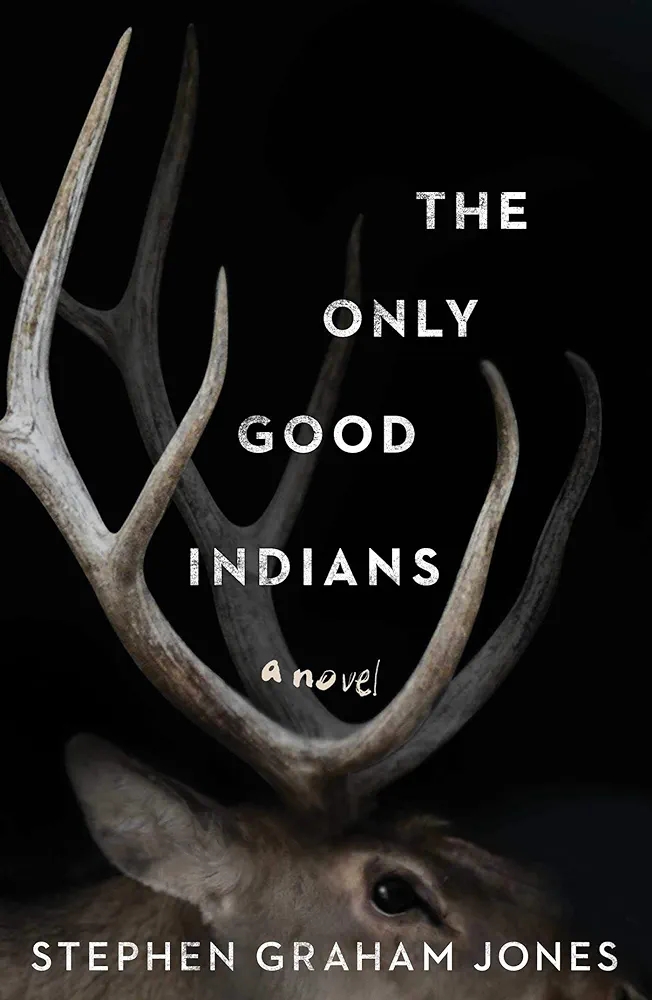
I had heard a lot of great things about Stephen Graham Jones, a native American horror writer who has taken the genre by storm. I’ve been wanting to read him for quite some time, and so I decided to listen to The Only Good Indians on my drive to Panama City Beach and back this past weekend.
And it did not disappoint.
The headline for Richard Boss Rivs would be INDIAN MAN KILLED IN DISPUTE OUTSIDE BAR.
That’s one way to say it.
Ricky had hired on with a drilling crew over in North Dakota. Because he was the only Indian, he was Chief. Because he was new and probably temporary, he was always the one being sent down to guide the chain. Each time he came back with all his fingers he would flash thumbs-up all around the platform to show how he was lucky, how none of this was ever going to touch him.
Ricky Boss Ribs.
He’d split from the reservation all at once, when his little brother Cheeto had overdosed in someone’s living room, the television, Ricky was told, tuned to that camera thay just looks down on the IGA parking lot all the time. That was the part Ricky couldn’t keep cycling through his head: that’s the channel only the serious-old of the elders watched. It was just a running reminder of how shit the reservation was, how boring, how nothing. And his little brother didn’t even watch normal television much, couldn’t sit still for it, would have been reading comic books if anything.
First of all, I want to address what a terrific writer Jones is–although this is hardly ground-breaking news. For me, the strongest part of the story was the authorial voice and the tone set by it. I can’t say whether something like this–like anything written by people outside of my own experience–is authentic or not, but it was completely believable. I truly got a sense of what it is like to be a Native-American living in North America in the present day; the mind-numbing poverty and dealing with the incessant racism from white people. His characters were three-dimensional and fully realized; the dialogue sounded right, the rhythm of the words he used to create a melody of syllables and sounds sang from the page. I felt like I was there in every scene, in the room with the characters and bearing mute witness to what they were experiencing, and what they were going through and experiencing, with the fully-realized life experiences coming into play with every word they said and every action, every thought, every movement. The deceptive simplicity of the prose was powerful and resonated; it sounded like poetry coming through my speakers.
I also found myself really interested in basketball–which is very unusual.
I also realized, as I was listening, spellbound behind the wheel of my car, that there was also commonality of human experience here; the poverty, the worries about money and the future and the bleakness of the helpless acceptance of despair–this is definitely a horror novel, but it’s also a stinging indictment of poverty and societal inaction in the face of it; their resigned acceptance of their fate mirrors the more callous resignation most people feel when thinking about poverty in these United States–“nothing I can do about it.”
While telling a strong story that is almost impossible to step away from, Jones also educates us cleverly with a sentence here and there–I’d never thought about where the term buck naked came from, and there are so many of these sprinkled throughout the book; terms and phrases that white people use without a second thought but come from a long history of racism and prejudice; the title itself is taken from the horrific saying “the only good Indian is a dead Indian.” I myself am always careful not to refer to the native population by the colonizing name assigned to them by the lost Spaniards looking for spices; it was jarring hearing it over and over again, and made me a bit uncomfortable–but I suspect that was the entire point. (I think the worst was when the junior high school basketball prodigy Denora was thinking about playing a game against white schools, and the horrible signs and things their students yelled at her and her teammates–the one that was particularly offensive was Massacre the Indians!, which reminded of the trash Chicago Bears fans holding up signs when playing the Saints in the NFC title game after the 2006 season: “FINISH WHAT KATRINA STARTED!”, which turned me from someone with a nostalgic affection for the NFL team in the city where I spent most of my childhood into someone who wants them to lose every fucking game they play.
Massacre the Indians.
There’s no doubt in my mind reservation kids have to deal with this kind of bullshit all the time, and its embarrassing and infuriating at the same time. The cruelty is always the point.
But I digress.
I really enjoyed this book. I felt like reading it somehow helped me reach a better understanding of a situation I was already aware of, while being incredibly entertaining at the same time. I cannot state that enough: what a great experience this book was from beginning to end. The tension and suspense were ratcheted up with every chapter and sentence; the monster was terrifying and horrifyingly relentless, and the characters were all strongly rendered in both their strengths and their flaws.
When I finished the book, I couldn’t help but wonder if this book, and others by Jones, were being pulled from library shelves because reading them might make white people feel bad. The book made me remember again why controlling access to what anyone can read is about control more than anything; we can’t let people read diverse points of view or see opposing opinion is the underlying message of the banners, and quite frankly, grow a fucking pair already! Seriously, who is calling who a snowflake?
Read this book! You can thank me later. And now I want to read more of Jones’ work.
*Centennial may not have been historically accurate in its depiction of the Arapahoe tribe, but I feel that it showed how the US government broke promise after promise to them, and the depiction of their systemic extermination was not done in a “manifest destiny” way. The ugliness of the US and its racism was right there on full display.
This morning I get to go pick up my temporary teeth before heading into the office. It’s no longer a clinic day; I’d be covering Mondays for a colleague who’d had major surgery and he’s back now. I am also a little tired this morning. I slept really well last night but could have slept much longer, the physical and mental hangover from having driven so much this weekend. I left for Panama City Beach during half-time of the LSU-Missouri game; and given how LSU had been playing, you can imagine my delight when I checked the score when I stopped for gas to see that the Tigers had rallied to beat the other Tigers 49-39. The Saints destroyed the Patriots 34-0 while I was driving back yesterday; again, imagine my delight when I checked the score when I stopped for gas past Mobile (I try not to ever spend money in Mississippi, for any number of reasons. The same with Tennessee). So my teams apparently do better when I’m not able to watch, which is something I’ve suspected for quite some time.
This is a week of medical stuff–the teeth this morning, a heart sonogram on Wednesday morning, and something else entirely on Friday that I can’t think of. The MRI of my shoulder, I think? There are so many appointments and things going on while I am getting ready for this surgery that I am not even entirely sure I can keep track of them all–the anxiety roiling up from the depths again–but I am pretty sure I put everything on my calendar and I am resisting the urge to give into the anxiety and better check compulsively numerous timesto be sure stage. I know I wrote everything down on my calendar; I will double-check that tonight when I get home from work, and that will be the end of it as far as that kind of anxiety and stress and pressure are concerned. I think I am doing a great job of controlling the anxiety by recognizing it and refusing to allow it to take control, but some days are definitely harder than others. I only got irritated several times on the drives this weekend–and I would say that those situations would have irritated any driver, even those without anxiety as a mental disorder.
I did get to listen to The Only Good Indians by Stephen Graham Jones, which I greatly enjoyed (more on that later) and Saturday before I left I read some more of Final Girls, which is starting to get rolling now–although it occurred to me in the car that I should have listened to the rest of Final Girls in the car and thus been able to move on to something else to read this week, but ah well, sometimes that’s how life goes. I was very tired when I got back to New Orleans last night–the drive was very smooth, with a few exceptions of stupidity along the way (I’m looking at you, Mobile tunnel) but I didn’t sleep great Saturday night after that drive, and so that’s why I’m dragging and a little the worse for lack of sleep. I also have a bit of a sore spot in my neck from sleeping wrong at some point over the last two nights, my guess being it was last night’s, combined with poor posture while driving. Tug also missed me; he spent most of last evening sleeping in my lap, but once he woke up he turned back into the terror Paul had described when I got home–knocking everything off every surface he climbed up onto; attacking my feet; chasing pens around the room–definitely some big kitten energy going on. Yeah, it’s a bit annoying, but at the same time it means he’s acclimated and knows he’s at home enough to feel safe to play and have fun and be a kitten, which is great. Maybe not when he’s walking all over my keyboard confidently like there’s nothing there, or when he’s trying to get whatever I am eating, but it’s great that he’s so comfortable in the house that he can be himself, and that’s always a good thing.
And now I get to spend the day trying to acclimate back to my every day existence, which isn’t always easy. Going away always is unsettling for me, and then I have to figure out how where I am at and what all else I have to get done and do and plan and so forth; which is another reason why having a to-do list is so vitally important; it helps me to re-acclimate to my reality after a break /interruption. I also can’t remember where I am with things at the office, either. Yay? But I need to get to the office and get some things done today–and as my coffee is kicking in and clearing the cobwebs out of my dusty brain, I am starting to feel more motivated than I was before I left; I think maybe knowing that the weekend was causing me some anxiety subconsciously which undermined (self-sabotaged) my attempts last week to get things handled and done and under control.
One of the lovely things about driving long trips like this weekend is that my mind wanders and I think about things; the ability to keep up with an audiobook while my mind sifts through problems and unties the Gordian knots of confusion and self-delusion in my mind has been truly wonderful. While in the car this weekend I was thinking back to what all I had gotten done and accomplished since the start of the pandemic disruption (and yes, I know I am not unique and it has happened to everyone), the general sense of “I am not getting anything done” and “when I am writing I’m not enjoying it” which has been unsettling me and keeping me off-balance since March 2020 (hard to believe it’s been almost four years, isn’t it?), but on the other hand, professionally the pandemic was actually very good to me. I got a substantial raise and promotion at my day job; I got nominated for a shit ton of awards over the last couple of years, and sure, I think there was a significant gap in publishing–from Royal Street Reveillon in the fall of 2018 until Bury Me in Shadows was about a three year gap now, wasn’t it? That in and of itself is the longest gap in my publishing career, but then I came on like gangbusters in 2022 with #shedeservedit, A Streetcar Named Murder, and Land of 10000 Thrills (Bouchercon anthology), and of course have two back-to-back releases this fall with Mississippi River Mischief and Death Drop. I was also publishing short stories during the 2018-2021 interregnum, and I was working on a multitude of other writing projects during that time in addition to the books that wound up being released in fits and spurts since 2021; I still find it hard to believe I went that long between books–maybe I’m forgetting something? But I don’t think I actually am; I am terrible about remembering everything I’ve written and published, and always forget things. But at first I was disappointed in myself to think I’d gone that long between books before silencing that negativity, and then I nipped that in the bud. There’s no disgrace in admitting that the pandemic knocked me for a loop and off-balance; I’m not the only person this happened to, and it takes a massive life disruption to slow down my writing–which is pretty impressive.
It’s hard to stay positive as it goes against my brain’s wiring, but I am getting better.
And on that note, I am heading into the spice mines. May your Monday be just as lovely as you are, Constant Reader, and I’ll probably be back later.
Monday and back to the office with me today. Weekends are simply not long enough, ever, and should always be at least three days, methinks. Yesterday I witnessed the dreadful Saints performance, and it was not a good weekend for Louisiana football fans; the only glimmer of light locally was Tulane’s victory. I finished reading Shawn’s book, which was marvelous, and then picked out my first Halloween Horror read: Riley Sager’s Final Girls, and it’s long past time I’ve read this book. It’s rather embarrassing that I’ve not yet gotten to it. I also downloaded the audiobook of The Only Good Indians by Stephen Graham Jones for this weekend’s drive to the Redneck Riviera, and read another Alfred Hitchcock Presents short story, from Stories for Late at Night, “The Ash Tree” by M. R. James, which was delightfully creepy and reminded me of Daphne du Maurier’s “The Apple Tree”–and that in turn made me think about creepy trees as a trope in horror, and thought perhaps I should give the trope a whirl at some point. We watched the Scouts Honor: The Secret Files of the Boy Scouts documentary–which was just as creepy and awful and horrific as I thought it would be, as well as yet another pointed reminder of how straight people have failed to protect children since, oh like forever, and then cover it up as much as possible but then have the nerve to accuse queer people of pedophilia and grooming?
Sure, Jan.
We also watched the Jennifer Garner Apple Plus series The Last Thing He Said, which wasn’t great but wasn’t terrible, either; it just kind of evolved and wasn’t very thriller-ish or suspenseful. I also predicted one of the bigger plot twists in the first episode long before it played out in the show, but it was well done and an interesting story; but it wasn’t very thrilling or suspenseful; it never really seemed like there was any danger or stakes. It ws talked about a lot, but never part of the show’s reality? It was interesting enough to hold our interest–although I think I may have approached telling the story in a different manner than they did. It’s an interesting thought, at any rate.
It’s lovely having a kitten in the house, even if it means being more alert and having to get up more regularly because there was a crashing sound from somewhere else inside the apartment–usually followed by a galloping kitten moving at high speed away from the noise and mayhem he caused. He woke me up this morning by knocking my glasses off my nightstand table and then playfully batting them around on the floor, and once I took those away from him he went for the broom. He’s incredibly sweet, though, and I love that he’s so fearless and feels comfortable and at home enough to play. He slept on me for most of the Saints debacle yesterday, through the Boy Scout movie, and then moved back and forth between me and Paul during the Jennifer Garner show.
I also started writing the opening of a short story or a novel or something at any rate while watching the Boy Scouts documentary–part of it and the scandal was in New Orleans–and had an idea for the opening scene for something so I started writing it down; mainly about a college student away from home for the first time who’s obsessed with true crime and wants to be a true crime writer but isn’t sure how to get started chasing her dream other than majoring in Journalism at Liberty State in Liberty Center, Kansas–the town from #shedeservedit, why not reuse it? I don’t know why I started writing this when there are so many other things I should be working on. But that’s also life, you know, when you’re a writer–at least for me, there are always so many other ideas and thoughts and stories banging around in my head that it’s sometimes hard to focus on what I need to get done.
Heavy heaving sigh.
I never did make that to-do list for the week, so perhaps that should be the first thing on the list (I often do this so I can cross something off the list immediately; it’s satisfying and always seems to keep off working on getting the list completed). I also think that once I finish reading the Riley Sager I am going to reread a classic Stephen King that I’ve not revisited in a long time, The Dead Zone, which used to be one of my favorites and is still one that I think about a lot–especially during the rise of the former president, who eerily reminded me of the character of Greg Stillson, written thirty or forty years or so before the rise of the reality host/failed real estate mogul. (I’d considered rereading it in the wake of the 2016 election, but didn’t have the strength; I think now would be a good time.) I liked the opening of the Sager; which was encouraging. I hope to be able to get several books read this month…I think my reading is going to start picking up again, hallelujah. I think having a cat sleeping my lap while I read was what I was missing, and why it was hard for me to read since we lost Scooter. (I promise not to turn this into a Tug stan blog, seriously.) Today is going to be his first day left at home on his own for a while; we’ll see how he handles that.
And on that note, I am heading into the spice mines. Have a lovely Monday, Constant Reader; I’m sure I’ll be around again later on.
It’s hard to believe that it’s October already; but this year has also seemed to last forever, which is bizarre and weird. I slept really well last night, and had a pretty relaxing day overall yesterday. I ran my errands yesterday morning and got them all done, which was lovely and then came home to watch some football games. It was an odd day, and my primary takeaways were that LSU needs a new defensive coordinator because they’re defense is getting worse rather than better; Georgia looked surprisingly vulnerable; Florida looked terrible; and I think Alabama–even in an off year–is going to wind up winning the conference because they’re the only team with an elite defense. Paul went to the gym during the Auburn-Georgia game, and Tug slept on me the entire time he was gone, which was lovely and relaxing. I’ve missed that. There really is nothing quite as calming as having a cat sleeping on you.
It’s so lovely having a cat in the house again, and I’d forgotten what it was like to have a kitten. Scooter was supposedly two years old when we got him, but Skittle was a six month old kitten. Tug isn’t quite five (still not sure about that name) months yet, but he’s definitely got BIG KITTEN energy, He’s absolutely fearless and not shy at all. It’s also nice hearing his paws on the stairs as he comes down them. I’ve missed the sound of a cat coming down the steps. He’s not heavy enough for me to hear him jump down from the bed yet, but I’m sure he’s going to grow into a nice size. It’s always fun getting to know your new pet’s personality–and like I said, he can make a toy out of anything. Scooter also wasn’t the kind of cat who would knock things off surfaces just to see what happens–Tug appears to be both the kind who will accidentally knock things off but also will do it on purpose. He also wanted my ice cream yesterday! Like I said, he’s completely fearless–will explore anywhere, and he is also fascinated by the windows. He also can jump pretty high, and I think we don’t need to worry about bugs in the house anymore.
I’m trying out cacao instead of coffee again this morning; it doesn’t have the bitter bite of coffee that I really like, but the real test of cacao will be tomorrow morning. I have been having one cup before switching to coffee–and yes, I do wonder if it’s the caffeine addiction that makes me switch over after the one cup–but tomorrow I think I’ll have a cup of coffee when I wake up and then take cacao in my go cup for the office. I don’t think I will ever give up coffee entirely, but I think I need to bring down my dependence on it, and I should probably never have more than three cups a day anyway (the most I have when I go into the office; I drink more when i am home).
Today I have a lot to get done. I was lazy yesterday after the errands and just watched games all day. The Saints play at noon today, but I doubt I’ll have the game on today. My kitchen/work space is a disaster area, and there’s things to do–dishwasher to unload, more dishes to wash, things to file and put away–and I’d like to do some writing today if i can. I didn’t finish Shawn’s book yesterday as I’d planned, so I will finish it this morning and then move on to reading horror for the month for Halloween and do some writing this afternoon. I want to get some of these short stories edited and/or finished, and there’s some other writing clean-up that needs to be done. I also need to make a to-do list. So, I am guessing the cacao certainly wakes up my mind in the mornings, as mine is now racing. I feel a little asleep still physically, if that makes any sense, so I’ve moved on to coffee and there’s that bitter bite I like. But I am definitely going to be productive today, and the first step of that is to finish Shawn’s book. After that I’ll come back into the kitchen and clean up in here–as well as write about Shawn’s book–and do some organizing before some writing. I have so many projects in progress right now that I need to be better organized, and definitely better motivated. I know the organization thing is a by-product of the anxiety (if I stay organized I won’t get anxious worrying about things I’m forgetting to do; if I stay motivated I won’t get stressed by deadlines, and on and on and on), but coping mechanisms work and exist because they work; and anything that brings down my anxiety is okay with me.
And on that note, Shawn’s book is calling to me, and so it’s off to my easy chair with me. I’ll probably check in with you again later. And if not, have a great day, Constant Reader!
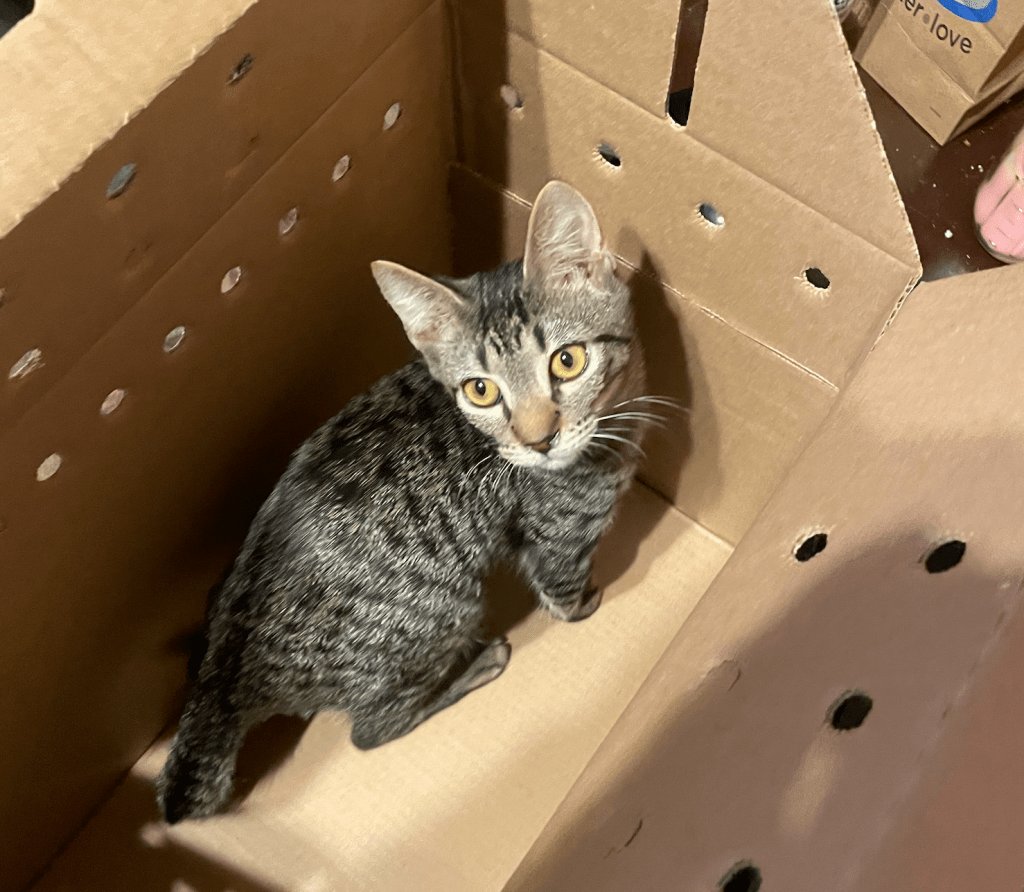
So, we brought this little fella home yesterday from the SPCA.
His name, already given to him when we picked him, is Rum-Tum-Tugger (I announced it incorrectly on social media yesterday with a typo calling him Tigger by mistake) and that will probably change as we get to know him better; he doesn’t know the name at all. He’s almost five months old, and is completely fearless. I wanted to take all the cats home (and the dogs, too; it’s always so sad to me to see their hopeful faces and their wagging tails, thinking you might be their rescuer. All the cats we met were sweet, some a little shy (Sing out Louise!) which made me sad because they seemed to put some effort into making friends, but are apparently used to not being picked they gave up trying to win us over once we walked away from them. Tug was having none of that, and let us know he was the only cat for us. He has the cutest little meow, and there was no shyness at all once we got him home; he fearlessly explored the entire apartment, made cuddle time as well as let us both know, with head butts and purrs and exposed belly and making biscuits, that he was happy to have his Forever Home. I woke up this morning to him purring and curled up next to me on my pillow, and last night he followed Paul up to bed–and then came back down looking for me the way Scooter used to–hey, it’s bed time! He’s a kitten so he’s very playful–he made toys out of wrappers and dust and whatever he could find on the floor–he chased my highlighter around on the floor for a good half an hour or so.
Obviously, he needs some toys. Scooter didn’t care about toys, but clearly our very playful house tiger kitten needs things to play with.
I slept really well last night, despite going to bed so late–we finished off Sex Education last night. I don’t know if that was the finale for the show or just for the season, but it seemed like the perfect way to end the show if that was the intent. The season was a bit uneven, but they all learned important lessons and fractured families and friendships began healing. I also was incredibly satisfied with how the Otis/Maeve relationship was wrapped up. It seems to me that another season would undo this season, if that makes sense, and another one would feel kind of forced. The actors are getting too old for their roles, if that makes sense (much the same as the original cast of Elité), and I liked the note the season ended on.
This morning I am trying cacao instead of coffee, and just brewed my first ever cup of it. Here’s hoping it tastes as good as it smells? It’s unsweetened chocolate, really; and by itself, it’s kind of bland. But adding vanilla and sweet-n-low makes it taste more like hot chocolate. I’m trying this out as a coffee alternative; it’s supposed to give you a coffee-like energy but without caffeine, and without the caffeine there’s no crash later. I kind of like it. I don’t know that it’ll replace coffee in my daily routine, but it’s good and we’ll see how the effects play out with me. I am going to drop beads off today for the disabled kids, and books to the library sale but don’t really feel like I need to make a grocery run. I think we have everything we need, so it can wait until one night after work on my way home. I also need to get gas and air up my car tires, now that the weather has gotten milder. I’ll be taking it in for an oil change and a tire rotation this coming Friday.
LSU plays at Mississippi tonight; it’s the Magnolia Bowl rivalry game so they always, like Arkansas, play like world-beaters when they play LSU. They can make their season by beating LSU, and after last week I am not so confident the Tigers will make it out of Oxford with a win–they also got beat by Alabama last week for the seventh or eighth year in a row, so they also need the win to stay relevant in the division and the conference; it would take a miracle for them to win the West with two losses. (I refuse to call the University of Mississippi by its commonly used nickname for any number of reasons, not the least of which is that it’s a callback to plantation days. That school has been problematic for decades, but at least they no longer wave Confederate treason flags at games; how must seeing that have felt to visiting Black players? Obviously, their fans didn’t give a shit, like how Alabama’s student section was chanting homophobic and racist slurs at the Texas players several weeks ago–nothing says welcome to the SEC like homophobia and racism.) I’m not sure what other games are on today, but I think for me today I am going to clean up around the house some and finish reading Shawn’s book so I can move on to Halloween Horror Month. I feel like I slept well but have low energy this morning, and I am just going to roll with the low energy and rest and relax for the majority of the day so I can get some writing done tomorrow. Next weekend I’ll be in Panama City Beach for the night visiting Dad and my aunts and uncles, so no writing will get done that weekend. I think I will try to work on Jackson Square Jazz during the games today, too.
So, on that note i am going to head into the spice mines. The kitchen is a disaster area, as always, and I should have spent some time on it last night, but that’s what Saturday morning is for; catching up on things. Have a lovely Saturday, Constant Reader, and I’ll be back at some point.






 Queer and Loathing in America