Mabel Normand

Saturday in the Lost Apartment and all is well–at least so far.

I ran errands last night on my way home from work so I don’t have to go anywhere or do anything today involving leaving the house, and I think I’ll go ahead and make groceries on-line today to pick up tomorrow; we don’t really need a lot of stuff but it must be done. There’s a part of me that feels incredibly lazy doing this for some reason–perhaps the more I do it, the less guilt I’ll feel about having someone else make my groceries for me. I guess that’s really what it is; getting used to a new service. I mean, even the Fresh Market will do this, too–but one of the things I like about the Fresh Market is, well, everything seems fresher than at the other groceries, and picking out fruit and vegetables isn’t something I am willing to trust to another person just yet. I like to see the fresh stuff I am buying and pick it (although I am still regretting not stopping at that roadside stand when I was on the North Shore last weekend and picking up some Creole tomatoes fresh from the field, especially since I’ve not seen any in stores since then).

It rained again most of the day, and of course we’re still under a flood warning through sometime tonight. There are two systems out there I’ve yet to check but probably will momentarily. It’s that time of year when we seem to be getting hit with a higher degree of frequency since Katrina–just before Labor Day–and I know there have been at least three more storms around this time that I can think of right off the top of my head (2008, 2012, and last year for sure). Well, I took a look and yes, there is still a system in the Caribbean near the Yucatan, and there’s another one developing in the eastern Atlantic (meaning there are now two out there) but at least we’re okay for now. Labor Day weekend, on the other hand, could be something else entirely. Last year’s Ida was more of a Labor Day thing, if I am remembering correctly, or at least its impact and aftermath lasted through Labor Day. (2021 is still kind of blurry for me.)

The sun is shining right now, and I rested really well last night. A good night’s sleep is always a pleasure on the weekends, of course, and I even allowed myself the indulgence of sleeping in a little later. I have some laundry to finish and a sink to clear in the kitchen, and some other casual cleaning up and household maintenance to take care of this morning before I dive back into the wonderful world of work. I did get Chapter One rewritten Thursday–still leaves something to be desired, but isn’t completely the shitty mess it was before–and I did get started revising Chapter Two, which is going to be trickier–and then I have to springboard into Chapter Three, which I still have to figure out. I also want to do some work on some other things I am working on (as always) and I want to dedicate some time to reading Gabino’s marvelous novel The Devil Takes You Home today and tomorrow. I’ve actually been better these last couple of weeks at not being completely exhausted when I get home, which has also enabled me to try, at some level, to keep up with the housework so I don’t have to spend the entire day today cleaning and organizing and filing–there will be some of that, of course, and I also have to spend some time revisiting older Scotty books; maybe one of the things I could do today is start working on the Scotty Bible? That would help me remember everything that’s going on in the family and refresh my brain about some other things (did I ever give Rain’s doctor husband a name, for one really strong example of bad memory) and of course it would never hurt to have all of that assembled in one place that is easily accessible. Heavy sigh.

We also are watching Bad Sisters on Apple TV, and am really enjoying it. It’s rather dark; it’s about five extremely close Irish sisters who lost their parents young and were all raised by the oldest sister, who now lives in the family home, is single and apparently unable to have children. One of the sisters is married to an emotionally abusive asshole named John Paul who apparently takes delight in torturing and being cruel not only to his wife but to her sisters. One decides he needs to die, and recruits the oldest to help her kill him…and then each episode details how another sister got involved in the plan. The show opens with his funeral, so we know they succeed at some point, but the story alternates between the past (the sisters slowly coming together to decide to kill The Prick, which is what they all call him) and the team of brothers who work for the insurance company who have to pay out the death claim. The brothers (half-brothers, actually; one is played by the same hot actor who played the escort Emma Thompson hires for sex in her most recent film, which we enjoyed and I can’t recall the name of now) don’t really get along either. The oldest is convinced John Paul was murdered, but the younger brother is really attracted to the youngest sister and they are starting to develop a romantic relationship. It’s quite cleverly written and plotted–and even before I was completely sold on the show, I realized I wanted to keep watching because I hated John Paul so much I wanted to see how they decided to kill him and how. But well into the second episode I had to confess to being hooked. I loved the dueling timelines (I have always been a sucker for stories that are told this way, both the past and the present, flashing back and forth; I’ve always wanted to do one that way, but it seems really hard. A good example of a crime novel using this technique is Alison Gaylin’s What Remains of Me), the writing is sharp, and the acting top notch. It also takes place in Ireland, with gorgeous cinematography. I’ll keep you posted as we continue to watch.

We also watched the latest episode of Five Days at Memorial, which was truly painful to watch. The first episodes didn’t really get to me, but episode five–the fifth day, when the decision was made that everyone had to be out of the hospital and whoever couldn’t get out would be left behind regardless of the consequences, was absolutely wrenching in a way the previous episodes had not been. My Katrina scars are as nothing compared to what a lot of other people experienced: I survived, I was able to get out before the storm arrived, and my scars, while still from loss, are from bearing witness by watching television and witnessing what I saw when I finally came home in October, as well as living in a nearly-empty, 90% destroyed city after my return. (Last year, when we trapped here as Ida came in, was bad enough; I cannot imagine how horrible it would have been to have been stuck here praying for someone to come rescue us. At least we were able, and had the means, to finally get out when we ran out of food and water.)

I’ve also found myself thinking a lot about my Katrina writing these last couple of days–my essay “I Haven’t Stopped Dancing Yet”; my short stories “Disaster Relief” and “Annunciation Shotgun” and “Survivor’s Guilt”; and of course, Murder in the Rue Chartres. I was thinking about this book last night–partly because of watching Five Days at Memorial, because it reminded me that Rue Chartres wasn’t supposed to be the third Chanse book at all. The third Chanse book was supposed to be something else altogether, but obviously in the wake of Hurricane Katrina my plans for both the Chanse and Scotty series had to dramatically shift and change. Seventeen years ago was a Saturday, the Saturday we nervously watched the storm, having now crossed south Florida and entered the Gulf, intensifying and growing and taking aim directly at New Orleans. We decided to not leave just yet; every other time a hurricane had threatened the city after we moved here we watched and waited patiently, and were rewarded with the storm turning east before coming ashore and the city avoiding a direct hit. We never lost phone, cable or power during those other instances–we were nervous, still reassuring ourselves of the turn to the east before landfall but the reality that we would have to leave was becoming more and more real. It’s odd that this year the dates all on the same day they fell back in 2005, so it’s a reflective anniversary that mirrors the actual weekend it happened. I’m debating whether I want to watch the new documentary on HBO MAX, Katrina Babies–that might be definitely too much for me to handle. (I’m still surprised that we’re able to–and were willing to–watch Five Days at Memorial, to be honest.)

At least I know Paul won’t be shaking me awake tomorrow morning at eight saying, Honey, we need to go.

OH! I didn’t tell you. Yesterday my other glasses I ordered from Zenni arrived–the red frames and the purple frames, and I absolutely love them. I don’t think I need to order any more pairs, to be honest, but it’s so cool to have them! And to have options now. I never ever thought of glasses as anything other than utilitarian, to be honest; I needed them to work and that was all I cared about, and I also thought they were too expensive to treat as part of a “look” or to be more style conscious…but Zenni is so inexpensive; the three pairs I got are all cheaper than the pair I got with my eye exam, and using my insurance. Had I saved my insurance for use on Zenni, they would have been even cheaper.

Life. CHANGED.

And on that note, I am going to make some more coffee and dive back into the spice mines. Have a lovely Saturday, Constant Reader.

Mama’s Pearl

I’ve never much cared for the term domestic suspense, because, as someone whose mind works primarily in playing around with words, it has always seemed to me that the inverse would be international suspense, which, to me, sounds like downplaying the work of women and its importance, since books primarily given this”domestic suspense” label generally are women. (Although one can make an argument that men cannot, or do not, write domestic suspense because they traditionally are more involved outside the home and family? Interesting premise there…)

I know there has been debate over the years about the differences between crime fiction written by men or by women, and that women’s crime fiction isn’t always taken quite as seriously as that written by men. I’ve tried puzzling this out, and have made my own brain hurt trying to come up with reasons for why this injustice has always been perpetrated on women crime writers; it’s almost as though the ideation is that women’s fiction is somehow more internal and more contained and almost smaller; the themes of their work being about relationships and family rather than big universal save-the-world themes in male-written fiction. That might have a small kernel of truth to it, as a starting point for a much broader discussion that should be held by those with bigger brains and more knowledge of our genre than my limited knowledge and experience; I just know that while I can occasionally enjoy one of those BIG style books about saving the world with lots of action and gunplay and danger, I prefer as a general rule the stories where the crime story comes from the fracturing of relationships and the emotional damage inflicted by personal cruelty and thoughtlessness from those we know intimately.

Alison Gaylin has, in the slightly more than a decade and a half since she published her first book, Hide Your Eyes (which is absolutely delightful), has become one of the best in what I suppose would be classified as “domestic suspense.” Her If I Die Tonight won an Edgar Award; she was nominated three or four times before, and her What Remains of Me remains one of my favorite reads of the last decade. She writes about mothers and their children; how families can disintegrate in the face of criminal tragedy, or how the scars from a long ago tragedy can continue to break open and bleed in the present.

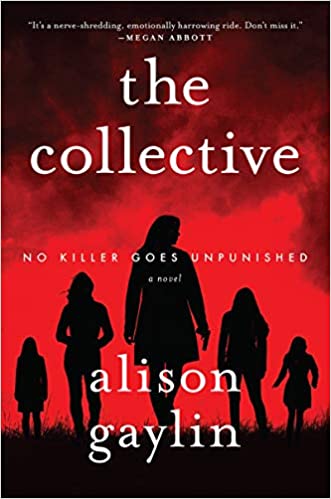
But with her latest, The Collective, she has somehow managed to kick it up into another gear.

The ceremony starts in twenty minutes. I’m climbing out of the subway tunnel, a thousand unwanted smells in my hair. I’m not used to being around this many people–the stink of them, the heat, the noise. The noise especially. I just shared a subway car with a group of high school girls, and their laughter still swirls in my ears. I probably should have driven, but it’s been hard for me to drive long distances since Emily’s death. My thoughts start spinning along with the wheels, memories of road trips, of carpools and radio sing-alongs and petty arguments and before I know it, I am aiming straight for the divider.

The venue is just three blocks away. I walk slowly, slower than everyone around me, trying to catch my breath, to still my thoughts, to think of nothing but the sidewalk and the cold night air and where I need to be.

From half a block away, I recognize the Brayburn Club. I know it from the photo I found online. It’s located in a Gramercy Park brownstone with leaded windows and wide, majestic steps. It’s a week past New Year’s. but the Brayburn Club is still decorated for the holiday season, a lush wreath filling the front door, icicle lights dripping from the window sills like fresh beads of sweat.

I pass a group of young women smoking last-minute cigarettes–friends of his, maybe?–and I think back to the time I caught Emily smoking weed with her friend Fiona. She must have been fourteen, always a little old for her years and bored of our small Hudson Valley town. I got so angry with her. Grounded her for two months. Her dad thought it excessive. We smoked pot when we were that age, Matt said, missing the point. Yes, we smoked pot when we were fourteen, but Emily wasn’t us. She was better than us.

I won’t do it again, Mom. I promise. Her voice in my head is as clear an real as the shrieking laughter of the girls on the train. I want to lose myself in it and never come back.

It isn’t until I’m at the top of the stairs, after I’ve handed the boy at the door my invitation and I’m in line for the coat check that Emily’s voice quiets and I remember where I am and why I’m here.

The book focuses on a web designed in the Hudson valley named Camille whose life–and family–has been disrupted by a horrible tragedy; the death of her daughter Emily. Her overwhelming and all-encompassing grief has ended her marriage (her ex-husband has moved far away and remarried; finding solace in alternative spirituality), and made her friends very uncomfortable to be around her so they slowly have dropped away…leaving Camille alone with her anger, her bitterness, and her memories. Unable to handle her grief, she focuses on the boy responsible for Emily’s death–who has gone on to academic success and great popularity at his college–with the end result that she crashes an award ceremony for him, creates a scene, and winds up in jail. After she gets out, a woman who was also present at the ceremony and was sympathetic to her presses a business card with the word Niobe on it (not a spoiler here–anyone who knows Greek mythology will recognize the name of the proud woman with twelve children who dared to compare herself favorably to Leto, mother of Apollo and Artemis; the twin gods who then slay Niobe’s children in front of her). Camille’s actions have gone viral–someone recorded the scene she created at the ceremony, and not the good kind of viral where everyone is outraged at her suffering and goes after the young man who essentially killed her daughter.

Soon, she is lured into the dark web world of Niobe, a collective of women who are all grieving mothers, their children all killed through the misadventures or deliberate acts of others who then got away with it. The collective all work together to make sure that justice–vengeance–is done; it’s actually very clever how it all comes together (no spoilers here) but Camille is assigned tasks to do. She has no idea why, or what they are for, or how they all act in concert with simple chores or errands done by any number of other women, but all together the end result is vengeance.

Or justice, depending on your point of view.

But the further Camille ventures into this exhilarating, if questionable, world, the more questions arise in her head: is this actually justice? The other women she comes into contact with–who can she ask questions of, who can she trust? And of course, the first rule of the Collective is that you don’t ask questions or talk about the Collective…

Camille is a deeply flawed woman, and yet Gaylin taps into the character so deeply that even as you think to yourself, oh no girl don’t do that this will not end well, the reader can also connect with the unsurmountable grief she feels; the wonderful feeling of doing something, even if it’s not legal or moral–there really is nothing worse than that helpless feeling–and you can’t help but root for her as she gets more and more deeply involved…and the suspense! Gaylin is a master of building suspense to the point you cannot stop reading–and resent even having to stop for a bathroom break.

I do recommend this very highly. It’s exceptional, and a master of the form firing on all cylinders.

Rapture

Wednesday and pay the bills day; which hasn’t been depressing in a while but I suspect will be by the time I am finished with this always odious chore. After a sleepless night on Monday, last night’s sleep was much better. I was horribly tired all day yesterday–the combo of no sleep and the workout Monday night; tonight I will be heading back to the gym again after work–and as such did no writing last night. I did write yesterday–in my head; I finally came up with the perfect concept for a story idea I’ve been toying with for quite some time, “Murder on the Acela Express”, with an assist from a very good friend, so I did scribble that down and made some notes in my journal. I also had to proof the final draft of this year’s Edgar annual, which also took up some time Monday evening and on breaks at work, so it’s not like I have been slacking this week. But I really want to get back to “Festival of the Redeemer,” and at some point I want to look over “The Sound of Snow Falling” and see what to make of it; I have figured out the story at last–I knew who the characters were, the set-up, and the setting; I just didn’t now how to write the crime and end it, which I do know now.

So, progress of a sort, right?

There was also exciting news at the day job this week–my position has been funded again by the CDC for another five years, which will actually take me all the way to retirement. While it was always unlikely that the funding would ever be pulled with the concomitant loss of my job, every time the grant is up for renewal it always rather hovers in the back of my mind like a slightly sore tooth you can’t help but worry with your tongue even though it hurts. I also got a raise (the entire staff did), which was a pleasant surprise, and we were also given two extra vacation days, with the agency closing down on a Friday and Monday in August to give us all a long weekend–and it’s the weekend before I turn sixty; my birthday will also be on a Friday this year, which is generally a work-at-home day for me (if that still holds after we go back to full operations again) so I can stay home, watch movies, and make condom packs all day, which will be kind of nice. And then Bouchercon is the very next weekend, and then the next weekend is Labor Day and Southern Decadence–which I am not entirely sure is going to happen, or what is going to go on with that at all. And my car will be paid off come January, which will be even more lovely. So there are things to look forward to, certainly; and I am getting a little bit excited. I generally don’t look too far ahead–there’s always so much to do to keep me occupied I don’t think about the future much–but maybe I need to start doing that a bit more; although there is something to the idea/notion that looking ahead is sort of wishing your life away, which is why I try not to do that unless of course a deadline of some sort is involved.

Although I seem to tend to do that a lot every week by looking forward to the weekend and wishing it would arrive faster.

The summer humidity has returned after all the rain of May; this morning my windows are covered in condensation as the sun is rising, and I feel very rested and alert this morning, which is lovely. I did a load of laundry last night, which I need to fold before getting ready to head into the office this morning; I suspect I will be very tired tonight simply from working, stopping at the grocery on the way home, and then going to the gym–plus we have the last episode of season one of Blood on Acorn to watch, and another episode of Cruel Summer should be loaded on Hulu–the show is surprisingly compelling, and watching it unfold over three different timelines, each one a year apart but on the same day–is a story device I’m really liking a lot more than I thought I would. I know it can be done in a novel–Alison Gaylin’s What Remains of Me did a dual timeline, and Laura Lippman’s After I’m Gone bounced around in time like that, and I think it did have three time periods–and it’s something I think I would like to try at some point in the future. I think part of the reason I’ve been in the doldrums about my writing is because I’ve not been pushing myself to try new things, to experiment and play with the form of story-telling, and I’ve been feeling stale….which isn’t a good place to be when you fancy yourself a writer.

And I think that has been a lot of the malaise I’ve been feeling lately–the last few years with my writing, really–that sense of writing by rote, on automatic; and not pushing myself and trying new things. I will say that the short story writing has been really terrific in that regard, getting to explore themes and ideas and form in a shorter medium (I have published several short stories recently that, ironically, have been reviewed with the note: should have been longer, like a novella–which is always the problem with writing short stories for me; I always feel like there’s more to the story, and apparently that is indeed the case with some of them; but I am trying not to turn short story ideas into longer forms of fiction anymore…which is also kind of why i am experimenting with the novella form). I will say I enjoyed the hell out of Royal Street Reveillon because I was really pushing myself by juggling plots and subplots; it also felt more like a Scotty book than the ones previous–mainly because the plots were more simple and linear. I was having a lot of fun writing it–I do remember that–despite the headaches of juggling so much plot and story-lines.

Aaaaaannnnnndddddd….I think I know what the next Scotty is going to be. I am going to start making notes on it today…we’ll see how it goes.

Jambalaya (On the Bayou)

Goodbye Joe, me gotta go, me-oh-my-oh.

Now I want jambalaya.

Yesterday kind of sucked over all. I wasn’t in the least bit sorry to go to bed last night and bid the shitty day adieu. The energy of the day was off from the moment I got up yesterday, and just never got any better than that, sadly. The drive from the office to the grocery store was an endless annoyance of stupid drivers and their senseless, dangerous behavior. The grocery store was full of thoughtless trash who seemed to think they were the only people in the store, and then I almost got hit by another idiot driver who wasn’t watching or paying attention as I took the turn off St. Charles to my street–had I not been paying attention or been five seconds later, I definitely would have been broad-sided. I got home and the house was a disaster area, so bad I couldn’t get organized enough to clean because somehow I’d allowed the kitchen to get so bad that I had both sinks full of dirty dishes, the stove and counter were filthy, and a dishwasher full of clean dishes that I had to put away before I could start doing the rest of the dishes–which turned out to be more than one load. The shrimp creole turned out delicious, though, and when it was finally time to relax and watch some television, when we opened the Netflix app on the television, the third season of Thirteen Reasons Why had dropped. The second season wasn’t very good–and the first had its moments of nonsense–but as we watched the preview, it looked interesting–and of course the cast is all very young and appealing, so we decided to give it a whirl. The third season is, so far, the best of the three, to be honest; I enjoyed the first season, was surprised by its twists and turns, but ultimately the gimmick that tied the first season together–the tapes Hannah left behind after her suicide–was a bit outdated. For one thing, can you even buy blank cassette tapes anymore? Even when the book was originally published, sometime during the second Bush administration, the cassettes were outdated–but it was important to the story that it had to be cassette tapes–digital recordings wouldn’t work for the necessity of the story–and the one big plot hole that was never resolved was how did all the kids have the means to listen to cassette tapes? Clay had to borrow Tony’s ancient Walkman–and let’s be serious, Walkmans didn’t last very long, even when babied. To use cassette tapes in this decade was absurd on its face; why not videotapes, if we’re using obsolete technology?

But the third season is off to a really good start, and it appears that the third season is going to follow the story-telling methodology of the earlier seasons: the present, the recent past, and the distant past as timelines. The first season’s question was why did Hannah kill herself? The second season concerned itself with will Hannah get justice?, and it appears that the third season is going to be a lengthy, lazily unfurling murder mystery, in which the show’s villain has been murdered and of course, everyone in the cast has a motive. It will be interesting to see how they proceed with this, and I’m actually hopeful it will be a better experience than the first two flawed seasons. And yes, I am very well aware that the entire notion that the group of friends are helping out the poor bullied kid who almost became a school shooter last season by taking care of him and watching out for him, while getting him psychiatric help, is a bit much…but then again, teenagers often think they can solve problems that are beyond their scope.

Juggling multiple time-lines is not something I’ve tried in any of my works; Alison Gaylin and Laura Lippman both are masters of the varied timelines–so if you’re looking for a tutorial on how to structure a novel this way I highly recommend Gaylin’s What Remains of Me and Lippman’s After I’m Gone–but it is something I’ve always wanted to try. My novels are always linear–A to B to C–and it might be a fun challenge sometime to do the multiple timeline thing.

While I was cleaning yesterday some ideas for “Never Kiss a Stranger” popped into my head, and I’m hoping I’ll remember them today so i can add them in. I have some errands to run today, and definitely to spend some time with the new Lippman novel–which I may just finish today–and have some other work to do in addition to cleaning and doing some writing. I feel good this morning; awake and lively and functional, so here’s hoping it will last through the day–and going out into the heat and humidity, which I am rather dreading as it is so draining. But I have prescriptions and mail to pick up, groceries to make, and  I’m hoping I’ll be able to make some serious progress on projects. There’s college football games today–of all things, they are calling it “Week Zero”, which is insane–so I may watch the Miami-Florida game tonight before queueing up Thirteen Reasons Why.

I’m not really sure what I’m going to do about dinner today–and I’ll need to make up my mind before heading out to make groceries, you know? I’m also considering going back to taking salads to work for lunch every day–one of the reasons I stopped was because salads would turn brown if I made a big bowl, and it was too much trouble every morning to make a salad, plus it wasn’t helping me lose weight or anything–but now I’m thinking it’s probably not a bad idea to go back to salads again. Of course, I also have the shrimp creole. Maybe I’ll wait and get the salad fixings on my way home from work on Wednesday, which is my new short day.

Decisions, decisions. Maybe I’ll just wait till Labor Day weekend, and start then.

And on that note, I am heading back into the spice mines. Have a lovely day, Constant Reader! See you tomorrow.

224328_112843218799710_100002220986484_121507_5660605_n

If You Leave Me Now

One of my favorite writers when I was a kid was Charlotte Armstrong.

Armstrong was astonishing, really. The first book of hers I read was The Witch’s House. My parents had allowed me to join the Mystery Guild and I, of course, one month failed to do my duty and send the order card back declining that month’s selections. It was probably one of the best mistakes I’d ever made through my instinct for procrastination; I wound up getting a three volume omnibus of Armstrong called The Charlotte Armstrong Reader, and Elephants Can Remember by Agatha Christie. I shelved the Christie and forgot about it until years later–when I’d started reading Christie–but The Witch’s House sounded interesting to me; it had “witch” in the title and I’ve always been drawn to witches, for some reason, and I was at the age when I was still reading my kids’ mystery series but was slowly beginning to transition to books for adults. I was enthralled by The Witch’s House, and read it very quickly, and followed it up by reading the next, Mischief, which I liked even better. But the local library didn’t have any Armstrong novels in stock–which surprises me even more now than it did then–and so I didn’t continue reading Armstrong until years later. Armstrong is one of my favorite writers, even if the books might seem a bit dated today; whenever I read another one of her novels I greatly enjoy it. Armstrong’s books were–I don’t know how to put this, but I am going to give it a try–were dark without darkness; there was always a sense of optimism in her books no matter how dark they got (there’s one particular scene in The Gift Shop that to this day rattles me when I think about it) and I do think she is overdue for a renaissance. It was the combined work of Jeffrey Marks and Sarah Weinman that reminded me of Armstrong and got me to go back and try to finish reading her canon; they also introduced me to Dorothy B. Hughes and Margaret Millar (among others).

The point is, women have always been some of the greatest writers in the crime genre, and societal and cultural sexism have gone a very long way to ensuring that the men who wrote in the same period as these ladies are now lauded as giants of the genre and must-reads, while the women–who won just as many awards and critical laurels and big sales–faded away into obscurity. Mary Higgins Clark was the bridge from these great women of the past to the modern women who write domestic suspense–and really, has there ever been a greater concept for a domestic suspense novel than Where are the Children?–but the second wave of major women crime writers primarily focused on private eye fiction (Sue Grafton, Marcia Muller, and Sara Paretsky).

But what the great Sarah Weinman calls “domestic suspense” never faded away; and nowadays we have some truly terrific women writing truly terrific novels in this subgenre–Lori Rader-Day, Catriona McPherson, Carol Goodman, Wendy Corsi Staub, Alafair Burke, and so many others–and it’s really become one of my absolute favorite subgenres, primarily because of the work these women are doing. It’s extraordinary; I cannot urge you enough to check out these women’s books, Constant Reader.

I could go on and on about these women and domestic suspense forever; but I’ll spare you and cut to the chase.

x510

“It was the girl.” The old man leaned forward, bracing against the worn-out armchair as though he were trying to escape its grasp. “April Cooper. She was the real killer.”

Quentin Garrison watched his face. He was very good at describing people, a skill he used all the time in his true crime podcasts. Later, recording the narration segments with his coproducer Summer Hawkins, Quentin would paint the picture for his listeners–the leathery skin, the white eyebrows wispy as cobwebs, the eyes, cerulean in 1976 but now the color of worn denim, and with so much pain bottled up behind them, as though he were constantly hovering on the brink of tears.

The man was named Reg Sharkey, and on June 20, 1976 , he’d watched his four-year-old daughter Kimmy die instantly of a gunshot wound to the chest–the youngest victim of April Cooper and Gabriel Allen LeRoy, aka the Inland Empire Killers. Two weeks later, his wife, Clara, had decided her own grief was too much to bear and committed suicide, after which Reg Sharkey had apparently given up on caring about anything or anyone.

Quentin said, “Wasn’t it LeRoy who pulled the trigger?”

Alison Gaylin has been nominated for the Edgar four times (Best First for Hide Your Eyes, Best PBO for both Into the Dark and If I Die Tonight, Best Novel for What Remains of Me)  and claimed the prize, just this past week, for If I Die Tonight. Her novels encompass a wide variety of subgenres; her first series featured an amateur sleuth; she then wrote two brilliant crime novels built around the entertainment industry; and then did the Brenna Spector trilogy: private eye novels that were, by and large, quite superb. All of her novels were superb, but once the Brenna trilogy was completed she moved on to stand-alones of psychological suspense that also crossover into the domestic suspense category; explorations of families and the dysfunction that leads to damaged people and possibly crimes. What Remains of Me was a throwback to  her earlier stand alone novels about the entertainment industry; only delving more deeply into the friendships and family relationships with the insightful eye of an artist. What Remains of Me juggled two time-lines and two murders; one committed in 1979 and another committed in the present–both linked and connected to the same woman, the same cast of characters, and the big reveal was stunning. If I Die Tonight was all set in the present day, but Gaylin’s family relationships in this novel are just as fractured and dysfunctional on every level; the concept Gaylin explored in this novel was public face private truth–the singular kernel of truth in this book being that things are so rarely what they appear to be in public, whereas the actual truth is far more complicated, far more complex, and far too often not what anyone actually wants to know.

Never Look Back also, like What Remains of Me, juggles two timelines; one in the past, which is expressed and explored through letters a teenaged girl writes to her future child, the other, a present where the aftermath of a brutal killing spree decades earlier by the teenaged girl writing the letters and the “boyfriend” who took her along for the ride; the notorious Inland Empire Killers. In the present day, a happily married gay man whose own childhood and family was actually shattered by the Inland Empire Killers, now works as an adult as a coproducer of true crime podcasts. The book opens with him confronting the father of the youngest victim of the killers–who also happens to be his grandfather, whom he doesn’t know. The interview ends badly, with bitterness and shouting and recriminations; Quentin blames his grandfather for his mother’s tragic, drug addicted, and wasted life, which in turn made his own childhood a mess. Quentin is now happily married…but driven by an obsession to get to the bottom of the killings so many decades ago.

And then comes the tip that April Cooper, the young girl writing the letters and the “Bonnie” to Gabriel LeRoy’s “Clyde”–might not have died in the fire which everyone believed killed them both; that she might actually be still alive and living in the Hudson Valley of New York.

This is a terrific premise, and Gaylin delivers in ways the reader cannot imagine as they ride the rollercoaster of suspense and emotion along with her characters. It’s an enormously satisfying read, with lots of juggled subplots and clues being left in the most casual of ways, so that the careful reader might even be able to figure out the truth long before the characters. Quentin is a terrific character, and so is Robin Diamond, the website  columnist whose mother might–or might not–hold the key to the answers Quentin is so driven to learn. The suspense and the twists are stunning, but the ending is powerful and enormously satisfying…and there’s not a single loose plot thread left behind.

Charlotte Armstrong was dubbed the Queen of Suspense by critics and reviewers during her lifetime; Alison Gaylin is a worthy heir to that title.

The book is available for preorder now; I’d advise you to do yourself a favor and preorder now. You aren’t going to want to miss this one.

Sweet Love

Saturday morning and feeling fine. Another good night’s sleep is in the books, and I am swilling coffee and looking forward to getting some things done today. I have to make groceries (I wound up pretty much effectively blowing most of yesterday off–who saw that coming?) and I need to get some work done on the WIP. I did get all of the laundry–including bed linens–done yesterday, and the dishes, and some cleaning and organizing done. I also pulled the WIP out from the back-up, and sure enough, the 300 words or so I’d one on Chapter Three weren’t there, since they are on the flash drive.

But as I said yesterday, reconstructing the revisions I’d already done turned out to be easier–and better–than the revision I’d done already; and while I simply added a different three hundred words to that chapter, this 300 is better than the last 300 and I also restructured the opening of the chapter so it makes better sense and works better. So leaving the flash drive at the office was, as I thought it might be yesterday, for the best. I intend to get that chapter finished this morning, perhaps move on to the next, and then perhaps get a short story reworked before retiring to my easy chair with Alison Gaylin’s quite superb Never Look Back, which is quite superb, actually. I thought her last two novels–What Remains of Me and If I Die Tonight–were marvelous; this one looks to be even better than both of those….which means hours of reading bliss for me. Gaylin is an author who always outdoes herself with each new work, like her peers Megan Abbott, Laura Lippman, Lori Roy, and Alafair Burke.

And I think the next book up with be something by a gay author, as I continue working on the Diversity Project. I also need to get back to reading Murder-a-Go-Go’s, so I can keep writing up the stories in it. I also should be doing more promotion for Survivor’s Guilt and Other Stories. I’ve done a terrible job of pushing the book thus far–even forgetting the publication date–and yeah, it’s a wonder I still  have a career to speak at all in this business.

But it’s great to feel rested and relaxed; that happens so rarely that having several good nights’ sleep under my belt has me wondering, is this how everyone else feels? Don’t take the ability to sleep for granted, Constant Reader, if it is something you are blessed with; it can be taken away from you before you know it and you’ll really, really miss it once it’s gone.

We watched some more of Kim’s Convenience  last night, and continue to enjoy it. I do want to get back to watching You and The Umbrella Academy at some point, but neither show crosses my mind when I am flipping through the Apple TV apps trying to find something to watch. I also never finished watching Pose, and there’s also Fosse/Verdon, which I’d like to take a look at as well. And I barely ever think to go to Amazon Prime…primarily because their television app isn’t really user friendly. (I’ve still never forgiven Hulu for changing theirs from something incredibly intuitive and super-easy to use to the more complicated version they have now.) But there are some terrific films I’d like to see–I still haven’t seen Black Panther, for example–and of course there are some classic films available for streaming.

It’s ever so easy to get distracted, you know?

So, once I finish this I am going to go read for an hour before getting back to work on the WIP, and then I am going to head to the grocery store. I’ll work on it some more when I get back from the grocery store, and then read some more until about five-ish, after which I’ll probably go sit in my chair and scroll through apps looking for something to watch…oh yes, the NCAA women’s gymnastics championships are on tonight, and LSU made it to the final four, along with UCLA, Oklahoma, and Denver. Paul and I are enormous LSU fans, and we watch the gymnastics team compete, whenever possible, on television. And football season will be returning soon…I am already getting emails from Stubhub about buying game tickets. Paul and I are still riding our eight-year streak of never seeing LSU lose when we are in the stadium; let’s hope that streak continues for a ninth year.

And now it’s time to head back into the spice mines. See you on the flip side, Constant Reader!

25432_378855791357_104531801357_3657505_145083_n

A View to a Kill

God, yesterday.

Have you ever had one of those days where you took the morning off from your day job to drive out to the suburbs for an appointment with your eye doctor, only to arrive and find out that you don’t have an appointment after all–and the doctor isn’t even IN–and then after further investigation it turned out that when you called to make your appointment for March 2nd they made it for February 2nd? Yeah, that was how MY day started yesterday. So, I left with a new appointment for next Friday, which means taking ANOTHER morning off from work, and means I still don’t have my new contact lenses and my new glasses are still off somewhere in the future.

Honestly. It’s amazing there was no body count. Seriously. And, as always when something goes wrong in a day, everything else the rest of the day just seemed to go wrong, too. But today is going to be better.

Speaking of better, Alison Gaylin’s new novel comes out this week, and if you haven’t already preordered it, you need to do so. RIGHT NOW.

51G2hiEFpEL._SX331_BO1,204,203,200_

From the Facebook page of Jacqueline Merrick Reed.

October 24 at 2:45 am

By the time you read this, I’ll be dead.

This isn’t Jackie. It’s her son Wade. She doesn’t know where I am. She doesn’t even know I can get on her FB page, so don’t ask her. This isn’t her fault. I am not her fault.

I am writing to tell my mom and Connor that I’m sorry. I never meant to hurt anyone. I wish I could tell you the truth of what happened, but it’s not my truth to tell. And anyway, it doesn’t matter. What matters, what I want you both to know, is that I love you. Don’t feel sad. Everything you did was the right thing to do. I’m sorry for those things I said to you, Connor. I didn’t mean any of it.

Alison Gaylin has been nominated for an Edgar Award three times: Best First Novel, Best Paperback Original, and Best Novel. (For the record, let it show there are many many horrible things I would do to be nominated once, let alone three times.) Her most recent novel, What Remains of Me, was a tour-de-force (Best Novel nominee), juggling two different time-lines as she told the story of two murders thirty years apart and yet connected. But somehow she has managed to surpass that novel with her latest, If I Die Tonight, which is powerful, compelling and beautifully written.

The book begins with the above Facebook post, which immediately pulls the reader into the story. Who is Wade? What is he talking about? Why is he going to kill himself? And from there, the book goes back to five days earlier, where the story truly begins. Jackie, mentioned in the post, is a single mother, estranged from her ex-husband and his current wife. The father of her two children has also pretty much abdicated any responsibility for his sons, other than the monthly check. Jackie is a realtor, and struggles to make ends meet. Her eldest son Wade is her primary worry: over the last few years he has withdrawn, become more insular, barely speaks to her. Friends don’t stop by to visit him or hang out, he doesn’t leave the house much. He is also no longer close to his younger brother, Connor. Jackie’s co-worker at the real estate agency is also her best friend; Wade used to be infatuated with her daughter but is no longer.

The peace and quiet of this little town in the Hudson Valley, Havenkill, is abruptly shattered in the early hours of a weekend morning when an attempted carjacking ends with a popular young athlete at the high school, Liam, hospitalized in critical condition; he and a friend came to the rescue of the woman being carjacked, but the car was stolen anyway and the comatose boy was run over. Who would do such a thing? The woman in the car is a one-hit wonder from the 80’s, Aimee En, and yet pieces of her story don’t make sense. What happened that night? And when Liam dies and it becomes a murder investigation, Jackie becomes increasingly more terrified that Wade was involved somehow.

Gaylin’s mastery of character is on full display in this novel; every character is real, believable, and alive. Even when they behave in ways that are either self-destructive or selfish, it makes sense and fits with the character; no one ever does anything that doesn’t make sense in order to advance the narrative. The plot is devilishly complex and layered, with twists and turns that make the truth almost impossible for the reader to ferret out. Gaylin makes you care for and understand every character, even if you don’t approve of what they’re doing.

But the heart of this novel, its true theme, is the relationships between parent and child. Jackie and Wade, police detective Pearl Maze and her estranged father, her co-worker Helen and her daughter–every step along the way Gaylin is examining those relationships: what goes wrong between them? Can distance, once it develops, be overcome? What is and isn’t acceptable for a parent to accept from their child in terms of behavior, and vice versa? How well can a parent know a child, and vice versa? What is enough space, and what is too much?

And every twist in this novel is earned, as it barrels along to its satisfying conclusion.

This is going to be one of the top books of the year; in fact, 2018 has–with Gaylin’s, Laura Lippman’s Sunburn, and Alafair Burke’s The Wife–already gotten off to an amazing start for crime fiction, and there’s a Megan Abbott coming this summer. If these women are indicative of how high the bar is being risen in crime fiction…it’s going to be a great year in our genre.

Songbird

I always say that short stories are much harder for me to write than novels, and I also realize that makes me sound completely insane. But it’s true. I don’t know why I have such a mental block about writing short stories, but the sad thing is I do. I make it much harder than it probably needs to be, most likely. And there’s nothing I admire more than people who write excellent short stories. There’s apparently nothing Stephen King can’t do when it comes to writing; I can name of the top of my head any number of absolutely brilliant short stories he’s written. Daphne du Maurier, Shirley Jackson, William Faulkner–the list goes on and on. I wish I read my short stories, honestly; it makes sense to read short stories when I don’t have a lot of free time to read a novel, or between clients at work, etc. I really want to reread King’s collections Night Shift and Skeleton Crew, and I have anthologies all over my house, as well as back issues of both Ellery Queen’s Mystery Magazine and Alfred Hitchcock’s Mystery Magazine that I should really read.

Music often inspires me; all of my blog titles are song titles, for example, or a lyric from a song, so when I heard about Jim Fusilli’s new anthology Crime Plus Music, crime short stories inspired by music, I had to get a copy.

Thus far, I’ve only read one of the stories, but it’s quite exceptional and may be one of the best short stories I’ve read this year: Alison Gaylin’s “All Ages.”

Gaylin is one of my favorite authors. I’ve loved all her novels (there is one I haven’t read; I’m holding it back because of that weird thing where I always want there to be one more book I haven’t read by a favorite writer), and her What Remains of Me is one of my favorite novels of 2016. Her contribution to my own anthology Blood on the Bayou, “Icon”, was something I was incredibly proud to publish.

But “All Ages”–wow.

We started with the hair. Bret said that was where all adventures started–Great hair, great music, great buzz. And so the first thing we did on the night of the all-ages X show at The Whisky was to lock ourselves in her upstairs bathroom with two cans of Aquanet, three boxes of Midnight Raven temporary dye, and an assortment of pics and combs, gels whose names I can no longer remember but whose colors I do–battery acid green, radioactive yellow…Each of them with anepoxy-like consistency and a sickly chemical smell. We teased the mercy out of each other’s hair and took swigs from a bottle of peach schnapps we’d found at the back of her parents’ liquor cabinet and we played X albums–Under the Big Black Sun, Los Angeles, some bootleg tape recorded live at one of their local shows. Bret’s trifecta in action. And it was working. Exene’s steely voice grew more and more beautiful with each gulp of schnapps, John Doe’s growl a cloud I could float on. My hair turned stiff and black and defiant and before long I was a star, a punk rock star. I felt like dancing.

Gaylin captures the 80’s beautifully, and what it was like to be a kid during that time (she also does this in What Remains of Me). The story, also like the novel, flashes back in time from the present to the 80’s, as the main character remembers what happened the night of the X concert, and how she and Bret hadn’t been friends for years, now that she is attending Bret’s funeral. It’s a lovely story, about friendship and loss, the complicated relationships between girls…and there’s a twist that will knock you out of your chair.

The book is worth the price for this story alone, and it has an amazingly stellar line-up of top crime writers in addition to Gaylin as well: Craig Johnson, Val McDermid, and Gary Phillips, just to name a few.

I’m looking forward to reading the rest.

And now back to the spice mines.