Hello, Monday morning and how are you? I am feeling okay this morning, all things considered. I slept well last night but am once again unused to getting up early in the morning so feel a bit groggy this morning and like I really want to go back to bed, if I am being completely honest. I wrote quite a bit last night, which was terrific, and went to bed later than usual because I was trying to finish chores before going to bed. The laundry did get finished, and I did run the dishwasher last night. I’m not feeling so great this morning, but my COVID test (several co-workers were out last week with it) is negative so it’s probably something else other than that. I am feeling better at the moment, which is great, but man did I have some serious nausea there for awhile this morning. Sparky is trying to get something out from beneath the couch, like the sweet little apex predator he is, and I am hoping I feel better within the next few minutes. The shower will probably help, but I also need to shave–never a lot of fun under the best of circumstances1–so I need to be able to pay attention and be awake before I press a razor against my skin.
It was nice having a do-nothing weekend (untrue, I did some things) for the most part and also found myself thinking oh, so this is what it’s like to for people who do not have a second joband have their weekends and evenings free and it’s rather seductive, I have to say. It’s also nice to spend time with Paul again on the weekends, and that will always trump anything else I might have to do. Even as I sit here this morning, waiting to wake up and feel better before getting ready for work, I think to myself maybe it’s time to step away from the writing, or keep taking time off. I probably won’t have a book out this year, which is fine with me, actually. I write because I love to write, and sometimes it’s hard to find that joy when I’m writing now. But sometimes you do have to force it, even when it doesn’t feel organic or good or like you’re doing your best work, because if you wait for inspiration or when you “feel” like doing it, it would never get done.
In fact, the problem with do-nothing weekends are how seductive they are. Even now I find myself thinking oooh next weekend I can do nothing other than chores and errands and that is NOT a good thing by any means.
Obviously, I am more awake now (thank you, coffee!) and feeling better. I guess maybe it was just the getting up early again adjustment thing. I don’t know. But tonight I know there’s another load of laundry to do, clean dishes in the dishwasher to put away, and I need to get the mail on the way home from work. We’re in yet another heat advisory today, hurray, which will make driving around this afternoon unpleasant at first.
We wound up watching more Evil yesterday, which took a very interesting turn that I didn’t see coming, and now I am really interested in what’s going on in the continuing arc of the show. It also made me (again) think about how horror tropes inevitably always require an affirmation, not of Christianity but of Catholicism. Exorcisms, trappings of Catholicism are used against evil or vampires, and so on and so forth. Catholicism is the oldest form of Christianity, no matter what you think of that brand, and so it only makes sense that the legends and myths that come down through history use the signs and symbols of the Roman Catholic Faith–which I’ve always wondered about; wouldn’t Vlad Tepes, as a Transylvanian, have been Eastern Orthodox rather than Catholic? But the West never thinks about Eastern Orthodoxy, do we? Ah, Western bias–it IS a thing.
And on that note, I am going to get ready for work and head into the office. Have a lovely Monday, Constant Reader, and I’ll be back probably later. You know how I am.
I would happily give up my ability to grow facial hair so I’d never have to shave again. It’s not like I can grow a beard in the first place. ↩︎
Quite a number of years passed between the time when I wrote my first vampire novella, The Nightwatchers, and the time I was asked to write another.
I also hadn’t intended to use Todd Gregory, but that was the name I was publishing under with Kensington at the time, and so they wanted me to use it for the novella–and you know me: they were paying me well so I didn’t care. The fraternity books I was writing for them under that name were doing well, and so they wanted some kind of tie into the fraternity stuff. I didn’t want to write a vampire story set in fictional Polk, California; I wanted to write about New Orleans–I’m sorry, I know it’s a cliche, but vampires and New Orleans just go together in my head. What I actually wanted to do was go back to the mythology I’d created for The Nightwatchers, and at first worried that using my “other” name precluded me doing just that…but then I reminded myself you’re both the same person, dumbass and so that’s precisely what I did. For the fraternity connection, I decided to bring four college students from the University of Mississippi to visit New Orleans for Carnival (one of them was from New Orleans), and have them all be brothers from the same fictitious fraternity I used for the fraternity stories: Beta Kappa. (I first used Beta Kappa in Murder in the Rue Dauphine; it’s the same fraternity Chanse belonged to at LSU, so whenever I need a fraternity that’s my go-to; I even used it in my story “This Town” for the anthology Murder-a-Go-Go’s), and of course, one of the boys gets turned over the course of the weekend.
After all, shouldn’t everyone be afraid of coming to big, bad, dangerous New Orleans?
“Happy Mardi Gras!”
The woman was obviously drunk as she threw her arms around Cord Logan and pulled him close and tight to her soft breasts. She pressed her mouth on his before he had time to react and push her away. His entire body stiffened and he winced. Her mouth had the nauseating taste of sour rum and stale cigarettes. He pushed her arms away from him. Repulsed, he pulled his head backward and took a step back, almost bumping into a weaving guy in an LSU sweatshirt carrying a huge cup of beer. She stood there in the middle of Bourbon Street, grinning at him. She looked to be in her mid-thirties, and heavy strands of beads hung around her neck dipping down into her cleavage. Her lipstick was smeared, making her look kind of like a drunken clown. Her hair was bleached blonde with about three inches of dark roots growing out of her scalp, and was disheveled and messy—her hairspray had given up on it hours ago. Her bloodshot eyes were half-shut, and she tilted her head to one side as she looked at him, her sloppy smile fading. She was wearing a low-rise denim mini-skirt over stout legs and teetering heels. Her red half-shirt with Throw me something mister written on it in gold glitter revealed a roll of flab around her middle, and a fading sunburst tattoo around her pierced navel. She tried to grab his head and kiss him again, but he deflected her arms.
She narrowed her eyes, going from ‘happy drunk’ to ‘mean bitch’ in a quarter second. “What’s a matter? Don’t you like girls?” she jeered at him, weaving a bit on her heels. She put one hand on her hip, replacing the smile with a sneer.
What? He stared at her, and froze for a moment as horror filled him.
For that instant, everything seemed to stand still. The dull roar of marching bands in the distance, the rock music blaring out into the street from the bars lining Bourbon Street, the shouting and yelling of the revelers, all faded away as he stood staring at her squinting eyes.
Don’t be stupid, Cord, no one can tell just by looking at you.
The spell was broken when a strand of purple bands flew between them, hitting the pavement with a clatter. Cord involuntarily took another step back. The woman squealed with excitement and bent over, her T-shirt falling open at the neck to reveal a cavernous blue-veined cleavage. She stood up clutching the beads in her fist, a look of triumph on her face. She turned around, Cord forgotten, and lifted her shirt, showing her bare breasts to the crowd of men holding beads on the balcony. She shook her shoulders, making the large breasts sway from side to side, and she started yelling up at the men on the balcony. They all began whistling and cat-calling. The beads began to fly—Cord grabbed a strand of gold ones just before they hit him in the face. He slipped them over his head and moved on down the street before she remembered him and tried to kiss him again.
Something like this actually happened to me at my first ever Carnival, when I flew in from Tampa for it in 1995. I was walking with a friend up Bourbon Street to the gay bars (“running the straight gauntlet” is what we used to call it) when this woman stepped directly in front of me and went through this entire song-and-dance that I later adapted into the opening of Blood on the Moon.
I don’t remember if I’d ever written about a young gay man slowly beginning to take baby steps out of the closet before, or i Cord was the first–I think he may not have been the first; Jeff in Every Frat Boy Wants It I think was probably the first–but I really liked the idea of him coming to New Orleans for Carnival with some of his fraternity brothers, and that his best friend in the fraternity is the only other person who knows about his true sexuality–and suggests, in fact, that Cord lose the group during a parade and head to the gay end of the Quarter to explore and be free. Unfortunately for Cord, he runs into Jean-Paul, an incredibly hot older man and his group of really hot older gay men…but the next morning, Cord has some issues with the sun and other things. That evening Cord heads back down to the Quarter to see if he can find Jean-Paul, and instead runs into a Creole named Sebastian; and Sebastian is a male witch with an ulterior motive: he wants to drink from Cord’s blood–Cord is infected, but hasn’t completely succumbed to transitioning into a vampire yet, and Sebastian thinks vampiric-infected blood will make his own witchcraft powers even stronger.
I liked the character of Cord a lot, and I liked that he didn’t really transition into becoming a young gay vampire by any choice–Jean-Paul selected him as a plaything for the night, that’s all, and had no intentions of turning him, until Sebastian got involved–and while this story ended with a definite resolution–I also saw not only how the story could continue, but how I could also weave The Nightwatchers and the mythology I created for that novella into this new story. I eventually wrote another short story about Cord–“Bloodletting”, which was in Blood Sacraments, and when my editor asked me to write an actual vampire novel, I made “Bloodletting” the first chapter and continued it from there…and that became the novel Need–which is a tale for another time.
I never really thought much about writing vampire fiction.
I’ve been a Stephen King fan since I read a battered paperback copy of Carrie when I was fourteen, and ‘salem’s Lot continues to be a top 5 King novel for me, if not my favorite (it’s always a toss-up between this and The Stand, frankly) and despite my attempts to turn myself into a King clone in the 1980’s, I’ve never been very good at writing horror. I love to read it–there are some truly terrific horror writers publishing now (if you’ve not read Paul Tremblay, you really need to start), and they are, if you’ll pardon the incredibly cheap pun, killing it. I can do creepy. I can do Gothic. I can do atmosphere and all those marvelous things I love in horror fiction. But I cannot, for the life of me, scare people. I don’t know why I can’t write anything that gets under your skin and into your nervous system; the kind of thing that makes you leave a light burning after you go to bed. I wish I could write like that. I’ve certainly tried a few times…I still have an idea for a horror novel sitting in the back of my brain that I am really going to have to try to get around to writing at some point, because I really should give it a real try sometime.
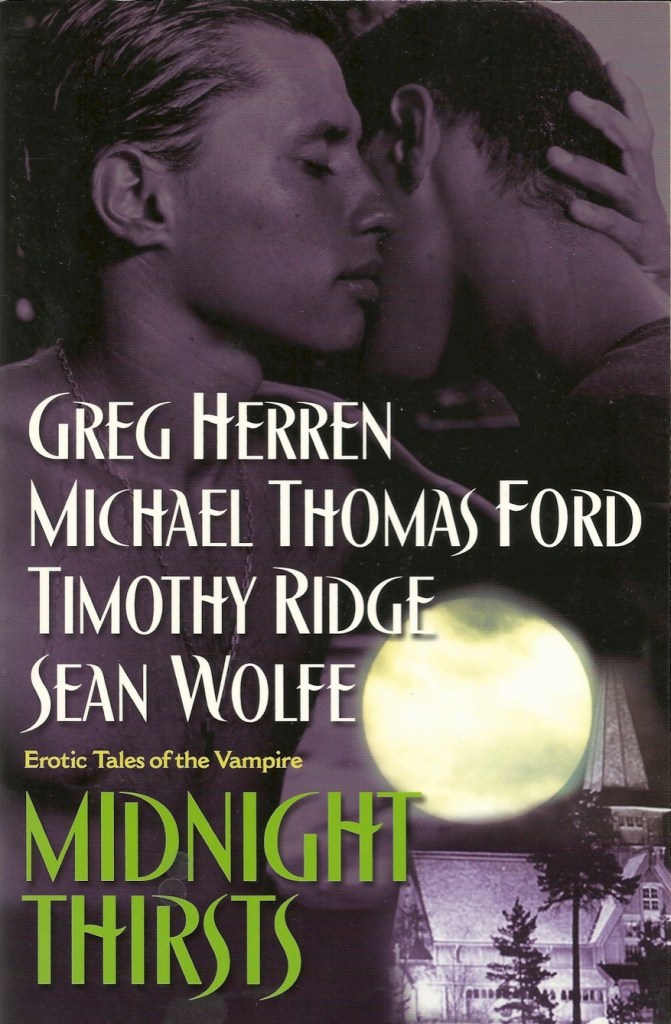
I have always enjoyed reading vampire stories. “salem’s Lot has always been one of my top five Stephen King novels; I loved Dracula (oh to write an epistolary novel!) and numerous other such tales. It took me awhile to come around on Anne Rice’s The Vampire Chronicles (a tale for another time), but I did eventually. Twilight never struck any chords with me. But the one thing I never thought I would do was write about vampires, despite loving them the way I do–going all the way back to my childhood and Dark Shadows. I don’t think I ever would have written about vampires, but my editor at Kensington thought I could; thought I would do a good job at it, and encouraged it, beginning with an offer to write an erotic vampire novella for a collection to be called Midnight Thirsts.
Go home, old man, Rachel thought, tapping her black fingernails on the counter.
It was aquarter till nine, fifteen minutes before she could lock the doors. Everything was clean and the cash register was already counted down. All she had really left to do was dump the remains of the day’s coffee down the sink, lock the cash drawer in the safe, and turn everything o. She’d be gone by ten minutes after at the latest.
She glanced out the big windows fronting the coffee shop. The streetlight just outside cast a yellowish glow in the thick mist pressing against the glass. She shivered and looked back at the old man. He was sitting at one of the tables in the far corner, with the same cup of coffee he’d ordered when he came in around seven thirty. He hadn’t touched it. It was still as full as when she’d filled the cup, only no steam was coming off the black surface now. He didn’t seem to be watching for anyone, or waiting. He never glanced at this watch, which she’d spotted as a platinum Tag Heuer, nor did he ever look out the window. Every once in a while. he would look up from his newspaper and catch her staring. He’d smile and nod, then go back to his reading.
Apparently, he was determined to read every word.
She stood up, bending backward so her back cracked. The night had been really slow. The Jazz Café, even on weeknights, usually was good for at least thirty to forty dollars in tips. Tonight, when she counted out the tip jar, it yielded less than seven dollars. Just enough to get her a pack a cigarettes and a twenty-ounce Diet Coke at Quartermaster Deli on her way back to her apartment. It wasn’t, she thought, wiping down the counter yet again, even worth coming in for.
Usually, on this kind of night, cold and damp and wet, Rachel was kept busy with orders for triple lattés. The tables would be full of people who would coming in shivering, bundled against the cold wetness in the air, which seemed to penetrate even the thickest coat. They’d hold their steaming cups of coffee with both reddened hands, talking and laughing. SOme would be doing their homework on laptops.
She liked busy nights, when the orders kept coming and the tip jar filled. Then, the time seemed to fly by, her closing shift passing in the blink of an eye. She hated the slow nights, when every passing minute seemed to take an eternity. She glanced back at the clock on the wall, then back at the old man. If you would just leave, she thought, I could go ahead and close early.
He’s kind of good-looking, she thought as she sipped her tepid cup of green tea, for an older guy.
At that moment he look up, and their eyes met. His were blue, a deep blue with some green in it. Once again, he nodded his head to her and smiled, but this time he didn’t go back to his newspaper. He held her eyes.
Not to worry, my child, I’ll be gone soon enough.
She turned away, shaking her head, the hair on the back of her neck standing up…
As is frequently the case with my work, The Nightwatchers began as a short story. Within a year of moving here, Paul had struck up a friendship with the director of the Tennessee Williams/New Orleans Literary Festival (which is where he now works), and as such he volunteered us both to help out with the 1997 Festival. I worked at the sign-in desk, where people picked up their badges and so forth, and it was in the lobby of Le Petite Theatre de Vieux Carre, a marvelous old theater on the corner of Chartres and St. Peter, right across the street from the Cabildo, and kitty-corner to Jackson Square. It was very old, and the main stage was named for Helen Hayes, who’d actually played there before. It was haunted, too–every building in New Orleans is–and I heard some of the stories. Being a volunteer, I had access to back stage, upstairs to the balcony, the prop attic; everywhere. (I eventually used some of this knowledge in Jackson Square Jazz.) At some point during the weekend I had an idea for a story–a horror story–about a theater company rehearsing in an old haunted theater in the French Quarter, where the person always cast in the lead female roles is also sleeping with the director. The young actress who deserved the part doesn’t listen to company gossip, but she does eventually find out that the rumors are true, and at some point made a deal with a devil who appeared to her in her dressing room, on and on and on. I called the story The Nightwatchers, because to me, that was what the devils/demons were called–they watch at night for souls to prey on. When I was asked to write this novella, I dug out the story and reread it, deciding it was perfect to adapt into something new.
I played with it a while, and couldn’t quite get it right in my head until I decided to abandon the theater idea; I’d tried turning the girl into a gay guy but it didn’t really work. I also couldn’t seem to get the atmosphere right, either, and I was convinced–still am, in fact–that the atmosphere had to be just right or the story wouldn’t work. Then one night I was walking through the lower Quarter in December–meeting Paul somewhere, I think–and it was one of those evenings when the fog is so insanely thick that you literally can’t see more than a foot or so in front of you at any time. As I walked along the sidewalk, with the old buildings pushing up against the sidewalk, when I heard the sound of hooves on the street–and realized, bemusedly, that in the fog and the only light from a gaslight–that I could have traveled back in time. Only in New Orleans can you feel like you’ve traveled back in time when it’s foggy, I thought, and wrote an entire scene around that feeling when I got back home. It was the perfect mood/atmosphere for the story, and it worked very well.
And as I wrote the novella, I got more and more into the characters and started imagining my own supernatural world, with vampires and witches and werewolves and everything else, including a ruling council over the paranormal world, the Council of Thirteen, and the old man Rachel sees in the coffee shop is a representative of the Council, in New Orleans to hunt a rogue vampire…a vampire who believes her young friend Philip Rutledge (now the center of the story) is the reincarnation of someone he loved hundreds of years earlier when he was human (shades of Dark Shadows!) and so wants to turn Philip into his eternal companion, and it’s up to Nigel and Rachel to rescue Philip.
It was a lot of fun to write, and I left the ending a bit open so I could write more about the characters if I ever chose to do so; I actually slotted a continuation novel into my writing schedule; it was supposed to be what I wrote next after finishing Mardi Gras Mambo…needless to say, life conspired to keep me from ever getting around to this book. I am still a bit disappointed I never carried on with the story; I used this same mythology when I returned to writing about vampires again several years later with Blood on the Moon.
So, that’s how The Nightwatchers came to be a story. Writing this now I see the parallels between what I wrote and some things I read and enjoyed (or watched, a la Dark Shadows); and is my “Nightwatcher” group that different from Anne Rice’s Talamasca? Probably not.
I did read and enjoy the other novellas back in the day; I’ve been meaning to revisit Michael Thomas Ford’s because it was particularly memorable.
I often refer to ‘salem’s Lot as “Peyton Place, but horror.” Because while Stephen King’s second novel (and still one of my favorites) absolutely does its job as a wrenching piece of horror fiction, it’s also a truly insightful and meaningful look at a small town (population 1300) and how everyone knows everyone, as well as the way their lives intersect and connect and cross intricately; we get to know a lot of the townspeople before they succumb to the horror that is overwhelming their little town. If you took the vampires out of the story, you’d have to replace them with something, as there’s no story without them, but at the same time, this novel along with Needful Things some twenty or so years later, are remain two of the best books about life in small towns that I’ve ever read.
I used to reread old Stephen King novels a lot for comfort, losing myself in the worlds he creates and enjoying the stories, the writing, and the characters. ‘salem’s Lot is definitely one of my favorites of his; definitely always in the Top 5, with perhaps only The Stand outranking it.
Almost everyone thought the man and the boy were father and son.
They crossed the country on a rambling southwest line in an old Citroen sedan, keeping mostly to secondary roads, traveling in fits and starts. They stopped in three places along the way before reaching their final destination: first in Rhode Island, where the tall man with the black hair worked in a textile mill; then in Youngstown, Ohio, where he worked for three months on a tractor assembly line; and finally in a small California town near the Mexican boarder, where he pumped gas and worked at repairing small foreign cars with an amount of success that was, to him, surprising and gratifying.
Wherever they stopped, he got a Maine newspaper called the Portland Press-Herald and watched it for items concerning a small southern Maine town named Jerusalem’s Lot and the surrounding area. There were such items from time to time.
He wrote an outline of a novel in motel rooms before they Central Falls, Rhode Island, and mailed it to his agent. He had been a mildly successful novelist a million years before, in a time when the darkness had not come over his life. The agent took the outline to his last publisher, who expressed polite interest but no inclination to part with any advance money. “Please” and “thank you,” he told the boy as he tore the agent’s letter up, were still free. He said it without too much bitterness and set about the book anyway.
The boy did not speak much. His face retained a perpetual pinched look, and his eyes were dark–as if they always scanned some bleak inner horizon. In the diners and gas stations where they stopped along the way, he was polite and nothing more. He didn’t seem to want the tall man out of his sight, and the boy seemed nervous when the man left him to use the bathroom. He refused to talk about the town of Jerusalem’s Lot, although the tall man tried to raise the topic from time to time, and he would not look at the Portland newspapers the man sometimes deliberately left around.
When the book was written, they were living in a beach cottage off the highway, and they both swam in the Pacific a freat deal. It was warmer than the Atlantic, and friendlier. It held no memories. The boy began to get very brown.
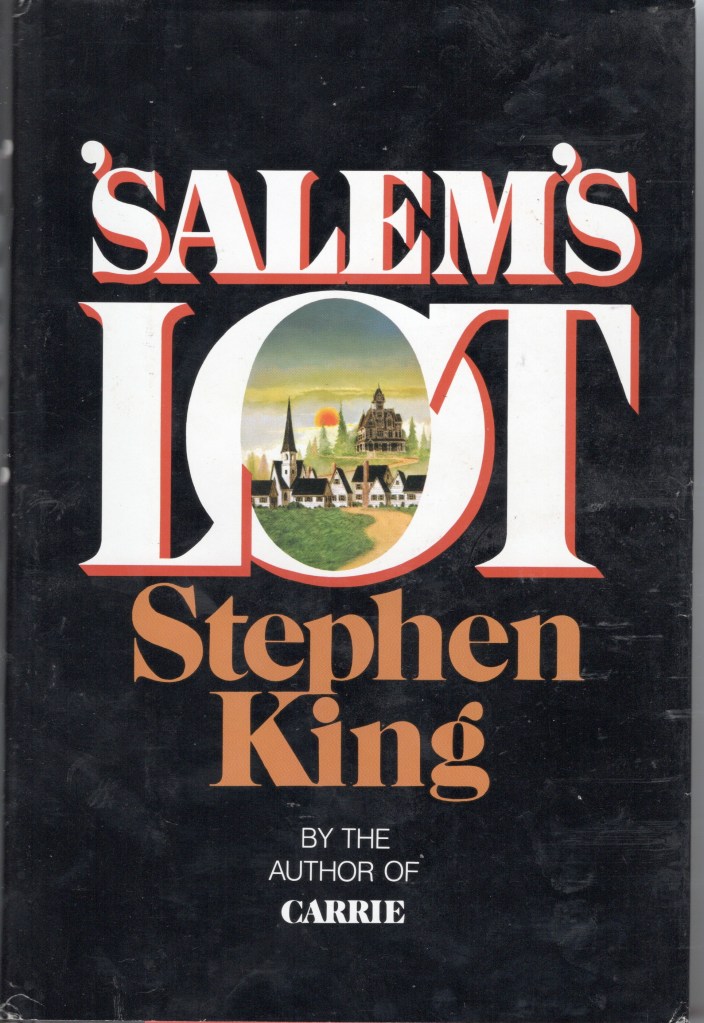
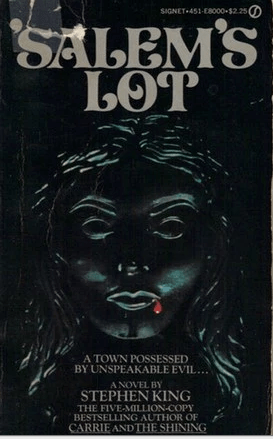
This is the cover of the version I originally read in high school–I bought it off the paperback rack at the Safeway in Emporia, Kansas. I kept that copy for years; eventually replacing it with a hardcover reprint in the 1990′, before finally getting an old copy with the original cover on eBay (which has since turned out to be a first edition; I love finding all the mistakes in it as I reread it).
I had read Carrie in paperback in one night when I’d borrowed it from a friend; it was only in the last decade that I finally acquired a copy of it to keep and reread periodically (I bought it to read the opening shower scene at Banned Books Night; ironically, the objections to the book have nothing to do with explicit talk about menstruation, or bullying, or violence…people object to the book because of its depiction of Christianity, particularly in the case of Carrie’s fanatic mother, Margaret (whom I always see in my head as Piper Laurie, who should have won an Oscar). I don’t think Carrie was the book that made me begin to question Christianity, to be honest; I think I already was questioning it before I read the book, but it was one of the first times I’d see a disparaging representation of someone committing horrifying abuses in the name of Jesus, or how the way the religion viewed sexuality could be taken to such horrific extremes. But I loved the book and became interested in Stephen King as an author. I was aware of ‘salem’s Lot before I found a copy while grocery shopping with my mom; I’d known he’d published a second book because I saw it in the book club ads (Doubleday, Book of the Month, etc.) in magazines. I had no idea what the book was about when I started reading it–I had no clue it was about vampires, and vampires never even crossed my mind when I started reading. It was a Saturday (Mom always drove into Emporia on Saturday to buy groceries), and I repaired to my room with the book (my homework was already done, and whatever college football game was on that Saturday was of no interest to me) and started reading. I finished reading it at around two in the morning, and was completely blown away by it. There was no way I was going to stop reading, and there was no way to stop reading once the big reveal about the vampires happened and the pace picked up.
The book was utterly terrifying, and it started raining later on that day as I read. I was living in a small town (population 973) and my bedroom window looked out at a corn field that was right across the street. I started seeing, as I read, a lot of similarities between Jerusalem’s Lot in the book and my little town–the characters, the interconnectedness of the community, and like Ben Mears, I was still kind of a stranger in the town. I just remember that when I got to the part where Danny Glick comes to Mark Petrie’s window, the storm outside brushed a tree branch against my window and I literally jumped, the book flying out of my hands and landing across the room in the middle of the floor.
It was also the first time I remember reading a book whose main character was a writer–something Stephen King returns to quite regularly, write what you know indeed–which also helped me connect with the book more; Ben Mears was a publisher novelist of minor success, but had published three books already and hadn’t graduated from college. He also seemed like a real person, living and breathing and absolutely real; it wasn’t until this reread that I realized how much physically he’s like King–tall and slender with thick black hair.
But it was also the first time I’d read anything about vampires that was so clearly set in the real world, in the real present, and with real characters I could relate to–which made it even more terrifying. I started thinking about how easy it would be for, say, a vampire to come to our small little town and how quickly people could be turned, primarily because no one would believe it was actually happening until it was too late–which King handled beautifully in the book.
Monday and a work-at-home day, for data entry and other things. I also have a meeting at one (yay) and I am hoping to get some things delivered today so I don’t have to leave the house. Yesterday started out well; I wrote my entry and did some writing planning and then repaired to my easy chair to read; but then Paul got up and came downstairs and I decided that as long as I kept my notebook/journal handy, I could make notes while thinking and watching television. We missed the Saints game; I’d forgotten it was in London and by the time I checked what time it was starting it was already over so I can’t even blame the Saints for my complete (well, pointed, at any rate) failure to get as much done yesterday as I had wanted to–which means it’s entirely my fault.
I did watch the first two episodes of the new Interview with the Vampire series, and it put a lot of thoughts into my head. I thought it was remarkably well done and well-cast–I would have gone for a Skargaard for Lestat, but that could be True Blood’s fault as well–and it was beautifully filmed. The changes made to the original book (I liked that it’s structured as a follow-up interview to the original interview) and story were barely noticeable. It’s also amazing how different Jacob Anderson looks as Louis as opposed to Greyworm from Game of Thrones. It also made me start thinking about vampires and how/why they are so popular with queers–this show has no gay subtext, it’s right there in your face–and also remembered how incredibly disappointed I’d been when I first read the book, as a teenager. At that point in time, I’d forgotten that Dark Shadows had turned a vampire into a romantic leading man–my thoughts about vampires were entirely shaped at that time by Dracula and ‘salem’s Lot, and that was what I was expecting from Interview…and that is most definitely not what the book was. I read it again about ten years or so later, and still didn’t care for it much; I didn’t come into an appreciation of Anne Rice’s work until the 1990’s–a friend told me to read The Mummy so I did and enjoyed it, and then I read and loved The Witching Hour, so I took the first three volumes of The Vampire Chronicles with me to Hawaii on a vacation and that time…well, that time I got into the books and enjoyed them. Mrs. Rice soon became a “buy in hardcover on release” author for me, and remained that way for a very long time. I do think there’s a line from Barnabas Collins in Dark Shadows to Lestat/Louis to True Blood/the Sookie Stackhouse books; I once described True Blood as “Dark Shadows with sex, violence, nudity and blood.”
We then watched the first episode of Queer for Fear, a documentary series on Shudder about queer themes and subtexts in horror films, which was fun and certainly fit the theme of the day, but then we moved on to Your Honor starring Bryan Cranston, filmed and set in New Orleans (again, we marveled a lot about the geography–“oh, look, they’re transporting him from the courthouse to OPP but for some reason are coming in from I-10 which means they somehow detoured through Metairie”–and we can’t quite figure out where Cranston and his son live; they are always taking the bridge across the river, but Cranston can go jogging from his front door down St. Charles Avenue down to the lower 9th ward (clearly, training for a marathon of some sort) and back, so I am not sure why they have the need to go back and forth to the West Bank (Paul: this would only make sense if they lived in Algiers, but why would he cross the river to go jogging?). I know, I know, it’s fiction and make-believe and has everything to do with shots and visuals that remind the viewer it’s New Orleans; both the Crescent City Connection and the Huey P. Long bridges will do that, as will the drawbridge over the Industrial Canal, and nothing says New Orleans quite like the streetcar. I also know it’s being nit-picky and “more New Orleanian than thou”, but I can’t help it when I watch something filmed here (I was also identifying where scenes were shot in Interview with the Vampire as well). I’m sure New Yorkers do this a lot, too. We also watched this week’s House of the Dragon, which I am enjoying–there’s really no good characters to root for in this one; they are essentially all terrible people; at least in Game of Thrones we could root for the Starks as the only decent people in Westeros. We also watched the new episode of The Serpent Queen, as Catherine is now slowly coming into her own. I really am enjoying this series; I hope it doesn’t go off the rails at some point.
But now it’s October already–yikes; it seems as though this year has sped past but on the other hand January also seems like it was a million years ago already–and I’ve really got to start getting things done.
As I’ve been doing my entries about writing my books, it’s been a fun journey down memory lane, as I remember things I wanted to do and plans I had that somehow were either forgotten or pushed aside as other things crowded them out of my brain. Watching Interview and Queer for Fear reminded me of my own world of the supernatural I was trying to create with some of my horror writing (I don’t really consider my vampire writing as horror; yes, vampires, but the primary focus of them was the eroticism), and somehow I’ve managed to stick to the rules of that weird world of the supernatural I was creating through short fiction that spilled over into the erotica; so far I’ve done vampires and witches, rougaroux and le feu follet, all tied around parishes on the other side of the river and west/south of New Orleans. I have a couple of short stories to write still, and a book to get done–and I want to read more. I want to finish reading my current book and I think the first book for Horror Month will be a reread of Interview with the Vampire, perhaps followed by a reread of ‘salem’s Lot; why not explore the vampires?
And on that note, I am heading into the spice mines. Have a lovely first Monday in October, Constant Reader, and I will be checking in with you again tomorrow morning before the sun comes up. Yay.
Saturday morning and yet another, amazing night’s sleep. I didn’t get up until ten this morning! That’s like two days in a row, and I could have easily stayed in bed had I not realized that I will eventually have to start getting up early again and going to work next week. Tomorrow I’m going to set my alarm and get up around eight or nine, just to get back into the habit.
I’ve also reached the point where I am no longer sad not to be at Bouchercon this weekend anymore. I think I just finally got numb, stopped feeling sorry for myself, and started being happy for my friends and glad they’re having a great time over there. After all, there’s no point in being sad, really–it doesn’t make anything better, does it?–and there’s really no sense in being sad or upset over things you have no control over. Those are the things you just have to accept.
You don’t have to like them, though.
Last night we binged the rest of the available episodes of Castle Rock, and Lizzy Kaplan is just killing it as Annie Wilkes. She should at least get an Emmy nod for the performance; I won’t go out on a limb and say she should win since there are so many incredible television shows and performances out there now, between all the streaming services and so forth. This truly is an extraordinary time for television shows. I love that the writers have dragged Jerusalem’s Lot and the Marsten House into this season; there’s something strange going on in the basement of the Marsten House but we aren’t really sure what it is yet…this season is making me want to revisit Stephen King’s work, which is precisely what I don’t need to do; my TBR pile is massive enough as it is without going back and rereading some of my favorite Stephen Kings. Over the last year or so I’ve reread Pet Sematary, The Shining, and ‘salem’s Lot as it is; I’d love to reread Firestarter before reading The Institute–which I think is going to be my Thanksgiving week treat.
I think my next read–after a careful examination of my bookshelves, is going to be Richard Stark’s The Hunter. Stark of course is one of Donald Westlake’s pseudonyms, and my education in Westlake (and Lawrence Block, while we’re at it) is sadly lacking. I also never read the Ed McBain novels (but I did read Evan Hunter when I was in my twenties). As I said, my education is classic crime writers of the 20th century has been sadly neglected; and I’d also like to read Ross Macdonald’s stand alones, and I’d love to immerse myself in a reread of the John D. Macdonald’s Travis McGee novels (and finish reading through his stand alones as well). I also need to finish the canons of Margaret Millar and Charlotte Armstrong and Dorothy B. Hughes.
And of course, there are all those wonderful writers of color I need to read. And queer crime writers. And…
Heavy sigh.
I did manage to finish reading Certain Dark Things by Silvia Moreno-Garcia yesterday, and I enjoyed it tremendously. It was a very different approach to a vampire novel, and while I don’t know that I would necessarily classify it as a horror novel–not all vampire novels are horror novels–it really is quite good. It’s more suspenseful and, much as I hate to say it, it’s almost closer to a crime/suspense novel with paranormal elements than it is a horror novel. I do highly recommend it–I’ll write an entry about it at some point this weekend, perhaps even later today–and it’s precisely the kind of novel that is needed to reinvigorate the horror genre. I’ve been saying for quite some time that it’s the so-called minority writers (writers of color, queer writers) who are currently injecting new blood into, and revitalizing the crime genre–I would say that’s also the case with horror. The problem with genre fiction is that it tends to stagnate periodically and become repetitive and somewhat stale, until something comes along, shakes it up, and turns it upside down. The rise of the hardboiled female private eye novel in the 1980’s was the kick in the pants crime needed to breathe new life into a genre that was getting a bit stale; I think it’s the marginalized writers who are doing it now.
Look at me, generalizing about horror–a genre I am hardly expert in. As I always say, I’m just a fan with horror.
But I am hardly an expert in crime fiction, either. There are positively libraries of things I don’t know about crime fiction.
And on that note, I am heading back into the spice mines. Have a lovely day. Constant Reader.
Monday morning rolls around yet again, and a new week dawns. I slept pretty decently again last night, which is unusual. The alarm went off this morning and I hit snooze, despite being awake, because the bed was so comfortable. Sigh.
The Saints won again yesterday, and with the season LSU is also having, it’s been a pretty good football season for Louisiana football fans thus far. LSU undefeated, the Saints with a single loss? The big test for LSU is the Alabama game a week from Saturday–not sure when the Saints will be tested; but the day after the LSU-Alabama game the Saints are playing the hated Atlanta Falcons. So, yeah, that’s kind of a big weekend for both teams, and both have a bye this weekend–so no football in the Lost Apartment this weekend, alas.
We watched the new Meryl Streep movie on Netflix last night, The Laundromat, and weren’t terribly impressed with it. The story rather lacked cohesion, and there were times when I was frankly bored with it. I guess the idea was to expose and talk about the ways companies and the wealthy avoid paying taxes by setting up off-shore trusts and holding companies. but the examples given with how that affects people wasn’t particularly affecting? It was disappointing. Streep was good, but just not given enough to really work with.
I read some more into Certain Dark Things yesterday, which I am also really enjoying now that I’m getting deeper into the story. It’s very well written, and I like the structure of the narrative, as well as the entire mythology of vampires in the new world that Silvia Moreno-Garcia is creating here. It’s pretty good, and I do highly recommend it. I am hoping to get finished reading it sometime this week. I want to read one more horror novel before the end of the month and Halloween; although I’m not certain Moreno-Garcia’s novel really fits into the horror genre. The book isn’t scary, but it is about paranormal creatures, and an entire world and society of them. Similarly to Charlaine Harris’ Sookie Stackhouse novels, she imagines a world where vampires are “out of the coffin,” and people know they exist. The fallout from this has resulted in Mexico City establishing itself not only as an independent city-state, but also as a vampire-free zone. I also like the characters she’s exploring–Atl, the modern-day female vampire, descendant of a line of vampires going back to the Aztecs, and Ana Aguirre, a female police detective in the city investigating a murder obviously committed by a vampire. So in some ways Certain Dark Things can also be considered a crime novel, which is very cool.
I love when the two genres overlap, to be quite honest.
And on that note, tis back to the spice mines with me. Have a lovely Monday, everyone.
Ah, a lovely lazy Sunday morning, with a lot on my plate to get done.
LSU won again yesterday, taking Mississippi State down in their own stadium 36-13. With about five minutes left in the first half LSU was ahead only 9-7; State had just scored and the cowbells were ringing. As time ran out in the half, LSU was ahead 22-7. Within another five minutes of the second half, we were ahead 36-7, and the game was essentially over. Four touchdowns in less than ten minutes. Next up is Auburn in Death Valley; Auburn rebounded from their loss to Florida with a blowout of Arkansas, and they’ll be thirsty to beat LSU. Another loss and their championship hopes are over; Auburn has also lost two straight to LSU in the closing minutes.
It will be a tough one.
The Saints are playing later this afternoon, the Bears in Chicago at Soldier Field. I have a lot to get done this morning if I want to watch the game, frankly; I may wind up just working while it’s on in the living room. I managed to get nothing done yesterday; I overslept (it was needed, methinks) and so got a late start to the day. I did manage to make groceries and fill the car with gas, so that’s something, right? Today I have to finish my Sisters column, and I have to also work on Bury Me in Shadows as well as a proposal for another project.
Heavy heaving sigh.
But the weather yesterday was gorgeous, simply gorgeous. I do love when it gets to be mid to late October and we have what we consider fall down here–which means it never gets much hotter than eighty degrees and the humidity is gone. It’s so gorgeous, and the sky is so blue…ah, heavenly.
So I decided to treat myself to a sleeping pill, and after last night’s amazingly deep and restful night’s sleep, I understand completely how addictive these things can be. Yes, my sleep has been rather off and on since I stopped taking them every night, and I actually can feel an emotional difference in myself as well this morning; who wouldn’t want to feel this good every morning on waking up? But addiction is a very real thing, and a very real thing I’m afraid of, so I won’t be taking another one until I feel like I need a special treat.
The demolition of the Hard Rock Hotel construction site, postponed from yesterday to today, is going to happen at some point later this morning. I am feeling less like turning it into a “ripped from the headlines” novel today as I was over the last couple of days; while there would be some interesting points to be made about New Orleans corruption and greedy, shady contractors, for it to be a Scotty novel it would have to be somehow reigned in and made into a personal story of some sort. I can, of course, see the site from the elevated interstate as I drive to and from work every day; the elevated interstate gives one an interesting view of the city from those heights (it runs along Claiborne Avenue, and its construction destroyed irrevocably the business district for people of color and the neighborhoods that ran along Claiborne Avenue for decades–and yes, racism played a part in where the highway runs).
I started reading Silvia Moreno-Garcia’s Certain Dark Things and am already quite enthralled with it. For one thing, she’s creating an entirely new mythology of vampires–at least one that is new to me–and I love that the book is set in Mexico, currently in Mexico City. I also like the way she is carefully doling out plot points and back history for her main character, Atl–who is very interesting, and is involved in something dangerous that we aren’t quite sure what it might be at this point. I also like that the very first chapter, which introduces Atl to the reader, is told from the perspective of a street kid named Domingo. Moreno-Garcia created Domingo completely and in three dimensions, like he’s a main character, rarely than merely the lens through which we meet Atl. (He still might be an important character to the story; I hope so because I liked him, but it also wouldn’t surprise me terribly if he disappears from the story completely. If that is indeed the case, kudos to Moreno-Garcia for making even throwaway characters complete and real. I am really looking forward to reading the rest of the book.
Reading this also made me realize how badly I failed at vampire fiction with my few meager attempts. I didn’t really do anything new with them; I just wrote vampire stories to write vampire stories, without any thought about how to make them realistic, compelling, and original. I did have a big over-arching plan, though–it would have tied them all together and created something big and original in the second novel, Desire, which sadly never happened. But I’m not a horror/supernatural writer, and when I do venture into those realms, what I do best is ghost stories. I am currently writing another novel that is a ghost story; I already did one (Lake Thirteen), and will probably do another one at some point.
And now I should probably clean the kitchen. I am going to run an errand either before or during the Saints game–the city is always a ghost town during Saints games; it’s literally the best time to do errands, and everywhere you go they’re playing the game anyway–but I also need to get some cleaning and writing done long before I leave the house to do so.
I’m also still reading about the Lemana kidnapping in Ready to Hang, which is quite interesting, mainly because the child was held for so long. The history of the Italian immigrants to New Orleans is interesting–and often quite tragic, frankly–and I find it interesting that the Irish immigrants, who were most likely looked on with as much askance as the Italians, who came later, don’t have some horrible stories that appear in histories of crimes in New Orleans. I do know they were primarily confined to the stretch between Magazine Street and the river–which is why it’s still called the Irish Channel–but they don’t seem to be the victims of mob violence or as much intolerance as the Italians were around the turn of the twentieth century.
If they were, it’s not included in these books about historical crimes/tragedies in old New Orleans.
There’s been an idea forming in the back of my head about all this bloodshed and horror in the history of New Orleans; something along the lines of the land being cursed or some kind of cloud over it, like Stephen King’s Derry, which could also explain the prevalence of religion in the region–Catholicism and even voodoo–used primarily to protect the souls of the locals from the dark forces that seem to control New Orleans.
It’s an interesting thought, at any rate.
And now back to the spice mines. Have a lovely Sunday, Constant Reader!
I didn’t get as much done yesterday as I would have liked; running my errands in the pre-rain humidity literally wore me out, and then when I got going again I started cleaning and doing laundry and well, once I start doing that–as well as going through and trying to organize the books–I am pretty much done for the day….especially after I discovered Burnt Offerings was available for streaming on Prime. Oliver Reed! Karen Black! Bette Davis (who was totally wasted in her role)! I’d seen the movie years ago, I think when it first aired on television after it’s theatrical run, and while it’s still has some moments, it overall doesn’t hold up as well as I would have hoped. I read the book for the first recently in the last few years, and it was wonderful. But watching Burnt Offerings put me in mind of an essay about horror in the 1970’s; the 1970’s was a time when the suburbs really developed because of ‘white flight’ from the cities and desegregation; this was this whole movement of back to the country from the urban centers, and at the same time, there was horror that specifically focused on this phenomenon (without the racism and white flight issues); namely this book, Harvest Home by Thomas Tryon, The Stepford Wives by Ira Levin, and even Stephen King lightly touched on this in ‘salem’s Lot; the dangers of the country to people from the city.
One could even argue that James Dickey’s Deliverance also belongs in this category, and it put me in mind of an essay that I may never write. I also thought up another yesterday while running my errands, after car after car after car violated traffic rules and almost caused me to be in in accident (three times, to be exact; which might be a new record): “Right of Way,” in which I would extrapolate the American contempt for traffic rules and laws for everyone’s safety can be directly correlated to contempt for law and order, the system, taxes, everything. I made some notes, and this is one I may actually write. Essays are fun and I do enjoy writing them but I don’t very often, unless one is requested of me for something, and perhaps that’s the wrong approach.
Today I am going to go to the gym and I am going to start rereading Royal Street Reveillon and make notes for the big revision that is coming. I’m also going to start reading Jackson Square Jazz out loud for copy editing purposes, and I’d also like to work on “A Whisper from the Graveyard” today. I should at some point also work on finished “Never Kiss a Stranger,” which means I should also make a to-do list for everything I want to get done in July.
Hmmm. Perhaps not a bad idea, at that.
I also remembered I have notes on a short story I need to read and decide what revisions I need to be make.
It never truly ends, does it? But I am looking forward to Sharp Objects tonight on HBO; I actually liked this book by Gillian Flynn better than Gone Girl, which of course made her hugely famous and hopefully hugely rich. I still haven’t read her Dark Places, but that’s because I still subscribe to the “if I don’t read all the canon then I still have something by her to read” mentality, which is partly why I still have not read the entire canon of either Daphne du Maurier or Shirley Jackson or Patricia Highsmith.
So, I have a lot to do today–only one more day after today before I return to the office, but at least it’s only a four day work week–and so I should probably get back to the spice mines.
The next story up in Promises in Every Star and Other Stories is “Bloodletting”:
The damp air was thick with the scent of blood.
It had been days since I had last fed, and the desire was gnawing at my insides. I stood up, and my eyes focused on a young man walking a bicycle in front of the cathedral. He was talking on a cell phone, his face animated and agitated. He was wearing a T-shirt that read Who Dat Say They Gonna Beat Dem Saints? and a pair of ratty old paint-spattered jeans cut off at the knees. There was a tattoo of Tweetybird on his right calf, and another indistinguishable one on his left forearm. His hair was dark, combed to a peak in the center of his head, and his face was flushed. He stopped walking, his voice getting louder and louder as his face got darker.
I could smell his blood. I could almost hear his beating heart.
I could see the pulsing vein in his neck, beckoning me forward.
The sun was setting, and the lights around Jackson Square were starting to come on. The tarot card readers were folding up their tables, ready to disappear into the night. The band playing in front of the cathedral was putting their instruments away. The artists who hung their work on the iron fence around the park were long gone, as were the living statues. The square, so teeming with life just a short hour earlier, was emptying of people, and the setting sun was taking the warmth with it as it slowly disappeared in the west. The cold breeze coming from the river ruffled my hair a bit as I watched the young man with the bicycle. He started wheeling the bicycle forward again, still talking on the phone. He reached the concrete ramp leading up to Chartres Street. He stopped just as he reached the street, and I focused my hearing as he became more agitated. What do you want me to say? You’re just being a bitch, and anything I say you’re just going to turn around on me.
I felt the burning inside.
Desire was turning into need.
I knew it was best to satisfy the desire before it became need. I could feel the knots of pain from deprivation forming behind each of my temples and knew it was almost too late. I shouldn’t have let it go this long, but I wanted to test my limits, see how long I could put off the hunger. I’d been taught to feed daily, which would keep the hunger under control and keep me out of danger.
Need was dangerous. Need led a vampire to take risks he wouldn’t take ordinarily. And risks could lead to exposure, to a painful death.
The first lesson I’d learned was to always satiate the hunger while it was still desire, to never ever let it become need.
I had waited too long.
“Bloodletting” is an unusual story for me in that it’s actually a short story that bridges the gap between my novella “Blood on the Moon” and the novel Need; I eventually used it as the book’s first chapter. I have always wanted to give vampire fiction a try; I created an entire world that I first wrote about in the novella “The Nightwatchers,” which I always intended to develop into a series. I still would like to develop that series, and when the opportunity came to write “Blood on the Moon” I realized I could simply still use the world I’d created for “The Nightwatchers” and move on to different characters. The second book in the series, the one that was to follow Need, Desire, was going to tie the two story-lines together but Need didn’t sell as well as the publisher would have liked and so Desire died in the water. I may still go back and write it, of course, but I have no publisher for it and I am not particularly interested in self-publishing that much. But…I never say never. I wrote “Bloodletting” for Blood Sacraments, and only had to change the original concept a little bit; in the original idea Cord, my vampire, was actually sitting on the roof of St. Louis Cathedral watching the crowd for his next victim. I still love that image, and may use it sometime, but I did eventually change it to how it reads now.





 Queer and Loathing in America