There are few things more Louisiana than rooting for LSU…unless its rooting for the Saints, maybe. Southern people love their football, especially the college variety.
Paul and I have not been to a game since 2021, when our “never saw the Tigers lose in person” streak, which began with the Mississippi game in 2010, came to an end with the only loss to Auburn in Tiger Stadium this century. We managed to make it through twelve seasons without ever seeing the Tigers lose while we were at the stadium, which is a pretty good run.
Chanse was an LSU alum–he even played football there–and I think I’d idly mentioned in the first book that he’d been injured in the Sugar Bowl in the last game of his senior year, and never elaborated more than that on his past at LSU. I think there were some more reflections in the second book in that series, but I know I never brought it up again after the second book in the series. I have an in-progress Chanse novella, which is set on the LSU campus at his old fraternity, but I don’t know if I’ll ever finish the story of the fraternity murder. As for Scotty, his background was so vastly different from Chanse’s that I couldn’t really send him to LSU. Men in his family on his mother’s side all go to Vanderbilt; his sister Rain went to Baylor. Storm did his undergrad at Vanderbilt but went to Tulane Law. Scotty of course flunked out of Vanderbilt (his parents rebelliously chose UNO), but the whole family on both sides root for LSU.
And of course, Valerie’s twin sons go to LSU in A Streetcar Named Murder.
I also make the point that the murder victim–a cousin of Scotty’s–in Mississippi River Mischief, along with his wife and kids, went to LSU; the wife was even a Golden Girl with the marching band (the kids are current students there). I built an entire Scotty mystery around the kidnapping of Mike the Tiger, the live mascot who lives on campus (Baton Rouge Bingo) and while I’ve not really done a lot of referencing of LSU in the Scotty series since that particular book, that is probably going to change with one of the upcoming books in the series. I roughly have plans for three more–one set during the summer of 2019, while the boys are living in the dower house on Papa Diderot’s estate in the Garden District; another during the cursed Carnival of 2020, and then a pandemic shut down book…and that just might be the end of the series. It may not be–I will probably keep writing Scotty books as long as I can type and the synapses in my brain still fire–but I am not going to rule out ending the series, either. Depending on what happens with my surgery and my recovery, I hope to write the next Scotty this coming spring.
And there are some things from this current book I’ll have to deal with in the next as well–as well as Scotty’s grandparents and parents aging. I’m thinking the cursed Carnival book will deal with a death in the Bradley family and the fall-out from Papa Bradley’s will. (I’ve only really gone into the Bradley side of the family once; and there’s a lot to unearth and explore there.)
I’m also toying with the idea of writing a book from Taylor’s perspective, and there’s always that Colin book I’ve been wanting to write forever.
So, if you want the series to continue, it will help if you order a copy of it!
(NOTE: I started writing this post back in January, after I’d returned to New Orleans from my last Mystery Writers of America board meeting–this is to give context to the opening paragraph– as you are no doubt well aware, Constant Reader, that I’ve not been back to New York since January; so this is that same trip where this happened and I started thinking about these things, which have never been far out of the forefront of my mind since then.)
While I was in New York recently, walking around to and fro, here and there, hither and yon, I was always checking my phone (and yes, I hate that I’ve become one of those people) and then shoving it back into my pants pocket without putting it to sleep first or closing the app that was open. As I walked around, of course this led to my phone doing all kinds of weird things –closing an app and opening another, etc.; but at least there were no butt dials, right? At one point, when I pulled out my phone as I took a seat on the subway, somehow what was open on the screen was a google search for my book A Streetcar Named Murder–and when I went to close that screen I touched one of the images by mistake, which took me to the Goodreads page for the book. Bear in mind, I never look at Goodreads for any of my books, let alone Amazon–the temptations to start reading the bad reviews is too great, and while I can usually laugh them off, occasionally–and it depends entirely on my mood, of course–one will get under my skin and it will annoy me, and that’s not good for anyone.
This particular day on the subway the Goodreads page opened to the bad reviews first–its average is four stars, which I will always take because I am not Lauren Hough–and the very first one made me laugh out loud on the subway. Paraphrased, it was basically someone taking umbrage at “someone who doesn’t live here or know the first thing about New Orleans” writing a book about New Orleans. The reason they had come to this conclusion was because Valerie referred to Mardi Gras as “Fat Tuesday”, and according to this one-star reviewer, no one from New Orleans would ever say Fat Tuesday instead of Mardi Gras.
Well, I’ve lived here for twenty-seven years and I have heard any number of locals say Fat Tuesday rather than Mardi Gras, and so of course I had to click on the reviewer’s profile…and grinned to myself when I saw that they actually live in Metairie, not New Orleans…which to locals is a bigger crime than getting something wrong about New Orleans: claiming to be from New Orleans when you actually live in Metairie. (the rejoinder is usually along the lines of “bitch, you live in Metairie.”)
It was also kind of fun to be accused of inauthenticity when it comes to writing about New Orleans, because I personally have never claimed to be an expert on anything New Orleans (others have said that about me, and I always am very quick to reply not even close); the more I learn about the city the more I realize how little I actually know about the city. There’s an extremely rich (and often incredibly dark) history here; it’s hard for me to wrap my mind around the fact that the New Basin canal was there as long as it was, or that there were several train stations around the French Quarter (including one that essentially was in Storyville–rather convenient for the whores and pimps, right?), or that where UNO is now used to be the lake shore resort of Milneburg, or that the only way across the river or the lake was by ferry until Huey Long built a bridge at the Rigolets (the narrow inlet between lakes Pontchartrain and Borgne).
I was on a panel once at the Tennessee Williams Festival with Bill Loefhelm (if you’re not reading Bill’s books, shame on you and correct that immediately) and the question of New Orleans authenticity came up, and Bill’s response (paraphrasing) was that New Orleanians have a tendency to play a game called “NOLier than Thou,” in which they try to one-up each other to see who the true New Orleanian actually is–which is, of course, gatekeeping. (And yes, I immediately turned to him and said, “I like that and am going to steal it” SO CONSIDER IT STOLEN.)
It does bother me somewhat when I read books set in New Orleans written by people who have never lived here; you can tell, but I also get over it pretty quickly; who is to say who can and can’t write about a place? There’s a significant difference between visiting and living here, which I realized almost immediately after we moved here, and that also becomes very apparent in fiction. I had started writing the book that would become Murder in the Rue Dauphine before I moved here, and I realized, once I did live here, that everything I’d written about New Orleans was completely wrong. I didn’t work on the book for another two years; and even then I wasn’t entirely sure I’d lived here long enough to write about the city. So…I kind of cheated by making Chanse MacLeod not a native either; he’d moved to New Orleans after getting his degree in Criminology from LSU, and had been here about six or seven years when the story opened. So he was an outsider, too; so his views on the city and how things work around here were from an outsider’s perspective, like mine; that was easier. With Bourbon Street Blues, I decided that Scotty was not only a native but came from two old-line society families, from the Garden District and Uptown. One of the greatest joys of my publishing career was having the Times-Picayune’s mystery reviewer, as well as the Books Editor, both say repeatedly that I got New Orleans right in my books. (Thanks again as always for all of your support, Diana Pinckley and Susan Larson!)
And I never really worried about it too much from then on. I wrote about New Orleans as I saw it–the potholes, the cracked sidewalks, the leaning houses, flooding streets, oppressive weather and hurricanes. As the years passed, I became more and more aware that my New Orleans writing was primarily confined to the Quarter, the Marigny, the CBD, the Lower Garden District, the Garden District, and Uptown–a very narrow slice of the city, but those were also my slices of the city, so that’s I wrote about. Sometimes I’d venture into another neighborhood–Lakeview, the Irish Channel, English Turn–and sometimes the story would take the characters to another part of Louisiana–the bayou and river parishes, the Maurepas swamp, the Atchafalaya Swamp, Baton Rouge–which, oddly enough, I had no qualms about fictionalizing. I’ve created numerous fictional towns and parishes surrounding New Orleans; I’ve even invented a sleazy gay bar in the Quarter (the Brass Rail).
So, was I doing New Orleans (and Louisiana) right by making stuff up, inventing places like the Royal Aquitaine Hotel, the Brass Rail, Bodytech Health Club, Riverview Fitness, etc.? Sometimes you have to fictionalize things, even if they are based on something that really exists. I never really thought much about it; I felt like I was getting the feel of New Orleans right, that my characters talked the way people in New Orleans do and react the way people here do, and that I was putting enough reality into the books for them to ring true to locals, natives, and tourists. Sometimes the cases are based on, in or around something that actually happened or exist; like the Cabildo Fire, the Fire at the Upstairs Lounge, Hurricane Katrina and the ensuing flood; termite swarms; Huey Long’s deduct box; and even the court case in, I think, Murder in the Irish Channel that triggered the murders was actually based on a civil trial I served as a juror on.
When I started writing A Streetcar Named Murder, I realized a lot of things I was writing about had to be fictionalized; I couldn’t set a murder at a Mardi Gras krewe ball and use an actual krewe that exists in real life, for one thing (like I had to invent a French Quarter hotel for a couple of murders to occur in) and while I didn’t want to use the cheat that Valerie had moved here again, like I did with Chanse, I wanted her to be of New Orleans but not be of New Orleans…so her parents are from Georgia and moved here after college and marriage, so Valerie was born here, went to school here, met and fell in love with and married her husband here–but her roots aren’t very deep, so she is both insider and outsider at the same time. I liked that idea; like how I am of the South but not of the South, she was of New Orleans but not of New Orleans at the same time. When creating Jem Richard in Death Drop, again, he’s a recent transplant to the city but his father is from New Orleans but relocated to Dallas, where Jem was born and raised. Jem spent a lot of his summers in New Orleans when he was growing up with his paternal grandmother, so he too is of New Orleans but not of New Orleans; which I am really liking as a method of storytelling about the city. I also moved Jem to a different part of the city; he lives in the 7th ward, on St. Roch Avenue in what is known as the St. Roch neighborhood (aka what realtors are trying to redefine and rename as the “new Marigny”, in order to raise prices) which is also very close to my office. Part of this was to move the action out of the neighborhoods I usually write about (although he does wind up in both Uptown and the Quarter) and so I could explore another neighborhood/part of the city than what I usually write about.
I also had recently–prior to the pandemic–started feeling more disconnected from the city than I ever had before. Primarily I think this was due to my office moving; we had been on Frenchmen Street in the Marigny, one block from the Quarter and where Scotty lives, so whenever I needed some Scotty inspiration I could walk a block, stand under the balconies of his building and just look around, drinking in the sights and sounds and smells of the block. To get past this, I started joining New Orleans history pages on Facebook, like Ain’t Dere No Mo New Orleans or the HNOC page and various others–you do occasionally run into Confederate apologists and racists there (they usually cry about the “crime” in New Orleans–you know, the usual dog-whistles from the white flight racists who fled to Jefferson Parish or the North Shore to escape desegregation of the public schools) and reading more histories of the city, state, and region–which are incredibly fascinating. That reading/research helped me write my historical Sherlock in New Orleans short story, “The Affair of the Purloined Rentboy”–but I have also since realized I got some things wrong in the story too, but there is just so much to know. I set the story in 1916 for example….without knowing New Orleans was hit by a MAJOR hurricane in 1915 that wiped out any number of settlements and villages around the lakes and the bay shores (that will turn up in a story sometime; the destruction of the lake front village of Freniere is just begging to be fictionalized and written about). When I mentioned this to another writer, who primarily does historicals, she snorted. “It’s impossible to know everything, and would people in 1916 still be talking about a hurricane from 1915?”
Probably, but if it doesn’t have anything to do with the story being told, why would I mention it?
A very valuable lesson, to be sure.
So, yes, lady from Metairie: you caught me. I’m not from New Orleans, you’re correct. But I’ve also published over twenty novels and umpteen short stories set here, and have even won awards for doing it.
And I’ll call it Fat Tuesday if I fucking want to.
The Huey P. Long Bridge at sunset, photo credit Marco Rasi
Yesterday was a bit of an emotionally challenging one at work yesterday, but handling days like yesterday is the most important part of my job, and part of the primary reason I took the job in the first place. It does get to me sometimes; not as often as one might think, but that’s also having years of experience in doing the work, too. I was emotionally and mentally tired when I got off work, decided not to run any errands and just come home to have some time to myself for a little while instead. There were chores that needed doing, of course, so I put on my big boy pants and went to work. Chores are always lovely when you’re processing things, or when you’re writing something. I like how satisfying it feels to be doing something mindless with your hands while your mind works away at something.
I did manage to do some work on the sequel to Death Drop, and got about 1200 words down, so that’s something. It wasn’t as easy as the work was on Sunday, but I was also better rested then and hadn’t already worked a full day when I sat down to work on the first chapter of the new Valerie, too. Both manuscripts are starting to come together in my mind, which is nice–but I am not sure if this “work on one for a chapter and then switch to the other” is going to be productive or help me at all in getting them both done, either. And the chores helped me assess the chapter and come up with the things that need to be said and written in it, which I will do tonight. So yay for the chores again!
I’ve been toying with the idea for a blog entry for several years now that is actually turning into a longer-form essay. (It’s been sitting in my drafts for a very long time here.) It began as a response to a homophobic op/ed run in a college paper at a major Southern university that was so incredibly offensive on every possible level (there wasn’t a homophobic dog-whistle the little bigot writer didn’t blow) that it was hard to believe a college student in this day and age could write, unashamedly and with such great pleasure and glee, such incredibly bigoted rhetoric disguised as “concern” when what was actually written was nothing more than an uninformed, un-researched, and completely emotional rant, entirely based in nothing factual. All it did was merely give the author a chance to expose their anger and feelings of contempt for queer people. That person should never ever be given any kind of platform again under any fucking circumstance–unless she goes to work for the Murdochs. That post then continued growing, until it became something else entirely, eventually consuming another blog post draft I’d been toying with for a very long time about authenticity and #ownvoices and cultural appropriation. It’s a separate piece from the other essay I’ve been developing (“Are You Man Enough?” about masculinity)–apparently, I’m getting into the writing of essays now, even though no one will want to ever publish them–but it’s something I feel strongly about, especially with that recent nonsensical essay making the rounds about gay romance that erases gay writers almost completely. Yes, yes, we get it, you think straight women invented gay romance.
You can say it a million times, you can even believe it–but that still doesn’t make it true.
Erasure of queer people is an ongoing effort.
The water situation in New Orleans–always dire, no matter how you look at it really–is finally getting national attention (which means I’m hearing about it from friends and family), and this is a question/problem that is going to continue, and not just here, either. Florida seems just as determined to make a quick buck at every moment without any concern for their fresh water supply, which is being steadily poisoned by chemicals and other pollutants; I am sure the rise of the seas is going to also gradually impact the Florida aquifer, too, as well as those of cities along rivers on the coasts. Now imagine a major hurricane coming this way and sending a twenty-foot storm surge of saltwater up the river. It was never a concern before…but it is from now on. Yay! Obviously, Louisiana’s environmental issues are something I’ve always been concerned about, but the concern is definitely ratcheting up a lot lately. This brutally hot summer, the drought, the river level being so low for so long…it’s hard not to think about it. It should be our legislature’s primary concern…but they’re too busy legislating against trans people and banning books because, you know, priorities.
I also started watching, while waiting for Paul to come home from work last night, some old episodes of the original Dark Shadows, which I’ve been thinking about a lot lately. The funny thing about the show and my memories of it are that I don’t really remember a lot of the storylines or characters beyond the original; probably because the “Barnabas is a vampire” storyline was also made into a feature film (House of Dark Shadows) and when the series was rebooted in 1989, they started with that same storyline. Prime used to have the individual episodes; now they have them bunched together with titles–I was watching the episodes when Quentin (David Selby) first came on the show; the grouping is called The Haunting of Collinwood, which made it more fun because I don’t know how the storyline runs–although I know Quentin became one of the stars of the show so this evil persona he’s inhabiting here inevitably must be redeemed. I may have to rent House of Dark Shadows to watch again.
As you can see, I am starting to get into the Halloween Horror Month spirit already!
And on that note I am heading into the spice mines. Have a lovely Wednesday (oh! It’s Pay-the-Bills day!) and I’ll talk to you again later.
And here we are at a manic Monday yet again, and shortly I will be heading into the office for yet another exciting week of the day job. Hurray and huzzah? I slept really well on Saturday night, getting up just after seven yesterday despite not going to bed until almost midnight; I found myself reading some things Saturday during the games that I shouldn’t have started–one of them being Queen Margot by Alexandre Dumas; I have the ebook–and I was also reading legends and stories about Louisiana’s past as well as Alabama’s; I have an ebook called Warrior Mountains Folklore: An Oral History by Rickey Butch Walker (which is an Alabama name if I’ve ever heard one); which isn’t necessarily about the Alabama county I’m from, but the ones directly north, including notorious Winston County, which contains the Bankhead National Forest. It also tells stories of the indigenous people of the area, and reminded me that Tuscaloosa actually is the Creek words for “black warrior,” meaning the Black Warrior River is actually the Tuscaloosa (tusca loosa); this will all go into the construction of my fictional Alabama county, which is ongoing. (And yes, the irony that one of the greatest–if not the greatest–college football programs is in a town named Black Warrior in the native tongue is hilarious.)
(It has occurred to me that I don’t necessarily have to connect all of my Alabama stories just as I don’t need to connect all my Kansas stories–which I realized while writing #shedeservedit–which was kind of freeing. I need to think in terms of multiverses rather than one single interconnected universe with my writing, don’t I? It certainly makes things easier than trying to keep the continuity and so forth going.)
Anyway, I am sure my Alabama just-for-fun research will undoubtedly pay dividends in future writing, no doubt. I also have been having ideas for more stories set there; I may give Jake’s boyfriend Beau his own story at some point; I keep going back to the legend of the Blackwood witch from antebellum/early statehood days, because the witch story is one I’ve always wanted to tell. Beau, being an archaeology major with a minor in Alabama History, is just the perfect person to tell the story of the witch I’ve always wanted to tell. But is it weird to have another vengeful spirit in the woods behind the Blackwood place, and the Civil War ruins? Or could it be tied to the lost family cemetery, still out there in the woods somewhere? As you can tell, I’ve been thinking about it lately.
I managed about a little more than twenty-five hundred words on the new Valerie yesterday, which felt great to do, really. I wanted to write some more on the Jem sequel, too, but after finishing the Valerie chapter I just felt mentally fatigued. I’m not used to writing this much in a short period of time anymore (just over an hour or so) and it’s going to take me a while to get back up to the proper writing speed I cannot maintain year-round. But it felt great to be creating again, and I do love the plot of this book. I also spent some quality time with Shawn Cosby’s marvelous All the Sinners Bleed, which is going in a direction I did not see coming and one that I am really enjoying. Shawn is such a master story-teller! I can’t wait to finish this so I can write about it–and I hope I finish it in time to read Lou Berney’s new one before I switch to October Halloween Horror Month. I think I may try out a Grady Hendrix novel for one of my horror reads and of course, I am terribly behind on Stephen King, and there are also some other lovely horror novels and collections in my piles of books to be read that could make for a fun reading month: Stephen Graham Jones, Silvia Moreno-Garcia, Paul Tremblay, Christopher Golden, Sarah Pearse, and Katrina Monroe, among so many others–I need to get back into the habit of reading for at least an hour every day. The only way to get through all the books i want to read is to make a daily time allowance for reading and stick to it.
After the abysmally disappointing Saints game, I went back to my easy chair and rather than delving back into Shawn’s book, I decided to start reading Jackson Square Jazz, the finished and published edition, to get a better handle on the story again. It’s been a long time, and I knew it had to do with a young figure skater, the Napoleon death mask, and the Cabildo fire, but not really much beyond that–although I think it’s actually the book where Scotty is in his first canonical car accident. Again, I am distant enough from it now not to immediate go into editing mode as I read it–ironic, since I need to re-edit it–and just read it. I really need to stop being so hard on myself. I know I’ve already made great strides in that direction, and I like my new positive attitude toward writing and publishing. I think analyzing why I am so hard on myself, recognizing the mentality I defaulted to when reading my work meant needing to flip a switch in my brain and going into a different mode other than editorial and doing it consciously makes a lot of difference. I was pleased rereading my short story collection, and was pretty pleased with rereading Jackson Square Jazz, particularly since it’s an early book in my canon and it’s been over twenty years since I wrote it.
(It’s kind of awe-inspiring and terrifying at the same time to realize just how long I’ve been doing this. Bill Clinton was president when I signed my first book contract.)
Well, that made me feel rather elderly.
I slept super-well last night, too. I was very tired and falling asleep in my chair, so I went to bed around nine and only woke up once, around two, and then woke up again half an hour before the alarm (as usual). Hopefully, I will not be too tired to function later today.
And on those two rather sad trombone notes, I am heading back into the spice mines. Have a lovely Monday, Constant Reader, and I will be back before you know it.
I’ve been toying with an idea for an essay for a while. It began as a blog post, but as I worked on it I realized it might be too long for a blog entry, were I to cover the entire scope of the issue even in abstract form. I moved it from here into a Word document yesterday, which may or may not mean something bigger in store for it than simply a blog entry. I don’t know. It will probably wind up here at some point as one of those long rambling things I do from time to time when I feel passionately about something. Consider that your warning. I’ve been thinking about masculinity a lot lately–it’s been an albatross hung around my neck since I was a child (“Boys don’t play with dolls! Boys don’t read Nancy Drew!”) and after reading so many bad takes about how “men are in crisis”–which basically boil down to an inability to adapt to cultural and societal change that is so intense that they resist such adaptation violently–I started thinking about masculinity and what it means to be a man; if it means anything, really. It’s probably too important an issue for me to take on in a personal essay, but personal essays are supposed to be revealing, and no one expects me to have an encyclopedic knowledge of everything ever written about American masculinity, and to discuss it; thinking I can’t write something for whatever reason is self-sabotage of the worst kind, and something I am guilty of, over and over, throughout my life and career.
And yes, self-sabotage is 100% a by-product of my anxiety.
I also have Justin Baldoni’s book about masculinity, Man Enough, which is also an exploration of masculinity. Baldoni played the incredibly hot and sexy father of Jane the Virgin’s baby, and so as a gorgeous male actor/sex symbol, he has some gravitas to speak on the subject. I’m looking forward to cycling around to his book, once I finish my reread of a Charlemagne biography I really enjoy. I also spent some more time with Shawn’s All the Sinners Bleed, which I am liking and savoring as I go–and can’t wait to spend some more time with it today. When I finish, Lou Berney’s Dark Ride has preempted everyone and been moved to the top of the TBR pile. It’s so lovely having so many great options of what to read next. I also think once October rolls around I am going to read only horror that month, in honor of the season–so I need to finish Shawn and Lou’s books before the month turns.
It also occurs to me that many of my books–unbeknownst to me–have explored the topic of masculinity in great detail already.
I slept really well last night, and only got up once. Ironically once I did wake up, I thought wow you really slept late and then saw it was quarter past seven on my alarm. I guess how it feels matters more than how long it actually was, and what truly matters is that I woke up feeling rested and relaxed and ready for my coffee this morning. I am debating right now whether I want to take the books to the library sale and the beads to the donor bins as well s make a slight grocery run–but am leaning towards not making the trip outside the house. I don’t really need anything from the store until Monday at the earliest, and the boxes of books and beads are out of the way and not bothering anyone, let alone my need for order and open space in the living room. I also want to work on some writing today before the games, so maybe leaving the house today isn’t in the cards–or am I just being lazy? It’s definitely possible that laziness and procrastination and my tendency to self-sabotage is what is really going on here. It’s possible. I do tend to put things off I consider unpleasant (and by unpleasant, I mean have to put some effort into it)…
LSU plays Arkansas tonight in Death Valley, and tonight we’ll find out two things: basically, how good either time is. It’s hard to say this early in the season how much quality your wins and losses have; the Florida State-Clemson game today will impact how good the LSU loss to the Seminoles was, and of course we aren’t sure how good Mississippi State is, so we don’t know if that was a quality win yet or not. Arkansas lost to BYU last weekend, so there’s also no telling how good they may or may not be, either. The whole conference seems to be down this year, but a tight win for Georgia can be shaken off as meaningless this early, and Alabama may bounce back; a Nick Saban coached Alabama team has never lost more than three games in a season since 2010 and only twice overall; sure, they looked unimpressive against USF and lost badly to Texas in Tuscaloosa, but does that mean Alabama isn’t going to rebound and is destined for a bad season? No, I don’t think so. Love them or hate them, Alabama consistently wins, and an early season loss means nothing to their program. Sure, LSU could run the table, win the West and potentially even the conference title game and make it to the play-offs; but they have to run the table on a schedule filled with landmines, including both Alabama and a rebuilding Auburn as well as the always hated Florida Gators. There are some great games today, which is why I want to spend some time reading Shawn’s book this morning before the games start, and I plan on rereading and revising Jackson Square Jazz during the games today.
And of course, there’s always filing and organizing to be done. I have seriously messed up my filing system so thoroughly and completely that it’s going to require a major overhaul to begin with, but I also have to think about putting together a new and workable system that will be easier to maintain than this haphazard way I’ve been doing things–and of course the computer files are an utter disaster as well. Heavy sigh.
I’ve been doing a lot more research (or rather, falling into research black holes on the web) about New Orleans during the decade of the 1910’s. I am definitely going to write a Sherlock pastiche for the Bouchercon anthology–which of course means I will most likely be rejected. Perhaps a Sherlockian-type character, and if they turn it down I can simply turn him into Sherlock and toss the story into my short story collection? I need to finish the revisions of “Whim of the Wind” and finish a draft of “Parlor Tricks,” which will probably go into that collection as well. What particularly interests me now is “Manila Village,” a settlement of Filipinos on Barataria Bay, settled by native Filipinos who were forced to serve in the Spanish navy and escaped to Louisiana. There’s still a strong Filipino-American community here (which I actually didn’t know before falling into this wormhole of research), and I do feel that Holmes, living in New Orleans in that decade, would probably embrace them and their culture. (I also need to research the Isleños; descendants of the Canary Islanders who settled here.) New Orleans was also dramatically different geographically back then; the New Basin Canal was still there, for one thing, and I am not entirely sure when the Carondelet Canal (also called the Old Basin Canal) was filled in, but it came right up next to Congo Square; the streets in the Quarter were either dirt or cobblestone, and the lower part of the neighborhood had been almost entirely taken over by Italian immigrants.
I’ve also got strong starts of first chapters for another Jem book (sequel to Death Drop) and another Valerie (sequel to A Streetcar Named Murder); so there’s plenty of writing to be done this weekend as well. I’m not feeling overwhelmed by any or all of this writing that must be worked on and done; this morning I literally feel like all I need to do is roll up my sleeves and dive into the word documents head first, which is a great way to feel.
And on that note, it’s spice mine time this morning. Have a great Saturday and I’ll probably check in with you again later.
Monday morning and back to the office with me once I’ve woken up, cleaned up, and showered. It was a good weekend for the most part, mostly anticlimactic feeling after the visit with the surgeon on Friday morning; I’d say the best word to describe the weekend would be relief. I slept well last night, and yesterday was a nice, relaxing one. I cleaned and read my own works in progress and made some revising notes; I also started writing the opening of the next Valerie book in my journal, which was kind of fun. There’s a bit of a mess that needs to be cleared up before the book really starts going, but that’s what rewrites are for. At some point this week I’ll need to transcribe what was written into a Word file– I also need to do that with “Parlor Tricks,” a short story I freeform wrote some stuff in my journal for–and I also want to get back to writing again. I’ve been lazy lately–burnout maybe from the back-to-back writing of the most recent two–but I need to start working again.
But it’s always nice to revisit works-in-progress you’ve not progressed on or thought much about in over a year other than the occasional idle thought: oh, I should probably finish that novellaor short story or whatever and then make a note or something and promptly forget about it. I’d not realized how far I’d gotten with a Chanse (!) novella until I read it yesterday, and even as i was reading it I was thinking tweak this or this would be a good place to go into this and oh you can restate that paragraph to make it a lot more powerful , which was nice. I also reread the starts of several short stories in progress, several of which I’d forgotten about, like “A Little More Jazz for the Axeman” and “Please Die Soon”–a really fun exploration of gaslighting as well as unreliable narration, and even the main character isn’t sure if she’s being gaslit or if her mind is fucking with her, which is a super-fun concept to work with. I also looked through “Festival of the Redeemer” and “A Holler Full of Kudzu” and “Spellcaster”; all of which have a lot more potential than I remembered or would have thought.
We got caught up on The Morning Show last night–it really is a strong show, kind of like The West Wing about a television network, in some ways, and the cast is simply superb–and then started watching Suspect on Britbox, which I am not sure I am sold on, to be honest. It’s a great concept and has a great cast, but…I’m so tired of “something happens to child of bad/absent father and so angry father must appease feelings of guilt by tracking down killers/rapists/kidnappers/etc. to avenge child they neglected while alive.” I fucking hate this trope because they always portray the dad as some sympathetic hero. Sorry, if you beget children, you need to be a good parent to them and present while they are alive, and “avenging” said child doesn’t make up for it. (I really think S. A. Cosby ended this trope forever with Razorblade Tears; Shawn took a very tired trope, breathed new life into it, and wrote the definitive book on the subject; no one else need bother anymore unless you do better than Shawn…and good luck with that.) Was Liam Neeson not available to play Super-dad in this? Someone needs to do a lengthy critical essay book about the trope of the super-father in fiction, the societal problems they mask, and their unrealism bordering on fantasy to the point of being inadvertent straight male camp. (Which really is what James Bond, Mission: Impossible, and The Fast and the Furious franchises are, just like the Marvel/DC comic book movies are–there’s a dissertation for a PhD in Women’s Studies for someone. You’re welcome.)
I also, in reading the stacks of paper-clipped drafts in one of my stack of inboxes, found another draft of “Whim of the Wind” I’d forgotten about–see what I mean about my shitty memory?–where I’d undertaken a thorough rewrite, and I’m not certain I don’t prefer this opening to the most recent attempt to revise the story. So I am going to compare/contrast the two of them, and see what comes out of it. I also am not certain I like the new ending I came up with, because it doesn’t really work with the tone and voice of the story (it’s also very reminiscent of how I’ve ended a couple of other stories lately, and I don’t like being repetitive, which I find in short stories a lot more frequently than I’d like, to be honest), so I am going to give it yet another old college try to see if I can’t finally whip this damned story into publication strength (after forty years, it’s the least I can do for it). Writing freeform in longhand yesterday in my journal also seemed to unlock something in my mind–the creative stall or whatever you want to call it–but I feel like writing again, and I don’t dread it or even think meh not doing anything today isn’t going to hurt anything, which is incredibly stupid (but one of those lies my brain tells itself to get out of writing).
And on that note I am heading into the spice mines. Have a lovely Monday, everyone, and I’ll check in with you again later.
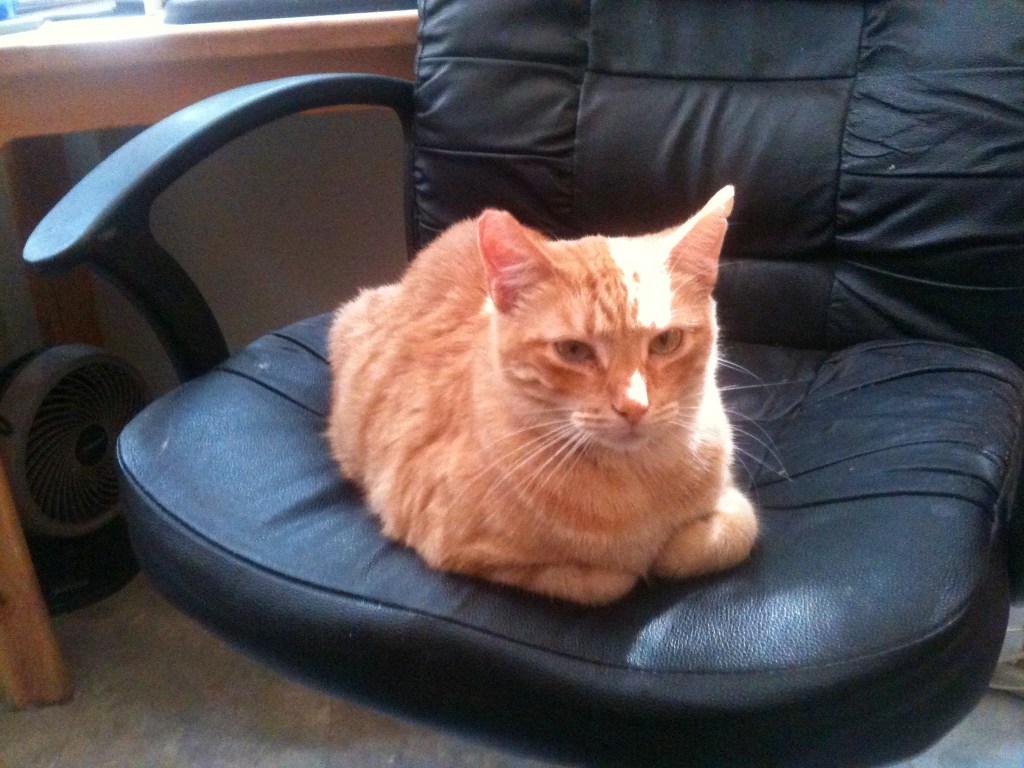
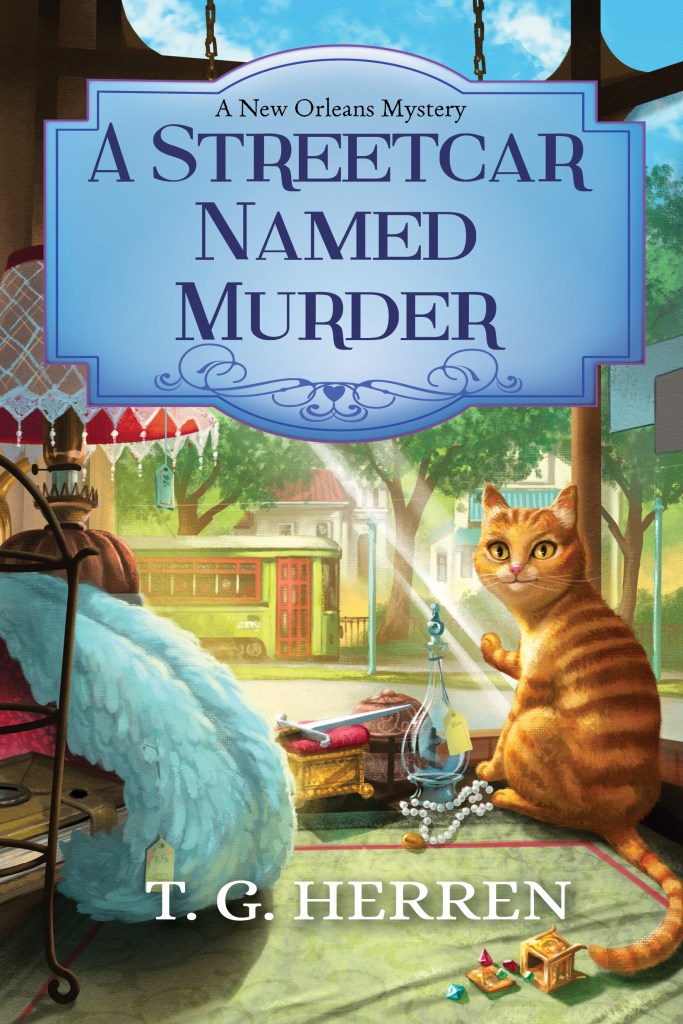
I think the thing I love the most about the cover of A Streetcar Named Murder is that the cat looking back over his shoulder with the bitch please look on his face was modeled on Scooter.
I’ve been putting my cat into books for a while now. Our Skittle was Paige’s cat, and I know I gave Taylor a cat in the Scotty books, but I don’t remember if it was Skittle or Scooter (and I need to find that out).
I never thought of myself as a cat person, to be honest. I think this was primarily because I never spent time with cats when I was a kid; I had a dog growing up and most people I knew also had dogs. If they had cats, well, the cats were aloof and uninterested for the most part, but every once in a while I’d be at a friend’s place who had a cat and their cat just fell in love with me for some reason–I’ve always attracted people’s pets, which is cool because by and large I do love animals–but it never occurred to me to get a cat. Paul also had dogs growing up, so he always kind of wanted us to get a dog. Much as I love dogs and much as they love me, though, I don’t have the time or the patience to have one, so I always nixed the idea of a pet. But that first winter we lived in the carriage house we had a mouse–and of course wanted to be rid of it. “It’s an old house in an old neighborhood,” our neighbors and landlady advised, “and the best way to get rid of a mouse is to get a cat.”
A cat?
But the mouse was freaking out Paul–I wasn’t thrilled to have one, but could manage a cold-war of tolerance with one if need be–and so we decided to go ahead and get a cat. It was Christmas Eve, I remember that, and we headed down to the SPCA in the Bywater. We looked at one, who seemed interesting–orange and big–but when the girl opened his cage he hissed at us all and clawed her hand. (I know now that he was probably terrified, hence the reaction, but what did I know about cats? All I saw was a mean one, and if it would claw the hand of a caretaker, I didn’t know how well he’d adapt to our house and our lives…) But there was a kitten in a nearby cage who kept sticking his paws out and chirping at Paul to get his attention, and once Paul started paying attention to him, he was purring and rubbing against the bars trying to get to us. The girl took him out of the cage and he started purring even louder. He was purring so loudly they couldn’t hear his heartbeat. We decided to take him, named him Nicky, paid the small fee and brought him home. I walked over to Walgreens to buy litter, food, a litter box, and a carrier, and thus we had our first cat. We never called him Nicky–the only person who ever did was our landlady–but he was amazing. Very loving, but at the same time a good hunter who could jump really high to take a bug out of the air, and of course he was beautiful, just beautiful. During the evacuation for Katrina Paul and the cat stayed at his mom’s–and his mom was the one who started calling him Skittle, because he “skittered around playing chasing things.) We had Skittle for almost seven years when he got the cancer, and it spread very quickly. The day we had to put him to rest was one of the hardest days of our lives–Paul was so depressed he barely got out of bed the entire weekend–and the apartment felt empty and lonely without our cat. The illness and the decision had been so hard on both of us to make that I kind of didn’t want to get another pet because I never wanted to go through that pain again, and Paul felt the same.
We lasted less than a week.
I went to the Cat Practice to pick up Skittle’s ashes on a Thursday after work. While I was waiting–I always have to wait whenever I am there–I always go around and look at the cats they have looking for forever homes (while I always hate having to leave without bringing them all home, it’s also kind of sad if there aren’t any there). In a cage behind the front desk was an orange boy, and according to the label on his cage his name was Texas and he was two years old. I walked over, and he was so friendly and loving–purring and rubbing against my hand–that I seriously thought I should bring you home with me, sweet boy,
That evening, we were watching something on television that wasn’t terribly involving–I was scrolling through the iPad and Paul dozed off on the couch. Suddenly Paul sat up with a gasp and said,”Oh my God!” and insisted he’d woken up and seen a mouse sitting on the lip of our garbage can. I saw nothing–and I’d looked over when Paul sat up, but not specifically at the can, so I could have missed it–but I also didn’t hear anything. (I will also confess to not hearing well–I’ve always been hard of hearing, and now that I am getting older it’s getting worse, so me not hearing anything isn’t as conclusive as it might be coming from someone else.) I just assumed he dreamed it, but he was insistent, and equally insistent we had to get another cat. I mentioned seeing Texas that afternoon, suggested Paul go see him in the morning on his way to work, and if he wanted him, to go ahead and get him, and I would swing by to pick him up after I got off work.
Needless to say, not only did I go pick him up after work, Paul went with me. We got him home, he immediately hid under the coffee table, so we decided to let him acclimate. It literally took about fifteen minutes before he came out from under the table, climbed up onto Paul’s chest and started purring. His coat was a little rough, but within two days he was soft as silk. Paul loves nothing more than to cuddle with the cat–Skittle tolerated it for a while before escaping–and we picked the absolute right cat: Scooter loves to cuddle and wants nothing more than a warm lap or body to curl up and sleep on. He will literally come and howl at me while I am working on my computer because he wants me to morph into a cat bed in my chair.
So, of course I gave Valerie a cat, named it Scooter, and made him a sweet orange boy, like ours. When they were designing the cover, I did tell them the cat was actually MY cat, and they asked me for a photo to give to the artist!
I am delighted that Scooter will live forever on the cover of my book.
What is a cozy mystery without one? I don’t know because I’ve never read one that didn’t have a strong sense of community in it, but for me, the depictions of community is one of the primary draws of cozies.
As I have mentioned before, the vast majority of cozies are generally set in small towns, small communities where everyone always seems to come together, everyone knows everyone, and there’s an undercurrent of caring about others that makes them cozy and comfortable to read. I was worried at first about setting one in New Orleans, to be honest; New Orleans is many things to many different people, but I’ve kind of always seen New Orleans as a darker city than most, and that darkness that is always out there on the periphery of the bright sunshine, no matter how cheerful you might be or how lovely of a day it is. Part of it is the history here–New Orleans was a center of the slave trade, after all, and you don’t get much darker than human trafficking–and of course, the city has always been a major port…and ports aren’t exactly known as sedate places. There has always been a lot of crime here, and you really can’t go anywhere in New Orleans without overhearing people talking about the “crime problem” and shaking their heads at the decline of Western civilization as we know it down here by the riverside.
So, how can I write a light, breezy novel about a city that is so dark?
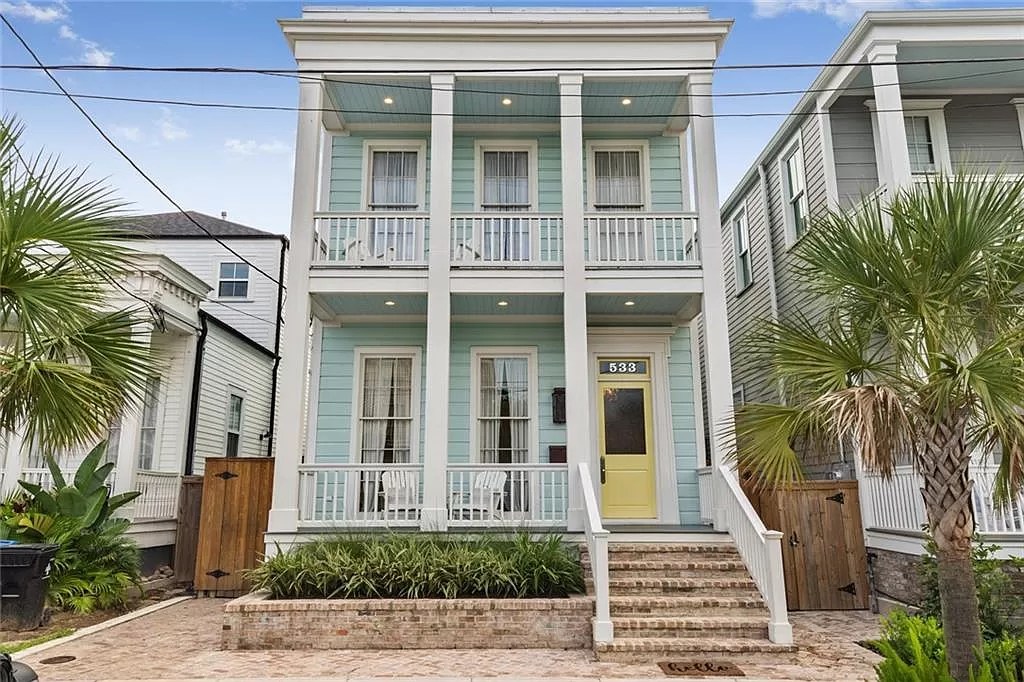
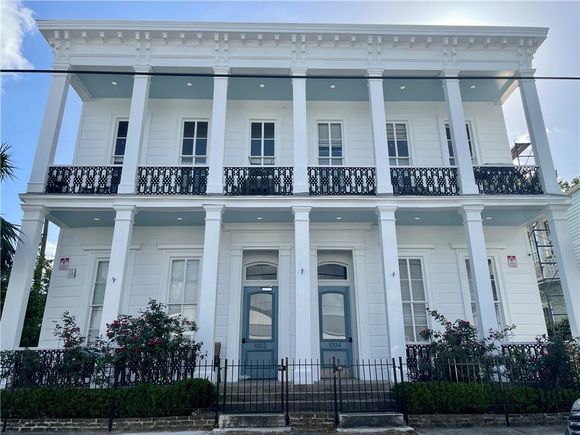
The key was community, of course. New Orleans is a city, but it’s also a city of neighborhoods, and always has been. Generations of families passed homes and property down to their children and their children and so on. “Where’d you go to high school?” was a question asked because the answer told the asker lots of things. Private school or public? What neighborhood did you grow up in? And as I thought more about it, I realized my lonely block in the lower Garden District has that sense of community to it. Neighbors look out for neighbors. We’ve lived in the same place since either 2002 or 2003; I’m never really sure I can remember when we moved onto the property; those years between moving back here in 2001 and Katrina are kind of blurry for me. But we’ve gotten to know our landlady pretty well as well as some of our neighbors; others have come and gone over the years but we always all end up down at the corner for parades during Carnival, catching throws and hanging out and having a good time.
And I realized I could do the same for Valerie.
In A Streetcar Named Murder I only introduced the reader to a few members of Valerie’s community in the Irish Channel: her best friend and neighbor Lorna; the gay couple next door in one side of a double and one’s mother, Mrs. Domenico, on the other side; and her friend Stacia who lives further down the street. I also mentioned there were a couple of houses being used as Air BnB’s, which may play a part in a book should the series get picked up. I had learned my lesson from the failed Paige spin-off series years ago; the mouthy, brash and snarky best friend cannot be the main character, but the book/community needed someone like that in the book. The main character has to be kind–but there’s always a more colorful secondary character necessary to say the funny and borderline mean things in place of the main character.
This is where Lorna comes in.
Lorna is very colorful indeed, and was a lot of fun to create. She’s married to an airline pilot who is often gone for long stretches of time (his name is Jack Farrow; since he’s a pilot she calls him Captain Jack Farrow). She’s British, speaks multiple languages, is fiercely intelligent and doggedly loyal. She also writes lusty romance novels that are huge bestsellers under the name Felicity Deveraux. Lorna is a great best friend who is also always up for anything, and naturally, she has a huge imagination and a big personality. Interesting and fun as Lorna is, I don’t think I would ever write about her as the main character because, like Paige, she would need to be toned down and I don’t really want to do that to her.
It is Lorna’s ambition to join a Mardi Gras krewe that actually puts Valerie at the scene of the crime in the book. See how that works?
But her neighborhood isn’t her only community, either; there’s a community around Rare Things, the antiques store she inherits–Randall Charpentier, her new boss; Dee, her co-worker; and of course the people who are in and out of the shop–the hot guy from an outer parish who repairs and refinishes furniture, for one–on a regular basis. If it becomes a series, I can flit the cases back and forth from her neighborhood to the store and vice versa; there are all kinds of plots and stories I can tell that could come from both.
And there’s still another community that Valerie belongs to that was only touched on in the first book–the parents’ group at Loyola High (it doesn’t exist in real life, folks, but it’s based on Jesuit), the Cardirents. This is how Valerie knew the victim in this book; they were both in the group, with a fraught history (which is more fraught than Valerie ever knew).
So, yes, it is possible to create the sense of community a cozy mystery requires in New Orleans; New Orleans, in fact, is ripe for it.
And on that note, I will sign off here. More blatant self-promotion to come, no worries on that score!
Writing a cozy set in New Orleans seemed, at first, to be a little daunting.
One of the key tenets of a cozy is the sense of community one gets while reading it (see Donna Andrews’ Meg Langslow series for the perfect example; I love Caerphilly, Virginia, and enjoy revisiting twice a year to see how everyone is doing), and it took me a moment to readjust my thinking from “community means a small town” to “no, you moron, anything can be a community; and you can certainly find community in New Orleans.” And then I remembered Leslie Budewitz’ superlative Spice Shop series, which is set in Pike’s Market in Seattle. Seattle is a city, just as New Orleans is; and sure, it might be easier to just invent an entire new fictional small town to set a cozy series in, but if anything, there’s more sense of community in New Orleans than I’ve ever felt in other cities…and it was really about creating a community around my character, Valerie, and picking a neighborhood for her in which to live took me a while as I weighed pros and cons; the only thing that was definite was she was NOT going to live in the French Quarter (there’s a throwaway line where she thinks about how long it’s been since she’s been to the Quarter, and maybe she and her two best friends should arrange to have dinner at Galatoire’s or Antoine’s–yes, I used two of the better known restaurants in the city and the Quarter for the examples, but I also knew I could mention them without needing to explain them to the reader). I did go back and forth about the Marigny or Bywater, but finally decided to put her into a neighborhood that did not flood during Katrina, which narrowed the choices dramatically.
New Orleans is a city of neighborhoods, and those neighborhoods used to be so distinct that knowing what part of the city someone lived would automatically create some assumptions–just as how the ever-popular question of where’d you go to high school used to be another way to connect with someone you’ve just met–there are any number of differences between those who went to Newman or Jesuit or Holy Cross or Ursulines or Ben Franklin or Warren Easton or McMain Magnet. New Orleans is a small enough city that chances were, you’d also know (or ar related to )someone else who’d gone to that high school at the same time, or you also knew other people who lived in their neighborhood. Obviously, the French Quarter is perhaps the most famous neighborhood in New Orleans, followed by the Garden District, working down through the Marigny, the Bywater, Mid-city, Gentilly, Lakeview, Broadmoor, etc. (With the gentrification of the city over the past sixteen or so years, realtors have also started creating new neighborhoods–which can be confusing. For example, they are trying to rebrand the Central Business District–the CBD–into SoMa, South of Market, which makes no fucking sense whatsoever as there is no market for the area to be south of; I often will have someone mention one of these new neighborhoods by name to me and I have no idea what they are talking about. They are also trying to rebrand the 7th Ward as the “new Marigny”…good luck with that.)
Scotty lives in the Quarter, and Chanse lives in the Lower Garden District–I’ve also written a lot of stories set in that neighborhood, which is also where I’ve always lived, and is quite distinct from the actual Garden District–I used to joke that we lived four blocks and three decimal points from the Garden District. So having done those neighborhoods already extensively, I wanted to pick a new place for Valerie to live and for me to write about.
I’ve always kind of been partial to the Irish Channel, although we’ve always lived in the Lower Garden District (distinct from the Garden District). I wrote one book about the Irish Channel already (aptly titled Murder in the Irish Channel), and of course, when I needed a place for Valerie to live, I decided the Channel would be the perfect place for her. Twenty years or so ago there will still blighted and crumbling houses in that neighborhood just waiting to be purchased, renovated and gentrified. The stretch of Magazine she lives near used to be one of my favorite parts of the city–I met any number of people for coffee at the Rue de la Course that used to be there, I used to really enjoy the Semolina’s restaurant as well as the Middle Eastern place whose name I can’t remember now (Byblos? it was the last restaurant meal in New Orleans before Hurricane Katrina), and of course I sometimes shopped at the A&P or the Walgreens–before I realized Prytania and Tchoupitoulas were the easiest and quickest ways to get uptown; I wasted a lot of time stuck in Magazine Street traffic back in the day. Our friends Carrie and Lisa used to rent half of an enormous Victorian house near Third and Constance; I loved that enormous, drafty and dusty old house (it’s actually where my main character in my in-progress novella Never Kiss a Stranger lives), and was very sorry when they moved further uptown. Paul and I used to have a lot of fun looking for costumes and other home decor in the numerous thrift shops on Magazine; the one for St. Vincent de Paul (at the corner of Robert and Magazine, which eventually closed and became a Vitamin Shoppe; I don’t think the space is currently in use) was amazing. They used to sell handmade wooden tables and bookcases, made by monks in a monastery somewhere in northern Louisiana, and this furniture was not only solid, but it was inexpensive. We still have the bookcases and tables–one of them is my desk, the other is Paul’s–and I don’t think we spent much more than a hundred dollars on the two tables and the four bookcases. We must have bought that all after we moved back here after the year that should be forgotten; we didn’t move much furniture there or back.
But oh, how I would love to get some more of those bookcases. They are sooooo solid…
Plus, putting Valerie in the Irish Channel gives me the opportunity to write about St. Patrick’s Day–which I’ve never done with either of my other series–at some point in the future.
The Irish Channel obviously takes its name from the fact that many Irish immigrants settled there when they came to New Orleans. The Historic Landmarks Commission defines its boundaries as Jackson Avenue to Delachaise Street and Magazine Street to Tchoupitoulas. However, the New Orleans City Planning Commission defines the boundaries of the Irish Channel as these streets: Tchoupitoulas Street, Toledano Street, Magazine Street, First Street, the Mississippi River and Napoleon Avenue.
See what I mean about how confusing the city can be? We can even properly define the boundaries of our neighborhoods. I’ve always considered the Channel to start at Jackson (as does the Garden District proper) and end at Louisiana; with the other boundaries Magazine and Tchoupitoulas.
But I did think having her live so close to Louisiana Avenue–between Seventh and Harmony–would put her right smack dab into the heart of that neighborhood and in walking distance of practically anything she might need. I wanted her to be able to be able to do her errands most of the time on foot, because that also (in my mind) cemented the sense that it was a neighborhood and a community, if that makes sense? And once I’d picked where she lived, I was able to start building her community around her.
It literally has everything I love (well, most of it, at any rate): the St. Charles streetcar, Scooter, and all kinds of fun antiques and artifacts–and so brightly colored and beautiful. They even slipped in a strand of beads cleverly disguised as pearls! It is one of my favorite covers, and not just because it doesn’t have a shirtless man on the cover–I know, I know, it’s been awhile since I actually had one–certainly it’s been since Royal Street Reveillon–oops, no, Survivor’s Guilt and Other Stories is post Royal Street Reveillon, so I guess it’s just the last two young adults and this one since then. And as I said, I really love the color scheme. I may have to have this blown up into a poster and have it framed–that’s how much I love it.
So, who is this Valerie Cooper and why did I decide to write about her and from her point of view?
I’d written from a female perspective before–under pseudonyms–and since I generally relate easier to women than I do to (straight) men, most of my reading is from a female point of view. I’ve always wanted to do a series from this perspective; on the rare occasions I’ve written from a straight man’s point of view (usually in a short story, although occasionally under a pseudonym for a novel) but not as often. I had thought about trying to write a cozy series from a male perspective (I have a great idea for one that I don’t think anyone would buy or want, but I love the idea and may try to do something with it sometime) but eventually defaulted to a woman. Most cozies are told from the feminine perspective (there are exceptions), and so it felt more right to have a female protagonist. I learned from the Paige series being marketed as cozies (which they weren’t) that the strong, sarcastic, borderline bitchy doesn’t play well within that subgenre, and so since I knew I was specifically writing a cozy this time, I knew to follow the rules.
One of the things I had noticed in the cozy series I read is that usually the first book in the series follows a transition of sorts for the main character (Mia P. Manansala’s flopped in the big city and returned to her small hometown; Raquel V. Reyes’ character has just moved back to the Miami area from New York, so she’s happy about it but concerned on others–read the book, you won’t be sorry; others have just gotten divorced, walked on a cheating partner, etc. etc. you get the drift), and I wanted to do something a little softer and less jarring–so I went with her being a youngish empty nester. Married young to a handsome fireman several years older (six, to be exact) she is left a widow when he is killed on the job to raise their twin sons by herself. She’s not worked outside the home since she was a teenager, and now the boys are off to LSU and she’s home alone in the big Victorian house she and her husband bought as a fixer-upper and then renovated while raising the kids. The house is done, her husband is dead and her kids are at school–so she is now finding herself at loose ends and not really sure what to do with herself. She dropped out of college after her marriage when she found herself pregnant–not planned, but not a disappointment, either–and now is considering going back to get her degree at UNO, or maybe finding a job–but what can she do?
I did worry about her not having finished college and just being a stay-at-home mother. It didn’t seem very pro-woman to me, but then I chastised myself. My sister was a stay-at-home mom, and I remember that when she finally was given the choice, my mother was one as well…and I realized I was falling into the wrong mindset about Valerie to begin with–there’s nothing wrong with a woman deciding to be a stay-at-home mom and not ever really working outside the home; the point of feminism is that women should be able to choose what they want rather than have limitations placed on their decisions (which a lot of non-feminist women do not understand), and why not write about a stay-at-home mother now finding her own way in life? I also wanted to surround her with friends and support–so she lives next door to her best friend (they became friends after the woman moved in next door) and is also close to Stacia, a divorced lawyer who lives down the street. The gay couple next door in a double shotgun, Michael and John, are also friends, as is John’s mother, who lives in the other side of the shotgun. Her own parents have retired to the Gulf Coast of Florida, and she is very close to her late husband’s family, the Coopers.
Her name is Valerie because I’ve always liked the name (it’s one of my favorite female names, along with Laura), and I picked Cooper because it’s a friend’s maiden name. I decided to make her be an actual local; born and raised in the city–but her parents are not from New Orleans; they moved here for the father’s job. So she was born here, but she wasn’t born into any of the many striations of social class here. Her parents weren’t connected to old-line New Orleans, they didn’t belong to any Mardi Gras krewes, and Valerie herself–while going to Sacred Heart–never got involved in any of the Carnival stuff, preferring, as she says, to participate by going to parades and catching throws. She’s also an only child who thinks of her late husband’s older sister Therese as a kind of replacement older sister since she didn’t have one.
I wanted to upset Valerie’s tame, placid, almost boring life with a series of shocks that upend everything about her life and what she believed she knew about her life, her house, her late husband–and what better way than to have her realize, thanks to someone else–that the notice she got from the city about the house being reappraised for taxes and didn’t think too much about could actually become a big catastrophe for her. The house they bought so cheaply and renovated could now be worth vastly more than she and Tony paid for the house (I named her husband Tony because I’ve always liked that name for a man; Scotty was almost Tony) because their neighborhood, sketchy and dangerous when they moved there, has been gentrified (as so much of the city has been) and when someone she knows and doesn’t like (a very thin line there I was worried about crossing by introducing that character–toning it down to a Valerie level of dislike was something I really had to pay attention to) lets her know what the market value of her home might actually be–Valerie instantly goes into financial panic mode. If the house is worth ten times what they paid for it, wouldn’t that mean the tax assessment would also got up times ten? She’s run into the woman while picking up fresh shrimp at Big Fisherman Market on Magazine (right there by what used to be the A&P and now I can’t recall what chain went in there? BREAUX MART. Whew, was getting a bit concerned there about my brain working) and walking back home, turning it over and over again in her mind as she reflects how much the neighborhood has changed since she and Tony first moved in–and then when she gets home, she finds out a registered letter from a lawyer has arrived for her.
And nothing in her life is ever the same again.
Essentially, the letter lets her know that she and her sons have received an inheritance from an uncle of Tony’s she never knew even existed, and it includes Rare Things, an antiques business on St. Charles Avenue in the lower Garden District, and the story is then off and running.
I do really like Valerie. I hope readers do, too–because I’d like to keep writing about her.






 Queer and Loathing in America