Santa Baby

A gazillion years ago I edited a queer Christmas anthology, Upon A Midnight Clear. Back when I was new to the business and wanted to change the world (oh, how I miss that youthful naivete and optimism–even though I was in my early forties), one of the things I had noticed–in my limited experience and knowledge of all things publishing, including the queer side of things–that there weren’t many Christmas stories from a queer perspective or with a gay man as the center of the story. (A major exception to this was Jim Grimsley’s beautiful novel Comfort and Joy, which is still one of my favorite gay novels; he also published a short story excerpted from the book that was published in one of the Men on Men anthologies–the story was also called “Comfort and Joy”. When I signed the contract for the Christmas anthology, you can best be sure I immediately emailed Jim and asked for reprint rights, which he very graciously granted.) So I decided to combat this by doing a Christmas-themed anthology for gay men, by and about and for gay men. I later found out that there had been a previous one (edited by Lawrence Schimel, if I am remembering correctly), and there have been some books and stories and novellas since then.

As is my wont, I tend to forget about Upon a Midnight Clear–it was, after all, pre-Katrina and pre-Incident–but every once in a while I remember it and think about it….and it’s usually because I opened the introduction by quoting Bette Davis as Margo in All About Eve: “I detest cheap sentimentality”–it’s a favorite quote of mine, and it pops into my head all the time, and I used it in this instance to express how annoyingly sappy most fiction–be it short stories, novels, television shows, or films–can be when it centers Christmas. It was a labor of love in some ways–for me especially, trying to reinvent my own feelings about the season–and it might be time for me (or preferably, someone else) to take another run at another gay Christmas anthology; Upon a Midnight Clear has been out of print since 2007, and while i know there have been others in the years since, I kind of would love to do another one…or perhaps one of Christmas noir.

Ooooh, I really like the sound of that.

I made some good progress on Chapter 18 yesterday, and fully intend to finally wrap that chapter up tonight and perhaps begin Chapter 19. It’s very cold again this morning in the Lost Apartment, but I have solved that issue–someone suggested to me on Facebook (I believe it was Carolyn Haines) that I buy electric blankets, and it was literally one of those moments when you think duh, how fucking stupid am I, really? In my own defense, I’ve never owned an electric blanket and we never had any when i was growing up, so I have no experience with them and it probably would have never occurred to me to get one. I ordered two from Macy’s, they arrived last week, and Paul and I broke them out last night while we were watching The Hardy Boys (which I am really enjoying much more than I ever thought I would), and yes, game changer. I am sitting at my desk right now wearing sweats, a ski cap (purple and gold LSU of course) and my electric blanket is covering my lap and it is MARVELOUS, just as it was last night.

And Scooter was absolutely in heaven last night with the electric blankets.

Today I am working from home and slept amazingly well last night; I also stayed up longer than I had intended to, which also had something to do with it. I had some writing to complete for a website–due yesterday-but the materials I needed to write about never arrived so yesterday I spent some time coming up with a work around, which I think wound up working splendidly. The writing I did yesterday also went swimmingly well; I believe my main character is really taking shape and so is the story, and I am very excited about getting this book out there for everyone to read. I am nervous about it, of course, just like always; but I am taking some risks with this book and I am pushing myself creatively. The more I work on this book, though, the further away another Scotty book seems. I had an interesting conversation on Twitter the other day (other week? who the hell knows? Time literally has no meaning anymore) about private eye novels, and I expressed that while there are certainly still good ones being written, the subgenre feels a little on the stale side to me these days; and I also confessed that this could have everything to do with my already having written fifteen of them. The stand alones I started writing and publishing in 2009 (or 2010; see earlier comment about time having no meaning) gave me enough of a break from writing the private eye novels so that I always came back to them feeling fresh and invigorated, much as how alternating between Chanse (serious) and Scotty (more silly) used to help me stay fresh with both series. I feel like Royal Street Reveillon was probably the best Scotty I’ve written in a long time; I was very pleased with how the book turned out, and from time to time I think well, that one turned out so well that might be a good place to stop–and then I remember I left Scotty’s personal story on a cliffhanger, and I probably need to get that wrapped up at some point. But once I finish these two contracted novels, I want to work on Chlorine, and there’s another paranormal New Orleans novel bouncing around in my head–Voices in an Empty Room–but I might be able to put that aside to work on another Scotty–although I have to admit there’s also a Colin stand alone bouncing around inside my head as well.

But then maybe my brain is just overloaded at the moment.

And on that note, tis back to the spice mines. Have a lovely day, Constant Reader!

Jingle Bell Rock

Constant Reader may have noticed that I have started using Christmas songs and hot guys in Christmas costume, effective this past weekend. This is my annual countdown to Christmas–twelve days leading up to it rather than the twelve after; most people wouldn’t get that I was doing Christmas to Twelfth Night (which is the night Carnival technically begins–but we aren’t really having Carnival this year in New Orleans, yet another crippling blow to the city’s economy), and I prefer to confuse people as little as possible–particularly since it is generally so easy to do, frankly.

It’s dark and cold this morning as I sit sipping my cappuccino; it’s a mere forty-eight degrees outside, with the high for the day projected to be a toasty fifty-nine degrees. It was cold last night as I walked to the gym–yes, I went after work, which was nice and felt great, and then it was back home to write for a bit before bed. I was very tired–getting up early AND the gym–but I did get some work done on the complete overhaul of Chapter Eighteen, which is going to slow me down considerably, but it’s actually okay. I still have time, and if I can get more than one chapter done in a day I’ll still have time to get it all done and let it sit momentarily before sending it in after one last polish. I did get the final cover design yesterday, which is absolutely gorgeous; definitely one of my favorite covers.

We also watched a couple of episodes of The Hardy Boys before retiring for the evening, and I have to say, I am very impressed with the show. I get why the purists object to it, but the show is better written, acted, and plotted than the dreadful 70’s iteration, which the purists seem to love. But oh no! Diversity! The boys aren’t a year apart! Aunt Gertrude is too young and goes by Trudy! THE HORROR! I think it’s well done, and the series is very close to the spirit of the books–if not as cardboard and two dimensional and simplistic–which has me curious to give Nancy Drew another whirl. (In fairness, I also liked the first episode of that reboot, but I watched it by myself one night when Paul was working late and never got back to it.)

I think maybe this next year will be the year I try to write my middle grade series.

But I slept really well last night, and don’t feel tired at all this morning, which is absolutely lovely. I have taken the week off between Christmas and New Year’s, which means I’ll be out of the office for nearly ten days (New Year’s Eve is a workday, but it’s also a work-at-home day, which means…out of the office for nearly ten days), and I am looking forward to that. It’s also an opportunity to have a lot of down time in case I need it for finishing the book–which hopefully I won’t need–and it will also give me a chance to get started on the final rewrite of the next one, due on March 1, and after that, I will focus on Chlorine until I can get a good first draft out of the way. I ordered The Man Who Invented Rock Hudson yesterday, and it should be here by the weekend, and it’s the final piece of research I need for the Hollywood casting back ground stuff. I will also need to do some other background reading–studios, economics of the period, what else was going on, what was LA and Hollywood like in that period, etc. And perhaps at long last I will also read James Ellroy’s LA Confidential–it seems fitting.

Oh! And I. need some time to finish my short story for the MWA anthology, which will hopefully make it stand out from the submissions pile and get selected. One more thing to scratch off my “bucket list”–get into an MWA anthology. I wish I had some things ready to end out for submission, but alas, I don’t. Maybe “This Thing of Darkness”, after a bit of a tweak, and “Death and the Handmaidens”–again, after another tweak or two–but I hate that I’ve not sent any stories out for submission lately. I also want to finish some of these that I’ve got started.

So. Much. Writing. To. Do.

And on that note, tis back to the spice mines with me. Have a lovely Tuesday, Constant Reader, and hope you’re having as lovely a holiday season as a pandemic will permit.

This Love

Today’s working from home adventure will be interrupted by a trip to the office for a working lunch! I love when we get paid to do work and get fed at the same time. One of the drug companies is doing a brief training for us, and they are treating us to lunch from Mona’s on Frenchmen. I miss Mona’s; when I worked all those years at the office on Frenchmen Street I used to treat myself to Mona’s periodically–their gyro plate was my go-to, always, and I’ve been missing my gyros, so you can imagine my delight when I learned about this training.

Huzzah, indeed!

Free lunch is always a plus.

I also have errands to do at some point, and I probably should go to the gym this evening. I plan to be super-productive today–I am going to watch The Stunt Man while I am making condom packs this afternoon as well–and of course, there are any number of household chores that need to be completed. Ugh, so much cleaning and picking up to do around here, as well as writing to do. I made a pretty decent start on Chapter 17 last night, so hopefully tonight I can get through it and Chapter 18; and with a strong push this weekend I can almost get all the way through the rest of the book, which would be amazing and would put me way ahead of schedule. So, that’s the goal for this weekend, at any rate. I also want to finish The Spy Who Came in From the COld, because I got a very advance copy of the next Alison Gaylin novel, The Collective, which I cannot wait to dive into.

If I can get the book finished this weekend, I can then spend next week working on short stories before diving back into the book’s final pass, and I might even be able to get it turned in early. I am also looking forward to getting the final cover design–which I fucking love–at any minute. I approved the final proof of it yesterday, and so it should be arriving in my inbox at any time. I am also feeling a lot more confident about the book itself, which is always a good thing; this final revision, I think, is helping to really pull it all together.

We tried watching His Dark Materials last night. I’ve never read the books, but that doesn’t mean I can’t watch and enjoy the show (I’ve still only read the first book in A Song of Fire and Ice, but that didn’t stop me from enjoying Game of Thrones both before and after I read the book), but there was too much going on that I didn’t understand and thus made it much harder to follow. Paul fell asleep–which should give you an indication of his level of enthrallment–and so I think we’re going to take a pass on it. We also started watching the new Hulu adaptation of The Hardy Boys (if you will recall, I was highly amused that the kids’ series fan pages were in a major uproar about the show and the changes made to it from the books, and I will agree, those changes are substantial enough to make you wonder why they bothered calling it The Hardy Boys–but would a show called something else get any traction?), which I liked just fine, even if it was a lot darker than anything ever seen in the books. I mean, their mother is murdered in the very first episode–the Hardy Boys, at least in the original series, never dealt with anything so dark and scary as a murder–and instead of the Hardys having always lived in Bayport, they live in “the city” and move to “Bridgeport” during the premiere. They’ve also turned Biff Hooper into a girl (I don’t have a problem with this) and overall, it’s not bad and we’ll probably continue watching. (I will, at any rate; Paul may not) I also want to give the CW series adaptation of Nancy Drew another shot; I actually liked the premiere, but never went back to it from there.

And seriously, there is such a book in these rabid fans and their reaction to changes to their sacred texts.

I also would like, at some point in 2021, to start pulling together my own kids’ series. It has been something I’ve wanted to do since I was a kid, and lately I’ve been feeling that gravitational pull to writing a kids’ series again. Oh, I know I have two books scheduled for deadlines already and that I need to dive into Chlorine once I get these both out of the way–and there’s probably another Scotty book out there I should write (at least the one)–but as I have mentioned more and more lately, I am becoming much more conscious of running out of time; when I was in my forties, it seemed like there was all the time in the world to write everything I wanted to write. Now that I am approaching sixty like a bullet, and more ideas come to me all the fucking time, I am becoming highly aware of the finite amount of time I have and that I am not going to be able to write everything I want to write. It’s a shame–I really have too many good ideas that will probably go to waste–but you know, that’s kind of how life works.

And on that note, tis off to the spice mines with me. Happy Thursday, everyone.

The Way I Loved You

I feel so much better that I’m almost afraid to trust it, frankly.

Last night I fell back into the Internet wormhole about the protective forts built to safeguard New Orleans years ago–there are more of them than you might think, and sadly, most of them are either unsafe to visit or hard-near-impossible to reach (Fort St. Philip particularly; only accessible by helicopter or boat). I’m thinking of debuting my fictional interest in Fort St. Philip in a short story–the idea came to me last night, and while it’s not fully formed, it’s there–but while making notes (as I did madly yesterday, and not just about Fort St. Philip but about the other forts protecting the city) it started coming together for me. We’ll see–I still have to work on the revisions of “The Snow Globe” and I still need to finish writing “A Dirge in the Dark”–and I am not entirely certain how one would define the story in the first place.

I slept really well again last night, which was lovely I am apparently adapting (at long last) to this “get up early” schedule, which is, while emotionally an unappealing thought, rather satisfying. I am hoping to be really productive today–have to go to the gym tonight after work–and then back to the story. We got caught up last night on this week’s episode of The Undoing, which I am finding more and more interesting with each episode–although my initial suspicion was the plot twist at the end of this week’s episode.

I’m feeling better now than I have in a very long time. I’m not entirely certain why that is–perhaps I am finally getting used to life in a pandemic? And while I am not entirely on board with the idea that I am used to life in a pandemic–it’s not something I think any of should have to get used to, intellectually–it is what it is, and I of all people need to get out of this weird stasis feeling I’ve had since March and get back to working on my writing and getting this apartment back under control. I also would like to get back into my reading groove; I’ve not read anything in novel form in quite some time and I really do need to get back into reading again. Reading always inspires me and helps get me into my writing groove, and The Hot Rock, cleverly written and intricately plotted, should prove inspiring.

I have several other books on hand that I am interested in getting to read soon–which I will not do until I am finished with The Hot Rock–including a reread of The Bad Seed, which I’ve not read since I was a teenager, in addition to an old Fletcher Knebel story, Night of Camp David, and I do want to reread Shirley Jackson’s Life Among the Savages–and of course, there are short stories everywhere.

The LSU-Alabama game this weekend is in question because of COVID positivity amongst the LSU team; if the game is cancelled, it’s just going to be cancelled, as LSU is out of bye weeks and has already had to reschedule the Florida game, and there simply is no more time in this abbreviated schedule to reschedule this game. I am not saying this wouldn’t be an enormous relief for LSU fans, but the way they team is playing, and the way Alabama is playing this year–well, it would be an extremely excruciatingly painful experience for the team and fans. It’s already questionable whether I would inflict such pain on myself by watching–the collapse of the LSU program this season has already been horrific enough to witness–but what kind of fan would I be if I gave up on them? I never gave up on the Saints–even in 2005–so it would be wrong for me to bail on this benighted season.

Yesterday, the preview trailer for the Hulu series adaptation of The Hardy Boys dropped, and as expected, right on cue, all the “fan pages” I belong to on Facebook went insane. IN-fucking-sane. (However I always find the collective outrage of fevered fan boys and girls most amusing.) My personal favorite was the person who stated that he “hates adaptations that don’t follow the book(s) strictly”–which made me laugh out loud.

Um…has any book ever been filmed and adhered strictly to the original text? Outside of Rosemary’s Baby and a handful of others….yeah, he must not watch a lot of adaptations.

I really need to write a Scotty book about kids’ series fans.

And on that note, tis back to the spice mines.

The Long Run

Not only do I write two private eye series, erotica, and the occasional stand alone,  I also, sometimes, write what’s classified as young adult fiction. I have not published anything that could remotely be considered y/a in quite a while, and therein lies a tale (I think the last book I published that could be considered “young adult” was Dark Tide; I could be wrong. I no longer remember when and in what order my non-series books came out).

To be clear, the fact that I even call those books “y/a” even though I don’t really think of them as young adult fiction is a marketing thing, really; in my mind, they’re simply novels I wrote about teenagers. I started writing about teenagers when I actually was one; the stories I wrote in high school weren’t bad, for a teenager, and were the first indication–from my fellow classmates, and my English teacher–that I could seriously become a published writer if I chose to try to do so; the utter lack of seriousness my writing aspirations received from my family was kind of soul-crushing. But I always wanted to write about teenagers, from the very beginnings; I wanted to do my own Nancy Drew/Hardy Boys style series, and then progressed to other stories.

I progressed as a reader pretty quickly when I was growing up; I went from the series books, like the Hardy Boys and Nancy Drew, and the Scholastic Book Club mysteries, to Agatha Christie, Charlotte Armstrong, and Ellery Queen when I was around eleven or twelve, if not younger; I know I read both Gone with the Wind and Antonia Fraser’s Mary Queen of Scots when I was ten. The few books I read that were considered “children’s books” (there was no such thing as young adult fiction then) were books like The Outsiders and The Cat Ate My Gymsuit and I did enjoy them; I just didn’t think of them as either being particularly authentic or realistic. Nor did they have any bearing on my life, or the lives of my friends–I viewed them like youth-oriented television shows like The Brady Bunch, existing in some bizarre alternate universe that has no basis in actual reality or what those of us who were that age were actually experiencing. I always thought there was something missing–complicated and authentic books about the lives of real teenagers and the real issues they faced everyday, without getting into the insanity of the preachy-teachy “issue” books that usually wound up as ABC After-school Specials, which I loathed. 

Not all “issue books” were bad, in all fairness; some, like Lisa Bright and Dark, about a girl struggling with mental illness whose parents refused to face their daughter’s reality, so her friends tried to help her by serving as amateur psychologists, and  I Never Promised You a Rose Garden, about a teenaged girl in a mental hospital dealing with her illness were actually quite good. But I loved books like The Cheerleader, about a poor girl in a small New England town with ambitions and dreams that far exceeded those of most of her friends…dealing with issues of popularity, sex, and first love.  David Marlow’s Yearbook was also a favorite, and while not marketed to kids, was about high school, but had some themes and plot-lines considered far too heavy for teens to digest in the 1970’s. You can also see it in the pap that was considered movies for teenagers; G-rated bubble-gum like The Computer Wore Tennis Shoes, and inevitably came from Disney and starred Kurt Russell. (These movies are an interesting time capsule; I did try to watch one of them recently on Disney Plus and didn’t last three minutes in that squeaky clean, sex-free college environment.)

(Also, I would like to point out at this time there were terrific books being published in the 1970’s for teens that dealt with major issues and were groundbreaking; Sandra Scoppetone was writing about queer teens back then, and there were some others doing terrific work at the time–I just wasn’t aware of those books until much later.)

My first three young adult novels–Sorceress, Sleeping Angel, Sara–were written as first drafts in the early 1990’s, put in a drawer, and forgotten about for nearly twenty years. Sorceress  had no queer content in it at all; it was my version of the truly popular trope of romantic/domestic suspense where an orphaned girl goes to live in a spooky mansion far away from her old life (Jane Eyre, Rebecca, almost everything written by Victoria Holt), and slowly becomes aware that everything in the house isn’t as it seems. It was a lot of fun to write–I loved those books and I loved putting a modern spin on them. Sleeping Angel’s first draft was never completed, and the published version is vastly different than what the original first draft contained; there are still some vestiges of the original plot there in the book that are never truly explained, and by the time I realized, after many drafts, that I hadn’t removed those vestiges from the book it was too late to do anything about it other than hope no one noticed. The book did well, won an award or two, and is still a favorite of my readers, according to what I see on social media. One of the things I added to the story was a queer subplot about bullying, which is what I think readers truly responded to, and I also feel like adding that to the story in addition to the other changes I made to it made it a stronger book. Sara was always intended to have gay characters and a gay plot; I originally started writing it as a novel for adults and realized, over the course of writing it, that actually the teenage story was the most interesting part and I could deal with some issues there if I switched the focus of the book to the teenagers. One thing that changed from the 1991 first draft to the draft that was published is that the character I originally had being bullied for being gay, even though he wasn’t (another character, one of the biggest bullies, actually was), was actually not only gay but had come out, and so the book also talked about the reverberations of a popular football coming out, and what impact that had on the school social structure and hierarchy.

Sara, incidentally, is one of my lowest selling titles–which also kind of breaks my heart a little bit.

Since those three, there have been others I’ve written–Lake Thirteen, Dark Tide–and I’ve also dabbled in what is called “new adult fiction”–books about college-age or just out of college-age characters–this is where The Orion Mask and Timothy and the current one I’m working on, Bury Me in Shadows, fall on the marketing spectrum.

One of the questions I had to deal with in writing young adult novels with queer content was the question of sex. I had already been through being banned in Virginia because I had written gay erotica (a really long story that I revisited recently with Brad Shreve on his podcast; I really do need to write in depth about the entire experience); what would happen if ‘notorious gay porn writer’ Greg Herren began writing fiction specifically aimed at teenagers? But the truly interesting thing about being used as a political pawn by the right-wing fanatics in the power games they play is that once they’ve made use of you, they forget about you and move on. My young adult fiction was released without a single complaint, protest, or any of the sturm und drang that my speaking at a high school to a group of queer and queer-supportive youth created scant years earlier.

Interesting, isn’t it?

And yet…there is no sex in any of those books. None. I don’t  remember my gay teens even getting a chaste kiss, let alone a sex life, or fantasies, or a boyfriend.

And what about desire?

A couple of years ago someone tagged me on Facebook on an article about just that very subject; that was when I started writing this post (three yeara ago, looks like) but I never finished writing this until this morning.

Go ahead and read it. I’ll wait.

Okay, welcome back. Some interesting points, no?

Now, check out this one. 

I know, it’s a lot of information to process, but it’s something we should all be thinking about, particularly as the calls for diversity in publishing and popular culture continue. Sex is, quite obviously, a touchy subject when it comes to young adult fiction, but when it comes to questions of sexuality and being a sexual minority, what is too much and what is not enough? Even depictions of straight sexuality is frowned on and controversial when it comes to young adult fiction. (For the record, that is also considered the case for crime fiction–no explicit sex scenes–or at least so I was told when I was first getting started; doubly ironic that my mystery series were what the right-wing Virginian fanatics considered porn–I really do need to write about that.)

I also have noticed the elitism evident in hashtags like #ownvoices and #weneeddiversevoices that have come and gone and return periodically on Twitter; those actively involved in promoting those tags, when it comes to queer books, make it abundantly clear they only care about those published by the Big Five in New York–which is a good target, I agree, and they do need to be doing better when it comes to diversity and “own voices” work–but this focus also ignores the small presses, particularly the queer ones, who have been doing this work all along and making sure queer books were still being published for all ages and getting out there and made available to those who want and need them. I am absolutely delighted to see queer books by queers being published by the Big 5, and young adult work in particular…and yet…there are some serious issues still with the Big 5–and with what is called ” young adult Twitter”.

I do find it interesting to see who they decide are the “cool kids” and who they banish to the outer tables with the freaks and geeks.

It’s part of the reason I don’t engage with young adult twitter, to be honest. I really have no desire to return to the high school cafeteria at this point in my life.

And I’ll write about teenagers whenever there’s a story I want to tell involving teenagers–which currently is the Kansas book; I turned my protagonist in Bury Me in Shadows into a college student because it actually works better.

And on that note, tis back to the spice mines with me. (And huzzah for finally finishing this post!)

Vulnerable

Today’s sexy man objectification photo certainly doesn’t seem like the right illustration for today’s title, does it?

He kind of looks like the alternate world Flash from the television show and turned out to be the villain of Season 2, Zoom, Teddy Sears, and I think he is in the second season of Netflix’s The Politician, as part of the throuple relationship Judith Light’s character is involved in. He is really pretty, even if he is not the guy in today’s picture, who is also really pretty.

But then assuming that a big muscular handsome man can’t be vulnerable as well is misandry, I suppose. Everyone, after all, can and should be–and definitely shouldn’t be afraid to be–vulnerable.

Yesterday was a good day–which seems to be par for the course lately, which is absolutely lovely. I got a lot of work done yesterday–granted, most of the day was spent making condom packs, which is my lot in life when it comes to working from home these days–but they are needed and necessary for the works kits we pass out during syringe access, and it’s hard to keep up with the demand. One of the nice things about making condom packs is I can watch something while I make them; the last two Wednesdays I’ve been watching The Mickey Mouse Club production of the Hardy Boys serial, The Mystery of the Applegate Treasure, which is loosely based on the first Hardy Boys adventure, The Tower Treasure. It was interesting to see the changes Disney made to the Hardy Boys to appeal more to their young audience–the Hardy Boys weren’t seventeen and eighteen, as they were in the books (I don’t recall how old they were in the original texts; Nancy Drew went from sixteen in the originals to eighteen in the revisions), and of course, Mrs. Hardy doesn’t exist in the serials. In fairness, their mother was never much of a character in the series–her name even changed from Martha in the original texts to Laura in the revisions–and their father’s sister, Aunt Gertrude, was more of an adult parental figure in their lives than even their father, and she replaces Mrs. Hardy in the Disney serials completely. The basic premise of the book is that the Tower Mansion is robbed, and suspicion falls on the father of their friend, Perry Robinson, who worked there; the burden of being fired means Perry has to drop out of school and of course, everyone in Bayport believes his father is guilty. Even in the revised texts, where a lot of the characterizations and color is dropped from the plot and the Hardys themselves become more two-dimensional, the way the Robinsons are shamed and ostracized by the town is very well-done; naturally, the Hardy boys, who want to be detectives like their famous father, go to work to clear the Robinsons.

In the serial, Perry is a juvenile delinquent from “the city” who is sent to Bayport to get away from bad influences, and works for crazy old Silas Applegate (in the book, his name was Hurd and he had a sister; both were known as “eccentrics”); soon Perry is framed for stealing tools and the Hardys, taking sympathy on him, take him on as a client. The Applegate treasure is an old pirate treasure of Jean Lafitte’s that was stolen from the mansion some ten years before; and no one really believes that it ever existed as Silas isn’t exactly mentally stable. It’s actually not a bad adaptation, and two of Disney’s biggest child stars, Tim Considine and Tommy Kirk, play the Hardys; any flaws it has are flaws of the time and the need for Disney (and pretty much all television shows) to sanitize and clean up small towns (well, life in general); what i always call the “Mayberritization” of American life. (Peyton Place, which was published during this same period, is far more accurate–which is partly why it was so scandalous.)

I started watching the second Hardy Boys serial, The Mystery of Ghost Farm–but I can also see why the Hardy Boys serials ended with this second one. It’s not as well done or as well plotted as the first; primarily because it isn’t based on one of the books and is wholly original…and while I can certainly understand why they didn’t base it on the second boo, The House on the Cliff (the plot of which centers on the boys looking for their father, whose been kidnapped by a gang of smugglers), they could have just as easily used Book Three, The Secret of the Old Mill.

These are, oddly enough, on Youtube rather than Disney Plus, as are some of the other serials, like Annette, and some of the two-part mysteries that originally aired on The Wonderful World of Disney.

And, as I’ve talked about recently, I’m thinking about reviving my middle-grade mystery series that I’ve been tinkering around with ever since I was about eight years old and started reading the kids’ series in the first place.

We also finished Dark Desire last night, and there were a lot of surprising plot twists in those final four episodes, and a great season cliffhanger at the end as well. I do recommend it, because it’s great fun and trashy yet engaging; and of course Alejandro Spietzer is gorgeous and charismatic. It’s apparently been renewed for a second season; Paul discovered this yesterday while searching for other series and/or films starring this gorgeous Mexican actor. Yes, we’re fan, and yes, we’re just that shallow.

And on that note, I am heading back into the spice mines. Have a lovely Thursday, Constant Reader, and I’ll shout at you again tomorrow morning.

Was It Worth It?

I’ve always been a reader; my earliest (and most of the happiest) memories of my early years is of reading books that I deeply loved. I think it was the 4th grade where I really began to read series books of mysteries for kids; I’m not sure which was the first one, but it was either The Three Investigators’ The Mystery of the Moaning Cave or Trixie Belden’s The Read Trailer Mystery. When I discovered Nancy Drew and the Hardy Boys and the rest, I decided I not only wanted to be a writer when I grew up but wanted to write a similar type series. I wrote my very first “book” in the fifth grade, called The Mystery of the Haunted Mansion, and of course it was really derivative and more of a pastiche; I don’t remember the name of my main character, but I had a friend type it up for me, and then I bound it inside cardboard and drew a cover for it (which I still remember; it was basically a rip off of the original cover for Nancy Drew’s The Ghost of Blackwood Hall). The concept of a mystery series for kids has never really left me, and always periodically came up again throughout my life…until I actually started writing seriously. About fourteen years ago I thought about it again; going so far as to actually come up with a series character…and it came up again in conversation with a friend who actually writes middle grade the other day (That Bitch Ford, to be exact) and the idea has continued to swirl in my head ever since. Yesterday morning, I went through my horribly disorganized file cabinet, looking for the file folder labeled KIDS’ SERIES and took it out of the file. Inside are yellowed pages of book synopses, lists of possible titles, characters, different series…and as I paged through it, I also found traces of things that eventually showed up in my work since I actually became a published writer: the name of a town, character names, etc.

But I moved the file from the cabinet and put it in my inbox; at some point, perhaps this weekend, I’ll start going through it and seeing what might actually be of use to me. It’s not something I’m going to work on now–heavens no, there’s still too much else I have to write that I am already behind on–but it’s something to think about for the future, for sure.

And as I glanced over some of the titles, some of them were clearly “inspired/influenced” by Scooby Doo Where Are You and Jonny Quest. One–The Mystery of the Galloping Ghost–may have even been used in the Ken Holt series; I’d have to check to be certain, but I definitely think so. (And yes, I know titles cannot be copyrighted; both Ken Holt and The Three Investigators uncovered The Secret of Skeleton Island, for example) And I literally just watched the Jonny Quest episode with the gargoyle last week (on my list of titles is The Mystery of the Stone Gargoyle), and there’s also one called The Mystery of the Lost Crusade–I have thought, for many years, about writing a Colin stand alone called The Lost Crusade–and now I see that I had come up with that very title at least fifteen years earlier, before it swam up to my consciousness again. And surely The Witch of the Swamp was inspired by a Scooby Doo Where Are You episode I rewatched lately, about a witch in a swamp. And there’s The Mystery of the Crying Nun–I currently have a short story in progress called “The Crying Nun” (it’s a New Orleans ghost story). And The Mystery of the Haunted Airport was definitely a rip-off of a Scooby gang adventure.

There’s even detailed character descriptions, and plot summaries for more than ten of the “books.”

Something worth exploring, since I have nothing else to do.

We watched another episode of Dark last night, and boy, you have to hand it to the Germans when it comes to atmosphere and creepiness. They are slowly but surely explaining what is actually going on in this little German town–we’re only two episodes in–and the lovely thing is it’s most likely, based on last night’s episode, nothing we were thinking it was going to be. I love shows that surprise you like this; Orphan Black was really good at this, and I love having no idea where the story is going or what could possibly happen next. Those shows inevitably end up being my favorites to watch.

I slept very well again last night, and am working from home today with a lot of things to get done for the day job as well as a lot of things to get done for various things this weekend–both writing wise and volunteer wise–and I also have to make groceries at some point this weekend as well. The summer weather has finally kicked into it’s usual high gear–I don’t know why it always blindsides me every year, but there you have it–and so going out into the heat to do anything is always an energy-suck and exhausting. I also want to get deeper into my reading of Kelly Ford’s wonderful Cottonmouths–I’m not sure why I am having so much trouble focusing on reading this summer, but there it is–and think next will be a reread of Mary Stewart’s The Ivy Tree. I’m also going to spend some time culling the books again this weekend, even though there’s no place for me to take them to donate because of the pandemic. I also need to take some bags of beads to the donation drop for those as well–which will also be a lot of fun in the heat, yay–but it’s just clutter, you know.

And the thing is I want to declutter, and it’s not like we’ll go the rest of our lives never getting more beads. Catching them is more fun than keeping them, anyway.

And on that note, tis back to the spice mines.

It’s A Sin

Ah, SIN.

The human concept of sin is something that has alays fascinated me; as does the societal distinction that sin isn’t necessarily a crime. Adultery, after all, made the Top Ten in the Bible; but adultery isn’t a crime, at least in our country. Maybe I’ve been reading too much medieval plague history, but as a result the entire concept of sin v. crime has been running through my head a lot. We also always tend to speak and think of historical as being more religious and superstitious than our modern, “rational” time; which is why when the religious superstitions start finding their way out of the woodwork, people are always surprised. I’ve seen that a lot, actually, since 2008; the surprise of people who were just now noticing that much of organized religion is steeped in bigotry propped up by skillful, selective usage of their “holy” book while ignoring the parts that do not prove their bigotry and ignorance as holy. I’ve been toying, since the start of this current pandemic and the beginning of my own plague readings, with a story called “The Flagellants,” based on an idea obtained from rereading Barbara Tuchman’s A Distant Mirror and it’s plague chapter–about a movement of religious fanatics who believed God had sent the plague as a punishment for mankind’s sin (as fanatics have always believed in divine punishment as long as they have believed there are gods in the sky), and marched through the streets praying and repenting loudly while flogging themselves; their theory (if one can call it that) was that they were representing mankind’s penitence to God and therefore their behavior was intended to get God to take the scourge away. This set me to thinking about that Christian group that loves to show up here in the Quarter during Southern Decadence and Carnival to loudly tell us all, through megaphones and over amplifiers, that we are all sinners that need to repent and find our way back to the Lord, and wondering why they weren’t parading through the streets of the Quarter, doing something similar. (Their faith isn’t as strong as they would have us believe, apparently.) And so I started writing said story, but wasn’t really sure where to take it…I have some ideas; hopefully this weekend will help me sketch some of those ideas out.

Ah, sin.

A three day weekend is always a delight; I’m of the mind that every weekend should be three days rather than two. It generally takes me one day to rest and recover from the weekend, which is when I do my errands and clean and so forth, and then I am centered enough and rested enough (after two good night’s sleep) to get some work done on Sunday. With a three day weekend, that gives me an extra day to simply focus on writing. Naturally, of course, if every weekend was a three day weekend it would eventually prove also to not be enough time for me, I suppose, and so probably best to leave things as they are and simply enjoy those weekends when they come around. I have some plans for today; primarily a grocery run and perhaps a trip to the gym, along with some cleaning and organizing and perhaps some writing/brainstorming.

We continue to enjoy The Great on Hulu; I do recommend it, it’s very entertaining if not always the most historically accurate–and as I have stated many times, when it comes to television or film adaptations of actual historical events, accuracy inevitably goes out the window (the most egregious example of this being The Tudors. By combining Henry VIII’s sisters Margaret and Mary into one person, and then having her die without children, they essentially erased not only the Brandon/Grey line–no Nine Days’ Queen Jane Grey–but also the Scottish Stewarts; so no Mary Queen of Scots or any of the royalty since the death of Elizabeth I); and complaining about historical inaccuracies in fictional representations of actual history is low-hanging fruit, as it were.

I also want to finish reading Phyllis A. Whitney’s The Red Carnelian, and I’ve also started rereading a book from one of my favorite kids’ series, the Ken Holt mysteries by Bruce Campbell. The Ken Holt series is always neck and neck with The Three Investigators as my favorite kids’ series; they are very well written, action-packed, and well plotted as well; with a kind of hard-boiled edge to them. The first book in the series, The Secret of Skeleton Island, (a title also used in The Three Investigators series) introduces us not only to our young hero but to the people at Global News (Ken’s father is a globe trotting reporter; his mother is dead, and since his father is gone a lot Ken is at a boarding school somewhere outside of New York; I always assumed it was up the Hudson valley but it may have actually been Long Island), and how Ken meets up with, and basically is adopted into, the Allen family. I’m actually enjoying the book–and considering it was written for 9-12 year olds in the late 1940’s/early 1950’s, and it still holds up, is saying quite a bit. The fact these books never caught on or were as popular as, say the Hardy Boys, and have been out of print for decades, is disgraceful.

And on that note, I am going to head into the spice mines. Have a lovely Saturday, Constant Reader, and I look forward to speaking to you again this weekend.

IMG_1305

The Calm Before the Storm

Alfred Hitchcock was a great film director, and was responsible for some of the best movies ever made, from Rebecca through Notorious through North by Northwest to Vertigo to Strangers on a Train to The Birds to Psycho; the list of great Hitchcock films goes on and on and on and has been studied by film academics and written about; you certainly cannot forget Truffaut/Hitchcock, either. Lost in the discussions of his abilities as a filmmaker (and how he was somewhat abusive to his leading ladies) is his contributions to the culture in other ways. Alfred Hitchcock Presents ran for years; an anthology show like The Outer Limits or The Twilight Zone, he presented bizarre stories (often based on short fiction; perhaps the most famous episode of all was based on a Roald Dahl short story in which a wife kills her husband with a frozen leg of lamb, which she then cooks and serves to the investigating police officers) on a weekly basis and the show ran for a long time. (It’s available to stream now, and I keep meaning to dive back into the show.

But Hitchcock also was a master, before it was a thing, of licensing his name out for use; his name meant something as a master director of film suspense, and in addition to the television series there were also anthologies, also published under the aegis of Alfred Hitchcock Presents–my grandmother used to buy and read them; so did my parents–and even today one of the best short story markets for crime is Alfred Hitchcock’s Mystery Magazine. There were anthologies for adults, anthologies for teens and anthologies for kids.

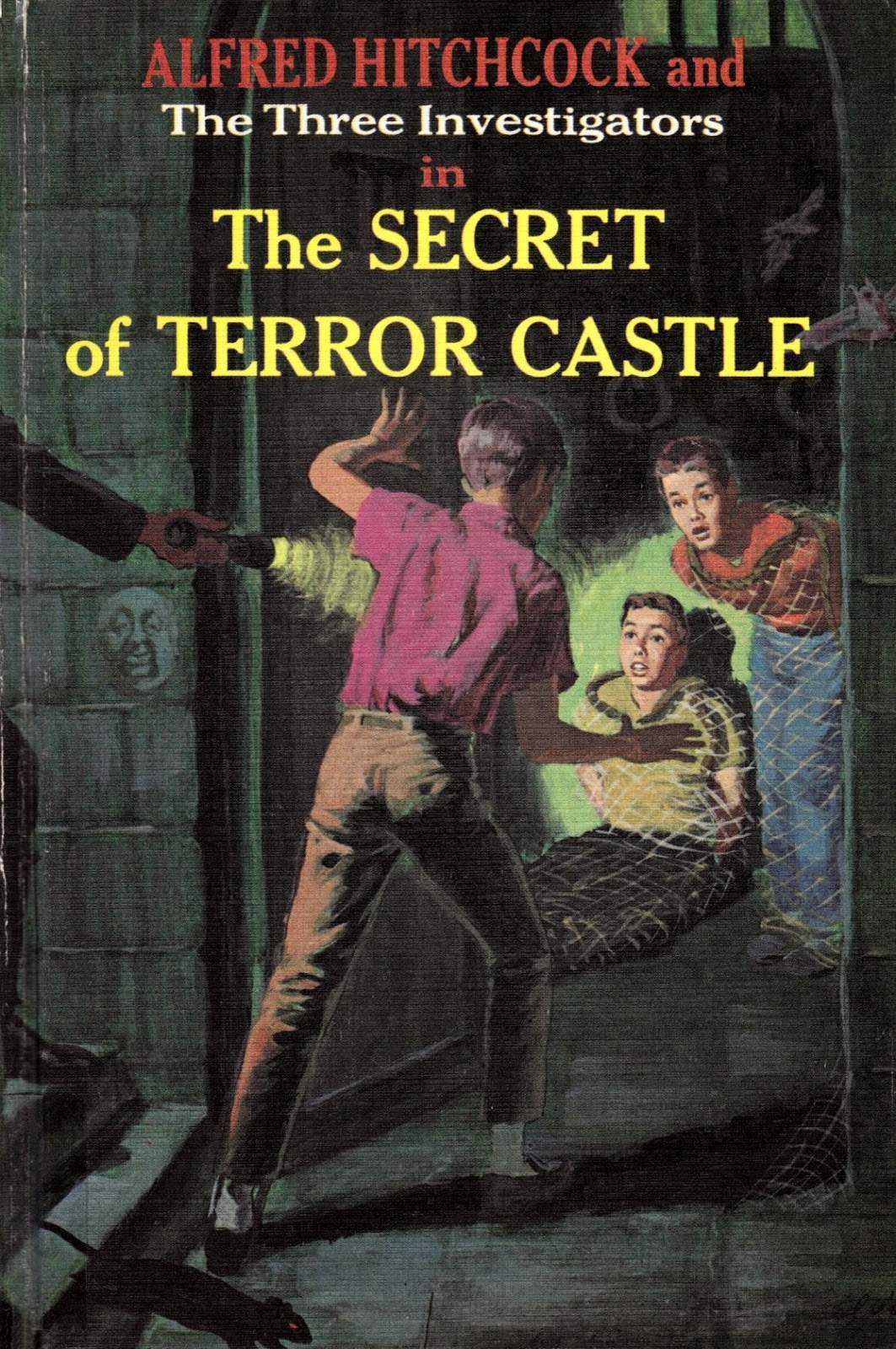
And there was also The Three Investigators.
3 investigators 1

Bob Andrews parked his bike outside his home in Rocky Beach and entered the house. As he closed the door, his mother called to him from the kitchen.

“Robert? Is that you?”

“Yes, Mom.” He went to the kitchen door. His mother, brown-haired and slender, was making doughnuts.

“How was the library?” she asked.

“It was okay,” Bob told her. After all, there was never any excitement at the library. He worked there part time, sorting returned books and helping with the filing and cataloguing.

“Your friend Jupiter called.” His mother went on rolling out the dough on the board. “He left a message for you.”

“A message?” Bob yelled with sudden excitement. “What was it?”

“I wrote it down. I’ll get it out of my pocket as soon as I finish with this dough.”

“Can’t you remember what he said? He may need me!”

“I could remember an ordinary message,” his other answered, “but Jupiter doesn’t leave ordinary messages. It was something fantastic.”

“Jupiter likes unusual words,” Bob said, controlling his impatience. “He’s read an awful lot of books and sometimes he’s a little hard to understand.”

“Not just sometimes!” his mother retorted. “He’s a very unusual boy. My goodness, how he found my engagement ring, I’ll never know.”

She was referring to the time the previous fall when she had lost her diamond ring. Jupiter Jones had come to the house and requested her to tell him every move she had made the day the ring was lost. Then he had gone out to the pantry, reached up, and picked the ring from behind a row of bottle tomato pickles. Bob’s mother had taken it off and put it there while she was sterilizing the jars.

“I can’t imagine,” Mrs. Andrews said, “how he guessed where that ring was!”

“He didn’t guess, he figured it out,” Bob explained. “That’s how his mind works…Mom, can’t you get the message now?”

“In one minute,” his mother said, giving the dough another flattening roll. “Incidentally, what on earth was that story on the front of yesterday’s paper about Jupiter’s winning the use of a Rolls-Royce sedan for thirty days?”

And that is how The Three Investigators series (technically, in the beginning  “ALFRED HITCHCOCK and the Three Investigators”) began. While it’s not as smooth, per se, as the opening of the Trixie Belden series in The Secret of the Mansion, this is also a dramatically different series, and will always have a place in my heart as one of the best series for kids–if not the best–ever published. It never reached the same heights of popularity as Nancy Drew or the Hardy Boys; which was a shame, because it was a much better series than either of those. For one thing, the Three Investigators actually considered themselves to be professional detectives; Nancy and the Hardys, amongst with most of the others, were strictly amateurs (although in the Kathryn Kenny books, “the Belden-Wheeler Detective Agency” became kind of a running gag or thing; it was what Trixie and Honey decided they wanted to be when they grew up; and frankly, I’ve always kind of wanted to see a Trixie-as-an-adult hard-boiled series). And while this opening is a little longish about getting to the point, it eventually does; Bob is a highly excitable young man who works at the library, and this is also our first look at Jupiter Jones, and one of the best things about the series is Jupiter; he is the central character and there would be no Three Investigators without him–and he is one of the most remarkable, and original, characters in kids’ mystery series fiction.

I always thought of Rocky Beach as a sort of stand-on for Long Beach in this series; this is where the boys live, and it’s just south of Los Angeles and a drive to Hollywood. This is where the three boys who make up the titular team of the series live; the third investigator, whom we have yet to meet in this opening, is Pete Crenshaw. And that bit about the contest and the Rolls-Royce? It’s very important. Access to a vehicle, and someone to drive them around, is an integral part of the creation of this investigative agency; they can’t always count on getting rides or paying for cabs or only involving themselves in cases they can investigate on bikes; this is the impetus Jupiter has been looking for to open the agency. Jupiter’s message to Bob is impenetrable to his mother; but it makes perfect sense to Bob–and therein lies another one of the great charms of this series: Jupiter lives with his uncle Titus and aunt Mathilda; the couple own and operate the Jones Salvage Yard, a sprawling junkyard where they repurpose other’s people things, or fix them. Jupiter himself is quite adept at wiring and repairing things; just one, as we the readers will find out, of his many skills. Hidden deep within the salvage yard is the wreck of a mobile home, which the boys use as “headquarters”; over the years Jupiter has managed to hide the mobile home behind piles of junk. The yard is also surrounded by an enormous, tall wooden fence, and Uncle Titus has encouraged local artists to paint murals on the fence. With the help of Bob and Pete, Jupiter has created “secret entrances” into the salvage yard, with tunnels through the piled up junk; that way the boys can come and go as they please without having to use the main entrance. They also have a covered workshop in another area hidden from view; Jupiter’s message to Bob is simply Red gate rover, come over come over, the presses are rolling. Bob knows this means,  come to headquarters, use red gate Rover, and we’re printing our business cards. 

“Red Gate Rover” means use the entrance through the fence that is a mural of a team of firefighters fighting an enormous blaze; there’s a dog watching them, and the knothole in the dog’s eye will spring the hidden gate open. And sure enough, once he gets there, the printing press is rolling and Jupiter presents him with a card, that reads:

THE THREE INVESTIGATORS

We Investigate Anything

? ? ?

–and also has their names. Jupiter is, naturally, the first investigator with Pete as second; Bob is Records & Research, since he works in the library and is their best writer; it is his job to write up their cases. As such, and with an understanding that all cases also need to be introduced as well as get sufficient publicity for their agency to get clients, Jupiter has decided on two things: to ask Alfred Hitchcock to introduce their cases, and offer to help find him a truly haunted house, as he is looking for one for his next film. Using the Rolls-Royce, driven by a very proper British chauffeur named Worthington, Jupiter and Pete call on Mr. Hitchcock at the studio. (The Rolls-Royce, by the way, has every luxurious amenity available to a limousine in that time; and is gold-plated, which sticks out. It was originally commissioned by a Saudi oil millionaire.) They bluff their way in–partly because Jupiter pretends to be Hitchcock’s nephew, even arranging his face to imitate his expressions and voice and patterns of speech–but Hitchcock isn’t that interested in introducing their cases, but has no worries about them looking for a haunted house for him. (While they are calling on Hitchcock, Bob has gone to the library to research something–Jupiter writes the words Terror Castle on the back of one of their business cards and offered no explanation.) But when Jupiter does his impression of “Hitchcock as a 13 year old”, Hitchcock is offended and promises to introduce the first case as long as Jupiter will never do the impression again (and, it is to be noted, the introduction and afterward, as supposedly written by Hitchcock, is clearly done so grudgingly; this was a genius touch by author Robert Arthur–and over the course of the series Hitchcock not only grows fond of the boys but starts sending clients their way).

The thing I loved perhaps the most about this series (outside of the wonderful titles for the books) was they actually were investigators. They actually solved the mysteries they were investigating–well, Jupiter did, mostly–through observation and interpretation of data. Jupiter was, in many ways, kind of a young Sherlock–and he often referred to Holmes. Another thing that was very clever about the series is that the stories were rarely, if ever, told from Jupiter’s point of view; Bob and Pete were always the point-of-view characters, representing the reader, who also couldn’t figure out what was going on. Since it mattered for suspense and storytelling to not know what Jupiter was thinking, Bob and Pete stood in for the reader, confused by the cryptic things Jupiter said–or casually observing Jupiter noticing something that didn’t make sense.

Another thing that, in my opinion, makes the series stronger than others is it is made, very plain, from the very beginning that fat-shaming is a bad thing. Jupiter is described as stocky or husky; he deeply resents being called fat, and whenever someone cruelly makes such an observation, both Pete and Bob always get angry and jump to his defense (Jupiter was also a child star, playing Baby Fatso in a Little Rascals type television show; his being a fat child made him the butt of the jokes in the show and he DESPISES being laughed at)–compare that to how Bess is frequently mocked for being hungry and chubby in the Nancy Drew books, or the depiction of the Hardy Boys’ supposed best friend Chet Morton as an always-hungry, overweight comic relief and foil they always laugh at–yeah, not cool, Stratemeyer Syndicate, not cool at all.

The first Three Investigators story I read was The Mystery of the Moaning Cave. We were in Alabama one summer, and staying with a cousin of my mother’s who had a son my age who also loved to read, and loved mysteries. He had a stack of library books, and I picked up my very first Hardy Boys read, The Mystery of Cabin Island, out of the stack. I was two chapters in when he finished reading his book (The Mystery of the Moaning Cave) and asked me to swap books with him. I was enjoying the Hardy Boys, but the cover of the Three Investigators book he was offering me was tantalizing, plus that title! How could a cave moan? I started reading, and was soon swept up in the story–which remains, to this day, one of my favorites in the series. It reminded me of another book I greatly loved as a child, The Mystery of the Haunted Mine, but the problem was my library didn’t have any of these books, and I could never find more of them anywhere. In junior high a friend of mine was a fan of the series, which led me to reread The Mystery of the Moaning Cave, which I loved all over again, and then its predecessor, The Mystery of the Screaming Clock, which was also amazing. I eventually discovered, on a birthday trip to Toys R Us, an entire shelf of the books; I got five–The Secret of Terror Castle, The Mystery of the Whispering Mummy, The Secret of Skeleton Island, The Mystery of the Laughing Shadow, and The Mystery of the  Coughing Dragon. 

I honestly don’t recall how I was able to collect the rest of the series, or where I got them or what order in which I read them, but I did eventually read the entire series. Later, the series moved on to other authors other than Robert Arthur and the quality became more hit-and-miss, but even the worst Three Investigators case was better than the best books in other series. I still love the Three Investigators, and occasionally will take one down to reread it, again marveling at how well constructed the books are; how tight the plots and how strong the characterizations. I also loved how something small and simple, like the search for an escaped parrot (The Mystery of the Stuttering Parrot) would lead to a massively complicated and interesting case about a massive art theft, or the search for a missing cat with mismatched eyes turned into The Mystery of the Whispering Mummy, or a near car crash led them to a small European principality and international espionage in The Mystery of the Silver Spider. Their cases inevitably started small, but eventually grew into something major; like they grabbed onto a loose, seemingly unimportant thread that unraveled a much larger case.

One thing that always amused me was how adults rarely, if ever, took them seriously. Jupiter’s aunt and uncle, and the parents of Pete and Bob, always looked at their “firm” as a “little mystery-solving club”. Inevitably the adults who pooh-poohed their abilities had to eat their words. I also loved that Jupiter wasn’t athletic but was smart. I identified with that a lot more than I did with the Hardy Boys, who were literally good at everything they tried.

The death of Alfred Hitchcock was an enormous blow, and the publisher–Random House, I believe–introduced a mystery writer for a while to replace Hitchcock, but the quality was already starting to decline, and eventually even the fictitious mystery writer, Robert Sylvester, was replaced by another fictitious entity; but the book in which the switch was made didn’t avoid the truth of Hitchcock’s death, and they actually handled it very well.

And some of the earlier books are seriously dated now; The Secret of Terror Castle centered on the home of a silent film horror star whose career was derailed by his speaking voice when talkies came; obviously, that would have happened around ninety years ago now, so there wouldn’t be any contemporaries still alive. Likewise, The Mystery of the Screaming Clock centered on someone who was a sound effects expert for radio suspense shows–which would, at best, have been seventy years ago now.

I’ve never believed this series was as popular as it deserved to be, nor did it get the attention it truly deserved. The books have been out of print for awhile now–maybe you can get used copies, there may even be ebooks now, I don’t know–but they should still be available. I would love to write one of these, to be honest.

They were the shit, y’all.

If You’ve Got the Money, I’ve Got The Time

One of the things I find fascinating about many people is their dedication to nostalgia; their insistence that some past time of their life was somehow this incredibly magical time of innocence (which it could conceivably have been); a utopia paradise of some sort where everything was right with the world and everyone was so happy and–you get the picture. It’s like how people glowingly refer to high school as one of the “best times of their lives” (which, frankly, is terribly sad and tells me more about their present circumstances than I’d care to know); the past wasn’t magic and neither were our childhoods. If they mean I liked life better before I knew how awful it can be, that I can understand–and I do think that is what they actually mean, even if it isn’t what they are actually saying: they preferred life when the bills and putting food on the table was someone else’s responsibility; when the biggest worries were who will I go to the Homecoming dance with and I have to study for that History test and so forth. But my teenaged years weren’t halcyon and rosy. The 1970’s was a very strange decade of reaction to the 1960’s–and for a queer kid, first trapped in a middle to upper middle class suburb of Chicago and then a small rural town in Kansas, it was hard. I’ve no desire to ever relive high school or go back to being a teenager. Sure, it might be easier to be a queer teen  in a Chicago suburb now–but I suspect it’s not that different in a rural high school in Kansas now than it was forty years ago.

Reading was always my escape from the pressures of a world into which I really didn’t fit–and one that from my earliest memories as a child I knew I didn’t belong in. Reading was a godsend for me, and I read ravenously. I was always being told to go outside and play instead of reading; the most effective punishments were the ones either prohibiting me from reading or limiting how much I could read, and the earliest signs of my obsessive/compulsive disorder were evident with my discovery of the mystery series for kids, which was the next gradual move for me as a reader from the Scholastic Book Fair mysteries. My goal has always been to finish collecting all the series I read and collected as a child: the Hardy Boys, Nancy Drew, the Dana Girls, The Three Investigators and Trixie Belden, as well as the lesser known ones like Biff Brewster, Ken Holt (over whom I had a weird bonding moment with James Ellroy), Rick Brant, Vicki Barr, Judy Bolton, Cherry Ames, Kay Tracey, and Connie Blair. (I also collected the Chip Hilton sports series.) I still have the copies I had as a child, and in the aftermath of Hurricane Katrina, I discovered eBay and tried to finish collecting the series. I don’t have room in the Lost Apartment to display them proudly in a bookcase–I have far too many books; and many of them are boxed up and stored–but I refuse to rid myself of them, because I keep holding out hope that someday I will live in an apartment or condo or house where I can have a room filled with bookcases that will also serve as my office.

But eBay gradually led me to collectors’ and fan pages of these books on Facebook..occasionally someone on one of those pages will be selling a copy of something I need to complete my collections.  There is a generic page for series books in general, and then there are individual pages for Nancy Drew and the Hardy Boys, respectively–and probably still others for the other series that I don’t know about. I know there are also fan websites and serious scholarship on the kids’ series–some of them make for interesting reading, if you have some free time (or are wasting time you should be spending on writing). Some of the fan websites also have conferences and trips–the Nancy Drew group, for example, has an annual trip to where one of the books was set, and tours and so forth to visit the places Nancy also went to look for clues in the course of her investigation. (They were in New Orleans a few years ago; I was going to register–it’s not cheap–until I realized it was more about being a fan than anything else.)

And boy, do these people take their series fandom seriously. I’m not as rabid or as devoted as the majority of them; periodically I might reread one of the series books (I’d love to write an essay about the Ken Holt series, which was darker and more hard-boiled than any of the others; which was why James Ellroy and I bonded over them–which is still so weird to me), but I don’t reread an entire series from beginning to end, and while I used to remember plot details quite vividly, as I’ve gotten older those memories are fading.

I’ve not watched the new CW series Nancy Drew–well, I watched the first episode but didn’t keep watching; primarily because I haven’t had time and Paul and I usually watch shows together–at least, I like to give him a chance to watch something I might enjoy before moving on to watch it on my own (like Riverdale). Maybe he’ll be interested in Nancy Drew, maybe he won’t; I thought he’d like Riverdale but he didn’t. Maybe Nancy Drew is something I’ll wind up watching while he’s working in the evenings; I don’t know. But I’ve also not seen the recent film adaptation, Nancy Drew and the Hidden Staircase, either. But boy, do these Nancy Drew fans take their Nancy Drew seriously. They were outraged that Nancy Drew had sex in the first episode (because Nancy of course never had sex in the series; I don’t even think she even enjoyed a chaste kiss from Ned in all 58 of the original books) and Ned Nickerson was black! Nancy Drew was not only having sex but she was having sex with a black teenager!

The pearls were clutched so tightly! And if you stuck a piece of coal up these people’s asses, it would have come out a diamond. There was a lot of moaning and whining about people’s childhoods being ruined (really? Mine is still just fine) and the “horrors of political correctness” and on and on and on. In other words, Nancy should be a virgin and only know white, straight, cishet people. Got it.

Anyway, Hulu recently announced that they are doing a Hardy Boys series; however, instead of Bayport the town is Bridgeport; their first case is their mother’s murder; and rather than being 18 and 17, their ages will be 16 and 12. Their father is off investigating the murder and so he deposits them with their aunt in Bridgeport, but they soon realize their mother’s death is somehow connected to the town–and everyone in town is a suspect.

Yes, these are significant changes to the original canon of the Hardy Boys, but also remember: The Mickey Mouse Club did two serialized versions of the Hardy Boys, making them also about 13 and 14. The Hardy Boys fans are fan with this, of course, and with the other changes Disney made…so what’s the problem? As someone pointed out, in response to all the whining and moaning about ruining characters and childhoods and “political correctness”, someone also commented, grumpily, “I suppose Chet will be slim, gay, and black”–which actually sounded kind of good to me, frankly. The character of Chet is overweight and loves to eat (kind of like Bess in the Nancy series) and also like Bess, his appetite and weight are the subject of lots of jokes, teasing and sometimes humiliation. Not really cool, if we’re being completely honest.

And yes, all of these people are grandparents with graying hair and are white people. All of this whining and complaining over two television series based on characters that have evolved and changed and been rewritten multiple times in the nearly hundred years they’ve been around–to appeal to  new generations of readers. The original versions of the books were all revised in the 1950’s and 1960’s because they were loaded with racial and ethnic stereotypes that were beyond offensive; naturally, the nice old white people prefer the original texts (big shock, right?).

And if any kids’ series need to be turned into television programs, can I vote for The Three Investigators and Encyclopedia Brown?

I am really tired of this whole “you’re ruining my childhood” nonsense. Unless they are traveling back in time to do so, your childhood hasn’t changed.

I’ve always wanted to write a book about kids’ series fans and conventions; I might just have to now. I mean, I get it–people don’t like change, and something that was beloved when you were a child you want frozen in amber forever. But I just wish these people would unpack their issues with the updates and changes–and nothing gets my gorge going more than the ever popular whine of every racist, misogynist, and homophobic piece of shit out there: politically correct. Sorry you don’t feel safe expressing your hateful bigoted opinions any more without consequence.

I’ve also always wanted to write my own middle-grade series; I used to think about that all the time when I was a kid, even up to coming up with characters and titles for the books in the series because of course I did. I don’t know if I can write middle-grade or not; but it’s worth a shot sometime.

And of course, I can talk for hours on the subject of the kids’ series. Perhaps someday I will.

1801217_10152346389544050_285672915_o