He’ll Have to Go

A gray Sunday morning in the Lost Apartment, with a lot of things to do this morning. I have some errands to run, some food to prepare, and proofing to do today before I rest my sleepy little head in my bed this evening. Sparky wasn’t having my “let me sleep” mentality this morning, but he didn’t get aggressively insistent until about seven, so it was fine. I feel pretty well rested this morning, too, which is very nice. Yesterday was a nice day. I didn’t get nearly as much done as I should have, but I don’t care nor do I mind. I did have the games on for most of the day, but not really watching. Texas Tech throttled BYU, and then Georgia embarrassed Alabama, which I did watch. I didn’t watch either of the evening games, but was delighted for Indiana and Duke. I don’t think anyone see either of them winning ahead of those games, and what lovely chaos yesterday’s results unleashed on the college football playoffs, and there will be lots of anger and arguments once the teams who made it are announced this Tuesday. Since LSU is out of it, I’d love to see either Indiana or Vanderbilt win it all…but Vanderbilt probably isn’t getting in. I don’t know how much attention I am going to pay to the playoffs to begin with–I didn’t watch hardly any of it last year.

We also got caught up on Heated Rivalry–I hadn’t known it wasn’t all available yet until last night–and I am reserving my commentary until we’ve finished watching the entire thing. I’m enjoying the ride thus far, and that’s saying something–Paul is loving it. I’m not a hockey fan, so that aspect of the show isn’t resonating with me. (My first major crush in high school was a hockey player; I should write about that someday, although I have numerous times in fiction.) The show is stirring up shit on social media, though–some of the criticisms the show is getting is wild. My personal favorite is “hockey players don’t look that hot”–yes, their faces were be beaten up a bit more and they’d be missing some teeth, for sure–but seriously, why is it so hard for people to grasp the concept that it’s a romance? Romances, film or television or book or short story, aren’t accurate depictions of anyone’s reality. I don’t know why it is so hard for people to grasp that (although, in fairness, I am guilty of it myself from time to time) important, salient fact–and that ignorance is often masked in condescension; which is highly ironic. Condescending to (and about) a genre that you don’t understand is hardly a sign of your intellectual superiority. All genres deserve respect from writers outside of that genre, period. You’re not writing The Great Gatsby1 yourself, asshole.

I also finished going through my journals looking for notes on Chlorine during the Alabama-Georgia game, which was a lot of fun. It also made me realize there’s really no need for me to keep my papers and try to donate them to an archive (Tulane’s library was interested for one of their special collections almost two decades ago, but I never bothered getting around to it because I really didn’t care that much); all they really need or would want would be my back-up hard drive and my journals. It was kind of fun going through them, and I should more often because there’s a lot of good stuff in there about plotting and character and editing ideas and so forth. There’s also a lot of good ideas and fragments in there, too. I started keeping a journal in the mid-90s, and kind of got away from that at some point after moving to New Orleans. I started up again on New Year’s, I think in 2016. Paul and I had our annual lunch at Commander’s Palace with Jean and Gillian, and on the way back to the car afterward we stopped at Garden District Bookshop specifically for me to buy a journal so I could start keeping one again. I have been pretty consistent ever since then, and they are a fun record to revisit periodically. (I have my old ones around here somewhere, but I can never remember where they are.) It also gave me the answer to a question that has puzzled and confused other authors almost as long as I have been publishing: how do you write so fast? I don’t write fast, I type fast. Books and stories have existed in the corners of my mind for years in some cases before I actually write them, and have made notes and developed characters and titles and plots over many years before I organize them all and sit down to actually write the book. I don’t execute a novel from idea to characters to plot to write the whole thing in three months or so; I spend three months organizing it all while typing it all out–and in some cases, I’ve even started one before getting stuck and putting it to the side. In most cases, I am finishing a book in three months. (I have several novels on hand that are in some stage of completion, and I don’t even want to know how many novellas, short stories, and essays there are in the files.) They were started and thought out a long time before I actually write them.

Today’s goals are to get my bills caught up on paid for, running my errands, and proofing the typeset pages of the new book. I am making chicken white bean chili today (which should be delicious), and want to get some filing and organizing done. I am also going to gather all the Chlorine notes scanned in to the computer so I can start organizing them and working on the book. I also realized yesterday, as I selected and picked out the “noir” I’m going to try to read this month (through Twelfth Night, for the record) and realized that what I have considered to be noir all these years…well, I was incorrect; I was conflating hard-boiled with noir, and while they are very close to being the same and have things in common, there are more than enough differences to be entirely separate sub-genres. A book doesn’t even have to be a crime novel to be noir. Maybe it’s something I should write about for the newsletter, you know?

And on that note, I am heading into the spice mines on this gray, chilly day. It did rain for most of the day yesterday, which made for a very cozy day in my easy chair with Sparky in my lap and a blanket. Have a lovely Sunday, Constant Reader, and I’ll be back tomorrow.

As you can see, I have unlocked my Christmas hunk folder for the year.
  1. I used this book–which I loathe–as an example, because it’s often considered one of the great American novels. ↩︎

How Do You Do?

Saturday morning and I feel good. It looks like it’s going to be a beautiful day outside–yesterday and the day before were gorgeous–and I don’t feel exhausted or fatigued or tired. My muscles are a bit fatigued, but they aren’t sore, which is super great. I also woke up early for a Saturday, too. I am thinking this might turn out to be a terrific day. I am going to go drop books off for the library sale and get the mail and wash the car (it was attacked by a mob of birds, from the looks of it) before coming home and having a nice rest of my day–hopefully productive. I did have a productive day yesterday, too.

My legs are a bit fatigued from walking to the gym yesterday as well as going to Costco, but as opposed to PT, I wasn’t worn out from it nor did I fall asleep in my chair. I’m not sure what that means, really; is my stamina coming back? Does it have to do with the time of the day? I don’t know, but it was a lovely evening for a walk and the program I am doing on my own is relatively short; only eight different exercises. Huzzah! I honestly didn’t know how it would go, and having it go relatively easily was actually quite nice. We’ll see how this continues to go, and then I am going to get back into a regular three times per week routine after the therapy is all done. I am going to have a different mentality completely this time with exercise, as well–more concern about my health than trying to look good. Feeling better is much more desirable than looking better, if that makes sense? (I always tried to keep my mind on the benefit of working out rather than the physical improvement, but it rarely if ever worked because I was so hard on myself about not being in shape and not looking better and so on. Anxiety.)

I didn’t finish putting away everything from Costco last night, so I’ll have to finish that today. I also need to do some filing and organizing, and the floors definitely need to be worked on. I also want to get some reading and writing done, too. My plans for the weekend perhaps might be overly ambitious, but so be it; they always have been historically but you can’t get stuff done unless you’re overly ambitious. We shall see how the day goes, I suppose.

We watched the LSU Gymnastics last night, and then Paul went back upstairs to work some more while I relaxed downstairs and watched a true crime documentary called Down the Hill: The Delphi Murders, which…I don’t know. Doing a true crime documentary about an unsolved case seems…unsatisfying, at least to me as a viewer. (Granted, Murder on the Bayou and all the others about the Jeff Davis Eight also ended with no one being apprehended; yet it was very interesting all the way through.) I am not going to lie–watching true crime documentaries are often inspiring for me and give me ideas about stories and books to write, so I also have an ulterior motive in watching them. Down the Hill wasn’t that interesting of a story, to be honest, but the image of the railroad bridge that ended on the other side with no more tracks is one that will stick with me for a while. (I’m in the process of writing a short story called “The Haunted Bridge”, so that also is kind of helpful in some ways.)

I think this morning–before I run my errands–I may rewatch Saltburn so I can finish my essay about it. This is one of the few movies in recent memory that really resonated with me as I watched, seeing layers and possibilities within the story that straight people apparently didn’t pick up on? Which is why I think it’s important for me to talk about it from a gay male perspective, which sounds rather arrogant now that I’ve written it down, doesn’t it? But the gay perspective is so often not covered in media, and it’s the kind of lens that straight people have trouble seeing. (Hint: the one film that Saltburn reminded me the most of is one that no one ever mentioned, which…renders a lot of the criticisms directed at the film moot? And why on earth did no one compare it to The Great Gatsby, another book/film about someone infiltrating the world of the rich?)

As you can see, my mind is waking up. I’ve noticed this week that my mind seems clearer than it has in a long time, and the fog I’ve been dealing with since having COVID in the summer of 2022 seems to have finally lifted. I made it through the week with energy and not feeling tired and getting things done, as though my Type A personality has finally reemerged from a years-long sabbatical. Which means…that it’s time to bring this to a close and head into the spice mines this morning. Have a lovely Saturday, Constant Reader, and I’ll undoubtedly be back later.

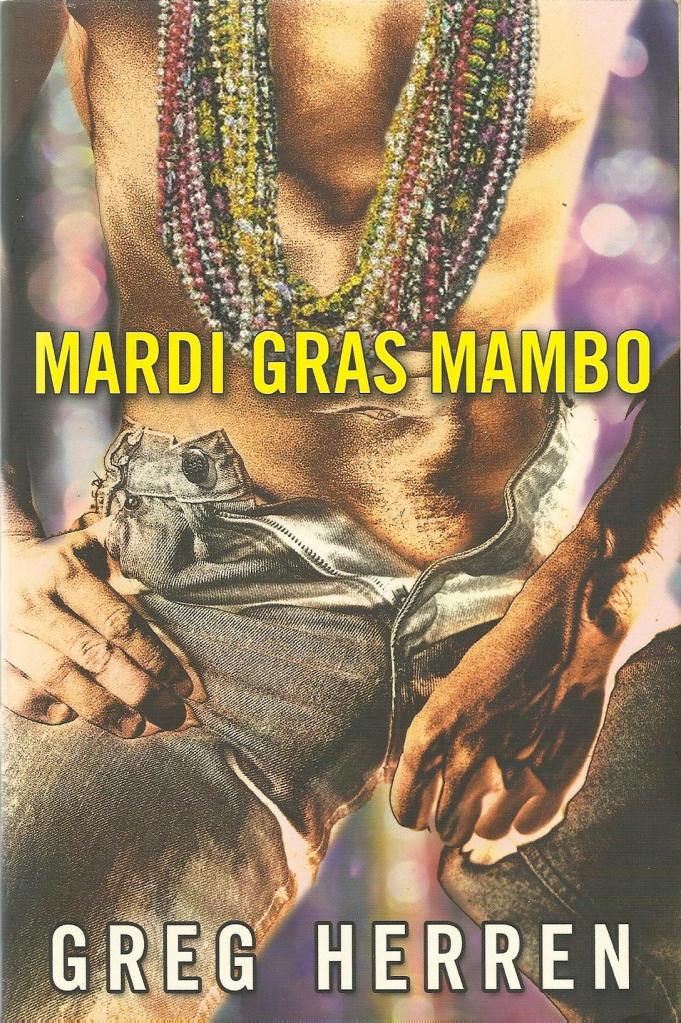
Mardi Gras Mambo

Or, my own personal Vietnam.

I’ve told this story any number of times; how the writing of the book was derailed by two awful things that happened in my life, and how I finally got back to writing again in the spring of 2005, managing to finish this and turn it into literally two or three weeks before Hurricane Katrina came barreling ashore and changed everything in my life, and the long recovery time from that paradigm shift, trying to adjust to the new reality I was facing every day. It felt weird going over the copy edits, weirder still doing the page proofs (I actually had the incredibly sharp-eyed Becky Cochrane and Timothy J. Lambert do it for me while I was visiting the Compound, thanks again, guys!), and even stranger having to tour and promote a book about New Orleans set before Katrina while still dealing with the recovery.

I’ve told those stories before, and that isn’t really what these entries are about; these entries are about the books themselves and how I came up with the stories and so forth, and the writing of the books. The primary problem, of course, is that I wrote this book between and around tragedies; the two year period I call the Time of Troubles that began on Memorial Day weekend in 2004 and ran through about 2008, really; because that’s about how long it took after all those issues for me to feel like my feet were beneath me again and I once again had a grasp on my life. I don’t remember what the original story was about, other than it centered on the Krewe of Iris, Scotty’s Diderot grandmother’s best friend who’d married a much younger muscle-stud Russian, and that’s really about it. The Russian would have something to do with a Colin case–and it would turn out actually be the case that brought him undercover to New Orleans in the first place during Southern Decadence; in Jackson Square Jazz we find out what Colin’s real job is, and that he was in town originally about the Napoleon death mask–but he was also in town to keep an eye on the young muscle-stud Russian who’d married Scotty’s grandmother’s best friend. It wasn’t really working, and I didn’t much care for the story, to be honest; I’d already asked for an extension before Memorial Day weekend in 2004 when all the shit started happening; after Paul was attacked they took it off the schedule and told me not to worry about it. (I appreciated the courtesy greatly at the time, but at the same time had this sinking feeling in the back of my head uh oh, they may not want another one after this–which turned out to be correct. But I dismissed the fear as part of my on-going struggle with Imposter Syndrome. It took me about six months, more or less, to get back to writing. I started my blog right after Christmas that year, and there I was writing every day again, and by January of 2005 I was ready to get going on this book again. I remember rereading everything I’d already done, not liking it, and deciding to scrap it and start over with the same essential premise: rich older society woman in New Orleans has married a much younger Russian boy-toy; Colin is investigating the boy-toy; and it’s Carnival season. Shortly after getting about halfway into a new first draft, the Virginia thing happened and I was derailed again. After that was over and I went back to the book…once again I didn’t like what was happening in the story and I threw it all out and started over again.

But this time, I hit my stride and four months later I turned the book in at long last, along with a proposal for a fourth, Hurricane Party Hustle, which was going to be set during an evacuation and would wrap up the loose ends left at the end of Mardi Gras Mambo.

And of course, three weeks later Katrina changed everything, and Hurricane Party Hustle went into the drawer.

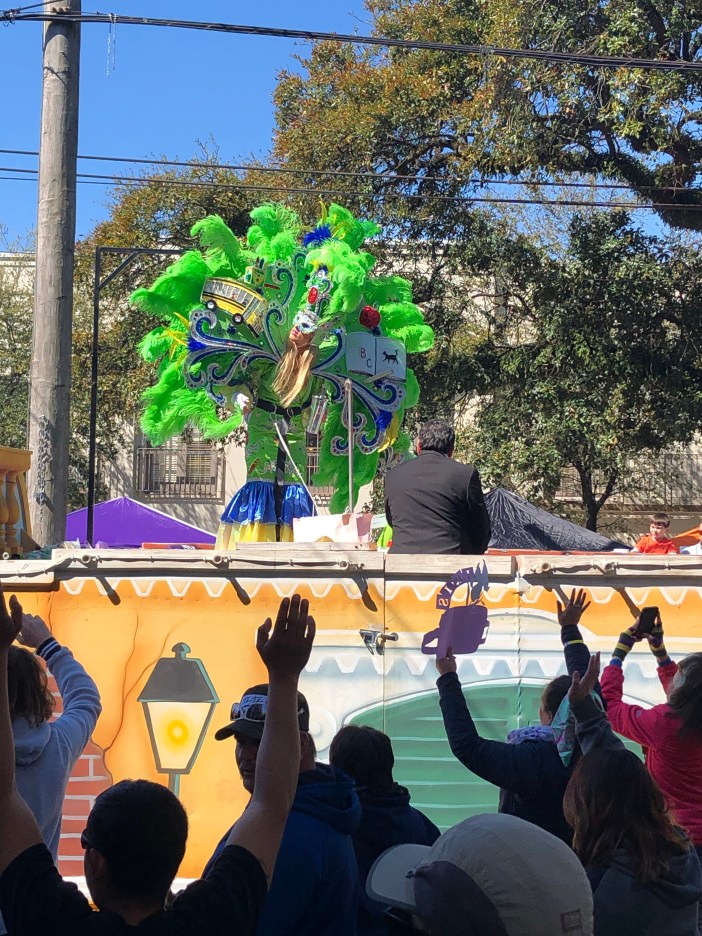
Last night I dreamed it was Mardi Gras again. It seemed to me I was standing inside an iron gate, watching one of the night parades go by. The sidewalks in front of the gate were crowded with people, all shouting, with their grasping eager hands up in the air. Out beyond the edge of the curb, I could see people sitting in lawn chairs. Still others were up on ladders, with coolers and plastic bags of booty piled around them on the ground. Fathers and mothers were holding up babies, while black kids with the crotches of their pants down around their knees walked behind the crowd, weighted down by the ropes of beads around their necks. Beads were flying through the air, some getting caught and tangled in the branches of the towering gnarled oaks lining the avenue.  The heavy upper branches of those oaks also blocked out the glow of the ancient street lamps so the night seemed even darker than it should. I could hear a marching band, playing a recent hip-hop hit, and the strange clicking sound of the baton girls’ tap shoes on the pavement. The air was heavy with the heavy fragrance of hot grease, corn dogs and the strange melted yellowish-orangey substance the vendors put on nachos that purports to be cheese—but no one is really sure what it is. A group of flambeaux carriers were passing by, dancing that odd little circular dance they do, their propane tanks popping and hissing, throwing long and twisted shadows that also danced inside the iron fence I was behind. Right behind them a huge float pulled by a tractor was coming and the crowd’s shouts became louder, more desperate, more pleading. On the float’s front was a huge white clown face, its bright red lips parted in what passed for a smile but seemed to me to be a frightening leer. The masks on the float riders glowed supernaturally at the hordes begging them for generosity in the strange light cast by the moon when it cleared the thick clouds in the cold night sky.   I stood inside the black iron fence, my arms wrapped around me against the cold as an increased sense of menace and dread built inside me. Something bad was going to happen—

Oh, get real, Scotty!

If I do have bad dreams, I don’t remember them when I wake up. I’ve certainly never been troubled in my sleep, even though crazy things always seem to happen to me. I’m just one of those people, I guess. For whatever reason, the Goddess has decided to throw some wild stuff at me—she always has, even when I was a kid—and what can you do? I just don’t think I am one of those people who were destined to have a nice, normal, quiet life. Maybe it’s because I was named Milton Bradley at birth. Yes, that’s right. Milton Bradley. My older brother started calling me by my middle name, Scotty, before I started school and thank the Goddess, it stuck. Can you imagine how cruel the kids would have been to someone named Milton, let alone Milton Bradley? And then of course there’s the gay thing. I was lucky—my parents are pretty liberal and were delighted to have a gay son—like it somehow proved how truly cool they really are or something. They are pretty cool, actually.

By now, I’d taken to starting all of my New Orleans novels with a Tennessee Williams quote; for this one I chose a line from Vieux Carré: “You’ve got a lot to learn about life in the Quarter.”

I had opened Bourbon Street Blues with a parody of “The name’s Bond, James Bond” and I’d done something similar with Jackson Square Jazz–“Danger is my middle name”, riffing on Trouble is My Business. I decided to open this book with a parody of the opening line of Rebecca: “Last night I dreamed I went to Mardi Gras again.” But that entire opening paragraph of du Maurier’s is so fucking brilliant, I couldn’t help myself and made my entire first paragraph a parody of that opening. I then decided that from then forward, every Scotty book would have a Williams quote and each prologue–where Scotty introduces himself and his cast of characters and gives backstory so I don’t have to do it in the text of the story itself–would parody the opening paragraph of a famous novel, rather than just the first line (I am actually struggling to find the proper opening to parody to start the prologue for this one. I’ve used Rebecca, Peyton Place, The Haunting of Hill House, and Lolita, among others so far already; I’ve tried with this one to use An American Tragedy, Atlas Shrugged and The Great Gatsby thus far, with no luck. I’ve tried Valley of the Dolls several times for other books in the series already, but I can’t ever get it to work for me).

I do remember that the one thing that didn’t come across in those earlier drafts that I had abandoned was the sense of insanity that Carnival always brings with it; that feeling of “controlled anarchy” we experience those two weeks of parades, of knowing you have to schedule your entire life around a parade schedule–true even for those who do not live inside the box, as we say here; the box being the Uptown parade route–I always have to schedule my job, my trips to run errands uptown, everything, predicated around having to get home at least two hours before the parades start, and am incredibly lucky if I can get a parking spot within three blocks of the Lost Apartment. The thing I kept forgetting in those earlier versions was the books are meant to be fun. Granted, I was hardly in a mental space to write something fun…and of course the decision to really take it completely over the top the way I did was something I still think about to this day and wonder, where on earth did you get the idea for identical triplets?

Which, while crazy, made more sense than the cloning story I tried to write the second time.

Maybe those bad things happened for a reason? Because I couldn’t be more pleased with how the story and the book turned out. I also ran out of room to finish the personal story…but I also was operating on the assumption I’d get a contract for a fourth book. If not for Katrina, Kensington might have made another offer and Hurricane Party Hustle might have been the fourth Scotty than something just sitting in the files.

The book was released on Fat Tuesday, 2006. Paul and I had been out of town–the truncated Carnival/parade season seemed almost too sad to handle, so we’d accepted a gig to speak at the South Carolina Book Festival. We flew back to New Orleans the Sunday morning before Fat Tuesday. I’d checked my email that morning before boarding the flight to Atlanta (we changed planes) and then our cab driver couldn’t get closer to St. Charles than Baronne Street. A parade was going as we got out of the car, and we had to cross the parade (it was in the high seventies and sunny) with our luggage–I’ll never forget looking up as we got ready to cross and catching a bag of beads with my hand just before it connected with my face–and got home. I checked my emails and my word! SO MANY EMAILS.

You see, that day’s edition of the Times-Picayune carried Susan Larson’s review of the book, and it was a rave! Everyone emailed me as soon as they saw it–I still bask in the glory of that review–and I was about to embark on probably the most ambitious book tour of my career.

I just didn’t see, though, how I could write another funny, light book about a city still in ruins whose recovery was still questionable.

The series was, for the moment, over–with the personal story not resolved the way I would have wanted, but it could stand as it was, should there never be another Scotty story.

Rereading it, I couldn’t but laugh at some of the outrageous twists and turns the plot took.

I guess you could say I’m proud of it.

King of My Heart

I went down a wormhole thought pattern of sorts this morning, triggered by reading a Crimereads essay about spy novels, and their genesis; it mentioned that Rudyard Kipling’s Kim was one of the first spy novels, and I also realized that only had I not read Kim, I’m not entirely sure I’ve ever read Kipling; however, a quick Internet search just not has reminded me that I have, indeed, read Kipling: Rikki-Tikki-Tavi, The Jungle Book, Captains Courageous, but I really don’t remember anything about them (let’s be honest, all my memories of The Jungle Book are naturally from the Disney animated film). I may have also even read Just So Stories, but am not entirely sure. I’m sure Kipling’s work does not stand the test of time–just the title of the poem “The White Man’s Burden” made my eyes almost pop out of my head when I came across it this morning–as they undoubtedly reflect the white supremacist view of Imperialism and the need for the British Empire.

On that same note, I feel relatively certain that the M. M. Kaye novels I once enjoyed (Shadow of the Moon and The Far Pavilions) probably wouldn’t hold up well, either.

I always read for pleasure and for enjoyment; to escape the world in which I found myself inhabiting and feeling like a changeling for the most part; I still do, for the most part. I haven’t been paid to write a book review in over a decade; I’ve always felt that as an author myself, there was a conflict of interest in accepting pay to read and critique another author’s work, and there was always, inevitably, the possibility that an honest view on something that didn’t work for me as a reader would be seen as a vindictive move on my part to torpedo another author, out of jealousy or spite or both. There are any number of these reviewers being employed, and paid quite handsomely, by major newspapers, and I don’t want to be one of them. I don’t like writing negative reviews, and if I am reading something I don’t care for, having to finish reading it because I am being paid to write about would inevitably make me resent the book and its author and would thus color the review.

I generally read things I think fall under my purview as a writer–mostly crime novels, some horror now and then, and maybe something every once in a great while, that would be considered literary. Often these are books by writers I already have discovered, or new ones recommended to me by others whose tastes I respect–The Coyotes of Carthage came to me in this way; Lisa Unger was recommended to me by numerous friends; and yes, Paul Tremblay came to me as a recommendation from a friend. I know I need to expand my horizons to improve as a writer, which is why I am not only committed to the Diversity Project (books by marginalized writers) but also to the Short Story Project. The Diversity Project has been a terrific learning experience, and the Short Story Project has helped me become a better short story writer. I’ve been trying to read New Orleans history lately–with a dash of Louisiana thrown in for flavor–in order to get a better sense of the city and state, so that I can write about them both more knowledgeably; plus there is so much inspiration in reading about the past of both city and state! It’s also incredibly humbling to know how little of that actual history I did know, and even though I knew how rich that history was, I had no idea just how much of a gold mine of inspiration and ideas it would prove to be.

Like I said, I tend to read things I think I will enjoy, and if I am not enjoying the experience, I inevitably stop reading. I have started things and put them aside, only to go back to them again and greatly enjoy them; Paul Tremblay’s A Head Full of Ghosts being the best and most recent example of this I can remember; I started it, got several chapters in, and wasn’t feeling it. I went back to it months later and couldn’t put it down, and frankly, after The Cabin at the End of the World, Tremblay is becoming one of my current favorite authors.

So, I’ve been wrong about books before, and I’ve also been wrong about authors before. Hence the dilemma in being a book reviewer, and why I have chosen for many years now to seek extra income by reading for reviews. I enjoy writing about books I enjoyed on here, my blog; that’s part of its reason for existence, and I also curate what I read and write about here. No one chooses for me what I read or what I write about; and I will only review something negatively if the writer is, frankly, long dead; and even then, it’s simply an explanation of why the book didn’t work for me (an example of this latter type was Night Has a Thousand Eyes by Cornell Woolrich; I appreciated the book but there were things about it I didn’t like, that I felt didn’t “play”, but since he is long dead–over fifty years–I wasn’t overly concerned about hurting his feelings….and I have enjoyed other works of his).

I often talk about how my education in what the Academy considers to be classic American literature (British, too, for that matter) is sorely lacking. It’s something that I occasionally wonder about; should I go back and read these so-called classics as decided by a group of people whose opinion I generally don’t respect very much? It’s entirely possible, I know, that books I was forced to read as a teenager in high school and college were actually better than I thought at the time because I loathed being forced to read anything and I despised the way they were taught by pompous pseudo-intellectuals with tenure (I really enjoyed mocking that world in my story “Lightning Bugs in a Jar”, and will probably mine it again at some point as story fodder).

But I can honestly say I went back twice to reread The Great Gatsby only to discover that I loathed it even more than I remembered loathing it the first time; I also spent some time in my twenties trying to read other works by the writers I was forced to read and found that I did, in fact, enjoy some of them. I hated Sinclair Lewis when I was forced to read Main Street in college; I later went back and enjoyed both Elmer Gantry and It Can’t Happen Here very much. I disliked Fitzgerald’s This Side of Paradise very much, and I loathed the Hemingways I was forced to read (The Old Man and the Sea, A Farewell to Arms) so much that I just can’t bring myself to read anything else of his. I was very surprised, actually, to find myself enjoying Faulkner quite a bit, and I keep meaning to go back and reread both The Sound and the Fury and Sanctuary–but there are also a lot of other Faulkner novels I’ve not read, and probably should. I also despised Tom Sawyer and the other, celebrated Mark Twain short stories I was forced to read; but as an adult greatly enjoyed Puddinhead Wilson, The Prince and the Pauper, A Connecticut Yankee in King Arthur’s Court, and Life on the Mississippi.

But I am not someone who became a writer because I wanted to have a legacy, or be lionized; I became a writer because I wanted to tell stories, and I wanted to tell the stories that I wanted to tell. I never had any desire to have my work be taught in colleges, or for students to be forced to write papers about my work. I always say that sort of thing isn’t up to me to decide, and it’s never been my aim. If I’m forgotten after I die, well, I won’t be the first.

I justify to myself not reading a lot of literary fiction by saying there simply isn’t enough time for me to read everything that I actually want to read, let alone find the time things people think I should read. But I also have this sense in my mind that perhaps I am missing out on something; I know I’ve read books that have gotten critical acclaim that were more on the literary side and liked them very much and learned from reading them. Colson Whitehead, for example, is simply brilliant while also writing genre fiction–The Nickel Boys and Underground Railroad were stunningly brilliant; I really need to read more of his work–and thinking about Colson Whitehead led me to thinking about, of all people, Cormac McCarthy. I’ve not read McCarthy, but from what I have gathered from what I have heard about his work is it technically is also genre fiction; The Road is a post-apocalyptic dystopian novel, after all–a friend whose opinion I respect read and hated the book, so I’m probably not going to go there–so I started going through his canon on the web and I finally settled on one to add to my TBR pile at some point, Outer Dark, because it too sounds like genre fiction. We shall see how that goes, shan’t we?

Laura Lippman often says that genre fiction is literature, and by claiming literary classics as genre (the most common is, of course, Crime and Punishment) we are demeaning the great genre work, which stands on its own without the necessity of claiming Dostoevsky or Faulkner’s Sanctuary as crime fiction (although I do believe Sanctuary is pulpy noir of the best kind). I do agree with her to some degree; as I said, I do think Sanctuary is noir, and an argument could be made that An American Tragedy by Dreiser is as well. (I’ve also pointed out numerous times that The Great Gatsby is really a murder mystery told in reverse) But her point is spot on: genre fiction doesn’t need to claim classics from the Academy in order to be recognized as literature, and claiming those books does make it seem like trying to make fetch happen.

I also like to believe that my best work is still ahead of me.

Of course, that means I actually need to do it.

And on that note, tis back to the spice mines.

How Can You Expect To Be Taken Seriously?

Monday and here we are, getting ready to stare down yet another week.

We watched more of Little Fires Everywhere last night, and it really is extremely well done. It really is an interesting look at race and privilege and power; all while using tropes that were staples of soap operas. As the show amps up and starts racing along to its climax, the basis of the majority of the drama of the show is a custody struggle over an adopted baby–a storyline so stale for soap operas that I don’t know that the few left even use it anymore. But with strong writing, excellent production values, and an enormously talented cast, this stale trope not only works in this instance, but works very well. I am curious, though, as to why the book is set in 1997 rather than the present; the reason behind it isn’t apparent, and it feels incredibly current; although the music at school dances and so forth is rather jarring, and it takes a moment to remember that the story is set over twenty years ago. I don’t even notice the lack of smart phones and social media. I’m just sorry that I didn’t get a copy of the book to read along while I watch, which was such a terrific experience with Big Little Lies. 

And Reese Witherspoon certainly has a type of woman that she regularly plays, doesn’t she? Super Karen?

I finished a dreadful first draft of “Falling Bullets” last night, and it is dreadful. Fortunately there are other drafts to be done, and corrections and edits that can be made to it, but at this point I’m just happy I finished a draft–it’s been awhile since I’ve finished something I’ve started. At first I was rather nonplussed because about 1500 of the 2000 words I’d already written–mostly the stuff I’d written Friday evening–didn’t really work anymore; but I went back to the beginning and started tweaking things, and was even able to tweak enough of the 1500 problematic words to save most of them. So, while I am not pleased with the draft and its condition, I am pleased that it is finished, at around 4600 words.

I also finished reading Thunder on the Right yesterday, and had a lovely time with it. I do think it is one of the lesser Mary Stewart novels–but a lesser Mary Stewart is better than  a lesser writer’s best, so there’s also that.

I have decided to take today off from work; I am not feeling as great as I should, and literally cannot face another day of data entry and condom packing. Fortunately I have enough vacation time accrued for me to take yet another day off–although I really need to start letting the time build up again, for when this is all finally over and done with, so I can take an actual vacation, which is something I am going to be in seriously need of–and so am going to stay home, finish some odds and ends, and then get ready to face the rest of the week. I also have to work early tomorrow morning, so will have to get to bed early this evening; and I think we’re going to maybe start slowly opening the STI clinic next week. I am of two minds about this–I am certain we can do it safely, but at the same time I worry whether clients will be willing to come in to get their screenings done. I miss my old life, quite frankly, and like everyone else, long to get back to it. But unlike everyone else, I don’t see the old normal coming back. This situation has changed so much about our lives and how we do things, and in many cases, things that were considered “impossible” before have now been shown to be possible. I can’t imagine, for example, that the expensive old version of the book tour will return now that we have seen it can be done relatively inexpensively virtually. I easily can see publicists cutting expenses at publishers by arranging on-line interviews and readings and Q&A’s and book club meetings rather than spending money for an author to travel. And for authors who can’t foot the cost of their own tours, well–here’s an inexpensive alternative that may actually work.

Next up for the Reread Project is an old favorite of mine by Barbara Michaels, House of Many Shadows. Dr. Barbara Mertz wrote, of course, wonderful mysteries as Elizabeth Peters (if you’ve never read the Amelia Peabody series, you really, really  need to), and wrote suspense novels that may or may not have a supernatural bent to them–Ammie Come Home is, obviously, by far and away my favorite of these–as Barbara Michaels. I rediscovered the Michaels novels in the late 1970’s/early 1980’s, and became just as addicted to them as I would to the Elizabeth Peters novels later that decade; House of Many Shadows is one of my favorites of the Michaels novels; The Crying Child is another. The rest are also good without question, but to my mind those three are head-and-shoulders above the others. The Michaels novels also have great, great titles: Wait for What Will Come, Be Buried in the Rain, The Dark on the Other Side, and Witch, to name only a few. And, if I am being complete honest, Bury Me in Shadows was inspired by the Michaels novels; as was Lake Thirteen.

And the humor in the Scotty books probably owes more than a little to the influence of the Elizabeth Peters novels.

I also gave up on rereading Katherine Anne Porter’s long short story about the Spanish flu, “Pale Horse Pale Rider.” I can certainly understand why critics and literary enthusiasts shit themselves over Porter’s writing, but it just doesn’t work for me. I don’t care about her characters or what happens to them, and Porter is definitely one of those authors who–to me–loves the sound of her own voice; what could be said in a sentence or two turns into rambling pages and pages in which she basically says the same thing, over and over again. And she never wastes any time on making the reader care about her characters, or even getting to know them well. I thought, when I first read her Collected Stories years ago and found them to be tedious and boring (as I was rereading “Pale Horse Pale Rider” I could actually hear a Lit professor enthusing about her works in my head), and I thought I’d give them another chance, thinking perhaps I had matured enough as a reader to enjoy them now; that it was my own immaturity as a reader and lover of the written word that kept me from enjoying them in the first place.

I am pleased to report I am wrong, and that I find Porter’s work as constipated and dull as I did the first time, and there’s nothing wrong with not liking her work. I still dislike The Great Gatsby, even after reading it three times, after all; let the literary snobs come for me. I don’t care. Scoff at me all you like, I will never like or admire Porter.

And on that note, I think I’ll go lay back down for a bit. Have a lovely Monday.

IMG_1024

Did You See Me Coming?

And somehow, just like that, we made it to Wednesday again. Well done, Constant Reader; sometimes it feels like we’re just not going to get there.

So, yesterday morning between screenings, I checked out my iCloud drive to just see what precisely I have in progress at the moment (not counting everything else that has been unfinished for years) and the count is: four novels, four novellas, and at least nineteen short stories. (And y’all wonder why I talk about having creative ADHD. Barbara, please.) Then again, should I get all of these things finished by the end of the year, I would absolutely have another short story collection completed (there are already several unpublished, finished stories I have in my “to submit” folders as well, and three that have been sold–two of which are out now–in The Beat of Black Wings and The Faking of the President; so at some point that second collection will be ready to go within the next year or so*) and so it looks as though the dearth of Gregalicious publications will be solved once he gets off his ass and starts finishing things.

Heavy heaving sigh.

One thing I noticed yesterday as I drove to my essential job (yes, my job is considered essential) is that there was a lot more traffic then usual at that time; and then I remembered driving home Friday night after work in heavier traffic than usual as well. Oh no, I thought, I wondered how long it would be before New Orleanians couldn’t stand the isolation anymore and despaired; but there was so little traffic on my way home from work last night that I managed to play one song on my phone through the car speakers as I pulled onto the highway and it was just finishing as I pulled into a parking space across the street from my house (yes, I managed to hit every light as green once I got off the highway too; I LOVE when that happens), so maybe it’s not so bad after all.

These are such strange and new times, and I’m never really certain what to think about them, you know? Or to try to think ahead; this week is about all I can handle right now, thank you very much and good night.  But I’m also a planner, even if the plans and their timing remains somewhat amorphous all the time; it’s just kind of who I am. I’m also aware that if you don’t plan ahead a bit, you tend to get very surprised along the way and that is never, ever a good thing.

Yesterday I discovered, entirely by accident, that one of my favorite old movies–The Letter, starring Bette Davis, had actually been a short story by W. Somerset Maugham first, before he himself adapted it into a play which then became the basis for the two film versions (the more famous Bette Davis version was actually a remake of the Jeanne Engels version from the previous decade), and it was in the public domain, so I downloaded a copy of it to read for the Short Story Project; it’s a long story, clocking in at over 13,000 words, which in today’s world I suppose would make it a novella. I am, of course, rather excited to read the original source material, and I’m not sure I’ve ever read Maugham before–just another one of those great old white male writers I’ve never read; and it occurs to me just now that one of the things I should reread for the Reread Project is Hemingway’s A Farewell to Arms. I’ve never really gotten Hemingway, and certainly didn’t when I was forced to read him in high school–hating the experience so much I never went back to him–but maybe it wouldn’t hurt to give Papa another turn. Perhaps as a more mature adult and reader I can appreciate him more (although my recent reread of The Great Gatsby made me hate the book even more than I already did); but I certainly didn’t mind reading some other Old White Men over the years, like Sinclair Lewis and Theodore Dreiser (I should tackle the massive An American Tragedy sometime; I really liked Sister Carrie when I read it), and I should probably make up one of the greatest gaps in my reading history–The Adventures of Huckleberry Finn, which I’ve never read–but I’ve read a lot of Twain over the years.

It is absolutely insane how many works I have in progress! (I just reread the opening of this entry again) But I do believe that perfectly illustrates my point about my creative ADHD….and there are even more short stories than that, really; those are the ones I’ve worked on at some point over the last few months. And of course, more ideas come to me all the time. Heavy heaving sigh.

And on that note, I need to get ready to face my day. Have a good Wednesday, Constant Reader!

*the third, “The Carriage House”, has been sold to Mystery Tribune, and I’m not sure when it will be released; so stay tuned!

IMG_0695

Sara

Memorial Day Monday, and I haven’t gotten near as much done as I intended, according to the “long weekend stay-cation to-do list”, but I got so much more else done that I cannot feel defeated or disappointed in myself.

Which, of course, is a step in the right direction. I’ve also gotten used to waking up in the morning between nine-thirty and ten; tomorrow’s alarm is going to be a very rude awakening, I fear. But it is what it is, I suppose, and at least this is only a four day work week, so that’s something, right?

Always find the upside, you know?

I took a lot more notes in the journal yesterday, figuring out how some other stories are going to play out, and even started brainstorming on Muscles. I know this doesn’t seem like I’m getting very much done as far as actual writing is concerned, and that may be true; but what I’ve done this entire weekend is make the actual writing possible. Today I am going to try to get some of that actual writing done–I know, right? SCARED OF THAT. And I also have some reading to do; I’m participating in a panel of readers to choose some short stories for an anthology. I also have some other busy-work to take care of today as well; so I am going to try to get that done before I start writing.

I am still reading that Roth novel; it’s not very quick going, despite being so well-written and the characters aren’t really quite as awful as the ones I recall from Letting Go, but it’s kind of slow going; there’s not really a reason to keep turning the page, which is always the problem, at least for me, with literary fiction. On my shelves, TBR, are two big literary fiction books that are massively long, Hanya Yanaghara’s A Little Life and Garth Risk Hallberg’s City on Fire, and while there are  gay characters and themes in both…they’re so long. Since they have gay characters, I kind of feel, as a gay author, some responsibility to the community to read them, dissect the gay characters, etc. It is representation, after all, and that representation should be critiqued by someone within the community.

I am sure that was handled by Gay and Lesbian Review Worldwide, which is a lovely magazine, and yet…I feel like it’s sort of my job somehow; a need or feeling which I definitely need to get past and over as quickly as possible. I am sure I will finish reading the Roth this week and I can get back to reading crime novels. (Yay!)

So, yesterday’s journal entries included work on my short stories “The White Knuckler” and “Never Kiss a Stranger” and “Hold on to the Night” and “This Thing of Darkness” and “And the Walls Came Down”; and the novels Muscles and Bury Me in Satin. I am writing a lot in my journal, which is convenient and easy, of course; I love having my journal, and I love having it handy, so whenever something occurs to me I can write it down and riff on it for a little while. This has been working tremendously; I solved the problems with the Scotty novel this way, made progress on the WIP; and at the rate I am going when it’s time to work on Bury Me in Satin the entire thing will have already been written or planned out in my journal.

Which will certainly make the process easier.

I’m all about it being easier, in case you’d never noticed.

As I page through my journal I also see notes I made for two essays; one about the evolution of teen movies from the 1950’s to the present (triggered by watching the original Friday the 13th last night, with a very young, dewy and beautiful Kevin Bacon), and another about Robert Downey Jr.’s career trajectory, and yet another about whether Carrie White from Carrie was a villain or a victim (this popped up on Facebook this week, and the question was very strange; I always considered Carrie a victim and certainly never as a victim; I also made the connecting thought that varied interpretations of what role she played in the novel/film has everything to do with the reader/viewer’s life experience as well as how they see themselves; which is an interesting direction to take, essay-wise; I was also thinking it might not be a bad idea to include Christine’s Arnie in the discussion. I consider both novels to be excellent depictions of teenage life and high school; no one really does childhood or high school quite the way King does).

So, that’s it for today, the end of my stay-cation. I got a lot of brainstorming and problem-solving finished for my writing; the Lost Apartment is in some sort of order at long last, and I am of course making myself all kinds of promises I won’t keep; about staying on top of the household chores and staying on top of the writing and the reading and using my journal to get myself out of sticky situations with both. I am very glad I took the stay-cation, even if I didn’t get close to getting all the things finished that I needed to get finished. My visit to the storage facility had to be postponed because of the recurring back pain; hopefully I can get that handled one day this week; either Thursday or Friday.

Always keep moving forward.

Next up in the Short Story Project is “The Jockey” by Carson McCullers, also from The New Yorker’s The 40’s: The Story of a Decade:

The jockey came to the doorway of the dining room, then after a moment stepped to one side and stood motionless, with his back to the wall. The room was crowded, as this was the third day of the season and all the hotels in the town were full. In the dining room bouquets of August roses scattered their petals on the white table linen and from the adjoining bar came a warm, drunken wash of voices. The jockey waited with his back to the wall and scrutinized the room with pinched, crepy eyes. He examined the room until at last his eyes reached a table in the corner diagonally across him him, at which three men were sitting. As he watched, the jockey raised his chin and tilted his head back to one side, his dwarfed body grew rigid, and his hands stiffened so that the fingers curled inward like gray claws. Tense against the wall of the dining room, he watched and waited in this way.

I’ve never been ashamed to admit that often I don’t get McCullers’ work; but I like the way she writes and the insights into her characters that she shares. This short story, about a damaged jockey who enters a crowded dining room during the season at Saratoga and confronts three people, dining together, who’ve had some impact/will have some impact on his life, and their complete disinterest in him as anything other than an object to be pitied, eventually to be scorned, is well drawn and depicted; and very telling about human nature; how we are with people who are of use to us and who we, as a society, generally are to those who cease to be of use to us. I have to confess, my revisitation of McCullers, between this and Reflections in a Golden Eye, has made me a lot more interested in her and her work; just as reading some of Flannery O’Connor’s stories recently has raised my interest in her work as well.

As I have said before, I often find my failure to get certain writers, seen as masters or geniuses, or in other ways celebrated by the so-called Academy, as a failure not only as a reader or a writer but as an intellectual and even, possibly a moral failure; but my recent reread of The Great Gatsby went a long way towards curing me of that mentality; likewise, the recent re-approaches to the works of McCullers and O’Connor have also made me realize that in some cases, I may not have been intellectually and morally ready to read these works. I am going to give Hemingway another chance at some point  as well, and I do want to read more of Faulkner. I’ve certainly enjoyed reading Sinclair Lewis and Theodore Dreiser a great deal more as an adult than I did in college courses. I didn’t enjoy reading Jonathan Franzen, and I’ve come to believe that David Foster Wallace is a cruel joke played on unsuspecting readers and students of literature by bitter professors. I also found Styron’s Set This House On Fire more readable, more enjoyable, and more of an achievement than Sophie’s Choice or The Confessions of Nat Turner; but I also read the latter when I was in my early twenties, so it may be possible for me to appreciate them more greatly now; I do consider myself to be a more sophisticated reader now than I was in my callow youth.

And now, back to the spice mines.

IMG_4109

Flashdance…What a Feeling

Tuesday! I finished the second draft of “For All Tomorrow’s Lies” yesterday; I think the ending still needs some work, so I am going to let it sit for a while longer; maybe look at it again next weekend. I also got started on the prologue for the next Scotty, Crescent City Charade, but I think that was merely procrastination to keep me away from line editing. This time, I am making the first paragraphs of the prologue a play on Nabokov’s opening for Lolita, but am not entirely sure that will not change; I was also thinking The Great Gatsby would be a good, maybe better, fit. I also spent some time reading Lyndsay Faye’s The Gods of Gotham, which is so fucking good I want to live inside its pages.

Which is pretty damned good, quite frankly.

I had severe back pain yesterday; last night I treated it with Ben-Gay and a heating pad, and that seemed to fix it. This morning there’s still some pain and tightness, so I am using the heating pad again as well as slathering my back with Ben-Gay. I’m not sure if I strained my back muscles during my Saturday workout, or if they’ve simply tightened up from being stretched before the workout; which is irritating. If they’ve simply tightened up, then I should stretch them again–but if they’re strained, I don’t want to make it worse.

Heavy heaving sigh.

Looks like I’ll be bringing the heating pad to the office with me. The only thing I truly hate about getting older is the aches and pains, along with the loss of energy. It is amazing what a difference heat can make to sore muscles, though. As I’ve sat here with the heating pad against my back while I type, my back feels better. So weird. So, so weird.

Which makes me tend to think it isn’t a strain…oy.

All right, I’m heading back into the spice mines.

Here’s a Tuesday hunk for you:

IMG_0868


This Town

It’s Friday morning in New Orleans, and I slept fitfully; but when I did sleep, it was terrific. I only have to work a half-day today, which is lovely, and tonight I am hoping to not only get a chance to read some more of Rebecca Chance’s lovely Killer Affair, but to get further in the line edit as well. This weekend my plan is to work on the line edit and clean, alternating between the two, which hopefully will do the trick. I’ve not gotten as far along this week on anything that I’d hoped; the weekly to-do list is a complete and utter disaster. The good news this week was that our renewed passports arrived (hurray!), I got some great books–everything from the new Michael Connelly to Eric Ambler to Chester Himes–to add to the TBR pile, and the latest short story is really taking a good shape, one with which I am really and truly pleased.

My short stories are much darker than my novels. The WIP, currently being line edited, has little to no humor in it; at least none that I’m aware of–but then again I am not the best judge of that. I love to tell the story of my New Orleans Noir story, “Annunciation Shotgun,” which I thought  was this dark, unsettling tale, and continued thinking so until at a reading for the anthology, Chris Wiltz, one of the other contributors (her story, “Night Taxi,” is quite chilling) said to me, “Oh, I loved your story! It’s so funny!”

I was a little taken aback, as I’d thought it was a dark story…and then when it was my turn to read to the gathered audience, there were times when I got laughs.

Okay, I remember thinking, I guess I can be funny even when I’m not trying to be.

This story I’m working on now is also grim and dark; but I think the primary reason I’m drawn to the genre I work in primarily is my interest in damaged people. The Great Gatsby  was about damaged people, and the damage people can leave in their wake; it didn’t try, however, to explain or get into how the people got damaged and why,  and that was its greatest disappointment to me. This current story was inspired by watching a documentary while Paul was at his mother’s; I always have to find things to watch when he’s gone that we wouldn’t want to watch together (in other words, things want to watch that he doesn’t. He tired of the TV series Scream; so I finished watching it while he was gone. Likewise, you can never go wrong with documentaries). I watched one on either Netflix, Hulu, or Amazon–I don’t remember which–about a young man and his brothers, who’d escaped a religious cult. As I watched these damaged young men trying to make sense of their childhood and fit into a world and society they were woefully underprepared for, while the main point-of-view character was also trying to reestablish a relationship with his mother, still in the cult and distant to him–I couldn’t help but wonder about the young women refugees from the cult he interviewed, and the stories they shared about their sexual abuse and, basically, being brainwashed into thinking that was normal. (The boys were also apparently sexually abused as well as physically abused, but their sexual abuse was skipped over; mentioned but not gotten into in depth.) I had my notebook in my lap, and I scribbled down notes…and eventually started writing the story I thought up while watching the documentary. The story is dark–I am revising it now, making it even darker than the first draft–which also limits its saleability quotient, but hey, I am definitely going to put it out there.

Christ, I have so many works in progress. Nothing like creative ADD without a deadline to anchor you down.

I’ve also not decided what book to write next once this WIP is finished. I am thinking about getting back to Scotty with Crescent City Charade, but there’s another noir I’d love to tackle, and my “A Holler Full of Kudzu” could easily be explored as a novel.  Heavy heaving sigh.

And on that note, it’s back to the spice mines with me! Here’s a Friday hunk for you, to get your weekend started properly.

Nyle_Feature

Lust to Love

Thursday! This week has slipped right through my fingers, hasn’t it? I looked at my weekly to-do list and was very disappointed to see many things not crossed off, that will have to carry over until next week. I am going through the WIP painstakingly; I am doing a line edit, which is something I’ve not done in a long time on one of my own manuscripts (which is really shameful to confess; in my own defense the copy editors haven’t had to do too much to my manuscripts to clean them up because I generally write very clean copy to begin with), but I am also trying to make this manuscript leaner than it came in on the last several drafts; it’s still sitting at over a hundred thousand words and at most, it should be ninety. At MOST. But it’s taking me longer to do than an usual edit, and I am having to pay more attention because I don’t have long stretches of time to dedicate to it, grabbing an hour here or there whenever I can. I will probably wind up working on it a lot this weekend because I really want to get it finished, once and for all.

I’ve also been revising a short story at the same time, and that’s coming along really well, too. I am very happy with the writing I’ve been doing, which is a lovely thing.

So, The Great Gatsby. I’ve been thinking about it a lot since I finished reading it the weekend before last, and while I am still not convinced it is either the great American novel or a masterpiece, I did enjoy it much more than I did when I was a teenager and had to read it for American Lit at Bolingbrook High.

TheGreatGatsby_1925jacket

In my younger and more vulnerable years my father gave me some advice that I’ve been turning over in my mind ever since.

“Whenever you feel like criticizing anyone,” he told me, “just remember that all the people in this world haven’t had the advantages that you’ve had.

He didn’t say any more but we’ve always been unusually communicative in a reserved way and I understood that he meant a great deal more than that. In consequence I’m inclined to reserve all judgements, a habit that has opened up many curious natures to me and also made me the victim of not a few veteran bores. The abnormal mind is quick to detect and attach itself to this quality when it appears in a normal person, and so it came about in college I was unjustly accused of being a politician, because I was privy to the secret griefs of wild, unknown men.

When I read this book in high school, all I could think was how boring. As my teacher went on and on about the symbolism of the green light on the dock, the eyes on the billboard in the valley of ashes on the road from the Long Island twin villages of East and West Egg (where the Wilsons’ garage was), the valley of ashes itself, and on and on, I just rolled my eyes in the back of the room, unable to wait to get back to reading whichever Ellery Queen or Agatha Christie or P. G. Wodehouse or Victoria Holt or Phyllis A. Whitney novel was next up in the stack from the library. My primary takeaway from the book? Every character in it was awful, even Nick Carraway, the narrator who knew everything, said nothing, and allowed the tragedy to unfold.

Several years ago, I was talking about books with a writer friend and I just kind of casually tossed out the notion, without putting a lot of thought into it, that “I mean, The Great Gatsby is a murder mystery told in reverse. A crime writer would have started with the body in the pool, unpeeling the layers that led Wilson to shoot Gatsby, with the big reveal at the end that Daisy was actually driving the car.”

Laura Lippman, one of our most talented voices and one of the smartest people I know, has said that she doesn’t like when people take books that are considered ‘literature’  and use them as examples of crime novels, to give the genre more cred (and is there anything more annoying than the phrase elevates the genre? Whenever I see that it makes me homicidal, because it implies that everything else in the genre is garbage), like those who say, “well, Crime and Punishment is a crime novel.” The definition of mystery that Mystery Writers of America uses, though, (paraphrasing) is “any fiction about a crime; the commission of, the solving of,  the events leading to,and/or the after-effects of,  a crime.” Dostoyevsky’s book certainly fits that description, as does To Kill a Mockingbird, Les Miserables, Sanctuary, and so many other books. Laura’s point, though, is that there are plenty of crime novels that are literature and can be seen as such without having to pull in books that aren’t traditionally seen as crime novels to give the genre credibility.

But in all honesty, I would rather read The Great Gatsby written as a crime novel rather than the way it is written and structured. It’s fine–don’t come for me, Gatsby fans, seriously–as it is, but I think the themes could be explored more deeply in a crime novel. On this read, I didn’t find I cared or liked the characters any more than I did the first time; I’m certain that was Fitzgerald’s intent. Nick, our narrator and our introduction to the glittering world of the rich in the 1920’s, may not be the most reliable narrator. Tom and Daisy are, frankly, awful people. Tom is an aggressive bully who thinks nothing of cheating on his wife or hitting a woman; the scene where he breaks Myrtle Wilson’s nose is horrific. Daisy is a self-absorbed narcissist needing constant entertainment; the two of them are a perfect match, and one can only wonder about how awful of a person their daughter will be when she grows up. (Hmmm, now there’s a book idea: Daisy’s Daughter.)

We don’t really learn much about Gatsby at first, other than he seems to have a lot of money, lives in an enormous house in less fashionable West Egg, and throws a lot of parties. There are lots of rumors about him, which Nick dutifully records, but the reader does eventually discover that he grew up very poor, but during World War I he was briefly stationed in Louisville before deploying, where he met and fell in love with Daisy before she married Tom. Whether he actually loved her or simply became obsessed with her we never know, as readers; but not being good enough for Daisy is what drove him to get money–because he believed that his poverty was the thing that kept Daisy from his side, and also convinced himself that she loved him. They do reunite during the course of the book, but again, Daisy isn’t really in love with him. She’s just bored and knows Tom is cheating on her, but in the big confrontation scene in the apartment in New York where Tom usually meets Myrtle, Daisy just sits there and won’t commit to either man. She is the one who accidentally runs Myrtle over in the road–which leads her cuckolded husband to shoot Jay Gatsby while he floats on an inflatable raft in his pool. The funeral of the man who threw such lavish parties, filled with people, is sparsely attended; Tom and Daisy simply go away, wash their hands of the mess, and go on with their lives. Gatsby–and Myrtle–were just blips in their lives; speed bumps they had to slow for and forgot about once they moved past. Nick’s disgust with them–which they would no doubt laugh about as bourgeois middle class moralizing, also leads him to end his budding relationship with the athletic Jordan Baker, who is basically cut from the same cloth. She cares so little for Nick, it turns out–who she has been seeing for the entire summer–that when he didn’t call her for a few days she just shrugged and moved on. An embittered Nick says of them all, They were careless people, unconcerned with the people whose lives they’ve smashed.

The book sadly still holds up in its theme; the rich continue to be careless and unconcerned with other people; almost more so today than in Fitzgerald’s time. Gatsby, so desperate to be one of them, was never accepted and forgotten once he was gone.

I enjoyed the book much more this time out; as an adult, its look at classism in what was supposed to be a classless society made more sense, and resonated more, and the characters seemed more real; the thirteen year old sophomore who originally read the book didn’t know enough of the world for the book to resonate. It would be terrific if someone would do an homage-like update of the story; although the case could be made that this is a storyline that runs through almost every iteration of the Real Housewives shows.

And now, back to the spice mines.