Roar

Ah, Nancy Drew.

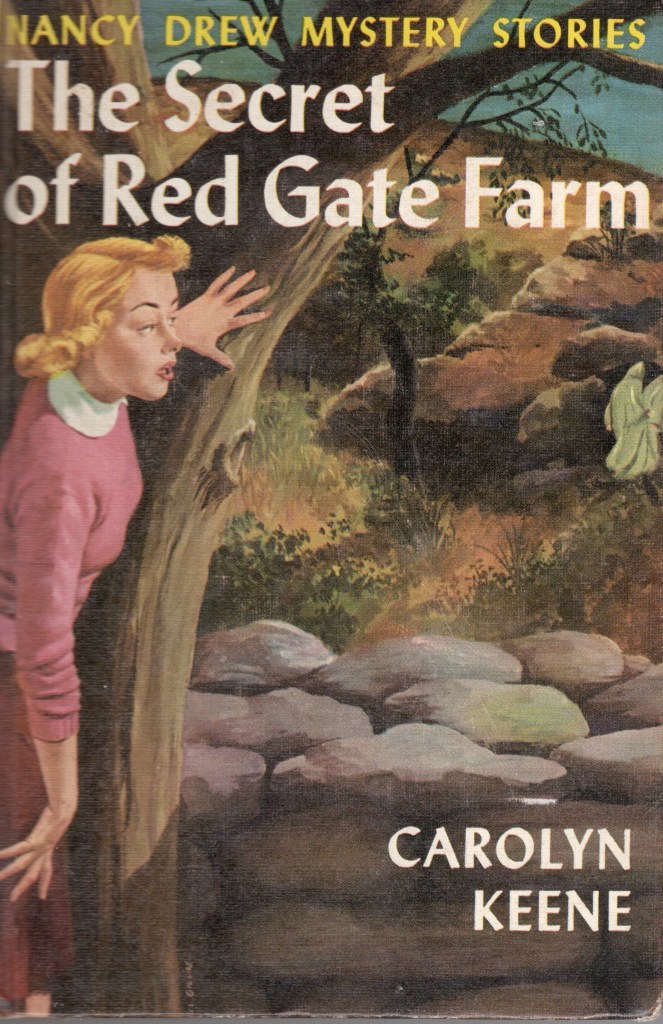
Nancy Drew wasn’t the first kids’ sleuth series I discovered (Trixie Belden’s The Red Trailer Mystery and The Three Investigators’ The Mystery of the Moaning Cave came first), but when I was in the fifth grade, sometime between 1969 and 1970, we had a table of books in the back of the room that had belonged to the (now grown) children of our teacher. I was already reading mysteries checked out from the library or ordered from the Scholastic Book Fair, so when I saw The Secret of Red Gate Farm there on the table, along with the banner NANCY DREW MYSTERY STORIES, I couldn’t pass it up.

And on the back was a listing of all the titles in the series to that point in Nancy Drew history when this copy was printed. This was very exciting for me–a series? Of mysteries? I’d never heard of such a thing, and my life was about to be changed forever.

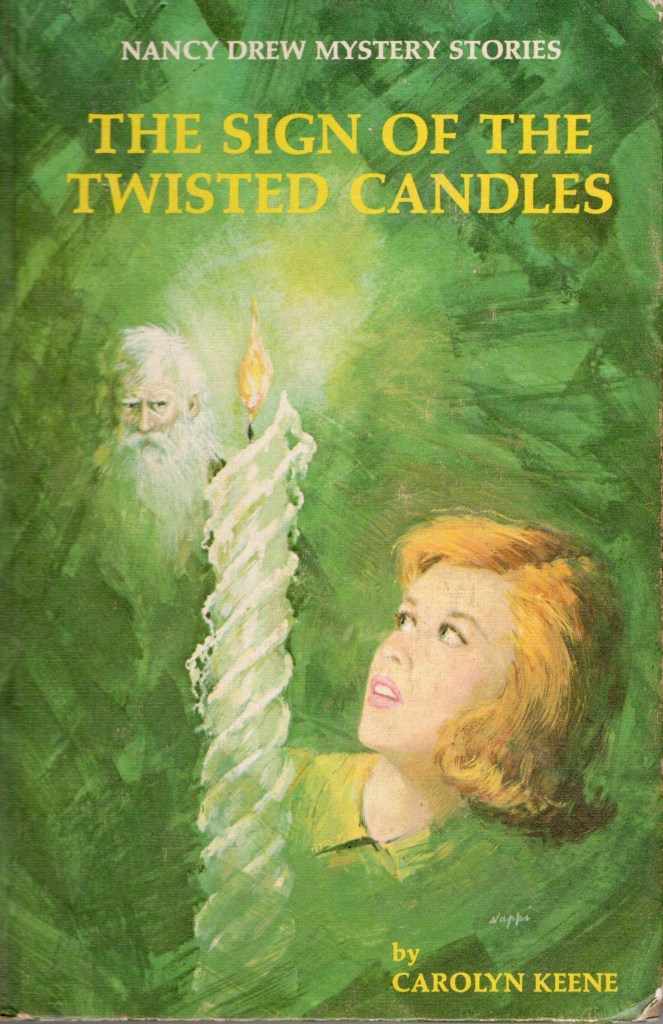
I recently found excellent replacement copies for my collection at the library sale–my copies of Crossword Cipher and Red Gate Farm are seriously dilapidated and wrecked–and I don’t remember if I have a revised text copy of Twisted Candles, so I picked it up, too. I do sometimes wonder if my collecting this books isn’t part of the neuroses I think it it is and part of a tendency to hoard things, especially books.

It probably will not come as a surprise to anyone that it always really bothered me that I didn’t read or acquire the books in order. There were other volumes in the series back on the table, including The Mystery at Lilac Inn, The Hidden Staircase, and The Haunted Showboat. (There was also a Dana Girls, The Secret of the Old Well. I eventually acquired the first and third books, The Secret of the Old Clock and The Bungalow Mystery, from the Woolworth’s on 26th and Pulaski in Chicago.) Nancy Drew was my first real foray into collecting a kids’ series, and of course, my parents were delighted that I moved on to the Hardy Boys without argument as ordered; they never liked me reading books with female heroines, which of course made Nancy Drew even more appealing to me because it was forbidden. (So, of course, I kept reading and acquiring them whenever I could when I wasn’t being supervised. So, yes, I was even in the closet as a Nancy Drew reader,)

But even as the revised texts appealed to me more because the font was better and the books were illustrated, I did notice, even as a kid, that Nancy was a lot more passive than she was in the original texts. Things happened to Nancy in the newer books, and her personality was bland to the point of being beige. It also irritated me that of course this rich lawyer’s daughter didn’t have a job, didn’t go to school, didn’t seem to have any responsibilities whatsoever other than traveling around doing as she pleased and stumbling over mysteries (sometimes the mystery came to Nancy). Her friends all adored her, would do anything she asked, and she was good at everything she tried. As someone who was not good at everything he tried, this annoyed me. Why not give her some flaws? Why make her this super-character who was perfect in every way? As I got older and revisited the original texts more, I could see why aficionados preferred the older versions, despite being dated and rife with racial and racist stereotypes; because Nancy wasn’t perfect in her original incarnation. She was a bit arrogant, definitely classist, and very headstrong to the point of being willful. She was also absolutely fearless, and had very deep convictions about right and wrong, and how wrongs must always be righted. She was fascinating but realistic. She’s aware of her privilege–even as she uses it as needed–but tries to use it to help others less fortunate, which is kind of admirable. The original text Nancy was the kind of character a girl between the ages and nine and thirteen would find aspirational, would want to be like, a role model of sorts presented at a young and formative age that they, too, could be smart and independent and liked as themselves, rather than as someone’s daughter or girlfriend or wife.

Even as a kid, I was drawn to strong, independent female characters. That has never changed.

Most of my collection of Nancy Drew mysteries–and all the other kids’ series I collect–are currently in boxes in my storage attic. There just isn’t room to have them out on display (which makes me crazy, but it’s either that or the copies of my own books, and my vanity trumps not displaying the books every time), because I do have copies of every Nancy Drew except for maybe one or two, and there are some revised editions I don’t have. Shortly after I got to the age where I could actually buy them with my own money, the editions changed; they went from the old flat matte covers to what aficionados and collectors call “the flashlight editions”, because there’s a flashlight as the logo on the spine (rather than the little black box with Nancy in profile) and they went to a glossy cover; also on the cover where NANCY DREW MYSTERY STORIES was changed to a banner across the top in yellow (the Hardy Boys’ banner was blue), and I didn’t like the new glossy covers or the flashlight editions or the banner…plus, I wasn’t going to start over and collect them all in this new format; this was when I started looking for them at yard sales, second hand stores, and flea markets (before the Internet and ebay).

I’ve also noticed how rabid the fans for both Nancy Drew and the Hardy Boys can be. I belong to several Facebook groups for fans and collectors, and those people can get worked up really easily–and of course, it always has something to do with bigotry and change. They hated the new Nancy Drew series because (gasp, the horror!) Ned was Black and even greater horror, she has sex. There was a lot of pearl-clutching over this, as there was about the new Hardy Boys series, in which Joe was made much younger, their mother was killed off, and there were a lot of supernatural elements to both (I never finished the Nancy Drew show, but not out of distaste; I always appreciate new interpretations and find the changes made interesting. I never finished because I forgot about it, in all honesty)–again, pearl clutching–but every so often it amuses me to think about writing a book built around this fandom. But it would of course have to be a fictional series, but it could be really, really funny.

And I think the Hardy Boys may now be in the public domain? I don’t know how that works, but I’d love to be able to write my own. I’ve always wanted to, and if I could actually use the original characters…how fun would that be? I’ve also always hoped to get a gig ghostwriting for either series…I suppose it’s not impossible, but I’m not sure they are still releasing new titles in either series. There have also been spin-off series, too–but I’ve never read outside the original canon. Once they stopped being published in hardcover, I don’t care about collecting the paperbacks or reading them, either.

But Nancy was important in the formation of my interests in reading and what I write, and maybe she wasn’t my favorite series of them all, but I have an appreciation for her and the books still to this day.

My goal is to write an entry on every series I collect–I think I’ve already done The Three Investigators–but so what if I have? My blog, my entries!

Next up, I will probably read the original text of the Hardy Boys’ The Mark on the Door, which I picked up in a tweed edition sans dust-jacket at the library sale.

Until then, hang in there.

Seekers Who Are Lovers

Sunday morning in the Lost Apartment again, and I am looking forward to a lovely and productive day here. We had a rather marvelous thunderstorm last night–although there was potential street flooding, so hopefully the car is okay–which was nice. It’s been awhile since we’ve had a thorough cleansing rain like that, which is part of why the heat index has been so miserable lately. The temperature has been hot, and the humidity about what it usually is–not humid enough to rain, but so close it’s miserable. I had planned to barbecue last night, despite the heat, but when I was getting ready to start putting everything together was when I realized it was not only raining but pouring. There was also magnificent, long lasting rolling thunder claps that lasted for seconds; the kind where it sounds like the sky is splitting apart. So, I made pizza instead for dinner, and hopefully will be able to cook out this afternoon. The power also went out overnight–I slept well again last night, to wake up to blinking clocks everywhere. It was out for maybe about twenty minutes, based on the emails from Entergy letting me know an outage had occurred (how does one check one’s email without power? A mystery for the ages) and the follow up announcing the restoration of power was sent about twenty minutes later.

I ran my errands yesterday, including making groceries and dropping off boxes of books at the library sale. I cleaned and organized and filed most of the rest of the day, finally getting the office area whipped into some semblance of order that’s not only workable but close enough to being finished that it won’t take long to do so that I can finish it over my coffee this morning and while taking breaks from writing this–although these things generally tend to be fairly stream of consciousness. Today I am going to make a to-do list for the week, update the bills list and make sure everything is current, and I’d like to make some progress on the rugs in the kitchen. The living room looks much more bearable now that those boxes of books are gone, and I think I need to thin out the beads next as well as do some additional book pruning. I cleaned out some drawers yesterday, getting that project under way, and I also need to go through my last few journals to mark the places where I made notes on the things I am thinking about writing now. I’m also trying to decide what the point of whatever it is I want to write next will be. I’d like to write something for the Malice anthology, but the deadline looms and I don’t think I really have anything I can whip into shape in merely one day, which means I am going to need to write a draft and figure this story out as I go–the idea is very amorphous, and I’ve not been feeling terribly creative yesterday, which could prove to be a most frustrating writing experience. There’s another one I’d like to revise and work on–I am feeling connected to it, and to its voice, but again I am trying to figure out what I am trying to say in the story. I need to reread all of these things, of course. I need to reread lots of things so that I can get a grasp of them again so I can find my way into writing them. I actually started two books this past week, can you believe that? Like I don’t already have enough things in progress already that I need to start two more? I wrote the first sentence of each book, and stopped there. I know what I want to say in both of them, and where I want those opening chapters of each to go, but I’m not sure precisely how to say it.

I also got deeper into Megan Abbott’s Beware the Woman, taking it slowly and savoring the experience as the rare treat and pleasure reading anything written by Abbott always winds up being. Each book is different in content, yet variations on a theme; I think future literary scholars will look book on her canon and study it as the incisive social commentary it is, about what it is to be a woman as well as how it is to be one, the strictures and compromises, the struggles between expectations and reality, all wrapped up in a lovely bow of beautifully constructed sentences that are complex in their very simplicity, and razor-sharp observations and insights into the strange tangle of emotions and contradictions that make us all so tenderly and sadly human.

We watched a tragic gay romance movie last night, Firebird, which was based on a true story from the days of the Soviet Union and its homophobia (still a thing in Russia to this very day, never forget). It was very well done, but it was also sad as such stories always are, with the kind of bittersweet ending where the truly conflicted one ends up dead and the one who isn’t moving on with his life stronger for the experience. So, no, not the feel-good gay movie of any year, by any means, so after that a few episodes of Awkwafina is Nora from Queens was just the ticket back from that downer.

Also, when I was dropping off books at the library sale, since I had cash on me (which is a rare thing) I checked the children’s section for series books I collect (I do this periodically, but only when I have cash on me) and I scored today with four books at two dollars apiece, and I had exactly eight dollars on me. I got three yellow-spined revised text (important) Nancy Drews (The Secret of Read Gate Farm, The Sign of the Twisted Candles, The Clue in the Crossword Cipher) which was the style when I started reading them so those are the ones I want. I already had copies, but the ones I already had on hand have been damaged over the years, and these were in excellent condition. I also got a tweed original text Hardy Boys The Mark on the Door, which I’ve never had a copy of (I only ever had the blue spine revised text) and have never actually read. There was no dust jacket, but it’s in really good condition. It’ll be fun to read it; per the fan groups, this was one of the books written during the time the original writer had left and the new ghost writers weren’t as good; and the plots tended to be a bit on the insane side sometimes. I am rather intrigued to read it–since they were all revised to get rid of offensive ethnic and racist stereotypes and language, it could be eye-opening.

I’ve also been reading Matt Baume’s marvelous Hi Honey I’m Homo, and am now up to the chapter on Dinosaurs, which I never watched. It’s really a fun book about how queer representation began and evolved over the years, as well as documenting the pushback against that representation (newsflash shocker: evangelicals have been coming for us every step of the way), and it’s written in an easy and accessible style that flows well. I’ve enjoyed his Youtube content, and I’m delighted to see that the book is in the same vein and just as well done. Highly recommended, and definitely more to come on that when I’ve finished reading the entire thing.

And now to my easy chair, to spend more time with Megan Abbott. Have a great Sunday, Constant Reader, and I will check in on you again tomorrow.

Carousel

As Constant Reader should know by now, while my entire identity and ego is wrapped up (probably too much) in being a writer, the truth is I have always been, currently am, and will always be, a reader first. I love to read, always have since I first learning what the little squiggles on the pages actually meant and learned how to decipher the little squiggles first into words, then into sentences, paragraphs and eventually entire stories. Reading was always my escape from a world too harsh for a little creative gay boy surrounded by people who didn’t read much nor cared much about books and so forth; sometimes the fantasy worlds I created in my head–always influenced by my reading–were safer and better places that I preferred to what, to me, was the horror of reality. I also learned a lot from my reading. I learned about other countries and cultures and groups; history and geography and other little odds and ends of information that remain lodged in my head and make me good at both Jeopardy! and Trivial Pursuit (case in point: I learned from Nancy Drew’s 44th adventure The Clue in the Crossword Cipher that the Incas’ language was quechua; I’ve never forgotten that, or that the Nasca Lines play a part in the book, and she and her friends also went to Machu Picchu).

Over the last few years I realized that my reading was primarily white and straight and decided to correct that; since then I have discovered the eye-opening marvel that is the talent of non-white authors and their remarkable story-telling ability. S. A. Cosby, Kellye Garrett, Silvia Moreno-Garcia, Mia P. Manansala, Alex Segura Jr, Raquel V. Reyes and many others have opened my eyes to other American experiences, and reading their work has also given me a broader and deeper understanding and appreciation of a different kind of American experience.

And then I read Gabino Iglesias’ 2022 release, The Devil Takes You Home.

Leukemia. That’s what the doctor said. She was young, white, and pretty. Her brown hair hung like a curtain over her left eye. She talked to us softly, using the tone most people use to explain things to a child, especially when they think the child is an idiot. Her mouth opened just enough to let the words flow out. She said our four-year-old daughter had cancer in her blood cells. Our Anita, who waited in the other room, playing with Legos and still wrapped in innocence. Acute lymphoblastic leukemia. Those strange words were said in a voice that was both impossibly sharp and velvety. Her soft delivery didn’t help. You can wrap a shotgun in flowers, but that doesn’t make the blast less lethal.

The young, white, pretty doctor told us it was too early to tell for sure, but there was a good chance that Anita was going to be okay. Okay, that’s the word she used. Sometimes four letters mean the world. She immediately added that she couldn’t make any promises. People fear being someone else’s hope. I understood her, but I wanted her to be our hope.

Jesus.

The opening of the book rips your heart out and rends your soul.

I am not a parent, never have been, never wanted to be, and never will be. I admire and respect parents (for the most part) because when I try to imagine what it’s like to be one, I can’t–it literally wears my brain down. I am a chronic worrier as it is; I get nervous when Paul doesn’t come home from work when he’s supposed to, or dawdles and delays and doesn’t text me. But for the most part, I know he’s an adult and functional and I believe he can, for the most part, navigate the world safely so I don’t spend a lot of time worrying about him.

I don’t think parents ever have a moment’s rest from the time the child is born until the child or the parents die–and I can imagine no greater grief than losing a beloved child.

Losing their child is how this book opens. And you just know in your heart of hearts–things aren’t going to get better any time soon for the father narrating this story. It isn’t a spoiler to let you know, Constant Reader, that by Chapter Three Anita is dead and her parents are swimming in debt and grief and drowning in it all. Before long, the marriage is over and Mario is alone with his grief and his debt and misery.

I don’t think I’ve ever read such a literate and powerful description of rock bottom in my life.

Mario turns back to crime in an attempt to make things right with the world and to somehow fill his horrible emptiness with something, anything. He starts off as a hitman, killing bad people and making money to pay down his debt and maybe, just maybe, somehow get his wife back and they can start over. Mario is desperate–and aren’t desperate characters the essense of noir at its purest distillation? He is then recruited to help liberate some cash from a cartel on its way to Mexico. Success means a cool two hundred grand and the potential to start over. Failure means a bullet in the head.

Both are better options than the life Mario is living at the time.

The pacing is breakneck and the story itself is a trainwreck you can’t look away from; you can’t help rooting for Mario, flaws and all, because the suffering is so intense you want him to find, somehow, both redemption and peace. (The book also serves as a stinging indictment of poverty in this country, and the near-impossibility of bettering yourself while drowning in the debt incurred for the possibility of bettering yourself, as well as our fraudulent health care system. Parents shouldn’t be saddled with insurmountable debt for trying to keep their child alive and especially not when the child passes.)

There are also some fascinating elements of the paranormal/supernatural mixed into the story, too–but while this might throw a typical noir off-track, it works here to heighten the sense of madness and unreality the entire book invokes. The true horror of the book is the system, designed to keep people of color down and to keep the cycle of poverty going.

Here are just a few of the gems in the prose:

The middle of nowhere is remarkably consistent in terms of being unmemorable.

The décor was a mix of a failed attempt at hill-country chic circa 1970 and neon signs for the kinds of beers folks buy at gas station convenience stores on their way to somewhere they wish they could escape.

The Devil Takes You Home is raw, fresh and original, with the kind of crisp smart literate writing that speaks of Lisa Lutz, Megan Abbott, and Jim Thompson.

I marked any number of pages for these writing gems that both awed and inspired me (to do better with my own work).

I highly recommend the book–but be warned: there is violence and gore aplenty, but it all works because it’s not there for shock value.

Always

I always learned from reading–which is probably why I was so bad at math, now that I think about it.

And while I’ve certainly read more than my fair share from reading non-fiction (history and biographies), I’ve also learned a lot from fiction (while admitting as an adult that some of what I’ve learned from reading fiction should be viewed with a much more critical eye)–the so-called “travelogue” books in the kids’ series, like Nancy Drew’s The Clue in the Crossword Cipher or the Hardy Boys’ The Mystery at Devil’s Paw was often how I learned obscure facts that frequently come in handy when watching Jeopardy or playing Trivial Pursuit (example: The Clue in the Crossword Cipher was where I learned that the Inca language is called quechua, and I also learned about the Nasca Lines and Macchu Picchu from that book). I love reading books that, through the course of the story, expose me to information about a culture or a society or country that I don’t know much about–I’ve generally heard of it, but don’t have any other knowledge and let’s face it, there’s only so much time in every day and it’s hard enough to keep the plates spinning as is–which is why I love fiction that tells me an entertaining story while at the same time teaching me something.

Julia Dahl’s debut novel, Invisible City, is one of those.

I was in Chinatown when they called me about the body in Brooklyn.

“They just pulled a woman out of a scrap pile in Gowanus,” says Mike, my editor.

“Lovely,” I say. “So I’m off the school?” I’ve spent the past two days pacing in front of a middle school, trying to get publishable quotes from preteens or their parents about the brothel the cops busted in the back of an Internet café around the corner.

“You’re off,” says Mike.

The rest of the press is on the scene when I arrive at the gas station across from the scrap yard. Pete Calloway from the Ledger is baring his crooked teeth at the NYPD’s Deputy Commissioner of Public Information, or as reporters call him, DCPI. DCPI is six inches taller and seventy pounds heavier than Pete. It’s barely twenty degrees out and Pete’s got his hoodie up, his shoulders hunched against the cold, but DCPI is hatless, scarfless, gloveless, coatless. His uniform jacket collar is pulled up, two inches of starched wool-blend against the icy wind.

“We’re hearing she was found without clothes,” says Pete. “Can you confirm that?”

Again, I am late to the Julia Dahl party. This book was an Edgar finalist for Best First Novel, and any number of my colleagues and friends in the mystery/crime community have raved to me about Dahl’s strong gift for writing. Invisible City was the final selection for me to take with me on last week’s trip, and it was a wonderful companion for me on my three and a half hour flight from Boston back to New Orleans. I was so deeply engrossed in the novel that–other than being interrupted by the flight staff to give me a bag of pretzels and a can of Pepsi, and then to collect my garbage–the plane could have caught fire for all I knew or cared; I just wanted to get to the bottom of the murder of the naked woman whose body discovery kicks off this well-written and very fast-paced mystery story.

Our main character here is Rebekah Roberts, and what a gift to the crime world she is! Well rounded, fully developed, and absolutely real, Rebekah is one of the most fascinating and complex series characters I’ve come across in quite a while. Dahl, like all great writers, lets us see Rebekah in all of her glory–with all of her flaws, her personality issues, her raw emotion–and while sometimes she might seem to an outsider as a bit brash or even much as I hate to say it, bitchy–Rebekah’s rawness and vulnerability makes her someone you not only enjoy spending time with as a reader, but you hate to stop spending time with her at the end. She’s fairly young, recently out of the University of Central Florida, and now living in New York trying to make ends meet (as well as build a journalism career) while working as a stringer for a tabloid paper in the big city. She’s not making a lot of money, and her small circle of friends are also terrifically rounded out as fully dimensional characters–and I hope, as the series progresses, we get to know them even better.

The case obviously begins with Rebekah going to cover the discovery of a nude woman’s body at a scrap yard in the dead of winter. But…the scrapyard is owned by Hasidic Jews, and the body is quickly taken away by a Hasidic funeral parlor rather than the medical examiner’s office, which strikes Rebekah as not only strange but not legal.

And this is where Dahl’s genius as a creator kicks in: Rebekah’s mother was Hasidic, questioned her faith, met Rebekah’s father and ran away with him. They were never married, but she gave birth to Rebekah, but the pull of her faith and her old life proved far too strong for her, and so she abandoned father and baby when Rebekah was six months old. She grew up without a mother, her father slowly changing the story of what happened to her mother as he deemed she was old enough and mature enough to handle the truth–from dead to gone to abandoned–and this, naturally, has caused some deep emotional issues for Rebekah to deal with. She hates her mother while longing to meet her and confront her–and gobbles anti-anxiety medication on the regular as she begins digging into the murder of this unfortunate Hasidic wife and mother, having to confront her own conflicted feelings about being not only half-Hasidic herself, but her own issues with that faith and way of life which she feels robbed her of her mother.

Dahl also does a magnificent job of exploring the Hasidic way of life–how alien it appears to the very much modern Rebekah, who cannot grasp why anyone in the modern day would choose such an archaic, ancient way of life, but as Rebekah learns more about why the Hasidim choose to live the way they do, my own understanding grew. The way she brings these Hasidic characters to life, refusing to simply turn them into stereotypical, one dimensional freaks and humanizing them instead, is a gift to her readers. I may not be able to comprehend living that kind of life, but I came away from this book with an understanding and empathy for them; why they self-isolate and remove themselves from the goyim in a way I don’t think I could have without Dahl unlocking that world in such a compassionate, empathetic manner.

And it’s a corker of a mystery too. I couldn’t put it down, and I am very excited to continue reading more in the series. Rebekah is an amazing heroine, destined to be ranked up there with the other great female crime series characters, and I look forward to watching Dahl continue to grow and flex her muscles as a writer–which are already, from this debut, clearly well-trained already.

Read this book. You can thank me later.

Starlight

And so now it’s Sunday.

I won’t lie; I’ve lost my sense of time and date and day already this weekend and I’m perfectly fine with it. I hope everyone who has the good fortune to have the weekend off–I know there are many who do not–are in the same state of what day is this that I found myself in most of yesterday and when i woke up this morning–I overslept again, which was amazingly lovely, but i really need to stop indulging myself this way–and am now awake, on my first cup of coffee, and ready to get shit done today. I did get shit done yesterday–I cleaned and organized quite a bit (not enough, it’s never enough) and while I do have some little bit of cleaning and a lot of organizing left to get done, at least I made a start on it yesterday. My desk, for example, this morning is clean and clear; which will make writing later much easier.

I finished Little Fires Everywhere yesterday–I blogged about it already, so I won’t repeat anything other than that it’s a fantastic book I encourage you all to read–and started reading The Coyotes of Carthage, which was originally recommended to me by my friend Laura, who was lucky enough to receive an advance copy. It, too, is fantastic and unlike anything I’ve ever read before, and I am really looking forward to getting more into it–I will undoubtedly take a reading break or two at some point today. It seems to be a political thriller about dark money and political consultants in a very rural county in South Carolina, with a Black male protagonist, so I am sure it’s going to be quite interesting to read.

But I really also need to write today; I’ve not looked at the manuscript since last weekend, and this “only writing on the weekends for one day” simply cannot continue to stand, really. I have too much to write, and I need to stop giving into the laziness or the tiredness or self-destructive patterns or whatever the hell it is that keeps me from finishing this damned book. Heavy sigh. I also have any number of short stories I need to wade through to pick out some to work on for submission calls.

Again, I think there’s something to that I am so overwhelmed believing I’ll never get everything done so why bother doing any of it thing.

Repeat after me: SELF-DEFEATING.

While I waited for Paul to finish working on a grant last night I watched, or rather, rewatched (although I didn’t really remember watching it before, and I figured, meh, if I’ve already seen it I can do stuff on my iPad while it’s on in the background) a documentary called Master of Dark Shadows, about Dan Curtis and how the show came about, and its legacy (I’m sure most people don’t remember Curtis also produced and directed the mini-series based on Herman Wouk’s novels The Winds of War and War and Remembrance). I was one of those kids who watched Dark Shadows only in the summertime, because my elementary school didn’t get out until 3:15; even though we lived only a block away from the school I couldn’t ever get home fast enough to watch even the end. I did love Dark Shadows–our sitter/caregiver, Mrs. Harris, also watched One Life to Live and General Hospital, which were my first exposures to soaps–and it always stuck in my mind; I always give it credit for my interest in horror and the supernatural. I enjoyed watching the documentary (and for the record, I loved the NBC reboot of the series in prime time in the early 1990’s, and was crushed when it was canceled; I rewatched it with Paul and he too was disappointed it ended on its cliff-hanger) and then we started watching a documentary about a double murder in India called Behind Closed Doors, in which the investigation was so incredibly fucked up–I mean, if the primary take-away from all the other true crime documentaries we’ve been watching has been man is our system seriously fucked up, the takeaway from this one is yeah, but ours is clearly better than others.

Which is kind of scary, really.

While I was also bored yesterday waiting for Paul–and only really sort of watching Master of Dark Shadows–I was right, I’d seen it before–I started looking things up on-line; which was an absolutely lovely example of how one can fall into a wormhole on the Internet. As you know, I’ve been having this Cynical 70’s Film Festival, and thinking about the rise, and proliferation of, conspiracy theories in that suspicious, paranoid decade, and one that I hadn’t remembered until yesterday sprang up into my min, completely unbidden, while I was reading about the Bermuda Triangle: Chariots of the Gods? by Erich von Daniken. Does anyone else remember von Daniken and his theories, which were based in nothing scientific or archaeological? Von Daniken believed that ancient texts–the Bible, the Code of Hammurabi, etc.–all contained evidence that in Ancient Times the Earth was visited by space aliens–Alien Astronauts, as he called them–who brought knowledge and information with them to the primitive creatures of our planet at the time, and also assisted them in the massive building projects that modern man cannot conceive of them building back then–the pyramids, for one thing, and the lines on the plains of Nazca (which I first read about in the Nancy Drew volume The Clue in the Crossword Cipher)–and those aliens with their vastly superior technology, were seen as gods by the primitives and those visits have come down to us in the form of mythology. It’s an interesting idea for sure–but it was all conjecture, with no proof. I read all of von Daniken’s books back in the day; others included The Gold of the Gods, and were simply further conjectures, but he developed quite a following, and set the stage for what is called the pseudo-science of Graham Hancock, his modern day successor. (I’ve also read some of Hancock’s work; his theory that the Sphinx is far older than we suspect based on water wear on its base is interesting, as is his other theory that the Ark of the Covenant’s final resting place is in Ethiopia; before reading that book I had no idea that Christianity was so firmly entrenched there) So, I spent some time looking up von Daniken’s theories yesterday, as well as some other conspiracy theories of the time–I also did a deep dive into the entire Holy Grail Holy Blood thing which provided the basis for The Da Vinci Code and Dan Brown’s entire career; and of course we certainly cannot forget the apocryphal writings of Hal Lindsay and The Late Great Planet Earth–which, really, is where The Omen came from; we forget how “end times” theory truly began flourishing in the 1970’s.

I’ve always been interested in stories about lost books of the Bible, or lost Biblical theory, along with the end-times prophecies Lindsay wrote about; Irving Wallace’s The Word, which was built around the rediscovery of a lost testament of Jesus which would revolutionize and make-over the Christian theology was one of the first novels of this type I read; it was also made into a mini-series, which made me aware of it in the first place (Irving Wallace isn’t really remembered much today, but he was a huge bestseller back in the day, and he wrote incredibly thick novels, mostly about international conspiracies or legal issues–The Seven Minutes, for example, was about censorship and “blue laws”; The Second Lady was about a Soviet conspiracy to replace the First Lady with a lookalike imposter who was a Soviet spy; The Prize was about the machinations around how the Nobel Prize was given out; etc etc etc). The Da Vinci Code fits clearly into this category, as does The Gemini Contenders by Robert Ludlum and The Fourth Secret by Steve Berry (which is about the fourth secret Our Lady of Lourdes–or was it Fatima?–revealed to either Bernadette or the peasant children; Irving Wallace also covered this in The Miracle); Raiders of the Lost Ark and Indiana Jones and the Last Crusade also kind of fit here, as both films are about the search for Biblical relics. I’ve always, always, wanted to write one of these. Years ago I had the idea for one, in which there was a secret document or testament hidden in the Hagia Sophia in Constantinople for years, and that part of the reason the 4th Crusade sacked the city was the Pope’s desire to get his hands on those documents, which were thus smuggled out of the city by the Patriarch and lost forever…this is the idea I always come around to for a Colin stand-alone (I also realize I could do Colin stand-alones set at various times throughout the last twenty years or so of Scotty books, as he is gone a lot of the time on missions), and the working title for it always is Star of Irene, because the Byzantine Empress Irene–contemporary of Charlemagne–has always fascinated me.

But I will never write a Colin stand-alone, or series, unless I get this fucking book finished, so I suppose it’s time for me to head back into the spice mines.

Have a lovely Sunday, Constant Reader.

I’ll Be There

Thursday–the last full day of work for me this week; Fridays I only work half-days. The weekend looms on the horizon, and in theory, my life should be settling down into a normal routine next week at the day job after weeks of never being completely certain what I would be working the next day. For someone who is an utter control freak about time and scheduling, this has been torturous for me. For some reason I crave structure; I have to be at the office at this time, I can go to the grocery store here and then I can come home and spend this time writing and this time cleaning and this time watching television, relaxing.

And yet I also don’t like being caught in a routine, a rut, if you will.

I am nothing if not a writhing mass of contradictions.

But, like with audiobooks, an old dog can learn a new trick every now and then.

I am currently rereading Erich von Däniken’s Chariots of the Gods?, which I originally read in the 1970’s. The 1970’s was, for some reason–probably all the upheaval of that decade and attempts to recover from the social unrest of the previous decade–a decade of weird conspiracy theory and even more peculiar science; the Bermuda Triangle, UFO’s, Area 54, ancient aliens, etc. I used to read a lot of these books, mainly because they were interesting, even though there were frequently enormous gaps and huge leaps of logic required to follow the authorial reasoning to the points they were trying to make in those days; and even as a teenager I often spotted these logistical flaws. But the concept behind Chariots of the Gods? was one that I was interested in, and while von Däniken’s writing style (in fairness, the book was written in German and translated) left something to be desired, one thing I took away from the book in the first place was the realization that exclamation points used in non-fiction usually means most of the reasoning is bullshit.

(I also loved the movie Stargate, which can probably be directly traced back to reading Chariots of the Gods?)

I kind of love these theories, though, even as I recognized they are problematic. A lot of human history isn’t recorded, and so we are left, for the most part, to wonder about the origins and rise of Egyptian civilization, or what life was like in Ur, or how the idea for written communication began or where it came from, and so forth. I also remember one of the reasons I was partly drawn into the whole Chariots of the Gods? things in the first place was because one of the “sites” he tried to explain away as being designed for ancient astronauts were the strange lines on the plan of Nazca, in Peru–which I had read about in the forty-fourth Nancy Drew mystery, The Clue in the Crossword Cipher. (In retrospect, I am also horribly disappointed neither Nancy or the Hardy Boys–in the original series–never went to Egypt; both Rick Brant and Biff Brewster did, in The Egyptian Cat Mystery and Egyptian Scarab Mystery, respectively.)

But, as I said, even I, a relatively uneducated and unformed preteen, could spot fallacies in logic and reasoning in the book. It was made into a TV special, In Search of Ancient Astronauts, and then a feature film with the same name as the book. Von Däniken wrote several more books–turning it into a virtual cottage industry–but I never read beyond the first.

I was reminded of this recently when I came across an article on Von Däniken’s racism, and that his theories were based in racism (you can read it here), and as I read through the piece, nodding, I was also amazed at how it never occurred to me that essentially, Von Däniken’s theories were predicated on racism and asserting white supremacy by erasing the historical accomplishments of ancient, non-white civilizations. So, I checked the book out of the library to reread it and look for the racial coding–plus, to see if there are as many irrational and illogical leaps made as I remember.

And I also can’t stop thinking about the Bermuda Triangle and other conspiracy theories that were huge in the 1970’s…and wondering why the 1970’s was such a fertile ground for pseudoscience.

And now, back to the spice mines.

IMG_4431