Sweet Time

And it’s New Year’s Eve.

I slept well last night but my blankets were all tangled up this morning, indicating the sleep was more restless than it has been for weeks. I also wasn’t in the mood to write my blog when I first woke up, so I decided to read, drink my coffee, and maybe have some breakfast before getting cleaned up. I usually write this over my morning coffee, and since I don’t reread or re-edit once it’s written, that could explain the run-on sentences, word repetitions, and occasional poor grammar no one ever points out to me. This blog began nineteen years ago (!!!) on Livejournal (the anniversary was 12/26), migrated over here in about 2016 or so, and still somehow keeps chugging along. It always surprises me that people read it, to be honest. It was always meant mainly for me, and was originally intended as a daily exercise to get me writing again. I guess it worked. When I started I had published four novels, a few anthologies, and some short stories. Nineteen years later, I’ve way surpassed that total, despite some fallow years in which I produced nothing.

I did some more picking up around here yesterday while watching football games. It was fun watching Mississippi beat Penn State, and don’t even get me started on the Florida State-Georgia game. I get the disappointment at not making the play-offs, but you also knew you were scheduled to play Georgia, another team disappointed in not making the play-offs, but instead of showing everyone that the committee was wrong and showing up to beat Georgia…and Georgia also had star players injured and over a dozen opting out and even more entering the transfer portal. This would have been a play-off game had either Auburn or Georgia beaten Alabama this year, but that’s how things go. Auburn went 13-0 in 2004 and wasn’t invited to the BCS title game. You don’t always get what you want in life or sport, and the question is how you handle that. If this was going to be the case, don’t accept the damned bowl bid. Your fans spent a lot of money to go to that game, and it was incredibly disrespectful to the team, the fanbase, and the university to show up and get embarrassed like that. After Coach O was fired in 2021, LSU went to its bowl game with 39 scholarship players and got trounced by Kansas State….but how does it appear in the record books? KSU 42, LSU 21. Twenty years from now when people look back at the history of college football and bowl games, it will read Georgia 63, Florida State 3. It’s a program and culture problem, and all the FSU fans apologizing for this disgraceful beating–do you quit when you don’t get a raise or promotion you worked hard for and feel like you deserved? The word for that is quitter…and for the record, Georgia played it’s back-ups, walk-ons and so forth in the second half and still beat your ass 21-0.

And if LSU went 12-0 and didn’t get picked for the play-offs…and pulled the same shit? Sure, I’d be angry about the play-offs but I’d also call out the Tigers for embarrassing the state and the university that way.

I’m really enjoying Danielle Arsenault’s Glory Be, and am savoring every word. What a fresh and unique voice! I have to say I am so glad I realized I needed to be better about my reading choices and should read more diverse writers. It’s been a great education for me as a reader, a writer, a person and a citizen. I’m still learning how to be better about race and gender and gender identity and sexuality; and I strongly encourage other readers to do the same. Crime fiction is so much stronger and healthier when it represents everyone, I think, and while I don’t consider reading diverse writers to be the total education I need on any social issues facing the country–I need to read more non-fiction and theory.

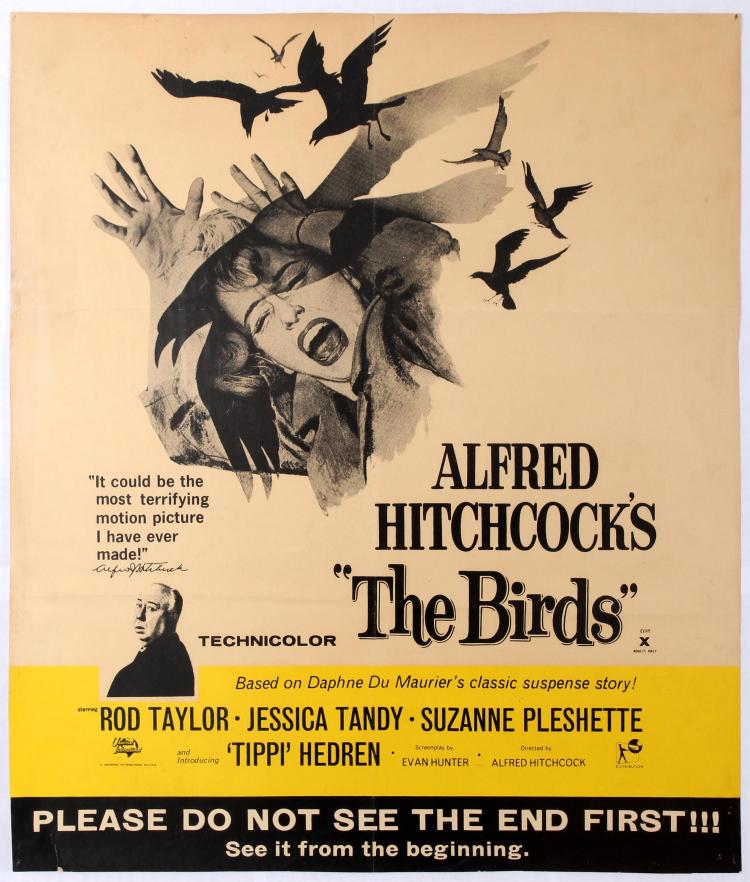
I rewatched The Birds yesterday after the football games, and it was pretty much as I remembered it. I’d only seen it twice before; originally as a child edited for television, when it frightened me so badly that I had nightmares (I was prone to them growing up) and for years could never see crows on a jungle gym or a wire without feeling uneasy and then again as a rental in college after I’d read the short story again and wanted to see how faithful the film was to the story. I didn’t care as much for it the second time around–the acting is really terrible and so is the script–but the suspenseful parts still held up and were scary. This third time around confirmed my second viewing; and I noticed some other flaws in the picture. Rod Taylor’s mother isn’t much older than he is, and why is there about a thirty year age gap between him and his sister? I think the short story is better than the film, but I can also see why people like it. I do consider it one of Hitchcock’s lesser films.

Since tomorrow is a day for thinking ahead and coming up with some goals for the new year, I suppose today should be a recap of sorts of this past year. It was, as I mentioned in a previous entry, a rather up-and-down rollercoaster of highs and lows with very little level ground in the middle. The recognition of mainstream award nominations for my work–even queer work–was a delightful surprise this past year. But even more important than that is I think my work is getting better. I had felt, some years ago, that my writing was becoming stale and that I wasn’t growing as a writer anymore; I’d become stagnant and that was one of my biggest fears. I wound up deciding to take some time away from writing books on deadline and write things just for me, things that I wanted to write but also wanted to take the time to do correctly. It was during this time that I worked on both #shedeservedit and Bury Me in Shadows in early drafts, and also started the novellas and working more intently on my short stories. I accepted the challenge of writing stories to themed anthologies, and produced some terrific ones of which I am really proud. When I dove back into series work with Royal Street Reveillon, I wanted to write something non-formulaic for the Scotty series. I also wanted to shake things up with Scotty a bit, as the series was getting a bit too comfortable and safe for me. Royal Street Reveillon certainly was neither comfortable nor safe, and neither was Mississippi River Mischief.

Bury Me in Shadows was not easy for me to write. When I went back to the book after setting it aside for awhile, I realized several things: I couldn’t ignore race and racism, I had to address the Lost Cause narrative, and I also had realized while doing more reading and research that the stories my paternal grandmother used to tell me about the Civil War and Alabama and the family were apocryphal stories you can turn up about almost everywhere in the rural South. The book wasn’t working, in fact, because I was trying to elide those issues because I was afraid of doing it wrong…so it pushed me to do better. And actually addressing those issues made the book easier to write. The same thing was true of #shedeservedit; I’d been working on this book in one form or another since I actually lived in Kansas. But again, I realized when I went back to it that what I was doing didn’t work because I wasn’t going there with toxic masculinity and rape culture because it wasn’t personal enough for my main character, and so I bit the bullet and made it more personal for him. It dredged up a lot of memories, some of them painful, but it also made the book better and stronger. I had been wanting to write a cozy for the longest time, and decided to try it for something different and new–and that became A Streetcar Named Murder. I was also very pleased with it, even though the deadline and the turnaround on it was a bit insane…but I still managed to take my time and turned it into something I was proud of when I got the final author copies.

My two releases of this year–Death Drop and Mississippi River Mischief–are also books of which I feel proud. I also published three terrific short stories this year: “Solace in a Dying Hour” in This Fresh Hell; “The Ditch” in School of Hard Knox; and “The Rosary of Broken Promises” in Dancing in the Shadows.

I think I’m settling finally into an acceptance that I am pretty good at what I do. I may not have the master’s or PhD in creative writing or literature of any kind; but I’ve never really wanted to be an academic writer. I never wanted to be Faulkner, but Faulkner did inspire me to interconnect novels and stories in my own fictional world (also Stephen King). I would like to do some non-fiction studies of genre and writers I enjoy, but in an accessible rather than academic way. Academics used to make me feel stupid and uneducated, and I also used to envy those writers who had that kind of background because I felt it made their work stronger than mine, or gave them insights into writing and building a novel that I’d never had, which made me and my work somehow lesser. But that wasn’t on them; that was on me. I was the one who felt inferior and lesser, not talented or good enough. That chip was on my shoulder and I was the one who put it there. My peers actually consider me a peer, and newer writers look at my longevity and my CV and are impressed by the prodigious output, if nothing else. I used to think all the award nominations were kind of hollow because I so rarely won; which was incredibly ungracious because some writers are never nominated for anything…but it doesn’t mean their work isn’t good. Now, I just find myself grateful to make a short-list of five out of all the possibilities for that slot, you know? I’m lucky, and I’m blessed.

I’ve reflected a lot on my life and my career this past year–Mom’s death had something to do with that–and I’ve identified, in many cases, why I am the way am by remembering the event that triggered the response in my brain of “okay, never want to experience that again” which led to so many self-toxic and self-defeating behaviors. But the bottom line of it all is I’ve finally accepted myself for who I am, have determined to stop self-deprecating, and take some pride in myself and my career and my life. I know the most amazing people and have the most incredible friends. I have a day job where I make a difference in people’s lives. I have an awesome life-partner, an enviable writing career, and I get to live in New Orleans.

Not bad, right?

Blue Bayou

Sunday morning and all is well in the Lost Apartment. Yesterday was kind of nice. I slept well again on Friday night, woke up at five, six and seven like every morning with no alarm, and then finally got up around seven thirty to get ready for the day, which was nice. I decided that it made the most sense to run my errands in the morning before the brutal heat of the afternoon; I needed to mail a letter and pick up the mail, as well as drop off Scooter’s leftover food at the Cat Practice and make groceries–and I needed cleaning supplies, so that was crucial to the day; an errand that had to be run. It was brutally hot, but I managed it all. I bought a lot of cleaning supplies, and spent most of the afternoon yesterday cleaning. I did the stairs, the floors in the bedroom, and finally emptied and cleaned out Scooter’s litter box. I was avoiding it because I was afraid doing it would make me sad, but ironically it was just a chore…but writing about it just now made me start to tear up a bit. Sigh. He was such a dear cat. (I also looked at the adoptable cats on the SPCA’s website. I really really want to get this twelve year old ginger boy that no one’s going to want because he’s old..but we’re old. Is it fair to get a baby cat that might outlive either or both of us? Well, that certainly cheered me up a bit. Christ.)

I also did the baseboards and the CD stand…which is something we’re going to have to discuss. We don’t even have a CD player anymore, and yes, it’s terrible to have paid for all that music only to lose it now all these years later but…I haven’t listened to a CD in years. My car has a CD player–maybe I can move some into the car and listen to them instead of the phone? We have all these great gay deejay dance mix CD’s–we used to buy them all the time, the little store across from the Pub used to sell them, and Tower Records–when it existed still–also sold dance remix CDs; I think I got the Debbie Harry dance mix CD single for “I Want That Man” at Tower Records. Anyway, years and years ago Paul had this wooden CD stand custom built. It’s a lovely piece of furniture, and perhaps it can be repurposed for something else–but the CDs are grimy and I cleaned them with a lick and a promise; but…do we really need to hold on to all those CDs? (The stand needs to be repainted white, too–years of nicotine have turned it precancerous–but that will have to wait until the weather calms the fuck down.

But I feel good about the apartment, really. Having the walls finally finished has awakened a nesting instinct in me that’s been dormant for quite some time. As I was finishing the stairs and looking around, I actually thought I wouldn’t mind having someone come by the house now even though it’s still not up to my standard (my work space will never stay tamed, alas), which is something I’ve not even considered in years. It felt good wiping down the walls and baseboards, picking up all that nasty dust and getting rid of it. I also bought a dust mop at the store yesterday (as one of my cleaning purchases) so I can run it over the walls more regularly to keep the dust from accumulating and turning into grime or cobwebs. It’s still very much a work in progress, of course, but I am feeling good about the homestead, and probably am about to do another brutal purge of the books.

I read some short stories yesterday as well–more of the Alfred Hitchcock Presents anthology stories, of course–and I am getting such an education in short stories, as well as having some powerful insights (well, to me anyway; remember, I go through life completely oblivious to everything) about my own stories, what I find myself afraid to do and how limiting my own fears about my abilities and my talents and my creativity have proven to be. One of the stories I read yesterday, “Getting Rid of George” by Robert Arthur, was about a movie star whose carefully hidden past suddenly comes back with a vengeance just as she is about to marry the love of her life and start her own production company with him, making herself quite rich in the process, and it hit me: one of the stories I am struggling with writing right now is about a wealthy gay man and his boy toy looking for a fabled ‘fountain of youth’ in a fictional Latin American country. I’ve had the idea for decades–since visiting the Mayan ruins in the Yucatan and thinking I should write a story about these ruins (and yes, well aware that I have to be incredibly careful and respectful of the Mayan culture and their descendants)…and this is the story set in a foreign locale I was going to try to write for the Malice anthology. I need to recognize self-destructive thinking when it presents myself; and whenever I think you can’t write this for whatever reason my reaction shouldn’t be to shy away from it but to dive into it headfirst and commit to it. (This is also one of those stories that I thought I had already written a draft of; but it is not to be found anywhere, nothing other than pieces of aborted openings–it may have been lost in the Great Data Disaster of 2018….but I just realized where it probably was and THAT’S WHERE IT WAS! Victory!)

And really, one of the two main characters in my story “Don’t Look Down” was a retired former boy band star. So, that was certainly outside my expertise, was it not?

I really enjoyed the Robert Arthur story; Arthur was also the creator of, and wrote, eleven of the first twelve Three Investigators mystery series, which makes him always special to me. He worked for Hitchcock on the literary side of the brand (Hitchcock became a brand like before we thought of creatives in terms of brands and branding and brand marketing), and also “helped” (i.e. “ghost edited”) most of the Alfred Hitchcock Presents anthologies. Arthur was a great writer, “Getting Rid of George” certainly is evidence of his talents, and it’s a shame he isn’t better known or regarded; but the great tragedy of juvenile books is that they rarely survive the test of time–they inevitably are forgotten, as are their authors, unless they win a Newbery medal or something, like Johnny Tremain, but I suspect even that tired old war horse of American revolutionary propaganda isn’t read nearly as much today as it was when I was a kid. There are few–Lois Duncan being one–crime writers for juveniles or young adults to be named Grand Masters by Mystery Writers of America; Arthur certainly deserved to at least be considered, as the creator of the Three Investigators and as a rather successful writer of crime short stories.

I read another story in My Favorites in Suspense, “Island of Fear” by William Sambrot, which I really enjoyed and thought was quite excellent. An Englishman looking for antiques and local art in the Greek islands spots a small island with a massive wall built along its shoreline, and wants to stop there as it is remote and doesn’t, per the captain, get many outside visitors. This is a “be careful what you wish for” tale; because he convinces the captain to let him off on the island, where he spots a gorgeous sculpture through a break in the wall, so exquisite he has to have it and meet whoever the people are who live in the land inside the wall. The island natives are quiet and don’t talk much–not his usual experience with Greeks–and finally convinces a young man to row him around the island to an opening in the walls so he can go ashore, meet the owners, and buy the statue. As I said, it’s a “be careful what you wish for” story, and the ending is quite satisfying as the last few paragraphs make sense of the “mystery” of the island. It may well have been my favorite of the stories thus far in the anthology (at least of the new-to-me material; remember the book opened with “The Birds” by Daphne du Maurier, which quite set the tone for the rest of the stories.

I also read a story from Stories That Scared Even Me, “Two Spinsters”, which falls into the category of “the unfortunate traveler,” which several stories in both anthologies fall into. It’s not bad, the main character being a police detective who gets lost on unknown backroads and can’t find the town he’s looking for, and is eventually forced to seek refuge at a strange house with two identical, if silent, spinsters–and there’s a lot more going on in that strange house than the weary traveler suspects at first. This story was written by E. Phillips Oppenheim, yet another writer I’ve never heard of or his work before. Oppenheim, however, was quite the big deal in his time; he wrote and published over a hundred novels and even more short stories; John Buchan (a Golden Age crime writer not as well known today as perhaps he should be) called him his primary inspiration when launching his own career in 1913.

Interestingly enough, the next story up in Stories That Scared Even Me is by Robert Arthur. There are only three stories left in My Favorites in Suspense, and the book closes with a short novel, The Blank Wall by Elisabeth Sanxay Holding, a classic from that post-war era that I’ve always wanted to read (it was common in those days to close a short story collection by including a short novel, and most crime novels in those days were rather short). I’ll probably finish reading those short stories today, but really need to get back to reading novels–maybe I’ll read a bit more into The Hunt by Kelly J. Ford, which is fantastic; taking so long to finish should not be seen as an indictment of Ford’s work. The book is fantastic and she is one of the great new voices in queer crime fiction–and I’ll be doing a crime panel with her later today for Outwrite DC.

I slept really well last night–it’s lovely having Paul home, really–and so today I hope to get some reading and writing done. I am about to adjourn to my chair to finish this Hitchcock anthology, and then I am going to work on getting some writing done while cleaning up the kitchen and my workspace. I feel very well rested this morning–I could have easily slept much later–so hopefully it will be a great day of getting things done.

Or not. Since Paul’s home now we can finish watching Gotham Knights, Hijack, and back to other shows we’re watching, and of course Paul needs to watch Season Two of Heartstopper, which means I can finally talk about it. I may check in with you again later, Constant Reader, and if not, I certainly will do so tomorrow.

Private Eyes

I loved the Three Investigators.

When I was writing about rereading “The Birds” the other day, it brought Alfred Hitchcock to mind again. I have been revisiting the old Alfred Hitchcock Presents anthologies lately, and slowly (finally) realizing what an enormous influence on my writing Mr. Hitchcock was. Obviously, there’s the films, and the television series, of course, but even more so in books–books he had little to do with other than licensing his name–because hands down, no questions asked, my favorite juvenile series was The Three Investigators. I loved those books, and still do. The Hardy Boys, Nancy Drew, the other series–they don’t really hold up well for me now, but I can still enjoy the The Three Investigators as much today as when I first read them. The books are incredibly well written, and the three boys themselves are very distinct from each other yet not one-dimensional, and that holds true for all the members of their supporting cast–Uncle Titus, Aunt Mathilda, Hans and Konrad, Hitchcock himself, Worthington the chauffeur–as well as the primary settings, the Jones Salvage Yard and Headquarters, a wrecked mobile home hidden in plain sight, beneath and behind piles of junk, with secret tunnels leading to it.

What I liked the most, though, was that the plots of the mysteries themselves were very intricately plotted, and the criminals were actually pretty smart, so it took a lot of good detective work, thinking, and intelligence to outwit them. Many of the books were treasure hunts, which of course I love love love, and often required the solving of a puzzle, which I also loved. The three boys who formed the investigation were Jupiter Jones, Pete Crenshaw, and Bob Andrews. Jupiter (First Investigator)had been a child star on a Little Rascals type television show as “Baby Fatso”, which he doesn’t like being reminded of, or being called fat (this was actually one of the few kids’ series that dealt with fatphobia and flat out said making fun of people for being overweight was cruel; think about how much Chet Morton gets teased for being fat in The Hardy Boys and the same with Bess Marvin in Nancy Drew); he is also the brains of the outfit. He has a quick deductive mind, pays attention to details, and has read a lot so he’s got a lot of arcane knowledge in his mind that comes in handy quite often. Pete (Second Investigator) is strong and athletic and not nearly as bright as Jupiter. Pete also gets scared easily, but an ongoing theme in the books is how Pete always overcomes his fears to come to the aid of his friends. Bob Andrews is Records and Research; he works at the local library so can do research for them, and he also is the one who writes up all their cases to present to Mr. Hitchcock, to see if it’s worthy of his introduction. When the series begins, he has a brace on one leg from a bad fall down a nearby mountain–so he doesn’t get to get involved in any legwork or in-person investigations for several volumes until the brace comes off.

And of course I loved learning from Jupiter’s vast stores of knowledge.

“Help!” The voice that called out was strangely shrill and muffled. “Help! Help!”

Each time a cry from within the mouldering old house pierced the silence, a new chill crawled down Pete Crenshaw’s spine. Then the cries for help ended in a strange, dying gurgle and that was even worse.

The tall, brown-haired boy knelt behind the thick trunk of a barrel palm and peered up the winding gravel path at the house. He and his partner, Jupiter Jones, had been approaching it when the first cry had sent them diving into the shrubbery for cover.

Across the path, Jupiter, stocky and sturdily built, crouched behind a bush, also peering toward the house. They waited for further sounds. But now the old Spanish-style house, set back in the neglected garden that had grown up like a small jungle, was silent.

“Jupe!” Pete whispered. “Was that a man or a woman?”

Jupiter shook his head. “I don’t know,” he whispered back. “Maybe it was neither.

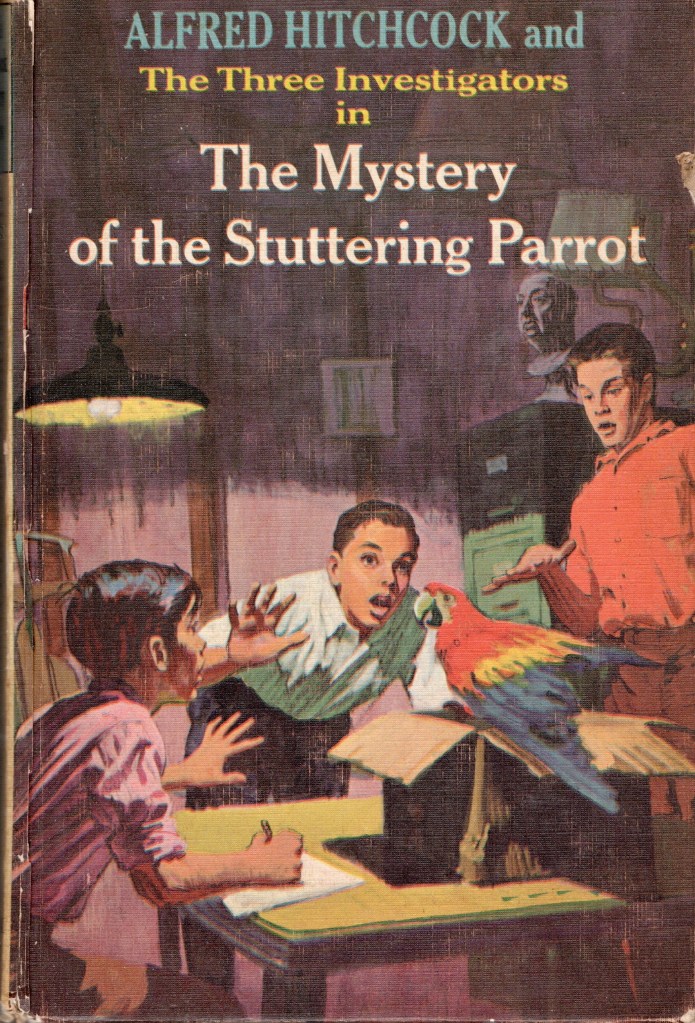
Jupe and Pete are on their way to call on a prospective new client, referred to them by none other than Alfred Hitchcock himself. Professor Fentriss had bought a parrot from a peddler, primarily because he stuttered and was named Billy Shakespeare (Fentriss is an English professor). The parrot says “to-to-to be or not to-to-to be, that is the question.” But this is in and of itself mysterious, as Jupe points out, because parrots don’t stutter; they have to be taught to stutter. Why would anyone teach a parrot to stutter? But the stuttering parrot is just the start of a bizarre and unusual case, with twists and turns and surprises everywhere the boys turn. Their detecting soon leads them to the revelation that there were six parrots and a mynah bird the peddler was selling, and they were all taught specifically to say one phrase. The phrases are clues to a treasure trail, and the prize is a magnificent and incredibly valuable painting by a master.

This book is an excellent example of precisely why I loved this series so much. The pacing is always excellent, the characterizations are three-dimensional, the mystery is intricate and puzzling and hard to figure out, and the conclusion of the book, where the boys have to beat several bad guys to actually find the painting, which takes place in a spooky abandoned cemetery on a foggy night, is some of the best atmospheric writing I’ve ever encountered. You really feel like you’re lost in the fog with bad guys you can’t see out there somewhere.

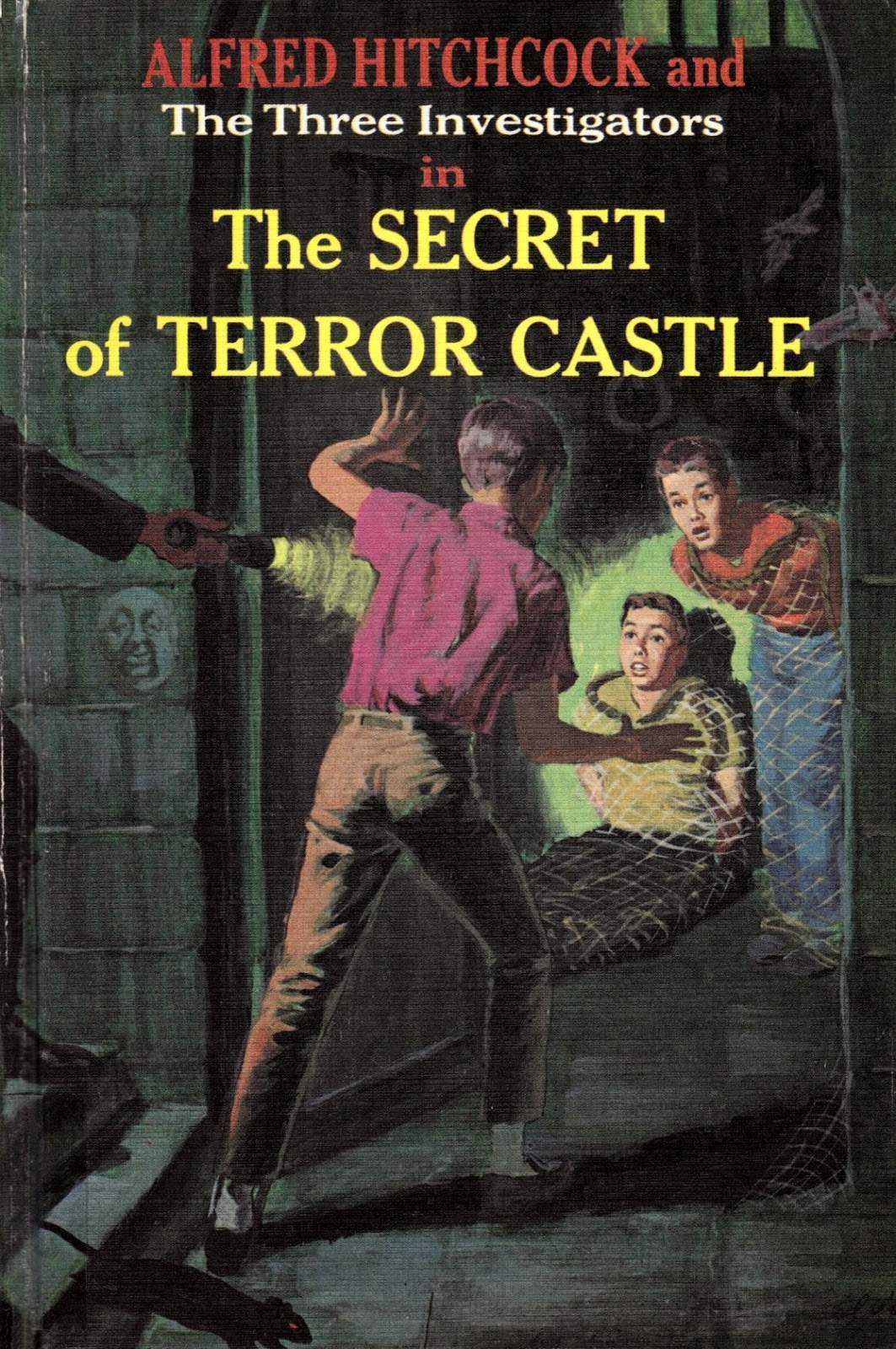
I’ve never understood why these books never achieved the popularity of the Hardy Boys and other series like them. They were better written, better stories, and just over all vastly superior to the Hardy Boys in every way. The first book in the series, The Secret of Terror Castle, remains one of my favorite kids’ books to this day (several books from this series make that same list). The problem with the series was time, really. Alfred Hitchcock eventually died, and they had to get someone else to fill in for him. Eventually, recognizing that Hitchcock’s name alone dated the books, they removed the references. The books themselves were never updated, which is also a shame because it dates the books but at the same time gives them a kind of nostalgic charm, as well. The Secret of Terror Castle was about the home of a silent film star whose career was ended by talkies, who turns out to be still alive. That was a stretch for me even when I first read it in the early 1970’s, let alone today. Whenever I think about writing my own kids’ series, I always think of it in terms of being Hardy Boys-like, but really what I would want to do is emulate the Three Investigators, whose books were well-written and a lot of fun to read.

Be sure I will talk about them again another time.

Fly Like an Eagle

One of the first Alfred Hitchcock movies I ever saw was The Birds. We watched it on our big black-and-white television, and it was absolutely terrifying. What made it even more terrifying was that we as viewers–along with the characters in the film–had no idea what had turned the birds into vicious flocks of attacking predators. The movie was absolutely terrifying to a very young Gregalicious, who ever after always gave whatever birds he saw a wary look. That innocuous scene where the birds start gathering on the jungle gym? First a few that you notice, then you look again and there’s more… you look back another time and there are even more….more and more with every look until you have a sick feeling and think maybe I better get out of here–yes, I related absolutely to that scene in the movie and whenever I see a flock of birds gathered anywhere I have a bit of an uneasy feeling. You never really think about how vicious and terrifying birds–descended from the dinosaurs, after all–can be. Sure, we all know about the birds of prey, with their sharp claws and razor-like beaks; but sparrows? Blackbirds? Crows? How do you defend yourself if a flock comes for you? God, even now, just thinking about it gives me goosebumps.

I recently rewatched the movie (during the Rewatch Project during the pandemic) and it’s not as good a film as I remembered, but it’s still terrifying. I was curious to see how I would react to the movie, because in the intervening years I had read the short story it was based on, and the story is much, much better than the movie.

The fact it was written by Daphne du Maurier didn’t hurt.

On December the third the wind changed overnight and it was winter. Until then the autumn had been mellow, soft. The earth was rich where the plough turned it.

Nat Hocken, because of a wartime disability, had a pension and did not work full time at the farm. He worked three days a week, and they gave him the lighter jobs. Although he was married, with children, his was a solitary disposition; he liked best to work alone, too.

It pleased him when he was given a bank to build up, or a gate to mend, at the far end of the peninsular, where the sea surrounded the farmland on either side. Then, at midday, he would pause and eat the meat pie his wife had baked for him and, sitting on the cliff’s edge, watch the birds.

In autumn great flocks of them came to the peninsula, restless, uneasy, spending afternoons in motion; now wheeling, circling in the sky; now settling to feed on the rich, just turned soil; but even when they fed, it was as though they did so without hunger, without desire.

Restlessness drove them to the skies again. Crying, whistling, caslling, they skimmed the placid sea and left the shore.

Make haste, make speed, hurry and begone; yet where, and to what purpose? The restless urge of autumn, unsatisfying, sad, had put a spell on them, and they must spill themselves of motion before winter came.

I love Daphne du Maurier.

The story was originally published in her collection The Apple Tree and Other Stories; when the film was released in 1963 it was rereleased as The Birds and Other Stories. (One of the problems with trying to read all of du Maurier’s short stories is because her collections inevitably have at least half the stories that have appeared in other collections; so you can wind up buying a collection for the two or three stories in it you’ve not read; for example, my first du Maurier collection was Echoes from the Macabre, which included “The Apple Tree” (title story of another collection) AND “Don’t Look Now” (also the title story of another collection) AND “Not After Midnight” (which, as you probably already guessed, is the title story of another collection). I have yet to find a definitive list of du Maurier’s short stories anywhere, and it certainly is long past time that all of her stories are collected into a single collection (are you listening to me, du Maurier estate?).

The reason I love the story so much is because it really is a master class in tension and suspense. It’s also a much more intimate, small story than the film. Nat is a simple worker, loves his wife and kids, and wakes up one morning to winter and bizarre behavior from the birds. The way du Maurier describes the sight of the seagulls all gathered out on the sea, rising the waves in silence, is creepier than any shot of Suzanne Pleshette sprawled out on the walk with her eyes pecked out. The radio–there only method of communication and getting news from the rest of the world–is reporting on the strange behavior of the birds, and that they are attacking people. Most of the action–the truly terrifying action–takes place inside Nat’s cottage while they are under siege; the attacks have something to do with the tides. During the lulls he boards up the windows and tries to lay in supplies, as he slowly begins to realize that the birds are winning. They wait out the attack one night and in the morning turn on the radio…only to get static. It soon begins to feel like they are, or may be, the only humans left alive. And Nat also realized that it’s just the smaller birds–sparrows, wrens, seagulls–and worries about what will happen when the birds of prey join in….and of course, they do…the story closes with the hawks attacking the front door while Nat resignedly waits for them to get through.

If I were teaching a suspense writing class, I would definitely teach this story. It’s simply brilliant.

Ella Megalast Burls Forever

Well, it’s the fifth and it’s back to the office with me this morning. It’s also Pay-the-Bills Day, woo-hoo! An oddly weird work week, the aftermath of a trip, and that weird stage of being beyond writing, if that makes any sense. I do have proofs to correct and other edits to come on something else, but I am not writing anything at the moment. I have some ideas I am toying with–a New Orleans ghost story, an Alabama book, among others–but for the moment I am just re-acclimated to myself and my world. I took yesterday off for the most part, and it was nice. I slept well again and felt good all day. I made holiday waffles for Paul, and I ate the Subway sandwich he’d purchased for me on Monday, I did some chores this morning while listening to the end of Carol Goodman’s marvelous The Seduction of Water (more on that later), and then Paul was up. I had thought about doing some work, getting started on the proofs or something, but once he was up I thought, we haven’t both had an entire day to ourselves in a long time so therefore, everything else could wait for another day.

We binged through a Paramount Plus show called School Spirits, which essentially is about a high school girl who is murdered, and her soul is trapped at the school with the spirits of other students throughout the school’s history who died there and cannot move on. She doesn’t remember how she was murdered or who had done it; there were gaps, and the other ghosts estimate that perhaps once she remembers everything she can then move on. It was cute enough, and entertaining enough, with some interesting twists here and there that it held our interest, and we watched all the way through until the season finale. We then moved on to the first two episodes of a horror series on Netflix, Red Rose, which was interesting and intriguing enough for us to continue, and decide to continue until we finish it. It was, all in all, a lovely relaxing day, and I am glad of it.

I also reread Daphne du Maurier’s “The Birds” yesterday. It’s really quite a wonderful and creepily intimate little story. I think it’s creepier and scarier than the film Hitchcock made of it–although the film is terrifying in an entirely different way. The story is very intimate and small–it focuses on a farmer trying to protect his family from the sudden turning of the birds, and how they have to fortify themselves in their house during the attacks, which in the story have to do with high tide. It’s really quite something, but du Maurier was such a master. I may write more about it later; the jury is still out on that.

I slept deeply and well last night, but didn’t wake up earlier than the alarm this morning nor am I awake and alive and ready to spring into action at work the way I was Monday morning. I don’t feel tired, I just don’t feel like I am fully awake just yet, which of course is fine. I do not regret taking yesterday off for myself; I am trying to not make myself crazy with that sort of thing anymore. No one can work at full capacity every day, after all, and there’s nothing wrong with me taking some time for myself and time off from everything every once in a while, to stop from going completely insane or at least wearing myself out. It’s much easier to take care of yourself, and I am trying to pay attention to my health on all fronts, including getting rest and not allowing my brain to get burned out. I think protecting my mental health, particularly since having the long COVID last year, is much more important now than it has ever been before in my life. I may not do a lot of thinking or writing this week, but there’s only two in-office days this week and a work-at-home Friday in my future, so maybe waiting until this weekend to do any of that sort of thing is perhaps for the best. I do want to start reading my new Megan Abbott novel; perhaps when I get home from work today I can use my writing time for reading.

Plus I need to figure out what I want to do next and come up with a plan of some sort for the next few years.

And on that note, I am heading into the spice mines. Have a lovely Wednesday, Constant Reader, and I will check in with you tomorrow, if not later.

Fluffy Tufts

Tuesday morning and I have the day off for the holiday blog. Huzzah! Although it’s going to seriously fuck with my head once I return to work tomorrow. I love these short work weeks, quite frankly; but at the same time they inevitably disorient me and make me uncertain of both day and date. But I will survive and get through this.

Yesterday was a bit of a revelation. I slept deeply and well Sunday night for the first time since leaving for the trip (I did manage one good night’s sleep in Kentucky, but that’s another story involving a massive thunderstorm, a loud weather alert alarm in the other part of the house and a brief power outage) with the end result that returning to the office for the first time in over a week wasn’t an unpleasant experience. There were some things I had to get caught up because they’d slid while I was gone (I take care of so many little things that are nevertheless important that my co-workers don’t even realize need to be done), and of course it was a lame duck workday–wedged between a weekend and a holiday–so the energy was weird and and we had a lot of unexpected problems to handle for clients, which we did handle with aplomb, but I felt off-balance all day and the time just flew; next thing I knew it was time to pack up and leave for the day–but I never got tired. I usually am groggy and partially out of it all morning, and hit a wall in the middle of the afternoon, but yesterday I felt just as energetic and relaxed as I did when I got to the office at seven thirty yesterday morning. I had to run over to Midcity to pick up my PrEP prescription, then swung over to Uptown to get the mail (a check! a check!), stopped at CVS to pick up some Claritin-D and my Xanax prescription before heading down to Tchoupitoulas to make some groceries at Rouse’s. I also bought too much perishable food, as it my wont; I want to make watermelon soup today (because it’s cool and refreshing) and chicken salad…and I also want to make a bowl of salad. I was thinking about making Shrimp Creole for dinner–but again, hot. I also bought hamburgers to cook out; I’ll probably go ahead and do that anyway at some point this afternoon or in the early evening. (Paul got me a turkey sandwich from Subway for dinner that I’ll need to eat at some point today.)

I slept really well again last night, too. Paul and I finished watching The Suspect, which was interesting and disturbing at the same time, and then moved on to this week’s Platonic (which is hilarious; you should be watching this show) and finally to Deadline with James D’arcy, which is quite interesting. I stayed up later than I usually do–almost midnight–because I never felt tired, and yet once I went to bed I went into a deep sleep that lasted until around six, and then I was able to sleep again until seven thirty. I feel good today, too; rested and energetic and peaceful, which is nice. I honestly feel better than I have in months, for two days in a row now, which is lovely and marvelous. (I also have cut back on my caffeine the last two days…which also may have something to do with it.)

So, what are my big plans for this holiday? I have some chores to do, as always, and of course I need to rearrange the refrigerator from the Costco run on Sunday (Paul helped put things away, which I appreciated but…I am like my mother in that while I appreciate the help, it always means I’ll have to redo it at some point….it’s really frightening how like my mother I am), and I want to finish listening to Carol Goodman’s marvelous The Seduction of Water, which I have about an hour left on (I can do it while folding laundry and reorganizing and cleaning this morning), and then I want to get started on Megan Abbott’s Beware the Woman. Also, one of my Alfred Hitchcock Presents volumes purchased on eBay opens with Daphne du Maurier’s superb story “The Birds” (yes, the story Hitchcock’s film was based upon) so I’ve been rereading that lately. Du Maurier was such a master; I’ll probably talk about the story more once I’ve finished rereading. At some point Paul will get up and we’ll probably watch some movies this afternoon. I’ve really only been in the mood lately for true crime documentaries or comedies (we watched Dirty Grandpa before I left for the north; wrong on so many levels and yet hilarious) lately, and much as I am enjoying the new Tom Holland series on Apple TV (The Crowded Room), it’s been much too heavy for me to watch lately. We may get caught up on it today, who knows?

I also have an out of nowhere unexpected offer to write another book, which is also lovely. But it will be from scratch, unless I can find something else to repurpose. I’ll spend some time brainstorming that today, too.

And on that note, I am heading into the spice mines. Have a lovely day, Constant Reader…I’ll probably be back later.

Welcome to the Room

Saturday!!!

Well, Paul left yesterday and suddenly I find myself living alone in this enormous apartment. It’s weird how that works. I guess Paul just is a very large personality or something like that? It’s just weird to me how the apartment can seem so different while he’s gone. I do sometimes, as I am morbid by nature, sometimes think when he goes away like this and I get bored and/or lonely and/or feel like I’m rattling around in this big huge empty space, well, if you outlive him this will be your future and I’m not quite sure how I feel about that? I know I don’t like thinking in those terms, but as the years pass and more things happen and we have different things happening to us health-wise and so forth, you do start getting a stronger sense of your own mortality, whether you like it or not. I always thought I would die relatively young, so I always feel like I am already living on bonus time I wasn’t meant to have–and yet, I keep going on somehow. It’s a complete mystery to me.

Sometimes I feel like Ishmael.

LSU has the weekend off like they always do the week before the Alabama game, so there’s no reason for me to have the television on for much today. Oh, sure, I won’t be able to resist having Georgia-Florida (“The World’s Biggest Cocktail Party”) game on, as I am expecting Georgia to humiliate the Gators (sorry, UF fans, I very rarely–if ever–want your team to win, but I am sure you return the favor and want LSU to lose every game they play as well), and I am not really all that sure who else is playing today, to be honest–I know Mississippi is at Texas A&M, which is a tough one for me to chose a favorite in; although I think I am going to have to lean towards Mississippi a bit–but again, my plan is to work this morning, run my errands (including making groceries–not much, but some), and then come home to clean and organize the apartment. I’m also going to take my laptop upstairs as well as a flash drive so I can use Paul’s computer if I need to write (and don’t want to use the laptop), and spend the rest of the day cleaning upstairs and trying to get things under control somewhat more up there. One can hope, at any rate.

I like my new espresso maker! I tried it out yesterday morning and it worked wonderfully. I think I may go back to having one in the mornings before I head into the office; that bold shot of caffeine certainly did its trick yesterday morning. I am currently having a homemade cappuccino as I type this, and it’s quite delicious, if I do say so myself. Having one yesterday didn’t affect last night’s sleep, as I feared would turn out to be the case. I slept great last night, despite being alone in the bed–Scooter helped a lot, as a cuddly purr-kitty–and I feel very rested and well this morning. Which is good, because I have a very big day planned here around the Lost Apartment–cleaning and writing and organizing–and I also have those errands to get to.

I must confess that after my work-at-home duties were completed yesterday I was terribly lazy. I didn’t write a word, which is shameful–I was mentally fatigued, plus off-balance because it was my first Paul-free evening–and so I rewatched Nicholas Roeg’s film of Daphne du Maurier’s Don’t Look Now on HBO MAX. I highly recommend the movie and the story; it’s really one of my all-time favorites, and the film does an excellent job with the story–far more so than Hitchcock did with her story The Birds (if you like Hitchcock’s film, you really need to read the original story, which is vastly superior in my opinion). I also finished my annual reread of Shirley Jackson’s The Haunting of Hill House, which as always was completely captivating. I cannot get over marveling at what an incredibly lyrical writer Jackson was, or how her prose just sings from the page while magnificently creating a morbid, melancholy tone that is, in and of itself, haunting. (I was thinking about watching the Netflix adaptation of Jackson’s We Have Always Lived in the Castle, another one of my favorites; Merricat Blackwood is one of the great fictional characters of the twentieth century in my opinion) I may dive into some Paul Tremblay short stories this weekend since I don’t have the time to finish reading another Halloween Horror novel, but tonight I may rewatch the original, classic film of Halloween again. I think I do owe it to myself to watch some horror films leading up to Halloween, don’t you think? Don’t Look Now, while not quite horror, certainly does fit the bill somewhat for my mini-film festival…I wonder if Robert Wise’s The Haunting is free to stream anywhere? That is probably my favorite horror film of all time–it scared me shitless when I was a small child, and still does to this day; skip the execrable remake, but the Netflix series adaptation is quite good, actually; the episode called “The Bent-neck Lady” is one of the best episodes of television ever filmed, in my opinion. I also want to spend some time today revisiting what I’ve written so far for Mississippi River Mischief to get an outline done and a character list, which I really need to get done, and I also plan to revisit another project I’m working on and am quite far behind on now.

I do have some laundry to do, some clean dishes to put away, and of course the floors always need to be done. I am going to spend the rest of this morning cleaning the kitchen and making a list for my mini-grocery making today; there are a couple of things I need to pick up–nothing much, really–and of course I have to drop off yet another box of books to the library sale. I also need to put air in one of my tires, and ugh, I have so much to do before my trip home for Thanksgiving. Heavy heaving sigh–sometimes it doesn’t help to look ahead, does it?

And on that note, I am going to bring this to a close and head into the spice mines. Happy Saturday, Constant Reader, and may your day be as lovely as you are.

The Calm Before the Storm

Alfred Hitchcock was a great film director, and was responsible for some of the best movies ever made, from Rebecca through Notorious through North by Northwest to Vertigo to Strangers on a Train to The Birds to Psycho; the list of great Hitchcock films goes on and on and on and has been studied by film academics and written about; you certainly cannot forget Truffaut/Hitchcock, either. Lost in the discussions of his abilities as a filmmaker (and how he was somewhat abusive to his leading ladies) is his contributions to the culture in other ways. Alfred Hitchcock Presents ran for years; an anthology show like The Outer Limits or The Twilight Zone, he presented bizarre stories (often based on short fiction; perhaps the most famous episode of all was based on a Roald Dahl short story in which a wife kills her husband with a frozen leg of lamb, which she then cooks and serves to the investigating police officers) on a weekly basis and the show ran for a long time. (It’s available to stream now, and I keep meaning to dive back into the show.

But Hitchcock also was a master, before it was a thing, of licensing his name out for use; his name meant something as a master director of film suspense, and in addition to the television series there were also anthologies, also published under the aegis of Alfred Hitchcock Presents–my grandmother used to buy and read them; so did my parents–and even today one of the best short story markets for crime is Alfred Hitchcock’s Mystery Magazine. There were anthologies for adults, anthologies for teens and anthologies for kids.

And there was also The Three Investigators.

3 investigators 1

Bob Andrews parked his bike outside his home in Rocky Beach and entered the house. As he closed the door, his mother called to him from the kitchen.

“Robert? Is that you?”

“Yes, Mom.” He went to the kitchen door. His mother, brown-haired and slender, was making doughnuts.

“How was the library?” she asked.

“It was okay,” Bob told her. After all, there was never any excitement at the library. He worked there part time, sorting returned books and helping with the filing and cataloguing.

“Your friend Jupiter called.” His mother went on rolling out the dough on the board. “He left a message for you.”

“A message?” Bob yelled with sudden excitement. “What was it?”

“I wrote it down. I’ll get it out of my pocket as soon as I finish with this dough.”

“Can’t you remember what he said? He may need me!”

“I could remember an ordinary message,” his other answered, “but Jupiter doesn’t leave ordinary messages. It was something fantastic.”

“Jupiter likes unusual words,” Bob said, controlling his impatience. “He’s read an awful lot of books and sometimes he’s a little hard to understand.”

“Not just sometimes!” his mother retorted. “He’s a very unusual boy. My goodness, how he found my engagement ring, I’ll never know.”

She was referring to the time the previous fall when she had lost her diamond ring. Jupiter Jones had come to the house and requested her to tell him every move she had made the day the ring was lost. Then he had gone out to the pantry, reached up, and picked the ring from behind a row of bottle tomato pickles. Bob’s mother had taken it off and put it there while she was sterilizing the jars.

“I can’t imagine,” Mrs. Andrews said, “how he guessed where that ring was!”

“He didn’t guess, he figured it out,” Bob explained. “That’s how his mind works…Mom, can’t you get the message now?”

“In one minute,” his mother said, giving the dough another flattening roll. “Incidentally, what on earth was that story on the front of yesterday’s paper about Jupiter’s winning the use of a Rolls-Royce sedan for thirty days?”

And that is how The Three Investigators series (technically, in the beginning  “ALFRED HITCHCOCK and the Three Investigators”) began. While it’s not as smooth, per se, as the opening of the Trixie Belden series in The Secret of the Mansion, this is also a dramatically different series, and will always have a place in my heart as one of the best series for kids–if not the best–ever published. It never reached the same heights of popularity as Nancy Drew or the Hardy Boys; which was a shame, because it was a much better series than either of those. For one thing, the Three Investigators actually considered themselves to be professional detectives; Nancy and the Hardys, amongst with most of the others, were strictly amateurs (although in the Kathryn Kenny books, “the Belden-Wheeler Detective Agency” became kind of a running gag or thing; it was what Trixie and Honey decided they wanted to be when they grew up; and frankly, I’ve always kind of wanted to see a Trixie-as-an-adult hard-boiled series). And while this opening is a little longish about getting to the point, it eventually does; Bob is a highly excitable young man who works at the library, and this is also our first look at Jupiter Jones, and one of the best things about the series is Jupiter; he is the central character and there would be no Three Investigators without him–and he is one of the most remarkable, and original, characters in kids’ mystery series fiction.

I always thought of Rocky Beach as a sort of stand-on for Long Beach in this series; this is where the boys live, and it’s just south of Los Angeles and a drive to Hollywood. This is where the three boys who make up the titular team of the series live; the third investigator, whom we have yet to meet in this opening, is Pete Crenshaw. And that bit about the contest and the Rolls-Royce? It’s very important. Access to a vehicle, and someone to drive them around, is an integral part of the creation of this investigative agency; they can’t always count on getting rides or paying for cabs or only involving themselves in cases they can investigate on bikes; this is the impetus Jupiter has been looking for to open the agency. Jupiter’s message to Bob is impenetrable to his mother; but it makes perfect sense to Bob–and therein lies another one of the great charms of this series: Jupiter lives with his uncle Titus and aunt Mathilda; the couple own and operate the Jones Salvage Yard, a sprawling junkyard where they repurpose other’s people things, or fix them. Jupiter himself is quite adept at wiring and repairing things; just one, as we the readers will find out, of his many skills. Hidden deep within the salvage yard is the wreck of a mobile home, which the boys use as “headquarters”; over the years Jupiter has managed to hide the mobile home behind piles of junk. The yard is also surrounded by an enormous, tall wooden fence, and Uncle Titus has encouraged local artists to paint murals on the fence. With the help of Bob and Pete, Jupiter has created “secret entrances” into the salvage yard, with tunnels through the piled up junk; that way the boys can come and go as they please without having to use the main entrance. They also have a covered workshop in another area hidden from view; Jupiter’s message to Bob is simply Red gate rover, come over come over, the presses are rolling. Bob knows this means,  come to headquarters, use red gate Rover, and we’re printing our business cards. 

“Red Gate Rover” means use the entrance through the fence that is a mural of a team of firefighters fighting an enormous blaze; there’s a dog watching them, and the knothole in the dog’s eye will spring the hidden gate open. And sure enough, once he gets there, the printing press is rolling and Jupiter presents him with a card, that reads:

THE THREE INVESTIGATORS

We Investigate Anything

? ? ?

–and also has their names. Jupiter is, naturally, the first investigator with Pete as second; Bob is Records & Research, since he works in the library and is their best writer; it is his job to write up their cases. As such, and with an understanding that all cases also need to be introduced as well as get sufficient publicity for their agency to get clients, Jupiter has decided on two things: to ask Alfred Hitchcock to introduce their cases, and offer to help find him a truly haunted house, as he is looking for one for his next film. Using the Rolls-Royce, driven by a very proper British chauffeur named Worthington, Jupiter and Pete call on Mr. Hitchcock at the studio. (The Rolls-Royce, by the way, has every luxurious amenity available to a limousine in that time; and is gold-plated, which sticks out. It was originally commissioned by a Saudi oil millionaire.) They bluff their way in–partly because Jupiter pretends to be Hitchcock’s nephew, even arranging his face to imitate his expressions and voice and patterns of speech–but Hitchcock isn’t that interested in introducing their cases, but has no worries about them looking for a haunted house for him. (While they are calling on Hitchcock, Bob has gone to the library to research something–Jupiter writes the words Terror Castle on the back of one of their business cards and offered no explanation.) But when Jupiter does his impression of “Hitchcock as a 13 year old”, Hitchcock is offended and promises to introduce the first case as long as Jupiter will never do the impression again (and, it is to be noted, the introduction and afterward, as supposedly written by Hitchcock, is clearly done so grudgingly; this was a genius touch by author Robert Arthur–and over the course of the series Hitchcock not only grows fond of the boys but starts sending clients their way).

The thing I loved perhaps the most about this series (outside of the wonderful titles for the books) was they actually were investigators. They actually solved the mysteries they were investigating–well, Jupiter did, mostly–through observation and interpretation of data. Jupiter was, in many ways, kind of a young Sherlock–and he often referred to Holmes. Another thing that was very clever about the series is that the stories were rarely, if ever, told from Jupiter’s point of view; Bob and Pete were always the point-of-view characters, representing the reader, who also couldn’t figure out what was going on. Since it mattered for suspense and storytelling to not know what Jupiter was thinking, Bob and Pete stood in for the reader, confused by the cryptic things Jupiter said–or casually observing Jupiter noticing something that didn’t make sense.

Another thing that, in my opinion, makes the series stronger than others is it is made, very plain, from the very beginning that fat-shaming is a bad thing. Jupiter is described as stocky or husky; he deeply resents being called fat, and whenever someone cruelly makes such an observation, both Pete and Bob always get angry and jump to his defense (Jupiter was also a child star, playing Baby Fatso in a Little Rascals type television show; his being a fat child made him the butt of the jokes in the show and he DESPISES being laughed at)–compare that to how Bess is frequently mocked for being hungry and chubby in the Nancy Drew books, or the depiction of the Hardy Boys’ supposed best friend Chet Morton as an always-hungry, overweight comic relief and foil they always laugh at–yeah, not cool, Stratemeyer Syndicate, not cool at all.

The first Three Investigators story I read was The Mystery of the Moaning Cave. We were in Alabama one summer, and staying with a cousin of my mother’s who had a son my age who also loved to read, and loved mysteries. He had a stack of library books, and I picked up my very first Hardy Boys read, The Mystery of Cabin Island, out of the stack. I was two chapters in when he finished reading his book (The Mystery of the Moaning Cave) and asked me to swap books with him. I was enjoying the Hardy Boys, but the cover of the Three Investigators book he was offering me was tantalizing, plus that title! How could a cave moan? I started reading, and was soon swept up in the story–which remains, to this day, one of my favorites in the series. It reminded me of another book I greatly loved as a child, The Mystery of the Haunted Mine, but the problem was my library didn’t have any of these books, and I could never find more of them anywhere. In junior high a friend of mine was a fan of the series, which led me to reread The Mystery of the Moaning Cave, which I loved all over again, and then its predecessor, The Mystery of the Screaming Clock, which was also amazing. I eventually discovered, on a birthday trip to Toys R Us, an entire shelf of the books; I got five–The Secret of Terror Castle, The Mystery of the Whispering Mummy, The Secret of Skeleton Island, The Mystery of the Laughing Shadow, and The Mystery of the  Coughing Dragon. 

I honestly don’t recall how I was able to collect the rest of the series, or where I got them or what order in which I read them, but I did eventually read the entire series. Later, the series moved on to other authors other than Robert Arthur and the quality became more hit-and-miss, but even the worst Three Investigators case was better than the best books in other series. I still love the Three Investigators, and occasionally will take one down to reread it, again marveling at how well constructed the books are; how tight the plots and how strong the characterizations. I also loved how something small and simple, like the search for an escaped parrot (The Mystery of the Stuttering Parrot) would lead to a massively complicated and interesting case about a massive art theft, or the search for a missing cat with mismatched eyes turned into The Mystery of the Whispering Mummy, or a near car crash led them to a small European principality and international espionage in The Mystery of the Silver Spider. Their cases inevitably started small, but eventually grew into something major; like they grabbed onto a loose, seemingly unimportant thread that unraveled a much larger case.

One thing that always amused me was how adults rarely, if ever, took them seriously. Jupiter’s aunt and uncle, and the parents of Pete and Bob, always looked at their “firm” as a “little mystery-solving club”. Inevitably the adults who pooh-poohed their abilities had to eat their words. I also loved that Jupiter wasn’t athletic but was smart. I identified with that a lot more than I did with the Hardy Boys, who were literally good at everything they tried.

The death of Alfred Hitchcock was an enormous blow, and the publisher–Random House, I believe–introduced a mystery writer for a while to replace Hitchcock, but the quality was already starting to decline, and eventually even the fictitious mystery writer, Robert Sylvester, was replaced by another fictitious entity; but the book in which the switch was made didn’t avoid the truth of Hitchcock’s death, and they actually handled it very well.

And some of the earlier books are seriously dated now; The Secret of Terror Castle centered on the home of a silent film horror star whose career was derailed by his speaking voice when talkies came; obviously, that would have happened around ninety years ago now, so there wouldn’t be any contemporaries still alive. Likewise, The Mystery of the Screaming Clock centered on someone who was a sound effects expert for radio suspense shows–which would, at best, have been seventy years ago now.

I’ve never believed this series was as popular as it deserved to be, nor did it get the attention it truly deserved. The books have been out of print for awhile now–maybe you can get used copies, there may even be ebooks now, I don’t know–but they should still be available. I would love to write one of these, to be honest.

They were the shit, y’all.

You Belong to the City

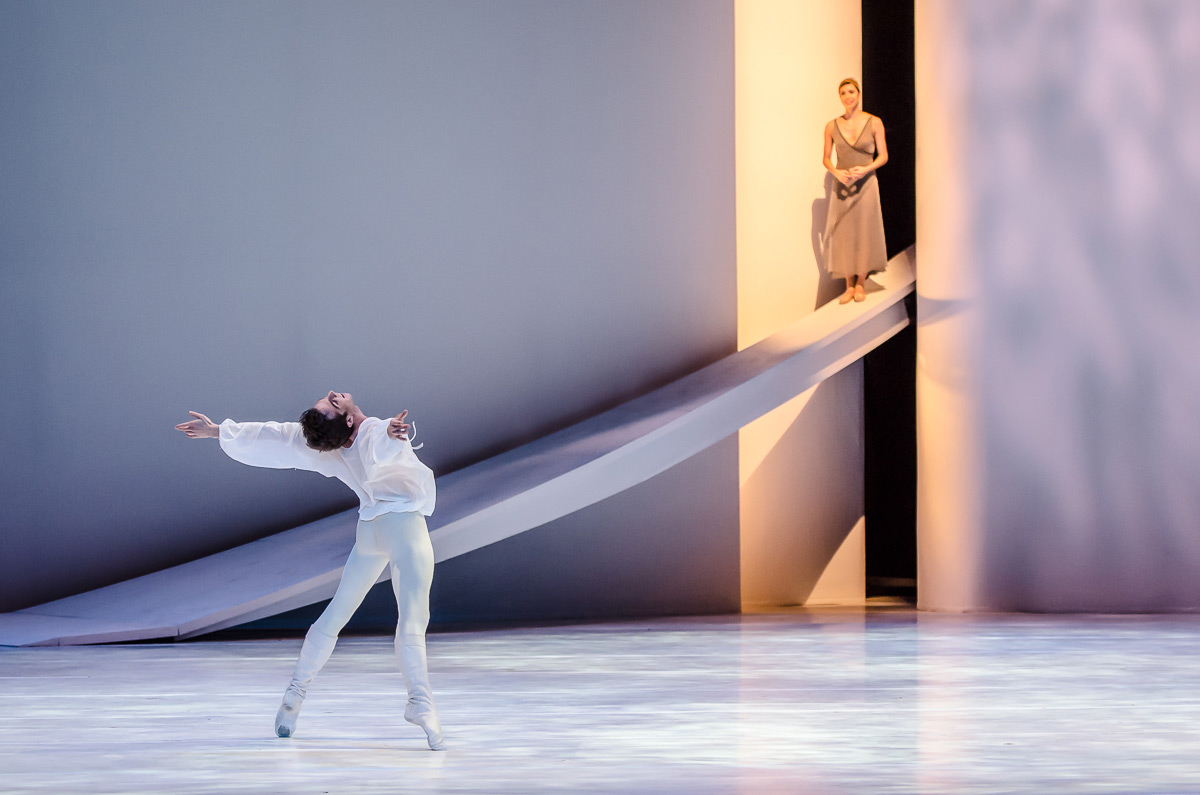
Saturday morning and I have sooooo much to do it’s terrifying. Tonight we have tickets to the ballet; Les Ballet de Monte-Carlo, to be precise. They are performing Romeo and Juliette. I have, as I have said before countless times, never seen ballet performed live. I am very excited, obviously. I have an idea for a ballet noir–I have so many ideas, really–and I love that I merely mentioned this one night while watching the superb ballet documentary Bolshoi Babylon, and that he remembered, with the end result we have the tickets for tonight.

He really is quite a dear.

sw-romeo-noelani-pantastico-lucien-postlewaite-balcony_1000

I am writing so many things right now, and working on so much, that it can overwhelm me a bit when I stop to think about it; therefore it’s best not to think about it. The Scotty novel is going to be the most complex plot I’ve written since Mardi Gras Mambo, which means I have to really be careful and pay attention in order to prevent enormous mistakes and errors as I go along. The short stories I am writing…it’s interesting, but in some cases it’s so much easier to just have an idea and then write to figure it out; sometimes when I finish the first draft and get to the end I know what has to be fixed, added, and changed; in other cases, I literally have no idea. My writing process is so bizarre and different than anyone else’s, and I cannot say I honestly recommend the way I do things to any beginning writer.

Take, for example, a story I wrote and submitted to the MWA Anthology Ice Cold numerous years ago. The anthology was for stories set during the Cold War, and I decided to risk writing a story with a gay theme, even if that theme was buried deep inside the story until about the middle. I also started with an image; a man in the depths of winter, standing on a stone bridge over Rock Creek in Rock Creek Park in Washington DC, dropping a gun into the cold, gray water. Stubbornly,  I held onto that image as the opening of the story through numerous revisions and rewrites. The story was rejected; and I’ve tried revising it again and again. It was recently rejected by another market, with a lovely note: You’re too good of a writer to get a standard rejection letter. This story moved too slow, but do send us more of your work. (And it is a sad indication of this ego-destroying business that said email made my day: they like me! They like my work!) And yet the best part of that rejection email was this minor, five word piece of feedback: this story moved too slow. As soon as I read that I realized that the structure of the story was its ultimate failing: the dropping of the gun into the creek wasn’t where the story began, so I am going to revise the story another time, reordering the events of the story. Maybe it doesn’t even begin where I’m thinking it does now; but I won’t know until I start working on it again.

Likewise, another story I am in the midst of writing right now opens with the sentence The ID’s were fake but no one seemed to care. It’s a great opening line, and it was the first thing to come to mind when I started writing the story, and it just evolved from that opening line; I wasn’t really sure what the story was, but I wanted to use that as an opening line, and so I started writing there. Am I tied to that as the opening line? I tend to be a bit stubborn about these things…which is definitely a fault of my own. I was so determined, for example, that the WIP must begin at a certain place that I was trying to make it work–but soon realized that its Chapter One was really Chapter Three, and a lot of the things I was doing were trite and cliche; so I moved the timing of the story back a few weeks. Sometimes, being stubborn is not a plus for a writer.

I am also going to, in today’s edition of the Short Story Project, talk about two Daphne du Maurier short stories that I read for the first time this week, from the New York Review of Books collection Don’t Look Now and Other Stories. As I have said before, I’ve not read all of du Maurier’s work; I hold back because I don’t ever want to run out of things of hers to read. I have several of her short story collections on hand (my favorite, of course, being Echoes from the Macabre, which I read first when I was a teenager, shortly after I read Rebecca for the first time–which also reminds me, I am terribly overdue for a reread of Rebecca), but unfortunately the problem with du Maurier collections is they often overlap; stories tend to appear in more than one collection: “Don’t Look Now,” for example, not only is in Echoes from the Macabre but headlines this particular volume; “The Birds”, which I talked about the other day, also appears in both.

Today’s stories, though, are of a type: “Indiscretion” and “Ls Sainte-Vierge” are both relatively short, and, like several of her other stories, wait until the very end to twist and shove the knife into your throat. This is not easy to do, and I’ve tried it with stories with little to no success; I think my best successes with these style have been “Keeper of the Flame” and “Annunciation Shotgun.”

“La Sainte-Vierge” doesn’t even seem all that dark, through most of it:

It was hot and sultry, that oppressive kind of heat where there is no air, no life. The trees were motionless and dull, their drooping leaves colorless with summer dust. The ditches smelt of dead ferns and long-dried mud, and the grasses of the fields were blistered and brown. The village seemed asleep. No one stirred among the few scattered cottages on the hill-side; strange, uneven cottages, huddled together for fear of loneliness, with white walls and no windows, and small gardens massed with orange flowers.

A greater silence still filled the fields, where the pale corn lay heaped in awkward stacks, left behind by some neglectful laborer. Not even a breeze stirred the heather on the hills, lonely treeless hills, whose only dwellers were a host of bees and a few lizards. Below them the wide sea stretched like a sheet of ice into eternity, a chart of silver crinkled by the sun.

It’s set in a small fishing village on the coast of Brittany; the point-of-view character is Marie, a fisherman’s wife who is very young and desperately in love with her husband. He is about to go out on another fishing voyage, and she has these terrible premonitions that something terrible is going to happen. He brushes aside her concerns repeatedly, telling her she’s completely foolish and superstitious (never a good sign in any story, let alone a duMaurier), so after he leaves in the evening to get the boat ready, she creeps out of the house to a local church to pray to a statue of the Virgin. Du Maurier’s description of the poor village’s cheap and tattered statue and the church is which it resides is morbid, sad and a bit tragic; yet as Marie prays the moonlight comes into the church and transforms the statue before her believing eyes, and she is shown a vision in her religious ecstasy. Happy and content, she returns to her home…but that something terrible the story has foreshadowed all along does occur, just not what she, or the reader, could have possibly seen coming.

The other story, “Indiscretion,” is equally marvelous in the same way but different; this story, in structure and ending, reminded me a lot of de Maupassant’s “The Necklace.”

I wonder how many people’s lives are ruined by a momentary indiscretion? The wrong word at the wrong time–and then finish to all their dreams. They have to go on living with their tongues bitten a second too late. No use calling back the spoken word. What’s said is said.

I know of three people who have been made to suffer because of a chance sentence flung into the air. One of them was myself; I lost my job through it. The other fellow lost his illusions. And the woman…well, I guess she did not have much left to lose, anyway. Maybe she lost her one chance of security. I have not seen either of them since. The curt, typewritten letter came from him a week later. I packed up then and came away from London, leaving the shreds of my career in the waste-paper basket. In less than three months I read in a weekly rag he was claiming a divorce. The whole thing was so needless, too. A word from me–a word from her. And all through the sordid little street that runs between Shaftesbury Avenue and Leicester Square.

This story basically is about fate and coincidence conspiring to wreck the lives of three people who, again, never saw it coming; and how happiness can be destroyed in just a matter of seconds. It’s bitter and sad and melancholy, like most of du Maurier’s work; but it also works beautifully, and her gorgeous writing style contributes to its terrible beauty.

And now, back to the spice mines.


Saving All My Love For You

Saturday morning. I have an eye appointment in Metairie this afternoon, but I definitely need new glasses. I also have to get groceries this morning (ugh), and I should probably figure out some time to go get the mail as well. Heavy sigh; the house is also a mess and this kitchen needs a-cleanin’. Paul’s going into the office today, so I’ll be alone; I am hoping, after I get home, to spend some time writing. I was very tired and didn’t feel good yesterday; my throat’s kind of sore this morning as well; I woke up a lot last night, but I did sleep. Tomorrow I am going back to the gym to get my workouts going again, so hopefully that will help in the sleep department. I’ve noticed that I’m not sleeping as well since Carnival started and I stopped having time for working out.

I can’t not sleep. I have too much to do and I can’t be tired. Yesterday was my short day at the office and after I got home, I didn’t feel well and was too tired to do anything besides sit in my easy chair and watch Adam Rippon videos on Youtube. (I told you I was stanning.) Then it was time to watch the Olympic figure skating, which was terrific. Very proud of our US skaters! Nathan Chen had six quads in his program, and made Olympic history, and young Vincent Zhou skated magnificently as well. All three of our skaters wound up in the Top Ten, which was terrific, and Nathan came close to medaling. If only he’d turned that second quad in his short program into a combination jump and gotten points for it, he would have. He had the highest score in the long program. Had they both skated clean short programs, they both would have medaled. So, there’s a lot of hope there for the future. Part of the fun of the Olympics is also seeing the future of the sport out on the ice as well–the silver medalist, Shoma Uno, is very young as well, and there was a young Russian who is very artistic. Worlds this year will be very fun to watch.

Oh, Adam. What would it have meant to fifteen year old me, deeply closeted and terrified someone might find out who I really was, to see you skate at the Innsbruck Olympics in 1976? Watching you this past week brought tears to my eyes every time; my heart was in my throat every time you went into a jump. You made me laugh in your interviews, you made me cry with your oh-so-beautiful skating. I can’t remember the last time I was so emotionally invested in seeing a skater do well? Michelle Kwan, whom I loved and still miss? Rudy Galindo in 1996? And how happy and proud to see all the love for you, to the point where even the trash tweeting shit about you could just make me smile and think he has a bronze medal, and you have your phone and bitterness. I feel SORRY for you that you can’t find joy in this, what a sad, bitter, pathetic life you must lead. Especially the gay Republicans, so desperate for the love and acceptance they’ll never get from their abusive relationship with a party that hates them. Adam is a star; will be a star, and he’ll always, always, have these Olympics, three gorgeous performances, and a bronze medal. No one can ever take that away from him with petty nastiness.

Watching Adam and his great joy in his sport and doing his best also made me realize something; it’s about doing something you love, and doing your best. I had already realized that I had lost my joy in writing sometime ago; I’m not sure when it went from being something I loved doing to an odious chore. But this year I’ve rediscovered how much I love it, how much I’ve missed it; how I love creating characters and telling stories and expressing myself on the page. I was already getting there on my own, but watching Adam, seeing him, took me to that final place. It’s not about medals, it’s not about awards, it’s not even about money; it’s about joy in doing something you love.

Thanks, Adam, for that–and for making me realize how I’ve been neglecting my eyebrows.

DVzJ3fZVoAADMDi

I also read some more short stories.

To be fair, I had already read Daphne du Maurier’s “The Birds”; her Echoes from the Macabre: Selected Stories is one of my favorite single-author collections of all time. But it had been awhile since I’d read this story; I knew it was vastly different from the Hitchcock film based on it, so I read it again.

On December the third the wind changed overnight and it was winter. Until then the autumn had been mellow, soft. The leaves had lingered on the trees, golden red, and the hedgerows were still green. The earth was rich where the plough had turned it.

Nat Hocken, because of a wartime disability, had a pension and did not work full-time at the farm. He worked three days a week, and they gave him the lighter jobs: hedging, thatching, repairs to the farm buildings.

Although he was married, with children, his was a solitary disposition; he liked best to work alone. It pleased him when he was given a bank to build up, or a gate to mend at the far end of the peninsula, where the sea surrounded the farm land on either side. Then, at midday, he would pause and eat the pasty that his wife had baked for him, and sitting on the cliff’s edge would watch the birds. Autumn was the best for this, better than spring. In spring the birds flew inland, purposeful, intent; they knew where they were bound, the rhythm and ritual of their life brooked no delay. In autumn those who had not migrated overseas but remained to pass the winter were caught up in the same driving urge, but because migration was denied to them followed a pattern of their own. Great flocks of them came to the peninsula, restless, uneasy, spending themselves in motion; now wheeling, circling in the sky, now settling to feed on the rich, new-turned soil, but even when they fed it was as though they did so without hunger, without desire. Restlessness drove them to the skies again.

One of the best parts of the film is that there’s no explanation why the birds have turned on humans; they just have, and there’s no way of knowing if they’ll ever go back to normal. The end of the movie is kind of left hanging; when I saw it the first time when I was a kid I was deeply dissatisfied with how the film ended. But there wasn’t really any way to end the film, and du Maurier herself gave no clues to what was going to happen at the end of her story. The story ends much the same as the movie; no end to the menace in sight, and even more chilling–I don’t remember if this was in the movie–but the BBC had stopped broadcasting; the horrifying part of this story is the incredible sense of isolation the family feels–are they the only people left alive in the world? On that level, the story is even more disturbing than the film; in the movie there are other people all around in the town. The story is set out in the country…and du Maurier never lets the reader know. The way the horror builds is almost unbearable; her mastery is truly amazing.

I also went back to the Laura Lippman well for “Easy As A-B-C’, from her collection Hardly Knew Her.

Another house collapsed today. It happens more and more, especially with all the wetback crews out there. Don’t get me wrong. I  used guys from Mexico and Central America, too, and they’re great workers, especially when it comes to landscaping. But some contractors aren’t as particular as I am. They hire the cheapest labor they can get and the cheapest comes pretty high, especially when you’re excavating a basement, which has become one of the hot fixes around here. It’s not enough, I guess, to get the three-story rowhouse with four bedrooms, gut it from top to bottom, creating open, airy kitchens where grandmothers once smoked the wallpaper with bacon grease and sour beef, or carve master bath suites in the tiny middle rooms that the youngest kids always got stuck with. No, these people have to have the full family room, too, which means digging down into the old dirt basements, putting in new floors and walls. But if you miscalculate–boom. Nothing to do but bring that fucker down and start carting away the bricks.

The premise of this story; a guy who owns a construction company is hired to renovate his grandparents’ old house for a young woman he finds attractive, despite his many years of marriage–is pretty clever. It also has a lot to say, in a very sly way, about gentrification and how old neighborhoods and their character are ruined by it; this is something going on to a very large extent in New Orleans, and has been for quite some time, and there’s a strong sense for us locals that with these changes, some of what made New Orleans so special, unique and different, is also being lost. Lippman inhabits the voice of this middle-age blue-collar man perfectly; she never once slips and makes an error that jars the reader out of the voice. And as the story builds to its own inevitable dark climax, you really can’t stop reading because you really aren’t sure how she is going to finish playing her cards. That’s the great joy of Lippman, and what makes her special and unique as a writer; you’re never really sure how this is all going to play out, but she never deliberately misleads you, ever–she doesn’t cheat, and once you get there, you think, yes, that’s the only way this could end.

Seriously, her new novel dropping this week, Sunburn, is definitely one of her best; check it out, if you haven’t already.

And now, I’ve got a jam to get Scotty and the boys out of.