Summer Breeze

Summers used to be different when I was a kid, or that’s how it seems now when I look back over the decades to those fuzzy and foggy and out of focus memories of my childhood. Of course, my memories are also my impressions, and I am not sure how those were formed. But back when I was a kid, I have this memory of people going away for summer vacations, and sometimes the really lucky ones went away for the entire summer. All that was required for this was a stay-at-home Mom and Dad who had enough money to rent a summer home to send them off to, joining them on his own vacation. Or maybe I am just remembering it from what I read in books during those years, and our own summer excursions to Alabama (I still would be willing to swear my sister and I spent the entire summer down there, even though I know we didn’t). But beach houses and books about teenagers coming of age while spending the summer at a vacation house on an island or near the beach was a popular subject for writers to explore. I can only think of three of them off the top of my head: Summer of ’42, Last Summer, and A Summer Place. I think I read them all over the course of a single summer, and maybe that’s why my brain defaults to thinking that way about summer breaks and vacations.

I don’t remember why I remembered Last Summer recently. It was written by Evan Hunter, and I also read its sequel, Come Winter, and I remembered both books as being rather dark, with a vague memory of their endings. But I wanted to read it again–I also remembered that John-Boy Walton himself, Richard Thomas, played the male lead in the film of Last Summer when he was a young actor, years before being cast on The Waltons. I’d be curious to see the film again, too.

We spent last summer, when I was just sixteen, on an island mistakenly called Greensward, its shores only thinly vegetated with beach grass and plum, its single forest destroyed by fire more than twenty years before. There were perhaps fifty summer homes on the island, most of them gray and clustered safely on the bay side, the remainder strung out along the island’s flanks and on the point jutting insanely into the Atlantic.

It was there the sea was wildest. It was there that we first met Sandy.

She was standing close by the shoreline as David and I came up the beach behind her, spume exploding on her left, pebbles rolling and tossing in a muddy backwash, a tall girl wearing a white bikini, her hair the color of the dunes, a pale gold that fell loose and long about her face. Her head was studiously bent. Hands on hips, lefs wide-spread, she stood tense and silent, studying something in the sand at her feet. It was a very hot day. The sky over the ocean seemed stretched too tight. An invisible sun seared the naked beach, turning everything intensely white, the bursting waves dissolving into foam, the glaring sky, the endless stretch of sand, the girl standing motionless, her pale hair only faintly stirring. We approached on her left, walking between her and the ocean, turning for a look at her face, her small breasts in the scanty bra top, the gentle curve of her hips above the white bikini pants, the long line of her legs.

The thing lying at her feet in the sand was a sea gull.

Last Summer is what would probably be considered y/a fiction today, despite being written by a highly respected author of both crime fiction (as Ed McBain) and literary fiction, as Evan Hunter. It’s also from that strange period of time that followed the end of the second World War, as the American economy boomed and both the working and middle class were better off than they had ever been before. Matt Baume, a delightful queer culture historian (his book about queer representation in film and television, Hi Honey I’m Homo, is currently a Lambda finalist, deservingly), made an excellent point on his video essay on Rebel Without a Cause, which pointed out the rise of teenage consumers–kids with lots of time on their hands due to the shift in the economy because they didn’t have to have jobs like they did before the war (only upper middle class and rich kids didn’t have to before the war) and the rise of home-ownership in addition to educational opportunities and suburban culture. Adults became quite alarmed at what this new breed of teenagers were up to, even more so than the usual tired worrying about the kids that has never gone away. Many of them were disaffected, and what they were allowed to watch and/or read became even more restricted. Many of them discovered the joys of alcohol and marijuana in greater degrees than ever before, which led to even more rebellion and concern. Parents went after comic books and magazines as corrupting influences–rather than recognizing their own failures as parents, which also gave rise to the modern mentality of uncontrollable children who needed to be protected from pernicious influences. There was, for example, a significant difference from “youth” movies like Rebel Without a Cause and Frankie/Annette in Beach Blanket Bingo. Check out his video here!

Last Summer reads very much as being about its time. “Serious” books about teenagers, many with dark themes, were in demand around this time–and they read very differently to modern readers. This book is about three friends spending the summer on an island somewhere off the Eastern seaboard, but few clues are given to its actual location, or the seaside town where the ferry operates from. The two boys, David and Peter (Peter is the first person voice of the story, remembering back to last summer) meet a girl named Sandy at the beach, and the first part of the book, about them nursing the gull back to health and trying to teach it tricks, bonds them more closely together. We don’t get very in depth about either David or Peter, Peter’s voice is calm and nonchalant, which lulls the reader into a sense of complacency. You begin to wonder where it’s going, but the boys are also becoming more and more aware of Sandy–and her body. Their closeness dances very close to crossing lines several times–she takes off her bikini top more than you’d think a teenaged girl in that time period would–but Sandy eventually bores of the gull and grows more and more annoyed by it until she kills it, and once the boys know, they destroy the gull’s body, which is very odd but telling.

And then they meet Rhoda, a shy girl with some issues of her own, and they kind of adopt her into their group the same way they adopted the seagull, and that’s when the creepy tension turns the book from being about bored teens into a horror. What they do to Rhoda is even more horrific now than it was when the book was originally published in the late 1960’s, and that blasé mentality about their assault on Rhoda–in which Sandy participates, making the horror even worse somehow–reveals them to be sociopaths, which makes the rest of the book make so much more sense, and even more chilling than it was originally.

There’s also some casual homophobia in the book–a gay couple on the island are mostly referred to as “the fags”, a horrible reminder of how prevalent that casual use of such slurs were in this country at the time.

I did enjoy the revisit, and it gave me some things to ponder and think about–and it’s still sticks in my head a week or so after finishing, so that’s a testament to Mr. Hunter.
Under the Boardwalk

I hadn’t been sure that I would keep writing young adult novels after I revised, rewrote and published the first three (Sorceress, Sleeping Angel, and Sara) I didn’t know if it was a direction I wanted to keep going in. I knew I wanted to do stand-alones–always have wanted to do stand-alones–and I also like writing about teenagers and young adults.

You may remember (doubtful) me talking about a horror novel a while ago that I started writing in the 1980’s called The Enchantress that I only got about three or four chapters into before abandoning (because I didn’t know where to go next with it; and the first chapter I specifically remember rereading at some point in the decades since and shuddering in horror at how badly it was written), but one of the places in the book really stuck in my head–an old family-owned hotel called Mermaid Inn, which sat on the shores of Tuscadega Bay (which was my stand-in for Choctawhatchee Bay–my grandparents retired to a house on that bay and I’d always wanted to write about that area; still do–it’s where “Cold Beer No Flies” was set). After shelving The Enchantress (which I do think about from time to time, and wonder if I should revisit the idea) I kept thinking, you should write a book and call it Mermaid Inn because that is a great title!

I made a folder for it, wrote a few sketchy notes, and then… it sat in my files for a very long time.

If you will remember, I had originally planned to write an entire series of interconnected young adult novels, a la the Fear Street series by R. L. Stine, and one of the varied locations they would be spread out over would be Tuscadega, Florida, in the panhandle on a fictional bay. That was part of the note I scribbled for the folder–set this in the panhandle of Florida, and somehow connect it to the fictional Alabama county you’re going to write about someday.

I decided to write Mermaid Inn sometime after Hurricane Katrina, when I discovered yet again my own ignorance of geography. I was beginning to realize that the panhandle wasn’t the right setting for this book and decided to set it on the Alabama Gulf Coast, which made me realize I had absolutely no clue about that part of Alabama’s geography. I’d just never really given it much thought, to be honest; I knew Mobile was on the bay, and I knew that when you drive on I-10 through Mobile you have to take a tunnel below the Mobile River. I just had always assumed there was nothing south of Mobile in Alabama–I mean, it’s ON the water–and figured that those lower prongs of Alabama that reach down along the sides of the bay were uninhabitable wetlands. I discovered this to not be the case when visiting friends for the first time who lived in Alabama south of Mobile. They told me to take an exit off I-10 and drive south, which I didn’t think was possible.

Turns out it was–and I realized…this will work for my book! So I filed it away and forgot about it again.

I don’t remember precisely why I decided to write Mermaid Inn, but I did, and set in a small town on the prongs, south of Mobile; my friend Carolyn Haines helped me with some background and I know she told me some stories about closeted society men in Mobile and their hijinks and I thought, I could use this for the book and I think that may have been the impetus? And then I created my character, Ricky Hackworth, from Corinth, Alabama–po’ white trash who needs a swimming scholarship to attend the University of Alabama. (Sidebar: alert readers will recognize that Beau’s last name in Bury Me in Shadows–and at one point in the story he mentions he’s only the second Hackworth to go to college; “besides my cousin who got a swimming scholarship.”)

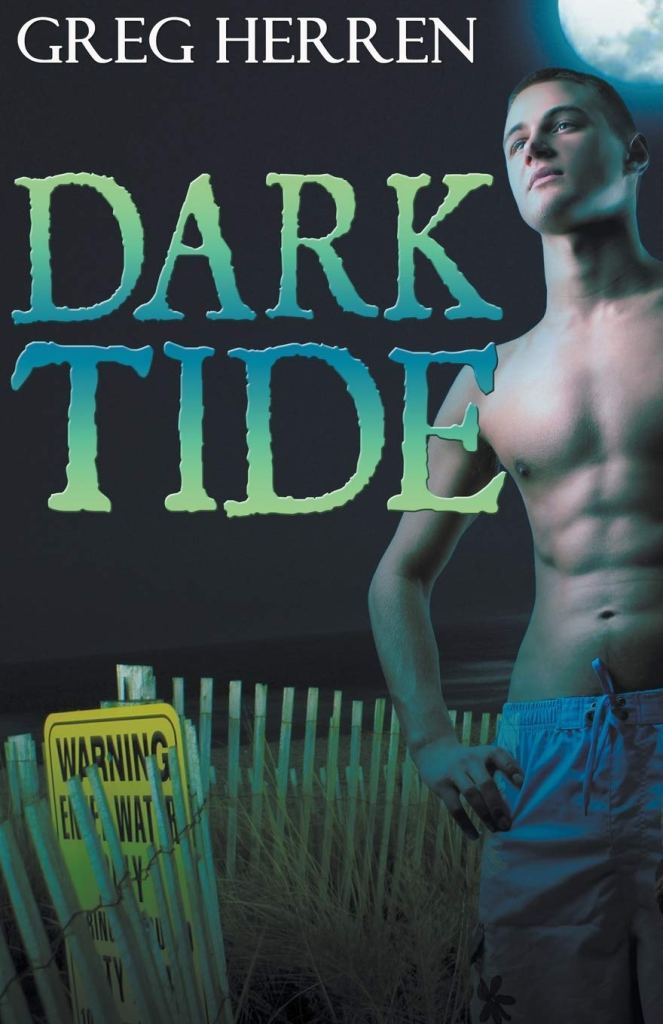
Bold Strokes didn’t like the title, and for perhaps maybe the fourth or fifth time in my career my original/working title didn’t make it on the cover. They recommended Dark Tide, which I really liked because it gave the sense of the book’s mood and tone and voice…and darkness.

The engine of my pickup truck made a weird coughing noise just as I came around a curve in the highway on the Alabama Gulf Coast and I saw Mermaid Inn for the first time.

My heart sank.

That’s not good, I thought, gritting my teeth. I looked down at the control panel. None of the dummy lights had come on. I still had about a half tank of gas. I switched off the air conditioning and the stereo. I turned into the long sloping parking lot of the Inn, pulling into the first parking spot. I listened to the engine. Nothing odd. It was now running smooth like it had the entire drive down. I shut the car off and kept listening. There was nothing but the tick of the engine as it started cooling.

Maybe I just imagined it.

Hope springs eternal.

The last thing I needed was to spend money on getting the stupid old truck fixed. Maybe it just needed a tune-up. I couldn’t remember the last time it had one.

Dad gave me the truck when I turned sixteen. It had been his work truck since before i was born–it was two years older than I was. He’d finally broken down and bought himself a new one. This old one was dependable and had almost two hundred thousand miles on it. Dad had taken good care of it. He’d babied it, gotten an oil change every three thousand miles without fail, and I could count on one hand the number of times it had been in the shop to be repaired.

It still had the original transmission.

It might not have been the nicest or prettiest car in my high school parking lot, but it got me where I needed to go and got good gas mileage. Since I was saving every cent I could for college, that was a lot more important than horsepower and cosmetics and a loud stereo that rattled your back teeth. The swimming scholarship I’d accepted from the University of Alabama wasn’t going to remotely cover anything close to the lowest estimate of what my expenses might be, but it was the best offer I’d gotten.

And I was grateful to have it. If they hadn’t offered, I wouldn’t be going at all.

Swimming was my ticket out of Corinth, Alabama.

That opening scene!

Dark Tide was probably my most hard-boiled young adult title published to that point. It was a dark story, and Ricky was poor–an economic condition I’d touched on with Sara, and something I generally try to avoid when writing. I’ve been poor, and I know how it feels; I don’t like remembering those days of checkbook mistakes and bounced checks and not having enough money from one paycheck to another. Ricky has taken a summer job as the lifeguard at Mermaid Inn in Latona, Alabama (Latona is another name for Daphne, which is actually a town on the prongs below Mobile), to save money to pay for college expenses his swimming scholarship to the University of Alabama wasn’t going to cover, and the water being there meant he could continue training. Once he arrives and is shown to his room on the uppermost floor of the building and meets the owner’s daughter, he learns that his predecessor from the summer before had simply disappeared–and young teenaged boys disappear with an alarming regularity over the past few years. He starts asking questions, mostly out of curiosity, and also starts having horrible dreams, about vicious mermaids beneath the water, and there are a lot of stories about killer mermaids from the days of the indigenous people and the Spanish. I wrote some terrific scenes in this book that I was really proud of–one particular dream sequence was especially chilling–and I was also trying something with the rhythm of the words, which I hadn’t done in a very long time, and I think it worked.

Writing Dark Tide was important to me because this was the book that reminded me again that I was writing stand-alones to help keep the series books fresher, more creative, and less paint by the numbers, too.

I Need Your Love Tonight

Monday and back to the office blog this morning, and I didn’t want to get up this morning. But now that I am, I feel fine and ready to get on with this day. I did not have the productive weekend that I wanted to have, but I got rest and that’s really the most important part of the weekend for me now. I did get some reading done–I am loving The Cypress House, more on that later–and I did assemble the new barbecue grill (which took much longer than it needed to and was much more complicated than it needed to be, but it’s done and I most pleased with myself for not only doing it, but redoing it when I had done something wrong, as opposed to just leaving it and making it work); it was cool outside but incredibly muggy, so I got overheated and super sweaty while doing it, with the end result that I was really tired when it was finished…and my appetite was gone. Ah, well, at least it’s done and ready for next weekend, right?

We started watching the final season of Young Royals yesterday, and it’s interesting. What’s even more interesting is seeing how the main characters have grown and changed in real life; the prince is now taller than Simon, which he didn’t used to be. They also look more mature in the face, if that makes sense? But watching them kissing now doesn’t feel as uncomfortable as it did in earlier seasons, so they’ve clearly gotten older in real life. I don’t know the ages of the actors and I don’t know if I care enough to go look and see how old they are, but one of the things that always makes me squirm a bit in shows with age appropriate (or appearing) actors is you feel a bit icky watching them be intimate with each other…which is one of the reasons why most teens in film and television are played by actors in their twenties. This, however, gives us all–especially those of us not around teenagers very often–the wrong idea about how adult teenagers look, especially when they’re sexually active…so it’s shocking when you run into actual teenagers and you see how young they really do look. This is something I’ve been wrapping my mind around since Heartstopper, and trying to write about. Maybe now I can finish those thoughts all the way through? Stranger things have happened…

The eclipse is today, and we won’t get full coverage of the sun here in New Orleans, but about 85%, but that doesn’t mean people aren’t going to be weird. I love that people think the eclipse is going to be the rapture (if only), or an omen/sign from God…because that’s just how the universe and space and time work. One shouldn’t be surprised that Marjorie Taylor Greene, who would have been screaming about witchcraft had she been alive in Salem in the 1690’s, would go all Old-Testament in the face of a celestial event science has explained for centuries now. I’d love to see someone do a deep dive on her life–what are her parents, that raised such an inbred moron, like? Siblings? Where did she go to school, if she did? There really is nothing worse than an idiot who thinks God speaks to them. I wonder if she thinks she’s the second coming of some Biblical character, like the idiot Speaker of the House (Louisiana does NOT elect its best people) thinks he’s Moses? Queen Jezebel would be my best guess as to which Biblical POS harlot she would be–or Herodias, mother of Salome.

In a few weeks I’ll be off to Alabama to meet Dad, after which we will drive up to Kentucky where I’ll stay for a few days. I’ve not seen Dad since October, so it’s well overdue, but of course I also had surgery in the meantime and therapy and so forth. I’ll be packing plenty of books to try to get caught up on my reading–and of course, I’ll be listening to audiobooks in the car while I drive. I’ve downloaded quite a few books to listen to in the car, and I’m really looking forward to the drive and letting my creativity roam as I drive. I am dreading that lengthy drive back to New Orleans, as always, but it could also be a but fun. I always love coming home to Paul and Sparky after being away for a while. The only traveling I’ll be doing for the rest of the year will be going to see Dad, so I am hoping to use the rest of the year to pay down some debt so I can make it to Left Coast Crime next year without a problem or worries.

And on that note, I am going to bring this to a close and head into the spice mines. Have a lovely Monday, Constant Reader, and I will talk at you again probably later.

It’s Just a Matter of Time

Sunday morning and the last day of Saints & Sinners. It’s been a lot of fun, if tiring. I headed down there yesterday afternoon in a Lyft, hung out in our suite for a bit and practiced for my reading–I read my story “The Ditch” from School of Hard Knox, and I think it went very well. It was a terrific reading session; Rob Byrnes, Jean Redmann, Marco Carocari, David Slayton, David Pederson and one other person whose name I can’t recall off the top of my head; my apologies because I really enjoyed what he read.I then went back up to our suite and came back down for the anthology launch with Paul. Those readings were also fantastic–and I am looking forward to reading the book more than I already was. I am also the judge for next year, so I’ll be reading a lot of stories in the fall. That will suffice as my volunteer work for 2024, so don’t bother to ask; the answer will be no.

I started reading an old Evan Hunter novel yesterday, Last Summer. It was a book I’d always wanted to read when I was younger, and I was reminded of it sometime during the pandemic, so I got a copy of it and its sequel, Come Winter, from eBay and so I started reading it at long last yesterday. I’ve never seen the film, either; but I do remember Barbara Hershey and Richard Thomas (aka John-Boy Walton) starred in it. It also put me in mind of another trope from that era of publishing; books with teenagers as protagonists (and/or antagonists) were almost always set during the summer, and so many were set on coastal islands–this one, Summer of ’42, A Summer Place, etc. It of course makes sense; teenagers had a lot of free time to get into shenanigans during the summer, especially when they were on a vacation somewhere. I’ve actually fallen into that trope a couple of times myself–Dark Tide, Lake Thirteen–and numerous other stories I would like to tell at some point. I do like the idea of gradually getting rid of all this paper around here by digitizing or disposing of things that I’ll never get around to writing. I don’t want to start writing fast in a frenzied attempt to write everything I want to before I die–and there’s always new ideas, too. But i know I’d really like to eventually get back to that novel where I based the victim on Ann Coulter…hmmm, maybe that could be the next Scotty. That’s actually a very good idea. Hmmmm.

It’s so nice to be around writers. It really is a balm for my soul. I did write some yesterday morning, but I am not going to even try today. I am very tired–I’ve done a lot of walking this weekend–and of course having to be “on” is tiring. The truth is I am not at 100% yet, much as I want to believe that I am, and there’s nothing wrong with that. One exciting development of the weekend is that I experienced no stress, anxiety or stage fright for my reading yesterday. Not only was I calm and not sweating buckets, I was actually able to relax and enjoy the experience. I don’t think I’ve ever done that before? It was wild. I’ve actually been relaxed the entire weekend; I don’t believe I understood before how much my anxiety impacted me at events like this. Having a calm and quiet head is a lovely thing, and now that the creativity has come back, I might actually start enjoying my life again.

I’ve also been spending a lot of time reminiscing about past S&S weekends, too; remembering how it all started, how much of it was done on a fraying shoestring because there was no money for it, and held in donated spaces at gay bars. It also used to be in May, so the weather was a LOT hotter. Paul and I used to always get the pool suite at the Olivier House for our home base, and people always used to wind up in our room later in the evening to drink and socialize and have a lot of fun. I couldn’t do that now–as it is, i stayed up past my usual bedtime Friday night and paid for it all day yesterday (legs are tired today, too). I also came up with a title for my memoir should I ever try to write one: Unreliable Narrator.

And LSU won the SEC women’s gymnastics championships last night in very dominant style. They weren’t as on as they usually are, and still set an incredibly high score and really have the potential to win the national title this year, too. And the US had a great outcome at the World Figure Skating Championships, winning two golds (men’s and ice dance) and a silver (women’s).

And on that note, I am heading into the spice mines. Have a lovely Sunday, Constant Reader, and I’ll most likely see you tomorrow.