Sunday morning and I slept really well last night, so am feeling rested. I believe the Saints game is tonight, if I am not mistaken, which gives me most of the day to get things done. I did manage to get some things done yesterday in the wake of the LSU debacle; my kitchen is all straightened and cleaned up (I also watched the Auburn debacle against Georgia before giving up on football entirely for the day, as it was clearly not meant to be my day at all) and I finished reading my Donna Andrews book (Round Up the Usual Peacocks, more on that later) while getting started on my revisitation of Interview with the Vampire (which I realized, once again, upon starting that it’s really not a horror story of the kind one usually associates with vampires) and I also got some other things done yesterday as well. Today I have even more things to do, including picking up the groceries I ordered yesterday, and am hoping that I’ll be able to get a lot of things powered through. My coffee tastes great, I feel rested–if a little loopy from sleep, and that should wear off rather soon. A new episode of Interview with the Vampire should drop today as well–it’s fun to reread the book while watching the new adaptation–and of course, tomorrow I have to return to the office to see how much, if any, of a difference returning to the office for Mondays will make in how my work week goes every week.
We watched Sins of Our Mother last night on Netflix, a documentary about the so-called “Doomsday Mom,” who began to believe we were living in the end times and that she and her lover were modern-day prophets, which led to the murders of their spouses, one of her brothers, and two of her children. She hasn’t been tried yet–which of course led to my “why would you make the documentary before the trial?” question–but it was interesting. I feel incredibly sorry for her son Colby, her only surviving child–how do you go on with your life after something like this happens to you?– which is why the impact of crime on people is becoming more and more interesting to me than actually writing whodunnit murder mysteries. How do you go back to your normal life? How do you carry on, go on, get past the horror of your brother and sister being murdered by your mother and her lover? That she has become almost completely insane with religious fervor? I shudder at the thought.
We also started watching the Netflix adaptation of Christopher Pike’s The Midnight Club into a series. I loved Christopher Pike back in the day, once I discovered him; I made a point of going back and reading everything he wrote, and it was reading Pike (and from him, discovering other y/a horror/suspense writers in his wake like R. L. Stine, Jay Bennett, and Lois Duncan) that led me into writing my original three young adult novels (Sara, Sorceress, Sleeping Angel). I liked the Pike novels because they were so damned dark, and happy endings were never guaranteed in a Pike book (I always liked Pike more than Stine, even though I liked the way Stine linked his books together under the Fear Street series header), which I also liked. The Midnight Club is totally dark; the premise is that the book is set in a hospice for terminally ill teenagers, and they gather every night at midnight to tell each other stories–scary stories for the most part, but stories–and they also swear that the first one to die will try to come back and tell the others what death is like…while strange things are going on in the hospice itself, in which you can never be sure if those things are really happening or if the kids themselves are hallucinating from their drug protocols, which as I recall kept me off-balance as I read the book. Such a great premise, really; I don’t really remember much of the book other than the setting and the dying teenagers–which is pretty fucking grim, if you don’t mind me pointing that out–so there’s this almost-casual acceptance of their impending deaths as well as their curiosity about the supernatural and the world beyond–or if there even is one. I remember reading The Midnight Club and thinking “this is really heavy shit for teenagers to digest” but then…I was reading Stephen King when I was a teenager, so there’s that…but Pike was the one who made me realize my perceptions of what you could and couldn’t do in young adult fiction were heavily skewed and incredibly incorrect in almost every way. I’m not sure I am going to write any more of them, to be honest–I do have ideas for any number of others, but I think I’m going to pause my young adult writing for a while and maybe, perhaps, do some stand alones that are for adults rather than a young adult audience…(although I think mine do qualify as readable by adults, too, but I am not the best judge of any of that, really)
I really need to work on my book this morning once I finish this and get cleaned up. I want to do a little more reading on Interview today, and I have some other things that need to get done, too. The key is to not allow myself to get derailed or distracted, which is never an easy thing for me to have not happen, you know? I sometimes wonder how much I could get done if I weren’t so easily distracted from everything, but there you are; we’ll never know because I will always be distracted. Heavy sigh.
And on that note, I am going to head into the spice mines this morning. Y’all have a lovely Sunday and if you have an NFL team you root for, I hope they do well today.
I slept really well last night, which I inevitably usually do on Thursday nights because I can sleep an hour later those mornings, which naturally makes for a better evening of sleep. I also stay up an hour later (I really have this thing about going to be before eleven that always feels wrong and like I am being cheated out of the evening or something). I was very tired after work last evening, but I did get a load of dishes finished and another started (which I will have to finish this evening). I didn’t write, but I did reread the chapters already in place and think (hope) that tonight I will get that revision finished and can finally, at long last, move on to the next.
And today is the last day of September, October Eve, if you will, which of course leaves me shaking me head in bewilderment about where September could have gone, and why did it go so quickly? Why did I get so little done? I don’t know those answers, of course, but I do know we have been having some lovely weather this week–and it’s not because of the hurricane so we can enjoy it in peace (the cold front we are having, however, is what pushed Ian east and kept him there). It was sixty-three degrees yesterday morning when I went in to the office, so chilly that it even startled me a bit as I went outside. It was still cool when I got off work as well–there was a lot of wind, too, as there has been most of the week–but I am sure we’re going to have at least another couple of really warm weeks yet before the summer finally releases its chokehold on New Orleans.
My plan is only to read horror in the month of October, but since I’ve not had the bandwidth to finish reading my Donna Andrews novel that is one of the things I am going to work on getting through this weekend. It’s not a chore, mind you–Donna’s books are always entertaining and always great reads, and I love the world she’s created in these books–but I also want to be able to focus on the book and actually, you know, read it when my mind is not so worn out and tired, so it can really enjoy the book for the volume of sheer entertainment it inevitably will turn out to be. And then I am going to move on to horror. I have some more Paul Tremblay and Christopher Golden novels on hand to read, and of course I am years behind on Stephen King–might not be a bad idea to revisit some of the classics as well as start reading through the newer works, and of course I should reread ‘salem’s Lot, and I haven’t done a reread of The Stand in quite a while, or Christine or The Dead Zone for that matter. I also need to get back to reading short stories, and I have some lovely volumes of horror short stories on hand I can read as well.
LSU plays Auburn Saturday night at Auburn, so I have most of tomorrow free to clean and read and so forth. Paul is also planning a trip to visit his mother, probably around Halloween, so I am going to have a long and lonely week to look ahead to–thinking that I’ll be able to get a lot done while he’s gone which of course will end up not being the case–and right now I don’t know what other games are on this weekend, so I am hoping I won’t actually blow all of Saturday sitting in my chair, reclined, with a purring cat in my lap while I mindlessly watch teams play games I don’t care about. I need to get back on top of all of my projects and snap out of this weird blasé place I’ve been in since Bouchercon where I just can’t seem to have the energy or strength or will to work through being tired. But the weekend looms, and if I can manage to get a good night’s sleep tonight hopefully tomorrow morning I will wake up with lots of motivation and energy–and the strength of will to ignore Scooter’s plaintive cries to provide a lap for him to sleep in.
We started watching Reboot last night on Hulu, and it’s hilarious. The core of the story is actually kind of genius; an old family-friendly comedy from twenty or thirty years ago, similar to the kind of show Diff’rent Strokes and Full House were (heartwarming fare with cute kids with corny jokes and broad humor and–ugh, you know what I mean) is being rebooted…with the original cast…only as a more modern, darker, and more realistic show. It’s hilarious, and the entire cast is terrific (Johnny Knoxville being a surprising standout). We loved it, and can’t wait to watch more. I am also getting kind of excited to watch the new adaptations of Anne Rice’s series, The Vampire Chronicles and The Mayfair Witches (although I think the vampire series may be called Interview with the Vampire? I’ve not followed stories about either show closely, figuring I’d watch once they started airing and then would check into what the plans for the shows are). Elité is also coming back, as are some other favorites. Huzzah!
And on that note, I am going to head into the spice mines. Have a lovely, lovely day, Constant Reader, and hope everyone in Florida is doing okay this morning. Check in with you again tomorrow!
Who dat? Who dat? Who dat say dey gonna beat dem Saints?
I am a very proud member of Who Dat Nation, and have been since we moved here in 1996. I never really paid a lot of attention to the NFL before moving to New Orleans; I vaguely was aware of who was good and who wasn’t–and I knew very certainly that the Saints had routinely been one of the worst football teams, consistently, in the league since they were formed in 1966. You couldn’t not be aware of how hopelessly bad the Saints were, year in and year out. I always root for underdogs–a particularly American trait, I might add, which is another good essay topic (how we always root for underdogs, especially in our entertainment–film, television, books–but in the real world we either look the other way or actually pile-on. We all feel bad for poor bullied Carrie White in Stephen King’s Carrie and hate the cruel kids…but how many of us ever stood up for some kid being bullied in school? My experience as the bullied is NONE.)–and so I always wanted to see the Saints somehow turn their program around. Paul and I always watched the games–or had them on–when they aired; there were many times the games were blacked out locally because they didn’t sell out the Superdome.
Three things were inevitable in New Orleans: hot summers, termites in the spring, and the Saints would suck in the fall. When we first moved to Louisiana LSU was also in a downturn slump; some seasons they’d win, some they’d lose, but they were rarely, if ever, in contention for the conference title. I had a Saints ball cap and a Saints T-shirt, of course, but I was an idle fan of theirs for a very long time.
As with so many other things, my attitude towards the Saints was completely changed by Hurricane Katrina.
It was the best of times.
It was the craziest of times.
Well, what it really had to be was the end times, which was the only logical explanation for what was going on in the city of New Orleans.
Pigs grew wings and nested in the branches of the beautiful love oaks everywhere in the city. Some thought the pilot light in hell had gone out, so that icicles hung from the noses of shivering demons in the realm of the dark lord. Others started watching the horizon for the arrival of the Four Horsemen, for surely the Apocalypse must be coming. Surely the earth was tilting on its axis. Maybe aliens would land in Audubon Park, or the Mississippi River would start flowing backward.
Anything and everything was possible, because the Saints were winning.
GEAUX SAINTS!
People who don’t live in the South don’t really understand how important football is down here. Football is more than a religion in the Deep South. I’m not sure what it is–my mom claims it’s because the South lost the Civil War–but it’s true. On Saturdays, when the colleges play their games, the entire region comes to a complete halt. People live and die by their teams–whether it’s LSU, Ole Miss, Alabama, Auburn, Florida, Georgia or Tennessee–and how they face on Saturday. I myself grew up cheering for the LSU Tigers–even though attending Vanderbilt was a family tradition on my mother’s side. Whenever Papa Fontenot gives me crap for dropping (well, flunking is probably a more accurate word) out after my sophomore year, I give him a withering look and reply, “Maybe I’d have done better at LSU.
That always shuts him up.
I don’t think even the Saints organization knew how much the team actually meant to New Orleans until they tried to move the team after Katrina.
Everyone knows the Superdome was damaged by Katrina and the aftermath. I’ll never forget driving back into the city in either late September or early October and seeing it as I came around that curve in I-10 just past Metairie Road and the cemeteries; I wrote in Murder in the Rue Chartres that it resembled a half-peeled hard-boiled egg. One of the saddest things for me about seeing the wreckage of the Lost Apartment was finding my beloved Saints ball-cap lying on the rug in the living room and consumed by black mold. It seemed so symbolic of everything that had happened to us and our city.
Obviously, the Saints had nowhere to play home games and arrangements had to be made. Some games were played at Tiger Stadium in Baton Rouge, others in San Antonio–and San Antonio made it very clear they would be more than happy to give them a permanent home.
It felt like the Saints organization was not only stabbing New Orleans in the back, but the entire state. I know I took it very personally; the city had supported and loved that team through decades of mediocrity if not outright suckage, and now when the city is at its lowest point, they’re going to move to San Antonio? But the NFL wasn’t having it–Tom Benson always made it seem like it was his decision, but the NFL was committed to New Orleans and wouldn’t let the Saints leave. The Dome was renovated and fixed in record time; the season tickets for 2006 sold out for the first time in years, and the new Saints–with our new coach and quarterback–debuted on Monday night football against the hated Atlanta Falcons. I wasn’t even aware of it, I was paying so little attention to everything going on around the country and world, to be honest. I ran my errands that day and noticed Saints flags were everywhere and people were wearing Saints jerseys and there was this strange sense of excitement in the air. Paul and I were living in the carriage house and we only had this tiny little black-and-white television, but we watched that night. And when Steve Gleason blocked that punt and the Saints recovered in the end zone–we both cried as we jumped up and down and screamed. (Everyone remembers the punt, but the entire game was amazing from beginning to end.) People call the blocked punt “the moment Louisiana healed,” and maybe they were right about that…but all I knew was for the first time in over a year we had something to be excited about, cheer about, and be proud of–and the Saints made it all the way to the NFC title game, so close to making it to the promised land of the Super Bowl.
I’ve been a rabid Who Dat ever since (2005 I also switched my first college allegiance from Auburn to LSU, but that’s a story for another time.).
And that magical season when the Saints not only went to, but won the Super Bowl? I had to write about it. I had never lived in a city that won a championship before, and let me tell you–it was insane in New Orleans that season, insane–as were the play-offs and the Super Bowl. I cried when Tracy Porter picked off Peyton Manning in the fourth quarter and ran it back for a touchdown to ice the game, and I cried again when the clock ticked to zero and the impossible had finally happened: the Saints had won the Super Bowl. It was so noisy that night; cars were honking their horns all night long, the streetcars rang their bells non-stop, and people were just chanting and cheering all over the city. We could hear the crowd at the bar on the corner, we could hear our neighbors, it was just insane and celebratory. Paul and I to this day have regretted not getting dressed and heading down to the Quarter to see it all; when will that ever happen again? The Saint may win a Super Bowl again, but it will never be the first time ever again.
I remember later that spring a friend asked if I thought the Saints would be good again the next year, and I just smiled. “I don’t know and I don’t care. All I know is we finally won the Super Bowl and I can die happy, and I think a lot of us feel that way.”
The Saints are New Orleans, and New Orleans is the Saints. (I also am a little disappointed in myself for forgetting that A Streetcar Named Murder is actually set during football season; I didn’t mention it once and that’s a significant flaw in the book, honestly.)
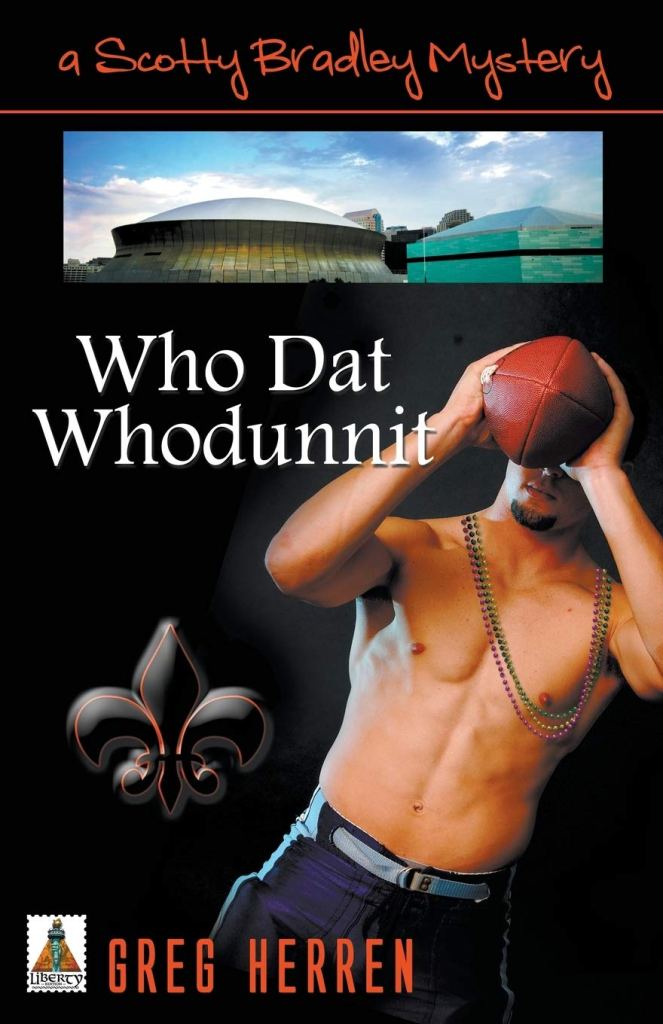
So I decided to write another Scotty book, set it in that period between the Saints winning the NFC Championship and the Super Bowl so I could document that time, and I also decided to bring the other side of his family–the Bradleys–into the mix and give him a cousin who actually was on the Saints team and kind of a dick.
It was around this time, when I was planning or writing the book, that same-sex marriage was in the news a lot. Several suits were winding their way through the courts, and public opinion–thoroughly anti-queer in 2004 when it was on the ballot on a lot of states–was starting to swing back the other way. There was an incident at a beauty pageant when Miss California (her name escapes me now) was asked by Perez Hilton (who shouldn’t be judging anything, frankly) about same-sex marriage. She had to say she was against it, and even apologized, saying “I’m sorry, it’s how I was raised!” as the crowd began booing and jeering. She didn’t win, and I actually felt like it was kind of a shitty question to ask, but on the other hand, California had passed Prop 8 in 2008 (which was kind of the catalyst for the public opinion change, I believe). I also have always believed the old “it’s how I was raised” is a copout for bad or unpopular opinions–most white people are raised racist, after all–and questioning and reevaluating values and beliefs you were raised with is part of the maturation process of becoming your own person. But I was willing to cut her a break–she was young, it was a “gotcha’ kind of question, and kind of unfair–until she doubled down and decided to became the Patron Saint of Homophobia, following in the pumps of another runner-up pageant queen who became the face of hate and bigotry, wrapping it all up in religion and “concern for children”: yep, the hateful old bitch Anita Bryant herself, may she burn in hell for all eternity. She didn’t last long–its hard to paint yourself as a martyr for family values when you’ve been caught sexting (and recording yourself masturbating to send your man–and that was the end of that. I decided to make the reigning Miss Louisiana a homophobe who got that question at Nationals and is now dating Scotty’s cousin the Saints player–and he brings her to Christmas, with the end result that she gets slugged by Scotty’s mother and their family storms out.
And the night the Saints win the NFC championship, she’s murdered.
It was fun because I got to involve a megachurch in Jefferson Parish (there actually is one), and a sordid history of her own that the beauty queen was keeping secret for her own reasons–(coughs LESBIAN coughs) and even got to bring some more past characters back into the mix, like Emily who worked at the Devil’s Weed, and I had a lot of fun with this look into the other side of Scotty’s family (the one I am working on now also deals with another branch of relatives).
And I got to write about the Saints winning the Super Bowl, which was even more awesome. This was the book where I really thought I was done with Scotty. The year after it came out, at the next Saints and Sinners, was when I was asked if I would do another Scotty book; this was when I made my famous reply, “if I can figure out a way to include Mike the LSU Tiger, Huey Long, and his deduct box into a book, I will write another Scotty book.”
Of course, later that night it hit me like a 2 by 4 across the forehead, and I made some notes that eventually became Baton Rouge Bingo.
Labor Day Monday and I have a nice relaxing day ahead of me of writing and reading and who knows what else? We also leave for Minneapolis the day after tomorrow, which is also kind of exciting. I did make a small run to make groceries yesterday and had a small Costco order delivered. I also watched some tennis (Coco Grauff) and then we watched the LSU Game. Jury’s still out; they played very lackadaisically to me, it seemed; not quite gelled as a team yet, but lots of talented players with some kinks to work out yet. They ended up losing 24-23, could have tied and/or won the game at the end, and rallied from 24-10 down in the closing minutes, so that was promising. I am of course disappointed the comeback failed, but at one point it literally looked like we were going to lose 31-17, and that final drive went ninety-nine yards in sixty-five seconds. So, they could continue to improve and get better, which is a good sign. I impatiently was hoping this could be turned around in one year, but….it even took Saban an off-year before turning Alabama into what it is today. It was a fun weekend of football, to be sure, and I am always happier when it’s football season.
I mean, take away the two fumbled punts, the blocked extra point, and the blocked field goal, and LSU would be 1-0 right now.
I am curious to see how the rest of the season shakes out.
I skim-reread Jackson Square Jazz yesterday, and again, I was very pleasantly surprised at how well the book still reads, roughly nineteen years after release, and again–I really did do a great job with the characters. I am writing an entry about it, of course, and then started skim-rereading Mardi Gras Mambo, too. I really wish I could remember what the plot was in the first two failed attempts to write the book, but maybe it’ll come to me while I skim reread, but I rather doubt it; I forgot those original plots years ago. I am glad that reader asked me about the Scotty books, though. I had figured I’d talked about them often enough that Constant Reader didn’t really need me to write the backstories behind the books in this series, but I am having the most wonderful time revisiting the books and remembering the process that produced each one. And these first three are so far back in my distant past that it’s almost like reading new-to-me books; I always wondered if my own work would ever get to that point, and clearly, they have done so. I’m not sure how to feel about it, but I imagine Philip Roth didn’t spend a lot of time thinking about his first couple of books, nor did Agatha Christie, Ellery Queen, or Erle Stanley Gardner. (Not that I put myself up there with those greats of crime fiction, but you know what I mean.) We write books and we move on from them to write other books, and the farther in the past those old titles get, the more distance I feel from them and the less I remember about them, which makes them much easier to read (at least for me).
And it’s really helping me get back inside Scotty’s brain and his voice, too. Always a bonus, you know?
Today I am going to take it easy but still get things done. I need to write–which I’ve done woefully little of this weekend–and I also need to overhaul the first three chapters of this book before I can move on with it, which should be taken care of today. (I started to do it yesterday but…Coco Grauff was playing!) I also have some other things to get done today–maybe I should make a list of what all I want to get done today; can’t hurt–including making my packing list for the trip (I checked the weather; I think I can get away with taking a sweat jacket with me rather than a coat; every night it’s supposed to dip into the 60’s, which, as we all know, is the dead of winter to me) and some other loose odds and ends. And the skim-rereading of my books is at least getting me to read again–just wait till Wednesday afternoon at the airport though; I’ll be tearing through that Gabino Iglesias novel like it’s going out of style. I don’t think I’ll finish reading the Iglesias, the King, and the Andrews on the trip, but I am taking a book in reserve just in case–A Walk on the Wild Side by Nelson Algren. I also need to prep myself for reading only horror in October, the way I do every year; I know there are some Paul Tremblay and Stephen King and Christopher Golden and some other great horror novels sitting there waiting in my TBR Piles. There’s also some great short stories I should read, too. I am sitting on a Daphne du Maurier novella–“A Border-line Case”–and maybe I should spend some time today reading that?
I do love me some du Maurier (reminder to self: reread My Cousin Rachel).
So, we’re basically sitting on today and tomorrow as interim days. I think the house is in good enough shape as is for us to leave without doing some more cleaning, but I always do some cleaning while I am writing. There’s a load of dishes that need doing, and some other picking up and things needing to be put away, but that’s always the case, isn’t it?
And on that note, I am going to make a to-do list, finish those dishes, and head into the spice mines. Have a lovely Labor Day, Constant Reader, and I will check in with you again later.
I also love the word “enchantress.” Go figure. Must be something about the sibilant s.
I moved from Kansas to Fresno, California in February of 1981. It was cold and there was snow on the ground when I boarded an Amtrak train at 2 in the morning with my mother. I fell asleep before the train left the station in Emporia; when I woke up it was gray outside and we were in western Kansas. The trip seemed endless, and our train was delayed because of weather crossing the Rocky Mountains; that part was terrifying, honestly. There were times when there was only enough room on the mountain ledges we rode over for the train tracks, and the wind was powerful enough to rock the train. I’ve always been afraid of heights, so obviously this was completely terrifying for me. I had brought books with me to read on the train, but I’d finished them all by the time we reached Barstow, California–missing our connecting train by half an hour–and thus were stuck there for twelve hours until the evening train to Fresno.
You haven’t lived until you’ve spent twelve hours in a train station in Barstow, California.
(Although reading everything in the magazine rack in that train station completely fueled my soap opera obsession–but that’s a story for another time.)
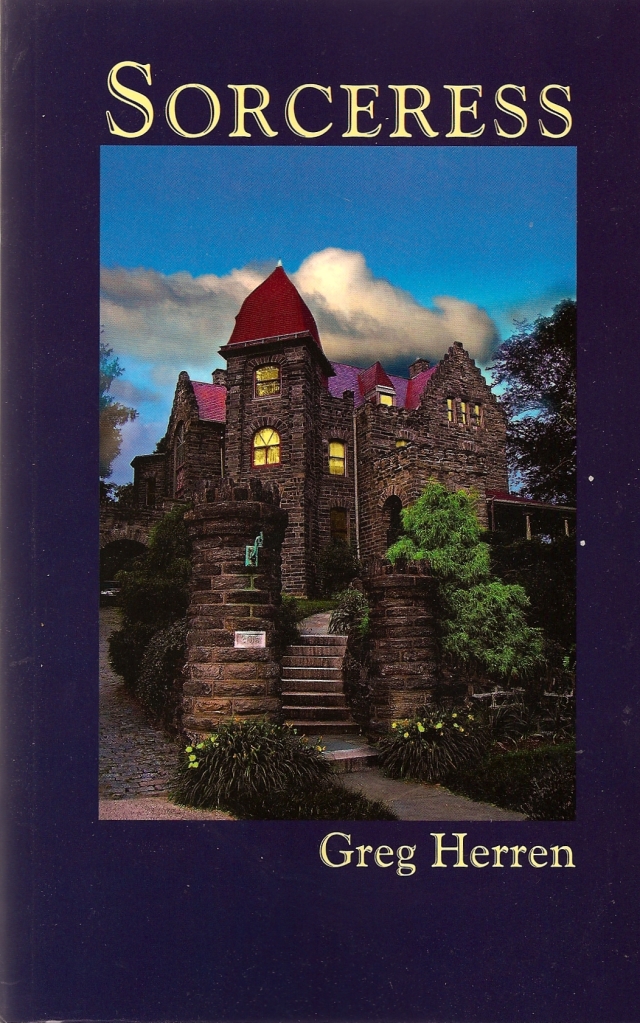
After I finished writing the first draft that became Sara I put the manuscript aside and started working on another one, which I called Sorceress.
Why was the move on Amtrak to California pertinent to the story of Sorceress and how it came to be? Because it’s one of the few books–in fact, the only book–I’ve written under my own name that is set in California (all the Todd Gregory ‘fratboy’ books are set in California).
It was a beautiful day to die.
The sun was shining and she could hear the birds singing in the trees outside. Through the window on the other side of the room she could see a gorgeous blue sky with wisps of white cloud drifting aimlessly. The house was silent around her, and she closed her eyes again, biting her lower lip.
Her throat was sore and she was thirsty.
There was a glass pitcher of water sitting on the nightstand just out of her reach. Drops of condensation glistened in the sunlight as they ran down the sides, pooling on the wood. She licked her lips and dry-swallowed again.
“Please.” She’d intended to shout, but all that came out was a hoarse whisper. Tears of frustration filled her eyes.
This can’t be happening to me, she thought as the tears began to run down her cheeks. She felt the wetness against her lips, flicking her tongue out to catch the moisture.
It might not be much, but it was something.
She tugged at the handcuffs again, and moaned as the raw skin around her wrists rubbed against the metal, dull arrows of pain shooting up her arms.
That isn’t going to work. You’ve got to think of something else. There has to be something.
As if on cue, the phone on the other side of the room began ringing.
If only I could reach the phone!
“If only I weren’t handcuffed to this stupid bed,” she said aloud.
If only, if only, if only.
A grandfather clock began tolling somewhere in the house.
Five o’clock. Maybe four more hours until the sun goes down.
She was safe until the sun went down.
She heard footsteps comingdown the hall towards the closed door.
“I’m thirsty!” she shouted. “Please! I’m so thirsty!”
The footsteps stopped. She was about to shout again when heard the footsteps start again—only now they were moving away from her door.
She closed her eyes.
Not a bad opening, huh?
I started writing the novel Sorceress sometime in 1992 or 1993; I’m not sure which. Sorceress was the easiest of the early manuscripts for me to write, and this was because I knew the story, from start to finish, before I started writing it–which is incredibly rare for me; I even knew the middle, which I always have the most trouble with. I originally wrote Sorceress in the late 1980’s as a novella that originally clocked in at around seventeen thousand words. But even as I wrote that incredibly long short story (at the time all I knew about novellas was that Stephen King sometimes wrote really long stories, like “The Mist”) and had always put it aside, because I knew there was more story there and it needed to be longer–novel length, in fact. So when I finished the first draft of Sara and was ready to move on to something else, I decided to finally expand Sorceress out into a novel.
Fresno wasn’t a pretty city, by any means. It had a desert climate (the entire San Joaquin Valley has a desert climate) that was very dry and climbed to well over 100 degrees in the heart of the summer (sometimes even getting up to over 110) and was all brown, mostly; brown, palm and orange trees, and concrete in the unforgiving sun. My parents bought a house in a subdivision in a city that bordered Fresno yet somehow wasn’t considered a suburb. It had a pool, two orange trees, and several eucalyptus trees. These seemed exotic and cool and fun–until you realized how much fruit one tree, let alone two, could produce, and there was no way to keep up with them, either; inevitably, the back yard was always dank with the sickly-sweet smell of rotting oranges. The eucalyptus trees with their slim, silvery leaves were also a pain in the ass; those leaves would get into the pool, and unless fished out, became water-logged and sank to the bottom, where they would stain and/or discolor the bottom of the pool. It seemed like those little leaves were always fluttering through the air and unerringly landing in the water.
Never again will I live a place where I am responsible for a swimming pool.
But the true beauty of Fresno was its location. It was within a few hours’ drive of many wonderful places: Yosemite, Sierra, and Kings Canyon parks, San Francisco, and Los Angeles. LA was the furthest away–four hours down the Grapevine; and the final descent through the mountains into the plains on the other side was one of the steepest highways I’ve ever driven down–but in college I also made friends with students who came from some of those mountain communities–Sonora, Oakhurst, Coarsegold, Tuolumne–and wound up visiting them at times. I spent most of my time visiting the mounts in either Sonora or Tuolumne. I’d never spent much time in the mountains before or since, and the thing that always stuck in my head was how close the stars in the night sky seemed up there, almost like you could reach up and grab one. I decided to create my own version of these small mountain towns and call it Woodbridge. When I started writing Sorceress as a novel, I set it in the countryside in the mountains outside of “Woodbridge.” By this time, I had already discovered y/a horror, obviously, and so “Woodbridge” was going to be the anchor of all my stories–they were all going to be connected, and in some ways the center of that fictional universe I was building was going to be Woodbridge (Sleeping Angel is also set in Woodbridge). I also put a college there; a campus of the University of California (UC-Woodbridge) which also gave me college students to play with as well as the high school kids. Laura, my main character, was originally from the same area of Kansas where Sara was set; I even mentioned her in passing in Sara, as a friend who’d moved away to California and who had been betrayed after she left by her best friend and her boyfriend…which also figured into the plot of Sorceress.
Sorceress was also the first book I wrote where I followed the Gothic tropes: a young woman all alone in the world after the death of her parents is summoned by an elderly aunt she didn’t know existed to California. The elderly aunt has a huge Victorian mansion in the mountains, a man-servant/housekeeper/butler, and once there Laura begins to suspect that not only are things not the way they seem, but that her own life might be in danger. There’s also a hint of the paranormal here as well…and some of the kids Laura meets in Woodbridge also figured into some of my other books for young adults as well.
When I had the opportunity to write something on spec for Simon and Schuster teen in the summer of 2005, Sorceress was the one I chose to revise and rewrite for them. I felt it was the most complete and needed the least amount of work, plus I loved the entire Gothic mood of the story. Then of course Katrina came along and knocked that right out of my head; I kept trying to revise it but focus was incredibly difficult, and finally I gave up. This is the story I mentioned in conversation with a friend, who was later given a job as an acquisitions editor, and this is the story she wanted me to pitch to her. I did, but they didn’t pick it up, but when she went out on her own later and started her own small press specifically for juvenile and y/a fiction, she wanted Sorceress, so I dragged it back out and went to work on it again. It was released in 2010, I believe; it’s hard to remember dates these days for me. Anyway, this is the book where I told Bold Strokes I was publishing a y/a with a friend’s small press, which got the response “you know, we do y/a too” that led to me giving them both Sara and Sleeping Angel, and led to all the others.
I also wrote another Woodbridge story–a very long novella–that I intend to either revise as a novella or expand out into a novel. This story directly references events in Sorceress and Sleeping Angel, as well as characters…so while it might be entirely too late to release another book in that linked universe I originally intended to create, a good story is a good story. I just am not sure about the ending of that one, which is one of the reasons it remains in the drawer.
Ah, Sara. The first actual book I wrote for a young adult audience, and what a long and tortured history this story actually had.
I started writing stories when I was really young, my own versions of the kids’ series books I was addicted to and were blatant rip-offs, frankly, but it was good practice, I started writing original fiction when I was in high school; basically, I started writing about a group of high school students at a small rural high school (kind of like the one I was going to), and always felt that someday I would turn them all into a book about those kids. A couple of years after high school I abandoned the first actual novel I tried to write (I don’t even know if I still have it anywhere but I don’t think so; it most likely got lost in one of the many moves over the decades), and decided to write a novel about high school students in Kansas. Writing in cursive longhand, I expanded the story beyond the teenagers–who were still the primary core of the story–but also wrote about their parents and siblings as well. It was very soapy–this was the time when my daytime soap addiction was at its highest–but ultimately, the real story was the murder. I wrote whenever I could, often changing character names and ending subplots and starting new ones willy-nilly as my mind bounced around, always coming up with new ideas for it. I started in 1980, and I finally wrote the end on it in 1984; four years. I had thousands of wide-ruled paper filled with my loopy, pretty handwriting; now the trick was to somehow type it all up and edit it, cut out all the excess and tighten it, decide on final names, and so forth.
Needless to say, I never did that. I still have it all somewhere, in a box–it did survive all those moves–but over the years I pilfered plots and character names and stories from it. I have a tendency to come up with character names for ideas for stories and books that never get used; I then turn around and use those names again in something else I am writing (I talked about Chris Moore and Eric Matthews before; I came up with those names for an idea I had for a book set in a fraternity, and have used them in Todd Gregory “fratboy” books and they’ve turned up elsewhere, too).
Sara is one of those books born from that original manuscript, and no, despite the opening sentence of this entry, I didn’t take the title from the Fleetwood Mac song. I’ve always liked the name, and right around when I started writing the book as a young adult novel, I went to a family reunion and met a cousin’s daughter for the first time, and she was absolutely adorable. She actually looked like she would grow up to look like my mysterious title character–and her name was Sara. (I had originally named the character Tara; it was an easy switch.)
Being a senior sure doesn’t feel any different, I thought as I looked at myself in the bathroom mirror, and I sure don’t look any different–besides that damned pimple on my chin.
I don’t know what I’d been expecting. I;’d been looking forward to my senior year almost from the very day I started high school. This was it–when the year ended, I’d be an adult. No more being treated like a kid, no more getting up Monday through Friday at six thirty, no more being at the mercy of teachers and coaches and guidance counselors–it would all end when I cross the stage, took the diploma, and put the tassel on the other side of the cap.
It couldn’t happen soon enough, thank you very much.
And then I could get the hell out of this podunk town in the middle of nowhere, and never look back.
I finished toweling my hair and hung the wet towel on the rack. I looked in the mirror again. I touched the angry-looking red blotch in the direct center of my chin. It might as well have been blinking and neon–no one could miss the stupid thing. I sighed and wondered what kind of omen that would turn out to be as I put on my underwear and a pair of jean shorts. Probably not a good one, I thought, sighing again as I brushed my damp hair into place. I was out of hair gel, so I just parted it on the side and combed it flat.
I was already starting to sweat. It wasn’t even eight in the morning yet, and our crappy house was already turning into a sauna. The house didn’t have central air conditioning–all we had was some window units in the bedrooms. Mom kept saying when she got a little bit ahead she’d buy one for the bathroom, but until then we’d have to make do with fans.
I walked down the hall back to my bedroom, wiping sweat off my forehead. I stood in front of the window unit and raised my arms so my armpits would dry. When I didn’t feel damp anymore, I reached over to the bed for my purple Trojan Football T-shirt. I pulled it over my head, but had to yank it down hard to get it past my chest. The weightlifting I;d been doing all summer had worked–the shirt stretched so tight across my pecs it looked like it might rip. I looked into the full-length mirror hung on the back of the bedroom door and smiled. It made my muscles look huge–so maybe no one would notice the stupid pimple. I tucked the shirt into my shorts and rubbed some antiperspirant into my armpits, hoping it would work this time. I picked up my backpack and made sure one more time I had everything: notebook, pens, my cheap cell phone–yeah, I hadn’t forgotten anything. I put my wallet into my back pocket and sat down on the edge of my bed to put on my socks and shoes.
I’ve often joked that Sara is my “get even with everyone I went to high school” book, but that isn’t true. Yes, I did not have a great time in high school–either of them–but it wasn’t all bad; I did have some friends, even though it often felt like I didn’t have any, and after graduation, I decided to shut that door behind me firmly and move on with the rest of my life. I harbored a lot of anger and bitterness about my high school experience, but time does provide some healing, even if there’s a scar left behind. I was weird and different from my classmates from kindergarten on: I was gay but I was also an artistic child with a wild and vivid imagination in an environment where no one knew what to make of either. I was different, and that was all that mattered, even if they couldn’t quite process that I wasn’t from another planet or an aberration that needed to be shunned and excluded and mocked.
As I have mentioned before, I started writing in high school about a group of high school kids in a rural high school similar to the one I was attending. That eventually morphed into a lengthy, hand-written (and incredibly amateurish and terrible) first novel from which I have pilfered plots, stories and characters ever since. Sometime in the mid-1980’s, as a fan of Stephen King and Peter Straub, I decided to try my hand at writing horror short stories, with an eye to maybe writing a horror novel. I even started writing a horror novel(The Enchantress, which I occasionally think about getting back out of the drawer and working on again; it did, however, lead me to write a different book decades later, but I still think about The Enchantress from time to time). By this time I’d taken a junior college writing class and was starting to get my confidence in my dream back after the horror of my first creative writing course in college; I took another course in it when I started going to Fresno State (CSU-Fresno at the time, to be correct) and that teacher, in a conference about one of my stories (which he really liked), told me, when asked about writing a novel, “The best way to study how to structure a novel is to take one that you really like, and then break down how it’s structured; how the story and the characters are built and the pattern and rhythm of how action is interlaced into the plot.” I’ve always remembered that, and sometimes when I am stuck on a book I think about his advice and think about how a book with a similar story to the one I am trying to tell is structured.
I put The Enchantress aside and decided to try, once again, to do something with fragments of that horrible first novel I’d written, and introduce an element of horror to it. I decided to structure the book the way Stephen King structured Christine–something awful happened when we were in high school, and now, many years later, the main character is looking back and remembering, and at the end of the story we find out that the reason he is telling us this story is because he’s afraid the awful thing is coming back again (reoccurance/revival of something evil is a strong theme in horror, and King has gone to that well numerous times, most famously with It and the dueling timelines). So, I started writing Sara with a prologue written in the present day; ten years later, the main character has gotten an invitation to the high school reunion and starts remembering back, and then in the first chapter we’re back in the late 1970’s and don’t return to the present again to the epilogue. I also decided to do the different POV thing King did in Christine (which I still think is one of his most underrated novels of all time); he tells the first part and the third part of the book in the first person point of view of Dennis, but the second section is the third person and bounces around from character to character before the return in the final section of the book (it really is a three-act structure). I thought this was very clever and decided to use it in this book, too. But instead of an evil car, we had a mysterious new girl at the rural high school who dazzles and enchants all the boys–but there’s something not right about her.
I decided that the book–primarily focusing on teenagers–would work best as a young adult novel (ater discovering there even was such a thing as y/a horror) and so I dropped the looking back prologue/epilogue framing and moved the action into the present day. I finished a first draft in about six months, and then put it in a drawer for about fifteen years before returning to it, overhauling it and dragging it into the new present day and publishing it.
Revisiting Sara now, thirty years after I first conceived it and ten years after publishing it, the first thing I noticed was “hmmm, you should have reread this before turning in the final draft of #shedeservedit, since technically the two books were supposed to be connected; with the newer book set in the county seat and Sara taking part in the rural southern part of the county” but I am also recognizing that my books don’t, in fact, all need to be connected together; there’s no reason why this particular county and its county seat can’t be a county or two away from this one, even if they are remarkably similar geographically; it’s the plains, after all. There may even be characters in this one with the same name as a character in #shedeservedit, but again, it doesn’t really matter–and I’ve written other stories set in Kansas in the same area where the geography is the same and maybe even some of the character names. I used the ten-year-reunion (or possibly twenty) in rural Kansas thing in my story “Promises in Every Star,” for example, and revisited the Kansas well for “This Thing of Darkness” too.
And will probably return to that well at least once more for a book, if not more than one.
I originally started writing Sleeping Angel in 1994.
That seems like such a long time ago, too. I hadn’t met Paul yet, was still working for that wretched airline at the airport, was broke broke broke and often ran out of money long before payday, and any kind of decent life for me seemed impossible. It was the next year I decided to snap out of the constant feeling sorry for myself, and instead of waiting for the world to come knocking on my door to make my dreams come true, that the only person who could make my dreams a reality was me, and that I needed to make the changes necessary to my life if I were going to become a writer for real–like stop dreaming about it and writing now and then, and start taking it seriously and writing all the fucking time, and trying to make it happen–which meant sending things out to try to get them published.
It’s weird how you forget things about books you’ve written until something out of left field reminds you of something. Julie Hennrikus, during our Sisters in Crime podcast interview, asked me about writing young adult fiction, and how I came to do that. The story is very simple, really; after discovering Christopher Pike and R. L. Stine and other young adult authors who wrote young adult novels that were either crime or horror or a cross of the two, I decided to take the book I was writing at the time–Sara–and write it as a young adult novel instead of as one for adults. It really didn’t take a lot, to be honest–I removed the framing device that firmly set the book back in the 1970’s–and turned it into a modern day story about teenagers (which it always was). After I finished Sara, I wrote another called Sorceress–and when I finished it, I began writing Sleeping Angel. I still didn’t have a strong grasp of how writing actually worked (which is kind of embarrassing when I remember how naive and stupid I actually was back then, but what did I know. seriously? Very little.) and so I never rewrote anything; I just printed them (I had bought a very inexpensive word processor that I loved, and wrote on) out and saved the originals. I was about half-way through Sleeping Angel when I discovered there was such a thing as queer crime novels…so I abandoned writing young adult fiction and started thinking more in terms of writing a gay private eye series…which eventually became the Chanse MacLeod series and Murder in the Rue Dauphine.
Flash forward another decade or so, and in the spring of 2005 I attended BEA and the Lambda Awards in New York. I lost twice that year (Best Gay Mystery for Jackson Square Jazz and Best Scifi/Fantasy/Horror for Shadows of the Night) and then on Saturday night I attended a cocktail party for the Publishing Triangle. (It was at this party that I met both Tab Hunter and Joyce Dewitt.) I also met a very nice man who was familiar with my work, and asked me if I had ever considered writing young adult fiction with gay characters and themes? I laughed and replied that I had two completed first drafts and a partial for another in a drawer back home; he then gave me a business card and told me he would love to take a look at them with an eye to publishing. I lost the card years ago, probably in the Katrina aftermath, but he was an editor for Simon and Schuster Teen, which was very exciting. I told him I would revise one and send it to him as soon as I finished Mardi Gras Mambo, which was at that point over a year overdue (I didn’t mention that part). This was exciting for me, as one can imagine; another opportunity gained by simply being in the right place at the right time, which has been the story of my career pretty much every step of its way. Once I finished Mardi Gras Mambo that August, I started revising Sara.
And then came Hurricane Katrina, and everything went insane for a few years, and I abandoned the attempt to rewrite Sara. There was just too much going on, I was displaced and finding it hard to get back into writing, and I just wasn’t in the right place emotionally to revise or rewrite a book. I’ve always regretted that last opportunity.
Flash forward another year or so and I casually mentioned to a friend this missed opportunity. What I didn’t know when I mentioned it (bemoaned it, really; I still regret this lost chance) was that she had been working for another publisher as an acquiring editor for young adult/children’s work. “Would you rewrite one of these for me? I’d love to pitch this to the company.” So….rather than Sara, I went with a rewrite of Sorceress, which had a teenaged girl lead character and I didn’t see any place to add queer content (I’d been adding that to the revision of Sara ) and sent it to her. Alas, before she had the opportunity to pitch it the line she acquired for was closed down and that was the end of that….until a few years later when she decided to start her own small press for juvenile/young adult fiction, and wanted Sorceress. I sent it to her, we signed a contract…and then I realized I needed to let Bold Strokes Books know I was doing this. I emailed them, and they replied, “You know we do young adult?”
Well.
I wrote back and mentioned I had two others collecting dust, and so I contracted both Sara and Sleeping Angel with them. I decided to do Sleeping Angel first–which is odd, as I didn’t even have a completed first draft; I don’t remember why I decided to do this, frankly–and so I started writing and revising.
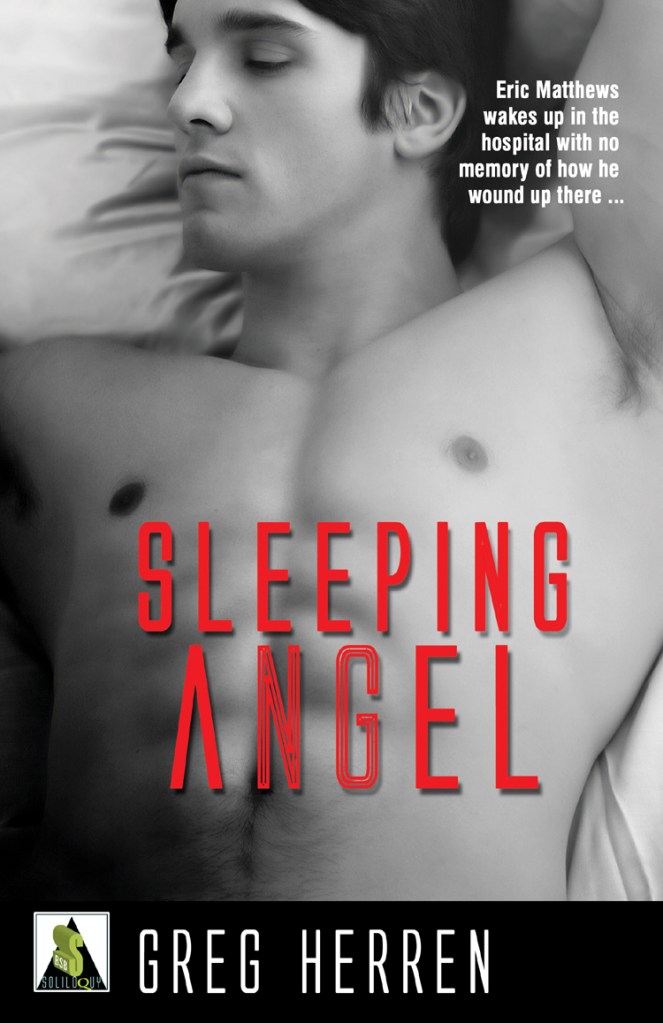
The really funny thing–just looking at the cover for the book–is that the character name “Eric Matthews” was one I came up with when I was in college; I had an idea for a book set in my fraternity, and came up with three names for characters that were pledge brothers and friends: Eric Matthews, Chris Moore, and Blair Blanchard. I used Eric and Chris for Sleeping Angel (completely forgetting that I had already used those names in Every Frat Boy Wants It a few years earlier), so yes, even though the fraternity books I used were by “Todd Gregory”, I accidentally re-used the character names.
Whoops.
The original intent with my young adult fiction was to connect it all together, the way R. L. Stine did with Fear Street, and sort of how all of Stephen King’s work is as well. The three books I started with–Sara, Sorceress, and Sleeping Angel–were connected, and were the springboard from which the others would come–or were supposed to come, from. Sara was set in rural Kansas. The main character of Sorceress moved from rural Kansas to a small town in the mountains in California, Woodbridge, which was also where Sleeping Angel was set. The main character of Sara moved to Kansas from the Chicago suburb where the main character of Lake Thirteen was from, and so on. (Likewise, the main character from Dark Tide was also from the same county in Alabama where Bury Me in Shadows took place, and #shedeservedit was set in the town that was the county seat for that rural Kansas area where Sara was set.) I’d consciously forgotten that, but fortunately my subconscious still holds on to things the forefront of my brain doesn’t.
When I originally envisioned Sleeping Angel back in 1993 (or 1994, I don’t remember which), the concept I wanted to explore was something, a concept, that Dean Koontz had used in his book Hideaway–that someone was in a car accident and died, only to be resuscitated by the EMT’s. But when he came back to life, he brought back something with him from the other side that gave him a psychic connection with a serial killer. It was an interesting idea–I wasn’t using the serial killer thing–but I loved the entire concept of someone being brought back with something extra (which, now that I think about it, is also the entire conceit Stephen King built The Dead Zone around). I decided to keep the car accident to open the book in the new version, but the opening I originally wrote had to be tossed. I also came up with an entirely new concept for the book: what if you were in a bad car accident, but there was a dead body in the car who was NOT killed in the accident but had been shot and was already dead when the car crashed? And if the main character has amnesia….who killed the kid in the back seat?
And away we went.
He was driving too fast, and knew he should ease his foot off the gas pedal, bringing the car down to a safer, more manageable speed.
But he couldn’t bring himself to do it.
“Hang in there, buddy,” he muttered grimly under his breath, taking his eyes off the road for just a moment to glance in the rearview mirror into the backseat. What he saw wasn’t encouraging. Sean’s eyes were closed, and he couldn’t tell if Sean was still breathing.
The blood–there was so much of it, and it was everywhere.
He swallowed and took a deep breath, trying to hold down the panic. He had to stay calm. He couldn’t let the fear take over, he just couldn’t. He had to hold himself together. He had to get to town, to get Sean to the hospital before it was too late–if it wasn’t already too late.
Not a bad beginning, right? Pulls you right into the story.
I don’t remember what–if anything–I was expecting when Sleeping Angel was finally released (it actually wound up coming out before Sorceress, ironically); it had not even been six years since the right-wing homophobes had come for me for daring to accept an invitation to speak to high school students in a Gay-Straight Alliance. And now I’d actually dared to write a book about teenagers, for teenagers. The horror! But the book come out and there wasn’t even the slightest whisper of controversy about the “gay pornographer” writing a y/a book. It got really good reviews for the most part, people really seemed to enjoy it, and it eventually won a gold medal for Outstanding Young Adult Mystery/Horror from the Moonbeam Children’s Book Awards, which I’d never heard of but was kind of a big deal, or so I’m told. The gold medal was nice, too–very pretty (but it’s not the rock from the Shirley Jackson Awards–the smooth polished stone I got for being a finalist may be my favorite thing I ever received as recognition for my writing).
Well, I kind of do every morning, really. It’s kind of hard sometimes to wrap my mind around the fact that next month is our twenty-seventh anniversary. Twenty-seven years. That’s a long time for someone like me, whose prior relationships never lasted much longer than a couple of weeks at best. I was thinking about my past last night, after I got home and collapsed into my easy chair, and thinking again how I could never write a memoir because I really don’t remember what actually happened, and over the years I’ve rewritten things to make me look better in my own mind and memory. We all have, I think, a tendency to see ourselves as always being in the right, and everyone else being wrong…and as more time passes we continue to color those memories and slant them in our minds until the truth, what really happened, what was actually said, have changed completely in our minds and these biased revisions become our truth; which is just one of many reasons I use my past–if and when I do write about my past–I only use it for fiction–because my past as I remember it now is probably mostly fiction.
I had another good night’s sleep last night, which was marvelous and feels great this morning. My muscles feel rested and relaxed as opposed to tight and tired, and my mind feels a bit refreshed. I am not in world-conquering mode quite yet; but I am getting there slowly but surely. I have a lot of work to get done this week and over this weekend; I am going to have to buckle down and force myself to actually get the work done this weekend no matter how badly I want to goof off and relax and do little to nothing–it’s really not an option for me this time around. I have too much to do, and the trip to Kentucky, necessary as it was, really threw me off schedule (which I was already behind, to be fair; the trip made things worse). So I am hoping–with feeling rested and everything today–that I’ll be able to make some serious progress on things, and get to a place where I can unplug for the entire weekend (other than the blog, of course) and avoid everyone and everything until I am completely caught up the way I should be on everything. I doubt that will happen–if anything was proven to me this past weekend on the trip, it’s that I get way too much junk email every day, so not looking at it and not deleting things is really not an option for an entire weekend.
I am also the featured author at Three Rooms Press this month, which is very cool; many thanks to Peter Carlaftes (and Kat Georges) for always being incredibly supportive of me and my career over the years, ever since they published the Florida Happens anthology I edited for St. Petersburg Bouchercon. I was rereading it last night in my chair while I was waiting for Paul to come home (so we could watch another episode of The Little Drummer Girl), and I winced quite a bit, as I always do. The other morning, when I taped the segment for Great Day Louisiana (which, it occurred to me last night, might not air) I was having to talk about writing and again, I think back to the questions asked (Malik, the interviewer, was great–friendly and nice and very high energy) and my responses and wince a little bit. I always feel so pompous and pretentious when I talk about writing, but I try to be as honest as I can. I’m never sure how I come across (and let’s be honest, I am a huge critic of myself), and I want to be practical–I always roll my eyes when I read interviews about writers talking about writing and they turn into this mystical, mysterious thing with muses and Gods of Inspiration and “opening a vein and bleeding on the page” and all of that stuff. Yes, you want emotional honesty in your work, and yes, you want your characters to be realistic and fully developed and well rounded and to have interior lives, but ultimately, at least for me, writing is work. I think about it, I go over it in my head, I sit down and write it and print it and edit it and revise and rewrite it and maybe that can, I suppose, be seen as “bleeding on the page”…but then I remind myself I am not a literary writer and so therefore I don’t go through all the angst and agony they do–I don’t spend hours trying to structure and craft a sentence until it’s perfect and poetry, either.
Then again, I’ve never really fit the mold of what most people think authors are like and I’ve never written the way other people do. And that’s fine; there’s no “one way” to be an author. I always tell people the entire point of writing manuals is to show beginners there are any number of ways to write and be a writer; what works for someone else might not work for you, and the point of the manuals with helpful hints and techniques and methodologies for getting words on the page is for you to try things to see what works best for you, and it may wind up being a combination of Sue Grafton said this and this other writers does this and let me try this thing Michael Connelly does and so on…you have to come up with whatever works for you, and there’s nothing wrong with borrowing bits and pieces of other author’s techniques and honing them into something that works for you.
Which is also why I will never write a How to Be a Writer manual. I could, on the other hand, do something like Stephen King’s On Writing, which is a combination writing memoir/manual, and is the book I recommend to any and every person who wants to write. And then I think, like anyone wants to read your memoir about writing….and didn’t you just say you aren’t sure of your own memories of the past, what’s true and what’s been revised over the years by your ego?
Yes, that would be a problem.
At any rate, it’s time for me to head into the office for another exciting day of STI testing. You have a great day, Constant Reader, and think of me down here in the spice mines.
I know, it catches people off-guard that a sixty year old gay man is a massive football fan, but I’ve never subscribed to stereotypes. I love football, with an especial love for the college game (I used to only watch the Saints in the NFL, but have started rooting for the Cincinnati Bengals because, well, Joe fucking Burrow); I think everyone knows I am a massive LSU fan. (GEAUX TIGERS!)
There really isn’t anything else in the world like a Saturday night in Death Valley. I will remember the 2019 night game against Florida probably for the rest of my life. God, what a great game, and it was so much fun. I am aware that I am digressing.
Anyway, I grew up in a Southern football family (even if we didn’t live in the South, we were from the South and that’s all that matters), so it was inevitable that I should become both a football fan and a football player. I played all four years in high school, all of my cousins also played, and I have close relatives who played at both the college and professional levels (and I don’t mean some small college in the middle of nowhere; I mean in the SEC–Auburn and Alabama, and there may be even more that I don’t know about). I have relatives who were successful coaches. Every fall Saturday the television was tuned into whatever college game was playing–even if we weren’t fans of either team; it’s hard to imagine now with the 24/7 college football coverage, but when I was growing up ABC had a monopoly on all NCAA football games. They would usually play one game of national significance, and then the second game was regional–important to that region. As we did not live in the South, we rarely got to see SEC games other than Alabama–Alabama was almost inevitably the only Southern team of “national interest” throughout the 1970’s (I really don’t remember the 1960’s much, but we lived in Chicago so I imagine we saw a lot of Big Ten and Notre Dame games; I don’t really remember a lot of my life before the suburbs, really–some things, yes, but most things not so much)
I’ve never really read a lot of fiction about football, though; it inevitably winds up being something cliched and tired. I loved North Dallas Forty by Peter Gent; hated Semi-Tough by Dan Jenkins; but do remember enjoying End Zone by Don DeLillo (I was going to reread this recently; but there’s so much to read. I did try to to reread Semi-Tough–but when I opened the book there were racial slurs and other mess on page one, so I threw it in the trash; no thanks). And I’ve also enjoyed other books with football involved, even if it wasn’t necessarily what the book was about. (The Hardy Boys were on the Bayport High football team in The Crisscross Shadow–the only time football is mentioned in the series.) There’s also a tendency, in books about high school and football to make the football players and cheerleaders the villains of the story, which has never really sat right with me. I was never bullied by anyone on the football team, and maybe the cheerleaders weren’t bitches to me because I was on the team and my sister was a cheerleader, but that wasn’t my experience (one thing I truly appreciated about Stephen King’s Christine was the horrible bullies at Libertyville High weren’t the football players but the hard-case kids–which was also my experience; which is probably yet another reason the book is one of my favorites of the King canon, methinks).
But…I can also see why it’s so attractive to make the jocks and cheerleaders the villains of high school dramas. And I sort of did something similar in #shedeservedit, didn’t I? Those boys on the Marysville and Steubenville high school teams certainly fit the bill of villainy.
So, when people started recommending Eli Cranor’s debut Don‘t Know Tough to me, I wasn’t so sure. I just published a book of my own about high school football and the toxicity it can engender in a small town (#shedeservedit), and revisiting my memories of high school and football was harder than I had thought it would be; I thought I could be dispassionate about it all while writing about it (I often write about things to try to distance myself from them and gain some perspective) but I was wrong. It was hard to write that book, much harder than I thought it would be–and it took years (first draft was written in 2015; published in 2022).
But enough people whose opinions I respect were raving about the book, so I got a copy and once I started reading it, there was no way I could stop.
Still feel the burn on my neck. Told Coach it was a ringworm this morning when he pick me up, but it ain’t. It a cigarette, or at least what a lit cigarette do when it stuck in your neck. Just stared at Him when He did it. No way I’s gonna let Him see me hurt. No way. bit a hole through the side of my cheek, swallowed blood, and just stared at Him. Tasted blood all day.
Tasted it while I saw in Ms. Miller’s class. Woke up in Algebra tasting it. Drank milk from a cardboard box at lunch and still, I tasted it. But now it eighth period football. Coach already got the boys lined up on either side of the fifty, a crease in between, a small space for running and tackling, for pain.
This my favorite drill.
I just been standing back here, watching the other boys go at it. The sound of pads popping like sheet metal flapping in a storm.
“Who want next?” holler Bull. Bull ain’t the head coach. Bull coach the defense. He as mean as they come.
One of my favorite books of all time about small towns is Larry McMurtry’s The Last Picture Show (I also love the film, which is extraordinary and one of, in my opinion, the best films made during the 1970’s). I did try to reread it recently–I was interested in refreshing my memory of its gay subplots and the mental breakdown of poor Joe Bob Blanton, but I’d also forgotten the part about the bored teenaged boys decided to fuck some calves, so when I got to that part I put the book down in distaste. But now that I’ve finished Don’t Know Tough, I kind of want to go back and reread The Last Picture Show again (I can skip that distasteful part…weird that I didn’t remember it).
Don’t Know Tough is yet another incredibly impressive debut, further confirming the truth of what I said at the Lefty Award banquet–the last few years have seen so many amazing and diverse and extraordinary debuts that the future of our genre is in very good hands. I won’t lie–when I started reading the book, I wasn’t sure I could keep reading it; I was worried that the entire book would be written in that grammatically garbled first-person voice but as I kept reading that first chapter I got into the rhythm of the language and started seeing the beauty and fluidity of the style choice–which is no small feat to pull off, and pull off consistently, throughout the entire book…to the point I was also a little disappointed that the entire book wasn’t done in that same style. Billy Lowe is the character whose voice this is; and the story of the novel revolves around him and the horrific Shakespearean tragedy that his life actually is. His mother is an alcoholic, and lives with an abusive piece of shit who obviously directs violence at Billy. He has a younger half-brother who was fathered by this POS; he also has an older brother who lives elsewhere. Billy’s situation has turned him into a wild beast of rage with an exceptional gift for channeling that rage into playing football. He’s not big enough in size to go major college, but his coach feels like there’s a chance he could get a football scholarship to a smaller college, and break the cycle of poverty he is trapped in at the moment. Billy is exceptionally compelling–it’s hard to read his first person point of view and not have your heart break for this kid; and hope that it’s all going to work out for him in the end, despite the disturbing pattern of violence in both his life and behavior.
Denton High has made the Arkansas state play-offs, but without Billy in the backfield their chances of advancing are practically nil. It’s important for Denton to do well in the post season because their coach’s job depends on it. Trent Powers is a born-again Christian, whose last coaching job in California crapped out–winning only three games in his final three seasons before being fired. This job is another chance for him, even though his wife and daughters hate relocating to a small town in Arkansas from California (much is made throughout the book of Coach Powers’ Prius, seen by the locals are weird and strange and almost otherworldly and unmanly). Coach Powers also has a very soft spot for his star player, and not just because he’s a star player–he actually feels compassion for the horror the young player’s life has been up to that point, and he wants to help–even if Billy doesn’t want any help from anyone. Billy’s future, to Billy at any rate, is already set, and he’s not going to end up going anywhere or doing anything or having a good life and decent future. He doesn’t see himself being worthy of anything or of doing better than his assigned lot in life.
The Powers family is a direct contrast to Billy’s; loving and nurturing couple, raising two daughters and trying to do right by them. How far is too far to go when helping someone in Billy’s situation, is the question. Coach’s wife–the daughter of a successful football coach who took Trent in when he was a kid from a similar background as Billy’s…and yes, he slept with his coach’s daughter and got her pregnant. So both Coach and his wife have the fear that the same thing will happen to their daughter and Billy–especially when the daughter starts opening up to Billy.
But one night Billy’s abuser is murdered. No one would blame Billy for killing the abusive bastard–well, the law would. But the story of what happened that night is far more complicated, and far more surprising, than the reader can imagine.
The pacing is also exceptional, and I love the contrasts between the third person point of view we see much of the novel in, with the Billy point of view chapters mixed in. The language choices and imagery are spare and tight yet full and rich and immersive–reminding me not only of Megan Abbott and her brilliant Dare Me, but also with a healthy dash of Daniel Woodrell, Tom Franklin, S. A. Cosby, and Kelly J. Ford (all masters of Southern Gothic) mixed in. The little touches of how claustrophobic small Southern towns can be, the class disparities between the haves and the have nots, and what teenagers in those types of environments was simply masterful.
I was completely blown away by this amazing work, and suspect that you will be as well. Highly recommended. I cannot wait to see what Eli Cranor does next.
It’s hard to imagine New Orleans without Chris Owens.
Obviously, New Orleans was here long before she was born, and yes, as with everything, New Orleans will go on. It’s hard to describe Chris Owens to outsiders, really; she was an entertainer, owned her own club on Bourbon Street, and continued performing there at least once a week for decades. I always meant to go see her perform, as I felt it was like paying homage to a local legend and should be done; Paul and some friends did go when I was out of town one week, and I’ve always regretted not ever going. Looks like that’s a regret that I will carry with me to my own grave.
Tomorrow I leave for Albuquerque early in the morning–well, the flight is at 9:50, but that means I have to be there two hours ahead of time, and have to get there, and all of that, you know. So I’ll probably be getting up around the same time I usually do, at six. I have to check in for the flight this morning and I have to pack tonight when I get home from work. Yay? I am excited to be traveling again, excited to be going to a mystery conference, and a little trepidatious about going…just a little bit. I am always a bit nervous about going to an event where I don’t know a lot of people, or the usual people I gravitate towards hanging out with aren’t going to be there. But I am bringing books with me to keep me entertained, of course; I am hoping to finish Arsenic and Adobo on my flight, with Wanda Morris’ All Her Little Secrets also in my bag “just in case”. I am also taking Robert Jones’ The Prophets and Julia May Jonas’ Vladimir and Rob Osler’s Devil’s Chew Toy. An ambitious reading plan, to be sure, but I would also rather not run out of books–although I am also relatively certain I’ll be flying home from Albuquerque with more books than I flew in with. I mean, I may end up hanging out in the bar with people, or I might not. As I said, while I do know a lot of people who are going to be there…my usual con-gang won’t be. I’ll have to wait to see them all at Bouchercon in Minneapolis this September.
Last night I felt a little done in by the time I got home from work, with laundry to get done and dishes to do. I rolled up my sleeves and went to work on the chores–I hate leaving the house messy when I travel, but I don’t think I will have enough time tonight before I have to go to bed to do any repairs to the mess, alas–and when they were completed, I retired to the easy chair (Scooter had been waiting for my lap, occasionally yowling to display his anger and disappointment that I wasn’t giving in to lap duty the moment he realized I was home and he’d been fed) and watched this week’s John Oliver before moving on to Young Justice (which I am really enjoying; it’s nice seeing the ‘not quite as famous’ DC superheroes in the show). Paul got home just after eight, and I stayed up a little while longer playing Scooter bed before retiring to my own bed for the night. I am also worried about being able to sleep on this trip, but at some point I know I will sleep deeply. And at least I do not have to get up early to fly back home. Huzzah!
I am also hoping to get some inspiration this weekend, which will mean attending panels and listening to writers opine about writing, character, plot, story etc. I generally do come away from these weekends invigorated and inspired (if exhausted), so here’s hoping. I have literally written nothing this entire month other than this blog and shitload of emails, and I do have a story due later this month. (note to self: reread that Stephen King story you were thinking of the other day, to see how he structured it) I also want to spend May writing the first draft of Chlorine, June writing the first draft of Mississippi River Mischief, July finishing off the novellas, and then circling back around to the novel manuscripts again. I am hoping that the lack of writing is burn out from all the work I did over the last seven months–finishing and polishing and working and writing like a madman–but then again, there’s always that fear in the back of my mind that it’s actually gone away for good this time. Do other writers worry about things like that? Maybe. I don’t know. I can only speak for myself, obviously–I never speak for anyone other than myself, so don’t ever assume that I am speaking for any community–but I do know I have this experience inevitably every time I finish writing something, or finish a massive binge-writing marathon.
And on that note, I am heading into the spice mines. Have a lovely day, everyone!






 Queer and Loathing in America