Monday and back to the office with me today. Weekends are simply not long enough, ever, and should always be at least three days, methinks. Yesterday I witnessed the dreadful Saints performance, and it was not a good weekend for Louisiana football fans; the only glimmer of light locally was Tulane’s victory. I finished reading Shawn’s book, which was marvelous, and then picked out my first Halloween Horror read: Riley Sager’s Final Girls, and it’s long past time I’ve read this book. It’s rather embarrassing that I’ve not yet gotten to it. I also downloaded the audiobook of The Only Good Indians by Stephen Graham Jones for this weekend’s drive to the Redneck Riviera, and read another Alfred Hitchcock Presents short story, from Stories for Late at Night, “The Ash Tree” by M. R. James, which was delightfully creepy and reminded me of Daphne du Maurier’s “The Apple Tree”–and that in turn made me think about creepy trees as a trope in horror, and thought perhaps I should give the trope a whirl at some point. We watched the Scouts Honor: The Secret Files of the Boy Scouts documentary–which was just as creepy and awful and horrific as I thought it would be, as well as yet another pointed reminder of how straight people have failed to protect children since, oh like forever, and then cover it up as much as possible but then have the nerve to accuse queer people of pedophilia and grooming?
Sure, Jan.
We also watched the Jennifer Garner Apple Plus series The Last Thing He Said, which wasn’t great but wasn’t terrible, either; it just kind of evolved and wasn’t very thriller-ish or suspenseful. I also predicted one of the bigger plot twists in the first episode long before it played out in the show, but it was well done and an interesting story; but it wasn’t very thrilling or suspenseful; it never really seemed like there was any danger or stakes. It ws talked about a lot, but never part of the show’s reality? It was interesting enough to hold our interest–although I think I may have approached telling the story in a different manner than they did. It’s an interesting thought, at any rate.
It’s lovely having a kitten in the house, even if it means being more alert and having to get up more regularly because there was a crashing sound from somewhere else inside the apartment–usually followed by a galloping kitten moving at high speed away from the noise and mayhem he caused. He woke me up this morning by knocking my glasses off my nightstand table and then playfully batting them around on the floor, and once I took those away from him he went for the broom. He’s incredibly sweet, though, and I love that he’s so fearless and feels comfortable and at home enough to play. He slept on me for most of the Saints debacle yesterday, through the Boy Scout movie, and then moved back and forth between me and Paul during the Jennifer Garner show.
I also started writing the opening of a short story or a novel or something at any rate while watching the Boy Scouts documentary–part of it and the scandal was in New Orleans–and had an idea for the opening scene for something so I started writing it down; mainly about a college student away from home for the first time who’s obsessed with true crime and wants to be a true crime writer but isn’t sure how to get started chasing her dream other than majoring in Journalism at Liberty State in Liberty Center, Kansas–the town from #shedeservedit, why not reuse it? I don’t know why I started writing this when there are so many other things I should be working on. But that’s also life, you know, when you’re a writer–at least for me, there are always so many other ideas and thoughts and stories banging around in my head that it’s sometimes hard to focus on what I need to get done.
Heavy heaving sigh.
I never did make that to-do list for the week, so perhaps that should be the first thing on the list (I often do this so I can cross something off the list immediately; it’s satisfying and always seems to keep off working on getting the list completed). I also think that once I finish reading the Riley Sager I am going to reread a classic Stephen King that I’ve not revisited in a long time, The Dead Zone, which used to be one of my favorites and is still one that I think about a lot–especially during the rise of the former president, who eerily reminded me of the character of Greg Stillson, written thirty or forty years or so before the rise of the reality host/failed real estate mogul. (I’d considered rereading it in the wake of the 2016 election, but didn’t have the strength; I think now would be a good time.) I liked the opening of the Sager; which was encouraging. I hope to be able to get several books read this month…I think my reading is going to start picking up again, hallelujah. I think having a cat sleeping my lap while I read was what I was missing, and why it was hard for me to read since we lost Scooter. (I promise not to turn this into a Tug stan blog, seriously.) Today is going to be his first day left at home on his own for a while; we’ll see how he handles that.
And on that note, I am heading into the spice mines. Have a lovely Monday, Constant Reader; I’m sure I’ll be around again later on.
Sunday morning and we’ve survived yet another day of a heat advisory, which was miserable when I went out to get the mail and some cleaning supplies (I also got grocery store sushi for lunch, don’t you dare judge me). But I wasn’t out in it all the much, and I managed. I slept decently Friday night, woke up a few times, like always, but went to bed and slept in until seven thirty (!) before getting up and getting started on the day. I started doing a thorough cleaning of the laundry room and the kitchen in the morning (I needed more wet Swiffer pads, which was why I had to stop before running errands, and I needed other cleaning supplies as well, too), and rearranged the top of the dresser upstairs so there was room for more books, so I took my copies of the annotated Holmes up there along with some other enormous research books that don’t fit in my bookcases and had taken up residence on top of the microwave–which I then cleaned and moved the cookbooks to (because that’s where they belong, goddamnit), which pleased me inordinately. I miss Paul, of course, but the plan to keep myself busy so as to not get lonely seems to be working out so far.
Yesterday, I cleaned.
I even moved furniture and rearranged my workspace. I also discovered that I’d bought one of those Apple speaker things I can stream Spotify through, so I can have music playing while I do things–so no risk of being detoured by television or going down Youtube wormholes. I did baseboards, Constant Reader. I really need to get some Venetian blinds for this window over my desk, much as I loathe giving in finally to the loss of the crepe myrtles. The LSU blanket I tacked up in a rather pointless display of spite and vengeance that had absolutely no effect on anything other than to further enhance the “college apartment” essence we’ve apparently been going for these last few years needs to come down. I’m a grown-up, after all, and the days of using blankets for shades should have been gone years ago.
Talk about arrested development! And as usual, the only person affected by my spite is me, as always.
But it felt good to clean everything, to pick up the rugs and beat them outside, to actually sweep the floors beneath and then wash them before putting back the rugs; moving furniture to anchor the ones more prone to moving, wiping every surface down and even getting some work done in the living room, too, which was marvelous. I also discovered that I had already written a draft of the fifth chapter–I didn’t remember getting past Chapter Four (although I thought I’d already figured it out just not written it–pleasant surprise!). Also, after putting the new drafts of chapters three of four in the three ring binder for the book (because I do this for every book), I found a note scribbled on the last page of Chapter Four–something I had noticed when I was revising it, but didn’t think was a big deal–and now I need to go back and fix it. It’s minor, not a big deal, but if I don’t catch it and fix it now…I may not and whoops! Today I am going to work on the living room some and try to get some writing done. I want to revise Chapter Five, maybe finish this next draft of a short story, and maybe finish writing the first draft of another. I also need to sit down and plot out another one.
I may clean the ceiling fans. Madness. I also need to get lightbulbs, or find the ones we already have.
I also stretched yesterday and used the the back massage roller thingee, which felt great–as did the stretching. I need to stretch more regularly; seriously. It only takes about five minutes, feels great, and always gives me a jolt of energy whenever I do it. And it’s good for me and a healthy thing to do, so why do I never think about doing it? Or why do I think about it and then just shrug it off? Perhaps someday I will understand, but it’s doubtful at this point.
I slept really well again last night, waking up relatively early this morning, which is good as I plan on having a productive day. This morning I plan to do some more cleaning, read some more, and then write all afternoon if possible. My coffee is definitely hitting the spot this morning and tasting marvelous, and here’s hoping this motivation carries through the day, shall we?
I did finish watching The History of Sitcoms last night, which I did enjoy somewhat, I could probably write an entire entry dissecting the episode about class, and the success CBS had in the 1960’s essentially stereotyping the South and Southern people with shows like The Beverly Hillbillies, Green Acres, and Petticoat Junction, among others. But the first two shows (I watched Petticoat Junction growing up, but don’t remember anything about it; the other two I remember very clearly) were actually a lot more clever that critics of the time thought–they were dismissed as very lowbrow humor, but they said a lot about class and were also kind of stinging indictments of American capitalism, mythology, and the class strictures we faced as a nation. (It was interesting that these shows about rural Southern people never address race; Granny on The Beverly Hillbillies still believed the Civil War was still on-going–she was in denial about the loss, I guess; which is certainly problematic when seen through a more evolved and modern perspective.)
I plan on finishing the downstairs today–which means the ceiling fans, or at least trying to get them cleaned; I can only reach so far with my ladder (I should have bought a six foot instead of a five foot all those years ago) but I think I can reach the blades of the fans…or at least I can change out the lightbulbs that are blown out. Then I can spend the rest of this week keeping the downstairs under control as I start working on the upstairs.
I also read two more chilling Alfred Hitchcock Presents tales, this time from Stories That Scared Even Me, “Men Without Bones” by Gerald Kersh and “Not With a Bang” by Damon Knight. I enjoyed both stories, despite having no clue about either author (these old anthologies do not include author biographies in the back, which is a rather disappointing oversight). Kersh apparently wrote the book Night and the City and lots of short stories; Harlan Ellison considered him one of his favorite writers, and “Men Without Bones” was certainly a chilling story, about a man who boards a banana boat hoping desperately for passage back to the United States, who then tells of a chilling voyage deep into the jungle to look for proof of alien visitation years ago when mankind was still in its infancy (which was a very popular trope when I was a kid; Erich von Däniken’s work was selling hundreds of thousands of copies in multiple languages); there is a very dark twist at the end of the already dark story that was rather jolting. Damon Knight was a very popular science fiction writer of the post-war period; I’ve not heard of any of his novels (he was named a Grand Master by SFWA, which he helped found; he was also very prolific as a short story writer, and he wrote the story “To Serve Man,” which became one of the more famous episodes of the original Twilight Zone. One of the things I am enjoying most about reading these old anthologies is learning about great writers of the past who may not be as well-known today as they were in their time; it sometimes makes me wonder if forty years from now some gay mystery writer could be reading old anthologies from this time and discover me? “Not With a Bang” is a post-apocalyptic story about the last two humans left alive–a man and a woman–but the woman’s experiences and what she witnessed as the world came to an end has kind of fried her brain; she cannot really process what happened and it sent her back to a rather prim-like mental state from earlier in her life; she refuses to have sex with the only man left alive unless they are married–but they cannot be married as there’s no one left alive to perform the ceremony. It’s never very clear if the man is so anxious to fuck her because he wants to repopulate the world or if its sexual anxiety and frustration; but he’s not a very good person and he also has caught the post-nuclear plague that wiped out everything the bombs and the fallout didn’t get; one of the symptoms is essentially losing the ability to move or speak and falling into a coma-like state that can be reversed with medication he has stockpiled…but once she has agreed to marry him and we realize that he’s not just frustrated with her–he’s not a good person and he plans to abuse her and be dreadful to her…and chillingly thinks and she could have a daughter…before he goes into a bathroom and freezes into the coma…with the door shut behind him and he’s lost the ability to speak.
These old macabre tales with their eerie twists at the end are probably–I am seeing now–the biggest influences I ever had with my short story writing. I still try to end my stories with a surprising twist, and that has everything to do with reading these anthologies when I was a teenager, watching Night Gallery and reruns of The Twilight Zone (as well as the reboot in the 1980s, which aired one of my favorite episodes of television of all time; a teleplay based on Harlan Ellison’s brilliant story–one of my favorites of all time–“Paladin of the Lost Hour”); these were the same influences Stephen King counts. I also read the horror/suspense comics a lot as a kid, House of Secrets, House of Mystery, Tales from the Crypt and The Witching Hour, among others; there were also little digests for Ripley’s Believe It or Not and other macabre comic tales. Apparently, you’re never too old to remember influences or learn more about yourself.
And on that note, I am going to go spend some more time with Kelly J. Ford’s marvelous The Hunt, and I will check in with you again later, Constant Reader. Have a lovely Sunday!
I realized the other night that, of all things, I take more pride in my short stories than I do in my novels. Isn’t that strange? Novels are, in theory, much more difficult to write than a short story–even at its barest minimum, a novel should be at least fifty thousand words while short stories generally cut off around a thousand. I think it’s because I still carry the scars from that asshole writing professor in college. I always struggle with short stories, and always have; I used to say that if I wrote a successful short story it was completely and entirely by accident. But writing erotica was an excellent tutorial in short story writing; in what other type of short story is “beginning, middle, end” so clearly delineated?
My first short story that got published outside of the realm of erotica was “Smalltown Boy,” which was published in 2003, I think. It’s still one of my favorite stories of my own; it’s an Alabama story and I am still very proud of it. I used to think I’d never get a short story published anywhere that wasn’t erotica, so when my stories started getting acceptances and published in non-erotica markets, it was very cool.
I like writing short stories because I can encapsulate an idea in that short form rather than writing an entire novel. I can also experiment with voice, style, theme, setting and story. I have any number of stories that don’t work but are completed; I have a lot more than were started and stalled because I didn’t know how to finish them. I think I have around a hundred short stories or so in progress; I actually counted a few years ago because someone asked and I didn’t know the answer.\
Several years ago, an Australian crime writer I’ve known for decades reached out and asked me if I would contribute a story to an anthology her publishing company was producing, The Only One in the World, which was a Sherlock Holmes collection–but the only rule was you couldn’t set the stories in London, period; I had never written anything close to a Holmes story and have never really been much of a Holmesian (I do love Laurie King’s Mary Russell series), but it was a challenge so I said yes–because for me, I love writing challenges because they push me out of my comfort zone and make me try things I might not ordinarily try. That story became “The Affair of the Purloined Rentboy” (still one of my favorite titles of all time) and it was a lot of fun to write, and I enjoyed the hell out of myself writing it…to the point I’ve considered revisiting my Holmes and Watson in 1916 New Orleans, several times.
Last year, the Sherlock editor, Narrelle Harris, reached out to me to see if I’d write something for a new anthology, The Fresh Hell, and there was a list of horror tropes we were given to chose from. Being from Louisiana, how could I not pick “haunted bayou”?
And so I started writing a story that became “Solace in a Dying Hour.”
Madeleine Chaisson opened her eyes and knew that the next time she shut them would be the last.
She cocked her head to listen. Even amongst those few (some say blessed, others cursed) who could hear them, most would describe the strange sounds they made as they danced about the dark, still waters as whistling. But Madeleine was special, different, not like the others.
She heard them clearly. She knew they weren’t whistling. They were singing.
But the sound she heard now was just the gulls over Bayou St Ferdinand shrieking as they swooped and flapped their wings looking for morsels of food.
Dirty scavengers, she thought with a scowl. She hated the gulls; had since she was a little girl growing up in this very house.
How much gull shit had she cleaned off the dock during her long lifetime? Papa would backhand her if he saw any of the dried white splotches with black pellets on the dock when he brought the boat back in from a day shrimping out in the Gulf.
‘It rots the wood, you lazy cochon,’ he’d say in his sing-song southeast Louisiana Cajun accent while she rubbed her stinging cheek. ‘And who will have to rebuild the damned thing when it collapses? Don’t I already work hard to keep you clothed and fed?’
Even with him years in his grave, after she began wondering if that was even true, she’d still take the bucket out and scrub the gull shit from the weathered old wood.
If I were a witch like they always said, I could have snapped my fingers and cleaned it, she thought with a snort.
The new anthology debuted today, and it is available on Amazon and other sellers here in the United States; here is the link to Bookshop.org : here. This link is to the trade paper; there’s also a much more expensive hardcover edition as well if you disdain paperbacks.
“Solace in a Dying Hour” is another one of my south Louisiana stories. It took me a long while to get to the point where I was comfortable writing about Louisiana outside of New Orleans (don’t ever ask me about the colossal error in geography I made in Bourbon Street Blues…I SAID DON’T ASK!); I think my first was “Rougarou.” I also wrote and published “A Whisper from the Graveyard” since that one, and this is my third. I’ve started building a fictional world of Louisiana outside of the city over the last seven or eight years or so; it could be longer since I no longer have any sense of time anymore. I have revisited rural Louisiana in books like Need, The Orion Mask, and A Streetcar Named Murder; I have more stories and books I am going to write about my fictional rural Louisiana; I’ve also fictionalized the north shore several times already.
“Solace” is an homage of sorts to two other stories I really loved, “Do the Dead Sing?” by Stephen King and “An Unremarkable Heart” by Karin Slaughter. Both involve someone lying in bed dying, and reliving some pretty horrible things that happened over the course of their lives. I had been studying Louisiana folklore and legends for quite some time, but it was around 2017 or 2018 that I started really doing a deep dive into Louisiana history and culture. A co-worker had moved to Houma, which is deep in the bayou country, and she was doing the same. She was who suggested I write about le feu follet, the swamp lights some see. There are numerous definitions and descriptions of who and what le feu follet actually are; I decided I wanted to use the lights and the whistling aspects of their legend, and I wanted the story to focus on a woman who’s lived a very hard life and been through some things…but who could not only see le feu follet for what they actually are and appear, but could tell that they weren’t whistling, but singing. I also kind of based her on my maternal grandmother, a very quiet woman who never showed emotion and never complained about anything; things were what they were and you just dealt with them, period. I wanted to get that sense of quiet strength that you can usually only find in rural Southern women, that practical pragmatism that has gotten them through hard lives and a lot of tragedy.
My maternal grandmother was pretty amazing, really.
I am very proud of the story and how it turned out; the anthology itself is amazing, and the cover is gorgeous. I hope you enjoy it should you choose to check it out.
Wednesday and Pay the Bills Day has yet again rolled around. Huzzah?
Yesterday was a good day. I had a great day at work getting caught up on everything around the office and seeing clients; I came home in a good mood and not exhausted, so I worked and edited for a while before blowing the proverbial end of day whistle and repairing to my easy chair to relax for the evening. It was nice, really, having a lovely day again. It has been so long. I also slept pretty well last night, too–I woke up a few times throughout the night, so it wasn’t a straight sleep through, but I feel rested and good this morning; not groggy or like my body hasn’t woken up yet, either. But the coffee tastes great, I don’t want to go back to bed and sleep some more, and I am getting my shit together. Today feels like it might be a good day; I’ve learned that how I feel when I wake up isn’t always necessarily the best indicator of how the day will go because they’ve certainly gone south once they’ve gotten underway, LOL.
Ted Lasso is back, tonight I think? Won’t be watching until the festivals are over and Paul is home in the evenings (same with The Mandalorian, and the festivals are next weekend), and of course we also have Outer Banks on deck, too. I didn’t read when I finished working yesterday–I’d wanted to–but by the time I’d finished with my editing, I was burned out and tired and just mentally fatigued, so I went to the easy chair and watched some history documentaries to pass the evening until I got tired (documentaries on Claude of France; Anne of Brittany; and several other figures from French history) and went to bed. It was very cold yesterday (for New Orleans and compared to lately) and so I had to end up turning on the heat last night. I just turned it on downstairs, figuring some heat would rise and it’s better to sleep under a pile of blankets when it’s a bit on the chilly side in the bedroom. It was nice to come downstairs this morning and not start shivering, or hovering by the Keurig waiting for the coffee to brew so I could wrap my cold hands around the hot cup. I also have been paging through Stephen King’s Danse Macabre and Grady Hendrix’ Paperbacks from Hell, which is a marvelous reference guide (I was happy to read–I’d forgotten–that King agrees with my assessment of The Exorcist and William Peter Blatty’s writing; this is another instance where the movie is better than the book) and I am not entirely sure I’ve written a post about Paperbacks from Hell? I’ll have to look, but this is another example of my memory being shot; how do I not remember whether I’d written about something or not? Particularly when it’s something I’ve really enjoyed? I suppose it wouldn’t hurt to do another post (if there was an original) about the book because it really is delightful and fun.
I also paid my latest camera ticket on-line last night. I fucking hate camera tickets. I got this one driving home from getting up super-early and having blood drawn; I just brushed my teeth and washed my face, threw on some clothes and headed down there without having coffee first–coffee can affect your blood sugar levels, and as mine are getting higher with every blood draw, my doctor is monitoring that–and so of course I wasn’t really terribly awake as I drove home sans three test tubes of blood.
I fucking hate the cameras. I get at least two tickets per year, and always–always–in a school zone. (No, that doesn’t mean I see kids milling about on both sides of the street and speed up, hoping…I am not fond of children, to be sure, but I don’t want to eliminate any of them) I guess when I get to the speed limit/school zone signs I need to just slam on the brakes rather than gradually slow, which is what I usually do.
Ah, well. I hope the traffic camera tickets help pay to fix the streets or fill in a pothole or two. There’s a lot of road repair going on at the moment–Elysian Fields, Claiborne, and Martin Luther King; all main streets and all ones that are part of my daily drives around the city–which is a good thing, even if it’s a massive pain in the ass right now for me.
And tonight I have to make groceries and probably should swing by the post office and I have a prescription ready, too, so hello, Uptown New Orleans! I need to edit tonight, too. I am hoping this centered, peaceful place I’ve found myself in these last couple of days is lasting….
And on that note, I am heading into the spice mines. Have a lovely Wednesday, Constant Reader, and I will check in with you again tomorrow.
Masculinity is something I’ve always felt I viewed from the outside.
It’s very strange; for someone who doesn’t look back very often and has a rather healthy disdain for nostalgia, for some reason since the pandemic started, I’ve been revisiting my past a lot. I don’t know, perhaps it was triggered by having dinner with an old friend from high school a while back (which also inspired me to write a horribly dark short story); or perhaps it’s because of short stories or novel ideas I’ve been toying with, but lately, I’ve been thinking about my past much more so than I usually do, and what it was like for me growing up. I wrote a Sisters in Crime quarterly column several years ago about the first time I realized, once and for all, that I was indeed different from everyone else–it centered the first time I heard the word fairy used towards me as a pejorative, as well as the first time I was called a faggot. I’ve also been examining and turning over issues of masculinity inside my head for quite some time (most of my life). #shedeservedit was itself an examination of toxic masculinity and how it reverberates through a small community when it’s allowed to run rampant and unchecked: boys will be boys. Some short stories I’ve published have also examined the same subject.
What can I say? My not being the American masculine ideal has played a very major part in shaping my life and who I am; how could it not? I used to, when I was a kid, pray that I’d wake up the next morning and magically be turned into the kind of boy I was supposed to be, the kind that every other boy I knew–from classmates to cousins to everything I watched on television and at the movies.
Society and culture have changed in many ways since I was a little boy who didn’t fit so easily into the conformist role for little boys; roles for male and female were very narrowly defined when I was a child, and children were forced into conforming to those roles almost from birth. Boys were supposed to be rough and tumble and play sports and get dirty and like bugs and frogs and so forth; girls were supposed to be feminine and play with dolls or play house, wear dresses and mother their baby dolls. Boys weren’t supposed to read or enjoy reading (but I was also supposed to get good grades and be smart), and that was all I wanted to do when I was a kid. I used to love Saturdays, when my mother would go to the grocery store and drop me off at the library on her way. I loved looking at the books on the shelves, looking at the cover art and reading the descriptions on the back. I loved getting the Scholastic Book Club catalog and picking out a few books; the excitement of the day when the books I’d ordered arrived and I could go out on the back porch when I got home and read them cover to cover. I was constantly, endlessly, pushed to do more “boyish” things; I played Pee-wee baseball (very much against my will), and later was pushed into playing football in high school–which I hated at first but eventually came to love…which just goes to show, don’t automatically hate something without trying it. But yeah, I never loved playing baseball. I was enormously happy when we moved to Kansas and I discovered, to my great joy, that my new high school didn’t have a team.
One less traditionally masculine thing for me to participate in was always a bonus.
The things that I really wanted to do weren’t considered masculine pursuits, and as a general rule I was denied them as much as possible. My parents forbade me from reading books about girls–Nancy Drew, the Dana Girls, Trixie Belden–which, quite naturally, made me want them more (my entire life the best way to get me to do something is to tell me either not to do it or tell me I can’t do it…either always makes me want to do it). Oddly enough, when my reading tastes became more adult–when I moved from children’s books to reading fiction for adults–they didn’t seem to care that I was reading books by women about women quite so much as they did when I was younger; either that, or they gave up trying as they finally saw me as a lost cause–one or the other; I don’t know which was the actual case. Maybe my embrace of football in high school overrode everything else suspect about me. It’s possible. My family has always worshipped at the goalposts…and I kind of still do. GEAUX TIGERS!
I spent a lot of my early life trying to understand masculinity and how it worked; what it was and why it was something I should aspire to–and never could quite wrap my mind around it. The role models for men always pointed out to me–John Wayne, etc.–never resonated with me; I always thought they were kind of dicks, to be honest. The whole “boys don’t cry, men never show emotions, men make the money and the entire household revolves around their wants and needs” shtick never took with me, and of course, as I never had any real sexual interest in women…the whole “locker room talk” thing was always kind of revolting to me, because I always saw girls as people. It probably had something to do with the fact that I was more likely to be able to trust girls than boys; I had so many boys decide they couldn’t be friends with me anymore because at some point other kids calling me a fairy began having an negative impact on their own lives all through junior and senior high school (to this day, I’ve never understood this; why were we friends before, and what changed? It wasn’t me…I didn’t suddenly switch gears from butch boy to effeminate overnight) it’s little wonder I have difficulty ever trusting straight men…but in fairness, I have trouble trusting everyone. But I never quite understood the entire “boys are studs girls are sluts” thing, but I also never truly understood the dynamics of male/female attraction. Yes, I dated in high school; I dated women in college before I finally stopped entirely. And yes, I also have had sex with women, back then–but never really enjoyed it much.
In all honesty, I still don’t understand masculinity, at least not as it was defined in my earlier decades of life. I’ve never understood the cavemen-like mentality of responding with violence (no matter how angry I get, I never get violent); I’ve never understood the refusal to recognize that women are human beings rather than life support systems for vaginas and wombs and breasts; I’ve never understood the mentality that a man’s desires should trump (see what I did there?) bodily autonomy for women. No man has a right to a woman’s body, nor does any man have a right to tell a woman what she can or cannot do with her body. Maybe always being an outsider looking in and observing has something to do with my mindset, maybe my difference and always having mostly female friends most of my life is what shaped me into understanding these things.
I also mostly only read women’s books, to be honest. There are some straight male writers I read and admire (Ace Atkins, Bill Loefhelm, Michael Koryta, Harlan Coben, Chris Holm, Stephen King, Jeff Abbott and Paul Tremblay, just to name a few) but I really have no desire to read straight male fantasies that reduce women to caricatures and gay men, if they do appear, as stereotypes; but after I recently read I the Jury by Mickey Spillane, a comment someone left on my post gave me a whole new perspective on how to read such books from the 40’s 50’s, and 60’s; the perspective of reading these books as examples of post-war PTSD…and that opened my eyes to all kinds of questions and potential critical analyses; that the horrors of World War II and what the veterans saw and experienced shaped the development of the culture of toxic masculinity that arose after the war (not that toxic masculinity didn’t exist before the war, of course, but the war experience certainly didn’t help any and it most definitely reshaped what “being a man” meant). I was thinking about doing a lengthier critical piece, on I the Jury, along with the first Travis McGee novel, and possibly including Ross Macdonald, Richard Stark and possibly Alistair MacLean. There’s certainly a wealth of material there to take a look at, evaluate, and deconstruct–and that’s not even getting into Ian Fleming and James Bond.
I’ve also always found it rather interesting that Mickey Spillane was Ayn Rand’s favorite writer. Make of that what you will.And on that note, I am off to bed. The last two days have been long ones, and tomorrow and Sunday will also be long days. I’m planning on driving back to New Orleans on Sunday–timing it so I get back after the parades are over so I can actually get home–regardless of what happens here. It’s not been an easy time here, and I am very tired.
I grew up loving both horror and crime stories–those wonderful old black and white Universal monster movies used to scare me to death, not to mention all the marvelous ghost stories and mysteries that got filmed back in the day. I also watched a lot of the 1950’s paranoia horror monster movies–Godzilla and its ilk–and those also used to give me horrible nightmares. I also liked how twisted horror comic books like The Witching Hour, House of Mystery and House of Secrets were. I’ve always wanted to write those kinds of stories, but if you think I have zero confidence in my abilities as a crime/mystery writer, there’s even less when it comes to my writing of horror. I never feel like I ever get it right, you know, and my stuff is macabre and peculiar and slightly twisted, but it’s not really scary. But like I did with the mystery novels and movies I watched as a child, I was always looking for myself in those tales and not finding myself. Oh, every once in a while there would be some homoeroticism in some horror I would be reading (Peter Straub’s If You Could See Me Now comes to mind), but for the most part, there wasn’t much. Thomas Tryon’s The Other resonated with me–it wasn’t until decades later that I learned Tryon was gay, and that sensibility infused all of his work, hence my connection with it–but usually when gays showed up in horror they inevitably were effeminate and soon to become victims. (Kill your gays has always been a thing, clearly.)
When I was going through my “I want to be the gay Stephen King” phase in the 1980’s, I didn’t put gay characters or themes in any of my stories–although rereading my attempts at horror from then now, I can see the sensibility was always there–but the horror novel I started writing in about 1986 or 1987, The Enchantress, had a gay point of view character, even though I didn’t really know what I was doing. I was always afraid, you see, to include gay characters in anything I hoped to get published because I was so busy keeping my two lives completely separated that I feared writing sympathetic gay characters would out me. (During my many writings about my high school students from Kansas, one of them was actually gay and was probably the most realistic and honest character in all of those writings) Trying to salvage those stories now, decades later, I sometimes will revise one and make the point of view character gay–which inevitably makes the story work better, incidentally–and they see publication eventually; “Crazy in the Night” was one of those stories, and another morphed into Bury Me in Shadows, actually. Just this morning I was thinking about some more of those old stories and how to make a couple of them work–partly because I spent the last two mornings reading Other Terrors: An Inclusive Anthology from the Horror Writers Association, edited by my friends Vince Liaguno and Rena Mason. The point of the anthology was to focus and highlight horror stories from marginalized writers–where they are marginalized by race or religion or sexual orientation or gender identity, and it includes stories from some of the top names in horror publishing today.
As with any anthology, some stories stick with the reader more than others; this isn’t a dis on any of the contributors to the anthology–every story was incredibly well-written–it’s just that everything is subjective and some stories stick with the reader longer than others. For me, the standouts were Jennifer McMahon (“Idiot Girls”); Alma Katsu (“Waste Note”); Gabino Iglesias (“There’s Always Something in the Woods”); Hailey Piper (“The Turning”); Larissa Glasser (“Kalkriese”), Michael Thomas Ford (“When The Lovelight Gleams”); M. E. Bronstein (“The Voices of Nightingales”); and S. A. Cosby (“What Blood Hath Wrought”). These were the ones that really resonated me, with the connections of strong writing, three dimensional characters, and completeness of the story. For many of the contributors, this is my first experience with their work, and I will definitely look out for more of their work. These were the ones that made me start thinking about ideas and stories and characters; stories that not only were enjoyable and immersive to read but also kick-started my own creativity and inspiration.
And what more can you ask from a reading experience, as a fellow writer?
Now I want to write more horror.
Definitely check the book out, Constant Reader, I think you’ll enjoy it.
So how is the new year going for you thus far, Constant Reader? I am on holiday for today, finishing the book hopefully this morning before the LSU game so I can watch it in peace with no worries–or so my attention won’t be divided between finishing it and watching the game. I also ordered groceries to be picked up later this afternoon as well. I made my quota again yesterday, and realized, as I moved into the living room with my journal to relax for the rest of the day, that I have written a ridiculous amount lately, and that it not only felt good but still does feel good. I don’t feel exhausted, despite all the writing and all of the other pressures, the way I usually do when I get to the end. I also feel good about the book, too–it needs some more work, but I am getting it in today with the full knowledge and expectation of necessary edits and revisions. But even as it is, it’s pretty decent, and I am pleased with it. I always put so much pressure on myself, and always doubt myself, and am always so terrified that I am not going to ever be able to get back into a writing groove and the creativity is going to dry up–or the desire to do it will go away once and for all. But I don’t think that’s reality. I think that’s more of that self-defeating self-doubt fear of success and unwillingness to feel pride neurosis I’ve really got to get past at some point before I die, and I do this to myself every time I write anything, really. Maybe it’s a part of my process, which is an absolutely terrifying thought–although that would be a great answer for the next time I’m asked about my process (which really doesn’t happen as often as one might think); “my process is to convince myself that I can no longer write, if I ever knew how really in the first place, and that the well has finally run dry and it’s all over and I am going to have to figure out something else to do with the rest of my life, and then once I’ve had an almost complete mental breakdown I will emerge yet again like a phoenix from the ashes of that meltdown and calmly sit down and blast out over thirty thousand words in slightly more than a week.”
Because that is literally how I write a book. Every. Single. Fucking. Time.
And why I squirm when asked about my process in interviews and on panels.
I slept in this morning and it felt marvelous. I feel rested and recharged, and ready to dig into the final chapter of the book as well s the epilogue. And after a few cups of coffee this morning I am going to go in. I’d love to be finished before the LSU game starts, but I think that’s at eleven and thus highly unlikely. I did do my six thousand words yesterday is just under four hours, so who knows? Maybe it is possible for me to bang out this chapter in an hour or so; one never really knows how well it’s going to go and how quickly the words will come out from my fingers flying across the keyboard; I know I used to write first drafts of short stories of about five thousand words in about two hours or so back in the day when I was younger, had more energy, and more time to think things through before sitting down to write. I often write everything out in my head before I sit down at the keyboard, so really the first draft gets written in my head, the second draft is me typing it all out and correcting things, the third draft is usually the fix the errors draft, and the fourth is the polish of language. Then comes editorial revisions and copy edits and all of that fun stuff. So, that’s my process. Sometimes I don’t even think about it before I sit down and start typing–which is the fiction-writing equivalent of spirit writing, where it just all starts coming out of me as I am typing it and I have no idea where any of it is coming from. You can see why it worries me that at some point the well will run dry? When you don’t know where the stories are coming from, it’s very easy to fear that they’ll stop coming at some point. It’s almost like magic, in a way.
We started watching Treason on Netflix last night, which was interesting. We also got caught up on Three Pines and Welcome to Chippendales (which they are really dragging out for far too long, and last night’s episode Juliette Lewis was so fucking annoying and homophobic I wanted to literally reach into the television screen and just slap the snot out of her; there’s nothing more annoying than a straight woman who doesn’t take a gay relationship seriously because it’s not, to a heteronormative, a “real” relationship; I’ve had this experience numerous times in my real life and yes, it’s a fucking anger trigger for me, as you can obviously tell) before watching Treason, which is interesting but again, it’s one of those annoying super-dad stories where Dad will put world security (or whatever) at risk for the sake of his own child. I hate those stories, so I am not entirely sure we’ll continue. It’s a clever premise (without the child-at-risk stakes) whereas a Russian spy has been helping a British MI6 agent rise through the ranks by giving him intel–the objective being to get him into a leadership position so they can coerce him into being a double-agent for them. That was interesting. The problem was some other group decides to kidnap his daughter–so of course, everything is up in the air–national security, safety of the general population, etc.–because he loves his daughter so much fuck everything else in the world because nothing else matters. I fucking hate Super-Dad stories–because in these cases Super-Dad always risks everything in the world–including, in some cases, the safety of a group of people dependent on him (this was when Stephen King’s Cell lost me; because of course everyone in the group went along with putting themselves at risk of death to help save Super-Dad’s child because that child is more important than ALL of them)…because it also paints an unrealistic picture of fathers who are present and good fathers. For me, the struggle to do what is best for the group rather than potentially sacrificing them all for the selfish goal of saving one’s own child would make a more interesting story. It also always amazes me in these stories that no one ever questions these decisions and go along with them. I know I can be a cold-hearted bitch but I am also very pragmatic. In an end-of-the-world situation like Cell, it simply doesn’t make sense for everyone to put their lives at risk for this man’s child. You have to put your own interests aside in order to be a good leader sometimes. Those are the kinds of sacrifices I’m interested in reading…the slow realization that you, a cisgender straight white man, aren’t the fucking center of the universe and must sacrifice for the benefit of all. That’s leadership.
Can you tell how sick I am of the Superdad fantasy? LOL.
I also spent some time reading A Walk on the Wild Side yesterday, which I am beginning to enjoy a bit more–the main character has finally reached New Orleans, and while some of the geography seems off–there are times when I can’t really quite figure out where they are or how they are getting around–but we’re finally getting to the part with the prostitutes and the bordello, which is really what I was reading it for (the first hundred pages are set-up for the reader to get to know the main character, Dove Linkhorn, and how he came to set out for New Orleans from Texas in the first place; which easily could have been condensed down to a couple of paragraphs, really; the book could have started with him climbing onto the freight train to escape his miserable life in Texas, and as the train rolled through the night flashbacked to all the first hundred pages which could easily be condensed to a few paragraphs/pages–but it’s mid-twentieth century straight white male MFA literary fiction, of course). I like reading about past New Orleans, and yes, reading this does make me think about writing more historical crime novels centered in New Orleans.
And on that note, I am going to open my word document and start plugging away at the finish of this. Have a lovely second day of the new year, Constant Reader, and I will check in with you either later or tomorrow.
I don’t remember how old I was the first time I saw Robert Wise’s film The Haunting; all I do remember was it was late at night–in Chicago, one (maybe more) of the local affiliates always ran films after the news at 10:30; they also ran afternoon movies at 3:30 Monday thru Friday–which is where I got most of my education in classic Hollywood movies. But The Haunting was probably the most terrifying movie I’d ever seen; it wasn’t until a rewatch later in my life that I realized that perhaps the most terrifying and unsettling thing about the movie was you never saw whatever it was that was creating the happenings at Hill House–and they were never really explained, either. I had nightmares after watching it the first time, and those nightmares became recurring. To this day I am not comfortable climbing a metal spiral staircase…
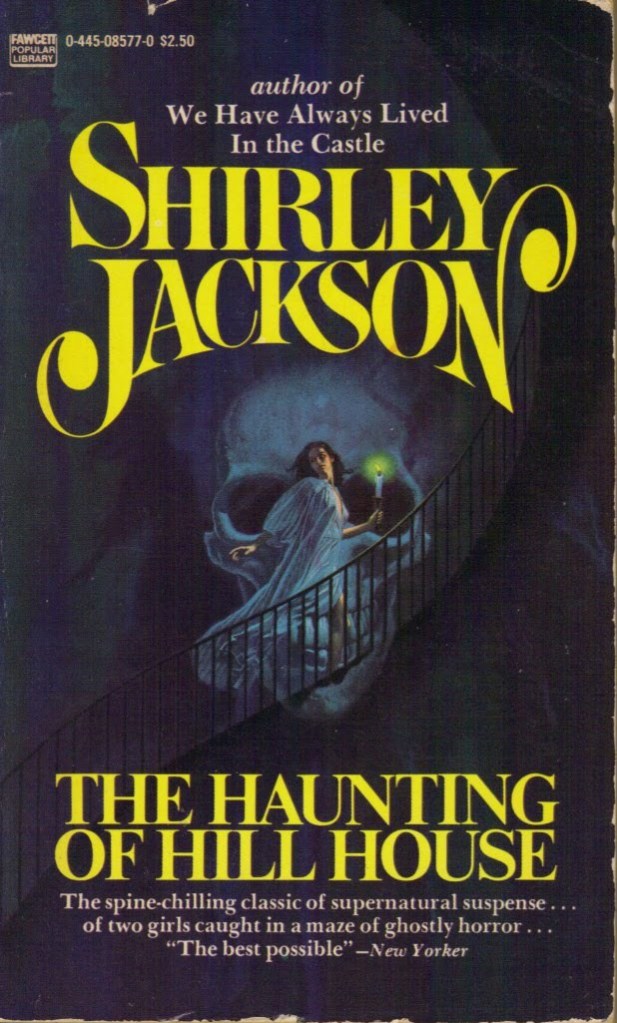
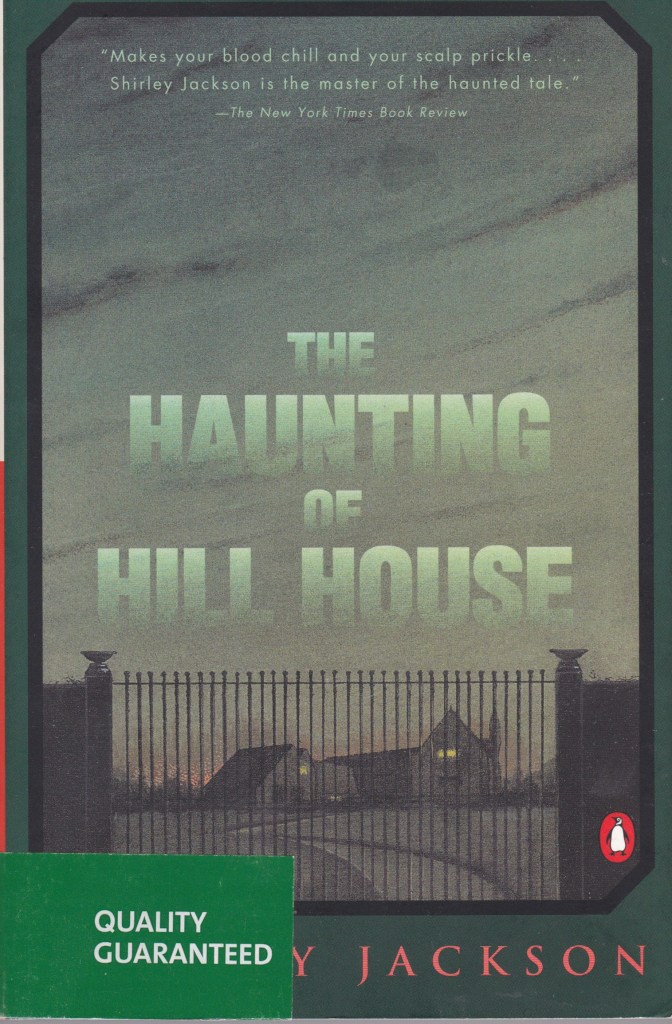
One afternoon when we were at Zayre’s for whatever reason–we went there almost weekly, although I am not sure why–I found a copy of Hell House by Richard Matheson on the paperback racks. It sounded, from reading the back, similar to the movie that had scared me so when I was younger, and I couldn’t help but wonder if the movie was taken from the book? I bought it and read it–loved it, in fact–but while it was similar to the story of The Haunting, it was also different enough for me to be certain they weren’t the same. (Hell House was filmed actually as The Legend of Hell House, which was also a terrifying film–more on that later). It wasn’t until years later, when I was in a used bookstore in Emporia, that I stumbled across this:
It was only a quarter, and looking at the back I recognized the characters–Nell, Theo, Dr. Montague, Luke–and of course, the name of the haunted house–Hill House. I bought it and a couple of others, and I started reading at the first opportunity, and was completely mesmerized. It quickly became one of my favorite novels of all time–I already knew Jackson’s story “The Lottery”, because at some point in school I’d been shown the film (why was this appropriate school viewing? Imagine trying to show it to students today!) and in a Drama class we’d actually read the stage adaptation and even put it on for the school (I think I had one line in our production?). Reading Stephen King’s Danse Macabre also told me more about both Jackson’s writing and the Robert Wise directed film, which was my first exposure to Julie Harris; I also remembered that the opening of Jackson’s novel was used by King as an epigram in ‘salem’s Lot; he also dedicated a book to her “because she never had to raise her voice,” which is a very poetic way to describe the softly macabre writing style and voice she used in her works. I lost my original copy at some point during moves over the years, and I acquired another copy after we returned to New Orleans in 2001 from our brief, preferably forgotten interlude in Washington DC–and have made a point to reread it every year since.
And no matter how many times I reread it, I never tire of its haunting, terrifying beauty.
No live organism can continue for long to exist sanely under conditions of absolute reality; even larks and katydids are supposed, by some, to dream. Hill House, not sane, stood by itself against its hills, holding darkness within; it had stood so for eighty years and might stand for eighty more. Within, walls continued upright, bricks met neatly, floors were firm, and doors were sensibly shut; silence lay steadily against the wood and stone of Hill House, and whatever walked there, walked alone.
Dr. John Montague was a doctor of philosophy; he had taken his degree in anthropology, feeling obscurely that in this field he might come closest to his truest vocation, the analysis of supernatural manifestations. He was scrupulous about the use of his title because, his investigations being so utterly unscientific, he hoped to borrow an air of respectability, even scholarly authority, from his education. It had cost him a good deal, in money and pride, since he was not a begging man, to rent Hill House for three months, but he expected to be compensated for his pains by the sensation following upon the publication of his definitive work on the causes and effects of psychic disturbances in a house commonly known as “haunted.” He had been looking for an honestly haunted house all his life. When he heard of Hill House he had been at first doubtful, then hopeful, then indefatigable; he was not the man to let go of Hill House once he had found it.
Dr. Montague’s intentions with regard to Hill House derived from the methods of the intrepid nineteenth-century ghost hunters; he was going to go and live in Hill House and see what happened there. It was his intention, at first, to followthe example of the anonymous Lady who went to stay at Ballechin House and ran a summer-long house party for skeptics and believers, with croquet and ghost-watching as the outstanding attractions, but skeptics, believers, and good croquet players are harder to come by today; Dr. Montague was forced to engage assistants. Perhaps the leisurely ways of Victorian life lent themselves more agreeably to the devices of psychic investigation, or perhaps the painstaking documentation of phenomena had largely gone out as a means of determining actuality; at any rate, Dr. Montague had not only to engage assistants but to search for them.
That opening paragraph alone is a masterpiece.
I parodied it for the beginning of one of my Scotty books–it gave me great pleasure to write the words New Orleans, not sane, stood by itself within its levees–and of course, this book was a pretty heavy influence on Bury Me in Shadows. The book reads almost like a fever dream, with its rhythms and poetries of language, and the story itself is as mysterious as one could possibly hope. The genius of Jackson is knowing that the biggest fear of all is the unknown; so we never know what is actually going on at Hill House–is the house actually bad, or just unlucky? The house’s history is bad and tragic from the very beginning, as we are told in Jackson’s spellbinding voice; who precisely was Hugh Crain, who built the house for his wife and family but never knew any kind of peace within its walls? What went wrong? Jackson never lets us know anything other than that the house is bad. Her primary point of view character is perhaps the must untrustworthy and unreliable of narrators, Eleanor Vance, Nell. Dr. Montague invited Nell because of a strange occurrence that happened when she was a small child; stones rained down on their house out of clear blue sky; her mother darkly blamed it on the neighbors (this also happened to Carrie White’s house when she was a little girl in Stephen King’s Carrie–in the newspaper write-up included in the book Mrs. White also blamed it on “the neighbors”), but other than that, Nell is pretty ordinary and small. She’s wasted most of her adult life taking care of her invalid mother; she’s now in her early thirties and living with her sister’s family, sleeping on the couch. She’s meek but capable of anger–she has a lot of anger and rage buried deep inside of herself–anger at the world, at the injustice of her wasted life, at the lack of a viable future; she has no prospects, no job, no friends, no nothing. The invitation to Hill House awakens a joy in her that she’s never known–she’s wanted somewhere. Her sister and brother-in-law refuse to let her take their mutual car; she gets up early and rebelliously takes the car anyway and heads to Hill House. As she drives she daydreams and observes everything along the road, making up a lovely fantasy for herself about living in a house with stone lions at the foot of the driveway; she stops for lunch and observes a little girl who refuses to drink her milk because she doesn’t have her special cup with stars on the bottom she can she as she drinks. Mentally, Nell urges the little girl not to give in, to not surrender to the injustice of not having her proper cup–as it will be the first of many surrenders of herself she’ll end up making throughout her life until she, like Nell, becomes invisible.
And then, hopeful and happy and excited, she arrives and gets her first look at Hill House:
The house was vile. She shivered and thought, the words coming freely into her mind, Hill House is vile, it is diseased; get away from here at once.
Which then gives Jackson the opportunity, as the next chapter opens, to describe Hill House:
No human eye can isolate the unhappy coincidence of line and place which suggests evil in the face of a house, and yet somehow a maniac juxtaposition, a badly turned angle, some chance meeting of roof and sky, turned Hill House into a place of despair, more frightening because the face of Hill House seemed awake, with a watchfulness from the blank windows and a touch of glee in the eyebrow of a cornice. Almost any house, caught unexpectedly or at an odd angle, can turn a deeply humorous look on a watching person; even a mischievous little chimney, or a dormer like a dimple, can catch up a beholder with a sense of fellowship; but a house arrogant and hating, never off guard, can only be evil. This house, which seemed somehow to have formed itself, flying together into its own powerful pattern under the hands of its builders, fitting itself into its own construction of lines and angles, reared its great head back against the sky without concession to humanity. It was a house without kindness, never meant to be lived in, not a fit place for people or for love or for hope. Exorcism cannot alter the countenance of a house; Hill House would stay as it was until was destroyed.
Nell’s sanity, never the strongest, is affected deeply by the house–she both hates and loves it, separate parts of her nature begging her to flee while the other telling her she’s come home, to stay. The other three in the party–Dr. Montague, Theo the lesbian with some psychic ability, and Luke, due to inherit the house one day–become aware very quickly that the house is having an odd effect on her; they also hate and fear the house, but that welcoming feeling Nell experiences, that desire to never leave, is for her and her only. The rest of the book is quietly terrifying–the noises in the night, the realization that whatever is going on in the house has a sly intelligence of a sort–and the scene where Nell is terrified in the night and holds Theo’s hand…until Theo turns on the lights and Nell realizes she was across the room so whose hand was I holding? is one of the most horrifying moments in horror fiction. And then, the chilling, tragic end.
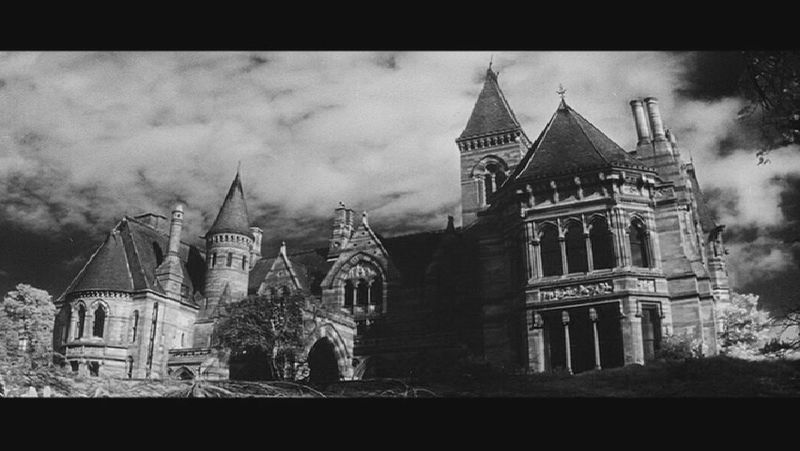
I also always see the house the way it was shown in the movie.
I also rewatched the movie while I was rereading the novel–not the execrable remake but the original–and it holds up just as terrifying and unsettling as it was the first time. Julie Harris is fantastic as Nell, fragile and frayed and slowly unraveling; in the movie isn’t not quite as left to the viewer as it is to the reader the notion that Nell herself is the one haunting Hill House; the house gains its power through her. (This was done beautifully in the Netflix adaptation, The Haunting of Hill House, which is loosely based on the book but updated and adapted and changed significantly; I thought the series was fucking fantastic and an excellent homage to both the book and the original film. You can’t improve on what came before, so why not reinterpret it? I know Jackson purists were outraged, but having seen the dreadful 1999 remake…yeah, this wasn’t that, for sure.)
Also, because of the movie, whenever I read the book I see it in my mind in black and white. The film wouldn’t work in color, either.
If you’ve not read the book, you really should. It’s a masterpiece on every level.
I never really thought much about writing vampire fiction.
I’ve been a Stephen King fan since I read a battered paperback copy of Carrie when I was fourteen, and ‘salem’s Lot continues to be a top 5 King novel for me, if not my favorite (it’s always a toss-up between this and The Stand, frankly) and despite my attempts to turn myself into a King clone in the 1980’s, I’ve never been very good at writing horror. I love to read it–there are some truly terrific horror writers publishing now (if you’ve not read Paul Tremblay, you really need to start), and they are, if you’ll pardon the incredibly cheap pun, killing it. I can do creepy. I can do Gothic. I can do atmosphere and all those marvelous things I love in horror fiction. But I cannot, for the life of me, scare people. I don’t know why I can’t write anything that gets under your skin and into your nervous system; the kind of thing that makes you leave a light burning after you go to bed. I wish I could write like that. I’ve certainly tried a few times…I still have an idea for a horror novel sitting in the back of my brain that I am really going to have to try to get around to writing at some point, because I really should give it a real try sometime.
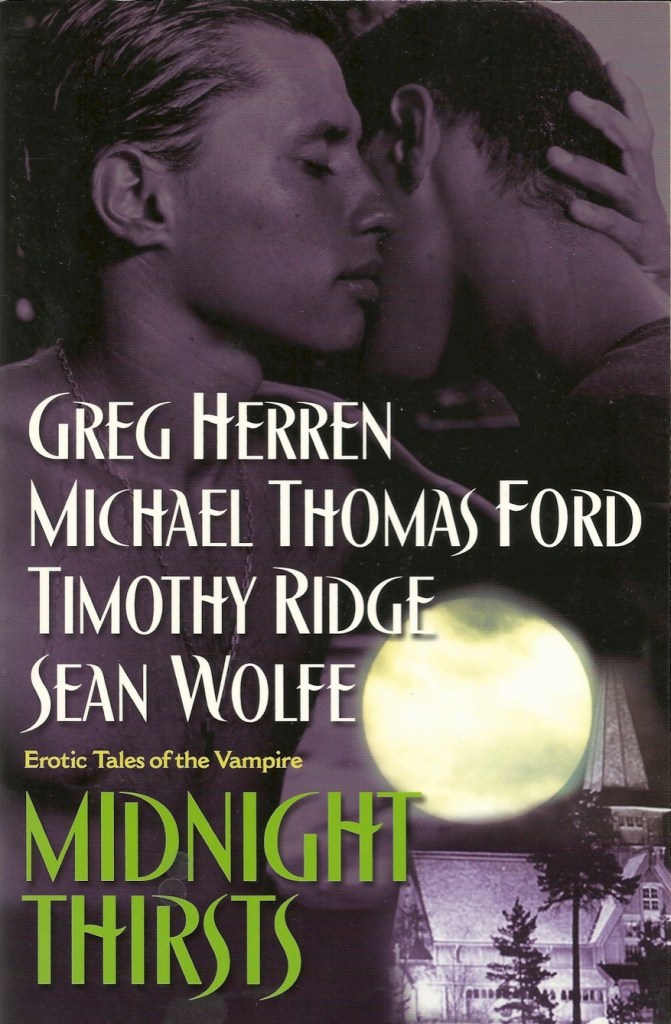
I have always enjoyed reading vampire stories. “salem’s Lot has always been one of my top five Stephen King novels; I loved Dracula (oh to write an epistolary novel!) and numerous other such tales. It took me awhile to come around on Anne Rice’s The Vampire Chronicles (a tale for another time), but I did eventually. Twilight never struck any chords with me. But the one thing I never thought I would do was write about vampires, despite loving them the way I do–going all the way back to my childhood and Dark Shadows. I don’t think I ever would have written about vampires, but my editor at Kensington thought I could; thought I would do a good job at it, and encouraged it, beginning with an offer to write an erotic vampire novella for a collection to be called Midnight Thirsts.
Go home, old man, Rachel thought, tapping her black fingernails on the counter.
It was aquarter till nine, fifteen minutes before she could lock the doors. Everything was clean and the cash register was already counted down. All she had really left to do was dump the remains of the day’s coffee down the sink, lock the cash drawer in the safe, and turn everything o. She’d be gone by ten minutes after at the latest.
She glanced out the big windows fronting the coffee shop. The streetlight just outside cast a yellowish glow in the thick mist pressing against the glass. She shivered and looked back at the old man. He was sitting at one of the tables in the far corner, with the same cup of coffee he’d ordered when he came in around seven thirty. He hadn’t touched it. It was still as full as when she’d filled the cup, only no steam was coming off the black surface now. He didn’t seem to be watching for anyone, or waiting. He never glanced at this watch, which she’d spotted as a platinum Tag Heuer, nor did he ever look out the window. Every once in a while. he would look up from his newspaper and catch her staring. He’d smile and nod, then go back to his reading.
Apparently, he was determined to read every word.
She stood up, bending backward so her back cracked. The night had been really slow. The Jazz Café, even on weeknights, usually was good for at least thirty to forty dollars in tips. Tonight, when she counted out the tip jar, it yielded less than seven dollars. Just enough to get her a pack a cigarettes and a twenty-ounce Diet Coke at Quartermaster Deli on her way back to her apartment. It wasn’t, she thought, wiping down the counter yet again, even worth coming in for.
Usually, on this kind of night, cold and damp and wet, Rachel was kept busy with orders for triple lattés. The tables would be full of people who would coming in shivering, bundled against the cold wetness in the air, which seemed to penetrate even the thickest coat. They’d hold their steaming cups of coffee with both reddened hands, talking and laughing. SOme would be doing their homework on laptops.
She liked busy nights, when the orders kept coming and the tip jar filled. Then, the time seemed to fly by, her closing shift passing in the blink of an eye. She hated the slow nights, when every passing minute seemed to take an eternity. She glanced back at the clock on the wall, then back at the old man. If you would just leave, she thought, I could go ahead and close early.
He’s kind of good-looking, she thought as she sipped her tepid cup of green tea, for an older guy.
At that moment he look up, and their eyes met. His were blue, a deep blue with some green in it. Once again, he nodded his head to her and smiled, but this time he didn’t go back to his newspaper. He held her eyes.
Not to worry, my child, I’ll be gone soon enough.
She turned away, shaking her head, the hair on the back of her neck standing up…
As is frequently the case with my work, The Nightwatchers began as a short story. Within a year of moving here, Paul had struck up a friendship with the director of the Tennessee Williams/New Orleans Literary Festival (which is where he now works), and as such he volunteered us both to help out with the 1997 Festival. I worked at the sign-in desk, where people picked up their badges and so forth, and it was in the lobby of Le Petite Theatre de Vieux Carre, a marvelous old theater on the corner of Chartres and St. Peter, right across the street from the Cabildo, and kitty-corner to Jackson Square. It was very old, and the main stage was named for Helen Hayes, who’d actually played there before. It was haunted, too–every building in New Orleans is–and I heard some of the stories. Being a volunteer, I had access to back stage, upstairs to the balcony, the prop attic; everywhere. (I eventually used some of this knowledge in Jackson Square Jazz.) At some point during the weekend I had an idea for a story–a horror story–about a theater company rehearsing in an old haunted theater in the French Quarter, where the person always cast in the lead female roles is also sleeping with the director. The young actress who deserved the part doesn’t listen to company gossip, but she does eventually find out that the rumors are true, and at some point made a deal with a devil who appeared to her in her dressing room, on and on and on. I called the story The Nightwatchers, because to me, that was what the devils/demons were called–they watch at night for souls to prey on. When I was asked to write this novella, I dug out the story and reread it, deciding it was perfect to adapt into something new.
I played with it a while, and couldn’t quite get it right in my head until I decided to abandon the theater idea; I’d tried turning the girl into a gay guy but it didn’t really work. I also couldn’t seem to get the atmosphere right, either, and I was convinced–still am, in fact–that the atmosphere had to be just right or the story wouldn’t work. Then one night I was walking through the lower Quarter in December–meeting Paul somewhere, I think–and it was one of those evenings when the fog is so insanely thick that you literally can’t see more than a foot or so in front of you at any time. As I walked along the sidewalk, with the old buildings pushing up against the sidewalk, when I heard the sound of hooves on the street–and realized, bemusedly, that in the fog and the only light from a gaslight–that I could have traveled back in time. Only in New Orleans can you feel like you’ve traveled back in time when it’s foggy, I thought, and wrote an entire scene around that feeling when I got back home. It was the perfect mood/atmosphere for the story, and it worked very well.
And as I wrote the novella, I got more and more into the characters and started imagining my own supernatural world, with vampires and witches and werewolves and everything else, including a ruling council over the paranormal world, the Council of Thirteen, and the old man Rachel sees in the coffee shop is a representative of the Council, in New Orleans to hunt a rogue vampire…a vampire who believes her young friend Philip Rutledge (now the center of the story) is the reincarnation of someone he loved hundreds of years earlier when he was human (shades of Dark Shadows!) and so wants to turn Philip into his eternal companion, and it’s up to Nigel and Rachel to rescue Philip.
It was a lot of fun to write, and I left the ending a bit open so I could write more about the characters if I ever chose to do so; I actually slotted a continuation novel into my writing schedule; it was supposed to be what I wrote next after finishing Mardi Gras Mambo…needless to say, life conspired to keep me from ever getting around to this book. I am still a bit disappointed I never carried on with the story; I used this same mythology when I returned to writing about vampires again several years later with Blood on the Moon.
So, that’s how The Nightwatchers came to be a story. Writing this now I see the parallels between what I wrote and some things I read and enjoyed (or watched, a la Dark Shadows); and is my “Nightwatcher” group that different from Anne Rice’s Talamasca? Probably not.
I did read and enjoy the other novellas back in the day; I’ve been meaning to revisit Michael Thomas Ford’s because it was particularly memorable.
I often refer to ‘salem’s Lot as “Peyton Place, but horror.” Because while Stephen King’s second novel (and still one of my favorites) absolutely does its job as a wrenching piece of horror fiction, it’s also a truly insightful and meaningful look at a small town (population 1300) and how everyone knows everyone, as well as the way their lives intersect and connect and cross intricately; we get to know a lot of the townspeople before they succumb to the horror that is overwhelming their little town. If you took the vampires out of the story, you’d have to replace them with something, as there’s no story without them, but at the same time, this novel along with Needful Things some twenty or so years later, are remain two of the best books about life in small towns that I’ve ever read.
I used to reread old Stephen King novels a lot for comfort, losing myself in the worlds he creates and enjoying the stories, the writing, and the characters. ‘salem’s Lot is definitely one of my favorites of his; definitely always in the Top 5, with perhaps only The Stand outranking it.
Almost everyone thought the man and the boy were father and son.
They crossed the country on a rambling southwest line in an old Citroen sedan, keeping mostly to secondary roads, traveling in fits and starts. They stopped in three places along the way before reaching their final destination: first in Rhode Island, where the tall man with the black hair worked in a textile mill; then in Youngstown, Ohio, where he worked for three months on a tractor assembly line; and finally in a small California town near the Mexican boarder, where he pumped gas and worked at repairing small foreign cars with an amount of success that was, to him, surprising and gratifying.
Wherever they stopped, he got a Maine newspaper called the Portland Press-Herald and watched it for items concerning a small southern Maine town named Jerusalem’s Lot and the surrounding area. There were such items from time to time.
He wrote an outline of a novel in motel rooms before they Central Falls, Rhode Island, and mailed it to his agent. He had been a mildly successful novelist a million years before, in a time when the darkness had not come over his life. The agent took the outline to his last publisher, who expressed polite interest but no inclination to part with any advance money. “Please” and “thank you,” he told the boy as he tore the agent’s letter up, were still free. He said it without too much bitterness and set about the book anyway.
The boy did not speak much. His face retained a perpetual pinched look, and his eyes were dark–as if they always scanned some bleak inner horizon. In the diners and gas stations where they stopped along the way, he was polite and nothing more. He didn’t seem to want the tall man out of his sight, and the boy seemed nervous when the man left him to use the bathroom. He refused to talk about the town of Jerusalem’s Lot, although the tall man tried to raise the topic from time to time, and he would not look at the Portland newspapers the man sometimes deliberately left around.
When the book was written, they were living in a beach cottage off the highway, and they both swam in the Pacific a freat deal. It was warmer than the Atlantic, and friendlier. It held no memories. The boy began to get very brown.
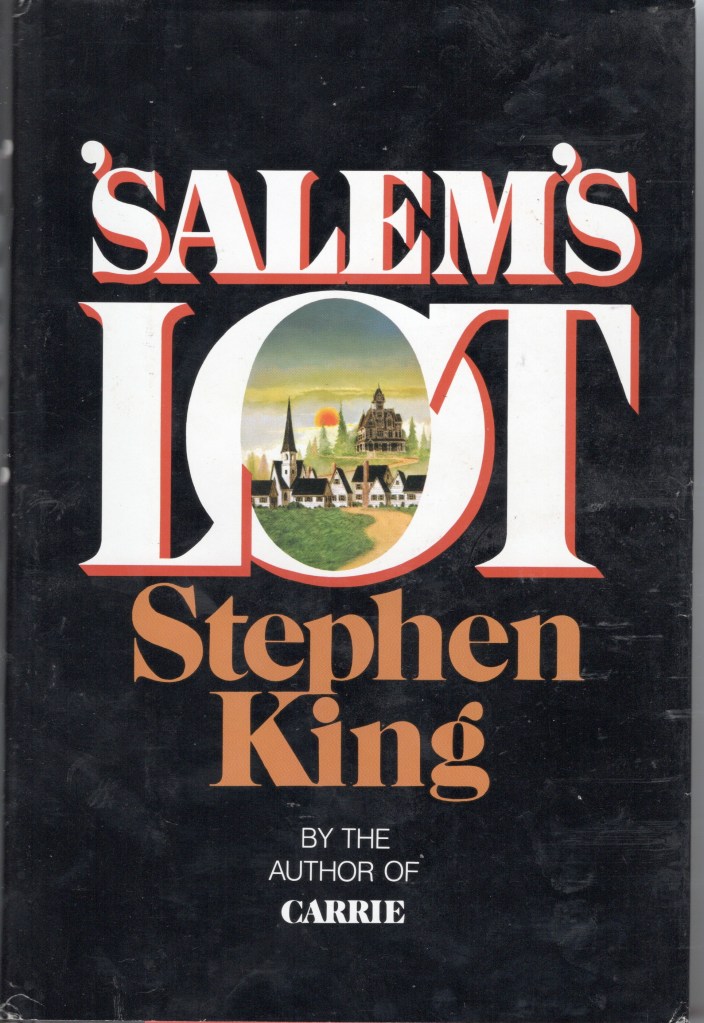
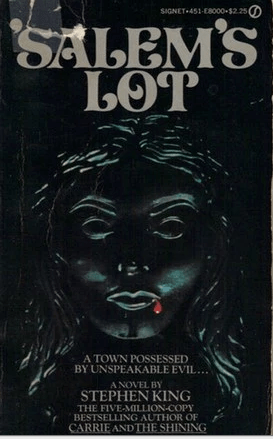
This is the cover of the version I originally read in high school–I bought it off the paperback rack at the Safeway in Emporia, Kansas. I kept that copy for years; eventually replacing it with a hardcover reprint in the 1990′, before finally getting an old copy with the original cover on eBay (which has since turned out to be a first edition; I love finding all the mistakes in it as I reread it).
I had read Carrie in paperback in one night when I’d borrowed it from a friend; it was only in the last decade that I finally acquired a copy of it to keep and reread periodically (I bought it to read the opening shower scene at Banned Books Night; ironically, the objections to the book have nothing to do with explicit talk about menstruation, or bullying, or violence…people object to the book because of its depiction of Christianity, particularly in the case of Carrie’s fanatic mother, Margaret (whom I always see in my head as Piper Laurie, who should have won an Oscar). I don’t think Carrie was the book that made me begin to question Christianity, to be honest; I think I already was questioning it before I read the book, but it was one of the first times I’d see a disparaging representation of someone committing horrifying abuses in the name of Jesus, or how the way the religion viewed sexuality could be taken to such horrific extremes. But I loved the book and became interested in Stephen King as an author. I was aware of ‘salem’s Lot before I found a copy while grocery shopping with my mom; I’d known he’d published a second book because I saw it in the book club ads (Doubleday, Book of the Month, etc.) in magazines. I had no idea what the book was about when I started reading it–I had no clue it was about vampires, and vampires never even crossed my mind when I started reading. It was a Saturday (Mom always drove into Emporia on Saturday to buy groceries), and I repaired to my room with the book (my homework was already done, and whatever college football game was on that Saturday was of no interest to me) and started reading. I finished reading it at around two in the morning, and was completely blown away by it. There was no way I was going to stop reading, and there was no way to stop reading once the big reveal about the vampires happened and the pace picked up.
The book was utterly terrifying, and it started raining later on that day as I read. I was living in a small town (population 973) and my bedroom window looked out at a corn field that was right across the street. I started seeing, as I read, a lot of similarities between Jerusalem’s Lot in the book and my little town–the characters, the interconnectedness of the community, and like Ben Mears, I was still kind of a stranger in the town. I just remember that when I got to the part where Danny Glick comes to Mark Petrie’s window, the storm outside brushed a tree branch against my window and I literally jumped, the book flying out of my hands and landing across the room in the middle of the floor.
It was also the first time I remember reading a book whose main character was a writer–something Stephen King returns to quite regularly, write what you know indeed–which also helped me connect with the book more; Ben Mears was a publisher novelist of minor success, but had published three books already and hadn’t graduated from college. He also seemed like a real person, living and breathing and absolutely real; it wasn’t until this reread that I realized how much physically he’s like King–tall and slender with thick black hair.
But it was also the first time I’d read anything about vampires that was so clearly set in the real world, in the real present, and with real characters I could relate to–which made it even more terrifying. I started thinking about how easy it would be for, say, a vampire to come to our small little town and how quickly people could be turned, primarily because no one would believe it was actually happening until it was too late–which King handled beautifully in the book.