Dancing in the Sheets

The sun is shining, and the temperature has climbed to 49 degrees. The boil-water advisory ended finally last evening–it’s just not a crisis in New Orleans unless we have a boil-water advisory!–and here I sit this morning, ensconced at my desk with a cup of coffee, a load of laundry tumbling in the dryer, with great expectations of the day. I went to the gym last evening after work, and my muscles, while a bit tired, still feel stretched and worked and supple, if that makes sense. Probably the best thing about rededicating myself to physical exercise again is how much better I feel; I don’t ache or feel tired the way I did just last week, and the stretching and the treadmill are also making me feel ever so much better. Today, I am going to clean (if it’s Saturday I must be cleaning) but I am also going to write, edit and read today. Paul is going into the office to work (it’s that time of year again) and so I have the day to myself. I want to finish the first draft of “The Trouble with Autofill” and I want to edit “Cold Beer No Flies.”

Among many other things; my to-do list is ridiculous, quite frankly. But the only way to make progress is not to get overwhelmed by the enormity of the list but rather to keep plugging away at it.

I finished reading Miami by Joan Didion earlier this week, and it was quite good. Didion’s writing style is quite amazing, actually, and while the story of the book might seem, at first glance, to be rather dated; the truth is it is still very much appropriate to our modern times. Miami is a look at the Cuban exiles in the city, how they relate to each other, and how they impact south Florida politically; and to a lesser extent, the relationship between the US government with them as well as with Castro’s Cuba. During the Cold War Cuba was a much more terrifying apparition, close as it was to Florida, and it’s amazing how people do not realize the political clout, as a result of their sheer numbers, that the Cuban immigrants weld in that part of the state, and in the entire state as well. The importance of Florida as a swing state cannot be discounted; and therefore the Cuban-American community’s influence on national politics is something that has to always be considered. (A present day comparison would be the Puerto Ricans moving to Florida today in great numbers as a result of the hurricane destruction of their island; the difference being those Puerto Ricans are already American citizens who can register to vote and can impact 2018 already.) Didion’s look at Miami in the 1980’s, as a Caribbean city on the mainland, is also reminiscent of descriptions of New Orleans as the northernmost Caribbean city; the thing I love the most about Didion’s work is how she makes you think. Reading Miami made me want to write about Miami; I’ve been wanting to write about Florida for a long time, as Constant Reader already knows. Something to ponder.

miami

I also started reading Mark Harris’ Pictures at a Revolution, which is a look at the film industry through the lens of the five films nominated for the Academy Award for Best Picture in 1967, and how they were made. Harris’ thesis is that was the year that bridged the gap between old and new Hollywood; and the five Best Picture nominees illustrated that perfectly: an expensive musical flop (Doctor Dolittle); two old style Hollywood pictures about race (Guess Who’s Coming to Dinner and In the Heat of the Night), and two films that illustrated new Hollywood and its influence by European filmmakers like Truffaut and Fellini and Antonioni (Bonnie and Clyde and The Graduate). I, of course, have always been fascinated by Hollywood history and have been ever since I read Garson Kanin’s Tracy and Hepburn and Bob Thomas’ Selznick as a kid; this book is right up my alley, and since it’s been awhile since I’ve read any Hollywood history, I am looking forward to reading this (and his Five Came Back–I’ve already watched the documentary based on it).

The Short Story Project also moves apace; I am frequently surprised as I look through my shelves for something to read how many single author collections and anthologies dot them. My Ipad also has quite a few loaded onto the Kindle app; I often buy them when they are either free or reduced in price, and so my Kindle app is filled with books I’ve not yet read, primarily because I don’t like to read on it (which I realize is nothing more than stubbornness; if I can watch movies or television programs on it, why resist reading books there?) Yesterday I found my battered old Dell paperback of Agatha Christie’s The Golden Ball and Other Stories, which I remember loving as a child. I was looking for my copy of Lawrence Block’s first anthology inspired by paintings–those of Edward Hopper– In Sunlight or in Shadow, which I would have sworn I’d purchased in hardcover; yet it wasn’t anywhere on the shelves or in any of the TBR piles, before remembering I’d bought it as an ebook when the Macavity nominations come out; Block’s story “Autumn at the Automat” was a finalist, along with mine (I still can’t believe it) and I wanted to read all the other nominated stories for an entry, so the immediacy of the need required buying the ebook. It is a handsome volume, though, so I’ll need to buy a hard copy to pair with the new one. (New bucket list item: write a story for one of these anthologies by Lawrence Block)

Once I’d located it on the iPad, I scoured the table of contents and landed on a Joyce Carol Oates story, “The Woman in the Window.” I have to confess I’ve not read much of Ms. Oates; I am not even remotely familiar with what she writes. But she, too, was a Macavity finalist last year, for her story “The Crawl Space” (which also won the Stoker Award), and that story creeped me the fuck out. I know she’s been a Stoker finalist before, but I also think she tends to write across genre a lot and therefore isn’t pigeon-holed in one way or the other.

Beneath the cushion of the plush blue chair she has hidden it.

Almost shyly her fingers grope for it, then recoil as if it were burning-hot.

No! None of this will happen, don’t be ridiculous!

It is eleven A.M. He has promised to meet her in this room in which it is always eleven A.M.

This story, frankly, isn’t as strong as “The Crawl Space,” but it’s an interesting exercise in how thin the line between lust and loathing is; the woman of the title is a secretary having an affair with a much wealthier man, and as she gets older and older she is feeling more and more trapped in the relationship; he is married and he often has to break plans with her for his wife. There is also a shift occasionally to his point of view, and he’s not so fond of her anymore, either. Passion has cooled but habit has set in; and the way those lines can get crossed is chilling–and how destructive such a relationship can be to both parties, emotionally and mentally, is explored in great detail yet sparse language by Ms. Oates. The story’s not as creepy, as I said, as the other; but the end–which she leaves kind of hanging–you do feel that something awful is going to happen; maybe not today, maybe not tomorrow, but eventually.

I’ve not read Joe Hill before, and there are several reasons for that; none of which would make any sense to anyone who is not me; I am nothing if not aware of my own eccentricities, which is why I generally don’t share them with people; I don’t need someone else to point out that something doesn’t make sense. But I do have a copy of his short story collection 20th Century Ghosts, which I spied on the shelves as I looked for my copy of the Block anthology. Aha, I thought, perfect. I can read a Joe Hill story for the Short Story Project. So, I curled up under a blanket in my easy chair, waited for Scooter to get settled in my lap, and started reading “Best New Horror.”

A month before his deadline, Eddie Carroll ripped open a manila envelope, and a magazine called The True North Literary Review slipped out into his hands. Carroll was used to getting magazines in the mail, although most of them had titles like Cemetery Dance and specialized in horror fiction. People sent him their books, too. Piles of them cluttered his Brookline townhouse, a heap on the couch in his office, a stack by the coffee maker. Books of horror stories, all of them.

No one had time to read them all, although once–when he was in his early thirties and just starting out as the editor of America’s Best New Horror–he had made a conscientious effort to try. Carroll had guided sixteen volumes of Best New Horror to press, had been working on the series for over a third of his life now. It added up to thousands of hours of reading and proofing and letter-writing, thousands of hours he could never have back.

He had come to hate the magazines especially. So many of them used the cheapest ink, and he had learned to loathe the way it came off on his fingers, the harsh stink of it.

I did not mention the elephant in the room; said elephant, of course, being that Joe Hill is Stephen King’s son. (The Kings are a very literary family; Mr. King’s wife Tabitha is a poet and a novelist; their other son Owen also writes, as does Owen’s wife, Kelly Braffet; I read a novel by Ms. Braffet sometime in the last couple of years–not aware of the King connection–and greatly enjoyed it.)

But simply based on a reading of “Best New Horror,” I have to say Joe Hill is also a terrific writer. And while it, like some of his father’s work, bears a strong resemblance to something I would have read in an Tales from the Crypt or House of Mystery comic book–that is not a criticism. I loved those comics, and the stories I read in them; they had a deep influence on me not only as a writer but as a reader. “Best New Horror”, as you can tell by the opening, tells the tale of Eddie Carroll, a writing teacher and a long-time editor of the Best New Horror series, a chore he has learned to loathe and, basically, phone in every year for the money. This resonated with me; as an anthology editor myself, one of the reasons I stepped away from editing them–or took a break from doing it–was because it was becoming rote; a chore rather than something I found joy in doing. Eddie is an example of why I stopped–I didn’t want to become like him; embittered by the experience and tired of not finding anything fresh or new (unlike Eddie, I was able to keep the experience fresh because each anthology I did was a new topic; if I had done twenty anthologies with the same theme I would have gone on a killing spree). But in the mail comes a story from a new writer that is simply brilliant; original and fresh and resonant and horrifying in its reality; the story reinvigorates Eddie and makes the editing job no longer a chore; he has to have this story, and will do whatever he has to in order to track the writer down…but as with any horror  tale of obsession, it’s not going to end well. But Hill brilliantly keeps stringing the reader along, and the ending is just absolutely brilliant and clever. I am really looking forward to reading more of these stories.

And now, I must get back to the spice mines. There are clothes to fold, dishes to wash, floors to clean, stories to write and edit; I am probably coming back here for another entry later as I am trying to get caught up on posting the stories I’ve read–but I make no promises. I have another story to write as a call for submissions crossed my computer screen on Thursday; I have an unfinished story that I can repurpose, but I also need to get a first draft done so I can work the story out.

Until later, Constant Reader.

Got a Hold on Me

Friday morning, and a short day at the office. I am very pleased to report that looking out my windows this morning I see no snow and ice, so I think perhaps this cold snap has finally come to its bitter end. We’re now having water pressure problems in the city, a boil water advisory, etc. etc. etc. Heavy heaving sigh. But other than that, things are going well. Like I said, I have a short day today; I am going to go to the gym this afternoon when I get home from the office, and I am going to spend the weekend writing and editing and reading. I started writing another short story yesterday, “The Trouble with Autofill,” which I think is kind of clever, and have lots of other editing and writing to do. Woo-hoo! Exciting weekend, no? I also want to get some reading and cleaning done. But I think as long as I keep going–sticking to my goal of positivity and focus, things will go well.

Maybe today’s blog should be titled When You Believe.

So, my agenda this morning is to get my kitchen cleaned up, get better organized, clean out my email, and do some writing. I’m going to get the mail before heading to the office, and I also need to pack my gym clothes so I can just ran in, grab the bag, and head back out the door. I also have lost three more pounds this week, finally breaking through that pesky 214 pound plateau I was at–I haven’t weighed 211 in years, so huzzah for working out! Now to keep going.

I started watching Black Sails again this week. I tried it several years ago, and just couldn’t get into it, even going so far as to think it kind of boring. I don’t know why; it has everything I love–pirates, beautiful locations, great period costumes, hot sweaty men in buccaneer outfits–but for whatever reason I just didn’t get into it. Maybe I wasn’t paying close enough attention? Something. Anyway, I am enjoying it a lot more this time around, so I am in for all four seasons. I love pirates–always have–despite having given up on the Pirates of the Caribbean franchise after the second movie–and while I am not sure why that is the case, I just have. I’ve always wanted to write a pirate novel; and I still have a Scotty adventure having to do with Jean Lafitte’s treasure still floating around in the back of my  head. I’m making all kinds of notes as I watch this show–reread Treasure Island, do some research on pirates, reread The Deep–so who knows? My creativity is certainly flowering these days; and I do think this go back to your roots thing is really working for me. I am doing that with my workout program–all the way back to how I got started, in 1994/1995; and carrying my little blank book around has certainly kick-started my creativity. How cool is that?

I’ve also added a lot of fun Alfred Hitchcock movies to my watchlist on Amazon Prime, some I haven’t seen and others I already have: Saboteur, The Birds, Shadow of a Doubt, Topaz, Frenzy, Psycho, Family Plot, and Vertigo.

The Short Story Project is also continuing; I read a shitload of short stories on my Snow Day Wednesday, but am still doling them out two at a time here. 😉 First up today: “Lord of Madison County by Jimmy Cajoleas, from Mississippi Noir, edited by Tom Franklin:

“Are yall ready to worship?” says Pastor Jerry. He’s got his eyes shut, one arm raised high to Jesus in some weird half-Nazi salute. Frosted hair slicked back, bald spots barely showing. Graphic T-shirt that says, Lord’s Gym, and has Christ bench-pressing a cross on it. Cargo shorts that he still thinks are cool.

I’m a little ways back in the youth room, chewing on a pen cap. The worship band kicks in; it’s all reverbed guitar and concert lights and the bullshit praise lyrics projected onto a screem behind them. You know, the songs that are the kind of crap you say to your girlfriend but it’s supposed to be about God? You are beautiful. You alone are my rock. You alone are my one and only. Oh, Jesus, baby!

Out in the crowd of youth-groupers are my customers. The girl with her hands up in the air giggling, singing louder than anyone? That’s Theresa. Everyone thinks she’s weird, that maybe she’s one of God’s holy fools, but they all agree that she’s on fire with Jesus.

Nah, she just popped a molly.

This is a great opening; I had wondered if anyone was going to address the Southern relationship with religion, and Christianity, in particular. My own psyche has been deeply scarred by a love-hate relationship with the Southern brand of Christianity; the entire nation was recently stunned by the Alabama evangelical embrace of pedophile Roy Moore–which was something that neither surprised nor shocked me. I need to write about religion; I do wish someone with a book called Religion in America: A History of the Turbulent American Relationship with God. Writing is very therapeutic, and I do have such a story that I’ve been working on for going on thirty years; I seriously doubt anyone would publish it. Anyway, I digress. This story, about a young drug dealer who has a fraught relationship with his mother, his father, and his mother’s boyfriend, is very clever and tightly written, with surprise twists and turns that take it in directions I didn’t see coming. Doug, kicked out of his wealthy private school where he was making money dealing to the rich kids, realized the best new market for his merchandise was the youth group at a local church. His dealing increased the youth group’s membership, and he has his own fraught relationship with Pastor Jerry, whom he rather despises, while dating Jerry’s daughter Kayla. Kayla is the big surprise here, a femme fatale right out of the James M. Cain classics, and a true delight. I’d love to read more about Kayla.

After Mississippi Noir, I took down The Best Horror of the Year Volume Four, edited by Ellen Datlow, and the first story there was Stephen King’s The Little Green God of Agony.”

“I was in an accident,” Newsome said.

Katherine MacDonald, sitting beside the bed and attaching one of the four TENS units to his scrawny thigh just below the basketball shorts he now always wore, did not look up. Her face was carefully blank. She was a piece of human furniture in this big house–in this big bedroom where she now spent most of her working life–and that was the way she liked it. Attracting Mr. Newsome’s attention was usually a bad idea, as any of his employees knew. But her thoughts ran on, just the same. Now you tell them that you actually caused the accident. Because you think taking responsibility makes you look like a hero.

“Actually,” Newsome said, “I caused the accident. Not so tight, Kat, please.”

There’s a reason why Stephen King is one of my favorite writers. One of the reasons is his uncanny ability to get into the heads of his characters, turning them into three dimensional beings that sound like someone you know. Kat, the physical therapist for an incredibly wealthy man–“the sixth wealthiest man in the world’–is tired of her job and tired of her patient. He won’t do the work required to get better and she is tired of watching him waste money and time on quick-fix quack cures that don’t do anything. This time, he’s brought in a small-time preacher from Arkansas who is going to exorcise the demon of pain from Newsome; it’s all she can do to keep a straight face and not say anything. Finally, she can’t resist and the preacher, Rideout, calls her out on a lot of things, seeing deep into her soul and telling her truths she doesn’t want to face herself, let alone share with anyone. And then the exorcism begins…in Danse Macabre, his later 1970’s/early 1980’s study of the genre, King talks about how horror comics of the 1950’s influenced his writing; as I was reading this story I could easily see it illustrated in Tales from the Crypt or House of Secrets. It’s terrific, absolutely terrific, and I was reminded again of why I love nothing more than curling up with Stephen King’s writing. It also vaguely reminded me of his novel Revival; I think this story may have triggered his creativity in that direction.

And now, I have spice to mine. Have a great Friday, Constant Reader!

IMG_3588

Give It Up

It rained overnight, and is still damp and gloomy this morning. There really is nothing like sleeping during a downpour, is there, the constant strumming of the rain, the comfort and warmth of the mattress and under the blankets, is there?

Yesterday was a crazy busy day for one Gregalicious, who got up in the morning and did some work, cleaned, and then walked to Comic Con for a signing and a panel. The signing was fun, and the panel discussion about creativity and creativity triggers was also a lot of fun; as exhausting and draining as it is to do public appearances, I also always somehow forget, in the nervousness and terror of having to speak in front of a room full of people, how much I actually enjoy talking about writing and creativity. So, there’s that. I then came home, watched the ice dance final at US Nationals, and then the Saints play-off game, which was a nail-biter down to the very last play of the game (GEAUX SAINTS!). We stayed up and watched the Golden Globes before going to bed; I also managed to get some brainstorming done in my journal, and I also read a short story, to keep the Short Story Project going.

One of the truly fun things about the panel was that Tom Cook was on it. Tom was an animator/director for Hanna-Barbera in the late 1960’s/1970’s, and of course, one of the shows he worked on was Scooby Doo Where Are You, which tremendously influenced me in the direction of mysteries and crime when I was a kid. So meeting Tom, and thanking him for the influence, was kind of a thrill for the weekend for me. I am starting to feel energized about writing again, which is very cool.

The short story I read was “East Wind,” from Daphne du Maurier’s The Doll and Other Lost Stories.

the doll

Nearly a hundred miles west of the Scillies, far from the main track of ships, lies the small, rocky island of St. Hilda’s. Only a few miles square, it is a barren, rugged place, with great jagged cliffs that run deep into deep water. The harbour is hardly more than a creek, and the entrance like a black hole cut out of the rock. The island rises out of the sea a queer, misshapen crag, splendid inits desolation, with a grey face lifted to the four winds. It might have been thrown up from the depths of the Atlantic in a moment of great unrest, and set there, a small defiant piece of land, to withstand forever that anger of the sea Over a century ago few knew of its existence, and the many sailors who saw its black outline on the horizon imagined it to be little more than a solitary rock, standing like a sentinel in mid-ocean.

“East Wind” is an early du Maurier tale, from early in her career (which people seem to want to divide into ‘pre’ and ‘post’ Rebecca); and in some ways the inexperience shows. The story is, as so many of her later stories are, very matter-of-fact; simply told with a move this  to that to the other; unemotional and simple. However, what is actually missing from this story that shows up in her later stories are layers of detail and complexity; stories like “Don’t Look Now” and “The Birds” have so many layers to burrow through, so much detail, and so much creepy, quiet horror that they continue to haunt the reader once the story is told. “East Wind” is an equally unpleasant tale, but doesn’t have the impact of the later stories in its telling.

As I started reading it, it reminded me of one of my favorite Stephen King stories, “The Reach”, which was the final story I think in Skeleton Crew, and was originally called “Do the Dead Sing?”, which is, in my opinion, a far superior title. That story was from the point of view of an old woman, dying in her bed on a cold, blustery winter night, and remembering something that happened many years ago–while also hearing her beloved dead one’s calling to her to join them. The story was brilliant and beautiful and haunting, and as I said, remains one of my favorite King stories to this day.

The du Maurier tale is similar in that it is about a remote island, where the inhabitants have very little contact with the outside world and because of a limited pool, have become more than a little inbred. The east wind of the title is brutal, blasting away at the little island and making the seas rough, so a brig of foreign sailors is forced to take shelter in the harbor, foreigners who don’s speak the same language. These exotic to the islanders strangers have an odd impact on the islanders, who become intoxicated in the strangeness and newness of this experience, which eventually leads to seduction and murder, changing and scarring the island forever; and of course, once this has happened and the east wind stops blowing, they get back in their ship and sail away because, of course, it was nothing to them. This is, of course, a terrific theme that du Maurier returns to again and again in her work; the dionysian influence of an outside force that causes trouble and then moves on without a care, leaving damage in its wake. The story itself, which is short and unemotional, is important as an early work because the reader, the duMaurier afficionado, can see how she developed themes she used extensively in her later career; her fascination with the concept of the unfeeling outside force on ordinary people’s lives, and the disruption such an influence can cause.

And now, back to the spice mines.

Sunglasses at Night

Sunday morning. Last evening I went to a Christmas party and had an absolutely lovely time; but stayed much longer than was probably warranted and got home much later than I should have. But there were lots of laughter, and I got to hang out with friends that I don’t see nearly enough, and so overall, I would classify it as a win. I also slept beautifully and deeply and restfully after getting home, so that, too, was absolutely lovely.

Today I have to do a lot of writing; I finished a project yesterday, which was also lovely, and managed to get the cleaning of the downstairs finished. Today I will move to the upstairs, doing cleaning and organizing when I take breaks from the writing/editing I have to do. I also will read some more of Donna Andrews’ How the Finch Stole Christmas when I can; hopefully wrapping up reading it this evening as well. I’m not sure what I am going to read next; I am rather torn between a reread of George Baxt’s A Queer Kind of Death, Joan Didion’s Miami, Dashiell Hammett’s The Dain Curse (also a reread), or something else in the pile. I also haven’t done my annual reread of Rebecca, but I think I am going to save that for actual Christmas. There are also some other duMauriers lying around the apartment I haven’t read that I need to (The House on the Strand, The Progress of Julius, The Scapegoat), some Ross MacDonalds, many Margaret Millars, and so many other books by writers I adore and am way behind on–I still have Stephen Kings that are languishing on my shelves, unread–and of course, come January it’s going to be Short Story Month again.

I also have another short story to write that I keep forgetting about, which, of course, is insane. (Note to self: put post-it note up on computer.)

But the good news is I am finally feeling motivated again about writing; this past year hasn’t been, for me, a good one as far as writing is concerned. I had a long conversation with my friend Susan last night about the current Scotty and the problems I’m having with it–and of course, while talking about the problems out loud with her I solved the problem. (It really is amazing, isn’t it, how saying things out loud can make a difference and make you see what’s been missing? The same thing happened with the WIP when I was chatting about it with my friend Wendy in Toronto–as I spoke I could see in my head what I needed to add, and then she put her finger right on the problem and pointed it out just as I was coming to the realization, which confirmed that it was the correct one. Again, it’s all a matter of having the time to make these fixes, but now that I know whatI need to fix, well, that makes it all a lot easier.

I also finished post-it-noting Garden District Gothic yesterday while watching the first half of the SEC championship game, so the Scotty Bible also proceeds apace, which is also lovely.

So much I need to get done this month!

And on that note, it’s back to the spice mines.

CalvinKlein11

Far from Over

Monday morning. I am very tired this morning; I worked Condom Outreach yesterday at the Halloween New Orleans Tea Dance at Crescent Park, which was fun, tiring and entertaining on many levels. Lots of pretty boys to look at, lots of alcohol/drug related sloppiness, and the weather was bizarre. It was hot and humid when we walked over there, than a nasty storm rolled in for a while, and after the storm moved on it was very cool the rest of the time. It’s still cool now; I suspect the heat and humidity have finally broken, thank the Lord.

IMG_3184

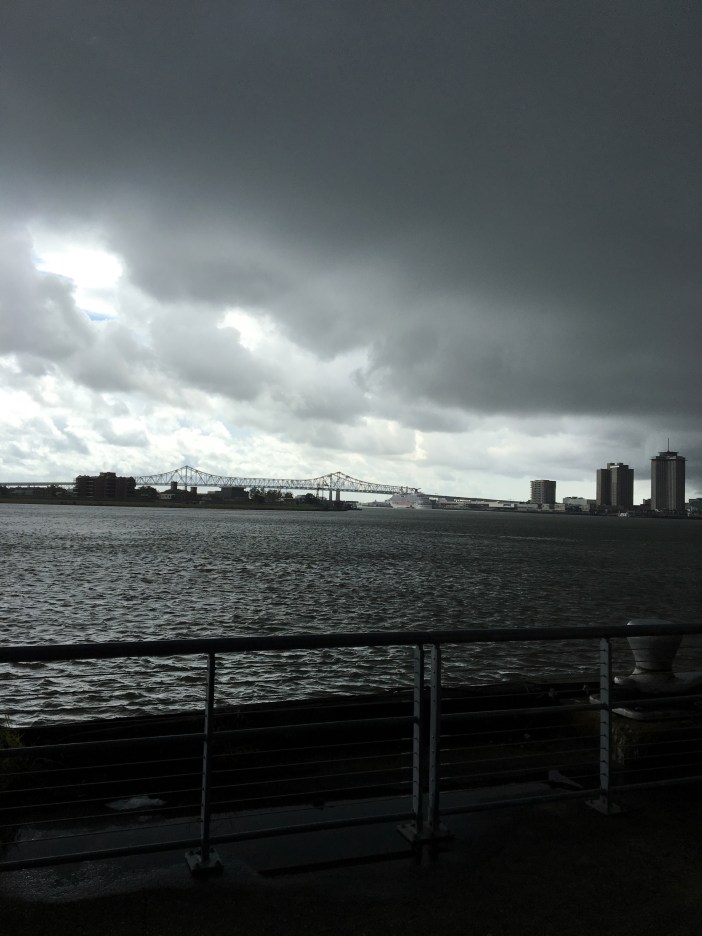
I have to say, Crescent Park is beautiful; the view of the river there is spectacular. I also took some terrific panorama shots:

IMG_3212.JPG

Gorgeous, right?

Last night we watched the premiere of The Walking Dead, and I have to say, finally. Last season Paul and I wearied of the show; primarily because Rick and the gang basically turned into wimps over and over again. It was awesome last night seeing them kicking ass and not bothering to take names. Huzzah!

I also started my reread of The Haunting of Hill House, and am reading it more slowly than I usually do; trying to savor it as well as thinking about its influence on other novels about ‘the bad place.’ I’ve already seen it’s direct influence, in the earliest chapters, on Burnt Offerings; Eleanor’s drive to Hill House is very similar to the drive taken by the family to the house in Burnt Offerings. The writing is so lyrical, and whimsical, almost like a fairy tale in its use of language and imagery; and Eleanor, poor Eleanor…also of note–Eleanor is selected by Dr. Montague for the Hill House expedition because when she was a young girl, stones rained down on her family home from the sky for several days without explanation; there’s mention of the same phenomenon happening to the Whites in Stephen King’s Carrie.

And that opening!

Lord, if I could only write an opening that sublime and beautiful and haunting.


Photograph

Another good night’s sleep. I barely know what to do with myself. Today is my Sunday, since i have to work tomorrow, but that’s fine. I have to run a couple of errands but intend to spend the day cleaning, watching football, maybe doing some editing, and trying to finish reading Anna Dressed in Blood. October is winding down, and I still need to reread The Haunting of Hill House and I want to read Stephen King’s End of Watch by the end of the month. Then I am going to get back to crime reading–I have the ARCS of the new novels by Laura Lippman (Sunburn), Alafair Burke (The Wife), Alison Gaylin (If I Die Tonight) and Ivy Pochoda (Wonder Valley). Such a plethora of riches…and I also have a lot of other wonderful books waiting in the TBR pile.

The house is a disaster area, quite literally, and if I don’t get something done about it today I may just lose my mind. I had lunch with my friend Laura yesterday, and after getting back from yesterday’s errands I had literally no energy left. I don’t know what has happened to my energy levels, but I definitely think I need to start going back to the gym regularly. I haven’t since August, and I think my body is sending me an SOS. I hate when that happens. I am thinking about going to the gym later today before the LSU game and doing a light, get back into the groove work out. I also was thinking of doing just that tomorrow night after work as well.

We’ll see, as I always seem to say.

But yes, I have to stop feeling tired and using that as an excuse for not getting things done. I am way behind on everything, did nothing on the to-do list I finally put together last week, and this shall not stand. I have way too much to do–of course, maybe I am allowing the amount of things I have to do overwhelm me which creates the self-fulfilling prophecy of getting nothing done–but today I am determined. I am not feeling tired the way I usually have when I’ve woken up this week from my good night’s sleep, and so I am going to try to get caffeinated and get moving on everything,

And on that note, I am off to the spice mines.

Here’s a hunk for you.

IMG_2999

Dead Giveaway

Tuesday morning, it’s sixty degrees and I’ve had another glorious night of sleep. I am still a bit groggy, only being on my second cup of coffee, but today it’s back to reality after the bliss of Bouchercon and being wrapped up in the world of writing and publishing for almost a week. Heavy heaving sigh. I think we brought the cold weather back down from Canada with us! But I am digging out from under–I really did go AWOL while we were gone on a lot of things–so this morning I need to get caught up on my email and get the house back in some kind of order. I have Friday off as well, since I am working Sunday (condom outreach at the Gay Halloween tea dance at Crescent Park), so that will also help some as far as getting caught up is concerned.

Methinks I need a to-do list.

I started writing a short story yesterday; it’s an idea that’s been lying around in my head for a really long time and I thought, hell, I should start writing this, partly because an idea for the opening came to me. For the longest time this dark noir story was set in Kansas in my head–I even wrote, I think, a rough draft a long time ago but have always wanted to revise it as a noir, and reading Craig Pittman’s Oh Florida! made me realize that part of the problem with the revision I was having was because it should have been set in the panhandle of Florida. (I really recommend the Pittman; Im enjoying the hell out of it and it’s bringing back a lot of memories for me of all the time I’ve spent in Florida) I had started writing another one last week–“Sorry, Wrong Email”–that I would also like to finish this week….so much to do; I really need to make that damned to-do list.

First thing on the to-do list: make a to-do list.

Second thing on the to-do list: figure out what my next horror read will be. (I’m thinking I need to finally finish off Stephen King’s Mr. Mercedes trilogy with End of Watch, which is more paranormal than mystery; but I may save that for a weekend read.) Maybe it’s time to reread The Haunting of Hill House, which I haven’t gotten around to doing yet. Hmmmm. Decisions, decisions.

And man, looking around my kitchen at the messy wreckage…I need to get this mess cleaned up.

Okay, enough procrastination. It’s back to the spice mines with me, and here’s a hunk for your Tuesday morning:

IMG_2995

Try Again

Stephen King, in his seminal work on horror Danse Macabre, talked about two different kinds of house horror novels–the haunted house, and the bad place. The primary difference between the two is that a haunted house story is about the actual spirits and what they do; what must be done to put the spirit to rest (Barbara Michaels’ brilliant Ammie Come Home fits into this category), and the bad place where you don’t really know what is causing whatever it is that is going on in the place; it’s just a bad, bad place. Examples of the bad place  are of course Shirley Jackson’s The Haunting of Hill House, Stephen King’s The Shining, and Michael MacDowell’s The Elementals.

While I was traveling to and from Toronto, I read two short novels about ‘bad places’; Robert Marasco’s Burnt Offerings and Christopher Rice’s The Vines. 

I remember Burnt Offerings from when I was a kid, and we used to go to the Zayre’s department store every Saturday. I would spend the entire time my mother was shopping looking at every book in the book racks, and I picked it up numerous times only to always set it back and pick something else; I’m not sure why. I remember it was also made into a movie with Bette Davis that I’ve also never seen, and periodically it appears on lists of ‘best haunted house’ novels. Vaillancourt Books recently reissued it, and I bought a copy. It’s good, even if it subscribes to one of those horror tropes that always requires the suspension of belief–if something seems too good to be true, it usually is. A family from the city–Queens, i believe–take a summer rental out on Long Island that, of course, is too good to be true; a dilapidated but once stately manor. Husband, wife, young son, and the husband’s aunt–despite the husband’s misgivings–move out there for the summer; the only requirement of them (other than the rent) is that three times a day the wife must take a tray of food up to the owners’ mother’s suite of rooms and never knock–just leave the tray outside. The wife soon becomes obsessed with the house and cleaning it, putting it into order; finding treasures in closets and cupboards and bringing them out…and ignoring the distance growing between her and her husband, his aunt, and her son. Strange things start to happen, and occasionally she is aware that something’s terribly amiss…and then goes back to cleaning. The story is told very simply, the setting is perfect, and the descriptions of the treasures she finds are lovingly written–and the sense of growing impending doom and claustrophobia are perfect.

The Vines is Christopher Rice’s second horror novel (The Heavens Rise is the first; it’s still in my TBR pile) and it, too, is a variation of the bad place horror convention; Spring House is a gorgeously restored house outside of New Orleans with a horrifying history of its own. The night of owner Caitlin Chaisson’s birthday party, she sees her husband having sex with a beautiful young woman who works for the catering company; emotionally distraught, she leaves the house intent on slashing her wrists and killing herself in the estate’s gazebo. But as she cuts at her wrists, her husband and his one-nighter come outside to the gardening shed, and something monstrous grows up out of the ground to drink her blood and avenge her betrayal. The one-nighter loses her mind and the husband disappears; none of this makes any sense to the police who arrive and are not willing to upset the wealthiest woman in the parish. There are two other primary characters–Nova, the African-American daughter of Caitlin’s groundskeeper and a student at LSU who is there that night, and Caitlin’s former best friend, a gay nurse who has been estranged from her since he told her the truth about her husband’s infidelities–and years earlier, Blake and his teenaged boyfriend were attacked in a hate crime, the boyfriend dying…the true story of the attack has never come out, and it’s a lot more complicated than anyone ever knew. It’s a terrific tale of vengeance from the past and vengeance for the present, with the tension building as it hurries to its climax. I was also impressed with how Christopher handled the bloody, slave-owning history of Spring House–something I’ve wondered about how to handle without being too heavy-handed with a ghost story I’ve been wanting to write with its origins in the Civil War period in rural Alabama.

And now, back to the spice mines.

I Won’t Hold You Back

Being from, not only the South but also from Alabama, I am very particular about Southern fiction, and fiction set in Alabama (there is more of it than you might think; there is certainly much more of it than To Kill a Mockingbird). Robert McCammon has written some exceptional Southern horror fiction set in Alabama; I absolutely loved Boy’s Life, while I have yet to read Gone South (which is in the TBR pile). He actually  set a book in the part of Alabama I am from; it was a good book, but it bore no more actual resemblance to that county than anything other book set in the rural South; it was as though he simply put up a map of Alabama and stuck in a pin in it, said “okay this is where it will be set” and worked from there. But it was a good book that I enjoyed; it had some interesting things to say about religion–particularly the rural Southern version of it. I myself want to write about Alabama more; I feel–I don’t know–connected somehow when I write about Alabama in a greater way than I do when I am writing about New Orleans, and that’s saying something. Mostly I’ve written short stories, the majority of which have never been published; only two have seen print, “Smalltown Boy” and “Son of a Preacher Man.”

I remember Michael McDowell from the 1980’s, when the horror boom was at its highest crest; I never read his work but I was aware of it. I remember reading the back covers of his Blackwater books and not being particularly interested in them; there was just something about them, and their Alabama setting, that somehow didn’t ring right to me; I don’t remember what or why, but I do remember picking them up several times in the bookstore, looking them over, and putting them back.

In recent years, McDowell has enjoyed a renaissance of sorts; he was a gay man who died from AIDS-related complications in 1999. I wasn’t aware that he was part of the writing team who published a gay mystery series under the name Nathan Aldyne until sometime in the last few years, and I’d been meaning to get around to finally read one of his horror novels, the reissue of The Elementals (which included an introduction by my friend, the novelist Michael Rowe–whose novels Enter, Night and Wild Fell are quite extraordinary)–which again is set in Alabama, only this time Mobile and the lower panhandle of Alabama that sits on either side of Mobile Bay (the same area, in fact, where I set my novel Dark Tide, only my novel was set on the other side of the bay). My friend Katrina Niidas Holm recently asked me to read the book so we could discuss it drunkenly over cocktails at Bouchercon in Toronto later this month; this morning I sat down and read it through. (It’s not very long; 218 pages in total.)

the elementals

In the middle of a desolate Wednesday afternoon in the last sweltering days of May, a handful of mourners were gathered in the church dedicated to St. Jude Thaddeus in Mobile, Alabama. The air conditioning in the small sanctuary sometimes covered the noise of traffic at the intersection outside, but it occasionally did not, and the strident honking of an automobile horn ould sound above the organ music like a mutilated stop. The space was dim, damply cool, and stank of refrigerated flowers. Two dozen enormous and very expensive arrangements had been set in converging lines behind the altar. A massive blanket of silver roses lay draped across the light-blue casket, and there were petals scattered over the white satin interior. In the coffin was the body of a woman no more than fifty-five. Her features were squarish and set; the lines that ran from the corners of her mouth to her jaw were deep-plowed. Marian Savage had not been overtaken happily.

In the pew to the left of the coffin sat Dauphin Savage, the corpse’s surviving son. He wore a dark blue suit that fit tightly over last season’s frame, and a black silk band was fastened to his arm rather in imitation of a tourniquet. On his right, in a black dress and a black veil. was his wife Leigh. Leigh lifted her chin to catch sight of her dead mother-in-law’s profile in the blue coffin. Dauphin and Leigh would inherit almost everything.

Big Barbara McCray–Leigh’s mother and the corpse’s best friend–sat in the pew directly behind and wept audibly. Her black silk dress whined against the polished oaken pew as she twisted in her grief. Beside her, rolling his eyes in exasperation at his mother’s carrying-on, was Luker McCray. Luker’s opinion of the dead woman was that he had never seen her to better advantage than in her coffin. Next to Luker was his daughter, India, a girl of thirteen who had not known the dead woman in life. India interested herself in the church’s ornamental hangings, with an eye toward reproducing them in a needlepoint border.

On the other side of the central aisle sat the corpse’s only daughter, a nun. Sister Mary-Scot did not weep, but now and then the others heard the faint clack of her rosary beads against the wooden pew. Several pews behind the nun sat Odessa Red, a thin, grim black woman who had been three decades in the dead woman’s employ. Odessa wore a tiny blue velvet hat with a single feather dyed in India ink.

Before the funeral began, Big Barbara McCray had poked her daughter, and demanded of her why there was no printed order of service. Leigh shrugged. “Dauphin said do it that way. Less trouble for everybody so I didn’t say anything.”

This is an auspicious beginning to a novel that straddles the line between Southern Gothic and horror; but in using the word horror I am thinking of the quiet kind of horror, the kind Shirley Jackson wrote; this isn’t the kind where blood splatters and body parts go flying or you can hear the knife slicing through flesh and bone. This is the kind of horror that creeps up on you slowly, building in intensity and suspense until you are flipping the pages anxiously to find out what happens next.

McDowell introduces all of his characters in those few short sentences; Dauphin and his wife, Leigh; her mother Big Barbara; her brother Luker and her niece, India. Odessa also has a part to play in this story, and the only other character who doesn’t appear in this opening is Big Barbara’s estranged husband, Lawton. Lawton, like Mary-Scot, only plays a very small part in this tale, and so the reader doesn’t need to meet him until later.

(I do want to talk about character names here; the Savage family all have names that have something to do with Mary Queen of Scots; the deceased is Marian, her long dead husband Bothwell; Mary-Scot is as plain a reference as can be, whereas her two brothers were Mary Stuart’s husbands: Dauphin–her first husband was Dauphin Francois, later King Francois I of France–and the deceased elder brother, Darnley; the romantic Queen’s second husband was Lord Darnley. Marian’s –of Mary–deceased husband Bothwell bore the name of the Scottish Queen’s third husband, the Earl of Bothwell. These Savage men died in reverse order of the Queen’s husband’s though; Bothwell first followed by Darnley,  and of course, as the only one living, Dauphin will die last. Also, there’s never any explanation for why Big Barbara is called Big Barbara; usually in Southern families the reason you would call someone “Big” is because there is a “Little;” there is no Little Barbara in this story, and I’m not sure where Luker came from as a name, either. I wondered if it was a colloquial pronunciation; names and words that end in an uh sound turn into ‘er’ in Alabama; Beulah being pronounced Beuler, for example, so I wondered if his name was Luka…)

The McCrays and the Savages are families bound by decades of friendship and now marriage; they have three identical houses on a southern spit of land in the lower, western side of the Alabama panhandle in a place called Beldame; Beldame is very remote, bounded by the Gulf on one side and a lagoon on the other; during high tide the gulf flows through a channel into the lagoon and turns Beldame into an island. There are no phones there nor power lines; electricity is provided by a generator and there is no air conditioning. Oh, how I remember those Alabama summers without air conditioning! One of the three houses is being lost to a drifting sand dune and is abandoned…and as the days pass, the reader begins to realize there’s something not right about that dune…or about that house.

The book reminded me some of Douglas Clegg’s brilliant Neverland; that sense of those sticky hot summers in the South, visiting a place you’re not familiar with and is kind of foreign (the primary POV once the story moves to Beldame is India, who has never been there before); those afternoons where the heat and humidity make even breathing exhausting, the white sugary sand and the glare from it, lying in a shaded hammock just hoping for a breeze–the sudden rains and drops in temperature, where eighty degrees seems cold after days of it being over a hundred…the sense of place is very strong in this book, and Beldame is, like Hill House, what Stephen King called in his brilliant treatise on the genre Danse Macabre, ‘the bad place.”

I really enjoyed this book. A lot. And it has made me think about writing about Alabama again; this entire year I’ve been thinking that, and now feel like it’s a sign that maybe I should.

And now back to the spice mines.

Wanna Be Startin’ Something

Well, I finished the tragic mess that is currently known as Chapter Seven’s first draft yesterday. And it is a mess; this is easily one of the sloppiest first drafts of a novel I’ve ever written. In fact, I feel so bad about how shitty it is I may even go back and rewrite the entire first half once I finish Chapter Ten. This book is so bad, I can’t even believe how badly I can write a Scotty novel. Oh, well, that’s what rewrites and revisions and future drafts are for.

I also finished rereading It yesterday. Wow, you are undoubtedly saying, that’s a lot of reading. But truth be told, much like the Losers Club when they return to Derry twenty-seven years later, the more I read the more I remembered. And yes, I skimmed some sections, and skipped some entirely. It’s a perfectly fine novel, and I would recommend it..but there are problematic sections, and yes, I do feel like I’m committing treason by saying anything negative about Stephen King and his work, because he is my writing idol, and he has been since I was a teenager. What works in this book works extremely well; no one writes about the lives of children, how they relate to other children, and what it’s like to be a loser as a child (or feel like one) the way he does. I identify with every one of those kids, I feel for them, I desperately want them to succeed and have great lives and live happily ever after. Their return as adults doesn’t work quite as well as the parts that are set in the past; the characters are still richly defined, and their relationships still work–but I still didn’t like the resolution of the story, either when they were kids or when they were adults; I didn’t like the way the book ended (but for the life of me, I couldn’t write such a book nor could I think of a way to end such a book), and it reminded me a lot of Floating Dragon by Peter Straub in many ways (or vice versa; I think I read the King first and then the Straub originally and was struck by the similarities; I do love both books and think of them fondly). I’m not sorry I took the time to reread It and reacquaint myself with Derry and the Losers Club; there are some genuinely good scares in the book, and it’s one of the best books about a small city I’ve read–King really does a great job of depicting life in these smallish towns/cities and how the social dynamics work in them, whether it’s Derry, Castle Rock, or Jerusalem’s Lot. (That was one of the best parts of Needful Things for me; how the town dynamics worked and how the characters and their lives and their petty foibles and feuds all were entwined so intricately together.)

One of the other interesting things I found in rereading It was there was an LSU connection in it; in the town Ben has moved to and currently lives in there was a local kid who was a star athlete and went to LSU, only to party too hard and flunk out, and wound up coming back to the small town as an alcoholic. The town is Hemingford Home, where of course Miss Abigail lived in The Stand; also in that same book when Nick Andros is jumped, one of the assailants was wearing his fraternity ring from LSU–he was the sheriff’s brother-in-law, and he partied too hard and flunked out of LSU as well. Methinks Mr. King knows someone who went to LSU and flunked out for partying too hard. Those are the only two references to LSU in King’s work that I know of; would that Rocky Wood was alive so I could email and ask him.

Maybe someday I’ll get to ask Mr. King.

And of course, It is very reminiscent of the novella “The Body.” which is probably my favorite work of King’s, if pressed to name a favorite–the Losers Club, like the smaller group of friends in “The Body”, has the fat kid, the kid whose brother died and parents haven’t gotten over it, the poor kid (only switched from male to female in It), and the kid who gets beaten up a lot because of his smart mouth.

And there’s also the writer character–King often throws a writer in his work (Ben in ‘salem’s Lot, Jack in The Shining), but this was the first book where he really went all-in on  writer character with Bill Denbrough–and of course, his next novel was Misery, which of course took the writer character, and the dangers of fame, to a whole new level.

But yeah, the gang bang scene has a whole different vibe about in 2017. It didn’t phase me thirty-one years ago, but now it’s just kind of…icky.

As I said, I’m not sorry I reread it; most of it still stands up, and I still think it’s a terrific, if flawed, novel.

Today I need to get this kitchen in order, and I want to work some more on both the WIP and the new Scotty, maybe even a short story. Next up for my reading is Michael MacDowell’s The Elementals.

And now, back to the spice mines. Here’s a hunk to get your week off to a nice start.

17523549_1306428822738512_2755094986544804343_n