There are three “disturbances” out in the Atlantic with the potential to develop into tropical systems. None are a threat to the Gulf Coast (at least, not yet), but we are heading into the time where hurricane season is super-busy. This year is also the twenty-year anniversary of Katrina, so I’ll be avoiding all the coverage of that for the most part. Even after twenty years, it’s still hard for me to watch any of that stuff–but maybe this year I should break the power of the PTSD and watch it all. It was such a horrible time, truly…but we did watch that show about Memorial Hospital (Baptist). But twenty years on, maybe it is time to watch some of the coverage that I pointedly ignore every year. I dunno, we’ll see.
Yesterday I felt a little under the weather–stomach again–which had me concerned that I was having a reoccurrence of the colitis, but this morning I feel fine, even well rested for a change. I managed to get a lot done at work yesterday, which was great, and I made groceries on my way home. I was tired when I got home, but I wrote for a very little while before Sparky’s need for attention wore me down and I went to my chair. We watched some more Unspeakable Sins, which is such an amazing rollercoaster ride. More has happened in the seven or eight episodes we’ve watched than happened in an entire season of Melrose Place. Nobody does soapy thrillers quite like the Spanish language production companies. So far, we’ve had a failed blackmail seduction, two kidnappings, one faked death, and several criminal syndicates–and of course, lots of videos of wealthy and prominent people at sex parties. We also have a teenager whose stepfather got him addicted to drugs and abused him.
That is seriously one fucked up family.
We’re finally out of the heat advisories, and the maximum temperature for today is 89…which is low for August but I’ll gladly take it. Rain (gasp) is also in the forecast. The rain is predicted for late this afternoon, around when I’ll be coming home, actually, so no errands tonight for sure. I didn’t want to get up this morning, but…that’s really nothing new on a work day, is it? This is a slow week in the clinic (next week is busy busy busy), which is nice, since we’re having a site visit tomorrow. I think I have everything done that I need to have done for the visit, which was the entire goal for yesterday.
I am feeling good about most everything and am not being critical of myself for not pushing myself harder, you know? I’m also kind of still adjusting to life again, which seems to take longer to do the older I get, and seems more necessary as well more often. This has not been a great decade for me, and I can definitely state that my sixties haven’t been the best so far (I’ve pretty much forgotten the fifties, in all honesty). But the inexorable passing of time continues, as the sand in my hourglass continues to run, and my instincts are telling me to make the most of my time, so…sure, I get the I don’t want to’s still, and of course, the temptation of recharging with Sparky in my lap is always there, but I know I can get the work done when I put my nose to the grindstone.
And on that note, I am heading into the spice mines. Have a great Tuesday, Constant Reader, and I’ll be back tomorrow.
Tuesday morning, and I hope all is well with you, Constant Reader. I slept deeply and well, didn’t want to get under the weight of the blankets, but did and now I am waking up. I just had a piece of King cake (the on I bought Sunday has mysteriously been almost completely eaten since yesterday morning) with my coffee this morning. It’s forty degrees again this morning, only getting into the mid-fifties later. I did pick up my copy of Bemused (and a few other books, Disclaimer plus two non-fiction tomes, one about Appalachia and another about the Satanic panic and the Go Ask Alice literary fraud), came home, and Paul and I started watching season two of The Rig, which is interesting; I remember nothing much about the first season, but the show has shifted from the smaller story of the workers trapped on an oil rig in the North Sea and weird shit happening to a much bigger story that was kind of jolting. I do like the cast (including Emily Hampshire from Schitt’s Creek), and it’s interesting as it shifts from a horror story into The Abyss. Definitely an interesting choice, and one I did not see coming.
This year has turned into something, hasn’t it? Everyone was so glad to see 2024 usher itself out the door that we weren’t prepared for 2025 to be a disaster from day one. A terrorist attack on New Orleans to ring in the new year, and of course California is still burning. The very notion of putting conditions on federal aid, as well as “blaming” California for its own situation, is so not very Christian (looking at you, Mike Johnson–the fact that you consider yourself a modern Moses instead of a modern Jesus is telling) and an absolute joke when we open the federal wallet for hurricane relief without question every hurricane season (AS WE SHOULD)—when what we should be doing is figuring out way to make hurricane relief faster and more effective and efficient and to do better by victims of natural disasters–which are only going to keep increasing and with greater impact as we navigate the treacherous waters of the new regime. They come so fast and furious now that it’s easy to forget even the more recent ones. California is burning while North Carolina continues to recover from it’s unexpected hurricane disaster–does anyone even think about North Carolina now, in the winter? I do find it interesting that their state government is far more interested in overturning a free and fair election in their state while so many of their citizens don’t have shelter or power (or both). But we move on, like we always do, and assume that the recovery is completed once the story is out of the news. Angelenos are suffering a trauma right now, just as the North Carolinians still are, and the effects of those traumas are very long-lasting. Trust me, I know, and it will be years before either region is recovered, if they ever do.
Well, the New Yorker dropped its horrific article on the sexual abuse (re: rapes) perpetrated by Neil Gaiman on a LOT of women, and yes, I needed a Silkwood shower after reading it. It’s awful, and yes, it is terrible, but it doesn’t surprise me as much as it did the Gaiman fanboys and fangirls. I’ve never truly been that kind of a fan boy for anyone, really; there have been a few whose beliefs and values wound up not aligning with mine, but it wasn’t a trauma for me nor did it trigger an emotional meltdown because I don’t get that vested in artists as a general rule, so when they turn out to be awful in some way my reaction is generally well that’s a shame and I don’t read them anymore. Simple. Getting rid of Orson Scott Card from my shelves wasn’t a big deal, nor was never reading any further of Marion Zimmer Bradley’s1. I had read David Eddings’ The Belgariad2in the 1980s when I went through my fantasy reading period, but didn’t know about his crimes (with his wife and co-writer) against their adopted children3 or that they did jail time until the piece on Gaiman dropped yesterday and the Internet lit up with angry former fans and friends denouncing his behavior. As for me, well, I’ll always be fond of The Sandman and sorry the Netflix series is ending after a wonderful first season, but I probably won’t be reading anything else of Gaiman’s, or revisiting The Sandman again. But I do think you can separate the art from the artist, to some degree; but that’s up to individuals and their own ick factors, I think. My mentality is I won’t ever get a chance to read everything I want to read, so why revisit the works of problematic, or read new works by them? I had no problem whatsoever cutting Dan Simmons out of my must-read list, and he was one of my favorite horror writers.
The Internet blew up at Carrie Underwood yesterday for agreeing to perform at the coronation of the anti-Christ Monday. Hey, if she wants to lick his boots, go for it, bitch. I’m not the one who’ll have to answer for it to God someday. Have at it, but remember no gay will ever listen to, download or buy anything you ever record from now on. Everything he touches dies, and why do you think you’ll be exempt from that? I imagine you lost any non-MAGA listener you had, but hey–you’ve got that Aryan Master Race thing working for you, so have fun performing for the glory of the Fascists. How did that work out for Leni Reifenstahl?
I was also a little saddened to read about the death of one of my favorite soap stars, Leslie Charleson, recently. She was the second actress to play Dr. Monica Quartermaine on General Hospital, and she lasted decades longer than the original. I always liked Monica, and absolutely loved the way Charleson played her. Sure, I enjoyed the whole Luke-and-Laura stuff, but I primarily watched General Hospital for the Quartermaines, who were conniving and backstabbing and fucking hilarious. (Jane Elliott’s Tracy remains my favorite soap character ever; scenes between the two were great television.) I always thought they should have their own show, and the way they kept killing off Quartermaines willy-nilly over the years was really aggravating; I wanted more Quartermaines, not fewer, and they never deserved to be on the back burner.
And on that note, I am heading into the spice mines. Have a lovely Tuesday, Constant Reader, and I’ll check back in with you again tomorrow.
I was a fan of her gay romance, The Catch Trap, and had always meant to read her Arthurian novels…I can live without reading The Mists of Avalon, after all. ↩︎
I’d actually considered revisiting that series, because of my fond memories of it, but now? Ick ick ick. ↩︎
It’s pretty horrible to adopt children so you have victims at your mercy. ↩︎
Ah, the wonderful world of daytime soaps. It’s so weird to me that there are only four (The Young and the Restless, The Bold and the Beautiful, Days of Our Lives, and General Hospital) left on the air. At the height of my soap addiction, I watched more than four of them. I mean, you literally could spend the entire day from about eleven till three thirty watching them back then–four and a half hours solid of soaps. Usually there would be some kind of Good Morning America show on, followed by game shows, and then came the dramas. A lot of those game shows came and went, but ones like The Price is Right never seemed to go out of favor with audiences while the others waxed and waned.
Dark Shadows was the one I really loved when I was a kid, and to this day I still remember it fondly.
When we moved to Kansas in the mid 1970s, the town where we lived was only able to pick up one television station, a CBS affiliate out of Kansas City–less than half a year after we moved there we were able to get cable–but that first summer we lived there and I didn’t know anyone? All I did was read and watch television…and with only one channel, there really wasn’t much choice during the day so Mom and I started watching the CBS shows, and I am sure I am going to forget one here: Love of Life, The Young and the Restless, Search for Tomorrow, As the World Turns, Guiding Light and Edge of Night. (The latter was always one of my favorites, because there was a shit ton of crime. It was really a law-and-order soap, originally created to compete with Perry Mason on radio and had all the markings of a soap, with the usual love triangles, adultery and questionable parentage like all the others–but there was also always a very tangled and complicated murder mystery story running, usually connected to organized crime and sometimes not–but the main characters of the show were inevitably district attorneys and lawyers. Everyone on this show was eventually either murdered or went on trial for murder, which I thought was interesting.)
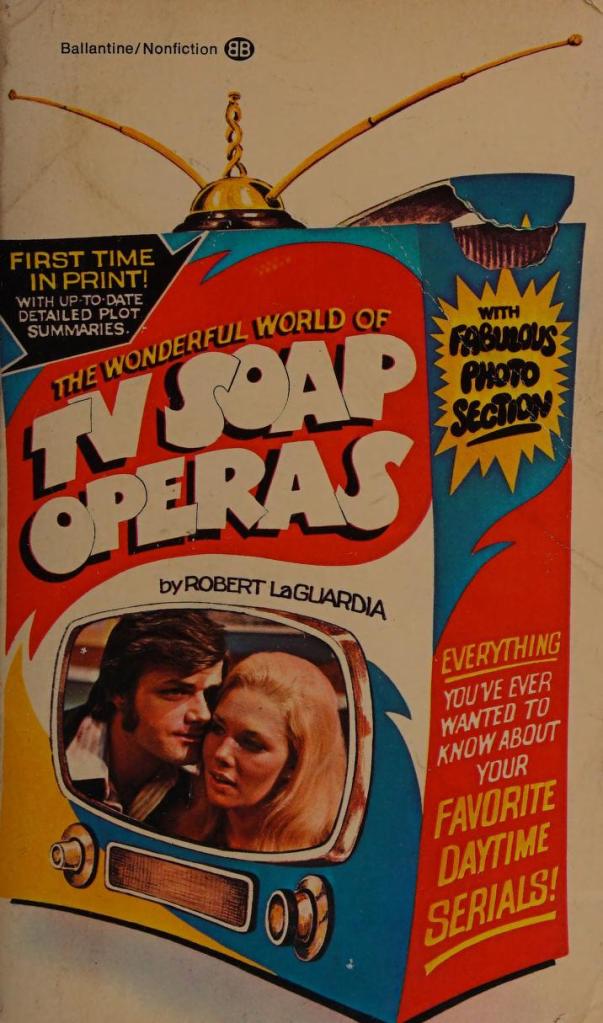
But the next summer, when I was at home all day, Mom still watched Y&R, but she’d moved on to shows I used to watch with my baby sitter in Chicago (General Hospital and One Life to Live) and a newer one I used to watch with my sister, All My Children, before switching back to CBS for Edge of Night. This was, of course, the beginnings of the General Hospital phenomenon of the late 1970s/early 1980s, primarily focused on Laura (and later, Luke and Laura) and while I did enjoy those stories…my favorites quickly became the Quartermaines, and Jane Elliott as Tracy, in particular. I became obsessed with the shows, watching them whenever I could, and then one day I found this book at a second hand store when I was about seventeen:
It was already out of date; at the time it was published the most popular show airing was NBC’s Another World (General Hospital was breaking all ratings records in the present day), so a lot of the book, when talking about modern times, focused on Another World, and its primary ratings driver, the love triangle between Steve, Alice and Rachel (George Reinholt, Jacqueline Courtney, first Robin Strasser and then Victoria Wyndham as Rachel; Reinholt and Courtney made the book’s cover). By the time I got to the book, Another World‘s ratings were already in free fall and ABC was in firm control of daytime’s ratings. It was also more of a puff piece rather than any in-depth reporting and digging. It was all about how talented and hard-working every one involved in daytime was, and conflicts and other off-camera issues were completely ignored. (It was updated several times, and the last edition I had a copy of, Soap World, was much better and not so “aren’t they all AMAZING?”)
But what was interesting to me about the book the most–and Soap Opera Digest–was that they both had summations/summaries of the soap’s plots from the beginning (not everything, obviously, but the main through plots and popular stories); that was how I actually learned how to write a synopsis. Interested in soaps and fascinated by these summaries, I started doing my own–inventing soap operas, coming up with the family relationships and marriages and so forth, and then would start writing the summaries. I also used to always have a bit of fun writing soap spoofs, generally casting my friends as “characters” and coming up with story lines and writing those summaries, even mini-episodes. I did several of these over the years, but the best was the one I wrote around my fraternity friends, The Young and the Pointless–and I have to say, I learned a lot writing that one. The others I’d done earlier didn’t last long and I’d get bored with it and stop; Y&P (as I called it) ended up being three “seasons” of twenty or so “episodes”, and I soon began understanding the struggles of soap writers–how do you top yourself with a story line? The need to constantly bring in new characters and subplots and balancing everything, until it became a bloated mess and I “canceled” it myself after the third season.
The first book I ever wrote, which I’ve mentioned before, was a sprawling soap opera about a small city in Kansas. Again, it was a learning experience and a difficult one at that; writing this book taught me about overwriting and filler; how bad dialogue can be if you don’t speak it aloud as you write it; and again, balancing characters and plots and subplots and story and keeping track of it all was insane. I’ve borrowed things from it over the years–plots, subplots, characters, locations, etc.–but always knew there was no point in trying to trim it down and use it as is. Murder in the Garden District’s case, in fact, was lifted fully from that manuscript; it was the main story. And I’ve used names from that manuscript repeatedly; they pop into my head unbidden and it isn’t until later that I realize where they came from and I change them.
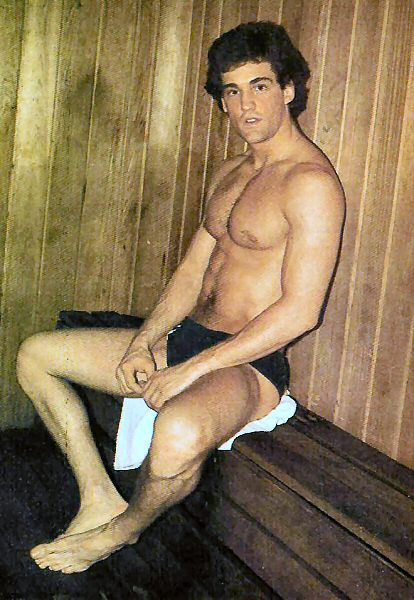
I watched many soaps over the years; I’d often watch other soaps with friends who watched those shows and would get into them for a bit before going back to my solid three: All My Children, One Life to Live, and General Hospital. I wrote a paper in college for a graduate level course on American culture in the 20th century; the paper was called “How Storylines on Daytime Television Drama Series Reflected Changes in the Mainstream Culture.”1 It was over a hundred pages long, and traced how the soaps went from being primarily marriage and divorce drama to mining social issues for story. I got an A on the paper, of course (I always got A’s on anything I had to write), and I’ve always had some of that information left in my head; and of course as the 1980’s began, they began casting beautiful young men with exceptional bodies to play heroes and villains on the shows–John Wesley Shipp is one I’ve never forgotten, and he’s still a handsome older man today, and so I was also able to occasionally see beautiful men shirtless or in speedos. I approved of this trend 100%.
John Wesley Shipp also did these kinds of photo shoots. My God, that body.
I eventually stopped watching them in the mid-1990’s, when I realized I could keep up with them or use that time to write; I chose to write instead. But even though I no longer watched, I kept up with them some on line and so forth. The twenty-first century purge was horrible to watch, as shows that had once been a popular mainstay of daytime television were mercilessly canceled between 2001 and 2012. It’s hard to believe there are only four left airing, and there haven’t been many in prime time for decades–although the continuing nature of the soaps is now the nature of almost every television series–that cliffhanger shit really does get people to tune back in.
But I always remember them fondly. There were so many wonderful stories over the years–including some completely insane ones–and characters, too. Luke and Laura on General Hospital, Greg and Jenny on All My Children, Viki’s dissociative identity disorder on One Life to Live, and all the wonderful murder mysteries and insane courtroom dramas are all remembered fondly by me–and then of course there was Erica Kane.
It just doesn’t seem like daytime anymore, without Susan Lucci chewing everything in sight as Erica Kane every afternoon, does it?
I really wish I had a copy of it, but it disappeared over the years and many cross-country moves. ↩︎
I grew up watching soap operas, and yes, soaps also influenced my development as a writer–which means I have to be careful not to slip into melodrama.
I know my grandmother watched them, and so did the lady down the street who babysat us in Chicago: One Life to Live, General Hospital, and Dark Shadows. I’ve always recognized Dark Shadows as a major influence on me as an artist and author; that and the old black-and-white crime movies my grandmother loved to watch with me. It’s why I’ve always had a taste for the dark and Gothic, and Dark Shadows merged horror with mystery in an expert blend that I can vividly recall to this day–and often go there in my work sometimes.
One Life to Live was always interesting, and they did stuff other shows weren’t doing. Viki’s Dissociative Identity Disorder storylines–including when it came back when she was under heavy emotional stress, usually involving memories of her father–was riveting; so was the Carla storyline, in which a beautiful young light-skinned black woman was passing for white, and involved with a white doctor. (I was terribly disappointed to find out, years later, that actress Ellen Holly, the first Black female star of a soap, received death threats and was also victimized by bigotry within the cast and crew and network.) It was never a favorite through the late 1970s and 1980s, but I watched; Erika Slezak was terrific as Viki and Robin Strasser was INCREDIBLE as her arch-enemy and stepmother, Dorian Lord. Andrea Evans returned in the 1980s as Tina, Viki’s ward…only to find out that Tina was actually her half-sister because her mother, Viki’s best friend, had an affair with Viki’s father…which led to yet another return of Viki’s DID.
Like all soaps, it was complicated.
But it was in the 1990s that One Life to Live became must-watch television.
Novelist Michael Malone was hired, out of nowhere, to be the headwriter, and he reshaped the show completely to his vision of what good storytelling should be, and the issues the show should be bringing forward. He introduced some new characters, slowed down the pacing of the show, and dove into the interior lives of the long-term characters, as well as their history. There were any number of explosive storylines during this period that made the show must-watch television; I recorded it every day so I would never miss anything. (All My Children and General Hospital were also having glorious runs at the same time; ABC was firing on all daytime cylinders.)
And then they brought in a new character, a friend of Viki’s son Joey, Billy Douglas–which was also Ryan Philippe’s big break.
Seriously, how adorable was young Ryan Philippe?
Daytime had dipped their toe in the water of queer characters before, before quickly ending the storyline and writing the character out. But in the early 1990s, Malone was willing to push the envelope and confront homophobia in all of its ugliness. It began with the arrival in town of Reverend Andrew Carpenter, who was shortly followed by his father, Sloan, from whom he was estranged. The reason of the estrangement was the father’s rejection of his gay son, who subsequently died from HIV/AIDS. Andrew can’t get past how his father rejected his brother due to homophobia, and they didn’t reconcile before the brother’s death. Already something was building here, and then Joey Buchanan’s (Viki’s younger son) friend Billy–a popular athlete, just elected class president–comes out to him. Joey is surprised, but accepting, and is there for Billy as he agonizes over what to do. Eventually, he goes to Andrew for counseling–and young villainess Marty Saybrooke, whose romantic interest in Andrew has been rebuffed, overhears the counseling session and tells everyone that not only is Andrew gay, but he’s been grooming (the term wasn’t used there) Billy into becoming gay too! The town is then torn asunder over the sudden outbreak of homophobia; Billy comes out to his parents and is rejected by his father, everything comes to a head, and the truth comes out–and Marty would get “punished” for her crimes later, in the most horrific way possible (again, must-watch television)–and Andrew and his father reconcile; the AIDS quilt is brought to Llanview; and people become more accepting of Billy. They introduced a love interest for him, but viewer reaction to this was harsh, and so they wrote Billy out by sending him off to Yale, never to be seen again.
Since then, almost every show gradually had gay or lesbian or bisexual characters, but I have stopped watching soaps, finally giving up on them in the late 1990s because I couldn’t really spare the time to watch anymore. But Billy, acted brilliantly by young Ryan Philippe, and beautifully written, was one of the first and best portrayals of a gay teenager on television, and I’ve been a fan of Philippe ever since.
It’s a shame One Life to Live no longer airs, going down in the bloodbath of soaps after the turn of the century. The show’s run in the first half of the 1990s was extraordinary–including the brilliantly conceived and written gang-rape of Marty that happened at a fraternity party, and the aftermath was explosive and brilliant. One Life to Live at the time also had a fantastic cast, wracking up Emmy wins left and right…and it was shortly after the Billy storyline concluded that they cast Nathan Fillion as Joey–and another fandom was born for me.
I’ve often wondered how much impact that story and character had on the public perception of queer people as well–during the Clinton administration things began to look up a bit from the horror of the 1980s, and I think television definitely had something to do with it, with positive representation.
Tuesday morning and the year continues to wind down in the inimitable way that every year does, with a whimper rather than a bang, like the last of the helium escaping from the leaky balloon.
My new book will be out in sixteen days; slightly more than two weeks. Those who preordered from my publisher (as well as those who requested ARC’s–advance review copies)will be getting them within a few days, actually, which is panic-inducing as well as more than a little bit terrifying. I am not so certain that I am more nervous about the release of this book than I have been around the release of any others in my past, or if this is the same nervous condition I always experience when a book is about to be released with my name (or whatever name I chose to use at the time I signed the contract) on the spine. I don’t remember; I am not certain if that is symptomatic of me aging or if it’s some kind of protective thing the brain does to spare my psyche; much as how one forgets how painful a teeth cleaning or a blood draw is between the last time it was done and the next time such things are scheduled; if we don’t forget how awful or painful or uncomfortable those experiences actually are, we would most likely never schedule another. (It is most fortunate that it will be years before I need another colonoscopy; that is an experience I would prefer to never live through another time, quite frankly.)
But I am nervous about the book. This one, as I have mentioned tirelessly (tiresomely?) takes on a societal and cultural problem for which I have no solution–well, that’s not entirely true, I always have a solution, but it’s never one people are willing to actually adopt–but it’s also kind of shameful that it has actually taken me so long to address this actual social problem; it’s also kind of shameful for me to admit that it took me so long to realize it was actually a problem. I mean, I knew intellectually it was, but I never realized how extant and/or extreme the problem actually was until the last decade or so. Now I am hyper-aware of sexual assault and it’s plainer, but just as ugly sibling, sexual harassment.
When I became aware that I was different from other boys–from other males–I also became aware of strange disparities that caused some cognitive dissonance in my young, unformed mind; why is sexual expertise, and experience, for men something to be lauded and applauded while the same thing is a source of shame for women?
This never made sense to me; how could men get experience and expertise without women? Why was one thing something to be admired in one gender but must be shamed in the other? In order for men to get the “conquests” and “experience” they needed to be admired and respected (the word that so often pops up in older books is “cocksman,” a word I loathed when I first read it and still do to this day), there had to be women to accommodate those needs and desires…which, I guess, was my first introduction to the “madonna/whore” concept. Societal expectations on women were, frankly, ridiculous; they were supposed to be pure and chaste while at the same time doing nothing to inspire passion or desire in a man; to not attract his attention this way; in other words, if a man became overcome with desire to the point that he stopped listening to a woman telling him to stop…it was her fault, not his; men were clearly slaves to their own passions, while women needed to always keep theirs in check, or else.
Boys, after all, will be boys.
I knew the word rape before I actually knew what it meant–from reading history; barbarian hordes and invading armies inevitably “raped and pillaged.” There was the very famous story, part of the founding myth of Rome involving the “rape of the Sabine women”; I think that was around the time where I began thinking rape meant abduction. The 1970’s, and the burgeoning women’s movement, brought with it a discussion of rape into the public sphere; how it actually affected women and how the judicial system essentially punished women for daring to accuse a man of forcing himself on her; this was the horror known as stranger rape, which belied the sad truth that most sexual assaults inevitably are ones where the assailant and the victim knew each other: aka date rape.
Usually, when the subject was brought up on a daytime soap, it was a date rape situation; star-crossed lovers being kept apart for one reason or another until the man at some point becomes carried away and forces himself on his “true love” against her wishes. This played out on Days of Our Lives–later, and more notoriously, on General Hospital and as late as the 1990’s on One Life to Live (ironically, the story as depicted on One Life to Live was brutal and honest and horrible; the storyline went off the rails later as the lead rapist became redeemed and an anti-hero star of the show).
Rape was often used as a plot device in romance novels (horrifying, isn’t it?); who can ever forget the night Rhett get drunk and in his jealous rage rapes Scarlett in Gone with the Wind–which is also the first time in her life she actually enjoys sexual relations with a man? What precisely is the message being sent here to the readers?
One of the things that struck me the most about the Marysville and Steubenville cases–besides the horrific similarities–was the reaction of the girls in the towns about what happened. Rather than feeling solidarity with the victims–and realizing there but for the grace of God go I–the general reaction was the opposite: the victims deserved what happened to them. There are few crimes where the automatic default is to blame the victim–in fact, outside of sexual assault/harassment I can’t think of any–and the level of blaming and shaming in both of these cases was appalling. Steubenville, the more famous of the two cases, resulted in convictions (and notoriously several reporters editorializing the “waste” of the lives of the convicted rapists; my sympathy is with the victims, frankly); no charges were ever filed in the Marysville case, and the victim, Daisy Coleman, eventually committed suicide (that was still years in the future when I first started writing my book).
I couldn’t get past it. I tried to think about it in terms of my own sister: what if this had happened to MY sister? My niece? My mom?
And the hashtag from Marysville haunted my mind: #shedeservedit.
I knew the hashtag was going to be my title, and that I was going to change the Kansas book one last time; my quarterback was still going to disappear at the beginning, but the story wasn’t going to solely be about that. My fictional town already had a decades-long successful high school football program and was already dying economically; with a growing addiction epidemic and declining population as employment possibilities also dried up. And with all that success, with the town’s identity entirely subsumed by its high school football team (ironically, the Trojans), it stood to reason that the town would rally behind its team and the players–and woe be to anyone who stood against any of the team’s abuses.
But…the question remained: could a man–even a gay one, or especially a gay one–write such a book? Was it my place to do so? Was writing this book an attempt to atone for not being aware of the problem for so fucking long? Could I approach it with the proper amount of sensitivity?
I guess there’s nothing left for me to do than wait and see, I suppose. I have my author copies, ARC’s are going out, and soon those who want to read it will be reading it.
And on that cheery note, I am heading into the spice mines. Have a happy Tuesday, Constant Reader.
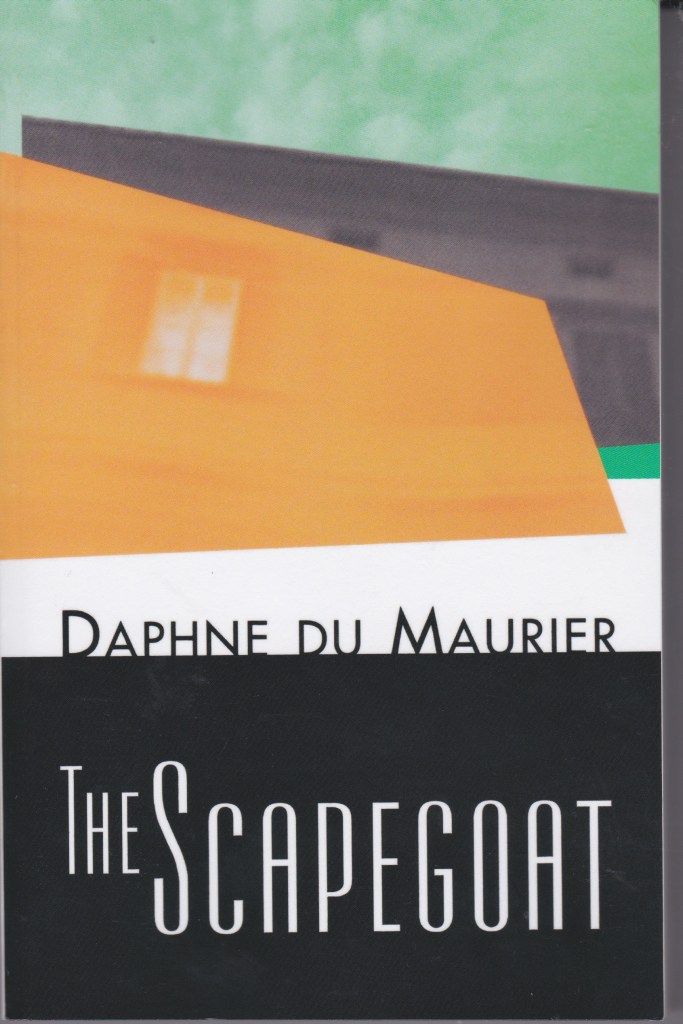
Daphne du Maurier has long been one of my favorite authors–ever since I discovered her short story collection Echoes from the Macabre when I was eleven or twelve; the first story in that collection, “Don’t Look Now,” remains one of my all time favorites; later in my teens I finally read Rebecca, and it has remained one of my favorite novels of all time, getting the periodic reread. One of the things I loved about du Maurier, as I tore through several of her other novels in the wake of Rebecca (The King’s General, The Flight of the Falcon, Jamaica Inn, and Frenchmen’s Creek) was that her novels subverted expectation; her books were marketed, or at least so it seemed to me, as romantic suspense novels and/or historical romances; yet the books were anything but that (whenever someone refers to Rebecca as romantic suspense it’s all I can do not to laugh in their face). The King’s General, for example, based on actual history, does not have a happy ending at all; and even the others aren’t exactly warm and fuzzy. About seven or eight years ago I finally read My Cousin Rachel, at the recommendation of a friend who couldn’t believe I’d never read it; once I had, it immediately shot to the top of my list of all-time favorites.
I’ve not finished the du Maurier canon–not because I don’t want to, but primarily because she’s dead and I know at some point, I will run out of du Maurier fiction. I know this is silly; I should, now that sixty is just on the horizon, start finishing the canons of my favorites because it would really suck to die and not be finished with them. (But then we always think we have more time than we actually do, don’t we? It’s sometimes very difficult for me to wrap my mind around the fact that I am, indeed, as old as I am.)
But watching the film of The Other made me think of this particular du Maurier, and I decided to give it a shot.
I left the car by the side of the cathedral, and then walked down the steps into the Place des Jacobins. It was still raining hard. It had not once let up since Tours, and all I had seen of the countryside I loved was the gleaming surface of the route nationale, rhythmically cut by the monotonous swing of the windscreen wiper.
Outside Le Mans, the depression that had grown upon me during the past twenty-four hours had intensified. It was inevitable, always, during the last days of holiday; but this time, more than ever before, I was aware of time having passed too swiftly, not because the days had been overfull but because I had achieved nothing. The notes I had written for the lectures I was to give during the coming autumn were scholarly, precise, with dates and facts that I should afterwards dress up in language designed to strike a spark in the dull minds of inattentive students. But even if I held their flagging interest for a brief half hour, I should know, when I had finished, that nothing I had said to them was of any value, that I had only given them images of history brightly coloured–waxwork models, puppet figures strutting through a charade. The real meaning of history would have escaped me, because i had never been close enough to people.
It was all too easy to lose oneself in a past half real, half imaginary, and so be blind to the presesnt. In the cities I knew best, Tours, Blois, Orleans, I lost myself in fantasy, seeing other walls, older streets, the crumbling corners of once glittering facades, and they were ore live to me than any real structure before my eyes, for in their shadows lay security; but in the hard light of reality there was only doubt and apprehension.
There are very few writers who can write so poignantly about depression and dissatisfaction with life; the dark night of the soul, as it were. This is where the hero of The Scapegoat finds himself at the opening of the novel. John, our thirty-eight year old hero, is an Englishman who teaches French history, is fluent in French, and is becoming incredibly dissatisfied with his life. Although his French is flawless and spoken like a native, his fascination and love for France has slowly become disaffecting for him–he feels like he doesn’t belong there and doesn’t quite fit in as he is not actually French; his life is humdrum and routine and lonely; he has no family, few friends, no loves. He has stopped in Le Mans on his way to visit a monastery, and as he walks around the rain-drenched city, he feels his difference very deeply; and then something strange happens: someone mistakes him for someone else, and then very shortly thereafter he runs into his mirror image–and his life is never going to be the same again.
The double, Jean, the Comte de Gue, is also dissatisfied and bored with his own life, and the two men have a few drinks. Eventually they repair to a disreputable looking hostel for another drink–and then our hero, John, passes out, only to wake up more than fourteen hours later to find that “his” driver is there, waiting for him to take him home. He soon realizes all of his things–passport, wallet, ID, car keys–are gone; he has two choices open to him. He can either tell this fantastic story of his to the police and to the driver, who will most likely judge him insane….or go along with the pretense, and slip into the life of his double.
Naturally, since this is a du Maurier tale, he chooses the latter.
In the hands of a lesser writer this contrivance–obviously, without making this decision the rest of the novel cannot happen–would be too glaring, too crazy, too much, really; but du Maurier does such a magnificent job of capturing his own boredom, ennui, dissatisfaction with the dull, plodding life he has made for himself that it actually almost makes sense for him to made this insane decision, for how can he possibly hope to pull off such an imposture? The look-alike story has been done to death over the years, and its overuse on soap operas–generally used when a popular actor has left the show, was killed off, and wants to return; or the double is evil and is taking over the good character’s life (they did this on Dynasty, poorly, with a Krystle look alike)–has made it seem trite and boring and over-used, as well as ridiculous. But Dickens used it for A Tale of Two Cities (even making his dopplegangers English and French, as du Maurier did), and of course, Mary Stewart’s brilliant The Ivy Tree also used the look-alike trope quite ingeniously. (Apparently Josephine Tey did the same with Brat Farrar.) Du Maurier does make this work–ironically, the only creatures who doubt that the Comte is actually the Comte are dogs; but then again, even when he behaves out of character for his look-alike or doesn’t know something he should, no one has any reason to doubt him or believe that a double has replaced their Jean. Would you suspect someone you love and know quite well has been replaced by a twin? There are also some wonderful subplots, regarding the real Comte’s relationships with his family, and while there really wouldn’t be much consequence if he is caught out, a lot of the thrill of the book comes from him not just uncovering the truths behind the fraught relationships with his relatives and the darkness of the past, but also figuring out ways out of situations where he would be found out.
And du Maurier’s writing style itself is the real star. There’s a hypnotic, dream-like quality to her voice; she weaves her words and sentences and paragraphs together softly but beautifully; there’s a melancholy to her style that always hypnotizes her readers into buying into the conceits of her stories and plots.
I greatly enjoyed this read, and am now looking forward to finishing the du Maurier canon.
My COVID test came back negative again, so I was right, I guess; dehydration and exhaustion combined in a 1-2 punch to send me reeling and off my game. My stomach is still messed up–sometimes stuff doesn’t go right through me, but most of the time it absolutely does–but that’s just how it is and we have to get on with life somehow. I am really sick of this, and I am going to be calling my doctor’s office later today. My doctor moved away, and I’ve been delaying dealing with contacting their office to get a new one, so now I guess I am in a position where I have to–in other words, moved to action because I have no other choice.
That happens a lot more than one might think, since my usual default is lethargy.
I revised my Sherlock story yesterday, so yes, I actually did get some writing done, and it wasn’t as easy as I might have liked but on the other hand, it also could have been much harder. There were a couple of times I was ready to throw in the towel and say hey I got something done at least, but forced myself to keep going. Now I’m going to let it sit for a few days before I polish it, and hopefully in the meantime i can get some other writing done. I know part of the weird emotional state I find myself in these days has more to do with the not writing than anything else; when I am not working on some form of writing, I’m always down. After I finished working on the story yesterday I felt fantastic; that adrenaline rush only matched by the one that comes from endorphins after a good workout. I’ve not been to the gym in over a week, either–I’ve neither had the energy nor felt well enough to actually go, plus not wanting to put people at risk…but I am going to have to start thinking about when I can go back again.
As a result of remembering a story I’d started a few weeks ago and completely forgotten about, I decided to make a list of all the stories and things I have in progress at the current time. It was quite eye-opening; eighty nine short stories in some degree of completion; seven novellas in the same situation; and two novels. This is what I mean by my creative ADHD; many of the stories are no more than 500 words (I made a point of not counting the ones that are just a title and an opening sentence or paragraph) but some of them have been through multiple drafts and still others have a first draft completed. I posted about it on social media, and based on the reactions I received, I realized two things: one, that I now understand why people call me prolific and two, the reason I think I am lazy and don’t ever get anything done is precisely because I have so many works in progress that are not completed. Add to that the reality that I constantly get new ideas for stories, novellas, and novels all the time, and you begin to see why I am so rough on myself when it comes to this sort of thing. I am trying to be better about being hard on myself–there’s a strong sense, though, that without being hard on myself I wouldn’t get as much done; but at the same time, I’m not getting much done these days…but I think this shift is necessary in order to delete negativity out of my life. There’s already so much negativity in the world I don’t need to create more for my life and career. But I need to get moving on the Secret Project, and now that this revision is behind me, I have some time to work on it now.
We finished season one of Elite last night and started season two, and I have to say–if you’ve not watched this show, you absolutely must. The story moves like a runaway freight train, the plot is incredibly intricate, intertwined, and complicated. The writing is stellar and the acting–the gorgeous young actors who make up the cast–is also topnotch. It’s so much better than 13 Reasons Why, and its approach to alternate sexualities is much better–considering this is a Spanish show, and I’ve always considered Spain to be conservative and Catholic, again shows how wrong you can be when you make assumptions about values and beliefs. It’s even hard to encapsulate the ongoing storylines on the show because so much happens and it moves so fast. It’s less like Edge of Night in terms of crime/soap hybrids than it is a Spanish, prep school version of How to Get Away With Murder–which we never finished watching the final season of, because it’s plot is so complicated we lost track and literally had no idea what was going on anymore.
And on that note, time to get back to the spice mines. Have a lovely Monday, one and all.
Jealousy is an interesting emotion, or feeling, or whatever the hell it actually is; certainly one of the deadly sins. I’ve been accused of being jealous of other people plenty of times in my life, which is kind of funny. Maybe when I was a kid I experienced jealousy of other people and their accomplishments, but not so much the older I got. I’ve never been jealous of other writers; I’ve never envied them their successes or big contracts or movie rights sales. I may want those things, but I certainly am not jealous of those who have them or are getting them or will get them in the future. I’m usually happy to see writers succeed, or win awards, or get nominated for awards, or get selected to best of lists, and so forth.
It’s not for me to decide who deserves what, nor is it for me to question anyone’s success. It’s counterproductive, and I’d rather not spend my time seething because someone else got a bigger piece of cake than I did. I just write what I write and hope people think it’s interesting or intriguing enough to read, and that those who do, enjoy themselves.
SIDEBAR: I do, however, reserve the right to say what the actual living fuck when I see things like I saw yesterday on Twitter; tweets and links to articles about how straight white male debut authors got ridiculous amounts of money upfront, after which the book proceeded to tank, and the writer disappeared into some sort of oblivion afterward. I have seen that happen quite a bit during my years in this business, and it’s almost always, inevitably, some straight white dude with a few short story sales to prestigious literary magazines and the right educational pedigree, inevitably writing something not particularly new. I’m not jealous; I just don’t understand the mentality behind those business decisions. I also feel sorry for the writer; I cannot imagine how horrible it would feel to have all these expectations placed on you (soothed, undoubtedly, by that insane amount of filthy lucre) only to have your career come to a screeching halt suddenly. Oh, I’m sure they’ll publish another book sometime for a more modest advance, or write reviews for important newspapers and magazines, the occasional short story; but for me, it would have been hellish to write one book and then never publish another.
So, sometimes there are times when I think oh you should push to get an agent much harder–keep trying or I would really like to land a nice two-book deal with one of the Big 5–and then I think, I don’t like like stress and pressure; writing and publishing the books I do, on the smaller end of the publishing scale causes me enough stress and the pressure is horrific and I cannot imagine being able to handle it on a much grander scale.
I mean, I’m already crazy; do I need to add things to make me crazier?
I purchased these two lovely little portable desktop air conditioners of a sort; they’re from Arctic Air and you put water in them and turn them on and they somehow blow very cold air on you. They are small, of course; one is currently sitting on my desk and keeping me very cool (my office/kitchen is probably the most miserably hot place in the Lost Apartment; the upstairs bathroom running a close second), and I have the other on the counter next to the stove, and the two are creating a lovely cool area at my desk, with the ceiling fan turning overhead that is actually rather delightful; I haven’t really felt comfortable at my desk in quite some time–and that hasn’t helped me with either focus or dedication to stay with the writing. Hopefully this will help me, going forward.
Now I want to get one of the floor units.
We continue to watch 13 Reasons Why, but I am not quite sure why. This season is all over the map, story-wise; and show anchor Clay, who has to basically carry the show, has become very uninteresting to watch. I can’t decide if it’s because the young actor (Dylan Minnette, whom I’ve enjoyed the previous three seasons) is so very good at playing the out of control teenager whose mind and life has spun so wildly off course, and whose mental stability is crumbling. The others young actors are performing quite well, despite the awkwardness and forced story sometimes; I think that’s why we continue to watch–the cast is quite good, and we do end up caring about them and their massively fucked-up lives. If you would call the show a soap, I’d say it’s more in the Edge of Night vein, because it’s about crime and trauma.
It also makes me think of the two manuscripts I have sitting in limbo, waiting for me to finish the Secret Project so I can get back to them.
Sometimes it’s hard to remember that this is June; that less than six months ago on a snowy night I had a lovely dinner at a restaurant much too nice for the likes of me (and there was lots of wine) with a lot of mystery writers and much fun was had. I didn’t know that was the last time I would participate in such a gathering for I don’t know how long. I assumed there would be the Williams Festival and the Edgars and Malice Domestic as there always was in the months to come after January. I remember walking across the street with Meg Gardiner as the snow fell, and everyone being amazed that I wasn’t freaking out about the snow; it’s really not the snow, as I sometimes forget to point out, that I mind so much as the weather conditions–the cold and damp–that create it that I actually mind. And that night wasn’t cold but it was damp; and the flakes were big and fat and wet and beautiful and hadn’t turned yet into slush on the sidewalks and the gutters. The city lights were lit, some Christmas decorations were still up, and there were cars and taxis crowding in the streets and lots of people in their winter clothes going about their business on a snowy January Saturday night in Manhattan. I miss those nights, and the company I sometimes am lucky enough to get to keep; connecting and spending time with other writers, in the company of other writers, always inspires me when I listen to them talk. I’m never bored around other writers, and sometimes, when I get the nerve up to actually talk and interact, they don’t look at me like I’ve a third eye or I am quite literally the stupidest person they’ve ever met. I miss that. I miss the company of other writers, because other writers remind me how much I love doing this, remind me that it’s central to who I am, and that I am never happy if I’m not writing.
Sometimes you need to be reminded of the things you love, and how much you love them.
Tuesday! We survived Monday, did we not? That is, ultimately, a reason for celebration.
And–believe it or not, I finished Chapter Eighteen last night, which was incredibly cool. I haven’t worked on Bury Me in Shadows in so long I was beginning to think I was never going back to it.
Huzzah! Go, Greg, go!
They are slowly starting to close the Bonnet Carre Spillway, meaning that the river is beginning to go down, and might soon no longer be in flood stage. As we are ever aware in New Orleans, water is the eternal problem for our sinking city, and we will all sleep a little better knowing the flood is, at long last, receding.
We also finished watching Big Little Lies last night, and I have to say, I enjoyed it and thought it wrapped everything up nicely in a way the first season’s finale did not; which, of course, made the second season necessary. There shouldn’t be a third season; this is all tied up in a nice bow, and there’s no need for a third. It was, in a way, kind of nice seeing the fall-out from the lie they all agreed to tell after the ending of the first season; how the repercussions and fall out from the lie undermined and destroyed their lives in the third season–although blaming the lie for Renata’s troubles, which were solely the fault of her man-boy husband, is a bit much.
I slept deeply and well last night, but unfortunately am still wishing I was still in bed. I’m sleepy and tired, but not from not sleeping well, but rather from getting up too early this morning. It’s of course day 2 of my marathon opening the week each week, and I managed to make it through my entire day yesterday without either getting tired or being tired. This morning I woke up tired. I am hopeful the process of going through my morning ablutions will finish waking me up, and of course, tomorrow I can sleep a little later since I don’t have to be in until later. It’s also pay day, which means pay-the-bills day, which is never particularly pleasant, either.
Of course, when I get home from work tonight I’ll be watching part two of the Real Housewives of Beverly Hills reunion. I’m not entirely sure why; I have lost most of my interest in this show–it certainly doesn’t compare to either the New York or Atlanta (and, from what I’m seeing, Potomac) franchises, and I’m not entirely sure why. This past season’s emphasis on a boring storyline, having to do with a failed adoption of a dog and the fallout from the failed adoption, wasn’t particularly interesting, especially when production kept dancing around the reality of the actual situation and tried to force more drama out of it peripherally. Apparently, the show had new producers this season, and it showed; usually the women are at the mercy of production, but this season made it seem that the production was at the mercy of the women. One thing these shows are terribly good at it, though, is switching gears and manipulating the audience; a woman who is incredibly unlikable in one season can come out of another smelling like the proverbial rose, and vice versa. I try very hard not to get too involved in the outer trappings of these shows I watch–the energy expounded in watching the shows and deciding who to like and who not to like, and forming opinions on what I’ve seen, is more than enough time spent on them. I do occasionally like to read the recaps (some of which are absolutely hilarious) and will spend some time reading the comments on the recaps, simply to see how far off base my own opinions are, and to see how differently other people can process the very same thing I’ve watched. That, to me, is the most fascinating part of watching the shows–and it is very similar, as Camille Paglia pointed out (and it galls me to no end to agree with her about anything) the audience involvement with the reality television programs, and the Real Housewives franchises in particular, is very similar with how audiences used to get heavily involved in soap operas. An entire industry built up over soap fandom; the same is happening with the Real Housewives.
The rise of reality television is also an interesting basis for a study on changes in American popular culture in the twenty-first century, which would make for either a brilliant long-form essay, or even a master’s thesis. (Someone, you are very welcome for this idea.)
Hopefully, tonight I will be able to tear through Chapter Nineteen after spending an hour rolling my eyes at the housewives. Gotta keep scratching things off that list, y’all.
I continue to watch Chernobyl, which is mesmerizing as it is horrible. I am now up to episode four, and can’t look away. It’s horrifying and amazing and terrifying and so bleak, and perhaps the thing I can’t get out of my head is you were alive when this happened and was being reported in the news and I don’t ever recall knowing it was this bad–it was bad, but I never knew it was THIS bad.
And that is terrifying, so terrifying that it upsets my stomach and makes my blood run cold.
It is also a very cold, analytical look at what happens during a major disaster in a country where the news is under government control, and when a government is not only authoritarian, but where everyone is afraid to tell the next person higher up in the chain the truth when it’s bad news. It’s heartbreaking, and done in an almost documentary style. There was a point last night when watching that I thought, why are they all outside around the facility without any kind of shielding from the radiation?
And then realized at that time, it no longer mattered; they were already so badly exposed their lives were essentially over. “Within five years,” is what they were told, and what they tell each other.
Absolutely horrific.
I didn’t get much writing done yesterday because I am at the point in the book where social issues come into play, and I am struggling because I don’t know how to make the points I want to make without sounding preachy or too “ABC After School Special”; I suppose the thing to do is not worry about any of that stuff because I can tighten and clean it up later, but when I am in the midst of writing I never think that way until the following morning, as I gaze bleary-eyed outside my windows into the grayness of the early dawn–you know, after I squandered my writing time the day before struggling.
Heavy sigh.
But in other good news, I have now slept well for two successive nights, which is lovely, and I woke up this morning without a problem when the alarm went off. Hopefully, that means not only will I make it through this long, long day, but won’t be bone-tired and exhausted when I get home. Of course, it’s Tuesday which means it’s a Real Housewives night, but frankly I find the Beverly Hills franchise to be rather boring this season. Perhaps some day I’ll write an entry about these shows and why I watch them, and what entertainment I get from them–but as Camille Paglia (whom I utterly detest, she is completely vile) once said, these shows replaced soaps, and the viewers are the same people who watched soaps; there is something camp and over-the-top about these shows, and the line between entertainment and reality has become so blurred with them that it is, actually, very soap-like; soap characters were like real people to their viewers, who talked about them like they were the people down the street. I don’t think Paglia’s analysis–it was part of a longer interview about culture in general–was particularly deep; it was kind of off-the-cuff and she hadn’t put much thought into the analysis, but she did strike a vein of truth with this, one that bears deeper thought and analysis and comparison (although I really disliked her comparing Tamra from Orange County to Donna Mills’ Abby from Knots Landing), and maybe someday I will do that.
When I have time. Because I have so much free time these days.
I also fell down into a rabbit hole yesterday–which, while a lot of fun, was also an enormous time-waster. This morning, the curiosity I had about the rabbit hole which was so intense and couldn’t be ignored, somehow doesn’t seem quite as intense as it did yesterday in the heat of the moment. Don’t get me wrong, I am still quite curious…but I don’t need to be refreshing social media to see new theories or discoveries.
And on that note, tis off to the spice mines with me. Have a lovely Tuesday, Constant Reader.






 Queer and Loathing in America