Turn the Beat Around

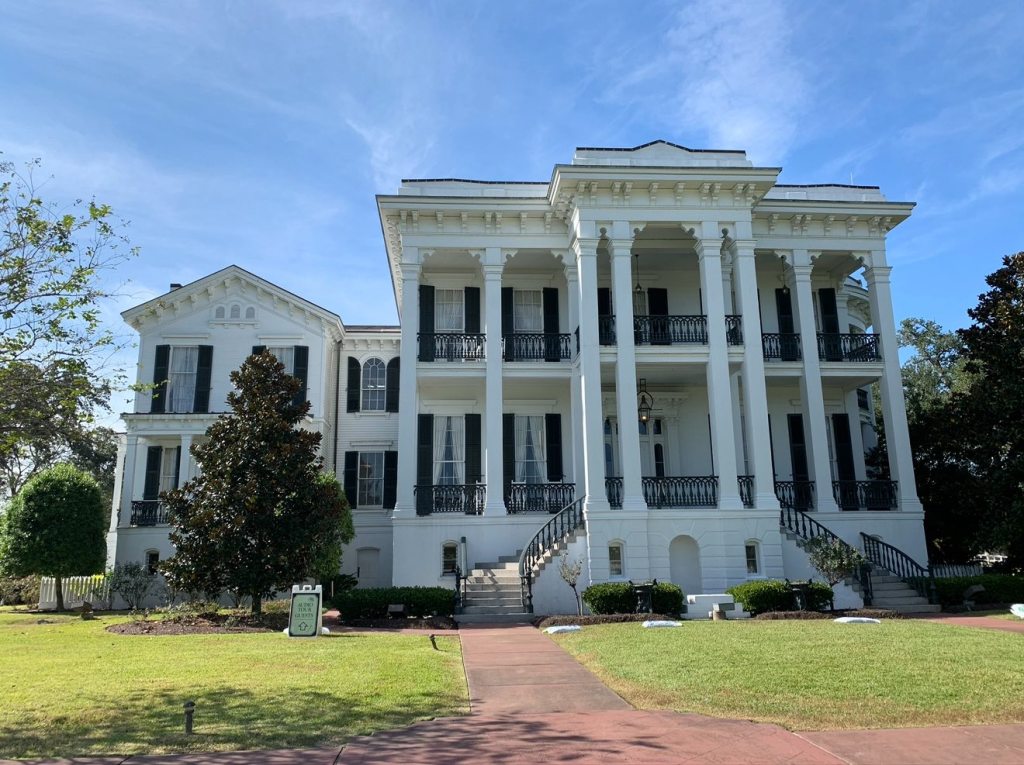
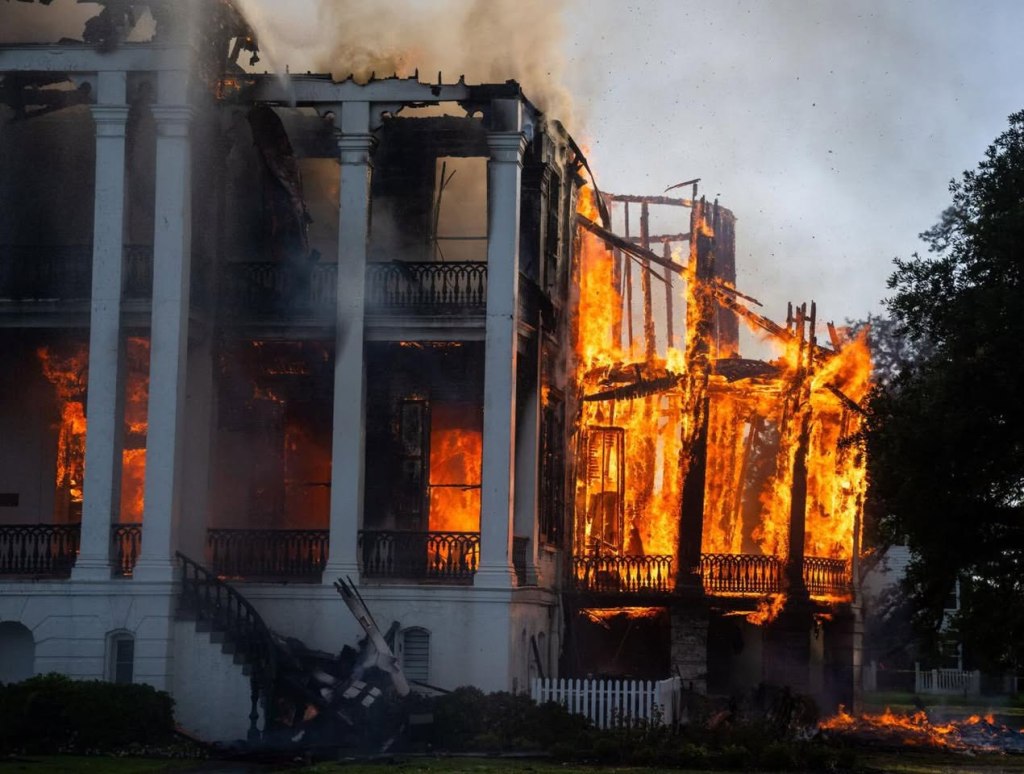
Nottoway Plantation, one of the beautiful old homes along the River Road north of New Orleans, burned to the ground Thursday.1 But what that lovely old historic home actually was? Just a monument to enslavement and stolen wealth. I also can’t help but hope the backstory to the fire is some Gothic shenanigans, a la Rebecca and Manderly burning to the ground.

I’ve certainly come a long way from that kid who was raised to believe in white supremacy and the Lost Cause ideology, haven’t I? My relationship to the South has always been fraught, once I began to read more and understand more and deprogram myself from that horrific grooming as a child. I can remember, though, reading Gone with the Wind when I was ten or eleven for the first time and my hackles being raised by the happy, contented enslaved people and how they were described and how they talked. (I loved the story itself, but the racism was so unrelenting and unending and horrible; I need to do a deconstruction of that book sometime–as well as other “make white people feel better about racism” books.)

Nottoway was a beautiful home, but it was also one of the most monstrous sugar plantations in Louisiana with an excessively brutal history. I am not sorry in the least this horrific place–where they teach nothing about the true history of the place and rent out for weddings and parties for white people (“yes, you too can have a Scarlett O’Hara wedding on an old plantation! So what about the brutal treatment of generations of enslaved people?”). It really was nothing more than a monument to oppression, cruelty, and the evil that men can do.

I started dealing with the ghosts of my own Southern past in Bury Me in Shadows, and this new repurposed book from an old manuscript is also going to deal with race in Alabama, too. I just have to finish this damned Scotty book and get it out of my scalp. New Orleans also has its own dark, bloody and brutal history I have to deal with at some point, too. I was reading a piece about Madame LaLaurie and her abuse of her enslaved people, and wondering how to turn that into a short story–and likewise, my Sherlock story will also have to deal with race, because of the Voodoo Queen. I’m not afraid to address any of these issues, really; as long as I do it and am mindful of the potential for offense and/or getting it wrong (I have a great editor, thank God) and tread carefully. You really can’t write about the South authentically without talking about race.

After I finished working yesterday, Paul and I ran some errands (including Costco) and by the time we got back I was completely worn out and exhausted. I started reading a Dana Girls 2mystery (one of the kids’ series I collect) titled Mystery at the Crossroads, which was originally published in 1954–right around when the Hardy Boys/Nancy Drew books began being revised to remove problematic content–and ho boy, is there some problematic content in this book! It’s about “gypsies”–and every handy stereotype about the Romani people is crammed into this book. But it was easy to read, it engaged my brain, and now maybe today I can get back into reading something substantial.

I also rewatched two movies last night–the animated Beauty and the Beast (yes, I get that it’s problematic but I love it) and Jesus Christ Superstar before falling asleep in my chair. Paul woke me at one, and I managed to sleep through the night and this morning I feel rested and good. I have some errands to run today, but I am going to try to just clean and read and rest and relax as much as humanly possible. I am still not 100% recovered from the illness, but I am getting there.

And on that note, I am going to head into the spice mines. Have a lovely day, Constant Reader, and I’ll be back on the morrow, if not sooner.

  1. And yes, the Lost Cause traitors are weeping publicly of the loss. Since it was one of those destination wedding/party places that glossed over its hideous history…good riddance. ↩︎
  2. I will be writing about the Dana Girls for my newsletter at some point; I want to write about all the kids’ series I read growing up. ↩︎

Bonaparte’s Retreat

Thursday and my last day in the office for the week. I was very tired when I got home from work yesterday–mid-week fatigue, most likely–but I slept super well and feel pretty good this morning. The temperature started dropping again last night–I checked and it was only 62 degrees inside last night–so I turned the heat on downstairs before heading to bed, and it’s nice and warm down here this morning. I don’t know how tired I am going to be later on, of course, but we’ve an easy clinical schedule today and I should be able to get caught up on all my Admin stuff today before I leave the office and come home. I am almost finished with a project, hopefully by Saturday it will be done and I can get back to my book work. No football for sure this weekend, so I have no excuse not to clean and write and go to the gym as we move into the New Orleans Holiday Season–which doesn’t end until after Carnival. Woo-hoo!

The last time I was visiting my father (or maybe the time before) he told me about a movie (it probably was the time before last, when I watched westerns with him) starring John Wayne that was set in Alabama and was about Bonapartists exiled from France who wound up settling in the western part of the state, which is how the small city (or town) of DEMOPOLIS was founded. (The movie was The Fighting Kentuckian.) Honestly, Alabama’s history is so rich and varied! I could write a million books set in Alabama–and that’s not even talking about places like Moundville, near Tuscaloosa. But there has to be some way I can tie Scotty and New Orleans into the Bama Bonapartists, you know? One of Napoleon’s nephews, Prince Achille Murat, lived at Magnolia Mound near Baton Rouge (I think the location is either on the LSU campus, or very close to it) for awhile in the early nineteenth century. Lots of Bonaparte connections down here, and after all, the Napoleon House is called that because after Waterloo, it was offered to Napoleon for his next exile–needless to say, the British weren’t having that. (There are Baltimore Bonapartes, too.) I came across a mention of the Murats of Magnolia Mound yesterday, and that made me remember about the movie and the Bama Bonapartists.

I also started reading White Too Long, and I am glad I have it. It’s essentially the story of how white supremacy and Christianity became linked through racism before the Civil War, and how those “southern” versions of particular Christian brands worked hand-in-hand with the Klan and other racists ever since. I think the Southern Baptists are the only ones left that didn’t merge back in with their Northern counterparts after the war, and the Southern Baptists have been responsible for a lot of bigotry and unconstitutional prejudiced laws and so forth ever since. The Southern Baptists were the queer community’s biggest enemy for decades, and have poisoned southern culture for generations. (They were also the very first organization to target Disney for being slightly more gay-friendly than anywhere else and announced the first boycott over it; it failed miserably.) It’s going to be an interesting read; I always find religion fascinating–especially how a benign message of caring for others and helping the poor and sick can get twisted so easily into a method of mind control for nefarious reasons. I still want to explore that more in a book, too, and I am going to finish that goddamned essay about my own personal experiences with religion and the Christian god.

Maybe try finishing the writing you’re already doing, Greg, before starting anything new–and yes, that absolutely includes doing research. Make notes of where to find said research and do not go ahead and start doing it–save it for when you’re ready to write it.

And if you never have the time to write it, then was there any need to waste any time researching it? Alas, I do have a curious mind, which can also be very one track at times.

And on that note, I am heading into the spice mines. Have a lovely day, Constant Reader, and I may be back later. One never knows.

Honeymoon Feelin’

Monday and back to the office with one Gregalicious.

I got absolutely nothing done this weekend! Isn’t that positively shameful? I probably should feel worse about it than I do, but here we are. Yesterday I got sucked into the vortex of chores and reading my books (Winter Counts and The Demon of Unrest), finished watching some documentaries I’d started, and just, I don’t know, rode the low energy wave? I had gotten up early yesterday morning–I’d forgotten to take my pills last night, so I woke up at two and never really fell back asleep, and finally I let Sparky coax me out of bed around seven; it was chilly and the bed was quite warm and comfortable. I started doing things, and then around eleven or so the caffeine started wearing down and so, frankly, did I. I decided to eat something and take a reading back, and then hours passed as I read, alternating the books as well as doing chores and the occasional snack while Sparky slept comfortably in my chair–leaving very little room for my legs. I checked out the news, watched the first episode of the new Dune show, and just kicked back. It was kind of nice, and I think I’m going to have the energy to start getting things done starting tomorrow. Yay, me!

I’ve certainly been pushing everything off, haven’t I? Bad Gregalicious, bad Gregalicious. But I was also wondering where and how this Thanksgiving holiday was going to hit. It was always Mom’s holiday, you know? And last year I scheduled my surgery the same week so I’d be too focused on recovery and the post-surgery horror to be sad or depressed. I don’t think I was overtly either this past weekend, but it could account for the low energy and the inability to get much done or stay focused for very long. Maybe I shouldn’t have put off facing this holiday without Mom till this year, and unfortunately, I was also home alone for it, with just my emotional support cat. It’s actually kind of sweet how he’s been glued to me the entire time I’ve been in the house since Paul departed. I don’t know if that is separation anxiety for him, or if he thinks I’m lonely and need the companionship.

In either case, it’s terribly sweet.

I am pleased that I got some books read, and some others started; I’ve also had a lot of thoughts about story revisions and endings as well as what to do with the new Scotty. I need to make a to-do list (believe it or not, I never did make one, other than the chores one–and I did get almost all of those done!), and I need to start thinking about goals and plans for the new year. Yikes! It’s almost 2025. How scary is that? Fifty years ago, I was heading into the winter break for my freshman year in high school–and trying to write a book set during that time (I wrote the first chapter in my head this weekend, here’s hoping I can find the time to type it up) in the present. Fifty years ago I was a freshman in high school. My parents had just turned thirty-two. How wild is that? I couldn’t imagine being my grandparents’ age back then, yet here we are.

Amazing what a difference taking my pills makes; I slept like the proverbial stone1 last night, and it was so warm and comfortable I really didn’t want to get up–it’s forty-four degrees here this morning–but Sparky made sure I did (he was hungry), and I do feel good this morning. Given how little work I actually did since I came home early from the office last Tuesday (I’ve been out for nearly a week!) We’ll see how the day goes, won’t we? Paul comes home tomorrow night (huzzah!) and the rest of the week will be normal; no more holidays for another couple of weeks, at least. Hopefully I’ll get back on track this week and start getting stuff done; I also have a shit ton of emails that I’ve been avoiding and I need to answer them. I think I have to work in the clinic today because one of my usual people is out, and I think the schedule for today is pretty booked; Mondays are always our busiest days, for some reason–getting it over with, most likely–and it’s usually my in-office Admin day, but we were super-slow last week and I am all caught up on that work, at any rate.

Reading The Demon of Unrest is actually kind of timely, and I am spending more time with it than my other read–primarily because everything I’m reading sounds so much like the times we are living in now–a country rife with division and hatred of the other side, fake news, the inability to listen of either side to actually hear the other side and not just assume what they really meant, etc. Larson does point out the deep hypocrisy of claiming “states’ rights” to allow slavery, but refusing to obey the Fugitive Slave Act by any free state was arguing for states’ rights. As always, the racist conservatives wanted their cake and to eat it with ice cream as well. How can you argue that the Federal government be ignored on the one hand but Federal law overruled state law at the same time?

Some things never change.

And on that note, I am going to get ready for work. Have a lovely Monday, Constant Reader, and I may be back later–stranger things have happened before.

  1. I wonder…if “sleeping like a stone” derives from tombstone, so it’s the same as “slept like the dead”? ↩︎

Sisters Are Doing It For Themselves

So we had a major thunderstorm yesterday afternoon, complete with street flooding and thunder and lightning and all the fixin’s. This naturally led me to wonder, as the lights flickered at the office and Elysian Fields (the street, not the Greek afterlife) filled with water, whether or not to wait until the advisory was lifted (in theory at 5:45 pm), or head home when my work day was complete? One can never be certain where and when parts of the city are going to flood; and the last thing in the world I need–being this close to having the car paid off–is to risk flooding it out and possibly ruining it.

Sigh. It’s never easy living in New Orleans.

Getting home was a challenge; Claiborne Avenue’s low-lying areas were filled with water, water was pouring down not just from the clouds but from the I-1o high-rise, and I decided to risk going through the CBD, never the best option, but potentially even worse than usual since the Plaza Tower started falling apart and

And now for some blatant self-promotion, The Queer Crime Fiction roundtable I participated in for Crime Reads can be found here. And my brief appearance on Writer Types recommending queer crime writers can be found at this link right here.

Thanks again to Lisa Levy for the roundtable, and to Eric Beetner for inviting me onto his podcast. Both were a lot of fun, frankly, and it’s always fun for me to have the chance to talk about books and writers and make recommendations of books and writers I admire and enjoyed. I really missed that during the pandemic.

We got caught up on Lisey’s Story last night–we were both dismayed to see that it hasn’t all aired yet, and so no new episode until Friday–and then went on to the second chapter of The Underground Railroad, which was equally as disturbing as the first, but in a completely different way; I do remember, reading the novel and thinking, my God, so many different ways white people have found to punish and hurt black bodies and souls throughout our history. The show, being a visual medium, is even more disturbing than the book, because my imagination wasn’t quite strong enough to erase the imagery from my head I had grown accustomed to throughout a lifetime of privilege, that kept elbowing the stark realities Colson Whitehead so poignantly and beautifully wrote about in his book, out of the way; the show does not allow this, and the beautifully way it is filmed so poetically reflects the beauty of Whitehead’s language, even as the subject matter in truly an abomination.

Laura Lippman’s Dream Girl drops today, and so those of you not fortunate enough to get an advance copy can now indulge yourselves in reading a truly marvelous book by a great thinker and a terrific writer. I need to get back to reading; Robyn Gigl’s By Way of Sorrow needs to be finished, and on deck I have Bath Haus by PJ Vernon, Everything I Never Told You by Celeste Ng, Arsenic and Adobo by Mia Manansala, and several others. So much reading; I really need to focus on getting my reading done and caught up. Now that I’ve finished the novella I can take a look at duMaurier’s “Don’t Look Now” again, as well as her “Ganymede”; I already know, from doing some post-writing research today that there are some major adjustments that need to be made to my novella, and it may wind up being longer than than 20, 430 words it sits at now–not the least of them the days of the week, and so forth. I also have to figure out some way to make the story work a little better, more suspenseful, than it sits right now; but that has a lot to do with figuring out the story as it went. I also want to start pulling together the next short story collection–madness, I know–but I do love when I am basically overwhelmed with projects; so I always have something to be working on if something stalls out or I just don’t want to work on something in particular.

I also took some time and started plotting out another Scotty; yes, I know–I really need to dive into Chlorine again, but I had also decided that I was going to do that in July; it doesn’t hurt to have the Scotty’s various intertwining plots planned and mapped out. I generally don’t do this with Scotty books, primarily because the writing inevitably takes me in much different directions than I had planned, and thus inevitably all the planning turns out to be waste time. Also ironically, despite having any number of possible and potential titles on hand, none of them seems to fit this story–and since I can’t ever really work on anything without a title, and knowing that the title can be eventually changed–I am calling this one, for now, Mississippi River Bottom, which was actually the working title for Jackson Square Jazz. My editor didn’t like Mississippi River Bottom (which I rather thought was a clever play on words) and asked me to change it. I also know that this working title doesn’t really fit the alliteration patterns of the rest of the series, and thus will inevitably have to be changed. Perhaps while I am actually writing it, the title will come to me; stranger things have, indeed, happened before.

Last night’s sleep was terrific–there were strange dreams, of which I’ve been having a plethora of lately; last night was me working at Target for some reason–but I again feel terrific and rested this morning; everything looks wet outside, so I am assuming the rain continued over night. It must not have been terrible or dangerous, as we never got one of those horrible WARNING alerts during the night on our phones. Tonight when I get off work I’ll go uptown and get the mail before heading home and to the gym. The Tuesday night workout is somehow always rushed, with me skipping things–more to do with too many people being there than me being lazy, really; the free weight area is always so crowded I inevitably skip the two exercises I used free weights for–and then it’s back home to watch some television and possibly do some writing. This weekend is going to see weird; I have a broken tooth that needs to be extracted, and I scheduled that for Friday afternoon. That inevitably will mean a strange diet of soft food over the weekend and pain killers; but better that than the dull throb and swollen gums I’ve been dealing with since the molar broke. Ah, the endless saga of Greg and his bad, bad teeth. One thing I definitely envy in other people is good teeth…I also want to get to work on “The Sound of Snow Falling.” I am assuming I’ll be incapacitated this weekend after the tooth extraction, but I am hoping I can at least sit in my easy chair and edit.

And yesterday, the first active roster NFL pro football player to come out came out! Yay, and welcome to the team, as it were. I’m old enough to remember when David Kopay came out in the 1970’s; the first former NFL player to do so.

And on that note–writing ADHD, my bad teeth, NFL player out of the closet–I am heading into the spice mines. Have a lovely and winning Tuesday, everyone.

Who Do You Think You Are

Sunday morning is here, and along with it sunshine and no doubt smothering humidity–later today I will be heading to the gym for the beginning of this week’s workout schedule and also trying to get some other things done today. I have to finish the web copy I promised to do today, and I am itching to get back to my writing. Yesterday was a very good day on every level–I was highly functioning for a change, and it felt wonderful, more like the kinds of days I am used to having, or rather, got used to back when I was regularly highly functioning. I did sleep very deeply last night–I did have some very strange dreams, though; all I remember is they involved Taylor Swift and losing teeth–but I woke up very well rested this morning and ready to go. I am awake and not sleepy-tired, my muscles don’t ache or feel tired, and we watched some amazing television last night.

And I actually started writing another Scotty book yesterday–nothing like creative ADHD, right?

But the opening scene for this book has been in my head for quite some time now. One day recently as I was toying with an idea for the next Scotty book, this line popped into my head: “I’m really worried about Taylor” (those who have read Royal Street Reveillon will understand) and then another sentence came to me recently: It was the Monday after Mother’s Day and the termites were swarming. I’d initially thought the swarming termites line was the opening for a short story, and yet…couldn’t figure out a story for it to go along with. The other day it hit me: the two sentences go together, and are the perfect opening for the next Scotty. Yesterday when I sat down to write, these two sentences were swirling together in my head and I thought, why not go ahead and put it down on paper, so it’s there when I’m ready to go back to work on another Scotty? I don’t even know what I am going to call this one yet. I had already–because of these openings, and knowing they wouldn’t work for the next Scotty I had planned to write–so I decided to push Twelfth Knight Knavery back in the Scotty schedule to be the one after this one. I am going to leave it as “untitled Scotty book” for now. I have two stories I want to weave together into this one, and another subplot, but I’ve not taken the time to actually map any of that out or anything as yet. But hey, I wrote nearly twelve hundred words before turning my attention back to “Festival of the Redeemer,” and I am going to take that as a win.

And “Festival of the Redeemer” is now sitting at over seventeen thousand words. Not too bad, really; I’d estimate that I wrote well over four thousand words between the Scotty (around 1200) and the novella yesterday. The story also took an incredibly dark turn, too–I’d always intended it to, of course, but still–the turn was so much darker than I’d planned it even kind of caught me a bit off-guard. I do like it, though–it is a first draft, and as such is very sloppy and slipshod and is going to need some serious revisions and edits, but I am pleased with it. This twisted tale seems so perfect for Venice–and it may turn out, after revisions and edits, to be much longer than the original planned twenty thousand; but word counts are inevitably goals, anyway, and more a measure of progress than anything else.

Have I ever mentioned how much I actually love writing? It makes me so happy to be writing, and it’s so satisfying; there’s really nothing like it, and I can’t even remember the last time that I derived so much pleasure from actually doing it; I don’t remember going into the zone the way I have been lately–I feel like it’s been years since I went into the zone where the words just flowed out of me and I lost track of time and word counts and so forth; which is probably why I’ve been having so many concerns about burn out and losing my ability to write–always a fear for me, always–and yet here it is back again, and I feel centered again. I feel like the last malaise last forever–at least for years–and now I am past it, and even if what i am writing is not anything I should be writing… but if I am going to publish a collection of novellas I have to actually write them, don’t I? And this one is really going somewhere–even if that place is somewhere incredibly dark…and you know what? HUZZAH FOR SOMEWHERE INCREDIBLY DARK.

But when I get this done–I think I may even get this first draft finished today or tomorrow-I am going to get that short story draft finished next and then I am going to get back to Chlorine. I need to get that first chapter revised and rewritten; a good task for this week, I think, and then I am going to work on that other proposal I want to get turned in to see if anything comes of it. Hey–you never know, right? You never know until you put it out there.

I also managed to clean the kitchen yesterday and worked on the filing, The area around my desk is a lot more neat and tidy than it has been, and my inbox is almost completely emptied out. This feels like a major accomplishment, and it’s nice to look over there and see just a few loose papers in there–which I may even get rid of today.

It’s amazing what I can do when I’ve slept, seriously.

We finished watching Elite last night, and it was terrific–perhaps not as good as the earlier seasons, which is a very high bar to reach; but with a cast reshuffle and an effective reboot of storylines, not surprising. We had three seasons to get to know the original cast, and with half of them gone (oh, how I miss Lucrezia!) and their replacements coming in, the story had to go into a bit of overdrive to get them involved with the original cast, and there were times it felt a bit forced and like it went too far too fast. The ending of the season was satisfying, and the next season–with two more characters being added–is now really well set up.

We then moved on to Apple Plus, with Rose Byrne’s new starring vehicle Physical, and I really enjoyed it–the three episodes that had dropped already, at any rate. Byrne plays a dissatisfied housewife whose own gifts and talents are being subsumed by that horrific housewife trope of the time–and even her supposedly “progressive” husband subscribes to that old patriarchical notion of what women’s value was in the progressive movement–they were there to fuck, feed, and clean up after the men; the men did all the thinking and the women did all the work. Then she discovers an aerobics class at a mall…and finds it incredibly empowering; rediscovering herself and who she is through the class. She’s not completely likable–she has a horrible inner monologue voice that is snarky and bitchy and judgmental (if funny at time)–but she’s understandable, and Byrne brings her charisma and likability along with everything she does. It will be interesting to see how the show develops.

After that, we switched over to Amazon Prime to watch the first episode of their mini-series adaptation of Colson Whitehead’s The Underground Railroad, a book that I loved and thought was absolutely brilliant. Here is slavery in all of its degradation, abuse, and horror–the Georgia plantation depicted here isn’t the prettified Tara of Gone with the Wind, and these slave owners and overseers aren’t the genial paternalistic Gerald O’Hara the Lost Cause movement insisted were the reality. It was incredibly difficult to watch, but necessary; my own discomfort in watching, I kept reminding myself, was nothing compared to what the enslaved people endured, and my white fragility needed to look the reality directly in the face and deal with it. These are my ancestors; and even if the family legends my grandmother told me when I was a child was mythology and lies, they certainly believed enough in this horrible system to fight and die for it.

And if I learned anything from Hurricane Katrina, it’s that no matter how terrible something looks and appears on television, the reality and its scope is a thousand times worse. The show is beautifully shot–the cinematography is stunning; and the beauty of the production, and the care taken, only adds to the horror of what the viewer is witnessing.

I kept thinking, the entire time I watching, heritage not hate, huh? Fuck all the way off.

And now I am heading back into the spice mines. Have a lovely Sunday, everyone.

Dueling Banjos

Writing about the rural Deep South is difficult.

I’m from the deep south, yes, but I didn’t grow up there. I spent a lot of time there, my parents were Southern, and so a lot of my values and mind-view for a number of years were patterned in the Southern mindset. I draw from my memories of summers in the rural backwoods of the mid-central-western part of the state, about seventy miles from the Mississippi state line or so, but there are also so many attitudes and mentalities and stereotypes and tropes about the rural Deep South that it is easy to become lazy and fall into those. I am trying very hard not to do that, but as I said, it’s hard. Stereotypes and tropes exist for a reason, after all–they weren’t created from nothing; there’s always a core kernel of truth in them, whatever they’ve become once the seeds were planted–but the key is to burrow into them to dig out the core kernel of truth to build upon, so you’re telling the truth. But I worry, as I continue to excavate into this book, that I am relying on negative tropes and stereotypes.

I think I was thirteen when Deliverance was released; we saw it at the drive-in, which was something my parents loved to do with us when we were kids. I didn’t understand a lot of what was going on in the movie–it was the kind of macho bullshit I loathed as a child, a loathing that has only somewhat lessened as an adult, so I stopped paying attention to it and I think I may have even dozed off. But I did see the scene early in the movie which has forever cemented into people’s minds a link between the backwoods South and redneck morons–“Dueling Banjos.” The open notes of the song are all that is needed to reference a joke about passing from civilization into the land of the uneducated, probably inbred, backwoods hillbillies; it has come to symbolize moonshine-makin’, overalls-wearin’, cousin-marryin’, dangerous rural Southern people. I’ve made the joke myself from time to time–driving through the Southern countryside at night, “You can almost hear the banjo notes, can’t you?”

Deliverance and “Dueling Banjos” are such a part of our zeitgeist and popular culture that the book and film have become kind of shorthand Southern references–even for people who don’t know the origins of the references. I’ve never read the book, but I bought a copy a few years ago because I heard one of the references in something–a talk show, a book, a film, a television show; I don’t remember which–but I thought it was time for me to read the book and possibly watch the film in its entirety; that there was a possibly an essay in both about masculinity, rape culture, and the American male. (For those of you who don’t know, many male-on-male rape jokes were born directly of Deliverance.) I never did get around to reading the book or watching the movie; to be honest, I’d completely forgotten about them and the essay idea until recently. I also never got around to reading the book because I’d heard bad things about James Dickey, who wrote the novel. Dickey was primarily a poet, and considered one of the better American ones of the second half of the twentieth century by the Academy, and Deliverance was his only novel. I knew people who knew Dickey, and the reports back on him were terribly unpleasant, if not surprisingly so. (American letters has produced some horrific examples of toxic masculinity with its iconic, deified authors.)

Southern people are masters at grievance; they’ve been aggrieved for quite some time now–probably as far back as when the rumblings in the northern states began against slavery.  Everything is always someone else’s fault; even that language from the 1960’s came back to haunt Alabama during the special election to replace Jeff Sessions in the Senate: “outside agitators.” That was always a favorite fallback of Southern white supremacy; people of color in the South were perfectly happy with the way things were set up, with not voting or having opportunities, and being segregated away from white people, until “outside agitators” stirred them up against their kind, genial white overlords. Outside agitation goes all the way back to slavery; Southern politicians and leaders railed against “Yankee agitation on the slavery issue.” It’s all there, in black and white, in the history books–if you know what to look for.

The politics of race in the South have always been problematic, but nothing is more irritating to me than white apologia fiction set in the South; in which the white people aren’t racists; those nasty lower class white trash people are the real racists, not the educated whites. I’ve seen this in any number of books and it never ceases to irritate me when I come across it; this historical revision that relieves the guilt of Southern white people is kind of like, as my friend Victoria says, how after the Second World War  no Germans had really been Nazis and everyone in France was a resistance fighter.

Bitch, please.

I guess all those southern white civil rights activists were working undercover, because they sure weren’t public in their opposition. (And yes, I know–not all Southern white people; but I sure don’t see any white faces in any of the footage from the civil rights marches and school integrations that weren’t in military uniform…or certainly not as many as novels and fictions would have us believe.) To Kill a Mockingbird is problematic to me in that I don’t believe for a minute that the sheriff and the cops in Maycomb, Alabama, were worried about the rednecks from the county lynching Tom Robinson and gathering up some of the good white people from town to defend the jail; history shows that the police were often Klansmen, or at least more sympathetic to the cause of white supremacy than they were to civil rights. That scene, while powerful, doesn’t ring true to me–it again divides Southern whites into the educated professionals and the uneducated racist rednecks, and I am not certain of the accuracy. The publication of Go Set a Watchman upset a lot of fans of the original work with its depiction of Atticus as a segregationist; they felt betrayed that the heroic white champion of racial tolerance and justice from Mockingbird was turned into a segregationist…but it was honest and real and rang true to me.

And seriously, I highly recommend anyone interested in looking at how Southern white people viewed civil rights during the 1960’s dig up The Klansman by William Bradford Huie.

This is, of course, part of the problem I am having with writing this first draft of a book set in the rural South that deals, in part, with issues of race in the modern rural South. I don’t want to be heavy-handed, nor do I want this to be another oh look another white person discovers how terrible racism is book, nor do I want it to be another “white savior” book; there are plenty of those already. But I also want to be honest; and how does one do that? There are always going to be those who criticize such a book for failing, or trying too hard, or some such. Southern racism, xenophobia, homophobia, and misogyny do exist, and having an openly gay teenager with roots in Alabama spend the summer there helping take care of his dying grandmother, while dealing with some other issues that arise during his visit, seems like a good lens to view all of these things through.

Or at least, seems to be one, at any rate.

I think this is one of the reasons I am having so much trouble writing this book and getting this draft done; I am so worried about being offensive or crossing some line as well as wanting to do it well and do it right that I am overthinking everything, and it’s like I have this incredible overwhelming sense of confidence about my abilities as a writer. But I am going to press on, all the while worrying…but I must needs remember: I can always fix everything in future drafts.

Part of my goals for the weekend are to finish writing a promised essay, to get three chapters of the book written, and to finish reading Steph Cha’s amazing Your House Will Pay. I also need to reread everything I’ve written for Bury Me in Shadows, and make notes as I go.

Heavy thoughts for a Friday morning, Constant Reader.

And now back to the spice mines.

IMG_2015

O Say Can You See

The 4th of July; the supposed birthday of the United States of America, aka Independence Day.

It really isn’t the nation’s birthday, but rather the anniversary of the day that the thirteen English colonies along the Atlantic seaboard essentially said enough, and declared themselves to be free of the yoke of what they saw as royal and parliamentary tyranny; the war against the English had been going on for just over a year at this point, and the troubles between Mother England and her thirteen American daughters for just over ten years at this point.

As Constant Reader is aware, Gregalicious loves him some history. The United States did not spring into existence on July 4, 1776; the very concept of a “united states” was neither broached nor discussed during the process of the development of the Declaration of Independence, summarized in the previous paragraph (which leaves out, and/or ignores some very pertinent and important details).

The creation of the United States occurred eleven years later, in 1787, with the development and ratification of our true founding document; the Constitution. How the Constitution came into being is beautifully and intelligently described in one of my favorite books of history, Miracle at Philadelphia by Catherine Drinker Bowen. Bowen’s book describes the painstaking process through which our government was developed, written, and agreed to by representatives of the thirteen independent states, and the lengthy, seemingly endless debates, held over between these extraordinary men during the oppressive heat and humidity of a Philadelphia summer.

In the centuries since the Constitutional Convention, those Founding Fathers, those colonial Americans, have become rather deified in histories and common parlance; a pantheon of truly American gods whose names and reputations should never be besmirched or discussed in  human terms. But remarkable men as they were; they were also men, and they were, as such, just as flawed and complicated as any modern American. Thomas Jefferson had a slave as mistress, who also bore him numerous children; John Adams was not only vain but petty; and so on.

Of course the Constitution did not outlaw slavery, one of the country’s original sins; the repercussions of which are still felt today. The debates over slavery, the debates over the power of government and the freedoms held most dear, make for fascinating reading, even if one most always keep in mind the white supremacy that absolutely and positively drove almost every delegate at the convention. The United States was formed with only concerns for the rights of straight white men of European descent, and almost every freedom for the individual put into the document was for the benefit of straight white men–i.e. predicated on what they saw as abuses of their rights and privileges by the British government during the colonial period.

The ideals of the country, as set forth in this founding document which is still the basis for our government some two and a half centuries later, are most impressive; we have, as a nation, failed to live up to those ideals regularly. The founders’ compromises on slavery, their determination to make horrific compromises in order to forge a nation, unfortunately directly led to the sectional strife and divide that led to our bloodiest conflict, the Civil War, less than a hundred years after the Constitution was ratified. But even that conflict didn’t resolve the issues of white supremacy; racial conflict and strife continue to this day. The Constitution didn’t give women the right to vote or participate in the government; that didn’t come until 1920, and the equal rights of women are still not enshrined in the law to this day. Women are also still playing catch-up when it comes to representation in government either. All of our presidents have been men, and most elected officials to this day are primarily men. Racial equality is still a dream, an ideal, that we are still struggling to achieve; LGBTQ+ Americans also still are not seen as full citizens in the eyes of the law just yet.

And yet I love my country, despite its many flaws, despite its inability to live up to its founding ideals and the years of  floundering when it comes to equality for everyone un the eyes of the law. Our system is flawed because human beings are flawed; and we still have a ways to go before we are finally the nation of free people envisioned by those men in Philadelphia in 1787.

Here are the words Jefferson wrote in 1776, stirring words and ideals that we as Americans must continue to strive to achieve.

In CONGRESS, July 4, 1776.

The unanimous Declaration of the thirteen united States of America,

“When in the Course of human events, it becomes necessary for one people to dissolve the political bands which have connected them with another, and to assume among the powers of the earth, the separate and equal station to which the Laws of Nature and of Nature’s God entitle them, a decent respect to the opinions of mankind requires that they should declare the causes which impel them to the separation.”

“We hold these truths to be self-evident, that all men are created equal, that they are endowed by their Creator with certain unalienable Rights, that among these are Life, Liberty and the pursuit of Happiness.

“That to secure these rights, Governments are instituted among Men, deriving their just powers from the consent of the governed, That whenever any Form of Government becomes destructive of these ends, it is the Right of the People to alter or to abolish it, and to institute new Government, laying its foundation on such principles and organizing its powers in such form, as to them shall seem most likely to effect their Safety and Happiness. Prudence, indeed, will dictate that Governments long established should not be changed for light and transient causes; and accordingly all experience hath shewn, that mankind are more disposed to suffer, while evils are sufferable, than to right themselves by abolishing the forms to which they are accustomed. But when a long train of abuses and usurpations, pursuing invariably the same Object evinces a design to reduce them under absolute Despotism, it is their right, it is their duty, to throw off such Government, and to provide new Guards for their future security.”

“Such has been the patient sufferance of these Colonies; and such is now the necessity which constrains them to alter their former Systems of Government. The history of the present King of Great Britain is a history of repeated injuries and usurpations, all having in direct object the establishment of an absolute Tyranny over these States. To prove this, let Facts be submitted to a candid world.

“He has refused his Assent to Laws, the most wholesome and necessary for the public good.

“He has forbidden his Governors to pass Laws of immediate and pressing importance, unless suspended in their operation till his Assent should be obtained; and when so suspended, he has utterly neglected to attend to them.

“He has refused to pass other Laws for the accommodation of large districts of people, unless those people would relinquish the right of Representation in the Legislature, a right inestimable to them and formidable to tyrants only.

“He has called together legislative bodies at places unusual, uncomfortable, and distant from the depository of their Public Records, for the sole purpose of fatiguing them into compliance with his measures.

“He has dissolved Representative Houses repeatedly, for opposing with manly firmness of his invasions on the rights of the people.

“He has refused for a long time, after such dissolutions, to cause others to be elected, whereby the Legislative Powers, incapable of Annihilation, have returned to the People at large for their exercise; the State remaining in the meantime exposed to all the dangers of invasion from without, and convulsions within.

“He has endeavoured to prevent the population of these States; for that purpose obstructing the Laws for Naturalization of Foreigners; refusing to pass others to encourage their migrations hither, and raising the conditions of new Appropriations of Lands.

“He has obstructed the Administration of Justice by refusing his Assent to Laws for establishing Judiciary Powers.

“He has made Judges dependent on his Will alone for the tenure of their offices, and the amount and payment of their salaries.

“He has erected a multitude of New Offices, and sent hither swarms of Officers to harass our people and eat out their substance.

“He has kept among us, in times of peace, Standing Armies without the Consent of our legislatures.

“He has affected to render the Military independent of and superior to the Civil Power.

“He has combined with others to subject us to a jurisdiction foreign to our constitution, and unacknowledged by our laws; giving his Assent to their Acts of pretended Legislation:

“For quartering large bodies of armed troops among us:

“For protecting them, by a mock Trial from punishment for any Murders which they should commit on the Inhabitants of these States:

“For cutting off our Trade with all parts of the world:

“For imposing Taxes on us without our Consent:

“For depriving us in many cases, of the benefit of Trial by Jury:

“For transporting us beyond Seas to be tried for pretended offences:

“For abolishing the free System of English Laws in a neighbouring Province, establishing therein an Arbitrary government, and enlarging its Boundaries so as to render it at once an example and fit instrument for introducing the same absolute rule into these Colonies:

“For taking away our Charters, abolishing our most valuable Laws and altering fundamentally the Forms of our Governments:

“For suspending our own Legislatures, and declaring themselves invested with power to legislate for us in all cases whatsoever.

“He has abdicated Government here, by declaring us out of his Protection and waging War against us.

“He has plundered our seas, ravaged our coasts, burnt our towns, and destroyed the lives of our people.

“He is at this time transporting large Armies of foreign Mercenaries to compleat the works of death, desolation, and tyranny, already begun with circumstances of Cruelty & Perfidy scarcely paralleled in the most barbarous ages, and totally unworthy the Head of a civilized nation.

“He has constrained our fellow Citizens taken Captive on the high Seas to bear Arms against their Country, to become the executioners of their friends and Brethren, or to fall themselves by their Hands.

“He has excited domestic insurrections amongst us, and has endeavoured to bring on the inhabitants of our frontiers, the merciless Indian Savages whose known rule of warfare, is an undistinguished destruction of all ages, sexes and conditions.

“In every stage of these Oppressions We have Petitioned for Redress in the most humble terms: Our repeated Petitions have been answered only by repeated injury. A Prince, whose character is thus marked by every act which may define a Tyrant, is unfit to be the ruler of a free people.”

“Nor have We been wanting in attentions to our British brethren. We have warned them from time to time of attempts by their legislature to extend an unwarrantable jurisdiction over us. We have reminded them of the circumstances of our emigration and settlement here. We have appealed to their native justice and magnanimity, and we have conjured them by the ties of our common kindred to disavow these usurpations, which, would inevitably interrupt our connections and correspondence. They too have been deaf to the voice of justice and of consanguinity. We must, therefore, acquiesce in the necessity, which denounces our Separation, and hold them, as we hold the rest of mankind, Enemies in War, in Peace Friends.”

“We, therefore, the Representatives of the united States of America, in General Congress, Assembled, appealing to the Supreme Judge of the world for the rectitude of our intentions, do, in the Name, and by Authority of the good People of these Colonies, solemnly publish and declare, That these united Colonies are, and of Right ought to be Free and Independent States; that they are Absolved from all Allegiance to the British Crown, and that all political connection between them and the State of Great Britain, is and ought to be totally dissolved; and that as Free and Independent States, they have full Power to levy War, conclude Peace, contract Alliances, establish Commerce, and to do all other Acts and Things which Independent States may of right do. And for the support of this Declaration, with a firm reliance on the protection of divine Providence, we mutually pledge to each other our Lives, our Fortunes and our sacred Honor.”

Happy 4th of July to all.
IMG_4531

Cool Change

Saturday morning and I slept late, which felt positively marvelous. I feel rested and ready to kick some ass and take some names–at least for now, at any rate. Paul is going to be out of the house most of the day–appointments and going to the office–and therefore I have the Lost Apartment to myself for most of the day and no excuse not to get a lot of things done. I am still planning on walking over to the AT&T store to replace my phone–who knows how that is going to go?–but other than that, my day is pretty much set for cleaning, revising, and reading.

Last night, we started watching the new Netflix show The Umbrella Academy, based on the Dark Horse comic series–and while I didn’t madly love it, I am curious enough to continue watching. For one thing, it has both Ellen Page and Tom Hopper (who I’ve been crushing madly on since his days as Billy Bones on Black Sails), and it has an interesting premise. We will be continuing with it tonight, I think. I had just started reading Lori Roy’s Gone Too Long when Paul got home last night, and then was distracted by getting caught up on How to Get Away with Murder and then The Umbrella Academy.

And I’ve been dealing with yet another Apple upgrade issue that has fucked with my desktop, laptop, phone and iPad since last night. Now the cloud drive is missing from both my desktop and my laptop (I managed to resolve the handheld device issues last night) and so am trying to get that resolved this morning. Seriously, Apple–when you update/upgrade your systems, is it absolutely necessary to fuck up everything for your customers? 

Seriously, Apple. Do better.

So I am trying to resolve all this before scheduling a call from Apple Support…which I also don’t understand; you used to be able to do this in an on-line chat, but now of course they make you take a phone call. Why, precisely? And how able-ist is this? What about those of us who are hard of hearing, or those who are deaf? Seriously, fuck you in the ass without lubrication, Apple. HARD.

Thank you for allowing me to vent about these issues, Constant Reader. It’s helping me reduce the future body count.

This week I got a copy of Kyle Onstott’s bestselling Mandingo from the 1950’s. As Constant Reader is aware, I’ve been trying to diversify not only my fiction reading but to learn more about the horrible history of race in North America. Part of this has taking an amorphous shape in my head around a lengthy essay, tracing revisionism of slavery and the Old South and civil rights from such novels as The Clansman (which was filmed as Birth of a Nation) to Gone with the Wind to To Kill a Mockingbird and The Klansman, which I recently reread. As I was scrolling through Amazon Prime looking for something to watch the other night, I came across the late 1970’s film Mandingo, and remembered that it was also a novel. I bought a copy from eBay which arrived this week (I wasn’t able to get far in the movie because it was just incredibly bad; not even campy bad, like Showgirls, just bad.) The book arrived this week and….just looking at the note from the publisher in the beginning was horrifying. Yet Mandingo might just be the only novel about slavery and the Old South that actually tears the veneer of respectability and gentility away and exposes the true horror of what the “peculiar institution” was actually like. (Even John Jakes’ dreadful North and South series never delved deeply into the actual horrors; Colson Whitehead’s Underground Railroad was one of the first novels to truly explore this that I’ve read.) Barbara Hambly’s Benjamin January series, set in New Orleans before the Civil War, also does a terrific job of exploring how deeply entrenched and horrible racism/slavery were.

This essay I am thinking about would probably wind up, should I ever have the time to read the books and write it (it would, for example, require a reread of Gone with the Wind and it’s over eleven hundred pages, as well as some in depth reading of actual history) would probably be a part of Gay Porn Writer: The Fictions of My Life…which is a project I really do want to work on someday.  Mandingo takes on an aspect of slavery and the South that is rarely, if ever, touched on in fictions: the sexual abuse of the female slaves by their masters (come on, like it never happened. Really?) as well as the breeding of actual slaves for better, more valuable stock, as well as raising them for fighting–kind of a human version of cock-fighting or dog-fighting. Is it more likely that never happened, or that it did? Slavery, as Harriet Beecher Stowe repeatedly explained in Uncle Tom’s Cabin, debases both slave and master; are we really supposed to believe that slave-owners didn’t abuse their ‘property’?

Given how people of color–theoretically free and equal in the eyes of the law in the twenty-first century–are treated in the present day, I’m not buying the notion of the kind, gracious slave owner.

Take, for example, this passage from the Publisher’s Note to the movie tie-in paperback edition which I just received in the mail:

From today’s vantage point,, almost a hundred years after the cataclysm, the developing situation may be viewed objectively. Actually, the finger of blame should be pointed at no one geographical group of people. Although the factions that promoted the abolition of slavery were ethically in the right (emphasis: mine), Southern planters in general are shown to have been victims of circumstance rather than diabolical tyrants as they have sometimes been painted. (again, emphasis mine.)

Doesn’t get more apologetic than that, does it? Those poor planters. (massive eye roll)

And is it any wonder that we still have so many societal problems of racial injustice today?

And on that note, back to the spice mines.

Bfxx_LRCYAEPj_N

Spooky

During the Civil War, Harriet Beecher Stowe was invited to dinner at the White House. When she was introduced to President Lincoln, his eyes twinkled and he said, “So this is the little lady who made this great big war.” Stowe, of course, had authored Uncle Tom’s Cabin, published originally in 1852, and it was probably one of the most influential books ever published in the United States.