I cannot believe I am writing my tenth Scotty book–the series that wasn’t supposed to be a series, then turned into a trilogy, and here we are on the tenth volume. I started writing the first book when we moved back to New Orleans in August of 2001, and here I am, nearly twenty-four years later, writing another one. I never dreamed this series would last this long, would continue to draw readers (or keep the ones I had), and do so well for me. 1
I’ve told the story of how I came up with the idea for him many times before (sometimes I wonder how much that story has adapted and changed over the years), but basically I had the idea for the story of Bourbon Street Blues first; one year Paul and I had managed to get the prime balcony spots at the Parade to look out over the Southern Decadence crowd one afternoon and I saw one of the dancers from the night before trying to make his way through the crowd in his cut-off sweatpants and string-strapped tank top, carrying his bag of “dance wear,” and not having much luck, as he kept getting stopped and touched and flirted with when the poor guy was just trying to get to work. It was mildly amusing, and then I wondered about how hard it would be to try to get away from someone trying to harm you in such a crowd, and then it became about the dancer trying to get away from the crowd, and I actually scribbled it down on a cocktail napkin, which I put in my wallet and found, a few days later. I did open a document and type up the note and some other thoughts and ideas, but I never thought anything would ever come of “Decadence stripper thriller,” but it was always there in my files. Every so often I would come across it, and think, I really do need to do something with that. I had already written a short story called “Bourbon Street Blues,” which had nothing to do with the stripper (although it actually was the seed from which Death Drop sprouted from–so yes, the moral of this overarching story is never throw any ideas or thoughts away because they will come in handy someday.
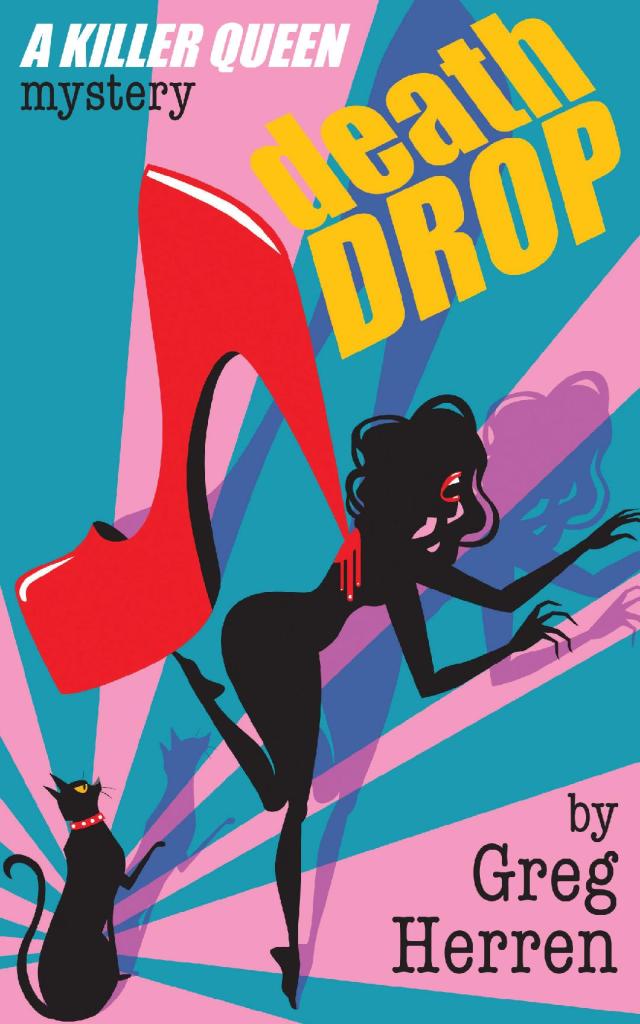
And isn’t this cover magnificent?
Bold Strokes always does well by my covers.
This title was actually originally the title I was going to use for Scotty IV (which ultimately became Vieux Carré Voodoo)–only back then it was Hurricane Party Hustle, and it was supposed to be set during an evacuation; I wanted to do something Man in the Iron Mask-ish, with the boys being hired by a gay man who was disfigured by having acid thrown in his face, to find out where his attacker–scion of a wealthy and powerful local family–has escaped to, and if the family was lying about not having any contact with him–and the whole thing would take place during an evacuation for a hurricane that didn’t come here; which was my primary experience with hurricanes at the time, and I always thought it was kind of an interesting and surreal thing to experience. There would also not be a lot of cops around during that time, either, which could make it even more fun and interesting.
Scotty III was delayed for a year because of personal problems and issues, but I finally turned in Mardi Gras Mambo a year and four months late; I also included the proposal for the fourth book, Hurricane Party Hustle, which I intended to be Scotty’s last hurrah. I would tie up all the hanging threads from Scotty III and bring the series to its natural close, at which point I was going to do something different; I was also planning on ending the Chanse series after one more book. I decided I was going to go back to school and get my master’s in creative writing, and maybe even a PhD. I got all of that set into motion, but within a couple of weeks, Katrina came along and blew up the lives of everyone in its path, and obviously, I couldn’t write a hurricane book for Scotty after the catastrophic failure of the federally built and maintained levees. I certainly couldn’t write anything funny. After a few years had passed, I decided hurricanes were not something I should write about2, and came up with another idea for Scotty–the movie star lookalike book, which I thought could be absolutely hilarious. But time had passed, and the publisher didn’t think Scotty had an audience anymore, so they passed on it. (I eventually used that for a Chanse book, only he didn’t look like the movie star, it was someone else.)
And every time I finish writing a Scotty, I’m never sure if I am going to write another. I never say never to him, though, the way I did with Chanse; I’ll always write Scotty if there is a way to make it interesting for the readers and challenging for me. I don’t want to write them by rote (which is where I felt I was going with Chanse), and so, yeah, as long as fun ideas that are challenging keep coming to me, I’ll keep going. I never want to get bored writing him, you know what I mean? That’s just not any fun. I decided to write this one as a challenge to myself and I am having a lot of fun with it.
And I changed the title from party to season; and have it take place during an actual hurricane in the city. Party just seemed too frivolous, and I don’t to give anyone that wrong idea.
I’ll let you know when it’s up for preorder, Constant Reader, and thank you for always reading him.
I also just remembered that my first friend, as a child, was named Scotty. Interesting. He was the first friend, come to think of it, who decided not to be my friend one day and never spoke to me again without me ever knowing why. Hmmm. ↩︎
I dealt with Katrina and its aftermath, as well as another hurricane evacuation, in the Chanse series, which I did finally end in the teens. ↩︎
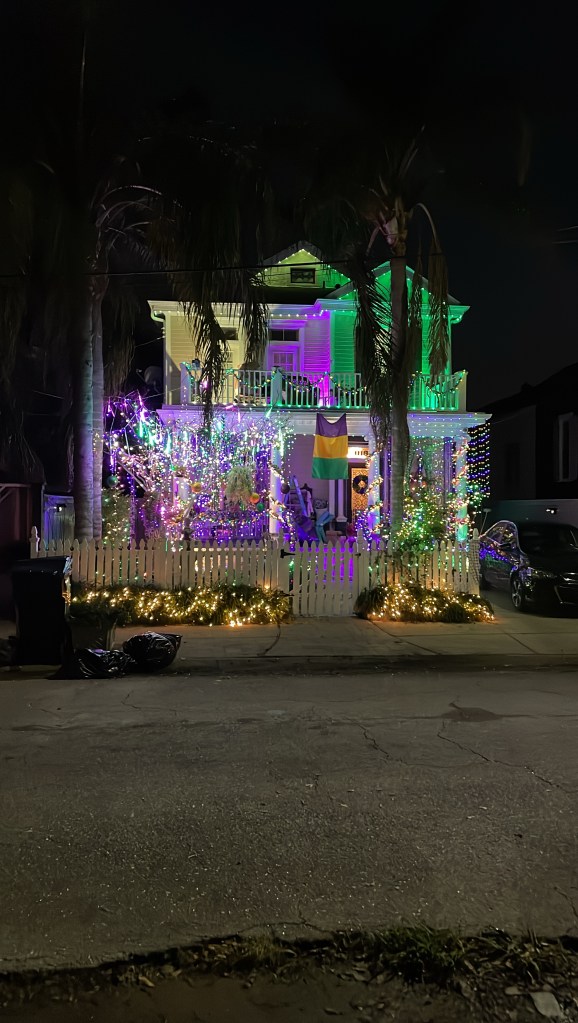
I really need to start taking walks around my neighborhood in the early evening to look at, photograph, and document the Christmas decorations. New Orleans loves holidays, loves costuming, and loves holiday-themed decor; everyone just goes to town for every holiday, and it’s one of the things I love about New Orleans. New Orleans always feels somehow more Christmas season-y than any place I’ve ever lived before, even though we very rarely have a white Christmas here (we did back in 2004); the only place that seems more Christmassy to me is New York–and that has everything to do with Miracle on 34th Street and Macys. When I worked for the airline I used to go to New York for a day every December and buy my mom an ornament from Macys–their Christmas floor was so amazing, always–but now I don’t work for an airline and Mom is gone, so that’s just another one of those nice but bittersweet memories now.
I’ve really been falling down on the job since the surgery about doing blatant self-promotion for Mississippi River Mischief; having major surgery within a few weeks of having two new books drop was perhaps not the smartest decision I have ever made. I always feel weird and uncomfortable doing self-promotion, anyway; I always think people don’t want to hear about this constantly and as you can tell, I’m not really good at it. I know I should be out looking for reviews that are positive and sharing them; but looking for positive reviews inevitably leads you to finding negative reviews, and at this point in time especially I have no interest in reading about how I’ve failed at my job. My books aren’t for everyone–but that doesn’t mean they suck, either. (If I don’t like a book I’m reading, I don’t finish it and I don’t talk about it; I simply say it wasn’t for me when/if asked.)
This enforced rest from the surgery has been an interesting time. I’ve read a lot–mostly short stories, some novels–and streamed a lot of things to watch, but I’ve also been going down a lot of wormholes in my own brain; trying to remember things with a memory that was already starting to fade a bit with age, but it accelerated dramatically after my COVID experience in the summer of 2022…I had already come to realize, recognize, and accept that my memories were faulty all along anyway; we always remember things differently than other people remember the same things because of who we are and how our minds work and how our experiences–and all those little things that make up our personalities and our perspectives–shape us into who we are. I like to paraphrase Joan Didion and say we tell ourselves lies in order to live–we don’t see ourselves as bad or as the villain in any given situation; we reshape events and remember them in ways that exonerate ourselves and push the fault onto others. Over the last years–pre-pandemic, I know that is the case if I can’t remember precisely when–I know I’ve been trying to look at occurrences in my own personal history and trying to be more objective about them all.
In some ways, that was where the story of Mississippi River Mischief came from; I wanted to deal with something from Scotty’s past that I’d brought up in one of the first books in the series (the long out of print Jackson Square Jazz, which hopefully will be available again in time for its twentieth birthday next year) and I’d always wanted to go back and reexamine that incident from Scotty’s past, with an older and much wiser Scotty reflecting on it and how it shaped and developed who he is–only to have it not be how he remembered it in the first place. It crossed my mind briefly while writing Royal Street Reveillon that “oh, the aftermath of this is a good place to deal with this thing from his past1,” and given how and why the underlying case in the new book comes to the Scotty and the guys, and what happened in the last book, this was the book where I had to go there and bring it all back. Yes, Jackson Square Jazz had been out of print since 2010, so the only way anyone could get it was from second-hand sources or libraries, so a couple of pages about Scotty’s past in an unavailable book–well, I did think for a while I wouldn’t have to dredge that up in this most recent book, but it didn’t take long for me to realize that I had to–it was cowardly not to deal with it and pretend I never wrote about it in the first place (especially since I’ve always intended for the book to be rereleased), and it fit in with not only the new story but what happened in the previous book.
And the fact that it was an extremely loaded subject made it all the more important that I address Scotty’s past–being seduced by his wrestling coach in high school–so that he could see it for what it actually was rather than what he remembered it as.
And the fallout will continue into the next one. (Yes, there are going to be at least three more, and I promise not to go four years between Scotty books again.)
Sorry, I’m trying not to give spoilers on a book that is almost six years old! ↩︎
Tuesday morning and it’s feeling a bit chilly in the Lost Apartment this morning. I am propping the brace on the edge of my desk so I can use both hands–and it doesn’t seem to bother the arm too much to use my fingers. I actually don’t feel any pain, but it feels a bit weird, if that makes any sense.
Yesterday was the first time I’ve felt like me again after coming home from the surgery. I cut up an old T-shirt (well, Paul did; one needs two hands to cut cloth) so I could fit it on over the brace without having to use the arm or move it; my left nipple peeks out every now and again, but that’s okay. Tomorrow morning is my first post-op visit to the surgeon, so I want to think about the things I need to ask about and write them down to take with me. It’s an early appointment–8 am–so I won’t be thinking as clearly as I would later in the day. I’m getting used to sleeping in the chair–I’ve been sleeping ten hours a night on average since that first sleepless night after the surgery, which is very-un-Greg-like, but I attribute that to my body recovering from the trauma of the surgery. I wish it would last forever, though, I really love sleeping.
Paul and I did go run those errands yesterday, and driving wasn’t an issue at all. I think the prohibition on driving in the instructions had more to do with the painkillers (which I don’t need) than any lingering after-effects of the surgery. It felt very nice to get out of the house, since I hadn’t even gone outside (I don’t think) since coming back home last Tuesday–hey, it was a week ago, wasn’t it? It seems like an eternity. I am very impatient to get through this, but of course you can’t rush recovery. I am trying not to get frustrated or impatient, but it isn’t easy for me–I haven’t gotten to the acceptance of things I cannot control yet, sadly–and my emotions are still all over the place. I had a couple of emotional moments yesterday which weren’t great–but those moments are also becoming fewer and farther between, which is a relief. I hate subjecting anyone to my particular brand of crazy, least of all Paul–who is usually the only person who ever sees it, and that is something I don’t like, either.
I didn’t write anything yesterday, the errands exhausted me, and so I spent the rest of the day in my chair. I watched a marvelous documentary series about film horror from Blumhouse–four episodes–which was a lot of fun but nothing really new that I hadn’t already known. It did give me an idea for a slasher thriller in two parts–the original occurrence than a revisitation ten years later; but the worry is, of course, that it’s been done already or I have nothing new to bring to the genre. It’s an interesting conundrum and puzzle I’d like to get figured out; one that will need to percolate for a while before actually getting to work on it. I always worry about how much preparatory work I do for my books, and I also worry I don’t do enough research for them, either. (I love research but also find it frustrating because I never know when I’ve done enough research, and as someone who is always spotting historical inaccuracies in all media…I don’t want anyone doing that to me or thinking that I’m a lazy researcher…although on second thought why the fuck do I care? There are always going to be those people, after all.) I was thinking about that very thing yesterday in terms of two other books-in-progress I’ve been working on for years; I’m not certain that I chose the proper career path given how my brain is actually wired–for someone who gets anxious to the point of shaking sometimes (it was really bad when I was a kid) why would you choose a career where you have to do things that trigger anxiety? I don’t ever get anxious about the day job, for example.
It’s weird but all this down time sitting in my chair unable to focus enough to read a novel (short stories are easier) has given my addled brain the opportunity to think and reflect. This whole past week has been an emotional rollercoaster–I think surgeries tend to make you emotionally raw to begin with–but I’ve also spent a lot of time grieving my mother since coming home last Tuesday. I was always able to engage my mind before and not think about it–even when I was too tired to do anything more than watch Youtube videos in the evening. But this forced inactivity is an entirely different thing, and I can’t seem to get control of my mind when it starts to wander. I’ve been thinking about my career and where it’s gone and where it may go in the future over this last week; my stubbornness at keeping going when maybe I should gave given up. I’m proud of all my work, and I’ve also come to accept that my old work maybe isn’t terrible the way I’ve always feared. I always approach rereads of my own work with my mind subtly shifting into editorial mode, and once I recognized that recently, I do go ahead and shut that off before I do read. I’m a different writer than I was twenty-two or more years ago, and I have always wanted to continue to improve, grow, and get better with each new story, book, or essay (I don’t care how bad these entries are, actually; it’s rare that I go back and revisit these); so of course I would write the older books etc. differently were I to write them today; that doesn’t mean the old ones aren’t good.
And honestly, how many award nominations do I need to get before I finally accept that I’m pretty good at this whole thing? That I have the respect of my peers?
I’m proud of all my work, but I also have preferences as far as that is concerned; some children I love more than the others. The ones I am not as fond of are the ones that I think I could have made better than they were; the ones I wish I had another pass at. That’s what I am thinking with finally re-editing and preparing Jackson Square Jazz for rerelease; here’s a chance to give it a bit more polish, make it come together better, and remove inconsistencies and continuity errors from the series as a whole. Reediting the manuscript is something I can do in my easy chair, and then I can slowly input the changes into the word document gradually until the entire thing is finished. Slow and steady wins the race, after all. I’m very happy, seriously, with my career as far as the work itself is concerned. I would like my writing to be a lot more profitable than it’s been thus far (what writer doesn’t dream of fame and fortune) but I couldn’t care less about the fame–I’ve always cared more about the fortune, actually; I’m pragmatic that way.
I’m hoping to write more today–after I finish this I have some emails to attend to–and I also have bills that simply must be paid so I can stop getting stressed about that, too. I don’t know how long I am good for in this chair sitting upright with the brace balanced against the edge, to be honest…but I need to give it a try. I am just not wired to be inactive, I guess,
Have a great Tuesday, Constant Reader, and I will see you again later.
Well, here we are on Monday morning after my surgery, and I’m not really sure what I’ll be doing today. I really need to pick up a prescription in Uptown, and we need to pick up the mail at some point, but I’m not really sure how I’m going to do that. I don’t know that I should risk driving yet, because New Orleans drivers are so horrible, but it has to be done and I need the prescription. I suppose I could take a ride service, but I hate spending the money as well. I guess I don’t have a choice though, so I’ll deal with that later. I also need to make groceries.
We had had an issue a few weeks ago with the apartment. They were doing some work on the patio deck above my kitchen, and unfortunately there was rotten wood up there. The ceiling kind of gave way; they ended up nailing up a piece of plywood over the hole in the ceiling. Unfortunately the next time it rained, of course, it leaked , but they finished the work up there and never came back to repair our ceiling. We had a massive thunderstorm Saturday night, and so i woke up Sunday morning to water on the floor in the kitchen, on the stove, and on the counter. The carpets in the kitchen were also wet; so I got out towels and a bucket for the dripping and hoped that the ceiling wouldn’t cave in. About two hours later, yeah, some of the plaster came down with a loud, startling crash, and so now there’s another hole in the ceiling. The insulation up there is soaked, so I had to leave the bucket for the dripping to continue. Needless to say, this is a really shitty time for this to happen and it spiraled me into a really bad depressive state yesterday. I have noted already that my emotions have been all over the place since the surgery — so something like this really sent me into a spiral. The anxiety really ramps up, so yeah, yesterday was just not a good day for me.
So, I repaired my easy chair with a Gatorade and Nurse Sparky and put on one of my comfort movies, Indiana Jones and The Last Crusade. I’ve always loved Indiana Jones, but I haven’t seen the most recent movie yet. I’ve always wanted to write an Indiana Jones type book; I love historical treasure hunts and have always thought that it would be fun to write those kind of stories with Colin as the main character — away from Frank and Scotty, to kind of fill in the blanks when he’s away from New Orleans. I have an idea that’s tied into the 4th crusade and the sack of Constantinople; a treasure hidden away in the Hagia Sophia since the Nicaean Council that established the dogma of Catholic Christianity. The Orthodox patriarchy had been keeping this treasure secret from the Pope and the Vatican for centuries, at least since the schism of 1052. My idea is that the Venetians and the Crusaders knew that the Pope would be furious to learn they had sacked Constantinople, but the Doge, Enrico Dandalo, not only knew about the secret but also knew presenting it to the Pope would get them forgiven. The primary problem with this is that I have never figured out what precisely was hidden in the Hagia Sophia; but I wanted to tie it into the Assassins and the Old Man of the Mountain. I thought that would make for a fun adventure, particularly setting it in a fictional Middle Eastern country. However, with everything that’s going on in the world nowadays, writing about the Middle East is probably not a good idea at this point.
I also read a lot of short stories over the weekend. I read all the stories in one of my Alfred Hitchcock Presents anthologies, Stories That Scared Even Me, and that was a lot of fun. The book was published originally in the 1960s or early 1970s and it is amazing how much attitudes in society and cultural attitudes have changed since that time. The contributors were almost entirely male — all of these anthologies are underrepresented with women — and there are a lot of really racist and patriarchal tropes in some of the stories. Several, for example, are set in Mexico; I’ll let your imagination do the rest rather than quote what they said so casually. I’m also writing a story set in Central America — I was writing it to submit to a horror anthology — and it was one that I had started writing back in the 1990s, I believe. I was kind of horrified by what I wrote — I feel like by the 1980s I should have known better about these kinds of tropes — but the story is salvageable; with some strong changes and a fictional country. But you can still get into trouble, even with that, and the last thing I ever want to do is write something problematic that will offend people. (I have already mentioned the story that I submitted to a anthology that’s not going to happen now about the South, which I recently reread and was horrified by.) A lot of these stories have those twisty type of endings that I always loved; that little hint of irony that really made the story sing. I always try to give my stories those kinds of endings because that’s what I grew up reading as far as short stories are concerned, and I often have to struggle to not try that with every story, because it’s not right for every story and I have a bad tendency to try to force things to work the way I want them to, instead of the way that they should work organically.
Dictating is much slower than typing, as I’ve noted before; this is taking me a lot longer to dictate then I would like. Where I actually typing this entry, I would probably already be finished by now. But you do what you have to do. I also started dictating my next book, figuring it’s better to get started on it while I’m at home recovering from the surgery, rather than waiting until such time as my left hand can be used for the keyboard. I’m still not having any pain — my primary issue is mobility, not being able to use my left hand for much, occasional nausea from the antibiotic, and the mood swings and depression. I wish I had already started on my anti-anxiety medication protocol before the surgery, but what can you do? Yesterday morning, I was thinking that I made a lot of bad decisions about this surgery and that I didn’t do it knowing everything that would result from it; but I was worried about not ever being able to go to the gym and workout again unless and until this was done, and pushing it back to next year wouldn’t have changed any of these issues, I don’t think, other than possibly better planning on my part. But that’s also part of the anxiety—I always question my decisions, and never really believe that I made the right choices afterward. I guess it is just a part of that hindsight being 20/20 thing that always drives me crazy. I never really am confident in the decisions I make, so I always try to not second-guess or doubt myself afterward; there’s no point in rehashing things that you can’t change. Why obsess over something I have no control over anymore? That’s the easiest way to drive yourself crazy, I think.
We’re also really enjoying the show Bodies on Netflix. It has everything that I like; a bit of science fiction, crime, surprise twists, and gay content. You can never go wrong with me when you have gay content. (That’s not entirely true; there are some really terrible shows in movies with gay content that are basically unwatchable) I also finished watching a Jane Seymour series on Acorn called HarryWild, which wasn’t great but was entertaining enough. I don’t know what all I’ve been watching to be honest with you, Constant Reader, but I’ve been watching an awful lot of television.
I did watch a terrible adaptation of Agatha Christie’s The Mirror Crack’d, and the less said about that the better.
I’m hoping today or tomorrow to be able to read a novel; I’m really enjoying the one that I was reading before the surgery and would like to finish it, but my mind is all over the place and has been since coming home from the surgery. I haven’t even been able to focus on the TV I’ve been watching as much as I would like. Part of it is the depression, part of it is the holiday without Mom, and of course, the surgery. You see how I am? I’m being hard on myself after a major surgery for not getting anything done or being productive. Heavy sigh. Welcome to the wonderful world of what goes on inside my head.
And on that note, I am going to bring this to a close and see if I can figure out what I’m going to do for the rest of the day, and what I can do about these errands. I hope you have a lovely Monday and as always, thank you for checking in and thank you for reading.
There are few things more Louisiana than rooting for LSU…unless its rooting for the Saints, maybe. Southern people love their football, especially the college variety.
Paul and I have not been to a game since 2021, when our “never saw the Tigers lose in person” streak, which began with the Mississippi game in 2010, came to an end with the only loss to Auburn in Tiger Stadium this century. We managed to make it through twelve seasons without ever seeing the Tigers lose while we were at the stadium, which is a pretty good run.
Chanse was an LSU alum–he even played football there–and I think I’d idly mentioned in the first book that he’d been injured in the Sugar Bowl in the last game of his senior year, and never elaborated more than that on his past at LSU. I think there were some more reflections in the second book in that series, but I know I never brought it up again after the second book in the series. I have an in-progress Chanse novella, which is set on the LSU campus at his old fraternity, but I don’t know if I’ll ever finish the story of the fraternity murder. As for Scotty, his background was so vastly different from Chanse’s that I couldn’t really send him to LSU. Men in his family on his mother’s side all go to Vanderbilt; his sister Rain went to Baylor. Storm did his undergrad at Vanderbilt but went to Tulane Law. Scotty of course flunked out of Vanderbilt (his parents rebelliously chose UNO), but the whole family on both sides root for LSU.
And of course, Valerie’s twin sons go to LSU in A Streetcar Named Murder.
I also make the point that the murder victim–a cousin of Scotty’s–in Mississippi River Mischief, along with his wife and kids, went to LSU; the wife was even a Golden Girl with the marching band (the kids are current students there). I built an entire Scotty mystery around the kidnapping of Mike the Tiger, the live mascot who lives on campus (Baton Rouge Bingo) and while I’ve not really done a lot of referencing of LSU in the Scotty series since that particular book, that is probably going to change with one of the upcoming books in the series. I roughly have plans for three more–one set during the summer of 2019, while the boys are living in the dower house on Papa Diderot’s estate in the Garden District; another during the cursed Carnival of 2020, and then a pandemic shut down book…and that just might be the end of the series. It may not be–I will probably keep writing Scotty books as long as I can type and the synapses in my brain still fire–but I am not going to rule out ending the series, either. Depending on what happens with my surgery and my recovery, I hope to write the next Scotty this coming spring.
And there are some things from this current book I’ll have to deal with in the next as well–as well as Scotty’s grandparents and parents aging. I’m thinking the cursed Carnival book will deal with a death in the Bradley family and the fall-out from Papa Bradley’s will. (I’ve only really gone into the Bradley side of the family once; and there’s a lot to unearth and explore there.)
I’m also toying with the idea of writing a book from Taylor’s perspective, and there’s always that Colin book I’ve been wanting to write forever.
So, if you want the series to continue, it will help if you order a copy of it!
The state’s nickname is “sportsmen’s paradise,” because all of the macho male outdoor sports–hunting, boating, fishing–are available here in abundance. We’re also called the Pelican State (most prevalent) and several other nicknames, not all of which are complimentary.
Louisiana has always been a conservative state, despite the existence of New Orleans. Originally French then Spanish before becoming American, Louisiana also was a part of the Confederacy and had an economy based on enslavement. We weren’t that far removed from David Duke’s gubernatorial bid (which came all too close to succeeding), and I remember Paul had gone on site visits with his boss at the Arts Council south of the city, and came home saying, completely in disbelief, that “people had yard signs saying ‘this is Duke country’–and me replying, sadly, “in the South they don’t bother to hide the racism–they see it as a positive.” But you cannot really go anywhere in Louisiana without being awed by the natural beauty on display here. I love Madisonville, and the Tchefuncte River area. It’s always a lovely drive to take 90 east when you head north (yes, I am aware I am saying you take an east-west highway to go north; welcome to New Orleans), and head out through the Venetian Isles area and drive along that narrow strip of land separating the lakes, crossing the Rigolets bridge and heading into Slidell.
A while ago, I was following a Twitter conversation about Burt Reynolds movies from the 1970s. Mind you, when I was living in Kansas our movie options were limited. There was a drive-in movie theater on the way from our little town Americus to the county seat of Emporia, and there was a small twin cinema on Commercial Street. The summer before my senior year Smokey and the Bandit opened on a Friday, and the following Friday Star Wars opened in the other theater. Both movies ran for about three months….so I saw them both repeatedly as there was very little else to do. The 1970’s were an interesting time for depictions of rural Southern sheriffs; Jackie Gleason hamming it up and going completely over the top. This was also the same time period that gave us corrupt politician Boss Hogg and the inept sheriff and deputies he controlled. These were always played for laughs, but the thing is–there really wasn’t anything funny about these types of characters in real life. Political and police corruption have always gone hand-in-hand in the Southern states; the police merely existing to enforce and enable the existing power structure. That Twitter conversation, along with reading Ethan Brown’s Murder on the Bayou and the various true crime documentaries about the Jeff Davis 8, put me in mind of writing about that kind of corruption. But I also kept wondering, but is this still true in the South? Do these kind of corrupt power structures still exist in the South? Would this read like a period piece?
And then the Murtaugh scandal broke.
Guess what? It IS still like this in the rural South. Thanks, Murtaughs!
I already had an idea for the next Scotty, and was pulling it all together, using a relatively minor political scandal here locally as the starting point for the story–which involved a conservative politician getting involved with a teenaged boy who worked at the food court at a mall, mostly buying him presents–clothes, underwear, swimsuits–and having the kid send him pictures wearing it. The age of consent in Louisiana is seventeen, and the kid was over seventeen, but while still being an icky thing, it wasn’t illegal–and they never did anything beyond that. It was mostly a harmless flirtation, until the kid, who was gay, realized that the nice man buying him gifts was actually a hardcore far right family values politician, so he went public. I still needed a murder, but I thought it would be simple to come up with one–the politician would have every reason in the world to kill to protect his secret, and he had his parish sheriff’s department to help commit and/or cover up the crime.
I did borrow two of the Murtaugh crimes for the book, but as starting points more than anything else, and came up with my own theories of said crimes for my own story–I wasn’t writing true crime, after all, and I wasn’t interested in proving the guilt of the Murtaughs. What I was interested in was exploring the decline and fall of a politically powerful family that had controlled a parish in Louisiana for well over a hundred years, almost like an absolute monarchy with primogeniture. I had also originally started the story with the kid coming to Scotty and Frank (through Scotty’s old buddy and former workout partner, David, who now teaches at NOCCA) because he gets a text from an unknown number which contains one of the pictures he has sent his older male friend (that he doesn’t know is a family values politician), and is worried about his own future if the information comes out. I wrote an entire draft of this story, but it didn’t work and I didn’t care for it…which was when it clicked into place: use two of the Murtaugh crimes to start with, and built it out from there. I decided that the kid at the mall wasn’t the original target of the politician, and that the original target was killed in a hit-and-run accident the year before; I also used the boat crash, turning it from a boat hitting a bridge to a pick-up truck hitting a bridge and pitching the passengers in the back into the bayou.
I also liked the teenager/older man dynamic, because it had played out with Taylor in the previous book–and Scotty had his own past with an older man when he was a teenager, which I was finally able to circle back around to.
I also invented the parish–surprisingly enough, there is no St. Jeanne d’Arc Parish in Louisiana–but it’s based loosely on what are known as the bayou and river parishes (Terrebone, Lafourche, St. Charles, St. John the Baptist). I already had a fictional parish on that side of the river (Redemption), but I decided Redemption wouldn’t work for this book, so I made it a neighboring parish.
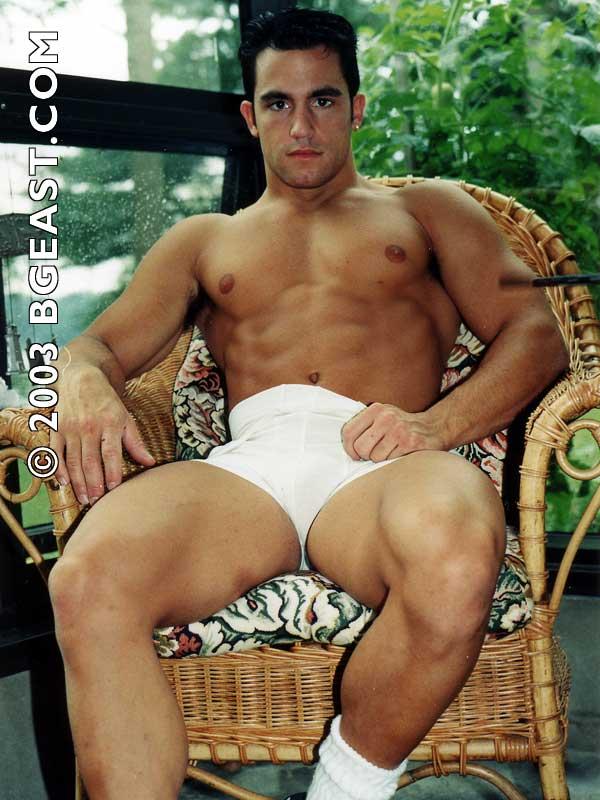
Whenever I am writing or creating a character, the first step I need to accomplish in order to keep going with them is that I need to know what they look like in my head before I can start. The first step is for me to know what they look like. I generally use real people are models for a starting point for my characters–but they do evolve from that initial “how they look” base and extrapolate the rest of their appearance from there. I also don’t base characters on real people, for the record–because you can’t. You can never base a character completely on someone else because you can’t get inside their head or know all of their life experiences and the things that shaped who they are and why they do the things they do.
This is the base-line physical model for Scotty I used when creating him. Scotty’s evolved since then.
This wasn’t the base model for Frank, but you get the idea; he’s pretty close to what I pictured.And this is where I started from with Colin.
I don’t base characters on real people because it’s impossible to do–you can only base a character on your perceptions of who that person is; you cannot know every experience they’ve had, every trauma, every event that occurred that shaped and changed and evolved them into who they are. This is why people–even ones you think you know really well–will always surprise you at some point. I’ve lived with Paul for twenty-seven years and he still surprises me. I didn’t know any of these men–all models for BGEast.com–at the time and of the three of them, the one I actually know is the one whom I didn’t actually use as the physical model for one of the three, and I didn’t meet him until the first three books were already in print and available.
But when I was creating Scotty, I wanted the readers to have fun with the books. I didn’t want to write anything dark or tragic or heavy; I already had the Chanse series to do that with. Chanse was a six foot four two hundred and twenty pound mass of neuroses, insecurities, cynicism, and bitterness; I really didn’t want to do that again because what would be the point of doing two series that were exactly the same? I wanted them both to capture the feel and spirit of New Orleans, but from very different perspectives. Chanse wasn’t happy about being a gay man; he was still struggling with it in the first book and slowly became resigned to it, rather than embracing it. Once Scotty told his parents and came out to them, he never looked back and started looking for his joy. Scotty’s family loved and embraced him as he was, and other than both sets of grandparents cutting off his access to his trust funds when he flunked out of college–which has nothing to do with him being gay; that was an attempt to get him to go back to school. The trusts were originally set up to become his when he turned thirty anyway, so he never really had to worry about the future–which is an incredible privilege. Even working as a personal trainer and some-time go-go boy for the money wasn’t that big of a deal; his landladies were family friends who’d never evict him in the first place and his parents would always come through for him anyway.
I also made his siblings the same as Chanse’s–I don’t know if that was intentional or not, but while Scotty is the youngest with an older brother and sister, Chanse was the eldest with a younger brother and sister he isn’t close to. Scotty’s family was tight, while Chanse’s was not. Chanse’s sister is married to an accountant for an oil company and lives in Houston; his brother still lives in their hellhole of a small city, Cottonwood Wells (small city, large town; I am never sure which is the right one) and I broached their relationship in the short story “My Brother’s Keeper.”
And I had Scotty live in the French Quarter as opposed to Chanse’s apartment on Coliseum Square; Scotty is that rarity in New Orleans–someone born and raised in the Quarter. Chanse was an import from Texas who moved to New Orleans after graduating from LSU; Scotty has always been here other than the two failed years in Nashville at Vanderbilt.
I wanted him to have absolutely no hang-ups or issues about being a gay man. I wanted him to embrace his sexuality and enjoy his sex life and have that Auntie Mame mentality of “life’s a banquet and most poor suckers are starving to death”; Scotty wants to have fun and enjoy his life. He doesn’t think he’s ever destined to find a boyfriend or life partner in the first book–he’s too unabashed a slut1 who loves getting laid and doesn’t want to tie himself down, plus most men he meets tend to be too serious for him. Scotty has no hang-ups or issues about his body, either. As a wrestler in junior high and high school his body became strong, muscular and lean; he never says whether he thinks he’s attractive or not–he says other people seem to find him irresistible in the first book, and he admits he doesn’t see what others see but they see it so okay. He’s become more serious as he’s gotten older and as he’s dealt with bad things–but he doesn’t go into a depressive state or withdraw from the world when bad things happen; he faces them head-on, and his motto (life doesn’t give you anything you can’t handle–it’s how you handle it that matters) is one we could all aspire to, really.
While taping Susan’s show last week I did say that Scotty was the idealized version of myself and the life I would love to have–sans the murders and kidnappings and shootings, of course–and naturally a lot of his traits have come from within my own mind; but while I find his mentality and life view aspirational, I often fall short. Scotty has a genuine kindness to him as his inner core that I don’t always default to, much as I wish I could and did. I am a lot more like Chanse than Scotty, even if they are kind of different aspects of my personality and who I am.
It’s sometimes hard for me to wrap my mind around the fact that I’ve been writing Scotty now for twenty years. Bourbon Street Blues came out on May 1, 2003. Twenty years of Scotty books, but only nine–like one every other year rather than every year.
And I also sometimes wonder if my subconscious somehow keeps track of Scotty, because I keep discovering things about him that I wrote years ago that were just kind of throwaways that now I can circle back to and create story arcs for these character traits and personal histories for the newer books.
There’s also a scene in Bourbon Street Blues where he proudly states he doesn’t have sex for money because he “prefers to keep (my) amateur status.” ↩︎
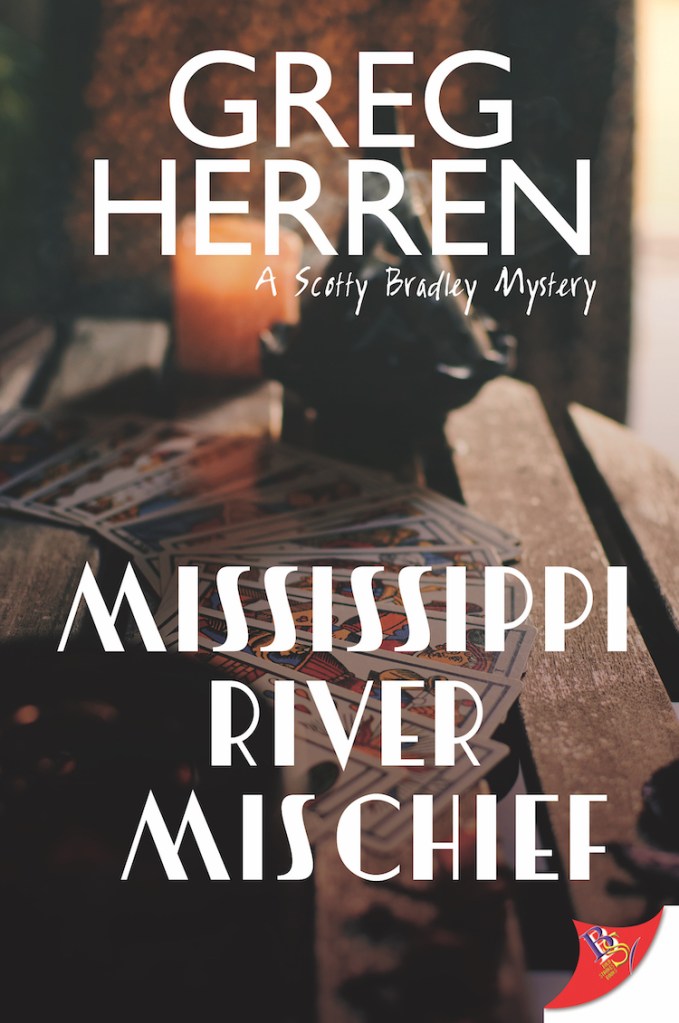
As if you weren’t sick of my self-promotion already, now I get to start promoting Mississippi River Mischief!
It’s hard to believe that this is Scotty’s ninth adventure. Not bad for someone who was just supposed to be a one-off, a stand-alone comic madcap adventure that took place during Southern Decadence. The idea for it came to me at Southern Decadence in 1999; on Saturday afternoon I somehow managed to get a prime spot on the balcony at the Parade to watch the massive crowd of sweating shirtless men partying down below at the intersection of Bourbon and St. Ann. I noticed a really hot guy wearing sweats and carrying a gym bag fighting his way through the crowd to get to the Pub downstairs, and I recognized him as one of the dancers for the weekend. In that instant, I had a mental flash of a dancer being chased through a crowd of shirtless sweating men at the corner by bad guys with guns and the dancer only wearing a lime-green thong. I held that idea in my head, and sometime later that weekend Paul said to me, “you know, you should write a book set during Decadence,” and I grinned and replied, “I already have the idea.” I had started writing a short story called “Bourbon Street Blues” a year or so before this; but realized that would make a better title for the stripper crime caper during Southern Decadence, so I made a folder for it and kept it in my files and in the back of my mind. Several years later, when talking with an editor about something else when I worked at Lambda Book Report, I asked if that might be something he’d be interested in. He said send him a proposal, which I did–having no clue what I was doing–and they offered me a two book deal, turning my stand-alone into a series. Having no idea how to write the second book in such a series, the money was too good for me to say no or to quibble, figuring I’ll figure it out when I need to–which is really the motto of my career.
The Scotty series has always had a bit of a “pantser” feel to it for me because I’ve always pantsed it. I knew that the first adventure–Bourbon Street Blues–was going to be that Southern Decadence story, and I also knew I was going to fictionalize a governor race, basing it on a senate race that occurred when we first moved here and we couldn’t believe that one of the candidates was actually a serious candidate (sadly, he was just a harbinger of what was to come in Louisiana; now he’d seem like one of the fucking sane ones), and I kind of borrowed, a bit unconsciously, from the Stephen King character of Greg Stillson from The Dead Zone. Bourbon Street Blues was a prescient novel in so many ways–and I had no idea of that at the time, seriously. There’s a scene where the Goddess shows Scotty the potential flooding of New Orleans after a levee failure (in the book it was deliberate though) and of course I predicted the Right’s move into full-bore hardcore neo-Nazism as well in that book…never dreaming it would become a reality.
Scotty has always been a fly-by-the-seat-of-my-pants series; I’ve never really outlined or planned the books or the series in any way, other than an amorphous idea that the love triangle situation I created in the first book would take three books to resolve. During the course of the third book I realized I needed at least one more book to resolve that story, and so it went from stand-alone to trilogy to quartet…and then Katrina happened. Katrina created an unplanned gap in the series, and I never really knew how to do Katrina from a Scotty perspective. It struck me that they wouldn’t have evacuated, but Scotty wouldn’t have ridden the storm out in his apartment, nor would his parents have done so at their place; they would have all gone to the Garden District where Papa and Maman Diderot have a generator. I just didn’t see how I could write a funny Scotty book about the levee failure and the city’s destruction. Also, we learned something about Scotty in the second book (Jackson Square Jazz) that I meant to deal with in the fourth book. By the time I was ready and able and willing to write that fourth book in the series…well, I forgot that I’d planned on dealing with that issue from Scotty’s past in it, and never did ever circle back around to that resolution of something from his youth.
I did remember when I decided to write Mississippi River Mischief, though. I kind of wrote myself into a corner with Royal Street Reveillon, in which something happened in Scotty’s personal life that was tied into the case, but I couldn’t write another book and pretend that never happened, even though it would be hard to deal with in the text of the book and story. But then, as I was trying to work it out in my head, I realized now you can circle around back to that issue from Scotty’s teen years because this is the right place and time for him to be reminded of it because of what happened to Taylor.
And you know what? I think it made for a better story now than it would have almost fourteen years ago.
Scotty has grown a lot over the twenty or so years (!!!) I’ve been writing him, but who he is at his core has never changed. Scotty is a good person, with a genuine sense of kindness, and is pretty level-headed and never really lets things get to him the way I let things get to me–and God knows, he’s dealt with a lot more shit than I have in life. I like his sense of humor, I like his spirituality, and I like his untrained, he-doesn’t-know-how-it-works psychic abilities, and of course, I love his family. His parents are amazing, his older brother and sister are also pretty cool characters, and of course Frank and Colin are also fun to write. I also never knew how subversive I was being by creating a throuple long before anyone ever talked about these kinds of relationships within the queer community–and it’s lasted all these years. There have been ups and downs, of course, but they always wind up coming back together again no matter what happens–and a lot has happened. Both Scotty and Frank have been shot a few times, not to mention all those car accidents–and he’s also helped cover up a crime (no spoilers here, no worries!).
(NOTE: I started writing this post back in January, after I’d returned to New Orleans from my last Mystery Writers of America board meeting–this is to give context to the opening paragraph– as you are no doubt well aware, Constant Reader, that I’ve not been back to New York since January; so this is that same trip where this happened and I started thinking about these things, which have never been far out of the forefront of my mind since then.)
While I was in New York recently, walking around to and fro, here and there, hither and yon, I was always checking my phone (and yes, I hate that I’ve become one of those people) and then shoving it back into my pants pocket without putting it to sleep first or closing the app that was open. As I walked around, of course this led to my phone doing all kinds of weird things –closing an app and opening another, etc.; but at least there were no butt dials, right? At one point, when I pulled out my phone as I took a seat on the subway, somehow what was open on the screen was a google search for my book A Streetcar Named Murder–and when I went to close that screen I touched one of the images by mistake, which took me to the Goodreads page for the book. Bear in mind, I never look at Goodreads for any of my books, let alone Amazon–the temptations to start reading the bad reviews is too great, and while I can usually laugh them off, occasionally–and it depends entirely on my mood, of course–one will get under my skin and it will annoy me, and that’s not good for anyone.
This particular day on the subway the Goodreads page opened to the bad reviews first–its average is four stars, which I will always take because I am not Lauren Hough–and the very first one made me laugh out loud on the subway. Paraphrased, it was basically someone taking umbrage at “someone who doesn’t live here or know the first thing about New Orleans” writing a book about New Orleans. The reason they had come to this conclusion was because Valerie referred to Mardi Gras as “Fat Tuesday”, and according to this one-star reviewer, no one from New Orleans would ever say Fat Tuesday instead of Mardi Gras.
Well, I’ve lived here for twenty-seven years and I have heard any number of locals say Fat Tuesday rather than Mardi Gras, and so of course I had to click on the reviewer’s profile…and grinned to myself when I saw that they actually live in Metairie, not New Orleans…which to locals is a bigger crime than getting something wrong about New Orleans: claiming to be from New Orleans when you actually live in Metairie. (the rejoinder is usually along the lines of “bitch, you live in Metairie.”)
It was also kind of fun to be accused of inauthenticity when it comes to writing about New Orleans, because I personally have never claimed to be an expert on anything New Orleans (others have said that about me, and I always am very quick to reply not even close); the more I learn about the city the more I realize how little I actually know about the city. There’s an extremely rich (and often incredibly dark) history here; it’s hard for me to wrap my mind around the fact that the New Basin canal was there as long as it was, or that there were several train stations around the French Quarter (including one that essentially was in Storyville–rather convenient for the whores and pimps, right?), or that where UNO is now used to be the lake shore resort of Milneburg, or that the only way across the river or the lake was by ferry until Huey Long built a bridge at the Rigolets (the narrow inlet between lakes Pontchartrain and Borgne).
I was on a panel once at the Tennessee Williams Festival with Bill Loefhelm (if you’re not reading Bill’s books, shame on you and correct that immediately) and the question of New Orleans authenticity came up, and Bill’s response (paraphrasing) was that New Orleanians have a tendency to play a game called “NOLier than Thou,” in which they try to one-up each other to see who the true New Orleanian actually is–which is, of course, gatekeeping. (And yes, I immediately turned to him and said, “I like that and am going to steal it” SO CONSIDER IT STOLEN.)
It does bother me somewhat when I read books set in New Orleans written by people who have never lived here; you can tell, but I also get over it pretty quickly; who is to say who can and can’t write about a place? There’s a significant difference between visiting and living here, which I realized almost immediately after we moved here, and that also becomes very apparent in fiction. I had started writing the book that would become Murder in the Rue Dauphine before I moved here, and I realized, once I did live here, that everything I’d written about New Orleans was completely wrong. I didn’t work on the book for another two years; and even then I wasn’t entirely sure I’d lived here long enough to write about the city. So…I kind of cheated by making Chanse MacLeod not a native either; he’d moved to New Orleans after getting his degree in Criminology from LSU, and had been here about six or seven years when the story opened. So he was an outsider, too; so his views on the city and how things work around here were from an outsider’s perspective, like mine; that was easier. With Bourbon Street Blues, I decided that Scotty was not only a native but came from two old-line society families, from the Garden District and Uptown. One of the greatest joys of my publishing career was having the Times-Picayune’s mystery reviewer, as well as the Books Editor, both say repeatedly that I got New Orleans right in my books. (Thanks again as always for all of your support, Diana Pinckley and Susan Larson!)
And I never really worried about it too much from then on. I wrote about New Orleans as I saw it–the potholes, the cracked sidewalks, the leaning houses, flooding streets, oppressive weather and hurricanes. As the years passed, I became more and more aware that my New Orleans writing was primarily confined to the Quarter, the Marigny, the CBD, the Lower Garden District, the Garden District, and Uptown–a very narrow slice of the city, but those were also my slices of the city, so that’s I wrote about. Sometimes I’d venture into another neighborhood–Lakeview, the Irish Channel, English Turn–and sometimes the story would take the characters to another part of Louisiana–the bayou and river parishes, the Maurepas swamp, the Atchafalaya Swamp, Baton Rouge–which, oddly enough, I had no qualms about fictionalizing. I’ve created numerous fictional towns and parishes surrounding New Orleans; I’ve even invented a sleazy gay bar in the Quarter (the Brass Rail).
So, was I doing New Orleans (and Louisiana) right by making stuff up, inventing places like the Royal Aquitaine Hotel, the Brass Rail, Bodytech Health Club, Riverview Fitness, etc.? Sometimes you have to fictionalize things, even if they are based on something that really exists. I never really thought much about it; I felt like I was getting the feel of New Orleans right, that my characters talked the way people in New Orleans do and react the way people here do, and that I was putting enough reality into the books for them to ring true to locals, natives, and tourists. Sometimes the cases are based on, in or around something that actually happened or exist; like the Cabildo Fire, the Fire at the Upstairs Lounge, Hurricane Katrina and the ensuing flood; termite swarms; Huey Long’s deduct box; and even the court case in, I think, Murder in the Irish Channel that triggered the murders was actually based on a civil trial I served as a juror on.
When I started writing A Streetcar Named Murder, I realized a lot of things I was writing about had to be fictionalized; I couldn’t set a murder at a Mardi Gras krewe ball and use an actual krewe that exists in real life, for one thing (like I had to invent a French Quarter hotel for a couple of murders to occur in) and while I didn’t want to use the cheat that Valerie had moved here again, like I did with Chanse, I wanted her to be of New Orleans but not be of New Orleans…so her parents are from Georgia and moved here after college and marriage, so Valerie was born here, went to school here, met and fell in love with and married her husband here–but her roots aren’t very deep, so she is both insider and outsider at the same time. I liked that idea; like how I am of the South but not of the South, she was of New Orleans but not of New Orleans at the same time. When creating Jem Richard in Death Drop, again, he’s a recent transplant to the city but his father is from New Orleans but relocated to Dallas, where Jem was born and raised. Jem spent a lot of his summers in New Orleans when he was growing up with his paternal grandmother, so he too is of New Orleans but not of New Orleans; which I am really liking as a method of storytelling about the city. I also moved Jem to a different part of the city; he lives in the 7th ward, on St. Roch Avenue in what is known as the St. Roch neighborhood (aka what realtors are trying to redefine and rename as the “new Marigny”, in order to raise prices) which is also very close to my office. Part of this was to move the action out of the neighborhoods I usually write about (although he does wind up in both Uptown and the Quarter) and so I could explore another neighborhood/part of the city than what I usually write about.
I also had recently–prior to the pandemic–started feeling more disconnected from the city than I ever had before. Primarily I think this was due to my office moving; we had been on Frenchmen Street in the Marigny, one block from the Quarter and where Scotty lives, so whenever I needed some Scotty inspiration I could walk a block, stand under the balconies of his building and just look around, drinking in the sights and sounds and smells of the block. To get past this, I started joining New Orleans history pages on Facebook, like Ain’t Dere No Mo New Orleans or the HNOC page and various others–you do occasionally run into Confederate apologists and racists there (they usually cry about the “crime” in New Orleans–you know, the usual dog-whistles from the white flight racists who fled to Jefferson Parish or the North Shore to escape desegregation of the public schools) and reading more histories of the city, state, and region–which are incredibly fascinating. That reading/research helped me write my historical Sherlock in New Orleans short story, “The Affair of the Purloined Rentboy”–but I have also since realized I got some things wrong in the story too, but there is just so much to know. I set the story in 1916 for example….without knowing New Orleans was hit by a MAJOR hurricane in 1915 that wiped out any number of settlements and villages around the lakes and the bay shores (that will turn up in a story sometime; the destruction of the lake front village of Freniere is just begging to be fictionalized and written about). When I mentioned this to another writer, who primarily does historicals, she snorted. “It’s impossible to know everything, and would people in 1916 still be talking about a hurricane from 1915?”
Probably, but if it doesn’t have anything to do with the story being told, why would I mention it?
A very valuable lesson, to be sure.
So, yes, lady from Metairie: you caught me. I’m not from New Orleans, you’re correct. But I’ve also published over twenty novels and umpteen short stories set here, and have even won awards for doing it.
And I’ll call it Fat Tuesday if I fucking want to.
The Huey P. Long Bridge at sunset, photo credit Marco Rasi
So, Greg, you have a book coming out from a new press in October, and the main character is a drag queen? What the actual hell?
Well, therein lies a tale.
I never thought I would write about a drag queen, in all honesty. It’s not that I’m opposed to drag or anything like that; drag has always been an important part of gay culture (I really wish someone would do a history of drag that’s not academic in tone and therefore accessible to everyone without a PhD) and I’ve always appreciated it as an art form. Yes, some queens are better at it than others, and there are some who are just really tragic…but I admire and respect every single one of them who puts on the dress and wig and heels and make-up and goes out there to perform. My own anxiety manifests itself whenever I have to perform or speak in public (although I managed to successfully control it and get through Boucheron panels swimmingly; I don’t think my stage fright is a thing of the past yet but I’m getting better); I can’t imagine the courage it takes to do drag that first time.
I also never considered doing drag because of my vanity–I wouldn’t look pretty in drag and I would want to be pretty. Shallow, party of one, your table is ready. I’ve seen many performances over the year and even have friends who do it, but my primary interest in drag has always primarily been in it as an art form and political statement critiquing gender roles, masculinity, and femininity; and it holds a very important place in queer culture. I once did drag, for a Showgirls-themed birthday party–I looked like Stockard Channing, which isn’t a bad thing–but it was more of a costume than a real attempt at doing drag. My friend Mark always wanted to make me up for Halloween or Fat Tuesday as Joan Crawford–it was the shoulders, the eyebrows, the narrow hips, and the shape of my face more than any striking resemblance to Ms. Crawford, I think–and while I was interested in being transformed into Ms. Crawford, one of the things I hated the most about doing plays in high school was the make-up. I hated having that shit all over my face, and it never did what it was supposed to in the first place (I inevitably always played old men, so they had to try to age me, and it’s not like we had make-up artists who knew what they were doing in high school.). And the padding? The wig? The dress? Not to mention the lack of pockets and the difficulty in using the bathroom– yeah, not for me. Drag does show up in my work sometimes–not very often–and the most fun thing for me about that is coming up with drag names for the characters. I know I’ve used Floretta Flynn a number of times, to the point where in my New Orleans universe she’s probably one of the bigger and most successful queens in New Orleans. Two of the biggest names in drag came from New Orleans–Varla Jean Merman and Bianca del Rio are both from here. We used to go to Drag Bingo hosted by Bianca and Blanche Debris at Oz on Sundays before she left for New York after Katrina–and Bianca was just as funny and just as big of a bitch then as she is now. She always drew crowds, and of course I met her a few times out of drag (I am quite sure Roy doesn’t remember me).
And believe me, I was very careful not to attract her attention while she was holding a microphone.
I also once wrote a short story that opened with one character saying in the Clover Grill, “You sure see a lot of tragic drag in this town at four a.m.”
Paul and I also were fans of RuPaul’s Drag Race for awhile, too–but like Project Runway, we stopped watching one season when it was obvious that it wasn’t being judged fairly (it was fucking blatantly obvious) and that was it for us. Don’t serve me competition reality when the competition is obviously rigged for a particular competitor. I do love some of the queens we did watch on there–it’s been amazing watching Jinkx Monsoon’s star take flight–and I always liked Tatianna, and just to name a few–Ben de la Creme, Adore Delano, and Manila Luzon are all fabulous. Paul follows a lot of them on Youtube, and of course I do enjoy Trixie and Katya’s We Like to Watch on Netflix.
And naturally, we love Bianca because she’s a New Orleans queen.
But it never crossed my mind to write about one as a main character. It wasn’t my milieu, so to speak (and just typing that made me want to bang my head on my desk. Take risks! I should always take risks in my work!), and so while every once in a while I’d think “maybe I should write a drag queen into this story”, I never did.
Last summer, I am not exactly sure when (2022 was pretty much a blur of misery), I got an email with a request for a ZOOM meeting with two very dear friends, along with another friend of theirs I may have met once over twenty years ago, James Conrad. He wrote Making Love to the Minor Poets of Chicago back in the days when I was a reviewer/worked for Lambda Book Report, and the purpose of the call was they wanted to talk about a possible project for me. You know me, I am always up for a new project and a new possibility…so you can imagine my surprise to find out what they wanted was for me to write a cozy with a drag queen main character. James owns and operates the Golden Notebook bookstore in Woodstock, and decided to start a publishing company through the store and wanted this to be their first venture into crime. I pointed out that I a) knew next to nothing about drag and b) I’m not really a cozy writer (the Scotty series can be classified that way except for a lot of cozy rule-breaking; and yes, I did write A Streetcar Named Murder, which wasn’t out yet and I wasn’t sure if it was even any good), they pointed out that I am a writer who can write anything (this is true, but there are some things I can’t and won’t ever write–and yes, as I typed that I was thinking there you go limiting yourself again–maybe those are the things you should be trying to take on), and then I also remembered a few things–some of my co-workers at the day job do drag, and in fact, my former supervisor had attend a “drag school” here locally, started by a queen who’d retired here from San Francisco after a lengthy and successful career in drag; Paul even knows the queen who runs it. I sent James an early electronic uncorrected proof of Streetcar, so he could get an idea of my writing style, and waited to hear back.
While waiting, I asked some of my co-workers if they’d be okay with me asking them questions–which of course they were more than happy to do–and the more I thought about it, the more it made sense for me to approach this in the same way I approached writing Streetcar–I knew nothing about antiques, so I made my character the same. So, if I am going to write about a drag queen, I needed to write her origin story first–and I decided to make her an accidental drag queen; forced to step in when a queen doesn’t show for a performance. But how would that work? I realized my character had to already know about hair and make-up, so I decided to make him a glam artist, hired to do make-up for women on special occasions and styling them. How did he wind up doing glam? His grandmother, who was from New Orleans, used to have her own Uptown beauty shop on Magazine Street that was frequented by upper class New Orleans women, who would also hire her for special occasions to style them. He spent his childhood summers in New Orleans; his grandmother was the only family member who had no problem with his sexuality, and she taught him all about hair and make-up (and classic Hollywood). He went to cosmetology school instead of college (his grandmother paid for it) and he worked in a high-end salon in Dallas until his grandmother died, leaving him the house and most of her money.
I also had a great idea for the opening, which I quickly wrote up and James liked it…and so we moved forward with the plans for it. I had a Scotty book under contract, and I knew I could juggle the two and get them both done on time.
Of course, I didn’t realize how much work it would be to turn MWA over to my successor, I didn’t know Mom was going to go into the final decline ending with her death during this time, and….well, hindsight is twenty-twenty, isn’t it?
“I don’t know, Jem,” Lauralee Dorgenois said, frowning and raising a perfectly plucked eyebrow as she looked back over her shoulder into the three-way mirror set-up in her dressing room. “You’re sure that this dress doesn’t make my butt look big?”
Okay, I’m going to take a sidebar right here to give y’all some free-of-charge advice that is more than worth its weight in gold. There is only one correct answer to be given without pause or hesitation any time a woman asks you if something she is wearing makes her butt look big: “No.”
You always, always,ALWAYSsay no.
If that is, in fact, a lie—you say “I don’t know if that cut drapes right” or “I don’t like what that color does to your skin”.
There are literally a thousand other options besides making the incredibly foolish mistake of saying ‘yes’ or the seemingly safe, non-comital ‘maybe.’ Marriages, engagements, friendships, and relationships have all ended over this question being answered incorrectly—and no, it’s not a trap question. Women are bombarded from childhood with images of what they are supposed to look like and what they are supposed to wear. They are taught to fear fat cells and fatty foods, spend millions on diets and gym memberships and personal trainers. They are gaslit into thinking that being any size larger than zero and not having big firm breasts and not having a wrinkle-free face aglow with the dewiness of youth means they are doomed to grow old alone and unloved. So, they try to fight aging—and the fear of being traded in for a younger model—by having poison injected into their faces, excess skin surgically removed, and their hair constantly colored and touched up. Centuries of societal and systemic misogyny, of telling women they don’t measure up, echo in those sad, simple words: does it make my butt look big?
My heart breaks a little every time I hear them.
However, I get paid to make them look good. My opinion must be honest, but I still need to be delicate. Why be hurtful when you don’t have to be?
I tilted my head to one side and brought my eyebrows together as I looked her up and down yet again. “You’re curvy, Lauralee,” I replied finally, fluffing the peacock feathers on her shoulders to spread them out further. It was true. Lauralee was about five seven, and maybe could stand to lose a pound here and there. Her hourglass figure had thickened a slight bit once she hit forty, but it was barely noticeable. I’d picked out a green silk dress for her because the color made her green eyes sparkle like emeralds. It clung perfectly to her hips and was cut low in the front to shove off the ample bosom, highlighted by an emerald pendant handing from a gold chain just above the cleavage. I’d braided her long auburn hair into a French braid that dropped about half-way down her back. I’d woven some extra pieces of auburn into the braid to make it thicker. “And there’s nothing wrong with that, you know. We’d put Marilyn Monroe on a diet today.”
Several years ago, I tried writing a third series set in New Orleans with a gay male protagonist. It was a character I had already created; he showed up in a couple of Scotty books: true crime writer Jerry Channing, who’d gotten rich on a true crime novel about a child murder case in the Garden District in the 1990’s called Garden District Gothic, (which also became a Scotty title when he and the boys got sucked into that ancient cold case) and wound up solving it. I had wanted to write a fictional story based on the very real Jeff Davis Eight murders, and thought who better to center in the story than a true crime writer researching the case for an article or perhaps even a follow-up book than Jerry Channing? But as I started developing the character out from the sketchy details provided in earlier Scotty books, I suddenly realized what I was actually doing was combining Chanse and Scotty into a single person, so I shelved the story–or at least, the new series, because if all I was going to do was just merge two previous characters into one, there was no point in bothering. I had then gone on to create a new series with a straight woman as the main character (A Streetcar Named Murder), and I was determined that, with this new potential series set in New Orleans, the last thing I needed was to just rip-off previous characters.
So meet Jem Richard, twenty-something glam artist and New Orleans home owner. Jem lives in the 7th Ward (not far from my day job office, actually; over on St. Roch Avenue between Claiborne and St. Claude), and the house flooded during Katrina–Jem remembers coming down with his family to help work on the house for his grandmother, Mee Maw of sainted memory–and I gave him a pole-dancing roommate who also works at Crescent Care. (Another Easter egg is the book opens with Jem being enormously disappointed to be ghosted by someone with whom he had several dates –a Tulane grad named Tradd. Bury Me in Shadows readers may remember Tradd as the asshole who broke up with Jake and sent him into the alcohol/drug spiral that landed him in the hospital when that story opens. I also want to use Tradd again somewhere else…but that is indeed a tale for another time.) Jem does well for himself, but has no health insurance and never is guaranteed work–but he also really doesn’t want to go back to working in a salon again, either. (He also sometimes books gigs with film, theater and television companies.) He’s kind of a lost soul, not really sure what he wants or what he wants to do with the rest of his life–but he also is lucky: he owns his own home, for one, and has several marketable skills. He kind of feels like he’s been spinning his wheels and not getting anywhere since coming to live in New Orleans. Jem has considered doing drag before–he’s very into costuming, and has won the Bourbon Street Award for Best Drag Costume on Fat Tuesday the previous two Carnivals–but he (like me) is haunted by stage fright. He did a play while in high school and the stage fright was such a horrible experience he gave up his dream of being a performer and started working as the make-up and hair person for the school productions.
So, when he’s hired to be a back-up glam artist for a fashion show at Designs by Marigny, only to find out the models were drag queens. A little taken aback, he rolls with the challenge, and when one doesn’t show, Jem gets pressed into service (he can fit into the dress). The show is being managed by the same person who runs the local drag school–a sweetheart named Ellis, whose drag name is Mary Queen of THOTS. Jem has a bad history with Marigny the fashion designer–she’d hired him todo the make-up for a previous show, and her check bounced–so the friend who recruited him to do the show makes sure he gets paid in advance. Of course, since the models are drag queens, the show attracts anti-drag protestors–there’s a suspicion that the designer, Marigny, deliberately used queens hoping to attract a protest and more publicity. Throughout the course of the evening Jem overhears Marigny arguing with several different people, and the next morning wakes up to the news she’s been murdered–and somehow Jem is not only a suspect but he’s also a target.
But why?
Jem also has a black cat named Shade.
As I said, while it had never occurred to me previously to write a drag queen character, the more I thought about it, the more I wanted to do so. Drag queens are currently under attack by the forces of bigoted evil. Part of this comes from the right-wing demonization of transwomen, spear-headed by hateful bigoted lying trash like Libs of TikTok (if you’ve ever retweeted the Axis Sally of the Proud Boys, know that’s why I blocked you and we will never, ever be friends again) and Moms for Liberty, who are both so fucking ignorant and clouded with hate that they think drag queens and transwomen are the same thing. The idea that children need to be protected from drag queens at all costs because it’s somehow sexualizing them is disgusting and ignorant and offensive on its face; merely rephrasing Anita Bryant’s vile claim that queers need to recruit children, i.e. all queers are pedophiles. They prove they’re liars on a daily basis and that it really has nothing to do with “concern” for children and everything to do with bigotry and hatred, because they never go after religious organizations, youth pastors, Boy Scout troop leaders, and Republicans–you know, the ones who are being convicted of child rape and child porn on a regular, almost daily basis –but only the queers are their primary concern. First off, not all drag queens are transwomen and not all transwomen were drag queens. Yes, some transpeople start their transition by doing drag, to get a better idea of whether or not they are more comfortable as a woman than as a man. I work with a lot of transpeople, and have for quite some time. I’ve witnessed people transition and evolve, and I’ve also seen the change in demeanor, confidence, and emotional well-being when they do.
What better way for a writer to fight back against ignorance than writing about it? And I loved the deliciousness of fighting homophobic and transphobic bigotry by writing a cozy series.








 Queer and Loathing in America