The Old Rugged Cross

As an adult, it has always amused me that historically gay men (or men who were attracted to other men) inevitably became/were artists, and just as inevitably were commissioned to sculpt and paint and create religious art to adorn Catholic cathedrals and the palaces of the church hierarchy. I loved that they used their art and their patron’s money to create images of beautiful men in various stages of undress or nudity, but since it was within the context of a religious scene, it was okay. Even the crucifix inevitably shows Jesus in nothing more than a modesty loincloth, with his lean muscular frame carved lovingly to look beautiful and sexy. The eroticism of classic religious art, that competing duality of religious fervor and sexual ecstasy (look at depictions of the Ecstasy of St. Teresa sometime, if you want to see some straight up erotic imagery; I’ve always wanted to use “The Ecstasy of St. Teresa” as a title sometime), confused me as a child–it wasn’t until much later that I realized most classic and Renaissance religious art could be easily be categorized as “Revenge of the Homosexuals on a Repressive Institution”–but it also interested me. When I was a kid hungering for erotic masculine images, I could never go wrong with religious art.

I mean, this is on the ceiling of the Sistine Chapel:

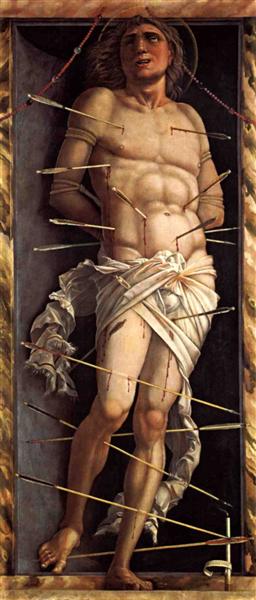
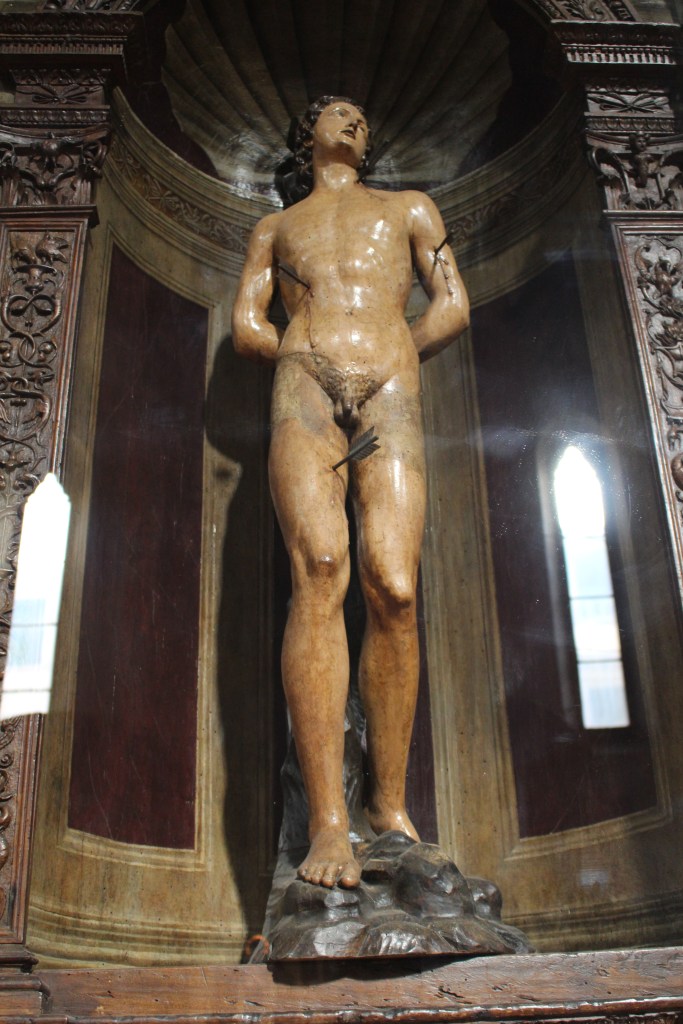
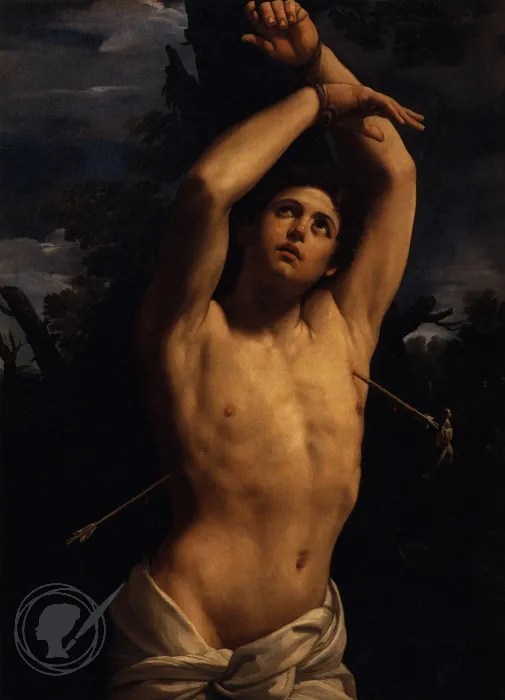
And don’t even get me started on depictions of St. Sebastian.
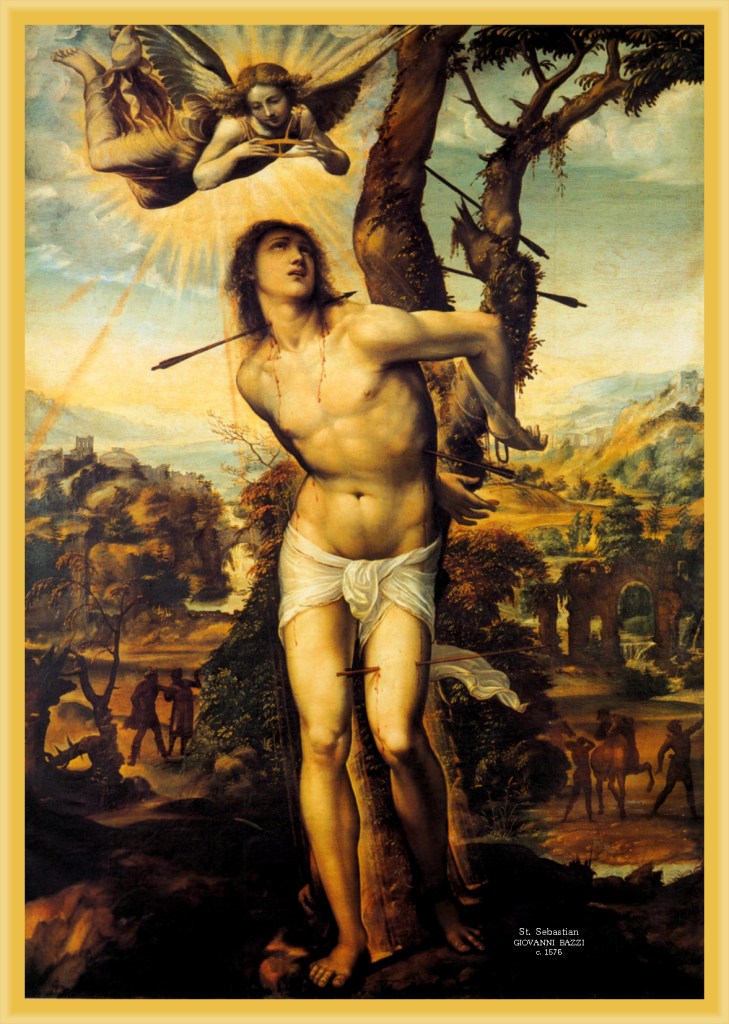
I love that they sculpted his pubic hair onto that last statue. Nice authenticity!

Someday I may write about St. Sebastian…or a boarding school named after him, which would be nice imagery for a queer crime/horror y/a set at such a place.

There was also a lot of homoerotic art in depictions of Greek and Roman mythology–the Laöcoön statue is one; and any depictions of Hercules/Heracles, Achilles, Apollo, etc.

And we’ll talk about Ganymede another time.

I was raised as a Christian, of the Church of Christ brand of Protestantism–and a hard, cruel, you’re-going-to-burn-in-hell-for-believing-anything-else faith it is indeed. I can’t speak to what that denomination is like outside of the South, or even Alabama for that matter–I did notice that the version in Kansas wasn’t nearly as hard or unforgiving; but still pretty unforgiving, in comparison to other sects–but I do know that where I am from, the Church of Christ is hard, rough, and sees a lot of stuff as sin. (Southern Churches of Christ are also very argumentative–which hardly seems Christian, does it? Members are always getting up in arms about something and wind up going to another congregation, sometimes having to move churches more than once.

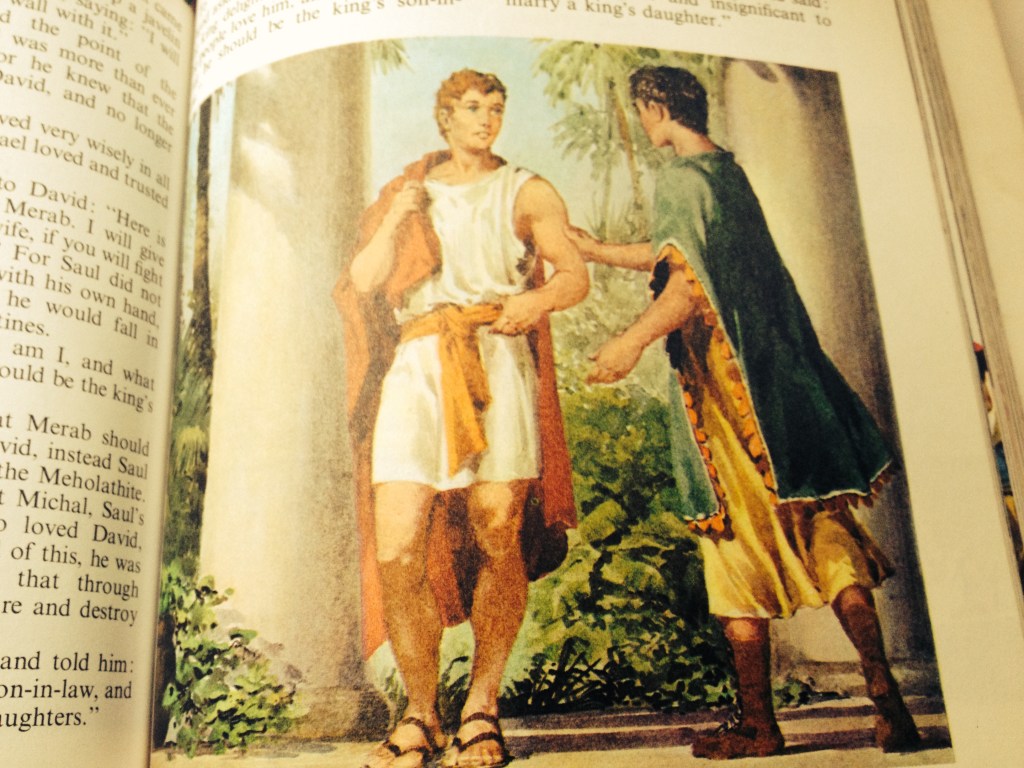
And when I was about eight or nine, my grandmother bought me a copy of The Children’s Bible, which was filled with illustrations (amazing how all those Middle Eastern Israelites were white, and even some had blond hair and blue eyes)…and maybe (probably) it wasn’t the intent of the publisher, but there was some seriously homoerotic imagery in the book. About ten years ago I was thinking about The Children’s Bible and wondering whatever happened to my copy…and remembering some of the illustrations in it, I thought no, you can’t be remembering that correctly and so I went on eBay and bought a used copy.

And when it arrived, my memories were actually correct.
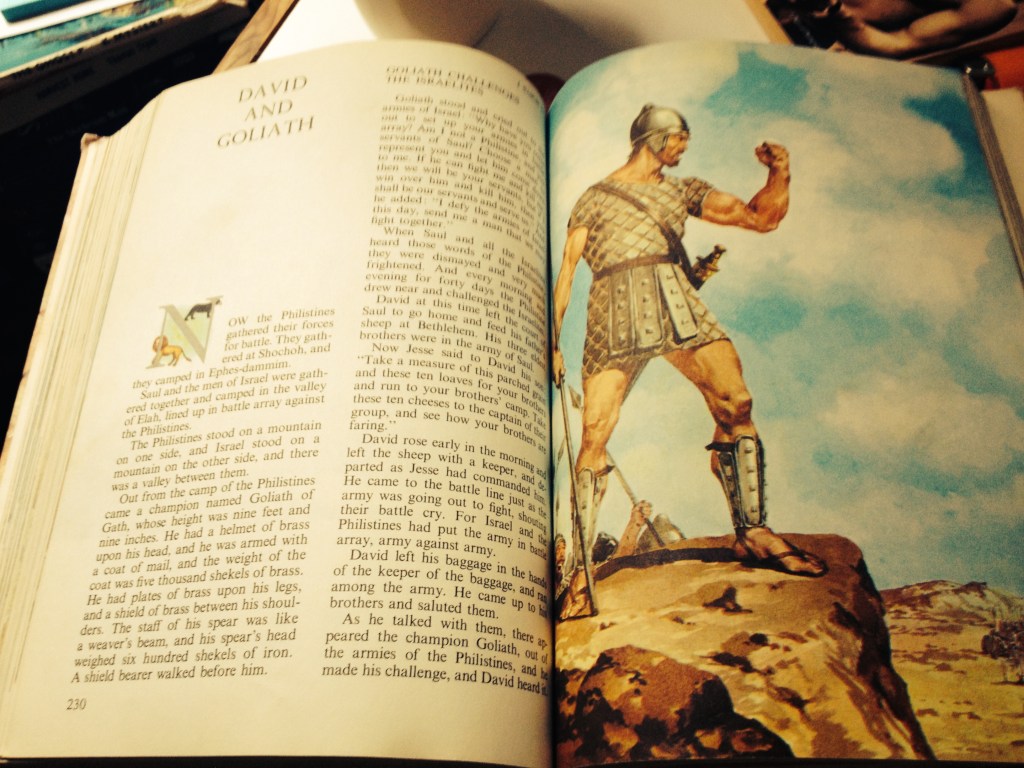
I mean, look at the muscles on Goliath. That image was burned indelibly into my brain, and it’s entirely possible my appreciation of muscles comes from….The Children’s Bible.

Perish the thought!

Grooming!

Indoctrination!

And of course, my favorite story in the book was David and Jonathan.
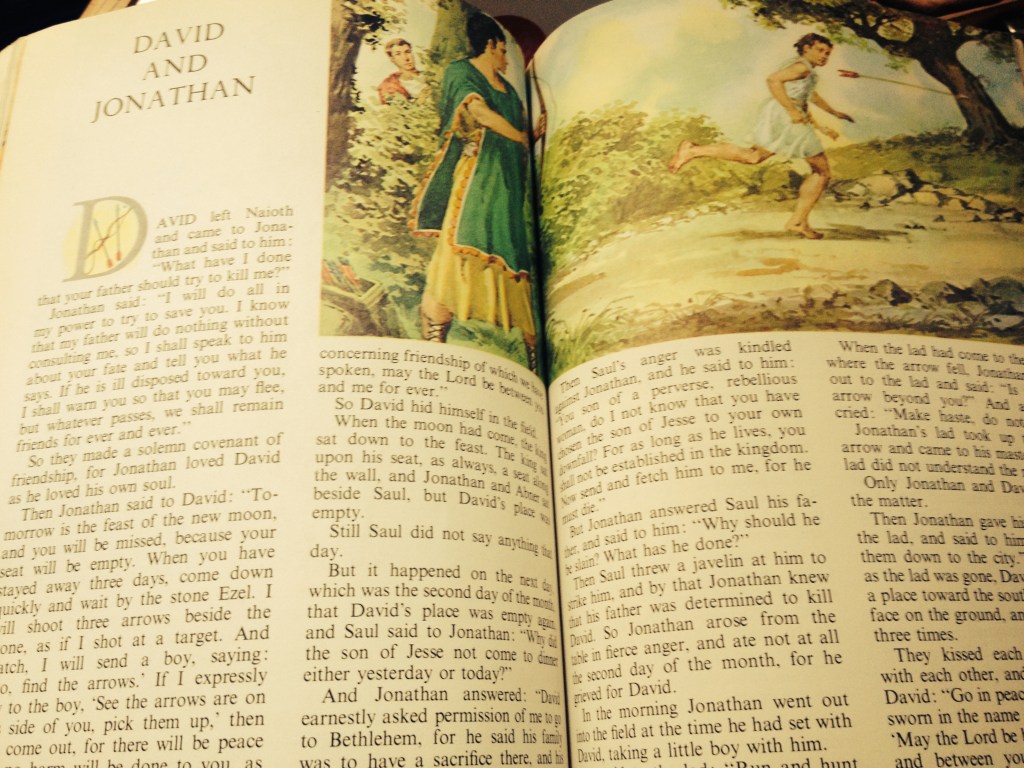
I mean, look at how they drew David!

I mean, it may not be Michelangelo, but damn.

(I also love that a Bronze Age Middle Eastern Jew somehow had pearly white skin, blonde hair, and blue eyes. Riiiiiiiiiiiiiight.)

Though David has awesome legs in both depictions, seriously.

When I was a kid, I’d always reread the David and Jonathan story (can’t imagine why it was my favorite…). I wanted a best friend like David–I always saw myself as Jonathan, the supporting player, the way I always did–gorgeous and charismatic and beautiful and beloved of God. I would think about the story and while I was too young and innocent to conceive of it as anything other than friendship–the same way I thought of the “friendship” between Achilles and Patroclus in tales of the Trojan War–when I got older, whenever I thought about the story I wondered about how deep that friendship between Prince Jonathan and David son of Jesse was. Why include the story at all? It really doesn’t add a whole lot to the tale of David’s life, and did it really matter for King Saul to have a son who was David’s friend and great love? Jonathan dies–not even the Bible was immune from bury your gays–and David mourned him with a great grief that seemed a bit more than “my best bro died.” I wanted to write the story myself, despite my lack of historical knowledge of the period or even when it was actually set, but I wanted to write about their love, their falling in love–and let’s face it, God didn’t really seem to have a lot of problems with their relationship, did he? He didn’t come to David and tell him to stop giving it to Jonathan; God didn’t curse the two of them or punish Israel for it; and yes, Jonathan is eventually killed…but even then God doesn’t come to David and say, did you not read Leviticus? I could hardly let you go on fucking him forever, you know.

So, I guess I am supposed to read it literally and just think they were best friends and loved each other as brothers. Yeah, no. There’s absolutely no reason for this story to be included in the David story in the Bible; none, unless of course there’s a kernal of truth in the story (don’t come for me, I’ve never bothered to find out if the Bible’s Old Testament kings of Israel were real people; I do know that real people turned up in the Old Testament that existed in history–Babylonians and Assyrians, for example, as well as Egyptians)but the mystery for me of why this story was included, why it was included if its merely legend or why was it included if they were real is the real question. There’s no moral lesson to be learned from the story of their friendship; their love and loyalty to each other was an issue for Jonathan because his friend’s greatest enemy was Jonathan’s own father, a king anointed by God–despite God capriciously turning His back on Saul for really such an insignificant reason that it really just boiled down to God just liked David better; I always felt sorry for Saul–how much would it suck to lose God’s favor for no good reason? Just because God found someone He liked better? (And considering the things God forgave David for, or just overlooked, really makes the hard turn away from Saul that much more petty and bitchy.)

God’s kind of an asshole in the Old Testament, frankly.

But yes, I’d love to write this story sometime. (Because I don’t have enough else to do, right?) I’d also want to write it from Jonathan’s perspective, although the death would be hard to do (Madeline Miller managed it with Song of Achilles quite beautifully) story-wise; but is the kind of challenge I love. Maybe someday, and maybe writing it will help me in my constant and never-ending life quest to come to terms with the religious grooming drilled into my brain as a child. I even have a great title for it, too.

I also have a novel in mind revolving around Michelangelo’s statue of David, too; maybe I could combine research and do them at the same time. THAT would be a challenge, would it not?


Gold

Everyone has heard of Constantinople at some point in their life, I should think–at least they’ve heard that annoying song “Istanbul (Not Constantinople)”. Some may even know that it fell to the army and navy of the Ottoman Turks under Sultan Mehmet II in 1453, ending the Eastern Roman Empire after a thousand years of existence. The Ottomans relocated the capital of their empire there, renaming it as Istanbul. (Christian Europe continued calling it Constantinople for centuries; it’s only over the last hundred years or so that Istanbul has come into more common usage.) But few know much more about the city and the empire it served as capital for over a millenium. Of those, some may know the basics–the Emperor Constantine, the first Roman Emperor to convert to Christianity, recognizing that the enormous Roman Empire had become impossible to rule or enforce law or protect, split the empire into eastern and western halves, and founded a capital for the east on the site of the village of Byzantium, renaming it Constantinople. The Western Roman Empire collapsed in 473 when the city fell; yet the eastern empire continued until 1453. Western Europe, always trying to reclaim the heritage of the Roman Empire (and ambitiously planning to rebuild it), always referred to the still existing Roman Empire as “Greek” rather than “Roman,” although the citizens of that great city and the vestiges of its empire continued calling themselves Romans until the Turks finally ended it.

But that thousand year history? It’s not easy to find information or books with much information; even the one history of the Empire I did read–Lost to the West by Lars Brownworth, along with his City of Fortune, a history of the Venetian Empire–glossed over centuries and only hit highlights. I’ve always wanted to write something historical set in the new Rome.

The Eastern Empire out-lasted its western counterpart by nearly a thousand years. Constantinople was one of the greatest Christian cities of all time; there was certainly nothing even remotely close to it in western Europe in terms of population, art, culture, education, and trade. It’s location put it in control of access and egress from the Black Sea; it also controlled the trade routes between Europe and Asia. Its fall in 1453 meant that those trade routes were now controlled by the non-Christian Islamic Ottoman Empire–and as such, other ways to reach the far east became necessary to the western Europeans, hence the Portuguese circumnavigating Africa and the Spanish attempt to sail west to find a route, leading to the “discovery” of the Americas. The fall of Constantinople was an incredibly important and necessary piece of the interlocking puzzle that led to European colonization and the global empires that resulted from it (as well as the oppression and enslavement and genocide of native populations); but Western historians–in particular, those monastic scholars in Catholic orders–have always tried to erase and /or lessen the importance of the eastern Empire and its capital, calling them “Greeks”, renaming the Eastern Roman Empire as the “Byzantine Empire,” etc.–and in no small part, this was also because of the Christian Schism of 1054, in which the Eastern Orthodox Church and the Roman Catholic Church split in two over questions of dogma. Therefore, it was in the interest of the Western Europeans to underplay the vital importance to European history of the remains of the Roman Empire because western Catholics considered their Orthodox brethren as heretics; their church was the true one, even if it was in the east that the religion originally came from, and it was in the eastern half of the empire the tenets and dogma of the “true” faith were established. The Pope in Rome always tried to assert his own authority over the Patriarch in Constantinople; the Patriarch considered himself to be the head of the faith and the Pope just another bishop. Thus, when Charlemagne conquered most of central Europe, he and the Pope created the Holy Roman Empire (which wasn’t holy, or Roman, or even really an empire in the traditional sense); the Romans in Constantinople were not pleased. (At the time, through some political machinations and drama, a woman was seated on the throne in Constantinople–the Empress Irene, one of the most interesting women in European history; she was also pretty terrible. The Pope decided there could be no such thing as a female Emperor, and so he crowned Charlemagne.)

The Holy Roman Empire also lasted over a thousand years.

Anyway, I’ve always been interested in the eastern Empire, even though it’s largely neglected in European histories. But one event in its history has always been interesting to me in particular –the fall of Constantinople to the Catholic 4th Crusade in 1204, which essentially set the stage for the second fall of the city, to the Ottomans in 1453. I also have an idea for a Colin book–which I’ve had for a very long time–that would have its beginnings in the 1204 sack of Constantinople.

It’s remarkably hard to find much information–granted, it’s not like I’ve tried very hard, but the fact that you have to try hard to find histories and/or books about the Empire and its capital, let alone the 4th Crusade–even histories of the Crusades themselves gloss over the fact that a Crusader army, blessed by the Pope, allowed itself to be diverted by the Venetians to capture and sack two Christians cities (Zara and Constantinople), and established “Latin” (western European) kingdoms and principalities out of the provinces that were once the Eastern Roman Empire. These Catholic kingdoms were so despised by their subjects that they didn’t last long, with another dynasty of the old empire arising to drive them out. The sack of the city and the pillaging and destruction that followed created such a deep hatred for the Catholic Church and the kings that followed the Pope that they preferred the Ottomans to a reconquest by the Catholic nations–which is saying something. Ernie Bradford’s The Great Betrayal: The Great Siege of Constantinople is a very thorough account of the tragedy and how it came to pass; the destruction of the mighty city–along with the destruction of priceless books and documents and art forever lost to us–was on a par with the burning of the Great Library at Alexandria.

The book itself is very interesting; the siege took nearly a year, and it’s actually kind of shocking that the Crusaders succeeded in taking the city, bearing in mind the strong defenses and so forth. A lot of things had to fit into place for it to happen, and they all did. The city came so close to holding them off successfully; it’s almost as though, as they would have said at the time, it was God’s will for it to happen. The city was also filled with all kinds of priceless Christian relics; after all, the religion was founded in the east, and as city after city fell to foreign invaders, a lot of priceless artifacts and holy relics were moved to the capital. (The great horses from the Hippodrome, for example, are proudly on display in the Piazza San Marco in Venice to this day.) A lot of the art was destroyed, jewels picked out of reliquaries, the gold or silver or bronze melted down for coin, and so forth.

As someone who has always loved history, and also has always loved treasure hunts–especially those that are involved with the history and development of Christianity, many years ago (I will freely confess to being inspired by Indiana Jones movies) I thought about writing such a treasure hunt story–where the ‘treasure’ being hunted was some important document or book or relic from the earliest days of Christianity that would revolutionize the faith as well as show how off-course it had gone since the earliest days…and wouldn’t it have made sense that whatever it was could have been kept in Constantinople, deep in the archives of the Orthodox Church? And with western, Catholic Europeans besieging the city, wouldn’t the Patriarch have wanted to keep it out of the hands of the Pope, and smuggled it out of the city to be hidden somewhere else, safe from the prying eyes of Rome?

And of course, when I created Colin–actually, when I brought him back in Jackson Square Jazz–I loved the character so much that I considered spinning him off; what about the jobs he’s on when he’s not in New Orleans? “Oh,” I thought, “my fall of Constantinople story! That could work for Colin!” And it even occurred to me the other day that I could even do them as “case files,” setting them throughout the past, both before and after he met Scotty and woven in between the Scotty stories. (It also occurred to me that I could do Scotty stories to fill in the years between books, if I wanted to…)

And reading this book–which i recommend if you want to know more about “holy wars” and how corrupt and unholy they actually were–made me think about it even more. I do want to include something about the Empress Irene, too.

Something to brainstorm at some point. Like I have the time to squeeze in another book…but it would be fun; although I don’t know how good I would be at writing action/adventure/thrillers.

It would be fun to find out, though.

Academic

Friday morning, and I slept well again last night. The washing machine arrives this morning (between 9:15 and 11:15) so I am up earlier than I would be ordinarily, but despite using an alarm to get up (I need to be sufficiently caffeinated when they get here to remove the old one and install the new one) and then it will be “catch up on the laundry day” while I do my home data entry today–which means the new one will be getting quite a workout today. I also had to remove the doors to the laundry room last night–it’s going to take some serious maneuvering to get the old one out and the new one in, and I figured the doors would be in the way–which made me feel quite butch and masculine. The feeling didn’t last.

The electricians came and replaced the fuse yesterday as well–so now I can use my dishwasher and the coffee maker can be on the proper counter where it belongs again. Slowly returning to a sense of normality here at long last, and starting to not feel quite so fried and exhausted, which is actually lovely.

I also have to do a conference tomorrow, which I need to prepare for, and honestly–my brain is so fried I keep forgetting that it’s happening and that I agreed to do it. I cannot remember being this discombobulated and fried before when I finished writing a book–but then again, it’s also been quite a while since the last time I finished two books in such quick succession without a break in between. Having everything around the apartment go on the fritz almost immediately thereafter was also not much of a help in that regard, and of course, that created more stress and insomnia…I’m really surprised I was able to sleep so well the last two nights, to be completely honest; but that was probably a result of exhaustion from the stress of things.

And of course, I also had to take down one of the laundry room shelves, just in case, and will have to put that back together once the washing machine is installed again.

So yeah, pretty big day around the lost apartment this morning….hopefully I can get going on my data entry before they come, and it’s probably what I am going to be doing for most of the day today. I make condom packs for hours yesterday–and ran out of condoms, so I don’t have that to do today, unless I run by the office to take these others and drop them off, and pick up some more…but I don’t really see that happening today…although….hmmm. Something to ponder before the washing machine gets here. (Of course, it would also depend on when the washing machine gets here as well…if they get here early I could run over to pick up my prescription, then head to the office, drop off the finished condom packs and pick up at least one more box….never mind, I shouldn’t think out loud on here. Suffice to say I have options.)

I actually don’t remember what all I watched yesterday while I was making the condom packs, but I am proud and happy to say that I broke the streak of serial killer documentaries at long last. I know I watched some interesting documentaries about queer horror movies, or why horror appeals to gay men (I honestly have no memory of Nightmare on Elm Street 2, which apparently is the gayest non-gay horror movie ever made?) as well as some documentaries about apocryphal books on the Bible, including Enoch–which led me down a rabbit hole into videos about the nephilim and pre-Flood Biblical history, as well as some interesting discussion about how things get mis-translated from the original archaic Hebrew into other languages over the years and then became stuc–like how “Lucifer” wasn’t really a reference to the devil (or Satan, or whatever) but a literal mistranslation of a verse probably referring to the recent fall of the Assyrian kind and his empire, rather than a reference to angels being cast own from heaven and sent to Hell to have dominion. I’ve always found that sort of thing to be interesting–potentially lost books of the Bible and prophecy, etc.–have always wanted to write a book about a missing or secret book of the Bible that was smuggled out of Constantinople before it fell to the Crusaders in 1204 during the Fourth Crusade, to keep it out of the hands of the Roman Catholic Church, only to disappear for centuries; a lost book that would revolutionize and change Christianity forever (not really an original thought–this sort of thing has been done before, most notably–for me, anyway–in Irving Wallace’s The Word); I’ve always seen it–since 2001, anyway, as a Colin novel (yes, the Colin stand alone novel I’ve been thinking about for twenty years; I’ve always kind of wanted to spin him off into his own espionage thriller series–think gay Dirk Pitt/Indiana Jones/James Bond hybrid), but again–when will I ever have the time to write such a book?

So, in a moment I am going to start doing my data entry for the day; while I wait for the washer to arrive and be installed. When I am done working for the day I intend to get down my Henry Willson biography and start mapping out Chlorine–yes, world, I am finally ready to start writing Chlorine, or at least work on it, anyway–and I also am going to start figuring out what to do with these short stories and so forth that I want to get out for submission. So, the goals for this weekend–after getting my work done and the laundry room reassembled–is to finish reading The Russia House, get some work on short stories done, and fill up another box to donate to the library sale (maybe two), and get the outline/character bios for Chlorine started. (I’m very excited about this….although I am getting a little more excited about the next book I want to write, Where the Boys Die.)

And on that note, I am heading back into the spice mines for the day. Have yourself a lovely Friday, Constant Reader, and I’ll check in with you again tomorrow.