Like a Rolling Stone

Well, yesterday was a fun day for college football. LSU won at Arkansas 34-10, which was an enormous relief. While LSU has now won eight of the last nine against the Razorbacks, it’s a rivalry game (The Battle for the Golden Boot) and Arkansas always, somehow, manages to play LSU tough (there have been some real shockers and close calls over the years), and the game was pretty much in doubt until an amazing fumble recovery caused and recovered by the amazing Whit Weeks (who is quickly becoming one of my favorite LSU players of all time) allowed the Tigers to finally pull away and beat them. Alabama lost to Tennessee, and this is the first time since 2007 (the last time they had a new coach) they have multiple losses going into November. Georgia trounced Texas in Austin last night, too; if someone would have told me after the USC game this year that LSU would be tied for first in the SEC with Texas A&M at this point in the season and ranked in the Top Ten, I probably would have laughed pretty hard. And of course, next week LSU plays at Texas A&M, which will give the winner a pretty big boost to making it to the conference championship, as only one team will come out of the game undefeated in conference play (A&M and LSU’s only loss have come out of conference; there are no undefeated SEC teams left). We also watched some of Skate America yesterday, and will probably watch more today. I didn’t get as much done yesterday as I would have liked, but that’s simply the nature of the beast and it’s fine. I slept a little late this morning, too, but feel good. The kitchen is again a mess, and I am going to make white bean chicken chili today, which will make even more of a mess; sad that I have to clean it only to mess it up yet again…and Vanderbilt now has the same record as Alabama. When did we diverge off the main timeline again? And of course, South Carolina embarrassed Oklahoma (welcome to the SEC!). Even Mississippi State put a scare into A&M, too.

Seriously, what a crazy–and unpredictable and fun–season this has turned out to be for us fans.

I don’t have to leave the house today, either, which is another delightful occurrence. I made groceries yesterday, and after getting home from that expedition I chose to settle in for a day of football. Sparky was still calmed from his vet visit on Friday–Paul thinks he’s sulking because his nails were trimmed, but he hasn’t attacked me or tried to climb me since we got home. He also spends a lot more time cuddling and sleeping with me in the chair. He’s such a sweet little baby. We also have a lot of shows to get caught up on, too. I am definitely going to Kentucky next weekend, too, which will be very nice. I can drive up on Sunday and come back on Friday, which will be a very nice long visit and then I can get back home to watch the Alabama game (they haven’t been the same since they beat Georgia, which is weird). I can spend a lot of time sleeping and resting and relaxing and reading, which is always a lovely thing to have going on, and then I can start focusing on getting writing done and keeping up with the house. It’ll definitely be weird once football season is over, too. The play-offs are going to be strange, too; a gauntlet to determine the national champion. My suspicion is no one is going to make it through the season undefeated.

And then it’s Carnival again. Where oh where did this year go?

But today, I need to read and I need to write. Once I finish this, I’ll go read for a bit and then clean the kitchen, and start making the chicken chili, which is mostly for lunches this week. I also have to make Swedish meatballs, which I bought at Costco to see if it would be any good. That can also be lunches (and dinners) for the week around here. Payday is Wednesday, so I’ll be able to get groceries for Paul before I leave, so he can survive the week. It’ll also be kind of cool just reading horror while I am at Dad’s; Shadowland to listen to in the car and then finish reading once in Kentucky; Tananarive Due and Scott Carson and Nick Cutter to take with to read up there; and then it’ll be November when I drive home so I can go back to listening to something non-horror for the ride home. Possibly a Carol Goodman, or a Lisa Unger, perhaps. I really have a plethora of riches in my TBR stacks. I know I should read more broadly, and I should expand my horizons out of crime and horror–would it kill me to read science fiction or fantasy or romance or (gasp) literary fiction? Probably not, and I do have some really great books in all those categories in the stacks, too. I think I want to read something by Valerie Martin, Jami Attenburg, or Celeste Ng by the end of the year. (I also have some Ann Hood novels on hand; she’s fantastic.)

And on that note, none of this is getting done while I sit here and swill coffee and scroll unnecessarily online, will it? So perhaps it’s best to bring this to a close and head into the spice mines. I may be back later, but I wouldn’t hold my breath, Constant Reader, so have a lovely Sunday, okay?

I Know a Place

Saturday morning in the Lost Apartment and all is well. I slept incredibly last night. I woke up at seven and stayed in bed relaxing in a half-sleep for another hour or so, and finally got up when Sparky woke up and decided he was hungry. He was delayed this morning–and was very calm and cuddly and sleepy yesterday–because of the vaccines he got yesterday, as well as the shock to his system of leaving the apartment. He likes his carrier–he’ll go in there on his own, and Paul often tells him to go get in the crate when he’s having Big Kitten Energy, which he does–but he finally started meowing yesterday when we took him outside in the crate. He’s never meowed before, only chirped, which worried me a bit…but now he’s done it so I guess he only meows when he’s unhappy. His nails were trimmed (which he also didn’t like this time), but we brought him home to be a sleepy, cuddly sweet kitty for the rest of the night. We also went to Costco yesterday, which was nice and a little tiring. We watched Skate America last night (ladies and pairs short programs) and of course, today is a football all day kind of day. LSU plays at Arkansas tonight, and of course Alabama-Tennessee is this afternoon’s game. I am going to take books to the library sale this morning and go to the grocery store today before I come home to watch games for the rest of the day. There’s also some cleaning I can do around here this morning, too. Yippee!

I’m also going to read some more of Gabino’s book this morning; I read some while Sparky and Paul were with the vet yesterday and I just love the way he writes, in this interesting combination of Jim Thompson crossed with some John D. MacDonald but heavily flavored and filtered through his own remarkable talent in a unique voice that is entirely his own. It’s very rare to come across a writer with a voice and style so strikingly original, and the pacing is ethereal but also fast at the same time. I loved his last book, and I am absolutely loving this own. Next weekend I’ll be heading up to Kentucky to see Dad for about a week, so I can listen to another horror novel in the car (maybe Shadowland by Peter Straub, which I’ve not read before. I can take the paperback with me if the audio book is too long for a twelve hour drive; I actually just went to Audible and got Nick Cutter’s The Troop, and saw that I had a Riley Sager already downloaded, so that’s the trip up and back sorted. I also got the Straub), and I can take some horror with me to read. I’ll make shrimp tempura for dinner tonight, and am kind of torn about making chili or not tomorrow, but will probably go ahead and do so; I may even make it over night so tomorrow morning I can just get up and put it in the refrigerator. That’ll sort my lunches for the week, methinks.

I also managed to get the majority of the dishes done yesterday, no small feat I might add. That’ll teach me to be lazy when I get home from work every day, won’t it? It seemed endless, and I was also doing the bed linens at the same time as well as unpacking Costco and putting everything away; the living room is, even now, filled with empty boxes that need to go out this morning. I need to revise that short story and start working on another one for the Bouchercon anthology open call; I picked out the story just have to finish it now, which is also no easy chore. But today is an official day off from everything other than relaxation, reading and some cleaning around the house. I’ll try to reread the story I’ve selected; I just need to remember to channel my rage at developments in the neighborhood and on my street–this is one of the reasons I love being a writer, petty revenge on people who’ll never even know they inspired me to kill them in fiction–and retrieve that voice from deep inside my head. I think one of the problems I’ve had with some of the stories I’ve been writing lately is I’ve been too lazy to write about people the way they really are, instead of an idealized character who is logical and rational and then simply snaps. It’s that breakdown of going from law-abiding to murderous that I live to explore–it worked really well in “Neighborhood Alert”–but in some of the noirish stories I’ve been trying to write and sell since the pandemic they come across as too cheerful; bitterness and rage is what drives my stories, and the tone and voice need to reflect that.

Tone and voice are key to whether your story works or not.

And on that note, I am heading into the spice mines. Have a lovely day, Constant Reader, and I’ll check in with you again later. GEAUX TIGERS!

Screenshot

I Will Follow You Into the Dark

I’ve always thought that my favorite two literary genres–crime and horror–were flip sides of the same coin. I sometimes reduce my theory to the barest of bones–both are about death but in crime the monsters are human. Horror novels always have elements of mystery and suspense woven into the story–there are always characters trying to figure out what is actually going on, and usually suspecting humans, only to find out it is not–and there’s also a lot of death. You have to figure out what is causing those deaths, and the best horror novels seem like straight-up mysteries until you find out otherwise. I didn’t really start reading horror until Stephen King and Peter Straub, and much as I love the genre, my first love will always be mysteries…but reading the kids’ series, with all their phony ghosts and hauntings and phantoms and spirits, got me really interested in the concept of ghosts–something that stays with me to this very day. (I mostly write about ghosts when I try horror; because Gothic is my absolute favorite and that runs across both genres.)

This is one of the reasons I fell in love with Michael Koryta’s novels. The first I read was So Cold the River, which was more of a ghost story/mystery about a haunted and cursed resort hotel in Indiana, which was a wild ride and great fun to read. He’s also written some other crime novels that crossed over into the supernatural; The Ridge was another favorite. I also wondered how he was writing both straight up crime fiction and sometimes supernatural styled mysteries; I was always told you couldn’t write in two genres like that under the same name.

And then he started releasing those types of novels under the name Scott Carson, so maybe there is something to that old publishing truism? I don’t know why he rebranded those books under a different name and it’s none of my business other than to satisfy idle curiosity. But I did recently finish one of his Scott Carson novels, and Where They Wait is an excellent illustration of the blurred line between horror and crime.

I was never a dreamer.

I mean that in the most literal sense. Figuratively speaking, I absolutely consider myself a dreamer. Aspirational, at least. Optimistic? To a point, although my profession–journalism–mandates a certain cynicism. When I say I was never a dreamer, I mean at night, in the depths of sleep.

No dreams. Just didn’t have ’em. Not good, bad, happy, or sad.

Slept well, though. I slept well. That’s hard to believe these days, but I know that it was true once.

People talk about their dreams all the time. I dated a woman for a few years who would wake up and recite the bizarre and vivid stories that had accompanied her through the night. Sometimes, I’d be tempted to pretend that I could share the experience. Dreaming sounds normal, right? Seems like something that should happen to all of us. And yet we don’t know much about the mechanisms of dreams, for all of our scientific research and psychological theorizing. We believe dreaming is tied to memory, that REM sleep is an archival process. We believe dreams are indicative of repressed emotions, or perhaps harbingers of maladies that haven’t yet offered physical symptoms. Warnings. Messages from the dead. From God. We believe all of these things and more, but what we know is this: dreams are still not fully understood after all these years. They come and they go.

For most people, at least.

I have always been interested in dreams, and what they say about our psyches and consciences. I’ve never studied the psychology of dreams–what little I did read was all supposition and theory, as there is no real answer to what dreams mean–is it just our brains doing freestyle, like a jazz singer bopping up and down the scales using their voice as an instrument, or are they the key to who we are, our hopes and dreams and traumas? I like to play around with dreams a lot in my work, since there is no real consensus on why some people do and some people don’t, why some remember their dreams and why others don’t; do people not remember their dreams because there’s nothing to remember, and on and on from there.

But dreams are at the heart of this chilling and masterful suspense novel, which is really more about tech horror than anything else. Our main character is a journalist who reported on the Afghanistan war, has recently been laid off from his job, and gets a call from an old buddy from the area where he grew up to write a puff piece on a local tech company and it’s newest development; a wellness relaxation app which sounds like every other relaxation app–other than it’s not. Given the latest version of the app to experiment with and write about, it starts affecting him in dreams–scary nightmares about an a shipwreck, and ghosts coming to visit him ,and the dreams are so incredibly vivid that he’s not entirely sure whether they were dreams or not. And as he discovers more, he finds that everything to do with the app is connected to him in some way, as his dreams become more vivid and sometimes waking; to the point he’s not sure if things are actually happening or he’s losing his mind.

This book was fantastic: the story is great, the pacing fantastic, the characters absolutely real–and the horror is terrifying, absolutely terrifying. Carson knows how to build suspense and suck the reader in along for the ride.

Highly recommended.

Promises in the Dark

I grew up loving both horror and crime stories–those wonderful old black and white Universal monster movies used to scare me to death, not to mention all the marvelous ghost stories and mysteries that got filmed back in the day. I also watched a lot of the 1950’s paranoia horror monster movies–Godzilla and its ilk–and those also used to give me horrible nightmares. I also liked how twisted horror comic books like The Witching Hour, House of Mystery and House of Secrets were. I’ve always wanted to write those kinds of stories, but if you think I have zero confidence in my abilities as a crime/mystery writer, there’s even less when it comes to my writing of horror. I never feel like I ever get it right, you know, and my stuff is macabre and peculiar and slightly twisted, but it’s not really scary. But like I did with the mystery novels and movies I watched as a child, I was always looking for myself in those tales and not finding myself. Oh, every once in a while there would be some homoeroticism in some horror I would be reading (Peter Straub’s If You Could See Me Now comes to mind), but for the most part, there wasn’t much. Thomas Tryon’s The Other resonated with me–it wasn’t until decades later that I learned Tryon was gay, and that sensibility infused all of his work, hence my connection with it–but usually when gays showed up in horror they inevitably were effeminate and soon to become victims. (Kill your gays has always been a thing, clearly.)

When I was going through my “I want to be the gay Stephen King” phase in the 1980’s, I didn’t put gay characters or themes in any of my stories–although rereading my attempts at horror from then now, I can see the sensibility was always there–but the horror novel I started writing in about 1986 or 1987, The Enchantress, had a gay point of view character, even though I didn’t really know what I was doing. I was always afraid, you see, to include gay characters in anything I hoped to get published because I was so busy keeping my two lives completely separated that I feared writing sympathetic gay characters would out me. (During my many writings about my high school students from Kansas, one of them was actually gay and was probably the most realistic and honest character in all of those writings) Trying to salvage those stories now, decades later, I sometimes will revise one and make the point of view character gay–which inevitably makes the story work better, incidentally–and they see publication eventually; “Crazy in the Night” was one of those stories, and another morphed into Bury Me in Shadows, actually. Just this morning I was thinking about some more of those old stories and how to make a couple of them work–partly because I spent the last two mornings reading Other Terrors: An Inclusive Anthology from the Horror Writers Association, edited by my friends Vince Liaguno and Rena Mason. The point of the anthology was to focus and highlight horror stories from marginalized writers–where they are marginalized by race or religion or sexual orientation or gender identity, and it includes stories from some of the top names in horror publishing today.

As with any anthology, some stories stick with the reader more than others; this isn’t a dis on any of the contributors to the anthology–every story was incredibly well-written–it’s just that everything is subjective and some stories stick with the reader longer than others. For me, the standouts were Jennifer McMahon (“Idiot Girls”); Alma Katsu (“Waste Note”); Gabino Iglesias (“There’s Always Something in the Woods”); Hailey Piper (“The Turning”); Larissa Glasser (“Kalkriese”), Michael Thomas Ford (“When The Lovelight Gleams”); M. E. Bronstein (“The Voices of Nightingales”); and S. A. Cosby (“What Blood Hath Wrought”). These were the ones that really resonated me, with the connections of strong writing, three dimensional characters, and completeness of the story. For many of the contributors, this is my first experience with their work, and I will definitely look out for more of their work. These were the ones that made me start thinking about ideas and stories and characters; stories that not only were enjoyable and immersive to read but also kick-started my own creativity and inspiration.

And what more can you ask from a reading experience, as a fellow writer?

Now I want to write more horror.

Definitely check the book out, Constant Reader, I think you’ll enjoy it.

Love in Store

Friday and my dream has come true: I have switched my work-at-home day from Monday back to Friday,. effective today, and I am so pleased. I’ve never adjusted to not being in the office on Mondays (I’ve always, no matter what, come into the office for regular workdays the entire time I’ve worked here unless it’s a holiday or I was on vacation), and now I can finally get a handle on what goddamned day of the week it is from now on.

Jesus.

I slept really well last night, which was marvelous. We watched more of Your Honor last night (which is one of the longest limited series I’ve ever encountered, every time I think well, this episode must be the finale it will end and queue up yet another episode. It turns out (I just looked) that there are ten in total, so I think we have two more, and it’s apparently been renewed for a second season, and I’m not sure how I feel about that. I mean, it’s an interesting show–I also love that the local crime family’s name is Baxter, which for some reason just cracks me the hell up–but it doesn’t really hold my interest the way it should; I often find myself scrolling through social media apps on my iPad while the show is on, so I miss things that could probably help it make more sense than it does; but as Paul said last night, “they really make New Orleans look beautiful,” which the show does quite well.

Then again, New Orleans is beautiful, so they are starting from a very good place there. (One of the only reasons I could bear watching Southern Charm: New Orleans was because the city was shot so beautifully)

Today, as I already mentioned, I am back to working at home. I got my second monkeypox vaccine this week, and my body’s reaction to the second shot has been a lot more interesting than the first. The first just left me with a small pinkish red circle on my arm, maybe about a half-inch in diameter. The second left an enormous angry red circle on my other arm with a large bump in the middle so that it kind of looks like a massive spider-bite. This morning its size has receded a little bit, but I imagine I am going to end up with the same thing on this arm as I have on the other; a small slightly reddish circle around the injection spot. (When I show it to people, they can always pick out where it is but you have to actually look to see it, if that makes sense? It’s not noticeable unless you’re looking for it.) I am getting my next COVID booster on Monday, and I am really thinking that as cold/flu season is upon us again I may start masking everywhere again because it’s really been lovely not getting either a cold or the flu the last couple of years. Are masks a pain in the ass sometimes? Absolutely. But so is getting sick, and I don’t understand how putting yourself at risk of catching any illness is some kind of power statement. I don’t care if I am nauseous and feverish and can’t keep food down for a few days! FREEDOM!

I was exhausted when I got home again last night–I am kind of hoping the change in “work-at-home” days will help me with that–and so I pretty much just vegetated for the majority of the evening. Scooter demanded a lap to sleep in and I was only too happy to oblige. How did I pass the evening before Paul came home? Lost in thought about my book and mindlessly, effortlessly scrolling through social media feeds until Paul came home. The exhaustion is problematic, to be sure; when my brain is too tired to actually focus enough to read a book–which is and has always been one of the great pleasures of my life–to escape reality and allow my brain to relax, well, there’s something wrong and I don’t like it. Am I just getting older? I am sleeping better–more deeply and longer–than I have in a very long time, and yet…

But I did think about the book last night while I idled away my early evening, which isn’t a bad thing. The plot is a bit complicated, and as always, I worry about straying away and creating subplots and misdirections that I’ll forget to tie up and/or resolve by the end of the books, and since I’m not Raymond Chandler, my plots have to make sense. Sigh. It must have been nice being Chandler and getting away with having plots that didn’t make sense; I’ve not read all of Chandler’s work and right now I have The Long Goodbye sitting in my TBR pile–and as much as I want to get to it, I need to finish reading my current book and read some horror for the month of October. I want to find my copy of Interview with the Vampire for one thing–maybe during the LSU-Tennessee game I can do some work on the books, with the intent to find my copy of that as well as clear out some more for donations–so I can reread it and ‘salem’s Lot back to back, and maybe even revisit a Peter Straub before moving on to new writers and new books I’ve not read. I also recognize how ambitious that sounds, given how much trouble I’ve been having focusing on reading, but rereads aren’t the same as new reads–and it was rereads that got me back into reading again after the Shutdown in 2020.

Sighs happily. That was when I revisited Mary Stewart, and how delightful was that?

All right, I should head into the spice mines now. Have a lovely day, Constant Reader–and I’ll talk to you again tomorrow before the game.

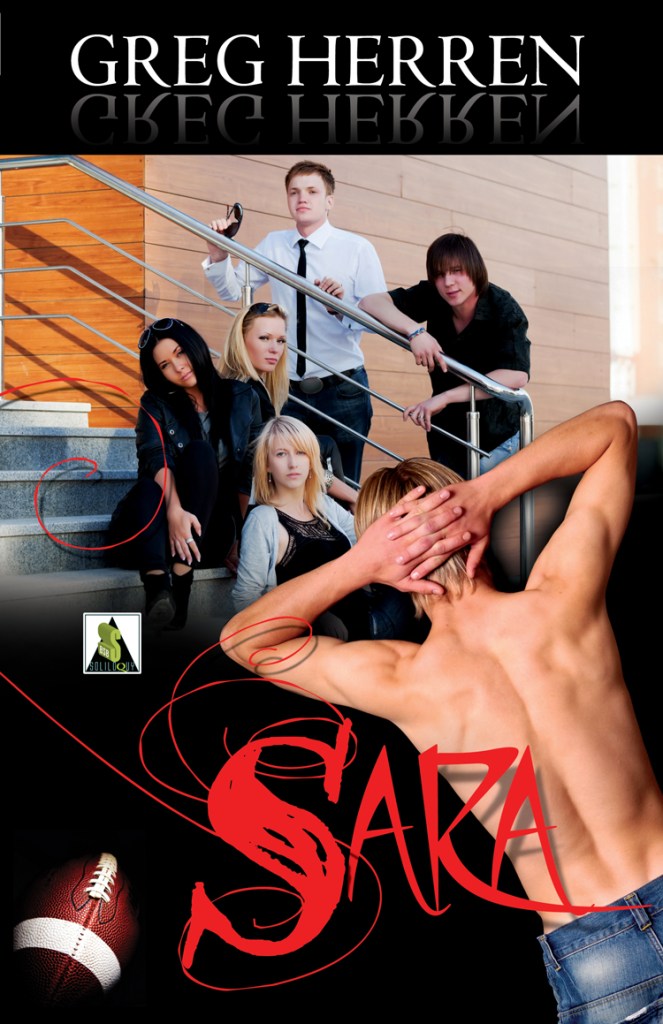
Sara

Wait a minute, baby…stay with me awhile.

Ah, Sara. The first actual book I wrote for a young adult audience, and what a long and tortured history this story actually had.

I started writing stories when I was really young, my own versions of the kids’ series books I was addicted to and were blatant rip-offs, frankly, but it was good practice, I started writing original fiction when I was in high school; basically, I started writing about a group of high school students at a small rural high school (kind of like the one I was going to), and always felt that someday I would turn them all into a book about those kids. A couple of years after high school I abandoned the first actual novel I tried to write (I don’t even know if I still have it anywhere but I don’t think so; it most likely got lost in one of the many moves over the decades), and decided to write a novel about high school students in Kansas. Writing in cursive longhand, I expanded the story beyond the teenagers–who were still the primary core of the story–but also wrote about their parents and siblings as well. It was very soapy–this was the time when my daytime soap addiction was at its highest–but ultimately, the real story was the murder. I wrote whenever I could, often changing character names and ending subplots and starting new ones willy-nilly as my mind bounced around, always coming up with new ideas for it. I started in 1980, and I finally wrote the end on it in 1984; four years. I had thousands of wide-ruled paper filled with my loopy, pretty handwriting; now the trick was to somehow type it all up and edit it, cut out all the excess and tighten it, decide on final names, and so forth.

Needless to say, I never did that. I still have it all somewhere, in a box–it did survive all those moves–but over the years I pilfered plots and character names and stories from it. I have a tendency to come up with character names for ideas for stories and books that never get used; I then turn around and use those names again in something else I am writing (I talked about Chris Moore and Eric Matthews before; I came up with those names for an idea I had for a book set in a fraternity, and have used them in Todd Gregory “fratboy” books and they’ve turned up elsewhere, too).

Sara is one of those books born from that original manuscript, and no, despite the opening sentence of this entry, I didn’t take the title from the Fleetwood Mac song. I’ve always liked the name, and right around when I started writing the book as a young adult novel, I went to a family reunion and met a cousin’s daughter for the first time, and she was absolutely adorable. She actually looked like she would grow up to look like my mysterious title character–and her name was Sara. (I had originally named the character Tara; it was an easy switch.)

Being a senior sure doesn’t feel any different, I thought as I looked at myself in the bathroom mirror, and I sure don’t look any different–besides that damned pimple on my chin.

I don’t know what I’d been expecting. I;’d been looking forward to my senior year almost from the very day I started high school. This was it–when the year ended, I’d be an adult. No more being treated like a kid, no more getting up Monday through Friday at six thirty, no more being at the mercy of teachers and coaches and guidance counselors–it would all end when I cross the stage, took the diploma, and put the tassel on the other side of the cap.

It couldn’t happen soon enough, thank you very much.

And then I could get the hell out of this podunk town in the middle of nowhere, and never look back.

I finished toweling my hair and hung the wet towel on the rack. I looked in the mirror again. I touched the angry-looking red blotch in the direct center of my chin. It might as well have been blinking and neon–no one could miss the stupid thing. I sighed and wondered what kind of omen that would turn out to be as I put on my underwear and a pair of jean shorts. Probably not a good one, I thought, sighing again as I brushed my damp hair into place. I was out of hair gel, so I just parted it on the side and combed it flat.

I was already starting to sweat. It wasn’t even eight in the morning yet, and our crappy house was already turning into a sauna. The house didn’t have central air conditioning–all we had was some window units in the bedrooms. Mom kept saying when she got a little bit ahead she’d buy one for the bathroom, but until then we’d have to make do with fans.

I walked down the hall back to my bedroom, wiping sweat off my forehead. I stood in front of the window unit and raised my arms so my armpits would dry. When I didn’t feel damp anymore, I reached over to the bed for my purple Trojan Football T-shirt. I pulled it over my head, but had to yank it down hard to get it past my chest. The weightlifting I;d been doing all summer had worked–the shirt stretched so tight across my pecs it looked like it might rip. I looked into the full-length mirror hung on the back of the bedroom door and smiled. It made my muscles look huge–so maybe no one would notice the stupid pimple. I tucked the shirt into my shorts and rubbed some antiperspirant into my armpits, hoping it would work this time. I picked up my backpack and made sure one more time I had everything: notebook, pens, my cheap cell phone–yeah, I hadn’t forgotten anything. I put my wallet into my back pocket and sat down on the edge of my bed to put on my socks and shoes.

I’ve often joked that Sara is my “get even with everyone I went to high school” book, but that isn’t true. Yes, I did not have a great time in high school–either of them–but it wasn’t all bad; I did have some friends, even though it often felt like I didn’t have any, and after graduation, I decided to shut that door behind me firmly and move on with the rest of my life. I harbored a lot of anger and bitterness about my high school experience, but time does provide some healing, even if there’s a scar left behind. I was weird and different from my classmates from kindergarten on: I was gay but I was also an artistic child with a wild and vivid imagination in an environment where no one knew what to make of either. I was different, and that was all that mattered, even if they couldn’t quite process that I wasn’t from another planet or an aberration that needed to be shunned and excluded and mocked.

As I have mentioned before, I started writing in high school about a group of high school kids in a rural high school similar to the one I was attending. That eventually morphed into a lengthy, hand-written (and incredibly amateurish and terrible) first novel from which I have pilfered plots, stories and characters ever since. Sometime in the mid-1980’s, as a fan of Stephen King and Peter Straub, I decided to try my hand at writing horror short stories, with an eye to maybe writing a horror novel. I even started writing a horror novel (The Enchantress, which I occasionally think about getting back out of the drawer and working on again; it did, however, lead me to write a different book decades later, but I still think about The Enchantress from time to time). By this time I’d taken a junior college writing class and was starting to get my confidence in my dream back after the horror of my first creative writing course in college; I took another course in it when I started going to Fresno State (CSU-Fresno at the time, to be correct) and that teacher, in a conference about one of my stories (which he really liked), told me, when asked about writing a novel, “The best way to study how to structure a novel is to take one that you really like, and then break down how it’s structured; how the story and the characters are built and the pattern and rhythm of how action is interlaced into the plot.” I’ve always remembered that, and sometimes when I am stuck on a book I think about his advice and think about how a book with a similar story to the one I am trying to tell is structured.

I put The Enchantress aside and decided to try, once again, to do something with fragments of that horrible first novel I’d written, and introduce an element of horror to it. I decided to structure the book the way Stephen King structured Christine–something awful happened when we were in high school, and now, many years later, the main character is looking back and remembering, and at the end of the story we find out that the reason he is telling us this story is because he’s afraid the awful thing is coming back again (reoccurance/revival of something evil is a strong theme in horror, and King has gone to that well numerous times, most famously with It and the dueling timelines). So, I started writing Sara with a prologue written in the present day; ten years later, the main character has gotten an invitation to the high school reunion and starts remembering back, and then in the first chapter we’re back in the late 1970’s and don’t return to the present again to the epilogue. I also decided to do the different POV thing King did in Christine (which I still think is one of his most underrated novels of all time); he tells the first part and the third part of the book in the first person point of view of Dennis, but the second section is the third person and bounces around from character to character before the return in the final section of the book (it really is a three-act structure). I thought this was very clever and decided to use it in this book, too. But instead of an evil car, we had a mysterious new girl at the rural high school who dazzles and enchants all the boys–but there’s something not right about her.

I decided that the book–primarily focusing on teenagers–would work best as a young adult novel (ater discovering there even was such a thing as y/a horror) and so I dropped the looking back prologue/epilogue framing and moved the action into the present day. I finished a first draft in about six months, and then put it in a drawer for about fifteen years before returning to it, overhauling it and dragging it into the new present day and publishing it.

Revisiting Sara now, thirty years after I first conceived it and ten years after publishing it, the first thing I noticed was “hmmm, you should have reread this before turning in the final draft of #shedeservedit, since technically the two books were supposed to be connected; with the newer book set in the county seat and Sara taking part in the rural southern part of the county” but I am also recognizing that my books don’t, in fact, all need to be connected together; there’s no reason why this particular county and its county seat can’t be a county or two away from this one, even if they are remarkably similar geographically; it’s the plains, after all. There may even be characters in this one with the same name as a character in #shedeservedit, but again, it doesn’t really matter–and I’ve written other stories set in Kansas in the same area where the geography is the same and maybe even some of the character names. I used the ten-year-reunion (or possibly twenty) in rural Kansas thing in my story “Promises in Every Star,” for example, and revisited the Kansas well for “This Thing of Darkness” too.

And will probably return to that well at least once more for a book, if not more than one.

Broken Promise

And here we are on Friday yet again. The nights this weekend are a return to the frigid climes of earlier this week, but the days promise highs in the 50s, at least, and it’s supposed to get back up into the 70’s next week…or so it said the last time I checked. I generally tend not to look at weather forecasts more than a few days out, primarily because New Orleans weather is completely unpredictable and defies expectations all the time. It feels chilly this morning–I’ve not checked the temperature yet–but the space heater is on, as always, and I am shivering a bit under my layers and considering going to get a blanket. The HVAC guys were here yesterday, but there’s still no heat and there’s also no sign of them outside this morning. Which is fine; I can huddle under blankets as I do my work-from-home duties this morning. Okay, I checked, and it’s thirty-five with a high of 48 predicted. Yikes! Sometimes, methinks, it’s better not to know some things.

The forecast for next week looks much better. It’s simply a matter of getting through this last blast over this weekend.

We finished watching season two of Mr. Mercedes last night, and it was…well, it was a bit disappointing. The season wound up diverging significantly from the book it was based on (End of Watch, the concluding book of Stephen King’s Bill Hodges trilogy), and while the middle of the season was compelling and impossible to turn away from, the last two episodes, for me and Paul at least, significantly went off the rails. The third season starts airing on March 4, based on the second book of the trilogy, and we’ll watch because we really like the characters–and I think Book 2 was my favorite of the trilogy–but now It’s a Sin has dropped and so has something else we wanted to watch as well, but right now I can’t think of what that other show might be. Oh, yes, The Luminaries with Eva Green.

I also watched, while making condom packs yesterday, the original film version of The Amityville Horror, which fits into both the Cynical 70’s Film Festival as well as the Halloween Horror Film Festival. I actually saw this movie in the theater when it was released all those years ago, and just like then, I found it unimpressive, not particularly scary, and farfetched. I had read the book, of course–I think I bought it off the wire racks at the Safeway in Emporia on 6th Street–but the book wasn’t very well written and the story–theoretically something that actually happened–wasn’t convincing and, I thought, pretty poorly written (and I wasn’t a particularly discerning reader back then, either). It was, however, a phenomenon; a huge bestseller and the movie also made a ton of money, spawning numerous cheesy sequels (none of which I watched). Horror made a big comeback as a genre in the 1970’s; it could even be seen as a “golden age”–there was a glut of films and movies in that decade, and the demand didn’t taper off until the late 1980’s/early 1990’s. Amityville was a big part of that–following The Exorcist and Rosemary’s Baby and Carrie; it was the decade when both Stephen King and Peter Straub’s careers are writers took off, and there were a lot of books published….a LOT. (I do highly recommend Grady Hendrix definitive Paperbacks from Hell–it will trigger a lot of memories for you if this was a period when you were actually alive…it certainly did for me.) But the movie is still bad, after all these years–James Brolin was certainly handsome, coming off his years on Marcus Welby and before he spent the 80’s managing Arthur Hailey’s Hotel on ABC. (Although I couldn’t help thinking, “wow, of someone would have told me back then Brolin would marry Barbra Streisand and live happily ever after and his son Josh would become a major star, I would have laughed and laughed and laughed.”) Margot Kidder plays his wife, Kathy, and this is the best, I think, she’s ever looked on film–they are a handsome couple and have some chemistry together, even though both performances eventually descend into one note, repeated over and over again. Rod Steiger also has a supporting role to which he brings all his Method bombast in a role that doesn’t really make a lot of sense, nor does what happens to him. The movie’s end, like the book’s, explains nothing other than the family abandoned the house and never returned. (Of course, the house has changed hands with people living in it for decades and none of them have experienced anything the Lutzes claim to have. Even cynical teenager me, when reading the book, thought, oh, you bought a house you couldn’t afford and dreamed up a crazy story to try to get out of the mortgage..the movie only convinced me further that I was correct in my theory. I looked it up on line, and the lawyer for the kid who murdered his family in the house later admitted he and the Lutzes, “over many bottles of wine”, came up with the story…to not only get them out of the mortgage but to try to get his client a new trial. The Lutzes still claim it all really happened. *insert ‘sure Jan’ GIF here*)

I think I bought another copy of the book several years ago–still in print all these years later!–to reread and see if it was as bad, if not worse, than I remembered. I have yet to get around to it…but watching the movie made me think I need to reconsider that urge to reread it.

But the 1970’s were, as I have said before, a weird decade of transition and change. Conspiracy theories were running rampant everywhere about everything–the JFK assassination in particular was talked about and theorized about a lot–but this was also the decade of the Bermuda Triangle, when UFO’s really became a topic of discussion, when The Late Great Planet Earth truly began shifting certain sects of Christianity into doomsday prophecy and end-times philosophy, and of course, we cannot forget the existential threat of Communism that had some people seeing Russian agents everywhere and there was the ever-present threat of nuclear annihilation.

Although there are times, too, when I think about the 1970’s as the last gasp of American naiveté and innocence. The one-two punch of Vietnam and Watergate made everyone start distrusting the government…and HIV/AIDS was just around the corner.

Hmmm. Some pretty heavy thoughts on a shiveringly cold Friday morning in New Orleans.

And now back to the spice mines. Stay warm, everyone, and stay safe.

Holy Ground

I came across the coroner’s obituary last night.

As I typed it, I realized what a New Orleans-like thing it was to say; and it made me smile a little bit. The coroner in question wasn’t currently serving New Orleans; he had retired in 2014 after ten terms in office, and his name was Dr. Frank Minyard. He played the trumpet, and was actually a gynecologist rather than a pathologist. Was he good coroner or a bad one? A little of each, I would gather, based on the obituary by John Pope you can read by clicking here.

But he was, like so many New Orleanians used to be, quite a character. New Orleans has always been a city full of characters, which is why so many people write about New Orleans, and write about it well. Not only can you probably get away with writing anything crazy-seeming about New Orleans; chances are if you dig a little into our history here, you’ll inevitably find crazier shit than anything you could dream up on your own. I have to say I have really been enjoying reading up on our local history here.

Hurricane Sally came ashore earlier this morning, and it had continued turning enough to the east that we didn’t get much of anything here in New Orleans. The panhandles of Alabama and Florida (in particular Mobile and Pensacola) are an entirely different story; my heart sank down into my shoes (well, my slippers) on seeing footage and images from that section of the Gulf Coast. Hurricane season is so emotionally exhausting, really; all that stress and tension and worry, and then when it goes somewhere else the enormous guilt one feels about the relief that your area escaped unscathed while others are losing everything–including some lives–is horrible, just horrible. It’s oddly gray and hazy-seeming outside the windows this morning, with the crepe myrtles and the young live oaks in the yard on the other side of the fence doing their wavy dance thing they do when the wind blows; the sidewalk outside also looks wet so we must have gotten some rain as well overnight, but not enough for me to notice anything as I slept through it all. (That’s the other thing about hurricanes, particularly the ones that come ashore overnight; you go to bed wondering what you’ll wake up to find in the morning–or worse yet, disaster will rip you out of a deep sleep.)

So, yes, this morning I feel very emotionally drained; well rested, but exhausted emotionally.

And then, of course, once the danger has passed, you have to reset yourself and get back to normality–whatever the hell that is, or what passes for it, at any rate.

Yesterday’s entry in the Cynical 70’s Film Festival was The Omen, which was a huge hit back when it was released in 1976 and spawned two sequels, Omen II: Damien and The Final Conflict. I had never seen the sequels, and I think I originally rented the film–I don’t think it played at the Twin Theater in Emporia–but I did read the book (the book was written by David Seltzer, who apparently, according to the opening credits of the film, wrote the screenplay; which came first? I don’t care enough to look it up) and of course, was put in mind of it by paging through The Late Great Planet Earth, which laid the groundwork for the movie. Obviously, it’s about the anti-Christ, who is Damien Thorn; the movie opens with the Robert Thorn (played with an almost wooden-like quality by Gregory Peck) arriving at a hospital in Rome only to be told that the child his wife has given birth to has died; he worries about her mental stability and how she will handle the news–and so a priest offers a substitute baby whose mother died giving birth. (And this is the first place I called shenanigans on this rewatch; one, he is about to start a lifetime of lying to his wife and two–was there any need to tell Robert Thorn his child died? If the idea was to have the Thorns accept the anti-Christ into their home as their child, wouldn’t it simply make more sense to swap the babies, so neither of them knew? Because how could they have been so certain Thorn would accept this literal deal with the devil?) The movie is paced fairly well, and it moves right along–there’s not a lot of gore or blood and guts, but it does beggar credulity at more than one point–and perhaps I am looking at it with jaded eyes some forty years later, but both Peck and Lee Remick, who plays his wife, seem to just be phoning it in for the paycheck and there’s also the element of their age; they seem to be fairly old to just be trying to start having a child at the opening of the movie. (I think the book plays this up more, stating that Kathy Thorn has suffered innumerable miscarriages leading up to this birth and it has shaken her mental stability; kind of hard to do that on film but it certainly would have made his motivation in accepting this needless deception–again, they could have just as easily substituted the baby without having to go through this entire risky rigmarole.) After finishing, I looked for Omen II but it’s not streaming for free anywhere; I then watched The Final Conflict, which was simply terrible (outside of Sam Neill, who was terrific and charismatic as an adult Damien, saddled with an incredibly bad and far-fetched script).

The movie does fit, however, with the Cynical 70’s Film Festival, because here we have yet another conspiracy, one in which some members of the Catholic Church have turned to Satan to try to bring about the end times as well as the birth of the Antichrist–because whereas in the 1950’s and the early 1960’s, it would have been unimaginable for such a film to be made, but also to be believable; who would have ever believed such a thing was possible? Of course, both book and film of Rosemary’s Baby set the stage for The Omen, but both were later 1960’s, when things were starting to change, times were getting more cynical, and so were people. Rosemary’s Baby changed almost everything, both in the world of novels and film, in showing that horror was both bankable and mainstream. The early 1970’s saw the publications, and enormous success, of books like Ira Levin’s The Stepford Wives, William Peter Blatty’s The Exorcist, Thomas Tryon’s Gothic horror masterpiece The Other, and eventually, Stephen King’s out-of-nowhere bestseller Carrie. Soon Peter Straub would publish Ghost Story and Carrie would become a hit movie, triggering a horror revival that brought both the literature and the films into the mainstream. This revival didn’t lose steam until the 1990’s, and frankly, I think horror is on the verge of another revival.

I could be wrong, of course. I certainly have been before, but I am seeing some really terrific work as well as amazing new voices–over the past year alone I’ve read some astonishing work by new-to-me writers, and I only wish I had more time to read everything I really want to. Paul Tremblay is amazing, and so is Bracken MacLeod, Christopher Golden, and Silvia Moreno-Garcia, among others; I’m seeing a lot of new and interesting looking titles being announced or reviewed almost every time I turn around.

I guess today is Wednesday? I am really not sure, living in this weird world that comes with hurricane watches, where it is very easy to lose track of dates and times and what day of the week it actually is. But a quick glance at Weather.com assures me that all the other storms out in the Atlantic basin pose no threat to Louisiana, so I guess we can relax for a little while, at least.

And on that note, tis back to the spice mines.

Picture to Burn

Thursday, Thursday, is today’s child full of woe? I used to know that rhyme when I was younger–one of those things that would pop out of my mouth and brain every now and then when I wasn’t expecting it to–and now I cannot seem to summon it from the depths of my memories. I think it was Tuesday’s child, anyway; was Thursday’s child full of grace or something like that? Possible, I suppose.

Another good night’s sleep was had yesterday evening, which is lovely. I have to go into the office today and run errands on the way in.  I’m just glad to be feeling more rested, to be honest, and then tomorrow is a work-at-home day, and then I slide into the three day weekend, which is kind of nice. I hope to finish reading  Little Fires Everywhere this weekend, start reading The Coyotes of Carthage, and perhaps dip my eyes back into the Short Story Project–I have Sara Paretsky’s short story collection glaring at me from the end table as well as the new Lawrence Block anthology, and so many others I’ve not finished reading–and of course, I want to get a lot of writing done. I want to spend some time on Bury Me in Shadows, as well as maybe get some short story writing done, which would be lovely.

One can certainly hope, can’t one?

But I’ve also learned my lesson about over-planning for the weekend; I know I need to just make a list of things to do that need to be done and not overly pressure myself to get it all done over the course of the long weekend, while recognizing that I also need to recharge my batteries and I also need to do some cleaning; perhaps even work on that damned file cabinet which I never finished working on.

Yesterday’s Cynical 70’s Film Festival choice wound up being nothing I was considering. Instead, I choose to rewatch The Exorcist, which I’ve never seen other than the “edited for television” version. The Exorcist was a phenomenon at the time, and most people still, to this day, consider it the scariest film they’ve ever seen and it regularly pops up on lists of best horror films ever made. I read the book at the height of its popularity, when I was in junior high school, and while it didn’t precisely scare me, it was lurid–we all read it for the lurid parts, like the crucifix masturbation scene and so forth; there was something sacrilegious about reading it, like actually reading it was an act of subversion. The film broke all box office records of the time and was nominated for a lot of Oscars, and the soundtrack–Mike Oldfield’s “Tubular Bells”–always brings up mental associations with the film. It was the first outright horror film to get that many Oscar nominations, or to be nominated for any, really, other than Rosemary’s Baby, which wasn’t nominated for a lot; William Friedkin, fresh off his Oscar winning outing with The French Connection–which is also on my list–directed it. A more traditional entertainment, The Sting, wound up sweeping the Oscars that year. A few years ago, I reread the book to see how well it held up, and as an adult who is also now a writer and has been a reviewer, and has read thousands of other books in the interim, I can say it doesn’t hold up well at all–it really isn’t all that scary, either; it was a product of its time and it might not even get published were it written today. The characters were very cardboard and one-dimensional and behaved in ways that made no sense whatsoever; the focus was on the sacrilege, really, and the shock. I wondered if that would be true of the movie, as well, in its unedited version.

The acting was fine, really; Ellen Burstyn is never bad in anything, and Linda Blair was also fine; but the truth is the direction of the film doesn’t really develop the characters enough to make the viewer empathize with them, or identify with them. The scares weren’t as scary as they were; it’s hard to be scared when you know something is coming and you’ve already seen it, after all; part of the thrill of a horror film is not knowing when the scares are coming, so rewatches never have quite the same effect. I watched this time in a more analytic way, rather than as a viewer–but while others I’d seen before–Aliens comes to mind–really hold up incredibly well, The Exorcist doesn’t; I don’t feel like I got to know enough about Chris MacNeil or Father Karras enough to care about either one of them; and I found that I had more questions about them and who they were than I did when I viewed it as simply an entertainment. I think had the film been filmed more intimately, rather than from a cold distance, it would have held up a lot more; I don’t know, I am neither a filmmaker or a critic. But it didn’t trigger much of a reaction in me, and that’s rather telling. I think the problem, from a story-telling point of view, is that it couldn’t make up its mind whether it was about the MacNeils or Father Karras; although the title would tend to make you think the focus was on Father Karras; it should have been titled The Exorcism, really, and that, I think, was the end problem result for me: the book and film were really about Father Karras and his struggle with his faith, but only touched on that issue glancingly; because it also wanted to focus on how dismissive we are of spiritual issues in our modern scientific world, and wanted to show how an atheist, irreligious woman would try to get her child scientific treatment and slowly come around to the idea that in the modern world, something rooted in past superstition was the issue. Both are great stories, but for me, it failed in trying to tell both and wound up just skittering across the surface like a needle on a warped vinyl record.

Ultimately, though, The Exorcist–both book and film–are important works in both disciplines; along with Rosemary’s Baby, ushered in the 1970’s revival and rejuvenation of horror, in both film and literature, and that influence cannot be denied. Without either of those books, would Carrie have been published, or Peter Straub’s first horror novel? It was The Exorcist, after all, that first really introduced me to horror.

And I absolutely loved the television series inspired by it.

And on that note, tis time for me to return to ye old mines of spice. Have a lovely day, Constant Reader, and I’ll catch you again tomorrow.

IMG_4201

Mighty Love

I love nothing more than a great ghost story (which is why, although I loved the book, I was enormously disappointed with Peter Straub’s Ghost Story; it’s an amazing novel and a horror classic and one of my favorite horror novels of all time, but it is emphatically not a ghost story). I’m not sure why I love them so much, but even as a kid, reading the mysteries for kids I always gravitated towards the ones with some kind of ghostly title: The Ghost of Blackwood Hall, The Haunted Fort, The Phantom of Pine Hill, The Ghost at Skeleton Rock, The Haunted Showboat, The Ghost in the Gallery, etc. The ghosts and hauntings in these books were never real–just like the ghosts and monsters on Scooby Doo Where Are You? weren’t–but I still was drawn to them.

There was an ABC Movie of the Week when I was really young that I absolutely loved: The House That Would Not Die. It starred Barbara Stanwyck as a woman who moved into a house she’d inherited from a relative, along with her niece, and of course, the house turned out to be haunted. The story was terrific and it scared me a lot–and you can never go wrong with Barbara Stanwyck; I may even have watched it with my grandmother, who was a big Stanwyck fan. A few years later, we were somewhere–some people my parents knew had invited us over for dinner, and before and after, as the adults, my sister and I were deposited in the den to watch television and entertain ourselves while behaving. They had books, which I gravitated towards, I pulled down a volume of Reader’s Digest Condensed Books and found a ghost story inside. As I started reading, I was drawn into it and I realized it was the same plot, the same story, of the TV movie I’d liked, and kept reading. I read the entire thing that evening–it was condensed, after all–and thought, oh, I’d like to see that movie again.

Flash forward and I am in college, browsing in a second-hand bookstore when I find a worn paperback copy of the book. Pleased and delighted at the opportunity to not only read it again but read the entire version? For fifty cents? Absolutely.

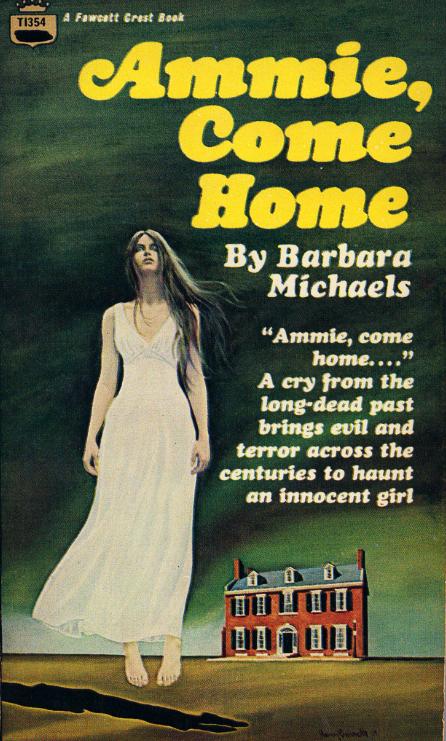
It was Ammie, Come Home, which is one of my favorite ghost stories, and favorite novels, of all time. It was written by Barbara Michaels–for another dollar I picked up two more of her novels, Witch and House of Many Shadows. I loved all three books, but I’ve always preferred Ammie, considered it my favorite. Over the years Michaels–and her alter-ego, Elizabeth Peters-became one of my favorite writers of all time. I love her books, no matter what the name or brand or whatever you want to call it; they are all witty, with strong, likable female characters, there’s some little dash of romantic interest involved in all of them, and a very strong suspense component. The Peters novels were more mysteries; the Michaels sometimes involved the supernatural, and sometimes they didn’t.

But, oh, how I love Ammie, Come Home, and I recently, during my isolation, took it down and made it a part of this year Reread Project.

Ammie Come Home Barbara Michaels Fawcett Crest 1968 harry bennet cover art

By five o’clock it was almost dark, which was not surprising, since the month was November; but Ruth kept glancing uneasily toward the windows at the far end of the room. It was a warm, handsome room, furnished in the style of a past century, with furniture whose present value would have astonished the original owners.. Only the big overstuffed sodas, which face one another before the fireplace, were relatively modern. Their ivory brocade upholstery fitted the blue-and-white color scheme, which has been based upon the delicate Wedgwood plaques set in the mantel. A cheerful fire burned on the hearth, sending sparks dancing from the crystal glasses on the coffee table and turning the sherry in the cut-glass decanter the color of melted copper. Since her niece had come to stay with her, Ruth had set out glasses and wine every evening. It was a pleasant ritual, which they both enjoyed even when it was followed by nothing more elegant than hamburgers. But tonight Sara was late.

The darkening windows blossomed yellow as the streetlights went on; and Ruth rose to draw the curtains. She lingered at the window, one hand absently stroking the pale blue satin. Sara’s class had been over at three-thirty…

And, Ruth reminded herself sternly, Sara was twenty years old. When she agreed to board her niece while the girl attended the Foreign Service Institute at a local university, she had not guaranteed full-time baby-sitting. Sara, of course, considered herself an adult. However, to Ruth her niece still had the touching, terrifying illusion of personal invulnerability which is an unmistakable attribute of youth. And the streets of Washington–ven of this ultrafashionable section–were not completely safe after dark,

Even at the dying time of year, with a bleak dusk lowering, the view from Ruth’s window retained some of the famous charm of Georgetown, a charm based on formal architecture and the awareness of age. Nowadays that antique grace was rather self-conscious; after decades of neglect, the eighteenth century houses of the old town had become fashionable again, and now they had the sleek, smug look born of painstaking restoration and a lot of money.

Ammie, Come Home is possibly one of the best constructed, if not the very best, ghost stories I’ve ever read. As you can see from the opening paragraphs, Michaels does an exceptional job of setting everything up, giving us insights into her main character, Ruth Bennett, and her relationship with her niece. We go on to find out that Ruth is probably in her mid to late forties, was widowed in World War II, never remarried, and for the most part, it’s implied that her husband’s death pretty much was the end of any romance in her life; something she isn’t terribly interested in. This is, of course, foreshadowing–but not the way the reader might think. Yes, in the opening scene of the book, which features her niece Sara getting a ride home from one of her professors, that ah, yes, Ruth and Dr. Pat MacDougal are going to fall in love-but there’s more to Ruth’s history than that, which of course is the mark of the truly terrific writer. We also glean that childless Ruth has grown deeply fond of her niece Sara–and disapproves of Sara’s boyfriend Bruce (mainly because of his youth, the way he dresses, and what she thinks of as his smug superiority).

(This last, by the way, is the only part of the book that feels dated. Written and originally published in the 1960’s, Sara and Bruce are both college students and Pat works at a college–he’s a cultural anthropologist with a specialty in superstitions and rituals–so, as anyone who knows anything about the 1960’s knows, it was a decade of youthful rebellion and anti-establishmentarianism. There are occasional asides from both Ruth and Pat about the generation gap–this was also the first time this phrase was used, during this period–where the kids want to make change. There are a few mild arguments over that, but it’s always very good natured and never gets very deep. But the very generation gap is part of the structure of the novel; when strange things start happening in Ruth’s home, particularly involving Sara–Ruth and Pat immediately think of mental illness; Bruce is the only one open-minded enough to see the truth; that the house is haunted by a malevolent spirit–and there may even be more than one.)

It’s also very clever of Michaels to use that generational divide to explore the notions of the supernatural and a spirit world–because Bruce is given a forty-eight hour deadline to convince the older two in their quartet that Sara isn’t mentally ill but is being haunted. So, as Bruce convinces them–helped by more apparitions and events in the house–the reader is also being convinced that what’s going on in the house is supernatural in origin. How she does it is a master class in suspense/horror writing; and there are some lines that just the reader to the bone: And what looked back at her through Sara’s eyes was not Sara.

The ghost hunters eventually get to the bottom of the haunting of the old house in Georgetown by finding out the deeply hidden truth about what happened there centuries earlier, and finally freeing the spirits trapped to the house.

And maybe the creepiest, yet saddest, thing is the disembodied voice they hear, over and over, in the back yard, calling Ammie….come home…..come home…..Ammie…. —which is described as “it sounded like what the wind would sound like if it had a voice.”

And despite the dated 1960’s references, the book still holds up, over forty years later.

I rediscovered Michaels in the mid to late 1980’s, which was when I also discovered that she also wrote the Elizabeth Peters novels, and that the absolutely delightful Crocodile on the Sandbank, which I’d loved, wasn’t merely a stand alone, but the first book in a long-running, and completely fantastic, series featuring heiress Amelia Peabody and her Egyptologist husband Emerson. There isn’t a single dud in the Amelia Peabody series–and there are smart, funny, clever, and intricately plotted–and over the years the Peabody-Emerson clan had children, raised them, and those children grew up to be involved in the adventures of their parents–and every book, save one, actually took place in Egypt at the turn of the twentieth century. I need to reread Crocodile on the Sandbank, and in fact, would love to revisit the entire series. She wrote two other series as Elizabeth Peters as well–the Vicky Bliss series and the Jacqueline Kirby–as well as stand alones; every Peters novel is a gem, as is every novel she wrote as Barbara Michaels.

And now back to the spice mines.