Doo Doo Doo Doo Doo (Heartbreaker)

Well, I’ve decided on my audiobook for the drive to and from Alabama this weekend: Carol Goodman’s The Night Visitors. Carol is one of my favorite writers (and has become a friend! I love my life) and I love her works; if you’re not reading her already you need to get on it–and there’s a healthy canon to dig into as well (always a plus). She also has a new book coming out this spring, called The Bones of the Story, which is a great title. I’m working on a short story this week while I am letting my novel manuscripts rest, and it’s definitely some slow going. I got about two thousand words into this story about a year ago, and I think it works perfectly for this anthology a friend of mine is putting together; I just need to finish the damned thing. But tonight I have a ZOOM call I have to do and I have to pack for my weekend in Alabama, and tomorrow morning I’m getting up, writing a post and hitting the road while listening to the divine Carol Goodman.

Does life get better? I think not.

It’s actually kind of funny; after I finished yesterday I realized I could, for the first time in quite a while, take some down time to myself for a minute or two without guilt or something looming over me needing to be done. After I sent the manuscript (such as it is) in along with my editorial thoughts and analyses, I thought, wow, I’ve sure written a lot since just before Christmas and showed an incredible amount of discipline–the kind of single-mindedness you’ve not had for quite a while, and I should feel drained and tired but I don’t. That was an incredibly over-confident assumption to make, even though it was true at the time I thought it. When I got home from work I realized my candle wick had burned down so far that it needed to rest and be replenished for a while. I am still feeling motivated and creative, though; I was simply drained yesterday. Before I went to bed last night (after watching another episode of The Recruit, which I am really enjoying) I kind of felt like the batteries were already starting to recharge. I feel very tired this morning, too–I slept well, don’t get me wrong, but I think I needed to sleep longer. Ah, well. I don’t have to get up before the sun rises tomorrow, so that’s something.

I always like Thursday nights.

But the kitchen is still a mess. I wasn’t in the mood to clean last night when I got home, either. I just felt disoriented, emotionally and intellectually spent, and physically tired. I used to call it the malaise, because it felt like melancholy brought on by the utter exhaustion of my creativity and drive to write. It’s very weird. Usually, the malaise also brings with it the feeling that I don’t even want to think about writing anything else ever again–which is not the case this time, which is very weird to me. I am champing at the bit to get to work on more things, new things, even to start working on the editing of everything else. It is very weird, and I will keep you posted on how this weird new version of malaise works itself out.

But I’ll have to clean the kitchen before the ZOOM thing tonight. That, or turn off all the kitchen lights.

Heavy heaving sigh.

I watched an interesting documentary on Youtube in my tired malaise last night, a new one from James Somerton called The Death of Queer Privacy, which was interesting. The primary focus of the documentary–Somerton does popular media critiques from a queer perspective–was, to begin with, about outing as well as the potentially problematic tropes in Paul G. Tremblay’s A Cabin at the End of the World and it’s film adaptation, A Knock at the Cabin. It was another look–deconstruction, if you will–if whether a straight identified (I don’t know how he actually does identify) writer centering a gay couple/family at the heart of a horror novel/movie is either good representation (they could just as easily have been a straight couple, a mixed-race couple, lesbians, etc.; sexual orientation didn’t play a part in the plot and if anything, the fact that the gay family was presented as normal and not a big deal tends to undermine any critical analyses of this as intentionally or unintentionally sinister) or if the book/movie, at heart, centers the trauma of a queer family as entertainment for the masses. I may want to watch that again; I wasn’t paying a lot of attention because I was tired and scrolling through social media on my iPad, so I may have missed some things, but the critique and look at the film itself was merely an introduction to the main topic, which was the attack on queer people’s right to privacy–which served as an interesting counterpoint to a lot of the public discourse about queer celebrities and how much of their lives, if any, needs to be shared with the audience. The recent forced outing of Kit Conner from Heartstopper is perhaps the best example of this; the idea that queer people in the public eye need to–nay, must–come out and be publicly queer, no matter how they themselves feel about revealing that much of themselves to the world, is problematic on its face. Somerton then went on to talk about how gossip blogger (and garbage human being) Perez Hilton essentially dragged a couple of people out of the closet. And really, are the personal and private lives of any celebrity any of our business? Simply because we enjoy someone’s performance in film and television, or like someone’s music, doesn’t really give us the right to know intimate details of their personal lives. I’ve never cared, beyond mere idle interest in hearing gossip; but I don’t care that much about it because I don’t know these people. What does who Taylor Swift is dating have to do with her music–other than her break-ups tend to spawn some amazing music–and why do I care? Why would I care who Tom Hiddleston is fucking, unless it’s someone I actually know? (There’s an interesting dialogue to be had about our billion-dollar celebrity gossip industry…) To circle around back to Tremblay, I knew he was publicly identified as straight as far as I knew (and didn’t care to know more). I was a fan of his before reading A Cabin at the End of the World (having greatly enjoyed A Head Full of Ghosts and Disappearance at Devil’s Rock–I’ve not read the others yet–and so I was delightfully surprised that the family the book was centered on was a gay couple and their adopted child. It was yet another entry in the “people go to secluded place and then horrible things happen” trope of horror, but with a remarkable twist that made it even more intense and terrifying. (I’m really looking forward to the film.) I read the book and enjoyed it, and I didn’t read anything sinister into it; but I was also reading it from an entertainment perspective rather than to gain a sociopolitical perspective for writing a critique…which now I kind of want to do, thank a lot, James Somerton–this is how this kind of thing always happens to me.

In fact, an essay exploring three mainstream novels by non-queer writers centering queer characters could prove interesting–and the Tremblay, S. A. Cosby’s Razorblade Tears, and Laurie R. King’s Back to the Garden would be the perfect trio to look at as they are relatively current, critical successes, and often award recognized.

And on that note I am going to head into the spice mines. Have a lovely morning, Constant Reader, and I’ll check in with you again later.

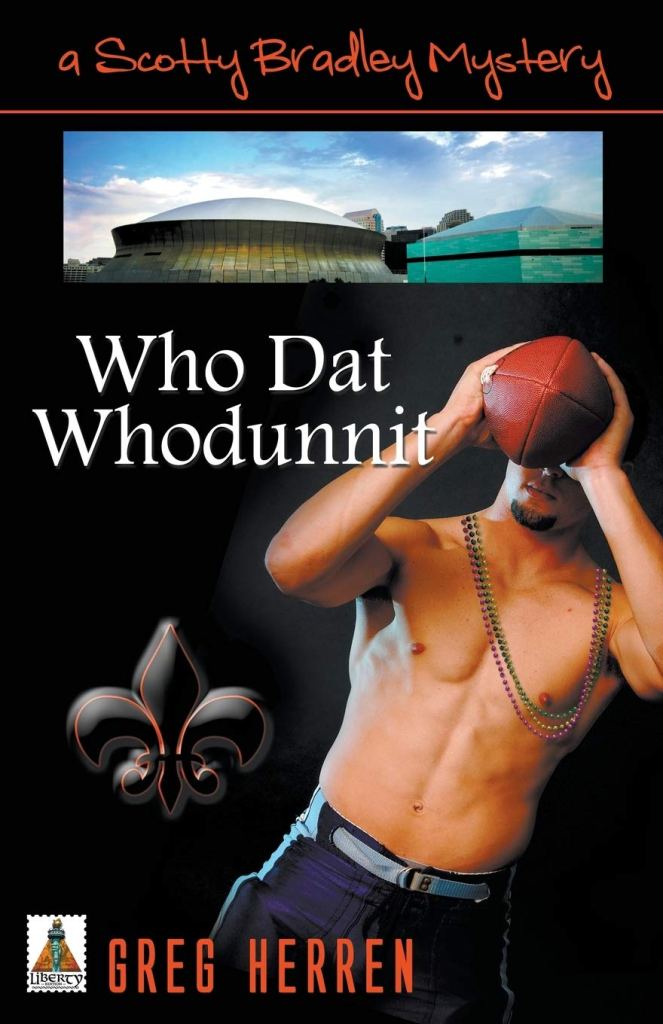
Who Dat Whodunnit

Who dat? Who dat? Who dat say dey gonna beat dem Saints?

I am a very proud member of Who Dat Nation, and have been since we moved here in 1996. I never really paid a lot of attention to the NFL before moving to New Orleans; I vaguely was aware of who was good and who wasn’t–and I knew very certainly that the Saints had routinely been one of the worst football teams, consistently, in the league since they were formed in 1966. You couldn’t not be aware of how hopelessly bad the Saints were, year in and year out. I always root for underdogs–a particularly American trait, I might add, which is another good essay topic (how we always root for underdogs, especially in our entertainment–film, television, books–but in the real world we either look the other way or actually pile-on. We all feel bad for poor bullied Carrie White in Stephen King’s Carrie and hate the cruel kids…but how many of us ever stood up for some kid being bullied in school? My experience as the bullied is NONE.)–and so I always wanted to see the Saints somehow turn their program around. Paul and I always watched the games–or had them on–when they aired; there were many times the games were blacked out locally because they didn’t sell out the Superdome.

Three things were inevitable in New Orleans: hot summers, termites in the spring, and the Saints would suck in the fall. When we first moved to Louisiana LSU was also in a downturn slump; some seasons they’d win, some they’d lose, but they were rarely, if ever, in contention for the conference title. I had a Saints ball cap and a Saints T-shirt, of course, but I was an idle fan of theirs for a very long time.

As with so many other things, my attitude towards the Saints was completely changed by Hurricane Katrina.

It was the best of times.

It was the craziest of times.

Well, what it really had to be was the end times, which was the only logical explanation for what was going on in the city of New Orleans.

Pigs grew wings and nested in the branches of the beautiful love oaks everywhere in the city. Some thought the pilot light in hell had gone out, so that icicles hung from the noses of shivering demons in the realm of the dark lord. Others started watching the horizon for the arrival of the Four Horsemen, for surely the Apocalypse must be coming. Surely the earth was tilting on its axis. Maybe aliens would land in Audubon Park, or the Mississippi River would start flowing backward.

Anything and everything was possible, because the Saints were winning.

GEAUX SAINTS!

People who don’t live in the South don’t really understand how important football is down here. Football is more than a religion in the Deep South. I’m not sure what it is–my mom claims it’s because the South lost the Civil War–but it’s true. On Saturdays, when the colleges play their games, the entire region comes to a complete halt. People live and die by their teams–whether it’s LSU, Ole Miss, Alabama, Auburn, Florida, Georgia or Tennessee–and how they face on Saturday. I myself grew up cheering for the LSU Tigers–even though attending Vanderbilt was a family tradition on my mother’s side. Whenever Papa Fontenot gives me crap for dropping (well, flunking is probably a more accurate word) out after my sophomore year, I give him a withering look and reply, “Maybe I’d have done better at LSU.

That always shuts him up.

I don’t think even the Saints organization knew how much the team actually meant to New Orleans until they tried to move the team after Katrina.

Everyone knows the Superdome was damaged by Katrina and the aftermath. I’ll never forget driving back into the city in either late September or early October and seeing it as I came around that curve in I-10 just past Metairie Road and the cemeteries; I wrote in Murder in the Rue Chartres that it resembled a half-peeled hard-boiled egg. One of the saddest things for me about seeing the wreckage of the Lost Apartment was finding my beloved Saints ball-cap lying on the rug in the living room and consumed by black mold. It seemed so symbolic of everything that had happened to us and our city.

Obviously, the Saints had nowhere to play home games and arrangements had to be made. Some games were played at Tiger Stadium in Baton Rouge, others in San Antonio–and San Antonio made it very clear they would be more than happy to give them a permanent home.

It felt like the Saints organization was not only stabbing New Orleans in the back, but the entire state. I know I took it very personally; the city had supported and loved that team through decades of mediocrity if not outright suckage, and now when the city is at its lowest point, they’re going to move to San Antonio? But the NFL wasn’t having it–Tom Benson always made it seem like it was his decision, but the NFL was committed to New Orleans and wouldn’t let the Saints leave. The Dome was renovated and fixed in record time; the season tickets for 2006 sold out for the first time in years, and the new Saints–with our new coach and quarterback–debuted on Monday night football against the hated Atlanta Falcons. I wasn’t even aware of it, I was paying so little attention to everything going on around the country and world, to be honest. I ran my errands that day and noticed Saints flags were everywhere and people were wearing Saints jerseys and there was this strange sense of excitement in the air. Paul and I were living in the carriage house and we only had this tiny little black-and-white television, but we watched that night. And when Steve Gleason blocked that punt and the Saints recovered in the end zone–we both cried as we jumped up and down and screamed. (Everyone remembers the punt, but the entire game was amazing from beginning to end.) People call the blocked punt “the moment Louisiana healed,” and maybe they were right about that…but all I knew was for the first time in over a year we had something to be excited about, cheer about, and be proud of–and the Saints made it all the way to the NFC title game, so close to making it to the promised land of the Super Bowl.

I’ve been a rabid Who Dat ever since (2005 I also switched my first college allegiance from Auburn to LSU, but that’s a story for another time.).

And that magical season when the Saints not only went to, but won the Super Bowl? I had to write about it. I had never lived in a city that won a championship before, and let me tell you–it was insane in New Orleans that season, insane–as were the play-offs and the Super Bowl. I cried when Tracy Porter picked off Peyton Manning in the fourth quarter and ran it back for a touchdown to ice the game, and I cried again when the clock ticked to zero and the impossible had finally happened: the Saints had won the Super Bowl. It was so noisy that night; cars were honking their horns all night long, the streetcars rang their bells non-stop, and people were just chanting and cheering all over the city. We could hear the crowd at the bar on the corner, we could hear our neighbors, it was just insane and celebratory. Paul and I to this day have regretted not getting dressed and heading down to the Quarter to see it all; when will that ever happen again? The Saint may win a Super Bowl again, but it will never be the first time ever again.

I remember later that spring a friend asked if I thought the Saints would be good again the next year, and I just smiled. “I don’t know and I don’t care. All I know is we finally won the Super Bowl and I can die happy, and I think a lot of us feel that way.”

The Saints are New Orleans, and New Orleans is the Saints. (I also am a little disappointed in myself for forgetting that A Streetcar Named Murder is actually set during football season; I didn’t mention it once and that’s a significant flaw in the book, honestly.)

So I decided to write another Scotty book, set it in that period between the Saints winning the NFC Championship and the Super Bowl so I could document that time, and I also decided to bring the other side of his family–the Bradleys–into the mix and give him a cousin who actually was on the Saints team and kind of a dick.

It was around this time, when I was planning or writing the book, that same-sex marriage was in the news a lot. Several suits were winding their way through the courts, and public opinion–thoroughly anti-queer in 2004 when it was on the ballot on a lot of states–was starting to swing back the other way. There was an incident at a beauty pageant when Miss California (her name escapes me now) was asked by Perez Hilton (who shouldn’t be judging anything, frankly) about same-sex marriage. She had to say she was against it, and even apologized, saying “I’m sorry, it’s how I was raised!” as the crowd began booing and jeering. She didn’t win, and I actually felt like it was kind of a shitty question to ask, but on the other hand, California had passed Prop 8 in 2008 (which was kind of the catalyst for the public opinion change, I believe). I also have always believed the old “it’s how I was raised” is a copout for bad or unpopular opinions–most white people are raised racist, after all–and questioning and reevaluating values and beliefs you were raised with is part of the maturation process of becoming your own person. But I was willing to cut her a break–she was young, it was a “gotcha’ kind of question, and kind of unfair–until she doubled down and decided to became the Patron Saint of Homophobia, following in the pumps of another runner-up pageant queen who became the face of hate and bigotry, wrapping it all up in religion and “concern for children”: yep, the hateful old bitch Anita Bryant herself, may she burn in hell for all eternity. She didn’t last long–its hard to paint yourself as a martyr for family values when you’ve been caught sexting (and recording yourself masturbating to send your man–and that was the end of that. I decided to make the reigning Miss Louisiana a homophobe who got that question at Nationals and is now dating Scotty’s cousin the Saints player–and he brings her to Christmas, with the end result that she gets slugged by Scotty’s mother and their family storms out.

And the night the Saints win the NFC championship, she’s murdered.

It was fun because I got to involve a megachurch in Jefferson Parish (there actually is one), and a sordid history of her own that the beauty queen was keeping secret for her own reasons–(coughs LESBIAN coughs) and even got to bring some more past characters back into the mix, like Emily who worked at the Devil’s Weed, and I had a lot of fun with this look into the other side of Scotty’s family (the one I am working on now also deals with another branch of relatives).

And I got to write about the Saints winning the Super Bowl, which was even more awesome. This was the book where I really thought I was done with Scotty. The year after it came out, at the next Saints and Sinners, was when I was asked if I would do another Scotty book; this was when I made my famous reply, “if I can figure out a way to include Mike the LSU Tiger, Huey Long, and his deduct box into a book, I will write another Scotty book.”

Of course, later that night it hit me like a 2 by 4 across the forehead, and I made some notes that eventually became Baton Rouge Bingo.