Monday and back to the office blog this morning, and I didn’t want to get up this morning. But now that I am, I feel fine and ready to get on with this day. I did not have the productive weekend that I wanted to have, but I got rest and that’s really the most important part of the weekend for me now. I did get some reading done–I am loving The Cypress House, more on that later–and I did assemble the new barbecue grill (which took much longer than it needed to and was much more complicated than it needed to be, but it’s done and I most pleased with myself for not only doing it, but redoing it when I had done something wrong, as opposed to just leaving it and making it work); it was cool outside but incredibly muggy, so I got overheated and super sweaty while doing it, with the end result that I was really tired when it was finished…and my appetite was gone. Ah, well, at least it’s done and ready for next weekend, right?
We started watching the final season of Young Royals yesterday, and it’s interesting. What’s even more interesting is seeing how the main characters have grown and changed in real life; the prince is now taller than Simon, which he didn’t used to be. They also look more mature in the face, if that makes sense? But watching them kissing now doesn’t feel as uncomfortable as it did in earlier seasons, so they’ve clearly gotten older in real life. I don’t know the ages of the actors and I don’t know if I care enough to go look and see how old they are, but one of the things that always makes me squirm a bit in shows with age appropriate (or appearing) actors is you feel a bit icky watching them be intimate with each other…which is one of the reasons why most teens in film and television are played by actors in their twenties. This, however, gives us all–especially those of us not around teenagers very often–the wrong idea about how adult teenagers look, especially when they’re sexually active…so it’s shocking when you run into actual teenagers and you see how young they really do look. This is something I’ve been wrapping my mind around since Heartstopper, and trying to write about. Maybe now I can finish those thoughts all the way through? Stranger things have happened…
The eclipse is today, and we won’t get full coverage of the sun here in New Orleans, but about 85%, but that doesn’t mean people aren’t going to be weird. I love that people think the eclipse is going to be the rapture (if only), or an omen/sign from God…because that’s just how the universe and space and time work. One shouldn’t be surprised that Marjorie Taylor Greene, who would have been screaming about witchcraft had she been alive in Salem in the 1690’s, would go all Old-Testament in the face of a celestial event science has explained for centuries now. I’d love to see someone do a deep dive on her life–what are her parents, that raised such an inbred moron, like? Siblings? Where did she go to school, if she did? There really is nothing worse than an idiot who thinks God speaks to them. I wonder if she thinks she’s the second coming of some Biblical character, like the idiot Speaker of the House (Louisiana does NOT elect its best people) thinks he’s Moses? Queen Jezebel would be my best guess as to which Biblical POS harlot she would be–or Herodias, mother of Salome.
In a few weeks I’ll be off to Alabama to meet Dad, after which we will drive up to Kentucky where I’ll stay for a few days. I’ve not seen Dad since October, so it’s well overdue, but of course I also had surgery in the meantime and therapy and so forth. I’ll be packing plenty of books to try to get caught up on my reading–and of course, I’ll be listening to audiobooks in the car while I drive. I’ve downloaded quite a few books to listen to in the car, and I’m really looking forward to the drive and letting my creativity roam as I drive. I am dreading that lengthy drive back to New Orleans, as always, but it could also be a but fun. I always love coming home to Paul and Sparky after being away for a while. The only traveling I’ll be doing for the rest of the year will be going to see Dad, so I am hoping to use the rest of the year to pay down some debt so I can make it to Left Coast Crime next year without a problem or worries.
And on that note, I am going to bring this to a close and head into the spice mines. Have a lovely Monday, Constant Reader, and I will talk at you again probably later.
As an adult, it has always amused me that historically gay men (or men who were attracted to other men) inevitably became/were artists, and just as inevitably were commissioned to sculpt and paint and create religious art to adorn Catholic cathedrals and the palaces of the church hierarchy. I loved that they used their art and their patron’s money to create images of beautiful men in various stages of undress or nudity, but since it was within the context of a religious scene, it was okay. Even the crucifix inevitably shows Jesus in nothing more than a modesty loincloth, with his lean muscular frame carved lovingly to look beautiful and sexy. The eroticism of classic religious art, that competing duality of religious fervor and sexual ecstasy (look at depictions of the Ecstasy of St. Teresa sometime, if you want to see some straight up erotic imagery; I’ve always wanted to use “The Ecstasy of St. Teresa” as a title sometime), confused me as a child–it wasn’t until much later that I realized most classic and Renaissance religious art could be easily be categorized as “Revenge of the Homosexuals on a Repressive Institution”–but it also interested me. When I was a kid hungering for erotic masculine images, I could never go wrong with religious art.
I mean, this is on the ceiling of the Sistine Chapel:
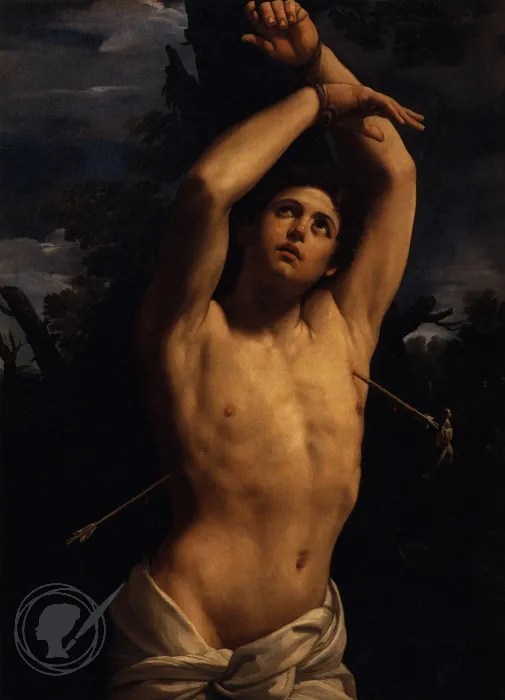
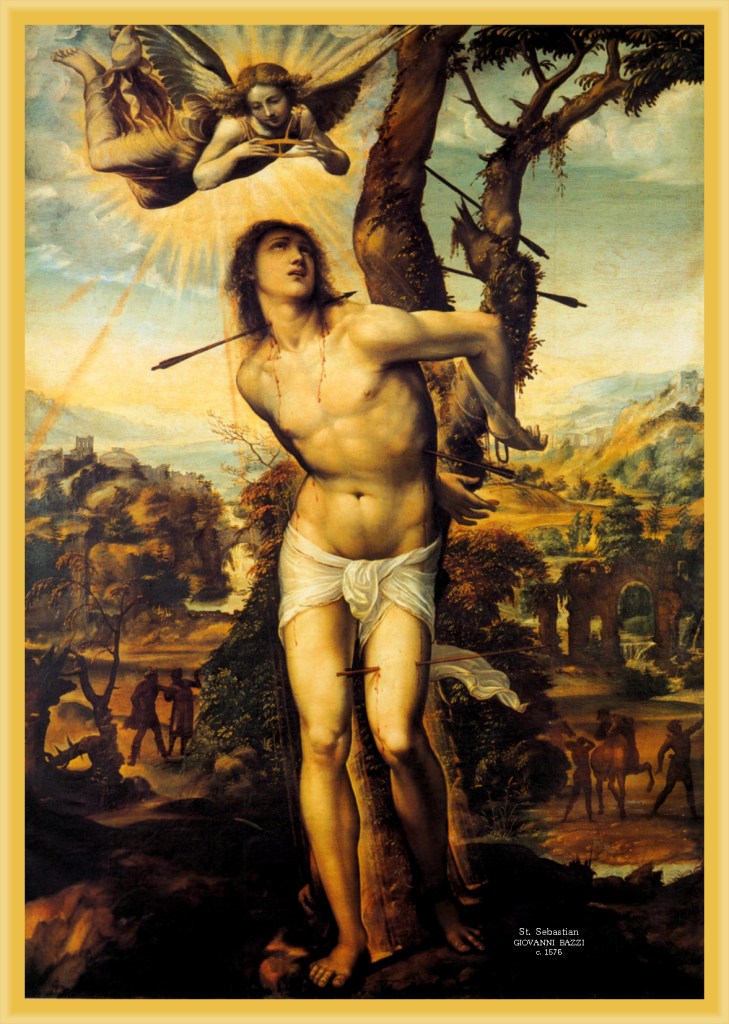
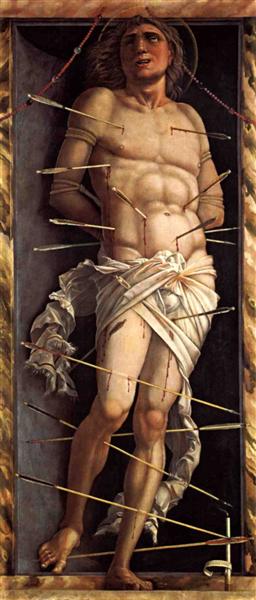
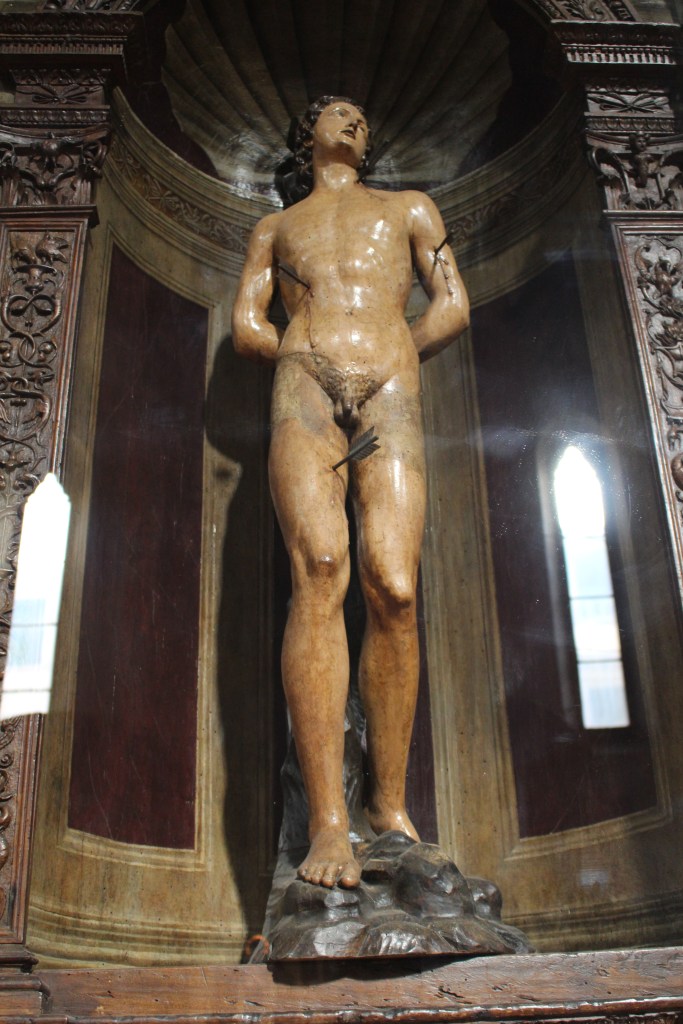
And don’t even get me started on depictions of St. Sebastian.
I love that they sculpted his pubic hair onto that last statue. Nice authenticity!
Someday I may write about St. Sebastian…or a boarding school named after him, which would be nice imagery for a queer crime/horror y/a set at such a place.
There was also a lot of homoerotic art in depictions of Greek and Roman mythology–the Laöcoön statue is one; and any depictions of Hercules/Heracles, Achilles, Apollo, etc.
And we’ll talk about Ganymede another time.
I was raised as a Christian, of the Church of Christ brand of Protestantism–and a hard, cruel, you’re-going-to-burn-in-hell-for-believing-anything-else faith it is indeed. I can’t speak to what that denomination is like outside of the South, or even Alabama for that matter–I did notice that the version in Kansas wasn’t nearly as hard or unforgiving; but still pretty unforgiving, in comparison to other sects–but I do know that where I am from, the Church of Christ is hard, rough, and sees a lot of stuff as sin. (Southern Churches of Christ are also very argumentative–which hardly seems Christian, does it? Members are always getting up in arms about something and wind up going to another congregation, sometimes having to move churches more than once.
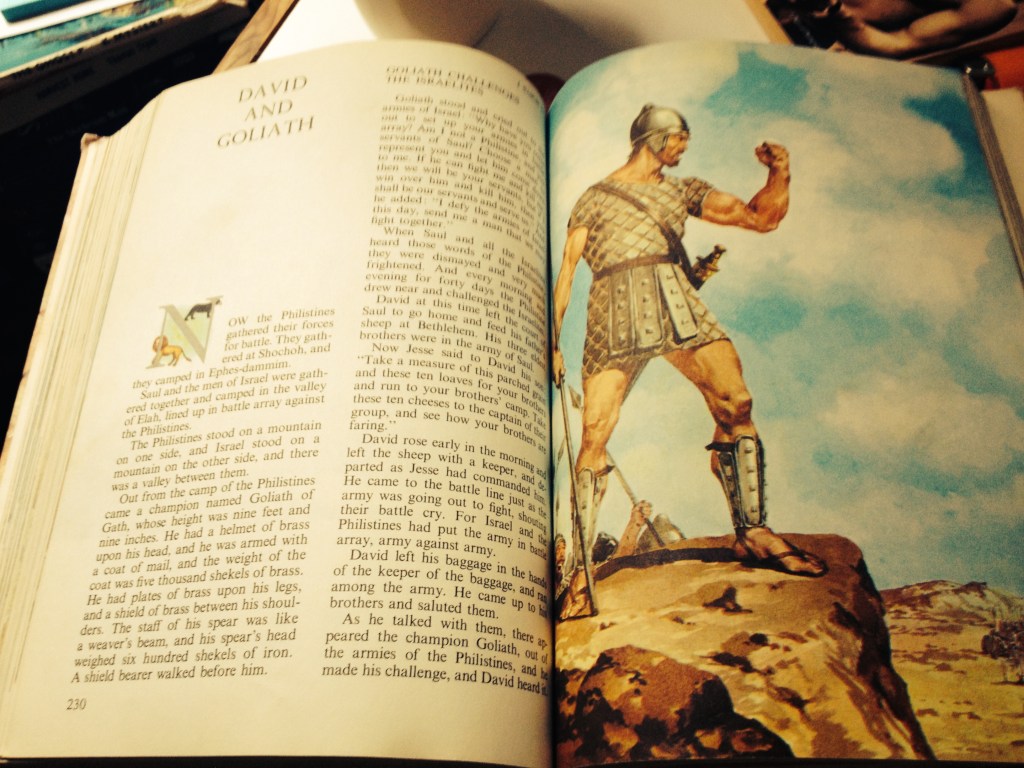
And when I was about eight or nine, my grandmother bought me a copy of The Children’s Bible, which was filled with illustrations (amazing how all those Middle Eastern Israelites were white, and even some had blond hair and blue eyes)…and maybe (probably) it wasn’t the intent of the publisher, but there was some seriously homoerotic imagery in the book. About ten years ago I was thinking about The Children’s Bible and wondering whatever happened to my copy…and remembering some of the illustrations in it, I thought no, you can’t be remembering that correctly and so I went on eBay and bought a used copy.
And when it arrived, my memories were actually correct.
I mean, look at the muscles on Goliath. That image was burned indelibly into my brain, and it’s entirely possible my appreciation of muscles comes from….The Children’s Bible.
Perish the thought!
Grooming!
Indoctrination!
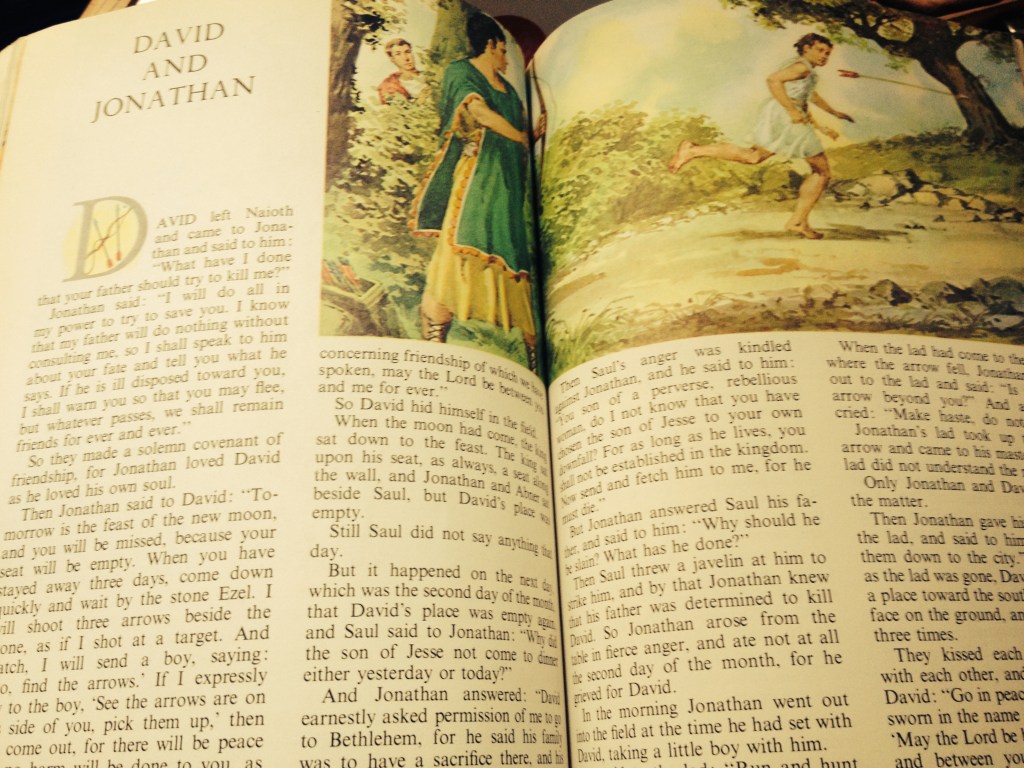
And of course, my favorite story in the book was David and Jonathan.
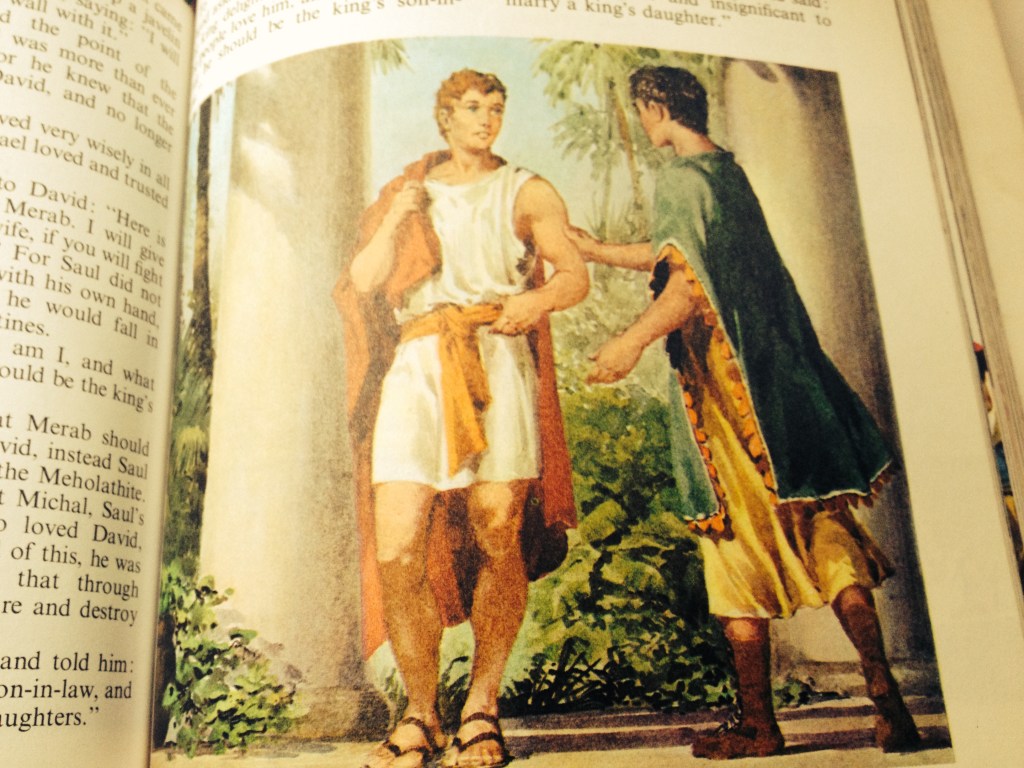
I mean, look at how they drew David!
I mean, it may not be Michelangelo, but damn.
(I also love that a Bronze Age Middle Eastern Jew somehow had pearly white skin, blonde hair, and blue eyes. Riiiiiiiiiiiiiight.)
Though David has awesome legs in both depictions, seriously.
When I was a kid, I’d always reread the David and Jonathan story (can’t imagine why it was my favorite…). I wanted a best friend like David–I always saw myself as Jonathan, the supporting player, the way I always did–gorgeous and charismatic and beautiful and beloved of God. I would think about the story and while I was too young and innocent to conceive of it as anything other than friendship–the same way I thought of the “friendship” between Achilles and Patroclus in tales of the Trojan War–when I got older, whenever I thought about the story I wondered about how deep that friendship between Prince Jonathan and David son of Jesse was. Why include the story at all? It really doesn’t add a whole lot to the tale of David’s life, and did it really matter for King Saul to have a son who was David’s friend and great love? Jonathan dies–not even the Bible was immune from bury your gays–and David mourned him with a great grief that seemed a bit more than “my best bro died.” I wanted to write the story myself, despite my lack of historical knowledge of the period or even when it was actually set, but I wanted to write about their love, their falling in love–and let’s face it, God didn’t really seem to have a lot of problems with their relationship, did he? He didn’t come to David and tell him to stop giving it to Jonathan; God didn’t curse the two of them or punish Israel for it; and yes, Jonathan is eventually killed…but even then God doesn’t come to David and say, did you not read Leviticus? I could hardly let you go on fucking him forever, you know.
So, I guess I am supposed to read it literally and just think they were best friends and loved each other as brothers. Yeah, no. There’s absolutely no reason for this story to be included in the David story in the Bible; none, unless of course there’s a kernal of truth in the story (don’t come for me, I’ve never bothered to find out if the Bible’s Old Testament kings of Israel were real people; I do know that real people turned up in the Old Testament that existed in history–Babylonians and Assyrians, for example, as well as Egyptians)but the mystery for me of why this story was included, why it was included if its merely legend or why was it included if they were real is the real question. There’s no moral lesson to be learned from the story of their friendship; their love and loyalty to each other was an issue for Jonathan because his friend’s greatest enemy was Jonathan’s own father, a king anointed by God–despite God capriciously turning His back on Saul for really such an insignificant reason that it really just boiled down to God just liked David better; I always felt sorry for Saul–how much would it suck to lose God’s favor for no good reason? Just because God found someone He liked better? (And considering the things God forgave David for, or just overlooked, really makes the hard turn away from Saul that much more petty and bitchy.)
God’s kind of an asshole in the Old Testament, frankly.
But yes, I’d love to write this story sometime. (Because I don’t have enough else to do, right?) I’d also want to write it from Jonathan’s perspective, although the death would be hard to do (Madeline Miller managed it with Song of Achilles quite beautifully) story-wise; but is the kind of challenge I love. Maybe someday, and maybe writing it will help me in my constant and never-ending life quest to come to terms with the religious grooming drilled into my brain as a child. I even have a great title for it, too.
I also have a novel in mind revolving around Michelangelo’s statue of David, too; maybe I could combine research and do them at the same time. THAT would be a challenge, would it not?
Saturday morning. I was incorrect about the department meeting; it’s later this month (when I’ll be in Bethesda, actually) so I went to the health fair, was told I should increase my exercise (duh, since I do none now) and other than that, I appear to be perfectly healthy–or at least per my vitals and blood work, at any rate.
How fortunate they weren’t testing for mental stability, eh?
But it was a lovely day to work-at-home. It was still cold overnight, but the high yesterday hovered in the high seventies, topping out at a solid, spring-like eighty degrees at one point in the afternoon, which was also nice. I filed and cleaned when taking breaks from work; laundered the bed linens, finished off the dishes, and straightened the rugs as well as sweeping and vacuuming. We got caught up on Yellowjackets and The Mandalorian, and while I was waiting for Paul to come home from the gym, I rewatched this week’s Ted Lasso with the captions on so I could catch things I missed on first viewing (something I do with every episode, as I did with Schitt’s Creek), and I have to say I enjoyed it a lot more on the second viewing than I did on the first. I am very curious to see where the show is going and how it’s going to end–but unlike everyone else, I’ve decided to not theorize about it or jump to conclusions predicated on my interpretation of what I’ve seen; instead I just want to enjoy the ride and trust the writers to do their jobs, which they’ve done superbly on every step of the journey thus far.
I slept really well last night and feel very rested this morning. I have to get the mail today and I should make a small grocery run while I am out, but ugh, how I hate the grocery store lately. It saps my strength and will and makes me want to curl up with Scooter and pretend the rest of the world doesn’t exist anymore out there. There’s not much we really need, to be completely honest; but I need to know what I want to make for dinner this weekend and what I am going to be taking for lunch next week. Decisions, decisions–but it feels good to be rested and clear-headed this morning. I don’t know that I feel particularly inspired this morning, but that’s okay. Once I finish this, I am taking my coffee and repairing to my easy chair to read Scorched Grace, which I hope to finish this weekend.
Anne Perry, a very successful author, died this week. She had an unfortunate past, having committed the crime that Peter Jackson’s film Beautiful Creatures was based on (also known as the film that gave us Kate Winslet and Melanie Lynskey) as a teenager, and served her time. I didn’t know Ms. Perry, nor have I ever read any of her work. This wasn’t out of any sense of oh I can’t possible be supportive of her! She killed someone! but more because they weren’t the kind of stories I particularly enjoy. I did ride in an elevator with her once at a Bouchercon, and she was polite, reservedly friendly (understandable), and seemed kind. I’ve been thinking lately that I’d like to read more historical crime fiction, particularly around the first World War (looking at you, Charles Todd!), but that TBR stack is already way too deep and tall and wide. However, Ms. Perry’s death has, of course, brought all that about her teenaged crime back into the news and onto social media to be rehashed and discussed and, well, frankly beaten into the ground. Ms. Perry’s situation also is key to a broader discussion about criminal justice, and our criminal justice system and how it operates. (Ms. Perry’s crime was committed in Australia, I believe.) I see a lot of people talking about how they don’t believe in redemption, and how they could never bring themselves to support someone who’d done something so terrible, etc. etc. etc. And it’s very true; we as a society tend to look askance at people who’ve served time in prison–and tend to judge them harshly.
How can you believe in a criminal justice system if you don’t believe in the potential of human redemption? I’m not an expert on any of this stuff, let me make that very clear at this point. I am merely examining this from a layman’s perspective and coming from a logical place to try to dissect all of this with nuance and rationality; what can I say, I took Geometry in high school and was on the debate team. I don’t think you can believe in our criminal justice system if you don’t believe in redemption, which seems kind of Old Testament to me; once a criminal always a criminal is what that boils down to, and if there is never even the slightest possibility that someone can be redeemed, what is the point of jailing them? Punishment? That seems kind of draconian and not very humanist, frankly. The odds are stacked against convicts as it is when they are released; as most of us will always keep an eye at them in askance, just waiting for them to commit another crime to prove that they belong in jail and should never be released. I understand the sex-offender registry–women and children are vulnerable and should be aware someone who may be a predator is living in their area now–but at the same time, it feels….punitive. Sex crimes are horrible, to be sure, but if they are so horrible and the offender is statistically going to commit the same kind of crime again–why let them out in the first place? Getting one of those flyers back when we lived on Camp Street is what inspired me to write my short story “Neighborhood Alert,” which is one of my favorite stories that I’ve done, and tried to use the story to illustrate the potential consequences that can come from such alerts.
I also think it’s interesting that people are so unforgiving in real life while they will read–and root for–characters like Tom Ripley or Hannibal Lector or Dexter. But that’s fiction, they say in response, to which I say so you would be repulsed by them if they were real, but you root for them in fiction? Make it make sense to me.
Ultimately, she did her time for her crime, and then spent the rest of her life writing crime novels successfully. Enough people either didn’t know about her past, or didn’t care enough to make them give up the pleasure of reading her work. As I said, I’ve not read her work but it’s not out of any sense of moral outrage or superiority, but because they aren’t the kind of books I ordinarily read–although now I kind of want to read one, to see how good she was. If you don’t want to read her, or didn’t, because of her past that’s your choice and your decision. But please don’t think for one moment you have the right to tell me what I can or cannot read, or what I can or cannot enjoy–because then you are no better than right-wingers trying to ban books and close libraries, and that is something I will not, do not, and cannot, support on any level.
I also kind of believe that redemption is possible, but not unless there is atonement and a desire to change. If I didn’t believe that, well, I don’t know how I could live with myself. This is a question I explored in my nasty little story “This Thing of Darkness”–can you atone for something terrible you did as a teenager? Especially if you are never punished for the crime itself? How do you live with yourself with such a thing on your conscience? (This is also the theme for one of my favorite books of all times, Thomas Thompson’s Celebrity)
And on that note, I am making another cup of coffee and heading to the chair with Margot Douaily. Have a lovely Saturday, Constant Reader, and I’ll be back here again tomorrow, as always.
I’ve always been—undoubtedly in part because I love history so much—an enormous fan of books where secrets from the past (even the far distant past) play an enormous part in the present lives of the characters in the story, and that solving those mysteries, learning the truth about the past, is necessary in the present for conflict resolution. As a history buff, the lack of a lengthy history as a nation is something I’ve always thought unfortunate; without ancient buildings and the way that history isn’t sort of always there in our faces the way it is in Italy or other older nations, it’s difficult for many Americans to either grasp, be interested in, or give a shit about our history—we have as a nation the attention span of a goldfish (thanks, Ted Lasso, for that reference).
To make a side by side historical comparison, for example, the Habsburg dynasty dominated central Europe for almost six hundred years, whereas the first European to actually arrive and establish a colony were under the aegis and flag of the Habsburg king of Spain—and that was in the early sixteenth century.
Secrets of the past casting a shadow over the lives of the living is often a theme in Gothics, my favorite style of novel/writing (noir is a close second). Rebecca is of course the master class in secrets of the past; the first Mrs. deWinter might not actually be haunting the halls of Manderley literally, but her ghost is definitely there. Victoria Holt’s romantic suspense novels inevitably were set in some enormous old mansion or castle, with potential ghosts a-plenty everywhere you turn. Phyllis A. Whitney’s one novel set in Britain—Hunter’s Green—also has a classic old British mansion with a potential ghost in it. Maybe it was the childhood interest in kids’ series, with the reliance on secret passages, hidden rooms, and proving that ghosts were frauds; every episode of Scooby Doo Where Are You? had the gang proving something supernatural was quite human in origin.
One of my favorite Nancy Drew books when I was a kid was The Ghost of Blackwood Hall; I don’t really remember much of the story now, other than a fraudulent haunting was involved and a woman—Mrs. Putney—was being swindled by a medium? (Reading the synopses on a Nancy Drew website, apparently part of the story involves Nancy and the gang coming to New Orleans, which I absolutely do not remember; my only Nancy Drew-New Orleans memory is The Haunted Showboat—involving yet another haunting. Interesting.) When I was writing the original short story (“Ruins”) I needed a name for the old burned-out plantation house; I decided to pay homage to Nancy Drew by naming it Blackwood Hall, and naming Jake’s maternal ancestor’s family Blackwood (his grandmother was a Blackwood, married a Donelson; Jake has his father’s last name, which is Chapman). I did think about changing this from time to time during the drafting of Bury Me in Shadows, but finally decided to leave it as it was. It might make Nancy Drew readers smile and wonder, and those who didn’t read Nancy Drew, obviously won’t catch it.
Hey, at least I didn’t call it Hill House.
But writing about ghosts inevitably makes one wonder about the afterlife and how it all works; if there is such a thing as ghosts, ergo it means that we all have souls and spirits that can remain behind or move on after we die. So what does writing about ghosts—or writing a ghost story—mean for the writer as far as their beliefs are concerned?
Religion primarily came into existence because ignorant humans needed an explanation for the world around them, combined with a terror about dying. It is impossible for a human mind to comprehend nothingness (whenever I try, I can’t get past “there has to be something in order for there to be nothing, you cannot have nothing unless you have something” and that just bounces around in my head until it starts to hurt); likewise, whenever I try to imagine even the Big Bang Theory, I can’t get past “but there had to be something to explode” and yeah, my head starts to hurt. Even as a kid in church, studying the Old Testament and Genesis, I could never get past “but where did God come from?” I don’t begrudge anyone anything that gives them comfort—unless it starts to impede on me. I’ve studied religions and myths on my own since I was a kid; the commonalities between them all speak to a common experience and need in humanity, regardless of where in the world those humans evolved; a fear of the unknown, and an attempt to explain those fears away by coming up with a mythology that explains how everything exists, why things happen, and what happens when you die. (I am hardly an expert, but theology is an amateur interest of mine, along with Biblical history, the history of the development of Christianity, and end-times beliefs.)
Ghosts, and spirits, have been used since humanity drew art on cave walls with charcoal to explain mysterious happenings that couldn’t be otherwise explained. I am not as interested in malevolent spirits—ghosts that do harm—as I am in those who, for whatever reason, are trapped on this plane and need to be freed. This was a common theme in Barbara Michaels’ ghost stories (see: Ammie Come Home, House of Many Shadows, Witch, Be Buried in the Rain, The Crying Child) in which the present-day characters must solve the mystery from the past; why is the ghost haunting this house and what happened to them that caused them to remain behind? I used this theme—spirits trapped by violent deaths in this plane whose truth must be uncovered in so they can be put to rest—in Lake Thirteen and returned to it with Bury Me in Shadows. I did, of course, worry that I was simply writing the same book over again; repeating myself is one of my biggest fears (how many car accidents has Scotty been in?), but the two books, I think, are different enough that it’s not the same story.
At least I can convince myself of that, at any rate.
There’s a few more ghost stories I want to write, actually; (it also just occurred to me that there was a ghost in Jackson Square Jazz, the second Scotty book) any number of which come from those legends my grandmother used to tell me as a child. I have this great idea for one I’ve been wanting to write set here in New Orleans for a very long time called “The Weeping Nun;” I have the entire ghost’s story written in my head, I just don’t have a modern story to wrap around it (same issue I have with my New Orleans ghost story book, Voices in an Empty Room) and of course there’s “The Scent of Lilacs in the Rain,” a short story about another Corinth County ghost I started writing and got to about five thousand words before the ghost even made an appearance. That great length is why I shelved the story—and now, of course, I realize I can do it as a novella, which is amazing news and life-changing, really. “Whim of the Wind,” the very first Corinth County story I ever wrote, is also kind of a ghost story, and maybe someday I’ll find the key to making it publishable (although I think I already did figure it out, thanks to the brilliance of an Art Taylor short story).
I’ve always believed part of the reason I was drawn so strongly to New Orleans is because the past is still very much a part of the present here—though not so much as we New Orleanians would like to believe, as several Facebook groups I belong to about the history of New Orleans often show how often and rapidly the cityscape has changed over the years—and you can sometimes even feel here, at times, under the right conditions (fog and/or mist are usually involved) like you’ve gone back in time, through a rip in the time/space continuum; which is something I’d actually like to write someday here—but that’s just an amorphous idea skittering through my brain.
And of course, I have an idea for a paranormal series set in a fictional parish here in Louisiana. I think about it every now and again, but am really not sure how I want to do it. I know doing a paranormal Louisiana town series will get me accused of ripping off Charlaine Harris’ Sookie Stackhouse novels, but that’s fine. I don’t think I would be doing vampire kings or queens or any of the directions Ms. Harris went with her series. (Monsters of Louisiana and Monsters of New Orleans—paranormal/crime short story collections—may also still happen; one never knows, really.)
As hard as it was sometimes to write, I think Bury Me in Shadows turned out better than I could have hoped. I think it captured the mood and atmosphere I was going for; I think I made my narrator just unreliable enough to keep the reader unsure of what’s going on in the story; and I think I managed to tell a Civil War ghost story (it’s more than just that, but that’s how I’ve always thought of it and that’s a very hard, apparently, habit for me to break.
I hope people do read and like it. We shall see how it goes, shall we not?




 Queer and Loathing in America