New Orleans

Twenty-eight years ago I came to New Orleans for my birthday weekend, and my life changed completely. Earlier that month I had already taken a cold, hard, long look at my life and I didn’t like what I saw. I had been wrapped in misery for years, wallowing in it, and diving so deep into the misery that I allowed it to erase my dreams and any hopes I had for the future. It was, after all, very easy to blame outside forces for my miserable life, and when you dig deep down into the misery, well, it’s a lot easier to just wrap yourself up in self-pity than take any responsibility for your own happiness; making excuses not to try rather than reasons to better myself. I worked for Continental Airlines at the Tampa airport–most times not a bad job for the most part, but the bad days were horrible–and didn’t make much money. I was broke all the time and yes, I wasted a lot of money treating myself to things–like buying lots and lots of books every payday–in an effort to make me feel better about myself and my miserable life. I was horribly lonely.

A bad experience with someone I was romantically interested in was the impetus for the changes I made to my life, because for whatever reason that night everything just bubbled up to the surface; I hated everything about my life, I hated where I was at, I felt trapped and like nothing good was ever going to happen to me. I stayed up the entire night, feeling sorry for myself and unable to sleep, tossing and turning and occasionally crying. At seven o’clock the next morning (it was a day off) I went into my bathroom and took a long, hard look at myself in the mirror. I never want to feel this way ever again, I thought as I looked at red swollen eyes, the unshaved face. the dark purplish circles under my eyes. I then repeated it out loud. I went back to my desk, sat down and opened my latest journal and wrote the words: I hate my life. I stared at the words for a few moments, and then added, I have no one to blame for this but myself. I am the only person who can change things for me. I want to be a writer. I want to be published, and I don’t want to work for Continental for the rest of my life in this job that makes me miserable. I am lonely and it’s probably too late for me to find a life partner. But I have to stop being afraid of everything, and I can’t go the rest of my life NOT living because I am afraid of dying. Other men are not attracted to me because I am overweight–no one ever looks at me twice when I go to bars. I cannot change my face but I can change my body. I will eat healthy. I will drop some of this extra weight. I will do crunches and push-ups every day from now on, and if by January I have been consistent with the workouts and the diet, I will join a gym. I need to start figuring out who I am and how to get what I want because no one is going to knock on my door and just give it to me. The only person who can change the things in my life is me, and I am going to work on being the best possible me that I can. And that means taking the steps necessary to change who I am and what my life is so I can become a writer.

Three weeks later, my birthday weekend rolled around and I flew to New Orleans with a friend for the weekend. We were staying with his on-again off-again boyfriend–who turned out to be one of the nicest gay men I’ve ever known. I really liked him. thought he was a good person–but once they broke up for good that was the end of that; I guess he associated me with his ex and so couldn’t be bothered anymore (or he did a great job of acting the part of the generous host; I am not sure how the invitation to stay with him came about; all I knew was we were going to New Orleans for my birthday and staying with this guy), which was always a shame. I was always grateful to him–have been for twenty-eight years–because coming to New Orleans that weekend was yet another key piece to the puzzle of Greg’s future, a piece I didn’t even now I needed.

I think at that point I may have lost five pounds or so. My friend was gorgeous; one of those perfect gay men with golden skin and very little–if any–body fat; his boyfriend was his counterpart, only with much bigger muscles, bluish-black hair, and that gorgeous gorgeous olive toned skin darker Italians have. They looked beautiful together, too, and I was in some sense a third wheel that weekend, but it was okay with me. They were totally into each other which left me with time on my own to think and reflect. He picked us up at the airport and took us to his apartment (which was in a complex on Sophie Wright Place that Paul and I eventually moved into when we returned from DC in August 2001), we showered and cleaned up, and headed to the Quarter.

I had been to New Orleans before that particular trip, and while I had always felt drawn in some ways to this city since I was a child, I’d never before felt the sense of belonging I felt that weekend. When we stepped out of the cab that night at the corner of Bourbon and St. Ann, I felt this enormous emotional release, as though tension I didn’t know I. had in my shoulders and brain were suddenly gone and a big burden had been lifted from my shoulders. It was as though my soul was saying at last you’ve come home, and I knew then, before we paid the cover charge to go into the bars there at the corner–Oz and the Pub/Parade–that I was going to someday live in New Orleans…and all of my dreams would come true once I did.

I have never been sure what was different about that trip than previous ones. On my brief, previouos visits to the city before, I’d never gotten a real sense of the city before–we stayed in motels by the airport or on the West Bank–and so it wasn’t really possible to get a sense of New Orleans. Waking up in the spare bedroom in the morning, walking out onto the balcony and looking around at the roofs and unique architecture of the lower Garden District, I felt like I was at home. It was also the first time I’d ever come to New Orleans to hang out with other gay people and in the gay section of the Quarter, and maybe that was the difference? I don’t know for certain, but I do know that was the magical trip when everything coalesced in my head on that trip here. I knew New Orleans was my home, and I needed to live there, and my dreams would finally all come true once I’d moved there.

My friend’s boyfriend was a great host. He made sure to take me to see Anne Rice’s home at First and Chestnut (which was also the home of the Mayfair witches in The Witching Hour, a book I’d loved that had only heightened my sense of need to come to New Orleans), and showed me (us) around the entire weekend; we went to Lafayette Cemetery in the Garden District, ate amazing food, and then at night we’d head down to the Quarter to the bars and danced the night away.

That was also the weekend I did Ecstasy for the first time, but that’s a story for a different time.

The entire weekend was a whirl; I have pictures somewhere (or lost many years ago during the course of a move or something) of all the places we went and things we did; the amazing food, dancing all night and going to the Clover Grill in the morning (or La Peniche, over in the Marigny) and then sleeping before going roaming again throughout the city. I fell for New Orleans hard that weekend, and have never really fallen out of love for the city, really, since. We broke up once (that dreadful year Paul and I spent in DC), but we came back and New Orleans forgave us for our desertion and welcomed us back home.

I don’t remember how old I was when I first heard about New Orleans, but I do remember Nancy Drew came to Carnival (called “the Mardi Gras” in the book, eye roll to infinity) in The Haunted Showboat (she also visited briefly during The Ghost of Blackwood Hall), but I don’t really remember much else. I think everyone in the country has a sense of Carnival/Mardi Gras, and always associates that with New Orleans–but New Orleans, obviously, is so much more than that. I was a kid when I watched the James Bond movie Live and Let Die–which whetted my interest in New Orleans and Louisiana–later movies like The Big Easy and Angel Heart and Tightrope expanded that interest, as did Anne Rice’s novels and the Skip Langdon series by Julie Smith. Whenever I had been to New Orleans previously I hadn’t felt anything but a sense that the city was different than everywhere else, and that difference felt alien to me.

But that entire weekend was different. That weekend in the city changed me and changed my life. I’d never felt like I’d belonged anywhere before–I always had felt out of place wherever I lived; part of it was being gay, part of it was being a creative, and the rest had everything to do with being raised by Southern parents with a Southern mentality but not living in the South (not a complaint, I am very grateful to have not been raised down here)–so New Orleans felt special to me; I’d finally found my place or, to quote Pippin, I’d finally found my corner of the sky.

Within a year I’d met the love of my life–who also was in love with New Orleans and wanted to live there–and on August 1, 1996, I drove the U-haul truck with all of our stuff and towing my old car into the city to start the rest of my life. I had already started dipping into the waters of writing–I got a gig with a gay paper in Minneapolis that actually paid me, and had started writing the book that would eventually become Murder in the Rue Dauphine. Within three years of moving to New Orleans I had a book contract and had sold my first ever short stories. Twenty-eight years to the day of that most important visit to New Orleans, and look at me now.

I live in the city I love with the man I love doing the work I love. I’m glad that I didn’t know at the time how important that weekend was going to prove to be; that it was, indeed, really the first day of the rest of my real life, when I finally stopped just enduring my life and actively started living it. It’s not always been easy to live here and love the city; New Orleans can be a hard place a lot of the time. We’ve endured hurricanes and floods, disease and injury, poverty and horror. But even the bad things are made bearable because we live in New Orleans.

I’ve written millions of words about New Orleans. One of the best compliments I can receive is being told that I’ve depicted the city so vividly and lovingly that it’s a character. I do laugh when people call me a “New Orleans expert”–I am anything but an expert; you could fill the Great Library of Alexandria with what I don’t know about New Orleans; every day I discover something new about this wondrous and bizarre place, the only place on earth I’ve ever felt at home. I will never run out of material to write about this magical city, and every day, more ideas and thoughts for stories and characters and essays about New Orleans comes to me.

So, my favorite part of my birthday is the fact that it is also the anniversary of me finding, at long last, where I belong.

And thank you, New Orleans, for always, no matter what, being New Orleans.

I’ve always rather blasphemously called this statue “Drag Queen Jesus”, for reasons that should be fairly apparent.

It’s Impossible

FRIDAY!

I always like Fridays mainly because I can sleep a little later than I am used to–after three completely hideous mornings of getting up at six; it really is relative, isn’t it? I mean, I just get up an hour later than I do on those mornings, and yet it feels like I slept for twenty years or something. Just can me Greg Van Winkle–although I think falling asleep in 2022 for twenty years would be terrifying when you woke up; imagine the leap from 2002 to now.

But for whatever reason I feel good this morning, whether it’s the sleep or whatever, and that’s a very good feeling. I feel rested and relaxed, which is always a lovely feeling, and I am looking forward to a three day weekend. I am going to read and write and do all kinds of things–as always, I have an ambitious plan for the weekend–but tomorrow I am doing some self-care (which is always lovely) before I run my errands, and I am going to try to get that all out of the way tomorrow, so I don’t really have to leave the house much the rest of the weekend, other than going to the gym (oh, yes, that’s on the list for this weekend) and an errand I have to run Monday. I am hoping to start and finish John Copenhaver’s The Savage Kind this weekend, and while I have an enormous TBR pile, I really should just read queer books this month. I think I’ll start revisiting Joseph Hanson, and I’ve also got The Devil’s Chewtoy in the pile as well. And hopefully, I’ll get some writing done this weekend as well. I didn’t work on “Never Kiss a Stranger” yesterday; instead I worked on another project that a publisher has shown interest in, but I need to get it figured out and a draft written. I’d originally planned to get that draft written this month–I am so far off schedule this year that it isn’t funny–but it does interest me and I played around with it a while last night before we finished watching The Victim, which is really well done. We also watched the new episode of Obi-wan Kenobi, and I don’t understand what the on-line bitching by the male virgins in the basement is all about. Why is it so difficult for people to grasp that there would be non-white humans in space in the future as well as a long time ago in a galaxy far, far away?

Although I suppose their preference would be an all-white universe.

Sad.

I was thinking last night–while I was waiting for Paul to come downstairs and watch television with me; as pop culture list videos autoplayed on Youtube while I doom-scrolled on my iPad–about writerly ticks; things I always seem to wind up writing about a lot more than I should; like of course I am reading something Greg wrote, because here is the part where there’s a thunderstorm or ah, there it is–the car accident Scotty gets into in every book (and sometimes Chanse, too) or ah, this must be New Orleans as written by Greg because its all about hot and humid. One of the reasons I do love living in New Orlenas is because I love rain. One of the things I miss the most about my office on Frenchmen Street (besides the awesome street name) is that the building directly behind my actual office had a tin roof, so every time it rained I’d open the window so I could hear the rain drumming on the tin roof. It always made me think of my childhood; my grandfather’s house had a tin roof when I was very young–the barn’s was never replaced–so I can remember listening to the rain while I was lying in bed, all snug and warm and dry; to this day I find a weird emotional comfort when it’s raining outside and I am snug and dry and under a blanket inside the Lost Apartment. I can even remember a scene from a Trixie Belden book–The Mystery of Cobbett’s Island–where Miss Trask was driving Trixie and the other Bob-Whites to Cobbett’s Island for a vacation, and it started raining on them; I was reading it in the car on the way to Alabama from Chicago and ironically, it was raining on the car as I read. I even started writing one of my many attempts to write a juvenile series a la Nancy Drew/the Hardy Boys/Trixie Belden with the characters getting caught in a thunderstorm while driving en route somewhere–I don’t remember anything else, but I remember writing about them riding in the rain….and ever since then, it seems like I write alot about thunderstorms. There’s even a thunderstorm scene in A Streetcar Named Murder, because of course there is.

I always write about rain–and I don’t think i could ever live in a desert climate again because I would miss rain too much.

So, note to self: no rain and no car crash in the next Scotty. We’ll see if I can stick to that.

And on that note, tis off to the spice mines. Have a lovely day, Constant Reader.

She’s Not Just Another Woman

Well, yesterday was actually quite lovely. I slept extremely well Thursday night and of course, the Anthony Award nominations turned my week around when the news broke that night (I still can’t believe Bury Me in Shadows is nominated TWICE), and I did spend a lot of yesterday trying to thank everyone for their congratulatory tweets, posts, comments and emails–I can’t think of anything lovelier than having to say thank you to people for their kindness–AND then Netflix renewed Heartstopper for an additional two seasons, which warmed the cockles of my cold, dark little heart. I wasn’t able to get as much done as I would have liked–but I did get some important thinking done, and today I am really going to start working on my edits. When I got home from work yesterday I did a lot of cleaning and organizing in order to get it out of the way before the weekend, precisely so I could focus on my edits. We spent the evening, once I’d made dinner (Swedish meatballs over egg noodles, if you were wondering) watching this week’s Under the Banner of Heaven and then one of the two new episodes of Hacks before we turned in early for the evening. I slept marvelously again last night, and feel very rested and a-rarin’ to go this morning. I do have some errands to run–nothing major that will take me away for long; I need to get the mail and put gas in the car–and then I can settle in for a day of editing and writing, which I am strangely looking forward to doing.

It was a rollercoaster of a week, ending withe incredibly pleasant high of having two Anthony Award nominations for the same book–still having trouble wrapping my mind around this, to be honest; I don’t know if it’s ever happened before–but I am not the only person with more than one nomination. Tracy Clark is nominated for Best Novel for Runner and for Best Short Story; S. A. Cosby is nominated for Best Novel (Razorblade Tears), Best Short Story, and Best Anthology for Under the Thumb. I feel confident no one’s ever been nominated for three Anthonys in the same year, as well; Shawn just keeps breaking down barriers with his extraordinary work. The nominations list is also one of the most diverse I’ve seen in all my years in this business, which certainly also bears remarking on.

As always, I still have a ridiculous amount of work to get done; but now that I am all rested this morning and feeling great about things, I am not so worried or stressed about it as I was yesterday or earlier in the week (being tired is so unpleasant, and just opens to the door to stress and anxiety and depression); we will see, of course, how long that will last very shortly, won’t we? I have hopes–although I know going out into the blisteringly hot and humid day to run errands will suck the energy right out of me, sending me quite literally to my easy chair; but I can work in the easy chair–if I make myself do it, which I feel like I can do today. I don’t think I am going to make the deadline for that short story–its fine, really; I was thinking about it last night and realized working on it has been a way of pushing off getting the edits on my book finished because I just can’t face working on it again, but I am over it already. I still don’t know the middle of the story, and I can always finish it some other time and get it done and try to sell it somewhere. It’s a pretty good story–I just need to figure out the middle of it.

Sigh. I hate the middle.

But looking around the desk this morning, there’s things I need to put away and filing that needs to be done; I also got down my Scotty books (with the pages marked with sticky notes for each character’s history and background; this was the initial step to creating a Scotty Bible to make continuity easier for me) and have them stacked neatly on the right corner of the desk underneath some others I’ll be using for Chlorine research (should I ever get around to that, I am beginning to sense the slippage of time through my hot little fingers). This is always the first step of writing a Scotty book; gathering the copies of the old for references. I have the prologue-opening spoof of a more famous book’s opening selected and even written somewhat (A START!) and I am doing some research–I am going to pay homage with the book to two Nancy Drew mysteries (The Ghost of Blackwood Hall and The Haunted Showboat) in this plot/story, so I actually had to sit down and reread both books (another blog post there, but you’ll have to be patient, Constant Reader) this past week–more of a skim, really; just to get some feel for them again since I didn’t really remember as much of them as I would have liked–and yes, I have thoughts (hence the blog post which I’ve already started).

But as I said, I have edits to dig into today, and some filing to do before I run the errands, so it’s perhaps best that I bring this to a close this morning and head into the spice mines. Have a lovely Saturday, Constant Reader, and I will chat with you again tomorrow morning.

Easy Loving

Monday morning and I really didn’t want to get out of bed this morning. I have so much to get done this week it’s kind of overwhelming, to be honest; and the temptation to just stay in bed for the rest of my life and avoid the world was kind of really powerful this morning. Yet the world stops turning for no man, let alone a Gregalicious, so there was naught for me to do other than arise, do my morning ablutions, and start drinking coffee. I did sleep fairly well, despite the enormous stress of a to-do list with incredibly lengthy chores and projects to work on, and feel pretty well rested this morning–if not quite up to dealing with the world at large.

Ellen Byron’s book launch last night was marvelous. I was delighted to see she had a very good turnout and sold a lot of books–and she is the QUEEN of swag. I for once didn’t have stage fright–I knew Ellen would be warm and witty and wise and funny; all I had to do was lob some questions at her and she was off and running (she did try to deflect attention back to me a couple of times, but I was ready to turn the spotlight right back on her after a brief answer and succeeded each time). The book itself is lovely, too; you want to get a copy of Bayou Book Thief, especially if you’re a fan of traditional mysteries. The cover is gorgeous, and it’s a fun story with a likable main character and a likable supporting cast, and Ellen’s adoration of New Orleans spills over on every page–and what more can a New Orleanophile ask for? I also picked up a copy of The Westing Game by Ellen Raskin (I saw it and remembered someone recommending it to me a while back, so I grabbed it immediately) and a copy of Albert Camus’ The Stranger, which I’ve been meaning to read for quite some time now (since Camus was inspired by The Postman Always Rings Twice for his own novel, I thought it only made sense for me to finally read the Camus)–I can never walk into a bookstore and not walk out with more than I intended to buy when I walked in (I had only intended to get a copy of Ellen’s finished book; I read a pdf) but that was fine–I wanted both books and let’s face it, I am always going to buy books at every opportunity, but it is time for me to start donating books to the library again.

I am not familiar with the part of New Orleans where the bookstore is located; Blue Cypress Books is on Oak Street past Carrollton, not far from where Carrollton and Claiborne intersect (and yes, the two streets actually run parallel to each other in my neighborhood; welcome to the wonderful and terribly confusing world of New Orleans’ bizarre geography). I would have, as per my usual, simply driven all the way to Riverbend on St. Charles then turned left on Carrollton…but I decided not to do my usual “this is how I know to get there” thing and used Google maps. Interestingly enough, Google maps took me on to Highway 90 then I-10 before getting off at the Carrollton exit in front of Costco and going that way…and it was faster–a lot faster, which I still kind of can’t wrap my mind around, but then again that’s New Orleans geography for you; my mind always thinks in terms of grids where everything runs north and south or east and west, and that isn’t New Orleans. The only actual grid design to anywhere in this city is the French Quarter–and only the French Quarter, at that. I have lived here twenty-six years and still get confused and mystified by how geography works here…which is one of the reasons I think people believe New Orleans is magical and mystical. Where else does geography make no sense other than here?

After I got home, we finished watching The Outlaws, which we really enjoyed, and started watching Gaslit. Julia Roberts is killing it as Martha Mitchell–I’d really forgotten a lot about her, but she was kind of a celebrity at the time, more so than the wife of Attorney General could ever hope to be, frankly–and she was enormously popular; everyone liked Martha Mitchell, because you never really knew what she was going to say next, which naturally didn’t sit well with the president of the time, Richard Nixon. (And again with a show set in the 1970s; sensing a theme–Minx, Candy, Gaslit–all set in the 1970s as a reminder to us all just how awful the 1970s actually were…pay attention, everyone. There’s a reason you never want to turn the clock back, or bring an era back.) I’d actually forgotten about Martha Mitchell–she’s often left out of books I’ve read about Watergate–and she was actually kind of an important cultural figure of the time. If the Nixon idea was to erase her from history, it kind of worked. The 1970s was definitely an odd decade.

As I was lying in bed dreading getting up and facing the world today, I thought, I would really love to have a vacation, you know. A week where I didn’t have a deadline to meet, or go into the office, or really do anything at all other than relax and read and watch movies or television shows I’ve not had a chance to see. It’s been a hot minute, and most of the traveling I actually do tends to be writing related in some way, which means it’s not really a vacation but a work trip. I don’t think I’ve actually had a vacation-vacation since we went to Italy, and that was eight long years ago. We’re talking about possibly going to Puerto Rico or some place in Central America (Costa Rica, if anywhere), but I think it’s past time…although I could also use some time off to stay home and get the Lost Apartment into some semblance of order, a Sisyphean task if there ever was one.

I didn’t finish my short story–the deadline was today and I know there’s no way I can get it finished in time to email off by midnight tonight, particularly since there would be little to no time to revise and/or edit it. It’s a shame, but at least the story is further along at about just over a thousand words than it was at less than two hundred; it’s a great idea but I’m basically stuck in the middle. I know how it ends, I just don’t know how to get it there, so letting it sit for a while is definitely in order. I did start writing the new Scotty yesterday–don’t get excited, I literally wrote maybe 175 words of the prologue; I found the book opening I wanted to spoof (Pride and Prejudice) and since I didn’t want to forget, I started writing it and it flowed along for another hundred words or so before I ran out of steam. The Scotty prologues are always the hardest part of the book for me to write; they are basically a recap of Scotty’s life thus far to get a new reader caught up without having to go back and read the first eight (!) books in the series as well as not spoiling the first eight books in the series should the reader decide to go back and actually read the first eight books in the series. (Something I actually need to do before I really dig in and start writing this thing…I really need to do the Scotty Series Bible and get that done so I have an easy reference without having to page through the books or do a search in the ebooks) I also did some research over the weekend for the book, which entailed rereading two Nancy Drew mysteries, The Ghost of Blackwood Hall and The Haunted Showboat (both books bring Nancy and her friends to New Orleans/Louisiana) and oh, yes, that bit of research definitely triggered a blog post which I started writing yesterday after I got ready for the event and was waiting for it to be the right time to leave. I kind of slam Nancy Drew in the post–but the truth is, despite my obsessive collecting of Nancy Drew books (trying to get the entire original series, with the yellow spines) I never actually liked the books all that much. (Same with the Hardy Boys.) While I appreciate the two series for their popularity and for getting kids to read (and to read mysteries) neither series was ever my favorite–but once I started reading and collecting, I had to keep reading and collecting because I am obsessive–and that obsession with collecting the books, while slightly tempered as I’ve gotten much older (and don’t have a place to display the collection), still exists. (Periodically I do think about emptying a bookcase and refilling it with my kids’ series books; it’s always satisfying for me to see them on the shelves. And yes, I know how weird that sounds.)

And now back into the spice mines with me. Y’all have a lovely Monday, okay?

Another Day

Sunday morning and I slept really well again. I woke up, as always, at just before seven, but stayed in bed lazily until nearly eight–when nature’s call became too much to be ignored for longer. But I have a nice fresh hot cup of coffee, a long Sunday with a lot to do and/or get done today (I also need to run to the grocery store this morning, which is always so exhausting) but I suspect that i can get everything I need to get done, done. Yesterday morning I spent some time with the Carol Goodman novel (which is really and truly spectacularly well done), went to do my self-care (which was lovely) and then picked up the mail and headed home to spend some time doing things. I did the bed linens, emptied the dishwasher and did another load (that needs to be emptied this morning) and also got some things organized for my next writing project. I did the Spirit of Ink interview at 2, as scheduled, and then when I was finished with that I was drained, as I knew I would be, so I did some more file organizing before retiring to my easy chair with my journal to make notes for Mississippi River Mischief, which I am also starting to get excited about writing (which is a lovely change from the usual, where I dread writing any and every thing).

So, overall, I was quite pleased with my Friday. Since we’d finished or gotten caught up on everything else we had started watching, we decided to binge through season two of The Hardy Boys on Hulu, which I am enjoying. Is it the Hardy Boys of my childhood? No, but neither was the 1970’s show with Parker Stevenson and Shaun Cassidy. I belong to several kids’ series groups on Facebook (they are very interesting people; I’ve always wanted to write a book about kids’ series fandom) and they were, of course, quite unhappy with this adaptation (but not NEARLY as up-in-arms as they were about the Nancy Drew television series, in which Nancy actually has sex with Ned–who’s Black in the show–in the very first episode). Maybe it’s because I’m a writer, but I don’t expect adaptations to match us precisely to the source material, and whether people in their fifties and sixties want to admit to it or not, both series in their original forms are horribly dated today. I did enjoy the show’s nods to the canon series throughout–one of the villains was named McFarlane (Leslie McFarlane ghost-wrote many of the original books) and the bad company is Stratemeyer Global (the Stratemeyer Syndicate created and owned both series, among many others), and there was also a single throwaway line at one point about “what happened at midnight” (which is one of the titles of the original canonical series); so that was all a bit fun for me. Even as I watched, I kept remembering all the dog-whistles of the fan group–disguised as “dedication to the original canon” of course–but when you use words like woke and so forth, your bigotry and personal biases are kind of put right out there on display.

And I can only imagine how upset they are that Aunt Gertrude (Trudy on the show) is a lesbian…which actually makes canonical sense, to be honest.

But it was a very pleasant way to waste the rest of the day, frankly, and I felt pretty marvelous when I went to bed last evening. I am really enjoying my sleep lately, which is marvelous, and lately I am feeling very–I don’t know, optimistic?–about my career and my future as a writer, which is always a plus. I am still waiting for my edits on A Streetcar Named Murder, and to hear back about my short story, but I am feeling pretty good about myself this morning (let’s see how long that lasts, shall we?) and tomorrow evening i am going to make a semi-triumphant return to the gym. This morning I am going to spend some time with The Lake of Dead Languages, and then I am going to head out to the grocery store, probably around elevenish, so I can come home and do some more writing and organizing and so forth. I am going to try to bang out a draft of a new manuscript by mid-June, and then I want to spend until August 1 finishing a first draft of Chlorine, at which point I will most likely have to start really working on Mississippi River Mischief. That’s a pretty good schedule, if I can stick to it–and then of course there are any number of short stories I want to get written in the meantime. There are two submission calls I saw recently (with very tight deadlines) I’d like to get something submitted to–but then it always comes down to time and motivation–both of which I am good at failing at–so it’s all going to depend, I suppose. But I am going to get organized here in my office space before retiring to read for the rest of the morning, which hopefully will mean productivity. We also need something new to watch, since we’ve binged our way through everything already–but there are any number of shows that dropped since the beginning of the year that we’d like to see that we never got around to, and more are coming out all the time.

I also want to rewatch Heartstopper at some point, so I can finish my post about it at some point. I really need to get those old unfinished posts finished and posted at some point, don’t I? I also have a bad review of Hemingway’s To Have and Have Not to finish as well as a review of Marco Carocari’s marvelous Blackout, as well as some ruminations about the resurgence of anti-queer political homophobia which hs reared its ugly head again.

And on that note, I am heading back into the spice mines. Have a lovely Sunday, Constant Reader!

Do You Know What I Mean

The traditional mystery often gets a bum rap by mystery fans. I’m not sure why that is; these books have never gone out of style, have never decreased in popularity, and have always been the backbone of the crime/mystery genre. They are often (wrongly, I think) identified with Agatha Christie–if anything, Christie should be identified with every sub-genre of crime/mystery fiction. She wrote private eye novels (Poirot); dark noir (Endless Night); spy fiction (N or M?, The Man in the Brown Suit, They Came to Baghdad); historicals (Death Comes as the End); and even romantic suspense (as Mary Westmacott). Sure, she often relied on the amateur sleuth–her most famous amateur being probably Miss Marple–but she literally did everything first, really.

Probably why everyone refers to her as the Queen of Crime Fiction.

But the traditional mystery, for some reason, gets short shrift in our modern world, despite being one of the most popular subgenres of crime fiction. Why? I don’t really understand it. Sure, there’s not any blood or sex or violence–the sort of thing generally used to sell everything from television shows to movies to laundry soap and deoderant. Many of us grew up reading books about amateur detectives, from Nancy Drew to the Hardy Boys to Trixie Belden. So why do so many turn their noses up at the traditional mystery, also known as the cozy mystery?

I think it’s much harder to write about crime without using the tough guy male lead (stereotype), blood, violence, swear words, and sex. Is it this lack of the “rougher” aspects of crime that earned these books the nickname “cozy”?

What precisely does the word cozy mean, used as a book descriptor in this way? Ask five mystery fans/writers, and you will get five different answers. It’s often hard to quantify the variety of subgenres within the mystery/crime field. Everything else aside, I think the most important thing, the key, for a mystery novel to get this kind of classification is that the book focuses, on one level, on a sense of community; the reader develops a warm, comfortable feeling, the kind that you usually get from visiting family and friends you don’t get to see all of the time. You open the book and start reading and already feel relaxed and at home; happy to see people you care about, are interested in, and are excited to find out what they have been up to. Donna Andrews’ Meg Langslow series is an excellent example of this; so is Leslie Budewitz’ Spice Shop mystery series (both series, obviously, are favorites of mine). These books welcome you in, invite you to put your feet up, get comfortable, and spend some time with your old friends you’ve not seen in a while.

This, naturally, is very difficult to establish when writing the first book in a new series of this kind; how do you immediately establish this warm environment where the reader feels comfortable enough to kick off their shoes and relax? It’s not the easiest thing to pull off for an accomplished writer; so it’s all the more remarkable when someone nails it in their very first book.

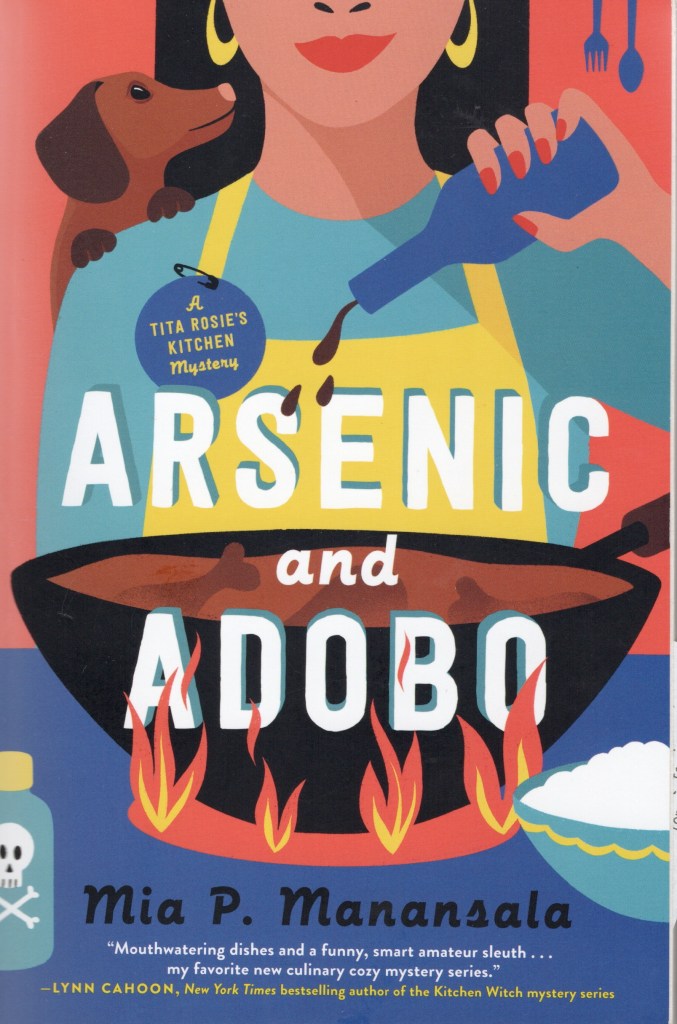
Mia P. Manansala nailed it in her debut.

My name is Lila Macapagal and my life has become a rom-com cliché.

Not many romantic comedies feature an Asian-American (or dead bodies, but more on that later), but all the hallmarks are there.

Girl from an improbably named small town in the Midwest moves to the big city to make a name for herself and find love? Check.

Girl achieves these things only for the world to come crashing down when she walks in on her fiancé getting down and dirty with their next-door neighbors (yes, plural)? Double check.

Girl then moves back home in disgrace and finds work reinvigorating her aunt’s failing business? Well now we’re up to a hat trick of clichés.

And to put the cherry on top, in the trope of all tropes, I even reconnected with my high school sweetheart after moving back to town and discovered the true meaning of Christmas.

Okay, that last part is a joke, but I really did run into my high school sweetheart. Derek Winter, my first love.

First of all, can we talk about the voice?

It is impossible not to fall in love with Lila’s voice from the very first sentence of the book. She is smart and funny and eminently likable, which is important in a traditional mystery (no one wants to read a cozy whose main character is an unlikable bitch) and much harder to do than most people who don’t actually write books think it is. Lila is a remarkable character; very clear-eyed about what she wants and what she doesn’t, as well as who she thinks she is and wants to be. She’s returned from her big escape to the big city to the small town she wasn’t terribly happy in when she was growing up–her past experiences continually are reminding her, and not in pleasant way, of why she left in the first place. She never intended to return home (as Thomas Wolfe said, you can’t go home again), but she is back and rather than focusing on what she is certain everyone she knows or is related to sees as her “failure,” she intends instead to focus on helping save her aunt’s restaurant business.

The immense strength of this story rests upon those family bonds, and Lila’s recognition of just how important those bonds–family, friends, community–actually are to her; and her growing realization, over the course of the books, that those things she once thought were strangling and restraining her are actually where her own power comes from.

The mystery itself is also strong: Lila’s wretched local ex, whose mother has since married a businessman who rents Tita Rosie’s building to her and is a total dick, has taken to writing shitty reviews of local restaurants, apparently targeting one and trying to destroy its business before moving on to another. Lila’s relationship with him is also strained; and she also doesn’t like the dickish stepfather either. It is while she is serving them lunch that her ex keels over face-first into his plate–dead from arsenic poisoning. In the food Lila fed him, and came from her aunt’s kitchen. The financially strapped business is shut down pending an investigation into the murder and a health department inspection, and there is the very real fear that Tita Rosie may lose her restaurant. Lila takes it upon herself to investigate and find the real culprit, to clear herself as well as her aunt and the beloved family business of any wrongdoing and scandal. The journey, which introduces us to her friends and family, and welcomes the reader into their charming world and community, twists and turns and is full of surprises every step along the way–as Lila also learns just how much the restaurant, her family, and her friends really mean to her.

This book is absolutely charming, well-written, and very fun. I cannot wait to revisit Lila and her crew in the second book, Homicide and Halo-Halo. Mia P. Manansala is definitely one to watch, and it’s going to be fun watching her career reaching even more heights than she has already achieved.

Where Do I Go From Here

The earliest years of my childhood–with a few minor exceptions–are lost in the foggy distant parts of my memories, unable to be summoned at will but sometimes resurfacing at the oddest moments. I don’t, for example, really remember much of how I started reading. I remember being fascinated by dinosaurs and getting dinosaur books from the library; I remember Scholastic Books Fairs and going to the library, both the Chicago Public Library’s nearest branch as well as the one inside my elementary school. I remember, vaguely, comic books: Richie Rich, Caspar, Wendy, Dot, Little Lotta and anything Disney before moving on to the world of Archie and Millie the Model before discovering, and loving, the world of DC super hero comics accidentally. Comic books were only a dime or twelve cents when I was a kid with an allowance of a dollar per week, so I could get quite a few comics with my allowance every week rather than trying to save it for another week so I could spend $1.50 on a Hardy Boys or Nancy Drew (by the time I discovered them, of course). I would not, nor would I ever, consider myself to be an expert on comics; I was a fan, and not a rabid one, either. I never learned the names of writers or artists (I do, however, remember Denny O’Neil from the 1970’s) until one of my returns to comics (I often went years without feeding my super-hero addiction); the 1980’s return got me learning names like John Byrne and Tim McFarlane. It’s always been a dream–one I don’t return to very often–to actually write for a comic title (I really really really want to write for Nightwing) someday but the older I get the less likely that item will be scratched off my lengthy bucket list (someday I might blog about the bucket-list things I am slowly becoming aware that I will never ever be able to accomplish).

Naturally, I’ve been looking forward to reading Alex Segura’s Secret Identity ever since the title was announced: comic books? The 1970’s? A crime story? COUNT ME IN.

And I am pleased to report it did not disappoint in the slightest.

Her eyes fluttered open at the sound.

Carmen Valdez rolled out of her small twin bed with ease, the muscle memory kicking in–even now, in the middle of the night. The shrill scream was familiar, too.

She tiptoed across her small bedroom, avoiding the toys strewn on the floor, as she made her way to the door.

Another scream.

Mami.

The screaming and arguing were routine. Carmen found that she’d become numb to it. She could almost predict it, in the hours before bed. If Mami and Papi were drinking–drinking that stuff–it was a bad sign. It meant they were changing. Becoming meaner. Darker. Something else. She would rush through her routine, rush to get to the relative safety of her room, her closed door, her darkness.

But she also knew the darkness could only shield her from so much. It hid her, but it didn’t silence then. She knew the screams would come. Carmen would just pray she could sleep through them.

I turned fourteen in 1975, and the entire world seemed to be, I don’t know, in some kind of transition that most people in my sheltered world believed would wind up not being good. We were already looking back; American Graffiti had struck gold with a nostalgia craze driven by the memory of “how much simpler (better) things had been back then” (despite the fact American Graffiti is actually a really bleak, dark movie) that was only further amplified by a resurfacing of the Beach Boys and the airing of Happy Days. My high school had “sock hops” (of all things) and my sister played the double album of the Beach Boys’ Endless Summer endlessly. It was easy, of course, to look at the sanitized world of television shows like Happy Days and repeats of Leave it to Beaver and wistfully wish for a simpler time…particularly when impressions we were getting of New York City wasn’t the pristine, clean city of Doris Day movies like Pillow Talk and Lover Come Back but the dirty, gritty noir sensibilities of movies like The French Connection, Shaft, and Serpico. I was already a reader, reading fiction for adults but still occasionally grabbing a comic book or two from the spinner rack at the Jewel Osco, or Mad from the magazine rck at the 7/11 on Briarcliff Road in Bolingbrook, the extremely white suburb my family had escaped to from Chicago and its desegregated schools.

It was also a weird time for comics, to be honest.

So, revisiting that time in Alex Segura’s new novel, Secret Identity, was interesting.

Alex’ book focuses on Carmen Valdez, a young Cuban-American woman living in New York and working as secretary to the publisher at Triumph Comics, a company much lower on the food chain than either Marvel or DC–the ones everyone knows–and hoping to get her own break into the business as a writer. She learned to speak English reading comics (mostly Archie and Betty and Veronica), but eventually moved on to caped crusaders. She gets an opportunity when another writer at Triumph asks for her help in putting together a new hero, the Legendary Lynx–even as a more experienced person in the business tells her not to trust Harvey Stern, the writer. But with all the hope and idealism that a hardscrabble life in New York with a dead-end job in a dying comics company has somehow not stomped out of her yet (ah, to be in my twenties again…), she takes the plunge and collaborates with Harvey–who winds up dead, shot in the forehead. No one knows the new comic Harvey had delivered six scripts for (under only his name) had any input from Carmen–who did the yeoman’s share of the work. Now she has to figure out how to reclaim her character and her work. To do so, she has to find out more about who Harvey was…and that means getting mixed up in a police investigation and eventually into the crosshairs of the killer.

I also appreciated the fact that “stolen work/characters” was the driving force in this book; comic book history is riddled with these kinds of situations, and it was fun seeing it from an insider’s point of view.

The story’s greatest strength is the character of Carmen. Within a few chapters of the story I felt like she was someone I actually knew, had talked to, maybe even had wine or drinks with; she felt like a friend…definitely someone I’d want to know in the real world. Another strength is Segura’s knowledge of the world behind the scenes of a comic book company and the industry itself. (I couldn’t help but grin periodically whenever someone referred to comics as a dying form; the 70’s slump was followed by a renaissance no one could have seen coming, and they are still going strong today.) Carmen’s relationships with the people in her orbit are also realistic and strongly drawn.

An added bonus inside the book are actual pages of art from The Legendary Lynx–which are strong enough to make a good comic book on their own (something we might be looking for in the future, Alex?).

Quickly paced with strong, believable characters, this was a terrific read. Thanks, Alex!

I’m Gonna Make You Love Me

I’ve always considered myself to be a child of the seventies.

Sure, I was a child for during the sixties, but I turned nine in 1970. While I am sure that turbulent decade provided some (a lot of) influences on me, my personality, my likes/dislikes, and my future, I am equally confident that my values and thoughts and beliefs probably weren’t as shaped from that turbulent decade as they were by the 1970’s. The seventies are really the first decade for which I have a lot of recall (recently, a friend was amazed that I remembered those horrible Rag City Blues jeans for women that were, for some reason beyond my thought processes, popular in the latter part of the decade; what can I say–I do remember the decade fairly well for the most part–or at least as far as my memory can be trusted). I’ve always wanted to write books either set in the seventies completely or even partly; Where the Boys Die, my 70’s suburban Chicago novel, keeps pushing its way to the forefront of my increasingly crowded (and clouded) mind. (NO I AM WRITING CHLORINE NEXT WAIT YOUR TURN)

I remember Watergate and how the scandal grew. I remember the 1972 landslide reelection of Nixon, and the country’s negative reaction to the Ford pardon of the man who brought him to power; I also remember Jimmy Carter running for president out of seemingly nowhere and getting elected. There was The Brady Bunch and The Partridge Family and Archie Bunker and Mary Richards; Sonny and Cher and Carol Burnett and Donny and Marie and the Jackson 5 and Grand Funk Railroad. Top Forty radio ruled the AM airwaves; not every car came equipped with FM capabilities, and the only way you could play your own music in your car was with an eight-track player. I started the decade reading the Hardy Boys and Nancy Drew and The Three Investigators; by the end of the decade I was reading John D. MacDonald and Sidney Sheldon and Harold Robbins. It was a very weird decade…of odd color and fashion choices; avocado greens and browns and American cheese orange were ridiculously popular, as was shag carpeting, velour, clingy polyester shirts, corduroys, bell bottoms and slogan T-shirts. Baseball shirts and rugby sweaters also became popular later in the decade. People had feathered hair parted in the center, and there was this weird sense of, I don’t know, missing out? Movies were grittier, harsher, more realistic; actors went from the polished shine of the old Hollywood system glamour to warts-and-all realism. Television was also beginning to change but was still heavily censored. Boogie and truckin’ and shake your booty became part of the vernacular; the decade began with the break-up of the Beatles and ended with disco’s last gasps while new wave and punk and rap started their rise.

It was the decade I went through puberty and realized that I was attracted to other boys instead of girls; I wasn’t quite sure what that meant but definitely found out in the seventh grade it meant I was a faggot, fairy, queer, cocksucker, and all those other lovely words that were burned into my brain that year. It was the decade where I read Harold Robbins’ Dreams Die First (a truly execrable novel) over and over again because the main character had sex with both men and women, and if I am not mistaken, contained the first male-on-male sex scene I’d ever read (oral); it was also the decade where we moved from Chicago to the suburbs to the cornfields of Kansas and I graduated from high school. (Ironically, it was in Kansas that I discovered gay books with explicit gay sex scenes in them–the News Depot on Commercial Street not only carried The Front Runner by Patricia Nell Warren and her other novels, but also Gordon Merrick; and their magazine racks also had gay porn magazines–which, now that I think about it, meant there were others there in Lyon County and environs; I didn’t realize it at the time, of course.) It was when Norah Lofts’ The Lute Player made me aware that Richard the Lion-Hearted was like me, too; and Susan Howatch’s Cashelmara and Penmarric also had gay characters and plots involving them…

I’ve always thought the seventies was a much more important decade than ever given credit for; usually it is merely considered a connecting time from the 60’s to the 80’s…but almost everything that came after–socially, politically, culturally–got started in the seventies. So I was glad to see this book about that frequently dismissed time.

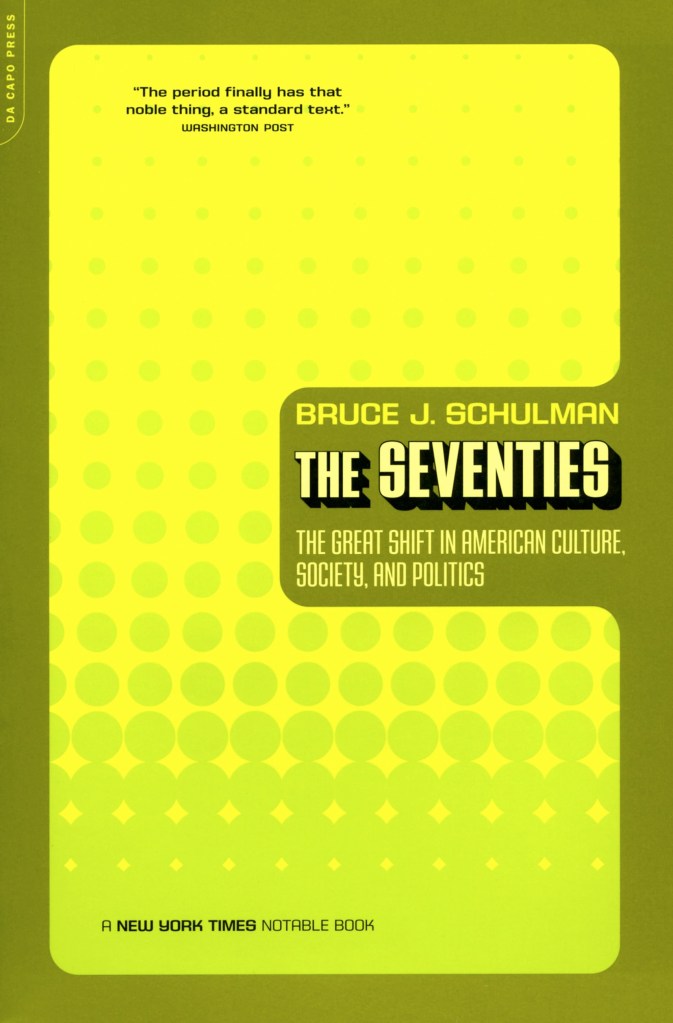
As I mentioned previously, the Seventies were turbulent; they were the decade that also saw the beginning of the end of the post-war economic/prosperity bubble. Gas shortages, skyrocketing inflation, and the insidious use of racism to break the Democratic coalition began–everything we find ourselves dealing with today had its roots in the Seventies–and it did seem, to those of us growing up in the shadow of the mushroom cloud, that the world had lost its mind and our country (or rather, its mythology) had lost its way. Schulman’s study of the decade, breaking down how the shifts in culture, politics, and our society began, were exploited for divisive purposes, and permanently changed attitudes moving forward was a fascinating, if chilling, read. I remember the terrorist attacks. I remember watching the Munich Olympics that ended in bloodshed on an airport runway and murdered Israeli athletes. The book brought back a lot of memories; I am not so sure I agree with all of Schulman’s assertions about the decade–there certainly wasn’t very much about the burgeoning gay rights movement, other than how it chased lesbians off into the Women’s Movement–but it was interesting to read the book and relive the decade a bit, as well as the memories it triggered.

I do highly recommend this book for people who weren’t around for the Seventies and might be wondering how the fuck did we end up in this current mess?

Always

I always learned from reading–which is probably why I was so bad at math, now that I think about it.

And while I’ve certainly read more than my fair share from reading non-fiction (history and biographies), I’ve also learned a lot from fiction (while admitting as an adult that some of what I’ve learned from reading fiction should be viewed with a much more critical eye)–the so-called “travelogue” books in the kids’ series, like Nancy Drew’s The Clue in the Crossword Cipher or the Hardy Boys’ The Mystery at Devil’s Paw was often how I learned obscure facts that frequently come in handy when watching Jeopardy or playing Trivial Pursuit (example: The Clue in the Crossword Cipher was where I learned that the Inca language is called quechua, and I also learned about the Nasca Lines and Macchu Picchu from that book). I love reading books that, through the course of the story, expose me to information about a culture or a society or country that I don’t know much about–I’ve generally heard of it, but don’t have any other knowledge and let’s face it, there’s only so much time in every day and it’s hard enough to keep the plates spinning as is–which is why I love fiction that tells me an entertaining story while at the same time teaching me something.

Julia Dahl’s debut novel, Invisible City, is one of those.

I was in Chinatown when they called me about the body in Brooklyn.

“They just pulled a woman out of a scrap pile in Gowanus,” says Mike, my editor.

“Lovely,” I say. “So I’m off the school?” I’ve spent the past two days pacing in front of a middle school, trying to get publishable quotes from preteens or their parents about the brothel the cops busted in the back of an Internet café around the corner.

“You’re off,” says Mike.

The rest of the press is on the scene when I arrive at the gas station across from the scrap yard. Pete Calloway from the Ledger is baring his crooked teeth at the NYPD’s Deputy Commissioner of Public Information, or as reporters call him, DCPI. DCPI is six inches taller and seventy pounds heavier than Pete. It’s barely twenty degrees out and Pete’s got his hoodie up, his shoulders hunched against the cold, but DCPI is hatless, scarfless, gloveless, coatless. His uniform jacket collar is pulled up, two inches of starched wool-blend against the icy wind.

“We’re hearing she was found without clothes,” says Pete. “Can you confirm that?”

Again, I am late to the Julia Dahl party. This book was an Edgar finalist for Best First Novel, and any number of my colleagues and friends in the mystery/crime community have raved to me about Dahl’s strong gift for writing. Invisible City was the final selection for me to take with me on last week’s trip, and it was a wonderful companion for me on my three and a half hour flight from Boston back to New Orleans. I was so deeply engrossed in the novel that–other than being interrupted by the flight staff to give me a bag of pretzels and a can of Pepsi, and then to collect my garbage–the plane could have caught fire for all I knew or cared; I just wanted to get to the bottom of the murder of the naked woman whose body discovery kicks off this well-written and very fast-paced mystery story.

Our main character here is Rebekah Roberts, and what a gift to the crime world she is! Well rounded, fully developed, and absolutely real, Rebekah is one of the most fascinating and complex series characters I’ve come across in quite a while. Dahl, like all great writers, lets us see Rebekah in all of her glory–with all of her flaws, her personality issues, her raw emotion–and while sometimes she might seem to an outsider as a bit brash or even much as I hate to say it, bitchy–Rebekah’s rawness and vulnerability makes her someone you not only enjoy spending time with as a reader, but you hate to stop spending time with her at the end. She’s fairly young, recently out of the University of Central Florida, and now living in New York trying to make ends meet (as well as build a journalism career) while working as a stringer for a tabloid paper in the big city. She’s not making a lot of money, and her small circle of friends are also terrifically rounded out as fully dimensional characters–and I hope, as the series progresses, we get to know them even better.

The case obviously begins with Rebekah going to cover the discovery of a nude woman’s body at a scrap yard in the dead of winter. But…the scrapyard is owned by Hasidic Jews, and the body is quickly taken away by a Hasidic funeral parlor rather than the medical examiner’s office, which strikes Rebekah as not only strange but not legal.

And this is where Dahl’s genius as a creator kicks in: Rebekah’s mother was Hasidic, questioned her faith, met Rebekah’s father and ran away with him. They were never married, but she gave birth to Rebekah, but the pull of her faith and her old life proved far too strong for her, and so she abandoned father and baby when Rebekah was six months old. She grew up without a mother, her father slowly changing the story of what happened to her mother as he deemed she was old enough and mature enough to handle the truth–from dead to gone to abandoned–and this, naturally, has caused some deep emotional issues for Rebekah to deal with. She hates her mother while longing to meet her and confront her–and gobbles anti-anxiety medication on the regular as she begins digging into the murder of this unfortunate Hasidic wife and mother, having to confront her own conflicted feelings about being not only half-Hasidic herself, but her own issues with that faith and way of life which she feels robbed her of her mother.

Dahl also does a magnificent job of exploring the Hasidic way of life–how alien it appears to the very much modern Rebekah, who cannot grasp why anyone in the modern day would choose such an archaic, ancient way of life, but as Rebekah learns more about why the Hasidim choose to live the way they do, my own understanding grew. The way she brings these Hasidic characters to life, refusing to simply turn them into stereotypical, one dimensional freaks and humanizing them instead, is a gift to her readers. I may not be able to comprehend living that kind of life, but I came away from this book with an understanding and empathy for them; why they self-isolate and remove themselves from the goyim in a way I don’t think I could have without Dahl unlocking that world in such a compassionate, empathetic manner.

And it’s a corker of a mystery too. I couldn’t put it down, and I am very excited to continue reading more in the series. Rebekah is an amazing heroine, destined to be ranked up there with the other great female crime series characters, and I look forward to watching Dahl continue to grow and flex her muscles as a writer–which are already, from this debut, clearly well-trained already.

Read this book. You can thank me later.

Heavenly Action

I’ve always been—undoubtedly in part because I love history so much—an enormous fan of books where secrets from the past (even the far distant past) play an enormous part in the present lives of the characters in the story, and that solving those mysteries, learning the truth about the past, is necessary in the present for conflict resolution. As a history buff, the lack of a lengthy history as a nation is something I’ve always thought unfortunate; without ancient buildings and the way that history isn’t sort of always there in our faces the way it is in Italy or other older nations, it’s difficult for many Americans to either grasp, be interested in, or give a shit about our history—we have as a nation the attention span of a goldfish (thanks, Ted Lasso, for that reference).

To make a side by side historical comparison, for example, the Habsburg dynasty dominated central Europe for almost six hundred years, whereas the first European to actually arrive and establish a colony were under the aegis and flag of the Habsburg king of Spain—and that was in the early sixteenth century.

Secrets of the past casting a shadow over the lives of the living is often a theme in Gothics, my favorite style of novel/writing (noir is a close second). Rebecca is of course the master class in secrets of the past; the first Mrs. deWinter might not actually be haunting the halls of Manderley literally, but her ghost is definitely there. Victoria Holt’s romantic suspense novels inevitably were set in some enormous old mansion or castle, with potential ghosts a-plenty everywhere you turn. Phyllis A. Whitney’s one novel set in Britain—Hunter’s Green—also has a classic old British mansion with a potential ghost in it. Maybe it was the childhood interest in kids’ series, with the reliance on secret passages, hidden rooms, and proving that ghosts were frauds; every episode of Scooby Doo Where Are You? had the gang proving something supernatural was quite human in origin.

One of my favorite Nancy Drew books when I was a kid was The Ghost of Blackwood Hall; I don’t really remember much of the story now, other than a fraudulent haunting was involved and a woman—Mrs. Putney—was being swindled by a medium? (Reading the synopses on a Nancy Drew website, apparently part of the story involves Nancy and the gang coming to New Orleans, which I absolutely do not remember; my only Nancy Drew-New Orleans memory is The Haunted Showboat—involving yet another haunting. Interesting.) When I was writing the original short story (“Ruins”) I needed a name for the old burned-out plantation house; I decided to pay homage to Nancy Drew by naming it Blackwood Hall, and naming Jake’s maternal ancestor’s family Blackwood (his grandmother was a Blackwood, married a Donelson; Jake has his father’s last name, which is Chapman). I did think about changing this from time to time during the drafting of Bury Me in Shadows, but finally decided to leave it as it was. It might make Nancy Drew readers smile and wonder, and those who didn’t read Nancy Drew, obviously won’t catch it.

Hey, at least I didn’t call it Hill House.

But writing about ghosts inevitably makes one wonder about the afterlife and how it all works; if there is such a thing as ghosts, ergo it means that we all have souls and spirits that can remain behind or move on after we die. So what does writing about ghosts—or writing a ghost story—mean for the writer as far as their beliefs are concerned?

Religion primarily came into existence because ignorant humans needed an explanation for the world around them, combined with a terror about dying. It is impossible for a human mind to comprehend nothingness (whenever I try, I can’t get past “there has to be something in order for there to be nothing, you cannot have nothing unless you have something” and that just bounces around in my head until it starts to hurt); likewise, whenever I try to imagine even the Big Bang Theory, I can’t get past “but there had to be something to explode” and yeah, my head starts to hurt. Even as a kid in church, studying the Old Testament and Genesis, I could never get past “but where did God come from?” I don’t begrudge anyone anything that gives them comfort—unless it starts to impede on me. I’ve studied religions and myths on my own since I was a kid; the commonalities between them all speak to a common experience and need in humanity, regardless of where in the world those humans evolved; a fear of the unknown, and an attempt to explain those fears away by coming up with a mythology that explains how everything exists, why things happen, and what happens when you die. (I am hardly an expert, but theology is an amateur interest of mine, along with Biblical history, the history of the development of Christianity, and end-times beliefs.)

Ghosts, and spirits, have been used since humanity drew art on cave walls with charcoal to explain mysterious happenings that couldn’t be otherwise explained. I am not as interested in malevolent spirits—ghosts that do harm—as I am in those who, for whatever reason, are trapped on this plane and need to be freed. This was a common theme in Barbara Michaels’ ghost stories (see: Ammie Come Home, House of Many Shadows, Witch, Be Buried in the Rain, The Crying Child) in which the present-day characters must solve the mystery from the past; why is the ghost haunting this house and what happened to them that caused them to remain behind? I used this theme—spirits trapped by violent deaths in this plane whose truth must be uncovered in so they can be put to rest—in Lake Thirteen and returned to it with Bury Me in Shadows. I did, of course, worry that I was simply writing the same book over again; repeating myself is one of my biggest fears (how many car accidents has Scotty been in?), but the two books, I think, are different enough that it’s not the same story.

At least I can convince myself of that, at any rate.

There’s a few more ghost stories I want to write, actually; (it also just occurred to me that there was a ghost in Jackson Square Jazz, the second Scotty book) any number of which come from those legends my grandmother used to tell me as a child. I have this great idea for one I’ve been wanting to write set here in New Orleans for a very long time called “The Weeping Nun;” I have the entire ghost’s story written in my head, I just don’t have a modern story to wrap around it (same issue I have with my New Orleans ghost story book, Voices in an Empty Room) and of course there’s “The Scent of Lilacs in the Rain,” a short story about another Corinth County ghost I started writing and got to about five thousand words before the ghost even made an appearance. That great length is why I shelved the story—and now, of course, I realize I can do it as a novella, which is amazing news and life-changing, really. “Whim of the Wind,” the very first Corinth County story I ever wrote, is also kind of a ghost story, and maybe someday I’ll find the key to making it publishable (although I think I already did figure it out, thanks to the brilliance of an Art Taylor short story).

I’ve always believed part of the reason I was drawn so strongly to New Orleans is because the past is still very much a part of the present here—though not so much as we New Orleanians would like to believe, as several Facebook groups I belong to about the history of New Orleans often show how often and rapidly the cityscape has changed over the years—and you can sometimes even feel here, at times, under the right conditions (fog and/or mist are usually involved) like you’ve gone back in time, through a rip in the time/space continuum; which is something I’d actually like to write someday here—but that’s just an amorphous idea skittering through my brain.

And of course, I have an idea for a paranormal series set in a fictional parish here in Louisiana. I think about it every now and again, but am really not sure how I want to do it. I know doing a paranormal Louisiana town series will get me accused of ripping off Charlaine Harris’ Sookie Stackhouse novels, but that’s fine. I don’t think I would be doing vampire kings or queens or any of the directions Ms. Harris went with her series. (Monsters of Louisiana and Monsters of New Orleans—paranormal/crime short story collections—may also still happen; one never knows, really.)

As hard as it was sometimes to write, I think Bury Me in Shadows turned out better than I could have hoped. I think it captured the mood and atmosphere I was going for; I think I made my narrator just unreliable enough to keep the reader unsure of what’s going on in the story; and I think I managed to tell a Civil War ghost story (it’s more than just that, but that’s how I’ve always thought of it and that’s a very hard, apparently, habit for me to break.

I hope people do read and like it. We shall see how it goes, shall we not?