I’m Your Man

Well, the first day of vacation passed without too much of note occurring. We grilled out for dinner–burgers and cheese dogs–and watched It on HBO; I cleaned and started organizing the kitchen; we watched a few more episodes of Big Mouth on Netflix-, and oh yes, Paul spent most of the day watching Wimbledon. I was most pleased to spend a day relaxing (and yes, I find cleaning and organizing to be relaxing; feel free to sue me), and will probably spend today doing more of the same, in addition to going to the gym and doing some writing and answering some emails. I keep thinking today is Sunday, which is also kind of funny–evidence of how nuts the mind can be; I kept thinking yesterday as Saturday. I need to revise my short story for submission to Cemetery Dance (yes, a long shot, but it’s a bucket list thing and I am going to keep trying every year until I actually get in) and in other bizarre news, I also managed to start writing my next book yesterday. I didn’t intend to; but I just felt like I needed to get that opening written down. It’s been swirling in my head for months now, and getting started neither took a long time nor was it particularly painful (what’s going to be painful is rereading the Scotty manuscript, which I am rather dreading).

Here it is:

The summer I graduated from high school my mother ruined my life.

Okay, I’m exaggerating. Mom says I do that a lot—well, that, and that I’m melodramatic. When I tell her being called a drama queen by my mom will make a great story for my future therapist, she just gives me that look and says, “The prosecution rests, Your Honor.”

This particular book is going to be vastly different from anything I’ve written before–I am being most ambitious in my thinking with this one–and I am also writing about a kind of character I’ve never really done before–oh, sure, gay teenager, to be sure, I’ve done that multiple times–but he’s also the only child of a incredibly successful attorney single mother, and the tricky part, the part that’s kept me from writing this book, which began as a short story called “Ruins” about thirty years ago, was I simply could not figure out how to get my main character to spend the summer in rural Alabama, which I have finally managed to do.

Also, yesterday while I was cleaning and organizing–and really, this is the best way to have this sort of thing happen–I kept getting ideas on how to fix and repair the Scotty novel. There really is something to writing an entire draft from start to finish, even knowing that it’s sloppy and you’re leaving things dangling or starting threads that you don’t see through to fruition, as opposed to going back and revising as you go so that by the time you reach the end, you’re past deadline and you don’t get to revise or rewrite the end, or have the time to go back and do much fixing once you’ve finally devised the end. I’ve always been paranoid about that with my Scotty books, which is kind of how I’ve written them all since Mardi Gras Mambo. But if 2018 has been about anything, it’s been about going back to the beginnings and remembering how I used to do things, and going back to my original systems has really been helpful when it comes to writing.

And I got to say, I love that very much.

Next up in Promises in Every Star and Other Stories is “Wrought Iron Lace”:

The guy who just moved in across the courtyard is gorgeous.

 I would guess that he’s still in his early thirties, maybe still the late twenties. Since I turned forty it’s really hard for me to judge age. Twenty years olds look like babies, fifty year olds look forty, and that group in between I just have no fucking clue. I watched him move in the day after I came home from the hospital. I have three pins in my leg from the car accident, and I have to keep it elevated as much as possible. I can’t stand on it yet, even with crutches, so I have a nice loaner wheelchair from the hospital. Friends are running errands for me when they can, and checking in on me to make sure I’m not lying on the floor in the bathroom helpless. I don’t think I’ve ever spent so much time at home by myself ever before. It’s amazing how little there is to watch on television, even with eighty cable channels. Is there anyone left on the planet who has not seen the movie Sixteen Candles? Why do they have to keep airing it?

It was a Saturday, and if ever there was a day of television hell, it’s Saturday. There’s nothing on, at any time of the day. I don’t really care that much about billiards, snowboarding, or timber-sports, thank you very much. I knew that the vacant apartment on the other side of the courtyard had been rented, the lower one, but I’d forgotten someone was moving in. My apartment is the second floor of a converted slave quarter, and my balcony has a view straight into the living room and bedroom windows of the lower in the back of the main house. I had seen the young lesbian couple who had lived there naked in the bedroom entirely too many times, and had trained myself not to notice those windows.

What can I say? I was bored, bored, bored.  It was eleven o’clock in the morning, I’d been up for three hours, and I wasn’t expecting anyone to come by again until two o’clock. I put a Jewel CD on, and pushed myself out onto the balcony. It was a beautiful October morning, the sky blue, the sun shining and warm, but none of the humidity that made New Orleans almost unlivable in the summer. There was a stack of books on the balcony table, and I figured this enforced captivity was a pretty good time to catch up on my reading. On top of the stack was a hardcover with two incredibly pretty young men giving each other the eye on the jacket. They were fully dressed, so I knew it was a romance rather than some porn. The sex would be soft-core, the characters fairly two-dimensional, and the problems they faced would be most likely vapid, but it would while away some time without requiring a vast degree of thought.

The door in the gate opened, and this guy came in. Wow, was my instant reaction. I put the book down on the table. He was wearing a black tank tee, tight black jean shorts that reached almost to his knees, with the bottom inch or so rolled up, and calfskin ankle boots with heavy socks pushed down on top of them. He was wearing a black baseball cap with the fleur-de-lis emblem of the Saints on the front. He had a key ring in his hand, and he walked right over to the door of the vacant apartment and unlocked it. When his back turned to me, my jaw dropped. He had without a doubt the most beautiful ass I have ever seen in my entire life. It was hard, it was round, perfectly curved. It was an ass to make men weep, an ass that belonged on an underwear box, an ass that could launch a thousand hard-ons.

I lit a cigarette.

A couple of other guys, muscular, attractive enough but nothing like the first, came back carrying boxes. Any other time, I would have probably been attracted to either or both of them, but the incredible beauty of the first boy (I found myself thinking of him as a “boy” strangely) made them seem like the girls who don’t make the Top Ten at Miss America. I’m sure they were used to it–it probably happened to them in bars all the time. I sat there for several hours, watching them move boxes and furniture, occasionally breaking to have a beer or a smoke break at one of the iron tables in the courtyard. The also-rans eventually removed their shirts, displaying fairly nice torsos, one with some hair, the other completely smooth. Again, under ordinary circumstances I would have been fantasizing a pretty damned vivid three way scene. If I could walk I’d be down there helping, flirting a little, feeling them out about trysting. I would watch the sweat glistening on their bare skin in the sun and wonder how it might taste, if their armpits were becoming a little smelly perhaps from the sweat, if their underwear was sticking to their asses. But my mind was solely on my new neighbor, hoping that he too would take his shirt of, give me a glimpse of his chest and back, maybe the waistband of his underwear showing above his shorts. It never occurred to me that they might be aware of me, the aging man in the wheelchair up on the balcony watching them hungrily without even saying hello. I never saw them look up or give any indication they were being watched. For all I knew, when they were out of sight on the street taking stuff out of the truck they could be laughing their asses off at the perv on the balcony, thinking he’s hidden behind the  wrought iron lacework. But if that were the case, it wouldn’t have mattered to me at all. I could not tear myself away from watching the boy in the black tank tee.

I wrote this story for an anthology called  A View to a Thrill (finally! I remember the anthology!) which was about voyeurism. Voyeurism always reminds me of Rear Window, and so I wanted to do a kind of Rear Window take on a gay erotica story; without the murder, of course.

When I first moved to New Orleans all those years ago, I always wanted to write a book about a group of gay guys–friends and frenemies–who all lived around a courtyard in the French Quarter and their quest for love and happiness and success; kind of Armistead Maupin meets Jacqueline Susann, using the same structure of Valley of the Dolls–one older character who’s already at the top of his game and owns the buildings, and the three younger ones who become unlikely friends/frenemies on their journey. I called it The World Is Full of Ex-Lovers (a play on two Jackie Collins titles), and from time to time, I found myself writing short stories about these guys. “Stigmata,” which was my first or second non-erotica short story, was about these guys; so was “Touch Me in the Morning,” the story I wrote for Foolish Hearts and had completely forgotten about until I took the book down and looked at the table of contents. I’ve got a lot of first drafts and partial drafts of stories written about these guys and their courtyard. One of the things I love about New Orleans is how, in rental situations (like the one I currently am in) you find yourself in a kind of enforced intimacy with your neighbors; one that you tend to ignore for the most part to maintain the illusion of privacy.

I even used the concept of the French Quarter courtyard with friends living around as a key component in Murder in the Rue Dauphine.

Maybe someday I’ll write that book. You never know.

Anyway, I digress. As I was pondering my ideas for a voyeur story, what better setting than a French Quarter courtyard that a number of people rent apartments around? I broke my character’s legs and gave him the upstairs apartment in a slave quarter/carriage house in the back of the courtyard, who observes a really hot young man moving into one of the apartments in the back wing of the main house, through the wrought iron lace of his balcony. I think the story turned out well, and I’ve always been pleased with both it and its title; in fact, when I thought about collecting the erotic stories together originally the book’s title was going to be Wrought Iron Lace and Other Stories.

And now, back to the spice mines.

IMG_4275

Let’s Go All The Way

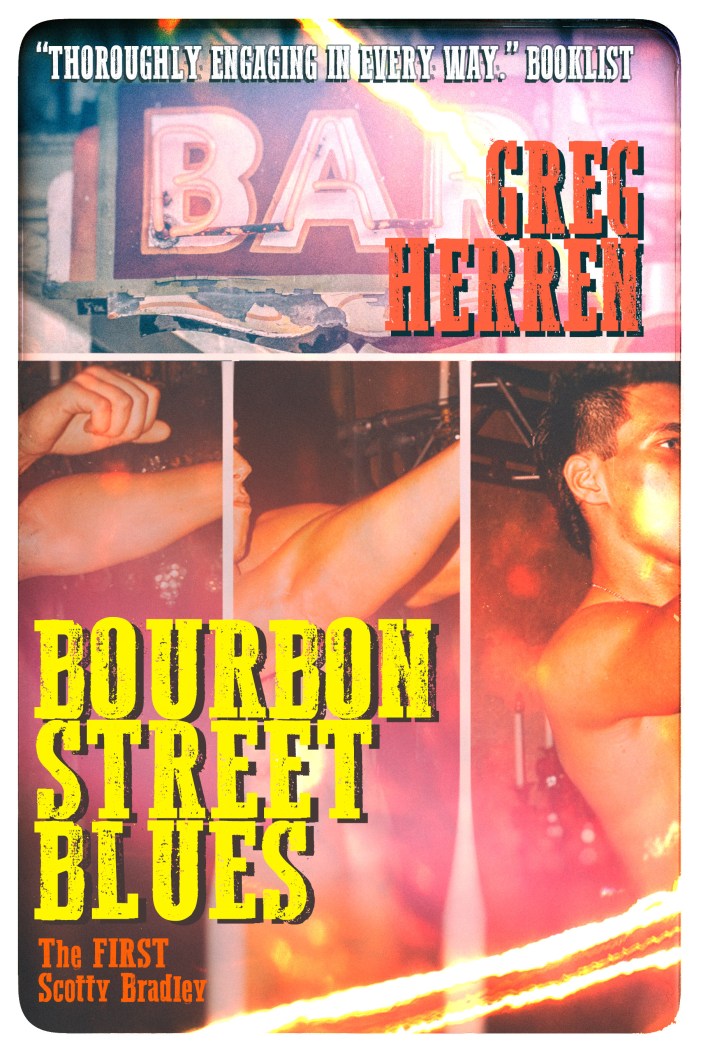
So, yesterday I didn’t write much, but I did get something very very important done: I finished the copy-edit/proofing of Bourbon Street Blues, which is now one step closer to becoming an ebook (and a print-on-demand hard copy, if someone so desires), and that really is exciting for me. Bourbon Street Blues is, out of all my books, special to me for so very many reasons. I always thought, for one thing, that it was a much better book than my first (with apologies to Murder in the Rue Dauphine), and for another it was the book where I created Scotty Bradley and his friends and family and world, and Scotty is, well, I’ve always been terribly fond of Scotty.

It’s sometimes hard to believe I’m currently writing the eighth Scotty book. I would have never dreamed there would be three Scotty books, let alone eight, all those years ago when I first dreamed him up. I was determined to create a character that I’d never seen before in gay fiction, or at least in any of the gay fiction I’d read at that time, and my reading at that time was pretty extensive. The late 90’s/early aughts was a strange time to be a gay writer, or to be a gay reader of gay fictions. We were just finding ourselves again after the development of the initial drug cocktails, which meant HIV/AIDS was no longer necessarily the death sentence it was known to be for so lo those many years. Most gay literature, from almost the very beginning of the plague, had been the art of the epidemic: about death, about loss, about hatred but also about love and compassion.

It was a strange time, frankly. All of us gay writers were faced with the conundrum: do we still write about HIV/AIDS? Do we pretend it doesn’t exist? Can we write about it and try to de-stigmatize it in our work? Do we mention condoms, condom use, safer sex? What responsibility do we, as gay writers, have to our community?

Scotty was, in some ways, a reaction to the work that had gone before mine, and to HIV/AIDS. At the time I was creating him, and writing his first book, the equality movement for the community was moving away from the focus on HIV/AIDS and looking at other issues of equality: overturning the sodomy laws; same sex marriage; and overturning ‘don’t ask don’t tell’, so that we could openly serve in the military.

Gay sexuality had become something dark since the early days of the plague, and even with the drug cocktails prolonging life and all the other medical advances that were taking the definition of the disease from fatal to chronic (i.e. something that could be managed with a drug regimen), there was a lot of sturm and drang about gay promiscuity; and while the sexually liberated days of the 1970’s certainly had a part in the spread of the disease, it wasn’t a punishment for gay promiscuity any more than the bubonic plague was a punishment for the schism of the church in the fourteenth century. 

So, when I created Scotty, I wanted to create a character that I hadn’t seen before; someone who not only embraced his sexuality but reveled in it. Scotty was highly promiscuous; wasn’t interested in a boyfriend or monogamy; and had absolutely no hang-ups or judgments about sexuality or promiscuity. He was a personal trainer and taught aerobics, was a former member of a male-stripper troupe who sometimes got back into his thong and moonlighted as a dancer now and then for extra cash. He smoked pot, drank, and celebrated the Gay High Holy Days of New Orleans (Southern Decadence, Halloween, and Mardi Gras) with Ecstasy. He was good-looking and sexy and he knew it, but wasn’t arrogant about it in the least; he was, if anything, amused by the fact that people found him, in his own words, “irresistible.”

Above all else, though, Scotty was, at heart, a nice guy who cared about other people.

I was surprised by the way people reacted, and related, to him. I was expecting to get bashed in the reviews–after all, hadn’t some reviewers dismissed my first series creation, Chanse MacLeod, as ‘just another gay stereotype’?–but the reviews were all incredibly positive, for the most part, other than the occasional one-star on Amazon.

I also wanted the book–and the series, as it turned out–to be light-hearted and funny, even as it took on social issues.

And you know else? Proofing Bourbon Street Blues was the first time in many years that I read the book again. And it ain’t bad. Ain’t bad at all.

And by the way, here’s the new cover for when it’s released again, courtesy of amazing cover designer J. T. Lindroos:

GregHerren-BourbonStreetBluesx2700

I absolutely love it.

And now, back to the spice mines.

 

Glory of Love

Saturday morning and it’s chilly in the Lost Apartment; the sun is out and there’s condensation on the windows. Scooter is perched next to my keyboard, staring out the window, watching Kitty TV; I’m not sure what’s on, but he’s fascinated. It rained brutally yesterday with flash floods and so forth throughout the city. It had been a few weeks since it had rained, but there it was; a long overdue downpour. I managed to get home before it got too terribly bad, and spent the evening organizing and cleaning out files, rather than actually writing. I just didn’t feel like I was in a writing place, and so I decided to go with that but demanded of myself to complete this tedious chore that I hate doing so much.

Essentially, it meant cleaning out old files that no longer need accessibility–old book contracts, royalty statements, and even file folders of old short stories now published, etc.–out of the file cabinet and boxing them up to put in storage. This, naturally, has freed up space in the file cabinet for files to be moved into from the ACTIVE files. (Yes, I am aware how insane this all sounds; but I have two small file holders on the small bookcase next to  my desk, where I file new ideas, articles that might lead somewhere, and new stories that I have started or are not immediately working on; on my desk itself I have a metal file rack that contains the folders of what I am immediately working on. I know, I know, but it makes sense to me, and it works for me.) I also gathered all my non-fiction research on being queer in America, as well as my journal (materials for my memoirs, should I ever write them, or at least personal essays about being gay)  to collect in one place: a lovely box that is currently sitting on my kitchen counter, preparatory to going into the storage space. While doing all of this I ran across several of my old journals.

IMG_4354

These are some of my journals–I suspect some of them have been lost to time, through moves and so forth–but the oldest is from 1994; the most recent of these is from 2003. I started my blog in late 2004, and I suspect that’s approximately also when I stopped writing in these. It was an interesting experience, idly paging through these before placing them in the box; some of the earlier ones are from, of course, when I worked at the airport. That’s when I started carrying one with me at all times; I always had a pen, my journal, and whatever book I was reading at the time with me when I was at the airport, on an airplane traveling, etc. The ones from my time at the airport are all written in green ink; because we used green pens at the airport for everything. I wrote on my breaks, I wrote when I was in between flights at the gates, I wrote while I was waiting to board an airplane, I wrote while on airplanes. Later, I wrote between clients at the gym, or while waiting for it to be time for an aerobics class I was teaching; I wrote in coffee shops. There are scenes in these journals, that eventually made it into Murder in the Rue Dauphine or Bourbon Street Blues; there are the openings of short stories I’ve written, scrawled in long hand on these pages. I’ve even found things like when I first had the idea for the book that became Dark Tide many years later; places where I worked on developing characters or plots of themes for the book or story I was currently trying to work on and/or finish; there are also personal moments, moments of frustration or joy or happiness, all recorded in my neat, broadly looping handwriting. Starting to keep another one of these this year has been enormously helpful for me in many ways; it was lovely to reconnect with the bound journal format. (I actually need to buy a new one; I am hoping they have some at Tubby and Coo’s, where I am going this afternoon for Bryan Camp’s book-signing for his brilliant debut novel The City of Lost Fortunes)

This morning I need to finish packing up these boxes, and perhaps work on getting some of the other files moved; it is literally astonishing how much paper I have. One entire file cabinet drawer is filled with short stories and novels-in-progress that I stopped working on at some point, folders with ideas jotted down, characters and names and ideas for stories and books. All this effort, besides keeping me from actually writing anything, is an attempt to declutter my workspace as well as to make it more organized; I had an idea for a story for an anthology call I saw recently, and I knew I’d written a draft of an appropriate story (possibly) years ago–which meant it was probably in the file cabinet and I should probably drag it out to see if there was anything written in it that was usable. The need for this file made me see how desperately flawed and out of control my filing system had actually been allowed to become so as it thundered and lightning lit up the sky and the yard filled with rushing water I started working grimly on fixing this mess.

I did find the file, by the way.

I need to go to the grocery store at some point this morning as well; I could wait to do it tomorrow,  but between the cleaning and the filing and the going to the book signing I don’t see any window for actually writing, so rather than putting it off till the morrow I should probably do it today, since today is going to be shot on that score. Or maybe it won’t be; I may be able to get some things done today on the writing. My writing/editing goal for the weekend is to read “Burning Crosses” aloud and be finished with it; to finish revising Chapter Two of the WIP, and possibly read all fourteen chapters of the Scotty book and see where things sit with it, preparatory to getting back to work on it as well.

I also want to dive into Alex Segura’s Blackout, which is getting rave reviews everywhere.

We started watching the second season of Thirteen Reasons Why last night, and I have to say, I am not overly impressed with it. The first two episodes were terribly uneven–the third began to pick up steam again–but the device of having Hannah appearing as a sort of ghost to Clay isn’t working for me and is something that I hope is used either sparingly as the show moves on, or is eradicated completely. We don’t need Hannah appearing as Clay’s conscience, nor do we need her at all. It derails the show, frankly; them having conversations is, to quote youth culture of some time ago, kinda whack.

So far, we’re disappointed with it. but not so much so that we will stop watching.

That, however, could change.

And now, back to the spice mines.

Fortress Around Your Heart

It’s Monday, and I didn’t get near what i wanted to get done over the course of the weekend; which is something I should simply refer to as Monday’s Lament from now on. I did get Chapter Twelve finished, and I got started on Chapter Thirteen; and I sort of know where the (meandering) story is going; and there are some things I am definitely going to need to go back and fill in later. And it’s Monday, of course; the start of a new week in which I can certainly hope to get a lot finished.

We watched a wonderful series from Australia this weekend on Netflix, called Deep Water. It’s a crime show, and it opens with the discovery of the body of a brutally murdered gay man. As the investigating officer starts digging into the case, she begins to suspect that this murder is somehow connected to some other murders–over twenty years earlier–of gay men in the same part of Australia. The more she digs, the more convinced she becomes, and she soon begins to suspect the accidental drowning of her older brother, on Christmas Eve, 1989, is yet another one of a string of murders, hate crimes, committed against gay men all those years ago. It’s extremely well-written, and powerfully acted; it also deals with sexism against women in the police department; the old boys’ network of the police; homophobia; cover-ups; and how much–and how little–society has changed in the past twenty-five years.

We also watched the second episode of Season 2 of The Handmaid’s Tale. I had wondered if the second season of this show would be near as bleak, depressing, and heartbreaking as the first, and so far the show continues to deliver. This particular episode, in addition to dealing with Offred’s situation, also brought back Alexis Bledel’s character, off at the brutal world of the Colonies, where the unwomen are sent. If you will recall from the first season, Alexis Bledel played the lesbian Ofglen/Emily; she was originally punished and then committed another crime, resulting in her being sent to the Colonies. This episode, while focusing on Offred/June as always, shows the Colonies and what her life is like there, while she remembers how the downfall of democracy and the rise of religious fascism and its impact on her as a married lesbian with a child. I love how The Handmaid’s Tale is not afraid to go there, quite frankly; and its message is quite plain: women and queers have common cause against the patriarchy.

Coupled with Deep Water, watching this episode put me into a deep, contemplative place. I haven’t really quite formed the thoughts yet, but there are some nascent ideas and thoughts forming in my head. I read a piece this weekend about Mort Crowley, The Boys in the Band revival on Broadway, and the disappearance of gay culture. I also have had come conversations with younger gay men over the course of the past two weeks. Paul and I were also listening to some gay dance remixes from our partying days of going to clubs and dancing the night away last night before bed, and we recalled those times with a bit of sadness; I do miss the fun we used to have, but do I want the full-on oppression that came with it?

It wasn’t that long ago, as Deep Water showed, that we were seen as disposable, human garbage on the fringes of society and no one cared if we were assaulted, murdered, disappeared. (There’s a serial killing investigation going on in Toronto right now that has been glossed over, ignored, despite all evidence to the contrary, for years: Toronto.) One of the reasons I originally wrote Murder in the Rue Dauphine  was precisely for this reason: who cared if some gay man was murdered? I think about the story line for that book from time to time, and often shake my head, thinking, “oh, that book could never be written today; it wouldn’t hold up, no one would believe that a closeted man would or could be blackmailed today.” And yet there is a story line in my current book along those same lines, that i struggle with; is this realistic in this day and time? Is this a secret someone would be willing to protect today? On the other hand, we do still see outings; there was a recent scandal in Metairie where the parish president was outed for pursuing a teenaged boy who worked at Lakeside mall. So, it’s not completely out of the question for a crime storyline anymore.

And this also makes me reflect, again, on ambition, and my tendency to self-defeat myself; my fear of failure, and how I built my career in such a way as to guarantee that I would never become hugely successful; writing gay characters and gay themes in crime fiction essentially guaranteed, almost from the first, that i would never be a New York Times bestseller or would win an Edgar Award or get reviewed in major newspapers; I could be published, but as a gay writer of gay stories, the expectations were low; no one would expect me to sell hundreds of thousands of copies in my little niche within a niche within a niche market. Did I subconsciously set out to sabotage my own career from the very start, setting myself up for low expectations from the start? I’d always intended–and it is there, in my journals–to eventually move to writing mainstream fiction; mainstream crime fiction. And yet, in all these years, of writing millions of words and creating hundreds of characters and telling all these stories, I’ve only recently (in terms of the years of my career) begun to try to write something more mainstream. It would take very little work to make that book appealing to my current publisher; it’s always there in the back of my head as I struggle with it and try to place my finger on what’s wrong with it and why no agent seems to want it–and then I remember that I’ve actually only sent tentative queries to a handful of agents, and am I giving up on it too soon? The amount of time I’ve actually spent on this piece of work isn’t that long in the overall scheme of things; I’ve worked on it around other things I’ve had under contract.

The entire point of last year was to work on it, get it finished and polished and ready for submission, and yet I allowed myself to waste most of the year in feeling sorry for myself and paralyzed and unable to write anything; was this simply another way of defeating myself, of fearing to fail and therefore not even trying?

You cannot succeed unless you aren’t afraid to fail.

Failure is the best way to learn.

And now, back to the spice mines.

17191400_1290543300993731_6767665762992739786_n

Round and Round

So, I did it. I went to the gym yesterday for the first time in months, and God knows when the last time I went without a trainer appointment. I am very proud of myself for taking this first step, and I have to remember to stay motivated. It felt fantastic. I’d forgotten how great endorphins feel. I went in, and did some stretches before heading to the weight machines. I went all the back to my origins (something I seem to be doing a lot this year), and started doing my work outs the way I did when I first got back in shape way back in 1995: a full body workout (chest, back, shoulders, biceps, triceps, leg press, and calf raises, then abs and cardio) and did low weights, tried to not overdo it, and only did one set of 15 on everything. I will go up to two sets of everything on the fourth workout; three sets on the seventh, and up the weights on the tenth, and then on every fourth thereafter. I am not concerned about gaining size; this is more of a cardiovascular than strength workout. Maybe by the summer I might change to something more muscle building, but any workout with weights is going to gain some size. I’d like to hit my goal weight of 200 by July; we shall see. I also am not certain what that is going to do to my build, to be honest. But I can adapt…and posting publicly about this is also going to shame me into being more consistent.

And this morning I still feel good; I can tell I exercised, but am not sore. Yay! SO lovely to know I am doing it right. It’s hard to believe that it’s been so long since I learned about the body and how to exercise properly. I wonder–yes, I just googled my old gym in Tampa; it closed in 2003 and was still owned by the same person when it closed as when it opened. Good ole Metroflex and Alan. When I wrote Murder in the Rue Dauphine I based the gym Chanse worked out at on Metroflex; I even named the manager Alan. I’d completely forgotten about that until just now….

We watched I, Tonya last night and really enjoyed it. I have a lot of thoughts about it, but I’m going to let them digest for a few days before I post about it. The cast is excellent, and I think the movie is, too.

I have lots I want to get done on this holiday Monday; I am making an excursion to Metairie, and have lots of writing to do, and lots of editing, and tons of emails to anwer and get caught up on.

The Short Story Project continues. Yesterday I read the first story in Sue Grafton’s Kinsey and Me, “Between the Sheets”:

I squinted at the woman sitting across the desk from me. I could have sworn she’d just told me there was a dead man in her daughter’s bed, which seemed like a strange thing to say, accompanied, as it was, by a pleasant smile and carefully modulated tone. Maybe I’d misunderstood.

It was nine o’clock in the morning, some ordinary day of the week. I was, I confess, hungover–a rare occurrence in my life. I do not drink often or much, but the night before I’d been at a birthday party for my landlord, Henry Pitts, who’d just turned eighty-two. Apparently the celebration had gotten out of hand because here I was, feeling fuzzy-headed and faintly nauseated, trying to look like an especially smart and capable private investigator, which is what I am when I’m in good form.

My name is Kinsey Millhone. I’m thirty-two years olds, divorced, a licensed P.I., running my own agency in a town ninety-five miles north of Los Angeles. The woman had told me her name was Emily Culpepper and that much made sense. She was very small, one of those women who at any age will be thought “cute,” God forbid. She had short dark hair and a sweet face and she looked like a perfect suburban housewife. She was wearing a pale blue blouse with a Peter Pan collar, a heather-colored Shetland sweater with grosgrain ribbon down the front, a heather tweed skirt, hose, and Capezios with a dainty heel, I guessed her to be roughly my age.

“Between the Sheets’ is a delight, if for no other reason than the fact that it’s actually a traditional mystery story; one that is solved by viewing the crime scene, interviewing people, and observing the clues left behind by the killer and making deductions. This is particularly fun because the Kinsey novels are hardboiled style private eye novels, tough with sparse prose and told from Kinsey’s slightly cynical, world-weary point of view. This short story, still in that voice, though, has several moments os humor, and could easily have been an Erle Stanley Gardner Perry Mason story, or an Agatha Christie–although Christie’s short stories always seemed to me to border on the noir side.

The other story I read was “Barn Burning” from The Collected Stories of William Faulkner, an enormous volume I’ve only occasionally dipped into:

The store in which the Justice of the Peace’s court was sitting smelled of  cheese. The boy, crouched on his nail keg at the back of the crowded room, knew he smelled cheese, and more: from where he sat he could see the ranked shelves close-packed with the solid, squat, dynamic shapes of tin cans whose labels his stomach read, not from the lettering which meant nothing to his mind but from the scarlet devils and the silver curve of fish–this, the cheese which he knew he smelled and the hermetic meat which his intestines believed he smelled coming in intermittent gusts momentary and brief between the other constant one, the smell and sense just a little but of fear because mostly of despair and grief, the old fierce pull of blood. He could not see the table where the Justice sat and before which his father and his father’s enemy (our enemy, he thought in that despair; ourn! mine and him both! He;s my father!) stood, but he could hear them, the two of them that is, because his father had said no word yet:

“But what proof have you, Mr. Harris?”

Faulkner is one of my all-time favorite writers; his “A Rose for Emily” is one of the greatest short stories ever written–if not the greatest–and both Sanctuary and The Sound and the Fury are works of art most writers can only aspire to. There’s no sentimentality in Faulkner, at least not to me; he doesn’t romanticize poverty, he doesn’t romanticize the rural Southern experience, nor does he write about heroic figures. He writes about damaged and flawed human beings, and while his work is called “Southern Gothic,” I’m not sure if gothic is the right word. For me at least the descriptor gothic conjures up an entirely different image and style of story and writing. Reading Faulkner reminds me of home, reminds me of relatives and summers spent in rural Alabama, of orange-meat watermelons and fireflies and  four o’clocks and screen doors and ticks on dogs and red dirt and big red Coca-Cola coolers with a bottle opener on the side. “Barn Burning” is told from the perspective of a young boy, Colonel Sartoris Snopes, and opens with his father being found not guilty, for lack of evidence, of burning the Harris barn after a dispute about a loose hog; but despite the lack of evidence the Snopes family is banished from the county and sent on their way to the next sharecropping farm, where things go bad yet again, but this time Sarty can’t let it happen. It’s about learning the difference between right and wrong, and learning that sometimes loyalty to blood simply because of blood isn’t enough. It’s a terrific story, with great imagery and beautiful language use, and yes, reminded me of my long love affair with Faulkner’s work. He’s not easy to read by any means; but so worth the effort.

And now,  back to the spice mines.

tumblr_o5h18dblnH1uzn77yo1_540

Borderline

Saturday morning. I have a lot of writing to do this weekend, and a lot of cleaning, My kitchen is a mess, but I made progress on the living room last night while reading Ivy Pochoda’s Wonder Valley, and am now reading How the Finch Stole Christmas by Donna Andrews. It’s a lovely comfort read; I love Andrews’ series, the characters, the lovely life of the small town of Caerphilly, where everyone cares about everyone else and has no problem stepping up when needed. It’s an idealized world that I wish were real…and Andrews’ Christmas novels are splendid; this is her fourth. It somehow seems apt to be reading an Andrews Christmas novel during the season,

It’s chilly in the Lost Apartment this morning, and I am washing all the towels (it’s a long, OCD related story, don’t ask) while I wake up and warm up with coffee. I am going to a Christmas party this evening; the first of the season, and one of my personal favorites: my friends Pat and Michael’s, with a splendiferous view of downtown New Orleans and Audubon Park. (I always try to take pictures from their balcony with my phone, but they don’t always turn out so well.) I need to finish that short story today, which reminds me of something really funny. The other day I said I hadn’t written a story for the second Lambert-Cochrane anthology, Foolish Hearts, and then yesterday when I was cleaning and reorganizing books…I saw two copies of Foolish Hearts sitting on one of the shelves in the bookcase where I keep my copies of  my books and anthologies I’ve been in. I literally did a double take; what on Earth? What story did I write for that anthology? I took one of them down, flipped it open to the table of contents, and there it was: Touch Me in the Morning by Greg Herren.

Two days ago, I would have bet anyone a thousand dollars that I never finished the story “Touch Me in the Morning” nor contributed anything to Foolish Hearts.

Kind of makes me wonder what else I’ve forgotten.

I woke up alone.

It wasn’t the first time, and it most likely wouldn’t be the last, either.

I could count on one hand the number of times a guy had spent the night with me—genus gay pick-up always seemed to slip out in the middle of the night, desperate to avoid that awkward conversation in the morning, with the exchange of phone numbers that would never be dialed.

Yet somehow, against all odds, I’d hoped this time somehow would be different.

I lie there in my empty bed, eyes still closed, with daylight bleeding through the blinds. I chided myself for having hoped, for even taking the moment to wonder if maybe he was in the kitchen making coffee, or in the bathroom. When will you learn? I thought, softly pounding the mattress with a fist, life isn’t a Disney movie—your prince may not come—stop being such a hopeless romantic.

But was it so sentimental, too much to ask, to want to wake up with his body spooned against mine?

I was time to face reality. I couldn’t hide in bed all day, so I pried my eyes open. My lashes were gummy, and my head felt like it was hosting a heavy metal battle of the bands. I sat up in bed and fought a wave of nausea as I lit a cigarette, not yet having the energy to go to the bathroom and brush my teeth and splash water in my face first. My stomach lurched against the combination of the taste of the smoke, the fur that had grown on my teeth, my swollen tongue, and the aftermath of too much alcohol and tobacco from the night before.

God, I’d been drunk.

Maybe that was the best way to play it. Too much alcohol added to smoking too many joints plus the depression from being dumped for the umpteenth time this year—wouldn’t that justify just about anything short of committing murder?

I closed my eyes and groaned, wishing I’d had the sense to die in my sleep.

How could I face Dennis this morning?

I looked at the clock. It was ten thirty. I closed my eyes and thought about it. He always taught an early morning aerobics class at six on Mondays, and then trained clients until about eleven. He’d be free after that until the late afternoon, and always came home, usually taking a nap to rest up for the next round of classes and clients. Maybe that’s why he left, I rationalized. Of course—he had to go to work, and I had been sleeping the sleep of the damned, the drunk, and over-indulged. Maybe he’d tried to wake me up to say goodbye before he left, but I was too unconscious to wake up.

There might be a note in the kitchen.

I remember when I wrote this story to begin with; I have absolutely no recollection of finishing it or revising it or anything, seriously. It was part of a series of interconnected short stories I was writing about a group of gay guys who all lived around a courtyard in the French Quarter–the courtyard I actually used in Murder in the Rue Dauphine and my story “Wrought Iron Lace”–which I basically was hoping to turn into a book called The World is Full of Ex-Lovers. That book, obviously, never happened.

And now, back to the spice mines as I wonder what else I’ve written and published and forgotten.

sex-appeal