Take Good Care of Her

Ah, here we are on what I wished were Taco Tuesday, but alas, it is not to be. Too much food already on hand to go out and get something entirely new. It’s dark again this morning, and of course there are any number of tropical systems out there that need to be watched, but at least we’re in the final months of the season. I was very comfortable in the bed this morning–Sparky was cuddled up with me when I woke up–but forced myself to get up. My week is kind of messed up already. I had to cover the clinic yesterday because someone’s on vacation (I kept thinking it was Tuesday all day), and now today I am working clinic by myself. That means I’ll probably be tired when I get home tonight, which is okay. I made groceries and got the mail last night, so I can come straight home tonight. I ordered some things on-line this week–new shoes, coffee–and I also repaired a book whose binding had broken (a Three Investigators tome), and tried repairing a pair of very cool Oxfords. I’ve had the shoes for almost thirteen years now, but have only wore them a handful of times (I rarely dress up and they’re too dressy to wear otherwise) so am not comfortable with just throwing them out when they just need to have the sole reattached. (Gorilla Glue failed me, so they’re going to have to wind up going to a shoe repair.) There wasn’t a lot of traffic last night on the way home, and after getting home and bonding with Sparky, I relaxed in my easy chair and bonded with the kitty while watching the news on-line. We did end up watching another episode of American Sports Story, and this season is really about the dangers of the closet, and how that level of self-loathing can twist someone into something dark.

Kind of sad, really; yet another example of the dangers of toxic masculinity (as if we needed another). And the guy who plays Urban Meyer is kind of uncanny.

I also read some more of Rival Queens, and have finally reached the part where the final Valois king, Henri III, has ascended to the French throne, and talks about his gender identity and homosexuality–and of course, the most interesting part to me; the mignons, his handsome young men that danced attendance on him as his favorites. Both mother and sister queens (Catherine de Medici and Marguerite of Navarre) despised the mignons, but weren’t so above the fray to not use them in their own attempts to either control the country or save her own life. It would be interesting, methinks, to write about this treacherous period of religious civil wars in France, with Spain, the Empire and England all meddling in French politics–lots on intrigue, back-stabbing, the changing of sides, assassination and murder, and of course, war. The second half of the sixteenth century saw France torn apart by factionalism and war, which wrecked the economy and kept France from building itself into a major power; fear of France really drove European history for centuries.

There certainly has been a lot of celebrity death lately, so much so that I’ve not really been able to keep up. Maggie Smith–what can I say about Maggie Smith? I first saw her on film in Murder by Death, and she was my favorite part of the movie. When I saw California Suite in the theater, I fell in love with her and wished the entire film had focused on her and Michael Caine; the other stories were dull and trite and cliched. From then on, I made a point to watch anything with Maggie Smith in it, and I was never disappointed. Such a massive talent, and so many great performances left behind. Kris Kristofferson was another giant, of music and acting. I first really noticed him in A Star is Born, and DAMN the man was fine. And that voice! Kristofferson was also a progressive and that came across in many of his classic songs. Just “Help Me Make It Thru The Night”, “Sunday Morning Coming Down,” and “Me and Bobby McGee” is enough to ensure an impressive legacy, and that’s just scratching the surface. He was also a very good person, a classy guy who cared about people and the downtrodden–from that period of country music where the greats (Johnny Cash, Waylon Jennings, Willie Nelson, and Kristofferson) were progressives who stood up to oppression and bigotry. (I also love his quote about Toby Keith’s music–“he’s done for country music what pantyhose did for finger-fucking.”)

In other exciting news, the so-called “abortion pills” have now been banned in Gilead, er, Louisiana; the bill banning them outright went into effect this morning. I never thought I’d see the day when we had a worse governor or legislature than we did during the Bobby Jindal “burn Louisiana to the ground” administration…so of course the Reich Wing bigots in Louisiana had to elect someone far, far worse. Such a beautiful state–with so many ugly people living here. That is unfortunately true about the entire South, really, and no, Southern states don’t deserve hurricanes as punishment, either; that’s the kind of hellfire and brimstone shit the Reich believes in, and I reject any natural occurrence as being “God’s punishment” for sin–when God doesn’t choose to protect children from physical, emotional, and sexual abuse, you can miss me with your bloodthirsty god.

I’m looking forward to working on the book some more, and I also want to submit a story to an upcoming anthology deadline that could actually work for me. We shall see how motivated I am, shan’t we?

And on that note, tis off to the spice mines with me. Have a lovely Tuesday, Constant Reader, and I hope you get some tacos tonight!

Ladies Who Lunch

Americans have always been fascinated by rich people.

We all want to be rich, after all; as someone once said, “The United States is a nation of temporarily distressed millionaires.” So, in lieu of actually being rich, we obsess about them. The rich used to be celebrities for no other reason than being rich. It’s always been interesting to me that in our so-called “classless” society (which was part of the point; no class privilege, everyone is the same in the eyes of the law) we obsess about the rich, we want to know everything about them, and we lap up gossip about them like a kitten with a bowl of cream. I am constantly amazed whenever I watch something or read something set in Great Britain, because that whole “royalty and nobility” thing is just so stupid and ludicrous (and indefensible) on its face that I don’t understand why Americans get so into it; the fascination with the not-very-interesting House of Windsor, for one. We fought not just one but two wars to rid ourselves of royalty and nobility…yet we can’t get enough of the British royals, or the so-called American aristocracy. (Generic we there, I could give a rat’s ass about the horse-faced inbred Windsors and their insane wealth, quite frankly.)

I wanted to be rich when I was a kid; I spent a lot of time in my youth fantasizing about being rich and famous and escaping my humdrum, everyday existence and becoming a celebrity of sorts with no idea of how to do so. I was intrigued by the rich and celebrities; I used to read People and Us regularly, always looked at the headlines on the tabloids at the grocery store, and used to always prefer watching movies and television programs about the rich. (Dynasty, anyone?) I loved trashy novels about obscenely wealthy (and inevitably perverted) society types and celebrities–Valley of the Dolls has always been a favorite of mine, along with all the others from that time period–Judith Krantz, Harold Robbins, Jackie Collins, Sidney Sheldon and all the knock-offs. I was a strange child, with all kinds of things going on in my head and so many voices talking to me and my attention definitely had an extraordinary deficit; I always referred to it as the “buzzing.” The only time I could ever truly focus my brain was either reading a book or watching something on television–and even as a child, I often read while I was watching television. (Which is why I read so much, even though that buzzing isn’t there anymore and hasn’t been for decades.)

As I get older and start revisiting my past (its traumas along with its joys) I begin to remember things, little clues and observations that stuck in my head as a lesson and remained there long after the actual inciting incident was long forgotten. I’ve always had a mild loathing for Truman Capote, for example, which really needs to be unpacked. Capote was everywhere when I was a child; there was endless talk shows littering the television schedules those days–Dick Cavett, Merv Griffin, Mike Douglas, John Davidson, and on and on and on–and Capote was always a popular guest on these shows. I wasn’t really sure what he did or who he was, but he was someone famous and he was on television a lot. I saw him in the atrocious film Murder by Death, and I know I knew/had heard that he was a homosexual, a gay; and I also knew I was a gay. It terrified me that I was destined to end up as another Capote–affected high-pitched speech and mannerisms, foppish clothing that just screamed gay at anyone looking; Capote made no bones about who or what he was and refused to hide anything…yet he gained a kind of celebrity and fame and success in that incredibly homophobic time period, and no one had a problem with putting him front and center on television during the day time.

But this isn’t about my own self-loathing as evidenced by my decades of feeling repulsed by Truman Capote; that I will save for when I finish watching Capote v. the Swans.

“Carissimo!” she cried. “You’re just what I’m looking for. A lunch date. The duchess stood me up.”

“Black or white?” I said.

“White,” she said, reversing my direction on the sidewalk.

White is Wallis Windsor, whereas the Black Duchess is what her friends called Perla Apfeldorf, the Brazilian wife of a notoriously racist South African diamond industrialist. As for the lady who knew the distinction, she was indeed a lady–Lady Ina Coolbirth, an American married to a British chemicals tycoon and a lot of woman in every way. Tall, taller than most men, Ina was a big breezy peppy broad, born and raised on a ranch in Montana.

“This is the second time she’s canceled,” Ina Coolbirth continued. “She says she has hives. Or the duke has hives. One or the other. Anyway, I’ve still got a table at Côte Basque. So, shall we? Because I do so need someone to talk to, really. And, thank God, Jonesy, it can be you.”

I do want to be clear that once I started reading Capote, he quickly became a writer whom I admired very much; I don’t think I’ve ever read anything he’s written that didn’t take my breath away with its style and sentence construction and poetry. He truly was a master stylist, and perhaps with a greater output he might have become one of the established masters of American literature, required reading for aspiring writers and students of American literature. In Cold Blood is a masterpiece I go back to again and again; I prefer his novella Breakfast at Tiffany’s to the film without question; and I was blown away by his debut novel, Other Voices Other Rooms, which was one of those books that made me think my childhood, and my being from Alabama, might be worth mining for my work.

I read “La Côte Basque 1965” years ago, and didn’t really remember it very much other than remembering I didn’t care for it very much. I was aware of the scandal that followed its publication and that all of Capote’s carefully cultivated rich society women friends felt betrayed by it and turned on him, which sent him into a decline from which he never recovered, before dying himself. I’ve always seen Capote as an example of wasted talents. Anyway, I read the story but not being familiar with his social set, I didn’t recognize any of the people gossiped about in the story or who the woman he was lunching with represented (Slim Keith, for the record), and so it kind of bored me; it was a short story about someone having lunch and gossiping about people the reader had no way of knowing who they were or anything about. I assumed this was because the story was an excerpt from the novel, and the novel itself would establish who all these women were and their relationships with each other. But I did know it was all thinly veiled gossip about his friends, and they never forgave him for it. (I also didn’t recognize “Ann Hopkins” in the story as Ann Woodward; I hadn’t known until the television series that he was involved in her story. I primarily knew about her from reading The Two Mrs. Grenvilles and articles in Vanity Fair, and I actually thought, when reading that book, that it was based on the Reynolds tobacco heir murder that Robert Wilder based his book Written on the Wind on; it wasn’t until later that I learned about the Woodward incident) so I thought, well, it was an entertaining if confusing read.

It was kind of like listening to two strangers talk in a Starbucks and gossip about people you don’t know; entertaining but nothing serious, not really a story of any kind, and I didn’t at the time see how it would all fit into a novel as a chapter in the first place. What purpose to the overall story did this nasty gossip play? Why was it necessary for Ina to share these stories at this particular lunch (and don’t get me started on White Duchess and Black Duchess)? Were these people she was talking about important to the book as a whole? It was hard for me to tell, and I put it away, thinking at the time probably a good thing he never finished the book.

Watching the show about fallout from the story’s publication, I decided to read the story again.

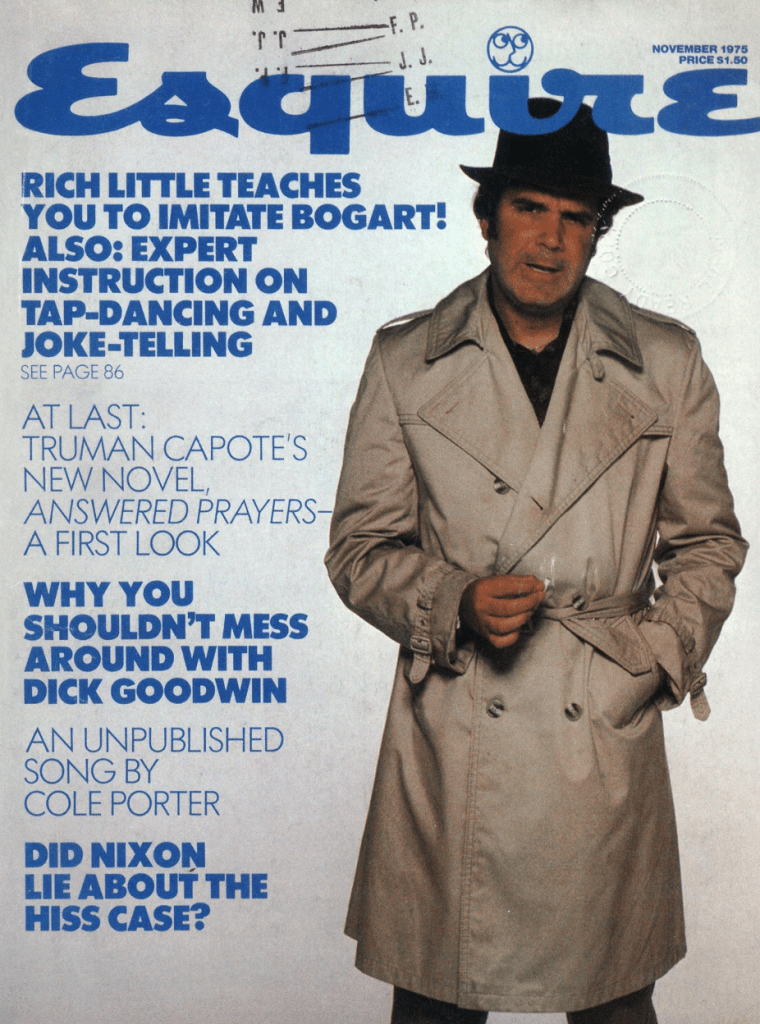
And I still question why Esquire chose to publish it, as well as why Capote thought this chapter was the one to send them. Capote was a genius, of course, and after In Cold Blood was one of the biggest names in American literature (he truly invented the true crime genre); of course they are going to publish whatever he sent them, no matter how bad it was. It wasn’t promoted as a story, after all, it was a novel excerpt.

What I’ve not been able to figure out from any of this is why he thought he could publish this without any fallout from his “swans.” I guess it went to the grave with Capote, who clearly didn’t–and I don’t think ever did–understand why they were so upset with him, which just astonishes me. (Someone once thought I based a character on her–I didn’t–and was very angry with me. I didn’t care, because I neither cared about the person nor her concerns, but I know how careful you have to be as a writer with these sorts of things.)

I wish I could say I liked it better on the reread. I did not. It’s still the same mess it was when I originally read over twenty years ago. It’s just a rich woman being bitchy to her gay friend she feels free to be bitchy about her friends with, and when you have no context (even knowing this time who the actual people were, and yes, he barely disguised them) about the women being discussed or anything about them…it’s just boring, gossip about people you don’t know and you don’t know enough to care about, so it’s just a bitchy little boring lunch. I don’t know what could come before that or after, as an author myself; had I been the fiction editor at Esquire I would have been pissed that was what he sent in, and I would have definitely taken a red pencil to it before I would have published it–and Esquire? Why did Esquire, a men’s lifestyle magazine, publish this when the right place would have been Vogue or Vanity Fair or even The New Yorker. None of it made sense then, none of it makes sense to me now; and if this is the best example we have of Answered Prayers, maybe it’s not such a bad thing that the manuscript–if it ever existed–disappeared.

Sorry, Truman, you were a great writer but this one was a swing-and-a-miss.

Most People I Know Think I’m Crazy

Sunday morning in the Lost Apartment and the sun is shining. It actually looks like a stunningly gorgeous day out there for parades, and of course King Arthur, the last of the day, is one of my favorites (a lot of gays ride in King Arthur). Yesterday was a slow day. I woke up after sleeping for ten hours feeling a little inside out, and the weather wasn’t a help. It rained off and on all day; the parades were all moved up because of the threat of weather (which was accurate; we had a flash flooding thunderstorm later on in the day), and since I was so tired and wrung out, I didn’t feel like attending any of them. I’ll probably go out for King Arthur, maybe for some of the earlier ones, and we’ll see how it goes.

As I said, I was extremely tired all day yesterday and decided to let my body and brain rest for most of it. I did do the dishes and I did get some things done early on, but I soon repaired to my easy chair, where I spent the rest of the afternoon reading–more on that later–but one of the things I wanted to reread was “La Cote Basque” by Truman Capote. I knew it was the story that turned his “swans” against him; I read it many years ago when I went through a Capote phase, when I was able to get past my distaste1 for him personally to start reading his work–which I quickly became a fan of; I love his writing, especially In Cold Blood, and I’ve always preferred the novella Breakfast at Tiffany’s to the film. I always thought he wasted his incredible talents, like so many did, and I am starting to appreciate him more as a person than I ever did before2 and now am curious about reading biographies of him. I never watched any of the films made about him, but now…now I am thinking I should watch them. Capote, Tennessee Williams, and Gore Vidal all knew each other and were contemporaries; openly gay men who didn’t give a fuck about morés and ignored the rule of “don’t ask don’t tell” that pretty much was the only way gay men or other queers could really survive the reality of the deeply homophobic world they existed in. I cannot imagine, but that was also the reality of the world I was also born into, creating internal conflicts that I am still trying to unravel to this day–like why I held Capote in so much distaste, which was really internalized homophobia, which I’ve been confronting since I first watched Capote v. The Swans, and trying to process my way through it.3

Ironically, I wound up rewatching those first two episodes again, because Paul wanted to watch–he also feels the same as me about Capote, which is partly why we never saw any of the earlier films about him–and it’s well done enough for me to easily sit through it again, and it surprised me because I never became bored, even though I’d already seen those episodes. We watched two more episodes of Lupin yesterday, despite my falling asleep during the second, after which we retired to bed.

And here I am this morning, feeling rested and not at all as tired and drug out as I was yesterday, which is a very good thing. I don’t know how much of anything I am going to get done today–I do know I want to spend some time reading and editing, if not writing–and of course there’s always picking up to do around here, and maybe I could vacuum.

I also spent some time yesterday finishing reading the novelization of one of my favorite movies of all time, The Last of Sheila, which I really enjoyed almost as much as I did the film,4 which will be covered in its own entry. I’ve been entranced by this film since I first saw it as a child one Sunday after church, and it still holds up; I’ve never once rewatched, knowing the surprise ending, and been bored or not entertained. (It’s also weird because there are scenes in Capote v the Swans showing Capote shooting Murder by Death, which was one of my earliest memories of seeing Capote, written by Neil Simon, one of the most popular playwrights of the middle part of the century that no one talks about anymore either but he was everywhere back then; I doubt Murder by Death holds up–and I didn’t really like it that much when I saw it in the theater back then, either.)

I’m also thinking it might be fun to revisit In Cold Blood and some other Capote works while I watch the show. I’ve always liked his short stories and his writing style…

And on that note I am heading into the spice mines. Have a lovely King Arthur Sunday, everyone, and I’ll catch you maybe later.

  1. Definitely will be more on this later, probably once I’ve finished watching. Capote v. the Swans. ↩︎
  2. Again, more on this later. ↩︎
  3. Hence the “more on this later” in the earlier footnotes. ↩︎
  4. Again, more on this later. ↩︎