Mama Can’t Buy You Love

Ah, Wednesday and it’s all downhill for the rest of the week, isn’t it? Huzzah! I feel good this morning, too, more rested and alert than I have been for most of the week. So, this week feels back to normal in that weird way of feeling better later in the week as my body again resets to getting up early every day. I was fatigued again last night when I got home from work, but I wrote for a little while once I was home, and did some chores (the kitchen looks presentable again) before zoning out with The Real Housewives of Beverly Hills and the news last night. I also ran an errand after work, picking up my copy of Christa Faust’s The Get Off, the third and probably final book of the Angel Dare series. I loved the first two (Money Shot and Choke Hold), and nobody writes like Christa. If you’ve not read Christa, and love noir, you really can’t go wrong with reading this trilogy. It really is fantastic.

As a general rule, I simply watch the antics of “”book social media” from a removed, slightly bemused distance and don’t get involved, other than a comment about how jaw-droppingly insane the latest controversy on those sites are, and these controversies usually involve the actions of a problematic author and/or publisher. I have my thoughts and opinions about each and every topic in those hashtags and posts that grow heated (remember the fun days of American Dirt? Good times!) but I don’t contribute to them because I don’t see any point. Are there authors that write bigoted, uninformed work that is questionable at best and horrifying at its worst? Are there readers who will embrace those works because said stories confirm their prejudices and values? 100%. Are they all, authors and readers, awful people? Certainly. Will arguing with them on social media do anything other than raise my blood pressure and wreck my day? Not likely. Personally? I don’t want to ever unintentionally offend anyone (unless you’re MAGA, in which case you shouldn’t be reading my work in the first place because you are not my intended audience but if you are reading it, suck it up snowflakes, and fuck your feelings); and I constantly question my choices in my work. My go-to is always if I question it, best to remove it. (Sidebar: I bet the American Dirt author–Jeanine Cummins?– was really happy about the pandemic because it made everyone forget about her and her shitty racist book.) There have been some tempests in this week’s (and last’s) social media teapots1, haven’t there? Sheesh. There was an explosion (again) of homophobia in the m/m writing community, which got people riled up (I love when cishet straight white women inform gay men that books with two men falling in love aren’t for us.) There was another kerfuffle where a romance writer gave her main male character an HEA–just not with the female lead, but another man. Horrors! Needless to say, that also triggered an on-line meltdown, and I am reminded again why I never want to write romance…just like I eschew the y/a publishing community, which is also a snake pit.

I’d rather jump into a piranha-infested river, to be honest. Or be forced to be on a Kardashian television show.2

And yesterday, the “Tori Woods” groomer romance situation blew up on the Internet–and her book, about a “romance” that begins when an adult male is attracted to a three-year-old “but waits for her to grow-up so it’s not child sexual abuse”, is from the same publisher as the last author who wrote racist books and was “canceled” (whatever the fuck that means) deservedly for being a racist piece of shit. Sounds like a publisher issue to me, doesn’t it? I think the publisher has also published problematically racist books before, too. There was some historical romance writer who also outed herself as a racist pos–apparently, people of color only existed in the past to be enslaved or rescued by noble white people–and seriously, how did RWA take so long to burn to the ground in the first place?3

Don’t get me wrong; I still want to write a gay romance novel at some point–and maybe even more than one, honestly. But I’d really rather not get dragged into that on-line community, if I can. (I saw yesterday that someone is publishing a grooming romance–and the grooming started when the girl was THREE. Um…yeah, no thanks.) Did not trying to be a part of the on-line y/a community probably, possibly have cost me some sales? For sure, but at the same time I am really grateful to have my peace of mind.

Peace of mind is priceless.

I also got my assignments for Saints and Sinners/Tennessee Williams Fests, and I am going to be hopping all weekend, it looks like–panels, a tribute reading, the anthology launch–and I will have LOTS of friends in town, too. But this year I took Monday off, too, so I can recover from the weekend and get things done around the house. I’ll also be commuting back and forth so Sparky’s not alone for the whole weekend, and someone needs to feed him, anyway. He is not going to be happy. Paul went to the office yesterday and wasn’t home when I arrived, so Sparky was especially cuddly and needy. I don’t mind, but clearly he doesn’t like being left alone–or puts on a good show after he has been.

My Youtube algorithms, always an interesting mystery, have recently started showing me videos about the classic scifi television program V. I loved V when it originally aired, but when it became a regular weekly series in the 1980s, I stopped watching because I lost interest. I did love the rebooted series, which was fantastic and again ended on a great cliff-hanger. And of course, once I watched one video, it started showing me more. This of course is because I’ve been watching videos about the rise of fascism in Europe between 1918-1939, World War II, and the “America First” movement of that period (newsflash: conservatives were Nazi-adjacent until Pearl Harbor)…and that’s the allegory at play in the series–the Visitors are stand-ins for Nazis, etc. I had grown up believing that it could never happen here…but watching this show made me realize how incredibly easy it is for people to side with their oppressors. It’s something, sadly, that is very human. I also remember a school did a social experiment with fascism, which was made into a TV movie called The Wave, which was again the same thing–the way we can so easily slide into being “good Germans.” I read Sinclair Lewis’ It Can’t Happen Here during the reign of Bush II: Electric Boogaloo, which cemented it even further into my head. I’ve talked before about writing a book that I originally got the idea for in the 1990s, where the queers fill in for the scapegoated minority…interesting, though, that my video research into fascism triggered the algorithm to remind me of V, which was also probably, along with Red Dawn, the biggest influences on that idea.

And on that grim note, I am heading into the spice mines. Have a wonderful midweek Wednesday, and I’ll probably be back later or tomorrow.

  1. Although I am really hoping the move to cancel Kim Kardashian and her odious family really takes this time. ↩︎
  2. Please, God, let this be the end of all things Kardashian. Haven’t we suffered enough? ↩︎
  3. Racists working with a gay white man (racist) brought RWA down, remember? ↩︎

Go West

I was never a fan of Westerns.

They were everywhere when I was growing up—movies and television shows—and my father has been a lifelong fan, so whenever there was a Western on TV, our set was tuned to it. Gunsmoke, Bonanza, The Rifleman—you name it, we watched it. Looking back, my dislike of Westerns was rooted in several things: toxic masculinity, racist depictions of indigenous peoples, and how entertainment in this genre was primarily used to create a mythological portrait of the settling (colonizing) of this continent and make it seem as though Europeans were doing the right thing (even using religion) even though they really weren’t. I never saw the natives as villains, and I didn’t like how easily Westerns picked up the trope of heroic white people and savage natives. Even as a child I could see it was all bullshit and I didn’t buy into it. I was about eleven or twelve when indigenous people occupied the massacre site at Wounded Knee, bringing attention to those false narratives and trying to change what was then culturally-accepted racist viewpoints on the indigenous Americans.

Look at the words used for the indigenous people–“savages”, “redskins”, “braves”, etc.; all dehumanizing and differentiating; “they are not like us so have no rights or privileges and we need to kill them all” was pretty much the US government’s policy to the natives.

Many sports teams still perpetuate this—how many teams still used these offensive names until recently? How many still do? And how upset do people get when those names are changed?

Anyway, I also mentioned in passing on another post that I’d like to explore Western tropes and why I’ve never been terribly interested in them as a genre. When I was in Kentucky the last time visiting Dad some movie channel was having a John Wayne film festival, which kind of made my heart sink. I’ve never really been much of a John Wayne fan (although I do love both True Grit and Rooster Cogburn) and generally avoid his films. The first movie was Hondo, with Geraldine Page (of all people; I wonder what she thought of the experience), and you know, I actually enjoyed it…and it made me think maybe I should revisit John Wayne and check out some of his other, better films. But Christa Faust, who is one of my favorite people in this community, commented she’d love to hear my thoughts on Westerns and their tropes.

She also turned me on to this:

If you aren’t aware of Christa Faust and her work by now, you really should be ashamed of yourself.

Redemption is an amazing Western graphic novel she wrote, and I very happily downloaded it as soon as she let me know of its existence. It also made me recognize and understand my own comics-fandom to a degree, too, and I may need to reevaluate that and explore it. I had thought about doing a Pride post about comic books and super-heroes, but it might need to be a longer form personal essay. Anyway, I don’t read enough graphic novels. I’d known that Christa had done scripts for comics before, but it never occurred to me that I should read them as well as be supportive of my friends who create this way. It is just another form of writing, really.

Christa is one of my favorite writers, and Money Shot remains to this day one of my favorite American noir novels. She’s also one of my favorite people; I love just sitting around shooting the shit with her.

And what she does with Redemption is absolute feminist magic.

You see, the thing about Western tropes is they can often be adapted to other genres–including literary (Lonesome Dove is my father’s favorite novel)–and the first Star Wars movie (I will never call it anything other than Star Wars) borrowed heavily from Westerns, as does The Mandalorian. You can see the influence of Westerns on pop culture almost everywhere you look, really (and really, Western tropes are often influenced by medieval tales of lone knights and paladin, which in turn were influenced by Greek mythology), and Redemption isn’t a classic Western set in the 1800’s; this Old West is the result of some kind of apocalyptic happening, with the end result that the town of Redemption has walled itself off from the rest of the world (for their own safety) and is being run by your typical right-wing doom-and-gloom Christian type, who uses God and the Bible for control rather than for inspiration. The town’s doctor, who is not only a Latina woman but a fierce feminist, has been tried and convicted for providing an abortion to a woman whose child died in the womb and was endangering her life.

She has also been sentenced to death.

If you are seeing parallels between this and our modern world, well, I am pretty fucking sure that’s entirely intentional.

The doctor’s daughter’s only hope to save her mother is to find a legendary gunslinger called the Butcher–who had a past with the doctor when they were young. No one is even sure if the Butcher is real, or if she’s merely a legend.

And in the character of the Butcher, Faust sets Westerns on their ear by taking the typical closed-mouth gunslinger (think Clint Eastwood in all those movies about the Man with No Name) and made her a woman, but without stripping any of the gender expectations for men in Westerns. She’s old, she’s tired, and she’s done with bullshit–but she can still outdraw and outshoot any and every man she runs up against.

The art by Mike Deodato is also incredible.

Highly recommended; and again, check out her other work if you’re not familiar with it. You can thank me later.

Girl, You Make My Day

One of the things I’ve greatly enjoyed over the last few years has been the sea change in how publishing views works by non-white and non-straight authors; the push for more diverse voices in the publishing community has already borne wonderful fruit. I’ve been saying for years that the world of crime fiction was in danger of getting stale again, much as it did in the late 1970’s and early 1980’s; particularly the private eye novel. The arrival of Sara Paretsky, Sue Grafton, and Marcia Muller on the scene shook things up and shook things out; the private eye novel got a much-needed shot in the arm of adrenaline with these three women and the others their work inspired; I strongly believe the move toward diversity is going to bear fruit in much the same manner–and it already has, frankly; the works of diverse writers like S. A. Cosby, Kellye Garrett, Rachel Howzell Hall, Alex Segura, Tracy Clark, Cheryl Head, and so many others have joined the great pioneers like Walter Mosley and the wonderful Barbara Neely to open up new perspectives on crime and crime fiction; our society and world; and again, this was desperately needed–and is necessary every so often, for our genre to refresh and expand and become more inclusive. We’re also seeing more queer books being sent out into the world from the big houses in New York, which is also incredibly exciting (another shout out to Yes Daddy By Jonathan Parks-Ramage and A Beautiful Crime by Christopher Bollen).

It’s a very exciting time to be a fan of crime fiction.

Noir has always been one of my favorite sub-genres of crime fiction, and I always enjoy reading modern takes on it. I want to write more noir, quite frankly; Chlorine would be the first of at least four I want to write, if not more (for now, I have ideas for four of them, with Chlorine being the most full formed). I always enjoy modern takes on noir–Laura Lippman’s Sunburn was quite marvelous, as was Christa Faust’s Money Shot and Choke Hold)–and of course, S. A. Cosby is a master of rural Southern noir; both Blacktop Wasteland and Razorblade Tears are destined to be considered classics, I think.

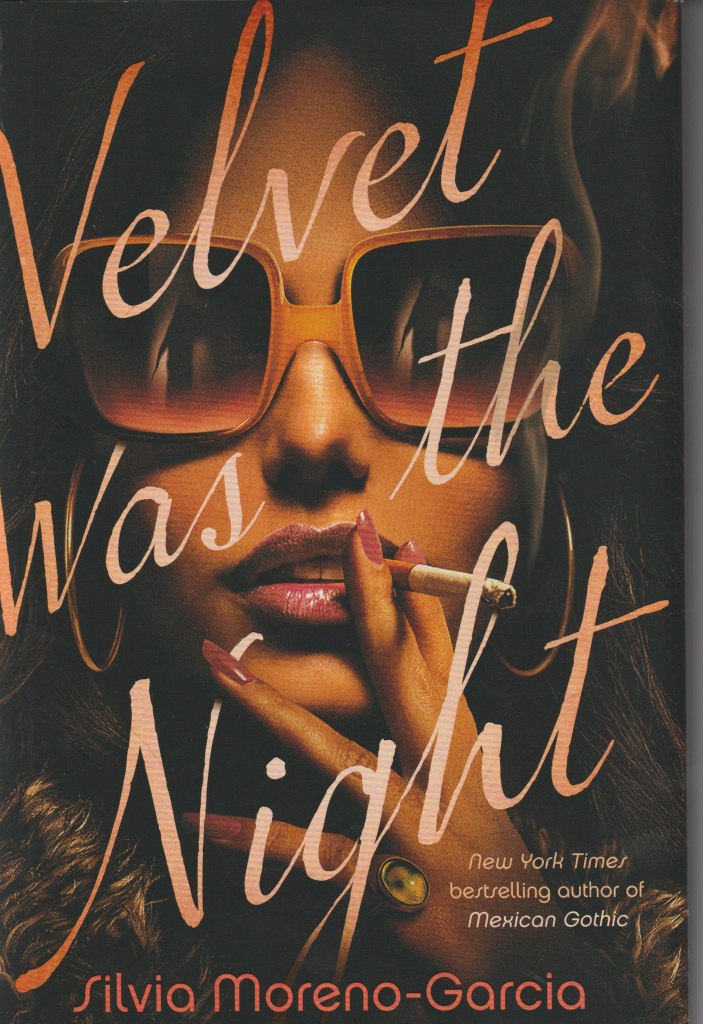
So, I was very curious to read Silvia Moreno-Garcia’s take on modern noir, Velvet Was the Night. It took me a very long time to finish–which is not indicative of the quality of the book, I hasten to add–because after I read so much during the post-Ida power outage, I kind of broke my brain and thus haven’t been able to really focus as much on reading as I would like; yesterday after the LSU game I sat down and finished it with Georgia-Kentucky on as background noise.

And what a fun ride it was.

He didn’t like beating people.

El Elvis realized this was ironic considering his line of work. Imagine that: a thug who wanted to hold his punches. Then again, life is full of such ironies. Consider Ritchie Valens, who was afraid of flying and died the first time he set foot on an airplane. Damn shame that, and the other dudes who died, Buddy Holly and “The Big Bopper” Richardson; they weren’t half bad either. Or there was that playwright Aeschylus. He was afraid of being killed inside his house, and then he steps outside and wham, an eagle tosses a tortoise at him, cracking his head open. Murdered, right there in the stupidest possible way.

Often life doesn’t make sense, and if Elvis had a motto it was that: life’s a mess. That’s probably why he loved music and factoids. They helped him construct a more organized world. When he wasn’t listening to his records, he was poring over the dictionary, trying to memorize a new word, or plowing through one of those almanacs full of stats.

No, sir. Elvis wasn’t like some of the perverts he worked with, who got excited smashing a dude’s kidneys. He would have been happy solving crosswords and sipping coffee like their boss, El Mago, and maybe one day he would be an accomplished man of that sort, but for now there was work to be done, and this time Elvis was actually eager to beat a few motherfuckers up.

He hadn’t developed a sudden taste for blood and cracking bones, no, but El Güero had been at him again.

The recent rise of Silvia Moreno-Garcia has been meteoric, although I am sure to her it has seemed anything but. I read her terrific vampire novel, Certain Dark Things, a while back, loved it, and have been following her career ever since as she has turned out novels at a terrific rate–Gods of Jade and Shadow, Untamed Shore, Mexican Gothic–all of which have been critically acclaimed and sold very well; I love that she bounces from genre to genre–horror to fantasy to crime; even bouncing around in the sub-categories of the crime genre. This is only my second read of her work–I have them all, of course–and had been meaning to get around to her take on noir with a Mexican flourish for quite some time. (I am really sorry I broke my brain with all the reading I did after the power went out; I greatly enjoyed this book, but it was so hard for me to focus for some reason…but am glad I sat down yesterday with the book, determined to finish it at last.)

One of the things that strikes me about Moreno-Garcia’s work is that I am seeing Mexico, a place I greatly love, through a fresh new perspective; like all Yanquis, I always view Mexico through the prism of a tourist. I’ve always wanted to write about Mexico, and have several short stories in the files that are set there (I did write one erotica story as Todd Gregory set in Acapulco; from the perspective of a tourist, of course: “Oh, What A Friend I Have in Jesus”)…but reading Moreno-Garcia makes me aware of how scant my knowledge of our Southern neighbor is–all of the counties south of the Rio Grande, frankly–which is a stinging indictment of our education system. (Don’t even get me started on the concept of Latin America vs. “America”) I know very little of Mexican history after the Spanish conquest, other than the Mexican War and the French empire set up under a Hapsburg by Napoleon III during our civil war. I know very little history of any of the countries that make up the rest of the American continents, really–and isn’t that more than a little bit disgraceful? I also know very little about their cultures, their politics, and what goes on there; a quick glance through the news also will show very little information or news being reported about those non-United States/Canada American countries, which is really a shame.

Velvet Was the Night is set un 1971, a particularly politically rife period in Mexico. The US was terribly concerned about communism being spread by the Soviets in what has always been considered the American soft underbelly–I mean, look at our reaction to Cuba–and there’s no question that CIA operatives and money were working to subvert Communism while supporting borderline Fascist governments because that was preferable to Washington than another potential Soviet satellite state in our hemisphere. The vast paranoia of that time–which really lasted from 1945-1990, really–cannot be underestimated or understated. By rooting her story in actual events of 1971–the crackdown of the Mexican government on dissidents–Moreno-Garcia slyly gives us a taste of how American foreign policy of the time affected everyone in Mexico, as well as a history lesson. (One of the great modern deceptions of our society is this idea that we always act benevolently as a nation; we’re doing this for your own good.) The book has two point of view characters; one, depicted in the opening above, is “Elvis”, a very young man who works as a thug, basically, for an oppressive group of anti-Communists that try to infiltrate dissident groups and haunt protests in order to make them turn violent, so the military can intervene on behalf of the “people.” Elvis grew up very poor and sometimes imagines what his life would be like if he were able to pursue his primary interests–educating himself and music. He doesn’t know what his future holds but is vaguely aware the path he is on–violence and more violence–will not end well. Over the course of the book he begins to question the values he’s been taught to believe in his gang, and begins to aspire to get out of it.

The other main character is Maite, a legal secretary barely getting by on her low salary and barely able to afford food. Her car has been in the shop unclaimed because she cannot afford the mechanics’ bill. She leads a lonely and solitary life, has a very vivid imagination and fantasy world she prefers to inhabit, colored strongly by her love of romance comic books and the music she likes to listen to. Maite’s lovely neighbor, Leonora, asks her to feed her cat while she is away, and when she agreed, Maite unknowingly enters the world of political struggle and upheaval. The riot depicted in the first chapter, that Elvis helps engineer? A friend of Leonora’s has taken pictures that prove that the riot was started by government forces, and those two rolls of film are the McGuffin everyone in the book is after–except poor innocent Maite, who, like any main character in a great Hitchcock film, becomes involved in something life threatening by simply agreeing to feed a neighbor’s cat–something she resents agreeing to do. When Leonora doesn’t come back, Maite starts looking for her–primarily motivated by the fact she can’t afford to keep feeding the car, and Leonora promised her money for feeding it–money she needs to get her car back. Motivated by her own poverty, Maite finds herself getting involved more and more in this clandestine world, and her own life is in danger soon.

The true strength of the book lies in the careful characterizations of both Elvis and Maite; two desperate people trapped by poverty in lives they want to escape, and the parallel journeys they both follow that lead their paths to cross; and the richness of the reality of what life in Mexico City was like during the turbulent time when the book is set. Moreno-Garcia shows us, as she did in Certain Dark Things, what the reality of life is like in one of the world’s largest cities, the reality the tourists rarely, if ever, get a chance to see. And while the hopelessness of both their situations seem unresolvable at times, the pacing is strong and the story construction so tight, and you the readers finds yourself rooting for them both to get out safely.

I really loved this book, and am sorry my inability to focus forced me to take so long to finish reading it. It’s extraordinary, and I recommend it highly.