Too Many Rivers

I don’t know; I kind of love rivers. Can you have too many? One of my favorite things about driving south to Mobile through Alabama is all the rivers and marsh you have to cross over; kind of like how you cannot leave New Orleans without crossing a bridge1. I think my affinity for rivers has to do with my love of history; civilization depending on rivers for millennia. Would there have been an Egypt without the Nile? Babylon or Ur without the Tigris and Euphrates? Paris without the Seine? London without the Thames? The North American rivers had a lot to do with the conquest of the continent and its colonialization, too–the St. Lawrence, the Ohio, the Mississippi and the Missouri all were major thoroughfares for movement and shipping. I sometimes wonder if the home county was settled because of the Sipsey River, which drains into the Tombigbee. (It eventually drains into the Mobile River in the marshes north of the city that I mentioned earlier.)

It’s Monday morning and back to the office with me. I didn’t get nearly as much done as I would have liked yesterday but I also don’t mind. The rest felt marvelous, and I stretched to alleviate the muscle tightness from working out Saturday. Physically, I felt pretty good most of the day, and again had some trouble falling asleep last night, but eventually I did and slept very deeply and well. It’s forty degrees out there this morning (yikes!), so it’s going to be a layers day (the office is always cold) and I am going to try to run errands after work on the way home. Today is an Admin day, and I am pretty much current on everything, I think. There are some things I absolutely will need to do today, but it should be an easy one. Sparky kind of wants me to go sit in my chair so he can curl up in my lap, but alas, Spark; it is not to be today, at least not until I get home from the office tonight. I don’t think I’ll have any trouble falling asleep tonight, though. I miss my warm bed already!

Paul was out most of the day yesterday getting tattoos, and he didn’t get home until late. I was watching the Golden Globes, which was kind of dull, actually; as I’ve gotten older I’ve lost interest in awards shows (I used to enjoy the Golden Globes more when everyone got drunk). There are so many now, to the point where the Oscars are so predictable there’s not any point to even rooting for someone, or being very vested in it. I did read for a little while, wrote and cleaned for a little while, and basically just spent the day relaxing and resting from going to the gym on Saturday. My muscles feel a bit fatigued still–which could be frustrating, if I let it be; I practically did hardly anything, compared to the workouts I used to do back in the day–but I’m also a lot older and had to recover from surgery for over a year. Today I feel like getting it together–my life, my shit, my everything–so hopefully that will be my mindset going forward from now on. I’ll still have lazy days, of course–my tendency to be lazy always overrides everything else when I let it happen–but I no longer berate myself when I do so. That’s kind of nice.

It’s also Twelfth Night, which signals the opening of Carnival season for 2025. It’s also the four year anniversary of the insurrection that tried to overthrow the 2020 election; I will never forgive the voters for signing off on pardons for everyone who attacked the Capitol that day. I’ve tried writing about how that felt, to sit at work and watch the horror unfold, wondering if this was ushering in a new authoritarian government and the end of anything decent in this country (that’s right, MAGA, y’all are indecent people as well as traitors); as Paul and I say to each other on an almost daily basis–“thank God we’re old.” I can’t imagine how bleak it must be to be young now and to have absolutely no hope for the future. I will be stopping on the way home from work to get our first king cake, and I am sure someone will bring one into work; it’s a thing, you know, but since the season is so long this year I am sure we’ll get bored with king cake long before Fat Tuesday. We will be having Carnival despite the terrorist attack; “won’t bow, don’t know how” is our attitude down here, and we always hold our heads high even in the midst of tragedy. We had Carnival (abbreviated, but we still had it) after Katrina, and it was so cathartic; it remains to this day one of my favorite Carnivals.

And on that note, I am going to head into the spice mines. Have a lovely Twelfth Night, Constant Reader, and I may be back later; stranger things have indeed happened.

  1. The bridges of New Orleans is a very fascinating subject, and they have an insane history involving so much bribery, corruption, and incompetence that it’s amazing that somehow, miraculously, they managed to get the job done. ↩︎

Is It Wrong (For Loving You)

Well, that was a fun, if tiring, weekend..

I got to the hotel after dark Friday and felt very tired. Dad had gone to his alma mater’s football game with two of his teammates (I started to say old in the generic sense and then realized Dad IS old and so are they so best not to, or at least write a caveat so here we are). It was a peaceful, lovely drive and I was listening to my audiobook (Paul Tremblay’s Survivor Song and I HAVE THOUGHTS), and there wasn’t much traffic, if any. It was a beautiful drive, and I never cease marveling at how beautiful Mississippi and Alabama are. I had planned on stopping to eat at the Whataburger in Tuscaloosa, but for some reason the map app did not take me that way this time; it seems like I never come up here or leave the same way twice in a row. It always takes the same amount of time, though it’s been interesting seeing parts of both states I am not familiar with. I almost stopped at a Jack’s in some small town I passed through after leaving 20/591; but I thought there would be somewhere else before getting here.

NARRATOR VOICE: There was, in fact, nowhere else.

I always forget how little there is between Meridian and Tuscaloosa, or between Birmingham and Chattanooga. It’s best to eat when you get hungry, and get gas before you get down to a quarter tank else you could be fucked. I know I’ve been ravenous sometimes when I’ve had to wait till past Chattanooga to eat, and same for going up from Mobile to Montgomery. It’s weird to feel so anchored to Alabama, isn’t it? I don’t remember living here; I was two when we moved north. We came down to visit a lot, and I know for Mom and Dad (and my grandmother who also lived in Chicago) they always referred to these trips as “going home” and so I, too, have always thought of Alabama as home in a corner of my mind. I never felt like I belonged almost everywhere I lived once I became more aware of just how different I was from everyone else. I felt displaced, like my life was supposed to have happened in Alabama but it didn’t, so in addition to feeling different I felt almost like a transient everywhere. New Orleans is home now, was always meant to be my home, and I have never felt more like I belonged than I do there. I think my life would have been very different had I grown up here, maybe even harder or more difficult; I don’t know. New Orleans and Alabama are, oddly enough, the only places where I don’t feel like a tourist.

I’ve always written about Alabama, and I do sometimes think that somehow my Alabama stories are my best work, as far as the writing is concerned. The story I’m revising right now was the first work I turned into a college writing class (after the first course I took was such a horrific, unmitigated disaster that basically pulled the rug out from under me and derailed my life for years) that not only the professor was incredibly enthusiastic about, but the entire class was as well. This was the story that made me start believing in myself a bit more after the asshole professor derailed my life2 when I was seventeen. Anyway, I digress. Driving through the countryside after getting off the interstate up there always is weird to me in many ways, because it’s so different than I remember. When I was a kid, most houses in the county were old and made of wood, and there were still tin roofs around, although mostly on barns and out buildings on the farms. Now the houses are mostly brick, there are a lot of McMansions, but there are still a lot of blighted buildings rotting and falling to pieces where they stand. There are abandoned country stores and dead gas stations, the store built from cinder blocks and the rusting pumps still out on a crumbling concrete island. It’s also funny because I wrote Bury Me in Shadows from memory, having not been up there in over twenty years, and seeing the differences now…I guess I never had to worry overmuch about basing that book in a county based on where we’re from, and the differences are so striking no one would recognize it as the same.

Saturday I went with Dad to his high school reunion lunch, which was at a nice restaurant where we always eat every time I’m up there (they have the most amazing chicken fajitas), and that was nice. We headed back to the hotel after and spent the rest of the day watching college football games. The LSU game was amazing, but they sent me into despair a lot during the night. They won the game without ever having the lead! A bitterly disappointing loss for Mississippi (how many times have their dreams died in Tiger Stadium? It’s really no wonder why they hate us so much), but a very exciting game. The Tigers are now ranked in the top ten–which is great, but a big win does not a season make, if you know what I mean–and the rest of the schedule isn’t easy, either. Two road games in a row, then Alabama before one more road game at Florida before finishing out the season with two home games in a row. There has been a lot of great football games this season already, which has made it a lot more fun to watch than it has been in years. Saturday alone, there was the LSU game; Alabama-South Carolina (Alabama eked out a two point win); Tennessee beating Florida in overtime; Penn State-USC went to overtime; Oregon beat Ohio State by one point; and Vanderbilt kept up its winning ways by beating Kentucky. I ain’t going to lie, I am rooting for Vanderbilt to have a great season.

Yesterday I drove home, finished listening to Survivor Song, and then listened to the “My Dad Wrote a Porno”. I was very tired when I got home, very tired, so I spent the day in my chair getting caught up on the news from the weekend before we started getting caught up on our shows. I went to bed early and slept well–I was tired all weekend, but had slept well both nights, but not long enough. I did sleep a little later this morning (I took the day off) than I was expecting (but I also woke up at 5:30 the first time), and feel good. There’s still some residual trip hangover today, but I don’t mind that in the least. The apartment is a mess–I left it one when I left Friday afternoon, and so that needs to be handled today and I am also going to have to run some errands and get reoriented back into normality before heading back into the office tomorrow morning bright and early. I also have some things that I need to get done today–probably will be able to get all that done this afternoon–and then probably will settle into a relaxing evening. We started watching season four of Outer Banks last night, so we’ll watch some of that I am sure.

I didn’t have time to do much reading or writing this weekend, either, but I feel like today I can get to some of that. I do want to finish Gabino’s book this week, so I can move on to another as well.

And on that note, I’m heading into the spice mines. Have a lovely Monday, Constant Reader, and I may be back later; one never knows.

  1. The two highways run together from Meridian to almost Georgia–somewhere in northeast Alabama at any rate; it really is always mostly a blur. ↩︎
  2. I also realized this weekend that horrible professor fucked up my life for a very long time, and I’ve never given him enough credit for unmooring me and setting me adrift. I’ve always hated him, but now I hate him even more, and what an abuse of power and control! He shouldn’t have been allowed near students under any circumstance. ↩︎

Under the Boardwalk

I hadn’t been sure that I would keep writing young adult novels after I revised, rewrote and published the first three (Sorceress, Sleeping Angel, and Sara) I didn’t know if it was a direction I wanted to keep going in. I knew I wanted to do stand-alones–always have wanted to do stand-alones–and I also like writing about teenagers and young adults.

You may remember (doubtful) me talking about a horror novel a while ago that I started writing in the 1980’s called The Enchantress that I only got about three or four chapters into before abandoning (because I didn’t know where to go next with it; and the first chapter I specifically remember rereading at some point in the decades since and shuddering in horror at how badly it was written), but one of the places in the book really stuck in my head–an old family-owned hotel called Mermaid Inn, which sat on the shores of Tuscadega Bay (which was my stand-in for Choctawhatchee Bay–my grandparents retired to a house on that bay and I’d always wanted to write about that area; still do–it’s where “Cold Beer No Flies” was set). After shelving The Enchantress (which I do think about from time to time, and wonder if I should revisit the idea) I kept thinking, you should write a book and call it Mermaid Inn because that is a great title!

I made a folder for it, wrote a few sketchy notes, and then… it sat in my files for a very long time.

If you will remember, I had originally planned to write an entire series of interconnected young adult novels, a la the Fear Street series by R. L. Stine, and one of the varied locations they would be spread out over would be Tuscadega, Florida, in the panhandle on a fictional bay. That was part of the note I scribbled for the folder–set this in the panhandle of Florida, and somehow connect it to the fictional Alabama county you’re going to write about someday.

I decided to write Mermaid Inn sometime after Hurricane Katrina, when I discovered yet again my own ignorance of geography. I was beginning to realize that the panhandle wasn’t the right setting for this book and decided to set it on the Alabama Gulf Coast, which made me realize I had absolutely no clue about that part of Alabama’s geography. I’d just never really given it much thought, to be honest; I knew Mobile was on the bay, and I knew that when you drive on I-10 through Mobile you have to take a tunnel below the Mobile River. I just had always assumed there was nothing south of Mobile in Alabama–I mean, it’s ON the water–and figured that those lower prongs of Alabama that reach down along the sides of the bay were uninhabitable wetlands. I discovered this to not be the case when visiting friends for the first time who lived in Alabama south of Mobile. They told me to take an exit off I-10 and drive south, which I didn’t think was possible.

Turns out it was–and I realized…this will work for my book! So I filed it away and forgot about it again.

I don’t remember precisely why I decided to write Mermaid Inn, but I did, and set in a small town on the prongs, south of Mobile; my friend Carolyn Haines helped me with some background and I know she told me some stories about closeted society men in Mobile and their hijinks and I thought, I could use this for the book and I think that may have been the impetus? And then I created my character, Ricky Hackworth, from Corinth, Alabama–po’ white trash who needs a swimming scholarship to attend the University of Alabama. (Sidebar: alert readers will recognize that Beau’s last name in Bury Me in Shadows–and at one point in the story he mentions he’s only the second Hackworth to go to college; “besides my cousin who got a swimming scholarship.”)

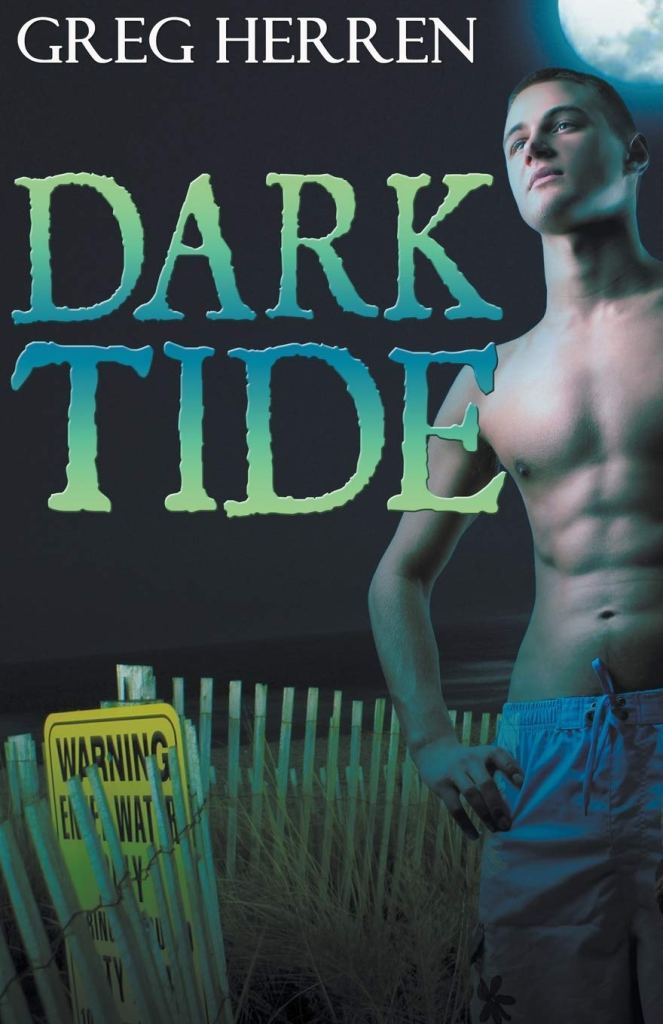
Bold Strokes didn’t like the title, and for perhaps maybe the fourth or fifth time in my career my original/working title didn’t make it on the cover. They recommended Dark Tide, which I really liked because it gave the sense of the book’s mood and tone and voice…and darkness.

The engine of my pickup truck made a weird coughing noise just as I came around a curve in the highway on the Alabama Gulf Coast and I saw Mermaid Inn for the first time.

My heart sank.

That’s not good, I thought, gritting my teeth. I looked down at the control panel. None of the dummy lights had come on. I still had about a half tank of gas. I switched off the air conditioning and the stereo. I turned into the long sloping parking lot of the Inn, pulling into the first parking spot. I listened to the engine. Nothing odd. It was now running smooth like it had the entire drive down. I shut the car off and kept listening. There was nothing but the tick of the engine as it started cooling.

Maybe I just imagined it.

Hope springs eternal.

The last thing I needed was to spend money on getting the stupid old truck fixed. Maybe it just needed a tune-up. I couldn’t remember the last time it had one.

Dad gave me the truck when I turned sixteen. It had been his work truck since before i was born–it was two years older than I was. He’d finally broken down and bought himself a new one. This old one was dependable and had almost two hundred thousand miles on it. Dad had taken good care of it. He’d babied it, gotten an oil change every three thousand miles without fail, and I could count on one hand the number of times it had been in the shop to be repaired.

It still had the original transmission.

It might not have been the nicest or prettiest car in my high school parking lot, but it got me where I needed to go and got good gas mileage. Since I was saving every cent I could for college, that was a lot more important than horsepower and cosmetics and a loud stereo that rattled your back teeth. The swimming scholarship I’d accepted from the University of Alabama wasn’t going to remotely cover anything close to the lowest estimate of what my expenses might be, but it was the best offer I’d gotten.

And I was grateful to have it. If they hadn’t offered, I wouldn’t be going at all.

Swimming was my ticket out of Corinth, Alabama.

That opening scene!

Dark Tide was probably my most hard-boiled young adult title published to that point. It was a dark story, and Ricky was poor–an economic condition I’d touched on with Sara, and something I generally try to avoid when writing. I’ve been poor, and I know how it feels; I don’t like remembering those days of checkbook mistakes and bounced checks and not having enough money from one paycheck to another. Ricky has taken a summer job as the lifeguard at Mermaid Inn in Latona, Alabama (Latona is another name for Daphne, which is actually a town on the prongs below Mobile), to save money to pay for college expenses his swimming scholarship to the University of Alabama wasn’t going to cover, and the water being there meant he could continue training. Once he arrives and is shown to his room on the uppermost floor of the building and meets the owner’s daughter, he learns that his predecessor from the summer before had simply disappeared–and young teenaged boys disappear with an alarming regularity over the past few years. He starts asking questions, mostly out of curiosity, and also starts having horrible dreams, about vicious mermaids beneath the water, and there are a lot of stories about killer mermaids from the days of the indigenous people and the Spanish. I wrote some terrific scenes in this book that I was really proud of–one particular dream sequence was especially chilling–and I was also trying something with the rhythm of the words, which I hadn’t done in a very long time, and I think it worked.

Writing Dark Tide was important to me because this was the book that reminded me again that I was writing stand-alones to help keep the series books fresher, more creative, and less paint by the numbers, too.

Dark Tide

I hadn’t been sure that I would keep writing young adult novels after I revised, rewrote and published the first three (Sorceress, Sleeping Angel, and Sara) I didn’t know if it was a direction I wanted to keep going in. I knew I wanted to do stand-alones–always have wanted to do stand-alones–and I also like writing about teenagers and young adults.

If you remember, a few entries back I talked about a horror novel I started writing in the 1980’s called The Enchantress that only got about three or four chapters into before abandoning (because I didn’t know where to go next with it; and the first chapter I specifically remember rereading at some point in the decades since and shuddering in horror at how badly it was written), but one of the places in the book really stuck in my head–an old family owned hotel called Mermaid Inn, which sat on the shores of Tuscadega Bay (which was my stand-in for Choctawhatchee Bay–my grandparents retired to a house on that bay and I’ve always wanted to write about that area). After shelving The Enchantress (which I do think about from time to time, and wonder if I should revisit the idea) I kept thinking, you should write a book and call it Mermaid Inn.

I made a folder for it, wrote a few sketchy notes, and it sat in my files for a very long time.

If you will remember, I had originally planned to write an entire series of interconnected young adult novels, a la the Fear Street series by R. L. Stine, and one of the varied locations they would be spread out over would be Tuscadega, Florida, in the panhandle on a fictional bay. That was part of the note I scribbled for the folder–set this in the panhandle of Florida, and connect it to the fictional Alabama county you’re going to write about somehow.

I decided to write Mermaid Inn sometime after Hurricane Katrina, when I discovered yet again my own ignorance of geography. I’d just never really given it much thought, to be honest; I knew Mobile was on a bay, I knew when you drove on I-10 through Mobile you have to take a tunnel below the Mobile River. I just had always assumed there was nothing south of Mobile in Alabama–I mean, it’s ON water–and figured that those lower prongs of Alabama that reach down along the sides of the bay were uninhabitable wetlands. I discovered this to not be the case when visiting friends for the first time who lived in Alabama south of Mobile. They told me to take an exit off I-10 and drive south, which I didn’t think was possible.

It is.

I don’t remember precisely when or how or why I decided to write Mermaid Inn and set in a small town on the prongs, south of Mobile; I just know now that at some point I decided to do this–and my friend Carolyn Haines might have been involved; I know she told me some stories about closeted society men in Mobile and their hijinks and I thought, I could use this for the book and I think that may have been the impetus? And then I created my character, Ricky Hackworth, from Corinth, Alabama–po’ white trash who needs a swimming scholarship to attend the University of Alabama. (Sidebar: alert readers will recognize that Beau’s last name in Bury Me in Shadows–and at one point in the story he mentions he’s only the second Hackworth to go to college; “besides my cousin who got a swimming scholarship.”)

The engine of my pickup truck made a weird coughing noise just as I came around a curve in the highway on the Alabama Gulf Coast and I saw Mermaid Inn for the first time.

My heart sank.

That’s not good, I thought, gritting my teeth. I looked down at the control panel. None of the dummy lights had come on. I still had about a half tank of gas. I switched off the air conditioning and the stereo. I turned into the long sloping parking lot of the Inn, pulling into the first parking spot. I listened to the engine. Nothing odd. It was now running smooth like it had the entire drive down. I shut the car off and kept listening. There was nothing but the tick of the engine as it started cooling.

Maybe I just imagined it.

Hope springs eternal.

The last thing I needed was to spend money on getting the stupid old truck fixed. Maybe it just needed a tune-up. I couldn’t remember the last time it had one.

Dad gave me the truck when I turned sixteen. It had been his work truck since before i was born–it was two years older than I was. He’d finally broken down and bought himself a new one. This old one was dependable and had almost two hundred thousand miles on it. Dad had taken good care of it. He’d babied it, gotten an oil change every three thousand miles without fail, and I could count on one hand the number of times it had been in the shop to be repaired.

It still had the original transmission.

It might not have been the nicest or prettiest car in my high school parking lot, but it got me where I needed to go and got good gas mileage. Since I was saving every cent I could for college, that was a lot more important than horsepower and cosmetics and a loud stereo that rattled your back teeth. The swimming scholarship I’d accepted from the University of Alabama wasn’t going to remotely cover anything close to the lowest estimate of what my expenses might be, but it was the best offer I’d gotten.

And I was grateful to have it. If they hadn’t offered, I wouldn’t be going at all.

Swimming was my ticket out of Corinth, Alabama.

That opening scene!

I’m on the Road

We tried to stick it out, ever hopeful that Entergy would pull off a miracle, but today we cracked and couldn’t take it anymore. We were also out of food, and while some stores are indeed open (without power), it was incredibly ridiculously hot today; I’ve not really slept since the power went out Sunday morning; and we decided to go today. With it being the Thursday before Labor Day weekend, I knew–between Louisiana evacuees and “last holiday weekend at the beach” people, there was no point in following I-10 East and trying to find anywhere to stay. I only had a half-tank of gas, and wasn’t sure we’d be able to get any if we went north or west, so we headed east on I-10. We got gas near Biloxi (yay!) and once we hit Mobile we turned north. I knew we’d be able to find a pet friendly room somewhere between Mobile and Montgomery, and I was correct. Paul, Scooter and I are now checked into a motel in Greenville, Alabama. We’ve both taken our first hot showers since before the power went out, and are relaxing in the air conditioning (on high and full blast) while the US Open plays on the television. Everything is currently charging. Scooter isn’t sure what to make of this, as he has never stayed anywhere besides our house or the Cat Practice in the last eleven years, but he was great in the car and just slept…which is his usual state. I am looking forward to tonight’s sleep–you have no idea, Constant Reader, how much I am looking forward to finally getting some sleep. We have the room until Sunday–we’ll either go back to New Orleans or decide what to do next then. I’ll worry about it tomorrow.

It was very weird how quickly this storm came together–we barely had space to breathe or even think, and then it was already too late to go. I had to turn in my edits on #shedeservedit by the first; there were rumblings Friday morning that we were in trouble, and I had to power through the edits to get them done just in case (a wise decision, for once). I had to have my teeth cleaned Friday morning, and after I got home from that I just worked on the edits, finally finished about half an hour before I was due to meet my friend Ellen Byron for dinner at Red Gravy on Magazine Street. (The dinner and the conversation was marvelous.) Saturday morning I got up and by the time I was coherent–I overslept a bit, as did Paul–it was too late, really. I-10 in both directions a parking lot; I-55 and I-59 north both the same. We left very late for Katrina–and the crawl across the twin spans with the beginnings of the system starting to come in was not something I ever wanted to live through again. We just kind of looked at each other, and decided to ride it out and hope for the best–figuring if we made it through, we could leave afterwards. We watched a lot of television Saturday night, went to bed relatively early, and then of course, Sunday morning the power went out around eleven. I grabbed a book–I had started Megan Abbott’s The Turnout last week, and so I read for the rest of the day.

The storm was terrifying. The entire house rattled and shook, and there were times when I thought–I would swear to God this is true–I felt the house shifting before settling back to where it was once the gust had finished. I kept waiting for the windows to blow out–I moved my computer away from the windows–and finally, it was over. I never want to ride out a storm like that again, frankly; once was more than enough. And then we settled in to wait for the power to come back on, with no Internet and very very VERY spotty (did I say VERY) cell phone service, we were essentially cut off from the rest of the world. My friend Alafair texted me at some point and I asked her if the levees held; we literally had no idea what was going on, not only in the rest of the world, but in our own city–let alone our neighborhood. The weather was hot and humid but bearable–it was miserable, but it could have been much worse; had Monday been like today we would have left then.

I did manage to read a lot–I finished The Turnout and moved on to Yes, Daddy by Jonathan Parks-Ramage (loved it!), Dead Dead Girls by Nekesa Afia (also recommend); A Beautiful Crime by Christopher Bollen; Everything I Never Told You by Celeste Ng; and A Letter of Mary by Laurie R. King. I started rereading Paul Monette’s The Gold Diggers, and also started Silvia Moreno-Garcia’s Velvet Was the Night, which came with me to Alabama. I am going to do blog posts on all of these books at some point–it was a week of amazing reading, frankly–and I also thought a lot about things I am working on and things I want to be working on, so it wasn’t a total loss of a week. I cleaned and organized in the kitchen some, and of course today I had to throw away everything in the refrigerator and the freezer, which was sad–all that money into the trash–but better to clean it out now rather than let it sit in there rotting and then come home to it. (A valuable lesson from Katrina.)

I thought about bringing manuscripts to edit with me, but then decided not to–I have the electronic files, after all, and I have enough paper around as it is. I started purging books again too–and I spent a lot of time, as I mentioned, thinking about things and life in general and what my priorities should be going forward–there’s nothing like a catastrophe to make you sit down and think about what is and isn’t important–and I am going to probably make some changes going forward. I hate that this disruption came when I was on a roll–with my writing, with the gym, with the reorganization of the apartment–but I am glad that it did happen in some ways; I was kind of letting myself drown again and a reset was kind of necessary. I also don’t know how long this particular disruption is going to last, either.

So, I am going to relax, enjoy hot showers and air conditioning and having access to the Internet again–and read and write and try to dig out from under.

And now I am going to take a doll and go to sleep.

Til tomorrow, then.

Holy Ground

I came across the coroner’s obituary last night.

As I typed it, I realized what a New Orleans-like thing it was to say; and it made me smile a little bit. The coroner in question wasn’t currently serving New Orleans; he had retired in 2014 after ten terms in office, and his name was Dr. Frank Minyard. He played the trumpet, and was actually a gynecologist rather than a pathologist. Was he good coroner or a bad one? A little of each, I would gather, based on the obituary by John Pope you can read by clicking here.

But he was, like so many New Orleanians used to be, quite a character. New Orleans has always been a city full of characters, which is why so many people write about New Orleans, and write about it well. Not only can you probably get away with writing anything crazy-seeming about New Orleans; chances are if you dig a little into our history here, you’ll inevitably find crazier shit than anything you could dream up on your own. I have to say I have really been enjoying reading up on our local history here.

Hurricane Sally came ashore earlier this morning, and it had continued turning enough to the east that we didn’t get much of anything here in New Orleans. The panhandles of Alabama and Florida (in particular Mobile and Pensacola) are an entirely different story; my heart sank down into my shoes (well, my slippers) on seeing footage and images from that section of the Gulf Coast. Hurricane season is so emotionally exhausting, really; all that stress and tension and worry, and then when it goes somewhere else the enormous guilt one feels about the relief that your area escaped unscathed while others are losing everything–including some lives–is horrible, just horrible. It’s oddly gray and hazy-seeming outside the windows this morning, with the crepe myrtles and the young live oaks in the yard on the other side of the fence doing their wavy dance thing they do when the wind blows; the sidewalk outside also looks wet so we must have gotten some rain as well overnight, but not enough for me to notice anything as I slept through it all. (That’s the other thing about hurricanes, particularly the ones that come ashore overnight; you go to bed wondering what you’ll wake up to find in the morning–or worse yet, disaster will rip you out of a deep sleep.)

So, yes, this morning I feel very emotionally drained; well rested, but exhausted emotionally.

And then, of course, once the danger has passed, you have to reset yourself and get back to normality–whatever the hell that is, or what passes for it, at any rate.

Yesterday’s entry in the Cynical 70’s Film Festival was The Omen, which was a huge hit back when it was released in 1976 and spawned two sequels, Omen II: Damien and The Final Conflict. I had never seen the sequels, and I think I originally rented the film–I don’t think it played at the Twin Theater in Emporia–but I did read the book (the book was written by David Seltzer, who apparently, according to the opening credits of the film, wrote the screenplay; which came first? I don’t care enough to look it up) and of course, was put in mind of it by paging through The Late Great Planet Earth, which laid the groundwork for the movie. Obviously, it’s about the anti-Christ, who is Damien Thorn; the movie opens with the Robert Thorn (played with an almost wooden-like quality by Gregory Peck) arriving at a hospital in Rome only to be told that the child his wife has given birth to has died; he worries about her mental stability and how she will handle the news–and so a priest offers a substitute baby whose mother died giving birth. (And this is the first place I called shenanigans on this rewatch; one, he is about to start a lifetime of lying to his wife and two–was there any need to tell Robert Thorn his child died? If the idea was to have the Thorns accept the anti-Christ into their home as their child, wouldn’t it simply make more sense to swap the babies, so neither of them knew? Because how could they have been so certain Thorn would accept this literal deal with the devil?) The movie is paced fairly well, and it moves right along–there’s not a lot of gore or blood and guts, but it does beggar credulity at more than one point–and perhaps I am looking at it with jaded eyes some forty years later, but both Peck and Lee Remick, who plays his wife, seem to just be phoning it in for the paycheck and there’s also the element of their age; they seem to be fairly old to just be trying to start having a child at the opening of the movie. (I think the book plays this up more, stating that Kathy Thorn has suffered innumerable miscarriages leading up to this birth and it has shaken her mental stability; kind of hard to do that on film but it certainly would have made his motivation in accepting this needless deception–again, they could have just as easily substituted the baby without having to go through this entire risky rigmarole.) After finishing, I looked for Omen II but it’s not streaming for free anywhere; I then watched The Final Conflict, which was simply terrible (outside of Sam Neill, who was terrific and charismatic as an adult Damien, saddled with an incredibly bad and far-fetched script).

The movie does fit, however, with the Cynical 70’s Film Festival, because here we have yet another conspiracy, one in which some members of the Catholic Church have turned to Satan to try to bring about the end times as well as the birth of the Antichrist–because whereas in the 1950’s and the early 1960’s, it would have been unimaginable for such a film to be made, but also to be believable; who would have ever believed such a thing was possible? Of course, both book and film of Rosemary’s Baby set the stage for The Omen, but both were later 1960’s, when things were starting to change, times were getting more cynical, and so were people. Rosemary’s Baby changed almost everything, both in the world of novels and film, in showing that horror was both bankable and mainstream. The early 1970’s saw the publications, and enormous success, of books like Ira Levin’s The Stepford Wives, William Peter Blatty’s The Exorcist, Thomas Tryon’s Gothic horror masterpiece The Other, and eventually, Stephen King’s out-of-nowhere bestseller Carrie. Soon Peter Straub would publish Ghost Story and Carrie would become a hit movie, triggering a horror revival that brought both the literature and the films into the mainstream. This revival didn’t lose steam until the 1990’s, and frankly, I think horror is on the verge of another revival.

I could be wrong, of course. I certainly have been before, but I am seeing some really terrific work as well as amazing new voices–over the past year alone I’ve read some astonishing work by new-to-me writers, and I only wish I had more time to read everything I really want to. Paul Tremblay is amazing, and so is Bracken MacLeod, Christopher Golden, and Silvia Moreno-Garcia, among others; I’m seeing a lot of new and interesting looking titles being announced or reviewed almost every time I turn around.

I guess today is Wednesday? I am really not sure, living in this weird world that comes with hurricane watches, where it is very easy to lose track of dates and times and what day of the week it actually is. But a quick glance at Weather.com assures me that all the other storms out in the Atlantic basin pose no threat to Louisiana, so I guess we can relax for a little while, at least.

And on that note, tis back to the spice mines.

I Won’t Hold You Back

Being from, not only the South but also from Alabama, I am very particular about Southern fiction, and fiction set in Alabama (there is more of it than you might think; there is certainly much more of it than To Kill a Mockingbird). Robert McCammon has written some exceptional Southern horror fiction set in Alabama; I absolutely loved Boy’s Life, while I have yet to read Gone South (which is in the TBR pile). He actually  set a book in the part of Alabama I am from; it was a good book, but it bore no more actual resemblance to that county than anything other book set in the rural South; it was as though he simply put up a map of Alabama and stuck in a pin in it, said “okay this is where it will be set” and worked from there. But it was a good book that I enjoyed; it had some interesting things to say about religion–particularly the rural Southern version of it. I myself want to write about Alabama more; I feel–I don’t know–connected somehow when I write about Alabama in a greater way than I do when I am writing about New Orleans, and that’s saying something. Mostly I’ve written short stories, the majority of which have never been published; only two have seen print, “Smalltown Boy” and “Son of a Preacher Man.”

I remember Michael McDowell from the 1980’s, when the horror boom was at its highest crest; I never read his work but I was aware of it. I remember reading the back covers of his Blackwater books and not being particularly interested in them; there was just something about them, and their Alabama setting, that somehow didn’t ring right to me; I don’t remember what or why, but I do remember picking them up several times in the bookstore, looking them over, and putting them back.

In recent years, McDowell has enjoyed a renaissance of sorts; he was a gay man who died from AIDS-related complications in 1999. I wasn’t aware that he was part of the writing team who published a gay mystery series under the name Nathan Aldyne until sometime in the last few years, and I’d been meaning to get around to finally read one of his horror novels, the reissue of The Elementals (which included an introduction by my friend, the novelist Michael Rowe–whose novels Enter, Night and Wild Fell are quite extraordinary)–which again is set in Alabama, only this time Mobile and the lower panhandle of Alabama that sits on either side of Mobile Bay (the same area, in fact, where I set my novel Dark Tide, only my novel was set on the other side of the bay). My friend Katrina Niidas Holm recently asked me to read the book so we could discuss it drunkenly over cocktails at Bouchercon in Toronto later this month; this morning I sat down and read it through. (It’s not very long; 218 pages in total.)

the elementals

In the middle of a desolate Wednesday afternoon in the last sweltering days of May, a handful of mourners were gathered in the church dedicated to St. Jude Thaddeus in Mobile, Alabama. The air conditioning in the small sanctuary sometimes covered the noise of traffic at the intersection outside, but it occasionally did not, and the strident honking of an automobile horn ould sound above the organ music like a mutilated stop. The space was dim, damply cool, and stank of refrigerated flowers. Two dozen enormous and very expensive arrangements had been set in converging lines behind the altar. A massive blanket of silver roses lay draped across the light-blue casket, and there were petals scattered over the white satin interior. In the coffin was the body of a woman no more than fifty-five. Her features were squarish and set; the lines that ran from the corners of her mouth to her jaw were deep-plowed. Marian Savage had not been overtaken happily.

In the pew to the left of the coffin sat Dauphin Savage, the corpse’s surviving son. He wore a dark blue suit that fit tightly over last season’s frame, and a black silk band was fastened to his arm rather in imitation of a tourniquet. On his right, in a black dress and a black veil. was his wife Leigh. Leigh lifted her chin to catch sight of her dead mother-in-law’s profile in the blue coffin. Dauphin and Leigh would inherit almost everything.

Big Barbara McCray–Leigh’s mother and the corpse’s best friend–sat in the pew directly behind and wept audibly. Her black silk dress whined against the polished oaken pew as she twisted in her grief. Beside her, rolling his eyes in exasperation at his mother’s carrying-on, was Luker McCray. Luker’s opinion of the dead woman was that he had never seen her to better advantage than in her coffin. Next to Luker was his daughter, India, a girl of thirteen who had not known the dead woman in life. India interested herself in the church’s ornamental hangings, with an eye toward reproducing them in a needlepoint border.

On the other side of the central aisle sat the corpse’s only daughter, a nun. Sister Mary-Scot did not weep, but now and then the others heard the faint clack of her rosary beads against the wooden pew. Several pews behind the nun sat Odessa Red, a thin, grim black woman who had been three decades in the dead woman’s employ. Odessa wore a tiny blue velvet hat with a single feather dyed in India ink.

Before the funeral began, Big Barbara McCray had poked her daughter, and demanded of her why there was no printed order of service. Leigh shrugged. “Dauphin said do it that way. Less trouble for everybody so I didn’t say anything.”

This is an auspicious beginning to a novel that straddles the line between Southern Gothic and horror; but in using the word horror I am thinking of the quiet kind of horror, the kind Shirley Jackson wrote; this isn’t the kind where blood splatters and body parts go flying or you can hear the knife slicing through flesh and bone. This is the kind of horror that creeps up on you slowly, building in intensity and suspense until you are flipping the pages anxiously to find out what happens next.

McDowell introduces all of his characters in those few short sentences; Dauphin and his wife, Leigh; her mother Big Barbara; her brother Luker and her niece, India. Odessa also has a part to play in this story, and the only other character who doesn’t appear in this opening is Big Barbara’s estranged husband, Lawton. Lawton, like Mary-Scot, only plays a very small part in this tale, and so the reader doesn’t need to meet him until later.

(I do want to talk about character names here; the Savage family all have names that have something to do with Mary Queen of Scots; the deceased is Marian, her long dead husband Bothwell; Mary-Scot is as plain a reference as can be, whereas her two brothers were Mary Stuart’s husbands: Dauphin–her first husband was Dauphin Francois, later King Francois I of France–and the deceased elder brother, Darnley; the romantic Queen’s second husband was Lord Darnley. Marian’s –of Mary–deceased husband Bothwell bore the name of the Scottish Queen’s third husband, the Earl of Bothwell. These Savage men died in reverse order of the Queen’s husband’s though; Bothwell first followed by Darnley,  and of course, as the only one living, Dauphin will die last. Also, there’s never any explanation for why Big Barbara is called Big Barbara; usually in Southern families the reason you would call someone “Big” is because there is a “Little;” there is no Little Barbara in this story, and I’m not sure where Luker came from as a name, either. I wondered if it was a colloquial pronunciation; names and words that end in an uh sound turn into ‘er’ in Alabama; Beulah being pronounced Beuler, for example, so I wondered if his name was Luka…)

The McCrays and the Savages are families bound by decades of friendship and now marriage; they have three identical houses on a southern spit of land in the lower, western side of the Alabama panhandle in a place called Beldame; Beldame is very remote, bounded by the Gulf on one side and a lagoon on the other; during high tide the gulf flows through a channel into the lagoon and turns Beldame into an island. There are no phones there nor power lines; electricity is provided by a generator and there is no air conditioning. Oh, how I remember those Alabama summers without air conditioning! One of the three houses is being lost to a drifting sand dune and is abandoned…and as the days pass, the reader begins to realize there’s something not right about that dune…or about that house.

The book reminded me some of Douglas Clegg’s brilliant Neverland; that sense of those sticky hot summers in the South, visiting a place you’re not familiar with and is kind of foreign (the primary POV once the story moves to Beldame is India, who has never been there before); those afternoons where the heat and humidity make even breathing exhausting, the white sugary sand and the glare from it, lying in a shaded hammock just hoping for a breeze–the sudden rains and drops in temperature, where eighty degrees seems cold after days of it being over a hundred…the sense of place is very strong in this book, and Beldame is, like Hill House, what Stephen King called in his brilliant treatise on the genre Danse Macabre, ‘the bad place.”

I really enjoyed this book. A lot. And it has made me think about writing about Alabama again; this entire year I’ve been thinking that, and now feel like it’s a sign that maybe I should.

And now back to the spice mines.