Green Light

One of the things I’ve been thinking about lately is how we don’t really have a Louisiana crime writer who explores and illuminates the damage we are doing to the ecosystem and environmentalism of the state the way John D. Macdonald infused many of his Florida novels with so frequently. Condominium, published in the 1980’s, is a stinging indictment of crooked developers and corrupt politicians putting up massive condominium buildings along the coastline of Florida, despite the damage they do to the environment, all in the name of a quick buck. I have been thinking about this because I spent a lot of time in the panhandle in the 1970s, back before Panama City Beach developed into what it is now. I’ve not been back there since 1980, at the latest; but just looking at Google Earth images it’s horrifying how different and over-developed that whole area has become. (I was looking at the images because I was thinking about setting a book along the Redneck Riviera/Baja Alabama/Emerald Coast/Miracle Strip, whichever name you use for the region.) Louisiana, nicknamed “Sportsmen’s Paradise” because of the abundant fish and game and the stunning natural beauty of the state, has pretty much spent the last hundred or so years (at least) destroying and despoiling the natural resources of the state of Louisiana, killing off wildlife species while introducing new invasive ones–and don’t even get me started on Cancer Alley, that stretch of the river between New Orleans and Baton Rouge lined with petrochemical plants parked next to poor, mostly Black communities that have, surprisingly enough, large instances of cancers in the residents. Now the level of the river is so low that it can’t keep the Gulf water pushed down, and the salty water is making its way up the river and intruding into our drinking water supply here in southeastern Louisiana. I’m sure the loss of so much of the wetlands to ensure oil company profits hasn’t affected this in any way, shape or form. There’s a really good environmental thriller to be written about Louisiana (if not more), and I think maybe part of the problem in writing about the destruction of Louisiana in the name of unfettered greed is that I don’t feel knowledgeable enough on the subject to tackle it, nor do I have the time to spend on the research necessary.

It’s really disappointing to me that James Michener never wrote one of his two thousand page plus books about Louisiana. Louisiana history, no offense, is a lot more interesting than Texas’.

And Sportsmen’s Paradise is a great title for a book about Louisiana’s environmental disasters.

I suppose I should just go ahead and do it, regardless of how difficult and long and tedious the process may be. I also think part of the reason I’ve resisted this aspect of writing about Louisiana is because no matter how dark my books may get, I always want justice to be done in some way and to end the book with some sort of hope; there literally is no hope for the future of Louisiana because our politicians are all too greedy and corrupt and only focused on the now rather than the future, no matter how much they beat the “but the children!” drum publicly to fool those incapable of deeper thought. There have been so many environmental disasters in Louisiana over the nearly three decades I’ve lived here I can’t remember them all; and yes, I definitely count boil water advisories in that, too. There was the sinkhole at Bayou Corne (anyone remember that?) and of course Deepwater Horizon, whose true impact and the damage it wrought on the Gulf and the coastline will not be fully known for generations.

The one consistent thing throughout Louisiana’s history has been the entrenched systemic political corruption. I have written about that.

I’ve also been thinking a lot about Jackson Square Jazz, as I get into this revision, and remembering why I wrote it and what I was trying to say within the book; there was a thread in it that ties directly into the new one, and there are also some thematic commonalities with S. A. Cosby’s All the Sinners Bleed, which I am really enjoying reading. Shawn is such an extraordinary writer, with a gift not only for language but character, dialogue, setting and story; the complete deal, as it were, and definitely is going to be considered one of the definitive crime writers of this new generation of exceptional talent that has risen over the last few years. I am going to spend some more time with Shawn’s book this morning, too; I am really enjoying it and wanting to see where it goes and how it all ends. I also have the new Lou Berney on deck, and Lou’s books are always high-quality, clever, and engaging.

College football was interesting yesterday. My Tigers prevailed in a three-point nail-biter against Arkansas in Tiger Stadium 34-31, running the clock out and kicking the winning field goal on the last play of the game. Paul and I were stunned, as was the crowd in the stadium..,and then I laughed. “LSU fans aren’t used to smart clock management in tight games,” I observed, and Paul started laughing with me because the crowd in the stadium didn’t know how to react to the end of the game either. It almost seemed ant-climactic rather than exciting…how many games have we lost this century because of poor clock management skills displayed by the coaching staff? So it was lovely, for once, to see the Tigers play smart at the end of a game for a change. Alabama finally looked like Alabama for the first time this season–but only in the second half as they iced Mississippi. LSU now has to play Mississippi in Oxford next weekend; it’ll be interesting to see how LSU stacks up against our old Magnolia Bowl foe. Colorado finally lost, which brought out all the racist college football fans on social media. The Texas A&M-Auburn game was just sloppy, ugly and unimpressive, while Mississippi State fell to South Carolina. But the big game of the day lived up to its billing–Ohio State v. Notre Dame in South Bend, with the Buckeyes scoring the winning touchdown on the literal last play of the game, 17-14. I literally only saw the closing minutes of the game, switching over once the LSU game concluded. The Saints play at noon today at Green Bay, so the grocery run I need to make will happen around that time–no fool me; everyone knows the best time to make groceries is during a Saints game here.

Yesterday was pretty relaxing, over all; a lovely day for the weekend and a restful and nice one, despite the stress of the LSU game. I’ll probably have the Saints game on in the background because it’s too anxiety-making to watch the games. (I have yet to learn how to control the anxiety during a game; it was certainly there last night and while I tried very hard not to get negative during the game, I could feel the adrenaline spiking and my heart rate going up, but I managed to keep my mind from spiraling and going super-dark as well not getting overly emotional It is, after all, just a football game and LSU football success isn’t necessary for my mental well-being.)

My goals for today are to read Shawn’s book for a few hours, get cleaned up and make a grocery run; while finishing the first chapters of the new Valerie and Jem books (tentatively titled, thus far, The House of the Seven Grables and You Gone, Girl) and also wanting to do some short story work as well, which is always fun. This Friday I am getting fitted for my new teeth (hurray!) and I have also reached the point where I can eat and enjoy noodles, so yesterday I made box mac’n’cheese (not Kraft, but one that came from the refrigerated section and simply needed microwaving and stirring; it wasn’t bad, either). Tonight I am going to make ravioli for dinner; we’ll see how that goes, although I am sure I won’t be able to eat any garlic bread. (I am able to eat Cheese Puffs, though.) I really want a burger, more than anything else. We are also making a trip to the SPCA to adopt a cat this coming Friday, which is perhaps the most exciting thing of all! I’ve really missed having a cat; they are such darling animals, and of course we want to get another ginger boy.

And on that note, I think I am going to head into the spice mines. Have a lovely Sunday, Constant Reader, and I’ll be back–if not later, than tomorrow.

Where Have You Been

I spent a lot of time in beach resort towns when I was younger. My grandmother and her second husband retired to the panhandle of Florida when I was ten and about to start the seventh grade, and when they moved down there I actually rode along with them because it was summer. My aunt and uncle had a beach house that they would rent out for weeks and weekends to make money in a small beach town along the Emerald Coast (they called it the Miracle Strip back then; Panama City Beach) and until we moved away to California, we used to go down to visit my grandparents and time it around a visit to the beach house as well. In the years since, I’ve often thought about writing about the panhandle and those sleepy little beach towns (believe me, Panama City Beach has changed dramatically since the 1970s); my short story “Cold Beer No Flies” is one of those stories, and I have another one–book-length–that I am considering writing at some point in the near future.

But beach resorts and the townies have always been interesting to me; the difference between those who live there year round and those who simply vacation there; the drifters who come in for jobs during those summer months and then disappear–what do they leave in their wake?–and it just seemed rife with possibilities.

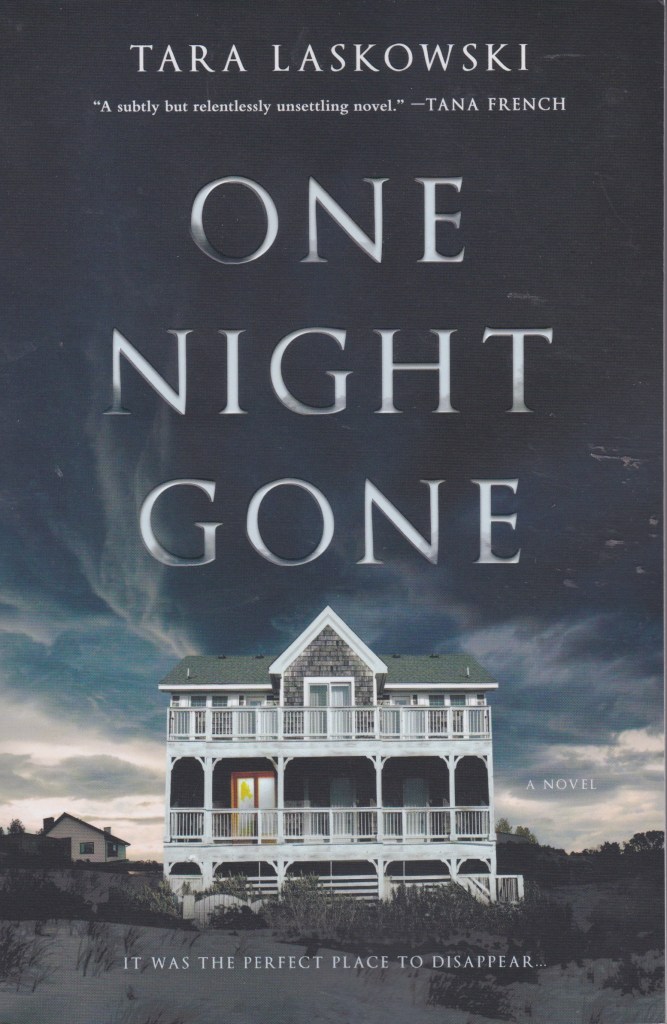
So, after greatly enjoyed her sophomore novel The Mother Next Door, I was really looking forward to her reading her debut novel, One Night Gone.

Constant Reader, it did not disappoint.

The girl tried not to look up into the hazy summer night, the seagulls circling overheard like giant paper airplanes. They made her dizzy. She focused on the horizon, the dark ocean churning, its vastness broken up by milky froths.

Thomas, the guy from the party, was pressed up against her, his thighs tight against hers. She could feel the heat in her cheeks, but at least it was cooler here at the end of the pier, away from the lights and sounds, from the constant pop pop pop bling bling of the arcade games and the deafening roar of the Zipper, a ride she’d thrown up on last year and then swore her friends to secrecy.

Thomas dipped her back over the railing–not too far, but enough that she felt the danger, felt that if he just shifted his large hand an inch or so off her back she’d fall, tumble like a tragic mistake. He laughed, pulling her back, his dewy breath catching in her hair.

“Stop it,” she said, batting at him, though she wasn’t sure she meant it.

She liked him. She liked the way he made her feel–important. Funny. Sexy. At the party, he’d said he was from the cornfields of Indiana, a state–she would never tell him–that she wouldn’t be able to point out on a map. He was tall like a cornstalk, she thought, and let that bubble up into a giggle on her lips as he swayed into her again and kissed it away.

One thing I absolutely love in crime novels is different timelines–one in the past and one in the present. I myself have never done this; and perhaps it’s about time I try (one of the ideas I have, ironically set in a Florida panhandle beach town, is a dual timeline novel); I’ve always admired writers who can do this and pull it off with aplomb because it looks really hard to me. Laura Lippman did this beautifully in After I’m Gone; Alison Gaylin in What Remains of Me; and Carol Goodman is a master of this. Add Tara Laskowski to this list–she also managed to pull it off with The Mother Next Door, her marvelous follow-up.

The story focuses on two women thirty years apart who come to Opal Beach for their own reasons. Allison, our modern heroine, is a former meteorologist who was fired for unprofessional conduct when going off on her cheating (now) ex-husband on air; she went viral and left her cheating husband, and her sister finds her this great housesitting gig in a mansion on the beach in the off-season and so Allison comes to a beautiful house on the Jersey shore in a resort full of secrets–going back to the disappearance of our 1980’s heroine, Maureen. Maureen comes from a bad background and she works for the carnival that comes to Opal Beach every summer; she finds herself becoming friends with locals and even getting romantically involved with one. Maureen is also desperate the way Allison is; desperate to escape a terrible past and start a new life with the cons and crimes of her past behind her. Maureen disappears that summer, never to be found again–and somehow Allison’s arrival at Opal Beach starts dredging up secrets and lies from that past so long ago…and Allison’s own life is put in jeopardy because there are any number of people who have their own reasons for wanting Maureen to stay buried in the past…

Laskowski is a terrific writer, with a knack for being highly efficient and proficient in her sentence and paragraph construction; she creates characters that are rounded and complete and multi-dimensional; and her ability to explore how little slights and personality clashes can grow into festering wounds is exceptional. Opal Beach felt very real to me–the bonfire parties on the beach, the gift shops and restaurants catering to the summer people, the climate and weather and the house itself. I really enjoyed this, and got caught up in the story quite easily.

Can’t wait for her next one.

All Too Well

Saturday morning, and there’s sunlight streaming through my windows–a lovely change from the majority of mornings this past week. I overslept this morning, something that has been happening with greater frequency over the last few weekends, but I also have been staying up later than normal and having trouble falling asleep when i finally do go to bed; I may have to change my pre-bed routine and go back to reading a bit before tumbling into bed. There was some study I read several years ago that indicated the light from screens made it harder for one’s mind to relax and turn off before bed, making sleep even more elusive than it already is for me.

The last thing I need in this world is to make it harder for myself to fall asleep.

I also realized yesterday afternoon when I finished work that I’ve been depressed for well over a week; going back to the week of my birthday. Depression is rather sneaky that way; I always forgot just how sneaky and malicious it actually is. You don’t have to feel sorry for yourself or have that ‘woe is me’ consciousness; it can manifest in being tired, having little or no energy, no desire to do your work, and thinking okay if I can just make it through this day. I literally felt myself come out of it, physically and emotionally, last evening after I finished my day’s work; the swing back to I can conquer the world was so palpable I actually can tell you what time it happened: 5:27, as I was loading blankets into the washing machine. These swings used to be much more obvious and apparent, and maybe…maybe I need something stronger than what I am taking to control all the chemical imbalances in my head. I don’t know. I worry so much about addiction that I am not even certain I should be taking the medication every day, and I also sometimes think I should take a week to wean myself off of it, to be certain, but then I remember that one of the symptoms of not taking the medication is an inability to sleep and like I need anymore assistance in THAT area.

It also never helps to have hurricane season amp up during the Katrina anniversary week. Sigh.

So, in this week’s film festival:

I watched Midway, the 2019 film about the climactic battle in the Pacific Theatre of World War II, which was the first American victory over the Japanese in the war and a major turning point; military historians consider it one of the most important naval battles in history, along with Salamis, Lepanto, and Trafalgar. I generally don’t watch war movies–I’ve never really cared for them much, and while I was watching Midway I realized why: I despise, and have always despised, toxic masculinity, and war movies are all about that amped up, testosterone driven macho bullshit. The main character of the film was someone who made me extremely uncomfortable with his posturing and, for want of a better term, dick-swinging; it wasn’t until he finally realized his posturing had resulted in the death of one of his airmen that he started to get it, and softened a bit, and became more likable (I also realize that this macho attitude is undeniably necessary for soldiers and the military; these are people who are putting their lives on the line and it really is a matter of kill or be killed; the problem is that it is incredibly difficult to shed that kind of training when you’re not on duty anymore or a civilian again, not to mention the PTSD). It also wasn’t until the end of the film, when the characters were shown as played by the actor with the story of what happened to them in their lives later, and the actor morphed into the real person on screen, that I realized that almost everyone in the movie was based on a real life person, not just the big admirals and so forth; that did make the movie a lot more powerful as I realized that not only was what I had just watched a fairly accurate depiction of the historical battle, but the individual experiences of the actual men who fought it. It’s a gorgeous film with stunning visuals, and the Pacific Theatre of the war never gets enough credit or recognition from us–we tend to remember the war primarily as being against the Nazis and the battle to free Europe from the Germans; bit the Pacific Theatre of the war is just as compelling, and the opening sequence–the horrific bombing and slaughter at Pearl Harbor–was just horrible to watch (one of the most moving experiences of my life was my first visit to the Arizona cemetery and memorial out in Pearl Harbor, where the water is so clear you can see the ship resting on the bottom, and oil bubbles are still escaping from the wreckage).

Yesterday I watched Blade Runner Final Cut  as part of my Cynical 70’s Film Festival (and yes I know it was released in 1982, but I consider it to be one of the last films that count as a Cynical 70’s film), and was most impressed. Rutger Hauer, of course, stole the film completely, and it was also a bit funny to me that the movie supposedly was set in 2019 (what an enormous disappointment 2019 turned out to be, given how Ridley Scott originally saw it forty years ago); visually it’s an amazing film, and I can also see how the visuals and art design of the film has influenced filmmakers ever since–the constant darkness and rain in Los Angeles (I kept thinking it’s rained more in this movie than it has in Los Angeles in the last year) reminded me of the  Alien film franchise and Altered Carbon and any number of other films. It was also interesting to see Sean Young and Daryl Hannah in the roles that first really brought them to audience attention–Sean Young was on the brink of major stardom for a while until she got labeled “troublesome and crazy; makes you wonder if she refused to fuck Harvey, doesn’t it?–and of course, a still young Harrison Ford just owns the screen. The concept behind the movie was interesting as well; it made me want to go back and read the source material (I’ve not really read much of Philip K. Dick, and given how influential his work was…yeah), and I still might. I bought a copy of Do Androids Dream of Electric Sheep?–great title–a few years back, but I can’t seem to put my hands on it now.

We also watched two documentaries last night: Class Action Park, about the exceptionally dangerous water park in New Jersey and the Showtime documentary about the Go-Go’s,  The Go-Go’s. Both are excellent and I do recommend both; I’ve always wanted to write about an amusement park–I have a short story somewhere set in one based on the old Miracle Strip in Panama City Beach–and still might; I’d hoped to do a Scotty book back before Katrina set in Jazzland, which is now, of course, a derelict ruin. The Go-Go’s, of course, were and remain one of my all-time favorite bands; I still listen to their music today and of course, contributed my story “This Town” (one of my favorites) to Holly West’s anthology Murder-a-Go-Go’s.

So, I am now awake after two cappuccinos (Gosh, why do I have trouble sleeping? A mystery for the ages), and looking ahead, there’s a lot to get done for me this weekend. I am way behind on both emails and the book, and of course I want to start reading Little Fires Everywhere, and the filing! Good lord, the filing. I also need to make notes from All That Heaven Allows, the biography of Rock Hudson I recently read as research for Chlorine, so I can return the book to the library this week; and it wouldn’t hurt to go through Tab Hunter Confidential and at least mark the pages that would be of use to me later.

We also finished watching The Case Against Adnan Syed, and I definitely have some thoughts and opinions about that case and show.

Watching Magic the other day, and a young Jerry Houser’s appearance in a bit role as the cab driver reminded me of another movie from the 1970’s, which I wanted to rewatch to see how it holds up: Summer of ’42, which also has one of the most beautiful scores every recorded (it won an Oscar for Michel Legrand, who composed it). I read the novel by Herman Raucher, and the book and movie are both considered seminal works and examples of the “coming-of-age” novel–and thinking about it now, how exactly would that work out nowadays? The main character was a teenager–15 or 16, I don’t remember which–and he becomes obsessed with a beautiful woman in her early twenties whose husband is off to war; when the husband is killed in her insane grief she sleeps with the young boy, who returns, even more deeply in love with her, the next day to find a goodbye note and her gone. The book and movie are told in retrospect; many years later, as an adult, he returns to Nantucket, still remembering her, and then the story is told in flashback, and then at the end he sadly looks at her old beach house and drives away. This remembrance also reminded me that I had written, as a short story, my own version of the same story–which never really worked–called “The Island”, which I still have here somewhere and could possibly at some point revise and rewrite; the primary problem for me with the story I wrote was the main character was only thirteen–RED FLAG–and just now I figured out how I could revise it and make it work (definitely not with a thirteen year old main character).

I might to actually spring for the $1.99 to rent Summer of ’42 on Prime, and see how, and if, it fits into my Cynical 70’s Film Festival.

And now it is time for the spice mines. Enjoy your Saturday, Constant Reader!

IMG_4178

Make It Happen

Friday! Huzzah! Huzzah!

Yesterday I did something I’ve not done in a long time: posted a Throwback Thursday picture. I have a folder of pictures I got from my family and scanned from my childhood, and I picked one from there.

This one, to be more precise:

Scan 18

As you can see, it was developed in February of 1974, which means it was taken on my sister’s little Kodak pocket camera in the summer of 1973. I also know that beach–Panama City Beach, Florida, where my aunt and uncle had a cabin about three blocks or so from the water they rented out and we often stayed at when we went south in the summertime.

As I posted the picture, I smiled fondly; I’ve never really written an awful lot about the Gulf Coast of Florida–there’s a couple of short stories I’ve never published, and ideas for more–but the most amazing thing about this picture, to me, is how empty the beach is for a July afternoon. I can’t even imagine that being possible today. Back then, there were no resorts, hotels, or luxury condos built on the beach side of the shore road; and there were no high rise buildings in Panama City Beach, either. Just little beach houses, very few year round residents in the area. The shore road wasn’t exactly lined with chain restaurants and fast food, either; mostly little mom-and-pop souvenir shops that also sold gasoline and cold soda and beer. Scattered along the shore road were family-owned seafood diners–I remember some amazing meals at these places. On the beach side of the road I remember there were these enormous ditches, with worn, weather-beaten wooden footbridges leading over them to the dunes–covered with sea grass and sea oats–and then on the other side you could climb down some weather-beaten gray wooden stairs to the actual sugar powder white sand. It was so beautiful there…the beautiful panhandle beaches spoiled me for all beaches I’ve been to ever since; setting a standard that is hard to beat. We used to go to Miracle Strip Amusement Park; the adults would sometimes go to the dog races at Ebro. The cabin had a big screen porch with a tin roof where all the kids would sleep in front; with just one of those little hooks to keep the screen door closed.

I can’t imagine parents letting their children sleep in such an unsecured location now; it seems like a recipe for children disappearing, doesn’t it?

Someday I suppose I will write about the panhandle of Florida back in the 1970’s; the only thing I’ve done thus far is an unpublished horror short story that is kind of cliche and will probably never be published anywhere (I am not a horror writer, but I keep trying. Or maybe I’m just not a good short story writer in general; or some combination of the two, I don’t know).

And now, back to the spice mines.

38531481_1909614639332770_2519910578747604992_n