Thunder Island

As Constant Reader already is aware, I’ve been trying to diversify my reading this year. The Diversity Project, as I’ve been calling it, has been revelatory for me; I’ve been reading books and authors I should have been reading all along, but somehow, despite having bought the books, they’ve collected dust and cobwebs in my TBR pile as I somehow always manage to reach for something else when it’s time to read something new. But it has been, as I said, revelatory to me; and I’ve been enjoying the hell out of the ride. My endgame, as it were, is that when I finish this “project”, any subconscious bias I might have in deciding on what to read will have been ripped out, root and stem, and it will simply fade away into something I won’t need to call attention to because I’ve bested the worst biases in my psyche–and aren’t the ones we aren’t aware of the worst?

Yes, they are.

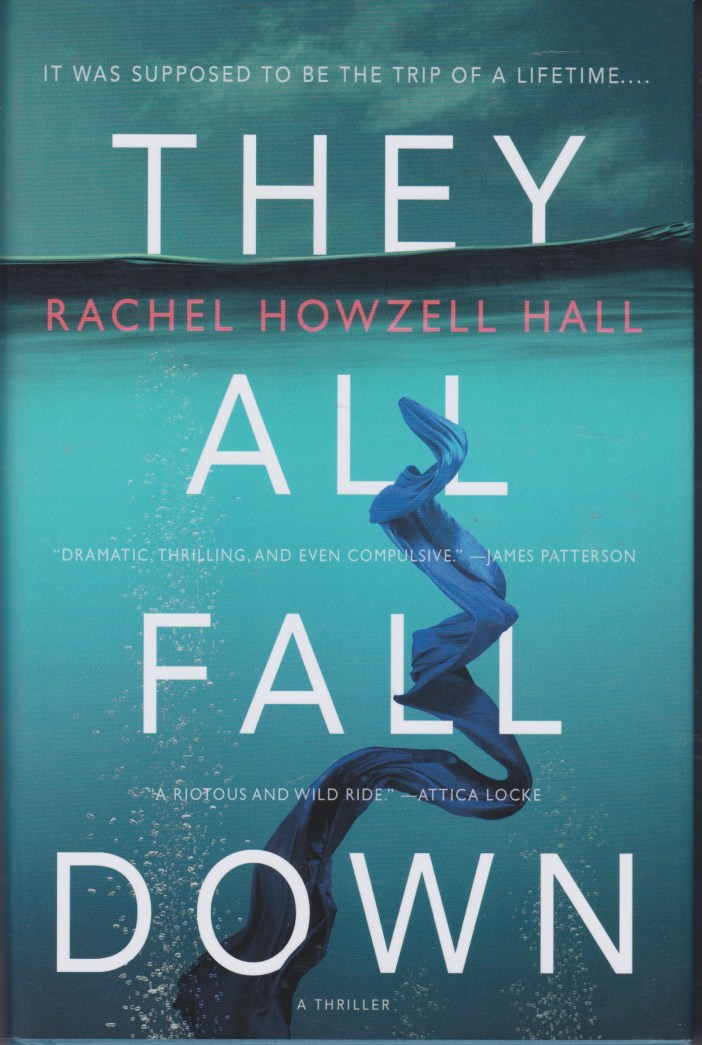
So over the last week I read Rachel Howzell Hall’s wonderful They All Fall Down.

they all fall down

The Los Angeles International Airport was the worst place to lose your mind in post-9/11 America. Especially if you perspired like Kobe Bryant in Game 7 of the NBA finals. Especially if you popped Valium twice a day to combat anxiety. And there I was, standing in the TSA security clearance line at LAX, a sweaty, anxious black woman wearing sweaty green silk, sipping air and blinking away tears.

Miriam, keep it together. They’re gonna pull you out of line if you keep on. Calm down. But “calm” was slipping further away, an iceberg on a quick current being pushed by a pod of enthusiastic killer whales.

And so I closed my eyes and I prayed again. God, don’t let them kick me out of LAX today. Please help me stay calm.

“Next.”

In my mind, I said, “Amen,” then opened my eyes. I forced myself to smile at the gray-eyed TSA agent seated behind the little podium, and hoped that she thought I was a slow blinker and not a terrorist praying one last time before setting one off.

The agent flicked her hand at me and said, “ID and boarding pass, please.”

I’m not sure how I became aware of Rachel Howzell Hall, but I think it was while I was serving on the board of directors for Mystery Writers of America and I was chairing the committee to recruit new board members; we were determined to diversify the board and I think the wondrous Margery Flax suggested her to me as a possible, viable candidate. We had a lovely email exchange and I bought one of her books, Land of Shadows, which went into the TBR pile and never came out of it. I’d heard lots of good things about They All Fall Down, so I got a copy, and decided to read it next.

And am I glad I did!

Sometimes I talk about Agatha Christie, but it’s been years since I’ve read any of her books (I did reread a favorite, Endless Night, a few years back; it’s the most noir of Christie’s novels, which are all, frankly, much darker than she gets credit for) but one cannot deny Christie’s rightful place as the greatest mystery writer of all time; she did it all, and she did it first. One of my absolute favorites of hers is And Then There Were None, which was groundbreaking and highly original and has been copied numerous times: the set up of taking a group of people somewhere remote, stranding them without chance of rescue or escape, and setting a murderer loose amongst them. Margaret Millar, for example, used this set-up for Fire Will Freeze; and it’s been the basis for many slasher movies, etc. I thought about doing my own version of this a few years ago–because the set-up is so classic and enduring, I wanted to give it my own spin–but the problem was how to strand a group of people without cell phone service or the Internet or even satellite phones, without using Christie’s “send them to a remote island” trope.

Let’s face it, though–the remote island is the perfect set-up.

They All Fall Down has been compared to And Then There Were None, and it’s apparent, almost from the first: a group of people have been invited to Mictlan Island, a remote location somewhere in the Sea of Cortez; all with different understandings of why they’ve been invited. Miriam Macy, Hall’s main character, believes she’s been invited to join the cast of a Survivor type reality television show; she’s hoping to win and use the prize money to reboot her shattered life. Hall only doles out information about Miriam slowly, over the course of the novel, but it’s a testament to her skill as a writer that there are two mysteries going on at the same time–the mystery of Miriam’s past, and the mystery of who is killing people on the island. The book is full of surprises and twists, the cast of characters is diverse, and the themes Hall explores are original, or given enough of a new spin to make them seem fresh and new.

But the real revelation of the book is the character of Miriam Macy, and the way Hall breathes life into this complicated woman who has done something horrible and yet continues to justify what she did rather than accepting any culpability for it. You can’t help but root for Miriam, an unreliable narrator if there ever was one, and the brilliance of Hall’s talent is that you keep rooting for Miriam as the story goes on, even after you find out the full story and her history, because her experience on the island is helping her to grow and see the darkness she has denied for years.

This book is an extraordinary accomplishment, and I can’t wait to read more of Hall’s work. Buy it, read it, and love it.

One of These Nights

I have been saying for quite some time that some of the best crime fiction in print is being written by women. This is not to say that there isn’t great crime fiction being written by men these days–there are a lot of amazing male crime writers–but the women don’t ever seem to get the attention–or rapturous praise–that men do. Sistersn in Crime has dedicated itself for over thirty years to put women on the same playing field–recognition, reviews, awards–as the guys, and their hard work is starting to pay dividends.

That isn’t to say we don’t have a long way to go, however; but I do believe in recognizing progress once it’s been made.

I met Jamie Mason I don’t know how many years ago; I do remember it was at Sleuthfest in Orlando (thanks for the invite and another shout-out to MWA-Florida!), and we were on a panel together about place/setting. I think Laura Lippman, who was a keynote speaker/special guest, was also on the panel, and maybe one more person? My memories are hazy these days, my apologies. But I liked Jamie immediately, she was smart and had really insightful things to say. After the panel, Laura and I repaired to the poolside bar for a cocktail and lunch (it was afternoon and no one was out there), and Jamie tentatively asked if she could join us.

From such humble beginnings are friendships born.

I bought Jamie’s first novel that weekend, Three Graves Full, and read it several months later and LOVED it. (It’s still one of my favorite crime novels of this decade, for the record.) She handed me a copy of the ARCs for his second, Monday’s Lie, at Bouchercon in Long Beach either later that year or the next; I treasure that ARC, but as is my wont, didn’t want to read it until there was another Jamie Mason book in print.

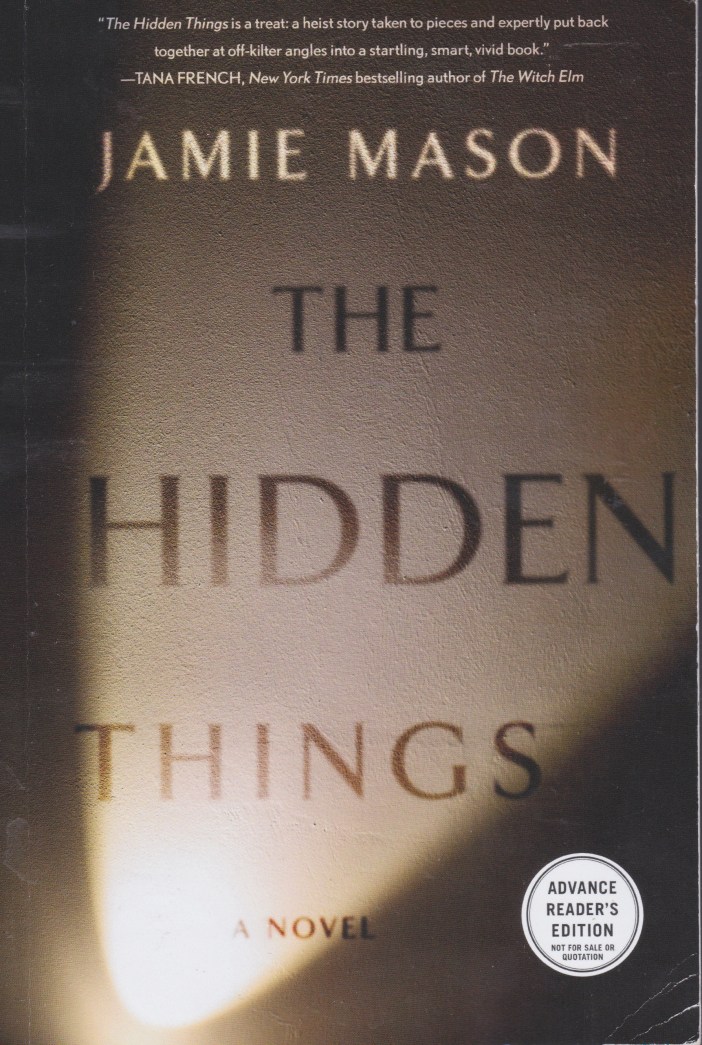
That time is now. This summer sees the release of Jamie’s third novel, The Hidden Things, and she very generously send me an ARC of it.

the hidden things

The video had been watched only forty-four times before Carly Liddell’s attacker was identified to the police. Viewer number forty-four was the prize tipster, and it was a good thing it was all resolved quickly. The young man in the video had killed a turtle over a span of hours one dull Saturday a decade earlier, at the age of nine, in the early weeks of the same summer he’d set his first fire. Since then, matches, rocks, the heel of his shoe, the long drop over the railing of a bridge, and other weapons of juvenile destruction had been urgently fascinating to him in ways that got him into trouble when he was a boy, in ways he’d learned to hide over the years.

He’d been stealing things, lately. And watching women.

He always would have made the news.

The video, a sloppy edit of footage from a home-security system, went on to become something of a phenomenon. It had been cut together in a hurry by a tech-savvy officer in the cybercrimes unit who was good with that sort of thing. It went up on the police website less than twenty minutes after the flash drive, loaded with the raw recordings from the home’s monitoring surveillance, had been plugged into his computer. Backslaps and high fives all around for that one.

I love the way Jamie writes.

She has a very distinct and different style from others writing today, which is, in and of itself, an achievement. She builds her stories from a small kernel, a small thing that might happen at any time any day to anyone, and it builds from there. In Three Graves Full that small thing was the main character’s decision to hire landscapers to redo the flower beds around his nondescript home; in The Hidden Things it’s a little more unique: a high school girl coming from school to an empty house is followed by an assailant who gets into the house behind her. She manages to fight him off and go for help; all of this is captured by security cameras inside the house. The local cops post the video on-line on their Facebook page in order to help identify the assailant, with the unexpected result that the video goes viral.

Videos go viral, after all, every day. So what makes this viral video memorable, different, from other viral videos?

Well, for one thing, neither the girl (Carly Liddell) nor her mother had known there were security cameras in the foyer of their home; so her stepfather has some explaining to do.

Secondly, something caught on video–the corner of a painting hanging in the foyer–catches the attention of some very dangerous people.

You see, Carly’s stepfather of four years has been keeping some seriously dark secrets from both her and her mother…secrets that start coming out now with serious consequences.

I absolutely loved this book. The characters are beautifully sculpted; Mason knows what makes people tick and also understands that small, barely noticeable touches are what make characters come to life as well as making relationships ring with honesty and truth and reality. The book is so good I deeply resented everything else that was keeping me from reading it–being tired, errands, cleaning, doing my own writing, my day job–and I literally had to finally push everything aside one day to read the second half in one sitting. Her style reminds me of a combination of Margaret Millar and Patricia Highsmith; literary but accessible at the same time.

It is officially being released in August; do yourself a favor and preorder it right now. And if you’ve not read her before, do yourself an even bigger favor and go read her back list. You won’t regret it.

Sweet Thing

Wednesday, and the downward slide into the weekend begins.

I somehow managed to pull out another 700 words on the WIP and have now progressed to Chapter 6, so I call that winning. It’s also payday, so at some point I need to continue paying the goddamned bills. Huzzah.

As you can see, paying the bills is not one of my favorite things.

Yesterday was an interesting day. It was a long day at work, and as is my wont, periodically I check social media between clients, to see what’s going on in the world and so forth. Twitter usually is only good for raising my blood pressure–honestly, what a fucking cesspool it usually is–but I stumbled into something that reminded me of what social media could be, and actually can be: The Writer magazine (which I used to read, back in the day; I even subscribed for a few years) had done a joint interview with Lee Child and Paul Doirot. Well and good, but the take the magazine chose to take when tweeting about the piece–and ostensibly what the piece was about–was about how these two male thriller writers were creating women characters that were three dimensional. Again, all well and good–except the tack taken by the tweet, and slightly less so in the piece itself–is that the crime fiction genre primarily traffics in female characters who are little more than either a femme fatale, a damsel in distress, or a combination of the two.

Whoa.

As you can imagine, crime writers were having a field day with this on Twitter. I think the reason I got pulled into this amazing and fun thread was because Jessica Laine, one of my fellow contributors to Murder-a-Go-Go’s, brought up me, and my story “This Town,” as an example of a man getting female characters spot-on correct. This naturally made my day–the rare occasions when one of my short stories gets some love are moments I cherish, as I am incredibly insecure about short story writing–and several other women writers whom I respect also were highly complimentary about the story. Sisters in Crime wrote a wonderful response to the piece, as did Nik Kolokowski in a response essay for Mystery Tribune. And while many of us were having a lot of fun on Twitter making jokes, cracking wise, and finding new ways to use sarcasm, the truth is more serious: the very idea that a major writing publication could be so way off base and uninformed about an entire genre (which has always been heavily populated by women writing about women), shows how much work remains to be done within the genre itself.

If I wrote about even a fraction of the women writing superb crime fiction, I would be here for the rest of the week, month, year, my life. The dismissal of the contributions of stellar women writing powerful books isn’t just a problem in the crime genre, but in fiction, period. (Romance is written primarily by women; thus the entire genre is frequently written off as unworthy.) It’s also indicative of the misogyny that pervades our society and culture; women have been fighting misogyny for millennia. Women writers are often asked about work/life balance, whereas men never are; women often write movingly and powerfully about social injustice and rarely get recognized for it. (Two really good examples of this are Dorothy B. Hughes’ The Expendable Man and Margaret Millar’s Do Evil in Return, both from the early 1960’s and tackling racism and abortion, respectively.) Stories by men about men are seen as “universal” stories, big stories tackling major themes and making commentary on the state of humanity and the world; women’s stories are considered to be insular, small, and in many cases, domestic.

One can almost look at the publishing world as a microcosm of society. Crime fiction is wrestling with the same demons that we are as a culture and a society; the clamor for full equality for women, people of color, and queer people is being pushed back against by those who feel they are being displaced by equal opportunity for all. The loss of an unfair advantage gained simply as a side effect of one’s gender, sexuality and color isn’t really a loss; but for those who are disadvantaged and sometimes disqualified based on any of those things, losing that disadvantage and being judged equally and fairly can make an enormous world of difference.

And now,  back to the spice mines.

59142_1633005911301_1421271844_1630402_2276766_n

If You Leave Me Now

One of my favorite writers when I was a kid was Charlotte Armstrong.

Armstrong was astonishing, really. The first book of hers I read was The Witch’s House. My parents had allowed me to join the Mystery Guild and I, of course, one month failed to do my duty and send the order card back declining that month’s selections. It was probably one of the best mistakes I’d ever made through my instinct for procrastination; I wound up getting a three volume omnibus of Armstrong called The Charlotte Armstrong Reader, and Elephants Can Remember by Agatha Christie. I shelved the Christie and forgot about it until years later–when I’d started reading Christie–but The Witch’s House sounded interesting to me; it had “witch” in the title and I’ve always been drawn to witches, for some reason, and I was at the age when I was still reading my kids’ mystery series but was slowly beginning to transition to books for adults. I was enthralled by The Witch’s House, and read it very quickly, and followed it up by reading the next, Mischief, which I liked even better. But the local library didn’t have any Armstrong novels in stock–which surprises me even more now than it did then–and so I didn’t continue reading Armstrong until years later. Armstrong is one of my favorite writers, even if the books might seem a bit dated today; whenever I read another one of her novels I greatly enjoy it. Armstrong’s books were–I don’t know how to put this, but I am going to give it a try–were dark without darkness; there was always a sense of optimism in her books no matter how dark they got (there’s one particular scene in The Gift Shop that to this day rattles me when I think about it) and I do think she is overdue for a renaissance. It was the combined work of Jeffrey Marks and Sarah Weinman that reminded me of Armstrong and got me to go back and try to finish reading her canon; they also introduced me to Dorothy B. Hughes and Margaret Millar (among others).

The point is, women have always been some of the greatest writers in the crime genre, and societal and cultural sexism have gone a very long way to ensuring that the men who wrote in the same period as these ladies are now lauded as giants of the genre and must-reads, while the women–who won just as many awards and critical laurels and big sales–faded away into obscurity. Mary Higgins Clark was the bridge from these great women of the past to the modern women who write domestic suspense–and really, has there ever been a greater concept for a domestic suspense novel than Where are the Children?–but the second wave of major women crime writers primarily focused on private eye fiction (Sue Grafton, Marcia Muller, and Sara Paretsky).

But what the great Sarah Weinman calls “domestic suspense” never faded away; and nowadays we have some truly terrific women writing truly terrific novels in this subgenre–Lori Rader-Day, Catriona McPherson, Carol Goodman, Wendy Corsi Staub, Alafair Burke, and so many others–and it’s really become one of my absolute favorite subgenres, primarily because of the work these women are doing. It’s extraordinary; I cannot urge you enough to check out these women’s books, Constant Reader.

I could go on and on about these women and domestic suspense forever; but I’ll spare you and cut to the chase.

x510

“It was the girl.” The old man leaned forward, bracing against the worn-out armchair as though he were trying to escape its grasp. “April Cooper. She was the real killer.”

Quentin Garrison watched his face. He was very good at describing people, a skill he used all the time in his true crime podcasts. Later, recording the narration segments with his coproducer Summer Hawkins, Quentin would paint the picture for his listeners–the leathery skin, the white eyebrows wispy as cobwebs, the eyes, cerulean in 1976 but now the color of worn denim, and with so much pain bottled up behind them, as though he were constantly hovering on the brink of tears.

The man was named Reg Sharkey, and on June 20, 1976 , he’d watched his four-year-old daughter Kimmy die instantly of a gunshot wound to the chest–the youngest victim of April Cooper and Gabriel Allen LeRoy, aka the Inland Empire Killers. Two weeks later, his wife, Clara, had decided her own grief was too much to bear and committed suicide, after which Reg Sharkey had apparently given up on caring about anything or anyone.

Quentin said, “Wasn’t it LeRoy who pulled the trigger?”

Alison Gaylin has been nominated for the Edgar four times (Best First for Hide Your Eyes, Best PBO for both Into the Dark and If I Die Tonight, Best Novel for What Remains of Me)  and claimed the prize, just this past week, for If I Die Tonight. Her novels encompass a wide variety of subgenres; her first series featured an amateur sleuth; she then wrote two brilliant crime novels built around the entertainment industry; and then did the Brenna Spector trilogy: private eye novels that were, by and large, quite superb. All of her novels were superb, but once the Brenna trilogy was completed she moved on to stand-alones of psychological suspense that also crossover into the domestic suspense category; explorations of families and the dysfunction that leads to damaged people and possibly crimes. What Remains of Me was a throwback to  her earlier stand alone novels about the entertainment industry; only delving more deeply into the friendships and family relationships with the insightful eye of an artist. What Remains of Me juggled two time-lines and two murders; one committed in 1979 and another committed in the present–both linked and connected to the same woman, the same cast of characters, and the big reveal was stunning. If I Die Tonight was all set in the present day, but Gaylin’s family relationships in this novel are just as fractured and dysfunctional on every level; the concept Gaylin explored in this novel was public face private truth–the singular kernel of truth in this book being that things are so rarely what they appear to be in public, whereas the actual truth is far more complicated, far more complex, and far too often not what anyone actually wants to know.

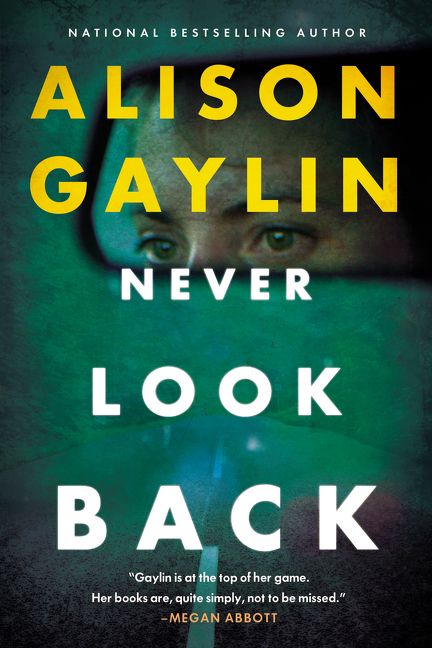
Never Look Back also, like What Remains of Me, juggles two timelines; one in the past, which is expressed and explored through letters a teenaged girl writes to her future child, the other, a present where the aftermath of a brutal killing spree decades earlier by the teenaged girl writing the letters and the “boyfriend” who took her along for the ride; the notorious Inland Empire Killers. In the present day, a happily married gay man whose own childhood and family was actually shattered by the Inland Empire Killers, now works as an adult as a coproducer of true crime podcasts. The book opens with him confronting the father of the youngest victim of the killers–who also happens to be his grandfather, whom he doesn’t know. The interview ends badly, with bitterness and shouting and recriminations; Quentin blames his grandfather for his mother’s tragic, drug addicted, and wasted life, which in turn made his own childhood a mess. Quentin is now happily married…but driven by an obsession to get to the bottom of the killings so many decades ago.

And then comes the tip that April Cooper, the young girl writing the letters and the “Bonnie” to Gabriel LeRoy’s “Clyde”–might not have died in the fire which everyone believed killed them both; that she might actually be still alive and living in the Hudson Valley of New York.

This is a terrific premise, and Gaylin delivers in ways the reader cannot imagine as they ride the rollercoaster of suspense and emotion along with her characters. It’s an enormously satisfying read, with lots of juggled subplots and clues being left in the most casual of ways, so that the careful reader might even be able to figure out the truth long before the characters. Quentin is a terrific character, and so is Robin Diamond, the website  columnist whose mother might–or might not–hold the key to the answers Quentin is so driven to learn. The suspense and the twists are stunning, but the ending is powerful and enormously satisfying…and there’s not a single loose plot thread left behind.

Charlotte Armstrong was dubbed the Queen of Suspense by critics and reviewers during her lifetime; Alison Gaylin is a worthy heir to that title.

The book is available for preorder now; I’d advise you to do yourself a favor and preorder now. You aren’t going to want to miss this one.

Nikita

I read a terrific piece about Mary Higgins Clark the other day; about how her books are really, at the barest bone, about how women cannot even truly trust men. It’s a terrific read, and I do think everyone should read this piece–draw your own conclusions. The brilliant Sarah Weinman then tweeted the piece, positing that she considers Clark the bridge between the domestic suspense thrillers of the past (writers like Dorothy B. Hughes, Margaret Millar, Charlotte Armstrong, and scores of others) to the modern day women who are killing it in the crime fiction world. On that tweet thread, someone (I think Jeff Abbott?) brought up Phyllis A. Whitney.

Now, Phyllis A. Whitney is one of my favorite writers of all time. I first read her children’s/young adult mysteries (the first being The Secret of the Tiger’s Eye, which I checked out from the library at Eli Whitney Elementary School, after which I started tearing through them. Some were available through the Scholastic Book Club, others I got from the library. I loved them all because they were always set in far off places I wanted to visit–Tiger’s Eye taught me about South Africa and apartheid; The Mystery of the Hidden Hand taught me about Greece and the black market for antiquities, etc.

My mom let me join the Mystery Guild when I was eleven, and I was very thrilled and excited to see as one of the choices, a book by Phyllis A. Whitney, Listen for the Whisperer, and I added it to my choices, filling in the little white box with the correct item number. I was also, at this same time, going through my Hollywood period, reading biographies of movie stars and producers and histories of the film industry. So, you can imagine my thrill to discover that Listen for the Whisperer also was sort of about the film industry; the main character’s biological mother, had been a major Hollywood star, even winning an Oscar, when a scandal destroyed her career; her director was murdered one night on the film set of what would ultimately be her last film, a Gothic black-and-white suspense film called The Whisperer.

It was amazing. A romance and a thriller and a murder mystery, with a lot of Hollywood background to it, it’s remained one of my favorite books of all time, and always makes any list I make of books that were important and/or formative to me.

I soon began tearing through her backlist: Thunder Heights, Seven Tears for Apollo, Blue Fire, Black Amber, Skye Cameron, The Trembling Hills, Silverhill, The Winter People, The Quicksilver Pool, Lost Island, The Moonflower, Sea Jade, Columbella, and Hunter’s Green. Mrs. Whitney continued producing work for almost another twenty years, and I read those books as they were released in paperback, later getting them as they were originally released in hardcover: Snowfire, The Turquoise Mask, The Golden Unicorn, The Glass Flame, Spindrift, Rainbow in the Mist, Woman without a Past, and Vermilion, among many others. Like her teen books, the adult novels also were often set in exotic places which Mrs. Whitney described perfectly, and you learned a little something about the places as you read about them. I also began to realize that when Mrs. Whitney went on one of her research trips, she often wrote two books set there–one for kids, and another for adults.

But the primary difference, I think, between Mary Higgins Clark and Phyllis Whitney is this: if, as the article I read (and linked to) is correct, Ms. Clark’s message is a woman can’t trust any man, then Mrs. Whitney’s was a woman can’t trust anyone, ESPECIALLY not family.

Mrs. Whitney’s books were often, not always, about a young woman trying to either obtain closure (like meeting the birth mother she never knew in Listen for the Whisperer, or confronting her estranged husband who finally wants a divorce after several years of separation in Hunter’s Green, or seeking a relationship with the child she gave up in Lost Island) or trying to get to know a family she’s never met or knew existed (Silverhill, Woman without a Past, Thunder Heights, Sea Jade). 

You couldn’t trust anyone in a Whitney novel; sometimes her killers were actually women.

A common trope in Whitney’s work was also the bad girl, who was often either married to, or engaged to, the love interest for the main character; and frequently, particularly in her earlier works, the bad girl wound up as the murder victim (Columbella, Lost Island). There was almost always a “bad girl” archetype in these books; a beautiful, sexually free woman who refused to be a submissive wife, and was sometimes, quite frankly, a nasty bitch to the main character (The Turquoise Mask, Vermilion) but eventually came over the heroine’s side and thus survived the story.

Here’s a list of all her novels (you can see, she was very prolific and her career lasted over fifty years; often publishing more than one book per year–and remember, she had to use a typewriter):

  • A Place for Ann (1941)
  • A Star for Ginny (1942)
  • A Window for Julie (1943)
  • Red is for Murder (1943), Reissued as The Red Carnelian (1965)
  • The Silver Inkwell (1945)
  • Writing Juvenile Fiction (1947)
  • Willow Hill (1947)
  • Ever After (1948)
  • The Mystery of the Gulls (1949)
  • Linda’s Homecoming (1950)
  • The Island of Dark Woods (1951), Reissued as Mystery of the Strange Traveler (1967)
  • Love Me, Love Me Not (1952)
  • Step to the Music (1953)
  • Mystery of the Black Diamonds (1954)
  • A Long Time Coming (1954)
  • Mystery on the Isle of Skye (1955)
  • The Quicksilver Pool (1955)
  • The Fire and the Gold (1956)
  • The Highest Dream (1956)
  • The Trembling Hills (1956)
  • Mystery of the Green Cat (1957)
  • Skye Cameron (1957)
  • Secret of the Samurai Sword (1958)
  • The Moonflower (1958)
  • Creole Holiday (1959)
  • Mystery of the Haunted Pool (1960)
  • Thunder Heights (1960)
  • Secret of the Tiger’s Eye (1961)
  • Blue Fire (1961)
  • Mystery of the Golden Horn (1962)
  • Window on the Square (1962)
  • Mystery of the Hidden Hand (1963)
  • Seven Tears for Apollo (1963)
  • Secret of the Emerald Star (1964)
  • Black Amber (1964)
  • Mystery of the Angry Idol (1965)
  • Sea Jade (1965)
  • Columbella (1966)
  • Secret of the Spotted Shell (1967)
  • Silverhill (1967)
  • Hunter’s Green (1968)
  • Secret of Goblin Glen (1969)
  • The Mystery of the Crimson Ghost (1969)
  • The Winter People (1969)
  • Secret of the Missing Footprint (1969)
  • Lost Island (1970)
  • The Vanishing Scarecrow (1971)
  • Nobody Likes Trina (1972)
  • Listen for the Whisperer (1972)
  • Mystery of the Scowling Boy (1973)
  • Snowfire (1973)
  • The Turquoise Mask (1974)
  • Secret of Haunted Mesa (1975)
  • Spindrift (1975)
  • The Golden Unicorn (1976)
  • Writing Juvenile Stories and Novels (1976)
  • Secret of the Stone Face (1977)
  • The Stone Bull (1977)
  • The Glass Flame (1978)
  • Domino (1979)
  • Poinciana (1980)
  • Vermilion (1981)
  • Guide to Fiction Writing (1982)
  • Emerald (1983)
  • Rainsong (1984)
  • Dream of Orchids (1985)
  • Flaming Tree (1986)
  • Silversword (1987)
  • Feather on the Moon (1988)
  • Rainbow in the Mist (1989)
  • The Singing Stones (1990)
  • Woman Without a Past (1991)
  • The Ebony Swan (1992)
  • Star Flight (1993)
  • Daughter of the Stars (1994)
  • Amethyst Dreams (1997)

She won two Edgars for her mysteries for children, and was eventually named a Grand Master by the Mystery Writers of America.

I did sometimes get frustrated with her heroines for being more wimpy than they needed to be; usually, though, the course of the novel allowed her heroines to become more confident in themselves as well as to work through whatever neuroses they had at the start of the novel. And like I said, a common theme was damaged families. Her books, along with those of Victoria Holt and Mary Stewart, were labelled as romantic suspense, but I think female noir is actually a better label for them; and as an adult, I really don’t think Stewart’s books actually are romantic suspense…but that’s a topic for another time.

And now, back to the spice mines.

freddie stroma

Sugar Walls

Sunday morning. Yesterday wasn’t nearly as productive as I would have hoped; but I am pleased to report that “My Brother’s Keeper” is finished,  and “Don’t Look Down” isn’t nearly as big of a mess as I thought it was before reading it from beginning to end. It needs some serious polishing before I can consider it to be done–or read it aloud–but I think another push on it today and it will be done. I also started writing yet another story yesterday–“This Thing of Darkness”–which is kind of an interesting idea. We’ll see how it goes. My goal for today is to finish “Don’t Look Down” and “Fireflies” today so they are ready for the read-aloud. And, of course, once “Don’t Look Down” is finished, my collection will be as well–which is kind of exciting.

I didn’t work on Scotty yesterday; I am going to hold off on going back to work on him until tomorrow. I want to get this collection finished, and he needs to sit for another day. I may go back and reread what I’ve already written; the first fourteen chapters, so I can figure out where, precisely, this next chapter needs to go.

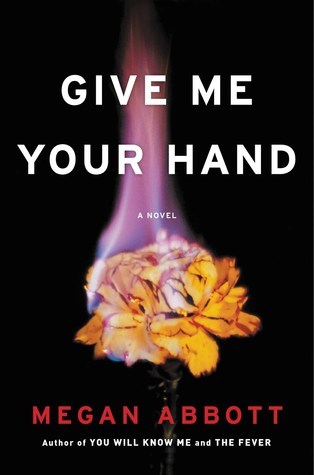
I also finished reading Megan Abbott’s amazing Give Me Your Hand last night.

29569206

I guess I always knew, in some subterranean way, Diane and I would end up back together.

We were bound, ankle to ankle, a monstrous three-legged race.

Accidental accomplices. Wary conspirators.

Or Siamese twins, fused in some hidden place.

It is powerful, this thing we share. A murky history, its narrative near impenetrable. We keep telling it to ourselves, noting its twists and turns, trying to make sense of it. And hiding it from everyone else.

Sometimes it feels like Diane was a corner of myself broken off and left to roam my body, floating through my blood.

On occasional nights, stumbling to the bathroom after a bad dream, a Diane dream, I avoid the mirror, averting my eyes, leaving the light off, some primitive part of my half-asleep brain certain that if I looked, she might be there. (Cover your mirrors after dark, my great-grandma used to say. Or they trap the dreamer’s wandering soul.)

Megan Abbott has been a favorite of mine, since years ago when I first read Bury Me Deep as a judge for the Hammett Prize. A period noir, set in the early 1980’s and based on a true story, I was blown away by its deceptive simplicity and hidden complexities. It echoed of the great noirs of James M. Cain and great hardboiled women writers, like Margaret Millar and Dorothy B. Hughes; a tale of desperation and love and murder, crime and ruined reputations, as it delved into the complex emotions that could lead a woman to commit a horrifically brutal murder; its exploration of small-town corruption was reminiscent of Hammett’s Red Harvest. Over the years since that first reading, I’ve gone on to read Abbott’s other brilliances: This Song is You, Queenpin, Dare Me, The End of Everything, You Will Know Me. Her women aren’t victims in the classic sense of victims in crime fiction; her women have agency, they make their decisions and they know their own power; a common theme to all of her novels is the discovery of that power and learning to harness it; whether it’s sexual power (The End of Everything), physical power (You Will Know Me), cerebral (Give Me Your Hand), or inner strength (Dare Me).

And somehow, she manages to continue to grow and get better as a novelist, as a writer, with every book.

She is probably the greatest psychological suspense writer of our time; her ability to create complex inner lives for her characters, to explore the duality of weakness and strength we all carry within us, and the delving into the complicated nuances of female friendships, with all their inner rivalries and passions and jealousies and affections, is probably unparalleled. Her books are also incredibly smart and layered; this one has references, both subtle and overt, to both Hamlet and Macbeth seamlessly woven into the text; the dual, competing themes of inertia despite the knowledge of a crime versus unfettered ambition; and what to do when faced with both. How do you decide? And what does your decisions say about you as a person?

Give Me Your Hand is set in the world of research science, which may seem a weird setting for a crime novel…but competition for research funding and positions, for advancement in career, the thin veneer of civility and camaraderie between co-workers angling for plum research assignments, is at its very heart, noir. One of the characters, Alex, says at one point, jokingly, “we’re a nest of vipers”…and it turns out to be very true.

The novel follows the complex friendship between the main character, Kit Owens and Diane Fleming, who first meet as young teens at Science Camp, and again later their senior year of high school. They become friends, with similar interests; Kit and Diane push each other to be their very best. It is the friendship with Diane that sets Kit on the road to  her career as a research scientist; yet their friendship is blown apart by a secret Diane shares with Kit,  and the knowledge of that shared secret haunts both women for the rest of their lives. Their paths cross again years later, working in the same lab and competing for a limited number of spots on a new, important research project having to do with how excessive premenstrual syndrome: premenstrual dysphoric disorder (PMDD). The book also offers two timelines: the senior year, with its heavy influence of the Hamlet theme, and the present, which is more on the lines of Macbeth. Blood also is used, repeatedly, brilliantly, as an image; the study is on a disorder caused by menstruation, and of course, blood as in relatives, as a life-force, as a motivator.

The book is slated for a July release; usually when I get advance copies I wait until the release date is imminent for me to blog about these books. But this one couldn’t wait; I’ve not been able to stop thinking about it since finishing it late last night.

Preorder the hell out of this, people.


Out of Touch

As a general rule, my blog is something that I simply sit down and write while I drink my morning coffee and wake up in the morning. It’s part of my waking up process, so not only is it unfiltered, it’s unedited; I rarely go back and reread it with an eye towards fixing mistakes, sentences where I’ve left out a word, spelling mistakes that spell check  didn’t catch as I write, etc.

But every once in a  great while, I’ll start writing a blog post and am not entirely comfortable with discussing the subject matter publicly. I’ve said things before publicly that later were removed from their proper context and thus twisted by someone with an agenda determined to make me look bad; so when I am talking about a sensitive topic, I tend to either shelve the blog post entirely, or put it aside to read over again at a later date, or post it so that only I can see it. I worry about posting things because the last thing I ever want to do is deal with an angry on-line lynch mob, or say something that, taken out of context years later, will be used to bludgeon me; lynch mobs don’t care about either context or nuance, alas, and once the torches are lit and the pitchforks hoisted, no one listens.

This has happened to me more than once, as I said, so I tend to be careful.

So, in some ways I’ve become self-censoring; but this self-censoring has also saved me a lot of stress, aggravation, and worry. I also rarely, if ever, go off on one of what my friend Jeffrey used to call my Julia Sugarbaker rants. This has helped lower my blood pressure, for one thing; I still do it, of course, I just don’t make it public anymore. My opinion on anything and everything isn’t so amazing and profound that I feel it needs to be shared because it will change minds and make the world a better place. Simply because I can speak my mind freely on-line doesn’t mean that I should. I have a right to my opinion, as does everyone, but I also have a right to keep my own counsel and I also don’t have to argue with anyone I disagree with publicly; and the reality is, I am never going to be convinced that I as a gay man am not entitled to equality; that transfolk have no right to human dignity; that women are lesser than men; or that white people by virtue of being white are somehow superior to people who are not. I also will never be convinced that people do not have the right to be seen as individuals, rather than any subgroup they might be put into by other people. There is nothing worse than being judged by preconceptions you have no control over.

As you know, Constant Reader, I’ve been engaged in something I call The Short Story Project since the beginning of the year; in which I am focusing most of my fiction reading on short stories rather than novels. I’ve not read any novels since the first of the year; I am still reading nonfiction. The reasoning behind this was twofold; because I don’t think short stories get nearly enough attention from readers, myself included, and because I have always struggled with writing them; this was, for me, a self-improvement exercise as a writer. It has helped in that regard; I have written more short stories in the first few months of this year than I have in any year since I decided to pursue this.

One of my favorite writers from the past is Ross Macdonald; he’s a favorite, but he isn’t up there with James M. Cain and John D. Macdonald and Daphne du Maurier and Shirley Jackson and Faulkner and some others than I consider not only to be iconic but also consider to be major influences on me and my work; Ross Macdonald is an influence, but not as much as the others I named and some others unnamed as well. But I do love Ross Macdonald (I love his wife Margaret Millar more, but that’s another blog entry, methinks), and several years ago I bought a compendium called The Archer Files, in which Macdonald’s short stories, some of which were unpublished, were pulled together in one volume and the editor did some academic discussion of them.

I am still kind of processing one of his short stories; “Strangers in Town.”  I have to give Macdonald credit for writing a short story in that time period (early 1950s)  with characters who were people of color who also drove the story, but…yeah, the casual racism of the period slapped me in the face. That story today most likely would not be published as written, but it has value historically since it stands as an example of how casual and easy systemic racism was in that period. He used parts of it in the next story in The Archer Files, and it also apparently structurally was important to his novel The Ivory Grin, which I think I’ve read; I miss my old ability to recall plots and characters and details of every book that I’d read. It would be a lot more helpful now than it ever was when I retained the skill, you know? Heavy sigh.

One of the issues of this new century involves separating the art from the artist; in other words, can you enjoy art by someone whom, as a private citizen, is problematic? The best examples of this, to name merely two, are Woody Allen and Roman Polanski. I am not a fan of Allen’s art nor have I ever been; but Roman Polanski? He fled the United States to avoid jail on charges of statutory rape. Yet I love his films Rosemary’s Baby and Chinatown; films I saw and enjoyed before he committed his crime.  Distaste has certainly kept me from seeing anything he has done since. But I still love those two films, and rewatch them on occasion; perhaps someday I will rewatch them to look for problematic tropes to unpack.

Likewise, other works from the American past are rife with tropes of sexism, homophobia and racism; the society and culture were sexist, racist, and homophobic; how can the art from that time not be? Yet but it’s how things were back then seems like a feeble response and defense; but I do think it’s possible to enjoy the art as long as one recognizes the presence of things which would never pass muster in today’s society and culture; there is a wonderful essay/book to be done about homophobia in crime fiction of the past, and how gay characters were seen/depicted/represented. I used to want to write that book, but I will undoubtedly never have the freedom and luxury of time to do the necessary research and writing of a book that would prove, ultimately, to have an exceptionally limited audience.

You can’t truly equate racism with homophobia; while there are similarities in oppression and bigotry, both systemic and personal, faced by the two communities, they aren’t the same thing; the differences can be, and are, as significant as the similarities. As a white gay man, I have systemic privilege of skin; unless my car has bumper stickers denoting it as belonging to a gay man I can feel relatively safe in my car from ‘driving while gay’; and while there are certainly levels of homophobia within law enforcement, just walking down the street I don’t need to be worried about being either harassed by law enforcement or profiled. Reading works, or seeing films, that are blatantly homophobic or have stereotypical queer characters who are there to be laughed at, mocked, or held in contempt, while somewhat jarring doesn’t feel the same to me as reading or seeing something current with those same metrics. I am not willing to judge a writer from the pre-Stonewall culture as harshly as I am someone from the present day; it is how things were. You cannot write a realistic novel or short story today about queer characters in the 1950’s, for example, without including homophobic characters and a certain degree of self-loathing in the queer characters themselves: they were outlaws, held in contempt by the society as a whole.

Yet Macdonald’s story bothered me; despite being written in a time when he was undoubtedly considered brave for writing characters of color who weren’t criminals or the kind of “Stepin’ Fetchit” stereotypes so prevalent in films of the time. And yet…and yet…

“Strangers in Town,” by Ross Macdonald, The Archer Files

“My son is in grave trouble,” the woman said.

I asked her to sit down, and after a moment’s hesitation she lowered her weight into the chair I placed for her. She was a large Negro woman, clothed rather tightly in a blue linen dress she had begun to outgrow. Her bosom was rising and falling with excitement, or from the effort of climbing the flight of stairs to my office. She looked no older than forty, but the hair that showed under her blue straw hat was the color of steel wool. Perspiration furred her upper lip.

“About your son?” I sat down behind my desk, the possible kinds of trouble that a Negro boy could get into in Los Angeles running like a newsreel through my head.

That last sentence! Referring to an adult young man of color as a “Negro boy”! And the story goes on with this sentence: She leaned towards me with the diffident and confiding charm of her race.

Yikes. Yup, no stereotyping going on there.

The murder victim was a “light-skinned brown woman.” Another “had straight black hair, trimmed short, and black-rimmed harlequin spectacles that gave her face an Asiatic cast.” Throughout the story, the word “Negro” is used; this is also jarring, because with all due respect, it’s the word that was used politely, rather than the other “n” word. But…no one said “African-American” back then…the police are also willing to view the murder of the light-skinned woman as a possible suicide–which would mean she’d slit her own throat; I can’t imagine anyone ever committing suicide that way–but the white cops’ willingness to believe that a woman of color could or would is also telling.

Other than these issues, it’s a good story; the way it twists and turns and moves away from the original crime and suspects makes for a great detective yarn; the cops never would have solved this, and the son of the woman who hired Archer most likely would have taken the fall for the crime. So, there’s that.

But the next story in The Archer Files, “Gone Girl”,  a different version of the same story, without the people of color, is also a much stronger story.

It was a Friday night. I was tooling home from the Mexican border in a light blue convertible and a dark blue mood. I had followed a man from Fresno to San Diego and lost him in the maze of streets in Old Town. When I picked up his trail again, it was cold. He had crossed the border, and my instructions were to go no further than the United States.

Halfway home, just above Emerald Bay, I overtook the worst driver in the world. He was driving a black fishtail Cadillac as if he were tacking a sailboat. The heavy car wove back and forth across the freeway, using two of its four lanes, and sometimes three. It was late, and I was in a hurry to get some sleep. I started to pass it on the right at a time when it was riding the double line. The Cadillac drifted towards me like an unguided missile, and forced me off the road in a screeching skid.

Rather than being hired by a mother whose son is being accused of murder, Archer now happens onto a strange situation while driving home from a case. He decides to stop for the night at a hotel, and becomes involved in another murder investigation. The basic story after this is the same, both structurally and thematically, but the casual racism is gone and it’s now about white people, and interestingly enough, not nearly so problematic as “Strangers in Town.” The second story works better as well; I’m not sure why that is; did it work better because he didn’t use the people of color, and thus without the stereotyping it worked better?

I am still processing this. As I said, I love Ross Macdonald, and his writing is extraordinary. He’s one of the greats. But what, and where, is that line?

I don’t know the answers; I don’t think anyone does, nor do I think there even is one answer. I don’t recall ever getting any racist vibe from Macdonald’s work before, but on the other hand, I may not have been looking for it, either; the subtleties of systemic prejudices aren’t always apparent at first glance, or even second. Sometimes it takes someone else to point them out.

While I can’t speak to whether racism in American art from the past should not be seen, viewed or read, I can speak, for myself, about art from our homophobic past (while recognizing they are not the same things). Seeing casual homophobia in American art from the past, while jarring, doesn’t bother me as much because that’s the way things were. I don’t think it should be glossed over, or censored out of existence; if we forget the past and how things were, we can’t make things better for the future nor can we understand not only how far we’ve come but how far we have to go; we cannot truly understand the present without understanding our past–and, for want of a better term, in stark black-and-white; we have to understand and appreciate the shades of gray.

And on THAT note, it’s back to the spice mines with me.

Here’s your Monday hunk.

IMG_2015

I Want to Know What Love Is

It’s been raining pretty much most of the weekend, which is fine. I went to get groceries, pick up a prescription, and get the mail before getting home and starting to work on the mess that is my home; I also finished writing a chapter of one manuscript and started writing another–which was my writing goal for yesterday. Today’s is to do second drafts of two short stories to prepare them for submission. I also have to go to the gym and finish the cleaning of the apartment and organizing my office. I started reading the big y/a best seller One of Us Is Lying by Karen McManus yesterday; I can see why it’s a bestseller and I can also see why it’s being developed into a television series a la Thirteen Reasons Why; it’s a deceptively simple yet surprisingly complex story, and likewise–well, I’ll talk some more about it once I’ve finished.

I’m enjoying writing again for the first time in years, which is a good thing, and I am actually putting a lot of thought and planning into what I’m writing, which is a really good thing. What I’ve written over the last six or seven years has been a lot more organic, coming to me as I wrote it from a basic premise and perhaps knowing what the end was; without putting near as much thought into theme and what I am trying to say, what I am trying to explore with the story, than I used to–I mean, it worked, but it also made the work a lot harder than it needed to be. I think this is particularly true of short stories; I think that’s primarily what I’ve been doing wrong in writing them–my entire approach to short stories has been wrong, and I’ve been, as I said, making it a lot harder on myself than it necessarily needs to be.

Which is, sadly, what I always tend to do for myself: make things harder than they need to be.

Heavy heaving sigh.

In addition to cleaning and everything else I did yesterday, I also managed to start watching Season 2 of Black Sails, which continues to enthrall. I am still liking the idea of finally writing my pirate novel (Cutlass), but not as much as before; it remains one of those dreams that I hold on to for when I am making a living as a writer again and able to not have a day job any longer. (There are several of those; they also require not only making a living but making enough money to travel and do research.)

Some day. I never give up on the dream.

The Short Story Project also continues; yesterday I read a story by Ross MacDonald from The Archer Files and one by Karl Edward Wagner from the gorgeous two volume collection The Best Horror Stories of Karl Edward Wagner, produced by Centipede Press maybe seven or eight years ago.

MacDonald’s story, “The Bearded Lady,” was quite good, as everything written by MacDonald is.

The unlatched door swung inward when I knocked. I walked into the studio, which was high and dim as a hayloft. The big north window in the opposite wall was hung with monkscloth draperies that shut out the morning light. I found the switch beside the door and snapped it on. Several fluorescent tubes suspended from the naked rafters flickered and burned blue-white.

A strange woman faced me under the cruel light. She was only a  charcoal sketch on an easel, but she gave me a chill. Her nude body, posed casually on a chair, was slim and round and pleasant to look at. Her face wasn’t pleasant at all. Bushy black eyebrows almost hid her eyes. A walrus mustache bracketed her mouth, and a thick beard fanned down over her torso.

The door creaked behind me. The girl who appeared in the doorway wore a starched white uniform. Her face had a little starch in it, too, though not enough to spoil her good looks entirely. Her black hair was drawn back severely from her forehead.

Lew Archer, on his way from Los Angeles to San Francisco, decided to stop in the small town of San Marcos and look up an old army buddy, inadvertently stumbling into a murder case. The story is interesting, the writing whipcrack smart, with MacDonald’s trademark, cynical short paragraphs immediately getting to the essence of a character. Don’t we, as readers, already have a strong impression of who that young woman is as a person after those three sentences? I’ve often wondered how one solves a murder in a short story–or writes a detective short story. I’ve tried and failed often enough. But the great thing about the Short Story Project is I am starting to understand how to write them, how they work, and how to make them work; which is a lovely thing. I have several ideas for Chanse short stories that I’ve never written because I didn’t know how; now I rather do, or at least have an idea, thanks to The Archer Files and Kinsey and Me (Sue Grafton). Both books are great learning tools for people who want to write detective stories, and MacDonald’s influence on Grafton is clear. (Although I’d still love to see someone do an essay, or book of criticism, comparing and contrasting MacDonald’s work with that of his wife: The Murderous Millars would be a great title.) MacDonald’s stories usually have to do with damaged and dysfunctional families; “The Bearded Lady” is another one of those, and is very well done. I highly recommend it.

The Wagner story I read was from the second volume of he Best Horror Stories of Karl Edward Wagner, which was titled Walk on the Wild Side, and was titled “The Last Wolf.”

The last writer sat alone in his study.

There was a knock at his door.

But it was only his agent. A tired, weathered old man like himself. It seemed not long ago that he had thought the man quite young.

“I phoned you I was coming,” explained his agent, as if to apologize for the writer’s surprised greeting.

Of course…he had forgotten. He concealed the vague annoyance he felt at being interrupted at his work.

Nervously the agent entered his study. He gripped his attache case firmly before him, thrusting it into the room as if it were a shield against the perilously stacked shelves and shelves of musty books. Clearing a drift of worn volumes from the cracked leather couch, he seated himself amidst a puff of dust from the ancient cushions.

I received both volumes of Wagner when I was judging the Bram Stoker Award for Best Single Author Collection, or whatever it is called; it was so long ago that I don’t even recall who the finalists were or who actually won. My memory is perforated like Swiss cheese nowadays, with holes and gaps; it also works like a sieve as new knowledge, and new books I’ve read, tend to pass through it without catching hold (I used to be able to name every book I’ve read, the plot, the main characters–and even some of the minor; over the years that ability has been sadly lost to time). I don’t, for example, remember the titles or the contents of the Wagner stories I read; but the books are beautiful volumes and I remember being impressed by his writing, so I kept them on my shelves. It was only a week or so ago that I realized, that I remembered, them; and that they might make a good addition to my year-long study of short fiction.

I’ve often said that writing about writers, about the business of writing and publishing, sometimes (often) feels masturbatory to me; only other writers would be interested in such a story. And yet writers pop up in my work all the time; Paige is a journalist and wannabe novelist in the Chanse series (and now that I’ve retired that series she’s migrated, apparently, over to the Scotty); another writer character I’ve created has appeared in several novels of mine–one Scotty, The Orion Mask, and one pseudonymous; he also appears to be the voice I used in several first-person short stories, including “An Arrow for Sebastian.” I have another such short story in process; I’ve not quite worked out how to make the story work, but there you have it. I was tempted to write an entire series about a writer, but as I started to develop my gay male writer character more I soon realized I had turned him into a hybrid of Scotty and Chanse; there was nothing new or original about him other than he was a writer and not a private eye. (I really do want to reread Azimov’s Murder at the ABA, though, and Elizabeth Peter’s brilliant Die for Love and Naked Once More.)

“The Last Wolf” is also about a writer, a writer who firmly believes in himself and his work, and that his work is art, and art should never be compromised for commerce. The world in which he lives is one where he is the last (apparently) person attempting to still write fiction; novels have fallen by the wayside and short stories are no longer published; the world has completely changed and his agent wants him to try to write for television shows–which, as described, sound horrifically awful. The writer refuses, the agent leaves, and he goes back to his typewriter. This story could easily be seen as angry, or even whiny; in the hands of a lesser author, the story would be precisely that. But Wagner paints a picture with his words, and maybe it resonated with me more because I am an author myself, but the sympathy rests entirely with the author. (Although I am one of those whose eyes roll so hard that  they almost unscrew when I hear another author speak of their ‘art’; but that’s a topic for another day.) I am looking forward to digging back into Wagner’s work again this year.

And now, I need to file and organize, perhaps vacuum, before I head to the gum. I want to get some things written today, and I need to revise those stories.

Hello, spice mines.

Sigh.

26196451_321860411641954_3040436925599999815_n

When You Close Your Eyes

Well, Constant Reader, we made it to Wednesday, didn’t we? I’m going to do this blog and then run off to the gym for my second workout of this week; sorry if this is getting tedious, but I worry that if I don’t say anything that’s when I’ll start slipping and NOT doing my workouts; a slippery slope I am reluctant to set my foot on, if you will. It’s so lovely to be doing this again and being motivated to do it; it’s more than a little infuriating that I allowed myself such a long break from taking it seriously, and doing it so little. But there’s no sense in crying over spilled milk at this point, is there? I am just happy that I’m at where I am at with it.

I am also very stoked to be jazzed about writing again. It’s interesting, on every level, how gong back to the beginning (both with working out and writing) has turned out so well, isn’t it? I am really pleased with these short stories I’ve written over the last week or so, the chapter of the WIP I wrote Monday, and the rethinking of the Scotty book I’ve done. I am definitely going to keep moving positively forward; and I am going to keep seeking an agent once I get this first fifty pages of the WIP whipped into better shape. This weekend I plan on rewriting and editing the four short stories I’ve done, plus I need to start working on the Bouchercon anthology, which I am also excited about–how long has it been since I was excited to edit an anthology, well might you ask? It’s been a long frigging time would be the proper answer, I am afraid.

I also finished reading Sarah Weinman’s sublime anthology Troubled Daughters Twisted Wives, and am the better for it. If you’ve not read this collection, you really should; particularly if you’re a writer. These stories hold up incredibly well, with only the occasional dated reference–and none of them so jarring that they take you out of the story. I’ve also added several new-to-me authors to my TBR list; alas, I shall have to track down copies of their works via secondhand dealers and eBay, as so much has sadly fallen out of print. I am also disappointed in myself for waiting so long to read this collection; but now that I have, I am glad. I am also grateful to Weinman for her hard work in pulling this together and shining a light on these terrific writers of the past.

It also occurs to me that a similar volume could be done for gay and lesbian crime writers whom modern readers don’t recall or remember; I doubt, though, that there would be a market for such a thing. That’s the tricky thing, isn’t it? Finding a market?

Sigh.

troubled daughters twisted wives

First up was “Lost Generation” by Dorothy Salisbury Davis:

The school board has sustained the teacher. The vote was four to three, but the majority made it clear they were not voting for the man. They voted the way they had because otherwise the state would have stepped in and settled the appeal, ruling against the town…

Tom and Andy, coming from the west of town, waited for the others at the War Memorial. The October frost had silvered the cannon, and the moonlight was so clear you could the words FOR GOD AND COUNTRY on the monument. The slack in the flagpole allowed the metal clips to clank against the pole. That and the wind made the only sounds.

Then Andy said, “His wife’s all right. She came up to Mary when it was over and said she wished he’d teach like other teachers and leave politics alone.”

“Politics,” Tom said. “Is that what she calls it?”

This was my first experience reading Mystery Writers of America Dorothy Salisbury Davis; despite being aware of her for quite some time. Sara Paretsky wrote a brilliant tribute to her after she died a few years ago; she’d been on my radar before that, but again, this is my first time reading her. This story is dark and amazing. We never know what the teacher’s politics are, but given the time period it’s not too hard to imagine what they were, given the fact that the group of men who gather to take care of him also include police officers–which was an all-too true and horrible aspect of the anti-Civil Rights whites of the South; the men paid with tax dollars and charged with protecting everyone were racists who abused their privilege and power to abuse and kill people of color and civil rights workers. There’s an amazing twist in this story, and the denouement is eminently satisfying and dissatisfying at the same time–not an easy thing to do.

Some of Ms. Davis’ books are now back in print, so snap ’em up, peeps!

“The People Across the Canyon” by Margaret Millar

The first time the Bortons realized that someone had moved into the new house across the canyon was one night in May when they saw the rectangular light of a television set shining in the picture window. Marion Borton knew it had to happen eventually, but that didn’t make it any easier to accept the idea of neighbors in a part of the country she and Paul had come to consider exclusively their own.

They had discovered the sight, had bought six acres, and built the house over the objections of the bank, which didn’t like to lend money on unimproved property, and of their friend, who thought the Bortons were foolish to move so far out of town. Now other people were discovering the spot, and here and there through the eucalyptus trees and the live oajs, Marion could see half-finished houses.

But it was the house directly across the canyon that bothered her the most; she had been dreading this moment ever since the site had been bull-dozed the previous summer.

I’ve written about Millar before; I’ve become an enormous fan of her work, and have been slowly making my way through her canon over the past few years. I do have the wonderful reprinted set of her books Collected Millar; a quick glance over at Amazon shows that many of her books, including the Edgar Award winning Beast in View are available as ebooks at fairly reasonable prices.

This story, about a couple and their young daughter, whose increasing obsession with the new neighbors across the way makes the stay-at-home mother not only jealous but concerned about the intensity of the obsession, strikes several chords: the mother becoming aware that her child is growing away from her and lamenting the ways her own every day life has allowed time to slip away, regretting that she didn’t spend more time paying attention to her child; the growing realization that you can influence and affect your child’s personality, behavior and temperament unknowingly; and ultimately, the exquisite torture and pain of being a parent. Millar only had one child, a daughter; it’s not hard to imagine where the roots and inspiration for this story came from. Quite excellent.

“Mortmain” by Miriam Allen Deford

“I’ll be back on Thursday, Miss Hendricks, and I’ll drop in here in the afternoon. It’s only three days, and I don’t anticipate any change. You know what to do. If anything happens, you can call Dr. Roberts; he knows all about the case. I wouldn’t go away, with Marsden like this, but–well, it’s my only daughter, and she’ll never be married again–at least, I hope not!–and she’ll be heartbroken if her old dad weren’t there to give her away.”

Dr. Staples turned to his patient.

“Good-bye, old man; I’m leaving you in Miss Hendricks’ charge till Thursday. You won’t be sorry to have three days free of me, eh?”

This gem of a creepy short story is straight out of what (thanks to Stephen King) I call the EC Comics playbook. The sad, dying patient has a load of cash in his safe; the nurse in whose care the doctor has left him for three days wants it to start a new life with the cad she’s in love with, and there we have the setup for a most clever game of cat-and-mouse in which each sentence builds the suspense and tension. If you want a great example of how to write suspense, this short little tale is all you need. In fact, if I ever teach writing again, this story is going to be one of the things I teach. It may even be one of those stories, like du Maurier’s “Don’t Look Now,” that I reread every now and again, to savor in its delightful brilliance.

And finally, “A Case of Maximum Need” by Celia Fremlin:

“No, no telephone, thank you. It’s too dangerous,” said Miss Emmeline Fosdyke decisively; and the young welfare worker, only recently qualified, and working for the first time in this Sheltered Housing Unit for the Elderly, blinked up from the form she was filling in.

“No telephone? But, Miss Fosdyke, in your–I mean, with your–well, your arthritis, and not being able to get about and everything…You’re on our House-Bound list, you know that, don’t you? As a House-Bound Pensioner, you’re entitled–well, I mean, it’s a necessity, isn’t it, your telephone? It’s your link with the outside world!”

This last sentence, a verbatim quote from her just-completed Geriatric Course, made Valerie Coombe feel a little bit more confident, She went on, “You must have a telephone, Miss Fosdyke! It’s your right! And if it’s the cost you’re worrying about, then do please set your mind at rest. Our Departmenet–anyone over sixty-five and in need–“

“I’m not in need,” asserted Miss Fosdyke woodenly, “Not of a telephone, anyway.”

The tale of Miss Fosdyke, and why she doesn’t want a phone, is the perfect ending to this wonderful collection of short stories. This story is chilling, surprising, and turns around so brilliantly at the end in a way that you do not see coming, and then everything makes sense. Superb, dark, macabre…you name it, it’s all there in this story…and I’ve added Celia Fremlin to my TBR list. Some of her books are currently in print, and if this story is indicative of the pleasures that await in her novels…well, I just can’t wait.

Well done, Ms. Weinman, well done.

And now, back to the spice mines.

I Still Can’t Get Over Loving You

Wednesday, and Day 4 of Facebook Jail. You know something? I wonder if they’ve heard of unintended consequences over at the Facebook Community Standards department. I usually spend far too much time scrolling through my Facebook feed and interacting with friends. So far this week, instead of doing that, I’ve revised a short story, worked on an outline, read a book (a wonderful history of The Mary Tyler Moore Show, Mary and Lou and Rhoda and Ted), read several short stories, and gotten some other things done. As this thirty day sentence continues, I will probably visit Facebook less and less–it’s kind of frustrating being able to see things and not respond to them–and by the end of the sentence, probably will be completely broken of the need to go there, and hopefully my attention span will have snapped back to what it was in the days before social media. I’m also liking Tumblr, INstagram and Twitter–you don’t wind up spending nearly as much time there, at least don’t, at any rate. Once I get used to not being on Facebook and having all this free time…look out.

I also read Lois Duncan’s young adult novel Ransom. Originally published in 1967 as Five Were Missing, it’s clear to see why Duncan was named a Grand Master by the Mystery Writers of America shortly before her death. I’ve not read all of Duncan’s work–I’m working my way through them all–but her novels were startlingly original and fresh, particularly when you consider when they were originally published. Ransom, inspired by a true crime in northern California where a school bus was hijacked and the students kidnapped, reads very quickly. The five students on the bus all are fully developed and fleshed out beautifully; and Duncan uses the kidnapping as a way of getting inside the heads of the characters and exposing them for what they are; the golden boy with dark secrets and feet of lead; the spoiled cheerleader who dislikes and resents her stepfather, only to learn that the father she idolizes is unworthy of her love; the military brat, deeply intelligent, who is the first to realize the truth of their situation and finds depths of bravery she never knew she had; the younger brother of the golden boy who realizes his own identity, and finds he has levels of potential strength his brother can only aspire to; and the orphan, being raised by his bachelor uncle with scars of his own to hide who finds out that self-pity only keeps him from enjoying his life. The dialogue is a little stilted and old-fashioned, but as I said, it reads very quickly.

Duncan was definitely a master.

Speaking of masters, I read a short story by Patricia Highsmith yesterday as well, “The Heroine,” which is the lead off story in Sarah Weinman’s Troubled Daughters, Twisted Wives; a brilliant anthology of stories written by women crime writers from the 1940’s thru the 1950’s, a time when women dominated the industry and many of these wonderful writers are sadly, overlooked and forgotten.

troubled daughters twisted wives

The girl was so sure she would get the job, she had unabashedly come out to Westchester with her suitcase. She sat in a comfortable chair in the living room of the Christiansens’ house, looking in her navy blue coat and beret even younger than 21, and replied earnestly to their questions.

“Have you worked as a governess before?” Mr. Christianen asked. He sat beside his wife on the sofa, his elbows on the knees of his gray flannel slacks and his hands clasped. “Any references, I mean?”

“I was a maid at Mrs. Dwight Howell’s home in New York for the last seven months.” Lucille looked at him with suddenly wide gray eyes. “I could get a reference from there if you like…But when I saw your advertisement this morning I didn’t want to wait. I’ve always wanted a place where there were children.”

I love Patricia Highsmith, and I have an enormous volume that contains all of her short stories. It’s really criminal that I, like so many other people, don’t read more short stories (hence my short story project, which I might make a year-long thing rather than just a few months), and it deeply shames me that I’ve had Troubled Daughters Twisted Wives sitting on my shelf collecting dust all this time without taking it down and reading it. This Highsmith story, “The Heroine,” is genius, absolute genius, in the cold, slightly detached way that Highsmith uses as her point of view, which makes her stories and novels so much more chilling. It’s very clear, almost from the start–ah, that foreshadowing–that the Christiansens are probably making a terrible mistake in not checking on Lucille’s references. And how the story develops is so much more chilling than you think it is when you get that uh oh feeling in your stomach when Mrs. Christiansen charmingly says she won’t check Lucille’s references. Highsmith’s authorial voice is so distant, so cold and matter-of-fact, and her word choice is always simple and spare…but she always gets that feeling of suspense, of oh my god what is going to happen that you feel amping up as you finish reading each sentence…and her denouements never disappoint.

Weinman has done an excellent job curating this collection; she also did a two-volume collection of novels by these writers called Women Crime Writers: Eight Suspense Novels of the 1940’s and 1950s: A Library of America Boxed Set. Some of the novels included in that gorgeous set I’ve already read–Charlotte Armstrong’s Mischief, Margaret Millar’s Beast in View, Vera Caspary’s Laura–but I am definitely going to have to get that set down from the shelf and read the others as well. Weinman is also pretty expert on the crime genre in general; very well read, fiercely intelligent and deeply perceptive, her newsletter The Crime Lady is amazing, and I read it every week for her thoughts on true crimes, the books she’s read and recommends…you can sign up for it here. You can thank for me for it later. She’s also writing a true crime of her own right now that I can’t wait to read.

And now, back to the spice mines.