Sweet Magnolia Blossom

Work at home Friday and was Mercury in retrograde yesterday? Is it still? My work laptop died yesterday morning when I tried signing into it after I got to work and it took most of the morning for me to get a new replacement one. So, I spent the morning without a computer–which meant outside of seeing my clients, I didn’t really have the ability to do much of anything. I finally got the new one around lunch time, but my day was already off and so was my energy, and since my routine had been disrupted, I had trouble getting back on track. Finally, I just made a list while I was eating lunch and that seemed to work, even though I still felt off all day. The replacement laptop (which is just temporary until they fix the old one) also had some issues with staying connected to my scanner, which was incredibly frustrating and resulted in my admin work taking far longer than it usually does, and I had a lot of documents to scan into patient files. The frustration was real, and I was exhausted when I got home. My brain was basically non-functional by the time I got home, and I actually fell sound asleep in my easy chair around nine-thirty. I didn’t get anything done once I was home–worn out from the endless frustration of the day–and didn’t even remember to charge my phone when I went to bed. I did manage to watch Real Housewives of Salt Lake City (which is lit this season and definitely my favorite of these shows at the moment), though, since that required little to no energy on my part. I hope to get a lot done today, both day job and Gregalicious wise; and we’re going to Costco later after I am done with work duties. (Need to make a list!)

But I slept very well last night, and woke up feeling pretty rested this morning, which is a good thing. The entire place is a disaster area, and I never managed to do anything about the dishes accumulating in the sink and now it’s of course out of control. Heavy heaving sigh. Even my desk is piled high with things that need to be put away. It feels chilly, and per the weather the high will only reach sixty degrees here today. I think I am going to walk to the gym tomorrow morning and get started back up with that again, and hopefully today will be a great clean and organize day for the house. Christmas is coming, and I am really not feeling it very much this year, to be honest, and haven’t for a few years. Paul and I decided to not do gifts again this year–we are divorcing ourselves from the capitalist holiday by refusing to spend much money observing it (we’re going to go see Babygirl in the theater on Christmas day), and I have to say I am gradually growing more radical and anti-capitalist by the day (so much for that you get conservative as you get older bullshit; I grew up as a conservative and my adult hood has been mostly about shedding that foul and utterly inhuman methodology. Profits over people, corporations are people but living breathing humans are not–I could go on and on talking about the class war in this country. I am a radicalized Paw Paw, I guess? I did have a client this week whose birth year was 2006–which was highly traumatizing, and would have been worse if I cared about being old. It was more of a shock to me that kids born after Katrina are eighteen (and older) now. Kids born the year of Katrina will be twenty next year. Twenty years, a third of my life, has passed since that time.

I am also looking forward to some good reading time. Both of my current reads (Winter Counts and White Too Long) are fascinating and well-written, and it’s quite easy to get caught up in the narrative. I’d love to finish both this weekend so I can move on to my next reads (leaning towards Alter Ego by Alex Segura or Missing White Woman by Kellye Garrett and The Exvangelicals for my non-fiction). I do want to get caught up on Donna Andrews’ two latest over the holidays, which are rapidly approaching. Soon it will be 2025 and even more insane chaos once the new “administration” is sworn in. The next four years are going to be bad, I think–signs point to yes–but I also survived the 80s and the 90s, so maybe I am a Cher/cockroach.

We started watching Black Doves the other night, and I really enjoyed the first episode. I love Ben Whishaw, and Sara Lancashire is a treasure. I am hoping we’ll be able to spend some more time with it over the course of the weekend. We also should go back to Slow Horses, which we never went back to for some reason; I think we got interrupted by something (a surgery? A funeral? Who knows?) and just never went back to it. I do also want to read the books by Mick Herron (got to love that last name), too. Ah yes, so many books to read. Heavy sigh. I have so many treasures in my TBR pile, as well as treasures from the distant past (I would love to read Anatomy of a Murder and A Summer Place and Summer of ’42 again, plus more of Margaret Millar, Daphne du Maurier, Charlotte Armstrong, and Dorothy B. Hughes) that I will probably never get through them all.

And on that note, I am going to head into the spice mines. Have a lovely Friday, Constant Reader, and I hope that I have a really productive one. I’ll be back either in the morning or later today, it’s a mystery!

Gorgeous retired Olympic and world champion ice dancer Guillaume Cizeron, who also is a model.

If Anyone Falls

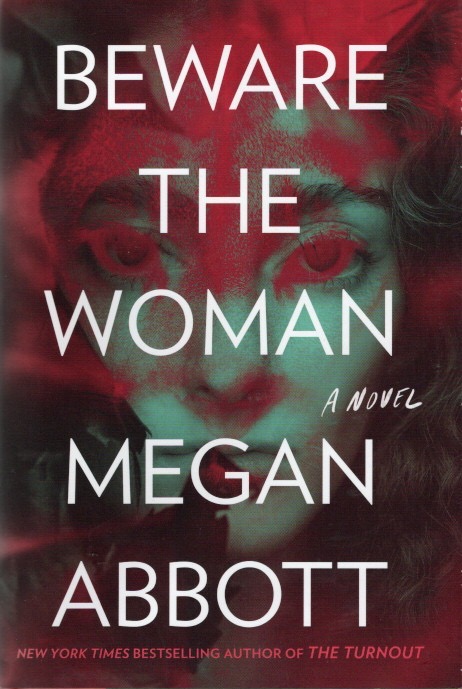
I finished reading the new Megan Abbott novel, Beware the Woman, this morning during a marvelous, raging thunderstorm that filled the gutters and streets of New Orleans with dirty swirling water, cutting the temperature to something bearable for once this summer and cooling the interior of my apartment to the point I needed to put on a sweatshirt and a knit cap on my head. Curled under a blanket with a good book while a thunderstorm rages with a warm cup of coffee on the side table, tendrils of steam rising in curly-cues of white from the creamer-lightened pool of soft brown, is perhaps my happiest of places.

Hell, reading anything new by Megan Abbott is my happiest of places.

My first Megan Abbott novel was Bury Me Deep, which stunned me with its craftsmanship, its voice, its literate choices of words and sentences structures that are short yet lyrical, minimalist strokes painting a broad canvas of human frailty and contradiction, crime and desire that comes from a primal place within, almost inexplicable and unexplainable yet so easily understandable and recognizable. I went on from there to Dare Me and the rest of her all-too-short canon; admiring, loving, respecting and enjoying each book with its magical spell woven by a true master of the literary form, astonishing in its humanity and an exploration of what lengths her characters will go to in order to get the thing (or things) they want, need, desire and hunger for.

Some of the earlier reviews I saw for Beware the Woman painted some parallels between the book and what is perhaps my favorite novel of all time, Rebecca by Daphne du Maurier…which had me intrigued and interested even more than usual.

But more on that later.

“We should go back,” he said suddenly, shaking me out of sleep.

“What?” I whispered, huddled under the thin bedspread at the motor inn, the air conditioner stuck on HI. “What did you say?”

“We should turn around and go back.”

“Go back?” I was trying to see his face in the narrow band of light through the stiff crackling curtains, the gap between every motel curtain ever. “We’re only a few hours away.”

“We should go back and just explain it wasn’t a good time. Not with the baby coming.”

His voice was funny, strained from the AC, the detergent haze of the room.

I propped myself up on my elbows, shaking off the bleary weirdness.

We’d driven all day. In my head, in my chest, we were still driving, the road buzzing beneath us, my feet shaking, cramped, over the gas.

Our main character here is Jacy Ashe, a pregnant wife in her early thirties, married to a neon sign artist, Jed, and working as an elementary school teacher. They are en route when the story opens to the remote upper peninsula of Michigan (primarily known to me from Steve Hamilton’s novels) to visit Jed’s retired doctor father, who lives up there in what used to be the family summer place, with his housekeeper, Mrs. Brandt. This is one of the classic set-ups of one of my favorite subgenres of crime fiction–the Gothic–as well as placing it strongly into another category I love, domestic suspense. This novel has echoes of du Maurier, Phyllis A. Whitney, Dorothy B. Hughes, and Margaret Millar…blended seamlessly together into a classic yet modern novel that updates and reinvigorates both subgenres, bringing them into the modern era and proving they are still just as relevant and important as they have ever been.

(Aside: I do not know where Abbott came up with the name “Jacy,” but it’s one I’ve always liked and wanted to use in my own work since first reading Larry McMurtry’s The Last Picture Show and seeing the Bogdonovich film based on it; I smiled and wondered if that was where Abbott got the unusual name from.)

The Gothic set-up is there, and I can also see the slight echoes from Rebecca: the brooding remote house in the country where tragedy has occurred in the past; the mysterious housekeeper who doesn’t seem to like our heroine very much; the slow-burn of slow revelations of secrets from the past; and the creeping paranoia and potential gaslighting of Jacy…often explained away as her pregnancy hormones or a reaction to the medications after she has a pregnancy complication. One of the strengths of Gothics, for me, is that question of paranoia vs. reality; the gaslighting that is always a hallmark of a Gothic novel. After all, what reason could either Jacy’s father-in-law or husband have for wanting to drive her mad and risking her baby’s health and well-being? She feels her husband slipping away from her and no one seems to believe her…this is probably one of the best depictions of a paranoid pregnant woman in literature since at least Rosemary’s Baby.

Someone once said the Gothic and domestic suspense novels were “women’s noir,” because the danger to them always arose from them being women and doing women’s things; a reaction to the terror of getting married and placing (until very recently) all of your agency into the hands of your husband–and what if you chose poorly?

Abbott takes the best elements of noir and combines them with the foundations of domestic suspense and Gothic to explore what it is like to be a woman, how it is to be a woman, and the trap of societal and cultural expectations for women.

And there’s a reason why the cops always look at the husband first when a woman is killed.

This is a brilliant novel, with many layers to unpack and unravel through its deceptively simple voice and brevity of language. Megan Abbott is a sorceress, a Scheherazade of crime fiction to whom you simply cannot stop listening. Read it, cherish it, love it.

Weirdo

What a lovely night’s sleep I had last night. I’m not sure what’s been up lately, but my sleep hasn’t been as good as it could be (or should be) but yesterday I got my order of pillow spray from This Works (I’ve used it before; my friend Lauren recommended it to me years ago. It’s what they give the first class passengers on British Airways flights to spray on their pillows to help them sleep during a flight; it does work…it’s just not inexpensive. I ordered two bottles with my stimulus check and they arrived yesterday–and last night I slept deeply, restfully, and well–and through the night.) I woke up at six–thanks, early mornings–but was able to go back to sleep for a few more hours. This is a very good thing, as I have–outside of some errands to run this morning–to spend the entire day working on my book–the same with tomorrow. It’s due on Thursday–but I may take the next weekend to go over it one more time.

I finished reading Gore Vidal’s Lincoln yesterday; it’s been quite a voyage. I’m not sure, frankly, how long it’s taken me to read it–I think I started it sometime last year–but I was reading a few pages a day rather than curling up with it. I love the way Vidal writes–he uses a weirdly distant, almost but not quite omniscient third person point of view–and the characters he follows are interesting choices. I’ve read another one of his chain of books Narratives of Empire (Empire) and rather enjoyed it; I’ve enjoyed most of Vidal’s work that I’ve read (Julian the Apostate is a particular favorite) and now I suppose will seek out others in the series; 1876 sounds kind of appealing, if for no other reason that it is a little-known but incredibly important year in American history. I’ll do an entry about Lincoln at some point, but I did really enjoy this, and do recommend it.

It’s very weird feeling so rested this morning–it makes me realize all those other mornings when I thought I was actually rested, well, I was wrong. It was just an improvement over insomnia, I guess.

It’s sort of gray outside again today–my windows are covered in condensation, which means it’s very definitely humid outside this morning. I am going to drop off two boxes of books at the library for their sale this morning and I need to stop at Whole Foos–I’ve been carrying a gift card valued at $25 in my wallet for nearly two years at this point, and as horrific as the Whole Foods on Magazine will be on a Saturday with all the uptown Karens out with their yoga pants or tennis skirts with a latté in hand will inevitably prove to be, I may as well make use of the extra trip uptown. I made groceries yesterday already, so I am just going to check out their berry situation as well as see if they have blackened catfish at the prepared food bar–it’s been a long time since I’ve had that, and Whole Foods’ is pretty good–and then head home to hibernate. Tomorrow all I have to do is work on the book and go to the gym–I am also doing some cleaning around the house, when I need a break and to clear my head–and hopefully, will be able to make some great progress on the book. We shall see, shan’t we?

The World Figure Skating championships are also currently going on in Stockholm–spoiler! I just checked results and Nathan Chen made a comeback from third place in the short to win the free skate by enough points to win the gold medal by a decisive margin–he hasn’t lost since the Olympics in 2018–which makes him the favorite for the Olympics next year. Pretty cool. We may win two medals in the ice dance, which finishes later–and the ladies finished fourth and ninth, so we can send three women to the Olympics next year as well. Our best pairs team finished seventh–not bad, since they’ve only been skating together for less than a year, and they are probably the best pairs team we’ve had in decades; they certainly have the potential to be at any rate. I just wish we could get another ladies’ champion again….particularly when you take into consideration we won two medals (gold and bronze) in 1992; a silver in 1994; gold and silver in 1998, and gold and bronze in 2002 (also a silver in 2006; the last time an American woman won an Olympic medal in figure skating).

The Tennessee Williams Festival also comes to a close this weekend, and I will shortly have my marriage back. Paul was actually home last night in time for me to make dinner–the Festival is virtual, so he doesn’t have to live at the Monteleone this weekend and can actually come home and watch things as they air on his computer–so we actually had dinner together for the first time since Valentine’s Day, really; and even that dinner together was an outlier. I’ve barely seen him for several months now, and perhaps that’s part of the reason I slept so well last night; because it was also a return to some semblance of what passes for normal around here; we ate dinner together and watched the rhythm dance competition.

It was kind of nice, actually.

I also reas Sara Paretsky’s introduction to a new edition of Dorothy B. Hughes’ Ride the Pink Horse. Hughes is one of the great crime writers of the past, probably best known for her In a Lonely Place, which is certainly stellar; but I’ve never been disappointed by a Hughes novel, just as I never have been with anything written by her contemporaries Charlotte Armstrong and Margaret Millar. I got a cheap ebook edition of Dorothy Gilman’s The Unexpected Mrs. Pollifax, which I remember enjoying tremendously–I loved the early books in the series, but in one of them Gilman gave her a love interest whom she also married, and I felt the books weren’t really the same after that and I stopped reading them. I reread the first two pages of the book last night and was instantly charmed, just as I had been decades ago when I read it for the first time (I honestly don’t know why I picked up the first one in the first place), but the idea of the CIA hiring a widowed grandmother as a courier because no one would suspect the nice elderly American lady always has entertained me tremendously. It also occurred to me, as I set my iPad aside to come make dinner, that I am currently reading John LeCarré’s The Russia House..another novel of spies and international intrigue, and that I should perhaps read the two books back to back, comparing and contrasting them; spy thrillers coming from such vastly different perspectives…and voices.

Ah, my coffee tastes marvelous this morning. My brain is shaking off the vestigial fog from the sleep and my body is waking up. I am going to take this delicious cup of coffee with me to my easy chair, where I shall spend the next hour reading LeCarré, before doing the dishes and then venturing out to get my errands completed. Have a lovely Saturday, Constant Reader, and I will talk to you again tomorrow.

Mean

When I was a child and lived on the south side of Chicago, elementary school was dismissed every day at 3:15 pm. It took about ten minutes for my sister and I to walk the block home, meaning we usually could just catch the last minutes and closing credits of Dark Shadows every day. This was disappointing, of course, because we loved the show and tried to keep up with it; the older woman down the street with whom our mother left us every morning on her way to catch the bus for her shift spooling wire at an electronics factory in Cicero and fed us both breakfast and lunch also watched, and would tell us the following morning what was going on in Collinwood (she also got us to watch One Life to Live and General Hospital with her; but we weren’t as veste in Llanview and Port Charles as we were with the haunted Collins family).

But at three thirty every day one of the affiliate networks in Chicago showed reruns of old movies, and we generally watched the movie–we weren’t allowed outside unless our mother was home–and she usually got home around four. My grandmother had already given me a taste for old movies and mysteries, so watching the afternoon movie wasn’t a hardship for me, and it kept my sister and I quiet while Mom made dinner and did whatever housewifely and motherly chores she had to take care of before Dad came home.

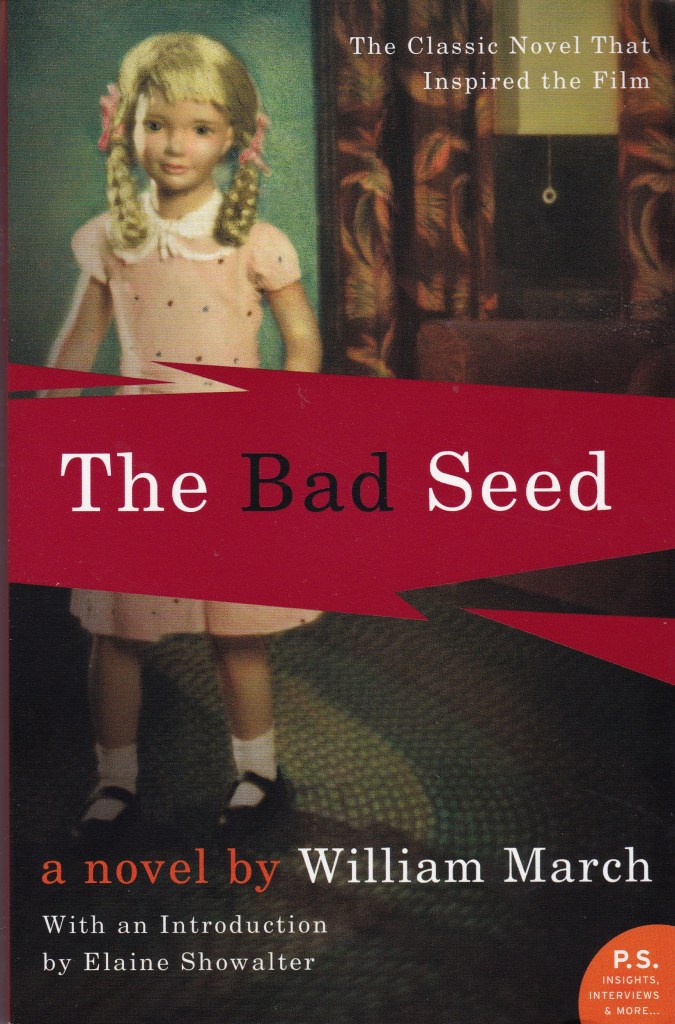
It was watching those afternoon movies where I first encountered The Bad Seed.

Later that summer, when Mrs Penmark looked back and remembered, when she was caught up in despair so deep that she knew there was no way out, no solution whatever for the circumstances that encompassed her, it seemed to her that June seventh, the day of the Fern Grammar School picnic, was the day of her last happiness, for never since then had she known contentment or felt peace.

The picnic was an annual, traditional affair held on the beach, an among the oaks, of Benedict, the old Fern summer place at Pelican Bay. It was here that the impeccable Fern sisters had been born and had lived through their languid, eventless summers. They had refused to sell the old place, and had kept it up faithfully as a gesture of love even when necessity made them turn their town house into a school for the children of their friends. The picnic was always held on the first Saturday of June since the eldest of the three sisters, Miss Octavia, was convinced, despite the occasions on which it had rained that particular day, and the picnic had to be held inside, after all, that the first Saturday of June was invariably a fine one.

If The Bad Seed has lost its ability to shock and horrify, it’s because in the decades since it was published (and adapted into both a play and film) the notion of a child being a killer has gone from being shocking to the general public to one that is kind of accepted; children do kill, and despite all the societal push towards sentimentality toward children. Rhoda is a sociopath, if not a psychopath; her inability to feel remorse or empathy or any other kind of human emotion is chilling to read about–she’s a stone cold killer, and clearly, she thinks nothing of killing to get something she wants: whether it’s the penmanship medal from her school, or a nice trinket promised to her, and then to shut up the janitor who sees through her and threatens to expose her; there’s a progression there. First she kills on impulse to get something she wants, then she coldly and calculatedly kills to protect herself. Rhoda is maturing as a killer, which is very chilling for the reader. The book is told entirely from the point of view of Rhoda’s mother, Christine–who is very slowly coming to realize, time after time, that her child is a monster, despite the innocence of childhood and everything we are taught to think, sentimentally, about children.

Psychology was starting to come into its own in the United States during the 1950’s, and you can see how crime writers took to psychology in that decade: The Bad Seed asks the question of nature v. nurture (although its answer is that it’s nature, genetic, and cannot be helped–and there’s some truth to that. I’m not entirely sure that sociopathy or psychopathy is learned behavior; are these cold-blooded killers born that way or are they creations of their environment? The solution Mrs. Penmark comes up with and executes in the novel is dramatically different from the film–the film had to abide by the Production Code, whereas novels had no such restrictions on them–and I believe the book’s ending actually works better than the film’s.

One thing that the book does brilliantly is depict the emotional turmoil and distress of the mother, slowly beginning to suspect and find proof that her child, that she loves so dearly, is actually a monster.

I first read this book when I was a teenager; I’d already seen the movie when I discovered the book on the shelves at the library, and so I checked it out and read it. I enjoyed it tremendously at the time–and it also had me watching other teens and young children for signs of sociopathy for a few years–and so thought it might be worth a revisit. It was, most definitely; it’s a bit dated, and of course the notion of a killer child isn’t quite so shocking as it was back during the Eisenhower administration–we’ve seen too many real life examples of this, and of course the trope of the killer child has been used, over and over again, in crime fiction and in films, so it’s not the brace of cold water in the face that it once was (kind of like how Beast in View by Margaret Millar was groundbreaking in its time–its still a great read–but what Millar did in that novel has been copied and imitated so much that it’s almost a cliche; one has to read these books with those sort of things in mind). Agatha Christie also used the trope of the sociopathic child (although in a quick google search it turns out Christie’s sociopathic child killer predated The Bad Seed; honestly, Christie did everything first).

It was a very pleasant reread, and as always, it’s interesting to visit (or revisit) books that were considered shocking in their time, only to have them turn out to be fairly tame–I’m looking at you, both Peyton Place and Valley of the Dolls–as well as to see how far the crime fiction genre has progressed. (I still consider Peyton Place to have a place in crime fiction, even though most people don’t. And while the crimes in the book may not be the driving point of the story, those crimes do impact everyone in the town in some way….there’s another essay to be written, probably after I reread the book at some point. It’s been awhile since I’ve revisited both Peyton Place and Valley of the Dolls….perhaps that can be my Christmas present to myself.

One of the Crowd

And it’s now the fifth of July, and so far–at least for me–the second half of this annus horribilis is off to an okay start. Yesterday was oddly not humid or hot; there wasn’t much direct sunlight and even by noon I hadn’t been forced to turn on the portable Arctic Air coolers that have so far made life in the kitchen/office bearable; I remain, as ever, buried and behind in all of my work, which is to be expected, of course–par for it, actually. I am always behind and scrambling to catch up, and since my personality is this peculiar combination of Type A mixed in with almost chronic laziness, this will most likely always be my state of being.

The sun is out, however, this morning, and while it remains cool here in the Lost Apartment, there’s no telling how hot it perhaps might get in here later this afternoon. I accomplished very little yesterday, truth be told; I started working on “You Won’t See Me” and didn’t get very far, because it was wandering off into a different direction than where it was originally intended to go–it wasn’t until I quit writing in disgust and adjourned to my easy chair that I realized (or remembered)where I’d wanted to go with the story in the first place, so I made some notes and went back to reading Cottonmouths. Later we streamed a lot more of The Club, which has a rather lengthy first season–it’s been a while since I’ve seen a season of anything recent that runs for over twenty episodes–and an awful lot has happened. We’re finally into the mid-teens, and halfway finished with the show, which we are still enjoying. And Cottonmouths remains quite delightful.

I refuse to allow myself to give into despair this fair morning over what I wasn’t able to get accomplished over the last two days. This morning I feel, for want of better terms, not only vivacious but alive and rested. The clouds of exhaustion that have made my thinking not as clear have lifted, or so it seems at this very moment, and we shall see how this day turns out, won’t we? I hope to get quite a bit accomplished today–we have the clinic open the next two days–and I have been sleeping well lately. I’m actually feeling close to normal for the first time in months, and while mentioning it also has me concerned that I might be jinxing it in some way, it’s actually been quite lovely.

It is very difficult to not fall into the ease of despair with the news every day–hell, every day for the last few years, quite frankly. The pandemic is raging out of control and might not get better for a while; Florida, for example, has reported more new cases over the last eight days than Louisiana has had since it first arrived here (um, where are all those people claiming it was irresponsible for us to have Carnival NOW? Cavorting on the beaches in Florida?), and as the crisis seems to continue to deepen rather than get better, the return to normality everyone seems to want gets pushed further and further back because of selfishness, frankly. As I joked to Paul yesterday about not getting much writing done yesterday, “What’s the point of writing anything new when who knows if there will even be a publishing industry next year?”

I’ve not, to be honest, thought much about my writing career this year, or at least since March. It was lovely being nominated for a Lambda Award–it’s been years since the last time–but I also knew once I saw Michael Nava’s name on the short-list I didn’t have a prayer of winning. But the nominations are always nice. I have thought about writing more Scotty books–I did leave their personal story on a cliffhanger in Royal Street Reveillon, after all–but there are two manuscripts in the hopper I need to finish first, and I want to work on Chlorine next. I need to get this Secret Project finished and out of my hair in order to get back to the two manuscripts–I’ve solved the issues with Bury Me in Shadows over the course of the pandemic–and I’ve also solved the plot issues with the Kansas book while I’ve essentially been too distracted and too exhausted and too ill to actually do any actual writing. My goal for this week–and yes, the week, not today–is to get that proposal finished; get a couple more of these stories under control and/or closer to finished; and if I have a highly productive week, to take next weekend off again to rest and recharge while trying to make some progress in the TBR pile. I want to reread another Perry Mason novel–I have The Case of the Calendar Girl in a hardcover I found in a used bookstore sometime during my travels over the past few years, and watching the new HBO Perry Mason has made me want to reconnect with the original character again–and I also want to get back into reading through both the John D. MacDonald and Ross MacDonald and Margaret Millar canons; which will help me get into a place where I will be able to get Chlorine written sooner rather than later. I also have some Dorothy B. Hughes novels on hand I’ve not read as well…and of course, there’s the Diversity Project to get back to at some point, in addition to the Short Story Project. I have Sara Paretsky’s short story collection on its way, as well as the latest Lawrence Block anthology, which I think is called In the Darkling Halls of Ivy (I could be wrong but it’s something like that), and of course, I still have his previous anthology on my side table, untouched.

So much to read, so much to watch, so little free time in which to do it all–and that includes, I might add, so little time to write everything I want to write before I die.

And on that note, I am going to head back into the spice mines. Have a lovely Sunday, Constant Reader–I certainly hope that I do.

Pandemonium

And yesterday morning I awoke to the delightful news that I sold another one of the three stories I sent out on submission on Monday; how splendid! So, “Night Follows Night” will be out in an anthology next year; I will of course keep you all posted on further developments.

So, that was a great twenty-four hours for my always desperately needy authorial ego, was it not? That, along with the excellent reception my reading for Timothy got last Friday night, was a lovely balm for me and my ever-tortured soul. This is what I mean when I talk about the bipolarity of writing; so much of the time it’s just you and the computer screen, the accusatory blank Word document open before you (or one with some words, not good, grouped together on it already) as you grimly search your mind for something intelligent, or at least semi-coherent, to start typing. And even when you manage to get something typed up and saved and rewrite and revise and polish…there’s still no guarantee you’ll eventually sell the story, and even when you do–no guarantee anyone reading it will like it, it will be included in reviews in a positive way, or there will ever be any feedback (and sometimes, awful as it is, I appreciate the negative because it means someone noticed, which is really, when you examine it more deeply, kind of sad.

“Night Follows Night” was actually inspired by my watching some documentary–I’m not sure what it was called–about a young man who had escaped from a religious cult his parents still belonged to; I think he and his brother had gotten away from it. It was horrifically sad, more than anything else–I want to say the cult was called the Children of God, but that wasn’t it, I don’t think–and all I could think about was how difficult it must have been to find the courage to run away from that and out into a cold, cruel world with just the clothes on your back and whatever money you were able to scrounge up. Around this same time I was reading one of Margaret Millar’s brilliant novels, How Like an Angel, which was also built around a religious cult, and I started thinking about it some more….the cult in the documentary also sexually abused its members, regardless of age or gender, and that also struck a chord in my head. When I started writing it I called it “This Thing of Darkness”–because, really, this backstory is incredibly dark, and carrying that around in your head would also be remarkably dark. But after the first draft or so, I chose to use that title for another story and changed this one’s title to “And The Walls Came Down.” While that kind of fit better, I still didn’t much care for it, and eventually came up with “Night Follows Night”–which I think truly fits; because for my poor main character, he never really gets to enjoy the daylight; it’s always night in his head.

Wouldn’t that be a horrible way to live?

And maybe–just maybe–I’m better at this writing thing than I ever give myself credit for?

Yes, I know–I need to stop that crazy talk right now!

This week for some reason seems to have lasted forever already; Paul and I both commented on this very strange occurrence after watching some episodes of season two of Titans, which is much better than Season One–and I really liked Season One. The boy candy is certainly there, and the women characters are enjoyable; and the fight scenes have yet to start seeming “I’ve seen this before”, which eventually killed Arrow for us; much as we loved the earlier seasons. I’m so delighted to see one of my favorite comic book super-hero teams done so well; there are too many members to do the Legion of Super-Heroes justice, so I’ll settle for Titans. I was also sorry to read that Krypton was cancelled after its second season; I have yet to watch it (I may get Paul to rewatch Season One with me), and am hoping it’s going to show up on DCUniverse or HBO MAX one of these days.

And there’s a delightful three day weekend looming. I am itching to get back to some of the short stories I have in progress, and I want to get the Secret Project completed. I actually have an extra day (HUZZAH!) so I can laze around for an entire day, gradually cleaning and so forth as I read Cottonmouths and perhaps do the floors (which are frankly disgusting) and I probably should clean the vacuum cleaner, and as always, so much to be done. But if I take that kind of a day on Friday, that means I have Saturday and Sunday to write (oh, and Hamilton is airing Friday night on something streaming–Disney Plus, perhaps?) and there’s absolutely no reason why I can’t get some great writing done.

Unless, of course, I undermine and defeat myself again as I am so prone to do.

Sometime during my first cup of coffee Entergy shut off our power–they were doing some work out there on the street for about thirty minutes–and this is, of course, one of the major flaws of the Keurig: what happens when the power goes off during your first cup? But it wasn’t as big a catastrophe as one might have thought; remember, I was cutting back on caffeine during the Great Dehydration Debacle of 2020, and I realized that I could survive a low caffeine morning–hell, there were mornings last week where I had zero caffeine, and there was no body count.

I also tried a new recipe Monday night–creamy pasta with shrimp and mushrooms (basically, it’s an Alfredo sauce, and who knew it was that fucking easy to make homemade Alfredo sauce?)–and it was actually quite delicious, despite the fact I forgot one of the ingredients. I added more cheese to the sauce then the recipe called for (because OF COURSE), and I will certainly make this again; and will eventually begin fiddling with the recipe to see if I can make it even better.

And on that note, tis time to return to the mines of spice. Have a lovely Wednesday, Constant Reader.

Mama He’s Crazy

Believe it or not, back before the Internet and social media, it was possible for a book to go viral; to become so popular and so talked about it would sell a gazillion copies and establish the author–usually–as a long-time bestseller. To this day, I don’t know how I became aware of the viral books of the 1970’s (titles like Coma by Robin Cook; Jonathon Livingston Seagull by Richard Back; Jaws by Peter Benchley; The Other by Thomas Tryon; The Exorcist by William Peter Blatty; and The Godfather by Mario Puzo, among others), yet I did become very aware of them, and read most of them (true confession: I never read Jonathon Livingston Seagull, despite being a number one fiction bestseller for two consecutive years).

Mary Higgins Clark’s Where Are The Children? was a viral sensation when it was first published in 1975; I read it in paperback, and distinctly remember plucking it off the wire rack in the Emporia Safeway. I started reading it in the car as my mom drove us back home to Americus–the little town seven miles or so northwest of Emporia, where we lived; population less than a thousand, and the only time I’ve ever lived in such a small town–and couldn’t stop reading. I helped her bring the groceries in, went to my bedroom, and piled the pillows up and went back to reading.

where are the children

He could feel the chill coming through the cracks around the windowpanes. Clumsily he got up and lumbered over to the window. Reaching for one of the thick towels he kept handy, he stuffed it around the rotting frame.

The incoming draft made a soft, hissing sound in the towel, a sound that vaguely pleased him. He looked out at the mist-filled sky and studied the whitecaps churning in the water. From this side of the house it was often possible to see Provincetown, on the opposite side of Cape Cod Bay.

He hated the Cape. He hated the bleakness of it on a November day like this; the stark grayness of the water; the stolid people who didn’t say much but studied you with their eyes. He had hated it the one summer he’d been here–waves of tourists sprawling on the beaches; climbing up the steep embankment to this house; gawking in the downstairs windows, cupping their hands over their eyes to peer inside.

He hated the large FOR SALE sign that Ray Eldredge has posted on the front and back of the big house and the fact that now Ray and the woman who worked for him had begun bringing people in to see the house. Last month it has been only a matter of luck that he’d come along as they’d started through; only lyck that hed gotten to the top floor before they had and been able to put away the telescope.

Time was running out. Somebody would buy this house and he wouldn’t be able to rent it again. That was why he’d sent the article to the paper. He wanted to still be here to enjoy seeing her exposed for what she was in front of these people…now, when she must have started to feel safe.

I bought another copy of Where Are The Children? in 2014; my original copy lost years ago to one of many moves, intending to go back and rereading it at some point. The importance of Mary Higgins Clark, not just to women crime writers but to the genre in general, cannot ever be overstated. Clark was the bridge between the domestic suspense masters of the past–Margaret Millar, Charlotte Armstrong, Dorothy B. Hughes, among many others–and the next generation of women crime writers that dawned in the 1980’s, as well as to the modern domestic suspense writers–women like Alison Gaylin, Lori Rader-Day,  Catriona McPherson, and Wendy Corsi Staub, among many others–and her example–of grace, generosity, kindness, and assistance–is one other writers should emulate.

We could all use more Mary Higgins Clarks in the world.

Anyway, because of this importance, I thought I should reread her first as an homage to her importance; I’d recently met her, in passing, and was shocked when I ran into her again a year later that she remembered my name and the short conversation we’d had as I’d helped her onto the escalator at the Grand Hyatt in New York; I, of course, remembered every word and that glowing smile she’d given me. There was little doubt in my mind she wouldn’t remember me; how many thousands of people had passed briefly through her life? But she was sharp as a tack, and remembered me. “Greg! I was hoping you’d be here if I needed help with the escalator again,” she said, holding our her hand to me with that thousand-watt smile of hers. Then she winked, “I’ll be looking for you later. How did that book you were writing turn out?” When I told her I’d worked out the problem (yes, as I helped her onto the escalator and chatted briefly, I somehow managed to tell her that one of the many reasons I admired her was her dedication to working hard, and asked if she ever got stuck–because I was stuck on my WIP. She laughed and said, “Work through it. That’s the only way.” She was right.) and the book was coming out that very month, she replied, “I look forward to reading it.”

I seriously doubt that she did, frankly–but it was an incredibly kind and generous thing to say to someone many many rungs on the ladder beneath her, if we can even be said to be on the same ladder.

Her recent death obviously saddened many, me amongst them. So I decided to memorialize her by rereading her first and most famous bestseller, Where Are The Children? 

And really, it was past time, wasn’t it?

Upon finishing my reread, I would say that Clark was most like Charlotte Armstrong, of the women who came before her; she wrote about, like Armstrong, normal every day women who were simply minding their own business when something evil came across their path, and they had to dig deep inside and discover their own strength to overcome it.

In Where Are The Children?, Clark came up with a devilishly clever plot about one of the worst things that could ever happen to a woman: the loss of her children. Nancy Harmon, now Nancy Eldredge, married one of her college professors and had two children by him, only to have them snatched away and murdered. Their bodies were found washed ashore, their heads taped inside plastic bags; dead before they went into the water. Nancy was tried for their murders, convicted–and then released on appeal due to a technicality. The disappearance of the prime witness against her made retrying her impractical; so she changed her hair and disappeared from San Francisco to Cape Cod, where she found and married a realtor and had two more children–where no one knows who she is. (This would, of course, be impossible–or incredibly difficult–today; with the Internet and 24 hour news, everyone in the country would recognize her, different hair color or no.) Nancy is still haunted by her past, most of which she has buried in her subconscious–but little does she realize her idyllic new life is about to upended: on the same day the local paper runs an article exposing her past, her two children, Michael and Missy, disappear yet again; and of course, it looks like she has killed yet another set of her children.

But what Clark does is let the reader know immediately that Nancy is not only innocent of killing this set of children, but the first set as well. The book opens, as seen above, with a chapter in the point of view of the villain of the story; she does this consistently throughout the book–we see the events from other points of views, other than just Nancy’s and the villain’s, which also helps the suspense build and keeps the reader turning the page.

Also, it should be noted that the entire timeline of the book is less than one day, and probably not even ten hours; the children disappear around ten in the morning and the climax of the book happens after nightfall. Also, the book takes place during a particularly nasty thunderstorm, which includes hail.

Another excellent way she builds suspense is bringing in minor characters on the periphery of the story, puts a scene in their point of view, and of course it turns out that each one of these minor characters holds another, crucial piece of the puzzle.

Where Are The Children? is a subversive novel in many ways, and it’s easy to see how it became a phenomenon, and why Clark won the hearts of millions of readers. She plays with the tropes of what it means to be a mother; how quickly we blame mothers for anything that happens to their children or how they behave; and how quickly the admiration for motherhood can turn to contempt and scorn–and how easy that turn is made.

It can also be seen as a sequel, of sorts, to those Gothic novels where a child is endangered and the heroine has to act to save the child; this was a well Phyllis A. Whitney and Victoria Holt drew from, many many times. Instead of trying to save the child, in this case this is the aftermath of what happened should the mother (or young governess, whomever the heroine was) not have succeeded the first time in saving the children–but has a chance at redemption by finding and saving the second set of children.

It reminded me somewhat of Charlotte Armstrong’s Mischief, which is also long overdue for a revisit.

And now, back to the spice mines.

Red

I was tagged awhile back in one of those post seven covers of books you love with no explanation things on Facebook, so I obliged, and even tweeted the covers.

I love nothing more than sharing information or titles or covers of books I love; the problem is, as always, narrowing the list down to just seven. I’ve read (and loved) thousands of books over the course of my life (I kind of wish I’d actually kept track or logged them somehow, because the completist in me wants to know the actual number), and for this round I decided to go with suspense novels written by women that I read when I was in high school or younger; women authors who might not be as well remembered as they perhaps should be (although, in fairness, Sarah Weinman and Jeffrey Marks have both done an excellent job of preserving some of these women writers; I went with the ones considered domestic suspense first, then switched and finished with romantic suspense).

The books I chose are: Mischief by Charlotte Armstrong; The Expendable Man by Dorothy B. Hughes; The Fiend by Margaret Millar; The Ivy Tree by Mary Stewart; The Secret Woman by Victoria Holt; Listen for the Whisperer by Phyllis A. Whitney; and An Afternoon Walk by Dorothy Eden.

Holt, Eden, and Whitney are generally forgotten today when female crime writers of the past are discussed; only recently have the names of the amazing triad of  Millar, Armstrong, and Hughes gone through a sort of renaissance. (Stewart isn’t as forgotten as Holt, Eden and Whitney; nor is she enjoying the same sort of renaissance as Millar, Armstrong and Hughes. More’s the pity in all four cases, frankly; the books might seem dated today, but they are excellent time capsules for the era in which they were written, and all seven women deserve better.) All seven women were fantastic writers, and the books I recommended are simply a starting place. Case in point: Victoria Holt’s The Secret Woman was the first of hers I’d read, so it always holds place of honor for me; but if pressed to name a favorite I would go with On the Night of the Seventh Moon, simply because it’s plot was almost completely insane–and she pulled it off. As I have said in previous entries, I also revisited Kirkland Revels lately, one of the few earlier works of hers I’ve not read multiple times–and frankly, it was kind of a revelation in how well it’s done.

I’ve also been revisiting Armstrong lately–well, over the last five or six years or so; undoubtedly since Sarah Weinman reminded me of her existence, and her importance to my developing crime fan mind as a kid–and I’ve focused primarily on reading the works of hers I hadn’t already read. Her Edgar-winning A Dram of Poison is actually one of the more charming suspense novels I’ve ever read; it was dark, of course, but had such a warm, optimistic heart that you couldn’t help but smile as a ragtag group of people tried to track down a lost olive oil bottle filled with poison.

I do want to reread Millar’s The Fiend (it’s my personal favorite of her novels) and Eden’s An Afternoon Walk (another favorite, but it’s been at least thirty years or so since I read it, if not more)–which is a very underrated and unjustly forgotten tale of domestic suspense that rivals the masters of the form.

And on that note, back to the spice mines.

Happy-31st-Birthday-Kevin-Peake-150429-05

Carrie

Saturday morning and yet another, amazing night’s sleep. I didn’t get up until ten this morning! That’s like two days in a row, and I could have easily stayed in bed had I not realized that I will eventually have to start getting up early again and going to work next week. Tomorrow I’m going to set my alarm and get up around eight or nine, just to get back into the habit.

I’ve also reached the point where I am no longer sad not to be at Bouchercon this weekend anymore. I think I just finally got numb, stopped feeling sorry for myself, and started being happy for my friends and glad they’re having a great time over there. After all, there’s no point in being sad, really–it doesn’t make anything better, does it?–and there’s really no sense in being sad or upset over things you have no control over. Those are the things you just have to accept.

You don’t have to like them, though.

Last night we binged the rest of the available episodes of Castle Rock, and Lizzy Kaplan is just killing it as Annie Wilkes. She should at least get an Emmy nod for the performance; I won’t go out on a limb and say she should win since there are so many incredible television shows and performances out there now, between all the streaming services and so forth. This truly is an extraordinary time for television shows. I love that the writers have dragged Jerusalem’s Lot and the Marsten House into this season; there’s something strange going on in the basement of the Marsten House but we aren’t really sure what it is yet…this season is making me want to revisit Stephen King’s work, which is precisely what I don’t need to do; my TBR pile is massive enough as it is without going back and rereading some of my favorite Stephen Kings. Over the last year or so I’ve reread Pet Sematary, The Shining, and ‘salem’s Lot as it is; I’d love to reread Firestarter before reading The Institute–which I think is going to be my Thanksgiving week treat.

I think my next read–after a careful examination of my bookshelves, is going to be Richard Stark’s The Hunter. Stark of course is one of Donald Westlake’s pseudonyms, and my education in Westlake (and Lawrence Block, while we’re at it) is sadly lacking. I also never read the Ed McBain novels (but I did read Evan Hunter when I was in my twenties). As I said, my education is classic crime writers of the 20th century has been sadly neglected; and I’d also like to read Ross Macdonald’s stand alones, and I’d love to immerse myself in a reread of the John D. Macdonald’s Travis McGee novels (and finish reading through his stand alones as well). I also need to finish the canons of Margaret Millar and Charlotte Armstrong and Dorothy B. Hughes.

And of course, there are all those wonderful writers of color I need to read. And queer crime writers. And…

Heavy sigh.

I did manage to finish reading  Certain Dark Things by Silvia Moreno-Garcia yesterday, and I enjoyed it tremendously. It was a very different approach to a vampire novel, and while I don’t know that I would necessarily classify it as a horror novel–not all vampire novels are horror novels–it really is quite good. It’s more suspenseful and, much as I hate to say it, it’s almost closer to a crime/suspense novel with paranormal elements than it is a horror novel. I do highly recommend it–I’ll write an entry about it at some point this weekend, perhaps even later today–and it’s precisely the kind of novel that is needed to reinvigorate the horror genre. I’ve been saying for quite some time that it’s the so-called minority writers (writers of color, queer writers) who are currently injecting new blood into, and revitalizing the crime genre–I would say that’s also the case with horror. The problem with genre fiction is that it tends to stagnate periodically and become repetitive and somewhat stale, until something comes along, shakes it up, and turns it upside down. The rise of the hardboiled female private eye novel in the 1980’s was the kick in the pants crime needed to breathe new life into a genre that was getting a bit stale; I think it’s the marginalized writers who are doing it now.

Look at me, generalizing about horror–a genre I am hardly expert in. As I always say, I’m just a fan with horror.

But I am hardly an expert in crime fiction, either. There are positively libraries of things I don’t know about crime fiction.

And on that note, I am heading back into the spice mines. Have a lovely day. Constant Reader.

11855786_931958863531801_5199844293871316406_n

Reelin’ in the Years

Sunday morning, and times keeps on slippin’, slippin’, into the future.

I slept in this morning–this life of “sorta leisure” is one that I could easily adapt to–and now sit, inside my condensation-covered windows, sipping my morning coffee and reflecting on what the day ahead has in store for me. I finished both interviews yesterday–despite the best attempts of my computer to thwart me, with freezing programs and even an operating system that locked up at one point, requiring me to force-restart the thing–but this morning, it appears to have updated its operating system overnight and is running quite smoothly this morning. I am not, of course, taking this as a sign that this latest update may have removed the bugs from the operating system–this has been a consistent problem since the Mojave update back in December, which created the Great Data Disaster of 2018, from which I still seem to not be completely recovered from–because it’s still early in the day and there’s plenty of time for this thing to malfunction all over the place yet. It did make doing the second interview difficult, but I finally managed to get it saved and emailed off yesterday. I have to do that group thing yet today–I was going to do it  yesterday but after all the functionality problems I was facing, thought it probably best to not try to do the round table and push it off until today. I also need to work on some fiction writing today as well, and of course, I have a toothache again, one of the few molars I have left, and it’s making chewing a bit of a challenge.

Yay, vacation.

I also want to start reading Laura Lippman’s Lady in the Lake today; alas, while I was watching things on the television yesterday I got sucked into City of Nets–and there’s nothing more distracting for me than Hollywood history. I read about half the book yesterday–sometimes making notes, other times just getting enthralled in the story–and around nine last night I thought, oh, I should be reading Laura’s book but instead couldn’t stop reading about Hollywood corruption and morality. I’ve always been interested in Hollywood history but have never really thought about writing it–I’ve always been reluctant to write much of anything not set in the present day–but I’m slowly coming around to writing recent history. As I said in one of my interviews, I am working on something set in 1994–“Never Kiss a Stranger”–and immersing myself in that period whenever I can, and originally went there for my story “A Whisper from the Graveyard.” As a result I am finding myself vastly interested in writing about the recent past–so much has changed in so quickly a time that it’s really amazing; the 1950’s, for example, might as well have been 1776. (Which, of course, reminds me that my story “The Weight of a Feather” is set in the early 1950’s/late 1940’s; not specifically in any year, but it’s definitely that post-war time.)

But I hope to get my round-table participation finished this morning, and then I am going to work on “Moist Money” for a little while, and then perhaps start Chapter 23 of Bury Me in Shadows. I’d like to get the first draft finished before September 1; and I’d also like to get to work on some other things that are just hanging around. I’ve already been much more productive than I’ve been on any of my previous long weekend vacations, which is a lovely sign, and I absolutely must get moving.

The end of the year will be upon us before we even know it.

I mean, LSU’s first football game is merely a couple of weeks away; and the Saints are already going through their preseason games. Football season is nigh; and shortly behind it will come the cooler weather. This summer hasn’t been that bad–despite the series of heat-advisory days we’ve been dealing with this month–and the river is finally no longer in flood stage, which is lovely and a bit of a relief; when the river is in flood stage there’s always this sense of impending doom hanging over our heads.  I would like it to get cooler, because I do want to spend some time exploring the Quarter–it’s been a hot minute–just to see what down there is different and what has changed; I used to work a block away, for example, from where Scotty lived and I could walk down there and check out his home and the rest of his block from time to time. It’s going to be awhile before I start writing another Scotty novel, and one of the things I do want to address/tackle in the new Scotty is the gentrification/short term rental issue; which will also require bringing back one of the characters from Royal Street Reveillon. (I do this often; bring characters back from previous books to impact the current one. Life kind of does that, too, so it only makes sense from a realistic standpoint to do this periodically.) But I’ll probably write the Chanse before the next Scotty; once I get all these partial novel manuscripts out of the way and submitted I am going to focus on writing Chlorine, then the Chanse, and then the Scotty. So, really, I need to be reading Hollywood history this fall, so I can be prepared to write Chlorine. 

As I love Hollywood history, this is not going to be a horrific chore. I also think I can justify reading James Ellroy’s L. A. Confidential as well for research.

It will also give me an excuse to reread In a Lonely Place by Dorothy B. Hughes, which will always be a pleasure to read. (I also have some other Hughes novels on hand, and the entire canon of Margaret Millar, which I would also like to  finish working my way through)

And on that note, I should probably get back to the spice mines. If I work on the round table for a bit, I can justify spending some time with the new Lippman novel.

Have a lovely Sunday, Constant Reader.

6-copy-1024x683