Take a Chance On Me

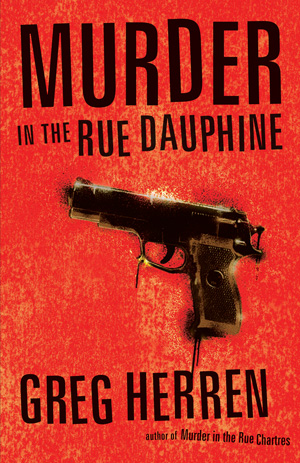
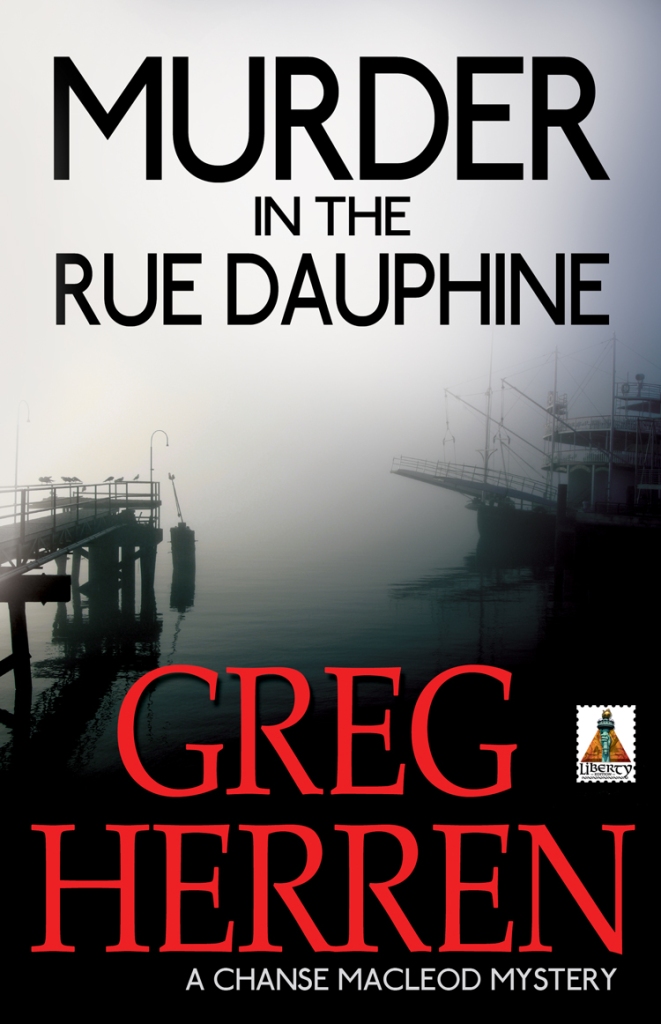
Ah, Murder in the Rue Dauphine.

It’s always weird for me to talk about my writing and my books and so forth on here; I always worry that I am either contradicting and/or repeating myself. When you’re as self-obsessed as I am, that can be a problem; talking about myself is probably my favorite thing to do–on here, at least. And I feel like I’ve told the story of where Chanse came from and how the series developed from the very beginning many, many times.

It was when I was living in Houston that I rediscovered crime fiction, and the old love was even deeper once it was rediscovered. This was the period when I read most of the Perry Mason novels, discovered Paretsky and Grafton and Muller, and decided to give Travis McGee and John D. MacDonald another try. (I had read The Dreadful Lemon Sky when I was a teenager, but I hadn’t liked it; I was more into the classic detective mystery, with lots of suspects and a denouement with everyone gathered in a drawing room as the identity of the killer was unveiled–the McGee series was definitely not that. But MacDonald had written a superb introduction to Stephen King’s first short story collection, Night Shift, and I had always wanted to give him another chance–pun fully intended.) I devoured the McGee series this time around; and I really admired the character and how fully rounded and developed he was (I should give the series a reread; I’d be curious to see how they hold up now)…and armed with all these new private eye novels and Perry Mason puzzles, so I started coming up with my own version. Even the name was a shout out to McGee. My character was also tall with sandy/dirty blond hair, a former college football player, and he lived in Houston, with an office downtown and a secretary named Clara. The title of the first book was going to be The Body in the Bayou, and I started basing the case on the tragic Joan Robinson Hill case, immortalized in Tommy Thompson’s Blood and Money (the premise of the story was that the character representing Joan’s father hires Chanse after Joan’s death to find dirt on John–and then John is murdered; fictionalized, of course.) I wrote about six or seven really bad chapters long hand before giving up. I didn’t know how to write a novel then nor did I understand the concept of rewrites and revisions and drafts. (My ignorance was truly astounding.) The hurdle I couldn’t clear was typing. I was a terrible typist. I’d had a job in California working for an insurance brokerage that was computerized, and had a word processing program that I used to write short stories on; it made such an incredible difference that I knew I would have a much better shot at actually making my dreams come true if I only had a word processor…

In 1991, after I moved to Tampa, I managed to get a word processor, and that was what I wrote my first two and a half young adult novels on–the original drafts of Sara, Sorceress, and Sleeping Angel–and used it happily for several years until it finally died on me. But by then, I was living with Paul and had swung back around to wanting to write adult crime fiction again, and I wanted to write the Chanse character that I’d already created…so I picked back up on The Body in the Bayou, moved it from Houston to New Orleans, got rid of the office and the secretary, and made Chanse gay. I kept the title, but threw away the story; I wanted it to be a gay story, too. I don’t really remember the plot, but it had to do with the murder of a beautiful boy-toy for a wealthy closeted gay man in New Orleans…and Chanse knew the boy-toy from his days working as an escort before he landed the rich man, I wrote about six or seven chapters of this before we moved to New Orleans….and I realized I’d have to throw it all out again because it was all wrong; I’d made the classic mistake so many writers make when writing about New Orleans: writing about it having never lived here, I only had tourist experiences–which are vastly and dramatically different from the actually “living here” experiences. So, once again, I threw it all out and started over, this time calling it Tricks instead of The Body in the Bayou.

The title morphed again to the less saleable Faggots Die after the first draft; and I remember talking to Felice Picano–he was coming into town for the Tennessee Williams Festival, and I picked him up at the airport. As we drove back into the city from Kenner, we talked about my book and the series, and he nixed the new title as well as the old one. “No one, ” he wisely said, “will pick up a book called Faggots Die, and Tricks sounds like a pornographic memoir of your sex life.” Felice was actually the one who suggested I mimic titles for the series from a classic writer…and we were throwing titles around in the car when I said, “You know, the streets in the Quarter are technically rues–Rue Bourbon, Rue Royale, Rue Dumaine–and the murder happens on Dauphine. Maybe Murder in the Rue Dauphine?”

“That’s perfect,” Felice said, and then we played with Poe titles the rest of the way into the city–incidentally, one of them was The Purloined Rentboy, which became my short story “The Affair of the Purloined Rentboy”, so never throw anything away.

And thus was Murder in the Rue Dauphine titled; and the plan for the series titles was also devised–the branding was changed by the publisher, but I can honestly say my first book was titled by Felice Picano.

Never come to New Orleans in the summer. It’s hot. It’s humid. It’s sticky. It’s damp. It’s hot. Air conditioners blow on high. Ceiling fans rotate. Nothing helps. The air is thick as syrup. Sweat becomes a given. No antiperspirant works. Aerosols, sticks, powders, and creams all fail. The thick air just hangs there, brooding. The sun shows no mercy. The vegetation grows out of control. Everything’s wet. The build­ings perspire. Even a simple task becomes a chore. Taking the garbage out becomes an ordeal. The heat makes the garbage rot faster. The city starts to smell sour. The locals try to mask the smell of sweat with more perfume. Hair spray sales go up. Women turn their hair into lacquered helmets that start to sag after an hour or so.

Even the flies get lazy.

My sinuses were giving me fits as I left the airport and headed into the city. It was only 7 o’clock in the morning but already hotter than hell. The air was thick. I reached for the box of tissue under my seat and blew my nose. The pressure in my ears popped. Blessed relief.

As I drove alongside the runways I could see a Transco Airlines 737 taxiing into takeoff position. I saluted as I drove past, thinking it might be the flight that my current lover was working. Paul looked good in the uniform. It takes a great body to look sexy in polyester. He does.

He’d be gone for four days on this trip. I was at loose ends. I’d wrapped up a security job for Crown Enterprises the previous Wednesday. The big check that I’d banked guaranteed I wouldn’t have to worry about money for a while. I like when money’s not a concern.

And so began a series that lasted for seven titles and about twelve years or so; I don’t remember what year the last book in the series was published. I never expected anyone would publish it; it was intended to be a “practice novel” so I would get used to rejections and learn. It was also the first manuscript I ever wrote that went through multiple drafts before I thought it was finished enough to send out on query. It was supposed to be an exercise in learning humility and getting experience with the business while I wrote the book I did expect to get an agent with and sell–which was what I’d always called “the Kansas book” for over a decade at this point. (It eventually morphed into #shedeservedit.) But you never really learn what you’re supposed to when you’re stubborn, thin-skinned, and used to being demeaned and talked over and not taken seriously, for any number of reasons. I sent the manuscript to three agents: two sent me lovely but form rejections, which was disappointed but not surprising. I took this well, put the manuscripts away to send to three more once the final rejection came.

It came on a Friday, if I recall correctly. I went to pick-up the mail and my manuscript was there. Not a surprise, of course, but still a little disappointing. I went out to my car and opened the package…and paper-clipped to the title page of the rubber-band bound manuscript was a torn piece of used paper, with a note in ink reading I find this manuscriptand characters neither interesting or compelling with the agent’s initials at the bottom.

It was like being slapped in the face.

By the time I got home I was in a raging fury. I was literally shaking with rage when I came inside. How fucking unprofessional, I thought as I sat down at my computer to check my emails, trying to decide how I would enact my vengeance on this rude piece of shit.1 There was an email there from the editor I was working with on an anthology which had taken my first-ever fiction short story and thus would be my first publication. I had never read the signature line–mainly because I was so excited for my first fiction sale (NARRATOR VOICE: it was porn). This day, he concluded his email with Please send us more work. We definitely want to see more from you and as my ego preened, slightly soothed from the insulting agent note from earlier in the day2, I also looked down at the signature line and realized I was communicating with the senior editor at Alyson Books! I immediately wrote him back a very short note: I’ve written a novel with a gay private eye set in New Orleans, would you be interested in that? and before I could talk myself out of it, hit send.

He wrote back immediately and said please send it to me ASAP!

I put the same manuscript back in a new envelope, and drove back to the postal service to get it in the mail before I changed my mind, and breathed a sigh of relief once I got back to the car–and immediately forgot all about it.

Six weeks later I came home to a phone message from the editor. I called him back, he made me an offer, and my career leapt forward much faster than I expected…and it started a roll of good luck and “being in the right place at the right time” that has kept me publishing almost non-stop since Murder in the Rue Dauphine was released in 2002.

It sold really well, got mostly favorable reviews, and scored me my first Lambda Literary Award nomination.

Not bad for a manuscript and characters who were neither interesting or compelling, right?3

It also took me a long time to realize–or rationalize–that the note wasn’t meant for me. (I was most offended that I wasn’t even worthy of an actual form rejection letter; that was the truly insulting part for me.) I realized when telling this story on a panel somewhere, that the note was probably meant for an intern or a secretary or an assistant, who just shoved the whole thing in an envelope to do the rejection and through some wild Lucy-and-Ethel office shenanigans, it went out without the rejection letter and with the note intended for internal eyes only…and made me wonder, how different would my career and life be had that fuck-up not happened?

We’ll never know, I guess.

  1. Not really proud of this reaction, but I did get the last laugh. ↩︎
  2. Said agent died a few years later. I may have smiled and said good, a la Bette Davis vis a vis Joan Crawford’s death. ↩︎
  3. I may be more forgiving about a lot of things these days, but I will always be petty about that hateful agent. ↩︎

Near You

Several weekends ago, I did an on-line panel for Outwrite DC. The moderator was John Copenhaver (whom you should already be reading), and my co-panelists were the always delightful and intelligent Kelly J. Ford, Margot Douaihy, Renee James, and Robyn Gigl. The video is actually up on Youtube, if you would like to watch it. John’s questions were insightful and intelligent (as always), and the conversation was marvelous, inspiring, and fun; there’s nothing I love more than communing with other queer crime writers (or any writers, to be certain), and I always try very hard to not monopolize panels because I do have a tendency to talk too much–especially if and when I get going on a topic I am passionate about. So, I thought it might be fun to take John’s questions and turn them into a long form interview, for thoroughly selfish and totally self-promotional reasons.

The panel blurb claims that “queer characters are riveting and necessary material for crime fiction and how those stories can shape (and perhaps reshape) the landscape of contemporary crime fiction.” Do you agree with this statement—and why do the stories of queer characters have the potential to shape crime fiction?

I completely agree with this statement. Queer crime fiction has a very proud history that was never really recognized or appreciated by the mainstream crime writers, readers, organizations, and conferences. That is changing for the better.

New blood is always necessary for any genre–horror, romance, crime, literary fiction–because genres tend to stagnate after a certain period of time. The cultural shifts of the late 1960’s and 1970’s echoed in crime fiction, for example; you couldn’t write crime in those periods without addressing all the cultural and social shifts; Ross Macdonald’s later novels are a good example of this. The 1970’s saw a lot of anti-hero books being written. The private eye sub-genre had grown quite stale by this time, which was when the women really moved in and gave it a shot of adrenaline–Marcia Muller, Sara Paretsky, and Sue Grafton blazed that trail, and revitalized a sub-genre that had kind of lost its way. Queer writers and crime writers of color are currently doing the same to the entire genre. Voices and perspectives we aren’t used to seeing are now getting into print and changing how we see, not only our genre, but each other. Crime fiction has always given voice to societal outsiders and outliers; queer people and people of color are the ultimate outsiders and outliers in this country. Who better to tell stories of societal alienation?

Why did you choose your sub-genre? How do you think the sub-genre has influenced the types of characters you write?

Well, I write in several different ones. Chanse MacLeod was a straight private-eye series; Scotty Bradley was more of an amateur sleuth/humorous series, but he does have a private eye license in Louisiana. A Streetcar Named Murder was a cozy, with an amateur sleuth heroine who gets caught up in a family mystery. I’ve also done young adult and “new adult,” whatever that is (it’s been described as ages 16-25), and Gothics with a touch of the supernatural. I tend to write things that I like to read, and I have a varied reading taste. I started writing the Chanse series because I wanted to do a harder-edged private eye series with a queer twist and set it in New Orleans. I didn’t know about J. M. Redmann’s Micky Knight series when I started writing Chanse; would I have done something different had I known she’d already covered the hardboiled lesbian private eye in New Orleans? We’ll never know, I suppose. Scotty was meant to be a lark; a funny caper novel and a one-off. And here we are nine books later…

As for Streetcar, I had been wanting to try a traditional mystery with a straight woman main character for a long time. When the opportunity presented itself, I jumped in with both feet. I like trying new things and pushing myself. Having to follow the “rules” of a traditional cozy was a challenge–especially because I have such a foul mouth in real life. I love noir so am working on two different gay ones at the moment.

Why do you think amateur detectives are appealing? Do you think there’s a reason queer characters often find themselves in the role of amateur detective?

I think it’s because we all think we’re smarter than the police? We enjoy seeing a character we can identify with figuring things out faster than the cops, especially without access to all the evidence, interviews, and forensics the cops do. Murder She Wrote has been off the air for about thirty years and yet the books based on the show continue coming out every year. If we start out in mysteries reading the juvenile series–Nancy Drew and the Hardy Boys and Judy Bolton and all the rest were amateurs, so we always cut our teeth in the genre with them to begin with. Scotty is basically an amateur, even though he has a private eye license he rarely uses; he and the boys never get hired (although they kind of do in the new one, coming this November.)

Let’s talk about place. Greg, your books take place in the South. Why is place important to the crime novel—why is it especially important to the queer crime novel?

Place shapes who we are–not just as queer people, but as people in general. There are similarities between growing up in a small town in the Midwest and growing up in one in the South, but the differences are very marked. I’ve lived all over the country–pretty much everywhere but New England or the Northwest–and always felt, as a Southerner (despite no accent and not growing up there) like an outsider. Couple that with being gay in a time when it was still considered a mental illness, and you have someone always on the outside looking in. But I have that Southern pull to write about the South–although many would say that writing about New Orleans and writing about the South are not the same; like me, New Orleans both is and isn’t of the South, and I feel that very strongly. I’ve written books set in California and Kansas, even one in upstate New York, but I very much consider myself a Southern writer.

Place is even more important in a queer crime novel because place shapes the queer people so much. As a writer, I think one of my strengths is setting and place, and I think that comes from being very much a fan of Gothics growing up. Gothics are known for place and mood, and I think those are two things I do well.

All of you write wonderfully flawed characters. Sometimes, as LGBTQ+ writers, we feel the burden of representation and the urge to write only positive LGBTQ+ characters as an attempt to undo history’s (the dominant culture’s) demonization of us. Unfortunately, that can be limiting—even flattening. Clearly, you’ve all struck a beautiful balance with your characters. Talk a bit about how you approached this issue.

The flaws, to me, are what make the characters seem real. Nancy Drew and the Hardy Boys always annoyed me because they were so perfect; no one is that perfect, and anyone that close to perfect in real life would be irritating and insufferable. I am am quite aware that I am flawed (one of my biggest flaws is believing I am self-aware because I most definitely am not), but I am not trying to be perfect; I just want to be the best version of myself that I can be. By showing queer people with all their facets and flaws and failures and blind spots, we’re showing the reader that we are human; despite what those who hate us say or claim, we are human beings just like everyone else, just trying to get through life and do the best that we can. The villain in my first book was a gay man–and the entire book was a commentary on how we, as queer people, tend to overlook flaws and red flags from members of our own community. Just because someone is queer doesn’t mean they are a good person–and queers with a criminal bent do exist, and often take advantage of that sense of camaraderie we feel with each other, especially when we don’t know the person well. I tend to trust a queer person more readily than I will a straight person, and that’s wrong–which is why I think we feel so much more hurt when queer people betray us.

Speaking of the demonization of LGBTQ+ folks … Ray Bradbury of Fahrenheit 451 fame said, “There is more than one way to burn a book. And the world is full of people running around with lit matches.” What do you think about the current tactics to ban queer books from schools, libraries, and even bookstores in places like Florida, Arkansas, and Texas? Why are they targeting queer books?

This is, I hope, the last gasp of the homophobes who’ve never updated their hate speech in over fifty years. What the hate group “Moms for Liberty” are doing and saying is no different than what Anita Bryant said and did in the 1970’s, what Maggie Gallagher and her evil co-horts at the National Organization for Marriage repeated, then came the One Million Moms…all too often it’s the cisgender straight white women who are the real foes of progressive politics who fight to uphold a bigoted status quo. They always claim they’re concerned moms worried about their children–but are perfectly fine with them being shot up at school; working in a meat factory on the night shift at thirteen (have fun in hell, Sarah Huckabee Sanders, when you get there and French-kiss your Lord and Master Lucifer); or shouldn’t have the right to vote…they know better than a child’s actual parents, you see, about what the child needs or wants. Maybe they should spend more time with their own children than worrying about everyone else’s? Phyllis Schlafly, queen skank of the conservative right, ignored her own family while she embarked on her crusade to strip women of their rights and autonomy–all the while shrieking like a hyena into any microphone nearby that she was fighting progress to save the American family while selling some Leave it to Beaver-like nonsense as reality. I always felt sorry for her gay son. Imagine that as your mother.

As for why, it’s about control and power. I actually respected Anita Bryant more, because she truly believed all the vile, horrible, unChristian things she said and espoused. Most of the others, including the unspeakably vile and disgusting Moms for Liberty, are working a grift for money, attention and power. Hilariously, they’ve sold their souls in the worst possible way in the guise of family, religion and God; if they’ve ever actually read their Bibles, they need to work on their reading comprehension skills as they are both apostates and blasphemers who will spend eternity doing the breast stroke in the lake of eternal fire. Hope they enjoy it.

Sorry your husbands and children don’t love you, but who can really blame them?

What are you working on next? What’s coming up?

I have a short story in an anthology called School of Hard Knox from Crippen and Landru (and somehow got a co-editor credit for the book with Donna Andrews and Art Taylor); Death Drop, the first in a new series from Golden Notebook press, drops in October; and the ninth Scotty comes out in November, Mississippi River Mischief. I am writing a gay noir, and may be writing second books for the new series I started with Crooked Lane last year as well as a sequel to Death Drop, and have a couple of short stories I want to finish to submit to anthologies I’d love to be in.

Girl, You Make My Day

One of the things I’ve greatly enjoyed over the last few years has been the sea change in how publishing views works by non-white and non-straight authors; the push for more diverse voices in the publishing community has already borne wonderful fruit. I’ve been saying for years that the world of crime fiction was in danger of getting stale again, much as it did in the late 1970’s and early 1980’s; particularly the private eye novel. The arrival of Sara Paretsky, Sue Grafton, and Marcia Muller on the scene shook things up and shook things out; the private eye novel got a much-needed shot in the arm of adrenaline with these three women and the others their work inspired; I strongly believe the move toward diversity is going to bear fruit in much the same manner–and it already has, frankly; the works of diverse writers like S. A. Cosby, Kellye Garrett, Rachel Howzell Hall, Alex Segura, Tracy Clark, Cheryl Head, and so many others have joined the great pioneers like Walter Mosley and the wonderful Barbara Neely to open up new perspectives on crime and crime fiction; our society and world; and again, this was desperately needed–and is necessary every so often, for our genre to refresh and expand and become more inclusive. We’re also seeing more queer books being sent out into the world from the big houses in New York, which is also incredibly exciting (another shout out to Yes Daddy By Jonathan Parks-Ramage and A Beautiful Crime by Christopher Bollen).

It’s a very exciting time to be a fan of crime fiction.

Noir has always been one of my favorite sub-genres of crime fiction, and I always enjoy reading modern takes on it. I want to write more noir, quite frankly; Chlorine would be the first of at least four I want to write, if not more (for now, I have ideas for four of them, with Chlorine being the most full formed). I always enjoy modern takes on noir–Laura Lippman’s Sunburn was quite marvelous, as was Christa Faust’s Money Shot and Choke Hold)–and of course, S. A. Cosby is a master of rural Southern noir; both Blacktop Wasteland and Razorblade Tears are destined to be considered classics, I think.

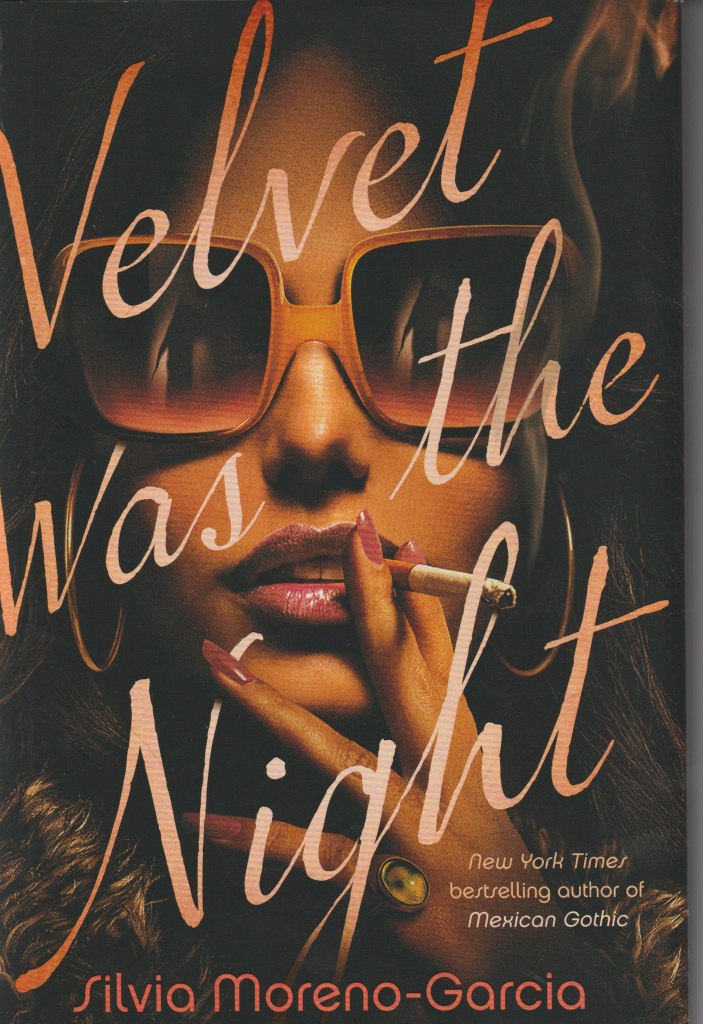
So, I was very curious to read Silvia Moreno-Garcia’s take on modern noir, Velvet Was the Night. It took me a very long time to finish–which is not indicative of the quality of the book, I hasten to add–because after I read so much during the post-Ida power outage, I kind of broke my brain and thus haven’t been able to really focus as much on reading as I would like; yesterday after the LSU game I sat down and finished it with Georgia-Kentucky on as background noise.

And what a fun ride it was.

He didn’t like beating people.

El Elvis realized this was ironic considering his line of work. Imagine that: a thug who wanted to hold his punches. Then again, life is full of such ironies. Consider Ritchie Valens, who was afraid of flying and died the first time he set foot on an airplane. Damn shame that, and the other dudes who died, Buddy Holly and “The Big Bopper” Richardson; they weren’t half bad either. Or there was that playwright Aeschylus. He was afraid of being killed inside his house, and then he steps outside and wham, an eagle tosses a tortoise at him, cracking his head open. Murdered, right there in the stupidest possible way.

Often life doesn’t make sense, and if Elvis had a motto it was that: life’s a mess. That’s probably why he loved music and factoids. They helped him construct a more organized world. When he wasn’t listening to his records, he was poring over the dictionary, trying to memorize a new word, or plowing through one of those almanacs full of stats.

No, sir. Elvis wasn’t like some of the perverts he worked with, who got excited smashing a dude’s kidneys. He would have been happy solving crosswords and sipping coffee like their boss, El Mago, and maybe one day he would be an accomplished man of that sort, but for now there was work to be done, and this time Elvis was actually eager to beat a few motherfuckers up.

He hadn’t developed a sudden taste for blood and cracking bones, no, but El Güero had been at him again.

The recent rise of Silvia Moreno-Garcia has been meteoric, although I am sure to her it has seemed anything but. I read her terrific vampire novel, Certain Dark Things, a while back, loved it, and have been following her career ever since as she has turned out novels at a terrific rate–Gods of Jade and Shadow, Untamed Shore, Mexican Gothic–all of which have been critically acclaimed and sold very well; I love that she bounces from genre to genre–horror to fantasy to crime; even bouncing around in the sub-categories of the crime genre. This is only my second read of her work–I have them all, of course–and had been meaning to get around to her take on noir with a Mexican flourish for quite some time. (I am really sorry I broke my brain with all the reading I did after the power went out; I greatly enjoyed this book, but it was so hard for me to focus for some reason…but am glad I sat down yesterday with the book, determined to finish it at last.)

One of the things that strikes me about Moreno-Garcia’s work is that I am seeing Mexico, a place I greatly love, through a fresh new perspective; like all Yanquis, I always view Mexico through the prism of a tourist. I’ve always wanted to write about Mexico, and have several short stories in the files that are set there (I did write one erotica story as Todd Gregory set in Acapulco; from the perspective of a tourist, of course: “Oh, What A Friend I Have in Jesus”)…but reading Moreno-Garcia makes me aware of how scant my knowledge of our Southern neighbor is–all of the counties south of the Rio Grande, frankly–which is a stinging indictment of our education system. (Don’t even get me started on the concept of Latin America vs. “America”) I know very little of Mexican history after the Spanish conquest, other than the Mexican War and the French empire set up under a Hapsburg by Napoleon III during our civil war. I know very little history of any of the countries that make up the rest of the American continents, really–and isn’t that more than a little bit disgraceful? I also know very little about their cultures, their politics, and what goes on there; a quick glance through the news also will show very little information or news being reported about those non-United States/Canada American countries, which is really a shame.

Velvet Was the Night is set un 1971, a particularly politically rife period in Mexico. The US was terribly concerned about communism being spread by the Soviets in what has always been considered the American soft underbelly–I mean, look at our reaction to Cuba–and there’s no question that CIA operatives and money were working to subvert Communism while supporting borderline Fascist governments because that was preferable to Washington than another potential Soviet satellite state in our hemisphere. The vast paranoia of that time–which really lasted from 1945-1990, really–cannot be underestimated or understated. By rooting her story in actual events of 1971–the crackdown of the Mexican government on dissidents–Moreno-Garcia slyly gives us a taste of how American foreign policy of the time affected everyone in Mexico, as well as a history lesson. (One of the great modern deceptions of our society is this idea that we always act benevolently as a nation; we’re doing this for your own good.) The book has two point of view characters; one, depicted in the opening above, is “Elvis”, a very young man who works as a thug, basically, for an oppressive group of anti-Communists that try to infiltrate dissident groups and haunt protests in order to make them turn violent, so the military can intervene on behalf of the “people.” Elvis grew up very poor and sometimes imagines what his life would be like if he were able to pursue his primary interests–educating himself and music. He doesn’t know what his future holds but is vaguely aware the path he is on–violence and more violence–will not end well. Over the course of the book he begins to question the values he’s been taught to believe in his gang, and begins to aspire to get out of it.

The other main character is Maite, a legal secretary barely getting by on her low salary and barely able to afford food. Her car has been in the shop unclaimed because she cannot afford the mechanics’ bill. She leads a lonely and solitary life, has a very vivid imagination and fantasy world she prefers to inhabit, colored strongly by her love of romance comic books and the music she likes to listen to. Maite’s lovely neighbor, Leonora, asks her to feed her cat while she is away, and when she agreed, Maite unknowingly enters the world of political struggle and upheaval. The riot depicted in the first chapter, that Elvis helps engineer? A friend of Leonora’s has taken pictures that prove that the riot was started by government forces, and those two rolls of film are the McGuffin everyone in the book is after–except poor innocent Maite, who, like any main character in a great Hitchcock film, becomes involved in something life threatening by simply agreeing to feed a neighbor’s cat–something she resents agreeing to do. When Leonora doesn’t come back, Maite starts looking for her–primarily motivated by the fact she can’t afford to keep feeding the car, and Leonora promised her money for feeding it–money she needs to get her car back. Motivated by her own poverty, Maite finds herself getting involved more and more in this clandestine world, and her own life is in danger soon.

The true strength of the book lies in the careful characterizations of both Elvis and Maite; two desperate people trapped by poverty in lives they want to escape, and the parallel journeys they both follow that lead their paths to cross; and the richness of the reality of what life in Mexico City was like during the turbulent time when the book is set. Moreno-Garcia shows us, as she did in Certain Dark Things, what the reality of life is like in one of the world’s largest cities, the reality the tourists rarely, if ever, get a chance to see. And while the hopelessness of both their situations seem unresolvable at times, the pacing is strong and the story construction so tight, and you the readers finds yourself rooting for them both to get out safely.

I really loved this book, and am sorry my inability to focus forced me to take so long to finish reading it. It’s extraordinary, and I recommend it highly.

Two To Make It Right

Thursday morning and I am slurping coffee and trying to get awake and ready for an exciting day of data entry and condom packing. I’ve not been terribly successful with my goal of cleaning out my inbox; I am going to try to work on that today after I finish working, after I go to the gym, and after I get today’s writing done.

I’ve identified a problem–a pattern, if you will–with my writing. I will get to a point in a short story where I am kind of stuck, and whereas what I do with a novel (write my way out of it) I won’t do that with the story, instead agonizing over it for a bit before consigning it to the oh well I’ll finish this later at some point folder. This is defeating, and why, ultimately, I have so many unfinished stories languishing around in my files. So, I am determined to solider on with the one I am currently working on, “The Sound of Snow Falling”, and try to get it finished. I am also determined to revise chapter one of Chlorine this weekend, and hopefully get into my next novella–either “Never Kiss a Stranger” or “A Holler Full of Kudzu”–and also get the Lost Apartment back under control at some point.

It’s amazing how little time it takes yet how easy it is for this place to look like a disaster area in need of FEMA assistance.

I also want to get back to reading–oh, how the books pile up!–and maybe it’s something I should do before I go to bed every night. I had tried for a brief while–after that less screen time before going to bed will help you sleep better thing circulated a few years ago–to read before bed every night; I have a non-fiction book on my nightstand that is now coated in dust that I would love to get back to reading–but it also wouldn’t hurt to do some fiction reading downstairs before I go up to bed, risking the getting caught up in the book and not wanting to put it down thing, which all too often happens to me with reading fiction. I am still greatly enjoying Robert Caro’s The Power Broker, by the way; Caro is an exceptional biographer. I also love how he weaves historical context into his biographies–I’ve only read the first volume of the Johnson biographies, and his description for how hard life was for poor rural women has never stopping haunting my mind–and always am blown away. I’ve never read the two biggest biographies of this century–Chernow’s Alexander Hamilton or McCullough’s John Adams, which I need to remedy–but then again my non-fiction reading (outside of necessary research for writing) has been woefully overshadowed this century by my fiction reading.

I also received copies of the MWA anthologies Deadly Anniversaries (edited by Marcia Muller and Bill Pronzini) and When a Stranger Comes to Town (edited by Michael Koryta), which reminded me of how much I’ve been languishing on the Short Story Project–while continuing to buy anthologies or single-author collections, which are also piling up around me. I also have a lot of short stories to read for my Bouchercon panel in August; I am on, of all things, a short story panel; which kind of caught me off-guard because I don’t consider myself a master of the form–or even half-way decent at it. But I have published quite a few of them, and my goal is to publish more (which means writing more of them) and I figure with the terrific panelists, maybe I can pick up a thing or two from some of them.

We started watching another Spanish language show last night, High Seas (Alta Mar in Spanish), which is a murder mystery set on a luxury liner sometime in the 1940’s, traveling from Spain to Rio de Janeiro. It’s gorgeously shot, the period costumes and decor are first rate, as is the acting. We’re on episode 4 now; there have already been two murders and some mysterious shenanigans, including a fire, and yes, we are completely sucked into it. (We’re taking The Underground Railroad slowly, because it’s not really something to be binged, since it raises so many philosophical and societal questions; you kind of need to absorb each episode. It’s really one of the most literate series I’ve ever watched, in part because the visuals are so incredible and poetic; I think it’s one that needs to be rewatched as well because it’s almost too cerebral–yet compelling–to absorb all at once for someone of such diminished intellectual capabilities as me–it’s also making me want to revisit the novel)

And on that note, I am heading into today’s spice mines. Have a lovely Thursday, Constant Reader, and I will check in with you later.

Temptation

A very cold Monday morning in New Orleans, and the sun has yet to peek its head out from under the blankets this morning. I slept deeply and well last night also, which made the getting up even more difficult this morning. My space heater is going on HIGH right now, and my cappuccino feels wonderful to my incredibly cold hands. This morning’s shower is going to be quite the challenge, though. But I do feel rested this morning, which is lovely, and while dealing with today’s cold temperatures will indeed suck, I feel like I am somehow up for the challenge.

Walking to the gym tonight after work will be a considerably different tale, I fear.

We started watching Bridgerton last night (that’s us, always on the cusp and cutting edge of what’s new and exciting) and as I watched, I found the word charming popping up in my head when thinking about the show, which is a word that has fallen out of favor and use as a descriptor for fictions, but I think needs to come back. (Ted Lasso, for example, is also a charming show.) As I watched, I began to understand the pull of romance novels again. It’s been quite some time since I’ve read a romance, and I think this has been a grave disservice, not just to the romance genre in general but to me as a critical thinker and writer. I loved romances when I was younger, with a particular appeal for those novels and authors who carried the label romantic suspense–because those combined my two favorite genres, romance and mystery. I also read an awful lot of historical romances–mostly ones based on true history; romance of queens and empresses and princesses and royal mistresses (one of my all time favorites is Anya Seton’s Katherine, which told of the great love story of John of Gaunt, Duke of Lancaster and son of Edward III, and his commoner mistress, Katherine Swynford; whom he had an entire brood of children with and married after the death of his second wife, raising her to be the highest ranking women in England, second only to the Queen herself), and as I watched the show last night, I thought to myself in an alternate universe you would have been a romance writer. The Regency period has never interested me much in England–although the clothes were quite marvelous, and any number of women today would benefit from the Empire style high-waisted dress–primarily because it wasn’t, to me, a particularly interesting period, what with the mad King and his awful sons, who created a succession crisis as they refused royal marriages while living with their commoner mistresses and having hordes of bastard children by them. The show is sumptuous and the attention to details of the period exact; it has the look and feel of care and money, and we were, as I said, quite charmed by it–and we certainly weren’t expecting that.

There is an interesting essay about how Americans enjoy watching rich people suffer as entertainment formulating in my brain as I type this–going back to the 1980’s prime time soaps and mini-series.

I tried working on my short story yesterday, and I did manage to get the 1600 words I’d originally written revised and polished and in better working order, but I did not write into the second act of the story, which is the part I always struggle with on everything, from short stories to essays to novels to novellas. The story is due on Thursday, so I think I am going to have to buckle down, avoid Twitter (yes, I continued trolling right wing politicians and Trump administration appointees yesterday. It’s so endlessly satisfying calling Sarah Huckabee Sanders a fake Christian, a liar, and a traitor to her face…or asking trash like Tomi Lahren why she hates the Constitution, reminding Ted Cruz and Marco Rubio they are cucks and traitors…but effective today I am banning myself from anything other than bantering with friends on there anymore–I have too much to do to bother with stating the obvious to treasonous traitor trash.)

The sun is now rising over the West Bank, and the light is very gray. The sky is covered with clouds–it may even rain today, if I am not mistaken–and this cold spell is supposed to last most of the week, dipping into the low forties after sundown.

I also read a marvelous short story yesterday called “The Fixer”, a collaborative work by Edgar winners Laura Lippman and Alison Gaylin, which was in the Mystery Writers of America anthology Deadly Anniversaries, edited by Grand Masters Bill Pronzini and Marcia Muller–released in the midst of the lockdown last spring, so it didn’t get the attention it truly deserved. The story is quite marvelous–you can never go wrong in the hands of either Lippman or Gaylin, let alone when they collaborate–and I greatly enjoyed it. It’s kind of a “#metoo” story in some ways; it tells the story of a faded child star who appeared in a science fiction television series who now makes most of her living selling signed photos of herself at Comic Cons, who in the present day runs into someone who was her ‘handler’ some years earlier when she was making a movie that eventually was shut done and never finished–ending her career with it–and what happened back then. It’s quite chilling, and a very hard look at how women’s bodies, regardless of age, are seen as property by men in the industry–property those same men have a right to use and abuse how they see fit. There have long been rumors about pedophilia in Hollywood–both Michael Nava and John Morgan Wilson wrote mystery novels around that very subject, which were two of their best books, I might add–and I highly recommend this story, and this anthology; every story in it was written by an Edgar winner, and I will be posting more about the stories as I read them.

The Saints also won yesterday, beating the Bears 21-10 (hey Bears fans, finished what Katrina started yet? Yeah. I have a looooooong ass memory) in an underwhelming game I had on while I cleaned the kitchen and made dinner. Next up are the Buccaneers, whom we’ve already beaten twice; will the third time be the charm for Tom Brady and his new team? Tonight is the Alabama-Ohio State game for the national title in college football, and I don’t find myself caring too terribly about that, to be honest. I might have it on? We’ll probably watch Bridgerton instead, and I’ll see who won when I get up tomorrow morning.

And on that note, tis back to the spice mines with me.

If You Leave Me Now

One of my favorite writers when I was a kid was Charlotte Armstrong.

Armstrong was astonishing, really. The first book of hers I read was The Witch’s House. My parents had allowed me to join the Mystery Guild and I, of course, one month failed to do my duty and send the order card back declining that month’s selections. It was probably one of the best mistakes I’d ever made through my instinct for procrastination; I wound up getting a three volume omnibus of Armstrong called The Charlotte Armstrong Reader, and Elephants Can Remember by Agatha Christie. I shelved the Christie and forgot about it until years later–when I’d started reading Christie–but The Witch’s House sounded interesting to me; it had “witch” in the title and I’ve always been drawn to witches, for some reason, and I was at the age when I was still reading my kids’ mystery series but was slowly beginning to transition to books for adults. I was enthralled by The Witch’s House, and read it very quickly, and followed it up by reading the next, Mischief, which I liked even better. But the local library didn’t have any Armstrong novels in stock–which surprises me even more now than it did then–and so I didn’t continue reading Armstrong until years later. Armstrong is one of my favorite writers, even if the books might seem a bit dated today; whenever I read another one of her novels I greatly enjoy it. Armstrong’s books were–I don’t know how to put this, but I am going to give it a try–were dark without darkness; there was always a sense of optimism in her books no matter how dark they got (there’s one particular scene in The Gift Shop that to this day rattles me when I think about it) and I do think she is overdue for a renaissance. It was the combined work of Jeffrey Marks and Sarah Weinman that reminded me of Armstrong and got me to go back and try to finish reading her canon; they also introduced me to Dorothy B. Hughes and Margaret Millar (among others).

The point is, women have always been some of the greatest writers in the crime genre, and societal and cultural sexism have gone a very long way to ensuring that the men who wrote in the same period as these ladies are now lauded as giants of the genre and must-reads, while the women–who won just as many awards and critical laurels and big sales–faded away into obscurity. Mary Higgins Clark was the bridge from these great women of the past to the modern women who write domestic suspense–and really, has there ever been a greater concept for a domestic suspense novel than Where are the Children?–but the second wave of major women crime writers primarily focused on private eye fiction (Sue Grafton, Marcia Muller, and Sara Paretsky).

But what the great Sarah Weinman calls “domestic suspense” never faded away; and nowadays we have some truly terrific women writing truly terrific novels in this subgenre–Lori Rader-Day, Catriona McPherson, Carol Goodman, Wendy Corsi Staub, Alafair Burke, and so many others–and it’s really become one of my absolute favorite subgenres, primarily because of the work these women are doing. It’s extraordinary; I cannot urge you enough to check out these women’s books, Constant Reader.

I could go on and on about these women and domestic suspense forever; but I’ll spare you and cut to the chase.

x510

“It was the girl.” The old man leaned forward, bracing against the worn-out armchair as though he were trying to escape its grasp. “April Cooper. She was the real killer.”

Quentin Garrison watched his face. He was very good at describing people, a skill he used all the time in his true crime podcasts. Later, recording the narration segments with his coproducer Summer Hawkins, Quentin would paint the picture for his listeners–the leathery skin, the white eyebrows wispy as cobwebs, the eyes, cerulean in 1976 but now the color of worn denim, and with so much pain bottled up behind them, as though he were constantly hovering on the brink of tears.

The man was named Reg Sharkey, and on June 20, 1976 , he’d watched his four-year-old daughter Kimmy die instantly of a gunshot wound to the chest–the youngest victim of April Cooper and Gabriel Allen LeRoy, aka the Inland Empire Killers. Two weeks later, his wife, Clara, had decided her own grief was too much to bear and committed suicide, after which Reg Sharkey had apparently given up on caring about anything or anyone.

Quentin said, “Wasn’t it LeRoy who pulled the trigger?”

Alison Gaylin has been nominated for the Edgar four times (Best First for Hide Your Eyes, Best PBO for both Into the Dark and If I Die Tonight, Best Novel for What Remains of Me)  and claimed the prize, just this past week, for If I Die Tonight. Her novels encompass a wide variety of subgenres; her first series featured an amateur sleuth; she then wrote two brilliant crime novels built around the entertainment industry; and then did the Brenna Spector trilogy: private eye novels that were, by and large, quite superb. All of her novels were superb, but once the Brenna trilogy was completed she moved on to stand-alones of psychological suspense that also crossover into the domestic suspense category; explorations of families and the dysfunction that leads to damaged people and possibly crimes. What Remains of Me was a throwback to  her earlier stand alone novels about the entertainment industry; only delving more deeply into the friendships and family relationships with the insightful eye of an artist. What Remains of Me juggled two time-lines and two murders; one committed in 1979 and another committed in the present–both linked and connected to the same woman, the same cast of characters, and the big reveal was stunning. If I Die Tonight was all set in the present day, but Gaylin’s family relationships in this novel are just as fractured and dysfunctional on every level; the concept Gaylin explored in this novel was public face private truth–the singular kernel of truth in this book being that things are so rarely what they appear to be in public, whereas the actual truth is far more complicated, far more complex, and far too often not what anyone actually wants to know.

Never Look Back also, like What Remains of Me, juggles two timelines; one in the past, which is expressed and explored through letters a teenaged girl writes to her future child, the other, a present where the aftermath of a brutal killing spree decades earlier by the teenaged girl writing the letters and the “boyfriend” who took her along for the ride; the notorious Inland Empire Killers. In the present day, a happily married gay man whose own childhood and family was actually shattered by the Inland Empire Killers, now works as an adult as a coproducer of true crime podcasts. The book opens with him confronting the father of the youngest victim of the killers–who also happens to be his grandfather, whom he doesn’t know. The interview ends badly, with bitterness and shouting and recriminations; Quentin blames his grandfather for his mother’s tragic, drug addicted, and wasted life, which in turn made his own childhood a mess. Quentin is now happily married…but driven by an obsession to get to the bottom of the killings so many decades ago.

And then comes the tip that April Cooper, the young girl writing the letters and the “Bonnie” to Gabriel LeRoy’s “Clyde”–might not have died in the fire which everyone believed killed them both; that she might actually be still alive and living in the Hudson Valley of New York.

This is a terrific premise, and Gaylin delivers in ways the reader cannot imagine as they ride the rollercoaster of suspense and emotion along with her characters. It’s an enormously satisfying read, with lots of juggled subplots and clues being left in the most casual of ways, so that the careful reader might even be able to figure out the truth long before the characters. Quentin is a terrific character, and so is Robin Diamond, the website  columnist whose mother might–or might not–hold the key to the answers Quentin is so driven to learn. The suspense and the twists are stunning, but the ending is powerful and enormously satisfying…and there’s not a single loose plot thread left behind.

Charlotte Armstrong was dubbed the Queen of Suspense by critics and reviewers during her lifetime; Alison Gaylin is a worthy heir to that title.

The book is available for preorder now; I’d advise you to do yourself a favor and preorder now. You aren’t going to want to miss this one.