Sweet Freedom

Ah, Monday, which this week is my short day. I didn’t (of course) get as much done this weekend as I would have liked; but the truth of the matter is I really need a day to run errands and do chores–which exhausts me–and then another day to just chill out and relax to get ready for the next week. But I am not beating myself up over not getting things done as planned any more; a to-do list is merely a list of things that have to be done at some point, without deadlines and/or pressure. (Well, actual deadlines do have to be followed, but you know what I mean.) I did spend the weekend getting caught up on things I watch (Animal Kingdom) and some movies I’ve always meant to watch (The Faculty, which was amazingly and gloriously ridiculous) and an absolutely brilliant documentary about Psycho (78/52: Hitchcock’s Shower Scene) and how it changed everything and influenced everything that came after it. It also called to mind how Anthony Perkins deserved the Best Actor Oscar that year and wasn’t even nominated–one of the biggest crimes in Oscar history.

I also did some reading; I read some short stories, which was fun, and I also read more of  Lou Berney’s November Road, which I am trying to read slowly, so as to savor every word and every moment. It really is brilliant; I have to say this is a top notch year in the world of crime fiction, with terrific novels being released left and right–this year has also seen Laura Lippman’s Sunburn and Alison Gaylin’s If I Die Tonight, with Lori Roy’s exceptional The Disappearing and Megan Abbott’s Give Me Your Hand being released this week, and so many amazing others I haven’t gotten to yet. My reading isn’t as public or as frequent this year as I would like, simply because I am judging an award yet again so am trying to focus on reading for that–hence the Short Story Project–and I worry that the great books are going to continue to stack up in my TBR pile, and thus defeat me in the process of ever catching up.

I really need to stop agreeing to judge prizes.

One of the stories I read yesterday was “Almost Missed It By A Hair” by Lisa Respers France, from Baltimore Noir, edited by Laura Lippman:

Had it not been his body in the huge box of fake hair, I like to think that Miles Henry would have been amused.

At least, the man I once knew would have seen the humor in it: a male stylist who made his fame as one of the top hair weavers in Baltimore discovered in a burial mound of fake hair at the Hair Dynasty, the East Coast;s biggest hair-styling convention of the year. It had all the elements that guaranteed a front page in the Sunpapers, maybe even a blurb in the “Truly Odd News” sections of the nationals. Television reports swarmed the scene, desperate for a sound bite from anyone even remotely connected to Miles. Yes, it all would have been sweet nirvana to Miles, publicity hound that he was. If he had lived to see it.

I knew him pretty well. I knew him when he was Henry Miles, the only half-black half-Asian guy in Howard Park, our West Baltimore neighborhood. His exotic looks ensured that he never wanted for female attention, although they also made him a target for the wannabe thugs who didn’t much cotton to a biracial pretty boy spouting hiphop lyrics. He was a few years older than I was, so our paths crossed only rarely. Besides, he was the neighborhood hottie and I was a shy chubby teenager with acne. The different in our social statures, as well as the difference in our ages, limited us to the socially acceptable dance of unequals. Meaning, I stared at him and he didn’t know I was alive. It was only when we were grown and found ourselves cosmetology competitors that we began to talk to each other.

This is a great story, and yet again further proof of how important the voices of diverse writers are. A murder that takes place at a convention for African-American hair and nail technicians? And frankly, I can’t remember the last time I enjoyed a short story as much as I enjoyed this one. I know nothing –or at least, very little– about African-American hair, although I know it’s a very fraught issue. But from the wonderful opening of the discovery of a dead man’s body in a box of fake hair all the way through the finish, the authorial voice is strong, and what makes it even stronger is how she deftly explains, in a non-info-dumpish way, about weaves and wigs and styles and hair sculpting and everything that goes into what women of color deal with when it comes to hair.

Brilliant, and brava.

33922821_10214050210062421_1612661903551627264_n

Higher Love

Since Philip Roth died this week, I decided to get down one of my copies of his work and give it a read. Roth is one of those authors whose work I know intellectually I am supposed to like and admire and aspire to be more like, but…I read his first novel several years ago, Letting Go. I was having another one of those periods where I realized that maybe I needed to not focus on reading so much crime fiction and needed to expand my mind more, read more critically acclaimed literary authors. I go through these phases periodically; I remember this particular phase not only included Roth but also William Styron’s Set This House on Fire, Faulkner’s The Reivers, something by Jonathan Franzen, and Infinite Jest by David Foster Wallace. As always, I appreciated some of the books and disliked others. My primary takeaway from the Roth, since he is the subject of this paragraph, was this is really well-written but I neither like nor care about any of these characters. The characters were richly drawn, almost intricately so; which is no small accomplishment, but the more I got to know them, the less I liked them and the less I cared about them. Even as I type this I realize how important characters are to my enjoyment of anything; short story, movie, novel, television show. I have to care, or why bother? I got the sense that as I read Roth didn’t much like the characters he was writing about either, which I don’t understand. Perhaps this is why I am not a Pulitzer Prize or National Book Award winner; I cannot write about characters I don’t care about, and I don’t want to watch or read the same.

Why would I invest hours of my time with characters I don’t like when I wouldn’t spend time with them if they were real?

As I said to begin with, I never read Roth again–I tried reading  The Plot Against America, but it lost my interest several chapters in; I do intend to try again–but I do have copies of some of his novels. The one I am going to try to read is When She Was Good. I’ve heard Laura Lippman, one of my favorite writers and intellects, discuss how much she admires Roth while being conflicted about his work; her novel with a similar title, And When She Was Good, is one of my favorite novels of hers. It’s also relatively short–from the looks of things, Letting Go may have been his longest novel–so I will be giving him another shot over the course of this weekend.

So, yesterday on my first day of vacation, I spent the day organizing and cleaning primarily, but I also did some work; I worked on the opening of my short story “A Holler Full of Kudzu,” which, I fear, might actually wind up being a novel; but I am going to continue working on it as a short story in the meantime, I also went to meet a writer friend in town for a few days for drinks at the Saint Hotel bar, which is becoming my go-to. It was fun to talk about writing and laugh about the nonsensical nature of this business with her; one of the best things about being a writer is being able to connect with other writers and in hearing other people are going through the same things.

It really is lovely.

I took the streetcar down there and back, and lugged the Roth with me to start reading. He really is a great writer; I’ve only managed the first chapter and it’s so well-written. I’ll be taking it with me to the Honda dealer today for the car’s oil change, and so I am hopeful the quality will continue; I think it will. I just hope the characters are likable, or at least relatable in some way.

After I finish with the oil change, I’m going to grab lunch over there and then do some errands, and then it’s home to get to work. I have some news brewing, and can’t wait to share it with you, Constant Reader! But until it’s all carved into stone…must say nothing.

28685311_1814566945504207_5775792724785308639_n


Jungle Love

Well, I finally got those story edits done yesterday, and it wasn’t that hard to do. I don’t know why I was resisting looking them over, reading the notes, and looking at the story; and frankly, the story is stronger for them. I now await whether or not there will be further notes–if I did a good enough job correcting things for the editor–and I feel as though a millstone has been lifted from around my neck. I honestly don’t understand myself sometimes. This wasn’t a big deal, and yet I avoided it for at least three weeks, not only letting it hang over my head like the sword of Damocles but it was always there, in the back of my mind as I worked on other things, nagging at me from the darkened recesses of my brain, worrying me the way I’d worry a loose tooth with my tongue.

And getting it done? Such an enormous relief.

And of course, once I conquered that beast, I went back to that pesky chapter and yep, sure enough, I was able to start whipping it into shape and what’s more, it was relatively easy. I guess I’d had so much trouble getting the damned thing done in the first place–and yes, for the record, it wasn’t the mess I thought it was–that I thought fixing it would be nearly as painful as writing it was. Nope, it wasn’t. Sigh. And now I know I can get back on track and on schedule. HUZZAH!

Seriously. This is why writers drink.

So I, for one, am really looking forward to this weekend and getting a lot of things done. Hurray!

I also read two more Ross MacDonald stories, from The Archer Files.

First was “The Angry Man”

I thought at first sheer terror was his trouble. He shut the door of my office behind him and stood against it, panting like a dog. He was a gaunt man in blue jeans, almost black with sweat and dirt. Short rust-colored hair grew like stubble on his hatless scalp. His face was still young, but it had been furrowed by pain and clawed by anger.

“They’re after me. I need help.” The words came from deep in his laboring chest. “You’re a detective, aren’t you?”

“A sort of one. Sit down and take a little time to get your breath. You shouldn’t have run up those stairs.”

Next was “Midnight Blue” :

It had rained in the canyon during the night. The world had the colored freshness of a butterfly just emerged from the chrysalis stage and trembling in the sun. Actual  butterflies danced in flight across free spaces of air or played a game of tag without any rules among the tree branches. At this height there were giant pines among the eucalyptus trees.

I parked my car where I usually parked it, in the shadow of the stone building just inside the gates of the old estate. Just inside the posts, that is–the gates had long since fallen from their rusted hinges. The owner of the country house had died in Europe, and the place had stood empty since the war. It was one reason I came here on the occasional Sunday when I wanted to get away from the Hollywood rat race. Nobody lived within two miles.

Until now, anyway. The window of the gatehouse overlooking the drive had broken the last time that I’d noticed it. Now it was patched up with a piece of cardboard. Through a hole punched in the center of the cardboard, bright emptiness watched me–human eye’s bright emptiness.

“Hello,” I said.

The stories are pretty good; I’m glad I took a break from reading the MacDonald stories because the style and voice were starting to grate on me. Don’t get me wrong; I think MacDonald–despite the occasional casual racism and misogyny–is one of crime’s best stylists, and I love Archer’s voice. But reading story after story consecutively was starting to grate a bit, particularly since some were clearly better than others. Both of these are gems; both of them wind up twisting and turning far away from their simple, casual beginnings.

I also have to say that reading the MacDonald stories, as well as Sue Grafton’s Kinsey and Me collection, along with Laura Lippman’s Tess Monaghan short stories in Hardly Knew Her have not only inspired me but kind of taught me how to write a private eye short story. We’ll see how my Chanse stories turn out, I suppose…but at least now I am willing to try writing them, whereas last year I never would have dared try.

IMG_1234

A View to a Kill

God, yesterday.

Have you ever had one of those days where you took the morning off from your day job to drive out to the suburbs for an appointment with your eye doctor, only to arrive and find out that you don’t have an appointment after all–and the doctor isn’t even IN–and then after further investigation it turned out that when you called to make your appointment for March 2nd they made it for February 2nd? Yeah, that was how MY day started yesterday. So, I left with a new appointment for next Friday, which means taking ANOTHER morning off from work, and means I still don’t have my new contact lenses and my new glasses are still off somewhere in the future.

Honestly. It’s amazing there was no body count. Seriously. And, as always when something goes wrong in a day, everything else the rest of the day just seemed to go wrong, too. But today is going to be better.

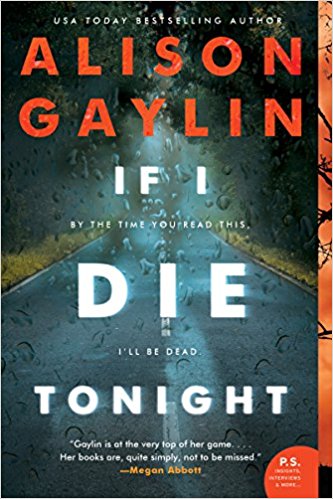
Speaking of better, Alison Gaylin’s new novel comes out this week, and if you haven’t already preordered it, you need to do so. RIGHT NOW.

51G2hiEFpEL._SX331_BO1,204,203,200_

From the Facebook page of Jacqueline Merrick Reed.

October 24 at 2:45 am

By the time you read this, I’ll be dead.

This isn’t Jackie. It’s her son Wade. She doesn’t know where I am. She doesn’t even know I can get on her FB page, so don’t ask her. This isn’t her fault. I am not her fault.

I am writing to tell my mom and Connor that I’m sorry. I never meant to hurt anyone. I wish I could tell you the truth of what happened, but it’s not my truth to tell. And anyway, it doesn’t matter. What matters, what I want you both to know, is that I love you. Don’t feel sad. Everything you did was the right thing to do. I’m sorry for those things I said to you, Connor. I didn’t mean any of it.

Alison Gaylin has been nominated for an Edgar Award three times: Best First Novel, Best Paperback Original, and Best Novel. (For the record, let it show there are many many horrible things I would do to be nominated once, let alone three times.) Her most recent novel, What Remains of Me, was a tour-de-force (Best Novel nominee), juggling two different time-lines as she told the story of two murders thirty years apart and yet connected. But somehow she has managed to surpass that novel with her latest, If I Die Tonight, which is powerful, compelling and beautifully written.

The book begins with the above Facebook post, which immediately pulls the reader into the story. Who is Wade? What is he talking about? Why is he going to kill himself? And from there, the book goes back to five days earlier, where the story truly begins. Jackie, mentioned in the post, is a single mother, estranged from her ex-husband and his current wife. The father of her two children has also pretty much abdicated any responsibility for his sons, other than the monthly check. Jackie is a realtor, and struggles to make ends meet. Her eldest son Wade is her primary worry: over the last few years he has withdrawn, become more insular, barely speaks to her. Friends don’t stop by to visit him or hang out, he doesn’t leave the house much. He is also no longer close to his younger brother, Connor. Jackie’s co-worker at the real estate agency is also her best friend; Wade used to be infatuated with her daughter but is no longer.

The peace and quiet of this little town in the Hudson Valley, Havenkill, is abruptly shattered in the early hours of a weekend morning when an attempted carjacking ends with a popular young athlete at the high school, Liam, hospitalized in critical condition; he and a friend came to the rescue of the woman being carjacked, but the car was stolen anyway and the comatose boy was run over. Who would do such a thing? The woman in the car is a one-hit wonder from the 80’s, Aimee En, and yet pieces of her story don’t make sense. What happened that night? And when Liam dies and it becomes a murder investigation, Jackie becomes increasingly more terrified that Wade was involved somehow.

Gaylin’s mastery of character is on full display in this novel; every character is real, believable, and alive. Even when they behave in ways that are either self-destructive or selfish, it makes sense and fits with the character; no one ever does anything that doesn’t make sense in order to advance the narrative. The plot is devilishly complex and layered, with twists and turns that make the truth almost impossible for the reader to ferret out. Gaylin makes you care for and understand every character, even if you don’t approve of what they’re doing.

But the heart of this novel, its true theme, is the relationships between parent and child. Jackie and Wade, police detective Pearl Maze and her estranged father, her co-worker Helen and her daughter–every step along the way Gaylin is examining those relationships: what goes wrong between them? Can distance, once it develops, be overcome? What is and isn’t acceptable for a parent to accept from their child in terms of behavior, and vice versa? How well can a parent know a child, and vice versa? What is enough space, and what is too much?

And every twist in this novel is earned, as it barrels along to its satisfying conclusion.

This is going to be one of the top books of the year; in fact, 2018 has–with Gaylin’s, Laura Lippman’s Sunburn, and Alafair Burke’s The Wife–already gotten off to an amazing start for crime fiction, and there’s a Megan Abbott coming this summer. If these women are indicative of how high the bar is being risen in crime fiction…it’s going to be a great year in our genre.

Everything She Wants

I am ill.

It’s been threatening since last Thursday morning, when I woke up with a nasty, periodic cough that hurt at the base of my throat; I hoped it was sinus-related since the weather went through one of its typical New Orleans bipolar moments and went from cold and damp to warm and humid overnight; but this morning I woke up with a croaking voice, a slight headache and a mild fever. I chose to stay home from the office today and nurse it, hoping to head off something even worse. I am going to be drinking hot tea with lemon and honey, and chicken noodle soup. I do not wish to be sick in any way, shape or form. I cannot be sicker. I have too much to do.

The odd thing is I felt good enough yesterday to go to the gym for the first time in weeks, and even felt fantastic the rest of the day. Oh, I still had the periodic cough that hurt, but my body felt terrific. I didn’t even wake up feeling sore this morning. But my throat hurts, and coughing feels like gargling acid. And then there’s the damned fever. Sigh.

Although now I wonder if the energy I used at the gym is what opened the door for the illness to take over? BASTARDS.

All right, I am going to go dose myself and try to feel better. Ugh, I hate being sick. And this is twice in less than three months.

So, here are today’s short story offerings.

First, we have “The Shoeshine Man Regrets” by Laura Lippman, from Hardly Knew Her.

“Bruno Magli?”

“Uh-uh. Bally.”

“How can you be so sure?”

“Some kids get flash cards of farm animals when they’re little. I think my mom showed me pictures of footwear cut from magazines. After all, she couldn’t have her only daughter bringing home someone who wore white patent loafers, even in the official season between Memorial Day and Labor Day. Speaking of which–there’s a full Towson.”

This is a Tess Monaghan story, which opens with Tess and her old friend Whitney bored while waiting for their car from the valet service, so they start playing a game: identifying the shoes of the other people waiting for their cars. A laundry truck has the parking lot blocked so everyone has to wait. The ‘full Towson’ is approached by an elderly man of color, who points out his shoes have a spot of mayonnaise on them and asks if he wants a shine. The ‘full Towson’ is a typical asswipe, an altercation eventually ensues, and the old man is arrested–and confesses to a forty-year-old murder….and this is when Tess gets involved. Very satistfying, and a most excellent denouement.

Next, I pulled out the MWA anthology Ice Cold: Tales of Intrigue from the Cold War, edited by Jeffrey Deaver and Raymond Benson, and read the first story, Deaver’s own “Comrade 35.”

To be summoned to the highest floor of GRU headquarters in Moscow made you immediately question your future.

Several fates might await.

One was that you had been identified as a counter-revolutionary or a lackey of the bourgeoisie imperialists. In which case your next address would likely be a gulag, which were still highly fashionable, even now, in the early 1960s, despite First Secretary and Premier Krushchev’s enthusiastic denunciation of Comrade Stalin.

Another possibility was that you had been identified as a double agent, a mole within the GRU–not proven to be one, mind you, simply suspected of being one. Your fate in that situation was far simpler and quicker than a transcontinental train ride: a bullet in the back of the head, a means of execution the GRU had originated as a preferred means of execution, though the rival KGB had co-opted and taken credit for the technique.

As I read along, the story seemed familiar, and yet at the same time I couldn’t remember much about it. When I finally reached the end, I realized I had read the story before, but it’s a good story and I enjoyed it very much. Deaver is of course a bestselling author; and I’ve read many of his Lincoln Rhymes novels–years behind on him, of course. I actually submitted a story to this anthology, and was rejected. I still haven’t placed that story anywhere, either–but I think I finally know how to fix what’s wrong with it.

And now, to my reclining chair and some soup.

IMG_3957

Heaven

So, I survived my voyage out to Metairie. I like the new eye doctor–Dr. Moses at Target–and I am trying out progressive contact lenses. I never really got the sense from my previous eye doctor of how they worked–basically, it sounded like witchcraft–but Dr, Moses very patiently explained how they work in a way which was incredibly easy for me to understand–and it wasn’t that hard. Basically, the pupil expands to see far away and contracts to see up close; so the progressive contact lenses are for distance viewing with a small spot in the center for reading; the pupil will contract and see through that small spot for reading, etc. Was that really that hard to explain? But they are…odd. I have a tester pair, for me to try out and get used to; and they are definitely going to take some getting used to. I can see fine for working on the computer and pretty much everything else, but reading things on say, the television–I can read it but it’s blurry. I’m assuming this is part of the adjustment process; or if it’s not, I need to have the prescription altered. I also tried reading with them in–a couple of books–and I couldn’t. I doubt that is part of the adjustment process. Heavy sigh. But I’ll have to go back in  have my eyes looked at again, I suppose, if these issues aren’t part of the “getting used to them” process.

I was very tired yesterday; I didn’t sleep as well as I should have on Friday night, so I really knocked myself out last night and feel very rested this morning, which is great. I think part of the sleep issue I’ve been having has to do with both not working out in a couple of weeks in addition to drinking more caffeine–I’d cut back dramatically on both coffee and Coke–and so today I am off to the gym and I am going to try to not drink as much caffeine. I need to drink more water anyway.

I didn’t get as much writing done yesterday as I had wanted to; I hadn’t originally planned to even try–errands and so forth generally don’t put me in a very good hey let me write place; and I was right. Plus the contacts made it seem weird, if that makes any sense? I’m sure it doesn’t. So I tried to get chores done–I laundered the bed linens, cleaned the kitchen, etc. I also got caught up on Real Housewives of Beverly Hills and Riverdale; when Paul finally got home last night we got caught up on How to Get Away With Murder. I also did some serious thinking about the things I am working on–a recently rejected short story, for example, that I’ve been having trouble figuring out how to fix for years and it finally hit me last night; the Scotty book and where it’s going; the WIP and where it’s going; a couple of other short stories I am working on (Christ, I am working on a lot of shit, aren’t I).

So, this morning, after sleeping in for a bit, I am going to get some filing done, do some writing in my journal (to work around some thought about what I am writing now) and then I am going to go to the gym, come home and get cleaned up, and then I am going to write/edit for a few hours before it’s time for the ice dancing tonight on the Olympics (I already miss Adam Rippon).

And of course, I read some more stories for the Short Story Project.

First up was “Black-eyed Susan” by Laura Lippman, from Hardly Knew Her:

The Melville family had Preakness coming and going, as Dontay’s Granny M liked to say. From their rowhouse south of Pimlico, the loose assemblage of three generations–sometimes as many as twenty people in the three-bedroom house, never fewer than eight–squeezed every coin they could from the third Saturday in May, and they were always looking for new ways. Revenue streams, as Dontay had learned to call them in Pimlico Middle’s stock-picking club. Last year, for example, the Melvilles tried a barbecue stand, selling racegoers hamburgers and hot dogs, but the city health people had shut them down before noon. So they were going to try bottle water this year, maybe some sodas, although sly-like, because they could bust you for not paying sales tax, too. They had considered salted nuts, but that was more of a Camden Yards thing. People going to the track didn’t seem to want nuts as much, not even pistachios. Candy melted no matter how cool the day, and it was hard to be competitive on chips unless you went off-brand, and Baltimore was an Utz city.

Parking was the big moneymaker, anyway.

Every fall, Paul and I try to attend as many LSU games as we can at Tiger Stadium. It’s so much, frankly, to be in the stadium and being in a crowd of like-minded LSU fans, yelling and screaming and jumping up and down. The first two years we went to games we parked in an African-American church’s parking lot–they were so nice, and would give us cans of soda as well as letting us park there–because it was very easy to get out of there with post-game traffic. The church sold its property, alas–no idea why, but then we needed another place to park. About a block or two closer to the stadium we found a place–Miss Fay’s. Miss Fay is an older woman of color who owns a vacant corner lot next to her house and can fit about twenty cars in there for twenty dollars each; not a bad haul for a Saturday. She’s very friendly and nice, as are the rest of her family, and so we’ve been parking there for about seven years now–and they also keep watch over the cars. The walk is a little less than a mile to the stadium from there, and even on the hottest days (that Auburn game in 2015, Jesus!) it kind of gets you in the mood for the game to walk there, and after the game–we always stay to the end–the walk back allows the traffic to thin out a bit so it’s not so bad. I’ve always wondered about Miss Fay and her family; as well as the other families renting out parking spaces in the yards we walk past on our way to the stadium.

That’s what this Lippman story is about; it’s from the point of view of a teenager whose family rents out spots in their yard for parking during the Preakness, and the myriad other ways they try to think of to make bank from the race-goers. The young man works as basically what we called at the airport a skycap; helping people lug their full coolers and so forth to the track. On this particular day he helps a really pretty woman who looks like a black-eyed Susan; and the next day he also works to  help clean up the mess at the track. Her coolers are still there, and therein lies a tale. This story is filled with social commentary and it’s done in an incredibly easy way; it’s about the reality of being lower income and scrambling to find ways to make money; and of course, it takes a turn that has nothing to do with the young man who was only peripherally involved. I was worried he might get pulled into the investigation, but I was very pleased with how Lippman handled the story, and I haven’t been able to stop thinking about it since.

I also read Lippman’s “Ropa Vieja”, from the same collection.

The best Cuban restaurant in Baltimore is in Greektown. It has not occurred to the city’s natives to ponder this, and if an out-of-towner dares to inquire, a shrug is the politest possible reply he or she can expect.

On the fourth day of August, one such native, Tess Monaghan, was a block away from this particular restaurant when she felt that first bead of sweat, the one she thought of as the scout, snaking a path between her breasts and past her sternum. Soon, others would follow, until her T-shirt was speckled with perspiration and the hair at her nape started to frizz. She wasn’t looking forward to this interview, but she was hoping it would last long enough for her Toyota’s air conditioner to get its charge back.

Lippman created the character of Tess Monaghan, an accidental private eye who works the mean streets of Baltimore, in her first novel, Baltimore Blues, and continued writing about her for years before branching out into her brilliant stand alones. The Tess novels are amongst my favorites in private eye fiction, and Lippman began winning awards and making short lists left and right from the very beginning. “Ropa Vieja” is a Tess story; and a good one. It’s been several years since the last Tess novel, Hush Hush, and despite that I slipped easily right back into the rhythm of her voice and her world without issue; it was remarkably easy, like putting on a comfortable old baseball glove or a pair of slippers. This is an interestingly twisted little tale, about a pitcher for the Orioles who got sick on the mound in a late season game; and it had to do with the traditional pre-meal dish of ropa vieja he’d eaten from the afore-mentioned restaurant. The owner hires Tess to somehow prove that it wasn’t the restaurant’s fault–and boy, does this story take some serious turns on its way to its ultimate denouement.

As I’ve mentioned before, Lippman is an extraordinary writer–she’s one of my favorites–and her effortlessly brilliant short stories always are surprising, clever, and smart. I am starting to get a better idea of just how one writes a private eye short story from reading hers; there may actually be a Chanse MacLeod short story brewing in my head–or at least, one featuring his partner that has to do with the recent shutdowns/raids of strip clubs in the Quarter. It would certainly be an interesting experiment to try.

And now, back to the spice mines.

Have a great Sunday, Constant Reader!

tumblr_ololkyEQSm1u3ef6to1_500

Saving All My Love For You

Saturday morning. I have an eye appointment in Metairie this afternoon, but I definitely need new glasses. I also have to get groceries this morning (ugh), and I should probably figure out some time to go get the mail as well. Heavy sigh; the house is also a mess and this kitchen needs a-cleanin’. Paul’s going into the office today, so I’ll be alone; I am hoping, after I get home, to spend some time writing. I was very tired and didn’t feel good yesterday; my throat’s kind of sore this morning as well; I woke up a lot last night, but I did sleep. Tomorrow I am going back to the gym to get my workouts going again, so hopefully that will help in the sleep department. I’ve noticed that I’m not sleeping as well since Carnival started and I stopped having time for working out.

I can’t not sleep. I have too much to do and I can’t be tired. Yesterday was my short day at the office and after I got home, I didn’t feel well and was too tired to do anything besides sit in my easy chair and watch Adam Rippon videos on Youtube. (I told you I was stanning.) Then it was time to watch the Olympic figure skating, which was terrific. Very proud of our US skaters! Nathan Chen had six quads in his program, and made Olympic history, and young Vincent Zhou skated magnificently as well. All three of our skaters wound up in the Top Ten, which was terrific, and Nathan came close to medaling. If only he’d turned that second quad in his short program into a combination jump and gotten points for it, he would have. He had the highest score in the long program. Had they both skated clean short programs, they both would have medaled. So, there’s a lot of hope there for the future. Part of the fun of the Olympics is also seeing the future of the sport out on the ice as well–the silver medalist, Shoma Uno, is very young as well, and there was a young Russian who is very artistic. Worlds this year will be very fun to watch.

Oh, Adam. What would it have meant to fifteen year old me, deeply closeted and terrified someone might find out who I really was, to see you skate at the Innsbruck Olympics in 1976? Watching you this past week brought tears to my eyes every time; my heart was in my throat every time you went into a jump. You made me laugh in your interviews, you made me cry with your oh-so-beautiful skating. I can’t remember the last time I was so emotionally invested in seeing a skater do well? Michelle Kwan, whom I loved and still miss? Rudy Galindo in 1996? And how happy and proud to see all the love for you, to the point where even the trash tweeting shit about you could just make me smile and think he has a bronze medal, and you have your phone and bitterness. I feel SORRY for you that you can’t find joy in this, what a sad, bitter, pathetic life you must lead. Especially the gay Republicans, so desperate for the love and acceptance they’ll never get from their abusive relationship with a party that hates them. Adam is a star; will be a star, and he’ll always, always, have these Olympics, three gorgeous performances, and a bronze medal. No one can ever take that away from him with petty nastiness.

Watching Adam and his great joy in his sport and doing his best also made me realize something; it’s about doing something you love, and doing your best. I had already realized that I had lost my joy in writing sometime ago; I’m not sure when it went from being something I loved doing to an odious chore. But this year I’ve rediscovered how much I love it, how much I’ve missed it; how I love creating characters and telling stories and expressing myself on the page. I was already getting there on my own, but watching Adam, seeing him, took me to that final place. It’s not about medals, it’s not about awards, it’s not even about money; it’s about joy in doing something you love.

Thanks, Adam, for that–and for making me realize how I’ve been neglecting my eyebrows.

DVzJ3fZVoAADMDi

I also read some more short stories.

To be fair, I had already read Daphne du Maurier’s “The Birds”; her Echoes from the Macabre: Selected Stories is one of my favorite single-author collections of all time. But it had been awhile since I’d read this story; I knew it was vastly different from the Hitchcock film based on it, so I read it again.

On December the third the wind changed overnight and it was winter. Until then the autumn had been mellow, soft. The leaves had lingered on the trees, golden red, and the hedgerows were still green. The earth was rich where the plough had turned it.

Nat Hocken, because of a wartime disability, had a pension and did not work full-time at the farm. He worked three days a week, and they gave him the lighter jobs: hedging, thatching, repairs to the farm buildings.

Although he was married, with children, his was a solitary disposition; he liked best to work alone. It pleased him when he was given a bank to build up, or a gate to mend at the far end of the peninsula, where the sea surrounded the farm land on either side. Then, at midday, he would pause and eat the pasty that his wife had baked for him, and sitting on the cliff’s edge would watch the birds. Autumn was the best for this, better than spring. In spring the birds flew inland, purposeful, intent; they knew where they were bound, the rhythm and ritual of their life brooked no delay. In autumn those who had not migrated overseas but remained to pass the winter were caught up in the same driving urge, but because migration was denied to them followed a pattern of their own. Great flocks of them came to the peninsula, restless, uneasy, spending themselves in motion; now wheeling, circling in the sky, now settling to feed on the rich, new-turned soil, but even when they fed it was as though they did so without hunger, without desire. Restlessness drove them to the skies again.

One of the best parts of the film is that there’s no explanation why the birds have turned on humans; they just have, and there’s no way of knowing if they’ll ever go back to normal. The end of the movie is kind of left hanging; when I saw it the first time when I was a kid I was deeply dissatisfied with how the film ended. But there wasn’t really any way to end the film, and du Maurier herself gave no clues to what was going to happen at the end of her story. The story ends much the same as the movie; no end to the menace in sight, and even more chilling–I don’t remember if this was in the movie–but the BBC had stopped broadcasting; the horrifying part of this story is the incredible sense of isolation the family feels–are they the only people left alive in the world? On that level, the story is even more disturbing than the film; in the movie there are other people all around in the town. The story is set out in the country…and du Maurier never lets the reader know. The way the horror builds is almost unbearable; her mastery is truly amazing.

I also went back to the Laura Lippman well for “Easy As A-B-C’, from her collection Hardly Knew Her.

Another house collapsed today. It happens more and more, especially with all the wetback crews out there. Don’t get me wrong. I  used guys from Mexico and Central America, too, and they’re great workers, especially when it comes to landscaping. But some contractors aren’t as particular as I am. They hire the cheapest labor they can get and the cheapest comes pretty high, especially when you’re excavating a basement, which has become one of the hot fixes around here. It’s not enough, I guess, to get the three-story rowhouse with four bedrooms, gut it from top to bottom, creating open, airy kitchens where grandmothers once smoked the wallpaper with bacon grease and sour beef, or carve master bath suites in the tiny middle rooms that the youngest kids always got stuck with. No, these people have to have the full family room, too, which means digging down into the old dirt basements, putting in new floors and walls. But if you miscalculate–boom. Nothing to do but bring that fucker down and start carting away the bricks.

The premise of this story; a guy who owns a construction company is hired to renovate his grandparents’ old house for a young woman he finds attractive, despite his many years of marriage–is pretty clever. It also has a lot to say, in a very sly way, about gentrification and how old neighborhoods and their character are ruined by it; this is something going on to a very large extent in New Orleans, and has been for quite some time, and there’s a strong sense for us locals that with these changes, some of what made New Orleans so special, unique and different, is also being lost. Lippman inhabits the voice of this middle-age blue-collar man perfectly; she never once slips and makes an error that jars the reader out of the voice. And as the story builds to its own inevitable dark climax, you really can’t stop reading because you really aren’t sure how she is going to finish playing her cards. That’s the great joy of Lippman, and what makes her special and unique as a writer; you’re never really sure how this is all going to play out, but she never deliberately misleads you, ever–she doesn’t cheat, and once you get there, you think, yes, that’s the only way this could end.

Seriously, her new novel dropping this week, Sunburn, is definitely one of her best; check it out, if you haven’t already.

And now, I’ve got a jam to get Scotty and the boys out of.

Think of Laura

Zulu is passing now; I can hear the drums of the marching bands. It’s a gorgeous morning, the sun is shining and I am betting the crowds up at the Avenue are deep; they certainly were last night for Orpheus. Paul and I both have to work tomorrow, so we’re ending our Carnival early; taking today to rest and recover so we can hit the ground running on Ash Wednesday. I also have a lot of things to do today; emails to answer, things to write, things to edit, things to read, a kitchen to clean. Even though it was abbreviated this year (I was in Alabama for the first weekend of parades), I enjoyed every bit of Carnival this year; and am already melancholy to see it end as always.

I’ve also been enjoying the hell out of the Winter Olympics, and like millions of people worldwide I am–what’s the word kids use now? Oh yes–stanning Adam Rippon. As a long time figure skating fan, I’ve known of Adam long before these games; I remember when he had a mop of floppy curls; when gossip websites were pairing him and Ashley Wagner as a couple (I rolled my eyes every time I saw the photos), and I remember when he came out. I blogged about homophobia in figure skating a while back; when Adam came out while still on the Olympic eligible circuit I thought to myself you’re never going to win anything now; so I was pleasantly surprised to see him win US Nationals and make the world team in 2016; he missed last season with a broken foot, and this season he is full-on out: his short program is to gay club music, and his long program, as everyone saw the other night, is breathtaking. I’m so happy for both him and Mirai Nagasu, who became the first American woman to land a triple axel at the Olympics that same night; they earned bronze medals as part of the team competition, and I couldn’t be happier for both of them–all of the Americans on the team, to be honest. Adam is so funny and refreshingly himself; a big personality and a natural wit he doesn’t try to hold back, and that honesty…I just can’t get enough. I had tears in my eyes when he finished his long program the other night; Paul and I both screamed when Mirai landed the triple axel. Seeing the trashy homophobes on Twitter trashing him or going after him makes my blood boil; I’ve resisted the urge to reply to them He’s got an Olympic medal and you’re a fifth-rate Twitter troll. Congratulations.

So. There’s that.

And in other news of the fabulous, the lucky world of readers can look forward to the upcoming release of a new Laura Lippman novel, Sunburn. I got an ARC at Bouchercon and read it in one sitting on a rainy Saturday back in October.

sunburn

It’s the sunburned shoulders that get him. Pink, peeling. The burn is two days old, he gauges. Earned on Friday, painful to the touch yesterday, today an itchy soreness that’s hard not to keep fingering, probing, as she’s doing right now in an absentminded way. The skin has started sloughing off, soon those narrow shoulders won’t be so tender. Why would a redhead well into her thirties make such a rookie mistake?

And why is she here, sitting on a barstool, forty-five miles inland, in a town where strangers seldom stop on a Sunday evening? Belleville is the kind of place where people are supposed to pass through and soon they won’t even do that. They’re building a big by-ass so the beach traffic won’t have to slow for the speed trap on the old Main Street. He saw the construction vehicles, idle on Sunday, on his way in. Places like this bar-slash-restaurant, the High-Ho, are probably going to lose what little business they have.

High-Ho. A misprint? Was it supposed to be Heigh-Ho? And if so, was it for the seven dwarfs, heading home from the mines at day’s end, or for the Lone Ranger, riding off into the sunset?  Neither one makes much sense for this place.

Nothing about this makes sense.

Laura Lippman has been one of my favorite writers since I read Baltimore Blues years and years ago. I tore through her Tess Monaghan series, and she very quickly became one of my buy in hardcover authors. I’ve never regretted making that switch, and as she has expanded her skills and pushed herself with her exceptionally brilliant stand alone novels, I’ve never once quibbled but I want another Tess novel! (I do, always, but the stand alones are so fucking fantastic that it doesn’t matter–I really just want a new Lippman, and wish she was on a yearly schedule rather than an eighteen month one.)

Laura’s career trajectory has been most impressive from a writing perspective; because as a writer of stand alones, she has gone from being a literary crime writer to a literary writer about crime, if that makes sense. Each of her stand alones are unique and different from the others; about as far removed from her series as any novels can be and still be by the same author. Each one of these novels are rare pearls, individual and vastly different from the others; different themes, different explorations, different everything. The one common thread that runs through these novels is that they are, for the most part, about women, and what women face in their lives; how they deal with crimes and tragedies that take them out of the ordinary and into the extraordinary. Laura also regularly experiments with form and voice and tense; enormous, dangerous risks as a writer that she somehow always manages to pull off, make engaging and enjoyable, and always manages to tell a story that makes a very compelling point.

Sunburn,  her latest, is as different from anything she has done before as it could be unless she decided to write about vampires or a zombie apocalypse; but she also brings her incredibly powerful sense of empathy to this tale of murder, vengeance, and oh-so-careful planning. The book opens with the main character, Polly Costello, walking away from her husband and child on a beach vacation and winding up in the hard-knock town of Belleville; she is being observed by Adam, who is being paid to keep an eye on her, follow her–but not to become obsessed by her, which is what happens. Their story is told in a very limited third person point of view, alternating between them, and as we slowly get to know them, watch their physical attraction expand and develop into something more, the questions remain: why did Polly walk away from her family and child? How could she do such a thing? Who is this enigmatic redheaded bar waitress?

And just how fucking good does Adam’s grilled cheese sandwich taste?

The prose in this book is lean; not an extra word to be found anywhere, and it is an homage of sorts to the kind of lean, tight, dark noir that the great James M. Cain wrote. (Cain is a hero of mine, and I have always wanted to write something that dark and lean and tight…ironically, one of the ideas I had for such a noir–gay, of course–was also titled Sunburn) I’ve seen, in some of the early reviews, comparisons to Cain’s Double Indemnity and The Postman Always Rings Twice, which seem obvious; there’s an insurance scam buried deep in the plot, it’s set in a bar/diner, it’s about an unexpected, explosive attraction between a man and a woman; there are side plots that end in mysterious deaths… but if anything, I’d say Sunburn is more reminiscent of Cain’s The Cocktail Waitress than anything else.

The book is extraordinary, and probably Laura Lippman’s best work to date; that wisecracking, tight prose; a complicated and complex plot that grows even more complicated as you read another page; fully developed characters you can help but root for, even if their motivations aren’t exactly pure; and ultimately, the book is about a woman with everything stacked against her all of her life, who  never gives up, and makes plans…risky plans; where she gambles everything, including her own happiness and desire, for her future, yet is flexible and smart enough to always adapt.

Polly Costello is a heroine Cain would have been proud to call his own.

Everytime You Go Away

There really is nothing like your own bed.

My inability to sleep in a hotel bed is becoming increasingly problematic the older I get; it’s hard for me to do public speaking events when I have trouble sleeping. I can rest; I just don’t fall deeply asleep and instead wind up in that half-sleep all night. In the morning I feel rested physically but not mentally, and I start getting tired. I also wind up drinking a lot more caffeine than I need to stay alert and focused, which then further complicates the inability to fall asleep. Heavy heaving sigh.

But the two events I did in Alabama this weekend–Murder in the Magic City on Saturday in Birmingham at the Homewood Library; Murder on the Menu in Wetumpka Sunday at the Civic Center–are wonderful events. They draw lovely crowds, all of whom love to read and also buy books, and are incredibly well organized. A special shout out to Margaret Fenton, who organizes Murder in the Magic City, and to Tammy Lynn Rushing and Fran Holland, who put together the Wetumpka event. If you ever get invited to speak, or have the chance to attend, you really should. Despite my inability to sleep, I always feel creatively invigorated as well as personally rewarded. I also really love the little town of Wetumpka; as weird as it sounds, I would like to go back there and spend a weekend exploring. I’ve always wanted to write about a small town in Alabama; and there’s lots of material, I suspect, there. I love that there’s a casino and a meteor crater there; one of the only concrete suspension bridges in the country; and two rivers. Driving from Birmingham to Wetumpka is always interesting; as at least a third of the trip is on state highways and not interstates, and as I drove, listening to my music and observing my surroundings, again I had many flashbacks to my own childhood and my own memories of Alabama. I also got re-inspired on a short story idea I had a couple of months back, and serendipitously an anthology it would be perfect for just popped up on my radar. Huzzah!

I took today off from work–a wise move–so I can get caught up on everything that slid while I was away this weekend. I have errands to run, some cleaning to do, some writing and editing, and a lot of organizing. *Whew*. Just thinking about it makes me feel very very tired. But I slept really well last night–there’s really nothing like your own bed, as I mentioned before–and I also need to get to the gym. I missed both Friday and Sunday workouts this weekend; I can make up the Sunday workout today but Friday’s, alas, is gone. I do miss it, and my body is all, what the hell man? And with Carnival getting back into full swing on Wednesday; it’s not going to be easy. I am going to skip cardio these next few workouts; I have to walk to and from work every day from Wednesday thru Friday, so those cardio workouts aren’t as necessary. I can go lift weights today, Wednesday, and Friday; I have Lundi Gras off so can replace the Sunday workout with one on Monday, and then get back to my regular schedule after Fat Tuesday. Huzzah!

And maybe I should start looking into eating healthier, too….sob.

I did manage to keep going on the short story project while I was in Alabama; I took Laura Lippman’s Hardly Knew Her collection with me and read the stories “Femme Fatale,” “Honor Bar, ” and  “A Good Fuck Spoiled.” (There were other stories there, like “Pony Girl” and “ARM and the Woman”, which I’d already read in their original publications; I even reprinted “ARM and the Woman” in my co-edited –with J. M. Redmann–anthology Women of the Mean Streets.) I loved these stories, and one of the things I love the most about Lippman’s short stories is how dark they are; they are most definitely hard-boiled and noir. I also love that the stories are about women who aren’t what would typically be called ‘nice girls;’ these are women with shady pasts who aren’t sorry about their pasts and will do what they need to do.

“A Good Fuck Spoiled” though, isn’t about a woman, although in some ways it is; it actually spins the tired trope of the older man/younger woman adulterous affair on its head. This is one of those stories where someone who is basically your average, every day husband and father is pushed over the edge into doing something dark in order to get out of a bad situation his own apathy kind of allowed him to drift into. It’s also exceptionally clever by playing with the entire concept of ‘betrayed wife’ against ‘golf widow,’ and of course, the husband, once he does what he needs to do–sees it exactly that way; I love how Lippman shows how someone can do something amoral and then completely justify it. God, this collection is amazing. Laura Lippman is definitely respected as one of our best crime writers today–but I don’t think she gets near enough credit as a short story writer.

And on that note, I need to make a list and start checking things off it.

IMG_1924

Tonight

SNOW DAY!

Yes, we had freezing temperatures in New Orleans the last two nights, and when I woke yesterday morning it was only 20 degrees; it’s 21 today. There was snow and ice outside both yesterday and today–not much, it’s New Orleans, seriously–but the exciting news yesterday morning was work was canceled because the roads were closed! The text went out around nine in the morning, but I, good boy who is determined to stick to his goals that I am, was at the gym. Yes, I got up yesterday morning, bundled up against the cold, and went to the gym. There were tumbleweeds blowing through there, of course, but I did my stretches, my workout, and twenty minutes  of cardio(okay, it was 17:58, but it was nine and I thought I needed to get home and get ready for work). I came home, did the dishes, packed Paul’s lunch, got cleaned up, packed my own lunch and headed out to the car, which had ice all over its windows. I got inside, started the car and turned the defrosters on, and was about to plug my phone into the stereo when I saw that I had 15 text messages….the initial messages about the office being closed and responses from co-workers. I immediately shut off the car and came inside and put my sweats back on.

Here is the horror that was New Orleans yesterday morning:

Really not much of anything, seriously. But as I told my boss last night, I know how to drive in snow and ice, but these people down here? Not so much.

The problem, apparently, was that the bridges into New Orleans–we’re kind of an island, surrounded by water and swamp and you have to cross a bridge to get into the city no matter from what direction–were icy, and of course, that makes them dangerous because people here don’t know how to drive on ice and the bridges are all pretty high. So the bridges were closed and so commuters couldn’t get into the city; the highways are also raised in many places and therefore dangerous when icy. So basically, the entire city shut down. I could have made it to work, but hey, you know, the office was closed. Today so far I’ve not heard about anything–I doubt very seriously we would close two days in a row, and I have no problem with going in.

But it was nice having a free day to stay home with the cat, you know? I did laundry, and since it was so cold at my desk in the kitchen even with the space heater on, decided to make it a real Snow Day and simply retire to my easy chair with the cat in my lap and work on the Short Story Project. I read a Lee Child story from one of the Lawrence Block painting anthologies, and a Laura Lippman from her collection Hardly Knew Her.

Lee Child’s story was “Pierre, Lucien, and Me”, from Alive in Shape and Color:

I survived my first heart attack. But as soon as I well enough to sit up in bed, the doctor came back and told me I was sure to have a second. Only a matter of time, he said. The first episode had been indicative of a serious underlying weakness. Which it had just made worse. Could be days. Or weeks. Months at most. He said from now on I should consider myself an invalid.

I said, “This is 1928, for fuck’s sake, They got people talking on the radio from far away. Don’t you have a pill for it?”

No pill, he said. Nothing to be done. Maybe see a show. And maybe write some letters. He told me what people regretted most were the things they didn’t say. Then he left. Then I left. Now I have been home four days. Doing nothing. Waiting for the second episode. Days away, or weeks, or months. I have no way of knowing.

I’m a fan of Lee Child, and one of my favorite memories was walking to Green Goddess with Alafair Burke when Romantic Times was here one year, and we ran into Lee on the street. I was a big fan, of course, but had never met him. Alafair, of course, knew him, and she invited him to join us. So I not only got to have lunch with Alafair Burke but also Lee Child. (How awesome are my namedropping skills?)

Anyway, he was as charming and self-deprecating as I’d heard–ridiculously tall and slender as well.

I love his Reacher series, but am many years behind on it, alas–so many books, so little time–but this story was short and quite lovely. The main character, as you can tell from the opening, is dying, and reflecting on his life; thinking back on whom he might need to apologize to or make amends with, and cannot really think of anyone. Then a name pops into his head; a millionaire he rather swindled, and the tale of the swindle makes up the rest of the story. The voice is charming and the swindle itself isn’t really that terrible, as far as these things go; he didn’t cause any harm, really, even if what he did was a crime.

I then moved on to Laura Lippman’s “Hardly Knew Her”, from her amazing collection Hardly Knew Her:

Sofia was a lean, hipless girl, the type that older men still called a tomboy in 1975, although her only hoydenish quality was a love of football. In the vacant lot behind the neighborhood tavern, the boys welcomed her into their games. This was in part because she was quick, with sure hands. But even touch football sometimes ended in pile-ups, where it was possible to steal a touch or two and claim it was accidental. She tolerated this feeble groping most of the time, punching the occasional boy who pressed too hard too long, which put the others on notice for a while. Then they forgot, or it happened again–they touched, she punched. It was a price she was more than willing to pay for the exhilaration she felt when she passed the few yew berry bushes that marked the end zone, a gaggle of boys breathless in her wake.

But for all the afternoons she spent at the vacant lot, she never made peace with the tricky plays–the faked handoffs, the double pumps, the gimmicky laterals. It seemed cowardly to her, a way for less gifted players to punish those with natural talent. It was one thing to spin and feint down the field, eluding grasping hands with a swivel of her nonhips. But to pretend the ball was somewhere it wasn’t struck her as cheating, and no one could ever persuade her otherwise.

Sofia, called Fee by her family and by no one else–she won’t allow it–has a father with a gambling problem; he plays in a game in the neighborhood tavern every Friday night. When he does well, there are gifts for the family on Saturday; when he doesn’t, he takes those gifts in the middle of the night and pawns or sells them, or turns them over as payment for a debt. He’s not a good bluffer, like his daughter, depending on the luck of the draw for his success or failure. But Fee is given a lovely amethyst necklace for her birthday–an heirloom–and when her father takes it to pay a debt, Fee is finished with her father, finished with this existence, and decides she is getting her necklace back. How this all plays out for Fee is a coming-of-age tale like no other I’ve read; one that only a talent like Laura Lippman could write. This collection of short stories is really quite extraordinary; as is the Block anthology; y’all really need to read these two books if you are a fan of short stories.

I also started watching, of all things, original episodes of Scooby Doo Where Are You? through Amazon Prime; I’ve been thinking a lot about Scooby Doo and its predecessor, Jonny Quest, since getting to meet one of the directors/animators for Hanna-Barbera at Comic-Con a couple of weeks ago. Jonny Quest is actually the first memory I have of watching something mystery/adventure related, and my love for Jonny Quest never really abated; I think, therefore, that the show was what triggered my lifelong love of mysteries and the crime genre; Scooby Doo came along around the time I was discovered the Hardy Boys and Nancy Drew and Trixie Belden. I’ll keep watching and musing about this some more, before making a post. I also still owe a post about I Tonya. I also finished reading Joan Didion’s Miami last night; so I’ll have to post about that as well.

So, that was how I spent my Snow Day; resting and relaxing and reading. It was actually quite lovely; we watched two episodes of Broadchurch last night and only have three to go before finishing the show. This third season is also quite good, and it’s cool how they’ve woven characters from the initial story into the present investigation; this entire season is an exploration about sexual assault, sex in genre, and porn. I am looking forward to seeing how it all plays out.

And now, back to the spice mines. As I said, I don’t think we’ll get another Snow Day today, so I have to get back to work. But how lovely to have a day where I didn’t really have to do anything; it’s been a long time. (Okay, I did the dishes and a load of laundry, but overall, it was a light responsibility day.)