Thursday and my last day in the office for the week. I was very tired when I got home from work yesterday–mid-week fatigue, most likely–but I slept super well and feel pretty good this morning. The temperature started dropping again last night–I checked and it was only 62 degrees inside last night–so I turned the heat on downstairs before heading to bed, and it’s nice and warm down here this morning. I don’t know how tired I am going to be later on, of course, but we’ve an easy clinical schedule today and I should be able to get caught up on all my Admin stuff today before I leave the office and come home. I am almost finished with a project, hopefully by Saturday it will be done and I can get back to my book work. No football for sure this weekend, so I have no excuse not to clean and write and go to the gym as we move into the New Orleans Holiday Season–which doesn’t end until after Carnival. Woo-hoo!
The last time I was visiting my father (or maybe the time before) he told me about a movie (it probably was the time before last, when I watched westerns with him) starring John Wayne that was set in Alabama and was about Bonapartists exiled from France who wound up settling in the western part of the state, which is how the small city (or town) of DEMOPOLIS was founded. (The movie was The Fighting Kentuckian.) Honestly, Alabama’s history is so rich and varied! I could write a million books set in Alabama–and that’s not even talking about places like Moundville, near Tuscaloosa. But there has to be some way I can tie Scotty and New Orleans into the Bama Bonapartists, you know? One of Napoleon’s nephews, Prince Achille Murat, lived at Magnolia Mound near Baton Rouge (I think the location is either on the LSU campus, or very close to it) for awhile in the early nineteenth century. Lots of Bonaparte connections down here, and after all, the Napoleon House is called that because after Waterloo, it was offered to Napoleon for his next exile–needless to say, the British weren’t having that. (There are Baltimore Bonapartes, too.) I came across a mention of the Murats of Magnolia Mound yesterday, and that made me remember about the movie and the Bama Bonapartists.
I also started reading White Too Long, and I am glad I have it. It’s essentially the story of how white supremacy and Christianity became linked through racism before the Civil War, and how those “southern” versions of particular Christian brands worked hand-in-hand with the Klan and other racists ever since. I think the Southern Baptists are the only ones left that didn’t merge back in with their Northern counterparts after the war, and the Southern Baptists have been responsible for a lot of bigotry and unconstitutional prejudiced laws and so forth ever since. The Southern Baptists were the queer community’s biggest enemy for decades, and have poisoned southern culture for generations. (They were also the very first organization to target Disney for being slightly more gay-friendly than anywhere else and announced the first boycott over it; it failed miserably.) It’s going to be an interesting read; I always find religion fascinating–especially how a benign message of caring for others and helping the poor and sick can get twisted so easily into a method of mind control for nefarious reasons. I still want to explore that more in a book, too, and I am going to finish that goddamned essay about my own personal experiences with religion and the Christian god.
Maybe try finishing the writing you’re already doing, Greg, before starting anything new–and yes, that absolutely includes doing research. Make notes of where to find said research and do not go ahead and start doing it–save it for when you’re ready to write it.
And if you never have the time to write it, then was there any need to waste any time researching it? Alas, I do have a curious mind, which can also be very one track at times.
And on that note, I am heading into the spice mines. Have a lovely day, Constant Reader, and I may be back later. One never knows.
They were everywhere when I was growing up—movies and television shows—and my father has been a lifelong fan, so whenever there was a Western on TV, our set was tuned to it. Gunsmoke, Bonanza, The Rifleman—you name it, we watched it. Looking back, my dislike of Westerns was rooted in several things: toxic masculinity, racist depictions of indigenous peoples, and how entertainment in this genre was primarily used to create a mythological portrait of the settling (colonizing) of this continent and make it seem as though Europeans were doing the right thing (even using religion) even though they really weren’t. I never saw the natives as villains, and I didn’t like how easily Westerns picked up the trope of heroic white people and savage natives. Even as a child I could see it was all bullshit and I didn’t buy into it. I was about eleven or twelve when indigenous people occupied the massacre site at Wounded Knee, bringing attention to those false narratives and trying to change what was then culturally-accepted racist viewpoints on the indigenous Americans.
Look at the words used for the indigenous people–“savages”, “redskins”, “braves”, etc.; all dehumanizing and differentiating; “they are not like us so have no rights or privileges and we need to kill them all” was pretty much the US government’s policy to the natives.
Many sports teams still perpetuate this—how many teams still used these offensive names until recently? How many still do? And how upset do people get when those names are changed?
Anyway, I also mentioned in passing on another post that I’d like to explore Western tropes and why I’ve never been terribly interested in them as a genre. When I was in Kentucky the last time visiting Dad some movie channel was having a John Wayne film festival, which kind of made my heart sink. I’ve never really been much of a John Wayne fan (although I do love both True Grit and Rooster Cogburn) and generally avoid his films. The first movie was Hondo, with Geraldine Page (of all people; I wonder what she thought of the experience), and you know, I actually enjoyed it…and it made me think maybe I should revisit John Wayne and check out some of his other, better films. But Christa Faust, who is one of my favorite people in this community, commented she’d love to hear my thoughts on Westerns and their tropes.
She also turned me on to this:
If you aren’t aware of Christa Faust and her work by now, you really should be ashamed of yourself.
Redemption is an amazing Western graphic novel she wrote, and I very happily downloaded it as soon as she let me know of its existence. It also made me recognize and understand my own comics-fandom to a degree, too, and I may need to reevaluate that and explore it. I had thought about doing a Pride post about comic books and super-heroes, but it might need to be a longer form personal essay. Anyway, I don’t read enough graphic novels. I’d known that Christa had done scripts for comics before, but it never occurred to me that I should read them as well as be supportive of my friends who create this way. It is just another form of writing, really.
Christa is one of my favorite writers, and Money Shot remains to this day one of my favorite American noir novels. She’s also one of my favorite people; I love just sitting around shooting the shit with her.
And what she does with Redemption is absolute feminist magic.
You see, the thing about Western tropes is they can often be adapted to other genres–including literary (Lonesome Dove is my father’s favorite novel)–and the first Star Wars movie (I will never call it anything other than Star Wars) borrowed heavily from Westerns, as does The Mandalorian. You can see the influence of Westerns on pop culture almost everywhere you look, really (and really, Western tropes are often influenced by medieval tales of lone knights and paladin, which in turn were influenced by Greek mythology), and Redemption isn’t a classic Western set in the 1800’s; this Old West is the result of some kind of apocalyptic happening, with the end result that the town of Redemption has walled itself off from the rest of the world (for their own safety) and is being run by your typical right-wing doom-and-gloom Christian type, who uses God and the Bible for control rather than for inspiration. The town’s doctor, who is not only a Latina woman but a fierce feminist, has been tried and convicted for providing an abortion to a woman whose child died in the womb and was endangering her life.
She has also been sentenced to death.
If you are seeing parallels between this and our modern world, well, I am pretty fucking sure that’s entirely intentional.
The doctor’s daughter’s only hope to save her mother is to find a legendary gunslinger called the Butcher–who had a past with the doctor when they were young. No one is even sure if the Butcher is real, or if she’s merely a legend.
And in the character of the Butcher, Faust sets Westerns on their ear by taking the typical closed-mouth gunslinger (think Clint Eastwood in all those movies about the Man with No Name) and made her a woman, but without stripping any of the gender expectations for men in Westerns. She’s old, she’s tired, and she’s done with bullshit–but she can still outdraw and outshoot any and every man she runs up against.
The art by Mike Deodato is also incredible.
Highly recommended; and again, check out her other work if you’re not familiar with it. You can thank me later.
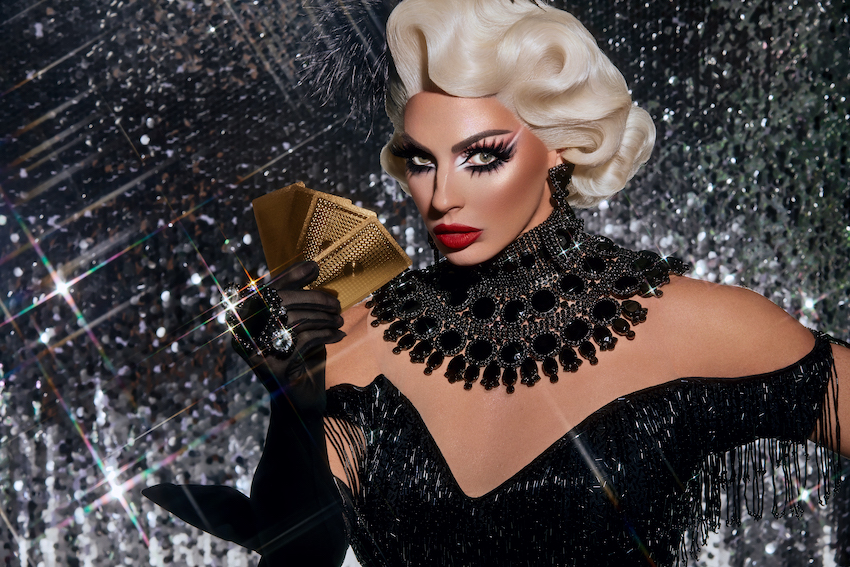
I love Alyssa Edwards. She’s the perfect reality star; a completely delusional human living in her own reality, yet also funny and witty with a highly expressive and thoroughly meme-able face, and basically harmless. I’ve always meant to catch her reality show on Netflix about her dance studio–which is so fricking cool that she does that–but have never gotten around to it. I was amused by her on her initial season, but really hated her feud with Coco Montrese, and of course that was also the season won by the marvelous Jinkx Monsoon. Alyssa was also terrific on All Stars 2, which made the rigging of the season all that much more disappointing. (We also gave up on Project Runway after one season where it was clear they’d already decided who was going to win at the start of the season. Don’t give me a rigged competition, thank you very much; if I want that, I’ll watch professional wrestling, thank you very much.)
Which makes it interesting for me to write a book about a drag pageant. I already have tons of ideas for the book, and it’s going to be very brutal in how it approaches the homophobes who have wrested control of Florida from the sane people (hey Moms4Liberty, how’d those elections turn out for you, you pathetic soulless pieces of shit? Your tears are as delicious as mimosas at a gay Sunday drag bunch, you miserable fucking bitches.) and have taken the state, once a beautiful place with scenic beaches and lovely weather, on its final steps to a complete and utter hellhole. Bravo, by the way; nicely done.
Anyway, back to drag; sorry about that sidebar. But that kind of shit will always enrage me. Nothing makes me angrier than misplaced self-righteousness. I may no longer be a practicing Christian, but I know that faith far better than many–if not most–of its most ardent public proselytizers and purveyors.
Gender-bending, of course, is nothing new. For centuries, women weren’t allowed on the stage so female roles were always played by men. This was certainly true in Shakespeare’s day, and often he wrote plays with characters pretending to be the other gender. So there’s a long, proud history of men doing drag in theater and performance art. Who decides what is masculine and what is feminine, anyway? As I have said numerous times, I love this new young generation of leading men and actors who are abandoning traditional black-tie male drag for new and inventive outfits that showcase their youth, beauty, creativity, and personal style; there’s nothing quite so stifling as toxic masculinity and it’s regular insistence that there is only one way to be a man–which is not only stultifying but incredibly limiting. Film and television (and theater, to a far lesser degree) have long influenced what is considered masculine in this country–the prototype being, of course, John Wayne. (Probably the funniest scene in both La Cage aux Folles and it’s American version The Birdcage is when the more butch of the gay couple tries to get the more feminine partner to be more masculine–telling him to walk like John Wayne…which was the first time I ever noticed how peculiarly John Wayne walked. Also amusing is that Mr. American Macho Man John Wayne–and Mr. Patriotism Ronald Reagan–didn’t serve in World Was II…but played war heroes in movies about it. Style over substance.)
But the history of the colonizing of this continent is very queer. Do we really believe those frontiersmen, trappers, hunters and explorers simply went for months and even years without having sex? There weren’t enough women to satisfy the need–and cattle drives? Pshaw. In any purely male society like that–the cattle drive, the explorations, etc.–there is always male/male sexual contact; “helping a buddy out.” This has been erased from history as effectively as if it had never happened–as though homosexuality is some modern thing that never existed before.
It’s always struck me as odd that the masculine ideal (as shown to us by Hollywood, at any rate) inevitably is depicted in all male environments–war movies, cattle drive movies, Westerns–with the occasional token female thrown in as a supporting love interest. These women are often set up to be abused–spanking was often popular in these films; how many times did John Wayne spank a woman in a movie?–and mocked and made fun of; if they had any kind of mind of their own, well, they had to be tamed.
Anyway, I digress.
I also know there are women who despise drag, see it as mocking women and misogynistic. I can actually see how they could feel that way, and far be it from me to tell a woman–any woman–how she should or shouldn’t feel about something, particularly when it comes to misogyny. (I sure don’t want anyone telling me what to think is homophobic or not.) I don’t think drag is misogynistic; if anything, it’s critiquing the misogyny of society. Dolly Parton also exaggerates femininity to the point of being a drag queen–she even says it about herself. Mae West was so good at this exaggeration that people believed she was an actual drag queen for years. Marilyn Monroe, Jayne Mansfield, and Jane Russell became sex symbols (and stars) by exaggerating their bodies and the way they dressed and their make-up and hair; how is that not female-drag as the converse of over-exaggerated masculinity (John Wayne, Charles Bronson, Clint Eastwood); establishing exaggerated norms of masculine and feminine that subconsciously altered what the over-all culture thought in terms of gender roles.
If I had a dollar for every time someone has told me to be more manly…
But the reason gender roles exist are because they are more comfortable for most people than thinking about it at any great length. You were born with a penis, so you should be interested in sports and guns and hunting and wear pants; your parents don’t have to think about it and neither do you. But for those of us who weren’t comfortable in those comforting boxes society so gladly constructed for us all to fit into–it’s not quite that easy. I hated having to do “boy” things and hated the expectations that since I was a boy I should like something in particular–and being incredibly stubborn, being told that I should like something was much more likely to make me disdain it. I didn’t want to play sports or even watch them when I was a kid; I just wanted to read. My struggles with wrapping my head around my gender and my sexual identity as a child were difficult, and those scars are still there–some of them are still scabbed over and not healed. All the messages I was being sent through popular culture, school, and society were telling me that something was wrong with me–and you don’t get over that overnight. I’m still unpacking a lot of that to this very day.
Writing Death Drop forced me to start thinking about these things again–gender markers, gender identities, the duality of our natures (no one is 100% one or the other, I think; I will always believe that gender and sexuality are a lot more fluid than anyone thinks)–and what makes one male and what makes one female. I hope, in writing more about Jem in the future, that it will help me understand myself better as well as society.
Masculinity is something I’ve always felt I viewed from the outside.
It’s very strange; for someone who doesn’t look back very often and has a rather healthy disdain for nostalgia, for some reason since the pandemic started, I’ve been revisiting my past a lot. I don’t know, perhaps it was triggered by having dinner with an old friend from high school a while back (which also inspired me to write a horribly dark short story); or perhaps it’s because of short stories or novel ideas I’ve been toying with, but lately, I’ve been thinking about my past much more so than I usually do, and what it was like for me growing up. I wrote a Sisters in Crime quarterly column several years ago about the first time I realized, once and for all, that I was indeed different from everyone else–it centered the first time I heard the word fairy used towards me as a pejorative, as well as the first time I was called a faggot. I’ve also been examining and turning over issues of masculinity inside my head for quite some time (most of my life). #shedeservedit was itself an examination of toxic masculinity and how it reverberates through a small community when it’s allowed to run rampant and unchecked: boys will be boys. Some short stories I’ve published have also examined the same subject.
What can I say? My not being the American masculine ideal has played a very major part in shaping my life and who I am; how could it not? I used to, when I was a kid, pray that I’d wake up the next morning and magically be turned into the kind of boy I was supposed to be, the kind that every other boy I knew–from classmates to cousins to everything I watched on television and at the movies.
Society and culture have changed in many ways since I was a little boy who didn’t fit so easily into the conformist role for little boys; roles for male and female were very narrowly defined when I was a child, and children were forced into conforming to those roles almost from birth. Boys were supposed to be rough and tumble and play sports and get dirty and like bugs and frogs and so forth; girls were supposed to be feminine and play with dolls or play house, wear dresses and mother their baby dolls. Boys weren’t supposed to read or enjoy reading (but I was also supposed to get good grades and be smart), and that was all I wanted to do when I was a kid. I used to love Saturdays, when my mother would go to the grocery store and drop me off at the library on her way. I loved looking at the books on the shelves, looking at the cover art and reading the descriptions on the back. I loved getting the Scholastic Book Club catalog and picking out a few books; the excitement of the day when the books I’d ordered arrived and I could go out on the back porch when I got home and read them cover to cover. I was constantly, endlessly, pushed to do more “boyish” things; I played Pee-wee baseball (very much against my will), and later was pushed into playing football in high school–which I hated at first but eventually came to love…which just goes to show, don’t automatically hate something without trying it. But yeah, I never loved playing baseball. I was enormously happy when we moved to Kansas and I discovered, to my great joy, that my new high school didn’t have a team.
One less traditionally masculine thing for me to participate in was always a bonus.
The things that I really wanted to do weren’t considered masculine pursuits, and as a general rule I was denied them as much as possible. My parents forbade me from reading books about girls–Nancy Drew, the Dana Girls, Trixie Belden–which, quite naturally, made me want them more (my entire life the best way to get me to do something is to tell me either not to do it or tell me I can’t do it…either always makes me want to do it). Oddly enough, when my reading tastes became more adult–when I moved from children’s books to reading fiction for adults–they didn’t seem to care that I was reading books by women about women quite so much as they did when I was younger; either that, or they gave up trying as they finally saw me as a lost cause–one or the other; I don’t know which was the actual case. Maybe my embrace of football in high school overrode everything else suspect about me. It’s possible. My family has always worshipped at the goalposts…and I kind of still do. GEAUX TIGERS!
I spent a lot of my early life trying to understand masculinity and how it worked; what it was and why it was something I should aspire to–and never could quite wrap my mind around it. The role models for men always pointed out to me–John Wayne, etc.–never resonated with me; I always thought they were kind of dicks, to be honest. The whole “boys don’t cry, men never show emotions, men make the money and the entire household revolves around their wants and needs” shtick never took with me, and of course, as I never had any real sexual interest in women…the whole “locker room talk” thing was always kind of revolting to me, because I always saw girls as people. It probably had something to do with the fact that I was more likely to be able to trust girls than boys; I had so many boys decide they couldn’t be friends with me anymore because at some point other kids calling me a fairy began having an negative impact on their own lives all through junior and senior high school (to this day, I’ve never understood this; why were we friends before, and what changed? It wasn’t me…I didn’t suddenly switch gears from butch boy to effeminate overnight) it’s little wonder I have difficulty ever trusting straight men…but in fairness, I have trouble trusting everyone. But I never quite understood the entire “boys are studs girls are sluts” thing, but I also never truly understood the dynamics of male/female attraction. Yes, I dated in high school; I dated women in college before I finally stopped entirely. And yes, I also have had sex with women, back then–but never really enjoyed it much.
In all honesty, I still don’t understand masculinity, at least not as it was defined in my earlier decades of life. I’ve never understood the cavemen-like mentality of responding with violence (no matter how angry I get, I never get violent); I’ve never understood the refusal to recognize that women are human beings rather than life support systems for vaginas and wombs and breasts; I’ve never understood the mentality that a man’s desires should trump (see what I did there?) bodily autonomy for women. No man has a right to a woman’s body, nor does any man have a right to tell a woman what she can or cannot do with her body. Maybe always being an outsider looking in and observing has something to do with my mindset, maybe my difference and always having mostly female friends most of my life is what shaped me into understanding these things.
I also mostly only read women’s books, to be honest. There are some straight male writers I read and admire (Ace Atkins, Bill Loefhelm, Michael Koryta, Harlan Coben, Chris Holm, Stephen King, Jeff Abbott and Paul Tremblay, just to name a few) but I really have no desire to read straight male fantasies that reduce women to caricatures and gay men, if they do appear, as stereotypes; but after I recently read I the Jury by Mickey Spillane, a comment someone left on my post gave me a whole new perspective on how to read such books from the 40’s 50’s, and 60’s; the perspective of reading these books as examples of post-war PTSD…and that opened my eyes to all kinds of questions and potential critical analyses; that the horrors of World War II and what the veterans saw and experienced shaped the development of the culture of toxic masculinity that arose after the war (not that toxic masculinity didn’t exist before the war, of course, but the war experience certainly didn’t help any and it most definitely reshaped what “being a man” meant). I was thinking about doing a lengthier critical piece, on I the Jury, along with the first Travis McGee novel, and possibly including Ross Macdonald, Richard Stark and possibly Alistair MacLean. There’s certainly a wealth of material there to take a look at, evaluate, and deconstruct–and that’s not even getting into Ian Fleming and James Bond.
I’ve also always found it rather interesting that Mickey Spillane was Ayn Rand’s favorite writer. Make of that what you will.And on that note, I am off to bed. The last two days have been long ones, and tomorrow and Sunday will also be long days. I’m planning on driving back to New Orleans on Sunday–timing it so I get back after the parades are over so I can actually get home–regardless of what happens here. It’s not been an easy time here, and I am very tired.

 Queer and Loathing in America